

Crypto World
Crypto Apocalypse: 84% of Altcoins in a State of ‘Total Underperformance’


Altcoins are arguably the segment that has suffered the most throughout this bear market, said CryptoQuant analyst ‘Darkfost’ on Tuesday.
84% of altcoins are trading below their 200-day moving average and are in a “state of total underperformance,” he added.
“Every attempt at a momentum recovery has failed outright,” he said, adding that the altcoin market capitalization (excluding ETH) continues to slide, with a weekly close below the 200 DMA now confirmed.
Altcoin Apocalypse
This is not new, as altcoins have been battered for the past eight months and have the second-longest underperformance streak since 2020.
The analyst described it as a “prolonged period of stagnation across the majority of altcoins, one that is pushing investors to their limits.”
He ended on a bullish note, stating that such periods have “historically also presented medium-term opportunities,” but identifying them “demands significantly more rigorous asset selection” than in previous cycles.
84% of Altcoins are trading below their 200-DMA
Altcoins are arguably the segment that has suffered most throughout this bear market.
Every attempt at a momentum recovery has failed outright, and the Total 3, which tracks altcoin market capitalization excluding ETH,… pic.twitter.com/Umz8ONIZQu
— Darkfost (@Darkfost_Coc) June 29, 2026
The broader crypto market is down around 51% from its peak in terms of capitalization, which is currently $2.15 trillion.
However, high-cap altcoins such as BNB, XRP, and Solana are down between 60% and 75% from their peaks. The majority of the lower-cap altcoins are down between 80% and 90% from their all-time highs.
Nevertheless, the top three altcoin season indexes show between 48 and 51 out of 100, which is neutral.
Permabull analyst ‘Sykodelic’ was bullish as usual, stating, “things are shaping up very well for altcoins.”
“I know that is very hard to believe after the soul-destroying performance of alts over the last few years, but things really are looking very constructive here,” he said on Monday.
This was backed up by technical analysts showing that, for the first time in over two years, the 1-week MACD has entered positive territory, “with the chart forming a strong bottom position,” mirroring the 2020 cycle bottom.
Crypto Market Outlook
A few altcoins have made marginal gains today, including Solana, Hyperliquid, and Zcash, but most remain at bear-market bottoms.
Bitcoin reclaimed $60,000, but it didn’t last, falling back below that psychological level during the Tuesday morning Asian trading session.
Meanwhile, Ether reclaimed $1,600 after Bitmine’s latest purchase, but it only lasted a few hours, with the asset falling back to $1,590 at the time of writing.
The post Crypto Apocalypse: 84% of Altcoins in a State of ‘Total Underperformance’ appeared first on CryptoPotato.

For years, crypto promoters sold blockchain technologies with a simple pitch: Digital assets trade round the clock, while sleepy traditional finance exchanges shut their doors at 4pm and stay closed until the next morning.
This week, the world’s largest clearinghouse decimated that pitch.
The National Securities Clearing Corporation (NSCC) is the equities subsidiary of the multi-quadrillion dollar clearinghouse Depository Trust and Clearing Corporation (DTCC).
According to a new announcement, NSCC is now clearing trades 24 hours a day, every business day of the week.
For context, DTCC processed roughly $3.7 quadrillion in securities transactions last year. Its equities-clearing engine now clears stocks and other TradFi equities all night long.
DTCC’s shift to 24-hour trading arrived in stages. The SEC signed off on the rule change before client testing began earlier this year. Major exchanges like Nasdaq are expected to add overnight trading sessions later this year and into 2027.
Although NSCC claims 24×5 operations, it admitted that certain “supporting systems” will take a one-hour technical pause on weeknights, despite the clearing engine itself running continuously.
For the always-on narrative, the DTCC hour expansion is awkward.
Rather than a differentiated value proposition of 24×7, crypto can now claim two extra days of operation: weekdays and weekends, instead of DTCC’s weekdays only.
If the 24×5 rollout goes smoothly and DTCC receives more demand, it could also expand to the weekend.
A long history of DTCC disappointing crypto fans
Of course, hope springs eternal. One crypto fan tried to recast the news as a positive, saying, “DTCC has officially moved to Monday through Friday clearing 24 hours a day. Getting ready for full tokenization of assets.”
The framing was indefatigable, and slightly wrong.
Tokenization of traditional assets like equities is certainly underway in small pilots, but DTCC has no obligation to choose any public blockchain. In fact, it will probably choose its own.
Indeed, the DTCC news was another installment in a long history of disappointments. Almost every time DTCC announces an initiative that might relate to blockchains, crypto enthusiasts project their personal ambitions onto it.
For years, fans of public blockchains like Ethereum and the XRP Ledger incorrectly predicted DTCC integrations that never arrived.
Read more: The great AmEx partnership with XRP that wasn’t
For live production systems, the clearinghouse has repeatedly favored permissioned, walled infrastructure over public blockchains.
In 2022, DTCC launched Project Ion, a settlement platform built on a private, permissioned ledger rather than any public blockchain.
Its more recent production choices have followed the same instinct.
In December 2025, DTCC partnered with Digital Asset to tokenize US Treasuries on the permissioned Canton Network. To no avail, public blockchain developers criticized that pick for its gated access.
XRP fans have hoped for more. Protos has already reported that no DTCC settlement currently touches the XRP Ledger. A directory listing earlier this year didn’t change that reality, despite misinterpretations by Ripple’s fan base.
So it is that the world’s largest clearinghouse added 24-hour clearing without any public blockchain, without crypto fee-paying transactions, and without the on-chain footprint its fans kept predicting.
XRP, the token most frequently tied to DTCC fantasies, was trading at $1.05 at time of writing, down roughly 20% over the past 30 days and half as valuable as it was a year ago.
Traditional finance’s 24-hour market launched on the same old rails, and crypto didn’t get an invitation.
Got a tip? Send us an email securely via Protos Leaks. For more informed news and investigations, follow us on X, Bluesky, and Google News, or subscribe to our YouTube channel.


Nasdaq is expanding the distribution of its market data into blockchain infrastructure, making one of its flagship equity data products available through the Pyth Network as financial firms increasingly build trading and settlement applications on blockchain rails.
The exchange operator said Tuesday it will publish its TotalView market data through the Pyth Data Marketplace, a platform that distributes institutional datasets to blockchain networks, financial applications and software developers. The move gives a wider range of users access to one of Nasdaq’s core market data offerings through a programmable interface rather than traditional market data delivery channels.
TotalView provides full depth-of-book data, showing buy and sell orders at every price level for securities trading on Nasdaq, including Nasdaq-, NYSE- and regional-listed stocks. The product also includes Nasdaq’s Net Order Imbalance Indicator, which offers a real-time view of buy and sell imbalances before the opening and closing auctions.
For Nasdaq, the partnership expands how its market data reaches customers as financial infrastructure evolves beyond trading terminals and dedicated market data feeds toward cloud-based software and blockchain-powered applications.

The largest cryptocurrency exchange will perform wallet maintenance later this week, disrupting certain vital operations.
The company has also faced severe regulatory challenges in the European Union and could be forced to stop servicing clients in the region from next month.
What Users Need to Know?
The maintenance is scheduled for July 1, and to support the procedure, Binance will briefly suspend deposits and withdrawals on the Bitcoin (BTC) network. The process is expected to last about an hour, after which operations will resume.
The company assured that it will handle the technical requirements for all users and said that trading tokens on the aforementioned network will not be affected.
It is important to note that such endeavors are frequent and typically cause no significant complications for clients. In May, the exchange temporarily paused ETH deposits and withdrawals due to wallet maintenance, and there were no reports of major issues.
Prior to that, Binance took similar actions to support improvements across various ecosystems, including Cardano, BNB Chain, and others. Last summer, it executed a live upgrade to its wallet infrastructure, briefly pausing deposits and withdrawals on all networks for about 15 minutes.
The Problems in Europe
Perhaps the main issue surrounding Binance as of late is its regulatory hurdles in the European Union. Last week, it announced that it had withdrawn its MiCA license application with the Hellenic Capital Market Commission (HCMC) in Greece and would, indeed, pursue authorization in another EU member state.
The EU watchdogs have put July 1 as the deadline for all crypto exchanges to comply with the rules, and it seems like Binance will fall behind. The company’s clients in Europe are left in the dark, as no official guidance (at least as of now) has been provided on how to proceed.
Meanwhile, crypto X is flooded with users commenting on the hot topic. Satoshi Club recently shared a conversation between an EU-based Binance client and the exchange, in which the support team clarified that operations in all countries in the bloc (except France, Italy, Spain, Poland, Belgium, and Sweden) will, for now, remain unaffected.
In comparison, Polish, Spanish, French, Italian, and other users have reportedly received withdrawal instructions.
The post Binance Will Temporarily Pause BTC Deposits and Withdrawals: What You Need to Know appeared first on CryptoPotato.
Yesterday, the largest publicly-traded Avalanche (AVAX) treasury company quietly told regulators it might not survive the year.
Last October, the company was talking about a $1 billion pile of AVAX tokens. Today, it has a market capitalization of less than $30 million.
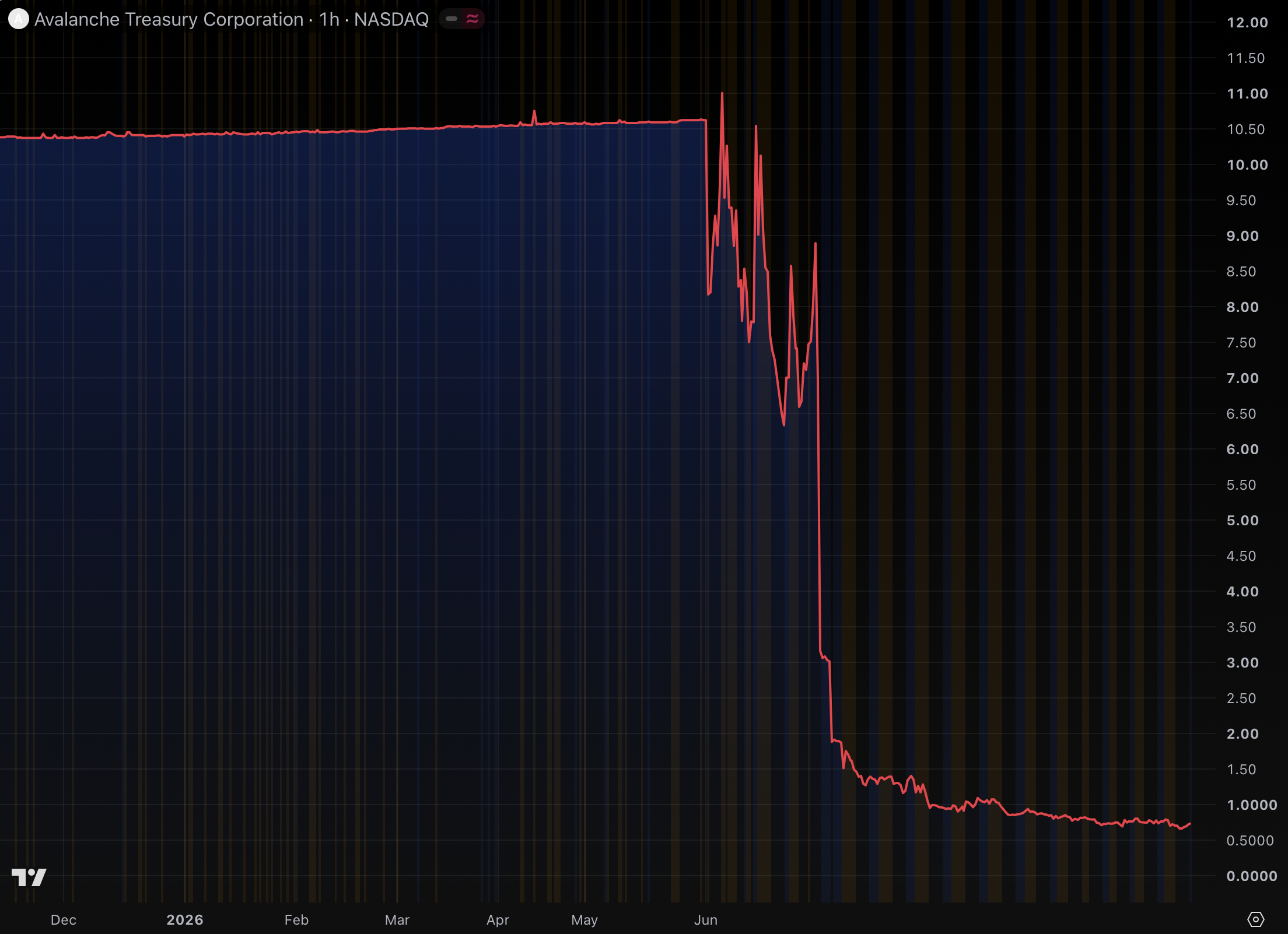
Avalanche Treasury Corp also filed a dire warning about its prospects just weeks after its once-highly-anticipated Nasdaq debut that actually resulted in a 93% sell-off in its stock price.
The company’s operating subsidiary lost more than $26 million in a single quarter, almost all of it a fair-value writedown on the AVAX it had hoarded. Indeed, AVAX has lost 47% of its value year-to-date, and nearly two-thirds of its value over the past 12 months.
The company paid roughly $265 million to acquire its coins, yet by the end of March, they were worth about $123 million, leaving the position more than half underwater.
AVAX treasury stock down 93% in one month
AVAT completed its merger with a blank-check company and filed listing documents in June. Optimism about the once-$10 blank check stock had already turned to pessimism. By June 10, the stock was pricing-in its deal finalization down 27% from the start of the month.
On June 10 and 11, investors, to their horror, read more documents about the deal filed with the SEC. Shares that had been trading above $10 at the start of the month closed at $1.85 per share on June 11.
Unfortunately, things have only gotten worse. Yesterday, shares were trading in penny stock territory below $0.73 per share.
In total, over the last month, shares have lost 93% of their value.
Worse, the company has also pledged a large share of its AVAX treasury to a lender, committing roughly 7.8 million of its 13.8 million AVAX as collateral on a loan.
Read more: China-linked TRUMP treasury stock crashes 98% after wild buyout claim
Public company going concern
In notes attached to its most recent financial statement, the company concluded that “substantial doubt about the Company’s ability to continue as a going concern is not alleviated.”
Building a publicly-traded digital asset treasury strategy has produced exactly what skeptics warned it would. Dozens of companies have declined in value since initial exuberance during a brief, mid-2025 mania.
Protos has documented the consistent, downward-sloping arc across the treasury sector.
AVAT isn’t alone in its doomed gamble on the value of AVAX.
Consider AgriFORCE Growing Systems, a struggling agritech firm that rebranded itself AVAX One last September.
It announced a roughly $550 million raise to buy more than $700 million of the same token. Anthony Scaramucci chaired its strategic advisory board, with a crowd of crypto funds behind the deal.
This company, which has undergone a name change, now carries a market value near $43 million, down 68% year to date and 93% over the past 12 months.
Got a tip? Send us an email securely via Protos Leaks. For more informed news and investigations, follow us on X, Bluesky, and Google News, or subscribe to our YouTube channel.


SpaceX went public in the largest IPO ever, and tucked inside its balance sheet are 18,712 bitcoin. Now every index fund and pension that buys the stock owns a sliver of BTC whether they meant to or not. Bulls call it a Trojan horse that could put a floor under Bitcoin. Here is what the holding actually does, and what it does not.
Summary
- SpaceX went public around June 12, 2026, in the largest IPO ever, priced at $135 a share, raising roughly $75 billion at about a $1.75 trillion valuation, with the stock spiking over 26% before sliding back below its opening price.
- The company disclosed 18,712 bitcoin, worth about $1.29 billion as of March 31, in its filing, so anyone who buys the stock gains indirect, passive exposure to Bitcoin.
- The bullish thesis is that index funds, pensions, and ETFs buying SpaceX for its aerospace and AI exposure will inherently and mechanically hold Bitcoin, creating price-insensitive demand and legitimizing BTC as a corporate treasury asset.
- The skeptical view is that the holding is a tiny fraction of a $1.75 trillion company, so the per-share Bitcoin exposure is minuscule, and that a giant risk-on IPO can drain capital from crypto in the near term rather than support it.
- The story also raises a Tesla-merger overhang that could concentrate roughly 30,000 BTC under Elon Musk, and a copycat question about whether other pre-IPO giants disclose Bitcoin to court crypto-correlated investors.
SpaceX went public around June 12, 2026, in the largest initial public offering in history, and inside the balance sheet of the most anticipated listing of the decade sits a detail that the crypto market has fixated on: the company holds 18,712 bitcoin. The offering priced at $135 a share, raised roughly $75 billion, and valued SpaceX at about $1.75 trillion, with the stock spiking more than 26% in early trading before sliding back below its opening price, a debut dramatic enough that reports described Elon Musk crossing into trillionaire territory on paper. For the broader market, the headline was the sheer scale of the raise and the arrival of a private giant on public markets. For crypto, the headline was the bitcoin.
With 18,712 BTC on its books, worth roughly $1.29 billion as of the end of March, SpaceX is now one of the larger corporate holders of the asset, and that holding has been folded, through the IPO, into a stock that thousands of funds will own. The argument that has spread across crypto social media is that this makes SpaceX a Trojan horse: a vehicle that smuggles Bitcoin exposure into the portfolios of investors who never set out to own any. That framing is catchy, and it points at something real, but it deserves to be examined rather than simply repeated, because the truth is more nuanced and more interesting than the slogan. The best version of the story is not that SpaceX suddenly controls Bitcoin’s price, but that Bitcoin has been made slightly more normal inside public-market infrastructure.
This article works through what the SpaceX bitcoin holding actually means for crypto, taking both the bullish and the skeptical cases seriously. It covers the IPO and the bitcoin inside it, the Trojan-horse thesis in its strongest form, why that thesis has genuine force, the math problem that cuts against it, the opposite argument that a giant IPO can pull capital out of crypto rather than feed it, the Tesla-merger overhang that could concentrate an enormous bitcoin position under one person, the question of whether other companies will copy the template, and a net read of what it all means. The forecasts and interpretations here are information, not advice. The goal is to let a reader walk away understanding both why the Trojan-horse idea caught fire and why the sober version of the story is more modest than the headline, because the gap between the two is where the real lesson about Bitcoin’s institutionalization lives.
The IPO and the bitcoin inside it
Start with the facts of the listing, because the scale is the context for everything else. SpaceX priced its IPO at $135 a share in a deal that raised roughly $75 billion, the largest public offering ever attempted, and valued the company at about $1.75 trillion, a figure lifted further by its earlier integration of Musk’s artificial-intelligence venture. The demand was extraordinary, with the offering reportedly several times oversubscribed and total interest running into the hundreds of billions of dollars, and the stock jumped more than a quarter in its first trading before giving much of that back and slipping below its opening price, a volatile debut that matched the hype around it. SpaceX’s business underneath the listing is real and large: 2025 revenue ran around $18.7 billion, driven heavily by Starlink, with rockets and the AI division making up the rest, though the company posted a substantial net loss for the year tied to the AI integration.
The bitcoin is the part that concerns crypto. SpaceX has held Bitcoin as a strategic reserve asset since 2021, viewing it, in Musk’s framing, as a long-term hedge, and its filing disclosed a position of 18,712 BTC with a fair value of roughly $1.29 billion as of March 31. Ahead of the listing, the company tidied up its holdings, consolidating legacy addresses into a single institutional custody arrangement, the kind of housekeeping a company does when it expects scrutiny of its balance sheet during an audit. For readers trying to understand how corporate BTC holdings work, this is the key difference between a private balance-sheet rumor and a public-market disclosure: the asset becomes visible, auditable, and part of the company’s reported financial picture.
What matters for the Trojan-horse argument is that this holding did not stay private. By going public, SpaceX wrapped its bitcoin inside a widely held stock, and the disclosure landed in the prospectus right alongside the Starlink revenue, which some observers read as a deliberate signal to bitcoin-friendly investors instead of an incidental footnote. The position is now a permanent, audited line on the balance sheet of one of the most important companies in the world, which is precisely what gives the next argument its appeal. SpaceX is not a Bitcoin treasury company in the Saylor sense; it is an operating giant with a crypto reserve attached, and that is exactly why the signal carries weight.
The Trojan-horse thesis in its strongest form
The bullish case is worth stating in its most compelling version before testing it. The argument runs like this. When a company the size of SpaceX lists on a major exchange, it becomes eligible for inclusion in the large stock indices, and inclusion in an index like a major large-cap benchmark means that every fund tracking that index must buy the stock, mechanically, regardless of any view on its components. Index funds, exchange-traded funds, pension funds, and other passive vehicles collectively command trillions of dollars and are required by their mandates to hold the constituents of the indices they track.
So once SpaceX enters the major indices, an enormous pool of capital will buy its shares not because those investors want aerospace, AI, or bitcoin, but simply because the stock is in the index. And because the stock carries 18,712 bitcoin on its balance sheet, every one of those passive buyers gains indirect exposure to Bitcoin whether they want it or not. That is the passive-buying mechanism explained in its simplest form: a mandate can create exposure without a fresh discretionary decision. The buyer thinks they are getting SpaceX, and buried inside that exposure is a tiny piece of BTC.
The thesis extends from there into a price argument and a legitimacy argument. On price, the claim is that this passive, mandate-driven buying creates a form of demand for Bitcoin that is insensitive to Bitcoin’s own price, because the funds are buying SpaceX for index reasons, not BTC reasons, and that this could function as a kind of structural floor under the asset, a layer of forced, ongoing exposure that does not sell on bad crypto news. On legitimacy, the claim is arguably more durable: by holding bitcoin as an audited treasury reserve inside a trillion-dollar public company, SpaceX validates Bitcoin as a serious corporate asset class, the same way earlier corporate treasuries did but at far greater scale and visibility. As one widely shared version of the argument put it, the bitcoin on SpaceX’s books is not a footnote but a balance-sheet argument, and every buyer of the stock gets passive Bitcoin exposure built in.
It is a genuinely clever observation, and it is not wrong. The problem is scale. A Trojan horse can be real while carrying a much smaller payload than the army imagines. The next sections separate the valid legitimacy signal from the much weaker claim that this creates a meaningful price floor.
Why the thesis has real force
Before puncturing anything, it is worth crediting what the Trojan-horse argument gets right, because parts of it are sound. The mechanical point about passive investing is accurate. Index funds really are required to hold index constituents, and the growth of passive investing means that a large share of all stock-buying is now done by vehicles that do not exercise discretion over individual holdings. If SpaceX enters the major indices, it is true that a great deal of capital will hold the stock automatically, and it is true that those holders thereby gain some exposure to the company’s bitcoin.
That exposure is real, it is ongoing, and it does not depend on anyone deciding they like Bitcoin. In that narrow sense, the Trojan horse is not a metaphor but a description: index inclusion would smuggle a measure of BTC exposure into portfolios indifferent to it. That matters because Bitcoin’s institutionalization is not only about people choosing Bitcoin directly. It is also about Bitcoin becoming part of financial products, company balance sheets, ETF structures, and public-market plumbing until investors encounter it without seeking it out.
The legitimacy argument is even stronger, and it may be the part that matters most. There is a meaningful difference between a smaller company holding bitcoin as a treasury bet and one of the most scrutinized companies on the planet carrying an audited, multibillion-dollar bitcoin position through the most high-profile IPO in years. The disclosure normalizes Bitcoin as a reserve asset at the highest tier of corporate America, and the fact that it sat in the prospectus next to the core business, instead of being downplayed, signals that SpaceX was comfortable presenting it to institutional investors. That normalization has a compounding quality: each major company that holds bitcoin and survives the scrutiny makes it easier for the next one to do the same, gradually shifting bitcoin from a speculative oddity on a balance sheet toward an accepted, if still volatile, treasury option.
For Bitcoin’s long-term institutional adoption, a trillion-dollar company carrying it through a landmark listing is a genuinely supportive data point. The Trojan-horse framing captures this real dynamic, which is why it resonated. The trouble is only that the price-floor version of the argument oversells the scale of what is happening. A signal can be important without being a demand engine.
The math problem with the thesis
Here is where the sober counterpoint enters, and it is decisive on the narrow price-floor claim. The bitcoin holding, while large in absolute terms, is tiny relative to the company that now contains it. SpaceX holds about $1.29 billion in bitcoin against a market valuation of roughly $1.75 trillion. That means the bitcoin represents well under one tenth of 1% of the company’s value.
For an investor buying SpaceX stock, the embedded bitcoin exposure per dollar invested is therefore minuscule: putting $1,000 into SpaceX shares buys, in effect, well under $1 of indirect bitcoin exposure. The passive, mandate-driven buying that the Trojan-horse thesis celebrates is real, but the slice of that buying which flows through to Bitcoin is a rounding error on the size of the position, not a meaningful new source of demand for an asset whose own market value runs well into the trillions. This matters because the price-floor claim depends on the indirect demand being large enough to move Bitcoin, and it is not. Index funds buying SpaceX are buying aerospace, satellite connectivity, and AI; the bitcoin is incidental ballast.
The dollars that reach BTC through this channel are a vanishingly small fraction of both the funds’ purchases and Bitcoin’s market capitalization. To put a real floor under Bitcoin, you would need sustained buying measured against Bitcoin’s own trillions, and the SpaceX channel simply does not supply that. The honest framing is that the Trojan horse delivers a legitimacy signal and a tiny sliver of passive exposure, not a structural price floor. Investors who bought the slogan expecting SpaceX index inclusion to meaningfully lift Bitcoin have mis-sized the effect by orders of magnitude.
The exposure is real; its impact on price is negligible. Both things are true at once, and conflating them is the central error in the bullish version of the story. That is why where BTC sits as this lands remains driven by Bitcoin’s own market structure, liquidity, macro backdrop, and flows, not by the tiny BTC line item embedded inside SpaceX stock. The IPO may matter for narrative; the chart still needs direct demand.
The other side: a giant IPO can drain crypto
There is a further argument that runs directly against the bullish read, and in the near term it may matter more than the Trojan horse. A listing of this size does not only add a sliver of bitcoin exposure to index portfolios; it also competes ferociously for investment capital, and crypto sits high on the list of assets that get sold to fund it. The SpaceX IPO was several times oversubscribed, drawing total demand reported in the hundreds of billions of dollars, and that demand had to come from somewhere. Because Bitcoin and other digital assets compete for the same risk-on dollars as high-growth equities and hot pre-IPO names, a generational listing approaching the market can pull money out of crypto as investors raise cash to chase the shares.
In the run-up to the SpaceX debut, that is exactly what some analysts observed, with crypto described as a potential first casualty of the IPO and high-beta tokens selling off as traders trimmed positions to fund their IPO allocations. The dynamic was visible in the tape. As the listing approached, Bitcoin slid toward $60,000 and high-beta tokens fell harder, with XRP and others dropping as the broader complex weakened in what looked like a rotation out of speculative crypto and into the IPO, a move made easier when one major brokerage cut its minimum account requirement for the SpaceX offering dramatically to widen retail access. In other words, the same event that the Trojan-horse thesis frames as bullish for Bitcoin acted, in the short term, as a drain on crypto, because the enormous appetite for SpaceX shares competed with crypto for the same pool of risk capital.
There is a longer-term wealth-effect counter to this, namely that the $75 billion raise unlocks an enormous amount of new wealth for early private investors, capital that tends over time to be redistributed down the risk curve into assets like high-cap cryptocurrencies, so the IPO could eventually feed crypto even as it drained it at the moment of listing. But for anyone weighing the immediate impact, the capital-competition effect is a serious and arguably larger near-term force than the trickle of indirect bitcoin exposure the Trojan horse delivers. The same IPO can be bearish for crypto today and supportive years from now, and both readings have evidence behind them. The mistake is assuming that because SpaceX owns BTC, every effect of the IPO must be bullish for BTC.
That is also why the stock’s own performance matters to crypto psychology. If an investor sees a SpaceX allocation outperform years of holding a major crypto asset, the capital-rotation argument becomes easier to understand emotionally as well as mechanically. A hot public-market listing can absorb the attention, liquidity, and risk appetite that might otherwise have gone into Bitcoin, Ethereum, or high-beta altcoins. The Trojan horse carries a sliver of BTC inside it, but the horse itself can still pull capital away from crypto.
The Tesla-merger overhang
Layered on top of the SpaceX story is a related question that could amplify everything: the possibility of a SpaceX and Tesla combination. Tesla already holds one of the larger corporate bitcoin treasuries among publicly traded companies, with a position reported at over 11,500 BTC, and Musk has at times explored the idea of combining his two largest companies. Neither company has announced a formal merger plan, so this remains speculative, but the arithmetic is striking. If SpaceX and Tesla were brought together, the combined entity would carry the sum of their bitcoin positions, roughly 18,712 plus over 11,500 BTC, which would place around 30,000 bitcoin under Musk’s control inside a single public company, one of the largest corporate bitcoin holdings in public markets.
A combined Musk bitcoin treasury of that size would sharpen both sides of the debate explored above. On the bullish side, it would deepen the legitimacy signal, concentrating a very large, audited bitcoin position inside an even more widely held and index-significant company, and it would extend the passive-exposure dynamic to an even broader base of investors. On the skeptical side, the same math problem would apply, only more so in absolute terms but still small relative to the combined company’s likely valuation, and it would introduce a concentration risk: a very large bitcoin position controlled by one individual, whose decisions about whether to hold, add to, or sell that position could move sentiment if not price. The merger is not on the table as an announced plan, and it may never happen, so it belongs in the analysis as an overhang and a scenario instead of a forecast.
But it is part of why the SpaceX listing drew such attention from crypto, because it hints at a future in which a single corporate vehicle, under a single famous owner, could hold one of the most significant bitcoin treasuries in the world. That prospect is worth watching precisely because it would magnify the dynamics this article describes instead of change them in kind. It would make the legitimacy signal louder and the concentration question sharper. It would not magically turn a corporate balance-sheet allocation into a guaranteed Bitcoin floor.
The copycat question
The final forward-looking thread is whether SpaceX has created a template that other companies will copy, which would matter far more than any single holding. The observation driving this is that SpaceX disclosed its bitcoin position prominently in its prospectus, alongside its core business, in a way some read as a deliberate pitch to bitcoin-correlated investors, the kind of allocators who might pay a slight premium for a stock that offers embedded crypto exposure. If that read is correct, then the bitcoin disclosure was partly a marketing decision, and a successful one could encourage other large private companies preparing to go public to do the same: hold some bitcoin, disclose it in the filing, and capture incremental demand from crypto-friendly investors during the listing. Some commentators speculated that other large pre-IPO technology and AI companies could adopt the template before long, disclosing bitcoin positions to court that pool of allocators.
This is the most speculative part of the story and should be treated as such, because it rests on inference about motives and on unconfirmed reports about other companies’ plans instead of on announced facts. It is entirely possible that SpaceX’s holding reflects nothing more than Musk’s long-standing personal conviction about Bitcoin, with no broader template intended, and that other companies will not follow because their leadership lacks the same view or sees no benefit. But the structural logic is real enough to watch: if disclosing a bitcoin treasury during an IPO measurably helps a company’s reception with a slice of investors, rational companies may do it, and a wave of large listings each carrying some bitcoin would, cumulatively, normalize the asset on corporate balance sheets far more than any single holding could. That cumulative legitimization, instead of the price-floor mechanics, is where the SpaceX precedent could matter most.
Whether other companies copy the template is the single most important thing to watch in the wake of this IPO. For now, it is a plausible hypothesis, not an established trend, and the honest framing keeps it in that category. The broader comparison is the corporate bitcoin-treasury meta, where companies are already being judged on whether their crypto holdings create value or financial stress. SpaceX may make the treasury idea more respectable, but Strategy shows how quickly the same theme can become fragile when market prices move against it.
What it actually means for crypto
Pulling the threads together, the SpaceX bitcoin story is real, important, and considerably more modest than its loudest framing, and holding all of that at once is the mark of understanding it. The Trojan-horse thesis is correct that index inclusion would mechanically give a vast pool of passive capital some indirect bitcoin exposure, and it is correct that a trillion-dollar company carrying audited bitcoin through a landmark IPO is a meaningful legitimacy milestone for the asset. Those points are sound and worth taking seriously, because the institutionalization of Bitcoin is a genuine, multiyear trend and SpaceX is a significant marker along it. Where the thesis overreaches is in the price-floor claim: the bitcoin is well under a tenth of 1% of the company’s value, so the demand that actually flows through to BTC via SpaceX is a rounding error against Bitcoin’s trillions, not a structural support for its price.
Set against that small positive is a real near-term negative, namely that an IPO of this magnitude competes for risk capital and can pull money out of crypto as investors fund their allocations, a dynamic that was visible in the weakness across Bitcoin and altcoins heading into the listing. The longer-term wealth-effect argument, that the raise will eventually redistribute capital down the risk curve toward crypto, cuts the other way but operates on a slower clock. The net read, then, is that the SpaceX IPO is best understood as a legitimization signal for Bitcoin instead of a demand engine, with a small structural exposure benefit, a real short-term capital-competition cost, and a more important open question about whether other companies copy the template and whether a Tesla combination concentrates an even larger position under Musk. For a crypto investor, the practical takeaway is to resist the slogan in both directions: SpaceX did not put a floor under Bitcoin, and it did not doom it either.
It made Bitcoin a little more normal as a corporate asset, took some capital out of the room on its way in, and set a precedent worth watching. That measured reading is less exciting than a Trojan horse, and far closer to the truth. It also leaves room for the other crypto angle of the IPO, where SpaceX exposure became part of the tokenized-stock race rather than only the corporate-treasury story. The IPO pulled crypto into the conversation from several directions at once: BTC on the balance sheet, capital rotation in markets, and tokenized equity products trying to package the shares on-chain.
Frequently asked questions
How much bitcoin does SpaceX hold?
SpaceX disclosed a holding of 18,712 bitcoin in its IPO filing, with a fair value of roughly $1.29 billion as of March 31, 2026. The company has held Bitcoin as a strategic reserve since 2021, viewing it, in Elon Musk’s framing, as a long-term hedge. Ahead of the listing, it consolidated its holdings into a single institutional custody arrangement, the kind of housekeeping done before balance-sheet scrutiny. The position makes SpaceX one of the larger known corporate holders of Bitcoin, and because the company is now public, that holding sits inside a widely held stock, which is the basis for the Trojan-horse argument that buyers of the shares gain indirect bitcoin exposure.
What is the SpaceX bitcoin Trojan-horse thesis?
It is the argument that because SpaceX holds bitcoin and is now a public company eligible for major stock indices, the index funds, pensions, and ETFs that must buy the stock will gain indirect, passive exposure to Bitcoin whether they want it or not. The bullish version claims this creates price-insensitive demand that could put a floor under Bitcoin and that it legitimizes BTC as a corporate treasury asset. The mechanical and legitimacy parts are sound: passive funds really would hold some bitcoin exposure through the stock, and a trillion-dollar company carrying audited bitcoin is a real validation. The price-floor part is where it overreaches, because the holding is too small relative to the company to move Bitcoin meaningfully.
Will the SpaceX IPO push Bitcoin’s price up?
Probably not in any meaningful, direct way, despite the Trojan-horse framing. The bitcoin holding is well under one tenth of 1% of SpaceX’s roughly $1.75 trillion valuation, so the demand that flows through to Bitcoin when funds buy the stock is a rounding error against Bitcoin’s multi-trillion-dollar market. In the near term, a giant IPO can actually weigh on crypto, because it competes for the same risk-on capital and investors sell crypto to fund share purchases, a dynamic visible in the weakness across Bitcoin and altcoins before the listing. The more durable effect is legitimization of Bitcoin as a corporate asset, which supports long-term adoption, instead of a direct price catalyst.
Could the SpaceX IPO actually hurt crypto?
In the short term, yes, and this is the underappreciated side of the story. An IPO of this size, several times oversubscribed with demand in the hundreds of billions, competes fiercely for investment capital, and crypto sits high on the list of assets sold to fund such allocations because it shares investors with high-beta tech and pre-IPO speculation. Heading into the SpaceX debut, Bitcoin slid and high-beta tokens like XRP fell harder, in what analysts described as crypto being a potential first casualty of the IPO drain. Over the longer term, the wealth unlocked by the raise could redistribute toward crypto, but the immediate capital-competition effect is a real headwind that runs opposite to the bullish Trojan-horse narrative.
What does a possible Tesla merger have to do with it?
Tesla already holds one of the larger corporate bitcoin treasuries, reported at over 11,500 BTC, and Musk has at times explored combining SpaceX and Tesla, though neither company has announced a formal plan. If they merged, the combined entity would hold roughly 30,000 bitcoin, around 18,712 from SpaceX plus over 11,500 from Tesla, placing one of the largest corporate bitcoin positions in public markets under Musk’s control. That would deepen the legitimacy signal and broaden the passive-exposure dynamic, while also concentrating a very large bitcoin holding under one individual. It remains a speculative overhang instead of an announced event, but it is part of why the SpaceX listing drew so much attention from the crypto market.
Will other companies copy SpaceX and disclose bitcoin?
It is a real possibility but unconfirmed. SpaceX disclosed its bitcoin prominently in its prospectus, which some read as a deliberate pitch to bitcoin-correlated investors who might favor a stock with embedded crypto exposure. If that helped its reception, other large pre-IPO companies, including major technology and AI firms, could adopt the same template, disclosing bitcoin positions to court those allocators. Some commentators have speculated exactly that. If it became a trend, a series of large listings each carrying bitcoin would normalize the asset on corporate balance sheets far more than any single holding. For now it is a plausible hypothesis based on inference instead of announced plans, and whether companies actually copy it is the most important thing to watch from here.
This article is information, not financial or investment advice. Figures on SpaceX’s bitcoin holding, valuation, IPO terms, and related companies reflect reporting available as of June 30, 2026, are point-in-time, and can change. References to a possible Tesla merger and to other companies disclosing bitcoin are speculative and unconfirmed. Cryptocurrency and equities are volatile and you can lose money. Do your own research and consult a qualified financial professional before making any decision.
Crypto World
Micron (MU) Stock Surges 232% This Quarter: Wall Street Analysts Reveal What’s Driving the Rally

Key Takeaways
- Micron’s stock has skyrocketed 232% during the current quarter, more than quadrupling year-to-date in 2026.
- Premarket trading on Tuesday saw shares hovering between $1,141 and $1,145, just shy of recent peak levels.
- The company has secured long-term supply agreements with minimum pricing that may account for approximately 40% of total revenue, with plans to expand this percentage.
- UBS projects gross profit margins will stabilize between 70%-75%, significantly exceeding the previous 2018 record of around 62%.
- Industry analyst Gil Luria suggests Micron’s valuation could potentially quadruple if artificial intelligence demand continues through the end of the decade.
Shares of Micron Technology showed minimal movement in early Tuesday trading, dipping approximately 0.1% to $1,144.00 during premarket hours. This marginal shift comes after an extraordinary rally that has captivated semiconductor investors throughout the year.
Data from Dow Jones Market Data reveals the stock has posted a remarkable 232% gain during the current quarter. Since the beginning of 2026, shares have increased more than fourfold.
Such dramatic appreciation has attracted significant attention from retail investors while simultaneously introducing increased volatility. Market participants are now closely monitoring indicators that might signal a potential correction.
The memory semiconductor industry operates in cyclical patterns of expansion and contraction. This week brought announcements from South Korean chip manufacturers regarding additional production capacity, raising concerns among some traders about potential future oversupply conditions.
However, Micron has implemented strategies designed to buffer against these traditional market fluctuations. The corporation has been establishing multi-year supply agreements that guarantee baseline pricing structures.
Profit Margins and Artificial Intelligence Dynamics
These supply contracts currently account for approximately 40% of Micron’s total revenue stream, with corporate leadership targeting further expansion of this coverage. UBS analyst Timothy Arcuri interprets this strategy as an indication that Micron anticipates maintaining gross profit margins within the 70%-75% range.
While this represents a decline from the exceptional 85% margin achieved in the most recent quarter, it substantially surpasses the approximately 62% peak the company reached during 2018. Arcuri maintains a Buy rating on the stock with a price target of $1,625.
The consensus Wall Street price target currently stands at $1,543, according to FactSet data. Within the past week, both Cantor Fitzgerald and Barclays have established price objectives as high as $2,000.
The bullish investment thesis centers heavily on artificial intelligence applications. Micron’s high-bandwidth memory products are integral components in Nvidia’s AI infrastructure, where demand has remained robust.
Competition from Chinese manufacturers has yet to materially impact this narrative. CXMT, a Chinese memory chip producer, disclosed in its initial public offering documentation that its production volume falls short of domestic requirements, constraining its capacity to serve clients such as Apple.
D.A. Davidson analyst Gil Luria believes the market is fundamentally undervaluing the AI memory sector. In a CNBC interview, he argued that Micron and Nvidia are trading as though AI capital expenditure is approaching its zenith, while equipment and networking stocks reflect pricing consistent with sustained growth extending to 2030.
Luria suggested this valuation discrepancy could indicate Micron deserves a market value approximately four times its current level if AI infrastructure investment maintains its trajectory. He emphasized that Micron trades at merely eight to nine times earnings, contrasting sharply with the 40 to 50 times multiples typical of many CPU-focused semiconductor companies.
Technical Analysis
Micron’s current price positioning places it significantly above all major moving averages, indicating the long-term trend remains positive. The stock trades approximately 9.8% above its 20-day moving average of $1,044.12 and an impressive 166% above its 200-day moving average of $430.86.
This substantial gap has prompted traders to anticipate a potential near-term consolidation. The MACD technical indicator has crossed below its signal line, suggesting momentum may be weakening despite the continuation of the overall upward trajectory.
The 52-week peak reached $1,255. Technical support levels are identified near the 20-day moving average, with April’s previous low serving as the subsequent reference point should selling pressure intensify.
Micron also demonstrates strong performance across Benzinga Edge’s momentum, quality, and growth metrics. Its value rating is comparatively low, reflecting the premium valuation investors currently assign to the shares.
The semiconductor manufacturer holds significant positions in multiple exchange-traded funds, including the Invesco S&P 500 Momentum ETF, the Invesco PHLX Semiconductor ETF, and the Global X DAX Germany ETF. Micron Technology shares were last quoted down 0.11% at $1,144.00 during Tuesday’s premarket trading session.

Crypto World
Crypto Trading Prop Firm vs. Traditional Prop Firm: What has Changed for Traders in 2026
Proprietary trading grew up around forex and futures. The funded-account model that most traders know today – a one-time evaluation fee, a profit target, strict drawdown limits, and a majority share of profits – was originally built for currency pairs, indices, and futures contracts traded with familiar market structures. Crypto arrived later, and for years, the majority of firms treated it as an extra product rather than a core market.
But by 2026, this has changed. Traders are no longer choosing between two similar prop firms with slightly different crypto offerings. They are choosing between distinct models. One is the traditional forex-first prop firm that added crypto contracts to its existing contracts. The other is the crypto-native prop firm, which is built for digital assets from the get-go.
This distinction matters because the underlying infrastructure affects almost everything: execution, pair coverage, leverage, weekend trading, payouts, and strategy fit.
Headline profit splits also matter, but they are far from being the whole story. Across more than 300,000 accounts tracked by FPFX Tech, roughly 14% of traders pass an evaluation, and only about 7% ever reach a payout. With odds like this, traders need to understand the structure behind the offer before paying for a challenge.

Traditional Prop Firms vs. Crypto-Native Prop Firms
The main difference between traditional prop firms and crypto-native prop firms is what each model was built to serve.
Traditional firms such as FTMO and The5ers grew out of forex, indices, and futures-style trading. That background gives them real advantages: long operating histories, clear rulebooks, established platforms, and proven payout records.
For example, FTMO has reported more than $500 million in cumulative trader payouts across more than 140 countries, while The5ers is widely seen as a reputable forex-first operator. For traders who want one funded account covering forex, indices, and limited crypto exposure, this model remains rather attractive.
The trade-off, however, is that crypto remains secondary, at least in most cases. On traditional platforms, digital assets are often offered as CFDs rather than positions routed to live exchange order books. Pricing comes through the firm’s platform and liquidity setup, which is not derived directly from venues such as Binance or Bybit, for example. Pair coverage also tends to be more limited, usually focused on Bitcoin, Ethereum, and some other large-cap altcoins. Leverage is usually conservative – often around 1:2 or 1:3, and some accounts require these positions to be closed before the weekend, despite the fact that crypto operates 24/7.
Crypto-native firms take the exact opposite approach. They are built around digital assets from the start. HyroTrader is one of the clearer examples. It offers live exchange execution through Bybit with access to more than 700 perpetual pairs, while its CLEO platform provides over 500 pairs, Binance-powered market data, API access, and leverage of up to 1:100. This creates a trading environment that’s closer to how crypto markets actually operate: continuous trading, broader altcoin access, exchange-based pricing, and stablecoin payouts in USDT or USDC.
The crypto-native model is better suited to those traders who specialize in digital assets, especially scalpers, altocin traders, weekend traders, and algorithmic strategies that need API access and deep pair coverage.
Of course, there are some limitations to this model as well. HyroTrader, for instance, is crypto-only. It pays in stablecoins rather than fiat, and applies stricter rules such as per-trade risk caps and trailing daily drawdown by default.
The choice is therefore not only about which model is better. Traditional firms suit traders who value reputation, regulation, and access to a range of assets. Crypto-native firms are well-suited to traders who need tailored infrastructure for digital assets.
Here’s a more concise breakdown of the inherent qualities of both models for crypto trading.
Traditional prop firms
- Execution is usually CFD-based
- Pricing may differ from exchange markets
- Short-term traders may be more affected because of pricing models
- Crypto coverage is narrower
- A limited toolkit restricts the use of specific crypto-focused strategies.
- Payouts rely on fiat rails.
- Rules reflect forex-first infrastructure.
- MT5 and cTrader remain major strengths.
Crypto-native prop firms
- Execution is exchange-based.
- Asset coverage is much broader.
- Altcoin strategies are much easier to run.
- Payouts usually settle in stablecoins.
- Fast payouts are becoming the standard.
- Rules are often designed around 24/7 crypto trading.
- Platforms are built for crypto-oriented workflows.
The Bottom Line for 2026
The difference between traditional and crypto-native prop firms matters a lot more in 2026 than it did two years ago. The old model treated crypto as an add-on to forex infrastructure. The new model treats it as its own market, with its own execution, leverage norms, payout rails, and trading behavior.
The right choice now is not just about which category sounds better – it’s about how you trade. If your strategy depends on forex, indices, and a few of the major cryptocurrencies, the traditional model might be a good fit. If your edge, however, depends on live exchange execution, deep altcoin coverage, API access, weekend trading, and more – a crypto trading prop firm built specifically for digital assets is likely the stronger match.
Disclaimer: The above article is sponsored content; it’s written by a third party. CryptoPotato doesn’t endorse or assume responsibility for the content, advertising, products, quality, accuracy, or other materials on this page. Nothing in it should be construed as financial advice. Readers are strongly advised to verify the information independently and carefully before engaging with any company or project mentioned and to do their own research. Investing in cryptocurrencies carries a risk of capital loss, and readers are also advised to consult a professional before making any decisions that may or may not be based on the above-sponsored content.
Readers are also advised to read CryptoPotato’s full disclaimer.
The post Crypto Trading Prop Firm vs. Traditional Prop Firm: What has Changed for Traders in 2026 appeared first on CryptoPotato.

Europe’s shift to the Markets in Crypto-Assets Regulation (MiCA) is creating fresh friction for international exchanges, with ESMA stressing that EU crypto clients must be handled through MiCA-authorized entities after the bloc’s July 1 transitional deadline. The guidance arrives as questions grow over how global platforms can keep servicing customers across the EU and EEA while meeting the licensing rules.
According to ESMA, crypto asset service providers (CASPs) must hold MiCA authorization to serve clients across the EU and European Economic Area. ESMA also clarified that MiCA protections apply only to the specific legal entity that is licensed in the EU—not to any other group entity located outside the bloc.
Key takeaways
- ESMA says EU/EEA clients should be served through a MiCA-authorized legal entity after July 1, rather than through non-EU arms.
- Reverse solicitation under MiCA is narrow: non-EU firms can only serve EU clients when the client initiates the relationship without any solicitation or promotion.
- ESMA points to activities like websites, apps, social media, online ads, sponsorships, and influencer campaigns as evidence of “solicitation.”
- Legal experts argue that third-country licensing (including Abu Dhabi) does not substitute for MiCA authorization for EU clients.
ESMA’s post-deadline message to the industry
ESMA’s spokesperson told Cointelegraph that CASPs must be MiCA-authorized to serve clients throughout the EU and EEA. ESMA further emphasized that “EU clients should be serviced through a MiCA-authorized entity,” adding that the protections under MiCA apply only to the licensed EU legal entity.
The clarification matters because it underlines a practical compliance distinction: an exchange can be active across multiple jurisdictions, but EU customers must ultimately connect to the regulatory perimeter of the MiCA-authorized entity if the business is operating in the EU market.
The guidance also comes amid broader uncertainty over how global exchanges will structure operations and customer servicing when licensing deadlines arrive. For traders and users, the concern is not just whether services continue, but whether the regulatory framework that applies in the EU actually attaches to the provider interacting with them.
What MiCA allows—and what it blocks for non-EU firms
ESMA said CASPs based outside the EU cannot provide services to local customers unless they qualify under MiCA’s “narrow exemption” for reverse solicitation, set out in Article 61.
Article 61 permits a non-EU crypto company to serve an EU client only when the client initiates the relationship entirely on their own—without any solicitation, marketing, or promotion by the firm. ESMA highlighted that the exemption does not apply if the third-country company solicits clients or prospective clients in the Union.
In ESMA’s explanation to Cointelegraph, the regulator pointed to language indicating that where a third-country company solicits clients in the EU, it should not be treated as a service provided solely at the client’s exclusive initiative.
ESMA also referenced its official solicitation guidelines, which enumerate examples of conduct that can amount to solicitation targeting EU users. The regulator’s list includes operating websites and mobile apps, using social media, running online advertising, and engaging in sponsorships and influencer campaigns aimed at EU audiences.
For exchanges with established marketing footprints in Europe, that framing raises the compliance stakes: ongoing user acquisition and brand presence—especially through digital channels—may be difficult to square with a “reverse solicitation only” business model.
Binance transition questions and the Abu Dhabi servicing debate
The ESMA clarification followed Binance’s communications to users about adjusting services in certain EU countries as part of its MiCA transition. Binance told users in countries including Poland, France, Spain, and Italy that changes were underway, while stating that users in other jurisdictions would not need to take action if the exchange did not operate through a local registered entity in their location—saying “no action is required at this time” in those cases.
In parallel, screenshots of Binance customer support messages circulated on social media appeared to suggest that some EU users could be serviced through Binance’s Abu Dhabi Global Market (ADGM) entity. That possibility triggered legal pushback.
Yuriy Brisov, a lawyer at Digital & Analogue Partners, told Cointelegraph that an Abu Dhabi license has no effect under MiCA for the purpose of serving EU clients, because MiCA treats Abu Dhabi as a third country—similar to other non-EU jurisdictions such as the United States or Singapore.
Brisov argued that if Binance claims certain EU users are being serviced through ADGM, then under MiCA terms this would still mean a non-EU company is serving those users. He added that the reverse solicitation exemption was intended for isolated situations where an EU customer independently approaches a non-EU firm, rather than for maintaining an existing customer base built through years of marketing and outreach.
Binance did not respond to repeated requests from Cointelegraph seeking clarification on whether any EU users would be serviced through its ADGM entity after the MiCA deadline.
Why this distinction may shape compliance—and user experience—across the EU
MiCA’s structure, as reflected in ESMA’s guidance, places the burden on the legal entity doing the serving. The result is that corporate group complexity may not help exchanges avoid licensing requirements: a non-EU entity cannot rely on the existence of a separate regulated license elsewhere to automatically bring EU services under MiCA.
For investors and users, this matters in concrete ways. The question is not only whether an exchange remains accessible, but which entity is actually providing the service after the deadline—because that determines whether MiCA’s consumer and regulatory protections attach.
Looking ahead, the most important variable will be how exchanges implement their transition in practice. ESMA’s emphasis on “solicitation” through everyday digital operations suggests that firms may need to take careful steps to ensure their EU-facing activities do not undermine any attempt to rely on reverse solicitation. Meanwhile, regulators and courts are likely to treat “entity-level” licensing compliance as a central requirement rather than a technicality.
Readers should watch for more direct confirmations from exchanges about which specific MiCA-authorized entities will handle EU/EEA users after July 1, and whether regulators pursue cases where marketing activity and account servicing appear inconsistent with the reverse solicitation framework.

Solana Company has entered a formal partnership aimed at building the blockchain and crypto infrastructure for Alatau City, Kazakhstan’s planned digital-first megacity. The Nasdaq-listed firm signed a memorandum of understanding (MOU) during the Alatau City Roadshow in Shenzhen and Hong Kong in June, according to the report that said the event yielded 30 cooperation agreements with a combined investment potential of more than $6 billion.
Solana Company chairman and CEO Joseph Chee said the parties plan to deepen their relationship and expand Solana’s ecosystem presence across the region. The agreement also adds to Kazakhstan’s growing exposure to Solana-related initiatives, including a Solana Economic Zone launched in Astana last year in cooperation with the Solana Foundation.
Key takeaways
- Solana Company signed an MOU to advise on Alatau City’s blockchain and crypto infrastructure during the June roadshow in Shenzhen and Hong Kong.
- The collaboration is framed around institutional adoption, infrastructure buildout, and Solana-aligned digital asset treasury capabilities.
- Kazakhstan’s earlier Solana Economic Zone in Astana and KASE’s Solana ETF launch help position the country as a recurring focus for Solana-related products and pilots.
- Alatau City remains in early planning, while reported constitutional and on-the-ground infrastructure hurdles raise questions about how quickly the crypto-focused vision can become real.
What Solana Company’s MOU covers
The MOU outlines four areas of cooperation between Solana Company and Alatau City’s authorities: digital asset treasury, blockchain infrastructure, accelerating institutional blockchain adoption, and platform development.
In addition, Alisher Abdykadyrov, CEO of the Alatau City Authority, said Solana Company will take part in creating an Alatau Crypto Cluster—a dedicated pilot zone and special economic area within the future city where crypto is intended to be used for everyday transactions.
Kazakhstan’s expanding Solana footprint
This is not Solana’s first attempt to formalize a presence in Kazakhstan. Last year, Kazakhstan reportedly launched Central Asia’s first Solana Economic Zone in Astana with the Solana Foundation. More recently, the Kazakhstan Stock Exchange (KASE) launched what was described as its first Solana ETF, providing a regulated channel for investors to gain exposure to Solana (SOL) through one of the region’s major exchanges.
Separately, the Solana Foundation also signed an MOU connected to Alatau City—this time specifically to develop blockchain capabilities—during the China roadshow. Taken together, the Solana-linked agreements suggest a multi-layer strategy: create policy and pilot environments, support infrastructure development, and wrap it in investment products that meet local regulatory expectations.
Why Alatau City matters to crypto markets
Megacity pilots have often been positioned as “real-world” testing grounds for blockchain infrastructure—especially where digital identity, payments, and regulated tokenization could be integrated into public services. In Alatau City’s case, the project is being marketed as a comprehensive smart-city build, including AI, digital identity, and blockchain technology from the outset, as noted by the Alatau City Authority during the Solana Summit Kazakhstan 2026, where a deputy CEO discussed the digital-economy concept.
For investors and builders, the question is less about whether a city plan sounds futuristic and more about whether it produces measurable adoption: working infrastructure, enforceable rules for crypto usage, and a path from pilots to scale. The emphasis on a crypto cluster and institutional adoption is particularly relevant because institutional participation tends to require clearer custody, compliance frameworks, and standards for how on-chain assets interact with the traditional financial system.
The project faces regulatory and practical constraints
While Alatau City is still largely in the early development and planning stage, multiple reports point to hurdles that could slow a crypto-forward rollout. In March, The Diplomat reported that Kazakhstan’s National Bank and the Financial Monitoring Agency had raised concerns about constitutional changes needed to support a crypto-based economy.
Other independent coverage has also suggested that day-to-day realities in the area may be lagging behind the megacity vision. Reports indicated residents were dealing with shortages including gas, water, electricity, and internet connectivity, implying the current state of infrastructure may be far from the “fully integrated” smart-city picture.
Cointelegraph reported reaching out to Alatau City for comment, but the underlying uncertainty remains: the next steps will likely depend on regulatory progress, infrastructure buildout, and how the crypto cluster is structured in practice.
Investors and builders watching this story should monitor how the MOU translates into concrete deliverables—such as the rollout timeline for the crypto cluster, regulatory outcomes tied to constitutional or compliance requirements, and whether Kazakhstan’s existing Solana pilots (including the economic zone and KASE ETF access) deepen into broader institutional infrastructure rather than staying limited to announcements.


On Pi2Day, Pi Network stopped talking about mobile mining and started talking about infrastructure, launching tools to sell its compute, identity, and verification to the outside world. It is a real strategic pivot toward the AI era. Whether it fixes Pi’s actual problem, a token down 96% with no demand, is the harder question.
Summary
- On June 28, 2026, Pi Network used its annual Pi2Day event to launch three products, SoloHost, Pi Sign-in, and PiVerify, reframing the project from a mobile-mining app into infrastructure for compute, identity, and AI.
- SoloHost turns Pi Desktop into a platform for local, privacy-first AI apps and, in time, distributed computing across Pi’s hundreds of thousands of user-run nodes, with node operators paid in Pi.
- Pi Sign-in offers a “sign in with Pi” identity login for third-party apps, and PiVerify opens Pi’s human-verification system, which has checked over 18 million users, to outside businesses that pay in Pi.
- The pivot is a credible attempt to monetize Pi’s genuine assets, a large verified user base and a node network, by targeting real demand for private AI, decentralized compute, and trusted digital identity.
- The harder problem is that none of it directly addresses Pi’s core issue: a token down roughly 96% from its peak, weighed down by daily unlocks and migration supply, with no tier-one exchange listing, and the price fell after the announcement.
On June 28, 2026, Pi Network used its annual Pi2Day celebration to make a statement about what it wants to become, and for once the statement was not about mining. The project that grew famous as a mobile app letting tens of millions of people tap a button each day to earn tokens launched three products, SoloHost, Pi Sign-in, and PiVerify, and framed them as a deliberate pivot: from a mining-centric community toward an infrastructure provider for the artificial-intelligence era, offering compute, identity, and verification services to the outside world. The pitch was explicit. Rather than relying only on growth inside its own walled ecosystem, Pi would begin selling its genuine assets, a verified user base of more than 18 million people, a network of hundreds of thousands of user-run nodes, and a hybrid human-verification system, to external developers and businesses.
It was, by the standards of a project often dismissed as a mobile mining curiosity, a substantive strategic statement, and several observers called it the most concrete attempt yet to give Pi real utility beyond its internal apps. The reception was telling, and it frames the question this article examines. The new products were widely covered and broadly seen as more serious than Pi’s usual announcements, yet the token’s price fell after the news, extending a long decline, and the community split between those who welcomed a focus on real infrastructure and those frustrated that, once again, there was no major price catalyst and no tier-one exchange listing. That split is the heart of the matter.
This piece works through what Pi actually announced and what each product does, the logic behind the pivot and why it could matter, the harder reasons it may not move the needle, the community’s divided reaction, the identity angle that may be Pi’s most distinctive asset, and what would have to happen for the pivot to become real. The analysis is information, not advice. The honest framing throughout is that Pi has made a genuine strategic turn toward a credible thesis, and that a strategic turn is not the same as a solution to the supply-and-demand problem that has defined the token’s brutal 2026.
What Pi actually launched
Begin with the products, because the substance matters more than the framing. The headline release is SoloHost, an open, permissionless framework built into Pi Desktop that lets developers build and list applications which users run locally on their own computers, rather than on remote servers. Its emphasis is privacy-focused local AI: the flagship example shipped alongside it, an open-source AI agent, runs and stores its data entirely on the user’s own device, so a person can use AI assistance while keeping their data off third-party servers. SoloHost effectively turns a Pioneer’s computer into their own server, accessible from their phone through the Pi Browser, which lowers the technical barrier to running self-hosted software.
Looking further ahead, SoloHost is positioned to support distributed computing: the network plans to let its node operators contribute computing power to AI tasks, turning the hundreds of thousands of user-run Pi nodes into a practical computing layer for AI workloads, with participating nodes compensated in Pi by the third-party clients that use them. That last detail matters, because it is a direct attempt to create external demand for the token. The other two products target identity and authentication. Pi Sign-in is an authentication service that lets people log into supported third-party websites and apps using their existing Pi account, much like the familiar option to sign in with a major technology provider’s account.
It gives outside developers access to Pi’s large, verified user base while offering users a password-free login, and it extends Pi’s reach beyond its own browser into the wider web. PiVerify is arguably the most strategically interesting of the three: it opens Pi’s identity-verification system to external businesses, letting them use Pi’s know-your-customer and human-verification infrastructure, with those businesses paying in Pi. This is built on a verification base of real scale, a hybrid system combining automated and human checks that has reportedly verified over 18 million users across more than 200 countries and regions. Taken together, the three products share a single thesis: compute through SoloHost and the node network, identity through PiVerify and Pi Sign-in, and privacy-preserving AI running through all of it.
Each is designed to let outside parties use Pi’s existing resources and, in several cases, to pay for that use in Pi. The substance is real, and it is a meaningful departure from the mobile-mining identity that has defined the project. For readers who need the older model first, Pi’s mining and consensus basics explain why the daily tap was never computational mining in the Bitcoin sense. Pi2Day’s message was that the project now wants the conversation to move from how people earned PI to what the network can sell.
The logic of the pivot
The strategy behind these launches is more coherent than Pi’s critics often allow, and it rests on a clear-eyed assessment of what Pi actually has. After years of operation, Pi’s genuine assets are not a sophisticated technology stack or a thriving decentralized-finance ecosystem; they are scale and identity. The project has tens of millions of registered users, more than 18 million of them verified through identity checks, and a network of hundreds of thousands of nodes run by ordinary people on their own computers. Those are unusual assets.
Few crypto projects have a verified human user base of that size, and few have a distributed network of that many participant-operated nodes. The pivot is an attempt to monetize precisely those assets by turning them into services the outside world might actually pay for: the node network becomes a compute layer, the verified user base becomes an identity and authentication resource, and the whole thing is pointed at the demand wave around artificial intelligence. The timing aligns with real trends, which is what gives the thesis its credibility. Three of the most sought-after capabilities in technology right now are privacy-focused local AI, in which computation happens on a user’s device rather than in a corporate cloud; decentralized compute, in which distributed networks provide processing power outside the big data centers; and trusted digital identity, which has become acutely valuable as AI-generated content and bots make it harder to know whether an online actor is human.
Pi’s three releases map directly onto those trends: SoloHost addresses local AI and decentralized compute, while PiVerify and Pi Sign-in address trusted identity. The deeper narrative Pi has leaned into is “human infrastructure for AI,” the idea that its validator network, which has processed enormous volumes of human-verification tasks, makes it a provider of proof-of-human services in an age when distinguishing people from machines is increasingly difficult and increasingly valuable. The founders made this case publicly at a major industry conference, signaling that the pivot is a considered repositioning instead of a one-off product drop. As a strategy, monetizing real scale against genuine demand trends is a reasonable plan, and a more credible one than waiting for an internal app ecosystem to spontaneously produce value.
Why it could matter
Give the bull case its full weight, because parts of it are sound. The first point is that Pi is, for the first time, attempting to create external demand for the token instead of relying solely on internal ecosystem growth. The mechanisms are concrete: businesses using PiVerify pay in Pi, third-party clients using node compute through SoloHost pay node operators in Pi, and external developers tapping Pi Sign-in bring their users into contact with the network. If any of these gains real traction, it would represent something Pi has never had, namely outside parties paying to use Pi’s resources, which is a far healthier source of token demand than speculation or mining rewards.
Genuine utility demand, money flowing in from external use, is exactly what a token needs to escape a purely speculative valuation, and the pivot is at least pointed at creating it. The second point is that Pi’s scale is real and hard to replicate. A verified user base in the tens of millions and a node network in the hundreds of thousands are assets that most projects pursuing identity or decentralized compute would envy, and if Pi can convert even a fraction of that scale into paying external usage, the numbers could be meaningful. The third point is that the trends Pi is targeting are not hype cycles likely to fade quickly; privacy-preserving AI, decentralized compute, and trusted identity are durable, structural demands that are growing as AI adoption accelerates, so Pi is aiming at expanding instead of shrinking markets.
The fourth point is signaling: the launch represents Pi’s most serious attempt yet to position its existing resources for real external use, and a project that ships substantive infrastructure and pitches it at conferences is behaving more like a builder than a promotional scheme, which has value for credibility even before adoption arrives. None of this guarantees success, but it confirms that the pivot is a real strategy aimed at real demand using real assets, which is more than the project’s harshest critics concede. The bull case is not empty. The key is that the bull case depends on usage showing up outside Pi’s own community, not simply on another announcement cycle.
That is also why the SoloHost compute model matters beyond Pi itself. In crypto terms, Pi is trying to move closer to a DePIN-style thesis, where users contribute hardware resources and receive token incentives when external demand pays for those resources. If Pi can turn its node network into a usable compute market, the token gains a clearer reason to circulate. If it cannot, SoloHost remains a credible feature without becoming a meaningful demand engine.
Why it might not move the needle
Now the hard part, because the bull case runs into a problem the new products do not directly solve. Pi’s central issue is not a lack of strategy; it is a brutal supply-and-demand imbalance that the pivot does not address head-on. The token trades near $0.12, down roughly 96% from its peak near $3 in early 2025, weighed down by a structural overhang: large daily unlocks add millions of new tokens to the sellable supply, and the ongoing migration of users from the app to the mainnet steadily converts previously locked balances into liquid, sellable tokens, all against demand that has so far been thin and unproven. On top of that, Pi still lacks a listing on a top-tier exchange, which limits the buying power and liquidity available to absorb the supply.
The new products, however credible as a long-term strategy, do nothing immediate about the daily unlocks, the migration overhang, or the absence of a major listing, which are the forces actually pressing on the price. That is why the supply overhang in detail matters more for the chart than the branding of the pivot. The timing problem compounds this. SoloHost, Pi Sign-in, and PiVerify are early, with the flagship compute framework in beta and the distributed-computing vision still ahead, so any external demand they generate will build slowly, if it builds at all, while the supply pressure is immediate and continuous.
Infrastructure adoption is a multiyear process measured in developers onboarded and businesses signed, not a catalyst that lifts a price in weeks, and the gap between a strategy being announced and that strategy producing measurable token demand can be very long. The market reflected exactly this skepticism: the price fell after the Pi2Day announcement instead of rising, because traders recognized that a credible long-term plan does not change the near-term arithmetic of supply exceeding demand. The sober reading is that the pivot, even if it eventually succeeds, is unlikely to reverse the token’s trajectory soon, because the thing weighing on Pi is a supply overhang that infrastructure announcements do not lift. A good strategy and a falling price can coexist for a long time when the supply side is the problem, and for Pi, the supply side is the problem.
The community split
The divided reaction to Pi2Day captures the project’s central tension, and it is worth understanding because it reflects two legitimate but incompatible expectations. On one side are community members who welcomed the announcements as exactly the kind of substantive, building-focused progress Pi needs, evidence that the team is constructing real infrastructure and pursuing genuine utility instead of chasing speculative attention. To this group, the pivot toward compute, identity, and AI is encouraging precisely because it is unglamorous and long-term, the unflashy work of turning a large community into a useful network. They read SoloHost and PiVerify as signs that Pi is maturing into something with a reason to exist beyond mining rewards, and they value that even though it does not immediately move the price.
On the other side are community members frustrated by the same announcement, for the same reason it pleased the first group: it shipped services instead of a price catalyst, and in particular it did not bring the tier-one exchange listing that much of the community has long anticipated. The days before Pi2Day were thick with speculation, including rumors of a major listing, and when the actual announcement delivered infrastructure instead, the disappointment showed up immediately in the price. This group experiences Pi’s slow, conditions-based pace as a recurring letdown, a pattern of significant events that produce features but not the liquidity and demand that would let holders realize value. The split between these camps is not really a disagreement about facts; it is a disagreement about what Pi should be optimizing for, long-term infrastructure or near-term price and liquidity, and Pi2Day satisfied the first while frustrating the second.
That tension, between the builders and the price-watchers, is structural to a project that has an enormous community sitting on tokens it mostly cannot yet sell at a price it likes, and it will persist until the pivot either produces real demand or it does not. The same tension appears in smaller ecosystem updates, including tools meant to improve app visibility and activity inside Pi’s own directory. Builders can see those as pieces of a broader utility stack, while traders see them as too indirect to absorb the supply hitting the market. Both reactions make sense because they are measuring different things.
The identity angle
Of everything Pi announced, the identity thesis may be its most distinctive and defensible asset, and it deserves a closer look because it is where the pivot is strongest. The problem PiVerify and Pi Sign-in address, verifying that an online actor is a real, unique human, has become one of the most pressing in technology as AI systems generate convincing text, images, and behavior at scale, making bots and fake accounts harder to detect. A network that can reliably attest to human identity has genuine value in that environment, and Pi has built exactly that: a hybrid automated-and-human verification system that has checked over 18 million users across more than 200 countries, producing a large base of verified human identities. Opening that system to external businesses through PiVerify, and offering identity-based login through Pi Sign-in, points Pi at a real and growing market, proof-of-human services for an age of AI bots, where its scale is a genuine competitive asset instead of a liability.
The honest caveats keep this from being a slam dunk. Pi is not alone in pursuing decentralized identity and proof-of-personhood; other projects have built reputations and technology in the same space, and some have more sophisticated cryptographic approaches, so Pi’s advantage is its scale instead of its novelty. Questions also remain about the robustness of Pi’s verification against determined fraud, the privacy implications of a large identity database, and whether external businesses will actually choose Pi’s system over established identity providers. But even with those caveats, the identity angle is the part of the pivot where Pi’s existing assets line up most cleanly with real, growing demand, and where its scale is most clearly an advantage.
If any piece of the AI-infrastructure thesis becomes a meaningful business for Pi, the identity layer is the most likely candidate, because it is the one where Pi already has something large and hard to replicate that the market increasingly needs. For an observer judging whether the pivot has substance, the identity angle is the most credible reason to take it seriously. It is also where the identity thesis Pi is chasing connects most directly to a wider crypto problem, not just a Pi-specific one. In an internet crowded with AI agents and synthetic users, verified human identity is not a niche use case; it is becoming basic infrastructure.
What would make the pivot real
In the end, the pivot will be judged not by its announcement but by whether it produces the one thing Pi has always lacked: real, external demand large enough to matter against the token’s supply. That requires a recognizable set of developments, and naming them is more useful than guessing at a price. The first and most direct is external businesses actually paying in Pi at scale, real companies using PiVerify for identity checks, real clients paying node operators for compute through SoloHost, real developers integrating Pi Sign-in, with the resulting token demand visible and growing instead of nominal. Adoption metrics, not announcements, are the proof.
The second is that this demand grows fast enough to outpace the supply pressure, the daily unlocks and the migration overhang, so that real usage absorbs the new tokens entering the market instead of being swamped by them. That is where why migration adds sell pressure becomes central to the investment case. The third is liquidity, which for Pi means a tier-one exchange listing that would bring the deep markets and buying power needed to support a higher valuation, the catalyst much of the community has awaited and that the infrastructure pivot does not by itself provide. The honest reading is that the bull case requires these together, real external demand, demand outpacing supply, and the liquidity to express it, not any one alone, and that none of them is presently in hand.
What Pi2Day delivered is a credible strategy and a set of early products pointed at genuine demand trends, which is necessary but not sufficient. A token cannot pay its bills with potential, and the supply weighing on Pi is immediate while the demand the pivot might create is prospective and slow. The realistic conclusion is that Pi has made a serious and arguably overdue strategic turn, that the identity and compute thesis is more credible than the project’s reputation suggests, and that whether it rescues the token depends entirely on execution that has not yet happened. The pivot is real; whether it works is the question the coming months, not the announcement, will answer.
Frequently asked questions
What did Pi Network announce on Pi2Day 2026?
On June 28, 2026, Pi Network launched three products framed as a pivot toward infrastructure for compute, identity, and AI. SoloHost is an open framework in Pi Desktop for running local, privacy-first AI apps and, in time, distributed computing across Pi’s node network, with node operators paid in Pi. Pi Sign-in is a “sign in with Pi” authentication service letting people log into third-party apps with their Pi account. PiVerify opens Pi’s identity-verification system, which has checked over 18 million users across more than 200 countries, to external businesses that pay in Pi. Together they reframe Pi from a mobile-mining app into a provider of compute, identity, and AI-related services to the outside world. The important point is that these products try to monetize resources Pi already has: a large verified user base and a large network of user-run nodes. That makes the pivot more substantive than a branding change, even if adoption remains unproven.
Is Pi Network pivoting away from mining?
In emphasis, yes. The Pi2Day launches mark a deliberate shift from a mobile-mining-centric identity toward positioning Pi as an infrastructure provider for the AI era, monetizing its genuine assets, a large verified user base and a node network, as external services. Mining and the broader migration process continue, but the strategic narrative has moved toward compute, identity, and AI. The logic is that Pi’s real assets are its scale and its verified human identities, not a sophisticated technology stack, so the path to value is turning that scale into services outside parties will pay for. Whether the pivot succeeds depends on actual external adoption, which has not yet been proven. The daily tap may still define how millions of users think about Pi, but it is no longer the most important part of the project’s pitch. The new pitch is that Pi can sell identity, verification, and compute to third parties.
Will the Pi2Day pivot raise Pi’s price?
Not directly or quickly, on the evidence so far. The price fell after the announcement, because the new products, however credible as long-term strategy, do not address Pi’s immediate problem: a supply overhang from large daily unlocks and ongoing migration converting locked tokens into sellable ones, against thin demand and no tier-one exchange listing. Infrastructure adoption builds slowly, over years of onboarding developers and businesses, while the supply pressure is continuous. The pivot could eventually create real token demand if external businesses pay to use Pi’s compute and identity services at scale, but that is prospective and gradual. The forces weighing on the price are present and ongoing. A good strategy and a falling price can coexist when supply is the problem. For Pi, the market is asking for proof that demand can absorb unlocks, not only proof that the team can ship products.
What is the “human infrastructure for AI” narrative?
It is Pi’s framing of its core thesis: that its network of verified human users and the validators who process identity checks make it a provider of proof-of-human services in an age when AI makes distinguishing people from bots increasingly difficult. Pi’s verification system has processed enormous volumes of human-verification tasks across a base of more than 18 million verified users in over 200 countries. The pivot leans on this, positioning Pi’s identity and verification resources, through PiVerify and Pi Sign-in, as infrastructure that businesses need as AI-generated content and bots proliferate. It is the most distinctive part of Pi’s strategy, because trusted digital identity is a real and growing demand, and Pi’s scale of verified humans is genuinely hard to replicate. The challenge is turning that verified base into a product outside businesses actually choose to use. Scale alone is not enough if the verification layer is not trusted, easy to integrate, and privacy-conscious. That is why PiVerify is strategically important: it is the bridge between Pi’s internal verification work and an external identity market.
Why is Pi’s price so low despite a large community?
Because supply has overwhelmed demand. Pi trades near $0.12, down roughly 96% from its early-2025 peak near $3, because large daily token unlocks and the ongoing migration of users to the mainnet keep converting locked tokens into sellable supply, while demand has been thin and there is no tier-one exchange listing to bring deep liquidity and buying power. Many users treat mined Pi as tokens to sell once they become transferable, and weak app adoption has meant little organic usage to absorb the supply. The community’s goals, faster migration and bigger listings, ironically increase the sellable supply. The result is a structural imbalance that ecosystem announcements, including the Pi2Day pivot, do not by themselves resolve. For the price to stabilize, usage demand has to become large enough to meet the supply entering the market. Until then, even good news can fail to move the token if holders use liquidity as an exit.
What would make Pi’s pivot succeed?
Real, external demand large enough to matter against the supply. Concretely, that means external businesses actually paying in Pi at scale: companies using PiVerify for identity checks, clients paying node operators for compute through SoloHost, developers integrating Pi Sign-in, with visible, growing token demand instead of nominal usage. It also means that demand growing fast enough to outpace the daily unlocks and migration overhang, so real usage absorbs the new supply. And it likely means a tier-one exchange listing to provide the liquidity and buying power a higher valuation requires. The bull case needs these together, not any one alone, and none is presently in hand. Adoption metrics, not announcements, will determine whether the pivot becomes real. Pi has made the strategic argument; now it has to prove that outside customers want what the network is selling.
This article is information, not financial or investment advice. Details of Pi Network’s Pi2Day releases, user and node figures, price levels, and supply dynamics reflect reporting available as of June 30, 2026, are point-in-time, and can change. Cryptocurrency is highly volatile and you can lose money. Nothing here is a recommendation about Pi or any asset. Do your own research and consult a qualified professional before making any decision.

Ark of the Covenant mystery blown wide open as ‘biblical relic’ is discovered

Warriors Reportedly Plan All-In Pursuit of LeBron James and Anthony Davis to Give Stephen Curry One Last Shot

World’s biggest clearinghouse didn’t need to XRP to go round the clock


-
 Sports7 days ago
Two goals and an assist by sheer aura: Cristiano Ronaldo just entered the World Cup chat
-

 Fashion4 days ago
Weekend Open Thread: Staud – Corporette.com
-

 Politics4 days ago
The House | Manchesterism won’t survive the painful trade-offs unless it gets citizens on board
-

 Politics4 days ago
Potential 2028er World Cup attendee leaderboard
-

 News Videos2 days ago
MAJOR BITCOIN & MARKET UPDATE!!!! (MUST WATCH ASAP!!!)
-

 Business4 days ago
Asia stock markets slide as tech shares slump
-

 Tech5 days ago
A Look At A Gaggle Of Transputer Boards
-

 Crypto World6 days ago
Securitize Wraps Roubini's SEC-Registered ETF as Dubai VARA Digital Security
-
Crypto World6 days ago
Bitcoin (BTC) Dips Below $62K, Ethereum (ETH) Plunges 6% Daily: Market Watch
-
 Crypto World5 days ago
Dell (DELL) Shares Tumble Over 5% Following Analyst Downgrade to Hold
-

 Crypto World3 days ago
Coinbase, Circle Deepen Crypto Stock Losses Despite Resilient S&P 500
-
Business7 days ago
Entergy settles forward sale agreements, raises $672 million in cash proceeds
-

 Crypto World3 days ago
Kraken's xStocks Opens Bending Spoons IPO Registration to EEA Retail
-

 Sports4 days ago
FIH Pro League: India defeat Pakistan 7-1, register biggest win of campaign | Other Sports News
-

 Crypto World4 days ago
Bitcoin Sparks $600M Hourly Liquidations With $65,000 Set To Become Resistance
-

 Tech3 days ago
Bluekit phishing kit adopts browser-in-the-middle for login theft
-

 Crypto World11 hours ago
Strategy authorizes up to $1.25B in Bitcoin sales under new capital plan
-

 Tech3 days ago
Russian hackers now target Signal backup recovery keys
-
 Crypto World4 days ago
Hyperliquid Named on Singapore MAS Investor Alert Register
-

 Crypto World4 days ago
RTX holders must register wallets before token distribution begins
You must be logged in to post a comment Login