

Crypto World
Crypto-enabled AI agents drive a maturing ecosystem, report finds


Artificial intelligence agents handling settlements in crypto have evolved from a speculative idea to a measurable part of the payments landscape over the past year. A collaborative study by crypto investment firm Keyrock, in partnership with Coinbase and the Tempo blockchain, shows machine-to-machine settlements totaling $73 million across 176 million transactions from May last year through April 2026.
Ben Harvey, a researcher with Keyrock, framed the development as a maturation of the field: “In the past 12 months, machine-to-machine payments have gone from concept to a developed ecosystem.” The report adds that incumbents have already deployed more than $8 billion in acquisitions to secure their foothold in what is becoming a new payment stack. This points to a marketplace where automation and programmable finance are increasingly central to everyday crypto activity.
Key takeaways
- AI agents settled $73 million across 176 million transactions between May 2025 and April 2026, according to Keyrock in collaboration with Coinbase and Tempo.
- By the end of Q1 this year, more than 104,000 AI agents were registered across 15+ directories, with the average transaction size around $0.31.
- Nearly all settlements—about 98%—were conducted in Circle’s USDC, highlighting the centrality of a single stablecoin issuer in the nascent AI-agent economy and raising concerns about systemic risk if reserve management or regulatory status changes.
- Industry signals point to rapid acceleration: Circle’s leadership has projected billions of AI agents operating with stablecoins in the coming years, and surveys show strong user appetite for AI-managed trading and portfolio decisions.
Rapid expansion of AI agent settlements
The scale of activity captured in the Keyrock report underscores a shift from experimental pilots to a functioning settlement layer for machine-driven commerce. The collaboration with Coinbase and Tempo aimed to quantify how far the ecosystem has come and where it might be headed as AI agents autonomously initiate and settle transactions across networks.
Harvey notes that the sub-dollar nature of many AI-agent payments exposes the inefficiency of traditional rails. He pointed out that a typical fixed processing fee—often around 30 cents per transaction—renders micro-payments uneconomical on conventional networks. The study emphasizes that stablecoins have become the practical settlement layer for sub-dollar machine payments, enabling cost-effective, near-instant settlements that would be impractical with legacy rails.
USDC’s central role and the risk it entails
Remarkably, the vast majority of AI-agent settlements—about 98%—used USDC, according to the report. While this confirms USDC as the de facto settlement currency for machine commerce, it also centralizes risk around Circle’s reserves, regulatory standing, and operational reliability. Harvey describes this reliance as both a validation and a vulnerability: “If Circle faces a regulatory challenge, a de-peg event, or even sustained downtime, the agent economy has no fallback.”
These observations contribute to a broader conversation about resilience in crypto payment ecosystems. As automation scales, the ecosystem’s dependence on a single stablecoin issuer could become a focal point for regulatory scrutiny and risk management strategies among startups, exchanges, and developers building AI-driven financial primitives.
Signals of acceleration and user appetite
The trend lines extend beyond settlement volumes. Circle’s leadership has publicly forecast a future in which billions of AI agents operate with stablecoins, representing a substantial expansion of automated, programmable payments. At the same time, user sentiment toward AI-managed finance remains cautiously positive. A CoinGecko survey of 2,632 crypto users found broad comfort with AI involvement in trading, with 87% willing to let AI agents manage at least 10% of their crypto portfolios.
Beyond these polls, the ecosystem is already seeing related product activity. Exodus recently launched an AI-agent-focused stablecoin on Solana, reflecting ongoing experimentation with specialized rails and instruments designed to support autonomous finance. Such developments illustrate a broader push to embed AI capabilities into the fabric of decentralized finance, from settlement layers to on-chain applications and liquidity provision.
What this means for users, developers, and investors
The emergence of AI-agent settlement raises practical considerations for users and builders. For users, the promise is faster, cheaper sub-dollar payments that unlock new use cases—micro-tokens for API calls, service payments, or on-demand access to data streams. For developers, the data suggests a growing demand for robust, interoperable agent frameworks that can operate across networks and wallets while maintaining security and auditability. Investors will likely watch for how the ecosystem handles concentration risks around stablecoins, especially in times of macro or regulatory stress, and which protocols diversify their settlement rails to avoid single points of failure.
As adoption accelerates, observers should monitor regulatory clarity around stablecoins and the resilience of crypto payment rails under stress. The next few quarters will reveal whether the AI-agent economy can sustain its early momentum or whether diversification of settlement assets and governance will become a prerequisite for scalable, permissioned machine commerce.
Readers should stay attentive to regulatory developments affecting stablecoins, the evolution of settlement-layer standards for AI agents, and the emergence of new tools designed to broaden anti-fragility in machine-to-machine payments.

Cardano launched its on-chain governance system in 2025 with the promise that ADA holders would finally control the network’s $470 million treasury. Eighteen months later, that promise is producing exactly what it was designed to: a community that is now openly rejecting funding proposals from the project’s founder. Charles Hoskinson is in a public, escalating dispute with the Cardano Foundation, Emurgo, and the DRep voter base he helped create. Three concurrent governance battles in 2026 have already shaped how Cardano’s treasury gets spent, who controls the next generation of protocol development, and whether the network can preserve its identity as crypto’s “science coin” while its own elected representatives vote against research funding. This is the story almost no major outlet is telling properly.
Summary
- Cardano’s DRep governance system has repeatedly voted against treasury proposals backed by Charles Hoskinson, Emurgo, and Input Output Global during multiple disputes in 2026.
- A proposed 32.9 million ADA research funding request tied to Leios scaling and quantum-resistant cryptography faced overwhelming opposition from DRep voters ahead of the June 8 vote deadline.
- Tensions between Hoskinson, the Cardano Foundation, and community delegates have raised questions about who now controls Cardano’s long-term direction and treasury spending priorities.
The promise and the trap
Cardano spent more than seven years building toward Voltaire, the governance era that would hand control of the network from its founding entities to its community of (ADA) holders. When the Plomin hard fork activated in early 2025, the system went live. ADA holders could now delegate their voting rights to “DReps” (Delegated Representatives), the on-chain equivalent of elected officials, who would vote on protocol changes and treasury withdrawals. The Cardano Constitution, ratified in 2024, gave DReps real authority. The treasury, which had grown to hundreds of millions of ADA from transaction fees and reserves, would be spent only with DRep approval.
This was the dream. A blockchain that did what most crypto projects only said they did: handed real power to its users.
What nobody quite anticipated is what happens when the founder of a network disagrees with the network’s elected representatives.
The first warning came in late 2025 with the Genesis ADA dispute. The first major test came in April 2026 when the Cardano Summit 2026 budget proposal hit the DRep voting system. And the third, still unfolding as of late May 2026, is the rejection of Input Output Global’s “Cardano Vision 2026” research proposal, which would fund the foundational work on Leios scaling and quantum-resistant cryptography. All three battles trace to the same underlying fault line: who decides what Cardano is for, and who gets to spend its money to get there.
The story is not, strictly, about Hoskinson. It is about what happens to a project’s founding figure when the governance system they helped design starts producing outcomes they did not expect. And it is happening, in public, with documented statements from every named participant, on a chain where every vote is permanently recorded.
The Genesis ADA dispute: who owns what
The first fight set the tone for everything that followed.
In November 2025, the major Cardano organizations (IO, Emurgo, the Cardano Foundation, Midnight Foundation, and Intersect) submitted a joint proposal to withdraw 70 million ADA from the on-chain treasury to fund what they described as critical 2026 integrations: stablecoin partnerships, custody providers, analytics services, cross-chain bridges, and price feed oracles. At the prevailing ADA price, this was roughly $18 million worth of treasury draw.
Some community members pushed back. The argument was that Genesis ADA, the initial token allocations given to IO, Emurgo, and the Cardano Foundation when the network launched, should cover these integration costs rather than the community treasury. The implication was clear: if the founding entities benefit from these integrations, the founding entities should pay for them.
Hoskinson responded on November 30 during a livestream he titled “Genesis ADA.” The remarks were direct. Genesis ADA was not a community treasury, he said. It was private earnings from the early-stage risk taken by the founding entities when the project could have failed. The allocations to IO and Emurgo were “rewards for building the original infrastructure, funding early operations, and supporting” the network during a period of regulatory uncertainty. They were not, and had never been, public funds. Calls to redirect them now were “retroactive and unfounded,” he argued, because many of today’s integrations did not even exist when Genesis ADA was defined.
The deeper point, which Hoskinson made openly in the same livestream, was that the Genesis ADA debate was a proxy for something larger. Cardano was preparing for what he called a “pentad” governance restructure in 2026, moving from the original three-entity model (IO, Emurgo, Cardano Foundation) to a five-entity executive layer, adding the Midnight Foundation and Intersect. The expanded structure, he argued, was needed to compete with “large and aggressive industry players” and coordinate negotiations for major infrastructure deals.
The community pushback held. The 70 million ADA request became one of the most-discussed treasury proposals in Cardano’s history, and the underlying tension between “private earnings” and “community treasury” did not resolve. It carried into 2026.
The Summit 2026 vote: the first time DReps said no
The second battle was procedurally smaller than the Genesis ADA dispute, but politically larger, because it produced a clean, public, on-chain outcome.
In April 2026, Emurgo submitted a treasury withdrawal proposal to fund the Cardano Summit 2026 in Berlin and presence at Token 2049 in Singapore. The original request was for 14.07 million ADA, roughly $3.66 million at the time. The 2025 edition of the Summit had been approved under the same governance framework, and the funding had passed, so Emurgo went into the 2026 vote expecting a similar outcome.
That is not what happened.
DReps pushed back immediately. The 2026 budget nearly doubled the 2025 cost. ADA’s price had fallen sharply through Q1 2026, sitting in the $0.24 to $0.30 range, and community sentiment had shifted toward what one DRep called “doing more with less.” The proposal’s gross budget was $2.26 million against a revenue target of only $450,000, an imbalance that became a focal point of criticism. The Cardano Foundation, in an unusual move for a major founding entity, abstained from the vote rather than backing Emurgo’s request, stating it wanted “to avoid directing the outcome.”
Hoskinson weighed in publicly. On April 11, 2026, he posted to X, arguing that “parties” would not save ADA’s price. Infrastructure would. He proposed the same money could fund “up to six permanent offices worldwide that would operate like a hub in Buenos Aires,” shifting Cardano’s outreach model from event-based marketing to permanent local presence. He went further: the treasury, he argued, should stop issuing “free grants” entirely, and funded projects should return up to 30 percent of capital to the treasury, which would then buy ADA from the market, creating natural buy pressure.
The original proposal failed. Emurgo submitted a revised version requesting 7.8 million ADA (approximately $1.95 million), with the Foundation contributing an additional $380,000 internally. The revised version was, by analyst accounts, materially stronger than the original. The Cardano Foundation again abstained from voting on it, formally noting it wanted the community to decide independently.
The Summit vote was, in plain terms, the first time the Cardano Foundation and Emurgo discovered they no longer set the budget themselves. DReps did. And the DReps, weighted by ADA delegations, were not in the mood to approve eight-figure event sponsorships during a price downturn.
The IO research proposal: the most consequential vote yet
The third battle is the most important one, and the one most likely to define what Cardano looks like in 2027 and beyond.
In May 2026, Input Output Global submitted a proposal titled “Cardano Vision 2026: Human Centred, Scalable, Post Quantum Secure – IO Research.” The request was for 32.9 million ADA in treasury funding (roughly $8.6 million at the prevailing price) to fund advanced research initiatives, including the Leios scaling technology and quantum-resistant cryptography. Leios is Cardano’s next-generation consensus protocol upgrade, designed to sharply raise the network’s transaction throughput, targeting the 2030 scaling strategy of 27 million monthly transactions. Quantum-resistant cryptography is the long-horizon defense against the threat that future quantum computers could break the elliptic curve cryptography that secures every major blockchain today.
This was, in IO’s framing, the foundational research that would keep Cardano relevant for the next decade.
DReps started voting against it almost immediately.
As of the week of May 19, 2026, with the vote scheduled to close on June 8, 86.72 percent of votes are “No,” with only 13.28 percent supporting the proposal. Among the most influential opposing voices was a DRep operating under the name YUTA, who announced an abstention vote and argued the proposal “mixes valuable research with what he considers unnecessary treasury spending.” YUTA’s stated preference was for the proposal to be split into separate submissions, so DReps could approve the Leios scaling work without simultaneously approving everything else IO had bundled with it.
A separate cluster of Japanese DReps voted against the proposal on different grounds, raising structural concerns about how IO was using the treasury to fund what they saw as work that should be covered by Genesis ADA allocations. The argument echoed the November 2025 Genesis dispute almost verbatim, but with sharper teeth: this time, the DRep system was actually voting, and the votes were going against IO.
Hoskinson’s response was extraordinary by any measure of crypto founder discourse. He warned, publicly, that if the proposal failed, IO would not resubmit it. He warned that “layoffs could follow if proposals fail.” He warned that ADA’s “downturn could become permanent if Cardano loses its research-driven edge.” He criticized opposing DReps as undermining “years of technological progress” for the sake of “ADA’s temporary price downturn.” And he warned that Cardano risked losing its identity as the “science coin,” the reputation it had built over “more than a decade of development and hundreds of millions of dollars invested in peer-reviewed research and academic rigor.”
The framing was that DReps voting against the proposal were not just rejecting a budget request. They were rejecting the foundational identity of Cardano itself.
DReps kept voting no.
What the three fights have in common
Step back from the specifics of each battle, and a pattern emerges that explains all three.
The Cardano governance system was designed to give ADA holders real authority over treasury spending. The system is now exercising that authority. The DReps who hold delegated voting rights are not, on net, voting the way the founding entities want them to vote.
This is not a failure of the governance system. It is the system working exactly as designed. The unstated assumption among many of the project’s founding entities had been that Voltaire would produce a decentralized rubber stamp for proposals the founding entities themselves brought forward. The reality has been the opposite: DReps are rejecting proposals, including high-profile ones, from the project’s most senior figures.
There is a price dimension to all of this that cannot be ignored. ADA has been trapped in the $0.24 to $0.30 range since January 2026, down sharply from earlier highs. Treasury proposals that fund event marketing, large research initiatives, or anything that does not produce immediate measurable value have become much harder to pass in this environment. The community has, in effect, become a fiscal hawk. DReps are protecting the treasury because the treasury’s purchasing power has shrunk, and they want to see clear returns on what little spending does occur.
There is also a structural dimension. The Cardano Foundation expanded its DRep delegation program in January 2026, adding 220 million ADA across 11 DReps. The move was designed, by the Foundation’s framing, to distribute voting power more broadly and maintain coordinated governance participation. The unintended effect has been to create a class of DReps who are accountable to no single entity, and who can vote against any of the founding organizations, including the Foundation itself. The Foundation’s abstention on the Summit 2026 votes is, in part, an acknowledgment that the Foundation itself can no longer count on the community to follow its lead.
And there is a personal dimension. Hoskinson’s public communication style has, by his own admission, contributed to the friction. In a Thanksgiving 2025 livestream, he openly accepted “responsibility for some of the tension” and urged the ecosystem “not to polarize.” The months that followed did not produce a less polarized ecosystem. The April 2026 “no more parties” post, the criticisms of DReps as undermining Cardano’s research mission, and the recurring framing of disputes as existential threats to the project have not lowered the temperature.
The deeper question is whether Cardano’s founder still has the political capital to push proposals through a governance system designed to operate without him.
The Foundation’s careful position
The Cardano Foundation deserves separate attention because its conduct during these three battles has been notably different from Emurgo’s, and notably different from IO’s.
The Foundation has not, in any of the three disputes, openly opposed Hoskinson. It has also not, in any of the three disputes, openly backed him. On the Summit 2026 vote, the Foundation abstained both times, formally stating its reasons. On the Genesis ADA dispute, the Foundation did not weigh in publicly. On the IO research proposal, the Foundation has stayed largely silent.
What the Foundation has done is build governance infrastructure. The January 2026 DRep delegation expansion put 220 million ADA into circulation across 11 DReps. The Foundation has introduced new standards (CIP-0113, the Programmable Tokens standard) and backed tokenization initiatives. It has, in effect, focused on the structural work of making governance function rather than on the political work of taking sides in any particular vote.
The Hoskinson-Foundation tension has surfaced periodically. In November 2025, Hoskinson posted criticism of the Foundation’s spending discipline, framing it as resistance to “accountability, oversight, or real KPIs.” The Foundation’s community and governance lead, Nicolas Cerny, responded by pushing back against what he called “CF derangement syndrome” and advising community members to practice “critical thinking rather than simply parroting the talking points of certain individuals.” The exchange, conducted publicly on X, was unusually sharp for an organization-to-founder communication in crypto.
The Foundation’s quieter posture in 2026 may reflect an institutional judgment that the public fights are not worth having. Or it may reflect a strategic patience: if Hoskinson’s relationship with the DRep community keeps deteriorating, the Foundation’s careful neutrality becomes more valuable, not less.
Either way, the asymmetry between the Foundation’s silence and Hoskinson’s public statements is one of the most telling features of the current dynamic.
What this means for ADA holders
For an ADA holder, the civil war has direct, material consequences that extend beyond founder drama.
Treasury spending is now harder to approve. This is, on balance, neutral or positive for ADA’s price in the short term, because every rejected proposal is a smaller draw against the treasury, which means less sell pressure from funded projects converting ADA to fiat. The Summit 2026 rejection alone kept approximately $3.66 million of ADA out of the market. The IO research proposal, if it fails as currently projected, would keep an additional $8.6 million from being sold.
Treasury spending is also slower. The lag between proposal submission and DRep vote, combined with the now-common pattern of revisions and resubmissions, means projects requesting funding face longer timelines and more uncertainty. This is good for fiscal discipline. It is bad for execution speed, particularly for time-sensitive infrastructure work.
The most consequential outcome for ADA holders is what happens to the founder. If Hoskinson follows through on the warning that IO will not resubmit the research proposal if it fails, the Cardano Vision 2026 research initiative would not proceed in its current form. IO’s research division has been one of the project’s strongest differentiators, the source of the peer-reviewed papers, academic partnerships, and “science coin” reputation that has carried Cardano through multiple downturns. If that engine slows, Cardano’s competitive position against Ethereum, Solana, and the broader Layer-1 field changes materially.
For now, the situation is unresolved. The IO research proposal vote closes June 8, 2026. The pentad governance restructure is still under discussion. The Summit 2026 revised vote is still active. Each of these has the potential to either de-escalate the tension or sharpen it further, and there is no clear signal yet which direction the next round will move.
The deeper question
Strip away the specifics, and Cardano is testing a question every other major crypto project will eventually have to answer.
What happens when a network’s governance system, designed to give power to its community, starts producing outcomes the founding figures of the network disagree with?
The honest answer is that this is what decentralization actually looks like. Bitcoin’s founder is gone. Ethereum’s founder has explicitly stepped back from operational influence. Cardano’s founder is still active, still vocal, and still convinced his vision for the project is the correct one, but the governance system he helped design no longer requires the community to agree with him.
That is not a failure mode. That is a feature. But it is a feature that produces visible discomfort when it operates against the founder’s preferences, and the discomfort is now public, ongoing, and documented on-chain.
Cardano’s civil war is therefore not a crisis. It is a test. The project that emerges from 2026 will be either one where DReps and the founding entities have learned to coordinate productively, or one where the founding entities accept reduced political influence over a system that has, by design, outgrown them.
Both outcomes are plausible. Neither is settled.
The Pi Network community has spent years asking when tier-1 listings would arrive. The Cardano community is asking a harder question: when the founder of the network and the community of the network disagree, who actually decides?
The answer, on chain, is increasingly clear. The DReps decide. Whether Hoskinson can rebuild political capital with that community, or whether Cardano will keep shipping through a governance system that no longer defers to him, is the story to watch through the rest of 2026 and into 2027.
For now, the votes are running. The proposals are being rejected. And the man who built the system that produced this outcome is, by his own framing, watching his project lose the identity he spent over a decade building.
That is the civil war. It is happening in public, in real time, and it is shaping Cardano in ways the project’s founder did not anticipate when the system that produced it was first designed.
This article is for informational purposes and does not constitute financial or investment advice. Governance votes and ecosystem disputes evolve quickly; the figures and statements described reflect reporting available as of late May 2026. Always do your own research.
Crypto World
Bitcoin price prediction: BTC faces critical resistance at $78,000 as ETF outflows mount

- Bitcoin ETFs posted $1.25 billion in weekly net outflows.
- BTC must clear $78,152 to sustain bullish momentum.
- Strategy paused Bitcoin purchases despite holding 843,738 BTC.
Bitcoin (BTC) continued to trade near the $77,000 level on Monday amid growing institutional outflows against improving macro sentiment and rising demand from spot buyers.
The world’s largest cryptocurrency was up 0.5% over the past 24 hours, trading at $77,182 at press time, slightly outperforming the broader crypto market.
The slight rebound pushed BTC’s price closer to a major resistance zone near $78,000, a level that traders are watching closely after weeks of volatile price action and heavy selling pressure from spot exchange-traded funds.
The market is reacting to easing geopolitical tensions after US President Donald Trump said a potential agreement with Iran was “largely negotiated,” reducing fears of a wider Middle East conflict.
Bitcoin ETF outflows continue to pressure sentiment
Institutional demand for Bitcoin ETFs weakened sharply over the past week, with spot Bitcoin ETFs recording roughly $1.256 billion in net outflows between May 18 and May 22, according to CoinGlass data.
Several of the largest withdrawals came from products linked to BlackRock and Fidelity, two firms that played a major role in driving institutional adoption after spot Bitcoin ETFs launched in the United States in early 2024.
The outflows added to concerns that institutional appetite for BTC exposure may be cooling as investors rotate capital toward other sectors, particularly artificial intelligence and semiconductor-focused investments.
At the same time, Strategy, formerly known as MicroStrategy, has paused its aggressive Bitcoin buying campaign this week.
Nevertheless, the company still holds 843,738 BTC, making it the largest corporate Bitcoin holder globally, but it chose to buy bonds instead of adding more Bitcoin to its treasury.
The move attracted attention across the crypto market because Strategy and executive chairman Michael Saylor have been among Bitcoin’s strongest corporate supporters over the past several years.
Meanwhile, BlackRock CEO Larry Fink adopted a more measured tone while discussing Bitcoin’s role in institutional portfolios.
Although Fink highlighted the success of Bitcoin ETFs, his recent comments reflected a more cautious stance compared to earlier bullish statements.
Still, not all institutional activity turned negative. El Salvador added another eight Bitcoin to its national reserves, extending the country’s long-running accumulation strategy under President Nayib Bukele.
Bitcoin dominance rises as traders rotate out of altcoins
Even with ETF outflows accelerating, Bitcoin managed to hold above key support levels as capital continued rotating away from smaller cryptocurrencies and into BTC.
Market data shows Bitcoin outperforming much of the altcoin market during the latest recovery.
At the same time, derivatives activity has increased sharply, with open interest in perpetual futures contracts jumping 11.44% within 24 hours, signalling rising leveraged positioning among short-term traders.
That increase in leverage amplified Bitcoin’s move higher but also raised the risk of sharper volatility if macroeconomic data or market sentiment shifts suddenly.
Technical indicators point to a critical resistance zone
Technical indicators currently present a mixed picture for Bitcoin’s short-term outlook.
Data from 23 technical indicators shows four buy signals and nine sell signals, leaving the broader short-term trend tilted bearish despite the latest rebound.
The most important resistance level sits at $78,152. Bitcoin needs a decisive close above that level to sustain upward momentum and target the next resistance near $79,331.
On the downside, immediate support stands at $76,773. A breakdown below that level could expose Bitcoin to deeper losses, especially if traders begin unwinding leveraged positions.
The 14-day Relative Strength Index currently stands at 47.70, suggesting neutral conditions rather than an overheated market.

Moving averages also continue signalling caution.
The Bitcoin price currently trades above only two of the five major exponential moving averages, while remaining below the long-term 200-day EMA, a level many traders use to assess broader market direction.
Analysts are also watching the 61.8% Fibonacci retracement level near $76,590, which has emerged as another important support area during the latest consolidation phase.


Crypto fund flows are starting to fracture, with investors exiting bitcoin and ether (ETH) exchange-traded funds (ETFs) while rotating into alternative tokens such as Hyperliquid’s hype (HYPE) and XRP (XRP).
Bitcoin ETFs saw more than $1 billion in outflows last week, extending a sharp institutional pullback, while ether funds lost another $215 million, according to data source SoSoValue. The continued bleeding from the two largest assets signals a cooling appetite for broad, benchmark crypto exposure.
But the redemptions haven’t been uniform.
Spot products investing in Hyperliquid’s hype token, issued by Bitwise and 21Shares, attracted a combined $72.38 million, underscoring that capital is being redeployed with precision rather than exiting the market altogether. XRP and sol ETFs registered inflows worth $22 million and $15.6 million, respectively.
“The broader message: capital has not left crypto uniformly. It is rotating toward newer narratives and away from crowded large-cap exposure,” Timothy Misir, head of research at BRN, said in an email.
Hype is real
The strong uptake for hype ETFs, which went live a week ago, coincides with a sharp rally in the token’s price and robust network activity.
The token has been on a tear, jumping from $38 to $63 in the past 10 days, CoinDesk data show. It has gained 59% for the month, a staggering performance compared with market leader bitcoin’s 1% gain.
Decentralized platform Hyperliquid has generated $13.2 million in fees over the past seven days, the fifth-largest tally, trailing stablecoin behemoths such as Tether and Circle Internet (CRCL) as well as launchpad Pump. Canton Network ranks fourth, though, according to DeFiLlama, that is largely driven by substantial incentives.
Hyperliquid’s revenue is expected to rise further, thanks to its recent agreement with Coinbase and Circle to integrate stablecoin USDC as a quote asset.
Some analysts say Hyperliquid is rapidly emerging as a challenger to traditional trading platforms and prediction markets. And for good reasons: Since the Iran war began in late February, the platform’s HIP-3 market has consistently handled millions in trading volume in perpetual futures tied to traditional and real-world assets (RWA) such as oil, gold and U.S. equity indexes.
“Hyperliquid fundamental metrics continue to strengthen across the board as HIP-3 markets reached new weekly highs at 2.6B in open interest across RWA perp markets. HIP-4 launched outcome markets a couple of weeks ago to more modest growth,” data tracking website Artemis said in the weekly newsletter.
“Equity perpetuals, pre-IPO markets and prediction markets are all in the very early innings, and Hyperliquid is well positioned to capitalize on that momentum,” Artemis said.
Crypto World
Stage 4 DOGEBALL Presale At $0.0006: Why Early Buyers See It As One Of The Best Cryptos To Hold In 2026 Before Prices Jump

Weekend presales that reset prices every Monday at 21:00 UTC are where some of the biggest upside is hiding, and DOGEBALL is a prime example. If you are researching the best cryptos to hold in 2026, this timed presale should already be on your radar.
DOGEBALL ($DOGEBALL) is currently in Stage 4 at just $0.0006, with more than $292K raised from 1000+ participants and a planned launch price of $0.015. With stages closing weekly and prices rising, buyers who wait risk watching later entrants lock in a bigger share of the upside.
Why DOGEBALL Payments And Gaming Make It One Of The Best Cryptos To Hold In 2026
DOGEBALL is building a full GameFi + PayFi ecosystem on its custom Ethereum Layer 2 blockchain called DOGECHAIN, positioning itself as one of the best cryptos to hold in 2026 for investors who value real utility. Instead of chasing pure speculation, DOGEBALL focuses on solving everyday payment and gaming problems.
With DOGEPAY, users can send crypto while receivers get fiat directly to their bank accounts, with zero FX fees, no banks, no PayPal, and no Wise in the middle. Transactions settle near instantly, making $DOGEBALL useful for global remittances, freelancers, creators, and anyone tired of slow, expensive transfers.
DOGEBALL Details: Deflationary DOGEBALL Crypto Presale 2026 With Real Utility
DOGEBALL is more than a token inside a wallet. It powers all fees on DOGECHAIN, fuels DOGEPAY transactions, and supports the upcoming gaming ecosystem where players can earn rewards and cash out to fiat instantly. This multi-use model gives $DOGEBALL constant organic demand from payments and gaming alike.
For the DOGEBALL crypto presale 2026, the team has already burned 4bn tokens from the original 20bn presale allocation, which is 20% of the presale supply. Unsold tokens from each stage will also be burned, tightening supply for late buyers as time and adoption progress.
DOGEBALL Crypto Presale 2026 ROI Potential At Today’s Stage 4 Price
The DOGEBALL crypto presale 2026 is now in Stage 4 with a live price of $0.0006 and an expected exchange launch price of $0.015. That gap creates a powerful incentive for buyers who move before the remaining stages lift the entry price further.
At $0.0006, every $1 buys around 1666 $DOGEBALL. If the token lists at $0.015, those 1666 tokens would be worth about $24.99. That is a 25x price multiple from presale to launch and roughly 2400% potential upside for Stage 4 entrants if the launch target is reached. With 22 total stages and a new, higher price every Monday at 21:00 UTC, each week that passes narrows that upside for newcomers while rewarding investors who secured tokens earlier.
Step By Step: How To Join The Crypto Presale And Buy DOGEBALL
Getting into this crypto presale is straightforward and designed for both new and experienced investors. The updated timed presale widget on the DOGEBALL website shows the live stage, price, and remaining allocation so you can see exactly what you are getting before you buy.
Simply connect a compatible Web3 wallet such as MetaMask, fund it with ETH or another supported asset, and choose how much you wish to invest. Confirm the transaction, and your $DOGEBALL allocation will be locked in at the current Stage 4 price, ready to be claimed when trading opens on exchanges at the planned $0.015 launch price.
Across the ecosystem, DOGEPAY will let users off-ramp crypto to any bank worldwide in 30+ currencies with same-day or instant settlement, while the gaming platform offers a play-to-earn contest with up to $1M in prizes and a top reward of up to $500K. Every payment and game interaction flows value through $DOGEBALL, turning presale buyers into early stakeholders in a live, revenue-generating network.
Here is a quick overview of the core value drivers for investors:
| Feature | Investor Benefit |
| Crypto-to-fiat payments (DOGEPAY) | Real world use, constant demand for $DOGEBALL |
| 30+ currencies, instant settlement | Wide global addressable market |
| Gaming with up to $1M prize pool | Strong user acquisition vector, big visibility |
| DOGECHAIN Layer 2 | Near-zero gas, sub-second finality, EVM compatible |
| 4bn tokens burned + stage burns | Increasing scarcity as presale advances |
| 100% audit score | Added security and investor confidence |

Conclusion: DOGEBALL Presale Timing And Best Cryptos To Hold In 2026 Potential
DOGEBALL brings together audited smart contracts, an Ethereum Layer 2 chain, global crypto-to-fiat payments, and a high-value gaming ecosystem with instant fiat cashouts. That combination gives $DOGEBALL a real chance to stand out in any serious list of best cryptos to hold in 2026.
The DOGEBALL presale is still early at Stage 4 and $0.0006, with a planned launch price of $0.015, weekly stage rotations at 21:00 UTC, and a total of 22 stages before listing. With 4bn tokens already burned and unsold tokens from each stage also set to be destroyed, every week that passes shifts the balance in favor of those who secured their allocation earlier rather than later.

Find Out More Information Here
Website: https://dogeballtoken.com/
X: https://x.com/dogeballtoken
Telegram Chat: https://t.me/dogeballtoken
FAQs For best cryptos to hold in 2026
What crypto will grow the most by 2026?
No one can predict perfectly, but projects with real use and strong tokenomics have an edge. DOGEBALL combines global payments, gaming rewards, and token burns, giving it a credible shot at strong growth by 2026.
Which crypto will 100x in 5 years?
A 100x move usually comes from early entries into high utility ecosystems. DOGEBALL’s DOGEPAY app and gaming platform create real demand for $DOGEBALL, giving committed long term holders exposure to serious upside if adoption scales.
Which crypto will be 1000x in 2030?
A 1000x result is rare and depends on massive user growth. DOGEBALL’s mix of global payouts, a $1M prize gaming ecosystem, and Layer 2 infrastructure puts it in the kind of category investors watch for outsized potential.
Which coin will reach $1 dollar?
Tokens that pair utility with disciplined supply have the best chance to approach $1 over time. DOGEBALL already burns tokens and powers payments and games, so continued adoption could gradually support much higher valuations.
Which meme coin will boom in 2026?
The meme projects most likely to boom will be those backed by real products. DOGEBALL blends meme appeal with audited tech, DOGEPAY’s fiat off ramp, and a major gaming prize pool, giving it stronger fundamentals than purely speculative meme coins.
Disclaimer: This is a Press Release provided by a third party who is responsible for the content. Please conduct your own research before taking any action based on the content.


Chun Wang, the Chinese-born Maltese entrepreneur who founded the Bitcoin mining pool F2Pool, is stepping into a high-profile spaceflight role after reportedly purchasing a seat on SpaceX’s planned interplanetary mission to Mars. SpaceX announced the two-year mission will venture beyond the Moon, perform a Mars flyby, and return to Earth. Wang has also secured a ticket for a planned weeklong commercial lunar flyby that will launch before the Mars mission.
In a post on X, Wang framed his involvement within the wider trajectory of space exploration. He argued that even if lunar flights remain privately funded only to a point, activity on the Moon is likely to advance anyway as governments and private players push lunar bases into reality. Yet his expectation for Mars is more uncertain: “And I think I should do something about that. I hope that by purchasing a flyby mission to Mars, SpaceX will have another reason not to forget about Mars. Because we seriously shouldn’t defer Mars to our next generation.”
The development underscores a growing trend among tech executives funding or personally participating in spaceflight. Beyond SpaceX, figures such as Jeff Bezos, Richard Branson, and Jared Isaacman have publicly backed or spearheaded ambitious space ventures in recent years, highlighting a convergence of wealth, technology, and exploration as a new frontier for personal branding and strategic outreach.
SpaceX’s Mars ambition is not a distant dream. The company has signaled that Starship cargo flights to Mars for research, development, and exploratory purposes are unlikely to begin before 2028. The ultimate objective, SpaceX has explained, is to establish a self-sustaining city on Mars, a venture it estimates would require more than 1 million residents and millions of tons of cargo to support a permanent presence.
Wang’s personal motivation to press the timeline reflects a broader view that public imagination and private investment can sustain long-range space projects once they earn continuous visibility. He hopes his participation will keep Mars from receding from the public agenda, even as the Moon remains a more proximate and less controversial target for investment and experimentation.
Key takeaways
- SpaceX announced its first interplanetary mission to Mars, described as a two-year journey that will venture beyond Earth’s orbit, perform a Mars flyby, and return home.
- Chun Wang, founder of F2Pool, has purchased a seat on the Mars mission and also booked a weeklong commercial lunar flyby that precedes the Mars mission.
- F2Pool, one of the earliest Bitcoin mining pools in China and now Maltese-registered, remains among the largest, holding about 11.85% of the mining pool market share according to mempool.space.
- SpaceX projects that Mars missions will not begin before 2028, with the long-term vision of a self-sustaining Martian city requiring over 1 million people and vast cargo volumes.
- The Fram2 mission—another SpaceX venture Wang previously backed—flown earlier this year carried real-world experiments such as in-space X-ray imaging and mushroom cultivation by a four-person crew.
SpaceX’s interplanetary plan and Wang’s commitment
SpaceX’s forthcoming mission to Mars is described as a multi-year, interplanetary expedition designed to test systems, life support, and propulsion in an extended space environment. The company outlined that the mission will depart Earth, travel beyond the Moon, perform a Mars flyby, and return to Earth as part of a broader program to validate the feasibility of long-duration, crewed travel to and from the Red Planet. The mission is tied to the broader Starship development program, which SpaceX has positioned as the backbone of its Mars-at-scale ambitions.
Wang’s decision to purchase a seat aligns with a growing phenomenon of notable tech figures directly funding or stewarding spaceflight campaigns. By anchoring a high-profile participant to the mission, Wang adds a visible, crypto-centric investor to a roster that increasingly blurs the lines between fintech, crypto, and space exploration. He will also join a separate SpaceX flight—a planned weeklong lunar flyby—set to launch prior to the Mars mission, according to the company’s updates.
F2Pool’s profile in crypto mining and the broader signal for enthusiasts
F2Pool, established in 2013 by Wang, stands as one of the earliest mining pools to emerge from China. Today, it sits among the top players in the mining ecosystem, with its market share commonly tracked by industry trackers. As of the latest publicly cited data, F2Pool holds roughly 11.85% of the mining pool market share, placing it among the most influential pools globally. This profile gives Wang a noteworthy footprint in the crypto mining space even as he diversifies his public portfolio with spaceflight ambitions. The pool’s prominence is often cited in discussions about network security, hash rate distribution, and the evolving economics of mining operations in a shifting regulatory and environmental landscape.
Wang’s involvement at this intersection of crypto and spaceflight underscores a broader pattern: leaders who have built highly technical, capital-intensive enterprises are increasingly viewing space as a frontier with potential strategic and reputational value. The Fram2 mission—an earlier SpaceX venture Wang bankrolled—demonstrated his willingness to extend his influence beyond Earth’s orbit and into the testing ground for space technologies and protocols.
Fram2, a recent precursor to Mars ambitions
In a prior SpaceX-sponsored expedition nicknamed Fram2, a four-person crew traveled to perform experiments in Earth’s polar environment, including in-space X-ray imaging and mushroom cultivation experiments. The mission, which launched earlier this year, featured a multidisciplinary crew comprising a German polar scientist, a Norwegian cinematographer, and an Australian Arctic explorer. Fram2 served as a practical demonstration of SpaceX’s approach to micro-mad experiments and remote research while providing high-profile exposure to private funding and public interest in spaceflight.
Wang’s role in Fram2 and now his purchase of a Mars mission seat highlight a pattern: private actors are increasingly willing to fund not only research but also the symbolic, aspirational dimensions of space exploration. The intersection of crypto, venture funding, and spaceflight is becoming a recognizable trend as the industry tracks how long-haul missions move from concept to reality.
What to watch next for Mars and beyond
SpaceX’s Mars timeline remains contingent on technical milestones, regulatory considerations, and the gradual expansion of crewed spacecraft capabilities. The earliest cargo missions to Mars, and the eventual introduction of a self-sustaining Martian city, will unfold over years, if not decades. Investors and participants in related ecosystems will want to monitor the pace of Starship development, the outcomes of lunar flyby missions, and the geopolitical and regulatory signals around international space collaboration and private sector participation.
For crypto participants, Wang’s journey adds a narrative thread about how capital from crypto mining and fintech ecosystems might support or influence long-term space initiatives. It also raises questions about how such high-profile involvement could affect public perception, regulatory scrutiny, and the alignment of incentives as humanity pushes further into the solar system.
As the Mars mission moves from plan to practice, observers will be watching how SpaceX communicates progress, how participants like Wang frame their involvement, and how these ventures influence a broader cross-industry discourse about the role of private capital in space exploration.
Solana has slipped back toward the mid-$80 range after repeated rejections near $100 triggered fears of a deeper correction below the critical $80 support zone.
Summary
- Solana price has remained below the key $90 resistance zone after falling nearly 15% from its recent high near $100, with traders watching the $80 support area closely.
- Daily charts show a developing double-top pattern, while CoinGlass liquidation data highlights dense leverage clusters between $83 and $78 that could accelerate downside volatility.
- Weakening Solana DEX activity, institutional outflows, and persistent macro uncertainty tied to inflation fears and Middle East tensions have continued pressuring sentiment across altcoins.
According to data from crypto.news, Solana (SOL) price was trading near $85 at press time after falling roughly 15% from its early-May peak near $100.
The decline came as institutional appetite for risk assets has weakened sharply over the past two weeks. U.S.-based crypto investment products recorded more than $1 billion in weekly outflows recently as investors reduced exposure ahead of upcoming Federal Reserve commentary and inflation data.
Solana-linked products were among the hardest hit after Goldman Sachs disclosed that it had exited several Solana and XRP exchange-traded product positions, reinforcing concerns that institutional capital continues rotating away from speculative altcoin exposure.
On-chain metrics have also deteriorated. Solana’s decentralized exchange activity has cooled significantly following the slowdown in meme coin trading volumes that previously fueled aggressive network growth earlier this year. Weekly DEX volume on the network has dropped more than 50% from recent highs, reducing fee generation and weakening demand for SOL as transactional activity declines across the ecosystem.
At the same time, rival ecosystems have started attracting liquidity that previously flowed into Solana-based applications. Base and Hyperliquid have seen increasing trader activity due to lower costs and strong perpetual trading demand. Hyperliquid, in particular, has emerged as a major competitor in decentralized derivatives, pulling both liquidity and speculative volume away from Solana-native platforms.
Meanwhile, oil market volatility and geopolitical uncertainty continue adding pressure to crypto markets. Brent crude prices remain elevated following renewed concerns surrounding shipping disruptions near the Strait of Hormuz, while investors continue monitoring negotiations between the U.S. and Iran. Higher energy prices have complicated expectations for Federal Reserve rate cuts, reducing appetite for speculative assets like Solana.
Is a double-top pattern pointing to another major Solana breakdown?
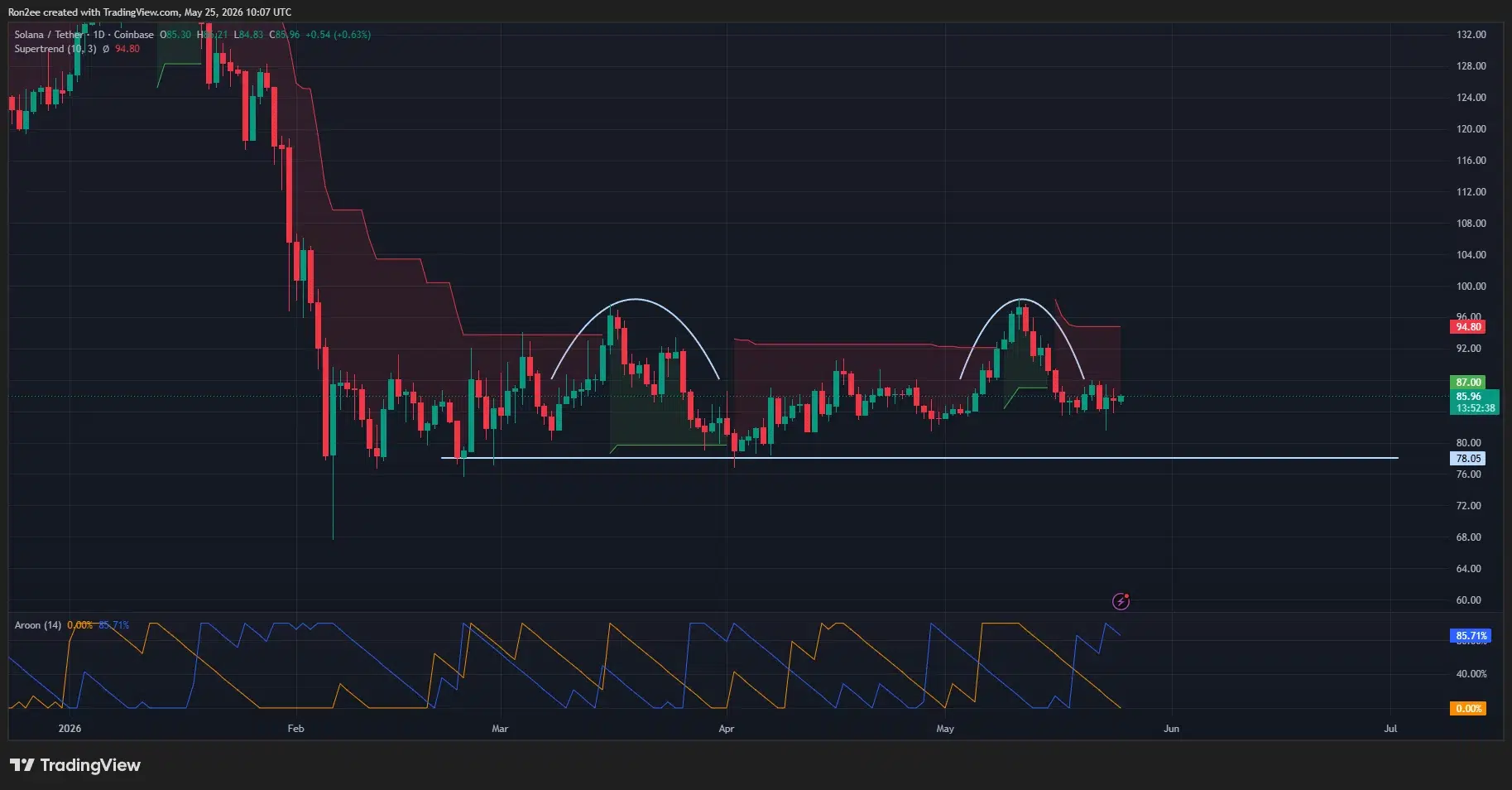
Technical indicators are increasingly pointing toward a fragile market structure after Solana failed twice to break above the $98–$100 resistance region. The daily chart shows a developing double-top pattern, with both rejection points occurring near the same supply zone before SOL price retreated back toward the mid-$80 range.
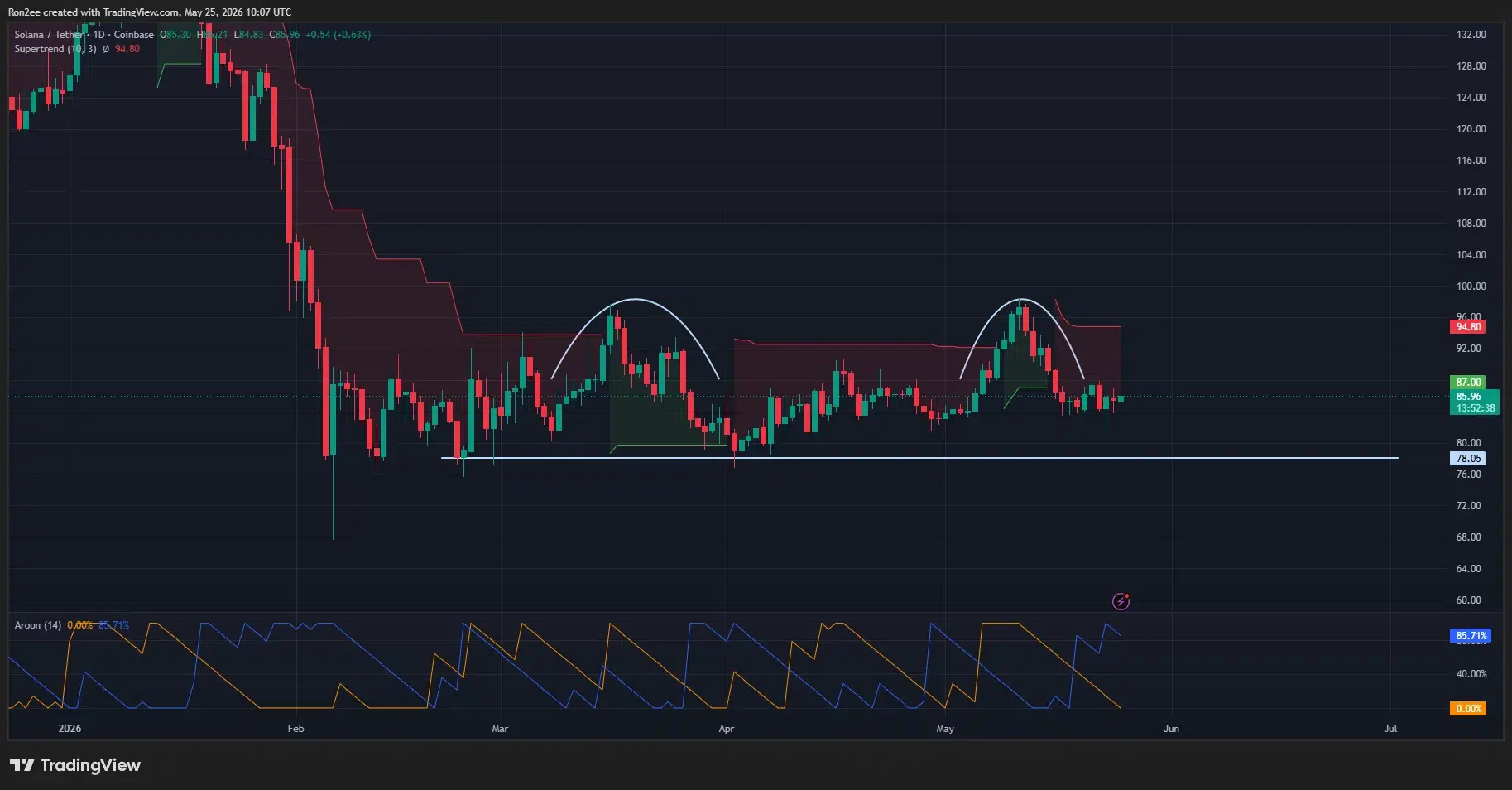
The neckline support for the structure sits near the $78 level, which has repeatedly acted as a key defensive area since March. A confirmed breakdown below that region could validate the bearish pattern and potentially open the door for a larger move toward the low-$70 range.
Pattern projections derived from the height of the structure suggest downside targets could extend toward $64 if panic selling accelerates.
Alongside the double-top formation, Solana remains below its Supertrend resistance near $94.80, indicating that sellers continue controlling the higher timeframe trend. Daily candles have also struggled to close above the descending resistance band formed after the late-April rejection, keeping bullish momentum suppressed.
Momentum indicators remain mixed but continue to favor bears overall. The Aroon indicator shows Aroon Up near 85.7% while Aroon Down remains near zero, signaling that short-term rebounds are still occurring. However, the indicator has historically produced several failed bullish signals during Solana’s prolonged consolidation phase this year, limiting confidence in a sustained recovery attempt.
CoinGlass liquidation heatmap data shows dense leverage clusters concentrated between $83 and $81, with another major liquidity pocket sitting near $78. Those zones could become magnets for price action if volatility increases during the coming sessions.
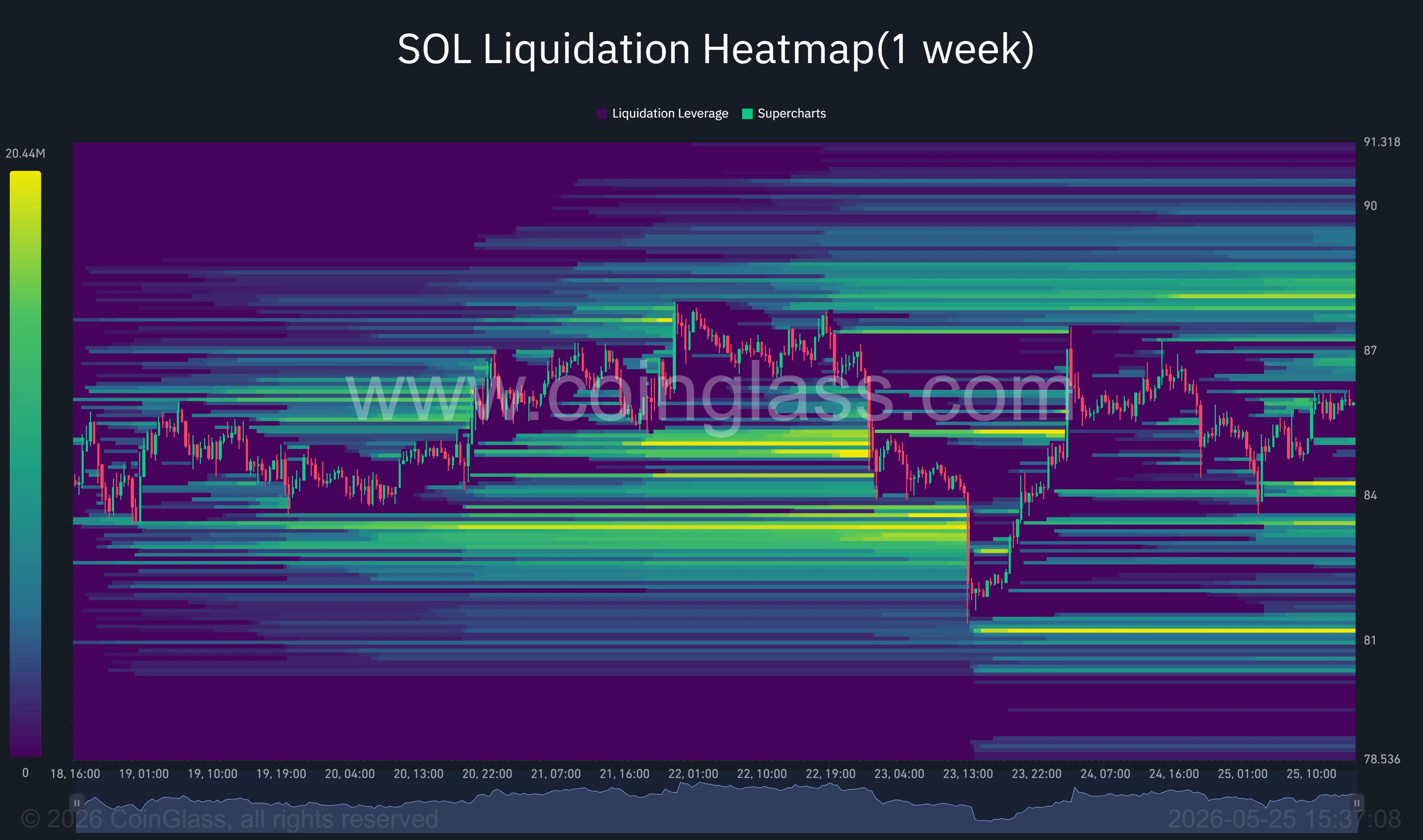
Funding rates across perpetual futures markets have also turned deeply negative, indicating aggressive short positioning from traders expecting additional downside. Negative funding often signals bearish sentiment dominance, particularly when paired with weakening spot demand and falling network activity.
Open interest has remained elevated despite recent price weakness, a combination that often precedes sharp liquidation-driven moves.
If Solana loses the $83 support floor decisively, cascading long liquidations could accelerate the decline toward the psychological $80 threshold very quickly.
Crypto trader DonAlt warned that Solana’s current structure resembles conditions seen before previous major drawdowns. In a recent market update, he said the setup “looks very similar to Q3 2022,” adding that a temporary bull trap could emerge before another deeper correction.
The trader suggested Solana could eventually revisit the $47 region in a worst-case capitulation scenario if market conditions continue deteriorating.
Despite the bearish setup, buyers have continued defending the $83–$84 area aggressively during recent sessions. Several long lower wicks on the daily timeframe indicate dip-buying activity remains active near support, preventing a clean breakdown so far.
What could invalidate the bearish Solana thesis?
A sustained recovery above the $90 resistance zone would weaken the immediate bearish structure and potentially force short sellers to unwind positions. CoinGlass liquidity data shows a heavy concentration of short liquidation levels above $87 and $90, meaning a breakout could trigger a rapid squeeze higher if momentum returns.
Improving macro conditions could also stabilize risk appetite across crypto markets. Softer-than-expected U.S. inflation data or any signals that the Federal Reserve may ease policy later this year would likely support renewed inflows into altcoins. Bitcoin reclaiming higher resistance zones could similarly improve sentiment toward Solana and other large-cap cryptocurrencies.
Network activity remains another critical variable. Any revival in meme coin trading volumes or a sharp rebound in Solana-based decentralized finance activity could improve fee generation and restore speculative demand for SOL. Developers also continue expanding infrastructure across the ecosystem despite the recent slowdown in user activity.
For now, however, the technical structure remains vulnerable while macro conditions continue to favor defensive positioning.
Unless bulls reclaim the $90–$94 resistance range soon, Solana risks slipping below the critical $80 threshold as traders continue pricing in weaker liquidity conditions and rising downside pressure across the crypto market.
Disclosure: This article does not represent investment advice. The content and materials featured on this page are for educational purposes only.
PI finds support at $0.15, but can it hold?
PI Network (PI) Price Predictions: Analysis
Key support levels: $0.15, $0.13
Key resistance levels: $0.16, $0.20
PI Remains in a Downtrend
After PI lost its support at $0.16, the price quickly dropped to $0.15, where buyers have shown some interest. However, it is too early to say if this support level will hold or not. A much stronger candidate is the level at $0.13, which rejected bears in the past.
With this latest breakdown, sellers regained the initiative, and they may eventually be able to send PI lower, even if buyers are trying to stop a resumption of the downtrend. This is unfortunate considering that PI has already corrected by 96% since its all-time high.

Sell Volume Remains Low
Even if sellers have the advantage right now, their volume remains low and is making lower highs. This shows that they lack conviction or appear uninterested in pushing PI’s price much farther down.
Should the support at $0.15 hold, then buyers have a good shot at trying to reclaim $0.16 and rebuild momentum towards a reversal to recover some of the most recent losses since the price action turned bearish.

MACD Continues to Fall
The 3-day MACD continues to fall to new lows, as indicated by its histogram. While that is bearish, this is happening on decreasing sell volume. In light of that, this could be interpreted as a bullish divergence with a possible reversal on the horizon.
If the MACD histogram turns flat this week, that will be the first signal that sellers are no longer able to control the price, and a relief rally could follow.

The post Pi Network (PI) Price Predictions for This Week appeared first on CryptoPotato.

For years, the blockchain world has been obsessed with visibility. We track chains, compare ecosystems, argue over TPS, and proudly declare which network is “winning.” But a quiet shift is happening beneath all that noise: interoperability is slowly making blockchains less visible—and that might actually be the end goal.
Because the future of crypto may not be about which chain you’re on… but about not needing to care at all.
The Problem With Today’s Blockchain World
Right now, blockchains behave like competing cities:
- Ethereum is the financial capital 🏦
- Solana is the high-speed trading hub ⚡
- Bitcoin is digital gold storage 🪙
- Layer 2s are gated suburbs and express lanes 🚇
But here’s the catch: users still notice the borders.
You need bridges. Wrapped assets. Manual swaps. Network selection dropdowns that feel like choosing a SIM card in 2009.
That friction is not just annoying—it’s a barrier to mainstream adoption.
Enter Interoperability: The Quiet Revolution
Interoperability protocols and cross-chain infrastructure aim to erase these boundaries.
Instead of moving yourself across chains, you simply move value and actions across them—without even noticing where execution happens.
Think of it like this:
- Today: “I used Ethereum, then bridged to Arbitrum, then swapped on Solana.”
- Future: “I made a trade.”
No chain names. No bridges. No mental overhead.
Just outcomes.
When Chains Stop Competing for Attention
The real power of interoperability is not technical—it’s psychological.
If done right, users stop asking:
“Which blockchain should I use?”
And start asking:
“What do I want to do?”
At that point, blockchains become infrastructure—like TCP/IP on the internet.
Nobody says, “I sent that email using TCP packets version 4.1.”
They just say: “I emailed you.”
That’s the level of invisibility crypto is heading toward.
The Paradox: The More Connected, The Less Visible
Here’s the irony:
The more interoperable blockchains become, the less you notice them.
Instead of “multi-chain complexity,” we get:
- One balance sheet across networks
- One identity layer
- One execution layer (hidden under the hood)
Blockchains don’t vanish—they just stop being the thing you think about.
Who Wins in an Invisible Blockchain World?
Not necessarily the fastest chain or the cheapest chain.
But the systems that:
- Abstract complexity best
- Route liquidity most efficiently
- Deliver a seamless user experience
- Hide infrastructure entirely
In other words, the winners are the ones you don’t see.
The Big Shift: From Chains to Systems
Crypto is evolving from a landscape of competing blockchains into something closer to:
A distributed execution system for global digital coordination.
Chains become interchangeable execution environments.
Users stop navigating ecosystems.
They just… use the internet of value.
Final Thought
Interoperability doesn’t just connect blockchains—it dissolves their importance in the user experience.
And when that happens, the most successful blockchain might be the one that feels like nothing at all.
Invisible infrastructure is not a loss of identity.
It’s maturity.
And in crypto, maturity looks like silence.
REQUEST AN ARTICLE
Crypto World
5 Critical Stocks on Deck This Week: Marvell (MRVL), Dell (DELL), Salesforce (CRM), Costco (COST), and Tesla (TSLA)

Key Takeaways
- Marvell Technology’s earnings will reveal momentum in custom AI silicon and data center infrastructure spending
- Dell Technologies must demonstrate that surging AI server revenue is driving meaningful profit improvement
- Salesforce results will indicate whether enterprise customers are increasing AI software budgets
- Costco’s quarterly performance will offer insight into spending habits among value-conscious consumers
- Tesla remains a focal point without an earnings report, as robotaxi progress, China sales, and AI initiatives drive headlines
Investors are bracing for a consequential week as five prominent companies prepare to deliver earnings results and strategic updates spanning artificial intelligence infrastructure, enterprise technology, consumer retail, and the electric vehicle sector.
Chip and Hardware Giants Under the Microscope
Marvell Technology enters the spotlight as one of the week’s most anticipated reports. The semiconductor company has carved out significant market share in custom chip design, optical connectivity solutions, and AI infrastructure components for hyperscale data centers. The central question: are major cloud providers maintaining their aggressive capital expenditure on artificial intelligence buildouts?
Marvell Technology, Inc., MRVL
With shares trading near elevated levels, market participants have set a high bar for results. A convincing performance would reinforce the thesis that AI-driven semiconductor demand extends well beyond Nvidia’s dominance and is creating opportunities across the chip ecosystem.
Dell Technologies faces equally intense scrutiny. The company has evolved from its legacy PC business into a critical supplier of AI-optimized servers for enterprise and cloud customers. Substantial contracts tied to machine learning infrastructure have fueled recent growth.
But top-line expansion alone won’t satisfy shareholders. The critical metric is whether Dell can convert robust AI server demand into expanding profit margins. Manufacturing these advanced systems carries significant costs, and investors are demanding evidence that the business model is becoming more profitable, not just larger.
Enterprise Software, Consumer Spending, and Tesla’s Ongoing Narrative
Salesforce represents the software dimension of the AI investment thesis. While hardware companies build the infrastructure, Salesforce must prove that enterprises are willing to pay premium prices for AI-enhanced applications, automation capabilities, and intelligent data platforms.
Management has heavily promoted its AI agent technology and platform services as the next phase of growth. When financial results arrive, analysts will scrutinize revenue acceleration, operating margin expansion, and signs that customers are adopting—and paying for—these new AI features.
Costco shifts attention to the consumer economy. As a bellwether for middle- and upper-income households seeking value, the warehouse club’s performance carries significant weight. Membership renewal rates, same-store sales growth, and foot traffic trends will provide crucial signals about consumer resilience.
Given the stock’s elevated valuation multiple, delivering robust results and optimistic forward guidance will be essential to maintaining investor confidence in the current price level.
Tesla won’t release quarterly earnings this week, yet the company remains a constant focal point for market participants. Updates regarding autonomous vehicle deployment, sales performance in China, production margins, and statements from CEO Elon Musk frequently trigger significant price movements.
While Tesla has been repositioning its story around self-driving technology, artificial intelligence capabilities, and robotics ambitions, Wall Street hasn’t stopped monitoring fundamental metrics like delivery volumes and quarterly profitability.
Broader Market Implications
Collectively, these five companies provide a comprehensive snapshot of multiple market themes. Marvell and Dell will test the durability of AI infrastructure investment. Salesforce will determine whether that spending is translating into software adoption. Costco will gauge the health of the American consumer. Tesla will serve as a barometer for growth stock sentiment and retail investor enthusiasm around transformative technology.
The outcomes from this diverse group could establish important directional cues for equity markets as the calendar moves toward mid-year.
XRP is trying to reclaim the support at $1.4. Will it be successful?
Ripple (XRP) Price Predictions: Analysis
Key support levels: $1.2, $1
Key resistance levels: $1.4, $1.6, $2
Are Buyers Returning?
In an interesting development, the XRP price reversed course as soon as it left the blue pennant and is now attempting to reclaim support at $1.4. If successful, this would be a bullish reversal.
While the battle between buyers and sellers continues, XRP has managed to halt the downtrend, at least momentarily. The price also formed a higher low, another positive sign.

Bearish Momentum Loses Steam
The drop from $1.6 to $1.3 was pretty sharp and gave no relief. Sellers were quite aggressive, but now they appear exhausted. Ever since the price touched $1.3, the sell volume vanished, and buyers are returning.
Because of this, the price is now well positioned to recover some of the recent losses. This can be further compounded if buyers reclaim $1.4 as support, which could provide a strong base for a retest of the next resistance at $1.6.

Low Timeframes are Already Bullish
The 4h RSI has already bottomed and is making clear higher highs and higher lows. Even the RSI moving average is rallying. If bulls can maintain this pressure and volume, the RSI is likely to stay above 50 and even aim towards 70, which would indicate a strong uptrend.
If the first few days of this week close in green, this cryptocurrency has a real shot at a breakout from the pennant with $1.6 as a key target for its rally.

The post 3 Things to Watch in Ripple (XRP) Price This Week: Analysis appeared first on CryptoPotato.

In Defense of My Attachment to This Lululemon Duffel Bag (2026)

Ripple XRP: Binance Founder Predicts 2026 SUPERCYCLE Starting Now!? (BREAKING CRYPTO NEWS)

Ryan Reynolds inspires Tyson Fury to buy football team as ex-Man Utd star steps in


-

 Crypto World4 days ago
Blockchain.com files with SEC for U.S. IPO
-

 Fashion3 days ago
Holiday Weekend Open Thread – Corporette.com
-

 Crypto World3 days ago
Bitcoin Accumulation Weakens as BTC Realized Losses Hit $600M
-

 Business3 days ago
Dell Technologies DELL Stock Surges 15% on AI Server Momentum and Analyst Upgrades in 2026
-

 Crypto World3 days ago
Space X IPO Is ‘Bad News’ for Tech Stocks: But What About Bitcoin?
-

 Politics3 days ago
Makerfield: a tale of two social-media histories
-

 Crypto World2 days ago
Robinhood crypto COO Tanya Denisova exits
-

 Crypto World3 days ago
MicroStrategy’s Saylor Says Miners No Longer Set Bitcoin Price, Another Force Has Taken Over
-

 Business17 hours ago
NYT Strands Answers May 24 2026 Revealed for Puzzle No. 812 Theme Summer Essentials
-
 Tech3 days ago
A 0.12% parameter add-on gives AI agents the working memory RAG can’t
-

 Crypto World3 days ago
AI infrastructure race heats up as IREN pitches full-stack strategy, WhiteFiber lands $160M deal
-

 Tech3 days ago
WhatsApp ads could make Irish debut after discussions with DPC
-

 Tech3 days ago
You Can Now Add ChatGPT To PowerPoint
-

 Business3 days ago
Trump Invests $1M-$5M in Kura Sushi USA Chain With 27 California Locations
-
 Crypto World7 days ago
Revolut Launches Dogecoin Debit Card Across UK and EU
-
 NewsBeat4 days ago
Charity run by Reform leader Malcolm Offord accused of ‘law breaking’ over Scottish registration
-

 Sports3 days ago
2026 CJ Cup Byron Nelson leaderboard: Brooks Koepka finds putting stroke in Round 1
-
Business3 days ago
Goldman Sachs reinstates Ageas stock coverage with neutral rating
-
 Crypto World5 days ago
Exa Labs raises $250 million in funding led by a16z
-

 Crypto World3 days ago
Trump Media’s Bitcoin Stash Shrinks Again as 2,650 BTC Lands on Crypto.com
You must be logged in to post a comment Login