

Crypto World
Crypto spot volume falls to $679B as retail demand weakens



Centralized crypto exchange spot volume fell to $679 billion in April 2026, marking its lowest monthly level since October 2023, according to CryptoQuant data cited by Wu Blockchain.
Summary
- CryptoQuant data shows centralized exchange spot volume fell to $679 billion in April 2026.
- Weak retail demand, lower search interest, and Bitcoin’s pullback reduced activity across crypto exchanges.
- Crypto.news reports show exchanges are leaning on derivatives, stablecoins, and services as spot trading slows.
The drop shows that traders are using spot markets less as the wider crypto market faces weaker demand, falling retail interest, and pressure from Bitcoin’s sharp pullback from its 2025 highs.
Crypto spot volume hits lowest level since 2023
CryptoQuant data showed that spot trading volume across centralized exchanges fell to $679 billion in April. The figure marked a sharp decline from the late-2025 market peak.
The report said the drop reflected weaker retail participation and lower demand. It also suggested that the market’s current problem is not only heavy selling, but a lack of buyers.
Perpetual futures volume also fell as speculative leverage left the market. That shift shows that traders have reduced risk across both spot and derivatives markets.
The data follows a wider slowdown across centralized exchanges. As previously reported by crypto.news, centralized exchange volume dropped about 48% from the October 2025 peak to $4.3 trillion in March 2026.
Retail interest falls across crypto markets
Crypto.news recently reported that global Google search interest in cryptocurrency fell to 26–30 out of 100. That is about 70 points below the August 2025 peak.
The fall in search interest points to weaker retail attention. It also shows that crypto prices and public interest are no longer moving together as closely as in past cycles.
Bitcoin has also traded under pressure. Crypto.news reported that Bitcoin fell below $70,000 on June 2 and traded near $69,200, about 45% below its October 2025 cycle high.
This weaker market setting has reduced trading activity. When prices fall and retail interest fades, spot volumes often drop because fewer users buy, sell, or rotate between assets.
Exchanges feel pressure from lower activity
Lower spot trading has already affected major exchange businesses. Crypto.news reported that Coinbase posted a $394.1 million Q1 loss as transaction revenue fell from a year earlier.
Coinbase said trading volume dropped to $202 billion from $401 billion in the same period last year. The company also said global crypto spot trading volume fell 44% during the quarter.
This shows how exposed exchanges remain to trading cycles. When spot volume drops, fee revenue can fall quickly, especially for platforms that rely heavily on transaction activity.
Some exchanges are now leaning more on derivatives, stablecoins, stock trading, and other services. These areas can help reduce dependence on spot crypto fees during slow markets.
Bitcoin selloff adds more market stress
The April volume drop also fits the latest market weakness. Crypto.news reported that Bitcoin and Ethereum faced a $1.89 billion options expiry on June 5 while prices traded near multi-month lows.
Bitcoin briefly approached $60,000 during the selloff. Traders also increased downside hedging as market sentiment weakened.
“Spot trading volume across centralized exchanges fell to $679 billion in April 2026,” CryptoQuant’s report said, according to Wu Blockchain.

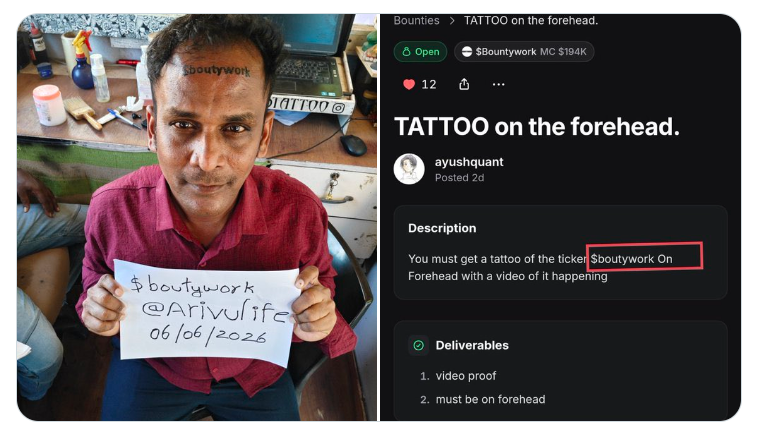
Pump.fun introduced ‘GO’ last week as a bounty marketplace where users can pay strangers in crypto to do almost anything. Within days, one of those bounties turned into a bizarre dispute over a forehead tattoo, a misspelled meme coin ticker, and a blocked 40 SOL payout.
Arivu, a man from Tamil Nadu, India, permanently tattooed the ticker exactly as written in the bounty prompt. Only afterward did he learn the post contained a typo.
The mistake could have cost him the reward. Instead, Solana traders launched a token in his name and turned the failed payout into a five-figure payday.

Forehead Tattoo Bounty Sparks Spelling Fight
Pump.fun opened its GO marketplace on June 4, and the platform immediately drew backlash over extreme listings.
One bounty offered 40 SOL to anyone willing to tattoo “$boutywork” on their forehead.
Arivu accepted the challenge. He filmed the full process at a local tattoo shop, including visible bleeding, and submitted the video as proof on June 6.
However, the payout stalled at one point. Critics argued the listing contained a typo and that the intended ticker was “$Bountywork” with an “n”.
Arivu countered that he had inked the exact text in the prompt.
Follow us on X to get the latest news as it happens
Traders Turn the Typo Into a Token
Rather than wait for a ruling, Solana traders launched BOUTYWORK on Pump.fun with Arivu’s selfie as its logo. The coin reached a market cap of $373,000 within hours.

Creator fees routed to Arivu totaled roughly $15,000, with estimated hauls around $17,500, while the unpaid bounty is worth about $2,585, with SOL at $64.62.
The incident deepens the questions about moderation raised during Pump.fun’s pivot toward utility tokens. It also lands as the platform faces scrutiny over PUMP’s valuation and runs a $350 million buyback campaign.
Whether the original 40 SOL bounty ever pays out now sits with Pump.fun’s moderators. Their decision on the typo may set the template for every subsequent disputed GO submission.
The post Pump.fun Bounty Backfires After Man Inks Misspelled Meme Coin on Forehead appeared first on BeInCrypto.
Crypto World
CPI on June 10 and the FOMC on June 17, Bitcoin’s Next Big Move Will Be Decided in the Next 7 Days

The two macro events that will define Bitcoin’s second-half trajectory land within seven days of each other: May CPI on June 10 and the FOMC dot plot on June 17.
April’s headline CPI already came in at 3.8% year over year, the highest reading since May 2023, and the market has not fully priced what a second consecutive hot print does to the Federal Reserve’s projected rate path. That mispricing is where the ±10% Bitcoin move lives.

The transmission mechanism is not complicated, but it is precise. CPI feeds directly into dot plot expectations, dot plot expectations move real yields, real yields move the DXY, and DXY moves Bitcoin.
Those four links in the chain are all live simultaneously in the June 10–17 window, and they are not pointing in the same direction right now.
Discover: The Best Crypto to Diversify Your Portfolio
How CPI Prints and FOMC Transmits Into Bitcoin Through the DXY Channel
The CPI transmission works through 3 channels simultaneously. First, headline inflation shifts market pricing on the number of Fed cuts embedded in the forward curve.
Second, that repricing moves nominal Treasury yields. Third, the yield differential between U.S. assets and the rest of the world adjusts the DXY, and Bitcoin, priced in dollars and correlated to global liquidity, responds inversely.
Scenario one: a hot print above 3.6% YoY. That is not a statistical outlier, given April’s 3.8% reading and PPI already running 6.0% year over year, the largest single-month advance since March 2022.
A second consecutive hot CPI eliminates the probability of any 2026 rate cuts from consensus pricing, pushes the DXY toward 107, compresses global liquidity, and hands Bitcoin a direct test of the mid-$60,000s.
The Kraken economic brief frames it precisely: “A stronger-than-expected read could reduce implied odds of rate cuts later in 2026.”
Scenario two: an in-line print between 3.3% and 3.6%. The dot plot becomes the deciding event. If the median dot for 2026 shifts from two cuts to one, DXY holds its range and Bitcoin trades sideways into the FOMC statement. No resolution, elevated volatility, and a market that waits for June 17 to provide the verdict.
Scenario three: a cool miss below 3.0%. Core CPI is currently at 2.8% YoY, and the Fed weights it more heavily than the headline in policy deliberations. A downside surprise on both measures reprices the dot plot toward three 2026 cuts, sends DXY toward 99, and triggers the risk-asset re-rating that Bitcoin bulls have been waiting for since April.
The Fed’s own framing, per the Kraken brief, is unambiguous: “Fed officials have framed the labor market and inflation as the two conditions determining the timing of any rate adjustment.” May NFP on June 5 arrives first, with April already showing a modest 115,000 nonfarm payrolls and unemployment holding at 4.3%.
That labor data feeds the same dot-plot calculus. Each release in this fortnight is not independent – it is sequentially dependent. As Kraken’s brief puts it: “From NFP on Friday through CPI on the 10th, PPI on the 11th, and the FOMC on the 17th, this fortnight has a clear macro sequencing logic. Each data release feeds the next.”
Bitcoin’s Chart Entering the Gauntlet: The Levels That Decide the 2026 Story
Bitcoin is not immune to macro volatility, and the prior session’s rapid erasure of geopolitical premiums proved it.
2 numbers define the technical structure heading into June. $68,000 resistance and $63,500 support. A weekly close above $68,000 on accelerating volume shifts the chart from consolidation to breakout.
A daily close below $62,500 opens $60,000, where the next significant demand shelf sits.
The short-term holder realized price is clustered near $65,000, the cost basis for wallets that acquired BTC within the last 155 days.

That level is not coincidental. It is the zone where the bull case and bear case are currently sharing the same address.
Daily RSI is mid-range, neither overbought nor oversold. Funding rates are positive but not elevated, meaning the next macro catalyst lands into a market that is directionally exposed without being obviously overleveraged.
The weekly chart is coiling. Lower highs since the April peak. Higher lows from the May flush. That compression does not hold through 2 inflation reports and an FOMC dot plot update. The June 10 to 17 window determines which way it resolves.
Volatility is coming. The only open question is the direction.
Discover: The Best Token Presales
The post CPI on June 10 and the FOMC on June 17, Bitcoin’s Next Big Move Will Be Decided in the Next 7 Days appeared first on Cryptonews.


The competition between blockchain networks in the tokenized real-world asset market is gaining more attention as analysts debate whether capital is starting to shift toward the XRP Ledger.
Summary
- Analysts claim XRPL added fresh RWA capital while Ethereum experienced recent tokenized asset outflows.
- Crypto.news previously reported XRPL’s tokenized asset market expanded sharply during the first quarter.
- Ripple’s RLUSD and tokenization strategy continue driving attention toward the XRP Ledger ecosystem.
A recent social media post from crypto analyst Ledger Man claimed that the XRP Ledger recorded about $1.5 billion in new real-world asset inflows over the last 30 days, while Ethereum experienced roughly $1.2 billion in outflows. The figures have not been independently confirmed.
Analysts point to possible capital rotation toward XRPL
According to Ledger Man, some market participants believe money could be moving from Ethereum into the XRP Ledger ecosystem.
The analyst said growing interest in tokenized real-world assets may be helping XRPL attract additional capital. The claim comes as tokenization becomes one of the fastest-growing sectors in digital assets.
“Capital may be quietly shifting from Ethereum to the XRP Ledger,” the analyst wrote.
The figures mentioned in the post should be viewed as analyst estimates until they are confirmed by blockchain data providers or official reports.
XRPL tokenization activity continues to expand
Recent crypto.news reporting showed that the XRP Ledger’s real-world asset market cap increased by more than 124% during the first quarter.
The report said tokenized assets on XRPL reached approximately $2.25 billion. Stablecoin activity also increased as RLUSD continued expanding across the ecosystem.
Ripple has been focusing heavily on tokenization infrastructure. The company has promoted use cases involving tokenized securities, funds, and institutional assets.
Crypto.news also reported that RLUSD expanded to multiple networks through Wormhole integration. The move provided additional liquidity options for developers and institutions.
Ethereum remains the largest tokenization ecosystem
Despite claims of outflows, Ethereum still hosts the largest share of tokenized assets and decentralized finance applications.
Many institutions continue using Ethereum because of its established infrastructure, developer base, and liquidity depth.
Large tokenization projects from financial firms have traditionally launched on Ethereum or Ethereum-compatible networks.
This means competition between Ethereum and XRPL is not necessarily a winner-take-all situation. Several networks are trying to capture different parts of the tokenization market.
Tokenized assets become a growing battleground
The tokenized real-world asset sector has become one of the main growth themes across the crypto industry.Banks, asset managers, and fintech companies are increasingly testing blockchain-based versions of traditional financial products.
David Schwartz recently said tokenized securities, money market funds, loans, and repos could become important parts of the XRP Ledger ecosystem.
As more institutions enter the market, competition between blockchain networks is expected to increase.
However, claims about large capital shifts between Ethereum and XRPL remain difficult to verify. However, the growth of tokenized assets continues to place both ecosystems at the center of the next stage of blockchain adoption.
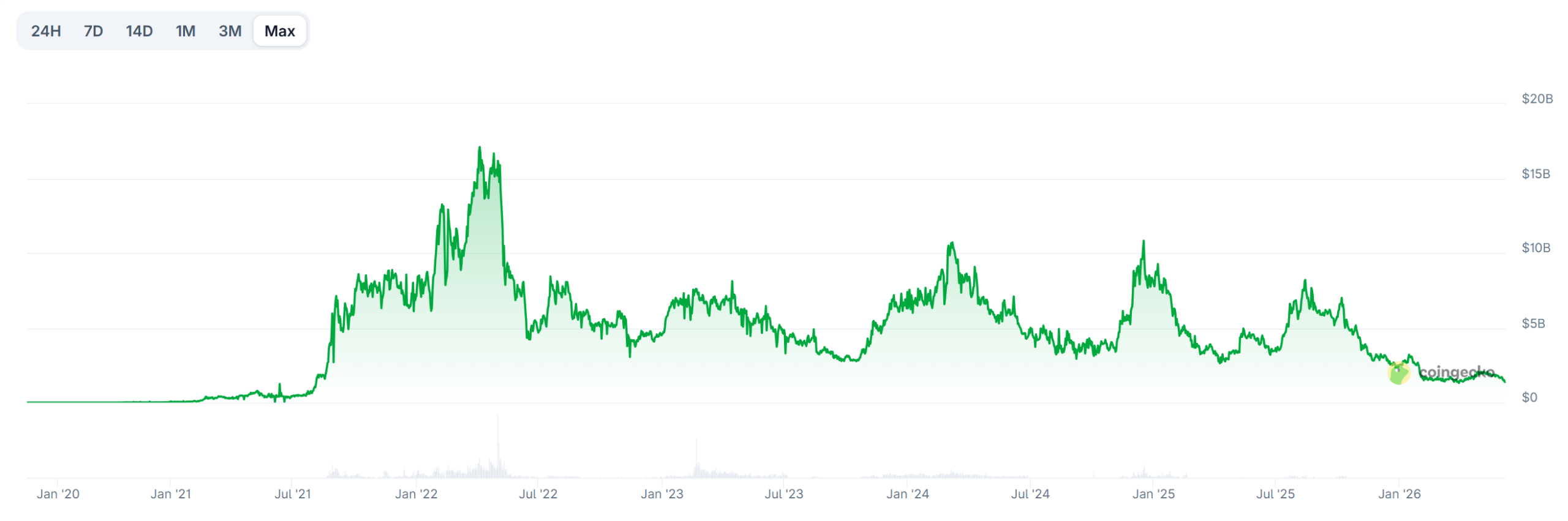
The non-fungible token (NFT) market cap has fallen back toward record lows as Ethereum (ETH) declines. CryptoPunks trade near $53,000, Bored Ape Yacht Club pieces sit below $15,000, and Pudgy Penguins hover around $7,300.
ETH lost roughly 28% over the past 30 days and now trades near $1,640. Floors measured in ETH fell far less than dollar values, exposing the sector’s denomination risk.

Ethereum Weakness Drags NFT Market Cap Toward Record Lows
Data from CoinGecko places the CryptoPunks floor at 32.5 ETH, or about $53,254. Bored Ape Yacht Club (BAYC) sits at 9.05 ETH, roughly $14,828, while Pudgy Penguins trade at 4.48 ETH, near $7,335.
The divergence is starkest at CryptoPunks. Its floor climbed from 31 ETH to 32.5 ETH over the past 30 days, yet the dollar floor fell 29% from above $71,000.

BAYC and Pudgy Penguins declined on both measures. Their dollar floors lost 39% and 42%, roughly triple their ETH-denominated drops of 9.4% and 15%.
Aggregated floor valuations now sit between $1.4 billion and $2.4 billion, depending on the tracker. CryptoPunks, the 2017 collection that anchors the sector, alone represents 27% of that total.
The slide tracks Ethereum’s broader downturn. ETH trades 67% below its August 2025 record of $4,946 and has lost 34% in a year.
A 17-session ETF outflow streak drained over $401 million from US spot ETH funds in May.
NFT analyst wale.moca, a former Azuki researcher, argued this dependency makes ETH-denominated gains hollow.
“The price of ETH is the biggest vulnerability NFTs have. It’s cool when floor price is up 5 ETH but it’s meaningless if ETH/USD is down -30% in the meantime,” wale.moca wrote.
Follow us on X to get the latest news as it happens
Thin Liquidity Deepens the Structural Problem
Trading activity tells a similar story. CryptoPunks recorded almost no sales volume over the past 24 hours, per CoinGecko. Daily volume across nearly 1,800 tracked collections totaled under $3 million.
The squeeze now reaches market infrastructure. NFT Price Floor, a leading data aggregator, announced it will shut down on June 30 because of insufficient funding.
Sentiment looked stronger earlier in the cycle, when an apparent NFT season comeback lifted CryptoPunks and Moonbirds.
BAYC, in contrast, has revisited the lows it set when its floor price crashed below 10 ETH.
Some teams are reducing their reliance on speculation. Pudgy Penguins has bet on culture over short-term price, signing a partnership with Manchester City to reach mainstream audiences.
Still, the dollar floors recovering depends less on NFT demand than on Ethereum itself.

Perhaps, the ETH June price outlook could offer signs of whether the blue-chip valuations can stabilize.
The post NFT Market Cap Slides Near Record Lows as Ethereum Drop Erases Blue-Chip Gains appeared first on BeInCrypto.
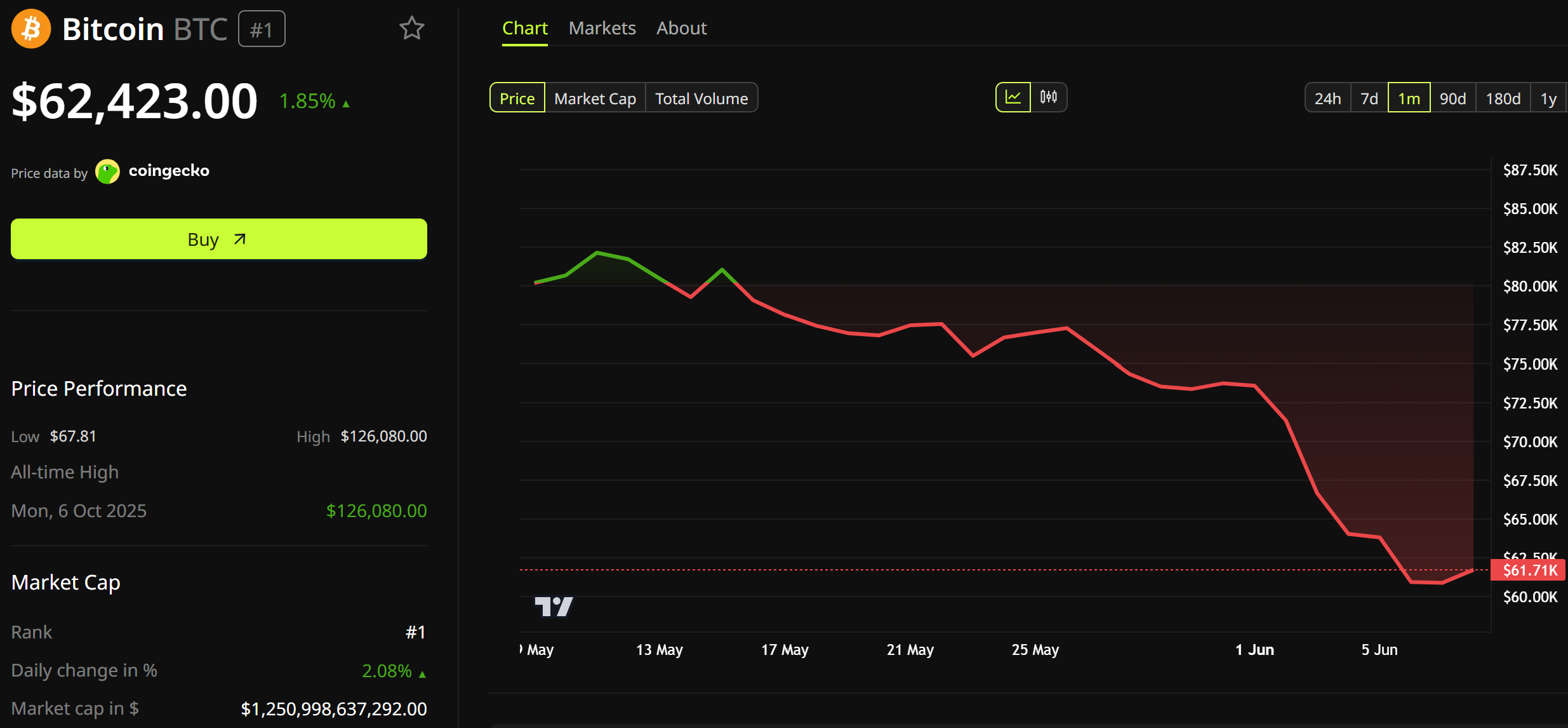
10X Research says the clock is ticking for Bitcoin (BTC), with two weeks and two events set to decide its next regime. Bitwise CEO Hunter Horsley counters that the real Bitcoin risk is far bigger. By default, no one cares.
Bitcoin trades near $62,300, down 21% in 30 days and roughly 51% below its October 2025 peak, according to BeInCrypto market data. Both firms agree that the market sits at a turning point. They disagree on what kind.

Two Weeks and Two Events on the Bitcoin Risk Clock
The firm’s June 7 update frames a decisive window that holds the May CPI report on June 10 and the Fed meeting on June 16 to 17. 10X expects the statement to drop its easing bias, cementing higher-for-longer rate pressure.
The warning carries a track record. On May 16, the firm set a stop at Bitcoin’s 30-day moving average of $78,404.
By its own accounting, Bitcoin then fell 23% from that line, confirming wider bear market chart signals. Ethereum (ETH), its preferred short, lost 30%.
“Dangerously in the current environment, Bitcoin is not an inflation hedge; it is a liquidity hedge. It rises when monetary conditions loosen and falls when they tighten,” 10X Research wrote in the report.
Follow us on X to get the latest news as it happens
The firm’s case rests on draining liquidity. It cites consumer inflation climbing from 2.4% to 3.8%, producer prices surging to 6.0%, and 30-year yields above 5.0%.
It also argues that no Trump policy backstop exists this time, unlike past tariff rollbacks and a ceasefire.
The verifiable data fits. April CPI printed at 3.8%, the highest since 2023, and traders are pricing roughly 70% odds of a hike by the end of 2026.
Still, 10X concedes the hardest thing to predict is not data but the moment investors decide to care.
Horsley turns that exact question against the whole industry.
Bitwise’s CEO Says the Real Problem Is That No One Cares
Elsewhere, Bitwise CEO Hunter Horsley sizes crypto against everything else:
- Global equities near $130 trillion
- Fixed income at $150 trillion
- Real estate at $300 trillion, and
- Gold at $30 trillion total roughly $640 trillion.
“Crypto’s $2 trillion is less than 1% of that, smaller than Microsoft alone.”
From that height, he dismisses the market’s obsessions as inward-looking. That includes Strategy’s first Bitcoin sale of 32 BTC since 2022 and Michael Saylor’s talk of an AI capital rotation. Most investors, he notes, follow none of it.
“Rather, the biggest obstacle is that, by default, no one cares. No one has to invest in anything, including crypto. This space needs to give people a reason to care, a reason to want to participate,” he emphasized.
The two warnings describe different clocks:
- 10X sees a liquidity problem with a two-week fuse.
- Horsley sees an attention problem with no deadline at all.
The CPI print and the Fed decision will test the first thesis within days. The second may take years to settle.
Both, however, point the same way. Bitcoin’s next move depends on whether anyone decides to care.
The post 10X Research Gives Bitcoin Two Weeks as Bitwise CEO Flags the Real Risk appeared first on BeInCrypto.


The GENIUS Act is moving into a key rulemaking stage as digital dollar users and stablecoin issuers face a June 9, 2026 deadline for comments on FinCEN and OFAC proposals.
Summary
- FinCEN and OFAC comments close June 9 for GENIUS Act stablecoin compliance rules.
- The proposed rule treats permitted stablecoin issuers as financial institutions under Bank Secrecy Act rules.
- Crypto.news reported banks want comment periods paused until primary stablecoin rules become clearer.
The post shared by Digital Perspectives cited June 9 for FinCEN-OFAC comments and July 18, 2026 for full rules. The dates place stablecoin compliance back at the center of U.S. crypto regulation.
FinCEN and OFAC set June 9 comment deadline
FinCEN and OFAC are seeking public comments on proposed rules for permitted payment stablecoin issuers. The proposal would apply anti-money laundering and sanctions compliance duties to firms that issue payment stablecoins.
The Federal Register notice says comments must be received by June 9, 2026. The proposal follows the GENIUS Act’s direction to treat permitted stablecoin issuers as financial institutions under the Bank Secrecy Act.
The rules would require issuers to maintain compliance programs suited to their size and business model. They would also bring stablecoin firms closer to the same oversight used for other financial companies.
The proposal covers customer checks, sanctions controls, suspicious activity monitoring, and other systems aimed at reducing illicit finance risks.
July 18 marks another GENIUS Act milestone
The second date cited in the post is July 18, 2026. That date marks one year after the GENIUS Act became law on July 18, 2025.
Legal trackers list July 18, 2026 as a key deadline for several implementing rules under the stablecoin law. These include rules tied to foreign issuer registration requests and related appeals.
This gives regulators a narrow window to turn the law into working standards. It also gives issuers a clearer timeline for planning compliance, licensing, reserves, and reporting.
For stablecoin users, the rulemaking could shape how digital dollars move across exchanges, wallets, apps, and payment networks.
Banks push back on stablecoin rulemaking
Crypto.news reported that major U.S. banking groups asked regulators to pause several GENIUS Act comment periods. They want the Office of the Comptroller of the Currency to finish its primary stablecoin framework first.
The banks argued that firms need a clearer base rule before responding to related comment periods. Their request shows that traditional finance still wants more detail before the rules harden.
Crypto.news also reported that stablecoin firm Agora filed for a national trust bank charter with the OCC on April 24. The move could place Agora under federal oversight before the new rules fully settle.
That shows two different responses to the same rulemaking race. Banks want more time, while some stablecoin firms are trying to secure federal status early.
Stablecoin issuers face a tighter compliance path
The GENIUS Act gives the U.S. its first federal framework for payment stablecoins. It focuses on reserve backing, issuer oversight, consumer safeguards, and compliance with financial crime rules.
For issuers, the next stage is practical. They must show how they will screen users, manage sanctions risks, monitor transactions, and respond to lawful orders.
The June 9 deadline matters because it is one of the last chances for firms, banks, and users to shape the FinCEN-OFAC rule before regulators finalize it.
The July 18 milestone then brings the wider stablecoin framework closer to full use. Stablecoin issuers now face a clear message from regulators: digital dollar products will need bank-style compliance controls.

Key Takeaways
- Meta has launched USDC stablecoin payments for content creators in Colombia and the Philippines, targeting over 160 countries by late 2026
- Recipients must set up their own crypto wallets, select compatible blockchain networks, and independently convert digital currency to local money
- Payment giants Visa and Mastercard are pursuing a different strategy — integrating stablecoins behind the scenes within traditional financial infrastructure
- Global stablecoin transactions reached $33 trillion in 2025, marking a 72% increase compared to the previous year
- U.S. Senator Elizabeth Warren has raised questions to Mark Zuckerberg regarding transparency, market competition, and systemic financial risks
In March 2026, Meta revealed plans to compensate content creators using USDC, a stablecoin tied to the U.S. dollar. Initial deployment began in Colombia and the Philippines, with the company aiming to reach more than 160 nations before year-end. Given that Meta processes approximately $3 billion annually in creator compensation, this transition represents a significant departure from conventional banking channels.
However, receiving the payment marks just the beginning. After USDC arrives in their account, creators face the conversion process alone.
The Steps Creators Must Navigate
To accept these payments, content creators need to link an external cryptocurrency wallet and select between two supported blockchain platforms: Solana or Polygon. Meta has made it explicit that funds sent to incorrect addresses or incompatible networks are permanently lost.
The subsequent conversion to local currency requires transferring USDC to a cryptocurrency exchange, completing identity verification procedures, exchanging digital assets for traditional currency, and finally withdrawing through domestic banking channels. Every stage introduces additional costs and processing time.
For someone creating content in Manila or Bogotá, this represents substantial overhead simply to receive their earnings.
Both initial markets feature vibrant creator ecosystems alongside costly conventional payment infrastructure. The Philippines particularly demonstrates widespread mobile payment adoption via services like GCash and Maya. These characteristics should make them perfect testing grounds for stablecoin compensation. Yet the off-ramp infrastructure — the mechanisms converting digital dollars into usable local currency — remains inconsistent.
Traditional Payment Networks Choose a Different Path
Mastercard invested $1.8 billion acquiring BVNK, extending stablecoin settlement capabilities across more than 130 territories while maintaining existing regulatory compliance frameworks. Visa collaborated with Bridge to introduce stablecoin-backed cards enabling users to spend digital dollar holdings wherever Visa operates, with currency conversion occurring automatically.
In these implementations, consumers never interact with blockchain technology. Stablecoins manage settlement infrastructure while the user experience mirrors traditional banking.
Meta’s model shifts complexity onto users. Payment networks keep it hidden.
Stablecoin transaction activity hit $33 trillion throughout 2025, climbing 72% year-over-year. Corporate adoption continues accelerating. The systems for transferring stablecoins are increasingly sophisticated.
The challenge lies on the opposite end — converting those digital dollars into currency people can actually use for everyday purchases.
Regulatory Attention Has Arrived
Senator Elizabeth Warren contacted Meta CEO Mark Zuckerberg in May, describing the platform’s insufficient transparency as “troubling.” Her letter highlighted concerns surrounding competitive practices, user privacy, payment infrastructure integrity, and broader financial system stability.
Meta’s response clarified the company has no intention of launching its own stablecoin. Instead, Meta stated it aims to enable users and merchants to transact using third-party stablecoins across its ecosystem.
Warren’s inquiry emerged while Congress actively develops cryptocurrency market structure legislation, positioning Meta’s deployment squarely within ongoing regulatory discussions.
Meta has brought stablecoin payments significantly closer to widespread adoption. The unfinished work involves making them sufficiently frictionless that creators never need to consider blockchain technology whatsoever.

Key Takeaways
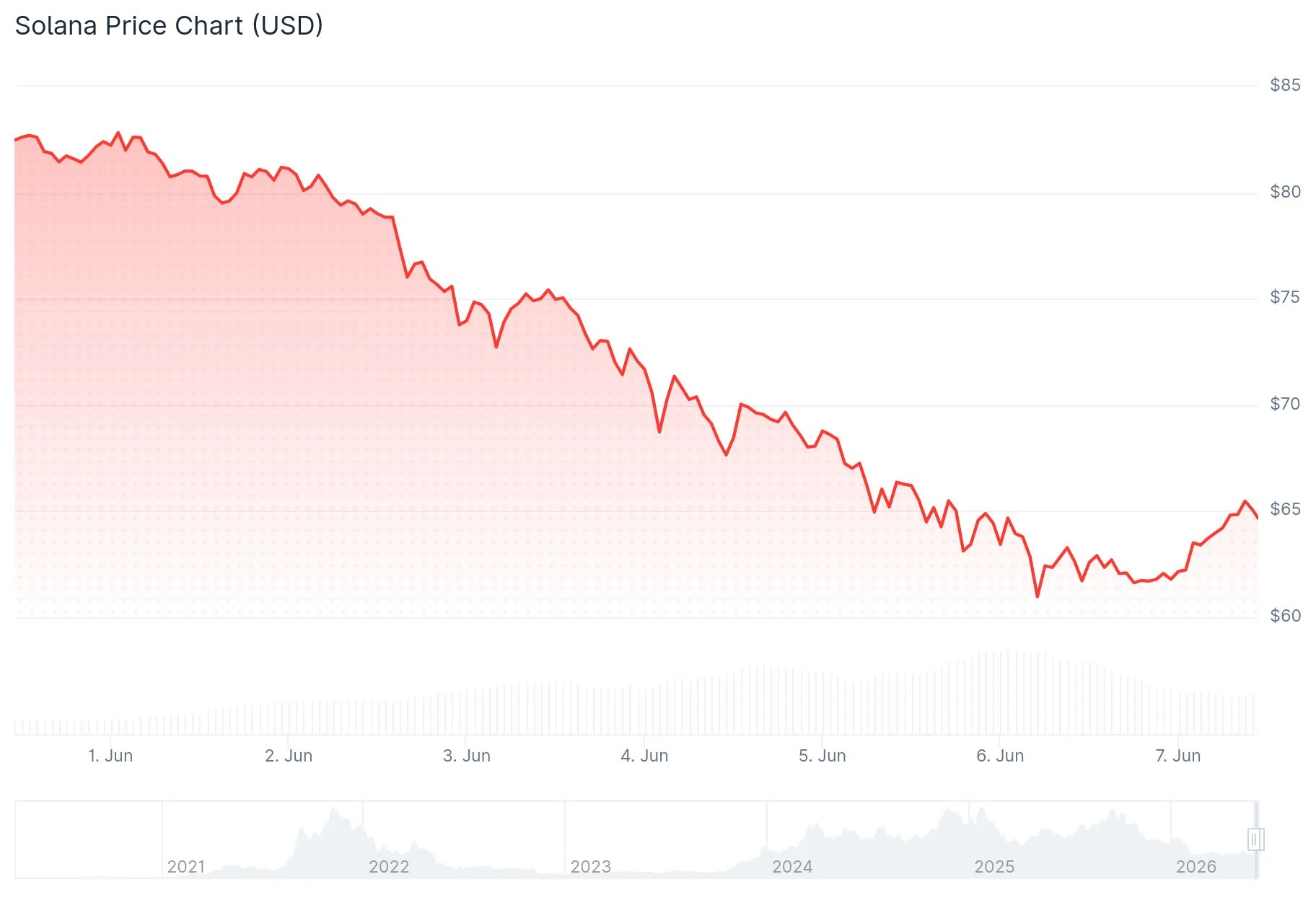
- Solana plummeted to $61, marking a 31-month low with over 4% decline in 24 hours
- Forward Industries moved $31.9M in SOL tokens to Coinbase Prime
- Spot Solana ETFs in the U.S. reversed course with net capital outflows
- Crypto market witnessed over $1.5 billion in liquidated positions within 24 hours
- Critical support zone identified at $60, with downside targets at $51.50 and $50
Solana has experienced a brutal descent throughout this week. On June 6, 2026, the cryptocurrency plunged to $61, reaching its weakest price point since November 2023. This 31-month bottom has market participants closely monitoring whether the $60 threshold can withstand ongoing selling pressure.
The token has suffered approximately 24% losses over the past seven days, declined 30% throughout the last month, and collapsed roughly 50% year-to-date. Current trading activity places SOL around the $62 mark.
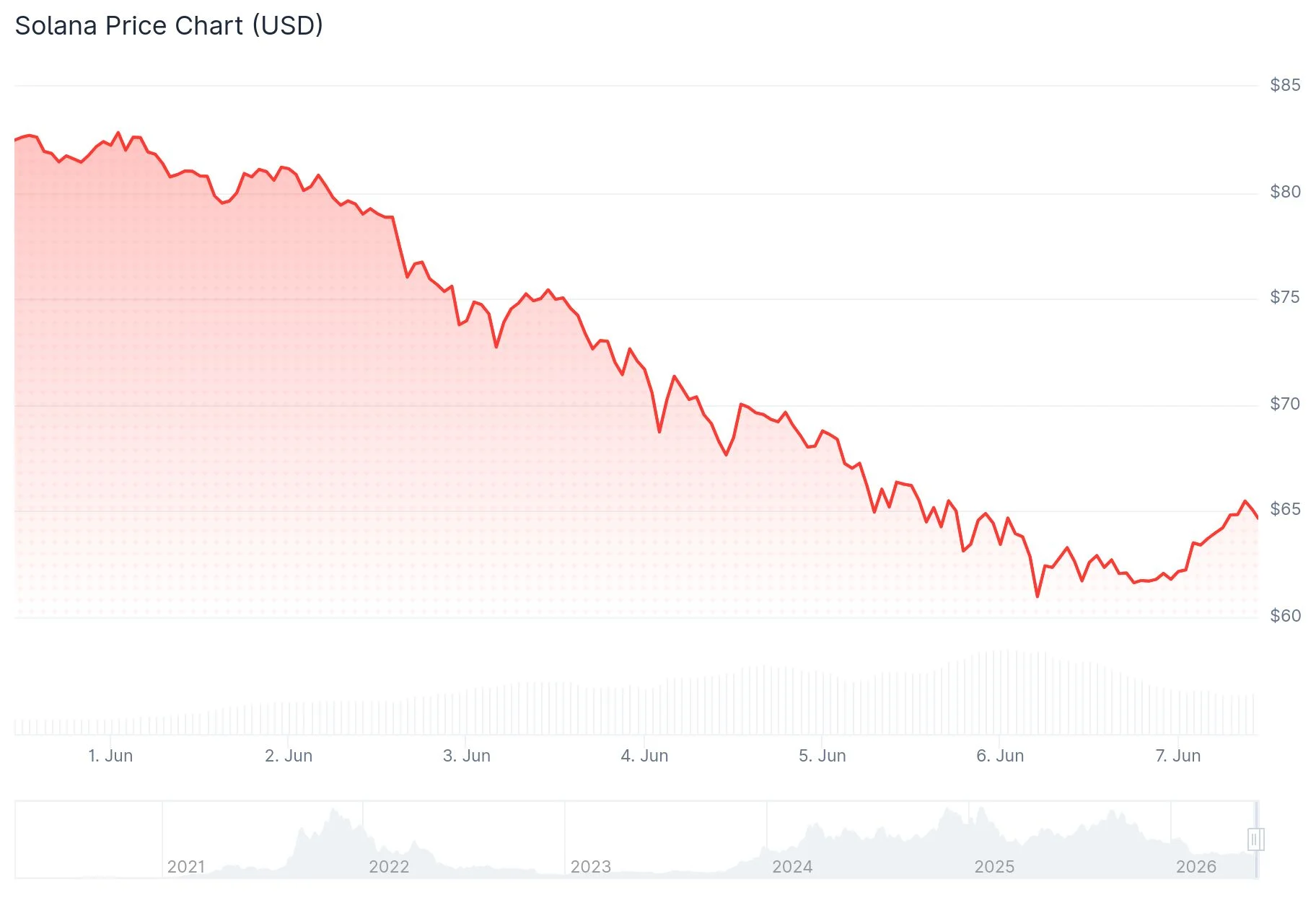
Multiple bearish catalysts have converged simultaneously to create intense downward momentum. Large holder activity, institutional product outflows, and widespread cryptocurrency market weakness have combined to amplify selling pressure.
A particularly noteworthy transaction involved Forward Industries. The firm moved 455,784 SOL tokens—valued at approximately $31.9 million—to Coinbase Prime following a month-long period of dormancy.
Forward Industries implemented a Solana treasury accumulation strategy in September 2025. Throughout this initiative, the company deployed roughly $1.59 billion to acquire 6.83 million SOL at an average entry price of $232. Current valuations place these holdings near $458.6 million, representing an unrealized loss exceeding $1.3 billion.
While the Coinbase Prime deposit doesn’t definitively indicate liquidation intent, market observers scrutinize such transactions carefully. Transfers to institutional trading platforms frequently precede position reductions by significant holders.
ETF Outflows Add to Pressure
U.S. spot Solana exchange-traded funds have shifted into net outflow territory following multiple weeks of consistent capital inflows. Institutional appetite, previously providing price stabilization, has reversed direction.
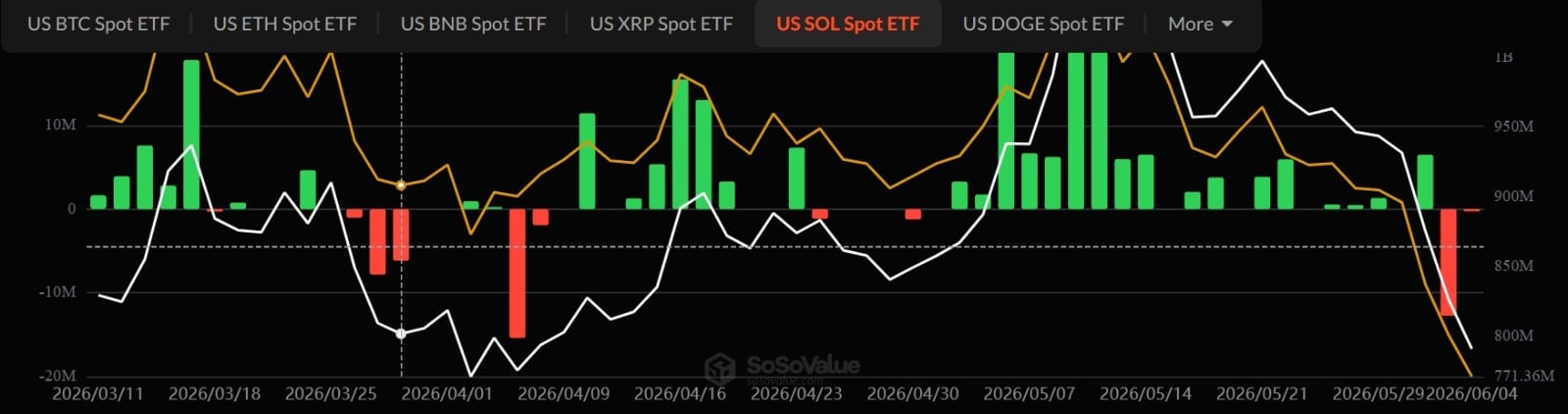
During March, when SOL ETF redemptions began accelerating, prices declined from $91 to $81. Market participants express concern that similar patterns could materialize again, this time from significantly lower baseline levels.
Cryptocurrency analyst Jack Adams offered perspective on current conditions, noting: “I am almost certain $SOL is heading back to retest $67–$58 once more before reversing into $120–$175 this year.” Adams identifies the $58–$67 band as a potential accumulation zone for long-term investors, despite near-term weakness.
The derivatives landscape has similarly suffered severe damage. According to CoinGlass metrics, more than $1.5 billion in cryptocurrency positions faced liquidation within a 24-hour period, with long position holders bearing the majority of losses. Solana represented a substantial portion of these forced closures.
Key Support Levels to Watch
The Relative Strength Index on Solana’s technical chart has declined to 15, firmly entrenched in oversold conditions. This extreme reading confirms seller dominance while indicating buyer exhaustion.
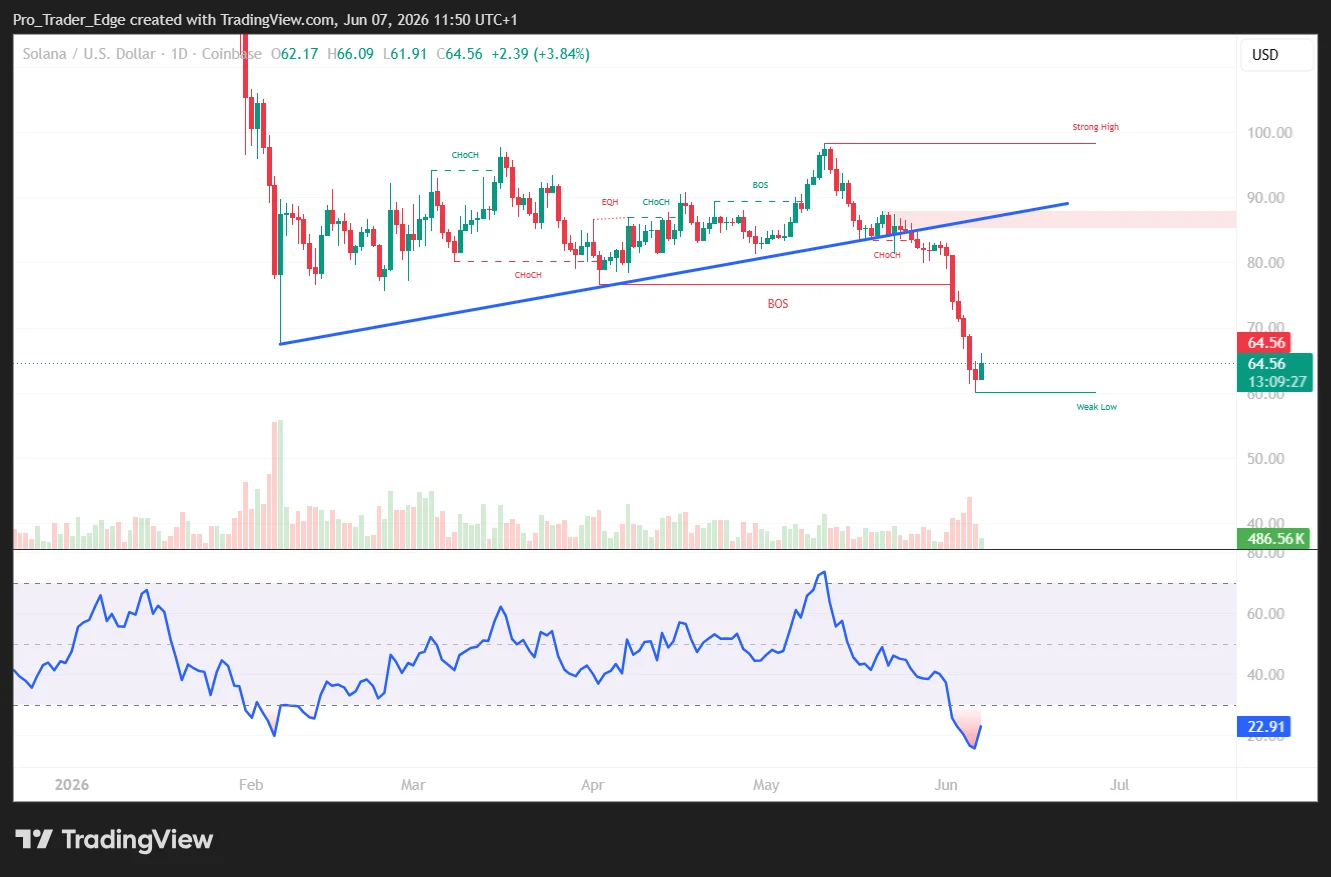
Weekly chart analysis reveals SOL testing support near $51.50—a price level that previously functioned as a significant breakout point in late 2023. Should this floor fail, the psychologically important $50 level emerges as the next critical downside target.
CoinGlass liquidation heatmap data identifies the largest concentration of leveraged positions clustered between $70 and $75, now functioning as overhead resistance.
Most recent market data shows SOL exchanging hands near $62, with broader macroeconomic pressures—including stronger-than-expected U.S. employment data and climbing Treasury yields—maintaining downward pressure on risk-oriented assets throughout financial markets.

Bear market comments and speculations have returned to the cryptocurrency space as bitcoin erased over $400 billion from its market cap in weeks, going down from over $82,000 to a Friday bottom of $59,000 on Friday – its lowest position in 19 months.
Although it managed to rebound above $60,000 quickly, analysts are now split on whether that support will hold this time as it did back in February. So, we decided to ask ChatGPT’s latest version about its take on the matter.
$60K’s Significance
BTC hasn’t been this low since before the US presidential elections nearly two years ago. Consequently, ChatGPT claimed that it’s “arguably bitcoin’s most important support level right now,” as it serves as a major psychological threshold.
“Markets often remember such levels, especially after they have already served as a turning point once before,” it said.
However, it outlined a problem with the current situation: such support lines generally weaken each time they are tested, which is probably why it gave in on Friday, even for a short period of time. The more often buyers are forced to defend a certain price zone, the greater the probability that it eventually gives way.
Nevertheless, ChatGPT believes a breakdown below this level is now “possible but not inevitable.” It put reasonable odds at roughly 40% that BTC loses the $60,000 line in the coming weeks and 60% that it holds and forms at least a medium-term bottom.
What Happens to BTC if It Does Break Down?
ChatGPT said the first likely level to hit would be $55,000 if the $60,000 floor gives in. If panic accelerates and traditional markets remain under pressure, then BTC could revisit another psychologically important mark at $50,000.
That would be a 40% correction from the May high at $82,000, which would be a painful move but still within the range of historically bull-market retracements. A more extreme scenario would involve bitcoin dumping into the $45,000-$48,000 range, but Peter Schiff recently warned that the asset could slump toward $20,000 if the $50,000 line is lost.
In contrast, OpenAI’s platform outlined a more bullish path forward if $60,000 holds. Should the bulls successfully defend it once again, the market could “quickly shift from fear to relief” and BTC “may attempt to reclaim $70,000 before targeting the $75,000-$80,000 region.”
“Historically, some of bitcoin’s strongest rallies have emerged precisely when sentiment became overwhelmingly bearish, and investors started preparing for much lower prices,” it concluded.
The post We Asked the New ChatGPT: Will BTC Inevitably Lose the $60K Support? appeared first on CryptoPotato.
Key Takeaways
- Joseph Lubin, Ethereum co-founder, transferred 110,000 ETH valued at approximately $170 million on June 6, 2026.
- This marked the first significant movement from the originating wallet in over three years.
- The transferred ETH reinforced collateral across three Sky (previously MakerDAO) vaults backing $259 million in DAI loans.
- Blockchain analysts confirmed the transaction was a risk management strategy, not a liquidation event.
- Ethereum dropped under $1,600 and temporarily surrendered its second-place ranking in crypto market capitalization to Tether’s USDT.
A cryptocurrency wallet associated with Ethereum co-founder Joseph Lubin executed a major transfer of 110,000 ETH valued at approximately $170 million on Saturday, June 6. The substantial movement triggered immediate speculation throughout cryptocurrency communities until blockchain experts provided clarity on the transaction’s purpose.
The transfer occurred through three separate blockchain transactions. The initial transaction relocated 40,000 ETH valued at approximately $61.9 million. A second transfer moved an identical 40,000 ETH amount worth roughly $61.7 million. The final transaction shifted 30,000 ETH valued at around $47.1 million.
The originating wallet had remained essentially inactive for approximately three years. This extended dormancy amplified attention to the sudden activity. Blockchain analyst Ted Pillows shared on X: “A wallet related to Ethereum’s co-founder Joseph Lubin moved $170,780,000 in ETH to a new address. This is the first outflow in 3+ years.”
Pillows publicly questioned whether Lubin intended to liquidate his holdings. The inquiry rapidly circulated throughout cryptocurrency social channels, generating widespread concern and speculation.
Transaction Aimed at Safeguarding Loan Collateral
Blockchain analytics firm Onchain Lens provided crucial context explaining the transfer’s true purpose. The ETH was injected as supplementary collateral into three Sky protocol vaults. Sky operates as the rebranded version of MakerDAO.
These vaults collectively maintain 412,430 WETH as collateral supporting $259 million in outstanding DAI loans. The liquidation thresholds for these vaults are positioned at $899, $1,020, and $1,056 per ETH respectively.
With Ethereum’s price hovering around $1,560 during the transfer, the collateral position maintained approximately 33% cushion above the nearest liquidation trigger point. Injecting additional collateral reduced liquidation vulnerability as ETH experienced downward price momentum.
One receiving wallet had previously attracted analytical attention. In February, Onchain Lens documented the identical wallet containing 137,908 ETH with $107.77 million in borrowed DAI. Saturday’s deposit expanded that specific vault’s collateral reserves to 177,908 WETH.
Lubin simultaneously serves as founder and CEO of Consensys, the prominent blockchain technology firm. Neither Lubin nor Consensys issued public statements regarding the wallet transactions. Consensys representatives declined comment when approached for clarification.
Ethereum Drops Under $1,600 Threshold
The collateral transfers occurred during a period of intense downward pressure on Ethereum. During the transaction window, ETH traded near $1,586, representing a nearly 5% decline within 24 hours.
Ethereum temporarily relinquished its second-place position among cryptocurrencies by market capitalization. Tether’s USDT claimed that ranking for a period on Saturday.
ETH has declined approximately 24% during the previous week and roughly 47% year-to-date. The asset experienced $271 million in long position liquidations during the 24-hour period surrounding these events.
Additional Ethereum Stakeholders Adjusting Holdings
Lubin’s collateral management activities coincided with position adjustments from other notable Ethereum stakeholders.
Bankless co-founder David Hoffman publicly disclosed reducing his ETH holdings on May 20. Blockchain transaction data additionally revealed an early Ethereum participant liquidated approximately 55,000 ETH and 9,442 wstETH totaling $136 million at an average execution price of $2,041.
The source wallet retained approximately 133,299 ETH worth roughly $211 million following the transfers, indicating Lubin’s overall position remains substantially intact.
Consensys is currently evaluating potential public market listing options with JPMorgan and Goldman Sachs reportedly providing advisory services.

LISA ‘MONEY’ mirrored dance cover #shorts (based on the Performance vid and added some freestyle)

David Lammy told JD Vance ‘you’re wrong’ after Henry Nowak case intervention

USMNT’s final World Cup experiment offers clues on how they will approach opener

HarrisX Poll Found 52% of Registered Voters Support the CLARITY Act

BloFin War of Whales 2026 Grand Prix opens registration for $5M trading championship

Blockchain.com files with SEC for U.S. IPO
LISA ‘MONEY’ mirrored dance cover #shorts (based on the Performance vid and added some freestyle)

INSANE CRYPTO JUST BECAME POLITICAL! THIS WILL NOT END WELL #crypto #trump #biden

Evil Husband Forces Wife Into $372,130 Of Debt | Financial Audit
-

 Business6 days ago
Jade Biosciences, Inc. (JBIO) Discusses Positive Interim Results From JADE101 Phase I Healthy Volunteer Study and Development Plans Transcript
-

 Fashion2 days ago
Weekend Open Thread: Evereve – Corporette.com
-
 Crypto World2 days ago
Jensen Huang Approves Samsung, SK Hynix, and Micron for NVIDIA (NVDA) HBM4 Memory Supply
-

 Sports5 days ago
French Open 2026 results: Alexander Zverev beats Rafael Jodar and will play Jakub Mensik in semi-finals
-

 Tech5 days ago
CryZENx Releases Fresh Playable Content Deep Inside Jabu-Jabu for His Ocarina of Time Remake
-

 Business4 days ago
Trump Taps Housing Chief Bill Pulte as Acting Intelligence Director After Gabbard Exit
-
Crypto World2 days ago
LBank Surpasses 25 Million Users Worldwide as AFA Partnership Continues to Drive Global Growth
-
 NewsBeat5 days ago
Republicans balk at Trump’s attempt to appoint a MAGA enforcer to lead National Intelligence
-

 Tech2 days ago
RCS Messages Between iPhone and Android Get End-to-End Encryption With iOS 26.5
-
 Crypto World5 days ago
Seagate (STX) Stock Surges to Record High on AI Boom and Legal Settlement
-
Crypto World4 days ago
EU AI Data Center Project Faces Delays as Funding Gaps Grow
-

 Entertainment4 days ago
Did The Mandalorian And Grogu Already Ruin The Next Star Wars Movie?
-

 Business4 days ago
Aehr Test Systems Stock Soars 17% Amid Surging AI Demand and Conference Spotlight
-
 Business5 days ago
Claude AI Down Today Reason: Why Anthropic’s AI is not working today? What’s the latest quota update
-
 Crypto World2 days ago
Merlin (MRLN) Stock Soars 32% on Major USSOCOM Autonomy Milestone
-

 Tech5 days ago
Instagram will stop bombarding teens with the same kind of obsessively unhealthy content
-

 Business4 days ago
Relay Therapeutics Shares Surge 20% on ASCO Momentum for Zovegalisib Breast Cancer Program
-

 Tech2 days ago
Credit card theft campaign abuses Stripe to host stolen payment info
-

 Tech2 days ago
Meta steals a tactic from Tesla and builds data centers in tents
-

 Tech2 days ago
Microsoft launches MXC, an OS-level sandbox for AI agents, with OpenAI and Nvidia already on board
You must be logged in to post a comment Login