

Crypto World
Fed officials see rate hike ahead if inflation stays elevated, minutes show

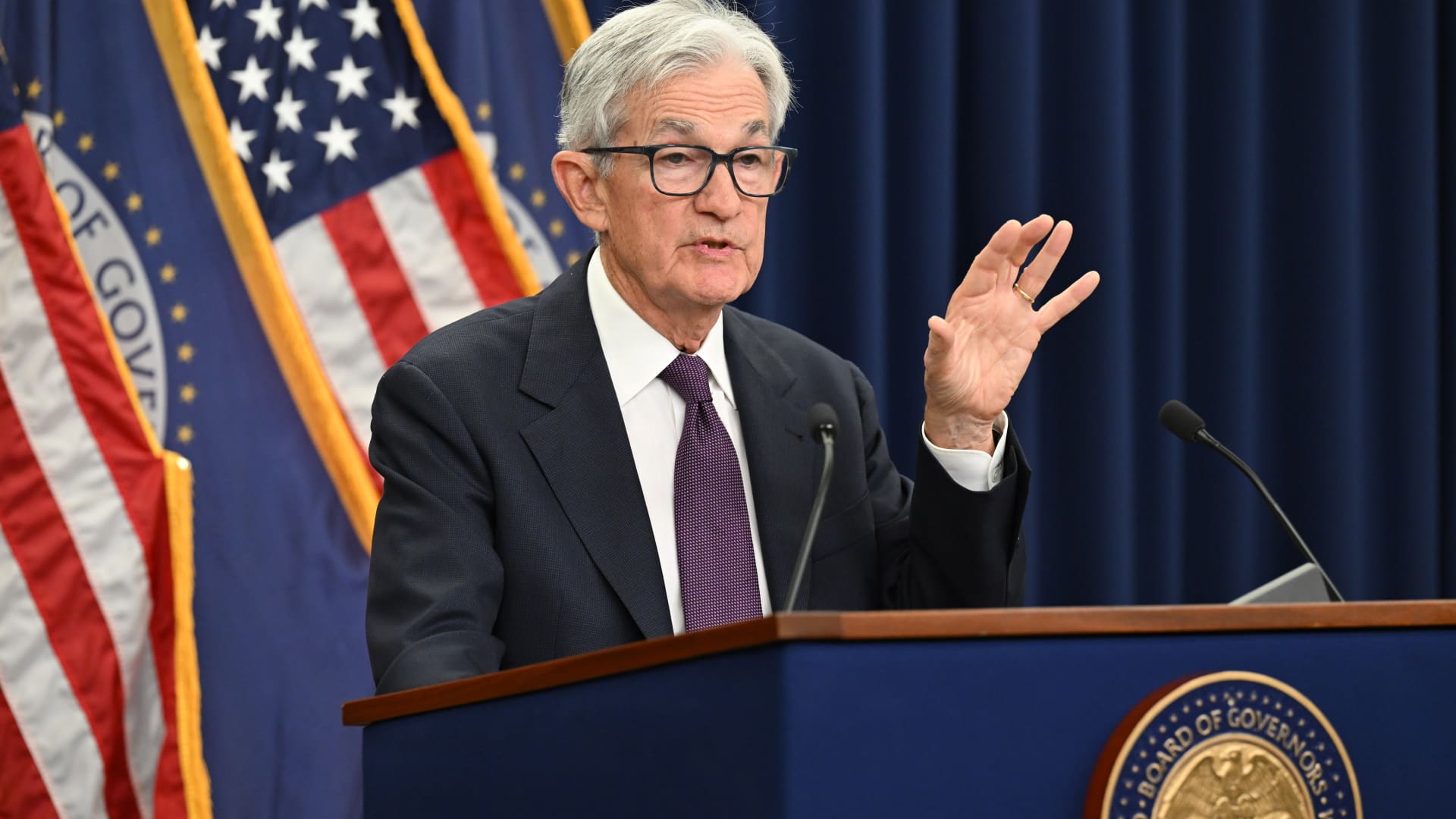
U.S. Federal Reserve Chair Jerome Powell attends a press conference in Washington, D.C., the United States, on April 29, 2026.
Li Rui | Xinhua News Agency | Getty Images
A majority of Federal Reserve officials at their most recent meeting anticipated that interest rate increases would be necessary if the Iran war continued to aggravate inflation, according to minutes released Wednesday.
Though the rate-setting Federal Open Market Committee again voted to keep its benchmark rate targeted between 3.5%-3.75%, the meeting featured four “no” votes, the most since 1992, and an apparently heightened level of disagreement about where policy should go.
At issue was the impact that the Iran war would have on prices and how that would work its way into monetary policy. Officials differed on how long the war’s impact would last and whether the post-meeting statement should continue to reflect a bias toward cutting rates as the more likely next move.
While several meeting participants said it would be appropriate to lower when it’s clear that inflation is moving back to the Fed’s 2% or when the labor market weakens, “A majority of participants highlighted, however, that some policy firming would likely become appropriate if inflation were to continue to run persistently above 2 percent.”
Three of the four “no” votes came from regional presidents who advocated policymakers keep their options open for increases amid an inflation surge. The group agreed with keeping the benchmark fed fund rates steady, but objected to the inclusion of language that referenced “additional adjustments” to rates. The phrasing is widely believed to infer the next move would be a cut.
The minutes noted that “many participants indicated that they would have preferred removing the language from the post-meeting statement that suggested an easing bias regarding the likely direction of the Committee’s future interest rate decisions.”
In Fed parlance, though, “many” does not constitute a majority, so the phrasing remained in the statement.
Officials broadly agreed that the Iran conflict would have “significant implications” for the Fed as it pursued its dual goals of full employment and stable prices, though they debated how long the impact on inflation would last.
“The vast majority of participants noted an increased risk that inflation would take longer to return to the Committee’s 2 percent objective than they had previously expected,” the document stated.
Warsh’s challenge
The meeting took place against an intriguing backdrop: It was the last time Jerome Powell presided over the committee, and it came amid escalating inflation pressures coming primarily from the war as well as other factors that have officials cautious over the future of policy.
Former Governor Kevin Warsh now takes over the helm, following a lengthy campaign that involved as many as 11 candidates. President Donald Trump chose Warsh and was explicit that he expects the Fed to be cutting rates.
Market pricing, though, has pointed to a higher probability that the committee’s next move will be a hike, either by late 2026 or early 2027.
Inflation had been trending towards the Fed’s 2% goal through 2025 and into the early part of this year. However, the war has changed the dynamic, with soaring energy prices sending most inflation measures above 3%.
Policymakers generally look through supply shocks like the oil surge as temporary. However, even core inflation, which excludes food and energy, has been climbing as well. Goldman Sachs expects that the Fed’s chief inflation forecasting measure will post an annual rate of 3.3% in April when that figure is released next week.
Warsh’s challenge, then, will be to convince his colleagues that improvements in productivity, led by artificial intelligence enhancements, will be disinflationary and counter the momentary impact of higher energy costs.
One of those colleagues will be Powell himself, who has chosen to stay on the Board of Governors. Powell has two years remaining on that term and said in April that he would stay on “for a period of time to be determined” while echoing a prior statement that he would stay until “this investigation is well and truly over.” No other Fed chair has stayed on the board in nearly 80 years.

Bitcoin is trading at $77.5k as the third week of May draws to a close. The market is recovering quietly from the $75k–$76k support zone after last week’s failed breakout attempt above $80k.
The structure has absorbed the pullback without breaking, the ascending channel floor continues to rise, and the on-chain picture tells a story that the price chart alone undersells. Sentiment is rebuilding from levels last seen at the very beginning of the previous bull market.
Bitcoin Price Analysis: The Daily Chart
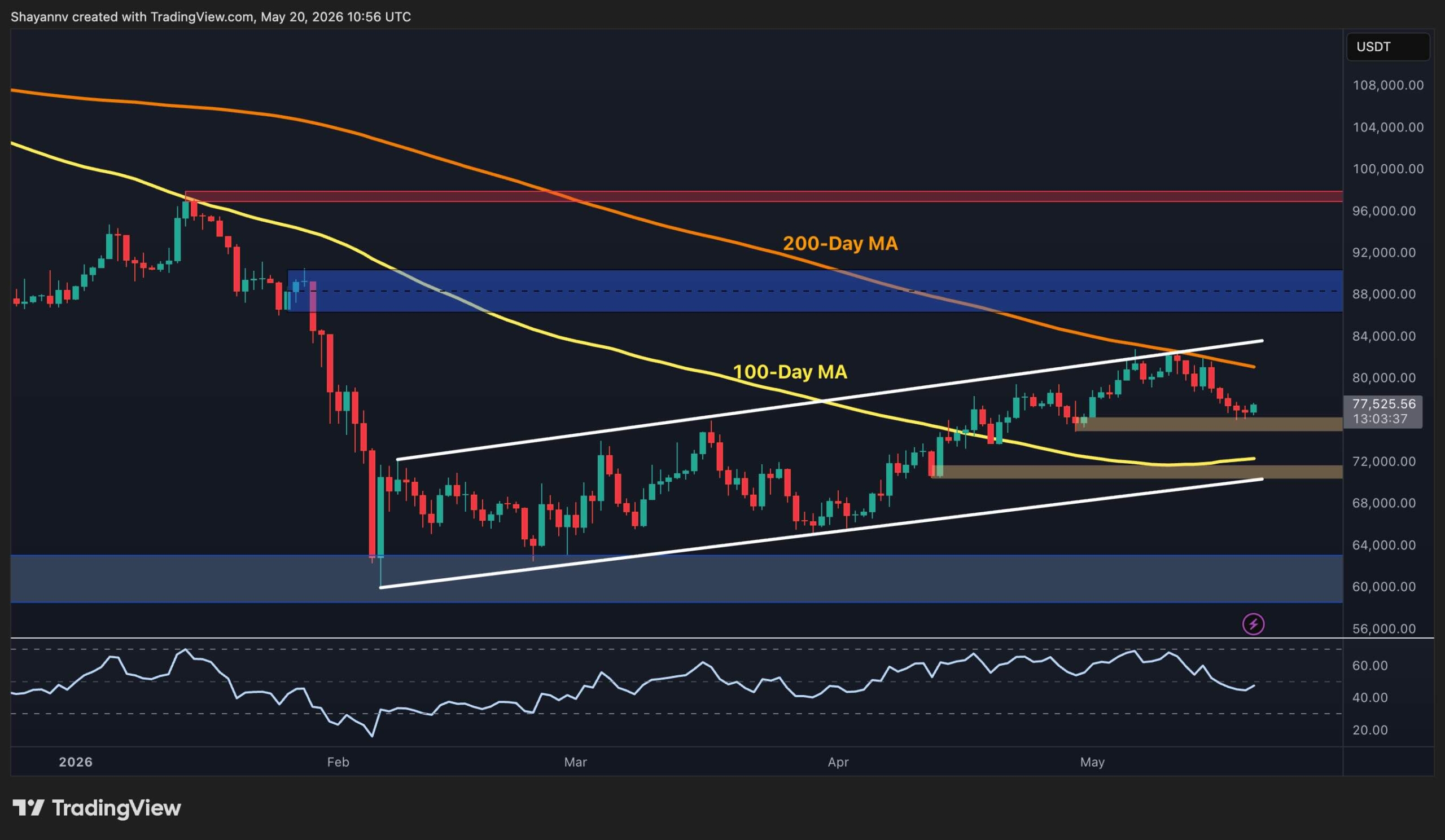
On the daily timeframe, the ascending white channel from the February low has held, with the asset bouncing from the upper edge of the $75k–$76k support zone today, rising toward $77.5k. The 100-day moving average is now sloping upward to approximately $72k and is now converging with that same support zone. This will likely create a strengthening combined support floor that rises a little further every week.
The RSI is also hovering around 50, showing little signs of directional momentum. A recovery back above $80k and a breakout above the 200-day moving average nearby are the immediate requirements to restore bullish momentum.
If this scenario materializes, the $88k–$90k band is the structural target above. On the other hand, a daily candle close below $75k and the 100-day MA near $72k would be the first serious structural damage of the recovery.
BTC/USDT 4-Hour Chart
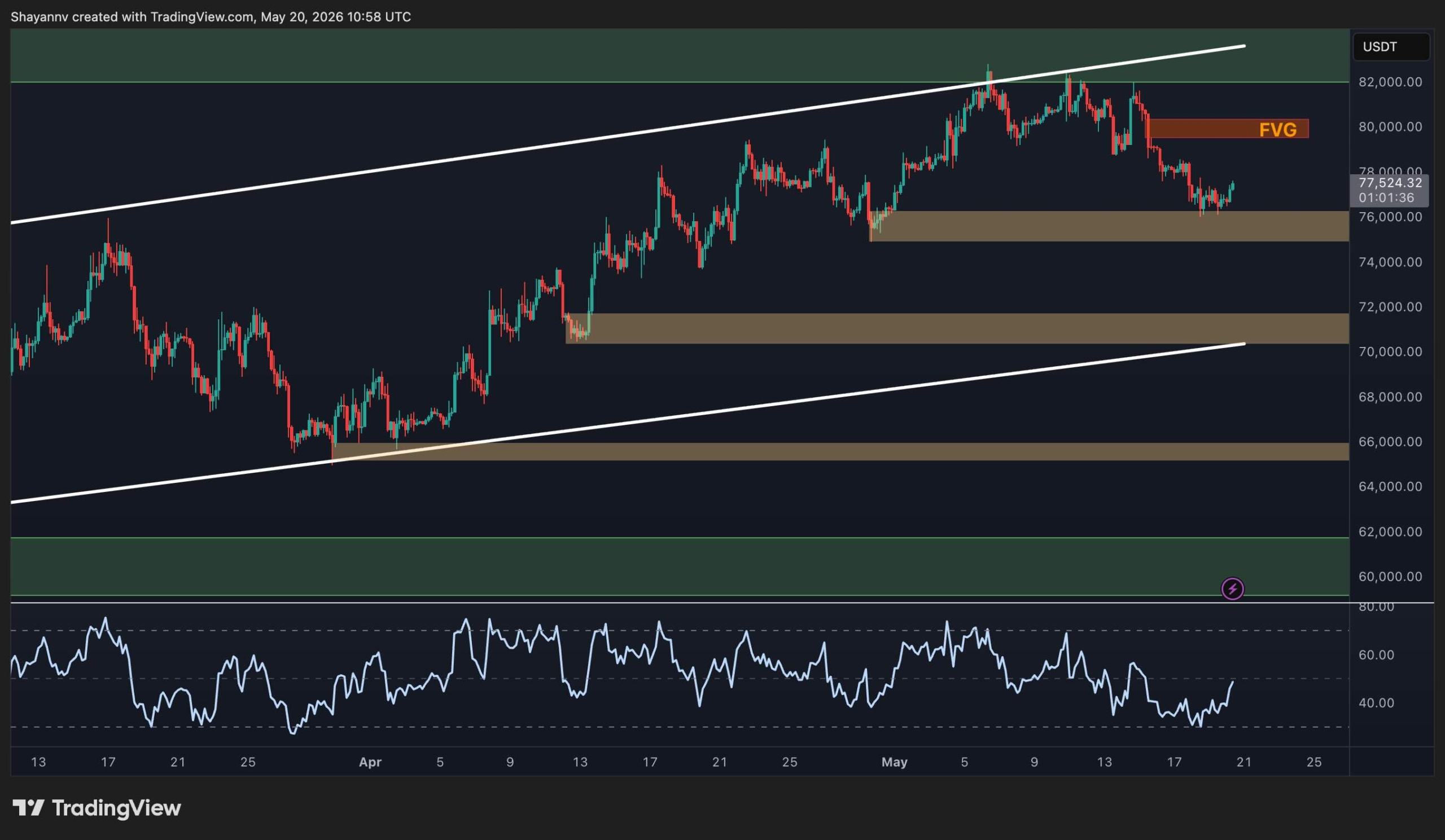
The bounce from the $75k–$76k support zone has lifted the 4-hour RSI from the low-to-mid 30s back to approximately 50. The asset is now tracking toward the bearish Fair Value Gap marked on the chart near $80k. This is a price imbalance left by the sharp sell-off from the $82k highs, which the underlying asset typically returns to fill before resolving direction.
The FVG is the immediate short-term target on the upside. A clean move through it would signal that the pullback is fully absorbed and the next push toward the $82k supply zone and the upper boundary of the daily channel is building. However, failure to trade through the FVG and a rollover back below $75k would suggest the selling pressure from the failed breakout is not yet exhausted, opening the path toward the lower demand zone at $70k–$72k as the next test.
On-Chain Analysis
The Net Unrealized Profit/Loss has recovered from its February low of approximately 0.12, which was the deepest reading since October 2023 and briefly demonstrated a capitulation period. The metric has now risen back to the current reading of 0.29. That number puts the market above the green zone, and the average BTC holder is sitting on moderate unrealized gains, but the kind of euphoria that precedes major tops is nowhere in sight.
The historical parallel is precise. NUPL crossed 0.29 in late 2023 near $40k on its way to the bull market peak. The journey from that level to the 0.50 threshold, where momentum historically accelerates, corresponded to a price move from roughly $40k to $80k. At $77.5k with NUPL at 0.29, the on-chain sentiment structure suggests the market is in a similar position. It’s likely past capitulation, rebuilding confidence, but with the majority of the cycle’s unrealized gains still ahead rather than behind.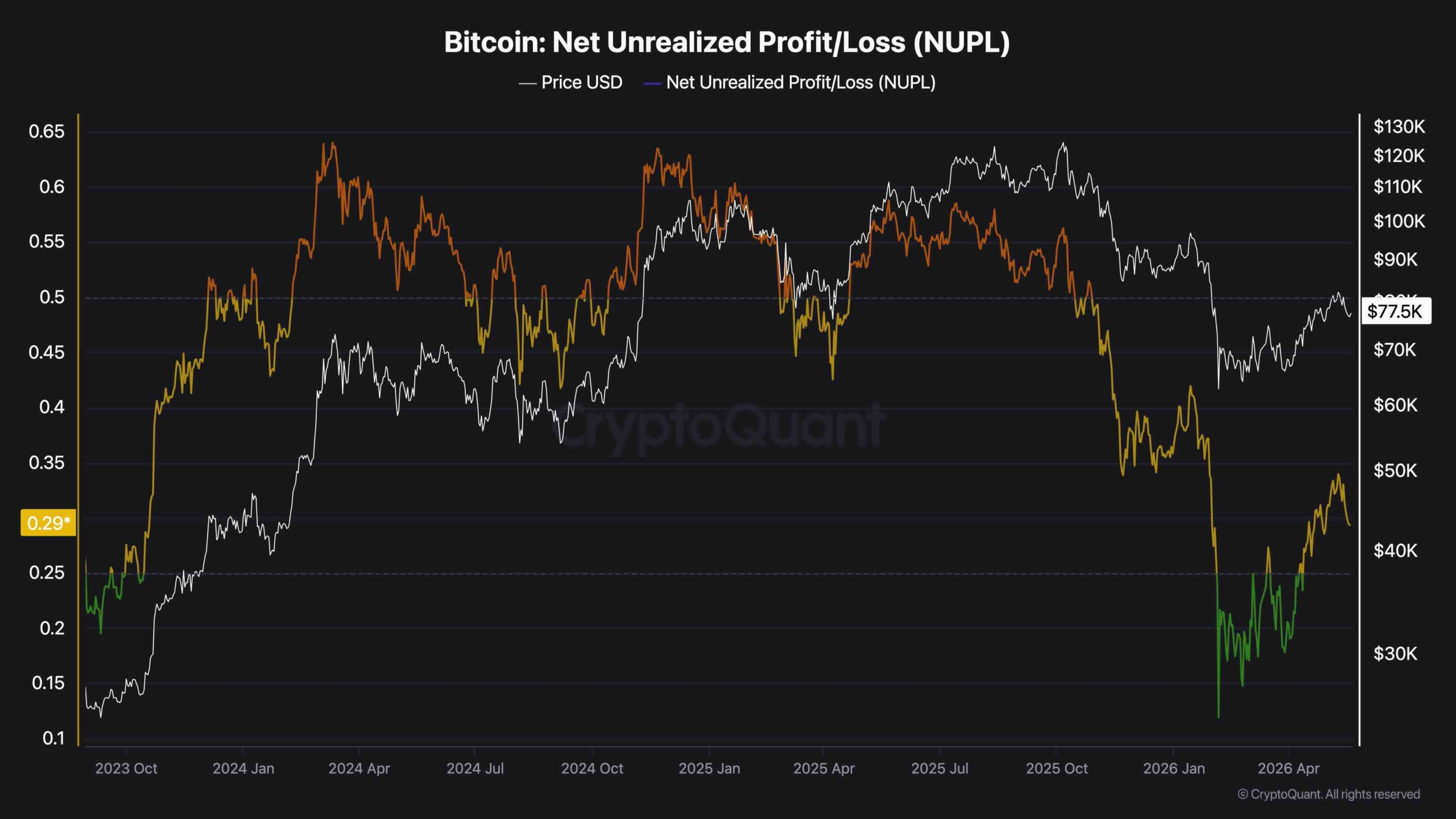
The post Bitcoin Price Analysis: On-Chain Metric Says BTC Is Coiling for a Big Move appeared first on CryptoPotato.
Crypto World
Latest Congressional swing at crypto tax reform would direct IRS to review de minimis exemptions


A bipartisan group of lawmakers introduced a revised crypto tax bill Wednesday that aims to update the tax code to better address crypto use cases and would, if signed into law, direct the IRS to analyze the effect de minimis exemptions might have.
Congressmen Steven Horsford (D-N.V.), Max Miller (R-Ohio), Suzan DelBene (D-Wash.) and Mike Carey (R-Ohio) reintroduced the Digital Asset Protection, Accountability, Regulation, Innovation, Taxation and Yields Act, otherwise known as the Parity Act, that Horsford and Miller had previously pushed a few times. The new language comes a week after lawmakers reportedly met to discuss crypto tax reform.
The new version of the bill calls for “regulated payment stablecoins” to incur no gain or loss unless the cost basis is less than 99% of the redemption value of the stablecoin, and it also creates a safe harbor for trading through brokers or in taxpayer accounts, defines how so-called “wash sale” rules might apply to digital assets and addresses how digital assets earned by acting as a validator.
The bill also directs the IRS to review what sort of tax burden crypto holders face when it comes to “small digital asset transactions” and how many transactions worth less than $200 are captured under existing law. This review should include the IRS’ needs if there was a de minimis exemption — meaning a carveout for activity that the law should consider too small to be concerned with — for crypto transactions, as well as whether and how such an exemption might be abused.
The crypto industry has long argued that freeing taxpayers of the burden of having to file and report taxes on small transactions would make it easier to use crypto as a payments tool for small items like a cup of coffee.
The bill is meant to just be a first step toward broader crypto tax reform, Horsford said at CoinDesk’s Consensus Miami conference earlier this month.
“I actually think tax is the foundation. Why? Because it’s tax policy that will determine number one, how these digital assets can be used in our finance system. And at a time when our federal tax code is outdated, it does not take into account the modernization of digital assets,” he said.
“For example, none of the current regulatory policy framework tells a consumer, an institution, or a builder what happens to their taxes when they sell a digital asset, earned staking reward, lend crypto on the U.S. platform or make a charitable contribution in bitcoin,” the lawmaker said “Those are tax questions. And they remain entirely unresolved.”
Hyperliquid's HYPE token crossed $50 on Wednesday for the first time since September 2025, in part fueled by a high-profile call from Bitwise's chief investment officer. Bitwise CIO Matt Hougan on Tuesday argued in a weekly memo that the market is undervaluing Hyperliquid. Hougan framed Hyperliquid… Read the full story at The Defiant
PI loses key support. Where will buyers return?
PI Network (PI) Price Predictions: Analysis
Key support levels: $0.15, $0.13
Key resistance levels: $0.16, $0.20
PI Loses Key Support as Sellers Return
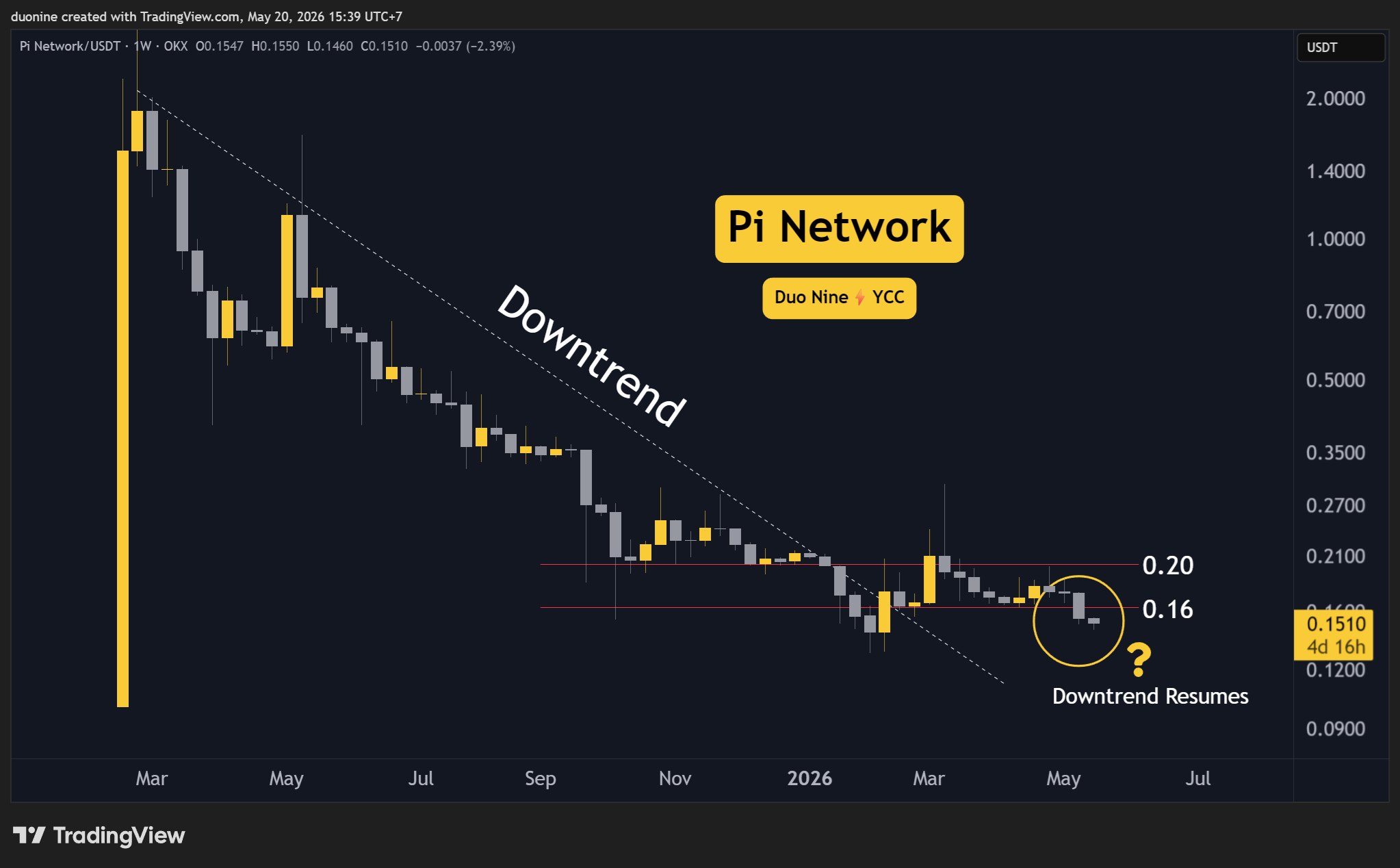
Since late last week, selling has intensified, which put pressure on the $0.16 support until this level could not hold any longer and broke. Because of this, it is now acting as a key resistance.
This breakdown could be interpreted as a resumption of the macro downtrend after a long pause that started in February when the price began to move sideways. To confirm the downtrend, the price will need to make a lower low under $0.13.
Bears Take Over the Price Action
Since PI lost support at $0.16, bears drove the price down to $0.15. Here, buyers appear to make a stand, but their conviction appears weak considering the low buy volume.
If buyers are unable to reverse this price action soon, then this cryptocurrency will likely test the all-time low at $0.13. A re-test of that level would be a bearish signal that could encourage sellers to push the price even lower.

Daily RSI Enters Oversold Area
Due to nonstop selling over the past five days, the daily RSI fell below 30 and entered the oversold area. This could explain why buyers may be interested here since a bounce is likely.
Sellers may need a break before they resume their pressure, which can give an opening for buyers to push back. However, any bounce may be short-lived, and a test of the key $0.13 support remains likely.

The post Pi Network (PI) Price Predictions for This Week, May 20 appeared first on CryptoPotato.


Securitize reported record quarterly revenue as the tokenization platform continued advancing toward an eventual public listing through its proposed SPAC merger with Cantor Equity Partners II (CEPT), underscoring growing institutional demand for tokenized real-world assets despite ongoing profitability pressures.
The Miami-based company said first-quarter revenue rose 39% year over year to $19.5 million, the highest quarterly revenue in its history, according to results released Wednesday.
Asset servicing revenue surged 201% to $8.3 million, reflecting the continued expansion of Securitize Fund Services, which serviced 650 active funds as of March 31. Tokenization revenue totaled $11.1 million, compared with $11 million in the same quarter a year earlier.
The company ended the quarter with $3.4 billion in tokenized assets under management, $24.9 billion in assets under administration and $1.9 billion in aggregated transaction volume.
Despite top-line growth, Securitize remained unprofitable as it increased spending on expansion efforts and preparations for becoming a publicly traded company. Net loss widened to $7.9 million, or 88 cents per diluted share, while adjusted EBITDA fell to $800,000 from $4.1 million in the prior-year period.
Chief Financial Officer Francisco Flores said the company continued investing in headcount and infrastructure to support long-term growth and its public-market transition, while maintaining what he described as disciplined expense management.
Securitize has agreed to merge with Cantor Equity Partners II, a Nasdaq-listed special purpose acquisition company, in a deal that would position it as one of the few publicly traded companies focused primarily on tokenized securities and real-world assets. Shares of CEPT rose 5% on Wednesday.

Bitwise Chief Investment Officer Matt Hougan described Hyperliquid as one of the most important crypto projects to emerge in recent years.
He believes that investors continue to underestimate both the platform’s long-term impact and the valuation of its native HYPE token.
Growth Trajectory
In a recent memo, Hougan said Hyperliquid has evolved beyond a crypto perpetual futures exchange into a financial “super-app” offering exposure to multiple asset classes, including commodities, S&P 500 futures, pre-IPO stocks, and prediction markets. According to Hougan, the platform’s growth has been driven in part by the regulatory environment emerging under SEC Chairman Paul Atkins, whose November 2025 remarks supported the development of multi-asset trading platforms operating outside conventional SEC structures.
The Bitwise exec noted that Hyperliquid now derives nearly half of its trading volume from non-crypto assets and claimed the figure could rise to 70% by year-end. Despite the platform remaining unavailable to US users, he described it as “one of the fastest-growing financial businesses” he has seen, while citing approximately $170 billion in monthly trading volume.
Hougan also stated that Hyperliquid represents a “Gen 2” token designed from Day 1 to accrue value, as he highlighted the platform’s reported policy of directing 99% of trading fees toward buying back HYPE tokens. This is very different from tokens launched during former chair Gary Gensler’s tenure. Hougan explained that those “governance tokens” that had little or no economic tie to the underlying blockchain or application, as they sought to remove any expectation of profit.
“In the future, I suspect this will be the norm for token design. In the meantime, it’s one of the reasons Hyperliquid is the best-performing large-cap crypto asset in the world over the past year.”
Hougan further claimed HYPE is currently one of the most mispriced assets in crypto due to category as well as anchoring error.
Institutional Momentum
His comments come days after 21Shares rolled out the first US spot ETF tracking Hyperliquid’s token under the THYP ticker. Bitwise followed suit with another exchange-traded fund tracking HYPE, under the ticker BHYP on the New York Stock Exchange (NYSE).
While other leading crypto assets continue to struggle, HYPE is leading the market rally. Over the past week alone, the token has amassed over 25% in gains.
The post Why Bitwise CIO Thinks Investors Are Mispricing Hyperliquid and HYPE Token appeared first on CryptoPotato.

Key takeaways
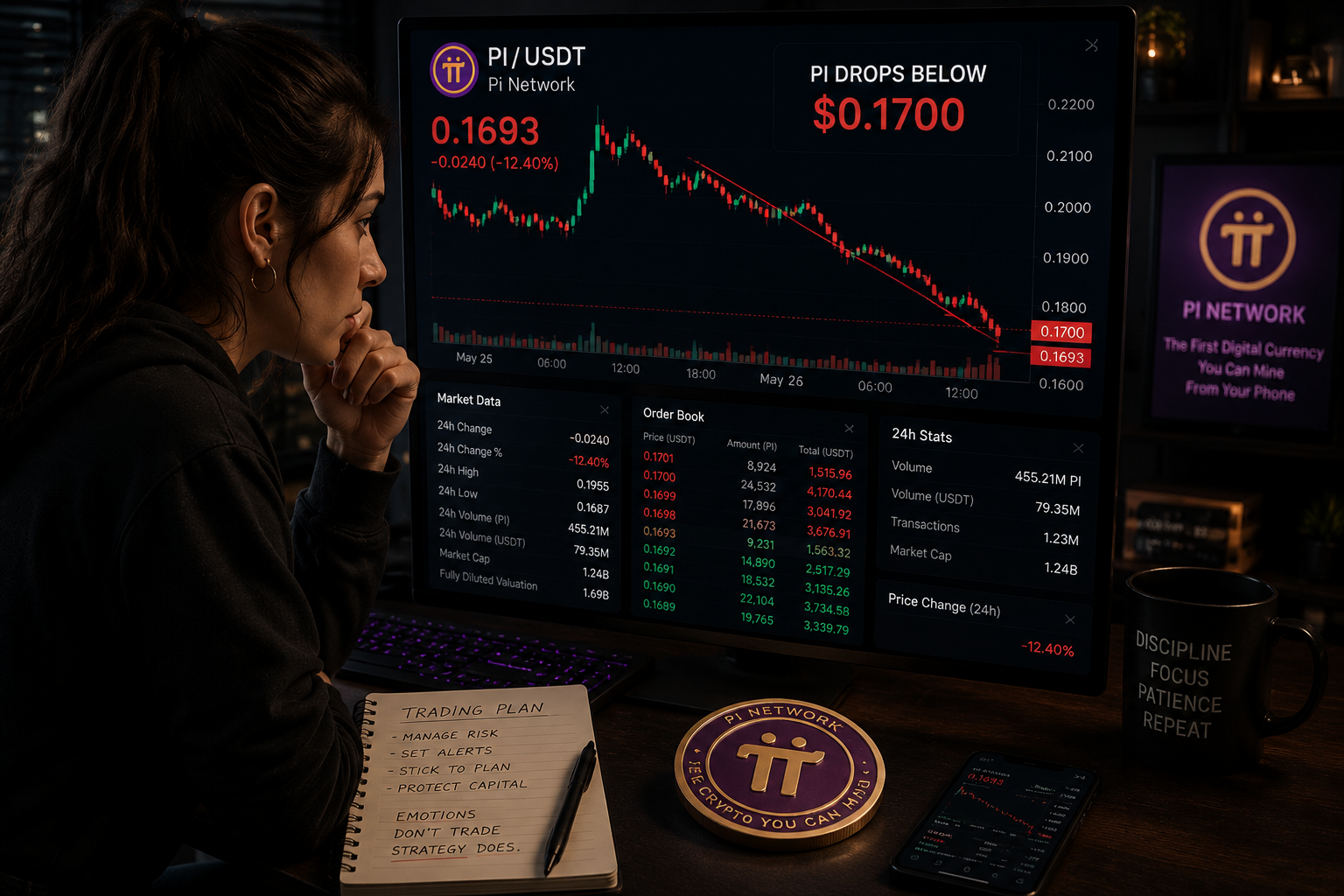
- PI has reclaimed the $0.1500 level after dropping below this critical area on Tuesday.
- The positive performance comes following the mainnet upgrade.
Pi Network has reversed its downward trend on Wednesday, climbing above the $0.1500 level following a major infrastructure upgrade to its mainnet nodes.
At press time, PI traded around $0.1518, extending recent losses while technical indicators hinted at the possibility of a short-term rebound.
Pi Core team completes major mainnet upgrade
The Pi Core Team announced that major mainnet nodes have successfully upgraded to Stellar protocol version 23, reflecting the project’s reliance on the Stellar blockchain infrastructure.
The update also included several backend improvements, such as migrating the operating system from Ubuntu 20 to Ubuntu 24 and upgrading the database engine from PostgreSQL 12 to PostgreSQL 16.
The latest upgrade is aimed at improving network performance, security, and long-term scalability as the ecosystem continues to evolve.
PI price outlook: Technical indicators suggest a possible recovery
The PI/USD 4-hour chart is still bearish and efficient as PI has underperformed over the past few days.
The bearish performance comes despite the infrastructure progress. The token is currently trading below both the 50-period Exponential Moving Average (EMA) near $0.1605 and the 200-period EMA around $0.1709, maintaining a broader bearish outlook.
However, momentum indicators suggest selling pressure may be weakening. The Relative Strength Index (RSI) has dropped to near 29, signaling oversold conditions while also forming a positive divergence as price approaches Tuesday’s low of $0.1463.
This type of divergence often points to a potential reversal or short-term bounce. If buying momentum increases, PI could attempt to retest a descending trendline resistance near $0.1519.
Meanwhile, the Moving Average Convergence Divergence (MACD) indicator remains flat below the zero line, indicating fading bearish momentum but not yet confirming a bullish recovery.

A successful breakout above the $0.1519 resistance level could open the door for a stronger recovery toward the 50-EMA at $0.1605, followed by the 200-EMA near $0.1709.
On the downside, the recent low at $0.1463 remains a critical support zone. A daily close below that level could invalidate rebound expectations and potentially trigger additional downside pressure for Pi Network.
Many leading altcoins, including Ethereum (ETH), Ripple (XRP), and Solana (SOL), have headed south over the past 30 days, moving in step with the market’s predominantly bearish tone.
However, Zcash (ZEC) has defied the overall pullback, posting a roughly 90% price increase during this period.
How Much Higher?
The privacy coin ZEC was the talk of the town towards the end of last year when its price surged from mere $50 to over $700 in a matter of two months. Back then, though, the entire crypto market was booming (even if Zcash was among the standout performers), whereas the recent surge appears far more unexpected.
Earlier this month, the token’s valuation briefly exceeded $630 before slightly retreating to the current $585 (according to CoinGecko’s data). Its market capitalization neared $10 billion, making ZEC the 14th-biggest cryptocurrency after flipping Cardano (ADA) and Bitcoin Cash (BCH). One factor that could have played a role in the ascent is the overall uptrend in privacy coins, with Monero (XMR) and Dash (DASH) also well in the green on a monthly scale.
Somewhat expected, crypto X is once again rammed with users envisioning further gains for ZEC. CryptoJack, for example, claimed that the asset has broken out of a descending channel, suggesting it could be starting a major move up.
Sjuul | AltCryptoGems and JAVON MARKS also gave their two cents. The former said ZEC looks “pretty bullish” as it’s potentially breaking out of a bull flag. JAVON MARKS noted the token’s strong progress and forecasted a possible rise above $700.
A Desired Correction?
Contrary to the bullish predictions made by the aforementioned market observers, ZEC’s Relative Strength Index (RSI) suggests the asset may cool off in the near term. The technical analysis tool ranges from 0 to 100, with ratios above 70 signaling that the coin is overbought and due for a potential pullback. On the other hand, readings below 30 are often considered buying opportunities. ZEC’s RSI briefly spiked beyond 80, while now it stands at roughly 66.

Such a correction, though, seems to be something that certain analysts would actually welcome. Altcoin Sherpa, for instance, said they want to hop on the bandwagon should the price drop to $470 or even lower.
The post Zcash (ZEC) Explodes 90% in a Month: Bull Trap or Major Rally Ahead? appeared first on CryptoPotato.


Key takeaways
- BTC remains around the $77k level after rejecting the 200-day moving average.
- The bearish performance comes as rising inflation and Treasury yields weigh on risk sentiment.
Bitcoin slipped below $77,000 earlier on Wednesday after failing to break above the 200-day moving average near $82,000, as rising inflation and tighter macroeconomic conditions weighed heavily on risk assets.
The decline comes after hotter-than-expected U.S. inflation data showed Consumer Price Index (CPI) growth accelerating to 3.8% year-over-year. At the same time, rising oil prices and a surge in the 10-year Treasury yield have reduced expectations for Federal Reserve rate cuts, with markets increasingly pricing in the possibility of a rate hike by December.
Bears continue to dominate the market
According to a report from K33 Research, Bitcoin’s rejection at the 200-day moving average mirrors patterns seen during previous market cycles in 2014, 2018, and 2022, when rapid rebounds were followed by sharp deleveraging-driven sell-offs.
K33 noted that those historical recoveries rebuilt trader confidence and leverage quickly, leaving markets vulnerable to aggressive corrections once momentum faded.
“A core ingredient in the ensuing legs lower was the unwind of positions built up during the rally itself,” the report stated.
However, analysts emphasized that the current cycle differs in several important ways. Bitcoin took significantly longer to revisit the 200-day moving average after breaking below it, spending 189 days before retesting the level in May. That compares with 96 days in 2014, 132 days in 2018, and 85 days in 2022.
Derivatives data suggest traders remain cautious rather than excessively bullish. Funding rates have stayed negative for 81 consecutive days, while options market skews are hovering near yearly highs, indicating persistent defensive positioning.
Institutional flows have presented a mixed picture. Global Bitcoin exchange-traded products (ETPs) recorded their largest weekly outflow of the year last week, totaling 24,303 BTC. The figure marked the ninth-largest five-day outflow since the launch of U.S. spot Bitcoin ETFs.
K33 noted that selling pressure intensified as Bitcoin approached the average ETF cost basis, a level that has historically triggered elevated outflows.
Bitcoin technical outlook: BTC consolidates around $77,000
At the time of writing, Bitcoin is hovering near $77200, slightly above the 50-day EMA at $76,743 and the 100-day EMA at $76,867.
However, the broader trend remains constrained by the 200-day EMA at $81,845, which continues to act as a strong overhead resistance level.
This positioning suggests that while short-term buyers are attempting to stabilize price action, longer-term trend signals have yet to confirm a bullish reversal.
Technical indicators point to declining bullish momentum. The Relative Strength Index (RSI) is drifting toward the mid-40s, indicating weakening buying pressure without yet reaching oversold conditions.
Meanwhile, the Moving Average Convergence Divergence (MACD) remains firmly in negative territory, reinforcing the view that recent upward moves have lost strength following the prior rally attempt.
If the rally resumes, immediate resistance is located at the 50% Fibonacci retracement level of the recent rally around $78,962. A breakout above this zone would be needed to challenge higher levels.

However, if the selloff continues, initial support is anchored by the 50-day EMA at $76,743. A break below this level could expose Bitcoin to further losses toward the 38.2% Fibonacci retracement at $74,487.
Deeper support lies near the reclaimed trendline around $70,785, with the 23.6% retracement level at $68,950 acting as a final key cushion for the current structure.
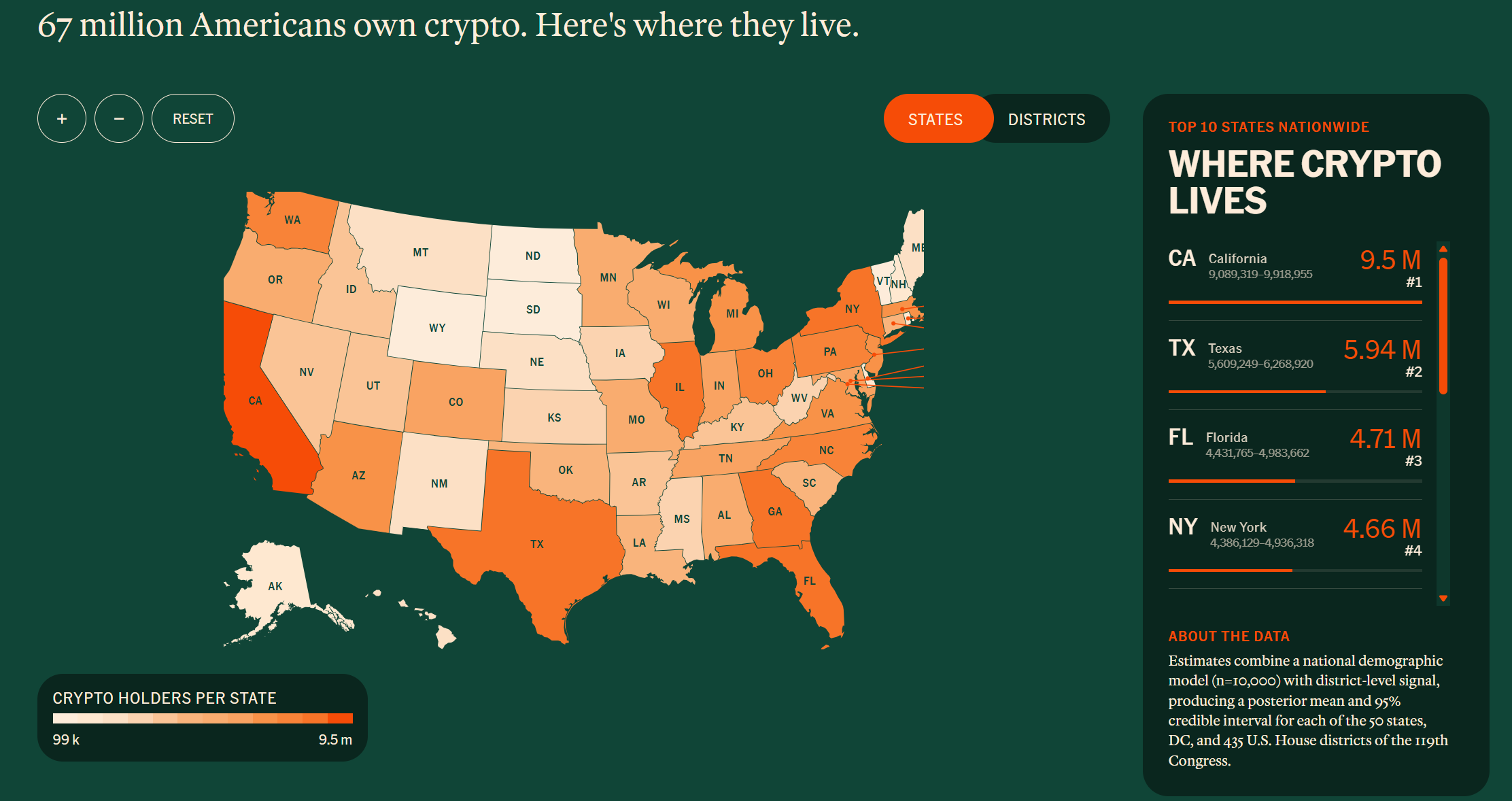
The National Cryptocurrency Association (NCA) says 67 million Americans now own cryptocurrency. The trade group cast the figure as proof that federal rules should clear Congress this year.
The May 20 push followed the Senate Banking Committee’s 15-9 vote on May 14. That vote advanced the Digital Asset Market Clarity Act of 2025 toward a full Senate floor test.
Adoption Hits One in Four US Adults
The NCA’s 2026 State of Crypto Holders Report polled 10,000 US holders with The Harris Poll. It recorded 12 million new owners, lifting the total to roughly one in four adults.
California leads with 9.5 million holders. Texas follows at 5.94 million, then Florida at 4.71 million and New York at 4.66 million.
Every state and congressional district registers significant numbers, according to the NCA’s interactive map.

CLARITY Act Nears Senate Floor Vote
The bill splits oversight between two federal regulators. Digital commodities go to the Commodity Futures Trading Commission. Securities-like tokens stay with the Securities and Exchange Commission.
The House passed an earlier version 294-134 in July 2025.
Democratic Senators Ruben Gallego of Arizona and Angela Alsobrooks of Maryland crossed over last week.
Every Republican on the panel voted yes, delivering the bipartisan committee vote. The bill now needs 60 floor votes to clear a filibuster.
“The Clarity Act isn’t about protecting an industry. It’s about protecting everyday Americans who deserve clear rules when they participate in the multi-trillion dollar crypto economy. 67 million Americans already hold crypto. The data is in. It’s time,” Ripple CLO and NCA President Stuart Alderoty pressed the case in a post.
Follow us on X to get the latest news as it happens
A Voter Bloc Forms Ahead of 2026 Midterms
Holders cluster across both party maps. Texas and Florida sit with California and New York at the top of the table.
That spread gives the cohort reach into competitive House districts in 2026. President Donald Trump’s strategic Bitcoin (BTC) reserve order has already aligned one party with the constituency.
Whether the floor vote tracks the committee’s bipartisan trajectory will test the data.
The post NCA Reveals the Number of American Crypto Holders as CLARITY Act Hits Senate Floor appeared first on BeInCrypto.

Girl ‘kidnapped and threatened with a knife during a seven-hour ordeal’

Astera Labs Shares Surge 12.29% to $274.24 on Strong AI Momentum and Analyst Upgrades
Bitcoin Price Analysis: On-Chain Metric Says BTC Is Coiling for a Big Move


-

 Crypto World5 days ago
BloFin War of Whales 2026 Grand Prix opens registration for $5M trading championship
-

 Fashion5 days ago
Weekend Open Thread: Theory – Corporette.com
-

 Crypto World5 days ago
E-Estate Announces 1 Year Live: Washington DC Summit as Real Estate Tokenization Enters Its Next Phase
-

 Tech6 days ago
Tech Moves: Microsoft AI leader jumps to OpenAI; former AI2 exec joins Meta; and more
-

 Tech5 days ago
Google reimburses Register sources who were victims of API fraud
-
 Crypto World6 days ago
Google’s Gemini AI Predicts Incredible Solana Price by the End of 2026
-

 Business5 days ago
H&R Real Estate Investment Trust (HR.UN:CA) Q1 2026 Earnings Call Transcript
-
 Entertainment6 days ago
Zara Larsson Has Blunt Response To Chris Brown Diss
-

 Sports5 days ago
Napoleonic enters 2026 Doomben 10,000 field via Abounding withdrawal
-
 Crypto World7 days ago
Two AI Tokens Lead May Rally, But Risks Are Rising
-

 Crypto World5 days ago
BeInCrypto 100 Institutional Awards Nomination: KAST for Best Digital Assets Neobank and Best Digital Assets Fintech
-

 Fashion4 days ago
On the Scene at Gucci’s Cruise Show in New York City: Mariah Carey, Kim Kardashian, Lindsay Lohan, Iman, and More!
-
 Crypto World5 days ago
Bitcoin Battles US Bond Nerves With BTC Price Dip Toward New May Lows
-
 Crypto World5 days ago
Wall Street’s Boldest Gold Prediction Has Russians Rushing to Buy
-

 Crypto World5 days ago
ICE and CME urge US regulators to curb Hyperliquid energy trading
-

 Fashion4 days ago
Trending Western Style Vests Perfect for Summer
-

 Entertainment5 days ago
David Letterman Returns to Late Show, Blasts Cancellation
-

 Politics6 days ago
DWP PIP Timms review continues to be an absolute farce
-

 Fashion4 days ago
Amazon Sundays: Memorial Day Hosting
-

 Crypto World5 days ago
IREN closes $3 billion convertible notes deal amid AI infrastructure expansion
You must be logged in to post a comment Login