
Crypto World
Goldman Sachs Targets BTC Yield With New Bitcoin Income ETF

Goldman Sachs filed with the SEC on April 14 to launch a Bitcoin Premium Income ETF, the bank’s first proprietary Bitcoin (BTC) fund product.
The filing adds Goldman to a growing list of Wall Street banks building dedicated BTC investment vehicles. Morgan Stanley debuted its own spot Bitcoin ETF just days ago.
How the Goldman Sachs Bitcoin ETF Works
The fund will invest at least 80% of net assets in instruments providing Bitcoin exposure. These include spot Bitcoin exchange-traded products and options on Bitcoin ETP indices.
Goldman’s core strategy relies on a dynamic options overwrite. The fund holds long positions in spot Bitcoin ETPs while selling call options against them, collecting premiums as monthly income.
The overwrite level ranges from 40% to 100% of BTC exposure, adjusted based on market conditions.
It does not hold BTC directly. A wholly owned Cayman Islands subsidiary can hold up to 25% of assets, helping the fund meet regulatory requirements for holding commodities under the Investment Company Act of 1940.
In flat or mildly volatile markets, option premiums may help the fund outperform plain spot Bitcoin ETFs. During strong rallies, the sold calls cap upside participation.
ETF analyst Eric Balchunas noted Goldman may be responding to client demand for lower-volatility BTC exposure.
“Goldman may sense opp to leap frog them and/or is prob hearing from their clients they want bitcoin but with less vol and happy to give up some upside for lower downside and income,” he wrote.
Wall Street’s Bitcoin Product Race Heats Up
Goldman has been steadily expanding its crypto footprint. Its most recent 13F filing showed roughly $1.1 billion in Bitcoin ETF holdings and more than $2.36 billion in total crypto ETF exposure.
The bank also recently acquired Innovator Capital Management, which issues Bitcoin-linked structured products.
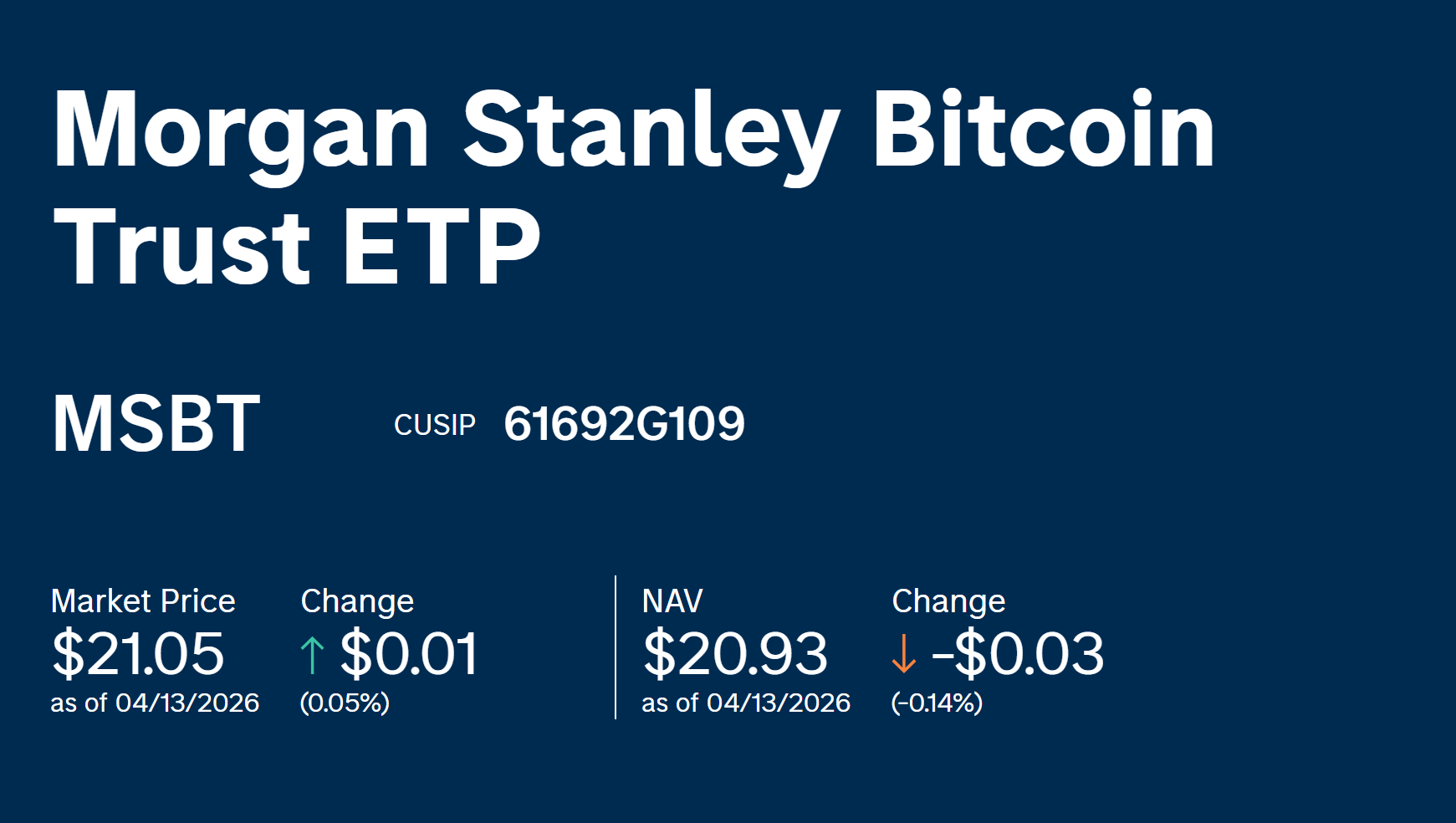
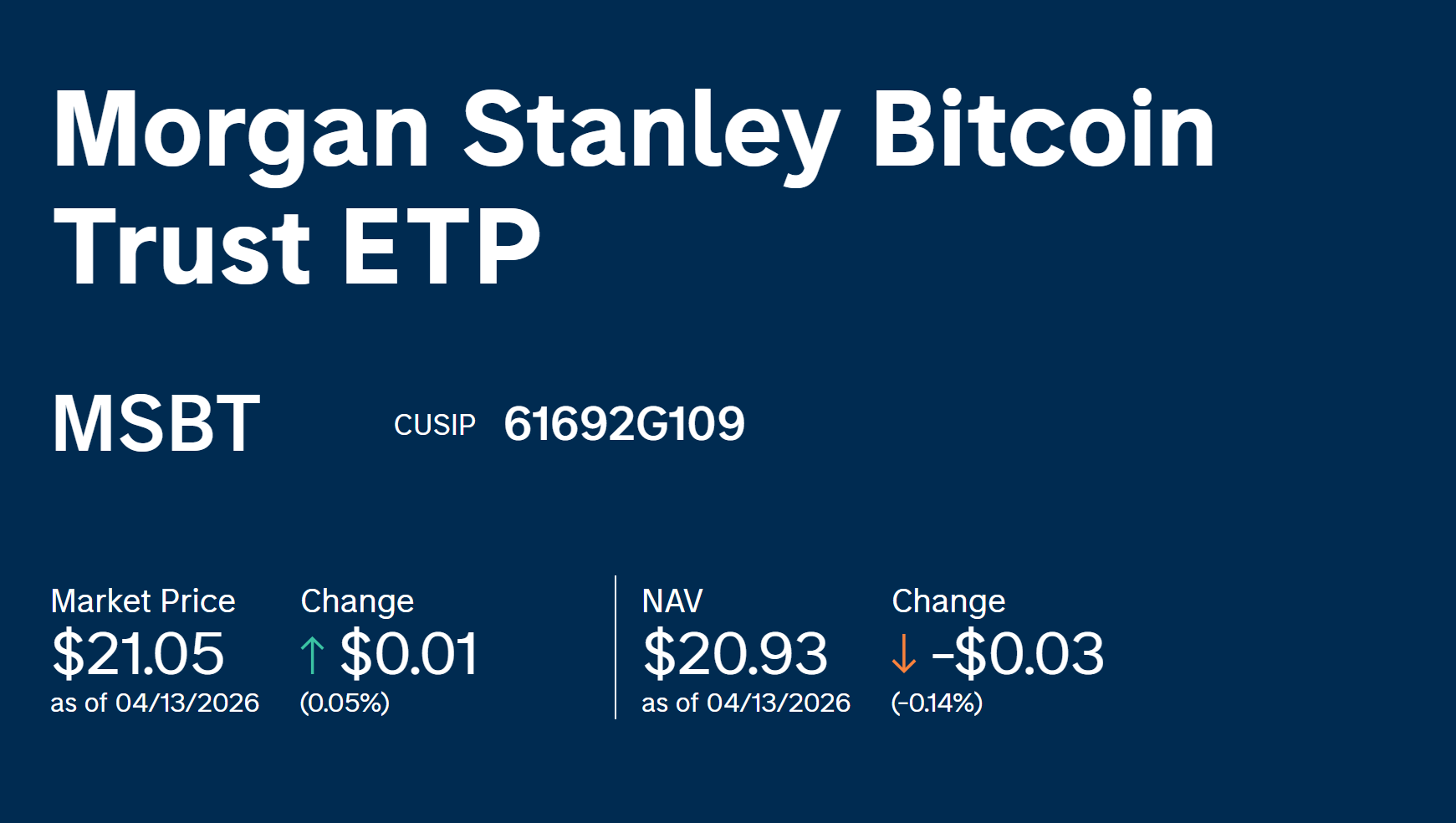
The filing comes less than a week after Morgan Stanley launched the Morgan Stanley Bitcoin Trust (MSBT) on NYSE Arca.
“Seeing a global giant like Morgan Stanley highlighting crypto on their homepage like this is such a positive sign…This is how it goes mainstream. TradFi isn’t on the sidelines of crypto anymore. It is actively prioritising and scaling it as a core asset class. Next stop: every large wealth platform in the world treating crypto like just another asset class,” commented Summit Gupta.
That fund tracks BTC’s spot price at a 0.14% expense ratio, making it the cheapest spot Bitcoin ETF on the market. It drew $30.6 million in first-day inflows.
Goldman’s product targets a different audience. While MSBT appeals to investors seeking pure price exposure at low cost, the Premium Income ETF is designed for those willing to trade upside for regular distributions.
Grayscale launched its own Bitcoin Premium Income ETF (BPI) in April 2025 with a 0.66% expense ratio. BlackRock has a similar product at an advanced stage of development. Goldman’s fees have not yet been disclosed.
The filing is a post-effective amendment. The fund could launch roughly 75 days after the April 14 filing date, pending SEC review. A ticker has not yet been assigned.
For traditional portfolio allocators, the entry of a $3.5 trillion asset manager packaging BTC volatility as yield further narrows the gap between crypto and conventional income investing.
The post Goldman Sachs Targets BTC Yield With New Bitcoin Income ETF appeared first on BeInCrypto.

TRON founder escalates feud with Trump-linked DeFi project, alleging coercion and frozen voting rights.
World Liberty Financial’s freshly posted governance proposal to unlock 62.3 billion WLFI tokens drew an immediate broadside from TRON founder Justin Sun, who published a lengthy rebuttal onX, calling the plan “World Tyranny, Not World Liberty Financial.”
Sun, who invested $75 million in the Trump family-backed DeFi venture, accused the team of engineering the vote so that dissenters are punished, as holders who vote against the proposal see their tokens locked indefinitely with no unlock path, while large holders like himself have been frozen out of the process entirely.
“I personally hold approximately 4% of the voting power, yet my tokens have been frozen and I am forced out of this voting process,” Sun wrote. “The outcome was determined before the vote even began.”
The proposal, announced by WLFI on Tuesday, would place early supporter tokens on a two-year cliff followed by a two-year linear vest. Founders, team members, and advisors would face a longer five-year schedule, with 10% of their allocation permanently burned on passage. Holders who do not opt in remain locked indefinitely. WLFI called the plan “one of the strongest long-term governance alignment signals in DeFi.”
Sun sees it differently. He called the vote “a performance where the police have already barricaded the doors of parliament” and pointed to what he described as a deeper structural problem: the WLFI smart contracts are ultimately controlled by a 3-of-5 anonymous multisig and a single anonymous guardian address that can blacklist any wallet. Voters, meanwhile, must complete identity verification to participate.
“Your voters must register, submit to scrutiny, and be vetted — while your dictators won’t even show their faces,” Sun wrote.
Feud Erupts Into Open War
The response caps a week of escalation between the two sides. Tensions boiled over on Sunday after Sun accused WLFI of embedding a hidden blacklisting function in the token contract and called the team’s actions illegitimate. WLFI fired back, threatening legal action. “See you in court pal,” the project’s official X account posted.
Sun demanded that whoever was operating the account identify themselves. “As the largest investor in this project, I demand that those responsible come forward by name, instead of hiding in the shadows.”
The clash followed days of scrutiny over WLFI’s treasury operations. The Defiant previously reported that WLFI deposited 5 billion of its own governance tokens into Dolomite, a lending protocol co-founded by WLFI’s chief technology officer, and borrowed roughly $75 million in stablecoins, some of which were routed to Coinbase Prime.
Sun’s wallet containing more than 500 million WLFI tokens has been frozen since September 2025, when the project blacklisted his address after on-chain analysts flagged transfers routed through HTX, his crypto exchange. WLFI alleged Sun breached his investor agreement. Sun has maintained that the freeze was unjustified.
Token in Freefall
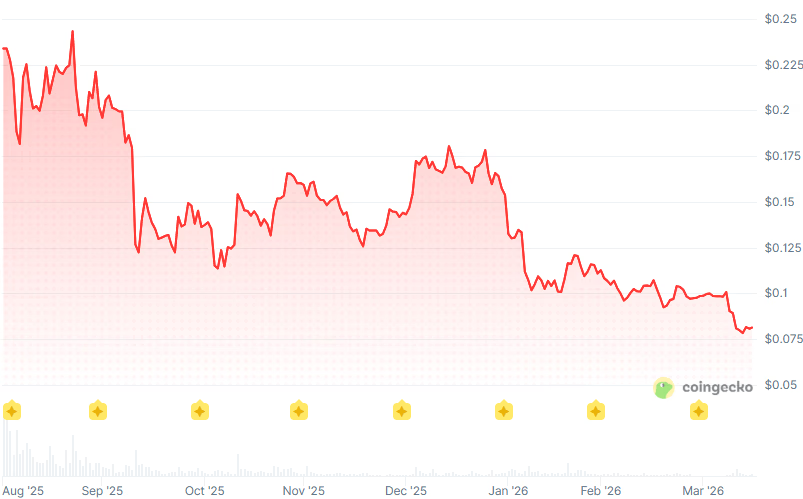
WLFI was trading around $0.08 on Tuesday, down roughly 75% from its all-time high and near its all-time low of $0.077 hit last week. The token’s market cap has fallen to approximately $2.5 billion.

Sun closed his statement by calling on all WLFI holders to “see this proposal for what it truly is” and to “reserve all legal rights of recourse.”
This article was written with the assistance of AI workflows. All our stories are curated, edited and fact-checked by a human.
Another political action committee (PAC) aligned with the cryptocurrency industry announced its endorsement for a candidate in Ohio’s Senate race, signaling a move that could mirror the 2024 US election.
In a Wednesday notice, Sentinel Action Fund, a group that claims to be the “only conservative Super PAC advancing pro-crypto candidates and supporting pro-crypto innovation,” said it would be supporting Republican Jon Husted in this year’s race to represent Ohio in the US Senate.
Husted was appointed by Ohio Governor Mike DeWine in January 2025 to replace JD Vance, who was elected vice president alongside US President Donald Trump in his 2024 election win. He still faces a field of Republican candidates ahead of a May 5 primary in Ohio, where former Senator Sherrod Brown will also face off in the Democratic primary against Ron Kincaid.
Sentinel Action Fund President Jessica Anderson specifically cited Brown as having “stood in the way of pro-innovation policies when it comes to digital assets” in the PAC’s endorsement of Husted.
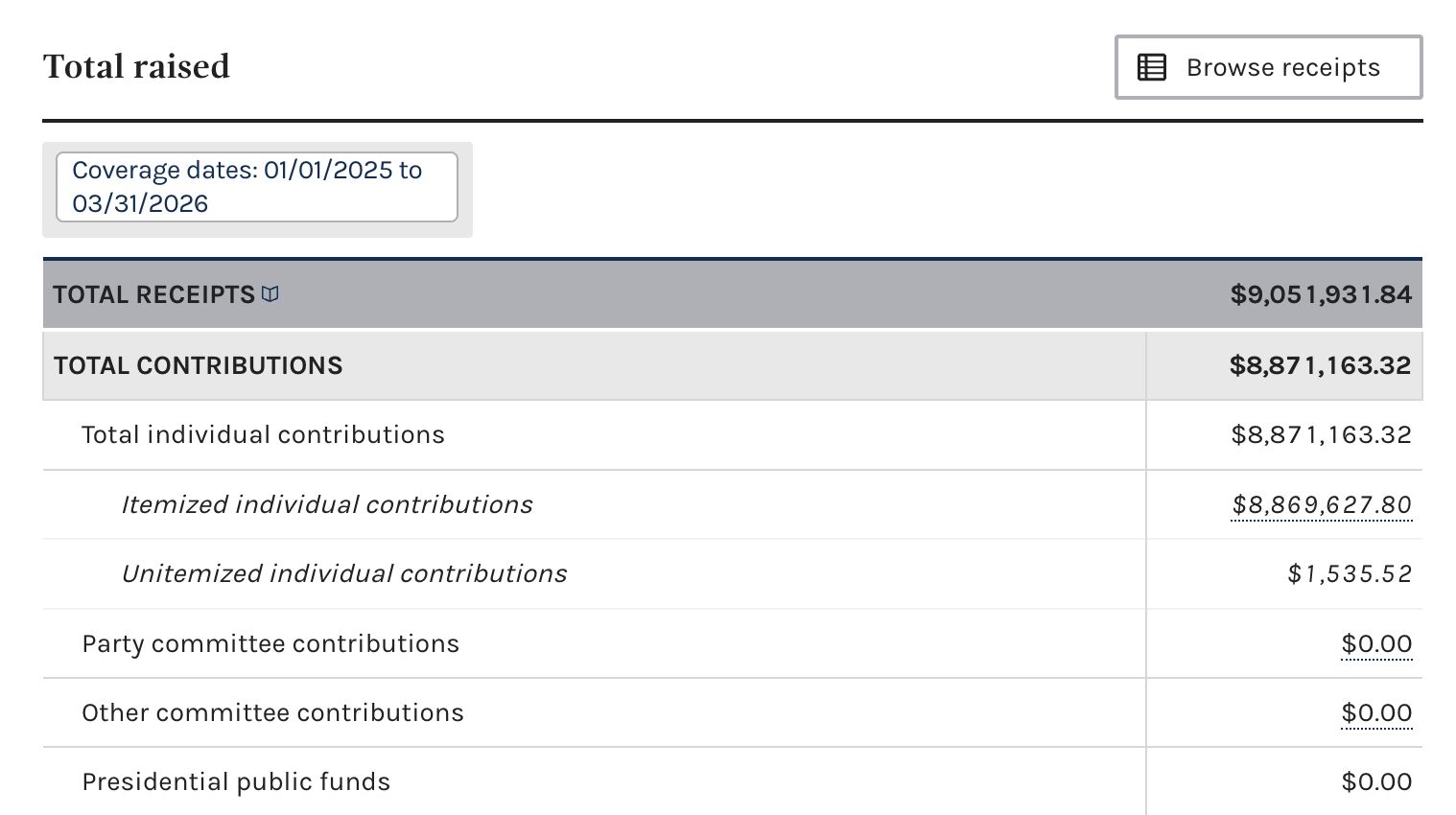
Although filings with the Federal Election Commission (FEC) as of Tuesday showed no disbursements supporting Husted in 2026, the PAC and its sister organization, Right Vote, pledged to spend more than $8 million in the Buckeye state. The Sentinel Action Fund reported about $9 million raised from January 2025 through March 2026, including $750,000 in contributions from the digital asset advocacy organization Solana Policy Institute and $250,000 from crypto investment company Multicoin Capital.

The PAC’s move into the Ohio race could serve as a bellwether for how money from crypto-aligned interest groups will respond to the upcoming US elections. In 2024, crypto-backed PACs spent more than $40 million in the US State to support Republican Bernie Moreno’s run to unseat Brown, who had made many public statements criticizing crypto.
Related: Coinbase-backed crypto advocacy group unveils 2026 election plan
Despite having lost his seat, Brown announced in August that he would run again for Senate. Moreno’s seat won’t be up for grabs until 2030.
Ohio Senate race isn’t the only one in the state focused on crypto
Vivek Ramaswamy, a former Republican candidate for US President and one of the backers for Bitcoin (BTC) treasury company Strive, has also thrown his hat into Ohio’s gubernatorial race.
Launching his campaign in February 2025 following his departure from Trump’s Department of Government Efficiency (DOGE), Ramaswamy supported efforts to create a strategic BTC reserve in Ohio.
However, many critics have pointed to the Republican candidate’s financial disclosures filed on April 6 as examples of conflicts of interest.
Ramaswamy reported a 10% stake in Strive and could benefit from the value of the company’s Bitcoin holdings increasing in response to Ohio’s treasury investing in the cryptocurrency, which he would have significant influence over as governor. Strive reported holding about 13,768 Bitcoin as of Wednesday, worth more than $1 billion.
Disclosure: A member of the immediate family of Staff Editor Robert Lakin has contributed to the campaigns of Ohio Democratic gubernatorial candidate Amy Acton and Ohio Democratic Senate candidate Sherrod Brown in amounts less than $200.
Magazine: Bitcoin will not hit $1M by 2030, says veteran trader Peter Brandt
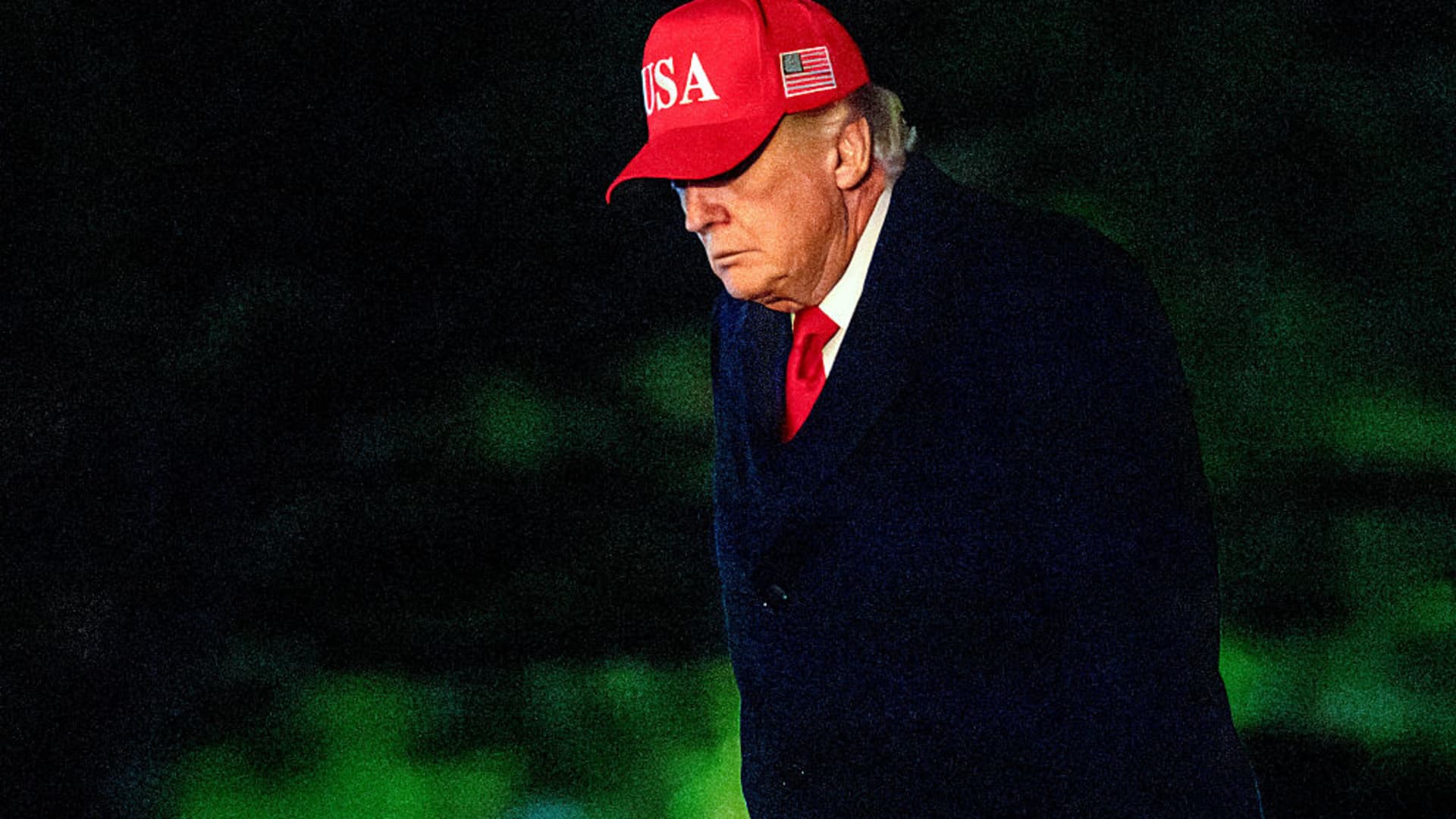
US President Donald Trump walks on the South Lawn of the White House after arriving on Marine One in Washington, DC, US, on Sunday, April 12, 2026. Trump attacked Pope Leo XIV for his criticisms of the US-Israeli war on Iran, calling the leader of the Catholic Church “WEAK on crime.” Photographer: Bonnie Cash/UPI/Bloomberg via Getty Images
Bloomberg | Bloomberg | Getty Images
U.S. derivatives regulators are examining a handful of unusual oil futures trades that took place minutes before a surprise announcement by President Donald Trump signaling a pause in attacks on Iran, according to Bloomberg News.
The investigation is being spearheaded by the Commodity Futures Trading Commission, which is scrutinizing activity on trading venues run by CME Group and Intercontinental Exchange, Bloomberg reported, citing people familiar with the matter. Both exchanges have been asked to turn over pertinent records.
Regulators are zeroing in on at least two instances over a roughly two-week period when trading volumes jumped sharply just ahead of key announcements. The information sought includes so-called Tag 50 identifiers, which can be used to determine who was behind the trades, the people said.
The CFTC declined to comment.
CME didn’t specifically comment on the unusual trades tied to Trump’s announcement, but the exchange pointed out that any investigation should also include new participants like prediction markets.
“Nothing is more important than market integrity,” a spokesperson at CME told CNBC. “We vigorously surveil our markets and work closely with the CFTC to oversee trading activity. Importantly, any review of market behavior must include all venues, including prediction markets like Polymarket and Kalshi that list related products with little to no visibility.”
ICE didn’t immediately respond to a CNBC request for comments.
CNBC previously reported on the suspicious activity on March 23 when S&P 500 e-mini futures and West Texas Intermediate May crude futures saw a sudden and isolated surge in volume in otherwise muted premarket trading.
About 15 minutes later, Trump said on Truth Social that the U.S. and Iran had held talks and that he was halting planned strikes on Iranian power plants and energy infrastructure. The announcement triggered an immediate reaction across markets, with S&P 500 futures jumping more than 2.5% ahead of the open, and WTI crude oil futures tumbling nearly 6%.
The sudden, simultaneous spikes in volume in stock-index and crude futures raised eyebrows among traders, particularly as they came without any clear news or trigger at the time.
Last week, Sens. Elizabeth Warren, D-Mass., and Sheldon Whitehouse, D-R.I., called on the CFTC to open investigations into such unusual trades, raising the question of whether there has been recurring misappropriation of material nonpublic government information.
— Click here to read the original Bloomberg News story.


Aave Checkpoint combines automated AI analysis with mandatory human verification to review all DAO proposals before onchain execution.
Aave Labs introduced Aave Checkpoint on April 15, an AI-powered governance security system designed to add a multi-layered review process for every proposal and payload before onchain execution. Checkpoint combines automated analysis with mandatory human verification, working alongside Certora’s manual proposal reviews to strengthen the security posture of the Aave DAO and ensure no proposal reaches the chain without thorough review.
The system implements two core components: automated AI analysis for initial proposal assessment and mandatory human review as a secondary verification layer. Checkpoint complements existing security measures rather than replacing them, positioning itself as part of Aave’s structured approach to governance risk management across the decentralized autonomous organization.
Sources: Aave Governance
This article was generated automatically by The Defiant’s AI news system from publicly available sources.


After crypto’s worst Q1 since 2018, ETF inflows have turned positive, and $268 billion in stablecoins sits on the sidelines waiting for a catalyst.


Network News
BITCOIN PROPOSAL THAT COULD FREEZE QUANTUM-RELATED COINS: Bitcoin was built on a promise that no one can touch your coins without your private key. No government, no bank, nobody. That promise is now, for the first time in Bitcoin’s 16-year history, being challenged by the developer community itself as part of measures to build defenses against future quantum computers that could compromise Bitcoin’s blockchain and steal your coins. Jameson Loop, one of the outspoken bitcoin contributors, and other cryptographers have proposed a move that could force bitcoin holders to migrate their coins to new quantum-resistant addresses or face having their coins frozen permanently by the network itself. In that scenario, holders would technically still “own” the coins, but lose the ability to move them. It is called Bitcoin Improvement Proposal (BIP)-361 and was updated in Bitcoin’s official proposal repository with the title “Post Quantum Migration and Legacy Signature Sunset.” This comes as a recently released Google report warned that a sufficiently powerful quantum machine could require significantly less firepower to compromise the Bitcoin blockchain than initially estimated. This prompted some observers to cite 2029 as the quantum deadline for bitcoin. — Omkar Goldbole Read more.
AI AGENTS POWER CRYPTO PAYMENTS: The cryptocurrency industry is racing toward a future where AI agents handle everything from booking flights to executing trades and making payments, but new research suggests the infrastructure underpinning that shift may not be secure. McKinsey recently projected that AI agents could mediate $3 trillion to $5 trillion of global consumer commerce by 2030. The team found that so-called “LLM routers,” or services that sit between users and AI models, can serve as a powerful attack vector for malicious actors. These routers are designed to forward requests to models like OpenAI or Anthropic, but they also have full access to everything passing through them, including sensitive data. “LLM agents have moved beyond conversational assistants into systems that book flights, execute code, and manage infrastructure on behalf of users,” the researchers wrote, highlighting how quickly these tools are taking on real-world financial and operational tasks. The LLM routers or attack points leave users extremely vulnerable as they assume they are interacting directly with a reputable AI model, such as OpenAI, Grok or otherwise, when in reality many requests pass through intermediary services that can see and modify that data, the researchers said. — Olivier Acuna Read more.
CoW SWAP SECURITY BREACH: CoW Swap, a decentralized trading interface, said Tuesday it temporarily halted its services after detecting a domain name system (DNS) hijacking incident affecting its website, underscoring ongoing security risks at the front-end layer of DeFi platforms. In a post on X, the team said the attack occurred at 14:54 UTC and warned users to avoid interacting with its interface until further notice. While the protocol’s underlying infrastructure, including its backend and APIs, was not directly compromised, both were paused “as a precaution” as the team worked to resolve the issue. DNS hijacking allows attackers to redirect users from a legitimate domain to a malicious lookalike site, often to drain crypto wallets or harvest private data. The attack vector has become a persistent weak point in decentralized finance, where users typically rely on web-based interfaces to access otherwise secure smart contracts. CoW Swap operates as a decentralized exchange aggregator, sourcing liquidity across venues and using the “Coincidence of Wants” mechanism to match trades directly between users or batch them for more efficient execution. Orders are handled by competing “solvers” that optimize trade outcomes, a design intended to reduce slippage and limit exposure to maximal extractable value (MEV). — Margaux Nijkerk Read more.
ZK PROOFS ON XRP LEDGER: The XRP Ledger added native support for zero-knowledge (ZK) proofs by integrating with Boundless, a ZK proving network, in what the company claims is the first such deployment on the ledger. The move is designed to let financial institutions transact privately on the public blockchain while meeting regulatory requirements. It addresses a specific barrier to institutional adoption that has persisted across every public blockchain. Transaction flows, treasury positions, and counterparty relationships are visible by default on public ledgers. For a bank settling cross-border payments or a fund managing OTC positions, that transparency creates competitive risk. Zero-knowledge proofs solve this by allowing one party to prove a statement is true without revealing the underlying data. It’s like passing a credit check, where the bank confirms an individual qualifies for a loan without disclosing specifics about income, debts or account balances to the lender. In practice on XRPL, this means a payment can be verified as valid, correctly funded, and compliant without exposing the amount, the sender, or the receiver to the public ledger. — Shaurya Malwa Read more.
In Other News
- The Trump family-backed World Liberty Financial has proposed unlocking 62.3 billion WLFI governance tokens on Tuesday, less than a week after CoinDesk reported the venture had used 5 billion of its own tokens as collateral on lending platform Dolomite to borrow $75 million in stablecoins. WLFI’s token was originally sold as a governance-only token with no transferability and indefinite locks. A vesting schedule with a defined path to liquidity changes the economic profile of what holders bought. The proposal would unlock liquidity for insiders who previously had no exit, thereby changing the token’s economics. The proposal splits the locked supply into two groups. Early supporters holding 17 billion WLFI would receive a 2-year cliff followed by a 2-year linear vest, retaining all tokens. Founders, team members, advisors, and partners holding 45.2 billion WLFI would face a 2-year cliff and 3-year vest, but with 10% of their allocation, roughly 4.5 billion tokens, burned immediately on passage. (Burns refer to the permanent removal of tokens from supply, usually by sending them to an address that is not controlled by anyone.) In practice, it means insiders would surrender 4.5 billion tokens in exchange for unlocking 40.7 billion previously locked indefinitely, with no vesting schedule attached. Those tokens had no path to liquidity before this proposal. — Shaurya Malwa Read more.
- Some 572 bitcoin worth $42.77 million moved from a Gemini hot wallet into wallets owned by Winklevoss Capital and custody wallets in the past 24 hours, according to Arkham Intelligence data, the first significant transfers into the fund’s addresses in over a month. The transfers came in two batches. One of 372 BTC and one of 200 BTC, about 11 hours later. Both moved from addresses tagged by Arkham as belonging to the crypto exchange to addresses tagged as Winklevoss Capital and Gemini Custody. Winklevoss Capital now holds 9,328 BTC worth $689 million across 128 tracked addresses, up from about 8,800 BTC after a $128.5 million deposit into Gemini roughly a month ago that brought holdings to their lowest level since 2012. It also holds 70,588 ETH worth $163.7 million, bringing its total tracked portfolio to approximately $853 million, the Arkham data show. The onchain data shows the direction of movement, not the intent. The transfers could reflect new purchases, internal rebalancing between Gemini’s exchange and custody infrastructure, or a partial reversal of last month’s deposit. — Shaurya Malwa Read more.
Regulatory and Policy
- Pakistan’s central bank notified all banks and financial institutions in the country that the ban on providing crypto services has been lifted. However, according to the new state bank rules, banks are banned from investing, trading or holding crypto assets using their own funds or customer deposits. The State Bank of Pakistan’s move follows the recent enactment of the 2026 Virtual Assets Act, which establishes Pakistan’s Virtual Asset Regulatory Authority (PVARA to license, regulate and supervise the sector. The central bank replaced its 2018 ban on crypto with new rules that permit regulated banks and other financial institutions to open accounts for crypto firms approved under PVARA. Under the new state bank framework, banks can provide services to virtual asset service providers (VASPs) licensed under the new crypto act, as well as to those seeking approval, subject to strict compliance with anti-money laundering (AML), know-your-customer (KYC), and other counter-terrorism financing regulations. — Olivier Acuna Read more.
- Tom Duff Gordon, the vice president of international policy at U.S.-listed cryptocurrency platform Coinbase (COIN), has left the firm for pastures green. Duff Gordon, who had been with Coinbase for close to 4 years, left the exchange to join OpenAI as head of EMEA Policy, a Coinbase spokesperson said via email. Duff Gordon had previously spent 8.5 years working as a banker at Credit Suisse. He did not immediately respond to a request for comment. An expert on crypto regulations, Duff Gordon, recently pointed out that U.K. banks are blocking millions of customers from accessing legal and compliant services by failing to distinguish between Financial Conduct Authority-registered firms with low fraud rates and higher-risk operators. — Ian Allison Read more.
Calendar
- Apr.15-16, 2026: Paris Blockchain Week, Paris
- May 5-7, 2026: Consensus, Miami
- Sept. 29-Oct.1, 2026: Korea Blockchain Week, Seoul
- Oct. 7-8, 2026: Token2049, Singapore
- Nov. 3-6, 2026: Devcon, Mumbai
- Nov. 15-17, 2026: Solana Breakpoint, London
Crypto World
A Bittensor Developer Dumped 37,000 TAO Crypto and Quit the Network: Is the Governance Crisis Just Getting Started?
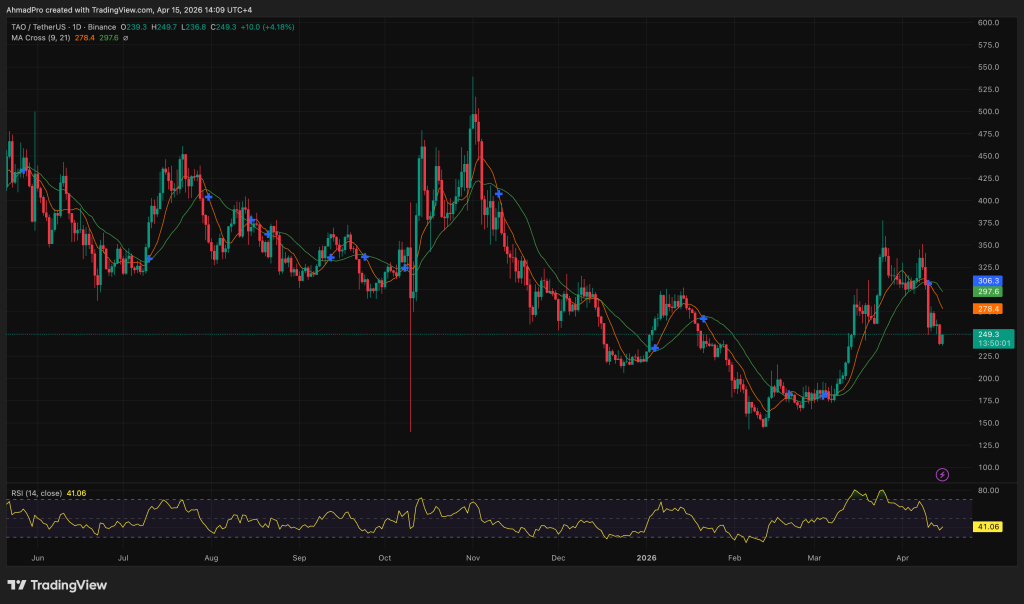
Bittensor TAO crypto token is trading near $249, down over 4.5% in 24 hours and nearly 68% off its all-time high of $767.68, after one of the most damaging governance crises in the project’s history.
The question isn’t just whether the price recovers. It’s whether the trust does. Covenant AI’s abrupt exit from the network has exposed a fault line that technical analysis alone can’t price in.
On April 11, Covenant AI publicly quit the Bittensor subnet, accusing co-founder Jacob Steeves of holding disproportionate control over governance.
The announcement immediately triggered panic selling. Analyst Michaël van de Poppe identified the core accelerant: Covenant’s founder dumped 37,000 TAO into the market, igniting a cascade of liquidations that sent TAO down nearly 25% from $330 to a low of $265.
The team has since responded with the Teutonic-I update and governance proposal BIT-0011, designed to prevent coordinated subnet exits from triggering similar sell-offs.
Whether that’s enough to stabilize sentiment is the only chart that matters right now. Broader crypto market conditions add an additional layer of complexity to TAO’s recovery timeline.
Can Bittensor (TAO) Crypto Price Recover Above $281 or Is Another Leg Down Coming?
TAO is currently testing one of the most critical support zones in its recent history: the $250–$263 band. Technical structure is bearish, the daily MACD has posted a clear bearish crossover, the token has now rejected a multi-month descending trendline twice, and the most recent swing high ($390) printed a lower high after the $475 peak.
Social mentions surged 340% and search interest spiked, a pattern that historically precedes sharp two-way moves rather than clean directional trends.
TAO crypto right now is all about whether confidence comes back or keeps fading, because if governance stabilizes and that proposal passes, that is where sentiment flips fast, and price can reclaim $281, opening the door toward $330 and restoring the whole AI narrative around it.
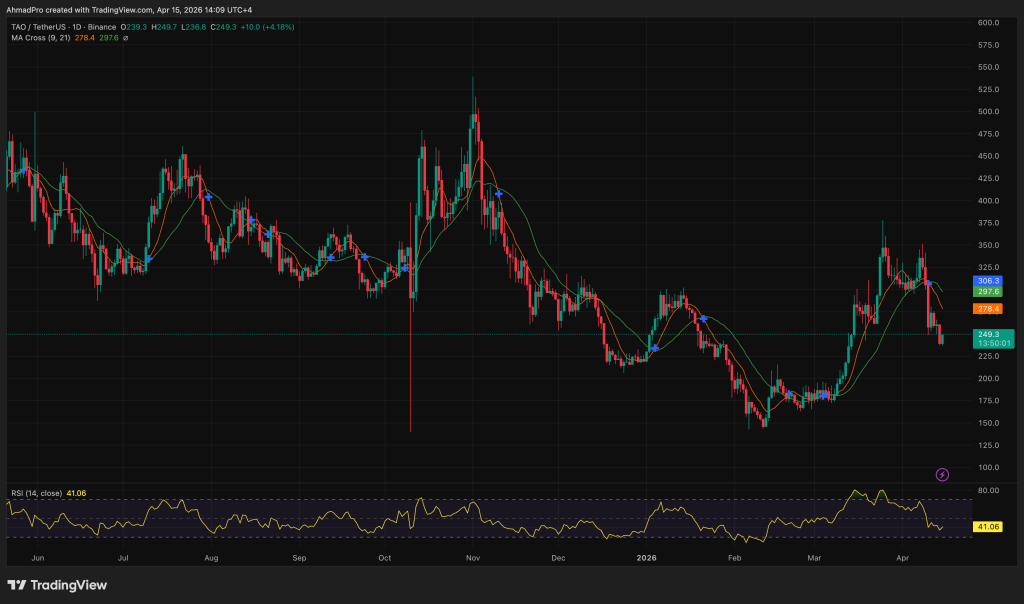
More realistically, though, trust takes time to rebuild, so price likely chops between $250 and $281 while buyers slowly absorb selling pressure and the market waits for clearer signals.
The risk is that if things keep deteriorating, because if more subnets leave and governance keeps failing, that $250 level becomes fragile, and once it breaks on a higher timeframe close, the downside opens quickly toward the low $200s or even lower if panic kicks in.
At a $2.55 billion market cap and ranked #38, TAO isn’t a project on the margins. But right now, price action is hostage to governance news, not technicals.
LiquidChain Targets Early Mover Upside as Bittensor Tests Key Levels
TAO’s governance crisis is a reminder that decentralized infrastructure is only as strong as its coordination layer, and that even projects with compelling AI narratives can crater on structural trust failures.
For traders watching TAO bleed through support, the risk-reward calculus at current levels is genuinely uncertain. That’s prompting rotation into earlier-stage infrastructure plays where entry price still carries asymmetric upside.
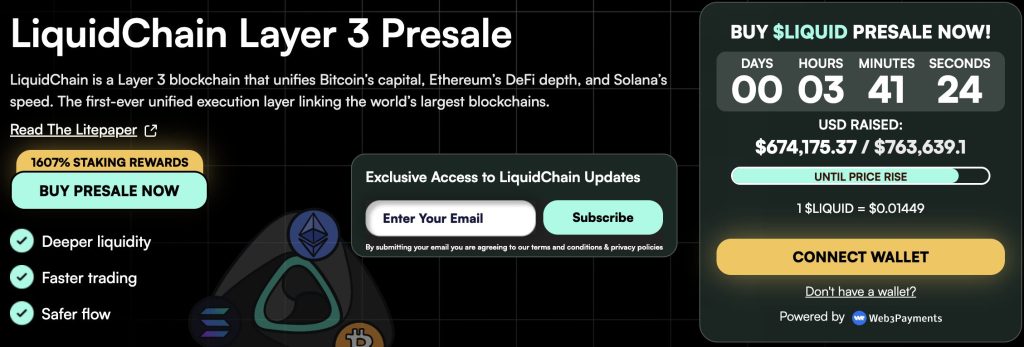
LiquidChain (LIQUID) is a Layer 3 infrastructure project currently in presale at $0.01449, having raised $673,819.16 to date.
The core proposition: fuse Bitcoin, Ethereum, and Solana liquidity into a single execution environment, what the project calls a Unified Liquidity Layer. Developers deploy once and access all three ecosystems simultaneously, with sub-second finality and verifiable settlement built into the architecture (a detail that matters more as cross-chain complexity becomes the dominant DeFi bottleneck).
Institutional interest in cross-chain infrastructure is accelerating. Presale assets carry substantial risk, including illiquidity and the possibility of total loss, DYOR before committing capital.
The post A Bittensor Developer Dumped 37,000 TAO Crypto and Quit the Network: Is the Governance Crisis Just Getting Started? appeared first on Cryptonews.


Key takeaways
- BTC eases back from 76k, a monthly high.
- Technical indicators suggest further correction in the near term.
Bitcoin has dropped below $74,000 after pulling back from a monthly high earlier this week. The cryptocurrency surged from $70K at the start of the week to hit $76K on Tuesday, before easing to its current level.
Mixed signals for the crypto market
The US Navy has confirmed a full blockade of Iranian ports, amplifying concerns over oil supply disruptions and pushing prices higher from three-week lows. However, President Trump has suggested that the conflict may be nearing an end, which has tempered further upside in oil prices and kept hopes of a de-escalation alive.
In addition to that, treasury yields have been on a downward trend, supported by softer-than-expected PPI data for March, which rose 0.5% month-on-month, below the 1.2% forecast. This easing of inflation concerns benefits Bitcoin, as lower yields signal improving liquidity and reduce the opportunity cost of holding non-yielding assets like crypto.
The US stock market has also been resilient, with the Nasdaq posting its tenth consecutive winning session, gaining nearly 10% in April. Crypto markets have mirrored this strength, with Bitcoin up approximately 8.5% so far this month.
These parallel moves suggest that Bitcoin is increasingly trading as a macro-sensitive asset, responding to broader market sentiment rather than purely crypto-specific factors.
Despite the current market conditions, institutional demand continues to support Bitcoin’s price action. Spot Bitcoin ETFs saw $411 million in net inflows on Tuesday, despite a $291 million outflow the previous day. This brings total net inflows for April to $741.9 million.
The growing institutional acceptance of Bitcoin is further highlighted by Goldman Sachs’ filing with the SEC for a Bitcoin premium income ETF, signaling a deeper commitment to crypto from traditional finance.
BTC could retest low support levels
The BTC/USD 4-hour chart is bearish and efficient as Bitcoin is down by more than 1% in the last 24 hours.
Currently, Bitcoin is trading within a rising channel that has been in place since early February. BTC is testing a key resistance level around $76K, which coincides with both the March high and the 23.6% Fibonacci retracement of the October high near $126K.

If the bulls regain control and Bitcoin embarks on a sustained break above $76K, it could target $80K, followed by $85K and the 200-day SMA at $88K.
On the downside, Bitcoin has initial support near $71K, with stronger support at $69.6K, the 50-day SMA. A move below $65K would signal a lower low, indicating a shift in market sentiment.
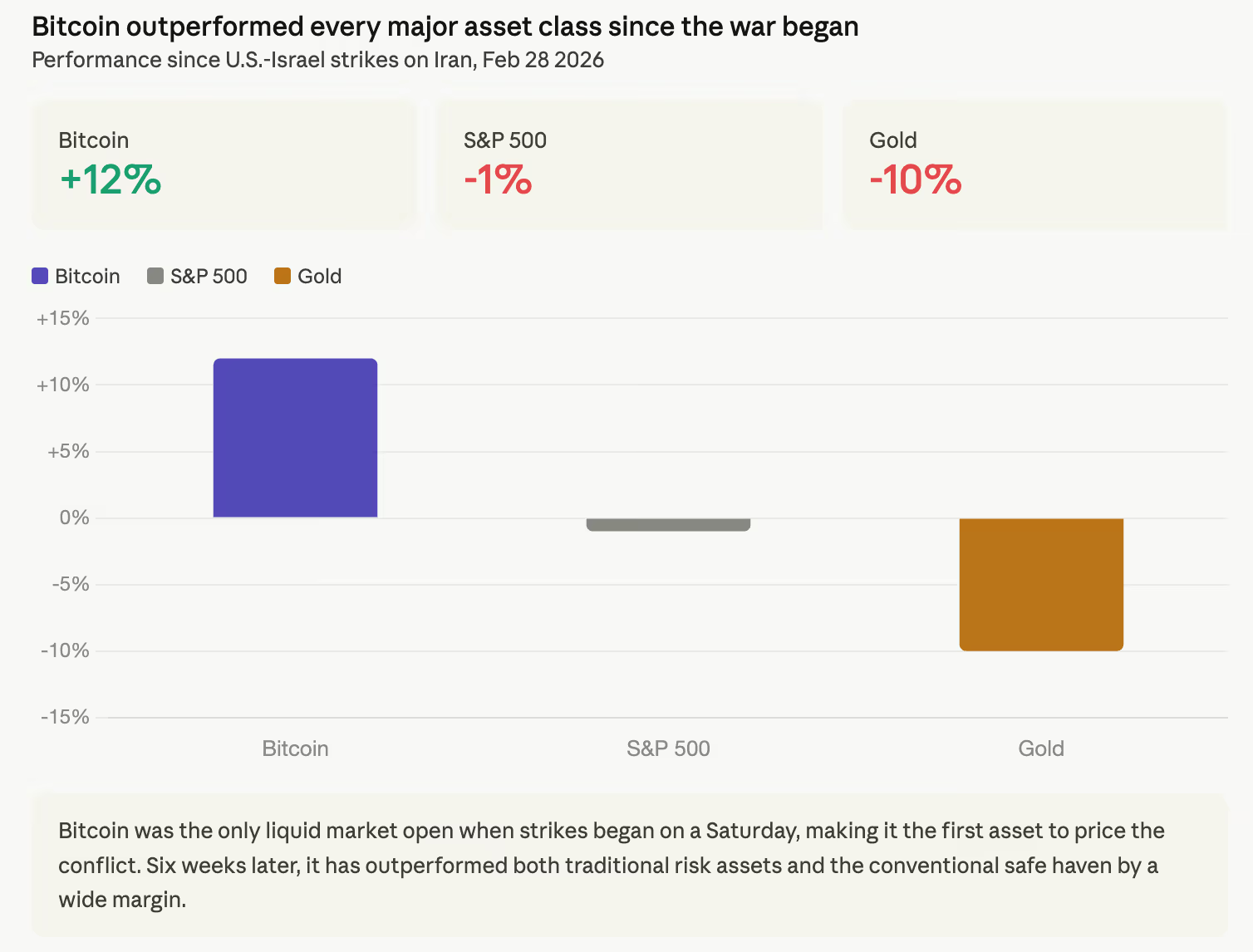
Bitcoin’s outperformance during the Iran conflict doesn’t fit the standard playbook, and Bitwise CIO Matt Hougan thinks he knows why.
The largest cryptocurrency has gained 12% since U.S. and Israeli airstrikes began Feb. 28, while the S&P 500 has fallen 1% and gold 10%. For an asset routinely dismissed as a leveraged tech bet during risk-off episodes, that performance has forced a rethink.
In a post on X, Hougan reframed bitcoin as two simultaneous bets. The first is the familiar “digital gold” thesis, competing for share of the $38 trillion store-of-value market.
The second is what he calls an out-of-the-money call option on bitcoin functioning as an actual currency, a bet he says most investors have treated as borderline irrelevant until now.

The Iran conflict changed the math on the second bet. Iran said it will collect a $1-per-barrel toll in bitcoin from ships passing through the Strait of Hormuz, the equivalent of roughly $20 million per day.
The levy is one of the first real-world examples of a sovereign state using bitcoin as a settlement mechanism for physical commerce, even if the circumstances were far from ideal.
“In a world where countries have weaponized their financial rails, bitcoin is emerging as an apolitical alternative,” Hougan wrote, tracing the shift back to the U.S. kicking Russia off the SWIFT network in 2022, a move France’s finance minister called a financial “nuclear bomb” at the time.
The options framework is what makes the argument worth watching.
Options gain value when either the probability of hitting the strike price improves or the volatility of the underlying asset increases. Hougan argues the Iran conflict delivered both simultaneously, raising the odds of bitcoin being used as a currency while increasing the volatility of the global monetary order.
If his framing holds, it implies that bitcoin should rally during future geopolitical conflicts, particularly those involving countries caught between the U.S. and Chinese financial systems, and that bitcoin’s total addressable market is significantly larger than the gold market alone.
The counterpoint is that Iran’s use of bitcoin occurs as a sanctioned state acting out of necessity, not preference. It says more about the limits of dollar-denominated enforcement than it does about bitcoin’s readiness to function as a neutral settlement layer. The infrastructure for that, stablecoin settlement, cross-border payment rails, sovereign wallet adoption, remains early-stage at best.
But Hougan’s core observation stands. The market is pricing bitcoin differently during this conflict than during any prior geopolitical shock, and the “digital gold” thesis alone doesn’t explain why.
Crypto World
Leading crypto presales on every investor’s radar in April 2026: Big opportunities right now
Disclosure: This article does not represent investment advice. The content and materials featured on this page are for educational purposes only.
Projects like BlockchainFX are gainining traction as investors target early-stage crypto presales for potential upside during market uncertainty.
Summary
- April 2026 sees surge in crypto presales, with BlockchainFX (BFX) leading as funding nears $15M target
- BlockchainFX gains traction with live beta, multi-asset trading, and strong early investor participation
- Final presale phase drives urgency as BFX offers staking rewards and cross-market trading access
Some months in crypto feel like noise, and some genuinely matter. April 2026 is the latter. The top crypto presales commanding serious attention right now are BlockchainFX (BFX), Pepeto, Ionix Chain, and IPO Genie, each pulling in different types of investors for different reasons. With markets still uncertain, early presale entries during a dip are often where the biggest gains quietly begin.
Among all the top crypto presales available this month, BlockchainFX keeps rising to the top of every serious conversation. Already live in beta, awarded “Best New Crypto Trading App of 2025,” and backed by 23,200+ participants who have pushed over $14.24M into the presale, BFX is now in its final phase. The $15M softcap is nearly reached, the launch countdown is real, and the window to get in at the ground price is closing fast.
BlockchainFX: The presale running out of time and tokens
BlockchainFX is a licensed, regulated trading super app where users can trade crypto, forex, stocks, ETFs, and commodities from one decentralized interface. Most traders today still juggle three or four separate platforms for different asset classes. BFX eliminates that entirely, handling everything in one place with full user custody. The platform is already live with thousands of daily active users and millions in daily trading volume, which is not something most presale tokens can say.
Holding BFX also earns daily staking rewards in both BFX and USDT, reaching up to $25,000 USDT, meaning investors are already generating returns while the presale is still active, not just waiting on a future price move. Multiple third-party audits, full KYC verification, and a verified smart contract back the platform’s credibility. For a token priced at $0.035, the amount of operational substance packed into this early stage is hard to find anywhere else in the top crypto presales list right now.
BFX20: Grab 20% more tokens before the $15m gate closes
The current presale price is $0.035 with a launch price of $0.05, already a 43% return from entry to listing alone. Using bonus code BFX20 adds 20% more BFX tokens to every purchase. On a $15,000 investment, that means roughly 514,285 tokens instead of 428,571. With analysts projecting BFX hitting $1 post-launch, that same $15,000 could return over $514,000. That is not speculation; that is presale math.
With $14.24M raised and the $15M softcap approaching fast, this is the final window. Buying is simple: connect MetaMask or Trust Wallet, pay via crypto or card, and the allocation confirms instantly. BFX20 is only valid during this last phase, and once the cap is hit, the presale closes and the exchange listing begins. Spend $100+ on BFX and gain exclusive access to the $500,000 Gleam prize pool!
Pepeto: Meme energy with an infrastructure angle
At $0.0000001864 per token and $9.04M raised, Pepeto has built a notable following. Unlike most memecoins that run purely on social momentum, the project includes PepetoSwap for zero-fee trading, a cross-chain bridge, and staking rewards. The goal is sustainable utility beyond the hype cycle, which makes it a more interesting memecoin pitch, though execution at scale is still in the process of being fully proven out.
Pepeto remains a memecoin at its core, and the volatility that comes with the territory is very much present. The utility vision is interesting but early. For investors browsing top crypto presales with a higher risk tolerance, it is worth watching, though the risk profile sits in a very different category compared to a regulated, already-live platform like BlockchainFX that has demonstrated real traction.
Ionix Chain: 500,000 TPS ambitions and AI-powered security
Ionix Chain is developing a Layer 1 blockchain using a proprietary “Quantum AI Consensus” mechanism aimed at exceeding 500,000 transactions per second with near-zero fees. Currently priced at $0.025 and moving to $0.030 shortly, the project targets DeFi and AI developers who need serious throughput. The AI-driven fraud detection and cross-chain interoperability put Ionix Chain among the more technically ambitious top crypto presales active in April 2026.
Layer 1 is a competitive space and Ionix Chain has bold claims that need to hold up at mainnet. Execution risk at this stage is real. For investors who want infrastructure exposure across their top crypto presales portfolio, the project deserves attention, though early technical promises in blockchain do not always survive the transition from whitepaper to live network cleanly.
IPO Genie: Opening pre-IPO doors for retail
IPO Genie is addressing a familiar frustration: retail investors locked out of pre-IPO deals while institutions capture all the early upside. At $0.0001408 per token and $1.38M raised, the platform uses AI curation to lower minimum entry points for late-stage startup investments. The listing target of $0.0016 represents significant upside from the current presale price for participants who get in early.
The concept is genuinely useful and the potential audience for democratized startup access is large. IPO Genie is still earlier-stage compared to other top crypto presales this month, and the project needs real deal flow and active user adoption to build confidence beyond the concept stage. The idea has clear merit, but the proof needs to follow soon.

The Research is in: BlockchainFX is the best crypto presale this April
Based on the latest research, the best crypto presale in April 2026 is BlockchainFX, and the case is straightforward. A live platform, regulatory approval, $14.24M raised, 23,200+ participants, daily staking rewards, and a $0.035 entry price that disappears the moment the $15M cap is reached.
Among all top crypto presales active right now, BFX has the strongest combination of real utility, proven infrastructure, and a genuinely limited window left to enter. Investors ready to act should visit the BlockchainFX website and use code BFX20 before the launch begins and the ground floor is gone.
For more information, visit the official website, X, and Telegram.
Disclosure: This content is provided by a third party. Neither crypto.news nor the author of this article endorses any product mentioned on this page. Users should conduct their own research before taking any action related to the company.

Free MLB home run picks, odds for April 15: Ben Rice among HR prop bets from MLB betting expert

Why more S’poreans are choosing jobs below their credentials

Why there are ‘hints’ of purple in special Todd Grimshaw Coronation Street episode


-

 Politics5 days ago
US brings back mandatory military draft registration
-
 Sports5 days ago
Man United discover Nico Schlotterbeck transfer fee as defender reaches Dortmund agreement
-

 Fashion5 days ago
Weekend Open Thread: Veronica Beard
-

 Politics6 days ago
Malcolm In The Middle OG Turned Down ‘Buckets Of Money’ To Appear In Reboot
-

 Politics3 days ago
World Cup exit makes Italy enter crisis mode
-

 Crypto World6 days ago
Canary Capital Files SEC Registration for PEPE ETF
-

 Business5 days ago
Tesla Model Y Tops China Auto Sales in March 2026 With 39,827 Registrations, Beating Cheaper EVs and Gas Cars
-

 Crypto World2 days ago
The SEC Conditionalises DeFi Platforms to Be Avoided for Broker Registration
-

 Crypto World2 days ago
SEC Signals Exemption for Crypto Interfaces From Broker Registration
-

 News Videos11 hours ago
Secure crypto trading starts with an FIU-registered
-
 NewsBeat3 days ago
Pep Guardiola and Gary Neville agree over Arsenal title problem that benefits Man City
-

 Business5 days ago
OpenAI Halts Stargate UK Data Centre Project Over Energy Costs and Copyright Row
-

 Business4 days ago
Ireland Fuel Protests Enter Day 5 as Blockades Spark Shortages and Government Prepares Support Package
-

 Politics6 days ago
LBC Presenter Mocks Trump Over Iran War Failures
-

 Crypto World5 days ago
Federal judge blocks Arizona from bringing criminal charges against Kalshi
-
 NewsBeat4 days ago
JD Vance announces ‘no agreement’ with Iran over nuclear weapons fear
-

 NewsBeat1 day ago
Trump and Pope Leo: Behind their disagreement over Iran war
-

 Tech6 days ago
A version of Windows 10 released a decade ago is now eligible for additional security patches
-

 Crypto World2 days ago
SEC Proposes Certain Crypto Interfaces Don’t Need to Register as Brokers
-

 Business5 days ago
IMF retains floor for precautionary balances at SDR 20 billion
You must be logged in to post a comment Login