
Crypto World
Harmony Patches Pre-Staking Quorum and Receipt-Replay Flaws After ONE Mint Claim

Harmony released a mainnet patch on Aug. 12 that changes two verification paths after reports of an unauthorized ONE mint: a quorum check affecting pre-staking-epoch committees and a cross-shard receipt mechanism that could apply the same transfer more than once. The v2026.1.1 release came after… Read the full story at The Defiant

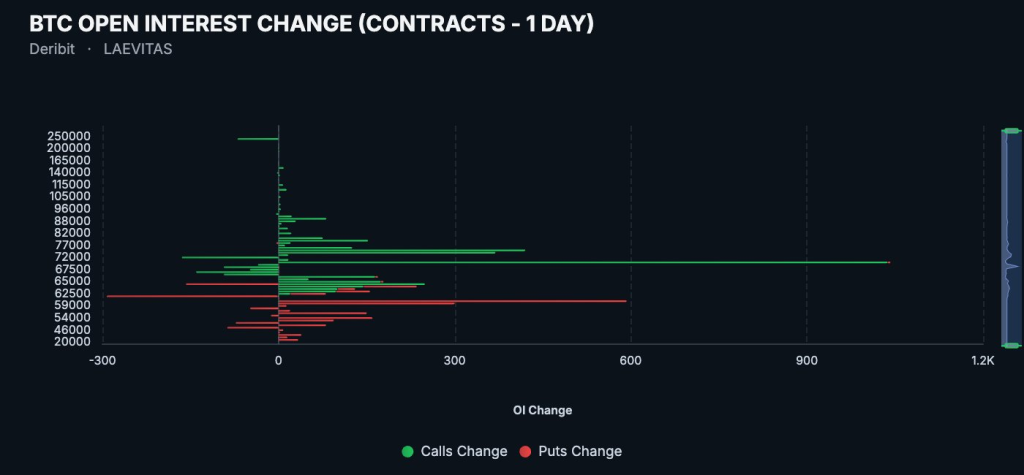
Bitcoin has spent weeks pinned inside a $62,000-to-$66,000 corridor, and options flow on Deribit shows traders paying roughly $2.5 million in aggregate premium to bet the coin clears $70,000 by late September.
That positioning puts real money behind a breakout thesis at the exact moment the U.S. Consumer Price Index print threatens to decide which way the range finally breaks.
The tension is straightforward: a cooler-than-expected inflation read could extend the risk-on mood already visible in equities, while a hotter number revives the case for another Federal Reserve rate hike in September. Either outcome could force a resolution to a consolidation phase that has left Bitcoin’s $64,000 support level under repeated scrutiny.
Discover: Everyone’s Got a Take. Join Kalshi and Get a Free $25 to Actually Trade Yours
Why the CPI Print Is a Binary Event for Crypto Markets
Consensus estimates compiled from Reuters, Dow Jones, and Bloomberg surveys point to headline CPI rising 0.1% month over month and 3.4% year over year, a step down from June’s reported 3.5% pace. Core CPI is expected at 0.2% monthly and 2.5% annually, figures tight enough that a modest surprise in either direction could swing rate-path expectations meaningfully.
That sensitivity matters because Bitcoin’s range has compressed heading into a scheduled catalyst. Traders positioning ahead of the print are effectively wagering that compressed ranges could resolve violently once the data lands, a dynamic explored in detail in CPI-driven Bitcoin price scenarios published ahead of the release.
Discover: Your Market Calls Are Worth Something. Start With Free $25 on Kalshi
What the Deribit Options Flow Actually Shows
The dominant flow on Deribit BTC options in the sessions leading into the print has concentrated in the September 25 expiry at the $70,000 strike, per Laevitas. The premium paid represents the maximum loss if Bitcoin sits below that strike at expiration, while the calls offer leveraged upside exposure without committing spot capital.

That’s a directional bet, not a certainty. Concentrated call buying at a single strike shows conviction among a subset of derivatives traders; it does not prove the broader market shares that view, and it says nothing about how quickly a move toward $70,000 would need to happen to make those contracts profitable.
Separately, TDX Strategies has recommended accumulating December optionality, favoring strangles on Bitcoin and Solana that pay out on a large move in either direction rather than picking a side. That’s a materially different bet than the September call flow – it’s a wager on volatility itself, not on direction, and it suggests not everyone in derivatives markets is convinced the CPI print resolves the range cleanly.
The Seasonal Headwind Nobody’s Pricing In
STS Digital managing partner Jeff Anderson has flagged September as historically Bitcoin’s weakest month, with an average decline of roughly 4% since 2013, and argued that a decisive break of either edge of the current spot range should see volatility expand quickly. That seasonal pattern sits awkwardly against the September 25 call positioning – traders are betting on a breakout in the same month that has statistically been Bitcoin’s softest.
Spot-market data adds another wrinkle. Nansen has reported Ether exchange net outflows of $49.7 million over 24 hours and $164.6 million over the past week, a pattern typically read as accumulation.
At the same time, Hyperliquid smart-money positioning shows net short exposure of $46.8 million in Bitcoin and $20.9 million in Ether. Spot flows and derivatives positioning are telling two different stories, and CPI is the event that could force them into alignment.
Don’t Miss Out on Our $1,000 USDT Airdrop on ByBit
The post CPI Sets the Stage for Bitcoin’s Next Major Range Break appeared first on Cryptonews.


A pair of would-be crypto thieves have been sentenced in France this week for their part in a home invasion that targeted a house lawyers say was previously owned by doxxed crypto millionaires.
Lawyers representing the house’s current owners, a farmer and bank executive both in their twenties, believe that the financial details of the previous owners, a wealthy retired couple who made millions with crypto, were leaked on the dark web.
As such, they believe that three separate teams of robbers used this outdated information to target the Somme property in the hopes of securing a crypto ransom.
The first group broke into the home on June 24, but the couple’s dogs were able to scare them off. The second broke in on June 26 and managed to tie up one of the victims and beat the other before fleeing.
Read more: France crypto conference doubles security as wrench attacks rise
A third attack took place on July 17 but the two criminals involved were deterred by an alarm installed after the first two break-ins.
It was these two men that were sentenced by the Amiens criminal court on Monday. One received a three-year prison sentence, while the other was sentenced to 18 months.
The couple now claims they no longer “feel safe at all” living in the property, and want to sell. Their lawyer stated, “They bought their house in the wrong place, at the wrong time.”
Got a tip? Send us an email securely via Protos Leaks. For more informed news and investigations, follow us on X, Bluesky, and Google News, or subscribe to our YouTube channel.


Nansen co-founder and CEO Alex Svanevik has projected that Bitcoin could reach $1 million by 2030 while arguing that the asset may never trade below $60,000 again.
Summary
- Svanevik sees $1 million Bitcoin by 2030 as a plausible outcome rather than a certainty.
- Expanding money supply and currency debasement form the main basis of his forecast.
- The Nansen chief expects Bitcoin’s market cycles to produce progressively higher price floors.
- U.S. spot Bitcoin ETFs give American investors regulated access but remain exposed to sharp price swings.
Monetary expansion could carry Bitcoin toward $1 million
In a statement to crypto.news, Nansen co-founder and CEO Alex Svanevik said Bitcoin’s long-term value will depend largely on global liquidity, government spending, and the continued expansion of the money supply.
Rather than pointing to one event that could send Bitcoin (BTC) to $1 million, Svanevik described the cryptocurrency as an alternative to monetary systems in which central banks and governments can create more currency. Bitcoin’s supply rules limit the total number of coins to 21 million, although new BTC will continue entering circulation through mining until the maximum supply is reached.
“I think the base case for Bitcoin is basically that you get higher lows, and you do have these run-ups that happen, roughly every four years,” Svanevik told crypto.news.
Under his argument, more money circulating through financial markets can raise demand for assets with limited supply. Svanevik said the direction of global liquidity matters more to Bitcoin’s long-term price than any single headline or market event.
“The more circulating money supply in a broad sense, the higher Bitcoin goes. I think Bitcoin should be thought of as a counterpoint to what’s happening on the central bank side, or the treasury side.”
Bitcoin’s four-year market pattern is often linked to its halving schedule, which cuts the block reward paid to miners. The next halving is expected in 2028, reducing new supply before Svanevik’s 2030 target date. Previous cycles have included steep rallies after halvings, but they have also produced drawdowns of more than 50%, meaning the historical pattern does not guarantee another increase.
An August 2025 Bitcoin forecast review published by crypto.news placed many 2030 projections between $250,000 and $500,000. The report also cited ARK Invest’s bull case of $1.5 million, base case of about $700,000, and bear case near $300,000.
Svanevik compared today’s $1 million forecasts with predictions made when Bitcoin traded far below $100,000. In his view, monetary debasement changes the unit used to measure Bitcoin, making price levels that once appeared unrealistic easier to consider over time.
“It sounds crazy to say Bitcoin at $1 million from our vantage point, but I’m sure it sounded crazy to say $100,000 Bitcoin if you’re in 2018,” he said. “You’re updating the unit of account because we’re just spending so much more money.”
Why Svanevik believes Bitcoin will hold above $60,000
Alongside his 2030 projection, Svanevik said he does not expect Bitcoin to return below $60,000, describing the level as a permanent floor in his personal assessment.
“My personal view is that I don’t think Bitcoin is ever going to go back below $60,000. I think forever.”
The claim rests on Svanevik’s expectation that future market cycles will establish higher lows. Continued currency creation, combined with Bitcoin’s fixed maximum supply and growing use among retail and institutional investors, supports his view that demand will prevent another fall beneath the threshold.
Market history, however, shows how difficult permanent price-floor forecasts can be. Bitcoin briefly traded below $60,000 in February 2026, while June volatility later pushed it close to the same level. On June 28, Bitcoin held near $60,000 after falling to its lowest price since late 2024.
More recently, BTC slipped below $63,000 on Aug. 3 as ETF outflows, security concerns, and uncertainty over U.S. crypto legislation weighed on the market. The asset traded near $62,556 at the time, down 4.35% over seven days, according to a report on the decline.
Veteran trader Peter Brandt has offered a different assessment of the same price region. Brandt said on Aug. 10 that he would lean toward another decline, while his head-and-shoulders chart pointed to a possible move toward $58,000 if BTC failed to recover key resistance.
The scenario was a technical projection rather than a confirmed target. Brandt had not opened a trade based on the pattern, and a sustained break above $67,260 would weaken the bearish setup shown on his chart.
U.S. ETFs extend Bitcoin access to large portfolios
For American investors, Svanevik’s expectation that Bitcoin will enter more retail and institutional portfolios can already be measured through U.S.-listed spot Bitcoin exchange-traded funds. The products allow investors to gain price exposure through brokerage and retirement accounts without directly holding private keys.
Demand through those funds has not moved in one direction. U.S. spot Bitcoin ETFs recorded nine consecutive sessions of net withdrawals in late May 2026, with investors removing roughly $2.8 billion. BlackRock’s iShares Bitcoin Trust accounted for about $2.04 billion of the total, while May ended with approximately $2.43 billion in net outflows.
Fund demand later recovered. During the five sessions ending Aug. 7, U.S.-listed Bitcoin ETFs attracted more than $850 million, their strongest weekly inflow total since April. The reversal showed that regulated investment products can add buying demand when capital enters, although redemptions can create selling pressure when investors reduce exposure.
Institutional disclosures also offer evidence that some U.S. advisers are adding Bitcoin products to diversified portfolios. Clear Creek Financial Management reported about $10.4 million across three Bitcoin ETFs in its latest Form 13F, led by a $9.69 million position in Bitwise’s BITB.
Form 13F reports cover certain long positions held by investment managers overseeing at least $100 million in qualifying U.S. securities. Because the filings are backward-looking and exclude cash, short positions and some other assets, they do not prove that the disclosed holdings remain unchanged.
Svanevik placed Bitcoin alongside gold as one of the best-known assets used by investors seeking protection from currency debasement. Portfolio inclusion, in his assessment, will expand as both individual buyers and institutions look for assets outside systems based on discretionary money creation.
“Bitcoin is kind of the most well-known way to counter that, except for maybe gold,” he said. “That’s why I do think it’s going to be part of a lot of people’s portfolios, both retail and institutions.”
Bitcoin’s $1 million target remains a conditional forecast
Reaching $1 million would require Bitcoin to rise almost sixteenfold from a price of roughly $64,000. At that price, its fully diluted value would approach $21 trillion because the protocol limits total supply to 21 million coins, although circulating supply will remain lower than the maximum in 2030.
Svanevik did not present the target as guaranteed. His case depends on continued monetary expansion, increasing portfolio adoption, and the absence of major threats capable of damaging Bitcoin’s role as an alternative monetary asset.
Regulatory restrictions, declining liquidity, or weaker institutional demand could interfere with that path. ETF activity in 2026 has already shown that professional capital can leave the market quickly when economic conditions or risk appetite change.
Svanevik nevertheless considers the seven-figure target possible within the remaining years of the decade.
“There’s nothing that suggests that we’re going to stop printing money; on the contrary, probably,” he said. “And in 2030, I think a million dollars per Bitcoin is definitely within the realm of possibility.”
Winklevoss-backed Zcash (ZEC) treasury company Cypherpunk Technologies has announced plans to pivot focus to its cancer drug candidate after it reported a $37.8 million net loss for the first six months of 2026.
Unless the price of ZEC rallies soon, the company has admitted that it will need to raise a lot of money to pay for its upcoming FDA trials.
“We expect to continue to generate operating losses for the foreseeable future,” the company forecasted today.
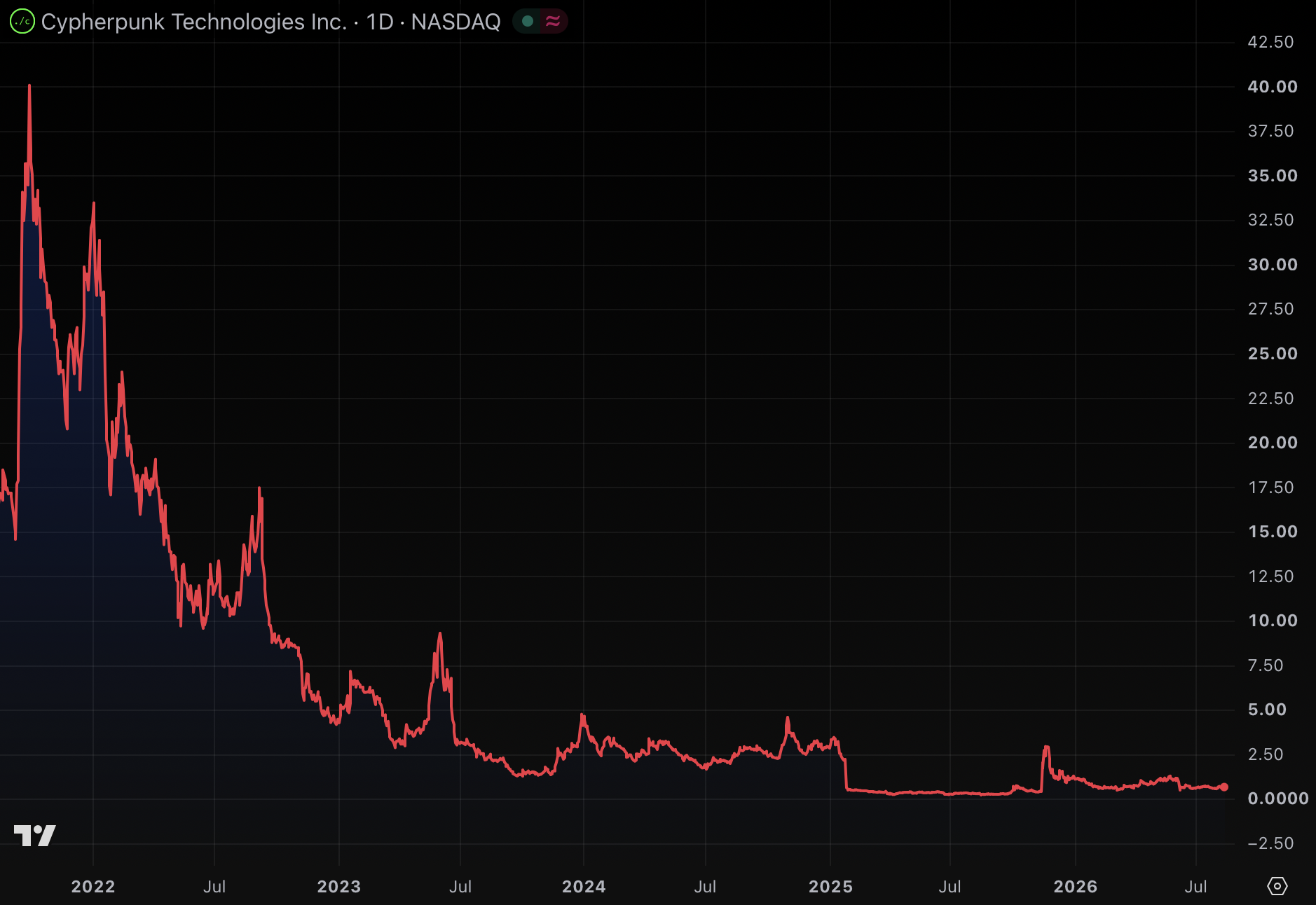
Cypherpunk’s ZEC holdings are worth roughly $157 million, yet Nasdaq traders value the entire company at just $74 million.
That is a basic multiple-to-Net Asset Value (mNAV) of just 0.47x and sadly unremarkable as crypto treasury stocks continue to trade for less than their holdings.
Counting pre-funded warrants and other sweeteners for its self-described Enterprise Value mNAV brings that multiple up to 0.96x on the company’s homepage — still less than the value of its ZEC.
Backed by Cameron and Tyler Winklevoss
Cameron and Tyler Winklevoss are the billionaires who helped create the company’s ZEC brand.
Initially successful, the company was able to acquire its ZEC for a $341.84 average purchase price — well below the current market for ZEC at $486.
The stock also hit $3.70 last November before falling back below $0.69 per share today.
Cypherpunk has lost tens of millions of dollars this year and continues to plan an expensive FDA trial path for its cancer drug. The stock has lost 40% of its value this year and 96% of its value over the past five years.
Gemini, the exchange the Winklevoss twins control, is the custodian for the company’s ZEC.
Read more: Zcash vs Bitcoin debate exposes Naval Ravikant’s conflicts of interest
More expensive cancer trials, and ZEC isn’t helping
Cypherpunk’s cancer drug candidate, an anti-DKK1 antibody Sirexatamab, failed to beat the control arm on progression-free survival across all patients in the randomized Phase 2 study.
The company attributes that miss to an underpowered final analysis.
On the DAT side of the business, the price of ZEC is flat year-to-date, so that didn’t help.
The FDA granted its drug candidate fast track designation in May anyway, a status that speeds up regulatory review. Regulators also agreed on the shape of a roughly 270-patient Phase 3 trial for colorectal cancer.
Onsi said the company is “conducting a strategic process to determine the best path to advance sirexatamab, whether as an independently financed spin-out company or with a partner who shares our commitment to cancer patients.”
In plainer terms, its drug candidate needs more money.
Tyler Winklevoss wrote at launch that “We plan to continue accumulating ZEC rapidly so that Cypherpunk owns at least 5% of the total ZEC supply.”
Nine months later, the company holds 323,394 ZEC today, or 1.92% of the circulating supply.
The company had just $7.6 million in cash and cash equivalents as of June 30, half a billion dollars of accumulated deficits, loss-generating operations, and an expensive path toward FDA approval for an aspirational drug.
Got a tip? Send us an email securely via Protos Leaks. For more informed news and investigations, follow us on X, Bluesky, and Google News, or subscribe to our YouTube channel.
Bitwise Asset Management has cut about 14% of its workforce, reducing headcount to roughly 155 from around 180 as the crypto-focused manager contends with a sharp retreat in assets. Bloomberg reported that Bitwise confirmed the reduction in an emailed statement. The reported totals amount to… Read the full story at The Defiant
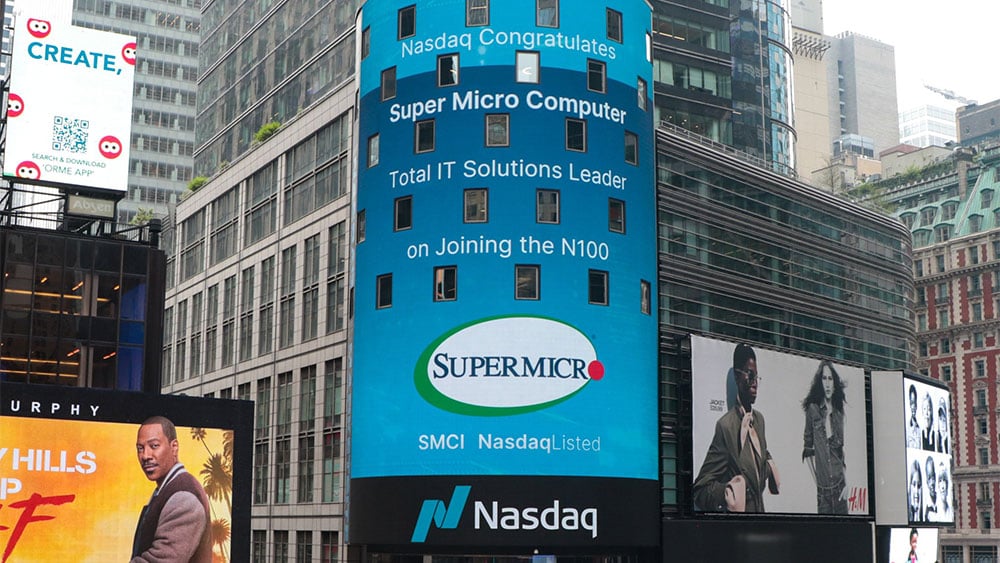
Super Micro Computer’s (SMCI) upbeat second-quarter earnings report provided a positive read-through for partner Nvidia (NVDA), analysts say. Supermicro stock jumped on Wednesday while Nvidia also advanced. The Q2 report from Supermicro “is almost a direct read-through for Nvidia,” Daniel O’Regan, managing director of equity trading for Mizuho Securities USA, said in a client note. “They take Nvidia’s chips, integrate…
Copyright ©2026 Investor’s Business Daily, LLC. All rights reserved. 87990cbe856818d5eddac44c7b1cdeb8
Doubt, fear, and confusion
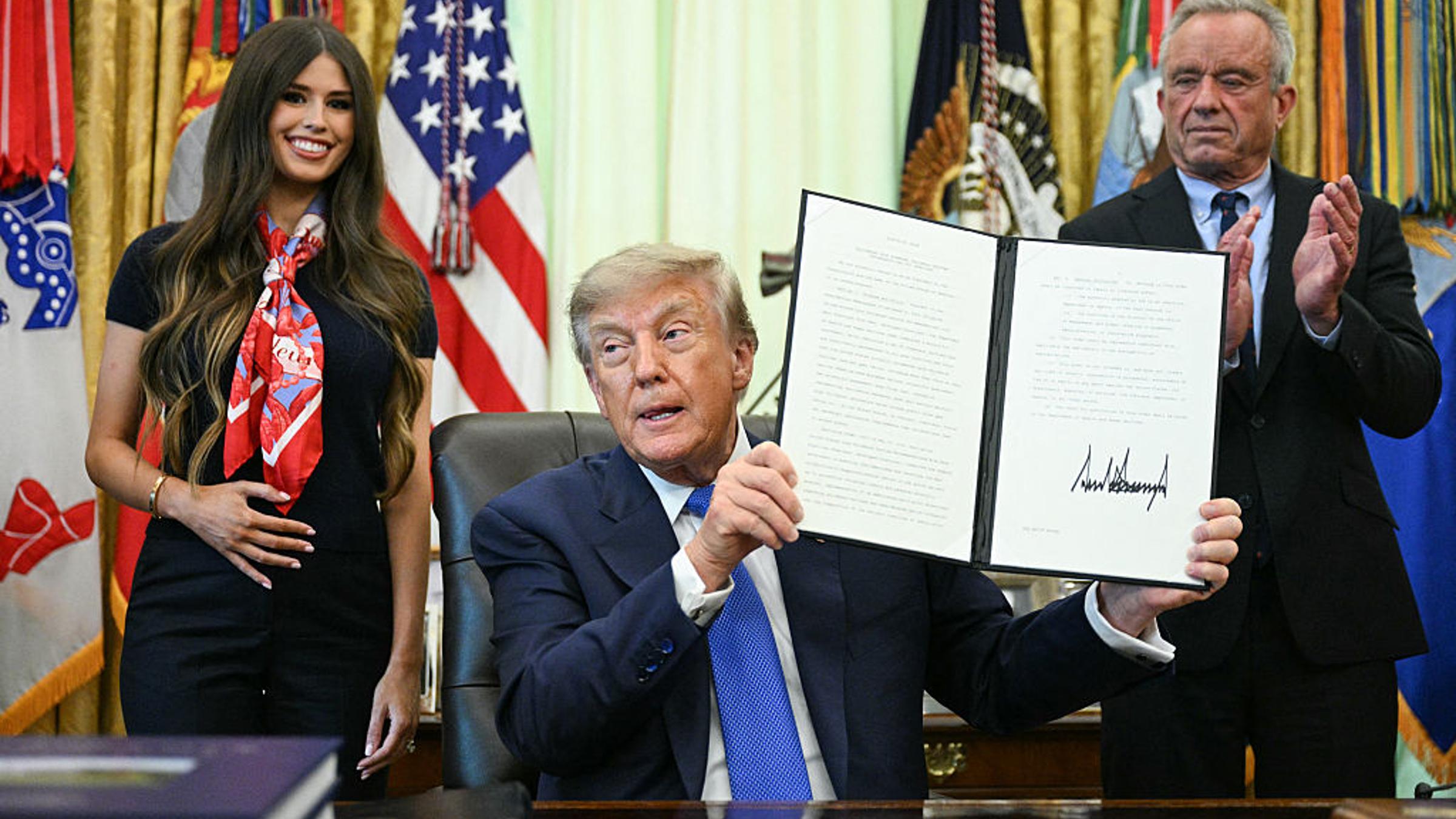
Doctors say they most fear what the executive order will do to increase vaccine hesitancy and uncertainty.
Though the executive order doesn’t mention autism, Trump cited rising autism rates as a reason for the changing recommendations during the signing ceremony. “Decades ago, children received only a small fraction of the vaccines required today,” Trump said. “In those times, people were much healthier, and of course, the high rates of autism now observed did not exist.”
Trump also claimed that children receive vaccines the size of a “bottle of soda.”
Shots contain no more than a teaspoon of liquid, Offit says, and usually contain a fraction of that. “This is so embarrassing for this country,” he says of Trump’s comments.
Riot Platforms just demonstrated that a Bitcoin mining company’s most valuable line item isn’t its hash rate; it’s the megawatts sitting behind it.
The company’s new 20-year, $9.1Bn compute lease with Anthropic converts a Texas mining campus into contracted AI infrastructure revenue that has nothing to do with block rewards, difficulty adjustments, or the price of BTC.
This huge mining deal was struck as BTC/USD traded pretty much flat over the past 24 hours, with a modest -0.2% decrease, and the price at $64,000. Daily trading volume for Bitcoin is at $22Bn.
Bitcoin Mining’s AI Pivot Gets Its Biggest Number Yet
Riot disclosed Monday that it had signed a 20-year agreement to supply 191 megawatts of capacity from its Rockdale, Texas campus to a company it described only as a “leading frontier AI” lab. Bloomberg reported, citing people familiar with the matter, that the customer is Anthropic.
The commercial terms are the real story regardless of who confirms what. The agreement runs through June 2048, is expected to generate $9.1Bn in revenue over that base term, and carries two five-year extension options that could push total contract value to as much as $16.1Bn if both are exercised, according to Riot’s disclosure.
Riot shares jumped 25% to $24.40 in after-hours trading on the news, per Bloomberg. CNBC subsequently reported the stock had initially soared more than 20% in regular trading before giving back almost the entire move, a reminder that even a landmark contracted-revenue deal doesn’t automatically produce a clean, durable re-rating in a single session.
From Hash Rate to Megawatts: The Valuation Shift
Riot, formerly Bioptix, has transitioned from a biotech firm to Bitcoin mining and is now evolving into an AI landlord, indicating a strategic pivot towards power and land utilization. Its Rockdale campus is home to two tenants, including a partnership with Advanced Micro Devices, contributing to its revenue success.
The broader market is increasingly valuing publicly traded Bitcoin miners for their power capacity and data-center assets rather than solely for Bitcoin production. This change reduces dependency on Bitcoin price fluctuations and mining variables, which have historically made miner stocks volatile.
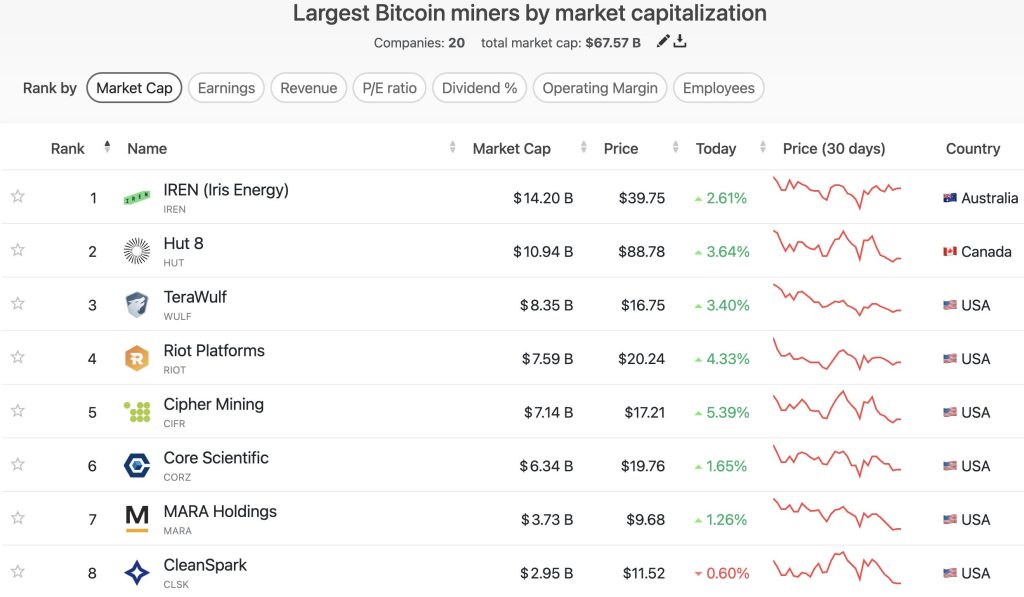
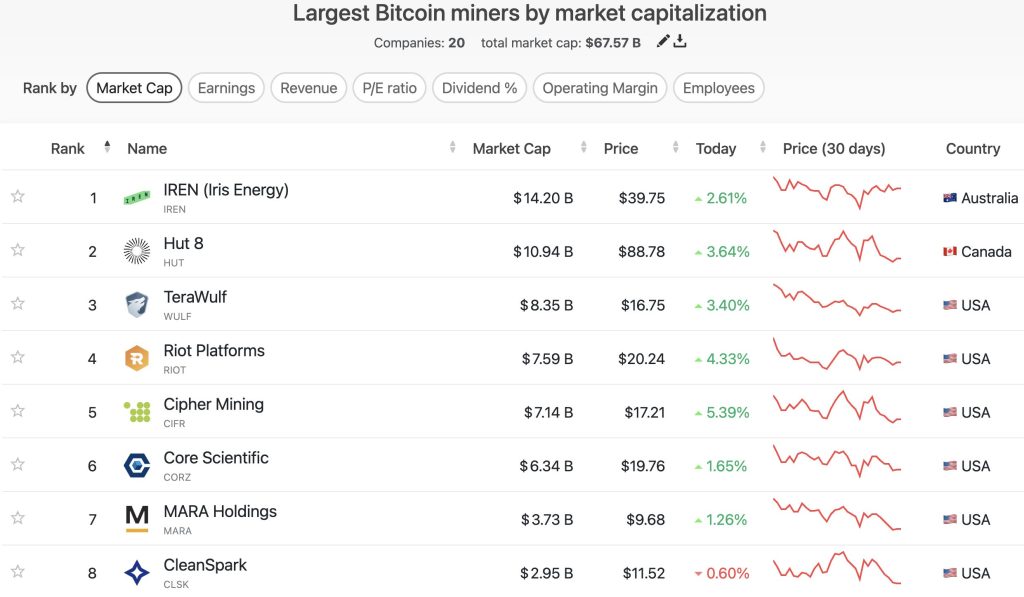
Companies like Cipher Mining, Hut 8, and TeraWulf are noted as hybrid miners, while Riot, historically seen as a pure-play operator, is now being evaluated based on its power capacity from its Anthropic deal, signaling a shift in how AI demand is influencing Bitcoin-related markets.
Discover: Get Paid to Be Right, $25 to Start on Kalshi
How the Lease Actually Differs From Bitcoin Mining Revenue
The mechanism here is closer to commercial real estate than mining economics. Riot isn’t operating GPUs or selling AI compute directly; it’s leasing power access, land, and data-center shell capacity to a tenant that brings its own hardware and workloads.
That structure is what makes the $9.1Bn figure fundamentally different from mining revenue. Bitcoin mining income fluctuates with BTC price, network difficulty, and the fixed schedule of halving-driven reward reductions.
A 20-year lease with fixed or contracted pricing insulates that portion of Riot’s revenue from all three variables, trading mining’s volatility for a bond-like, long-duration cash flow stream.
Anthropic’s appetite for that kind of arrangement isn’t limited to Riot. The company has also struck a roughly $10Bn agreement with the months-old infrastructure startup Volta Infra Holdings and agreed in May to buy close to $45Bn in computing from Elon Musk’s xAI.
This is, according to Bloomberg’s reporting, a pattern of diversified, multi-vendor sourcing from a lab whose Claude models sit at the center of the growing overlap between frontier AI and crypto-adjacent infrastructure.
Trade Bitcoin on Bybit and Get a Chance to Win Our $1,000 USDT Airdrop
What the Contract Doesn’t Prove
The $16.1Bn headline number requires both five-year extensions to be exercised; it’s a ceiling, not a floor, and Riot’s base-case disclosure of $9.1Bn is the figure that should anchor any valuation work.
Deployment also isn’t instant: Data Center Dynamics reported that initial capacity isn’t expected to go live until late 2027, with full deployment targeted for mid-2028, meaning the revenue ramp is gradual rather than immediate.
There’s also a regulatory variable specific to Texas. CNBC’s report cited Compass Point analyst Michael Donovan noting that ERCOT’s tightened scrutiny of new power projects could slow speculative build-outs across the state.
This is even as it makes already-approved, grid-connected capacity like Riot’s more strategically valuable to tenants racing for scarce power. That’s a two-sided dynamic worth watching rather than a settled tailwind.
Discover: Everyone’s Got a Take. Get Free $25 to Actually Trade Yours
The post Bitcoin Mining News: Riot Platforms Anthropic AI Lease Explained appeared first on Cryptonews.

The SpaceX logo is displayed at a SpaceX facility on Aug. 4, 2026 in Hawthorne, California.
Justin Sullivan | Getty Images
Short sellers betting against SpaceX are rapidly retreating from the trade, just as the newly public stock rebounds from its post-IPO slump.
Short interest in SpaceX fell to about 11% of the company’s publicly traded shares Wednesday, down sharply from a peak of 34% last week, according to S3 Partners. The decline reflects a combination of bearish investors closing out positions and a significant expansion of the stock’s tradable float following the first major lockup expiration.
“Shorts that wanted to short are out of bullets,” said Ihor Dusaniwsky, managing director of predictive analytics at S3 Partners. “Only so much money you can put into a trade.”
The exodus came as SpaceX shares staged a sharp rebound from their post-earnings sell-off, with short covering potentially adding fuel to the advance. Investors closing bearish positions must buy back shares, which can amplify upward moves when a stock is already rallying.
Shares jumped 8% Wednesday to around $144, lifting the stock about 7% above its $135 IPO price and roughly 38% above its Aug. 3 low.

SpaceX since IPO
SpaceX has endured a roller-coaster ride since going public. The stock initially tumbled after the rocket and satellite company disclosed in its first earnings report last week that capital expenditures were more than twice its revenue, fueling concerns about the enormous spending required to fund its ambitions.
The sell-off attracted a wave of short sellers, pushing short interest to unusually elevated levels relative to the stock’s limited public float. Short selling involves borrowing shares and selling them in hopes of buying them back later at a lower price.
That dynamic changed substantially last Thursday, when just over 911 million SpaceX shares became eligible for trading following the expiration of an initial lockup period. The newly unlocked tranche represented roughly 7% of the company’s shares outstanding and exceeded the 639 million shares sold in the IPO.
The larger float mechanically reduced short interest as a percentage of tradable shares. But short covering has also contributed to the decline, according to S3, as investors who had wagered against SpaceX bought back stock to exit their positions.
More supply is coming. On Aug. 20, another 319 million shares could unlock, followed by roughly 700 million in September and close to that number in October, according to the prospectus.
The additional shares could create fresh volatility by giving employees and early investors more opportunities to sell. At the same time, the larger float would make it easier for investors to establish new short positions if bearish sentiment returns.
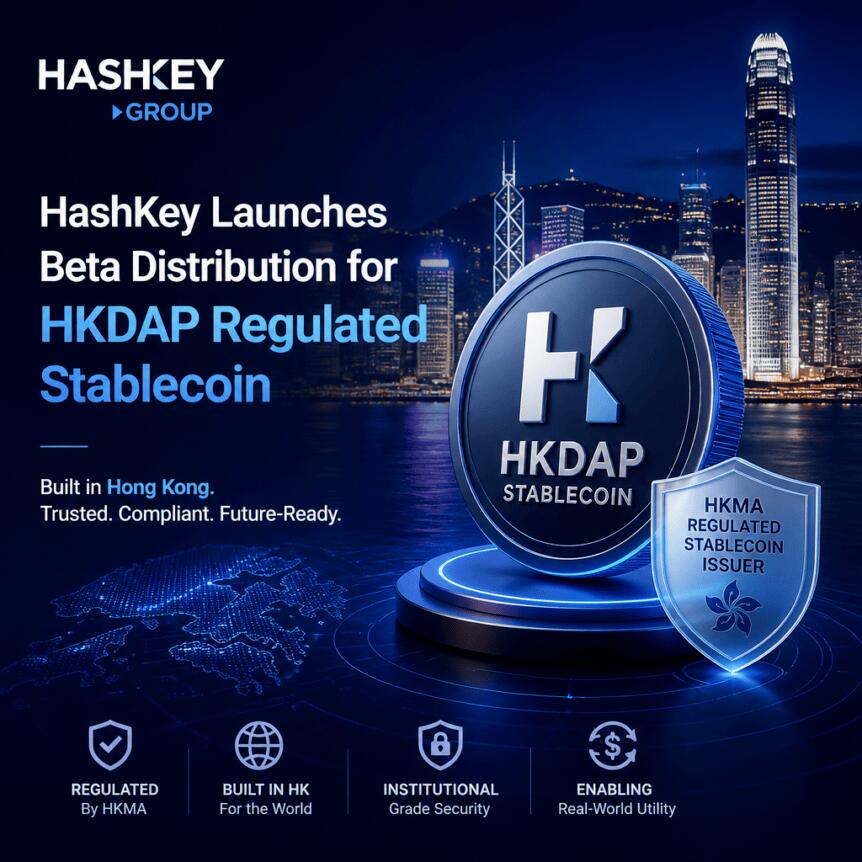
Anchorpoint Financial, a Hong Kong-licensed stablecoin issuer, has named HashKey Exchange as an authorized distributor for its Hong Kong dollar stablecoin, HKDAP. The move is designed to broaden eligible institutions’ and professional investors’ access to the fiat-backed token as Hong Kong’s regulated stablecoin framework continues to roll out.
In a Tuesday announcement, the companies said the distribution arrangement is part of a beta phase. HashKey reported that it has already completed its first HKDAP minting and redemption cycle with eligible clients, including both fiat on-ramps and off-ramps. Anchorpoint and HashKey also indicated that they intend to expand distribution over time and assess additional applications for HKDAP, such as cross-border payments, settlement workflows, and tokenized finance.
Key takeaways
- HashKey Exchange has been added as an authorized distributor for Anchorpoint’s HKDAP, expanding regulated access to the Hong Kong dollar stablecoin.
- The rollout is in beta, with HashKey already completing an initial HKDAP minting and redemption transaction using eligible clients.
- Anchorpoint plans to widen distribution and explore use cases beyond payments, including settlement and tokenized finance.
- HKDAP is positioned as “HKD At Par,” aiming to act as tokenized money within Hong Kong’s licensed stablecoin market.
Why the HashKey distribution matters for Hong Kong’s regulated stablecoin rollout
Distribution partners are often the practical bridge between an issuer’s compliance setup and the end-user access that determines whether a regulated stablecoin can scale. By authorizing HashKey Exchange to distribute HKDAP during a beta phase, Anchorpoint is effectively widening the number of institutional and professional channels through which the token can be minted, redeemed, and used.
HashKey’s confirmation that it has already completed an initial minting and redemption transaction is notable because it signals that at least part of the operational rails are live—not just planned. The inclusion of fiat on- and off-ramping in that first cycle also points to a focus on converting between traditional currency and the tokenized asset in a way that can support real transaction flows.
The companies framed the arrangement as expandable over time. For market participants watching Hong Kong’s stablecoin regime, the next question is how quickly authorized distribution can broaden beyond the initial set of participants, and whether additional ecosystem services will integrate HKDAP for payments and settlement.
What HKDAP is, and Anchorpoint’s regulatory positioning
HKDAP—short for “HKD At Par”—is described as a regulated Hong Kong dollar stablecoin intended to function as tokenized money for payments and other financial transactions. Anchorpoint’s role as the issuer is anchored in Hong Kong’s licensing process: the company was among the first to receive a stablecoin issuer license from the Hong Kong Monetary Authority.
Anchorpoint is a joint venture involving Standard Chartered Bank (Hong Kong), HKT, and Animoca Brands. According to earlier coverage by Cointelegraph, the venture was established in April 2025. Cointelegraph previously reported on the earlier plans by Standard Chartered and Animoca Brands—together with HKT—to launch a Hong Kong dollar-backed stablecoin.
As these licensing milestones are reached, the industry typically shifts from “permissioning” to “distribution and adoption.” In that sense, the HashKey beta rollout can be read as a step toward converting regulatory approval into day-to-day market usage.
Hong Kong dollar stablecoins could grow—if adoption data catches up
Hong Kong dollar-backed stablecoins may have the potential to become a meaningful segment of the broader stablecoin market, particularly given the city’s push for regulated issuance and supervision. A 2025 Citi report cited by the article’s underlying coverage estimated that stablecoin circulation in Hong Kong could reach $16 billion after the introduction of the local licensing regime.
Even so, observers face a data challenge. For now, US dollar-pegged tokens remain the clear majority of the global stablecoin market, while synthetic stablecoins are another smaller, emerging category. Reliable, public information on how much HKD-pegged supply exists and how widely it is used remains limited, making it difficult to judge where Hong Kong dollar stablecoins currently stand relative to that growth forecast.
Meanwhile, broader stablecoin activity has continued to intensify. The same underlying reporting points to Bernstein data showing that the combined adjusted transaction volume of USDC and USDt reached roughly $3.8 trillion in the first quarter of the year. While that figure does not measure HKDAP directly, it does underline that stablecoins remain central to large-scale on-chain transaction activity—creating a potentially supportive backdrop for new fiat-pegged entrants once distribution and liquidity deepen.
Next steps: broader access, more use cases, and what to monitor
Anchorpoint and HashKey said they plan to expand distribution over time and explore additional uses for HKDAP beyond basic minting and redemption. The proposed directions—cross-border payments, settlement, and tokenized finance—are closely tied to where tokenized currencies can deliver operational benefits, such as faster settlement cycles and programmable settlement for financial transactions.
For investors, traders, and institutional builders, the most actionable signals to watch will likely include how quickly distribution expands to more eligible counterparties, whether HKDAP liquidity improves across participating venues, and what concrete integrations emerge for payments and settlement. Just as important, market participants will want clearer visibility into HKDAP adoption over time—especially once Hong Kong dollar stablecoin activity becomes more measurable and comparable across issuers and channels.
As the beta phase progresses, the real test will be whether HKDAP can move from a licensed token concept into a consistently used fiat rail—one supported by distribution partners like HashKey and by credible, repeatable minting/redemption demand from regulated participants.

Lindsay Clancy’s bloodstained clothes she wore during children’s stranglings are put on full display in stunned courtroom: Live updates

Elon Musk Says ‘You Will Get Flying Cars’ As Tesla’s Long-Delayed Roadster Unveil Draws Closer

CPI Sets the Stage for Bitcoin’s Next Major Range Break

Weekend Open Thread: Staud – Corporette.com

Weekend Open Thread – Corporette.com

Weekend Open Thread: Brooks Brothers

EARNING APP | NEW EARNING APP TODAY | NEW LOOT OFFER TODAY | MONEY EARNING APPS | ONLINE EARNING APP

Yahoo Finance Live: Daily Market Coverage – August 10, 2026 9AM-11AM (ET)

How financial ruin gave rise to a dangerous new politics | The Story of Money
-

 Fashion5 days ago
Weekend Open Thread: Mattifying Sunscreen
-

 Fashion5 days ago
Frugal Friday’s Workwear Report: Cap-Sleeve Pointelle Crewneck Sweater
-

 News Videos4 days ago
Can Astrology Help Find Gold and Silver Trends? A Financial Astrology Guide
-

 Sports7 days ago
Jordan Coyle & Cordiamo take Laya Arena Stakes at RDS
-
 Business7 days ago
US stocks: Dow closes at record on Mideast optimism; SpaceX, AMD drag Nasdaq
-

 Politics6 days ago
Reform UK And Greens Sink To Lowest Favourability Ratings To Date
-

 Business7 days ago
Supply chain issues impact Ingredion
-

 Tech5 days ago
Rinn Pharma & Biopharma to join NordicPharmaTrain network
-

 Business4 days ago
How to Start a Cleaning Business: A Step-by-Step Guide
-

 Business3 days ago
Datadog: Best Of Breed For Multiple Reasons
-

 Business4 days ago
BDC Weekly Review: Private BDC Q2 Numbers Are Strong
-
 NewsBeat19 hours ago
Communication cards help banking customers access services or report scams
-
Sports7 days ago
Spider-Man: Brand New Day ending explained: Is Peter Parker alive?
-
 Tech6 days ago
Price Hikes May Be Coming for PC Motherboards Next
-

 Business6 days ago
Brightwater secures funding for WA-first dementia projects
-
 Crypto World6 days ago
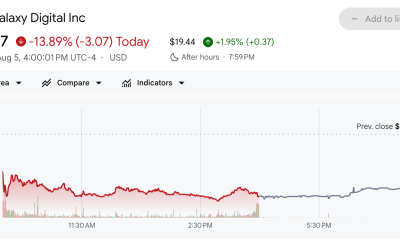
Galaxy Digital Stock Slides 14% as Crypto Prices Hit Earnings
-
 Business2 days ago
Oil Price Today (August 11): Crude oil rises to $88 after Trump’s compensation demand dents Hormuz opening. Here’s why
-

 Politics7 days ago
The Not-So Talented Mr Arday
-

 Business6 days ago
SpaceX Shares Plunge 13.6% After First Public Earnings as AI Capex Surge and Lockup Spark Selloff
-

 Fashion5 days ago
Weekly News Update, 8.6.26 – Corporette.com
You must be logged in to post a comment Login