

Crypto World
HYPE pops 7%, beating bitcoin declines, as SpaceX pre-IPO lands on Hyperliquid



Hyperliquid’s HYPE token rallied 7% over 24 hours after Trade.xyz launched the first pre-IPO perpetual market on the platform, offering synthetic exposure to SpaceX at a reference valuation of $1.78 trillion.



Iran has reportedly explored an insurance-based system for ships crossing the Strait of Hormuz, while unverified claims about Bitcoin-linked payments have added fresh uncertainty around how the wartime transit regime could operate.
Summary
- Iran has reportedly explored an insurance system for ships crossing the Strait of Hormuz, with speculation emerging around possible Bitcoin-based payments.
- Fars News denied reports that Tehran is already collecting crypto tolls, even as shipping firms face scam messages demanding Bitcoin or USDT for safe passage.
- U.S. authorities recently froze $344 million in USDT tied to Iran, fueling fresh debate over whether Bitcoin could become a preferred settlement tool under sanctions.
According to Iran’s state-linked Fars News Agency, the Iranian Ministry of Economic Affairs has proposed managing traffic through the Strait using a formal insurance framework tied to marine transit and financial responsibility certificates. Fars, which said it obtained a state document outlining the proposal, reported that the system could generate more than $10 billion in revenue for Tehran.
Set against the ongoing U.S.-Iran conflict, the proposal comes as commercial shipping through the Strait remains heavily disrupted. Roughly one-fifth of global oil trade normally passes through the narrow waterway, though multiple reports have stated that ship movement has slowed since U.S. airstrikes on Iran began in late February.
At the center of the latest speculation is a website called “Hormuz Safe,” which circulated online through screenshots advertising “Secure Digital Insurance for Maritime Cargo.” Several crypto-focused reports claimed the platform was linked to an Iranian effort to collect insurance payments in Bitcoin, although the site was inaccessible at the time of writing, and no official confirmation has emerged from Iranian authorities.
Iran denies active crypto toll collection
Last month, Fars News had separately rejected reports claiming Tehran was already collecting Strait of Hormuz transit tolls in cryptocurrency. In an Apr. 23 report, the outlet said allegations about Iran accepting Bitcoin or stablecoins from passing vessels were “inaccurate.”
At nearly the same time, the Financial Times reported that Iran had been considering a system under which oil tankers would pay transit fees in cryptocurrency, with negotiations allegedly starting near $1 per barrel of crude. Bloomberg later reported that an intermediary linked to Iran’s Islamic Revolutionary Guard Corps had discussed similar pricing during talks involving maritime operators.
Risk advisory firm MARISKS also warned that scammers were exploiting the uncertainty. According to the company, shipowners stranded west of the Strait received fraudulent messages from unknown actors pretending to represent Iranian authorities and demanding payment in Bitcoin or Tether for “clearance” and safe passage.
MARISKS said the messages were fake and warned that they did not originate from official Iranian channels. The firm added that at least one vessel may have come under fire while attempting to leave the area after engaging with the fraudulent communications.
Meanwhile, previous media reports have suggested Iran already collected its first revenue from wartime shipping tolls last month, although those claims remain disputed. Before the current conflict, no such toll system had existed for vessels crossing the Strait.
Bitcoin speculation grows after USDT seizures
Attention around possible Bitcoin payments intensified after U.S. authorities froze $344 million in Tether USDt tied to Iran last month. Earlier reports had claimed that Iranian-linked operators preferred USDT and the Chinese yuan for energy-related settlements, while also accepting Bitcoin in some cases.
Chainalysis noted in previous analysis that Iran has historically relied on dollar-backed stablecoins, particularly USDT on the Tron blockchain, to move funds outside traditional financial rails. The blockchain analytics firm said any future crypto-linked toll structure in Hormuz could create new compliance risks for virtual asset service providers interacting with sanctioned entities.
Industry figures have also argued that Bitcoin may appeal more to sanctioned states because it operates without a centralized issuer capable of freezing balances. Earlier in April, a spokesperson for Iran’s Oil, Gas and Petrochemical Products Exporters’ Union reportedly told media outlets that certain ships could continue passing through the Strait if they paid a tariff of $1 per barrel in Bitcoin.
Vessels would reportedly receive payment instructions only after Iranian authorities completed internal reviews, with transactions expected to be settled within seconds to avoid tracing or confiscation under sanctions enforcement.
Crypto World
Crypto security is turning into an AI arms race as agents may overwhelm compliance teams


AI agents and automated payments could reach a scale that crypto monitoring systems built for human-paced markets cannot handle, Elliptic CEO Simone Maini warned.


Bitcoin Depot, the largest bitcoin ATM operator in North America and publicly listed on Nasdaq, has filed for Chapter 11 bankruptcy.


The DeFi lending protocol reversed restrictions imposed after April’s $292 million exploit, restoring borrowing capacity across six networks as contagion fears ease.
Pi Network’s native token is on the move again, but in the opposite direction of what the project’s multi-million fan base expects and hopes.
The latest leg down comes amid community expectations regarding the new protocol updates and some team announcements.
PI Dumps Yet Again
It’s safe to say that the popular altcoin has seen better days, which weren’t all that long ago. Recall that it exploded to $0.30 two months ago during the mounting hype about the upcoming listing on the veteran US exchange, Kraken. The actual development, though, became a classic sell-the-news moment as PI plummeted shortly after it went live for trading, going down to its starting position at $0.18.
The subsequent breakout attempts were not as impressive, and PI was halted at $0.20 during each of them. The last one was at the end of April, when the bears took complete control and have been dominating ever since. PI managed to find some support at $0.17 and spent a few weeks trading sideways between that lower boundary and $0.18.
However, the rejection during the weekend brought the token down to $0.155, which was a three-month low. Another such local setback arrived in the past 12 hours as the entire market crashed. However, PI’s nosedive was more painful than almost all other altcoins, dumping by another 6% to under $0.15.
Its market capitalization has plunged below $1.6 billion, pushing the asset well outside the top 50 alts by that metric.

Update Still Awaited
Aside from issuing an urgent warning about the safety of its user base and an important KYC announcement, the team behind the project recently outlined the deadline by which the protocol upgrade v23 had to be successfully migrated. Following the completion of previous updates, such as v19.6, v19.9, v20.2, and v22, the team set May 15 as the date for the latest one.
Although that date passed on Friday, there hasn’t been an official statement from the Core Team about its successful completion. There are some contradicting comments on X, with some users claiming that the update has been deployed, while others believe it might take a few more days.
Nevertheless, they all seem convinced that v23 will be a game-changer for the broader Pi Network ecosystem, as it’s expected to pave the way for native smart contracts, dApps, and a Pi Dex.
The post Pi Network’s PI Plunges to New 3-Month Low Despite Hype Around ‘Game-Changing’ Update appeared first on CryptoPotato.
Crypto World
Iran may be turning the Strait of Hormuz into a bitcoin insurance market, local reports say


State-linked Fars News reported that Iran’s economy ministry has been working on a plan to manage shipping through the Strait with payments in bitcoin.
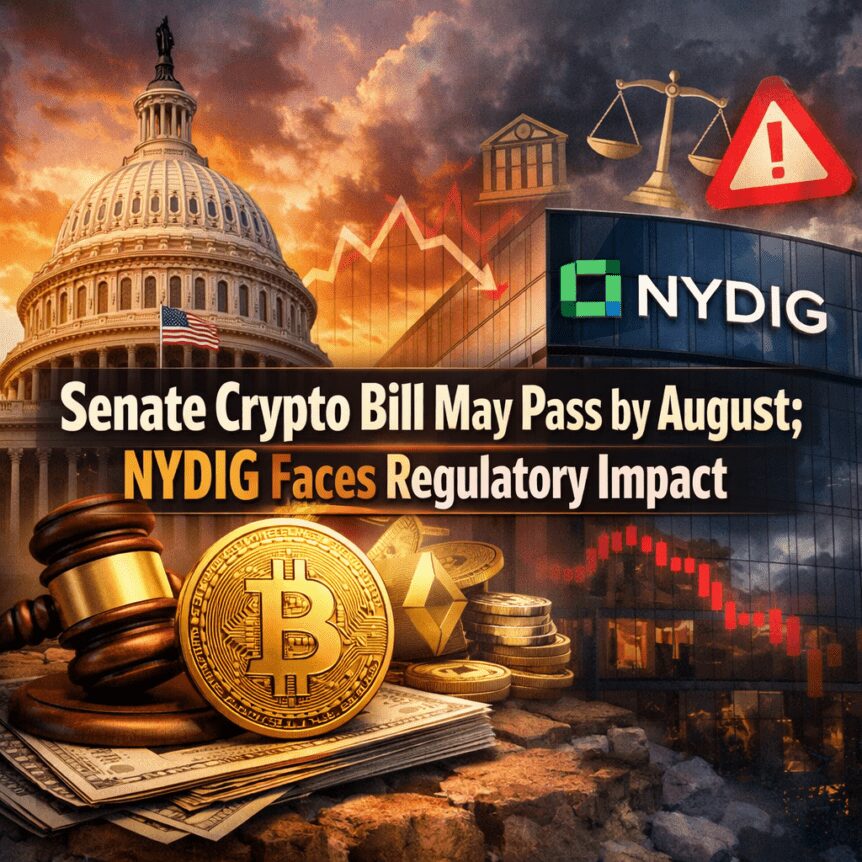
The US Senate’s high-profile crypto market structure bill remains on a tight timetable, with insiders warning that passage could slip into August or even miss the midterm window entirely if lawmakers cannot align before November. Greg Cipolaro, head of research at NYDIG, cautioned that the realistic negotiating window may extend from June to early August, while an earlier target floated by White House crypto adviser Patrick Witt pointed to July 4 for a Senate markup and floor votes. The reality, said Cipolaro, is likely less rigid: “This may represent an aspirational benchmark rather than a fixed legislative deadline.”
The draft legislation is designed to establish a comprehensive framework for how US regulators would oversee crypto markets, a centerpiece among this year’s most consequential crypto policy measures. Yet progress has been slowed by contentious negotiations over stablecoins, enforcement approaches to decentralized finance, and the extent of government officials’ use of crypto, among other sticking points.
According to Cointelegraph, the bill cleared a long-delayed markup in the Senate Banking Committee on Thursday, advancing to the Senate floor where it would require 60 votes to proceed and avoid a protracted debate. The committee vote was largely along party lines, underscoring the partisan dynamics that could shape the bill’s fate as lawmakers return from recess.
Key takeaways
- The Senate Banking Committee moved the crypto market structure bill toward a full floor vote, setting up a 60-vote threshold to pass and avert extended debate.
- With the Senate’s current 53-seat Republican majority, securing at least seven Democratic votes would be needed for swift passage; several Democrats have expressed concerns that the proposal does not go far enough to curb crime or sanctions evasion.
- The timing remains uncertain: the realistic passage window spans June through early August, but a July–September recess and the looming midterms could complicate scheduling; a post-election lame-duck session remains a potential alternative path.
- Beyond timing, passage would deliver regulatory clarity that could boost institutional participation in crypto markets. In particular, the bill would classify Bitcoin as a commodity under the Commodity Futures Trading Commission and reduce remaining regulatory overhang for Bitcoin as an institutional asset.
- Even if enacted, the bill’s fate is contingent on broader political dynamics. A Democratic gain in the Senate could derail the current Republican-backed framework in the next Congress, given the different legislative environment after the midterms.
Legislative trajectory and timing
The core purpose of the bill is to prescribe how US watchdogs would regulate crypto markets, seeking to harmonize oversight across agencies and provide a clearer pathway for institutions operating in the space. Its resonance within the policy landscape is tied to the ongoing debate over stablecoins, anti-crime provisions, and how to integrate crypto activity within traditional financial law. The latest committee action marks a critical milestone, but substantial hurdles remain before a floor vote and eventual enactment.
Regulatory implications and market impact
Proponents argue that a formal framework would reduce legal uncertainty and enable more robust participation by banks and other large investors, which have frequently cited the lack of regulatory clarity as a constraint on capital deployment in crypto markets. A central feature described in policy discussions is the potential classification of Bitcoin as a commodity for CFTC oversight, addressing a longstanding question about its regulatory status and eliminating a major bit of ambiguity for market participants.
For exchanges, asset managers, and crypto firms, the bill’s passage would set a baseline of compliance expectations—particularly around disclosures, registration requirements, and enforcement mechanisms. In parallel, the proposed framework intersects with broader regulatory structures under consideration in other jurisdictions, and policymakers frequently reference cross-border alignment as a goal to facilitate legitimate global activity while deterring illicit finance.
Political dynamics, risk, and enforcement considerations
Political dynamics loom large. Republicans hold a 53-seat Senate majority, meaning cross-party support is essential for a timely enactment. Achieving consensus would require at least seven Democrats to back the measure for a rapid path to passage. Yet several Democrats have voiced concerns that the bill does not sufficiently deter crime or address sanctions evasion, raising questions about the balance between bipartisan cooperation and stringent safeguards.
As Cipolaro summarized in his briefing, congressional negotiators face a tradeoff: “Congressional negotiators face a tradeoff between accepting an imperfect bipartisan framework in 2026 versus risking a substantially different legislative environment after the midterms.” The statement underscores the high stakes of timing; a change in control after the midterms could reshape the legislative approach to crypto regulation, potentially altering or delaying the policy roadmap.
Beyond timing, there are substantive policy questions that could influence the bill’s durability after passage. Provisions related to decentralized finance, ethics rules, and enforcement authorities remain focal points of negotiation, and even if the bill advances, regulatory interpretation and practical implementation will require close coordination across agencies and in-depth compliance programs by market participants.
From a compliance perspective, the potential clarity offered by a enacted framework could align with existing AML/KYC expectations and licensing regimes, while also prompting banks and broker-dealers to reassess their crypto exposure, risk controls, and reporting obligations. The interplay with other regulatory initiatives—such as the broader financial services rulebook and cross-border policy efforts—will be critical to ensure coherence and avoid regulatory arbitrage.
Closing the loop on enforcement considerations, a finalized framework would still need to address how to supervise rapidly evolving technologies and products within the crypto ecosystem, particularly when it comes to DeFi platforms and new token structures. Market participants would benefit from well-defined standards, but the evolving nature of the asset class means that oversight will require ongoing monitoring and possible updates to policy to address emerging risks.
What happens next remains highly dependent on calendar and coalition-building. Analysts and compliance teams should monitor committee schedules, potential amendments targeting stablecoins, and the broader electoral context, as these factors will shape both the likelihood of passage and the regulatory architecture that would follow.
If enacted, the law would mark a significant milestone in US crypto policy, providing a clearer authorization framework for institutional participation and enabling regulators to articulate specific standards for market integrity and consumer protection. For now, market observers are balancing optimism about regulatory clarity with caution about political wagering and the complexity of crafting durable, cross-agency oversight that can withstand changing administrations and election outcomes.
Source note: Coverage reflects developments reported in contemporary policy and market briefs, with attribution to Cointelegraph where cited.
Looking ahead, stakeholders will want to watch for the final passage dynamics, the specific text of any amendments, and the timing of a floor vote. The course of the bill will illuminate how Congress intends to frame crypto in the regulated financial system and what that means for the trajectory of crypto markets, institutional adoption, and cross-border regulatory alignment.


The U.S. Senate’s crypto market structure bill has entered a narrow legislative window that could close by August if lawmakers fail to move the measure before the midterm election cycle intensifies, according to research firm NYDIG.
Summary
- NYDIG said the U.S. Senate crypto market structure bill could face major delays if lawmakers fail to pass it before the August recess.
- Republicans may need support from at least seven Democrats to move the bill through the Senate floor with a 60-vote threshold.
- According to NYDIG, failure to pass the legislation could leave the crypto industry operating under continued regulatory uncertainty in the U.S.
In a market note published Friday, NYDIG head of research Greg Cipolaro said the most realistic timeframe for the bill to clear Congress runs from June through early August, despite recent comments from White House crypto adviser Patrick Witt, who said earlier this month that the administration was targeting a July 4 passage timeline.
Witt had stated that enough time remained for a Senate markup, a floor vote, and final House approval. Cipolaro, however, described the July target as more of an “aspirational benchmark” than a firm deadline.
Thursday’s Senate Banking Committee vote moved the legislation one step closer to the Senate floor after months of delays tied to negotiations over stablecoin rules, ethics provisions, and the treatment of government officials involved with digital assets. The committee advanced the bill largely along party lines.
With Republicans holding 53 seats in the Senate, at least seven Democrats would likely need to support the measure to secure the 60 votes required to avoid prolonged debate and pass the chamber quickly. Several Democratic lawmakers have argued that the current draft does not adequately address concerns tied to illicit finance and sanctions evasion.
Election calendar could complicate crypto bill timeline
As Cipolaro noted in the NYDIG report, Congress is scheduled to recess from late July through early September before lawmakers return to a politically sensitive period leading into the November midterms.
Under that timeline, Senate leadership may avoid scheduling a contentious vote requiring bipartisan support once campaigning accelerates. Cipolaro wrote that if lawmakers fail to advance the bill before the recess period, the next viable opportunity could come during a post-election lame-duck session.
Even then, NYDIG said the path would depend heavily on Republicans retaining Senate control and Majority Leader John Thune deciding to prioritize crypto legislation alongside government funding negotiations.
Current election forecasts continue to show a closely contested Senate race. While some projections give Republicans a slight edge, other models classify several battleground seats as tossups that could hand Democrats control of the chamber next year.
According to Cipolaro, a Democratic-controlled Senate in the next Congress would likely reduce the chances of the current Republican-backed market structure proposal advancing after January.
Within the same note, NYDIG said lawmakers are effectively weighing whether to approve an imperfect bipartisan framework this year or risk reopening negotiations under a different political balance after the elections.
Regulatory clarity seen as key institutional catalyst
Cipolaro added that passage of the legislation could materially improve institutional confidence in crypto markets by establishing clearer oversight rules for digital assets in the U.S.
Among the bill’s most significant provisions, NYDIG said Bitcoin would formally fall under the jurisdiction of the Commodity Futures Trading Commission as a commodity, removing what the firm described as one of the last major regulatory uncertainties surrounding Bitcoin’s role as an institutional asset.
Failure to pass the legislation, however, could leave the crypto industry operating under continued jurisdictional uncertainty. NYDIG said unresolved disputes over decentralized finance enforcement provisions, ethics language, or procedural delays could still derail negotiations before the current congressional window closes.
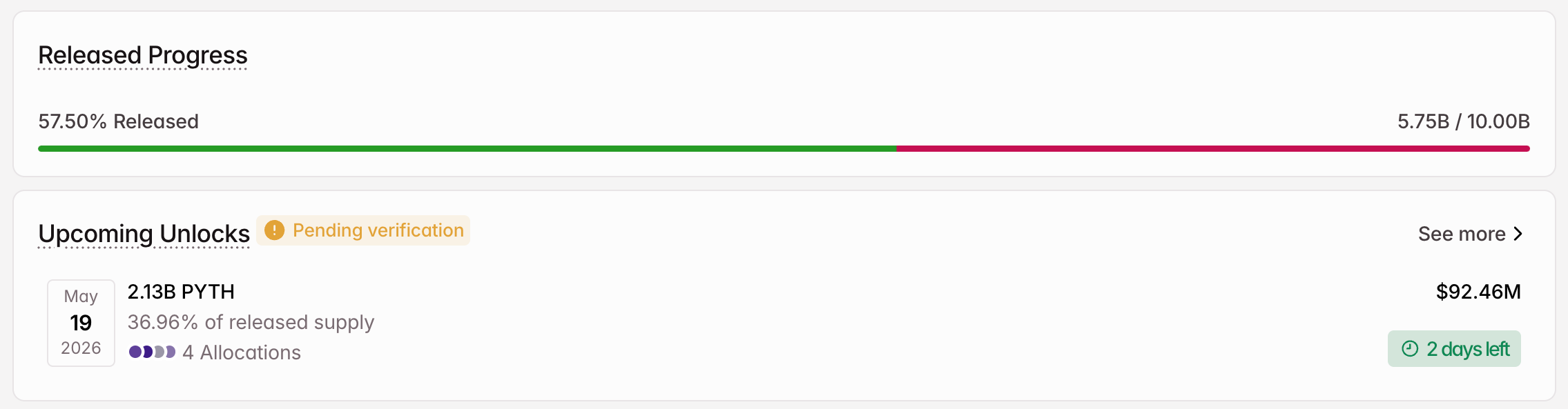
The crypto market will welcome tokens worth more than $770 million in the third week of May 2026. Major projects, including Pyth Network (PYTH), LayerZero (ZRO), and KAITO (KAITO), will release significant new token supplies.
These unlocks could introduce market volatility and influence short-term price movements. So, here’s a breakdown of what to watch.
1. Pyth Network (PYTH)
- Unlock Date: May 19
- Number of Tokens to be Unlocked: 2.13 billion PYTH
- Released Supply: 5.75 billion PYTH
- Total Supply: 10 billion PYTH
Pyth Network is a decentralized oracle protocol that delivers real-time financial market data directly to blockchain applications. It sources price feeds from over 120 first-party publishers, including major exchanges, market makers, and trading firms, covering crypto, equities, FX, and commodities.
On May 19, the team will release 2.13 billion tokens, worth approximately $92.46 million. The altcoins account for 36.96% of the current released supply.

The network will split the supply four ways. Pyth Network will allocate 1.13 billion tokens to ecosystem growth and 537.5 million tokens to publisher rewards.
In addition, the team will keep 250 million tokens for private sales. Lastly, Pyth will direct 212.5 million tokens toward protocol development.
2. LayerZero (ZRO)
- Unlock Date: May 20
- Number of Tokens to be Unlocked: 25.71 million ZRO
- Released Supply: 507.08 million ZRO
- Total Supply: 1 billion ZRO
LayerZero is an interoperability protocol that connects different blockchains. Its primary goal is to facilitate seamless cross-chain communication. Thus, it enables decentralized applications (dApps) to interact across multiple blockchains without relying on traditional bridging models.
The team will unlock 25.71 million tokens on May 20, representing 5.07% of the released supply. Moreover, the supply is worth approximately $32.65 million.

LayerZero will award 13.42 million altcoins to strategic partners. Core contributors will get 10.63 million ZRO. Lastly, 1.67 million ZRO are for tokens repurchased by the team.
3. Kaito (KAITO)
- Unlock Date: May 20
- Number of Tokens to be Unlocked: 17.6 million KAITO
- Released Supply: 374.28 million KAITO
- Total Supply: 1 billion KAITO
Kaito is an artificial intelligence (AI)-powered Web3 information platform that aggregates and analyzes cryptocurrency market data from diverse sources like social media, governance forums, news, and more. The KAITO token serves as a medium of exchange, governance tool, and incentive mechanism within the platform.
On May 20, the team will unlock 17.6 million tokens, representing 4.7% of the current released supply. The supply is worth approximately $8.58 million.

The foundation will receive 1.19 million tokens. Core contributions will get 6.94 million tokens. Furthermore, early backers will receive 2.31 million KAITO. Finally, the team will direct 7.16 million KAITO for ecosystem and network growth.
In addition to these, other prominent unlocks investors can look out for in the third week of May include MBG by Multibank Group (MBG), YZY (YZY), Soon (SOON), and more, which will contribute to the overall market-wide releases.
The post 3 Token Unlocks to Watch in the Third Week of May 2026 appeared first on BeInCrypto.


Bitcoin Depot, once the largest Bitcoin ATM operator in the US, filed for Chapter 11 bankruptcy protection on Monday and pulled its entire kiosk network offline.
The filing landed in the US Bankruptcy Court for the Southern District of Texas. Canadian entities will join the US proceedings, while other foreign units wind down under applicable foreign law.
Bitcoin Depot to Wind Down After Filing for Bankruptcy Protection in Texas
CEO Alex Holmes pointed to a regulatory shift that has turned hostile to Bitcoin ATM (BTM) operators. States have imposed transaction caps, tighter compliance rules, and outright bans in multiple jurisdictions.
“Operators have faced increasing litigation and regulatory enforcement. These developments have materially affected Bitcoin Depot’s business and financial position. Under these circumstances, the Company’s current business model is unsustainable,” he said.
Indiana became the first state to ban the kiosks in March, followed by Tennessee and Minnesota, according to AARP. Bitcoin Depot also faced lawsuits from attorneys general in Massachusetts and Iowa. Connecticut suspended its operating license in March.
Meanwhile, the Federal Bureau of Investigation (FBI) logged 13,460 crypto-kiosk fraud complaints in 2025, with reported losses of $389 million. That marked a 58% jump from the prior year.
Follow us on X to get the latest news as it happens
The bankruptcy filing follows the company’s recent disclosure that it could not submit its quarterly 10-Q report to regulators on time. Q1 2026 results came in dramatically weaker than the same period a year earlier.
Revenue fell $80.7 million, a 49.2% year-over-year decline, after transaction volumes shrank under the weight of regulatory impacts and the tightened compliance checks.
Gross profit collapsed 85.5% to $4.5 million from $31.2 million. Cash reserves fell from $65.6 million in December to $44.0 million by March, and the company accrued over $20 million in legal judgments during Q4 2025.
Bitcoin Depot’s collapse may indicate whether other major operators can survive similar pressures.
Subscribe to our YouTube channel to watch leaders and journalists provide expert insights
The post Bitcoin Depot Files for Bankruptcy as Pressure Mounts on Crypto ATM Sector appeared first on BeInCrypto.

Virat Kohli’s Tactic Masterclass Leads To Wicket For RCB Against Punjab Kings. Reaction Says It All – Watch

How Taylor’s University’s Camp of Leaders is developing the future

Scotland news LIVE as Celtic fans slammed by residents in ‘lawless no go zone’

Manchester United reach agreement with Casemiro over contract clause amid transfer speculation

US brings back mandatory military draft registration

Steven Gerrard disagrees with Gary Neville over ‘shock’ Chelsea and Arsenal claim | Football


-

 Crypto World2 days ago
BloFin War of Whales 2026 Grand Prix opens registration for $5M trading championship
-

 Fashion3 days ago
Weekend Open Thread: Theory – Corporette.com
-

 Crypto World3 days ago
E-Estate Announces 1 Year Live: Washington DC Summit as Real Estate Tokenization Enters Its Next Phase
-

 Fashion7 days ago
Coffee Break: Travel Steam Iron
-

 Politics6 days ago
What to expect when you’re expecting a budget
-

 Tech3 days ago
Tech Moves: Microsoft AI leader jumps to OpenAI; former AI2 exec joins Meta; and more
-
Crypto World5 days ago
Bitcoin Suisse expands with Digital Asset License and Investment Business Act Registration Approval in Bermuda
-

 Tech6 days ago
GM agrees to $12.75M California settlement over sale of drivers’ data
-

 Politics5 days ago
Pakistan to enter Chinese capital market as war inflation bites
-

 Crypto World5 days ago
Bitcoin Suisse expands with Digital Asset License and Investment Business Act Registration Approval in Bermuda
-
 Crypto World4 days ago
Google’s Gemini AI Predicts Incredible Solana Price by the End of 2026
-

 Business3 days ago
H&R Real Estate Investment Trust (HR.UN:CA) Q1 2026 Earnings Call Transcript
-

 Tech2 days ago
Google reimburses Register sources who were victims of API fraud
-

 Tech7 days ago
Over-Engineered Cardboard PC Case Houses a Full Computer Without Compromising Style or Performance
-

 Sports2 days ago
Napoleonic enters 2026 Doomben 10,000 field via Abounding withdrawal
-

 Politics6 days ago
The geopolitics behind the UK’s South Atlantic hantavirus rescue mission
-

 Politics6 days ago
The Board of Deputies just smeared Polanski to suck up to Farage
-

 Fashion5 days ago
The Best-Kept Makeup Secret for a More Defined Face
-

 Entertainment7 days ago
Matt Damon And Ben Affleck Sued Over ‘The Rip’
-
 Entertainment4 days ago
Zara Larsson Has Blunt Response To Chris Brown Diss
You must be logged in to post a comment Login