

Crypto World
Intuitive Machines (LUNR) Stock Surges on $186.7M Q1 Revenue and $1.1B Backlog Milestone


Key Highlights
-
First-quarter revenue reaches $186.7M as LUNR stock gains momentum on record backlog
-
Contract backlog surges to unprecedented $1.1B following major NASA awards and acquisitions
-
Lanteris acquisition drives substantial revenue expansion and space infrastructure capabilities
-
Company maintains full-year revenue projection between $900M and $1B for 2026
-
Positive Adjusted EBITDA of $2.7M marks significant profitability milestone for space firm
Shares of Intuitive Machines attracted investor interest following a robust first-quarter performance that saw revenue expand nearly threefold while the contract backlog climbed to an all-time high. LUNR stock traded at $36.43, representing a gain of $0.75 or 2.10% during the session. The upward movement came on the heels of impressive revenue figures, favorable profitability metrics, and significant contract awards.
Intuitive Machines, Inc., LUNR
The lunar and space infrastructure enterprise delivered $186.7 million in quarterly revenue for the three months concluding March 31, 2026. This figure represented an approximately 200% increase compared to the same period last year, driven substantially by the integration of Lanteris Space Systems. Performance across Commercial Lunar Payload Services, Orbital Mission Enabling Services, and National Security and Navigation Services programs contributed to the results.
January 2026 marked the completion of Intuitive Machines‘ $800 million Lanteris acquisition, significantly broadening the company’s space infrastructure footprint. This strategic transaction positioned the firm as a more comprehensive prime contractor serving commercial, civil, and national security space sectors. Notably, the Q1 revenue figure did not capture 12 days of Lanteris operations, representing approximately $13 million in excluded revenue.
Profitability Milestone Strengthens Financial Position
Intuitive Machines achieved $2.7 million in positive Adjusted EBITDA during the quarter, establishing a new profitability benchmark. This achievement provides a solid foundation as the organization scales up its participation in major space and defense initiatives. Management maintained its commitment to delivering positive Adjusted EBITDA for the complete fiscal year.
The company’s contract backlog climbed to $1.1 billion by quarter’s close, representing an $842 million increase from the December 2025 position. This substantial growth stemmed primarily from the Lanteris integration and additional NASA lunar transportation contracts. Consequently, the firm entered subsequent quarters with enhanced revenue predictability and contracted work visibility.
New contract awards totaling $428.9 million were secured throughout the three-month period. Notable wins included Space Development Agency tracking layer assignments and a substantial $180.4 million Commercial Lunar Payload Services contract from NASA. This NASA award represented the company’s fifth CLPS task order and inaugural Nova-D cargo-class lunar lander assignment.
Strategic Acquisitions Enhance Service Capabilities
During the second quarter, Intuitive Machines entered into an agreement to acquire Goonhilly Earth Station along with its COMSAT division. This strategic move aims to establish a comprehensive space-to-ground data services infrastructure spanning multiple orbital regimes. The proposed network would facilitate communications, navigation capabilities, data processing functions, and support for deep space exploration missions.
The organization also secured a position on the U.S. Space Force’s Andromeda IDIQ contract during Q2. This contract vehicle features a potential ceiling value of $6.2 billion across all awardees. Significantly, this represented the initial revenue synergy opportunity leveraging combined capabilities from both Intuitive Machines and Lanteris operations.
Looking ahead to full-year 2026, Intuitive Machines projects revenue will land between $900 million and $1 billion. This guidance incorporates the strengthened backlog position, expanded infrastructure capabilities, and increasing mission scope requirements. As such, LUNR’s recent price action reflects both near-term operational momentum and a robust pipeline of future space services opportunities.


Quick Summary
- SpaceX prepares for potential IPO with approximately $1.75 trillion valuation, possibly becoming history’s largest market debut
- Oracle (ORCL) shares tumbled following announcement of substantial AI infrastructure investments and financing plans
- Headline inflation in the United States surged past 4%, primarily fueled by escalating energy costs
- Crude oil prices climbed amid escalating geopolitical tensions with Iran, intensifying inflation worries
- OpenAI submitted confidential IPO paperwork, potentially transforming investor access to artificial intelligence companies
Today delivered multiple significant developments that forced investors to reassess positions across AI infrastructure, inflation trends, and upcoming public offerings.
SpaceX Pursues Unprecedented Public Offering
The SpaceX initial public offering has become the focal point of financial discussions. Market watchers anticipate the aerospace giant will debut with an approximate $1.75 trillion price tag, positioning it as the most valuable IPO ever executed.
Investor appetite appears robust. Reports indicate some retail traders have liquidated holdings specifically to allocate capital toward this anticipated listing.
Skepticism exists, however. Certain market observers are raising red flags regarding potential insider transactions and whether the astronomical valuation already incorporates multiple years of projected expansion.
Previous high-profile technology IPOs have frequently underperformed following initial trading sessions. The SpaceX market entry is poised to become a landmark financial moment in 2026, though post-listing trajectory remains uncertain.
Oracle (ORCL) Shares Tumble Despite Strong Contract Wins
Oracle delivered impressive operational results and secured significant artificial intelligence partnerships. Nevertheless, shares experienced a substantial decline.
The culprit: ambitious capital expenditure plans. Oracle disclosed intentions to deploy tens of billions toward AI infrastructure buildout. The company also announced plans to secure considerable debt and equity financing for these initiatives.
Market participants responded unfavorably. While artificial intelligence enthusiasm persists, mounting pressure exists for corporations to demonstrate that substantial capital outlays will translate into meaningful profitability.
Oracle’s stock decline signals that Wall Street is increasingly scrutinizing AI investment returns rather than merely celebrating contract announcements.
Inflation Surges Past 4% Threshold
U.S. headline inflation jumped beyond 4%, surprising market participants.
Energy price increases drove the acceleration. This development suggests interest rates may remain at elevated levels longer than previously anticipated by investors.
This carries implications for equities, particularly technology and growth-oriented companies, which demonstrate heightened sensitivity to rate trajectory expectations. Inflation data has emerged as a critical variable influencing market movements on a weekly basis.
Crude Prices Jump on Geopolitical Uncertainty
Escalating geopolitical tensions centered on Iran propelled oil prices upward during trading. Climbing energy expenses compound inflationary pressures while generating broader economic growth concerns.
Energy sector equities benefited from the price movement. Conversely, industries with significant fuel dependencies, including transportation and manufacturing, confront challenges if elevated pricing persists.
Sustained oil price strength could influence Federal Reserve monetary policy deliberations.
OpenAI Submits Confidential IPO Documentation
News surfaced today that OpenAI has filed confidential paperwork for a public offering. Anthropic may pursue a comparable strategy.
Combined, these public listings could provide investors with direct artificial intelligence company exposure for the first time, eliminating reliance on indirect investments through Nvidia, Microsoft, or Alphabet.
Certain analysts anticipate this development could spark sector rotation within technology, with investment capital shifting from established AI stocks toward newly public entities.
An OpenAI IPO would rank among the most substantial technology market debuts in history should it proceed.


SpaceX (SPCX) shares will begin trading on Solana the same day the company is expected to list on Nasdaq, according to Sunrise, a tokenization infrastructure provider, and Backpack Securities, a regulated brokerage and crypto trading platform, which are launching a tokenized version of the stock called SPCX.
The token, issued by Backpack, represents ownership of underlying SpaceX shares and can be redeemed for those shares through Backpack’s brokerage platform. The firms say eligible shares can also be converted back into tokens, creating a bridge between traditional brokerage accounts and blockchain-based markets.
The launch attempts to bring newly listed U.S. equities onchain from day one. Backpack says SPCX holders will have a direct redemption path to the underlying security.
SPCX will trade on Solana around the clock, including outside traditional market hours. The token can be held in self-custody wallets and traded across supported Solana-based venues.
The announcement comes as interest in tokenized real-world assets continues to grow across the crypto industry. Stablecoins have become one of blockchain’s most successful use cases, and several firms are now betting that equities could follow a similar path if tokenized shares can be made accessible to a global investor base.
Crypto World
Big banks are ditching private blockchains to build tokenized cash networks on public infrastructure


Banks are focusing on pulling stablecoins and tokenized forms of more traditional financial instruments into one integrated package to meet growing institutional demand for multi-asset flexibility.
Rather than waiting for a single winner to emerge, large asset managers and corporate treasuries are demanding a multi-instrument setup in which stablecoins, tokenized bank deposits and tokenized money market funds all run on the same infrastructure.
“The demand from institutional clients is consistent: they are not waiting for any single instrument to prevail,” Thomas Eichenberger, chief strategy officer and deputy group CEO at Swiss-based digital asset bank Sygnum, told CoinDesk on Thursday in an email.
“They are asking how tokenized deposits, regulated stablecoins, and tokenized money market funds can be combined and made interoperable, so a treasury function can move between them — permissioned settlement, 24/7 cross-border flows, yield with on-demand liquidity — under one regulatory framework they already trust,” he added.
Sygnum, which describes itself as the world’s first digital assets bank, partnered late last year with Swiss banking powerhouse UBS and PostFinance, a subsidiary company of the state-owned Swiss Post, to test blockchain payments between institutions on Ethereum.

Hong Kong-based fintech Reap has partnered with identity verification and anti-fraud platform Sumsub to strengthen its onboarding and compliance infrastructure as the company expands into new international markets.
The collaboration will allow Reap to automate Know Your Customer (KYC) and verification processes for both business clients and end cardholders, helping the company maintain regulatory compliance while delivering a seamless user experience across jurisdictions.
Reap, which specializes in stablecoin-powered cards, cross-border payments, and financial infrastructure for businesses, has been rapidly expanding beyond the Asia-Pacific region. As regulatory requirements continue to evolve across different markets, the company is seeking scalable compliance solutions that can support global growth.
According to Reap’s Head of Legal, Risk and Compliance, Darryl Wan, onboarding plays a critical role in customer experience and must remain both efficient and compliant regardless of where users are located.
Through Sumsub’s API-first compliance platform, Reap can configure onboarding workflows based on customer type, geographic location, and risk profile. The system enables localized verification requirements while maintaining consistent compliance standards across all markets.
One of the key components of the partnership is Sumsub’s Reusable KYC technology. The feature allows users who have previously completed verification through Sumsub to avoid repeating the same identity checks and document submissions when onboarding with new services using the platform.
The approach is designed to reduce friction while preserving compliance with anti-money laundering (AML) and counter-terrorist financing regulations.
Sumsub’s infrastructure supports verification of more than 14,000 identity document types from over 220 countries and territories. Combined with its liveness detection technology, the platform enables identity verification within seconds, helping businesses streamline onboarding without sacrificing security.
Penny Chai, Vice President APAC at Sumsub, said the partnership reflects the growing need for trusted digital identity solutions capable of operating across fragmented regulatory environments.
As Reap continues expanding its stablecoin-based financial services globally, the company plans to further automate onboarding and verification processes, ensuring its compliance framework can support long-term growth and new product launches.
Founded in Hong Kong, Reap employs approximately 300 people worldwide and focuses on bridging traditional finance and digital assets through stablecoin-native financial infrastructure. The company reported processing billions of dollars in stablecoin-funded transaction volume during 2025.
The partnership highlights the increasing importance of scalable identity verification and compliance technologies as stablecoin-powered financial services continue to gain traction globally.
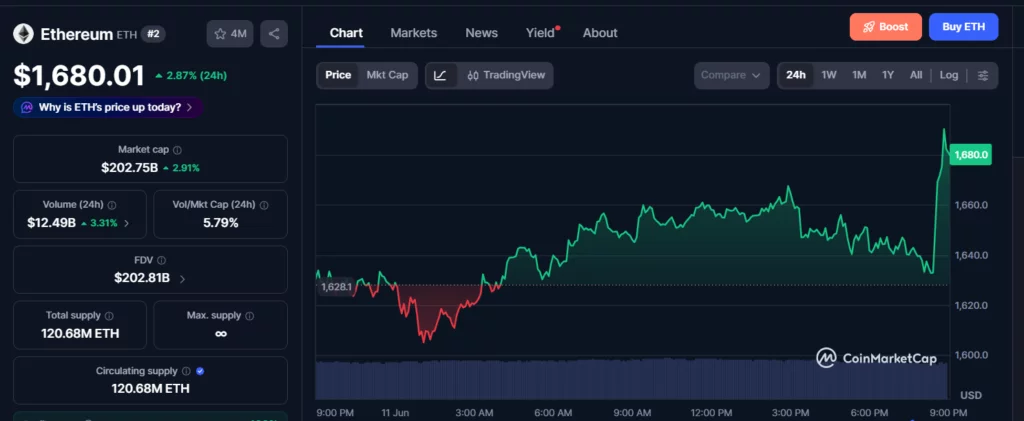
During today’s Asian trading session, Ethereum opened at $1628.
Summary
- Ethereum price climbed 2.87% to $1,680 after a late-session rally.
- CryptoQuant data shows exchange supply fell to 14.5M ETH.
- Staking, private wallets, and treasury holdings reduced exchange balances.
The opening price was at lower levels before the channel turned and traced an upward trend of highs and lows. This opening price has made market participants weigh in on the next targets as exchange supply hits low levels.
Ethereum price jumps 2.87% as late rally lifts price to $1,680
Tracking the ongoing price trend at the time of press, CoinMarketCap data reveals that Ethereum traded at $1,680.01, posting a 2.87% gain over the past 24 hours. The chart showed a volatile session that developed into a broader upward trend. Price activity remained under pressure during the early hours, with Ethereum falling below the $1,620 region before finding support and stabilizing. After that decline, the market gradually recovered and reclaimed lost ground through a steady sequence of higher moves.
Source: CoinMarketCap
Momentum strengthened during the morning period as Ethereum pushed above $1,640 and continued climbing. The advance extended through several intraday swings, with price maintaining a generally positive structure despite short pullbacks. By midday, Ethereum price traded near the $1,660 area and held most of its gains. The trend remained constructive throughout the afternoon, although price movements became more uneven and ranged within a relatively narrow band.
Later in the session, the Ethereum price briefly retreated from local highs and moved lower toward the mid-$1,630s. The decline proved temporary as the market reversed sharply near the end of the period. A strong late-session rally lifted the Ethereum price above previous intraday levels and drove a rapid breakout toward $1,690. Price then eased slightly from that peak and settled around $1,680, ending the session near its highest levels of the day.
Ethereum exchange supply drops to a record low at 14.5 million ETH
The ongoing Ethereum price trend comes at a time when Ethereum exchange reserves have fallen to a record low of 14.5 million ETH, according to CryptoQuant data. The decline began around July 2025 and has continued without a sustained recovery. The drop came as investors moved coins into staking contracts and private wallets. CryptoQuant data shows exchange balances stayed near 20 million ETH through most of 2024.
However, withdrawals accelerated in July 2025 and pushed reserves lower. CryptoQuant commentary stated that “exchange reserves continue to decline at a fast pace.” The metric tracks ETH held on trading platforms and available for immediate trading. Data shows outflows from major platforms, including Binance and Coinbase. As a result, the visible supply on exchanges dropped to its lowest recorded level.
Investors also moved more ETH into staking contracts during the same period. These locked balances remain outside immediate trading activity. Therefore, staking reduced the amount of Ethereum available on exchanges. Corporate treasury activity added to the decline in exchange holdings. BitMine expanded its ETH position after a $250 million capital raise in 2025. Market reports show BitMine holds over 5.5 million ETH. SharpLink also holds 868,699 ETH in its treasury structure.
Crypto World
eToro Integrates Grok-Powered Real-Time Market Sentiment Into AI Investing Assistant Tori

eToro has expanded its AI capabilities by integrating real-time market sentiment from X into its AI investing companion, Tori, through a partnership with xAI and Grok.
According to an announcement published by xAI on June 10, Tori can now access real-time information from X, allowing the AI assistant to monitor market sentiment, identify emerging trends and analyze investor reactions as they happen.
The move represents another step in eToro’s broader strategy to bring artificial intelligence deeper into the investing experience, giving users access to live market intelligence directly within the platform.
Bringing Real-Time Market Intelligence to Investors
Markets increasingly react to information shared across social media platforms before it reaches traditional news outlets. Through the integration with Grok, Tori can analyze conversations, sentiment shifts and breaking developments occurring on X in real time.
According to xAI, Tori can now “read market moods as they shift, track live signals and analyze information” using the company’s latest AI models.
The capability aims to simplify market research by allowing investors to ask questions about specific assets, trends or news events and receive insights based on real-time discussions happening across X.
Part of eToro’s AI-First Strategy
While the latest announcement from xAI focuses on real-time sentiment analysis, the integration builds on a broader relaunch of Tori that eToro unveiled earlier this year.
In April, eToro announced three major upgrades for its AI investing companion:
- Real-time market sentiment from X powered by Grok 4.2
- Persistent memory across conversations
- AI-powered Agent Portfolios that can be managed through natural language interactions
The platform says Tori can remember user preferences, portfolio information and previous interactions, allowing the assistant to provide increasingly personalized insights over time.
From Research to Execution
One of the most notable additions introduced by eToro is the concept of Agent Portfolios, dedicated sub-portfolios designed specifically for AI-driven investing strategies.
Users can allocate capital to a separate portfolio, define operating rules and allow AI agents to execute strategies within those predefined limits while keeping their primary portfolio under direct control.
According to eToro CEO and co-founder Yoni Assia, the objective is not to replace investors but to enhance their capabilities through intelligent automation and real-time analysis.
Growing Role of AI in Investing
The partnership between eToro and xAI highlights a broader trend across the financial industry, where AI tools are increasingly being used to process large volumes of market data, social sentiment and news flow in real time.
With more than 40 million registered users across 75 countries, eToro is among the largest retail investing platforms adopting AI-powered market intelligence at scale.
As competition intensifies among AI providers and fintech platforms, the integration of Grok’s real-time awareness of X conversations into Tori could offer investors faster access to market sentiment and emerging narratives that often influence asset prices before traditional analysis catches up.
Whether real-time social sentiment ultimately translates into better investment outcomes remains to be seen, but eToro’s latest move demonstrates how AI is rapidly becoming a core component of the modern investing experience.
About eToro
Founded in 2007, eToro is a global trading and investing platform offering access to stocks, ETFs, cryptocurrencies, commodities and other financial assets. The company serves more than 40 million registered users worldwide and has been actively expanding its AI capabilities through Tori, its proprietary investing assistant.


MassPay has partnered with Coinbase to integrate stablecoin funding and settlement into its cross-border payout network, giving enterprise customers access to USDC-based payments across 180 countries.
Summary
- MassPay has integrated Coinbase’s payment infrastructure to enable USDC-powered cross-border payouts across 180 countries.
- Corporate clients can fund in USD, convert to USDC through Coinbase, and distribute payments in crypto or local fiat currencies.
- Coinbase will provide custody, wallets, settlement, and payment orchestration, while MassPay manages payout delivery through its global network.
According to the companies’ announcement, eligible MassPay clients can send USDC globally, manage treasury operations through Coinbase Prime custody, and settle transactions on-chain instead of relying on traditional international payment rails.
The integration brings Coinbase’s payment infrastructure directly into MassPay’s platform. Coinbase said its payment APIs will provide wallet services, custody, payment orchestration, and payout functionality, allowing businesses to access stablecoin payments without building their own crypto infrastructure.
MassPay and Coinbase stated that the arrangement is designed to address longstanding challenges in cross-border payments, where companies often need to prefund accounts across multiple markets, tying up working capital and delaying settlements.
Stablecoin funding is integrated into payout operations
Under the integration, corporate customers can fund transactions in U.S. dollars and convert those funds into USDC through Coinbase. According to the announcement, businesses can then distribute funds through a single payment flow to recipients receiving USDC, other digital assets, or local fiat currencies.
Coinbase said the system removes the need for businesses to assemble separate crypto on-ramps, custody providers, wallet infrastructure, liquidity sources, and compliance solutions before using stablecoins for international payments.
At the operational level, Coinbase will provide custody services, wallet infrastructure, settlement capabilities, and regulatory coverage through its licensing framework. MassPay will continue handling payout delivery to recipients through its existing network.
According to the companies, eliminating prefunding requirements allows capital to remain available for business operations instead of sitting idle across payment corridors while awaiting settlement.
Coinbase expands its payments infrastructure strategy
The partnership adds another payments-focused initiative to Coinbase’s growing stablecoin business. In the announcement, Coinbase described itself as offering an end-to-end crypto payments stack that includes the Base blockchain network, USDC and other stablecoins, wallet services, payment tools, on-ramps, off-ramps, and payout infrastructure.
Coinbase also highlighted its position as a major USDC distributor. The company said USDC was co-created alongside Circle and noted that nearly $20 billion of the stablecoin is held on its platform.
Institutional infrastructure remains another focus. Coinbase stated that it serves as a primary custodian for leading spot crypto ETF issuers while maintaining what it described as one of the industry’s largest regulatory licensing footprints.
The latest payment partnership comes as Coinbase continues expanding services beyond exchange trading. Recently, the company received regulatory approval to offer access to global crypto perpetual futures for U.S. users, with Coinbase Chief Executive Brian Armstrong stating that the development would connect American traders to global perpetual futures liquidity through a regulated domestic platform.
At the same time, Coinbase has been advocating for stablecoin-friendly regulations in Washington. The company recently urged U.S. lawmakers to remove capital gains tax requirements on stablecoin payments and exempt small crypto transactions from certain reporting obligations, arguing that such changes could reduce friction for digital payment adoption.
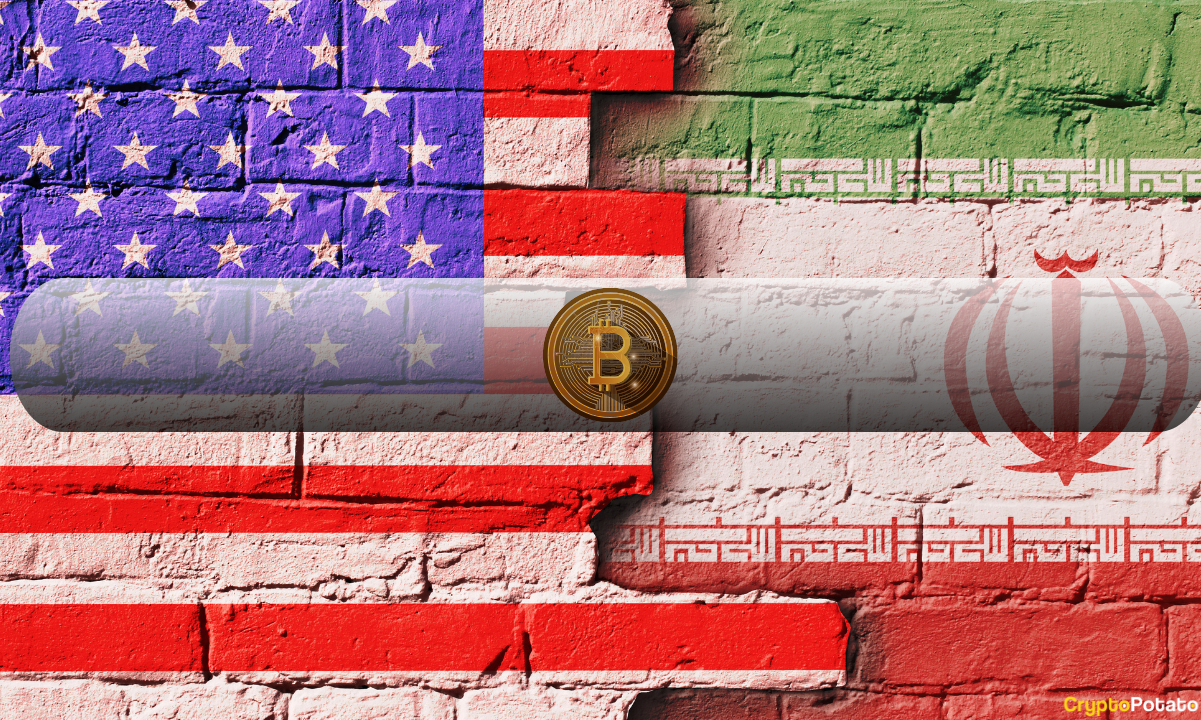
Bitcoin’s price experienced a noteworthy uptick over the past hour or so, jumping from $62,300 to a multi-day peak of $63,700. At the same time, oil prices dropped hard from over $91 to under $87 within minutes.
The main culprit for this is US President Donald Trump’s statement from less than an hour ago that his country will not execute the scheduled attacks against Iran. Interestingly, it came shortly after his latest threats, in which he warned that the US might take out bridges and energy infrastructure.
“Based on the fact that discussions with the Islamic Republic of Iran have been brought to the highest level of Iranian leadership and approved, I have, as President of the United States of America, cancelled the scheduled strikes and bombings against Iran this evening. Discussions and final points have been, in both concept and great detail, approved by all parties involved, including the United States, Israel, Saudi Arabia, UAE, Qatar, Turkey, Pakistan, Bahrain, Kuwait, Jordan, Egypt, and others.”
However, he noted that the naval blockade will remain in place until the permanent deal is reached. Answering a question from a reporter, the POTUS said that the agreement is “pretty much wrapped up.”
The ever-volatile cryptocurrency market reacted with an immediate price uptick to the promising statement, with BTC jumping by about a grand and a half. ETH has neared $1,700 once again, BNB reclaimed the $600 level, while SOL has risen by 5% daily to $67.
US oil prices have extended the losses as mentioned above, dropping below $87 within minutes.
BREAKING: US oil prices collapse below $87/barrel after President Trump cancels scheduled strikes on Iran. pic.twitter.com/bJXfJMwkHP
— The Kobeissi Letter (@KobeissiLetter) June 11, 2026
The post Bitcoin Jumps, Oil Drops as Trump Calls Off Planned Iran Strikes appeared first on CryptoPotato.


Polish President Karol Nawrocki has vetoed the country’s crypto assets bill for a third time, delaying the implementation of the European Union’s MiCA framework just weeks before the bloc’s July compliance deadline.
Summary
- Karol Nawrocki has vetoed Poland’s MiCA implementation bill for the third time ahead of the EU’s July deadline.
- The proposed law would have given the KNF licensing, reporting, and enforcement powers over crypto firms.
- Concerns over oversight intensified after the collapse of Zondacrypto, Poland’s largest crypto exchange.
According to Reuters, Nawrocki rejected legislation that would have aligned Poland’s crypto rules with the Markets in Crypto-Assets Regulation (MiCA) framework despite lawmakers approving the bill in May. The proposed law was designed to establish a domestic regulatory framework for crypto firms and bring the country in line with EU requirements.
Speaking on the legislation, Nawrocki said the bill failed to address concerns previously raised by his office. Reuters reported that while the president supports regulation of the crypto sector, he believes the current version does not provide sufficient safeguards and requires further changes before it can become law.
His latest veto extends a dispute that has already delayed Poland’s MiCA implementation for months. Earlier measures intended to introduce the EU framework were also blocked after Nawrocki raised objections to the powers granted to regulators and the potential burden on local crypto businesses.
The bill would have expanded KNF oversight
Back in mid-May, Poland’s lower house approved the long-awaited crypto assets bill amid mounting pressure to meet the EU’s implementation timeline. As previously reported by crypto.news, the legislation would have granted Poland’s Financial Supervision Authority, known as the KNF, authority over crypto-asset service providers operating in the country.
Under the proposed framework, crypto firms would have been required to obtain licenses, comply with reporting obligations, and follow new operational standards. The bill also included criminal penalties for serious violations connected to token issuance and exchange activities.
Earlier objections from Nawrocki focused on what he viewed as excessive regulatory powers for the KNF and supervisory fees that could discourage domestic crypto companies. According to Reuters, the president argued that overly restrictive rules could drive innovation and crypto businesses outside Poland.
Although he vetoed the legislation, Nawrocki indicated that he remains open to approving a revised version if lawmakers incorporate changes recommended by his administration.
“I support regulating this market. I support consumer protection, but it must be done effectively. The bill will be signed into law if it is amended.”
Exchange collapse has intensified pressure for regulation
Recent events in Poland’s crypto market have increased scrutiny of the sector. Public concern grew after the collapse of Zondacrypto, widely reported as the country’s largest cryptocurrency exchange, exposed weaknesses in oversight and investor protections.
The failure prompted lawmakers to accelerate work on the MiCA-aligned legislation, with supporters arguing that stronger supervision could help prevent similar incidents and restore confidence among users. Nawrocki, however, maintained that the current draft still falls short of addressing key structural risks despite those concerns.
Elsewhere in Europe, MiCA adoption continues to move forward as member states implement the framework and crypto companies prepare for the new rules. Reuters noted that Poland’s latest delay creates uncertainty over how quickly the country can complete the transition before EU requirements take full effect.
Outside Europe, policymakers in the U.S. are debating their own crypto market legislation. Several industry participants, including Ripple and Coinbase, have backed the CLARITY Act, though its progress remains uncertain due to ongoing disagreements among lawmakers over ethics-related provisions.
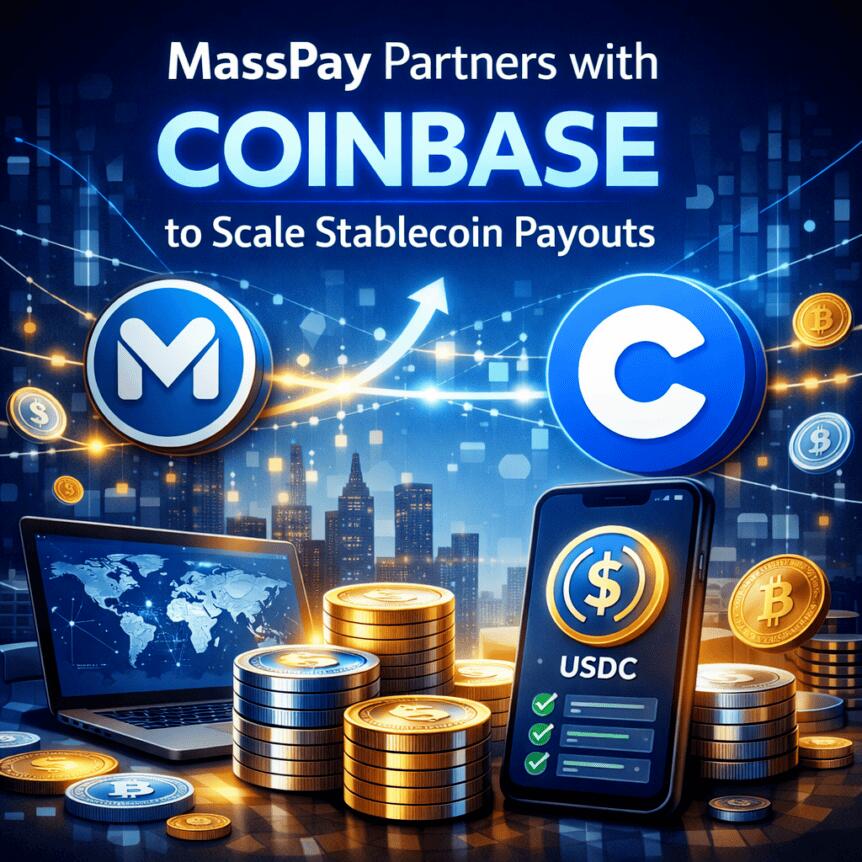
Cross-border payout platform MassPay and Coinbase announced a partnership to enable stablecoin-based cross-border payouts, merging MassPay’s global payout network with Coinbase’s crypto infrastructure. The collaboration links MassPay’s network spanning 180 countries with Coinbase’s wallet, custody and on-chain settlement capabilities, enabling customers to move between fiat, USDC and other digital assets.
MassPay CEO Ran Grushkowsky told Cointelegraph that stablecoins are still a small slice of the company’s transaction volume, but the joint rails are expected to support nine-figure payouts in the first year. He added that clients using the system have seen costs fall by roughly 40% to 70% versus traditional international wires, with settlement near instant rather than taking days on legacy rails.
Key takeaways
- MassPay’s network in 180 countries now interfaces with Coinbase’s custodial and settlement rails to enable fiat/crypto cross-border payouts.
- The collaboration targets nine-figure payout volumes in the first 12 months, signaling a scaling push for stablecoin-based cross-border payments.
- Cost reductions of 40% to 70% versus traditional international wires accompany near-instant settlement, potentially improving cash flow for global businesses.
- Compliance duties are divided: Coinbase provides regulated custodial infrastructure and licensing, while MassPay handles Know Your Customer checks, sanctions screening and tax documentation across its network.
- This move aligns with a broader industry transition toward stablecoin-enabled cross-border rails, echoed by Stripe’s Bridge acquisition and Circle’s Payments Network.
MassPay deepens stablecoin payout push
Under the agreement, Coinbase will supply wallet infrastructure, custody and on-chain settlement, while MassPay orchestrates last-mile payouts through bank transfers, mobile wallets and digital asset channels. The two firms split compliance responsibilities, with Coinbase contributing regulated custodial infrastructure and licensing, and MassPay handling KYC, sanctions screening and tax documentation across its expansive network. Grushkowsky noted that MassPay already offers stablecoin payout capabilities via other providers, and this collaboration with Coinbase aims to expand capacity and credibility.
Stablecoins accelerating cross-border rails
The MassPay–Coinbase partnership sits within a broader trend of traditional payments players building stablecoin-focused infrastructure for cross-border flows. In February 2025, Stripe completed the acquisition of Bridge, a startup focused on scaling stablecoins for business use, underscoring expectations that tokenized money will accelerate cross-border commerce. Circle has also advanced its own roadmap, announcing in April 2025 the Circle Payments Network to connect banks, payment companies and digital wallets for real-time cross-border settlement using USDC, EURC and other regulated stablecoins.
Related context: Stripe’s expansion into stablecoin rails and Circle’s network development illustrate how mainstream payment incumbents are reorganizing to accommodate tokenized money across borders.
As these rails mature, investors and merchants are watching how quickly they can scale to mid-sized and enterprise payouts, and whether regulatory clarity keeps pace with the evolving payments landscape. The current collaboration signals a meaningful vote of confidence from established players in favor of stablecoins as a cross-border settlement layer.
As more payments incumbents experiment with stablecoins, observers will watch how adoption scales across mid-market payouts and whether regulatory clarity keeps pace with the technology. Next milestones include broader currency coverage and geographic reach, as well as real-world impact on costs and settlement times across the network.

Nearly 250 banks are set to close this year – including eight in Greater Manchester
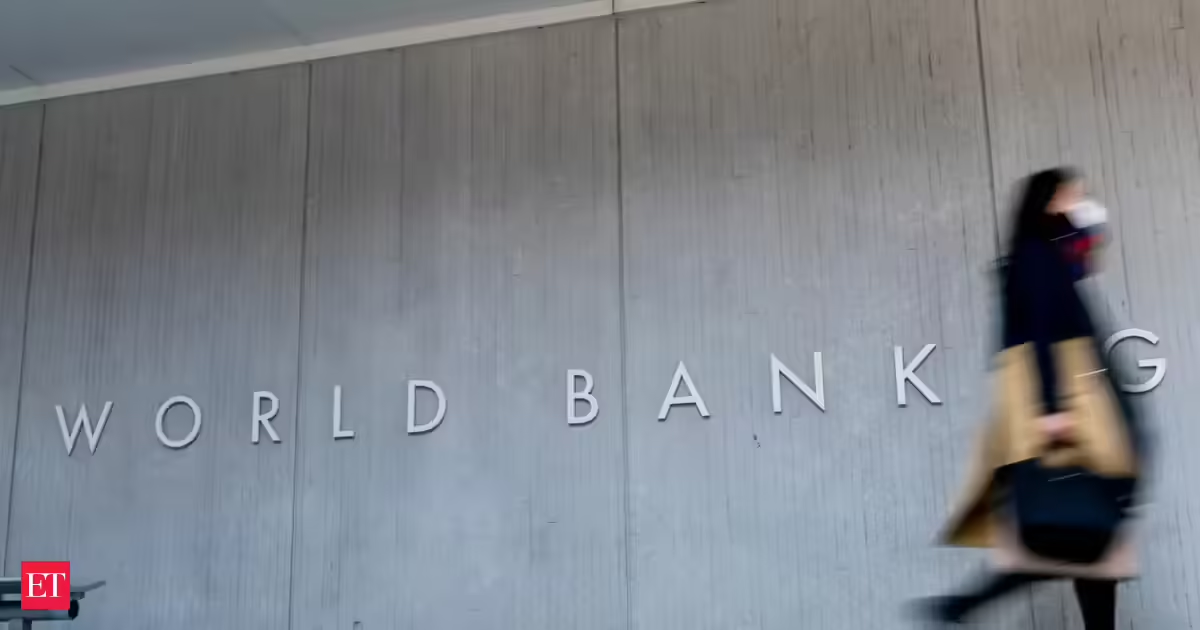
World Bank Raises India’s FY27 Growth Forecast to 6.6%
Market Movers: SpaceX’s Record IPO, Oracle’s Plunge, and OpenAI’s Public Filing



-

 Fashion6 days ago
Weekend Open Thread: Evereve – Corporette.com
-
 Crypto World6 days ago
Jensen Huang Approves Samsung, SK Hynix, and Micron for NVIDIA (NVDA) HBM4 Memory Supply
-

 Crypto World4 days ago
Anatomy of the June crypto crash: Fed, Iran, Saylor
-
 Entertainment5 days ago
The Best Mystery Series of All Time Is Surging on Streaming 30 Years After It Ended
-

 NewsBeat4 days ago
Alexander Zverev wins the French Open to finally earn a 1st Grand Slam title
-

 Tech6 days ago
Suspicious Polyfill login prompts pop up on Toshiba, Muji websites
-
Crypto World5 days ago
Senator Cynthia Lummis Calls CLARITY Act the Most Consequential Financial Legislation of This Generation
-

 Tech4 days ago
Microsoft unveils seven homegrown AI models in new bid for ‘long term self-sufficiency’
-

 Tech6 days ago
Microsoft launches MXC, an OS-level sandbox for AI agents, with OpenAI and Nvidia already on board
-

 Business6 days ago
(VIDEO) Justin Bieber Delivers Surprise Happy Birthday Serenade to Diners at Los Angeles Mexican Restaurant
-
 Business5 days ago
The Pain Points Taking a Fragile Tech Rally Down a Notch
-

 Business4 days ago
High Stakes for Wembanyama as New York Pushes for 3-0 Lead
-
 Crypto World3 days ago
Eli Lilly (LLY) Stock Surges 4% Following Breakthrough Sleep Apnea Trial Results
-

 Tech6 days ago
Von der Leyen’s AI envoy pick draws conflict-of-interest fire
-

 Tech6 days ago
Meta steals a tactic from Tesla and builds data centers in tents
-
Crypto World6 days ago
LBank Surpasses 25 Million Users Worldwide as AFA Partnership Continues to Drive Global Growth
-

 Tech5 days ago
Hackers now exploit SolarWinds Serv-U flaw to crash servers
-
 NewsBeat4 days ago
Alexander Zverev conquers demons and outlasts Flavio Cobolli to win French Open for first major title
-

 Crypto World4 days ago
Trump’s AI Ownership Plan Could Benefit Anthropic at OpenAI’s Expense
-
 Sports2 days ago
Bangladesh beat Australia after 20 years in ODIs, register only their second win over six-time world champions | Cricket News
You must be logged in to post a comment Login