
Crypto World
Jackson Hole Symposium, U.S. PCE prices, IREN earnings: Crypto Week Ahead

Your look at what’s coming in the week starting Aug. 24

Disclosure: This article does not represent investment advice. The content and materials featured on this page are for educational purposes only.
XRP jumps 45% in a week as Bitcoin’s short squeeze fuels gains, while UE Crypto offers diversified digital asset income.
Summary
- XRP fell 11.28% amid selling pressure, and increased market volatility has driven growing interest in UE Crypto cloud mining.
- UE Crypto attracts XRP investors through cloud mining and yield aggregation options, as well as multi-layer security and asset protection.
- UE Crypto cloud mining digital asset platform also provides digital asset investors with diversified income options.
Last week, Bitcoin broke above $72,000 and reached $79,000 last Friday, mainly driven by the U.S. Treasury’s plan to nearly double the scale of its long-term bond buybacks starting September 9. Traders who had been shorting cryptocurrencies for several weeks were forced to close their positions in response to tightening supply conditions. Within seven days, short positions across all assets totaling more than $3 billion were liquidated.
XRP did participate in this rally, but the move was not unique to XRP. This means that XRP’s rise was largely an amplified effect of Bitcoin’s rally rather than an independent repricing based on XRP’s fundamentals.
This distinction is crucial because whether the XRP breakout can continue depends on whether buying pressure remains after the short squeeze ends. A short squeeze is essentially temporary. Once short positions are liquidated, forced buying stops. What follows is either genuine demand supporting the new price level or a pullback as artificial buying pressure disappears.
As the regulatory environment gradually becomes clearer and financing conditions continue to improve, more investors are beginning to reconsider a key question: beyond relying on price appreciation for returns, are there more diversified, efficient, and sustainable ways to participate in the long-term value growth of XRP and the broader digital asset ecosystem?
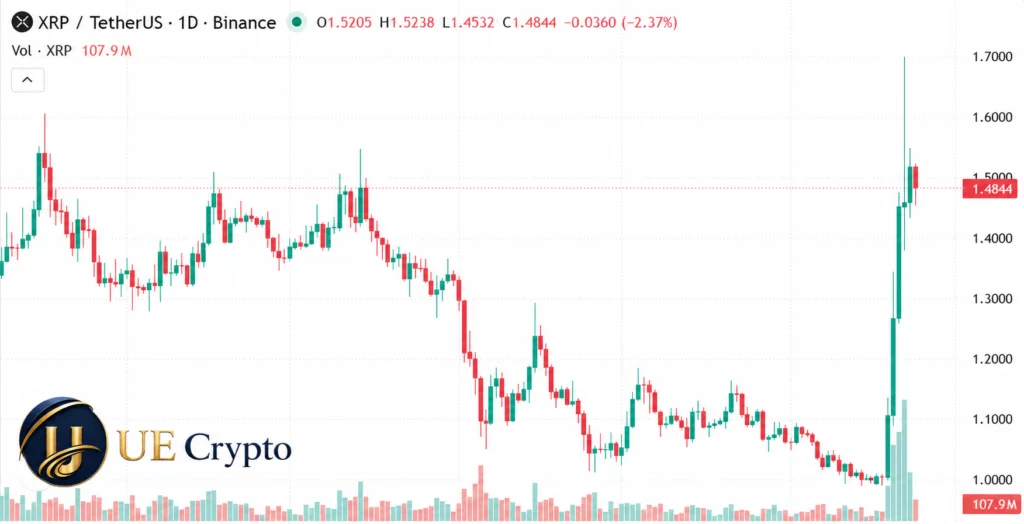
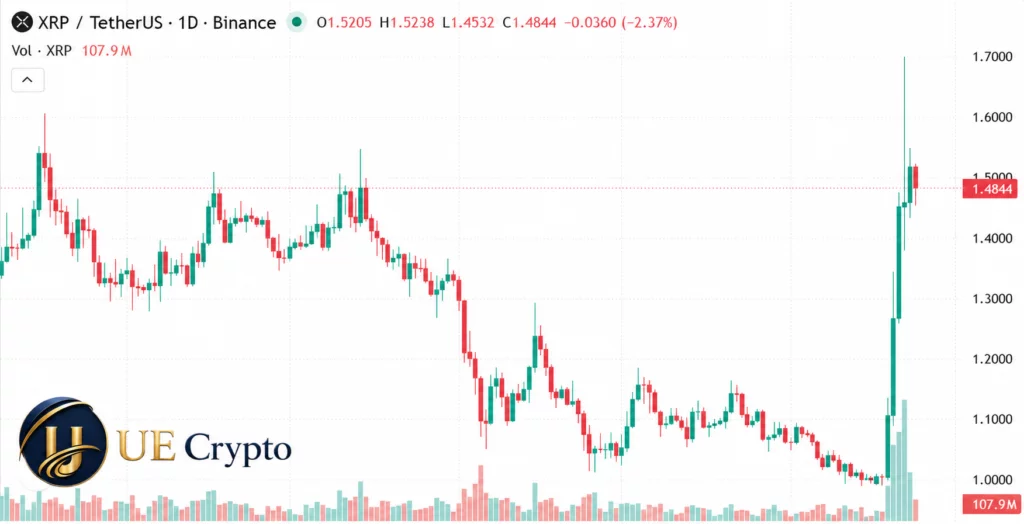
As of August 24, 2026, the current price of XRP (XRP) is $1.48. Over the past 24 hours, the price has moved 0.36%, while it fell 1.1% over the past hour. Over the longer term, the price has moved 45.6% over the past seven days and 34.2% over the past month.
Meanwhile, overall market liquidity continues to improve. Although secondary-market trading activity has declined somewhat and retail investors remain relatively cautious amid market volatility, institutional allocation demand remains steady, driving continued net capital inflows on most trading days.
Analysts are monitoring the next potential high-growth stock. While exploring a new round of investment opportunities, the UE Crypto cloud mining digital asset platform also provides digital asset investors with diversified income options.
Given XRP’s uncertain price movements and growing selling pressure, an increasing number of XRP investors are turning their attention to UE Crypto, seeking to expand their digital asset allocation channels through cloud mining and yield aggregation mechanisms and explore more diversified, stable, and sustainable income models.
Unlike highly volatile futures trading and approaches that rely solely on price movements, the UE Crypto cloud mining digital asset platform provides a more convenient and intuitive way to participate in digital assets. Users do not need to purchase expensive mining hardware or deal with complicated equipment deployment, technical maintenance, or daily operations. Users only need to participate in digital asset mining and can automatically receive returns according to the terms of the contract.
About UE Crypto
UE Crypto is headquartered in the United Kingdom and operates within European regulatory frameworks such as MiCA and MiFID II, continuously improving its transparency, operational standards, and user protection mechanisms.
The platform adopts a multi-layer security architecture, including:
- Annual financial and security compliance audits by PwC
- Digital asset custody insurance provided by Lloyd’s of London
- Enterprise-level network protection from Cloudflare and McAfee® security systems
- Bank-grade data encryption and professional security infrastructure to provide multiple layers of protection for user assets and accounts
Currently, UE Crypto supports a range of mainstream digital assets, including XRP, BTC, ETH, USDT, USDC, DOGE, LTC, and SOL, providing users with a more flexible and convenient digital asset service experience.
Start earning daily returns in just three steps
1. Register an account
2. Choose a mining package
Choose a suitable cloud mining contract based on personal budget and needs, and start mining with one click.
3. Start earning
Once the contract is activated, the system will automatically allocate computing power, and returns will be settled every 24 hours. Users can withdraw their earnings at any time or continue participating as needed to achieve long-term compound growth of their assets.
Popular UE Crypto contracts
BTC (Beginner Experience Contract) Investment Amount: $100, Contract Term: 2 days, Daily Return: $4, Total Return at Contract Maturity: $100 + $8
Dogecoin (DOGE, Digital Intelligent System Contract) Investment Amount: $500, Contract Term: 5 days, Daily Return: $6.25, Total Return at Contract Maturity: $500 + $31.25
BTC (Super Computing System Contract)Investment Amount: $1,000,
Contract Term: 10 days, Daily Return: $13.10, Total Return at Contract Maturity: $1,000 + $131
LTC (Algorithm-Driven System Contract) Investment Amount: $5,000
Contract Term: 25 days, Daily Return: $72, Total Return at Contract Maturity: $5,000 + $1,800
BTC (Quantitative Intelligent System Contract)Investment Amount: $10,000, Contract Term: 35 days, Daily Return: $158, Total Return at Contract Maturity: $10,000 + $5,530
For more details about the contract plans, please visit the UE Crypto official website.
Conclusion
XRP whales continue to buy at lower prices and sell at higher prices, while market volatility remains elevated. As a new market cycle gradually unfolds, investors are shifting their focus from simply tracking price movements toward strategies that place greater emphasis on risk management, asset allocation, and long-term returns. Against this backdrop, digital asset investment approaches are becoming increasingly mature and diversified, and the UE Crypto cloud mining digital asset platform has also become an area of interest for some investors exploring diversified digital asset allocation and income models.
Disclosure: This content is provided by a third party. Neither crypto.news nor the author of this article endorses any product mentioned on this page. Users should conduct their own research before taking any action related to the company.


The treasury firm stepped up its ETH buying as Tom Lee said the crypto’s 30% weekly rally could signal a larger move ahead.

The European Central Bank is pushing back against privacy criticisms surrounding its planned digital euro, arguing that the system’s technical design would restrict what the Eurosystem can see about individual payments. In an interview published on Monday, ECB Executive Board member Piero Cipollone said the central bank would not be able to identify people making or receiving digital euro transactions.
Cipollone’s remarks come as lawmakers, privacy advocates and crypto community figures continue to warn that government-issued digital currencies could enable expanded financial surveillance—even if particular design choices are intended to limit visibility. The debate has also intensified in the United States, where policymakers have moved to block federal CBDC development.
Key takeaways
- ECB Executive Board member Piero Cipollone says the Eurosystem would not be able to identify users making or receiving digital euro payments.
- Cipollone argues that transaction identifiers would be designed so that only banks involved in transfers can identify users, including for anti-money laundering checks.
- Offline digital euro payments are described as limiting available payment details to the payer and payee.
- While privacy safeguards are a focal point, the ECB also frames the digital euro as a way to reduce Europe’s reliance on non-European payment infrastructure.
ECB privacy design: limited visibility by the central bank
In an Aug. 10 interview published by the ECB, Cipollone outlined how the digital euro could be structured to reduce direct surveillance by the central bank. He said the “Eurosystem would not be able to identify the users making or receiving payments.”
Instead, Cipollone’s position is that identity resolution would sit with the financial intermediaries that carry out the transactions. According to his description, only the banks involved in payment flows would be able to identify users, including for anti-money laundering purposes, while the Eurosystem itself would not be able to directly link specific individuals to digital euro payments.
The ECB official also pointed to offline capabilities as another privacy boundary. He said offline digital euro transactions would make payment details available only to the payer and payee—an approach intended to limit third-party access in scenarios where payments do not rely on continuous connectivity.
Why privacy concerns remain central
Despite the ECB’s attempt to address privacy fears at the design level, the project still faces scrutiny from multiple quarters. The underlying concern is that central bank-issued digital money, even with constraints, could change the nature and scale of visibility into financial activity compared with cash.
The ECB’s assurances are likely to be tested against the real-world implementation choices that follow design specifications. Critics have argued that institutional oversight—whether through intermediaries, reconciliation processes, or compliance workflows—could still produce surveillance outcomes that users may find difficult to fully anticipate from technical descriptions alone.
Digital euro as payment sovereignty project
Privacy is not the only pillar of the ECB’s digital euro messaging. The institution has also pitched the initiative as a response to strategic vulnerabilities in Europe’s payments stack.
Earlier in the year, Cipollone argued in a public lecture in Latvia that Europe’s reliance on non-European payment providers creates “strategic vulnerability.” According to his remarks, two-thirds of euro-area card transactions are governed by non-European companies. The digital euro, he suggested, could reduce this dependence by supporting European-controlled payment infrastructure.
This broader framing matters because it places the digital euro at the intersection of consumer protection debates and industrial policy. Even if privacy safeguards are strong on paper, the political and operational rationale for the program could shape the compromises lawmakers accept as negotiations continue.
Legislative progress and the timeline being discussed
Regulatory momentum in Europe has continued alongside the privacy debate. The European Parliament’s Economic and Monetary Affairs Committee backed its position on digital euro legislation in June. Later, in July, lawmakers cleared the proposal for negotiations with the Council.
The ECB has also indicated that a digital euro could be issued as early as 2029, assuming the necessary legislation is adopted and the project completes remaining technical and operational steps.
U.S. policy contrasts: restrictions on CBDC development
The privacy dispute around the digital euro echoes a parallel debate in the United States, where lawmakers have moved to limit CBDC efforts. Earlier coverage has noted that President Donald Trump issued an executive order in January 2025 prohibiting federal agencies from developing or promoting a CBDC, citing concerns including financial stability, individual privacy and US sovereignty.
On the legislative side, House lawmakers have also advanced proposals aimed at constraining a potential US CBDC. One such initiative, the Anti-CBDC Surveillance State Act, seeks to prohibit the Federal Reserve from issuing a CBDC.
While the European and US approaches differ in institutions and legal frameworks, the policy contrast underscores a shared theme: whether digital versions of money should be treated primarily as an infrastructure upgrade—or as a systemic governance risk that could increase surveillance and compliance reach.
As the ECB moves closer to implementation, the key question for users and investors will be how the promised privacy boundaries translate into concrete technical specifications and compliance workflows, especially for online and offline transaction modes. The next milestones to watch are the outcomes of Europe’s ongoing legislative negotiations and the operational details that will determine how much control the Eurosystem, banks, and other parties actually have over transaction information.
Your day-ahead look for Aug. 24, 2026


Disclosure: This article does not represent investment advice. The content and materials featured on this page are for educational purposes only.
Flowra has launched its Open Orderflow Auction for Solana, introducing an open block-building system that allows registered searchers to compete for transaction inclusion while giving validators greater control over blockspace and MEV revenue.
Summary
- Flowra’s Open Orderflow Auction lets registered searchers compete transparently for transaction inclusion on Solana blocks.
- Flowra’s single-validator test raised compute units per block by 20.6%, with comparable block fees higher.
- Programmable Block Policy lets validators set inclusion rules and support compliance screening without protocol changes.
Flowra has launched its Open Orderflow Auction for the Solana ecosystem, introducing a competitive block-building framework aimed at opening the network’s MEV market to broader participation.
The framework is designed to open block building to competitive bidding, improve price discovery in Solana’s MEV market, and help validators capture more revenue. Registered searchers can compete for transaction inclusion through a transparent auction instead of relying on closed orderflow channels. Flowra said the Open Orderflow Auction is now available to validators and searchers, while it continues onboarding institutional-grade validators ahead of a broader rollout.
Open Orderflow Auction targets Solana MEV competition
Flowra said the auction changes how transaction inclusion can be offered to searchers. Rather than routing orderflow through closed channels, registered participants can bid openly for access to blockspace. The company expects that model to create clearer competition around transaction inclusion and allow validators to receive more of the value generated by MEV.
Solana validators process transactions and participate in network consensus. Flowra’s framework focuses on that validator layer by introducing a new method for constructing blocks and allocating blockspace. The company says its aim is to improve transaction transparency, value distribution, and incentive alignment among validators, users, and builders.
Early validator testing shows higher block activity
Flowra reported early results from testing its setup on a single validator. According to the company, the Flowra-enabled validator increased compute units per block by 20.6%. The validator moved from 84% to 101% of the network average during the test. Flowra also reported higher block fees than comparable validator software.
The company said the same setup achieved 100% block production and 99.999% block engine uptime. Those figures come from Flowra’s early testing and relate to one validator. The company is using the results as it expands onboarding for its Open Orderflow Auction across institutional-grade validators in the Solana ecosystem.
Programmable block policy adds validator controls
Alongside the auction, Flowra introduced Programmable Block Policy. The feature allows validators to define transaction inclusion policies at the block-building layer. Flowra said this can give validators more operational flexibility, including the ability to address regulatory or institutional compliance requirements without changing the underlying Solana protocol.
Flowra recently announced a collaboration with compliance infrastructure provider Honeypot. The companies plan to bring sanctions and risk screening to the block-building layer. Flowra presented the policy system as a way for validators to control how blocks are constructed while retaining verifiability and auditability.
Flowra draws from Ethereum block-building model
Flowra said its architecture takes inspiration from the competitive block-building model that emerged on Ethereum. Ethereum.org describes proposer-builder separation as a structure in which block builders submit bids and validators can select the most profitable offer. Flowra believes Solana’s high-throughput, low-latency design can support a similar market-based approach.
“Solana’s performance has made it one of the industry’s leading blockchain networks, but its MEV market remains largely concentrated,” Flowra CEO Harry Hwang said. “By opening block building to transparent competition, we’re creating a more efficient market for blockspace while giving validators greater control over how their blocks are constructed with full verifiability and auditability.”
Flowra develops validator and order flow infrastructure for Solana. Its products include validator infrastructure, delegation programs, and MEV-related technologies. The company’s broader goal is to support a more open, efficient, and scalable foundation for blockchain networks while improving how value is distributed among network participants. The auction is available to validators and searchers participating across the Solana ecosystem as the network expands further.
Disclosure: This content is provided by a third party. Neither crypto.news nor the author of this article endorses any product mentioned on this page. Users should conduct their own research before taking any action related to the company.
The world’s largest corporate holder of bitcoin has extended its no-buy pause for yet another week. On the plus side, the company has refrained from selling again.
As announced by co-founder and former CEO Michael Saylor, Strategy has remained on the sidelines for another week in terms of BTC moves, but it continues to grow its USD reserve. This was done in a two-fold manner.
First, the firm increased its regular USD reserve to $5.1 billion, but it also established another – USD Cash – of $1.59 billion. Strategy also repurchased another $136 million worth of STRC, whose price continues to climb closer to the par level of $100.
Strategy increased USD Reserve to $5.10B, established additional USD Cash of $1.59B, and repurchased $136M of $STRC. As of 8/23/26: Strategy holds ~4% of Total BTC Supply and has ~0% Net Leverage. $MSTR https://t.co/WZ9GFtJBXh
— Michael Saylor (@saylor) August 24, 2026
The company announced its last sale on August 10, disposing of another 1,690 BTC. Since then, it has made no bitcoin moves.
Strategy’s latest announcement was the first since last week’s major surge in bitcoin prices, which drove the asset from under $65,000 to just over $78,000 as of press time.
Aside from the actual growth against fiat currencies, this big revival put the company’s massive position in profit for the first time in months. After all, Strategy’s average accumulation price is at around $75,400, and the firm spent approximately $63.3 billion to acquire it.
Given the current market conditions, that substantial fortune is worth over $65.6 billion. Recall that the company’s position had tanked to an unrealized loss of over $10 billion a few months ago.
The post Strategy Adds $1.9B to USD Reserve but Buys No Bitcoin as BTC Position Turns Green appeared first on CryptoPotato.


The company sold 18.26 million MSTR shares, increased its USD Reserve to $5.1 billion and repurchased another $136.4 million of STRC.

Futures for the Dow Jones Industrial Average and the other major stock indexes traded lower Monday as Wall Street braced for “the single greatest financial offensive ever” against Iran. Meanwhile, Alibaba (BABA) was an early loser on the stock market today. Ahead of Monday’s open, Dow futures dropped 0.1%, as S&P 500 futures lost 0.2%. Nasdaq-100 futures declined 0.5% in…
Copyright ©2026 Investor’s Business Daily, LLC. All rights reserved. 87990cbe856818d5eddac44c7b1cdeb8


A crypto trader claimed yesterday an update for the FOMO app caused $6 million in crypto losses.
In a social media post, they cited an example of someone allegedly losing 662 SOL, worth about $62,000, after opening the iOS app called FOMO.
FOMO co-founder Prashan Dharmasena rejected the claim, countering, “It’s crazy that people can just come on this app and blatantly lie,” adding that the account in question has no transaction signed by FOMO’s fee payer.
Sticking to his story, Dharmasena repeated his defense to at least two other accusers.
The source of the original accusation is Derivatives_Ape, an X account built around Solana trading commentary, but that account isn’t the alleged victim. Instead, the post claims a “friend” suffered the loss.
According to forensic researcher ZachXBT, Derivatives_Ape, is a co-founder of Zkasino who “stole $30 million of investor funds.”
Although ZachXBT named the account as Zkasino co-founder Elham Nourzai, the handle seemed to be controlled by another Zkasino co-founder, Ildar Elham.
Read more: ZKasino rug pull suspect arrested in United Arab Emirates
The transaction exists, but who caused it?
The transaction included in the original allegation is a real transaction.
Despite displaying as truncated text, the screenshot in the allegation is authentic from solscan.io, a legitimate block explorer for Solana’s blockchain. There is a transaction that moved 662 SOL out of the cited wallet 14 minutes before the allegation posted to social media.
However, Dharmasena contests whether any bug in the FOMO app caused that movement — and whether it was an unauthorized transfer.
FOMO itself closed a $17 million Series A led by Benchmark in September 2025. Chetan Puttagunta from Benchmark, a top VC firm, took a board seat.
The company also raised a $75 million Series B led by Index Ventures, valuing the company at $550 million, with another leading VC participating, Union Square Ventures.
Balaji Srinivasan and Solana co-founder Raj Gokal are investors.
Read more: Coldcard attack: 25 minutes, 500 wallets, $38M in BTC gone
FOMO app denies responsibility
Derivatives_Ape wrote that FOMO “must have accidentally added something malicious in its new code” and that a friend “could literally watch the funds moving on-chain, but on the FOMO app it still showed as if his balance was there.”
The same post pins total damage at $6 million so far, limited to iOS. No breakdown, victim list or methodology accompanies that estimate.
FOMO’s own security documentation states flatly, “FOMO cannot access, move, or freeze your funds.” That self-custodial design, if true, would make a server-side drain of funds difficult.
Dharmasena argues the wallet named in the complaint never signed a transaction through FOMO’s own fee payer, which although that would exonerate FOMO in his view, is also a bit narrower than saying the wallet never touched the FOMO app at all.
FOMO’s incentive to deny an exploit is obvious. An active drain would threaten a company that has raised roughly $94 million in disclosed funding.
Derivatives_Ape might also have an incentive problem. Dharmasena’s repeated “paid fud” framing alleges coordinated, financially motivated disinformation.
A third-party account came to FOMO’s defense, claiming, “There’s a few other users posting the same text, probably paid by competitors” and that the specific wallet named was “not created through @fomo” at all.
The FOMO iOS app, as of writing time, is still live in Apple’s App Store.
Got a tip? Send us an email securely via Protos Leaks. For more informed news and investigations, follow us on X, Bluesky, and Google News, or subscribe to our YouTube channel.
The London-based multinational bank with $850 billion in assets announced it will distribute Anchorpoint’s HKDAP to eligible clients and partners.

How can holders turn to defensive strategies and earn more than $7,000 per day

German extremist-right AfD plans segregated education for disabled and refugee children

Liverpool’s alarming weakness is clear and signing a new winger won’t solve it





-

 Fashion3 days ago
Weekend Open Thread: Madewell – Corporette.com
-

 Business6 days ago
SMA Solar Technology AG (SMTGY) Q2 2026 Earnings Call Transcript
-

 Crypto World2 days ago
anatomy of crypto’s biggest liquidation event since 2021
-

 Business2 days ago
Musk’s Tesla, SpaceX Confirm $16.8 Billion ‘Terafab’ Chip Plant as World’s Largest Building in Texas
-

 Tech6 days ago
Qwen3.8-27B runs frontier-class coding agents and reasoning locally, no cloud API required
-

 Crypto World7 days ago
OCC Greenlights Trump Family Crypto Firm for Trust Charter
-

 Politics2 days ago
6 months on, Irish renters crushed by effects of government housing bill
-
 NewsBeat2 days ago
The ‘Lucky Dip Gang’ causing carnage for clicks: After five thugs were killed speeding in the wrong direction on a motorway, GUY ADAMS investigates a sick new trend… and why police aren’t even allowed to pursue them
-

 Crypto World7 days ago
NAVI Prime launches institutional lending framework on Sui
-

 News Videos4 days ago
Don’t Leave Your Financial Future To Chance | August 19, 2026
-

 Tech5 days ago
GLM-5.3 hits the API at $1.4/$4.4 per million tokens
-
Tech6 days ago
5 Of The Most Reliable Car Brands To Consider If You’re Buying A Used SUV
-
 Crypto World7 days ago
Dow’s 3-Year Winning Run Isn’t a Crash Signal, Still 49% Odds of Double-Digit Gains
-

 Business6 days ago
Stock Market Today: Tech Futures Slide As Treasury Yields Jump; Nvidia, Micron, Sandisk Sell Off
-

 Tech6 days ago
Keychron K8 Ultra 8K review: a great value keyboard with comfort issues
-
 Tech7 days ago
Nvidia discloses $21B stake in SpaceX
-
Business7 days ago
Fabrinet (FN) Q4 2026 Earnings Call Transcript
-

 Business4 days ago
Five Below: Kids Discount Retailer Reaps Rich Rewards
-

 Business5 days ago
Marvell Shares Jump 7% as Google Chip Deal Confirms Custom AI Silicon Partnership, Analysts
-
 NewsBeat7 days ago
Trump explodes at CNN reporter after question about young blonde aide who wrote him besotted letters
You must be logged in to post a comment Login