
Crypto World
Kalshi explores crypto perpetual futures as competition widens



Kalshi is preparing to expand beyond prediction markets and enter crypto trading, according to reports published on April 21.
Summary
- Kalshi is preparing crypto perpetual futures, moving beyond event contracts toward direct exchange competition now.
- The reported launch would place Kalshi against Binance, Hyperliquid, Coinbase, and Kraken in derivatives trading.
- U.S. regulatory shifts and Kalshi’s licenses could support onshore crypto perpetual futures for domestic traders.
The company is said to be planning a launch focused on perpetual futures, a product widely used on offshore crypto exchanges.
The reported move would place Kalshi in a more direct contest with firms already active in digital asset trading. It would also mark a shift for the company, which built its name around event-based contracts tied to elections, economics, sports, and other real-world outcomes.
The Information reported that Kalshi wants to begin its crypto push with perpetual futures. These contracts allow traders to bet on price moves without a fixed expiry date. The report said the first products could include crypto assets such as Bitcoin.
Kalshi did not confirm the plan publicly. The company declined to comment, according to the report. Even so, the timing has drawn attention because the exchange already operates under Commodity Futures Trading Commission oversight in the United States.
The report also said Kalshi recently secured a license that allows it to offer margin trading. That step could support a broader product set if the company moves ahead with crypto perpetuals. For now, the reported plan remains unannounced by the company itself.
Kalshi’s current business has centered on binary contracts tied to specific outcomes. A move into perpetual futures would expand that model into a market built around continuous price trading rather than single event resolution.
Perpetual futures remain a major crypto trading product
Perpetual futures are among the most used products in digital asset markets. They let traders maintain exposure without rolling contracts forward, unlike traditional futures. They also often include leverage, which can increase both gains and losses.
The product became widely known through offshore crypto venues such as BitMEX, Binance, and Hyperliquid. Because of regulatory limits in the United States, access to crypto perpetuals has remained limited for many domestic traders.
The report said Kalshi sees an opening as U.S. regulators consider allowing these products onshore. CFTC Chairman Michael Selig said last month that the agency plans to permit such offerings in the United States. That policy direction has added momentum to discussions around regulated crypto derivatives.
A regulated launch from Kalshi could give some traders an alternative to offshore platforms. It could also test whether U.S.-based firms can capture part of a market that has largely developed outside the country.
Rival firms are moving into each other’s markets
Kalshi’s reported plan comes as trading platforms continue to widen their product range. While Kalshi looks at crypto trading, crypto exchanges are also pushing into prediction markets.
Soon after The Information report appeared, Polymarket posted on X that ”perps are coming”. That message added to signs that major players in prediction markets are looking at the same trading category.
Competition is also building outside the United States. Coinbase recently launched perpetual-style futures linked to equities for non-U.S. users. Kraken has also introduced tokenized stock perpetual futures for users outside the U.S.
Kalshi’s reported entry into crypto would arrive as investors keep close watch on regulated trading products. In March, reports from The Wall Street Journal and Bloomberg said the company raised more than $1 billion at a $22 billion valuation, showing strong backing as it considers its next expansion step.



Firefox developer Mozilla revealed that an early version of Anthropic’s Claude Mythos AI identified 271 vulnerabilities in the Firefox browser during internal testing, all of which were patched this week.
Summary
- Mozilla said Anthropic’s Claude Mythos AI identified 271 vulnerabilities in Firefox during internal testing, all of which were patched this week.
- The model showed it can scan large codebases and detect security flaws faster than traditional human-led reviews, though no findings went beyond what elite researchers could uncover.
The findings point to how advanced AI systems are starting to scan large codebases at a scale that once depended on long hours of manual work by cybersecurity researchers. Mozilla said even hardened software targets could now be examined more deeply in a shorter time.
“As these capabilities reach the hands of more defenders, many other teams are now experiencing the same vertigo we did when the findings first came into focus,” Mozilla wrote. “For a hardened target, just one such bug would have been red-alert in 2025, and so many at once makes you stop to wonder whether it’s even possible to keep up.”
Earlier testing using another Anthropic model had uncovered 22 security-sensitive bugs in a previous Firefox release. Despite that progress, Mozilla noted that eliminating software exploits entirely has long been considered unrealistic.
“Until now, the industry has largely fought security to a draw,” the company wrote. “Vendors of critical internet-exposed software like Firefox take security extremely seriously and have teams of people who get out of bed every morning thinking about how to keep users safe.”
Mozilla said the new system can review source code and flag weaknesses in ways that previously required highly specialized human expertise. Internal results showed the model did not uncover bugs beyond the reach of top-tier researchers.
“Some commentators predict that future AI models will unearth entirely new forms of vulnerabilities that defy our current comprehension, but we don’t think so,” the company said. “Software like Firefox is designed in a modular way for humans to be able to reason about its correctness. It is complex, but not arbitrarily complex.”
Launched in March, Claude Mythos is described by Anthropic as its most advanced model for reasoning, coding, and cybersecurity tasks, positioned above its earlier Opus series. Pre-release testing suggested it could identify thousands of unknown vulnerabilities across operating systems and browsers.
Access to the system remains limited through a restricted initiative known as Project Glasswing, which allows select firms, including Amazon, Apple, and Microsoft, to scan software for security flaws.
Security researchers warn that the same capability could be used offensively. AI tools that can analyze code at scale may also automate the discovery of exploitable bugs across widely used software systems.
Testing by the U.K.’s AI Security Institute showed the model could carry out complex cyber operations on its own, including completing a multi-stage corporate network attack simulation without human input. Those results have drawn attention from governments and intelligence agencies.
Despite earlier tensions with Donald Trump’s administration over the use of Anthropic’s technology, the National Security Agency has deployed Claude Mythos Preview on classified networks, according to people familiar with the matter. The move signals growing interest among U.S. agencies in AI tools that can detect critical software vulnerabilities.
Anthropic has also acknowledged that current cybersecurity benchmarks are struggling to keep pace with its latest models, raising questions about how to measure AI performance in this field.
Mozilla said the results suggest a possible turning point, where defenders may begin to narrow the long-standing gap with attackers.
“We are extremely proud of how our team rose to meet this challenge, and others will too,” the company wrote.
“Our work isn’t finished, but we’ve turned the corner and can glimpse a future much better than just keeping up. Defenders finally have a chance to win, decisively.”
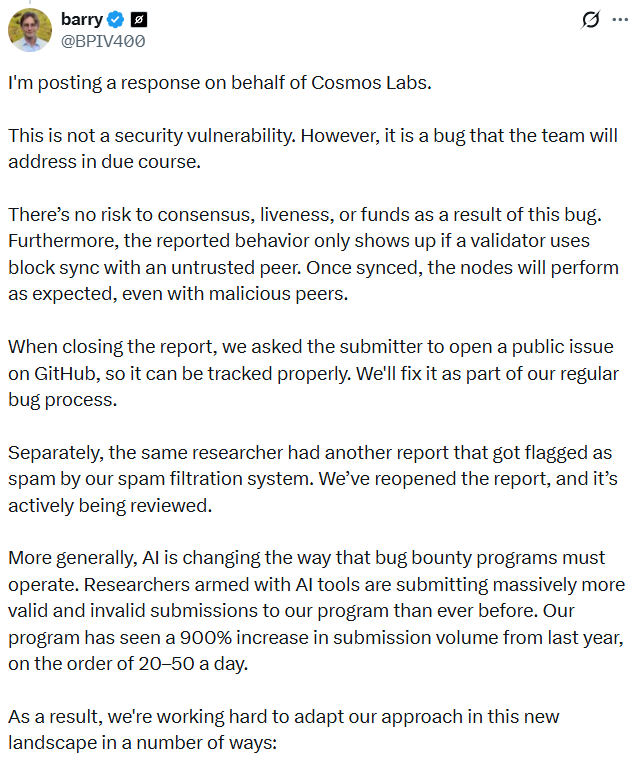
Crypto protocols have warned that an increase in AI use has led to a flood of bogus bug bounty submissions, putting a strain on teams trying to identify real threats to their protocols.
Bug bounties are a system to reward “good” hackers for submitting reports about potential vulnerabilities and are popular in the crypto industry. AI has now made it easier to sift through large amounts of code to find possible bugs, though AI is also known to hallucinate.
“AI is changing the way that bug bounty programs must operate,” said Barry Plunkett, co-CEO of Cosmos Labs, on Tuesday, responding to a bug bounty hunter who accused the protocol of ignoring their vulnerability report.

“Our program has seen a 900% increase in submission volume from last year, on the order of 20-50 per day,” he said, adding that it’s led to a huge increase in both valid and invalid reports.
Kadan Stadelmann, a blockchain developer and chief technology officer at Komodo Platform, told Cointelegraph he has also seen a notable increase in bug bounty submissions and payouts across organizations.
“There has definitely been an increase in low-quality bug bounty submissions, some of which have been false positives, potentially suggesting AI sourcing. One potential explanation is that AI has caused a decrease in the cost to produce a report, resulting in an influx of submissions.”
In January, Daniel Stenberg, the creator of the open-source data transfer tool curl, which is used in many apps, including blockchain infrastructure, announced he was ending his bug bounty program because of an influx of “AI slop in vulnerability reports,” and he was exhausted from sifting through them.

HackerOne, one of the largest bug bounty platforms in the world, reported in January that there were 85,000 valid bounty submissions in 2025, up 7% from the previous year.
AI could be both the cause and the solution
Plunkett said Cosmos Labs has already started to adapt its approach as a result of the uptick in bug bounty submissions by tightening how it scores submissions, prioritizing trusted researchers with a proven track record and working with other bug bounty providers that offer more advanced triage.
Meanwhile, Stadelmann said bug bounty programs have proven integral to defending decentralized systems, and adopting AI to assist in sifting through the noise could be a solution.
“Blockchain teams will have to create AI deterrents to sift through incoming bug bounties. The smaller the team, the bigger the problem of increased bug bounties will become. Software engineers won’t have the capacity to examine everything,” he said.
“This is where defensive AI systems to automatically sift through incoming bug bounties will be crucial. Teams dependent on bug bounties will need to develop stricter standards on their bug bounty programs as a means of lowering the number of incoming reports.”
Related: Crypto hackers stole $17B over past 10 years: DefiLlama

Key Takeaways
- Ruben Roy from Stifel Nicolaus increased AMD’s price target to $320 from $280, maintaining a Buy recommendation
- This fresh target suggests approximately 17% potential upside and exceeds the Street’s average forecast of around $291
- The upgrade reflects AI infrastructure demand surpassing expectations and significant partnerships with Meta and OpenAI
- AMD’s previously announced long-term EPS target of $20+ was established prior to the Meta partnership, suggesting room for upward revision
- Supply chain bottlenecks represent a significant concern that could hamper AMD’s ability to capitalize on robust demand
Shares of Advanced Micro Devices surged on Tuesday following a notable price target revision from Stifel Nicolaus, with the semiconductor stock climbing 3.47% during trading.
Advanced Micro Devices, Inc., AMD
Ruben Roy, a Stifel analyst who ranks eighth among equity research professionals covering Wall Street, increased his price forecast for AMD to $320 from his previous $280 target while reaffirming his Buy recommendation. This updated projection indicates potential appreciation of approximately 17% from present trading levels within the coming year.
Roy’s optimistic stance positions him notably above the Street’s collective view. Currently, 37 analysts with Buy ratings on AMD have established an average price target hovering around $291.
The strategic timing is noteworthy. With AMD’s quarterly earnings report on the horizon, institutional investors appear to be adjusting their positions in anticipation.
Catalysts Driving the Bullish Thesis
Stifel’s upgraded outlook rests on two primary pillars. First, demand for AI computing infrastructure is accelerating beyond previous forecasts across both specialized accelerators and conventional processor designs. Second, AMD has secured transformative customer agreements — particularly multi-gigawatt strategic commitments with Meta and OpenAI.
Roy highlighted an important consideration regarding AMD’s financial guidance. The company had previously communicated a long-term earnings-per-share target exceeding $20, but Roy emphasized that this benchmark predated the announcement of the Meta collaboration. He characterized this $20+ figure as a baseline rather than an upper limit.
Stifel isn’t the only institution expressing increased confidence in AMD’s trajectory. Bank of America lifted its price objective to $310 from $280 on April 18. BofA’s Vivek Arya calculated that each gigawatt of deployed AI infrastructure capacity could generate approximately $15–$20 billion in net revenue for AMD, projecting data-center segment growth exceeding 60% year-over-year throughout 2026 and 2027.
Manufacturing Constraints Pose Challenge
Despite the optimistic outlook, the price target increase includes an important caveat. Stifel identified deteriorating supply chain constraints as a material risk factor. AMD may struggle to manufacture sufficient chip volumes to satisfy the accelerating customer demand.
This disconnect between robust market appetite and constrained production capacity represents the critical dynamic in AMD’s investment narrative at present. The company’s success in addressing this imbalance will significantly influence whether the $320 price target proves achievable.
AMD’s processor and graphics technologies form the backbone of AI-powered data center infrastructure. Additionally, the company is developing Helios, a comprehensive AI server rack platform scheduled for commercial availability in the latter half of 2026.
Year-to-date, AMD shares have appreciated 31.16%, while posting remarkable gains of 218.75% over the trailing twelve months. Tuesday’s trading volume reached approximately 9.09 million shares, substantially below the three-month average daily volume of 32.47 million shares.
The consensus Wall Street rating for AMD stands at Moderate Buy, reflecting 20 Buy recommendations and eight Hold ratings issued during the past three months, with a mean price target of $287.33.



One in four European investors has invested in cryptocurrency, according to a new study of 6,000 people across Germany, Italy, Spain, and France.
The findings, referenced by Boerse Stuttgart Digital, indicate rising interest in digital assets.
Crypto Adoption Gains Ground Across Europe
Market research firm Marketagent polled investors aged 18 to 70 between August 2025 and January 2026. The findings revealed that Spain leads crypto adoption with nearly 28% participation. Germany follows at 25%, with Italy (24%) and France (23%) slightly behind.
The survey also highlights sustained interest, with 36% of crypto investors likely to reinvest within five years. Spain again ranks highest in overall interest at over 40%, followed by France (36%), Germany (35%), and Italy (34%).
Follow us on X to get the latest news as it happens
“Crypto adoption across Europe is continuing to grow, with Spain emerging as a frontrunner. Notably, it is not only the number of investors entering the market that is significant, but also the sustained intention to invest further in the coming years, even in the face of market volatility,” Dr. Matthias Voelkel, CEO of Boerse Stuttgart Group, stated.
Despite rising interest, limited understanding remains a key barrier. Investors in Germany report higher confidence than their peers. Yet 65% still find crypto too complex, compared to 73% in Spain and France, and 70% in Italy.
Improved knowledge could drive further adoption. 54% in Spain, 49% in France, and 44% in both Italy and Germany say they would invest more if better informed.
Notably, Boerse Stuttgart Digital highlighted that the interest presents a clear strategic opportunity for banks, brokers, and asset managers.
Nearly one in five investors expect their bank to offer crypto access within three years. The demand is strongest in Germany (22%), followed by Spain (19%), Italy (18%), and France (16%).
The potential for customer movement reinforces this shift, as 35% of European investors would consider switching banks for better crypto services.
Spain shows the strongest inclination (40%), ahead of Italy (35%), France (33%), and Germany (29%), indicating that crypto offerings are becoming a key competitive factor.
Beyond banking, insights from BeInCrypto Legal and Regulatory Expert Council suggest crypto is moving into mainstream political debate in the United Kingdom.
“So we have something we call a crypto voter, and we believe very strongly that will become a bigger issue,” Adriana Ennab, UK Director at Stand With Crypto, told BeInCrypto.
Dion Seymour, Crypto Tax Technical Director at Andersen and former HMRC policy lead, noted that the growing number of crypto holders in the UK signals the issue is no longer marginal and demands greater political attention.
Subscribe to our YouTube channel to watch leaders and journalists provide expert insights
The post Crypto Adoption Hits 25% Across Europe’s Four Leading Economies appeared first on BeInCrypto.
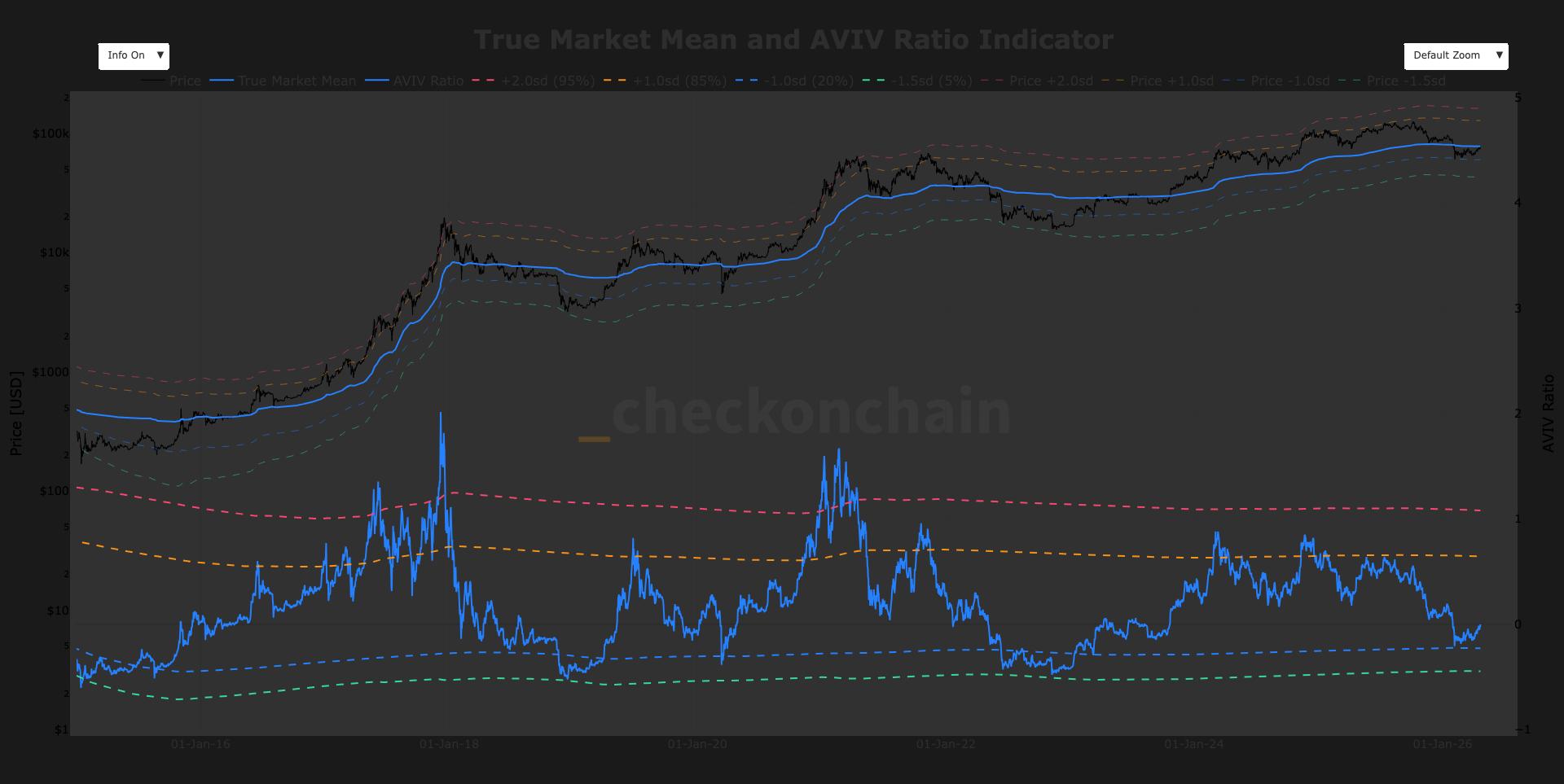
True Market Mean and Short-Term Holder cost basis form a critical $78.2K to $79.2K range that could define the next major move.

Key Takeaways
- Xbox Game Pass Ultimate pricing reduced by 23%, now $22.99/month from $29.99
- PC Game Pass sees a 15% decrease to $13.99/month from $16.49
- Day-one access to new Call of Duty releases eliminated from Game Pass subscriptions
- Xbox gaming revenue declined approximately 10% year-over-year with hardware plummeting 32%
- Recent Xbox leadership change under Asha Sharma drives pricing restructure
The Xbox division at Microsoft has faced mounting challenges. Gaming accounted for a mere 7% of overall company revenue in the most recent quarter, marking it as the sole major business segment experiencing decline.
The financial picture painted a stark reality: console hardware sales plunged 32% following Microsoft’s decision to shelve two game projects, “Everwild” and “Perfect Dark.” CFO Amy Hood acknowledged during an analyst briefing that Xbox content and services revenue fell short of internal projections.
Game Pass Ultimate’s $29.99 monthly subscription had been in place since October, when Microsoft implemented a $10 increase. That pricing decision, as it happens, proved unpopular with consumers.
According to reports, Asha Sharma—Xbox’s newly appointed leader—communicated to staff via internal memo that the subscription had grown prohibitively expensive. Sharma, who joined from Meta, assumed control of Xbox in February following a leadership restructuring that saw Phil Spencer transition out and Sarah Bond depart.
Her solution: reduce pricing while maintaining the game catalog. Game Pass Ultimate falls to $22.99 monthly—representing a 23% discount. PC Game Pass decreases 15% to $13.99. Both adjustments took effect immediately.
The Call of Duty Compromise
There’s a significant caveat. Newly released Call of Duty titles will no longer debut on Game Pass at launch. Microsoft had leveraged the blockbuster franchise as a primary incentive for subscription growth, particularly following its massive $75.4 billion Activision Blizzard purchase in 2023.
Moving ahead, subscribers wanting immediate access to fresh Call of Duty releases must purchase them separately at $69.99. These games will join Game Pass approximately twelve months post-launch.
This represents a meaningful compromise—reduced subscription fees, but diminished launch-day content availability.
Microsoft indicated the adjustments stem from subscriber feedback. “Our players cover a wide breadth of geographies, preferences, and tastes,” the company stated in an official blog post.
Game Pass subscriber count stood at 34 million throughout 2024. Microsoft has not released updated membership figures.
Competitive Landscape Pressures
Xbox remains behind Sony and Nintendo in both hardware sales and subscription service adoption. This competitive disadvantage has forced Microsoft to reconsider Game Pass’s value proposition and pricing strategy.
The termination of hardware initiatives and two game development projects signals a wider strategic reevaluation of the gaming division’s direction. Some industry observers have speculated about potential divestiture or scaling back of the Xbox business, though Microsoft has issued no official statements regarding such possibilities.
Amy Hood referenced an undisclosed impairment charge within the gaming segment during the recent earnings presentation. No specific amount was disclosed.
MSFT stock advanced approximately 0.79% in after-hours trading following the pricing announcement.
Analyst sentiment toward Microsoft remains predominantly bullish, with 34 Buy recommendations and 3 Hold ratings issued over the past three months. The consensus price target stands at $581.61.

Bitcoin price jumped 2.5% today after President Trump confirmed an extension of the Iran ceasefire, and the market moved exactly as the prediction suggests. BTC touched $77,500 in early Asia trading, its highest print since Friday’s two-month peak of $78,300.
Equities are mirroring, S&P 500 down by 0.5% on last night’s close, erasing $500 billion in the process. Ether climbed as much as 2.5% too, tracking BTC tick for tick. Spot Bitcoin ETF inflows have been providing a consistent institutional bid beneath recent price action, and today’s geopolitical relief added the external catalyst.
— Crypto Rover (@cryptorover) April 21, 2026
 CRASH:
$500,000,000,000 wiped from the U.S. stock market in just 90 minutes after Kevin Warsh’s statements. pic.twitter.com/uED5gQa0AF
“Crypto has been in a bullish mood in the past few weeks, often shrugging off bad news and climbing on good news,” said Caroline Mauron, co-founder of Orbit Markets.
The asymmetry shows structural demand for crypto.
Discover: The best pre-launch token sales
Bitcoin Price Prediction: $80,000 This Week
Wednesday’s spike put BTC back inside a decisive range. Most prediction projects Bitcoin at $75,000 over the next 10 days, with a weekly forecast of $77,300, which puts the current price bullish. More optimistic predictions have April 22 ceilings as high as $85,800, though that sits well outside the technical consensus.
The critical levels are clean. Paul Howard, senior director at Wincent, put it plainly: $72,000 is the key support zone, and $79,000 is where profit-taking has repeatedly capped the rally. But $75,000 should hold as a solid floor, and a clean close above $80,000 would “unlock significant further upside.”
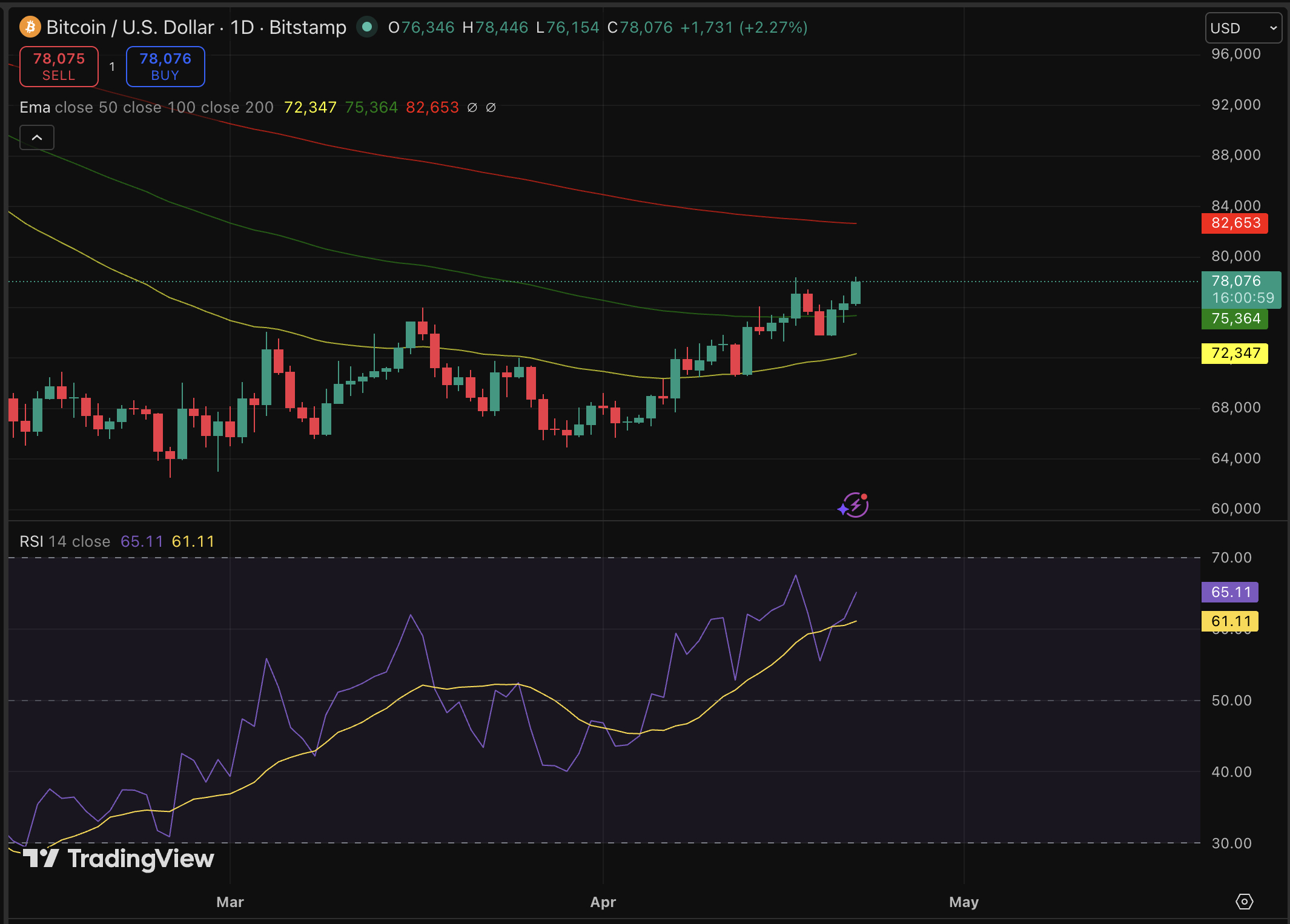
Technically, RSI sits high neutral at the 50 area, while the EMA composite leans bullish with 11 of 23 tracked indicators flagging buy signals. If the ceasefire extension holds, BTC could close above $79,000 this week, and momentum funds pile in, sending it to above $80,000.
Bitcoin has outperformed gold by a wide margin since the end of February, up more than 15% while bullion dropped 10%. This is not accidental.
Discover: The best crypto to diversify your portfolio with
Bitcoin Hyper Targets Early Mover Upside as Bitcoin Tests Key Levels
Bitcoin at $77,500 sounds bullish. But at this market cap, the math for multiples gets harder. Early-stage infrastructure plays inside the Bitcoin ecosystem are where asymmetric upside still exists — and that’s exactly the thesis behind Bitcoin Hyper.
Bitcoin Hyper ($HYPER) is positioning as the first Bitcoin Layer 2 with Solana Virtual Machine (SVM) integration with faster transaction throughput than Solana, paired with Bitcoin’s underlying security. The pitch addresses Bitcoin’s three core bottlenecks: slow transactions, high fees, and limited programmability.
Current presale price sits at $0.0136, with $32 million raised to date. Staking rewards are live with 36% APY bonus. The project includes a Decentralized Canonical Bridge for BTC transfers and high-speed smart contract execution via SVM. Institutional Bitcoin demand signals suggest the broader ecosystem is entering a higher-activity phase, which historically lifts infrastructure tokens alongside BTC.
Research Bitcoin Hyper before the presale closes.
The post Bitcoin Price Prediction: Another Ceasefire, Another Rally appeared first on Cryptonews.


Bitcoin rose above $78,000 on Wednesday after renewed easing in Middle East tensions supported risk appetite across digital assets.
Summary
- Bitcoin climbed above $78,000 after ceasefire news eased tension and pushed traders into risk assets.
- Roughly 110,000 traders were liquidated in 24 hours, with short positions making up most losses.
- Strategy bought 34,164 BTC for $2.54 billion, helping support momentum as institutional demand stayed firm.
The move came after US President Donald Trump said the ceasefire with Iran would be extended, while market participants also reacted to Strategy’s latest Bitcoin purchase.
The broader crypto market moved higher alongside Bitcoin. Total market value climbed above $2.7 trillion, while Ethereum, Monero, Bitcoin Cash, BNB, and Solana also posted gains. At the same time, leveraged traders faced heavy losses as liquidations neared $500 million over the past 24 hours.
Ceasefire extension supports market rebound
The latest price move followed comments from Trump on the conflict involving Iran. He said the ceasefire would remain in place as officials waited for a “unified proposal,” while adding that Iran’s government was “seriously fractured.”
Those remarks helped improve sentiment across global markets. S&P 500 futures rose 0.5%, while Nasdaq 100 futures gained 0.6%. In crypto, Bitcoin advanced 2.2% over 24 hours and 4.3% over the week to trade above $78,000 during Wednesday trading.
This was not the first market reaction tied to the conflict. Earlier in April, crypto prices also moved higher after the US and Iran agreed to pause hostilities for two weeks. The latest extension again pushed traders toward risk assets.
Brent crude remained near $98 a barrel, while the MSCI Asia Pacific Index slipped 0.7% as investors continued to assess how long tensions in the region could last. Even so, digital assets stayed firm as traders focused on the ceasefire decision.
Bitcoin leads gains as altcoins follow
Bitcoin traded at about $78,145 after breaking out of recent headline-driven volatility. Ether rose 2.1% to $2,366, BNB added 1.3% to $640, and Solana gained 1.8% to $87. Most of the top 10 cryptocurrencies traded in positive territory, with only stablecoins and Tron showing small declines.
The upward move also came after Strategy disclosed a fresh Bitcoin purchase. The company bought 34,164 BTC for $2.54 billion at an average price of $74,395 per coin. That pushed its total holdings to 815,061 BTC, acquired for about $61.6 billion at an average cost of $75,527.
With Bitcoin trading above that average entry price, Strategy’s position returned to a modest unrealized profit. The company’s latest purchase was its biggest since November 2024 and added another corporate demand signal to the market.
Fund flow data also showed renewed investor interest. CoinShares reported that global crypto funds recorded $1.4 billion in inflows last week. Bitcoin attracted $1.12 billion, while Ethereum brought in $328 million. Chainlink and Sui also posted inflows, while XRP and Solana saw outflows despite price gains.
Liquidations near $500 million as shorts take the hit
The fast market rebound caused sharp losses for traders using high leverage. Total liquidations reached about $460 million in the past 24 hours, with short positions making up roughly 70% of that total.
Bitcoin-related liquidations rose to $212 million, while Ether positions accounted for $123 million. The biggest single liquidation took place on Bitget and exceeded $7.5 million.
Data also showed that nearly 110,000 traders were liquidated during the period. The figures reflected how quickly sentiment changed after the ceasefire update and Bitcoin’s move above $78,000.
Disclosure: This article does not represent investment advice. The content and materials featured on this page are for educational purposes only.

Key Takeaways
- Tim Cook transitions from Apple CEO to Executive Chairman effective September 1, 2026
- Hardware Engineering SVP John Ternus, a 25-year Apple employee, named as successor
- AAPL shares declined 2.52% in response to the leadership announcement
- Q2 FY26 earnings scheduled for April 30; analysts project $1.94 EPS on revenue of $109.32B
- Wall Street maintains Moderate Buy rating with $305.81 average target price, suggesting ~12% potential gain
Apple appears ready to return to its product-focused roots.
The tech giant revealed Monday that Tim Cook will relinquish his CEO position on September 1, 2026, transitioning to Executive Chairman. John Ternus, who currently serves as Senior Vice President of Hardware Engineering after 25 years with the company, will assume the chief executive position. The announcement sent AAPL down 2.52%.
Ternus embodies Apple’s product-first philosophy. His signature accomplishment involved spearheading the Mac’s migration away from Intel processors to proprietary Apple Silicon — a strategic move that strengthened Apple’s competitive positioning in the personal computer sector.
His attention to detail borders on legendary. Speaking at a 2024 University of Pennsylvania commencement ceremony, Ternus shared a story about examining machined screw heads on the Cinema Display — his first Apple project. He discovered the manufacturer had added 35 concentric grooves instead of the specified 25.
“Maybe a customer notices, maybe they don’t,” Ternus explained. “But either way, whenever I saw one of those displays on someone’s desk, it mattered to me.”
This meticulous approach represents the foundation upon which Apple was established.
Refocusing on Product Excellence
Recent years saw Apple emphasizing its services ecosystem and artificial intelligence capabilities. The services division — encompassing App Store, AppleCare, and Apple Music — has delivered solid performance. The AI narrative has proven more challenging.
Selecting Ternus indicates a strategic realignment toward hardware as Apple’s fundamental strength. The reality is simple: without iPhones, Macs, iPads, and Watches, the accompanying services ecosystem becomes irrelevant. This appointment communicates that priority clearly.
Cook’s own succession plan mirrors his original ascension. Steve Jobs selected Cook — an operations and supply chain expert rather than a product visionary — because Apple required different leadership capabilities at that juncture. Today, Cook and the board are entrusting leadership to someone who thinks in precision measurements and manufacturing specifications.
The recently launched MacBook Neo, with student pricing beginning at $500, exemplifies the direction a Ternus-led Apple might pursue: competitive pricing while maintaining the premium quality standards the brand demands.
Financial Outlook and Shareholder Composition
The leadership transition comes just before Apple releases Q2 FY26 financial results on April 30. Analyst consensus calls for earnings per share of $1.94 alongside revenue reaching $109.32 billion.
Regarding shareholder structure, TipRanks data shows public companies and retail investors controlling 60.61% of AAPL. Exchange-traded funds represent 21.61% of ownership, while mutual funds hold 17.70%. Vanguard leads all institutional holders with 8.45%, followed by Vanguard Index Funds controlling 6.87%.
Wall Street analysts assign AAPL a Moderate Buy consensus rating, comprising 16 Buy recommendations, 8 Hold ratings, and 1 Sell rating across the previous three months. The consensus price target stands at $305.81 — approximately 12% higher than current trading levels.
Apple’s April 30 quarterly report will provide the initial significant gauge of market confidence in the new leadership framework.


Sui-based liquid staking platform Volo Protocol said on Wednesday that an attacker drained roughly $3.5 million from three of its vaults, the latest DeFi security breach in a month already shaken by nine-figure exploits.
Volo froze every vault after detecting the attack and notified the Sui Foundation. The stolen assets included Wrapped Bitcoin (WBTC), gold-backed XAUm, and USD Coin (USDC). The team said the remaining $28 million in total value locked across other vaults carries no shared attack vector.
Inside the Volo Protocol Exploit
Volo described the breach as a security incident in a statement posted on X early Wednesday. Only three vaults were affected, and the team said no other part of the protocol shares the same vulnerability.
The project is working with on-chain investigators and ecosystem partners to trace and recover the stolen funds. A full post-mortem will follow once the internal review concludes.
Volo originally launched as a dedicated SUI liquid staking platform, issuing the Volo Staked SUI (vSUI) token, before being acquired by Sui lending protocol NAVI in early 2024. The vault products targeted in this incident sit on top of that staking layer and accept wrapped assets and stablecoins as collateral for yield strategies.
Volo also moved to reassure users that any losses would not be passed on.
“Volo is prepared to absorb this loss. We will do our best not to pass this to our users,” Volo team, said.
The protocol said a remediation plan would follow once damage control operations finish, adding that rebuilding user trust depends on actions rather than promises.
Latest Hit in a Brutal Month for DeFi
Volo’s loss follows a string of major April incidents that have battered decentralized finance. Solana-based Drift Protocol lost about $285 million on April 1, in what Elliptic has linked to a suspected North Korean infiltration operation.
Less than three weeks later, restaking protocol Kelp DAO was drained of 116,500 restaked ether (rsETH) worth roughly $292 million through a compromised LayerZero bridge. Ethereum DeFi has since lost more than 17% of its total value locked.
Balancer also lost more than $128 million to an exploit earlier in the year. A targeted wallet drain cost one individual investor over $280 million across Ethereum and Arbitrum.
The Sui ecosystem has faced similar crises before. Attackers exploited the Cetus exchange for about 223 million dollars in May 2025. A flaw in concentrated liquidity pools enabled the attack. Sui validators and the community recovered most stolen funds. Total value locked on Sui exceeded 2.6 billion dollars in late 2025. This growth expanded the attack surface for exploiters. Attackers now target vault logic and oracle dependencies more often.
Volo promises to cover the 3.5 million dollar loss without external help. Depositors will watch closely when withdrawals reopen. The post-mortem should clarify the root cause. It will show whether the flaw was isolated or systemic. The findings may impact trust in the Sui DeFi ecosystem.
The post Volo Protocol Loses $3.5 Million in Sui Vault Exploit Amid DeFi Hack Streak appeared first on BeInCrypto.

Why this weekend’s London Marathon will impact more than just knees
Earnings call transcript: Nordea Bank Q1 2026 sees robust growth amid challenges

Mozilla uses Anthropic AI to uncover 271 Firefox vulnerabilities in internal test

Manchester United reach agreement with Casemiro over contract clause amid transfer speculation

Steven Gerrard disagrees with Gary Neville over ‘shock’ Chelsea and Arsenal claim | Football

US brings back mandatory military draft registration


-

 Fashion5 days ago
Weekend Open Thread: Theodora Dress
-

 Sports5 days ago
NWFL Suspends Two Players Over Post-Match Clash in Ado-Ekiti
-

 Politics5 days ago
Palestine barred from entering Canada for FIFA Congress
-
Entertainment2 days ago
NBA Analyst Charles Barkley Chimes in on Ice Spice McDonald’s Fiasco
-

 Business3 days ago
Powerball Result April 18, 2026: No Jackpot Winner in Powerball Draw: $75 Million Rolls Over
-

 Politics3 days ago
Zack Polanski demands ‘council homes not luxury flats for foreign investors’
-

 Crypto World4 days ago
Russia Pushes Bill to Criminalize Unregistered Crypto Services
-

 Politics2 days ago
Gary Stevenson delivers timely reminder to register to vote as deadline TODAY
-

 Tech3 days ago
Auto Enthusiast Scores Running Tesla Model 3 for Two Grand and Turns It Into Bare-Bones Go-Kart
-

 Tech6 days ago
‘Avatar: Aang, The Last Airbender’ Leaked Online. Some Fans Say Paramount Deserves the Fallout
-
 Business6 days ago
Creo Medical agree sale of its manufacturing operation
-

 Crypto World4 days ago
Russia Introduces Bill To Criminalize Unregistered Crypto Services
-
 Crypto World3 days ago
Kelp DAO rsETH Bridge Hack Drains $292M as DeFi Losses Top $600M in Two Weeks
-

 Sports6 days ago
British climbers complete new route in Swiss Alps
-

 Sports6 days ago
“Felt Much Better Today”: Josh Hazlewood Opens Up On His Recovery Win Over LSG
-

 Tech6 days ago
Ford EV and tech chief leaving automaker
-

 Business6 days ago
Cheaper Doritos and Lays helps PepsiCo win back struggling snackers
-
 Entertainment6 days ago
Clavicular Says Streaming May Not Work Without Substances
-

 Entertainment7 days ago
Ruby Rose Accuses Katy Perry Of Sexual Assault, Police React
-

 Crypto World11 hours ago
New York sues Coinbase, Gemini over prediction market offerings
You must be logged in to post a comment Login