

Crypto World
Live markets: Bitcoin hangs near $77,000 as interest rates continue surge, stocks continue slump



Crypto markets are flattish in early U.S. trading on Tuesday as stocks trade lower for a third consecutive session.


Key Insights
- SEC May Launch an Innovation Exemption for Tokenized Stock Trading Next Week
- Tokenized Equities Could Trade 24/7 Without Traditional Shareholder Rights
- DTCC, Nasdaq, and NYSE Continue Expanding Blockchain-Based Settlement Systems
SEC Advances Tokenized Stock Trading Framework
The U.S. Securities and Exchange Commission is preparing a regulatory framework for tokenized stock trading, according to a Bloomberg report published on May 19. The proposal could allow blockchain-based versions of publicly traded shares to trade on crypto platforms under lighter compliance requirements.
The framework may arrive through an “innovation exemption” that the SEC could release as early as next week. Under the proposal, crypto platforms offering tokenized securities would not need to follow every traditional registration rule. SEC Chair Paul Atkins has supported clearer digital asset regulations instead of relying on enforcement actions.
The reported structure would allow third parties to issue digital tokens tied to the value of public company shares. However, those tokens would not represent direct ownership in the companies. Investors would not receive voting rights, dividends, or participation in corporate decisions.
BREAKING: The SEC is set to release its so-called “innovation exemption” for tokenized stocks which will pave the path for trading digital versions of securities, per Bloomberg.
Details include:
1. In a “surprise move,” the SEC is leaning toward allowing the trading of…
— The Kobeissi Letter (@KobeissiLetter) May 18, 2026
Wall Street Firms Expand Blockchain Settlement Efforts
Major financial institutions continue increasing their involvement in tokenized stock trading and blockchain settlement systems. The Depository Trust and Clearing Corporation recently announced plans to begin limited production trades for tokenized assets in July. A broader rollout is expected in October.
The organization processes most U.S. securities transactions, making its participation important for institutional adoption. Nasdaq received SEC approval in March for rule changes supporting tokenized share trading while maintaining traditional ownership rights.
Meanwhile, the New York Stock Exchange secured SEC approval in April for its own blockchain settlement initiative. Its parent company, Intercontinental Exchange, also partnered with OKX to develop 24/7 on-chain settlement infrastructure.
Tokenized Equities Market Continues Rapid Growth
The tokenized equities sector has expanded quickly over recent months. Data from RWA.xyz shows the market now holds about $1.4 billion in distributed value across more than 2,200 assets. The sector grew roughly 30% during the last 30 days.
Monthly transfer volume has also climbed to $3.24 billion, while the number of holders increased by 25% to around 265,000 users. Supporters of tokenized stock trading argue blockchain systems can reduce settlement delays, lower transaction costs, and expand global market access.
At the same time, regulators and market participants continue examining investor protection concerns. Since tokenized shares may not provide standard shareholder rights, questions remain about accountability and legal protections during disputes or market disruptions.
The SEC’s latest move reflects broader efforts in Washington to establish formal digital asset regulations. The Republican-led Senate Banking Committee recently advanced crypto legislation as lawmakers continue shaping policies for blockchain-based financial products.
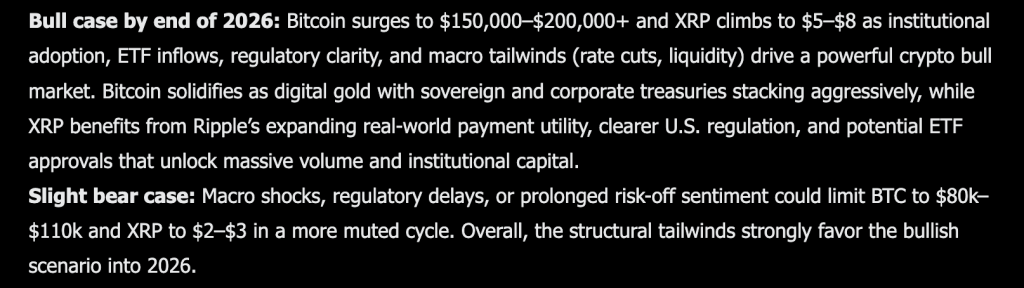
Nobody asked Elon Musk Grok AI to pick favorites. It predicts both Bitcoin and XRP in the same breath, and the price prediction it landed on for each are not conservative by any measure.
Bitcoin at $150,000 to $200,000. XRP at $5 to $8. Both by end-2026. Both driven by the same macro tailwind hitting 2 very different assets at once.
Grok’s framework treats this cycle as a convergence event rather than a single-asset story.
Bitcoin is solidifying its digital gold narrative with sovereign wealth funds and corporate treasuries stacking aggressively, while XRP is benefiting from Ripple’s expanding real-world payment utility, clearer US regulation, and ETF approvals unlocking institutional capital at scale.
The AI sees institutional adoption, ETF inflows, regulatory clarity, and rate cuts as 4 forces pulling simultaneously on both assets, which is what makes the dual prediction compelling. These are not correlated bets on the same thesis. BTC is a reserve asset story.
XRP is a payment infrastructure story. Grok is saying both win in this environment, just for different reasons.
The bear case applies to both equally. Macro shocks, regulatory delays, or prolonged risk-off sentiment could limit BTC to $80,000 to $110,000 and XRP to $2 to $3 in a more muted cycle.
Grok closes with its verdict: structural tailwinds strongly favor the bullish scenario into 2026.
Discover: The best pre-launch token sales
Bitcoin Price Prediction: Grok AI Bitcoin Predicts Is $150,000–$200,000. The Chart Shows Exactly How Far Away That Is
Bitcoin price is trading at $76,695 on the daily, sitting at the apex of a rising channel that has been building since the February low of $61,000.
The yellow circle on the chart marks the current decision point: price is pressing against the upper trendline of the channel right now and the next few daily closes determine whether this is a breakout or another rejection back into the range.
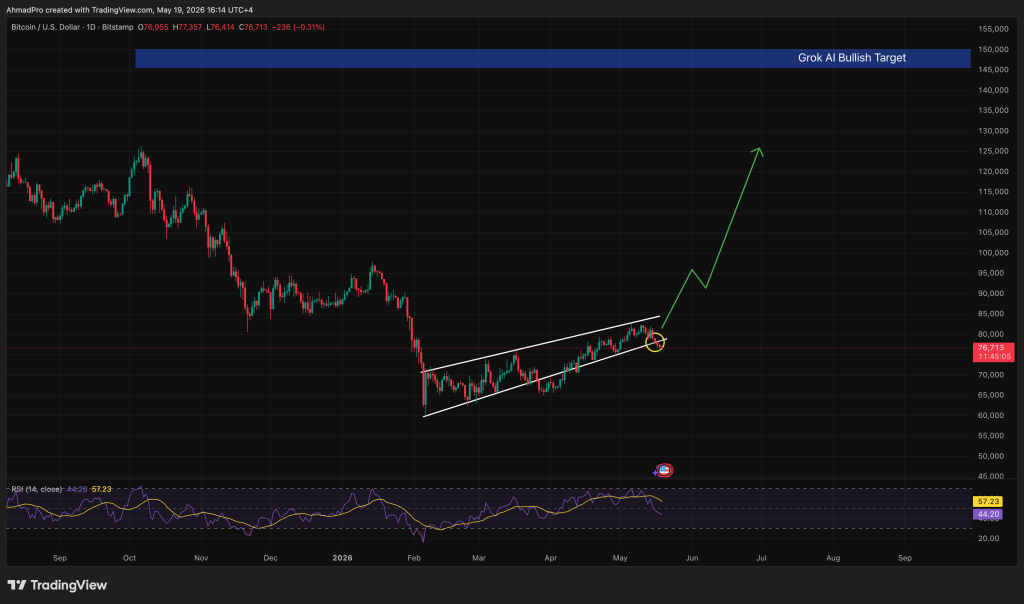
The Grok AI bullish target zone is labeled on the chart at $145,000 to $150,000, which represents the lower end of the prediction range and sits well above every resistance level currently visible.
Getting there requires clearing 2 major supply zones: $82,000 to $84,000 first, the remnant of the pre-crash consolidation, and then $96,000 to $98,000, the October 2025 highs. The chart projection shows a move from the channel breakout toward $95,000, a brief pullback toward $88,000, then continuation into the Grok target zone.
Support at $72,000 to $74,000 is the lower channel boundary that has held every dip since February. Lose it and the recovery thesis resets fast.
Discover: The best crypto to diversify your portfolio with
XRP Price Prediction: Grok AI Sees XRP at $5–$8, For Now, $1.60 Is Still the Gate
XRP price is trading at $1.37144 on the daily, and the pullback from the recent $1.50 push has brought price back toward the lower end of the 4-month range.
The chart structure has not broken but the momentum has clearly faded, and with support at $1.20 not far below current price the setup demands attention rather than complacency.
The chart has the full bull case mapped in sequence: resistance at $1.60, then targets at $2.40, $3.10, and $3.64. Each level is a checkpoint.
None of them are accessible until $1.60 breaks first. Grok’s $5 to $8 range sits above all of them, meaning the chart targets are waypoints on the journey rather than the destination itself.
The projected path shows a bounce from current levels toward $1.60, a minor pullback, then a sharp move toward $2.40 and continuation higher through the remaining targets.
Support at $1.20 is the red zone on the chart and the last meaningful floor before the bull thesis breaks down entirely. At $1.37 current price is sitting uncomfortably close to that level with no strong bounce structure visible yet.
RSI on the daily is at 42.87 with the signal line at 53.14, signal line well above RSI in the same pattern seen across multiple assets today.
Short-term momentum has turned negative while the average lags behind. RSI approaching the low 40s from above typically either finds a floor and reverses or continues toward oversold territory, and at $1.37 with $1.20 support below, the next 3 to 5 daily closes are the most important price action XRP has seen since the February crash.
Grok’s dual prediction needs BTC to lead and XRP to follow. Both charts are at decision points right now.
The post Elon Musk Grok AI Predicts Incredible XRP Price and Bitcoin Price by End of 2026 appeared first on Cryptonews.
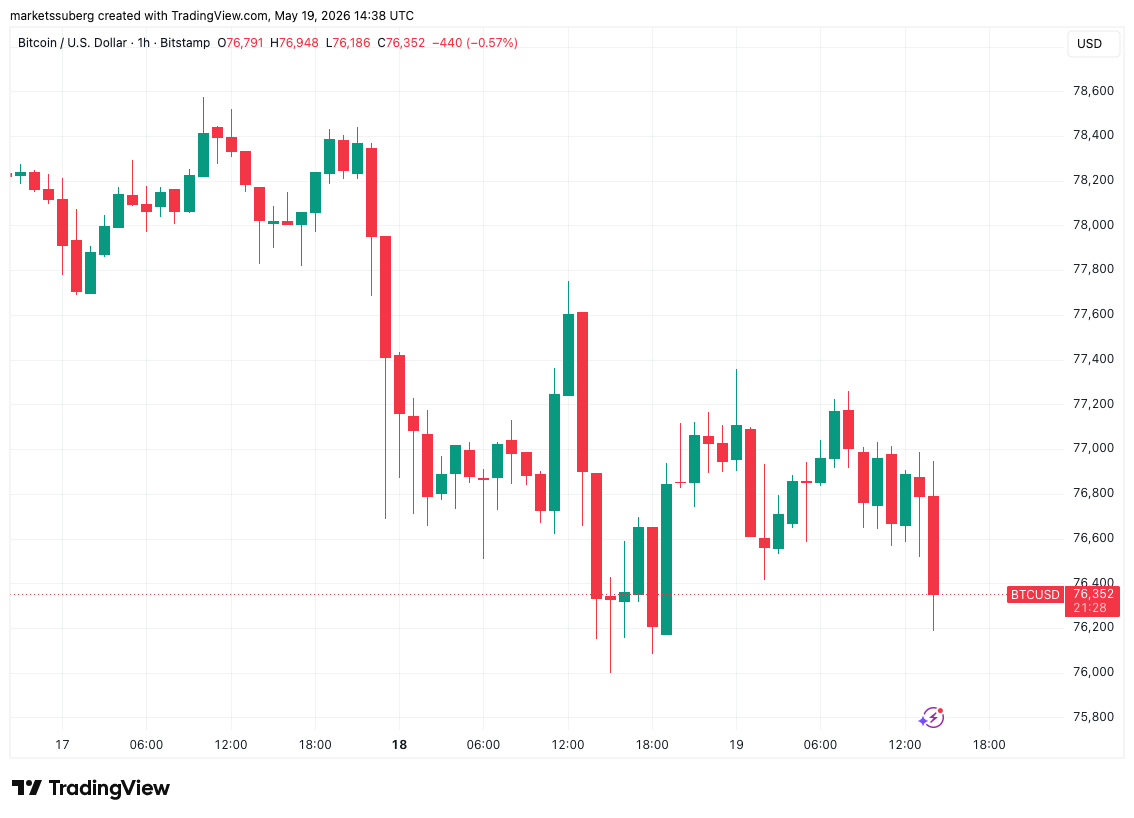
Bitcoin (BTC) consolidated near month-to-date lows on Tuesday as surging US bonds punished stocks and safe havens.
Key points:
- Bitcoin joins risk assets feeling the pressure from skyrocketing US bond yields.
- Catalysts, such as high oil prices, continue to impact market sentiment with the US-Iran war stakes still high.
- Bitcoin is now at a “crucial level of support,” the latest market analysis warns.
US 30-year yields reach highest since 2007
Data from TradingView showed BTC/USD lingering below $77,000 around the Wall Street open while preserving the previous day’s floor.
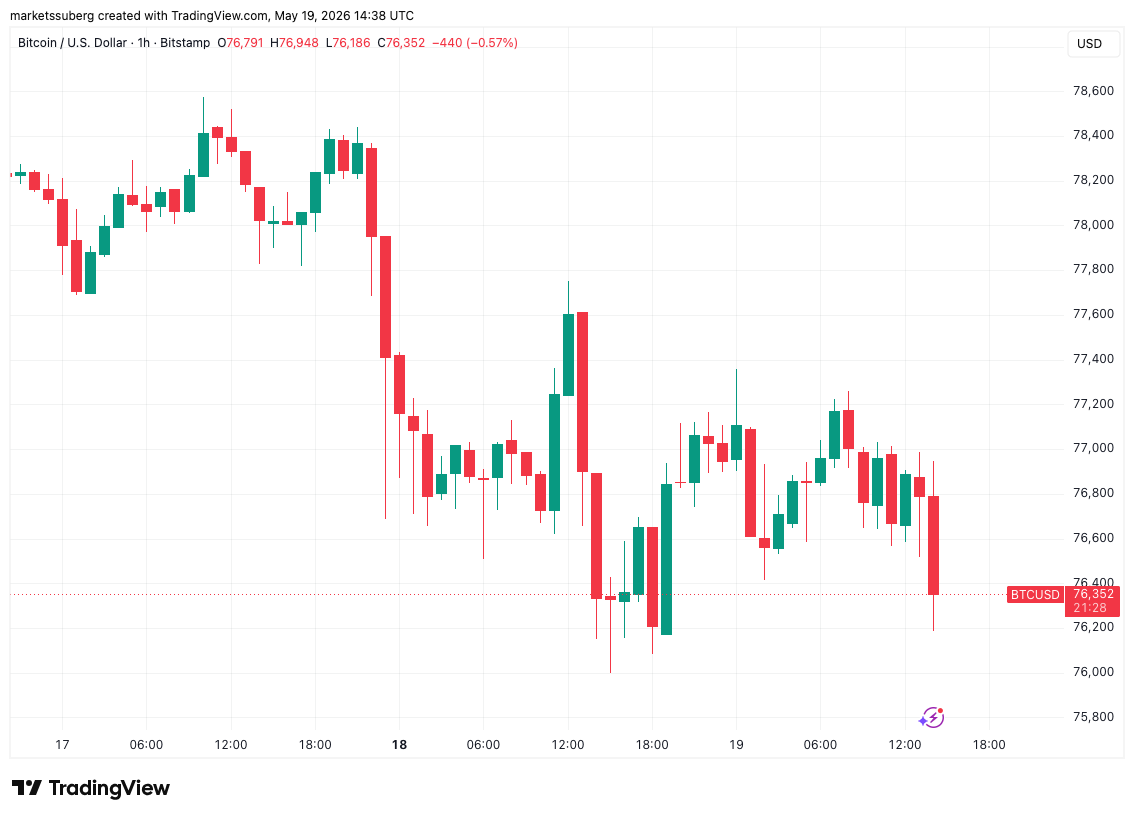
BTC/USD one-hour chart. Source: Cointelegraph/TradingView
Macro headwinds on the day continued to focus on US bond markets, with the 30-year yield hitting its highest levels since July 2007.
This sparked downside pressure on stocks, along with gold and silver. XAU/USD fell below $4,500 to reach its lowest levels since late March.
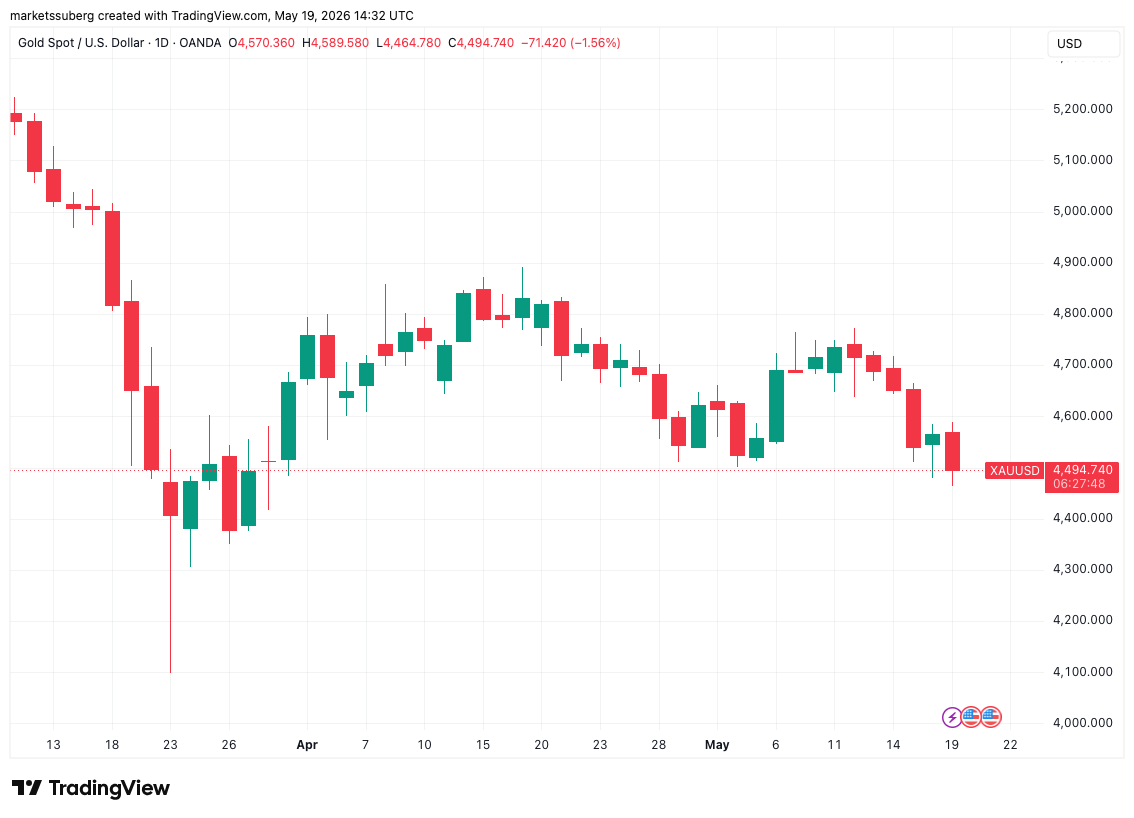
XAU/USD one-day chart. Source: Cointelegraph/TradingView
Commenting, Ole S. Hansen, head of commodity strategy at Saxobank, said that bonds reflected demand for “greater compensation for holding longer-dated debt amid war-driven energy inflation and mounting concerns over widening budget deficits.”
“This development has sent gold below USD 4,500 support, highlighting the current market reaction function driven by oil, inflation expectations, bond yields, and central bank rate expectations,” he wrote in a reaction on X.
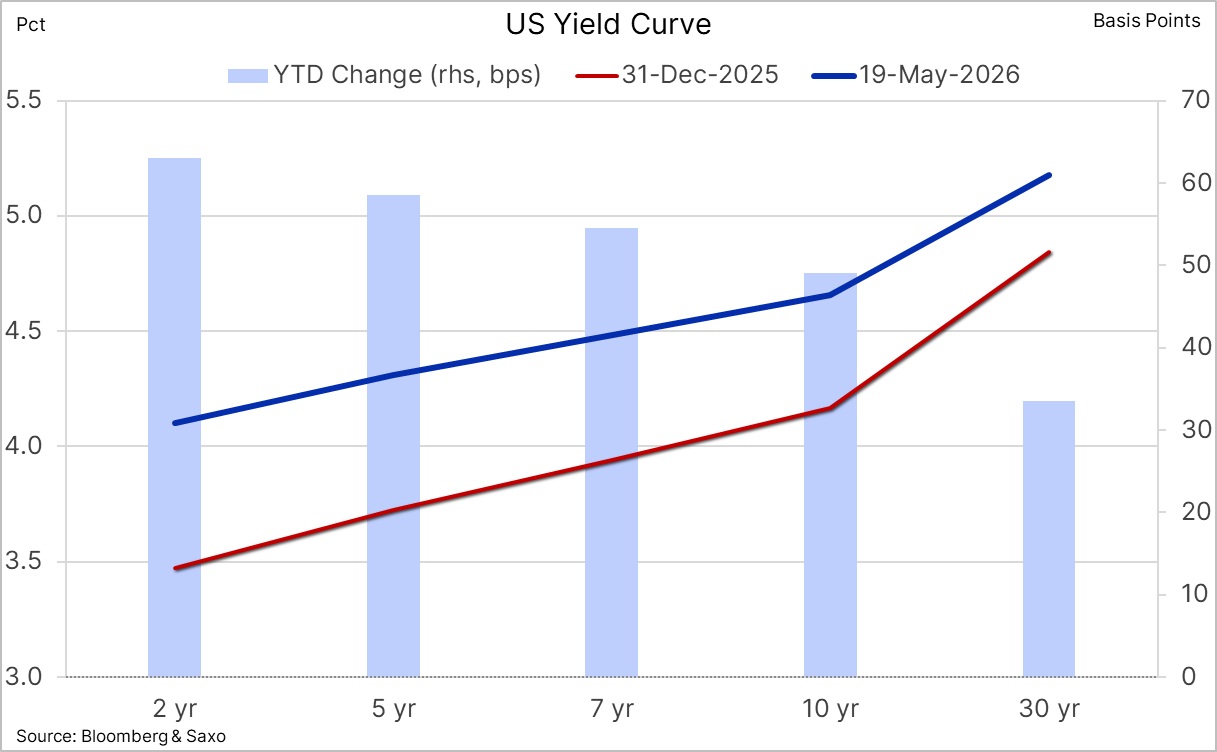
US yield curve data. Source: Ole S. Hansen/X
News that US president Donald Trump had canceled strikes on Iran offered markets little relief.
In a post on Truth Social, Trump added that gulf countries should be “prepared to go forward with a full, large scale assault of Iran, on a moment’s notice, in the event that an acceptable Deal is not reached” on the conflict.

Source: Truth Social
Bitcoin analysis sees “crucial” support holding
In crypto circles, the outlook became gloomier. Trader and analyst Michaël van de Poppe warned of a double BTC price headwind of high bond yields and high oil prices.
Related: BTC price ‘bull trap’ at $76.5K? Five things to know in Bitcoin this week
“Neither of these are progressive for risk-on assets (including Bitcoin), which means that we clearly need to see those reverse in order to see strength pouring back into the ecosystem,” he told X followers.
Van de Poppe said that Bitcoin itself did not “look great.”
“Bitcoin is at a crucial level of support and it seems to be that it’s going to be holding,” a previous X post stated.
“Anything lower of $75,000-76,000 might signal that the accumulation needs to take longer.”
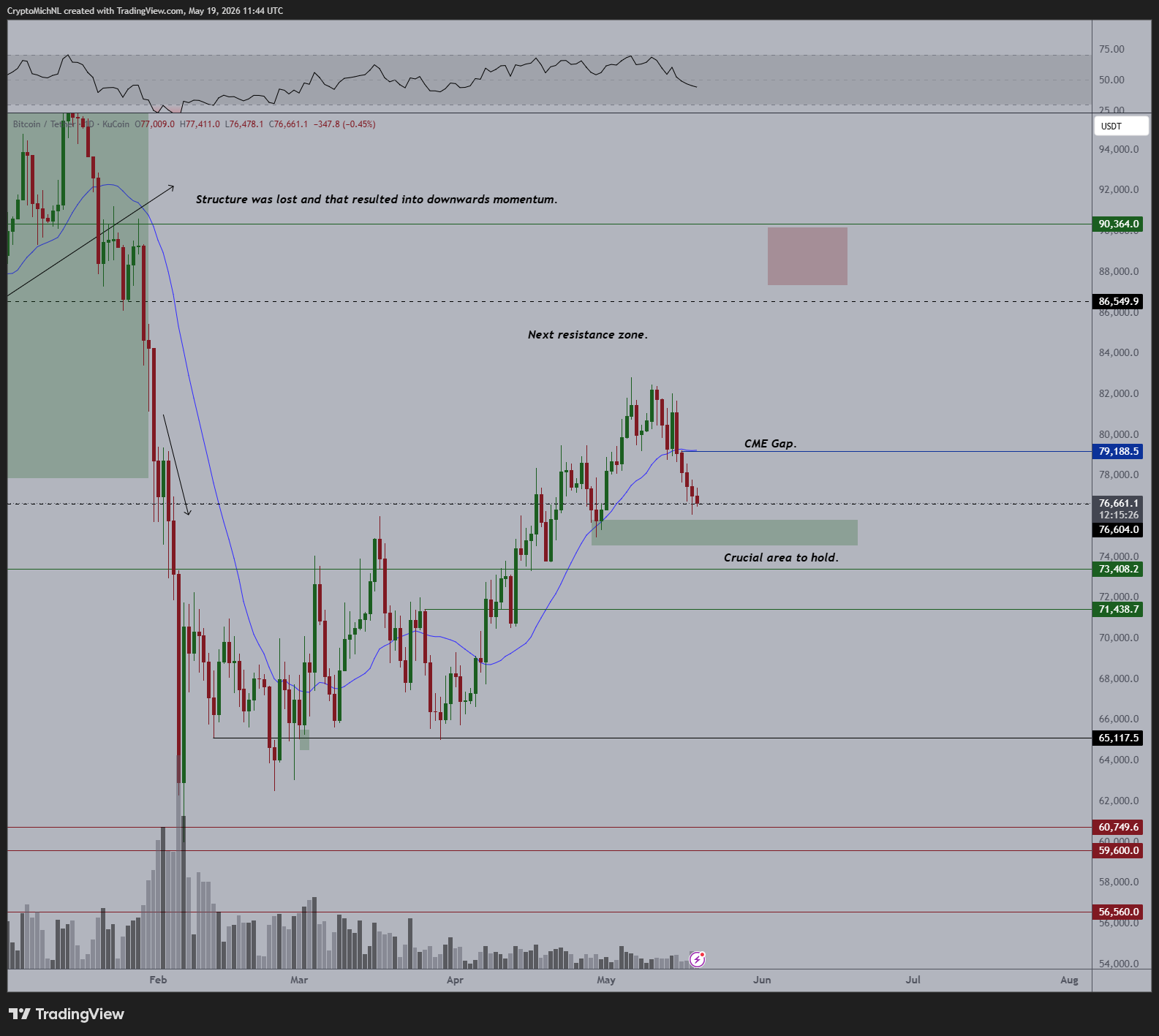
BTC/USDT one-day chart. Source: Michaël van de Poppe/X

Perpetuals launches UpsideOnly, an AI-powered ‘risk-free’ market prediction platform
Perpetuals.com Ltd, a Nasdaq-listed fintech group, has introduced UpsideOnly, a market prediction platform that lets users submit forecasts across equities, crypto, commodities and forex without staking personal capital. The company says it will execute trades with its own funds based on a proprietary AI model and distribute profits to users whose predictions help generate successful trades.
Perpetuals describes the service as a human-AI collaboration: participants contribute signals and the platform’s algorithm, BayesShield AI, applies those signals to make trading decisions. According to the company, BayesShield was trained on more than 22 billion retail trades, a dataset the firm says informs real-time signal refinement.
How UpsideOnly works
Users register and make directional predictions on various markets without depositing trading capital. Perpetuals evaluates those signals and, when its AI assigns sufficient probability to a forecast, the firm trades with its own capital. If a trade is profitable, the firm shares some portion of the gains with the users whose signals contributed to the decision. If a trade loses, Perpetuals absorbs the loss and users take no financial hit from the trade itself.
The product offers optional refundable deposits of $1 or more. Perpetuals says those deposits are not used for trading but are held in U.S. Treasury securities with an external fiduciary and are designed to deter bots. Users who place a deposit reportedly receive higher payout levels, reflecting the platform’s view that small deposits improve signal quality.
What the company claims and what to watch
Perpetuals positions UpsideOnly as a corrective to what it characterizes as an unfair retail trading ecosystem. The company argues that letting users contribute insight rather than capital aligns incentives differently from conventional retail broker models, where many individual traders lose money.
Key company claims include the scale of the training data behind BayesShield and the platform’s multi-asset coverage. Perpetuals also notes regulatory connections: an affiliate, PM MTF Ltd., operates under an EU multilateral trading facility regime and the firm cites compliance frameworks such as MiFID II, MiCA, DORA and EMIR for its European operations.
Market and regulatory implications
UpsideOnly sits at the intersection of several fast-evolving fintech trends: AI-driven trading, crowd-sourced forecasting and novel consumer products that blur the line between prediction markets and brokerage services. That mix could draw heightened regulatory attention.
Regulators will likely scrutinize how UpsideOnly is classified under securities, derivatives and gambling laws. The firm itself flags potential risks that the product could be characterized under gaming, sweepstakes or commodity-derivatives regimes, a point that reflects the legal complexity of monetizing user predictions when a firm executes trades on the back end.
Consumer protection authorities may also probe disclosure, the robustness of anti-abuse measures, and whether the model could incentivize risky behaviour from participants who do not face downside. The presence of refundable deposits intended to deter bots may not be sufficient, in regulators’ view, to address market manipulation or wash-trading risks without additional controls and transparency.
Business model and sustainability questions
At its core, the UpsideOnly model transfers trading downside to Perpetuals while offering users upside participation. That places a premium on three elements: the predictive edge of BayesShield, effective risk management at the firm level, and the durability of the signal sourcing mechanism.
Model performance and data limits. The company cites a very large retail trade dataset, but past performance and backtests do not guarantee future returns. Machine learning models trained on historical retail behaviour can be vulnerable to regime shifts, data biases and overfitting. The platform’s long-term profitability depends on whether the AI can identify persistent edges after costs and the profit split to users.
Capital and risk appetite. Perpetuals must bankroll losing streaks and market shocks, which could strain capital if the platform scales quickly or encounters rare adverse events. The firm’s Nasdaq listing gives it public-market access to capital, but sustained losses or drawdowns could prompt investor scrutiny.
Gaming the system. Prediction marketplaces and incentive systems attract strategic actors. Participants who try to exploit payout mechanics or coordinate signals could degrade signal quality and create losses. The refundable deposit is a modest deterrent and may reduce automated accounts, but it is not a comprehensive anti-abuse solution.
Industry context
UpsideOnly is part of a broader wave of products attempting to democratize alpha and repackage trading as an experience anchored by gamified inputs or social signals. The difference here is the explicit claim that retail users are shielded from trading losses because the firm executes trades with its own balance sheet.
That arrangement recasts users as signal providers rather than capital providers. Economically, that is similar to some prediction markets and algorithmic investment strategies that pay contributors for valuable information. Whether the economics scale as user volumes rise will be an important test of the concept.
Bottom line
Perpetuals’ UpsideOnly brings together crowd intelligence and an AI model trained on large retail datasets to offer participants exposure to trading gains without direct downside. The architecture raises meaningful questions about regulatory treatment, model risk, and capital sustainability. Market participants and regulators will be watching closely to see whether Perpetuals can convert user signals into repeatable returns while managing the operational, legal and financial risks inherent in underwriting trading losses.
Bloomberg has also reported on the launch, and Perpetuals has made its executive team available for interviews. The company cautions that “risk-free” refers specifically to user trading losses and does not eliminate operational or other platform risks.
Anatoly Yakovenko argues Solana needs its own atomically composable perpetuals DEX as Hyperliquid pursues regulatory clarity in Washington.
After the Clarity Act cleared the Senate Banking Committee, SEC Chairman Paul Atkins is expected to roll out an ‘innovation exemption‘ framework for tokenized stock trading, opening the door to 24/7 on-chain equity markets on regulated Alternative Trading Systems.
The tokenized stock market is not waiting on legislators to catch up.
Data shows distributed value hitting $33.7 billion, up 21% in the last 30 days, with monthly transfer volume reaching $3.03 billion. That momentum gives the regulatory push a concrete market context, not just policy abstraction.
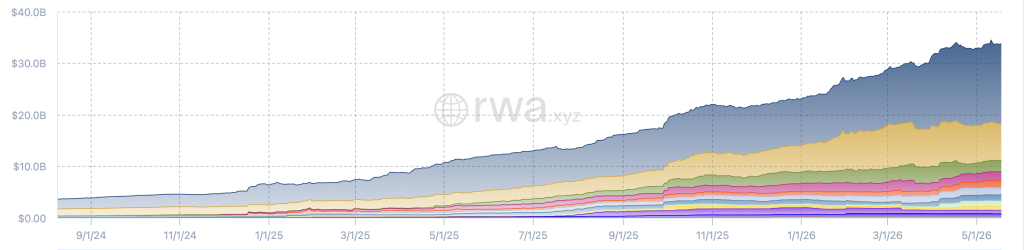
Bullish signal for RWA tokenization infrastructure and compliant on-chain equity platforms.
Discover: The best crypto to diversify your portfolio with
How the SEC’s Tokenized Stock Framework and ATS Infrastructure Actually Work, and Why the DTC Pilot Is the Real Foundation
The mechanism here is worth understanding precisely. The SEC’s proposed ‘innovation exemption’ is not a wholesale rewrite of securities law.
A January 2026 joint staff statement from three SEC divisions made the regulatory posture explicit: tokenization does not alter the fundamental characteristics of a security, and existing disclosure obligations, custodial requirements, and investor protections continue to apply regardless of whether a stock trades on a blockchain ledger.
The practical infrastructure is supported by the DTC Pilot, a three-year no-action relief granted to DTCC’s DTC in December 2025.
That pilot is limited to highly liquid, DTC-eligible securities and requires real-time regulatory observability and granular participant reporting – obligations that will bind any ATS plugging into the same settlement rails. In March 2026, the SEC approved Nasdaq’s rule change to allow trading of tokenized versions of DTC-eligible equities and ETPs, using the same ticker, market rules, and economic rights as the underlying shares.
The Atkins framework extends this logic further. Bloomberg reporting indicates the plan covers both tokenized stocks issued directly by or on behalf of issuers and third-party tokenized stocks with no direct issuer affiliation, a distinction that matters enormously for secondary-market liquidity and alternative trading system design.
Those two categories carry different disclosure obligations and custodial structures. They are not the same thing.
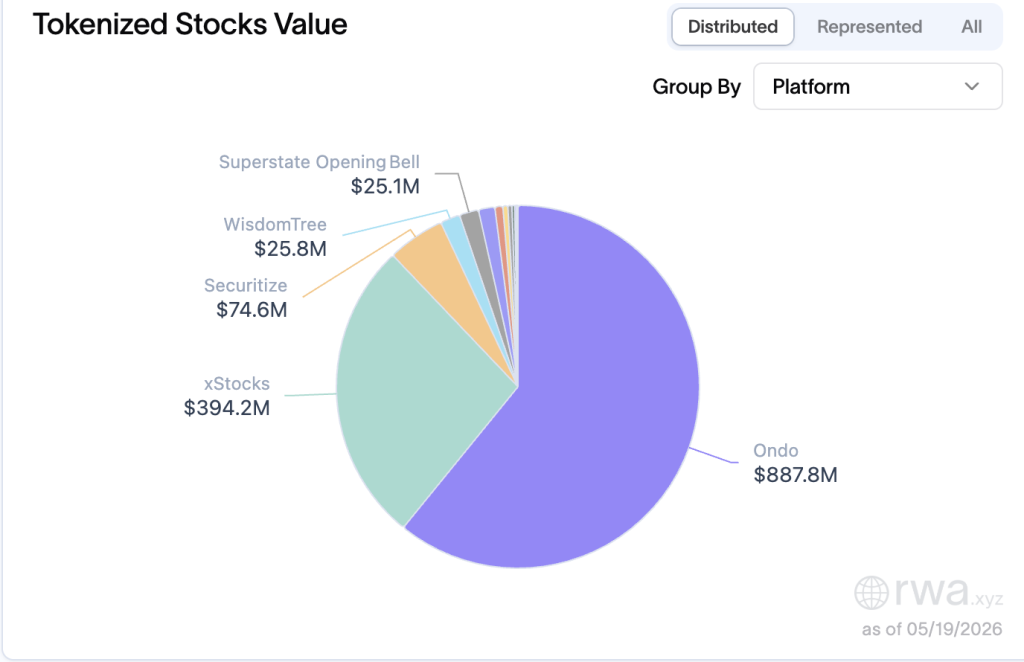
Ondo, built on Ethereum, currently commands 60% of the on-chain stock market. Tokenized Circle Group stocks represent roughly $212 million in value; tokenized NVIDIA Corp. sits at $89.3 million; tokenized Tesla Inc. at $85.4 million.
Those three names alone account for more than 25% of total tokenized stock value across 266,000+ holders and 83,257 monthly active wallets.
Can the Clarity Act Clear 60 Senate Votes – and What Does Each Scenario Mean for Blockchain Regulation?
The CLARITY Act’s path to law is the pivotal variable. The bill clears its next hurdle – a Senate Banking Committee vote – but the floor requires 60 votes. Republicans hold 43 seats, meaning pro-crypto advocates need at least 17 Democratic votes to break a filibuster. Polymarket currently prices the probability of a 2026 floor vote at 64%.
If passed, the CLARITY Act shifts primary regulatory oversight of crypto trading from the SEC to the CFTC – with a specific carve-out keeping digital securities oversight at the SEC.
That jurisdictional line is not cosmetic. It determines which rulebook governs tokenized equity ATS platforms, how margin and leverage rules apply, and which agency has enforcement authority over platforms like Ondo.
If Seventeen or more Democratic senators back the bill; the CLARITY Act passes in July 2026, the SEC’s innovation exemption framework launches concurrent with new ATS licensing, and tokenized stock distributed value, already at $1.43 billion, accelerates toward $5 billion by year-end as institutional platforms gain regulatory cover.
NYSE has already tapped Securitize to develop tokenized securities markets, and at least one additional U.S. exchange has outlined plans for 24/7 tokenized trading with stablecoin settlement, signaling that Nasdaq’s Pilot model will not remain unique regardless of what Congress does.
The SEC’s broader regulatory posture under Atkins is clearly shifting toward structured engagement rather than enforcement-first friction.
The blockchain regulation framework is moving. The 17 Democratic votes are the only variable the market cannot price with confidence yet.
Discover: The best pre-launch token sales
The post SEC Seeks Tokenized Equity Pilot as Clarity Act Reaches Senate Floor appeared first on Cryptonews.
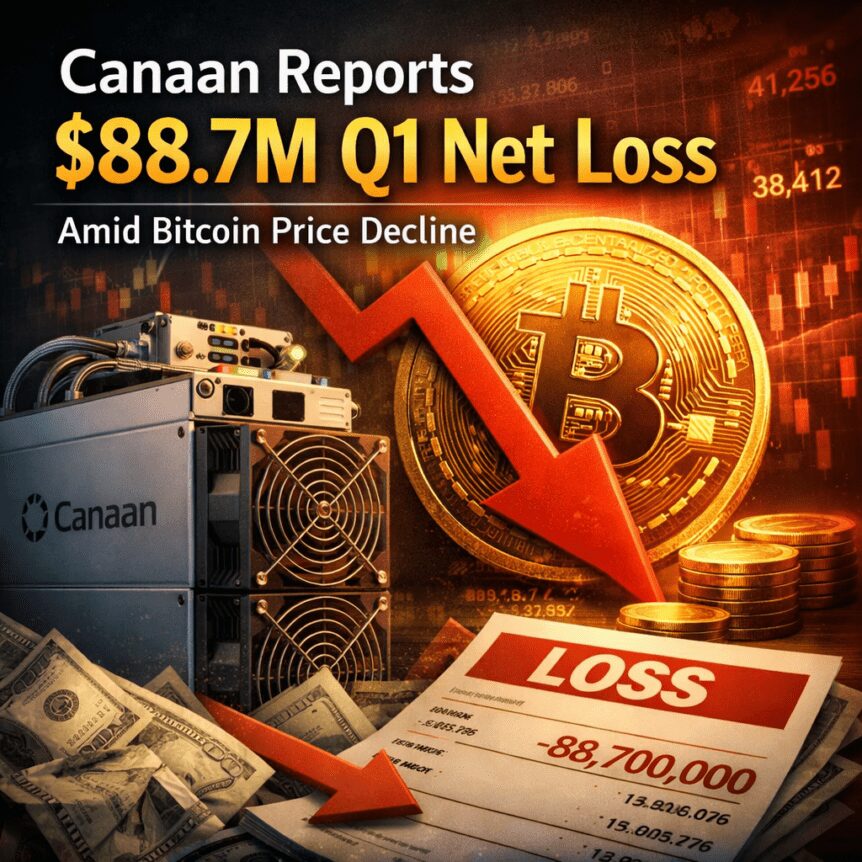
Canaan Inc., a publicly traded Bitcoin mining company, posted a challenging first quarter for 2026 as weaker Bitcoin prices pressured margins and a large inventory write-down amplified losses. The company reported revenue of $62.7 million for the quarter ended March 31, down sharply from $196.3 million in the prior quarter, while net loss reached $88.7 million. The results highlight how a sustained dip in crypto prices can quickly erode mining profits even as operators expand their physical footprint.
Industrial mining equipment remained the driver of revenue, generating $39.6 million in the quarter but reflecting a 75% sequential drop. Self-mining contributed $19.1 million, and the home mining segment yielded $2.7 million, more than doubling year-on-year. A $25 million inventory write-down weighed on gross margins, contributing to a gross loss of $23 million and an operating loss of $54.3 million. The results were accompanied by a cautious near-term outlook from the company.
“Although average Bitcoin prices and hashprice declined significantly quarter-over-quarter, our bitcoin production experienced a comparatively smaller decrease, reflecting the resilience of our mining operations and continued hashrate deployment,” Jin (James) Cheng, chief financial officer of Canaan, said.
The quarterly numbers came with broader context from the sector. Several large miners — Riot Platforms, Core Scientific, CleanSpark and TeraWulf — have posted widening losses in Q1 as mining margins compressed under falling BTC prices. At times, investors have begun reassessing the strategy mix of miners who are expanding beyond coin production to alternative compute workloads, including artificial intelligence and high-performance computing, to shore up revenue streams.
Key takeaways
- Q1 revenue and loss profile: Canaan booked $62.7 million in revenue for the quarter ended March 31, with a net loss of $88.7 million. The company cited a substantial $25 million inventory write-down and a broader impairment of gross margins amid a softer price environment for Bitcoin.
- Hashrate growth and balance sheet exposure: Self-mining hashrate rose to 11 exahashes per second, up 66% from a year earlier, underscoring continued capacity expansion. Canaan held 1,808 Bitcoin on its balance sheet as of March 31, valued at roughly $121 million, illustrating the dual exposure to crypto prices and operational scale.
- Strategic capital and power advantages: The company completed the acquisition of Cipher Mining’s 49% stake in three West Texas joint ventures, increasing its aggregate hashrate capacity by about 4.4 EH/s and 120 megawatts of power. The deal was completed via share issuance, providing access to power costs below three cents per kilowatt-hour on the ERCOT grid.
- Guidance and near-term outlook: Canaan guided Q2 revenues to a range of $35 million to $45 million, signaling a further sequential decline as the sector contends with weak BTC pricing and ongoing margin pressure.
- Industry backdrop and diversification trend: The quarter sits within a broader industry context of rising losses among major miners, while several players explore AI and HPC as alternative revenue streams. The sector’s pivot toward compute workloads beyond pure mining reflects search for more stable cash flows as crypto cycles fluctuate.
Canaan’s expansion, a hedge against a difficult cycle
Beyond the quarterly numbers, Canaan’s strategic moves signal a deliberate effort to reduce operating risk in an environment of volatile cryptocurrency prices. The 11 EH/s self-mining capacity upgrade, up 66% year-over-year, demonstrates the company’s commitment to increasing production efficiency as BTC prices remain volatile. The company’s assertion that its bitcoin production declined less thanHashprice and price declines suggest a degree of operational resilience—an encouraging signal for a sector that often sees margins compress in downturns.
The Cipher Mining stake acquisition is particularly noteworthy. By gaining 49% control over three West Texas joint ventures totaling roughly 4.4 EH/s and 120 MW of capacity, Canaan gains not only scale but access to power arrangements described as below three cents per kilowatt-hour on the ERCOT grid. In a capital-intensive business where energy costs are a dominant input, such pricing advantages can materially influence unit economics during periods of modest BTC price appreciation.
The transaction, closed through a share issuance rather than a cash payment, also reflects a broader industry-wide preference to preserve cash while expanding operational capacity. If power costs prove durable at those levels, and if Bitcoin’s price recovers, Canaan’s expanded hashrate could translate into improved hashprice capture and a quicker return to profitability than peers less able to secure favorable energy terms.
Looking ahead, the company’s Q2 revenue guidance of $35 million to $45 million points to ongoing sequential weakness. This forecast acknowledges the still-fragile price environment for BTC and the need to balance expansion with financial discipline. Investors should weigh whether European and North American miners can better manage energy costs and operational leverage in the coming quarters, especially as the sector pursues AI compute workloads as a supplementary revenue source.
Industry momentum and investor sentiment
The broader mining landscape in Q1 shows a sector-wide struggle to maintain profitability. Major players such as Riot Platforms, Core Scientific, CleanSpark and TeraWulf reported widening losses as hashprice pressures persisted. In Mara’s case, a $1.3 billion net loss included roughly $1 billion in non-cash mark-to-market adjustments tied to Bitcoin holdings, underscoring how much crypto price swings can distort reported results.
As margins tighten, a growing segment of miners is exploring adjacent compute markets. HIVE Digital Technologies, for example, revealed plans to develop a 320-megawatt AI data center campus near Toronto designed to support more than 100,000 GPUs at full capacity. The move illustrates a broader strategic pivot: monetize infrastructure through high-demand AI workloads while keeping a base exposure to Bitcoin mining.
The current results and strategic shifts come at a time when the industry is weighing regulatory and macroeconomic risks that could shape future profitability. If Bitcoin remains range-bound or dips further, miners will continue to rely on cost controls, energy arbitrage, and portfolio diversification to weather a protracted downturn. On the other hand, a meaningful BTC price rebound could lift hashprice and unlock greater upside for operators with low-cost power agreements and scalable infrastructure.
Canaan’s stock reaction reflected the mix of disappointment and cautious optimism that defines the sector today. Shares closed down after the earnings release, with a momentum noted in the pre-market session as investors reassessed the company’s near-term profitability trajectory in light of the guidance and ongoing capacity expansion.
As the market absorbs these results, readers should watch for several key indicators: the durability of Canaan’s ERCOT-based power economics, any further updates on the Cipher Mining ventures, and how BTC price dynamics influence hashprice and mining margins across the sector. The combination of aggressive capacity growth, price-sensitive revenue, and energy cost leverage will continue to dictate which miners emerge stronger from the current cycle.
In the near term, the central question remains whether BTC prices stabilize enough to lift mining economics, and whether the AI/HPC pivot provides sustainable revenue diversification for industry players. The answers will shape not only which companies survive but also how the long-term narrative for crypto mining evolves in an environment where energy cost and compute demand increasingly intersect.
Readers should stay tuned for updates on Canaan’s next quarterly results, any further capital moves tied to its joint ventures, and new datapoints on hashprice trajectories as macro conditions unfold.
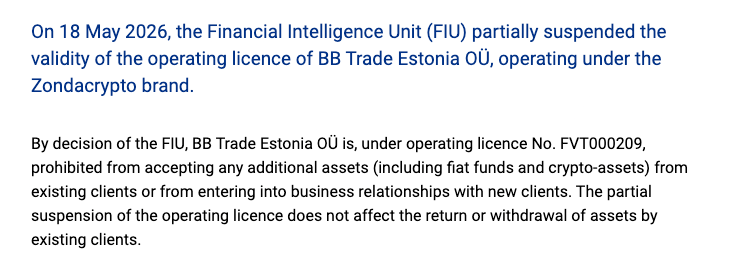
A European regulator has partially suspended the operating license of the company behind troubled crypto exchange Zondacrypto.
The Financial Intelligence Unit (FIU) of Estonia partially suspended the license of BB Trade Estonia OÜ, operating under the Zondacrypto brand, according to a statement on Monday.
According to the FIU, the company is now barred from accepting deposits and onboarding new clients, while existing users are still allowed to withdraw their funds.
The suspension puts BB Trade Estonia OÜ at risk of losing its operating license if it does not meet compliance requirements set by Estonian authorities.
Source: FIU
Zondacrypto faces broader regulatory scrutiny in Europe following withdrawal issues and its CEO saying that an exchange cold wallet holding about 4,500 Bitcoin ($345.9 million) was inaccessible.
A 30-day compliance window and potential license revocation
The FIU said that BB Trade Estonia OÜ has 30 days to bring its operations into compliance with legal requirements following the partial suspension of its license.
“If it fails to do so, the law obliges the FIU to revoke the operating license,” the regulator said.
The FIU did not specify what compliance breaches led to the suspension. Cointelegraph contacted the authority for comment but did not receive a response at the time of publication.
Estonia’s Financial Supervision and Resolution Authority (FSA) previously issued a warning against BB Trade on May 8, saying its “TeamPL” crypto token violated the European Union’s Markets in Crypto-Assets Regulation (MiCA) because it was listed without a white paper.
Zondacrypto at center of regulatory debate in Poland
The suspension comes amid broader concerns around Zondacrypto, including reported withdrawal issues and past comments by Polish Prime Minister Donald Tusk referencing around 30,000 potential victims linked to crypto-related losses.
Market data from CoinGecko shows little to no recent trading activity on the exchange at publishing time.
Cointelegraph was unable to reach Zondacrypto for comment, as email attempts bounced at the time of publication. Key BB Trade staff also left the company following earlier developments involving the exchange.
Founded in Poland in 2014 as BitBay, Zondacrypto has grown into a major European crypto exchange, particularly among Polish-speaking users.
Despite its Polish origins, the company has been registered in Estonia since September 2019, according to InfoRegister data, well before the EU’s MiCA regulation fully took effect in late 2024.
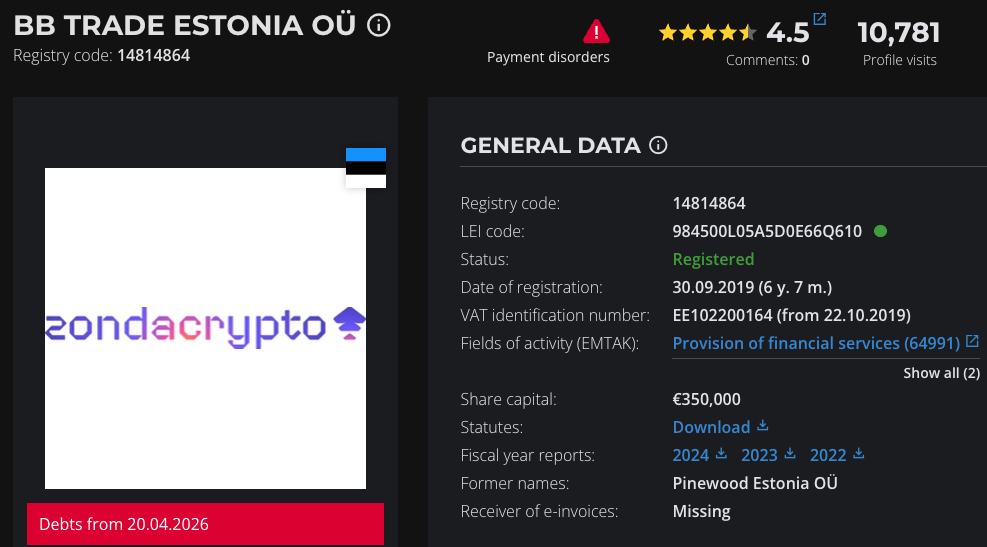
Source: InfoRegister
Zondacrypto has since become part of a broader regulatory debate in Poland, where officials have raised concerns about its potential links to Russian capital and political influence.
Related: Polish lawmakers back revised crypto bill after repeated vetoes
Some Polish policymakers have also criticized delays and inconsistencies in the country’s implementation of MiCA rules, even as the exchange operated under its Estonian registration.
On Tuesday, the FSA issued a MiCA license to LHV Pank, one of the country’s largest banks, making it the second financial institution in Estonia to receive approval under the EU’s crypto regulatory framework.
Magazine: eToro founder timed Bitcoin top perfectly due to belief in 4 year cycles


- Morpho is slightly up over the past 24 hours, trading around $1.77.
- Bulls eye a rebound after the latest broader cryptocurrency market dip.
- Ecosystem growth appears to bolster a short-term uptick.
Morpho (MORPHO) price has staged a modest intraday recovery after tumbling to session lows of $1.64 earlier in the day.
The slide coincided with Bitcoin’s sharp pullback to about $76,000, which pulled most altcoins lower and sees many hovering at near-term support levels.
MORPHO, however, has since moved 3% off its intraday lows and was trading around $1.76 at the time of writing, reflecting a relief bounce as buyers stepped in.
According to CoinMarketCap data, intraday highs across exchanges stood at $1.77.
Key integrations in Morpho ecosystem
The gains cut weekly losses to 16% and monthly downturn to about 14%.
No major upward catalysts are helping buyers, but Morpho’s expanding ecosystem is worth noting.
The project recently launched its DeFi layer on Tempo, powered by RedStone oracle feeds, and went live with curated vaults managed by Gauntlet and Sentora.
Both teams selected RedStone as the primary Oracle infrastructure for the new markets.
Market participants could view the launch as a supportive development that could underpin short-term liquidity and use-case expansion.
1/ Tempo is positioned to route billions in stablecoin flows across onchain markets. With @Morpho now live on @tempo, that capital becomes productive.
Sentora is partnering with Tempo to bring structured risk management to new lending markets.https://t.co/L91qDZmTlF
— Sentora (@SentoraHQ) May 18, 2026
Morpho has also been named a launch partner for Upshift Clear, joining Superstate on the initiative.
Upshift Clear functions as an instant redemption facility for tokenized real-world assets (RWAs), beginning with USCC.
Under the arrangement, idle USDC deposited in Clear vaults is routed into Morpho markets between redemption events.
The platforms say this creates additional on‑chain capital flow into MORPHO liquidity pools.
MORPHO price analysis – relief rally or fresh momentum?
Bear dominance over the past month suggests that the drop to $1.64 and bounce to $1.77 could be a relief rebound rather than a definitive trend reversal.
The technical picture, however, shows early signs of bullishness.
Bulls holding above the $1.70 mark would be a constructive signal for short-term traders to breach the $1.80 supply zone.
If this happens, buyers could open the path toward a $2.00–$2.20 target zone.
That upside will likely depend on continued interest in Morpho’s ecosystem and broader market stability.
Notably, a recovery in Bitcoin would ease pressure across the sector, with an altcoin rally likely amid capital distribution.
Failure to sustain levels above $1.70 would, however, leave MORPHO exposed to further downside action.
The likelihood of a retest of $1.60, which stands as a key near-term support, remains.
A decisive break below this could invite deeper selling and shift the outlook back to bearish.
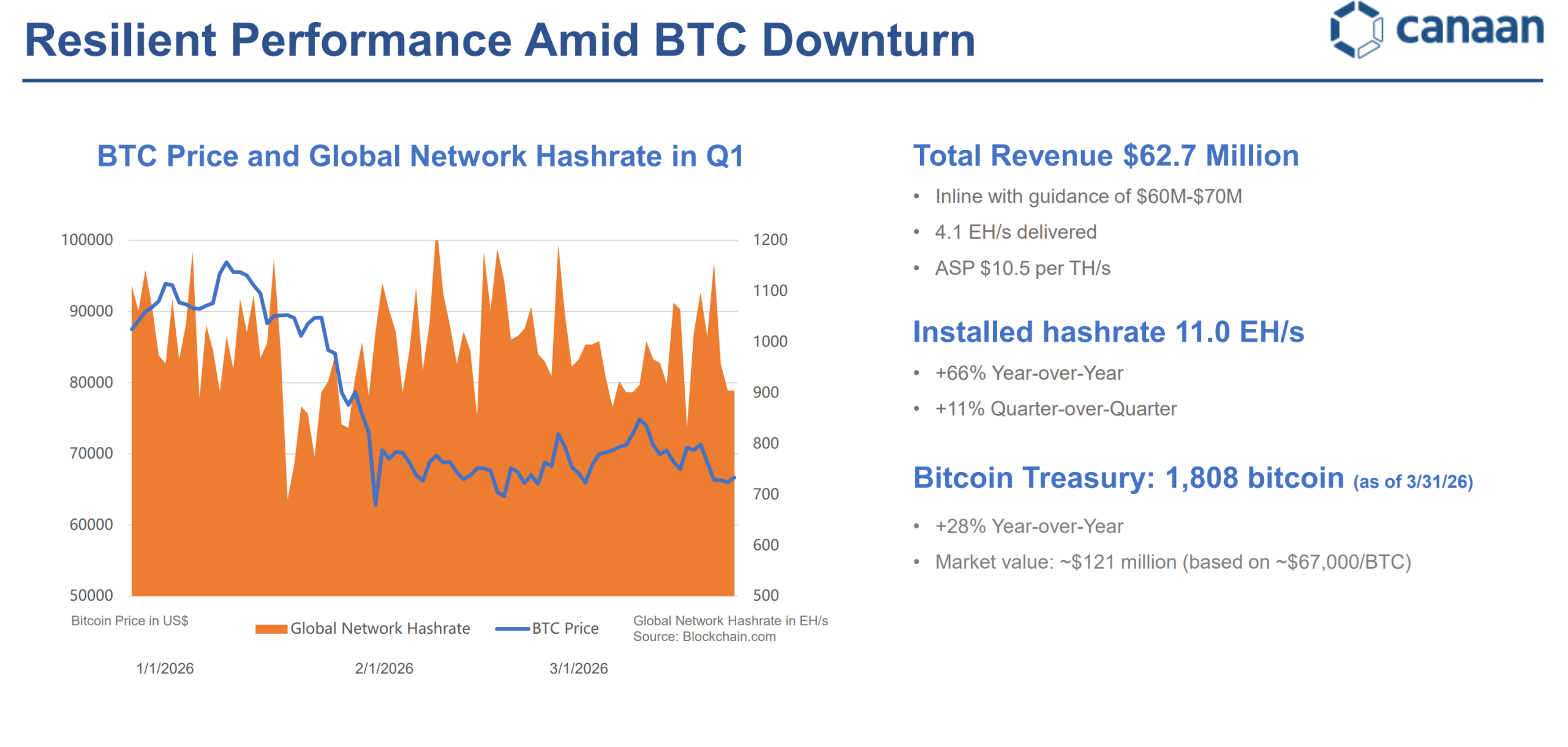
Bitcoin miner Canaan reported a net loss of $88.7 million for the first quarter of 2026, as falling Bitcoin (BTC) prices squeezed margins and triggered a significant inventory write-down.
The company posted total revenue of $62.7 million for the quarter ending March 31, a sharp decline from the $196.3 million it recorded in the previous quarter, according to a Tuesday press release.
Industrial mining equipment remained the company’s primary revenue driver at $39.6 million, though sales tumbled 75% from the prior quarter. Self-mining contributed $19.1 million, while the home mining segment brought in $2.7 million, a category that more than doubled year-on-year.
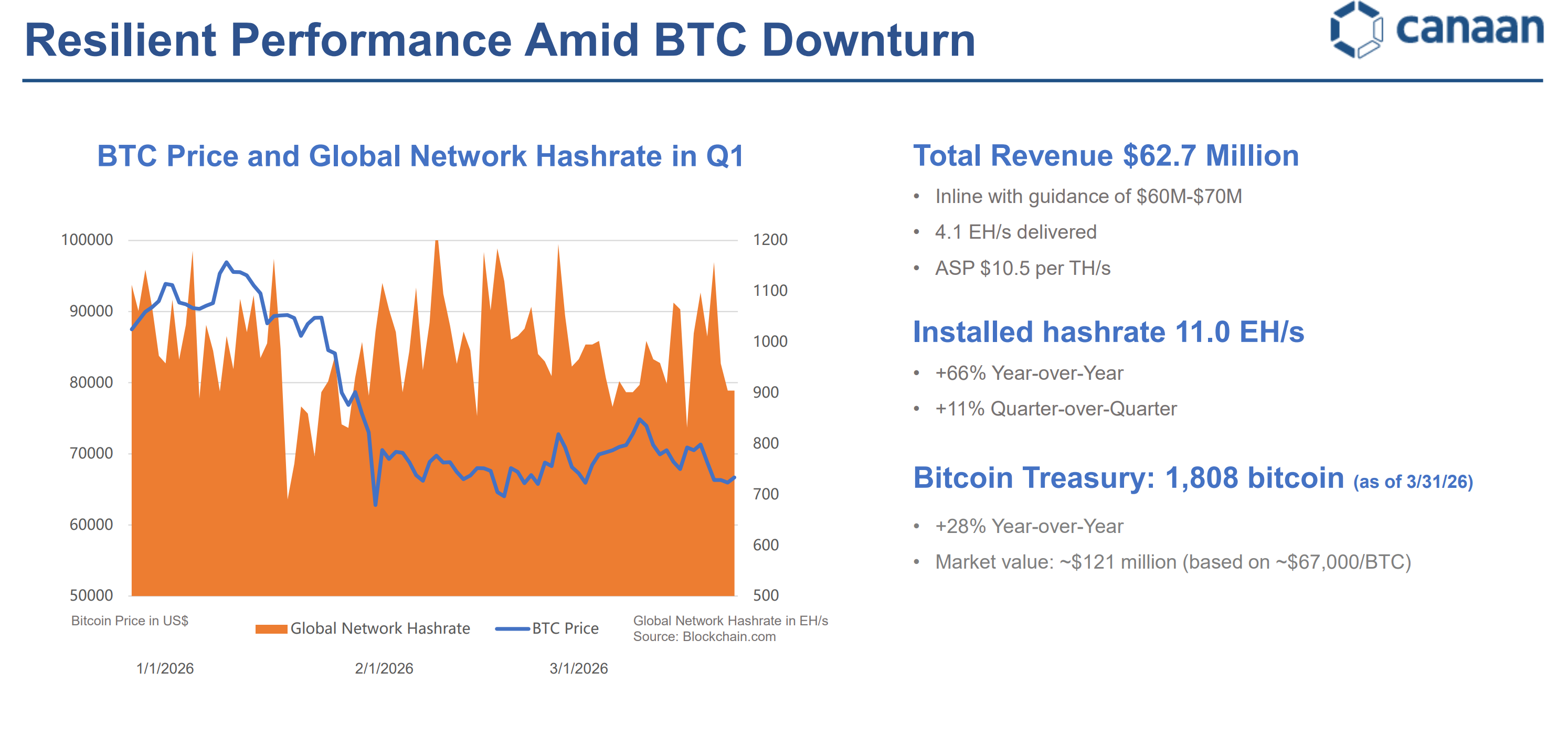
Source: Canaan
“Although average Bitcoin prices and hashprice declined significantly quarter-over-quarter, our bitcoin production experienced a comparatively smaller decrease, reflecting the resilience of our mining operations and continued hashrate deployment,” Jin (James) Cheng, chief financial officer of Canaan, said.
A $25 million inventory write-down weighed on the quarter’s gross loss of $23 million, while loss from operations reached $54.3 million.
Related: Bitcoin turns risk on as stocks hit new highs and miner profits rise: Is $85K BTC next?
Canaan’s self-mining hashrate surges 66%
Canaan expanded its self-mining footprint to 11 exahashes per second of installed computing power, a 66% jump from a year earlier. The company held 1,808 Bitcoin on its balance sheet as of March 31, valued at approximately $121 million.
In the quarter, Canaan also completed the acquisition of Cipher Mining’s 49% stake in three West Texas joint venture projects totaling roughly 4.4 EH/s in hashrate capacity and 120 megawatts of power. The deal, closed through a share issuance rather than cash, gives Canaan access to power rates below three cents per kilowatt-hour on the ERCOT grid.
Looking ahead, Canaan guided Q2 revenues between $35 million and $45 million, a further sequential decline.
Canaan shares closed down 3.54% at $0.4827 on Monday, shedding a further 7.71% in pre-market trading to $0.4455, according to Yahoo Finance.
Related: Hut 8 refinances Bitcoin-backed loan with $200M FalconX deal
Major miners report losses in Q1
Across the sector, major miners including Riot Platforms, Core Scientific, CleanSpark and TeraWulf all reported widening losses in Q1. MARA topped the group with a $1.3 billion net loss, roughly $1 billion of it tied to non-cash mark-to-market adjustments on its Bitcoin holdings.
As mining margins compress, a growing number of miners are pivoting toward AI and high-performance computing as an alternative revenue stream. On Monday, HIVE Digital Technologies announced plans to build a 320-megawatt AI data center campus near Toronto, capable of supporting more than 100,000 GPUs at full build-out.
Magazine: Guide to the top and emerging global crypto hubs — Mid-2026

Seth Rogen’s Heartbreaking New Movie Stuns Cannes with Massive Ovation

She Doesn’t Respect Your Financial Sacrifice #DisruptingDivorce #toxicrelationships #sexlessmarriage

Supermarkets urged to limit food prices by government

Manchester United reach agreement with Casemiro over contract clause amid transfer speculation

US brings back mandatory military draft registration

Steven Gerrard disagrees with Gary Neville over ‘shock’ Chelsea and Arsenal claim | Football


-

 Crypto World4 days ago
BloFin War of Whales 2026 Grand Prix opens registration for $5M trading championship
-

 Fashion4 days ago
Weekend Open Thread: Theory – Corporette.com
-

 Crypto World4 days ago
E-Estate Announces 1 Year Live: Washington DC Summit as Real Estate Tokenization Enters Its Next Phase
-

 Tech4 days ago
Tech Moves: Microsoft AI leader jumps to OpenAI; former AI2 exec joins Meta; and more
-
Crypto World6 days ago
Bitcoin Suisse expands with Digital Asset License and Investment Business Act Registration Approval in Bermuda
-

 Politics7 days ago
Pakistan to enter Chinese capital market as war inflation bites
-

 Crypto World7 days ago
Bitcoin Suisse expands with Digital Asset License and Investment Business Act Registration Approval in Bermuda
-
 Crypto World5 days ago
Google’s Gemini AI Predicts Incredible Solana Price by the End of 2026
-

 Business4 days ago
H&R Real Estate Investment Trust (HR.UN:CA) Q1 2026 Earnings Call Transcript
-

 Tech4 days ago
Google reimburses Register sources who were victims of API fraud
-

 Sports4 days ago
Napoleonic enters 2026 Doomben 10,000 field via Abounding withdrawal
-

 NewsBeat7 days ago
Comment on Keir Starmer surviving the day as Prime Minister like a turd that wont flush
-
 Entertainment5 days ago
Zara Larsson Has Blunt Response To Chris Brown Diss
-
 Crypto World6 days ago
Two AI Tokens Lead May Rally, But Risks Are Rising
-

 Fashion7 days ago
The Best-Kept Makeup Secret for a More Defined Face
-

 Fashion3 days ago
On the Scene at Gucci’s Cruise Show in New York City: Mariah Carey, Kim Kardashian, Lindsay Lohan, Iman, and More!
-

 Politics7 days ago
Palestine’s flag becoming a regular sight at European football stadiums
-

 Crypto World4 days ago
BeInCrypto 100 Institutional Awards Nomination: KAST for Best Digital Assets Neobank and Best Digital Assets Fintech
-
 Tech6 days ago
Why AI is making typography a boardroom conversation
-

 Politics7 days ago
The 81 MPs (so far) who have demanded tick-like Starmer out
You must be logged in to post a comment Login