
Crypto World
Marvel Drops Bitcoin Mention in Daredevil Season 2

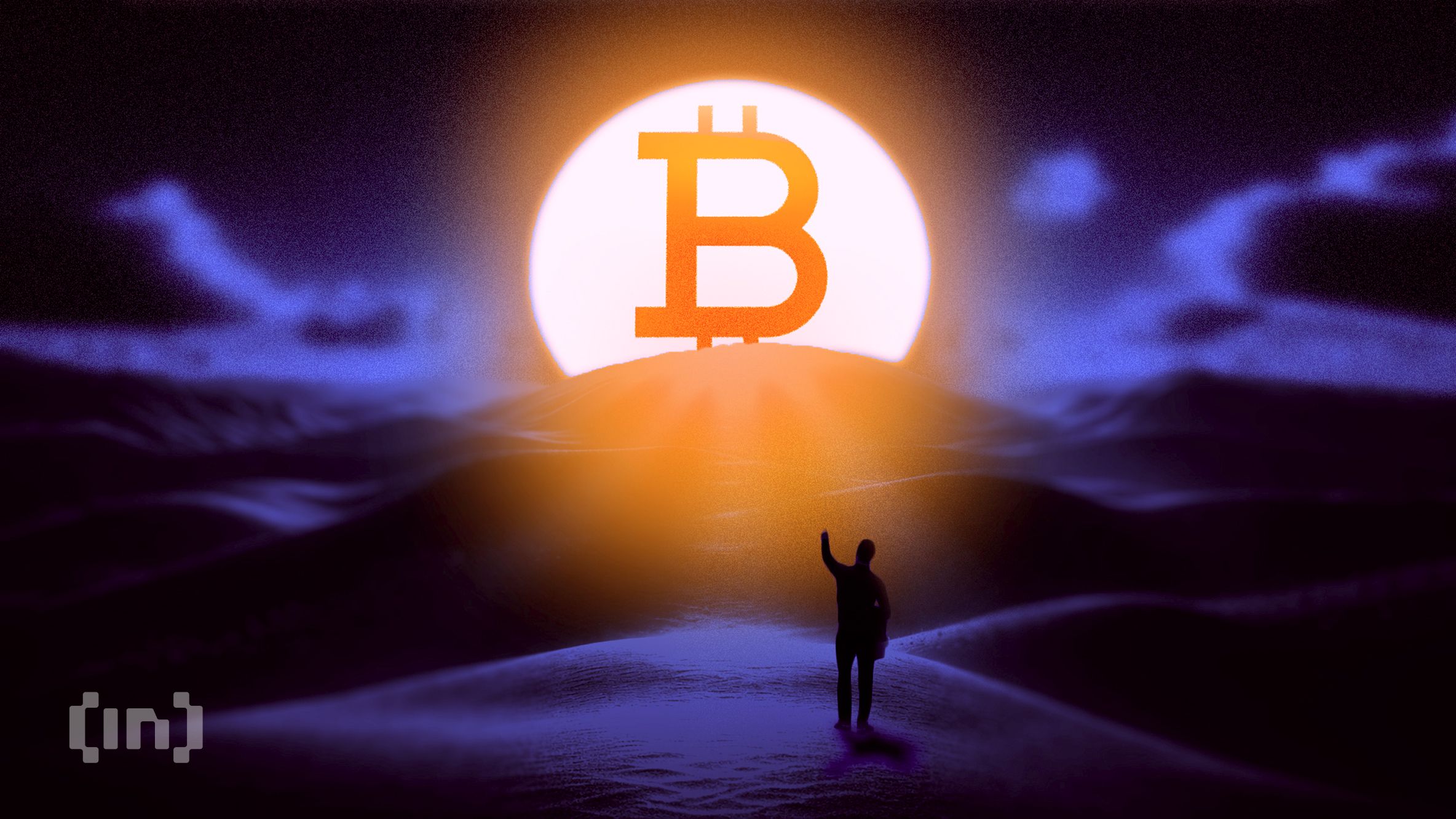
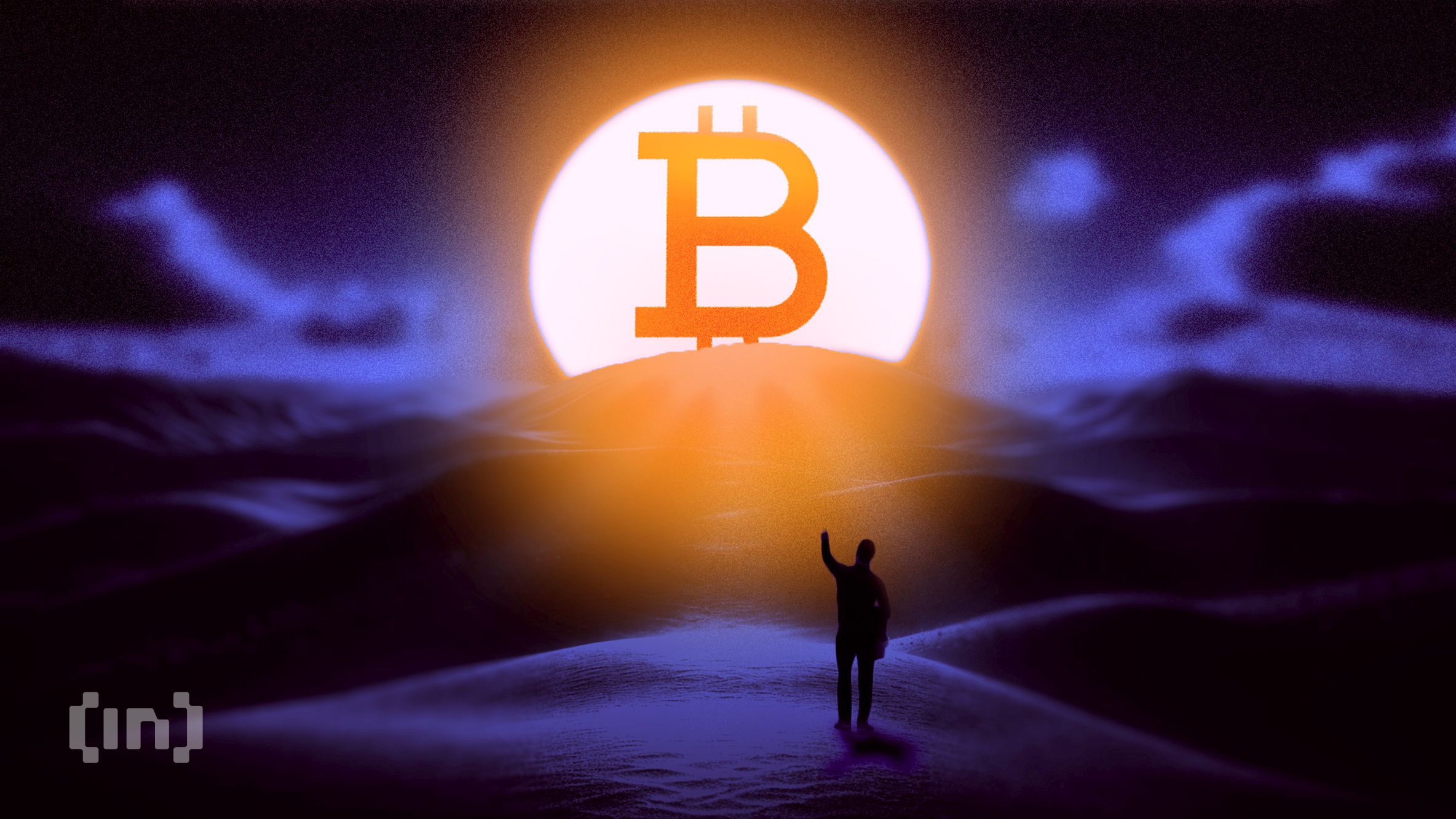
Wilson Fisk proposed diversifying his criminal empire into Bitcoin (BTC) during a flashback scene in Daredevil: Born Again, Season 2, Episode 5, marking one of the MCU’s most direct crypto references to date.
The moment aired on Disney+ on April 14 as part of “The Grand Design,” an episode built around Kingpin’s origin story.
Kingpin’s Bitcoin Pitch Got Overruled
The flashback takes place around 2014 to 2015, before the events of the original Netflix Daredevil series. Fisk, played by Vincent D’Onofrio, rides in a car with his right-hand man James Wesley, played by Toby Leonard Moore.
After discussing complications with an associate known as “The Lion,” Fisk floats the idea of Bitcoin as a way to modernize and diversify their money laundering operations.
Wesley pushes back, viewing crypto as too volatile. He steers Fisk toward the art world instead, mentioning a contact at the Scene Contempo Gallery.
Fisk initially dismisses art as pretentious but agrees to visit. That decision leads directly to his first encounter with Vanessa Marianna, setting up one of the MCU’s defining romances.
The timeline fits. BTC traded around $200 to $300 during that period, still far from mainstream recognition.
For a forward-thinking crime boss exploring discreet financial channels, the suggestion landed as both plausible and amusing.
Crypto Fans Reacted Quickly
The line went mildly viral on social media. A post on Reddit’s r/Bitcoin community titled “Daredevil: Born Again S2 E5” drew upvotes and comments ranging from “that’s wild” to debates over whether Fisk would have been an early whale.
No later episodes have followed up on the idea. The art pivot is what stuck for Kingpin’s empire.
The post Marvel Drops Bitcoin Mention in Daredevil Season 2 appeared first on BeInCrypto.


Key Highlights
-
Platform transitions from prediction markets to continuous crypto derivatives trading
-
Regulated perpetual futures set for April 27 rollout with USD collateral
-
Monthly trading volumes surpassed $1 billion mark in March 2025
-
Stablecoin collateral integration planned for Q2 following initial launch
-
Strategic positioning against established players like Coinbase and Binance
Kalshi is set to enter the cryptocurrency derivatives arena with a regulated perpetual futures offering scheduled for April 27. This strategic expansion represents a significant departure from the platform’s traditional event-driven contract model, introducing continuous trading instruments linked to digital asset valuations. The initiative enables Kalshi to directly challenge incumbent crypto exchanges while capitalizing on its compliant operational framework.
Platform Diversification Through Derivative Instruments
The upcoming launch introduces perpetual futures contracts that provide price exposure to cryptocurrencies without predetermined settlement dates. Unlike conventional event-based markets that conclude upon specific outcomes, these instruments facilitate ongoing position management. Consequently, this product evolution significantly enhances Kalshi’s trading infrastructure and market relevance.
These derivative contracts utilize funding rate mechanisms to synchronize contract valuations with underlying spot market prices continuously. This technical framework enables Kalshi to deliver stable pricing dynamics alongside adaptable trading parameters. Additionally, the perpetual structure accommodates extended investment horizons beyond what binary outcome markets traditionally provide.
Initial trading will utilize U.S. dollar denominated collateral requirements. Subsequently, Kalshi has outlined intentions to integrate stablecoin collateral options during the second quarter. This phased implementation strategy permits methodical expansion while adhering to regulatory compliance standards.
Expanding Digital Asset Trading Momentum
Cryptocurrency-related trading activity on Kalshi has demonstrated substantial acceleration throughout recent periods. March 2025 marked a milestone achievement with monthly transaction volumes crossing the one billion dollar threshold initially. This performance trajectory validates considerable market appetite and reinforces the strategic rationale for derivatives expansion.
Perpetual futures contracts currently constitute the dominant segment of worldwide cryptocurrency trading volume, particularly across offshore exchange venues. Nevertheless, regulated access within United States markets remains constrained, presenting a strategic opening for Kalshi. The platform can effectively capture traders prioritizing compliant pathways to crypto derivative exposure.
Beyond digital currencies, the company envisions extending its perpetual futures framework into commodities and additional asset categories. This comprehensive development timeline reflects broader strategic ambitions consistent with multi-asset platform evolution. Through this approach, Kalshi reinforces its competitive positioning for sustained market participation.
Competitive Landscape And Sector Dynamics
This strategic expansion positions Kalshi in direct rivalry with major platforms including Coinbase Global and Binance. These established exchanges currently provide cryptocurrency trading services, encompassing derivative products across various regulatory jurisdictions. Kalshi’s distinguishing characteristic stems from its comprehensive U.S. regulatory oversight structure.
The prediction markets sector has witnessed explosive expansion, with transactional activity achieving unprecedented benchmarks throughout 2026. This industry momentum reinforces Kalshi’s integrated approach merging prediction market infrastructure with perpetual futures execution. This hybrid architecture enables more effective liquidity aggregation and capital efficiency.
The platform has secured substantial capital backing, achieving multi-billion dollar valuation metrics. Industry intelligence indicates potential plans for a public market debut within an approximate two-year timeframe. These developments underscore Kalshi’s ongoing operational scaling efforts concurrent with strategic entry into additional financial product categories.

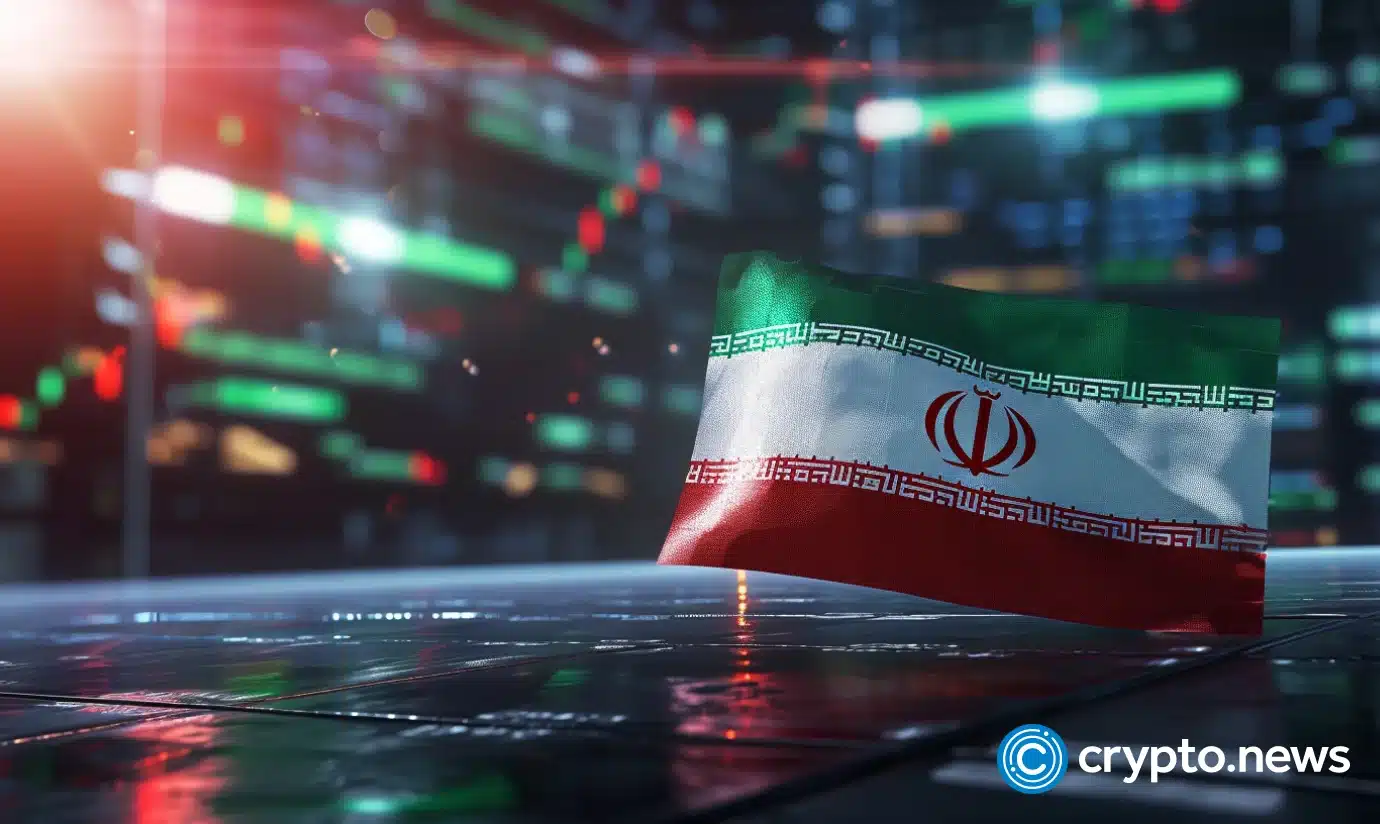
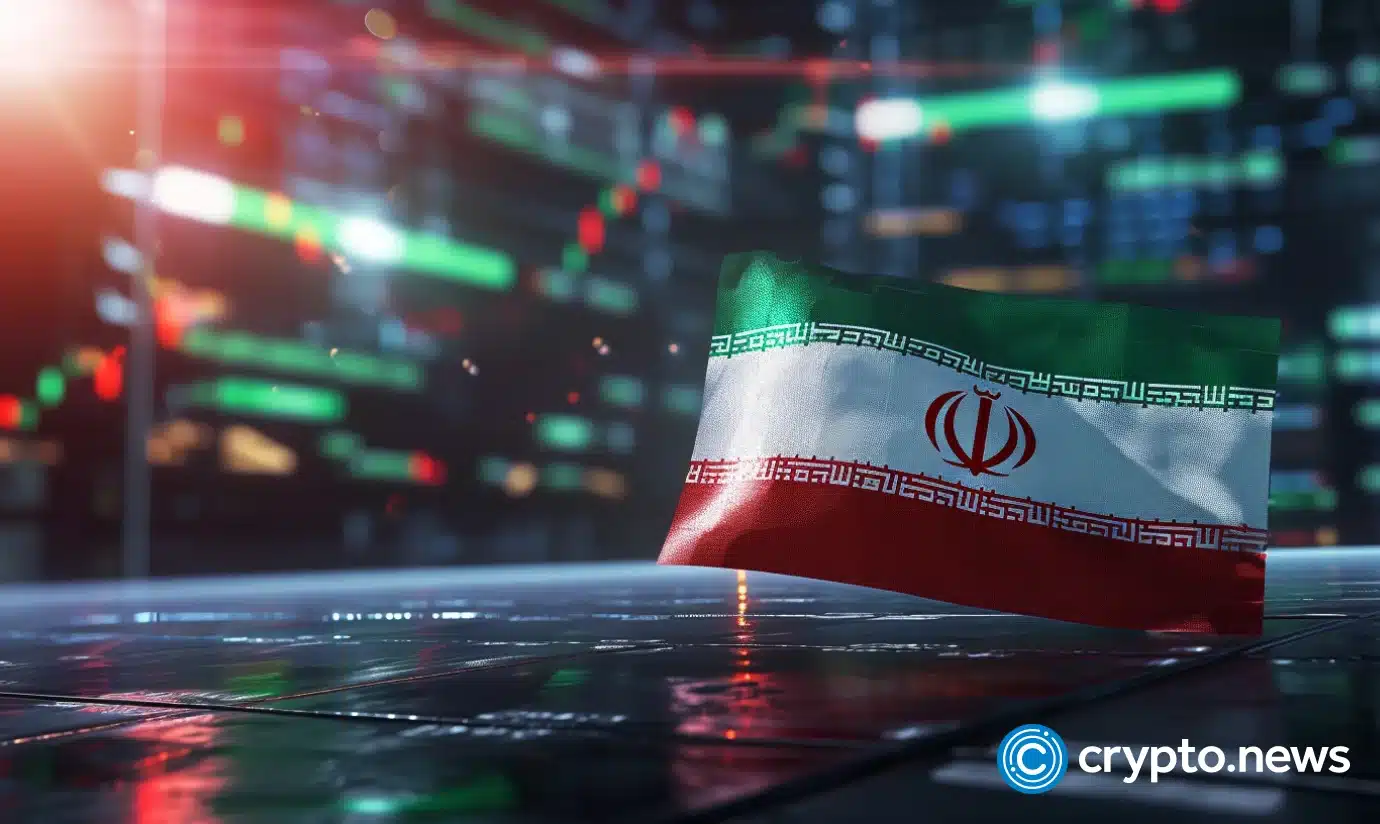
Iran war news escalated Tuesday as parliament speaker Mohammad Bagher Ghalibaf stated publicly that Tehran will not accept negotiations under conditions it considers coercive, with the 10-day US-Iran ceasefire set to expire Wednesday and both sides sharpening rhetoric ahead of prospective talks in Islamabad.
Summary
- Ghalibaf warned that Iran has spent the past two weeks preparing “new cards on the battlefield” and accused Trump of violating the ceasefire by maintaining the naval blockade and seeking Iran’s surrender.
- Iran’s foreign ministry said it has no plans for a second round of negotiations, while IRIB cited Iranian sources confirming no decision has been made to participate in Islamabad talks.
- Trump told CNBC he is “ready to go” back to war if no deal is reached and said he would not extend the ceasefire, while also saying he expects a “great deal” and that Iran has “no choice.”
Iran war news turned sharply negative Tuesday as Iranian officials delivered a unified message hours before the US negotiating team led by Vice President JD Vance was expected to arrive in Islamabad. Tehran’s position, as expressed through multiple official channels, is that it will not enter talks while the US naval blockade of its ports continues and while American officials publicly threaten expanded military strikes.
“We do not accept negotiations under the shadow of threats, and in the past two weeks, we have prepared to reveal new cards on the battlefield,” Ghalibaf wrote on X. He accused Trump of using the ceasefire period to seek Iran’s surrender rather than a genuine agreement, calling the US posture “warmongering.”
Iran’s foreign ministry spokesperson Esmaeil Baqaei confirmed at a weekly press briefing that “as of now, we have no plans for the next round of negotiation, and no decision has been made in this regard.”
Why Tehran Is Holding Its Position
The core Iranian complaint is structural. The US imposed a naval blockade of Iranian ports on the same day the ceasefire was announced, treating it as a tool of coercion rather than a genuine pause in hostilities. Iran has maintained since Sunday that continuing participation in any talks depends on the US changing its behavior, specifically lifting the blockade and stopping what Tehran describes as ceasefire violations.
Iranian President Massoud Pezeshkian separately criticized US officials for sending “unconstructive and contradictory signals,” noting that Trump publicly claimed Iran had agreed to give up its enriched uranium stockpile while Iran denied this within hours of the claim. The gap between what each side says the other agreed to is itself a structural obstacle to building the trust necessary for second-round talks.
The Hormuz Situation and What Happens at Midnight
The ceasefire expires Wednesday. The Strait of Hormuz, which Iran briefly reopened before closing again after the Touska cargo ship seizure, remains effectively closed to normal traffic. Iran sent drones toward US military ships after the Touska was boarded by US forces, signaling that its military posture remains active. The USS Gerald R. Ford carrier operates in the Mediterranean while the USS Abraham Lincoln is in the north Arabian Sea, with a third carrier group expected in the region by month’s end.
Trump told CNBC he is “ready to go” if talks fail and said he would not be rushed. He also said Iran has “no choice” but to negotiate. The contradiction between those statements and Iran’s stated refusal to talk under threat defines the standoff heading into the Wednesday deadline.
What This Means for Oil and Crypto Markets
The ceasefire hopes that lifted Bitcoin to $72,700 and pushed oil down 13% on April 8 are now at direct risk. A resumption of hostilities at midnight Wednesday would push Brent crude above $100 again and remove the macro tailwind that has supported crypto markets over the past two weeks. The oil price channel into inflation expectations, Fed rate policy, and risk asset positioning means that the outcome of Wednesday’s deadline is the single largest near-term variable for Bitcoin and the broader crypto market.
Cryptocurrency offerings are starting to influence how European investors are choosing their bank providers, but regulatory uncertainty continues to hinder mainstream adoption, according to a new survey.
A Börse Stuttgart Digital survey released Tuesday found that 35% of European investors would consider switching banks if another institution offered better cryptocurrency investment options, suggesting crypto is starting to influence how some customers choose financial providers.
Nearly one in five respondents said they expect their main bank to offer crypto access within the next three years, according to the survey, which covered about 6,000 investors in Germany, Italy, Spain and France. The findings suggest crypto is moving closer to the mainstream banking relationship, at least among investors already open to digital assets.
Still, regulations and a lack of education remain the biggest hurdles to adoption, with 76% seeing crypto assets as insufficiently regulated, while over 60% feel poorly informed about digital assets.
MiCA increased trust in digital assets for nearly half of European investors
European Union regulation appears to be helping on that front. The EU’s Markets in Crypto-Assets Regulation (MiCA) went into full effect for crypto asset service providers on Dec. 30, 2024.
Nearly half of the surveyed investors said that the MiCA framework increased their trust in digital assets, making them “safer and more attractive.”
“Trust and clear regulation are essential for the next phase of crypto adoption in Europe. With MiCAR bringing transparency and legal certainty, investors gain the clarity they expect,” said Matthias Voelkel, the CEO of Börse Stuttgart Group.
The results land as traditional financial institutions across Europe keep inching deeper into crypto. Börse Stuttgart Digital said in January 2025 that it had become the first German provider of crypto asset services to receive an EU-wide MiCA license through its custody subsidiary, positioning itself as a regulated infrastructure provider for banks, brokers and asset managers.
Related: Deutsche Börse invests $200 million in Kraken parent Payward
Spain leads European crypto adoption
Among the surveyed countries, Spain showed the highest crypto adoption rate with nearly 28% of investors already owning digital assets. Germany was second with 25%, Italy followed with 24% and France with 23%.
Of the respondents, 25% said they had already invested in crypto, and 36% said they are likely to invest again within the next five years, showing “sustained interest despite market volatility,” according to the report.

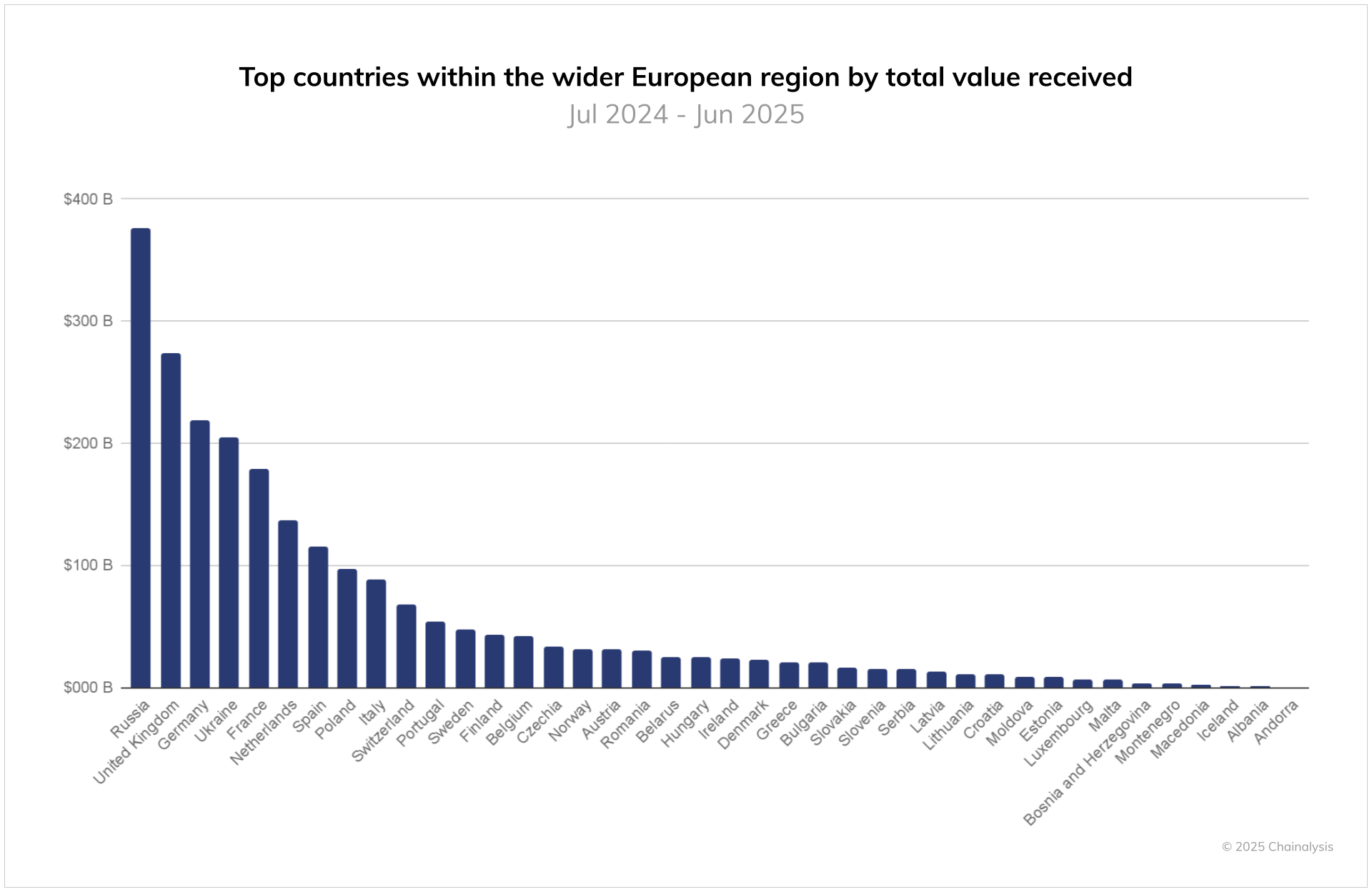
According to a Chainalysis report published in October 2025, Russia had the largest crypto market in Europe with $376 billion of value received between July 2024 and June 2025, trailed by the United Kingdom with $273 billion and Germany with $219 billion.
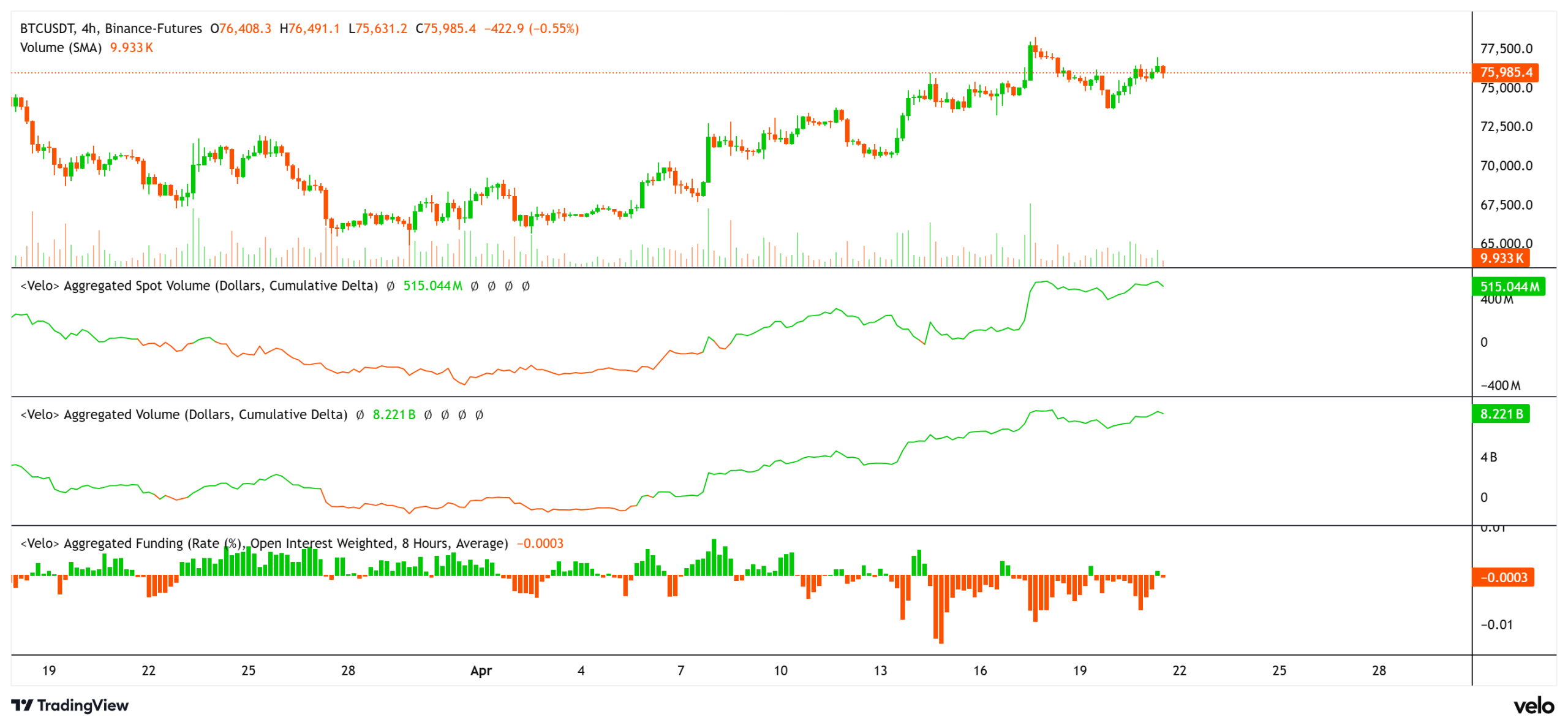
Bitcoin (BTC) rebounded above $76,000 on Tuesday, after the spot market demand on Coinbase exchange saw a second week of bullish volume trends.
Net spot buy volume has climbed sharply over the past 15 days, signaling sustained strength from bulls, but will BTC be able to turn the $75,000 level into a long-term support level?
Coinbase demand keeps spot volumes trending higher
The aggregated spot cumulative volume delta (CVD) continues to trend higher, rising to $517 million on Tuesday, up from $55 million on April 17. The broader CVD across spot and futures is above $8.5 billion, with BTC price consolidating just below $77,000 following Monday’s recovery.

The buy-side remained elevated and flat, with no clear distribution or selling over the past 24 hours. BTC has held firm while spot demand has absorbed selling pressure, keeping the upward slope in CVD intact.
The funding rates are slightly negative at -0.003%, indicating traders are still leaning bearish, which may trigger a squeeze toward the upside.
Crypto analyst Ardi noted that Coinbase activity has played a larger role in BTC’s 12% recovery in April. “Coinbase premium has been doing more of the work in this range than people realize,” Ardi said, pointing to past rallies that aligned with sustained positive premiums.

The premium, currently at 0.05, now serves as an early signal of demand strength. Ardi explained that a flattening or shift back into negative territory would point to thinning order books, which may slow down bullish price action.
Related: Bitcoin risks losing $70K as Strategy’s STRC slips below $100
Should traders expect $88,000 in May?
From a technical standpoint, Bitcoin printed a bullish engulfing candle on Monday, reversing the 2.5% dip on Sunday and signaling renewed strength. The price also moved back above the 100-day exponential moving average (EMA) after last week’s first retest of the level in more than four months.

On the higher time frame, Bitcoin continues to form higher highs and higher lows, keeping the trend intact. The focus now is on how the price behaves around $75,000, which could serve as a key inflection point.
Liquidity remains concentrated below, with about $2.8 billion in cumulative leveraged positions between $73,000 and $75,000, forming a support range. The overhead supply near $76,000 to $78,000 stands at around $1.8 billion in short leveraged positions.

MN Capital founder Michaël van de Poppe said the recent pullback aligns with a typical weekend pattern, with risk appetite returning as the markets reopened on Monday.
The analyst pointed to easing volatility and last week’s $1 billion in inflows into exchange-traded funds (ETFs) as supportive factors.
Van de Poppe added that continued strength near resistance could open the door to a move toward the $85,000 to $88,000 range in May, if broader conditions remain unchanged.

Related: VIX drops 45% in three weeks: Is Bitcoin price ready to retake $80K?
This article is produced in accordance with Cointelegraph’s Editorial Policy and is intended for informational purposes only. It does not constitute investment advice or recommendations. All investments and trades carry risk; readers are encouraged to conduct independent research before making any decisions. Cointelegraph makes no guarantees regarding the accuracy or completeness of the information presented, including forward-looking statements, and will not be liable for any loss or damage arising from reliance on this content.
Crypto World
Ethereum Price News: ETH Flashes a Bullish Setup No Holder Should Miss While Pepeto Nears Its Binance Listing
Ethereum price news on April 21 points to a setup that defines entries for the full cycle. ETH sits at $2,309 after seven straight sessions of positive spot ether ETF flows, and the daily chart carved a clean ascending triangle into today’s session per CoinSpectator. Cumulative ether ETF inflows reached a record $11.68 billion according to CoinDesk, and BlackRock’s ETHA alone holds over $6.5 billion in assets.
While the market argues whether ETH breaks $2,460 resistance or retests the $2,250 floor, more than $9.29 million has quietly moved into a presale led by the original Pepe cofounder with a Binance listing pulling closer each day, and fractions of a cent here beat any Ethereum price news print on a $280 billion asset this year.
Ether ETFs extended their inflow streak to seven straight sessions through April 20, pulling in $187 million for the strongest weekly period of 2026 per CoinDesk. That reverses three weeks of outflows and lifts cumulative flows to $11.68 billion. Morgan Stanley’s pending S-1 for a dedicated ether trust widens the institutional on-ramp further.
An unidentified whale opened a $90.9 million long on ETH at 20x leverage on April 20 per Crypto Briefing, a directional bet at a size that rarely shows up in quiet markets. Network activity jumped 41% week over week to 3.6 million daily transactions, confirming the demand underneath the chart setup.
Ethereum Price News Meets the Best Crypto to Buy: Is It ETH or Pepeto?
Pepeto: A Live Exchange With 267x Math and a Binance Listing Days Away
The current ETH outlook builds a strong case for Ethereum over the year, but every large cap token carries a hard ceiling on how fast it can move. A run from $2,309 to $3,500 is under 2x, and that stays true no matter how bullish the chart looks.
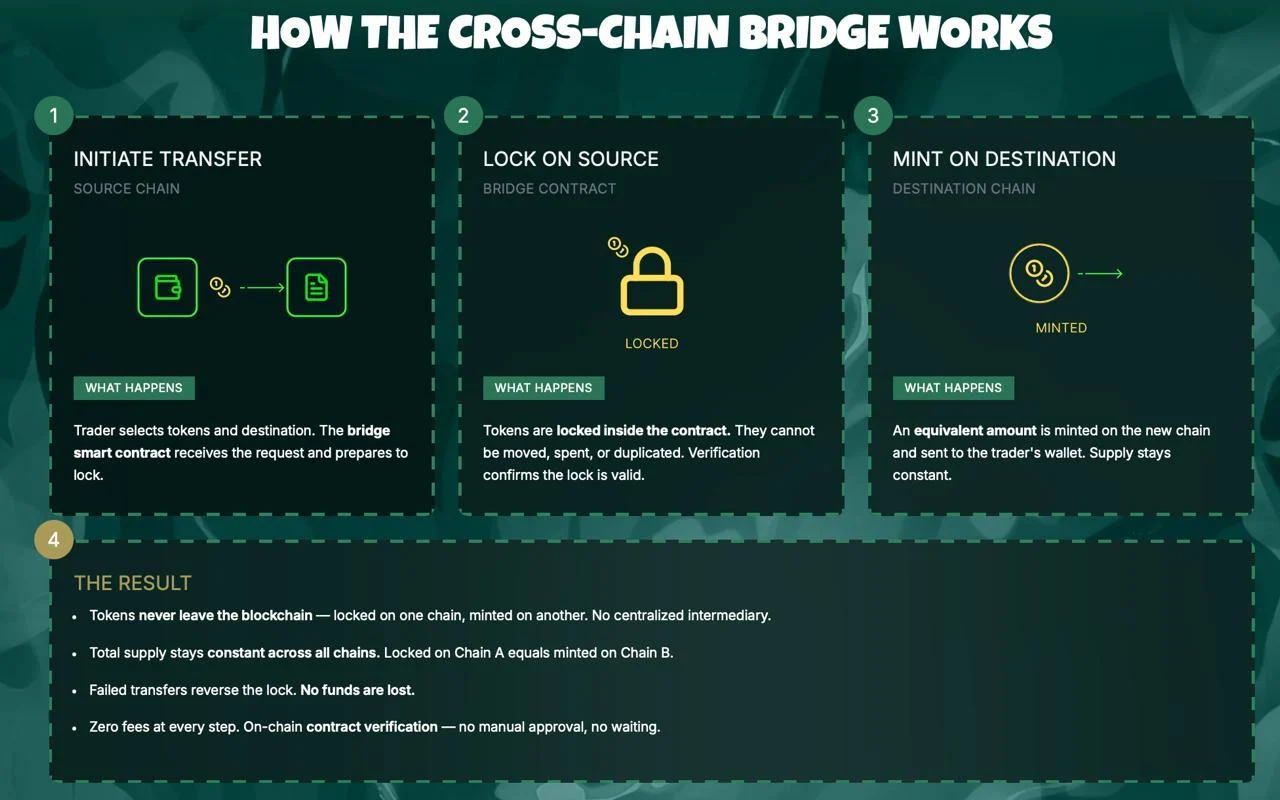
Pepeto starts from the other end of the math. The exchange is already operational inside the presale window, so every wallet that enters owns a working product from day one. Swaps across Ethereum, BNB Chain, and Solana run without a fee, and the cross network bridge carries tokens between chains without costing a single dollar.
Every feature on the platform works today rather than at some future date, and that is why traders keep naming Pepeto in the best crypto to buy conversation. The architect who shaped Pepe into an $11 billion phenomenon now runs this project alongside a senior Binance engineer. Every contract was cleared by SolidProof, and the Binance listing is confirmed.
Staking at 180% APY lets early positions compound while the window narrows. With $9.29M raised and the entry price locked at $0.0000001865, each filled round pulls the listing closer. The moment live trading opens, today’s price closes for good.
Ethereum Price at $2,309 as Key Levels Shape the April Outlook
Ethereum (ETH) trades at $2,309 on April 21 per CoinMarketCap, up 0.11% on the day after riding the Iran ceasefire rally higher. The Fear and Greed Index sits below 20, historically the zone where patient capital loads rather than sells.
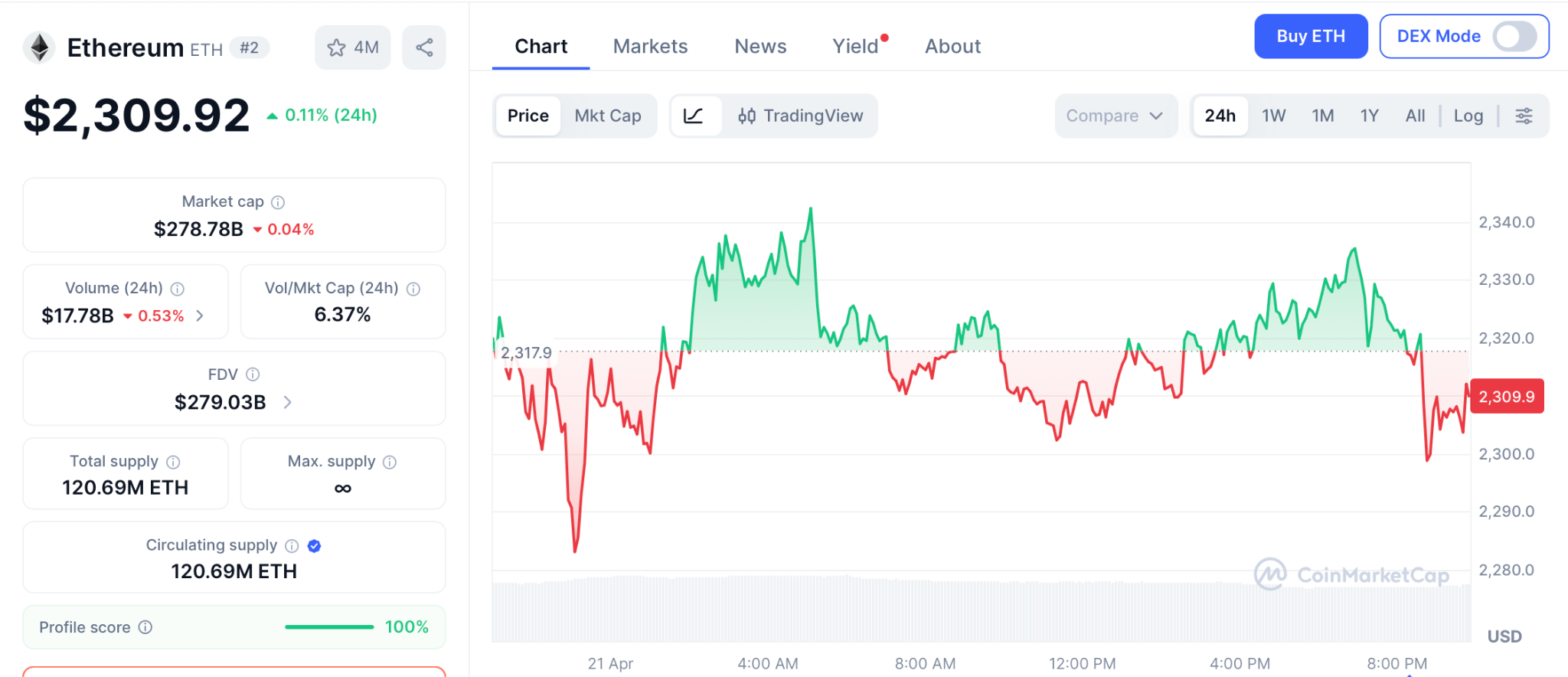
Holding $2,250 support keeps the ascending triangle thesis alive and opens a path toward $2,460 first, then $2,500 if ETF flows keep expanding. Standard Chartered still targets $7,500 on ETH for 2026, and Fundstrat models $4,500 by December. Even the $4,500 target caps returns near 95% from here, while presale entry at fractions of a cent carries a completely different multiplier above it.
Conclusion
Ethereum price news confirms ETH holding $2,309 as a seven day ETF inflow streak pulls back the curtain on the institutional demand behind the next leg, and from a $280 billion asset the upside on offer is nothing like what reshapes a wallet. That is why over $9.29 million has already entered Pepeto while fear stayed near the floor, from investors who mapped the listing outcome before the crowd noticed.
That echoes the pattern wallets that bought ETH under $1 rode in 2015, moving early and stepping into six figure bags inside one cycle.
Pepeto is where that return profile rebuilds this year with the Pepe cofounder and a locked-in Binance debut behind it. The Pepeto official website shows rounds closing fast, and every hour pulls the entry closer to gone.
Click To Visit Pepeto Website To Enter The Presale

FAQs
What does the latest Ethereum price news signal for ETH in April 2026?
Ethereum price news points to a seven day ether ETF inflow streak and a $90.9 million whale long at 20x leverage on April 20. Cumulative ether ETF inflows reached $11.68 billion with BlackRock’s ETHA holding $6.5 billion in assets per CoinDesk.
What is the best crypto to buy right now against large cap options?
Pepeto is the best crypto to buy right now because it runs a live SolidProof audited exchange with zero fee trading and a cross chain bridge built by the Pepe cofounder and a senior Binance engineer. Presale inflows sit at $9.29M at $0.0000001865 with 181% APY staking and the Binance debut locked on the calendar.
Disclaimer: This is a Press Release provided by a third party who is responsible for the content. Please conduct your own research before taking any action based on the content.

The nomination of Kevin Warsh to head the U.S. Federal Reserve intensified a long-running debate over central-bank independence as lawmakers grilled him about his financial disclosures and potential conflicts of interest. With Jerome Powell’s term as chair nearing its end, the confirmation hearing before the Senate Banking Committee became a focal point for questions about political influence, transparency, and how a future Fed chief would navigate a charged policy environment.
Warsh, a former Federal Reserve governor, faced pointed scrutiny from Democrats who argued that his financial holdings and ties could color monetary policy and risk management. The proceedings highlighted the broader challenge of balancing independence with accountability in a political era where presidential influence over the Fed remains a live concern for lawmakers and market participants alike.
Key takeaways
- Democrats pressed Warsh on his financial disclosures and potential conflicts of interest, raising concerns about the Fed’s insulation from political pressure.
- Warsh pledged to divest from personal holdings, including crypto and AI investments, before taking the oath if confirmed, signaling an attempt to address perceived conflicts.
- Crypto was explicitly discussed: Wyoming Senator Cynthia Lummis asked for clarity on digital assets, and Warsh described crypto as part of the U.S. financial services landscape.
- Republican and Democratic lines of questioning underscored disagreement over the Fed’s future policy stance, including the prospect of rate cuts urged by the president, though Warsh denied committing to any specific rate path.
Independence under scrutiny: the political dynamic of a Warsh nomination
As Powell’s term approaches its expiry next month, the Senate Banking Committee is tasked with evaluating whether Warsh can lead the U.S. central bank with sufficient autonomy. The exchange revealed a fundamental tension at the heart of the nomination: how to preserve the Fed’s dual mandate—maximum employment and stable prices—while acknowledging the political realities of the executive branch’s influence over presidential policy priorities.
Committee Chair Tim Scott acknowledged the need for a balance between independence and collaboration among the administration, Congress, and the Fed. In a CNBC interview cited by lawmakers, Scott stressed that independence means the Fed must perform its duties without being swayed by political pressures, particularly regarding the institution’s mandate. The debate thus shifted from personal biography to institutional trust: could Warsh be trusted to chart a prudent course even if the White House’s policy preferences diverge from market expectations?
Massachusetts Senator Elizabeth Warren, the committee’s ranking member, did not mince words. She labeled Warsh a potential “sock puppet” for the president’s policies, arguing that confirmation could pave the way for controversial arrangements or preferential treatment in the financial system. Warren warned that such a scenario might include “special accounts” or targeted supports that would undermine the Fed’s credibility. The tenor of her questions underscored a broader concern among lawmakers: that central-bank independence must be safeguarded to avoid entanglements with political favoritism or industry bailouts.
Warsh acknowledged the gravity of the independence issue but avoided direct answers about hypothetical policy outcomes tied to political pressure. When pressed about whether Trump’s influence could shape rate decisions, Warsh told Republican Senator John Kennedy that the president had never asked him to commit to a specific interest rate and that he would not have agreed to do so if asked—though he also noted that the question of influence remains more about guarding against perceived bias than about any single exchange. The exchange reflected the delicate calibration required of a Fed chair who may operate in a politically charged environment while maintaining a clear-eyed focus on monetary stability.
Crypto, conflicts of interest, and the broader policy backdrop
Crypto surfaced as a concrete touchstone in the hearing. Wyoming Senator Cynthia Lummis asked Warsh for his view on digital assets, and he responded that digital assets are “part of the fabric of our financial services industry in the United States.” The moment underscored the gravity of crypto’s regulatory and financial integration, and how a new Fed chair might weigh macro policy considerations alongside evolving digital-asset dynamics.
Warsh has pledged to divest from his personal financial holdings, including stakes in crypto and AI-related companies, before taking the oath if confirmed. Supporters argue that divestiture would reduce potential conflicts and bolster confidence in the Fed’s impartiality. Critics, however, point out that even divestment does not fully erase the perception of influence, especially given the scale and variety of assets that a policymaker may encounter in a complex financial system.
The hearing also touched on the broader political atmosphere surrounding the Fed. Trump’s repeated calls for rate cuts and leadership changes have kept the independence debate in the public eye. The Hill has reported that Trump signaled a preference for a rate-cutting stance, which intensifies the relevance of the next chair’s approach to policy. Warsh’s insistence on not tying policy to presidential expectations framed him as a candidate who could, in theory, maintain a degree of policy insulation—if confirmed.
What the markets are pricing in—and what comes next
Powell’s chair term concludes on May 15, leaving a short window for confirmation. If Warsh is not confirmed promptly, Powell might continue temporarily, while Warsh would assume a seat on the Fed’s Board of Governors through 2028 regardless of the outcome. The timing matters not just for policy direction but for the consistency and credibility of the Fed’s forward guidance during a period of elevated market scrutiny over inflation and growth trajectories.
Investors and traders are watching the process closely. Prediction markets have reflected a split in expectations about when a confirmation will occur. On Polymarket, a notable portion of positions bet that Warsh would be confirmed by May 15, but the majority anticipate that a decision may slip beyond June 30. The contrast between these views highlights the variance in perceptions about Senate pace, the likelihood of bipartisan support, and the political sensitivity surrounding a central-bank chair appointment in an election-year environment.
Beyond the chair itself, the dynamic surrounding the Fed’s independence could ripple through markets. A confirmed Warsh might be seen as signaling a commitment to a data-driven, financially prudent approach that could influence risk pricing, quantitative easing expectations, and balance-sheet normalization—especially if his prior records and forthcoming disclosures are interpreted as indicating a measured stance on inflation and growth. By contrast, a protracted confirmation or a transition that keeps Powell in a caretaker role could prolong uncertainty about the Fed’s leadership and its policy trajectory during a volatile macro period.
Next steps and what to watch
As the confirmation process unfolds, the central questions remain: Will Warsh successfully divest from his holdings in time to eliminate real or perceived conflicts? Can the Senate forge a path to confirm a candidate whose independence is under active scrutiny, while ensuring that the Fed remains aligned with its statutory mandate? And how will the markets interpret any shift in the Fed’s leadership, especially if market expectations about rate adjustments or balance-sheet policy diverge from the new chair’s stance?
In the near term, investors should monitor the timeline for the confirmation vote, any additional disclosures from Warsh, and further congressional remarks that clarify how the next Fed chair would balance independence with accountability. The outcome will shape how the Fed communicates its policy outlook, how it manages potential political pressures, and how it integrates the fast-evolving landscape of digital assets into its regulatory and monetary framework.
Readers should stay alert for updates on the confirmation vote schedule, new testimony or filing disclosures, and any shifts in the Fed’s messaging that could signal a new steadiness—or renewed tension—in U.S. monetary policy during a period of macro volatility.

Kalshi, the U.S.-based prediction-market operator regulated by the Commodity Futures Trading Commission (CFTC), is reportedly plotting a bold pivot into crypto trading by introducing perpetual futures for digital assets, starting with Bitcoin.
In a Tuesday report, The Information cited people familiar with the matter as saying Kalshi intends to roll out perpetual futures, or “perps,” on cryptocurrencies such as Bitcoin, broadening its product slate beyond binary event contracts.
Perpetual futures are a type of derivative that lets traders speculate on price moves without an expiration date. Unlike traditional futures that require rolling over positions, perps offer continuous exposure and are commonly paired with leverage — a structure that gained prominence in crypto markets through platforms such as BitMEX.
Kalshi’s contemplated expansion signals a shift toward continuous financial markets and could widen appeal for both retail and institutional traders seeking regulated onshore access to crypto derivatives.
Kalshi operates under U.S. regulation by the CFTC, a distinction that could position it as a compliant alternative to offshore crypto-derivatives venues. Regulators have signaled openness to bringing more trading volume onshore; CFTC Chair Michael Selig has indicated these products could become available in the United States in the near future.
Related: Onchain real-world perps surge, while altcoins drag on: Report
Key takeaways
- Kalshi reportedly plans to launch perpetual futures on cryptocurrencies, starting with Bitcoin, signaling a move from binary event contracts to continuous markets.
- The Information cites unnamed sources; the product would mark Kalshi’s first major expansion into crypto trading while leveraging its CFTC-regulated status.
- U.S. regulators have signaled a potential onshore path for crypto derivatives, with CFTC Chair Michael Selig suggesting these products could become available in the near term.
- The rise of perpetual futures is intensifying competition among platforms seeking non-U.S. access; major players are expanding into non-U.S. markets with stock- and crypto-linked perps.
- Industry data from DeFiLlama shows daily perp volumes near $20 billion on busy days, underscoring sustained demand despite broader crypto volatility.
Regulatory on-ramp and market dynamics
Kalshi’s possible crypto-perps launch would deepen ties between regulated U.S. markets and the fast-moving crypto derivatives space. By staying within the boundaries of the CFTC framework, Kalshi could offer an onshore alternative to offshore venues that have dominated crypto leverage and liquidity. The statements from CFTC Chair Michael Selig add to a regulatory narrative that seeks to bring more trading activity onto U.S. soil, a development investors and traders are watching closely for its potential to shift liquidity and risk management practices.
As perimeters of onshore crypto derivatives remain under discussion, Kalshi’s move could provide a test case for how a regulated, event-grounded platform might translate to continuous-price contracts. If realized, the product would complement Kalshi’s existing suite and potentially broaden its appeal beyond consumers who seek event-based bets to those looking for ongoing exposure to crypto prices.
Perps race expands beyond crypto to broader markets
The reported Kalshi pivot arrives amid a broader wave of attempts to offer perpetual-style instruments to non-U.S. audiences. Coinbase has begun offering round-the-clock perpetual-style futures tied to equities for non-U.S. traders, expanding beyond its traditional crypto-derivatives offerings and highlighting demand for around-the-clock exposure to traditional assets outside the United States.
Kraken has also pushed into tokenized stock perpetual futures for users outside the United States, giving traders exposure to major U.S. stock indices, precious metals, and individual equities via perpetual contracts. This reflects a growing appetite among crypto and traditional trading venues to cater to global audiences with perpetual formats that do not require contract renewal.
Market data corroborates ongoing interest in perpetual products. DeFiLlama’s latest figures show that daily perpetual futures volumes sit around $20 billion on peak days, roughly half of historical highs, but still point to meaningful liquidity and participation in perpetual markets across asset classes.
Taken together, the developments paint a picture of regulators nudging onshore participation higher while a competitive landscape accelerates the adoption of perpetual derivatives across crypto and traditional assets. Kalshi’s potential crypto-perps launch would be a notable milestone in that evolving dynamics, testing how a U.S.-regulated platform can compete in a market historically dominated by offshore operators.
Investors and users should watch closely for any formal confirmation from Kalshi and for regulatory updates that could clarify the timeline and design of onshore crypto perpetuals. The outcome could influence liquidity, product design, and the broader cadence of regulated crypto derivatives in the United States.

South Korea’s National Tax Service (NTS) has issued a government tender for software licenses intended to track virtual asset transactions as part of an amplified push to enforce tax compliance within the crypto market. The procurement notice describes the contract as providing “virtual asset tax evasion response transaction-tracking software licenses” with a defined budget and an accelerated delivery timeline, signaling a concrete step in the country’s broader enforcement agenda.
The contract is priced at 146.5 million won, inclusive of value-added tax, with delivery required within 30 days of contract signing. Bids are due April 28–30, and the proposal evaluation is scheduled for May 7, a tightly sequenced procurement process that underscores the government’s emphasis on rapid deployment of analytic capabilities.
The procurement notice provides limited technical detail. However, ZDNet Korea, citing an official from the NTS scientific investigation unit, reported that the software would enable real-time monitoring of crypto transactions, visualization of transfers across specific wallet addresses and exchanges, and support for investigations into hidden assets, offshore tax evasion, and unreported inheritance or gift transfers.
The tender follows earlier local reporting that South Korea was preparing an AI-based crypto monitoring system in advance of a planned 2027 tax rollout. The Korea Times reported on March 12 that the NTS opened a bid for an AI-backed system to analyze crypto transaction data, marking a broader push toward data-driven enforcement. Cointelegraph also has covered related developments indicating a government emphasis on scalable analytics to monitor digital-asset activity ahead of tax policy changes.
Key takeaways
- The NTS has launched a procurement for transaction-tracking software aimed at detecting crypto-related tax evasion, with a fixed budget and a tightly scheduled delivery timeline.
- Reported functionality centers on real-time surveillance of transactions, visualization of asset flows between addresses and exchanges, and support for investigations into hidden holdings and cross-border evasion schemes.
- The initiative aligns with South Korea’s broader policy trajectory toward a 2027 crypto tax regime, which would tax gains above 2.5 million won at an all-in rate of about 22% (20% income tax plus a 2% local tax).
- Regulatory and political dynamics remain unsettled, as opposition parties have proposed scrapping the crypto-tax plan, introducing policy risk that could influence enforcement funding and project timelines.
- For financial institutions and crypto service providers, the development signals increasing emphasis on data analytics, AML/KYC integration, and cross-agency information sharing within a tightening domestic compliance landscape.
Transactional tracking and enforcement: what the tender reveals
The NTS tender illustrates a concrete push to operationalize transaction visibility across the crypto ecosystem. By seeking software capable of linking transfers to specific wallets and exchanges in real time, the agency appears to be prioritizing end-to-end visibility that could feed into audits, asset tracing, and potential asset-recovery efforts in cases of suspected evasion or misreporting. The emphasis on “virtual asset tax evasion response” suggests an emphasis not only on data collection but on actionable analytics that can support enforcement actions.
From an implementation standpoint, the 30-day delivery window emphasizes a rapid deployment approach, likely favoring systems with modular components, scalable data ingestion, and built-in visualization dashboards. For market participants, the tender underscores the importance of robust data governance, interoperability with existing tax and reporting systems, and clear pathways for regulatory data requests. While the notice lacks granular technical specifications, the reporting around it points to a capability set that aligns with real-time analytics rather than retrospective audits alone.
Regulatory trajectory: crypto taxation and enforcement context
South Korea has signaled a continuing escalation in enforcement capacity as the 2027 crypto tax regime approaches. Under the planned framework, gains in cryptocurrency trading above a 2.5 million won threshold would be taxed at a combined rate of roughly 22%, comprising 20% income tax and a 2% local tax. This policy design intends to tax crypto-derived gains more comprehensively and align them with traditional income taxation structures.
Political dynamics surrounding the tax plan are material to its execution. On March 19, the main opposition People Power Party proposed scrapping the crypto gains tax, citing concerns about fairness, potential double taxation, and enforcement feasibility. The policy debate will shape not only the timing of implementation but also the level of funding and the scope of regulatory tools available to agencies such as the NTS.
The Korea Times’ March 12 coverage aligns with a broader narrative of authorities seeking to process increasing volumes of crypto data to support taxation and enforcement. The convergence of AI-driven monitoring initiatives with formal tax policy illustrates a policy environment where technical capabilities and statutory requirements are being developed in tandem. In the international context, Korea’s approach reflects a global trend toward enhanced visibility into crypto flows, albeit with jurisdiction-specific design choices. For observers, the critical questions revolve around how the expected technology will integrate with existing AML/KYC frameworks, how data privacy will be safeguarded, and how cross-border data-sharing arrangements will be regulated.
Implications for institutions and compliance programs
The tender underscores a shift toward centralized, analytics-driven enforcement within Korea’s financial ecosystem. Exchanges, custodians, banks, and other participants operating in or with domestic markets should anticipate increased scrutiny of on-chain activity and tighter reporting obligations. Practical implications include the need to strengthen real-time monitoring capabilities, establish robust data-sharing protocols with tax and regulatory authorities, and ensure that data governance and privacy considerations keep pace with evolving regulatory expectations.
From a compliance perspective, the development elevates the importance of integrating on-chain analytics with traditional KYC/AML programs. Firms may need to adapt to more granular data requests and more comprehensive transaction trees that map flows across wallets and exchanges. As regulatory guidance continues to evolve, institutions should monitor licensing trajectories, data localization requirements, and potential cross-border cooperation frameworks that could shape how crypto-related information is accessed and used in enforcement contexts. The Korean experience also contributes to a broader, policy-led discussion about how MiCA-like principles, where applicable, interact with domestic tax administration and financial supervision regimes.
Closing perspective
South Korea’s move to procure advanced transaction-tracking software for crypto activity highlights the increasing convergence of tax policy, enforcement technology, and financial-market supervision. As the 2027 crypto tax regime looms, market participants and compliance teams should watch for tender outcomes, regulatory clarifications, and any shifts in enforcement posture that could affect reporting standards, data-sharing practices, and risk management frameworks across the digital-asset sector.
Crypto World
Ethereum Price Prediction Eyes $2,600 Breakout While AlphaPepe Turns ETH Setup Into 100x Buzz
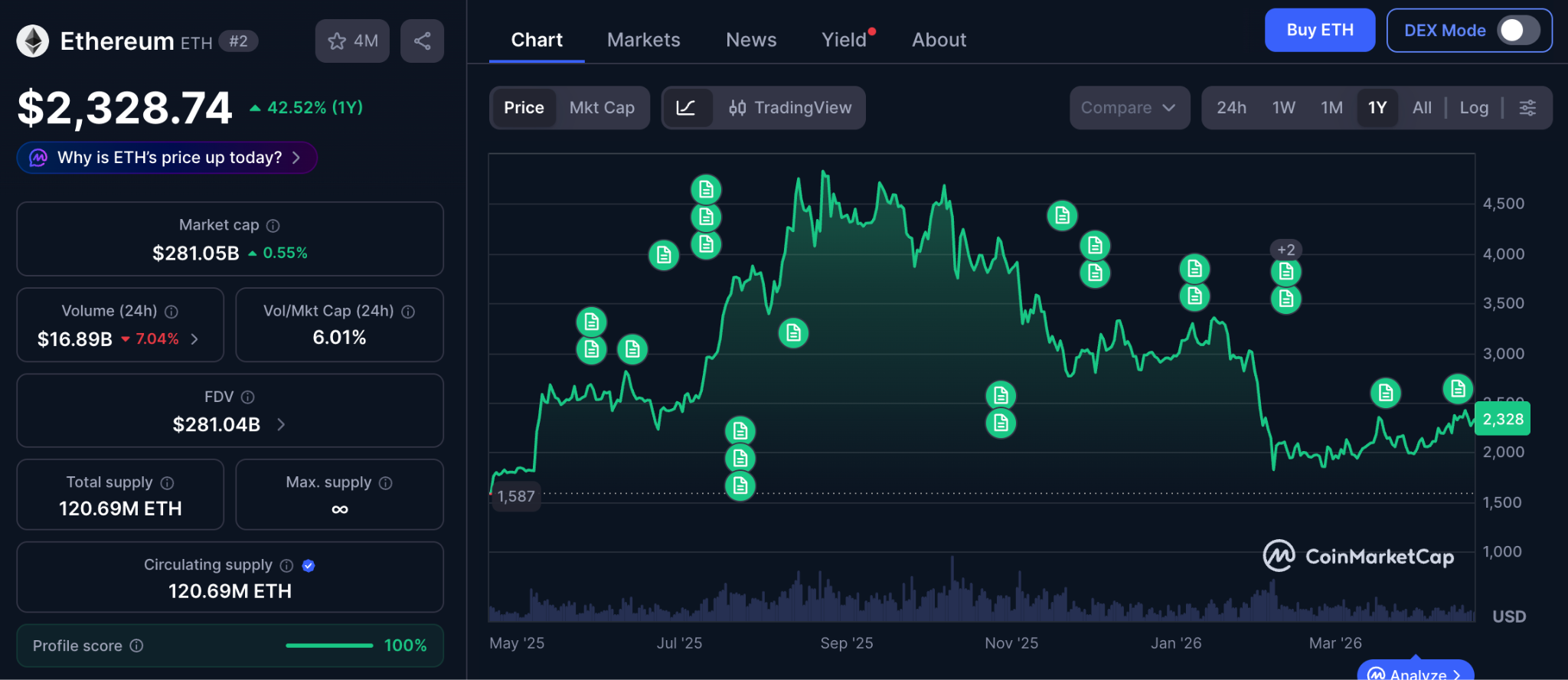
Ethereum price prediction is back in focus as traders watch whether ETH can push toward the $2,600 breakout zone. Ethereum remains one of the clearest large-cap signals for risk appetite across crypto. When ETH stabilizes, capital often starts looking beyond safer names and into earlier opportunities with stronger upside.
That is where AlphaPepe enters the picture. While Ethereum gives traders the large-cap setup, AlphaPepe gives early buyers a pre-listing setup before public trading begins. The project is now in Stage 14 at $0.01524, with more than $920,000 raised and over 7,900 holders positioned ahead of the planned exchange debut.
Ethereum Price Prediction Gets a Boost as Market Confidence Returns
Ethereum remains one of the most important signals for the wider altcoin market. When ETH holds support and pushes toward a breakout zone, retail confidence usually starts to rebuild. That is why the $2,600 Ethereum price prediction matters. It is not only about one token reaching one target. It is about whether the market is ready to rotate back into higher-risk opportunities.
The case for Ethereum is still built around DeFi, staking, stablecoin settlement, tokenization, and institutional crypto exposure. ETH remains the main altcoin benchmark, and any sustained move higher can quickly shift sentiment across smaller assets.
That is the same environment where presales start to attract attention again. Ethereum gives the signal. Pre-listing opportunities give buyers the chance to move before the crowd.
The Ethereum Setup, AlphaPepe Presale, and What This Rotation Changes
Ethereum reaching toward $2,600 would be bullish, but it also reminds buyers of the difference between large-cap upside and presale upside. ETH can still move, but it is already a major asset with deep liquidity and a large market cap.
AlphaPepe is building into that rotation with Stage 14 live at $0.01524. The presale has raised more than $920,000 and passed 7,900 holders, giving it visible momentum before public trading begins. The current entry still exists before the exchange market sets its own price.
The ALPHA30 promo code is also active for buyers entering with $1,000 or more, giving a 30% token bonus during the current window. That adds another timing trigger while the project remains in presale.
AlphaPepe Brings Live Utility Into a Meme Coin Presale
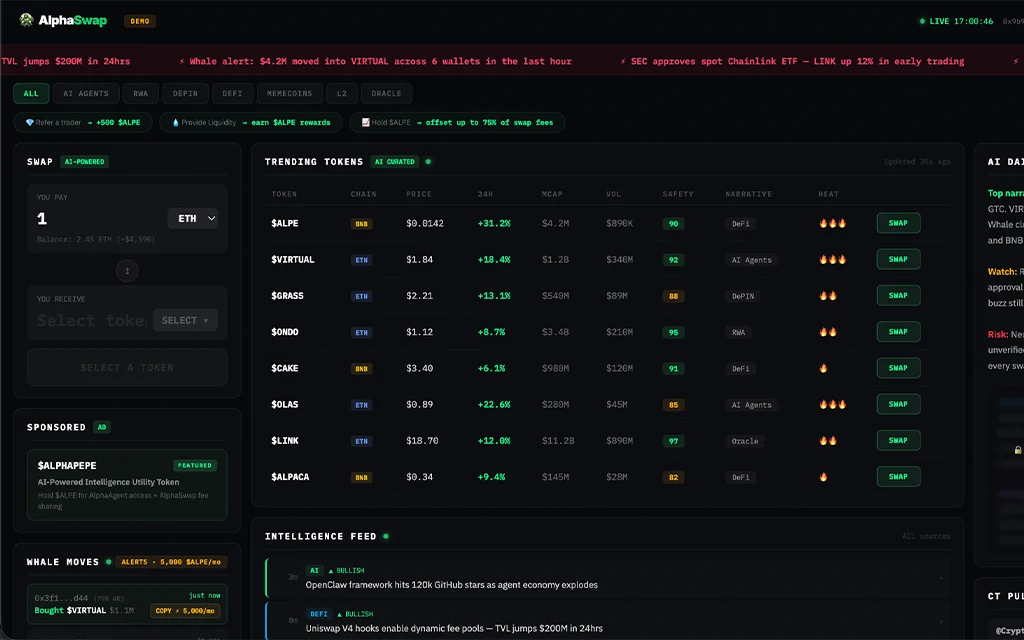
Most meme presales sell a roadmap first and build later. AlphaPepe is trying to flip that script with AlphaSwap, its AI-powered decentralized exchange already live before listing. That gives the project a working-product angle while many presales still rely only on future promises.
AlphaSwap supports cross-chain swaps and AI-driven contract screening, helping users check tokens before trading. AlphaPepe has also completed a 10/10 BlockSAFU audit, giving buyers another confidence signal before open-market trading. Combined with the growing holder base and rising presale total, AlphaPepe is not waiting until after listing to show traction.
Ethereum Price Prediction: Is $2,600 Possible?
Ethereum reaching $2,600 is possible if ETH holds its recovery structure and market confidence continues to improve. A breakout would likely confirm stronger appetite for altcoins, especially if Bitcoin remains stable and liquidity moves back into higher-risk crypto assets.
But there is a limit to large-cap math. Even a strong Ethereum move toward $2,600 is still measured in percentages. Retail buyers often look for earlier entries where the market has not priced in the full opportunity yet.
That is why the Ethereum price prediction connects directly to AlphaPepe. ETH can show that the market is ready. AlphaPepe gives buyers a pre-listing position before that same attention rotates into smaller names.
AlphaPepe 100x Buzz Builds Before Exchange Debut
The 100x buzz around AlphaPepe comes from the same retail logic that has driven past presale runs: low entry, fixed stage pricing, growing holder count, rising raise total, and a listing event still ahead. None of that guarantees a future outcome, but it creates the setup retail buyers look for before a token becomes widely available.
AlphaPepe’s current stage gives buyers the part of the cycle that later traders cannot access once listing begins. The presale price exists now. The exchange price comes later. The opportunity comes from the gap between those two moments.
As Ethereum price prediction targets $2,600, the market is splitting into two groups. One is watching large caps recover. The other is using that recovery as the signal to enter earlier plays before the next repricing event.
Click To Visit The AlphaPepe Official Website
FAQs
What is the current Ethereum price prediction?
The current Ethereum price prediction is focused on whether ETH can break toward $2,600 as confidence returns and traders rotate back into altcoins.
Why are Ethereum traders watching AlphaPepe?
Ethereum gives the market signal, but AlphaPepe gives buyers a pre-listing entry before exchange trading begins.
What makes AlphaPepe different from other meme coin presales?
AlphaPepe already has AlphaSwap live before listing, AI contract screening, cross-chain swap utility, over 7,900 holders, more than $920,000 raised, and a 10/10 BlockSAFU audit.
Disclaimer: This is a Press Release provided by a third party who is responsible for the content. Please conduct your own research before taking any action based on the content.
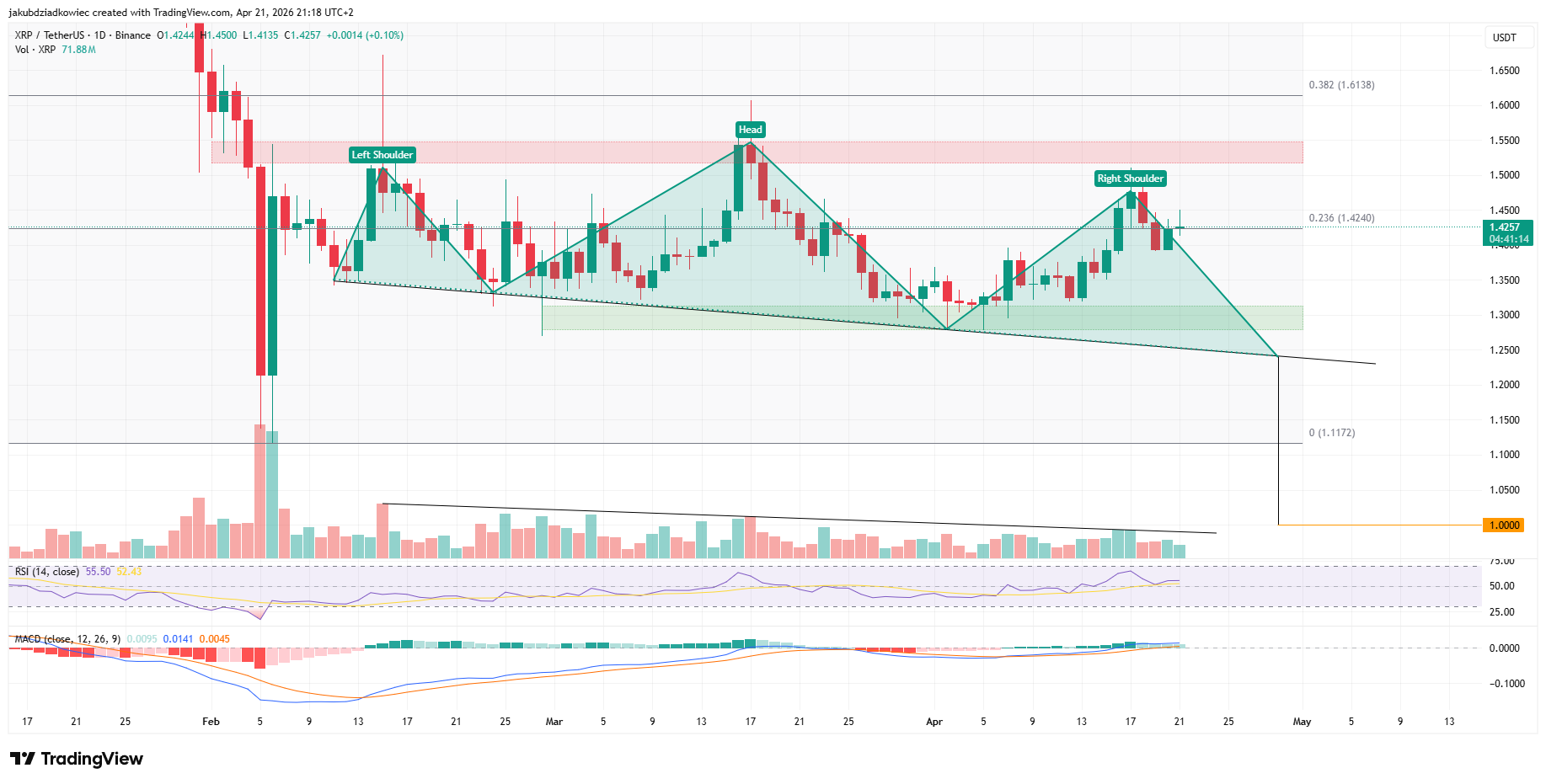
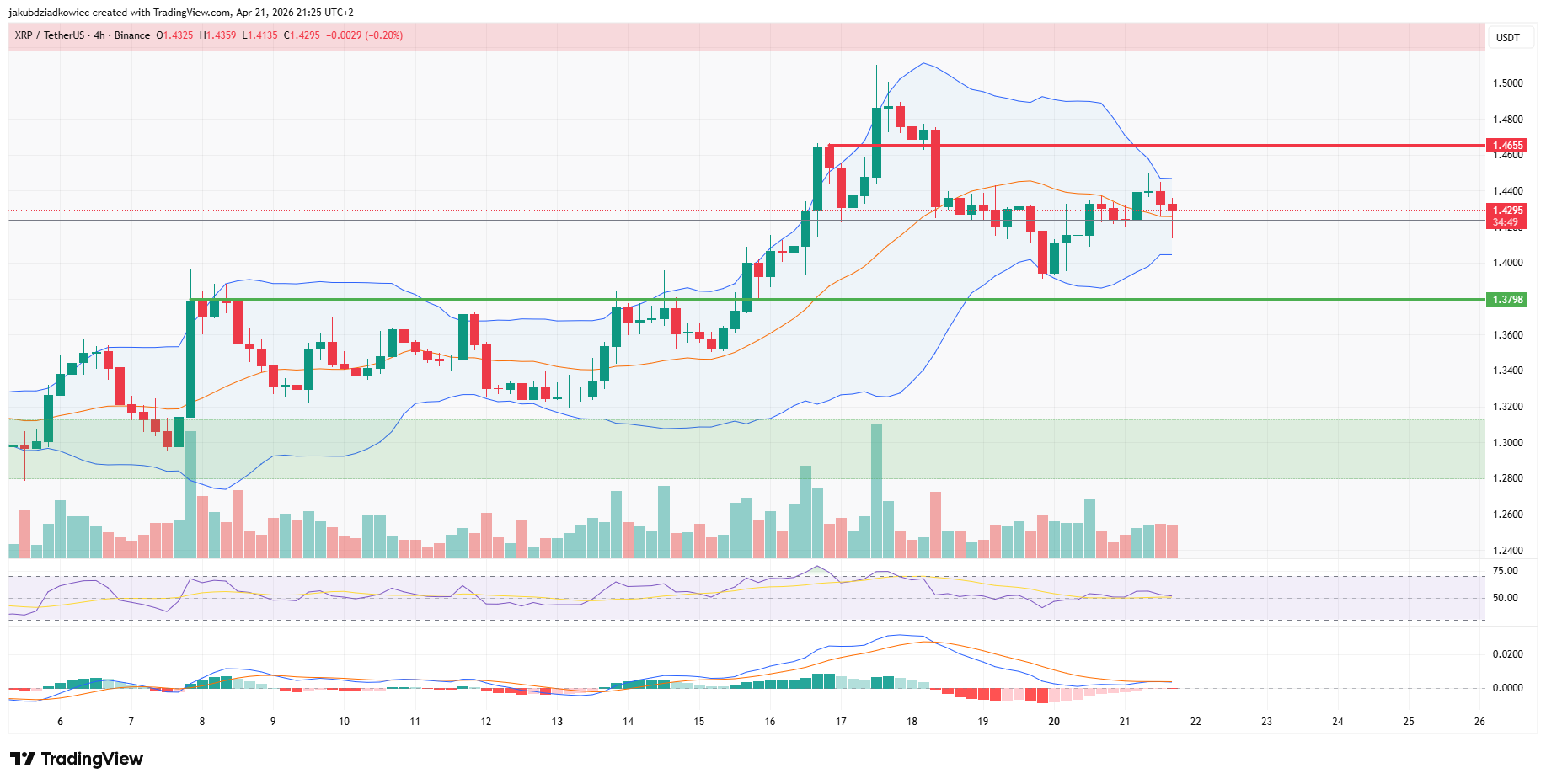
XRP trades near $1.42 on April 21 as a tightening 4-hour structure collides with a developing head-and-shoulders pattern on the daily chart, pointing toward $1.00.
Short-term accumulation signals suggest buyers still have a narrow window to defend $1.44, yet the larger daily structure remains the dominant threat to XRP price stability.
Daily Head and Shoulders Pattern Points XRP Toward $1.00
The daily chart tells a heavy story. Measuring candle closes rather than wicks, XRP has printed a textbook head and shoulders pattern. The left shoulder formed on February 15, the head on March 17, and the right shoulder on April 17, with the neckline running through the $1.28 to $1.31 support zone.
Daily volume has been declining through the right-shoulder formation, the classic confirmation profile for the setup. A confirmed daily close below $1.28 would activate a measured move toward $1.00, with $1.25 acting as the first interim stop.
On the bullish side, the 14-day RSI is recovering in the neutral zone after rejecting a peak of 65 in March, while the MACD histogram remains positive, though momentum is fading.
A decisive daily close above the $1.51 to $1.55 resistance box would invalidate the head and shoulders and reopen a push toward the 0.382 Fibonacci level at $1.61.
Seven spot XRP ETF applications now sit in final SEC review, with Q2 2026 decisions expected. Any early approval or surprise catalyst could override the bearish pattern entirely.
For now, XRP bulls must first reclaim the $1.51 to $1.55 zone to neutralize the risk of a $1.00 retest.
XRP 4-Hour Chart Shows Accumulation After Volatility Spike
The 4-hour XRP chart shows Bollinger Bands tightening after the recent expansion phase that drove price to $1.48. Following the pullback, XRP is trading at $1.43 and compressing against the middle band.
Volume has been steadily descending through the consolidation, a textbook accumulation signal. The Relative Strength Index (RSI) reads near 50, while the Moving Average Convergence Divergence (MACD) sits neutral after a mild bearish cross.
The key short-term levels are clear. Support holds at $1.38, while the first overhead barrier rests at $1.46. A 4-hour candle close above $1.46 would reopen the door toward the $1.50 region and flip near-term bias back to buyers.
Crypto Tony Flags $1.44 as Trend Pivot for XRP Bulls
The one-hour chart from trader Crypto Tony highlights $1.44 as the essential level for XRP to reclaim before any continuation higher. That price sits just above spot and marks the upper edge of the current intraday range.
XRP has repeatedly tested $1.44 from below but failed to print a decisive hourly close above it. Failure at this pivot keeps the bounce from $1.39 in play as a short-covering move rather than a sustained consolidation leg.
The $1.44 level also aligns with the cost basis of roughly 60% of the circulating supply, according to on-chain data, which explains why every recent rally has been sold into.
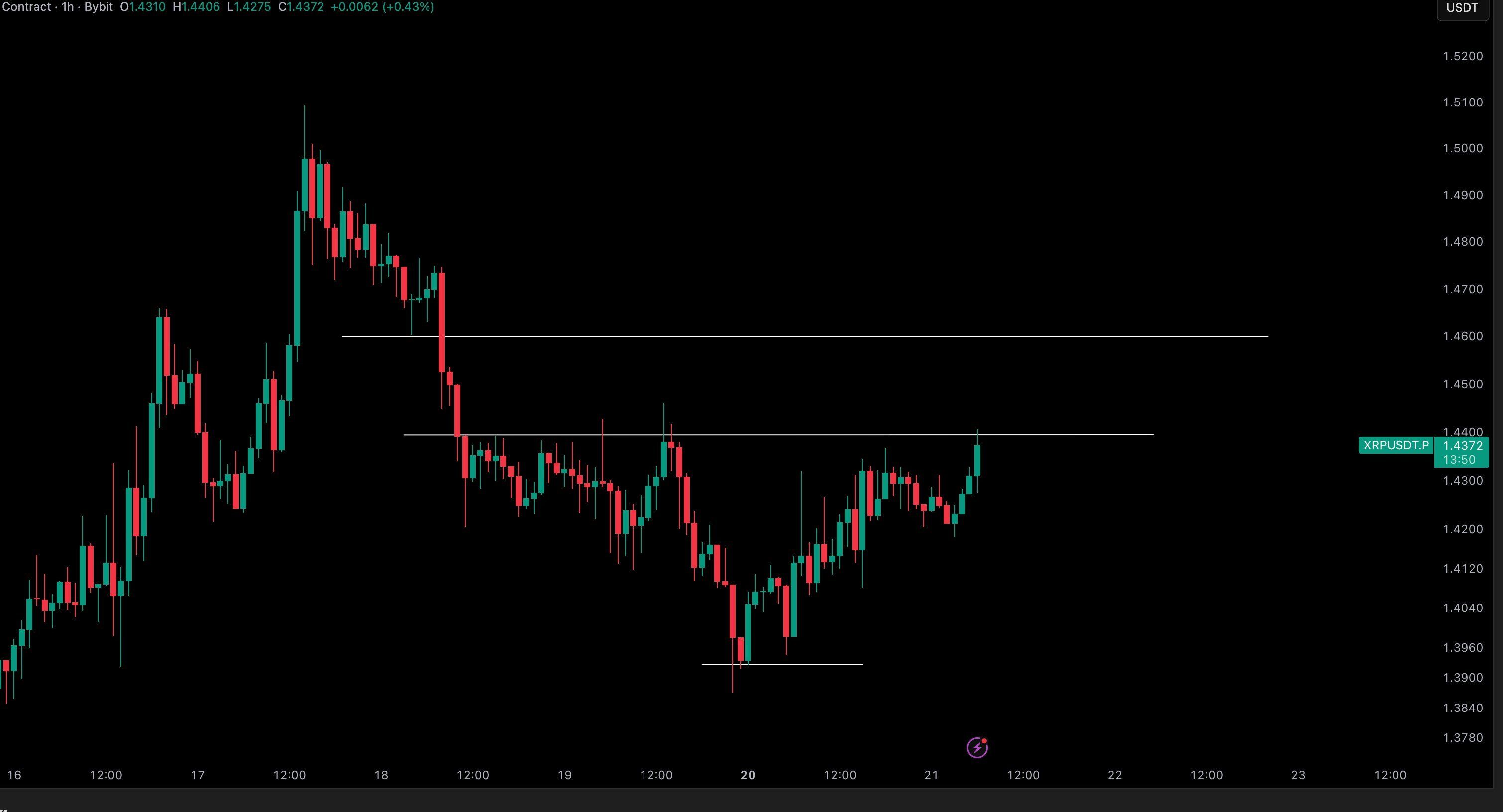
A clean hourly close above $1.44 would align with the 4-hour breakout thesis and bring $1.46 into immediate focus. A rejection leaves XRP vulnerable to another retest of $1.39, especially with the dominant daily pattern still in play.
The post XRP Technical Charts Show Potential Drop to a Dollar appeared first on BeInCrypto.

Liam Rosenior tears into Chelsea players as club hit ‘indefensible’ 114-year low in Premier League – reaction

5 unmissable Michael Jackson documentaries you need to stream before watching the late singer’s new movie biopic Michael

I’m a Celebrity’s Ant and Dec make huge U-turn as Adam Thomas sobs over ‘unfair’ twist

Manchester United reach agreement with Casemiro over contract clause amid transfer speculation

Steven Gerrard disagrees with Gary Neville over ‘shock’ Chelsea and Arsenal claim | Football

US brings back mandatory military draft registration


-

 News Videos7 days ago
Secure crypto trading starts with an FIU-registered
-

 Fashion4 days ago
Weekend Open Thread: Theodora Dress
-

 Politics4 days ago
Palestine barred from entering Canada for FIFA Congress
-

 Sports5 days ago
NWFL Suspends Two Players Over Post-Match Clash in Ado-Ekiti
-
Entertainment2 days ago
NBA Analyst Charles Barkley Chimes in on Ice Spice McDonald’s Fiasco
-

 Business2 days ago
Powerball Result April 18, 2026: No Jackpot Winner in Powerball Draw: $75 Million Rolls Over
-

 Crypto World4 days ago
Russia Pushes Bill to Criminalize Unregistered Crypto Services
-

 Politics1 day ago
Gary Stevenson delivers timely reminder to register to vote as deadline TODAY
-

 Politics3 days ago
Zack Polanski demands ‘council homes not luxury flats for foreign investors’
-

 Tech3 days ago
Auto Enthusiast Scores Running Tesla Model 3 for Two Grand and Turns It Into Bare-Bones Go-Kart
-
 Business5 days ago
Creo Medical agree sale of its manufacturing operation
-

 Tech6 days ago
‘Avatar: Aang, The Last Airbender’ Leaked Online. Some Fans Say Paramount Deserves the Fallout
-

 Crypto World4 days ago
Russia Introduces Bill To Criminalize Unregistered Crypto Services
-

 Tech7 days ago
Microsoft adds Windows protections for malicious Remote Desktop files
-
 Entertainment7 days ago
Dave Portnoy Slams Dianna Russini: ‘Makes Zero Sense’
-

 Crypto World7 days ago
X Launches New Cashtag Feature for Stocks and Crypto: X
-

 Sports6 days ago
British climbers complete new route in Swiss Alps
-
Crypto World3 days ago
Kelp DAO rsETH Bridge Hack Drains $292M as DeFi Losses Top $600M in Two Weeks
-

 Sports7 days ago
WTA roundup: All seeded players advance in Stuttgart, Rouen
-

 Sports6 days ago
“Felt Much Better Today”: Josh Hazlewood Opens Up On His Recovery Win Over LSG
You must be logged in to post a comment Login