

Crypto World
Mastercard Secures New York BitLicense for Crypto Operations

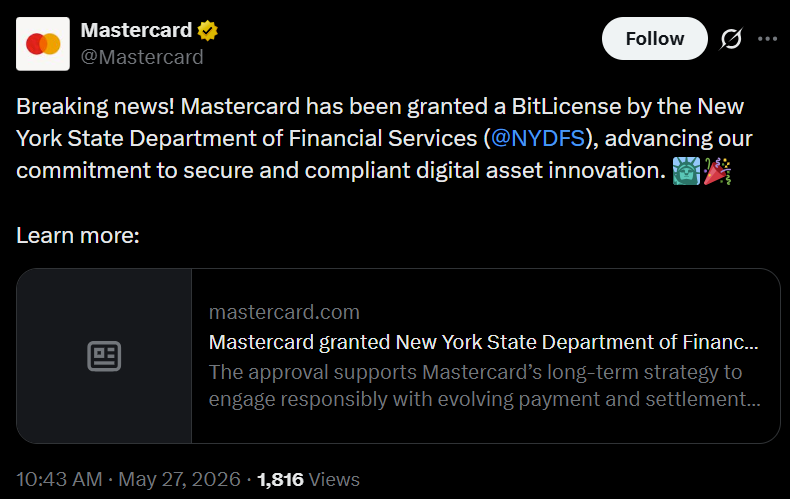
Mastercard’s US transaction services unit has received a BitLicense from the New York State Department of Financial Services (NYDFS), allowing the payments giant to conduct regulated digital asset business activity in the state.
The company announced the license approval on Wednesday, but did not unveil any new consumer-facing crypto products. Instead, Mastercard said it plans to continue developing payment and settlement infrastructure tied to digital assets, focusing specifically on stablecoins and tokenized deposits.
New York’s BitLicense is widely regarded as one of the strictest state-level crypto regulatory frameworks in the United States. Companies offering certain crypto-related financial services to New York residents are generally required to obtain the license.
Mastercard joins a growing list of companies that have recently secured a New York BitLicense as regulatory clarity around digital assets continues to evolve in the United States.
Earlier this year, crypto financial services company Galaxy received approval to expand its institutional digital asset offerings in the state. Bitcoin payments company Strike, led by Jack Mallers, obtained both a BitLicense and money transmitter licenses to support its Bitcoin (BTC) focused payment services in New York.
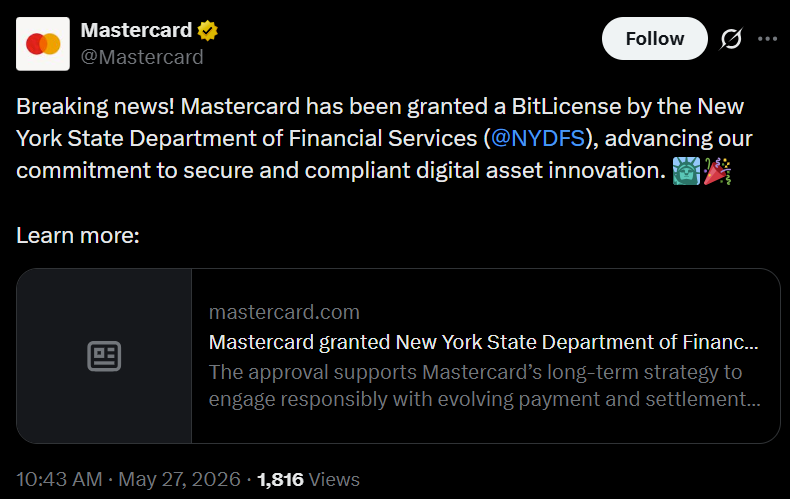
Source: Mastercard
The BitLicense isn’t Mastercard’s first crypto-related expansion in New York. In February, MetaMask introduced a Mastercard-enabled payment card in the state that allows users to spend crypto directly from their self-custodied wallets at merchants that accept Mastercard.
Related: Mastercard launches crypto partner program with a ‘who’s who’ of industry
Mastercard deepens both stablecoin and tokenization efforts
The BitLicense approval follows Mastercard’s recent acquisition of the stablecoin infrastructure company BVNK, valued at up to $1.8 billion. Expected to close later this year, the transaction included up to $300 million in performance-based payments and is aimed at strengthening the payments processor’s ability to connect traditional payment networks with blockchain-based transactions.
The acquisition came months after crypto exchange Coinbase and BVNK mutually agreed to end takeover discussions.
Earlier this month, Mastercard also said it completed its first cross-border US Treasury transaction on the XRP Ledger, underscoring the company’s growing focus on tokenized financial assets. Excluding stablecoins, the tokenization market is currently valued at more than $33.8 billion, according to industry estimates.
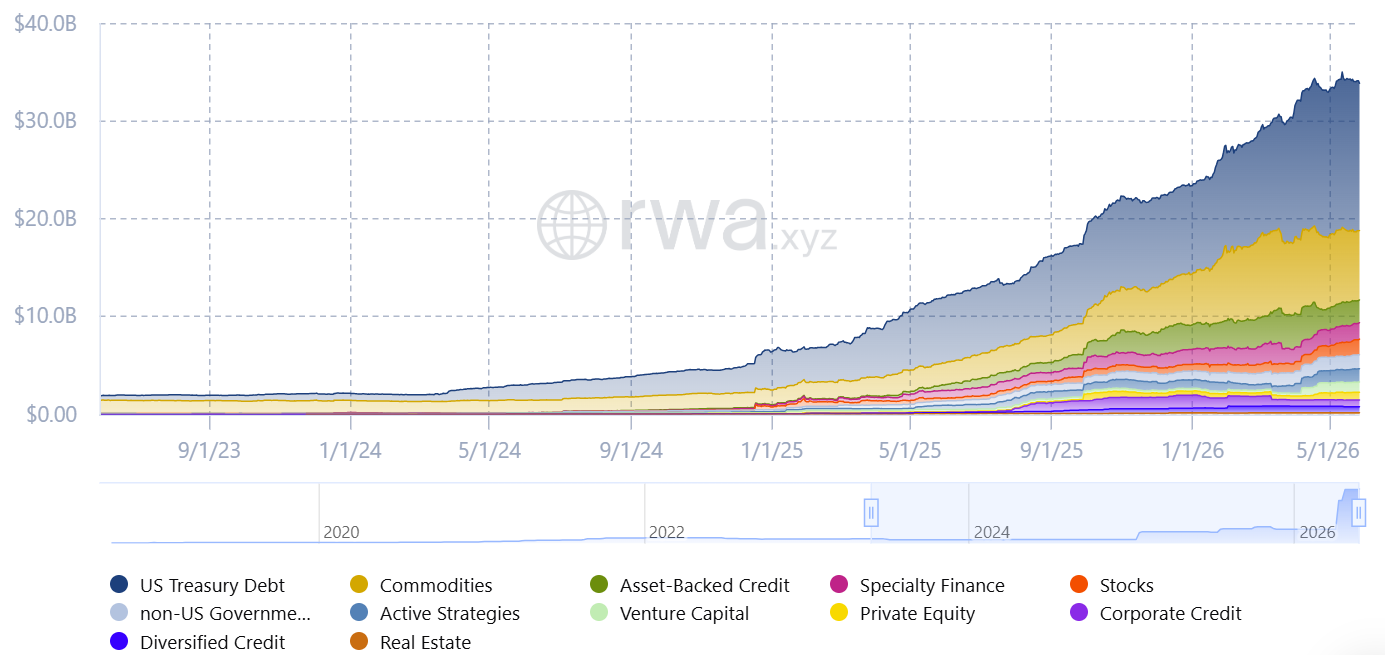
Total RWA market size. Source: RWA.xyz
Related: Crypto Biz: Wall Street wants more than just Bitcoin

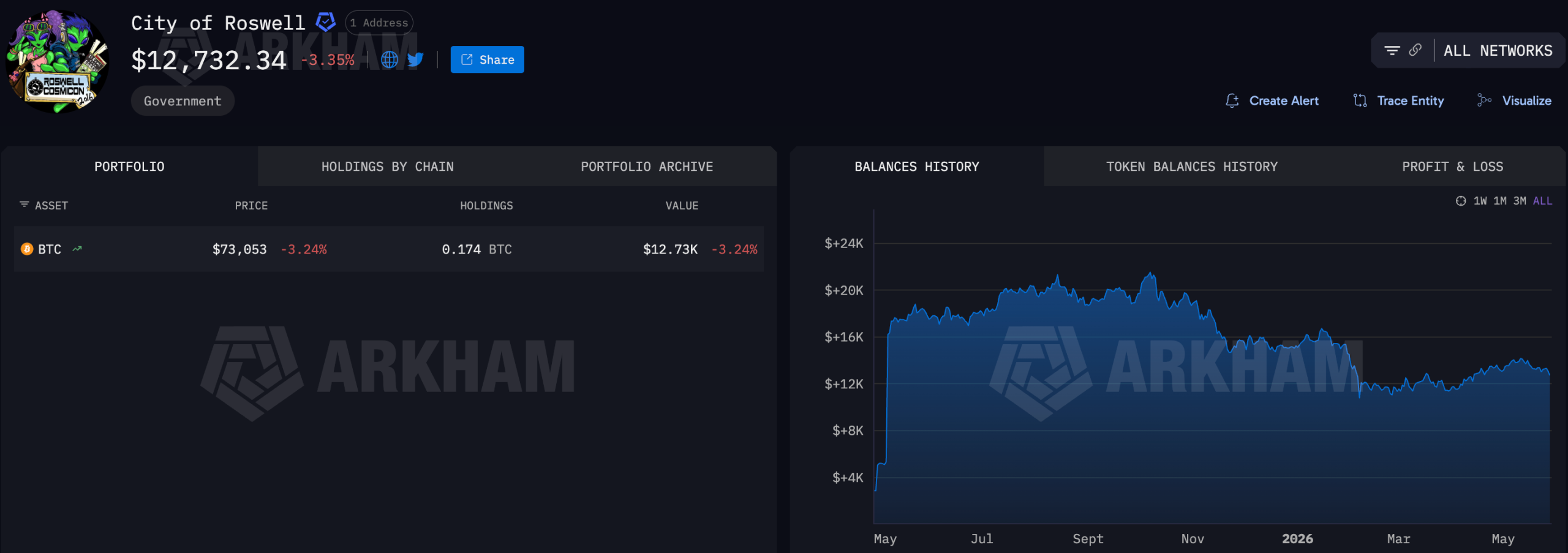
The City of Roswell, New Mexico, the small town synonymous with the 1947 Unidentified Flying Object (UFO) incident, now sits on a modest Bitcoin (BTC) stash. Blockchain analytics firm Arkham Intelligence flagged the holding in a public post this week.
The municipal wallet contains about 0.173 BTC, worth roughly $13,300 when Arkham revealed it. The funds arrived as donations last year and have stayed in a single address ever since, untouched by the city.
Inside Roswell’s On-Chain Stash
Arkham tagged the address as belonging to the City of Roswell and published its entity page through its intelligence tool. According to the firm, the donations were sent in 2025 and have stayed parked at the same address since.

The wallet has not pushed any funds out, suggesting either deliberate custody or simple inattention from city staff. Roswell officials have not commented publicly on who sent the Bitcoin or what they plan to do with it.
The town, home to 48,000 residents, has not flagged the holding in any public budget document. The dollar value Arkham cited reflects market levels at the time of the post and would shift with Bitcoin’s price.
A New Chapter for an Old UFO Story
Roswell’s link to extraterrestrial folklore dates back to July 1947, when a local rancher found metallic debris on his property. The Roswell Army Air Field initially described the wreckage as a flying disc. It retracted the statement the next day and called the find a weather balloon.
The town has built much of its identity, and most of its tourism economy, around alien iconography. The International UFO Museum and Research Center anchors a local industry built on the original story.
The Bitcoin holding adds a digital footnote to that lore. Arkham’s research team leaned into the framing, calling the donations a possible cypherpunk chapter in Roswell’s sci-fi history. Whether any of the senders identified themselves at the time remains unclear.
“Has the first extraterrestrial BTC stash been found?” Arkham teased.
Roswell joins a thin roster of US cities tied to on-chain Bitcoin activity. Miami’s Bitcoin adoption push leaned on a city-branded token rather than direct BTC custody. Most local governments hold no crypto at all.
At the federal level, the picture is larger. The Strategic Bitcoin Reserve order placed forfeited coins on the federal balance sheet. Arkham puts overall US government Bitcoin holdings near $24 billion.
Roswell’s stack is a rounding error against those figures. The story matters less for the amount than for the venue. The town is better known for tinfoil hats than treasury management.
The next question is whether Roswell ever spends the funds or leaves them to compound alongside its tourist economy. For now, the wallet sits where the donors left it, watched only by blockchain explorers and the occasional alien.
The post The UFO Capital of America Has a Bitcoin Wallet: Did Aliens Buy BTC? appeared first on BeInCrypto.

China’s Supreme People’s Court (SPC) said it will study new adjudication rules for virtual currency and cross-border finance cases as part of a broader effort to clarify how courts handle disputes in the digital economy. During a press briefing, Liu Guixiang, a Judicial Committee member of the SPC, said the court intends to formulate judicial interpretations on civil compensation involving insider trading and market manipulation “as soon as possible,” according to Yicai.
The SPC also signaled plans to develop judicial protection rules for artificial intelligence cases and data property rights, including disputes over data ownership, data transactions and AI-generated content. The move aims to establish clearer internal standards for deciding crypto- and AI-related civil disputes, potentially improving consistency amid a rising volume of such cases in China.
Observers note the timing aligns with broader regulatory signals and enforcement dynamics in the region. In a high-profile cross-border enforcement context, U.S. authorities reported the seizure of about $15 billion worth of Bitcoin in October 2025 in connection with investigations linked to illicit operations tied to Chen Zhi, founder and chairman of Cambodia’s Prince Group. The U.S. Department of Justice (DOJ) disclosed the action, underscoring ongoing global convergence around crypto-related enforcement. (Source: Justice.gov)
Key takeaways
- The SPC will study adjudication rules for virtual currencies and cross-border finance as part of formalizing digital-economy jurisprudence.
- The court plans to draft interpretations on civil compensation concerning insider trading and market manipulation.
- Judicial protection rules for AI cases and data property rights, including data ownership and AI-generated content, are under consideration.
- The initiative seeks to standardize crypto- and AI-related litigation, aiming for greater predictability for institutions, exchanges and fintech players.
- These judicial developments intersect with cross-border enforcement and regulatory dynamics shaping compliance and risk management for firms operating with or within China’s digital economy.
Adjudication rules for digital assets and cross-border finance
The SPC’s stated program signals an intent to extend civil-justice frameworks to digital assets and cross-border financial arrangements. By pursuing in-depth research and issuing judicial interpretations on civil compensation for insider trading and market manipulation, the court aims to provide clearer, more consistent standards for disputes in crypto markets and related financial activity. According to Yicai, Liu Guixiang emphasized the need for timely guidance to ensure uniform application across cases involving virtual currencies and cross-border transactions. The development could influence how courts allocate liability, interpret contractual terms in crypto agreements, and address fraud or manipulation allegations in cryptofinance contexts.
AI governance and data property rights in the courts
Parallel to crypto-adjudication work, the SPC’s focus on AI disputes and data-property rights highlights the judicial sector’s broader push to adapt to rapid tech-enabled disruption. The planned rules would address disputes over data ownership, data transactions and the protection of AI-generated content, potentially shaping licensing arrangements, data-sharing frameworks and IP rights in machine-generated outputs. As such, the reforms could affect technology providers, data platforms and enterprises relying on data-driven services, extending beyond crypto to the wider digital economy.
China’s crypto policy backdrop and CBDC trajectory
China’s long-standing stance toward cryptocurrencies is marked by a sequence of regulatory milestones. In December 2013, the People’s Bank of China (PBOC) banned financial institutions from offering Bitcoin-related services and stated that Bitcoin was not recognized as legal currency. In September 2021, a joint regulatory sweep by ten agencies—including the PBOC and securities regulators—issued a blanket ban on all crypto transactions, Bitcoin mining and initial coin offerings (ICOs) within the country. In February of the following year, authorities prohibited the issuance of unauthorized offshore yuan-pegged stablecoins and the unapproved tokenization of real-world assets (RWAs).
The regulatory environment has evolved alongside China’s broader push to deploy a state-controlled digital yuan. The government has approved commercial banks to participate in offering interest-sharing arrangements to clients holding the digital yuan, signaling a deliberate preference for a central bank digital currency (CBDC) framework over private stablecoins. This backdrop provides context for the SPC’s emphasis on formalizing adjudication rules as digital assets and AI technologies become more prevalent in the economy.
Enforcement backdrop and cross-border dimension
The period’s enforcement dynamics underscore the cross-border nature of crypto-related scrutiny. The DOJ’s action, as reflected in public reporting and official releases, illustrates how authorities pursue illicit networks with international footprints. The seizure of approximately $15 billion in Bitcoin in October 2025 relates to investigations into Chen Zhi’s operations and represents a salient example of how enforcement actions outside China intersect with domestic legal developments as the digital economy expands.
Closing perspective
China’s move to standardize adjudication around digital assets, AI and data rights signals a maturation of the domestic legal framework in step with a rapidly evolving digital economy. For institutions operating in or with China, forthcoming SPC interpretations will influence risk assessment, regulatory compliance, licensing considerations and cross-border cooperation. As enforcement and policy converge, staying aligned with evolving standards—especially around crypto disputes, data rights and AI governance—will be essential for robust compliance and strategic planning.


BlackRock IBIT saw $1.29 billion in shares cross a dark pool Tuesday, one of the largest blocks on record.
Summary
- A 29 million share IBIT block crossed off-exchange at 10:30 a.m. ET, dwarfing every other trade in the session.
- The print extended an eight-day outflow streak and pushed two-week US spot Bitcoin ETF redemptions to $2.26 billion.
- Bitcoin slipped about 1.4% during the flow before extending losses to around $74,800.
BlackRock IBIT saw $1.29 billion in shares cross a dark pool Tuesday, one of the largest blocks on record.
A nearly 29 million share block of the iShares Bitcoin Trust changed hands off-exchange at 10:30 a.m. ET, dwarfing every other IBIT trade of the session. Bloomberg analyst Eric Balchunas confirmed the print on X.
The crossing landed on the same day US spot Bitcoin ETFs lost another $333 million in net redemptions, tracked by SoSoValue. IBIT alone shed $192.4 million.
Why the IBIT block trade matters
“Confirmed.. 29 million share trade ($1.3b) of $IBIT executed at 1030am this morning,” Balchunas said on X. “Price unchanged today so mkt absorbed it well.”
The trade extended an eight-session outflow streak for the fund. Investors have pulled $2.26 billion from US spot Bitcoin ETFs since May 14, according to SoSoValue data.
Dark pools let sellers offload large positions without hitting public order books, masking the full weight of a transaction from the open market. The mechanism limits price impact but signals heavy institutional repositioning.
Bitcoin held near $76,000 immediately after the print but slipped about 1.4% on lower timeframes before extending losses. The asset traded around $74,800 at press time.
How the move fits broader ETF flows
The Tuesday print was not the sharpest single-day exit of the run. IBIT shed $448 million on May 18, when total spot Bitcoin ETF outflows hit $648.64 million.
Crypto.news previously reported that BlackRock-linked Bitcoin sales reached $1.01 billion over the prior week, the firm’s largest weekly disposal since November 2025.
The redemption stretch reverses a six-week inflow streak that pulled $3.4 billion into US spot Bitcoin ETF products through early May, documented at the time.
What traders are watching next
Georgii Verbitskii, derivatives trader and TYMIO founder, said the market avoided a deeper decline because available supply was absorbed rather than because demand had returned.
“The reason the decline was not even deeper is that the market was still able to absorb a substantial amount of supply without a full liquidity breakdown,” Verbitskii said.
Shawn Young, chief analyst at MEXC Research, framed the print as portfolio adjustment rather than panic selling. He said the contained price reaction looked more like a large rebalance than a disorderly exit.
Macro pressure is compounding the flow picture. The CME FedWatch tool now prices a 99% probability the Federal Reserve holds rates at its June 17 meeting, removing a near-term catalyst for risk assets.
The total US spot Bitcoin ETF market still holds more than $98 billion in assets, with IBIT accounting for roughly 62% of the category. The product remains the largest Bitcoin ETF by net assets despite the recent drawdown.
Investor sentiment has also turned. The Fear and Greed Index slipped from 34 to 25, deeper into fear territory, as the dark pool trade and broader outflows reset expectations for the next leg.
Bitcoin price hovered near the $75,000 zone on Wednesday as volatility cooled and traders watched whether the latest support area could hold.
Summary
- Bitcoin price trades near $75K as lower volatility and weak spot demand limit buyer conviction.
- BTC faces pressure from Bitcoin ETF outflows and signs of lower institutional exposure in spot funds.
- Traders are watching $74,662 support, with $76,327 acting as the first recovery level near term.
(BTC) traded around $74,834 after sliding 2.02% over 24 hours, with intraday movement between $74,708 and $76,140. According to data from crypto.news, the market has lost part of the support that came from steady institutional buying earlier this year. Traders are now focused on whether $74,662 can act as short-term support. A daily break below that area could expose BTC to a move toward $73,000.
Bitcoin price nears $75K as volatility cools further
Bitcoin price’s move lower followed a reset in positioning after BTC failed to hold the low-$80,000 region. That zone became difficult to defend as spot buying slowed and short-term holders faced weaker profit margins.
Glassnode’s recent market update reveals Bitcoin remains structurally resilient, but spot demand has weakened. The 30-day cost basis near $78,200 has turned into overhead resistance. That level now sits above spot price and may limit recovery attempts.
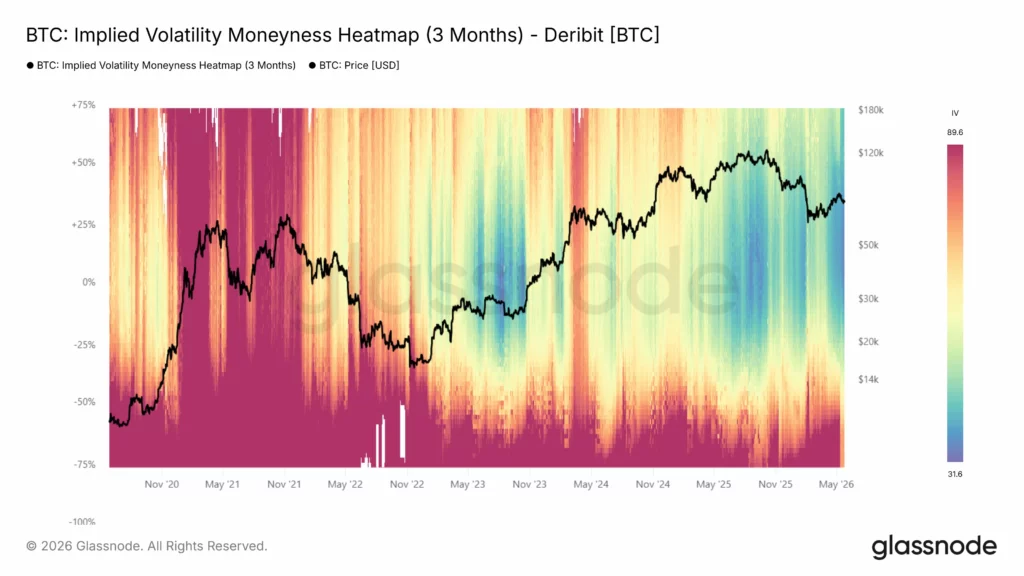
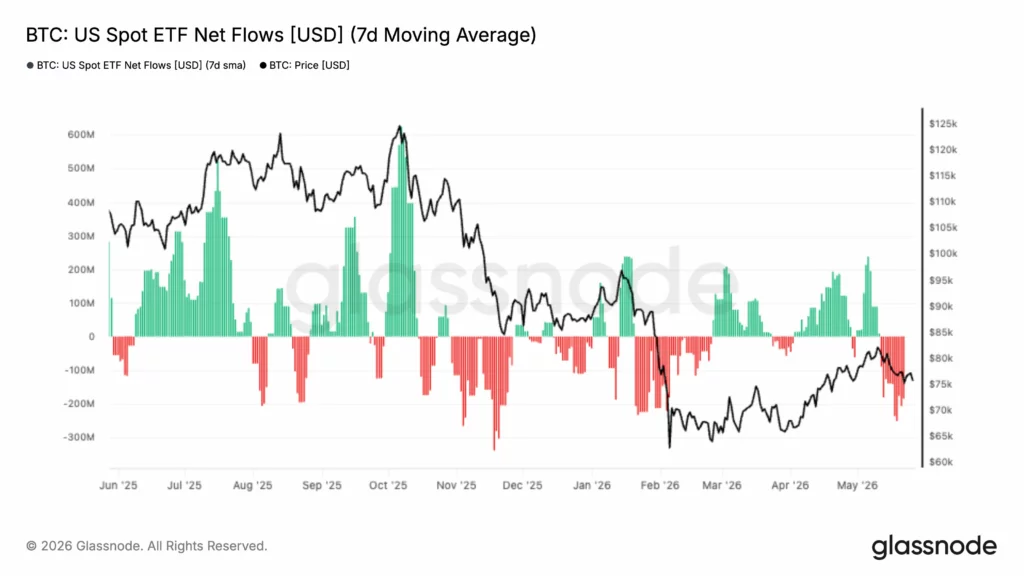
ETF demand has also lost strength after earlier support from institutional buyers. The 30-day change in U.S. spot Bitcoin ETF holdings has flattened in recent weeks, according to Glassnode. That reduces one key demand channel that helped BTC recover earlier in the quarter.
Bitcoin’s decline also came as traders tracked a large reported IBIT block sale. The sale added pressure to sentiment, but the current weakness is not linked to one event alone. ETF outflows, weak spot flows, and macro caution remain major factors behind the move.
Bitcoin price faces ETF pressure and weak spot demand
Bitcoin volatility is now important because the market sits close to a key liquidity zone. Traders are watching the $74,662 support area after BTC broke below its ascending channel. A daily close below that level could open a move toward $73,000.
The $76,327 area has become near-term resistance. A reclaim of that level could support a relief bounce, especially with RSI near oversold territory. However, weak spot demand limits any recovery unless ETF flows stabilize.
Macro conditions have also kept traders cautious. Higher yields, inflation concerns, and geopolitical risk have reduced appetite for risk assets. Bitcoin’s recent correlation with gold points to a market driven more by macro positioning than crypto-specific momentum.
The U.S.-Iran peace headlines gave stocks a lift, but Bitcoin failed to follow. Instead, BTC moved closer to commodities as oil dropped on hopes of the Strait of Hormuz reopening. That divergence kept traders focused on liquidity clusters below spot.
Traders watch $74K liquidity as BTC momentum slows
In a May 27 X post, trader Daan Crypto Trades said Bitcoin was struggling to choose between the equity rebound and commodity weakness, writing:
“$BTC is indecisive whether to join stocks or commodities today.”
The comment captured the split across markets as crypto failed to fully track the recovery in stocks.
Some traders remain bearish while BTC trades below short-term resistance. Others argue that the structure can stay constructive if the price holds above the trendline and horizontal support. The divide shows a market without strong conviction.
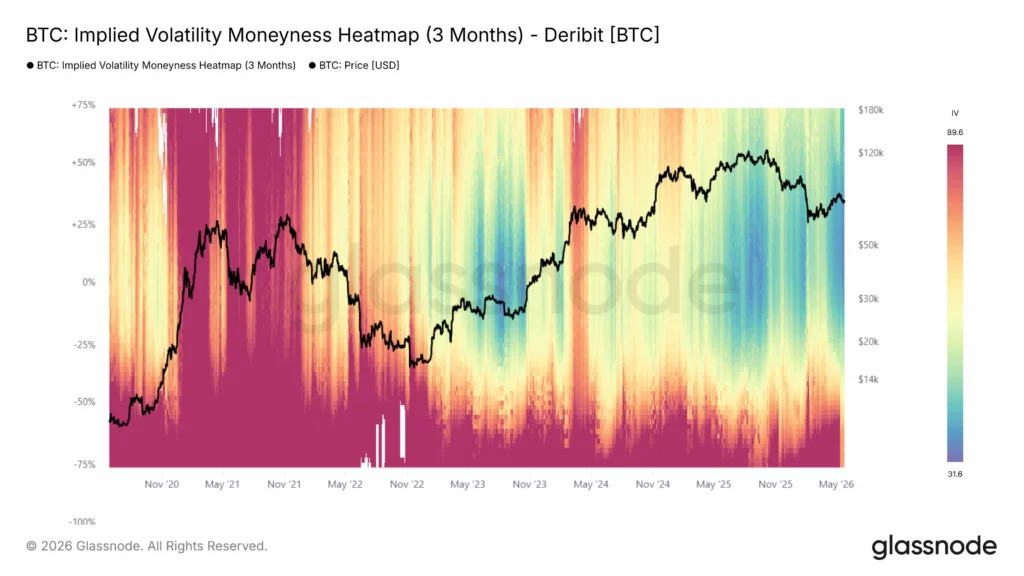
Options data adds another layer of caution. Glassnode data shows realized volatility has continued falling, while downside protection demand has returned. That setup can keep hedging flows active if BTC trades near short gamma zones around $75,000.
Bitcoin volatility may stay contained if support holds and ETF outflows ease. Still, price needs a stronger spot demand to move beyond a short bounce. Until then, traders are likely to watch $74,662 support and $76,327 resistance as the main near-term levels.
Disclosure: This content is provided by a third party. Neither crypto.news nor the author of this article endorses any product mentioned on this page. Users should conduct their own research before taking any action related to the company.

HIVE schedules Q4 and full-year 2026 results, earnings call to outline mining and AI compute performance
HIVE Digital Technologies Ltd., a publicly traded miner and data center operator, will publish its fiscal fourth-quarter and full-year 2026 results on June 1, followed by a webcasted earnings call on June 2 at 8:00 AM Eastern Time. The company, listed on the TSX and Nasdaq under the ticker HIVE, operates Bitcoin mining facilities and GPU-accelerated data centers across multiple jurisdictions.
Investors in listed mining companies will be watching HIVE closely. The company presents a hybrid business model that combines traditional proof-of-work Bitcoin mining with growing GPU-based hosting and AI compute services. That mix positions HIVE differently from pure-play miners, and the upcoming disclosure will be parsed for signs of how that strategy is translating into revenue and margin trends.
What investors will look for
While HIVE has not released financial figures ahead of the scheduled date, there are several operational and financial indicators market participants typically focus on for miners and data center operators:
- Bitcoin production and holdings – Quarterly BTC mined, the companys selling policy and changes in inventory are key for revenue recognition and balance sheet exposure to price volatility.
- Hash rate and capacity utilization – Changes in deployed ASICs, average network difficulty and effective hash rate provide insight into output capability and operational scale.
- Energy costs and sourcing – Miners margin heavily depends on power rates and availability. HIVE has emphasized low-carbon energy in its public materials, which can influence long-term operating costs and regulatory positioning.
- GPU hosting and AI compute revenue – Demand for GPU capacity from AI workloads has become a diversification avenue for several miners. The degree to which HIVE converts GPU deployment into recurring hosting revenue will be important for assessing revenue mix.
- Geographic performance – HIVE operates facilities in Canada, Sweden and Paraguay. Regional differences in power pricing, regulatory frameworks and uptime can materially affect results.
Strategic position and sector context
HIVE’s dual emphasis on hashrate services for Bitcoin and GPU-accelerated AI compute follows a broader industry trend where mining companies seek to diversify revenue streams amid cyclical crypto markets. GPU hosting can partially offset the volatility tied to BTC prices, by providing steady, contractual revenue from enterprise AI customers and cloud workloads. That said, GPU markets are competitive and capital intensive, and successful monetization depends on efficient deployment and strong client uptake.
For equity investors, HIVE and peers are often treated as barometers for several interlinked markets: the spot price of Bitcoin, the supply and utilization of mining hardware, and the emerging market for specialized AI compute capacity. Quarterly disclosures can influence sentiment across the miner cohort, particularly if companies adjust capital allocation between ASIC expansion and GPU deployment.
Governance, listings and leadership
HIVE trades on multiple exchanges, including the Toronto Stock Exchange and Nasdaq. The company has described itself publicly as an operator of Tier-I and Tier-III data centers and has highlighted energy sourcing as part of its operational narrative. Executive leaders named in prior corporate communications include Executive Chairman Frank Holmes and President and CEO Aydin Kilic. Management commentary on the earnings call will be closely watched for updates on strategy, capital spending plans and demand for GPU services.
Event access and disclosures
The company has said it will post the earnings release and a replay of the webcast on its investor relations website. Participation in the live call typically requires advance registration; registered participants receive dial-in details and the webcast link. As with most public companies, the formal financial statement and management discussion will provide the definitive view of performance for the period.
Implications for the market
Quarterly results from HIVE may have outsized relevance for several investor groups. Equity holders in mining firms will parse the report for operational efficiency and capital allocation between ASICs and GPUs. Bond and credit market participants and potential strategic partners may look for indications of stable hosting revenue that could underpin longer-term contracts. Finally, because mining companies often hold BTC on their balance sheets, results can influence both crypto market flows and the valuation multiples investors are willing to pay for miner equities.
Analysts and market commentators will also be watching for any commentary on supply chain dynamics for ASICs and GPUs, power procurement strategies, and regional expansion plans. These factors will help determine whether HIVE’s hybrid model offers a durable advantage against the backdrop of heightened demand for AI compute and the persistent cyclicality of crypto markets.
The companys full results and management commentary will be available after the scheduled release on June 1, and the earnings call on June 2 will provide additional colour on operational execution and strategic priorities.
How to follow
Investors and analysts can find the earnings release and webcast replay on HIVEs investor relations page. Those seeking the live discussion should register in advance to receive dial-in details and the webcast link.

Italian bank Banca Sella announced that it has completed its notification process with the Bank of Italy under the European Union’s Markets in Crypto-Assets (MiCA) regulation, allowing it to offer crypto-asset services.
On Wednesday, the bank said it is the first bank in Italy authorized to offer crypto-asset services, adding that the approval will allow it to launch a solution focused on the custody, transfer and receipt of digital assets in 2026, aimed at “selected categories” of customers.
Banca Sella is the commercial bank of Sella Group. According to Sella Group, it has almost 300 branches and more than 2,400 employees.
The approval gives Italy’s banking sector a regulated entry point into digital assets under MiCA, as European financial institutions move from crypto pilots and partnerships toward licensed custody, tokenized payments and stablecoin infrastructure.
Andrea Tessera, managing director of digital banking at Banca Sella, said tokenization is contributing to a shift toward “instant, interoperable, and programmable” payments. He said the bank’s planned crypto service is part of that shift.

Sella announces MiCA approval. Source: Sella
Hype gave earlier crypto exposure
The MiCA approval is not Banca Sella’s first connection to crypto. Banca Sella also said in the announcement that its MiCA approval follows its participation in a distributed ledger technology pilot promoted by the Bank of Italy’s Fintech Milano Hub in 2022.
Banca Sella said it has also created an internal DLT and digital assets team, and added that it’s also among the founders of Qivalis, a consortium of 37 European banks that plans to issue a euro-denominated stablecoin.
Related: Bank of Italy chief says banks, not stablecoins, anchor digital money
The bank also previously had crypto exposure through Hype, its digital banking brand, which integrated Bitcoin wallet services through Italian crypto firm Conio.
Conio said its first banking integration became operational in March 2020 through a partnership with Hype, Banca Sella Group’s digital banking brand. According to Conio, Hype went live in 2020 and allowed retail customers to buy, sell, send and receive digital assets.
Hype’s current website advertises a Bitcoin wallet that lets adult customers create a wallet and buy, sell or exchange Bitcoin directly from the Hype app.
In 2024, Reuters reported that Banca Sella had around 1.3 million customers, while Hype served around 1.7 million customers.
Magazine: 50K investors fight Korean crypto tax, Singapore cancels Bsquared: Asia Express
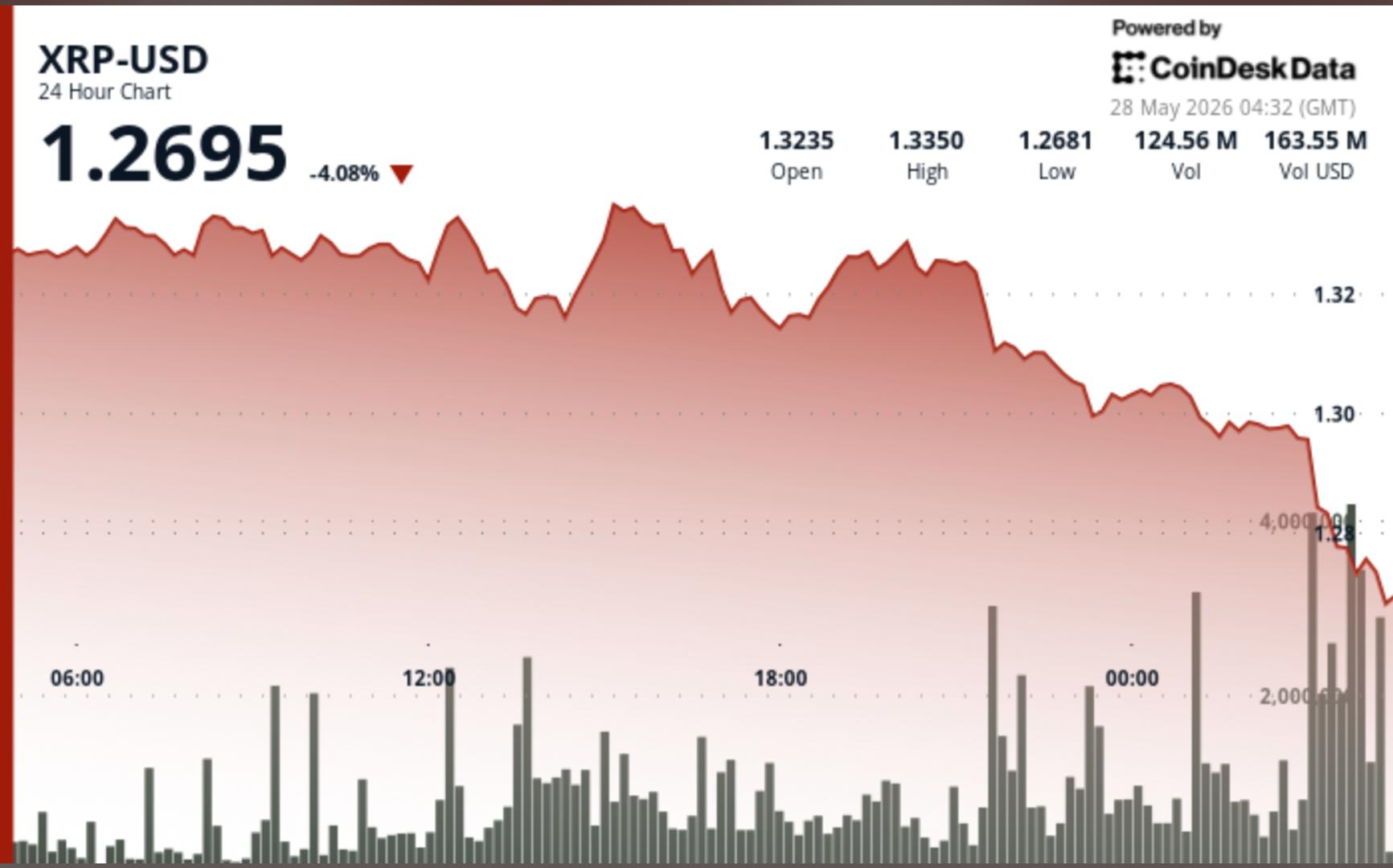
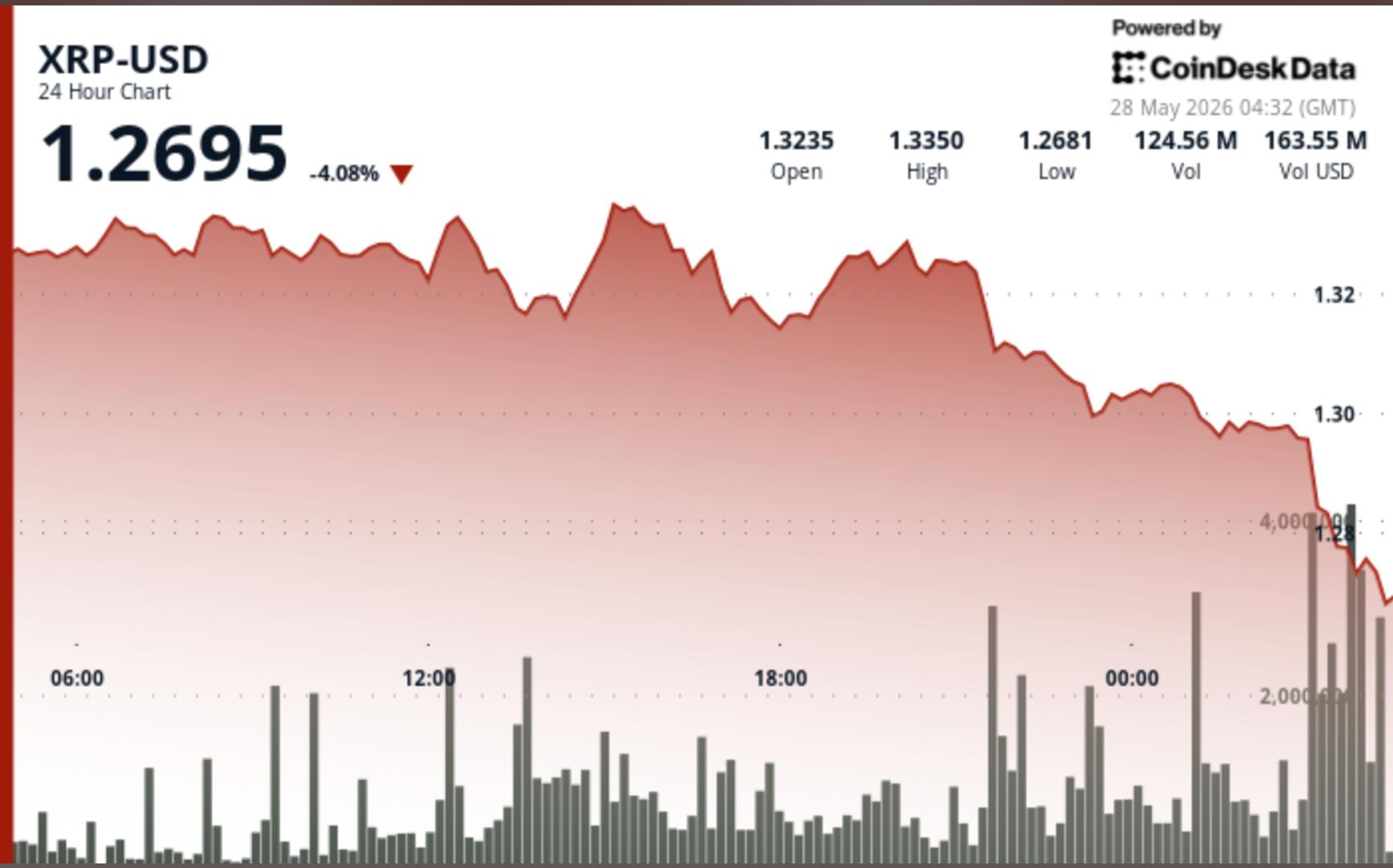
XRP finally slipped below the $1.30 area traders had been defending for months, and the move came with enough volume to matter. The market had already been weakening beneath resistance near $1.35, but once support gave way, sellers pushed price lower quickly before dip buyers stepped in near session lows.
News Background
• XRP derivatives positioning continued cooling during the session, with falling open interest signaling weaker trader conviction across futures markets.
• Analysts also kept pointing to a symmetrical triangle structure that has compressed XRP price action since early 2025, with the market now nearing the apex of that range.
• On-chain data still showed XRP leaving exchanges, a pattern some traders continue interpreting as longer-term accumulation despite the short-term weakness.
Price Action Summary
• XRP fell from $1.3267 to $1.2993 during the 24-hour session, briefly dropping as low as $1.2931.
• The sharpest selling came during the May 27 23:00 UTC session, when 64M XRP traded as price broke below support near $1.3150.
• XRP later staged a short-term rebound from session lows, recovering back toward the $1.30 area into the close.
Technical Analysis
• The breakdown below $1.30 matters because that level had repeatedly acted as a floor throughout the broader consolidation structure.
• XRP is now trading beneath several key resistance levels, with sellers continuing to defend the $1.33-$1.36 zone aggressively.
• The bounce from $1.2931 showed some evidence of exhausted selling pressure, though the recovery remained weak relative to the earlier breakdown.
• The broader symmetrical triangle pattern is still intact for now, but price is drifting dangerously close to the lower edge of the structure.
What traders should watch
• $1.30 becomes the immediate recovery level XRP needs to reclaim to stabilize short-term momentum.
• Failure to hold above recent lows increases the risk of a deeper move toward the mid-$1.20s and potentially the $1.10 area highlighted by several analysts.
• The longer XRP trades near the bottom of its compression range, the higher the odds the eventual breakout resolves lower rather than higher.

Kraken is expanding its yield offerings with a new non-custodial Bitcoin product that promises a 2.5% annual return. Built in collaboration with yield infrastructure provider Veda, the solution aims to simplify earning on Bitcoin without the common frictions of wrapping, moving, or managing a crypto wallet. The move comes as Bitcoin holders show growing interest in yield-style products, even as native yield mechanisms on BTC remain limited compared with programmable blockchains.
Kraken unveiled the product with the backing of Veda, which emphasized that the offering is designed to remove the headaches often associated with BTC yield strategies. In Kraken’s own messaging, the product is pitched as a straightforward way to earn on Bitcoin the exchange already intends to hold, addressing user demand for ease of use and reliability.
Key takeaways
- Kraken launches a non-custodial Bitcoin yield product at 2.5% APY, leveraging Veda’s yield infrastructure to route BTC into lending markets.
- The system uses Kraken Wrapped Bitcoin (kBTC) as a price-tracking representation of BTC, with Sentora allocating funds across Aave, Morpho, and Tydro through the integration.
- Withdrawals are non-instant and are expected to take about five days, with a 25% performance fee on rewards paid to the involved service providers.
- Early traction: roughly $30 million in BTC deposits from around 4,000 unique wallets were reported by Veda about 10 hours after launch.
- Kraken’s broader yield portfolio—three stablecoin yield products launched in January—has amassed about $245 million in deposits and generated over $2.2 million in yield since Jan. 26.
A fresh approach to Bitcoin yield
The new offering marks a notable evolution in the BTC yield space by delivering a non-custodial structure that lets holders earn on their Bitcoin without surrendering custody or performing intricate wallet operations. Kraken’s Earn product director, John Zettler, framed the initiative as addressing a clear investor preference: “Many Bitcoin holders on Kraken have made it clear they want simple ways to earn on the Bitcoin they already plan to hold.”
In practice, the model begins with BTC being swapped into kBTC, a token designed to mirror Bitcoin’s price. From there, Sentora—another linked component in the pipeline—channels the value into established lending venues such as Aave, Morpho, and Tydro. This multi-step approach allows users to gain exposure to yield-generating activity without the traditional friction of moving assets between wallets or custodians.
What makes this structure distinctive is its non-custodial nature. Depositors retain control over their funds, with withdrawals subject to a multi-day processing window. The arrangement also includes a 25% performance fee on rewards, a rate that’s aligned with other professional yield structures but could impact net returns for users depending on the performance of the underlying lending markets.
How the product operates and who benefits
At the heart of the offering is a cycle that begins with Bitcoin being represented as kBTC within Kraken’s ecosystem. This representation helps bridge BTC with the yield infrastructure built around decentralized lending protocols. By routing kBTC into traditional lending arenas via Sentora, Kraken users can theoretically earn a yield while maintaining exposure to BTC’s price movements.
For users, the upside is straightforward: a simple, non-custodial way to generate returns on BTC holdings that are otherwise idle. For the ecosystem, the product expands the array of Bitcoin-native yield options, potentially providing greater utility for BTC as a store of value. On the flip side, the non-custodial model concentrates trust in the security and reliability of the involved counterparties—in particular, Kraken, Veda, Sentora, and the lending protocols they tap into.
Deposit growth toward the product has already been significant in its infancy. Veda reported that within roughly 10 hours of launch, the Bitcoin yield product had crossed $30 million in deposits from about 4,000 unique wallets. Such rapid uptake signals a strong appetite among Bitcoin holders for yield-oriented products that avoid custody risk while preserving ownership of funds.
To provide context for readers tracking market evolution, Kraken’s three existing stablecoin yield products, which launched in January, have collectively drawn around $245 million in customer deposits and produced more than $2.2 million in yield since their inception on Jan. 26. This backdrop highlights Kraken’s broader strategy of layering yield offerings across asset classes to meet diverse investor preferences.
Adoption signals and market context
The Bitcoin yield landscape has been characterized by limited native yield opportunities, primarily because BTC’s design does not include built-in mechanisms to generate interest or rewards like some programmable blockchains. The new Kraken-Veda pairing taps into the broader crypto lending ecosystem to convert BTC exposure into yield potential, while attempting to mitigate the typical custody headaches associated with such strategies.
Analysts and market observers are watching how the model scales, particularly as it relates to liquidity, the stability of the kBTC representation, and the performance of the underlying lending platforms. The reliance on multiple counterparties and cross-network routing could introduce new operational risk layers, even as it offers a potentially compelling path to earn yield without moving away from BTC holdings.
In the broader crypto yield space, the trend toward diversified, user-friendly structures persists. The incorporation of non-custodial approaches contrasts with fully custodial yield products, underscoring a market appetite for options that balance ease of use, control, and risk management. As institutions and retail users alike reassess their BTC allocations, products like Kraken’s non-custodial yield offer a tangible way to monetize BTC holdings beyond price appreciation alone.
The development also sits within a broader regulatory and security context. While non-custodial solutions reduce custody risk, users must still evaluate the security posture of each component in the chain—the exchange, the yield infrastructure provider, and the lending platforms—to understand potential exposure during market stress or asset sharp moves.
What remains uncertain is how durable the early demand will be and how attractive the net yield will prove once governance and fee structures interact with shifting lending conditions. Observers will be looking for longer-term deposit trends, withdrawal reliability, and any changes to the fee framework as the product matures.
For traders and developers, the continued expansion of Bitcoin yield options is a reminder that BTC as an asset class is increasingly embedded in the broader DeFi and yield-enabled ecosystem. The pace at which new, user-friendly, non-custodial solutions emerge will shape how quickly more Bitcoin holders adopt yield-generating strategies without compromising control over their funds.
Readers should keep an eye on momentum in deposits, any shifts in the underlying lending rate environment, and how regulators respond to non-custodial yield constructs that blend traditional crypto custody with DeFi mechanics.
In the near term, the story to follow is the balance between user uptake and the performance of the lending channels that underpin the yield. If the trajectory holds, Kraken’s non-custodial Bitcoin yield product could become a meaningful reference point for BTC-native yield strategies in a market still eager for practical, secure ways to earn on crypto assets.
Source signals from Kraken and Veda indicate that the product is designed to deliver simplicity and accessibility for Bitcoin holders seeking yield without the usual operational overhead. As the ecosystem evolves, observers will watch how this model scales and what it implies for the broader adoption of BTC-yield approaches.


Russian officials have moved closer to a long-term shutdown of crypto mining in Moscow and nearby regions as lawmakers have advanced a separate bill to jail unregistered miners.
Summary
- A Russian power-industry commission has backed a proposal to ban crypto mining in Moscow, Moscow Oblast, and parts of Kursk until at least 2032.
- Kommersant reported that the government is also weighing a wider mining ban across 19 regions within Moscow’s power distribution zone.
- The State Duma has advanced a bill to criminalize illegal mining, with fines of up to 2.5 million rubles and prison terms of up to 5 years.
According to TASS, Deputy Energy Minister Evgeniy Grabchak said a government commission overseeing the electric power industry has backed a proposal to ban mining in the city of Moscow, the surrounding Moscow Oblast, and parts of the Kursk region, with the restriction expected to last until at least 2032.
Local officials raised the issue in late April, the ministry said, and the final decision will take their positions into account, according to a report by RBC.
Moscow area faces proposed six-year prohibition
In Moscow Oblast, regional Energy Minister Sergey Voropanov has argued that crypto mining brings little benefit to the local economy and has said that earlier restrictions elsewhere produced positive results, according to reports cited by RBC and Bits.media.
Bits.media has also recalled that Moscow Oblast Governor Andrey Vorobyov and Moscow Mayor Sergey Sobyanin have both proposed limits on mining in their jurisdictions.
The Russian energy ministry has counted at least 65 data processing centers connected to the grid across Moscow and the Moscow region, with a total capacity of 734 megawatts, according to figures cited in the report.
A separate Kommersant report has said the government is weighing a mining ban across 19 regions within Moscow’s power distribution zone, a move that would curb activity across the Central Federal District, which Kommersant described as the country’s main economic center.
In the Kursk region, Governor Alexander Khinshtein has proposed restricting mining in eight districts and the city of Lgov, according to the same coverage.
Khinshtein’s administration has said the region’s power supply problems have worsened due to the war in neighboring Ukraine, and has argued that a mining ban would free up reserve capacity and save electricity for other users, including residential and industrial customers.
The planned limits in Kursk have been discussed alongside the Moscow-area proposal, as Russian authorities consider how to reduce strain on local grids in regions with heavy power demand.
State Duma advances bill to criminalize illegal mining
In Moscow, the State Duma has passed a bill on first reading that would criminalize illegal mining, according to RIA Novosti and Prime.
The draft law sets penalties for mining without registration or for using stolen electricity, with punishments that can include fines, forced labor, and prison terms, RIA Novosti and Prime have reported.
Operators whose illegal facilities generate large income or cause major financial damage could face fines up to 2.5 million rubles, or about $35,000, according to the same reports.
For mining tied to an organized crime group, the legislation allows prison sentences of up to 5 years, forced labor, and additional fines, while also granting authorities the power to confiscate property, RIA Novosti and Prime reported.
Tightening rules after mining was legalized in 2024
Russia legalized cryptocurrency mining in 2024, with officials describing the country’s energy resources and climate as advantages, according to prior reporting referenced in the article.
After miners clustered in places with cheap electricity, energy deficits followed in several areas, the same coverage said, and Russian authorities responded last year by banning mining in 13 regions until spring 2031.
Those territories include Irkutsk Oblast, the Republic of Buryatia, Zabaykalsky Krai, most republics in the North Caucasus, and four occupied Ukrainian regions, according to the report.
Although individuals and companies can mine legally if they register and pay taxes, an explanatory note to the draft law has said fewer than 1,500 of an estimated 50,000 mining businesses have registered so far.
Bitcoin broke below $73,000 for the first time in months as fresh U.S. strikes on Iran sent risk assets lower and triggered one of the largest liquidation events of the year.
Bitcoin traded at $72,978 in Asian hours Thursday, down 3.4% over 24 hours and 6.3% over the past seven days, per CoinDesk data, after touching a low of $72,912. TEther (ETH) fell 4.2% to $1,976, losing the $2,000 level, and is down 7.7% over the past seven days. Solana (SOL) dropped 3.5% to $80.57, XRP slid 3.6% to $1.28, and Dogecoin lost 3.2% to $0.0979.
Hyperliquid (HYPE) was the only major to hold a weekly gain, down 4.5% on the day but still up 2.4% over the past seven days. Tron (TRX) held a 1.9% weekly gain despite the broad decline.
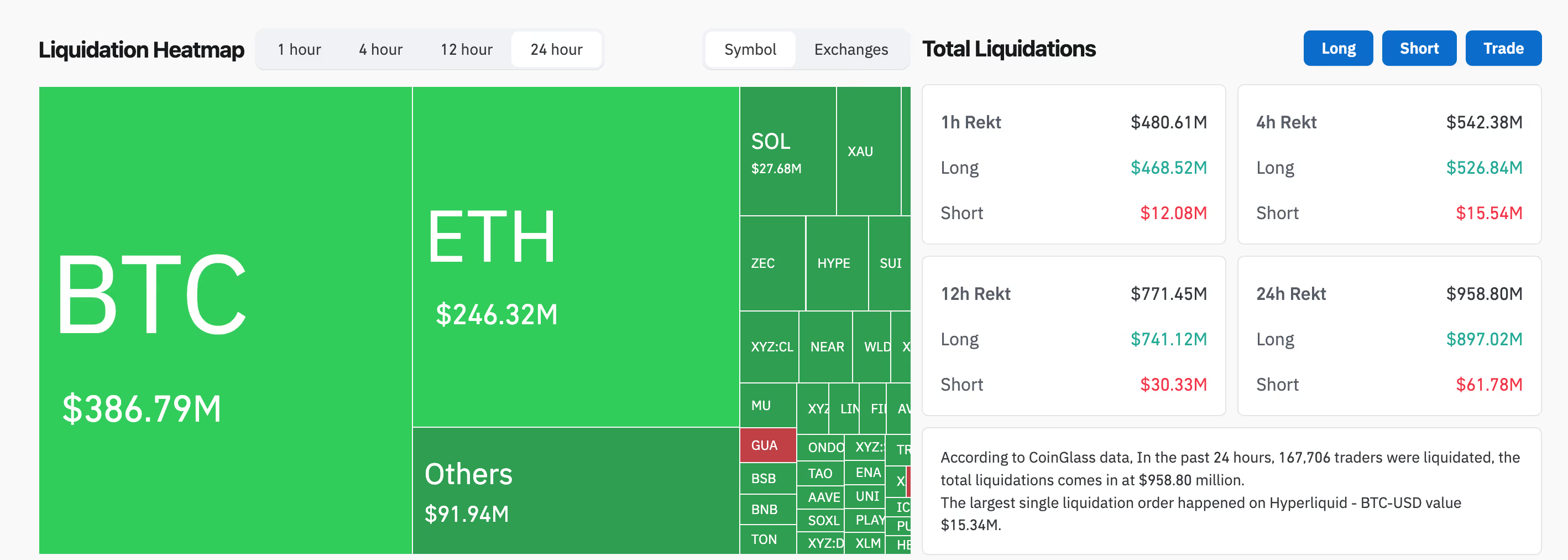
The drop flushed leveraged traders. CoinGlass data shows $958.8 million in total liquidations over 24 hours across 167,706 traders, with $897 million coming from long positions and $61 million from shorts.
Bitcoin liquidations led at $386 million, followed by ether at $246 million, with the largest single liquidation order was a $15.34 million BTC position on Hyperliquid.

A 93% long-skew on a near-billion-dollar flush is what happens when traders are positioned for a recovery and the market moves the other way. The leverage built up through the mid-May range got cleared in a single session.
The trigger came from the Middle East. U.S. Central Command carried out airstrikes on an Iranian military site near the Strait of Hormuz and shot down four one-way Iranian attack drones fired at a commercial ship, with a U.S. official describing the action as defensive and aimed at maintaining the ceasefire that began last month.
The U.S. Treasury imposed new sanctions on Iran’s Persian Gulf Strait Authority, accusing it of extorting vessels transiting the strait. Iran targeted the American airbase the strikes originated from, according to a report citing the Islamic Revolutionary Guard Corps.
Kuwait said it was responding to hostile missile and drone threats, with its army warning that explosions heard in the country were air defense systems intercepting targets.
President Donald Trump said no single nation would control the waterway. “It’s international waters,” Trump told a cabinet meeting at the White House. “The strait’s going to be open to everybody,” adding that the U.S. would “watch over it.”
Risk assets fell across the board. The MSCI All Country World Index retreated 0.4% from a record high, a gauge of Asian shares dropped 1.7%, and futures for the S&P 500 and Nasdaq 100 pointed lower. Oil climbed as the strikes clouded the outlook for a deal to reopen the strait.
The reaction shows how quickly the ceasefire optimism that had been building unwound. Crypto had held its range through several weeks of Iran headlines, with bitcoin staying above $74,000 even as ETF demand cooled. Thursday’s strikes broke that floor, and the speed of the liquidation cascade suggests traders were caught leaning the wrong way.

This City plans housing and business scheme at ‘derelict’ site in Manchester’s Northern Quarter

The UFO Capital of America Has a Bitcoin Wallet: Did Aliens Buy BTC?

Robert Pattinson Channels Chris Hansen In ‘Primetime’


-

 Crypto World6 days ago
Blockchain.com files with SEC for U.S. IPO
-

 Fashion5 days ago
Holiday Weekend Open Thread – Corporette.com
-

 Crypto World6 days ago
Bitcoin Accumulation Weakens as BTC Realized Losses Hit $600M
-

 Tech3 days ago
Microsoft’s quiet Claude Code retreat and the real cost of enterprise AI
-

 Business6 days ago
Dell Technologies DELL Stock Surges 15% on AI Server Momentum and Analyst Upgrades in 2026
-

 Crypto World5 days ago
Robinhood crypto COO Tanya Denisova exits
-

 Business3 days ago
NYT Strands Answers May 24 2026 Revealed for Puzzle No. 812 Theme Summer Essentials
-

 Politics5 days ago
Makerfield: a tale of two social-media histories
-

 Crypto World6 days ago
Space X IPO Is ‘Bad News’ for Tech Stocks: But What About Bitcoin?
-

 Business6 days ago
Trump Invests $1M-$5M in Kura Sushi USA Chain With 27 California Locations
-

 Tech6 days ago
WhatsApp ads could make Irish debut after discussions with DPC
-

 Crypto World6 days ago
MicroStrategy’s Saylor Says Miners No Longer Set Bitcoin Price, Another Force Has Taken Over
-
Tech17 hours ago
The Samsung pay deal is the moment Korean unions changed register
-
 NewsBeat7 days ago
Charity run by Reform leader Malcolm Offord accused of ‘law breaking’ over Scottish registration
-
 Tech6 days ago
A 0.12% parameter add-on gives AI agents the working memory RAG can’t
-

 Crypto World6 days ago
AI infrastructure race heats up as IREN pitches full-stack strategy, WhiteFiber lands $160M deal
-
 Crypto World3 days ago
Nvidia (NVDA) CEO Calls on Super Micro to Strengthen Export Controls Amid Smuggling Probe
-

 Tech6 days ago
You Can Now Add ChatGPT To PowerPoint
-

 Tech3 days ago
Westone Audio and Etymotic Acquired by Fidelity Collective in Major IEM Market Move
-

 Sports6 days ago
2026 CJ Cup Byron Nelson leaderboard: Brooks Koepka finds putting stroke in Round 1
You must be logged in to post a comment Login