

Crypto World
Minnesotan banks and credit unions set to provide crypto custody August 1



Minnesota established the midwest’s first unified digital asset safety net for banks and credit unions.



Coinbase used blockchain forensics to help UK law enforcement secure five criminal convictions tied to a violent kidnapping. Its Global Intelligence team traced stolen funds onchain in real time as the attack unfolded.
The case began last July, when a 36-year-old Hertfordshire man met four strangers at a Shoreditch bar in east London. They later forced him home and coerced him into opening several accounts, including Coinbase.
Coinbase Blockchain Forensics Traced Stolen Funds
When the attackers tried to move funds off the platform, Coinbase’s internal systems reportedly flagged the customer as under duress.
The exchange contacted UK police while the crime was still in progress, then mapped the flow of stolen assets.
Investigators traced £1,900 ($2,500) in crypto plus additional fiat across multiple wallets. They linked one address to a suspect who held a Coinbase account. Data and expert testimony were presented to St Albans Crown Court.
Four defendants were convicted of conspiracy to rob, kidnapping, and false imprisonment. A fifth was convicted of money laundering. The Hertfordshire Major Crime Unit led the local investigation.
“Our investigations team worked with UK law enforcement to successfully track and convict five individuals involved in crypto-related kidnapping. Blockchains allowed us to spot and trace their actions in real time as it was happening,” said Paul Grewal, Coinbase Chief Legal Officer.
Follow us on X to get the latest news as it happens
The verdict lands as physical crypto kidnappings and wrench attacks continue to rise.
CertiK documented 34 verified physical attacks on token holders between January and April 2026. London has emerged as a hotspot for muggings targeting wallet apps.
The convictions add to a growing record of blockchain forensics work, tying public ledgers to criminal prosecutions. Exchanges are leaning on this defense as crypto-related violence climbs.
The post Coinbase Blockchain Forensics Help UK Convict 5 in Crypto Kidnapping Case appeared first on BeInCrypto.


Payward, Kraken’s parent, grew Q1 2026 adjusted revenue 3% to $507m as derivatives jumped 51%, even while Bitcoin, market cap and spot volumes all saw steep double‑digit drops.
Summary
- Payward, Kraken’s parent, reported Q1 2026 adjusted revenue of $507 million, up 3% year-on-year despite a sharp crypto market downturn.
- Derivatives were the standout, with daily average revenue trades surging 51% on the back of NinjaTrader, Breakout and expanded futures activity.
- Kraken’s spot market share climbed from roughly 3.5% in mid-2025 to 5.2% in March 2026, while funded accounts rose 47% year-on-year to 6.1 million and platform assets hit $40 billion.
Kraken parent Payward has posted Q1 2026 adjusted revenue of $507 million, a 3% increase from a year earlier, even as Bitcoin, total crypto market capitalization and industry spot volumes all suffered double-digit declines, according to CoinDesk. During the quarter, Bitcoin fell 22%, overall crypto market cap slid 23% and spot trading volume across the industry dropped 38%, underscoring how unusual it is for a major exchange group to grow topline in that environment.
Payward grows through a brutal quarter for crypto
The outperformance was driven in large part by derivatives, where Payward’s futures business saw daily average revenue trades jump 51% year-on-year. Management attributed that surge to the expansion of NinjaTrader and Breakout, as well as the broader build-out of Kraken’s derivatives franchise, which is increasingly offsetting cyclicality in spot trading.
Despite the revenue growth, adjusted EBITDA declined to $18 million in the quarter as the company leaned into spending. Payward said it is deliberately prioritizing mergers and acquisitions, product development and regulatory infrastructure over near-term profitability, characterizing the current bear-market stretch as the right time to invest.
Market share gains and user growth
The company’s strategic push appears to be translating into real market-share gains. Payward disclosed that Kraken’s spot market share has climbed from about 3.5% in mid-2025 to 5.2% in March 2026, a meaningful jump in a market where incremental share is typically hard-won.
User metrics are also moving sharply higher: the number of funded accounts on Kraken grew 47% year-on-year to 6.1 million in Q1 2026, while total client assets on the platform rose to $40 billion. Co-CEO Arjun Sethi framed that performance as validation of the firm’s long-term strategy, saying, “While other companies choose to contract, we choose to continue investing.”
That stance stands in contrast to rivals that have cut headcount, scaled back product lines or pulled out of tougher regulatory jurisdictions over the past year. If the derivatives momentum and market-share gains continue, Payward’s decision to endure thinner EBITDA today in exchange for deeper global footprint and more diversified revenue streams could leave Kraken better positioned when the next upcycle in crypto volumes arrives.


Revolut launched its first physical crypto card on May 18, a Dogecoin-themed LED card for the UK and EEA.
Summary
- Revolut unveiled its first physical crypto card with a Dogecoin theme and LED display, usable anywhere Visa and Mastercard are accepted.
- The card links to users’ crypto balances and converts holdings to fiat at real-time exchange rates, with no additional exchange fees charged on purchases.
- The launch follows Revolut’s full UK banking licence in March 2026 and FCA approval last week for leveraged investment products and private wealth services.
Revolut announced on May 18 that it is launching its first physical crypto card, a Dogecoin-themed debit card with an LED display that illuminates at the point of payment. The card works anywhere Visa and Mastercard are accepted, with an initial rollout in the UK and EEA.
The firm said there are no additional exchange fees on crypto payments, though transactions are subject to real-time exchange rates at the point of purchase and may create tax obligations depending on local rules. Revolut converts users’ crypto to fiat automatically at checkout, meaning merchants receive standard settlement currency without touching digital assets directly.
Revolut crypto card takes crypto to checkout
The physical card links to users’ crypto balances and handles the conversion in the background. That removes the primary friction point that has kept crypto spending separate from everyday consumer finance: the need to manually convert before each purchase. Spending limits include a £100,000 cap per transaction and a maximum of 100 exchanges within any 24-hour period.
As crypto.news reported just days earlier, Revolut also secured FCA permissions for leveraged investment products, discretionary portfolio management, and advisory services.
The crypto card launch sits within a broader regulatory and product expansion that also includes its full UK banking licence received in March 2026 and a US banking charter application filed the same month. Revolut serves over 70 million users globally.
What the card means for crypto mass adoption
Revolut’s distribution scale is the headline fact here. As crypto.news documented in its crypto cards guide, consumer appetite for crypto-linked debit products has grown steadily in 2026 alongside regulatory clarity. Adding a physical card to a 70-million-user platform creates a potential mass adoption vehicle that most crypto-native card products have lacked.
The company’s earlier US banking licence application signals the card will eventually expand beyond the UK and EEA, potentially bringing crypto spending to one of the world’s largest consumer markets.
Tax treatment remains the main practical barrier: crypto payments are taxable sale events in most jurisdictions, meaning frequent spenders need clear record-keeping infrastructure to manage cost basis and gains.
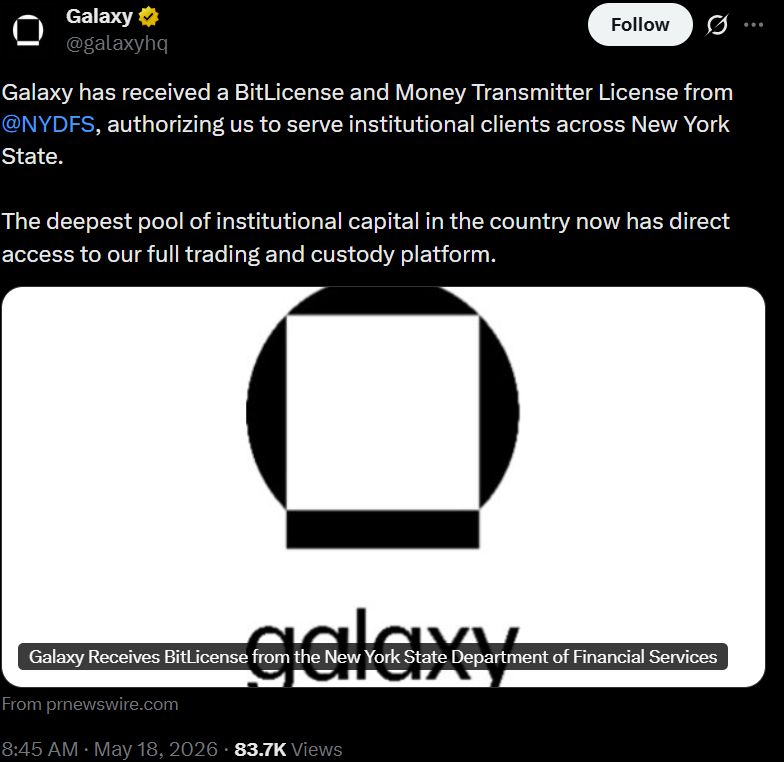
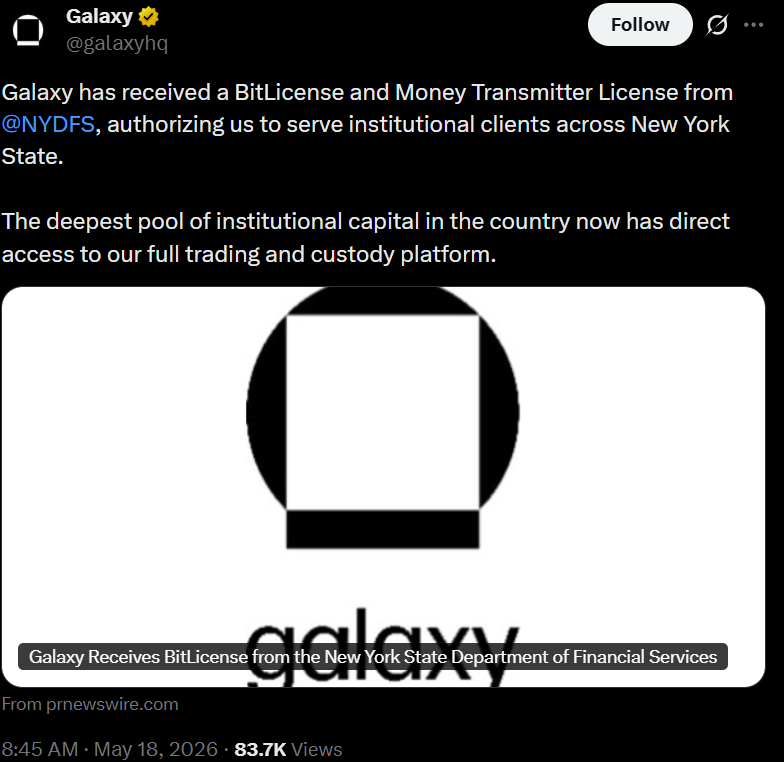
Galaxy Digital, a crypto-focused financial services company led by Mike Novogratz, has received a BitLicense and Money Transmission License from the New York State Department of Financial Services (NYDFS), allowing it to expand regulated digital asset services to institutional clients in the state.
The company said Monday that the approvals were granted to its subsidiary, GalaxyOne Prime NY, which provides trading and financing services to institutional investors.
The licenses extend Galaxy’s regulatory reach into New York, one of the most tightly regulated jurisdictions for cryptocurrency businesses in the United States.
In a statement, Novogratz said New York represents the “deepest pool of institutional capital in the country,” and that the approvals will help broaden institutional access to digital assets.
Introduced in 2015, New York’s BitLicense is widely considered one of the most difficult regulatory approvals for crypto companies to obtain because it requires extensive compliance controls related to anti-money laundering, cybersecurity, capital reserves and consumer protection.
Source: Galaxy
As Cointelegraph recently reported, Jack Mallers’ Strike was among the latest high-profile crypto companies to receive approval from the NYDFS, allowing the firm to offer Bitcoin services to residents and businesses in the state.
Related: Crypto funds see $1B in outflows as Iran tensions revive risk-off sentiment
Galaxy posts Q1 loss as data center business expands
The regulatory milestone comes as Galaxy continues to navigate a volatile digital asset market. The company last month reported a net loss of $216 million in the first quarter ended March 31, driven largely by lower digital asset prices, though the result was better than analyst expectations.
Gross revenue totaled $10.2 billion for the quarter, down from $12.9 billion in the same period a year earlier.
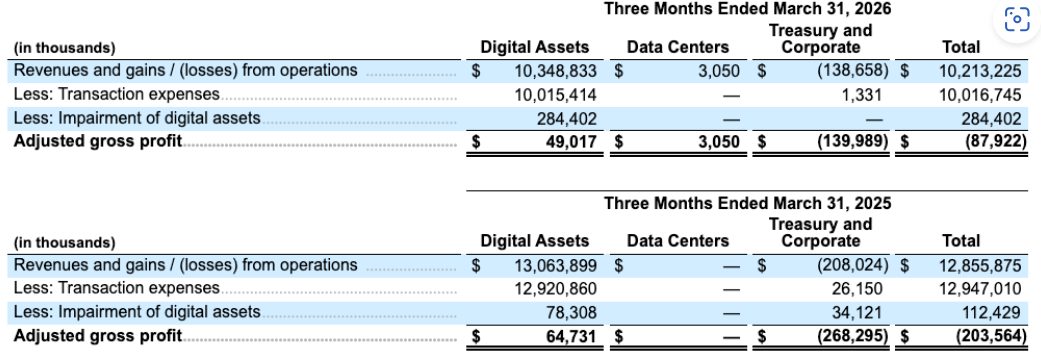
Galaxy’s Q1 2026 financial statement. Source: Galaxy
According to its Q1 earnings report, Galaxy expects growth to accelerate beginning in the current quarter as revenue from its data center business increases.
Like several other companies in the digital asset industry, Galaxy has expanded beyond cryptocurrency trading and investing into data center infrastructure. The company said future growth will be supported by its Helios Data Center campus in Texas and revenue tied to artificial intelligence and high-performance computing workloads.
Related: Galaxy, Sharplink plan $125M institutional DeFi yield fund backed by ETH treasury
Kevin Warsh is set to be sworn in as the next chair of the US Federal Reserve Board of Governors on Friday amid speculation about whether he’ll do what US President Donald Trump hopes he does: Lower interest rates once in office.
On Wednesday, the US Senate voted largely along party lines to confirm Warsh as the next Fed chair, succeeding Jerome Powell. While Trump nominated both Fed governors in different terms, the president repeatedly threatened to fire Powell in recent months, saying that the Fed chair “should be lowering interest rates.”
Source: Kalshi
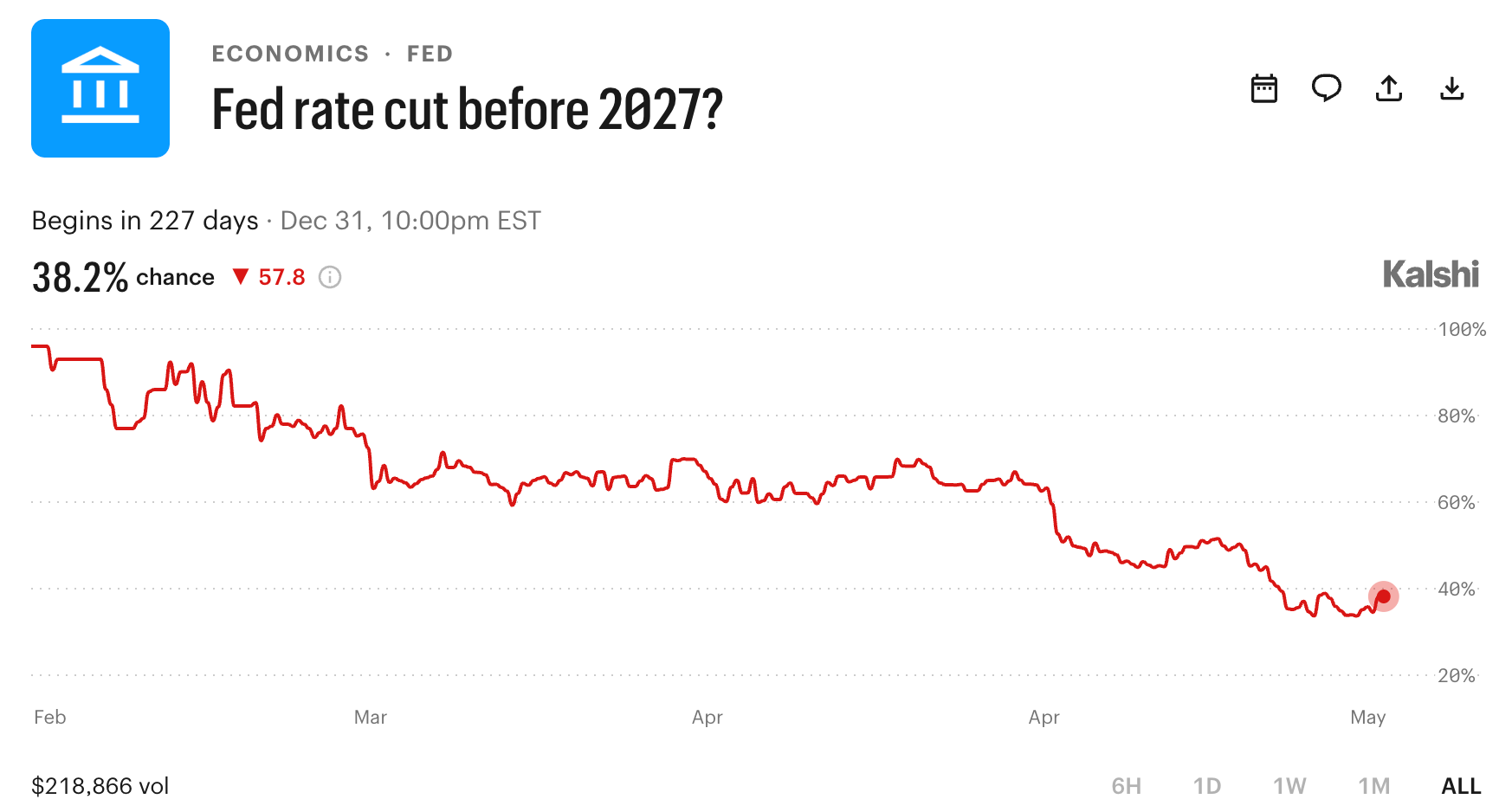
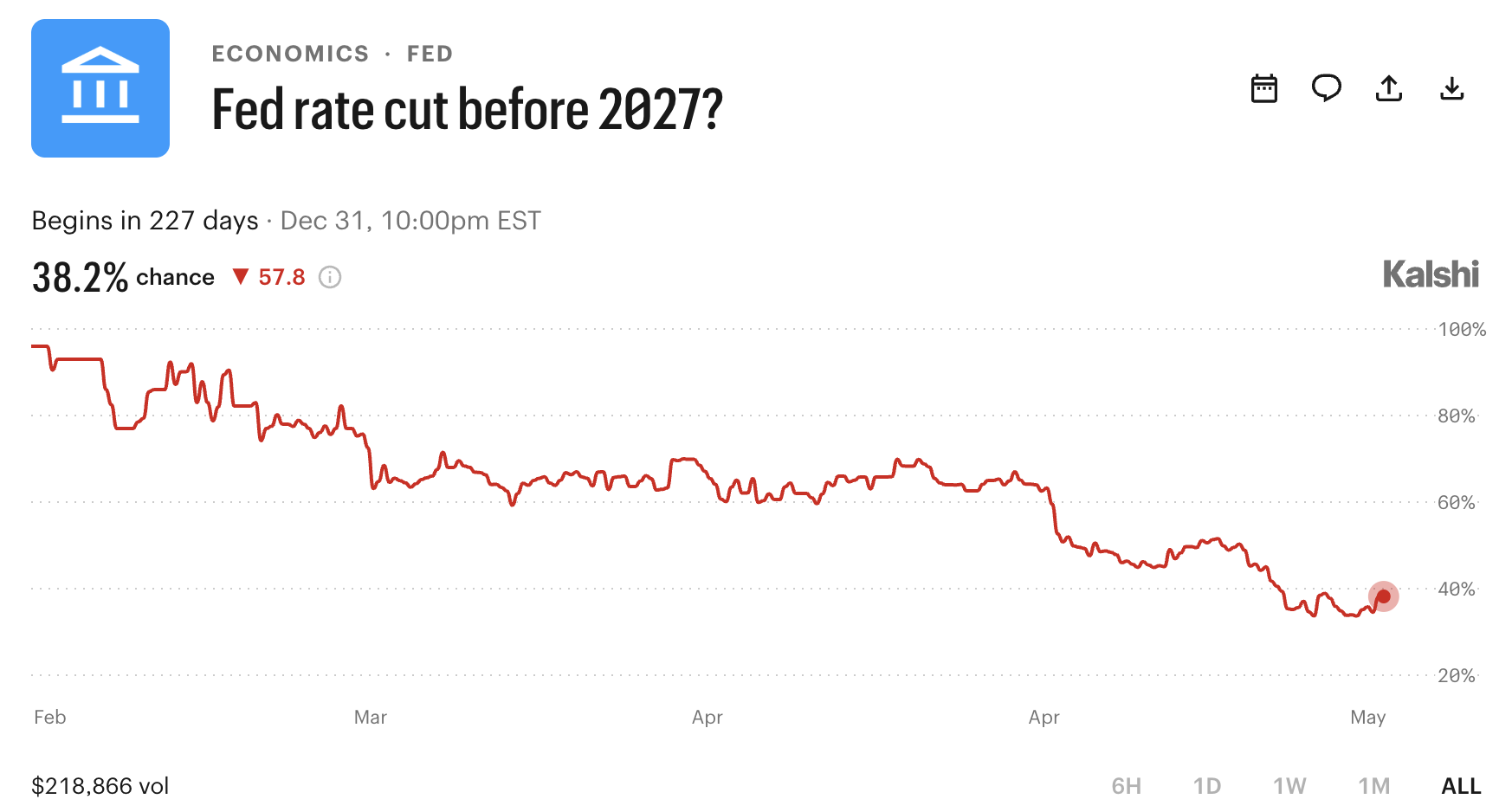
With Warsh expected to assume his role as Fed chair on Friday, prediction market platforms like Kalshi are offering users 38.2% chances on event contracts betting that the central bank will lower interest rates before 2027, dropping from 96% in February. In contrast, CME FedWatch shows a 98.8% probability that the Fed would not change its interest rates, currently at 3.50% to 3.75%, until the end of June, with a more than 94% chance of the same through July.
As Fed chair, Warsh will have significant influence in helping policy makers determine federal interest rates. With Powell, Trump repeatedly called for the Fed chair to cut rates on social media and said in April he would be disappointed if Warsh didn’t immediately move to do the same if confirmed. The next meeting of the Federal Open Market Committee, at which interest rates could be changed, is scheduled for June 16.
Related: Bitcoin, stocks risk ‘months’ of losses as Kevin Warsh Becomes Fed chair
At Warsh’s confirmation hearing in the Senate Banking Committee, Massachusetts Senator Elizabeth Warren said confirming him could result in the Fed “granting special accounts to [the Trump family’s] crypto company or bailouts to his friends on Wall Street if they get into trouble.” Warsh disclosed more than $100 million in assets ahead of the April hearing, including investments in AI and crypto companies.
US lawmakers awaiting CFTC nominations
With Warsh set to be sworn in on Friday, lawmakers are still looking to Trump to announce nominations for the US federal commodities regulator, the Commodity Futures Trading Commission (CFTC).
Since December, the CFTC has been led solely by Trump’s pick Michael Selig, who took over from acting chair Caroline Pham. The federal regulator has since taken a strong position on attempting to exclusively oversee prediction markets platforms like Kalshi and Polymarket amid US state authorities filing lawsuits against the companies over sports betting.
On Friday, the Republican and Democratic leaders of the House Committee on Agriculture called on Trump to “nominate a full panel” of CFTC commissioners, citing “urgent regulatory issues.” Specifically, the lawmakers voiced concerns about CFTC rulemaking if the Digital Asset Market Clarity Act (CLARITY), a bill to establish market structure for cryptocurrencies, became law.
Magazine: ETH stalls at $2.4K five times, SOL to rally to $120: Market Moves
Crypto World
Coinbase Lands Hyperliquid Stablecoin Role Eight Months After Governance Vote Picked Native Markets


Native Markets is selling its brand assets to Coinbase as USDC becomes the protocol’s canonical quote asset.


The Japanese bond market is facing strain not seen in decades. A renowned warns of a possible global domino effect that would impact yields, currencies and credit around the world.
In that scenario, XRP emerges as an unexpected tool to release trapped liquidity.
Why the Japanese Bond Crisis Worries the World?
The bond market is where governments and companies finance themselves by issuing debt. When yields rise, money becomes more expensive and financial stress increases across mortgages, credit and risk assets at a global level.
Japan is living a historic strain. The 30-year bond surpassed 4% for the first time since its creation in 1999, reaching levels close to 4.2% in May 2026. The 10-year bond hovers near highs not seen since the late 1990s.
Follow us on X to get the latest news as it happens
Analyst Catalina Castro raised the alarm about the situation in a post that sparked wide debate. According to her analysis, Japan, the main creditor of the United States, faces a panic scenario that could trigger massive sales of Treasury bonds.
The data backs part of her view. Japanese investors sold close to 29.6 billion dollars in US debt during the first quarter of 2026, the largest quarterly sale recorded since 2022.
The backdrop is the unwinding of the “yen carry trade.” For decades, Japan’s ultra-low rates allowed borrowing cheap yen to fund higher-yield assets. The Bank of Japan’s rate hikes are now dismantling that global flow.
“[…] Domino effect: Japan sells American bonds → American yields RISE further → mortgages rise → credit becomes more expensive → pressure on the ENTIRE American financial system. The stress on Japanese bonds BECOMES stress on American bonds. And we are already seeing it: the 30-year US Treasury bond reached 5% this week,” Castro explained on X (formerly Twitter).
How XRP Could Ease the Liquidity Strain?
The international financial system depends on nostro and vostro accounts. Banks keep prefunded funds in foreign currencies for cross-border operations, money that remains immobilized and does not circulate in the real economy.
It is estimated that between 27 and 37 trillion dollars remain parked in these accounts globally. When yields rise and money becomes more expensive, liquidity problems worsen significantly for the entire financial system.
This is where Ripple’s technology comes in. Its On-Demand Liquidity solution uses XRP as a bridge asset for real-time cross-border settlements. A bank converts local currency to XRP, transfers it and exchanges it to the destination currency in seconds.
This model eliminates the need for prefunded accounts and extensive intermediaries. According to Castro, it could release a significant portion of the trapped liquidity, redirecting it toward productive investment, loans or sovereign bond purchases.
“In theory, a bank sends its local currency, it’s converted to XRP/stablecoins/CBDCs in seconds, and then to the currency of the receiving bank. No intermediaries. No pre-funded accounts. That RELEASED liquidity can return to the productive system: to buy bonds, to lend, to invest. That’s the difference between a system that TRAPS liquidity and one that RELEASES it,” the analyst emphasized.
Ripple’s pilots show concrete results. They have demonstrated cost savings of between 40% and 70% and settlements in minutes, compared to the days required by traditional systems like SWIFT in international transfers.
Mass adoption, however, depends on pending factors. Regulatory clarity and institutional trust remain the main obstacles for this technology to scale within the traditional global financial system today.
What to Expect in the Coming Months?
The situation in Japan underlines the interconnected fragility of markets. It is not just an Asian problem, but a systemic risk that affects yields, currencies, credit and risk assets all over the world.
Investors are closely watching the next moves of the Bank of Japan. An escalation in Japanese yields or a greater repatriation of capital could intensify volatility in global markets during the coming months.
In parallel, the debate over modernizing financial infrastructures is gaining strength. Blockchain-based innovations like Ripple’s gain relevance as a path toward building a more resilient and efficient system.
Subscribe to our YouTube channel to watch leaders and journalists provide expert insights
The post Japanese Bond Crisis Triggers Global Alarm: Analyst Highlights XRP’s Key Role appeared first on BeInCrypto.

The crypto-focused financial services firm Galaxy Digital, led by Mike Novogratz, has secured both a BitLicense and a Money Transmitter License from the New York State Department of Financial Services (NYDFS) through its subsidiary GalaxyOne Prime NY. The licenses authorize Galaxy to expand regulated digital asset services for institutional clients within New York, marking a meaningful step in the company’s regulatory footprint in one of the most scrutinized crypto markets in the United States.
Galaxy said in a Monday release that approvals were granted to GalaxyOne Prime NY, which provides trading and financing services to institutional investors. Novogratz characterized New York as “the deepest pool of institutional capital in the country,” and said the approvals would broaden institutional access to digital assets. The BitLicense framework, introduced in 2015, is widely regarded as one of the most demanding regulatory regimes for crypto firms, requiring comprehensive controls across anti-money laundering, cybersecurity, capital reserves, and consumer protection.
As Cointelegraph recently reported, Strike’s NYDFS approval placed another high-profile crypto business within the state’s regulated framework, underscoring a growing emphasis on compliance and supervision in New York’s crypto ecosystem.
Key takeaways
- Galaxy Digital secures BitLicense and Money Transmitter License for GalaxyOne Prime NY, enabling regulated digital asset trading and financing services to institutional clients in New York.
- The licenses extend Galaxy’s regulatory footprint in a jurisdiction known for rigorous compliance standards, including AML/KYC, cybersecurity, capital reserves, and consumer protections.
- The development aligns with Galaxy’s broader diversification into data-center infrastructure, beyond traditional trading and investing activities.
- Galaxy reported a first-quarter net loss of $216 million with gross revenue of $10.2 billion, reflecting industry volatility, while signaling expected growth from its data-center business in the coming quarters.
- The NYDFS licensing pathway remains a critical gatekeeper for institutional participants and may influence how other crypto firms approach US market access and cross-border operations.
Regulatory milestone in a tightly regulated market
New York’s BitLicense is widely recognized as a stringent gateway to offering virtual currency services within the state. Beyond mere registration, firms must demonstrate robust compliance programs spanning anti-money laundering and cybersecurity, maintain appropriate capital reserves, and implement consumer-protection measures. The approval of GalaxyOne Prime NY signals not only a green light for Galaxy’s institutional clientele but also a benchmark for the level of oversight the firm will operate under in one of the most demanding regulatory environments in the United States.
The licensing decision reflects a broader pattern in which crypto firms seek to anchor operations in jurisdictions with clear, enforceable standards that can reassure institutions and counterparties. In New York, where financial services regulation is among the most developed in the crypto space, obtaining a BitLicense and related licenses is interpreted as a signal of legitimacy and operational readiness for high-volume, institution-grade activity.
Strategic expansion beyond trading and investing
Galaxy’s regulatory clearance comes amid a deliberate corporate strategy to broaden its asset and infrastructure footprint. In its Q1 earnings materials, Galaxy noted progress in expanding data-center capabilities as part of a planned growth axis alongside digital-asset trading and financing. The company points to its Helios Data Center campus in Texas as a key driver of future revenue, with revenue streams anticipated to be connected to artificial intelligence and high-performance computing workloads.
This shift mirrors a broader industry move where crypto firms are leveraging modern data-center capabilities to monetize energy- and compute-intensive workloads, including AI and HPC tasks, alongside traditional digital-asset activities. Galaxy has framed the data-center expansion as a means to sustain longer-term growth in a market characterized by cyclicality in asset prices and trading volumes. The company’s strategy aligns with expanding demand for regulated, institution-ready operational capabilities that can support both digital-asset markets and enterprise-grade compute workloads.
In a separate context, Galaxy has been involved in collaboration and product development that signals continued diversification beyond trading and custody. The company’s broader ecosystem includes institutional yield initiatives and DeFi-related offerings backed by crypto assets, demonstrating a deliberate attempt to diversify revenue streams and reduce reliance on price-driven trading performance.
Financial performance and forward-looking outlook
Galaxy’s first-quarter results highlighted the ongoing volatility in the digital-asset sector. The firm reported a net loss of $216 million for the quarter ended March 31, with gross revenue totaling $10.2 billion, down from $12.9 billion in the prior-year period. The quarterly results underscored the sensitivity of the business to crypto price cycles and market conditions, even as the firm pursued diversification into data-center infrastructure and related compute workloads.
Management indicated that growth momentum is expected to materialize as the data-center segment scales, with the Helios campus in Texas positioned to contribute meaningfully to revenue in the current and upcoming quarters. The company’s outlook suggests a bifurcated path: continued volatility in core crypto markets paired with the potential uplift from infrastructure-driven revenue streams, including AI- and HPC-related workloads. Investors and analysts will be watching how regulatory clarity and the broader policy environment influence Galaxy’s ability to monetize its data-center assets and any associated institutional offerings.
Notably, the regulatory environment in the United States remains a central factor for institutional players seeking to engage in regulated digital-asset activity. The NYDFS licensing pathway is often cited as a practical barrier to entry—one that can deter less prepared operators while signaling to counterparties that a firm has instituted robust compliance and governance frameworks. In this context, Galaxy’s approvals may facilitate more structured, compliant access for NY-based institutions seeking exposure to regulated digital-asset services, while potentially shaping competitive dynamics among large-cap players pursuing U.S. market access.
Beyond domestic licensing, observers note the broader regulatory discourse surrounding crypto assets in North America and Europe. While MiCA and other EU frameworks aim to standardize operations across member states, U.S. policy remains fragmented across federal and state levels. The industry’s emphasis on licensing, supervision, and consumer protections persists, with NYDFS serving as a prominent reference point for what constitutes enterprise-grade compliance in a regulated market environment.
According to Galaxy, the licensing milestone is a step toward deeper institutional participation in regulated digital assets, aligning with a broader industry push to ensure that market infrastructure keeps pace with demand from banks, asset managers, and other regulated entities seeking compliant exposure to crypto assets.
Closing perspective: the path ahead for Galaxy and its peers will hinge on the evolution of the regulatory regime, the pace of data-center-driven revenue growth, and the ability to maintain robust risk controls across trading, financing, and compute-intensive operations. As the market navigates ongoing cycles of volatility and policy developments, institutional-grade readiness and disciplined execution in both digital-asset and infrastructure lines will be decisive in determining long-term resilience and growth.


Shiba Inu saw billions of SHIB hit exchanges on May 18 as crypto market liquidations accelerated.
Summary
- Over 3 billion SHIB tokens were pushed onto exchanges on May 18, raising sell-side pressure as broader crypto market liquidations accelerated.
- CoinGlass data shows SHIB open interest at $61.2 million with $42,485 in futures positions liquidated in the 24-hour session ending May 18.
- SHIB was trading at $0.00000567 on May 18, down roughly 10% on the week and 54% over the past year.
On-chain exchange flow data tracked by CoinGlass shows SHIB open interest at $61.2 million on May 18, with $42,485 in futures positions liquidated in the 24-hour session. The inflow spike coincided with wider crypto market liquidations as leveraged long positions were unwound across multiple assets.
SHIB was trading at $0.00000567 at time of writing, down roughly 10% on the week. The token is 54% lower over the past 12 months and well below its all-time high of $0.00008616.
Exchange reserve data showed assets on Binance alone reaching 61.8 trillion tokens, a marked rise since March as profit-takers moved holdings onto platforms ahead of potential distribution.
Shiba Inu inflows signal rising sell pressure
Tokens moved onto exchanges are one step from the open market and available for immediate liquidation. The spike in SHIB inflows creates a mechanical increase in available sell-side supply, which typically suppresses price during periods of weak demand.
As crypto.news reported, institutional and whale-level SHIB transactions surged 111% earlier in 2026, indicating large holders are actively repositioning rather than holding passively.
Meme coins have faced persistent pressure throughout 2026. Bitcoin’s 22% decline in Q1 tightened conditions across speculative assets, with SHIB bearing the brunt alongside other high-beta tokens. The token’s 589 trillion circulating supply gives it limited leverage from burn activity, as individual whale distribution events can rapidly absorb months of supply reduction.
What SHIB needs to stabilise
Stabilisation requires demand to absorb incoming supply rather than sellers finding a thin order book. As crypto.news noted in its Shibarium upgrade analysis, on-chain adoption remains uneven and without acceleration in utility metrics, upside moves in SHIB continue to struggle.
A Fully Homomorphic Encryption upgrade planned for Q2 2026 through cryptography firm Zama could add a privacy dimension, but near-term price action depends on whether these exchange inflows reverse.
The broader context for meme coin behaviour in 2026 was covered by crypto.news in its analysis of how on-chain activity spikes often precede continued downside rather than reversals.


Aave has restored WETH loan-to-value ratios on Ethereum, Arbitrum, Base, Mantle, and Linea, re-enabling borrowing against the asset following a technical incident.

Google I/O 2026 Live Updates: Latest News on Android 17 and Gemini

E-scooter stolen from outside Sports Direct in Scarborough

Coinbase Blockchain Forensics Help UK Convict 5 in Crypto Kidnapping Case

Manchester United reach agreement with Casemiro over contract clause amid transfer speculation

US brings back mandatory military draft registration

Steven Gerrard disagrees with Gary Neville over ‘shock’ Chelsea and Arsenal claim | Football


-

 Crypto World3 days ago
BloFin War of Whales 2026 Grand Prix opens registration for $5M trading championship
-

 Fashion3 days ago
Weekend Open Thread: Theory – Corporette.com
-

 Crypto World3 days ago
E-Estate Announces 1 Year Live: Washington DC Summit as Real Estate Tokenization Enters Its Next Phase
-

 Tech4 days ago
Tech Moves: Microsoft AI leader jumps to OpenAI; former AI2 exec joins Meta; and more
-
Crypto World6 days ago
Bitcoin Suisse expands with Digital Asset License and Investment Business Act Registration Approval in Bermuda
-

 Politics6 days ago
Pakistan to enter Chinese capital market as war inflation bites
-

 Crypto World6 days ago
Bitcoin Suisse expands with Digital Asset License and Investment Business Act Registration Approval in Bermuda
-
 Crypto World4 days ago
Google’s Gemini AI Predicts Incredible Solana Price by the End of 2026
-

 Business3 days ago
H&R Real Estate Investment Trust (HR.UN:CA) Q1 2026 Earnings Call Transcript
-

 Tech3 days ago
Google reimburses Register sources who were victims of API fraud
-

 Sports3 days ago
Napoleonic enters 2026 Doomben 10,000 field via Abounding withdrawal
-

 NewsBeat6 days ago
Comment on Keir Starmer surviving the day as Prime Minister like a turd that wont flush
-

 Fashion6 days ago
The Best-Kept Makeup Secret for a More Defined Face
-
 Entertainment4 days ago
Zara Larsson Has Blunt Response To Chris Brown Diss
-

 Politics6 days ago
The Trial of Majid Freeman, Verdict
-
 Tech6 days ago
Why AI is making typography a boardroom conversation
-

 Politics6 days ago
Palestine’s flag becoming a regular sight at European football stadiums
-

 Crypto World6 days ago
Senate Approves Kevin Warsh to Federal Reserve Board Seat
-
 Crypto World5 days ago
Two AI Tokens Lead May Rally, But Risks Are Rising
-

 Entertainment7 days ago
Insides Reveal Taylor Swift’s Wedding Gown Chaos With 6 Dresses
You must be logged in to post a comment Login