

Crypto World
NEAR price climbs amid 32% volume spike: what’s the near-term outlook?



- NEAR price surged to $1.66 amid a notable volume spike.
- AI tokens bounced sharply, including Injective, Theta Network, and Akash Network.
- The near-term outlook for NEAR suggests a retest of $2 if momentum holds.
NEAR Protocol (NEAR) has traded higher in the past 24 hours as bulls eye near-term gains.
The uptick for the artificial intelligence-related token aligned with a broader AI tokens surge on Tuesday, with NEAR seeing a notable rise in trading activity.
NEAR price gains amid 32% spike in daily volume
NEAR is trading at $1.62, up about 7% over the past 24 hours and roughly 4% higher on the weekly chart despite Monday’s brief plunge beneath $1.50.
The price appreciation coincides with a 32% surge in daily volume, with intraday action putting the metric at $295 million as of writing.

Notably, that spike in activity has allowed NEAR to outpace many peers as the broader market navigates renewed downside pressure.
Likely, rotation into projects tied to on-chain compute and decentralized application ecosystems is driving the uptick.
The bounce in AI-related tokens provided additional strength to Injective, Theta Network, and Akash, each of which delivered gains of more than 5% in the past 24 hours.
Render also showed signs of eyeing a retest of a critical resistance level.
Crypto AI is trading up ahead of Nvidia’s first-quarter earnings results.
The industry heavyweight will report on May 20, and tokens across crypto are up amid broader anticipation.
Nvidia’s CEO Jensen Huang recently traveled to China with President Trump, with the US president meeting Chinese President Xi Jinping in a key summit.
NEAR price prediction
Technical indicators suggest a short-term bullish bias for NEAR.
On the daily chart, price action is forming what appears to be a cup-and-handle pattern.
This is a consolidation structure that often precedes continuation to the upside if the handle resolves on renewed volume.
NEAR also currently trades above major moving averages, an arrangement that typically favors buyers. But that’s not all.
Momentum metrics bolster the constructive outlook, with the average directional index (ADX) on the daily frame pointing to a strengthening trend.
Elsewhere, the relative strength index (RSI) sits near 64, indicating momentum with room for further appreciation before reaching overbought territory.
The Awesome Oscillator and MACD indicators both show bullish readings that align with a buying opportunity in the near term.
Price targets and risk levels
If bullish conditions persist, NEAR could extend above the $1.70 level.
Near-term upside targets would be in the $2.00 to $2.50 range, should volume maintain its recent lift and the cup-and-handle pattern get validated.
On the flipside, the initial support band lies around $1.50. The region marks a key consolidation zone, below which could be $1.20.

Bitcoin has climbed above the $64,000 level after U.S. President Donald Trump confirmed that the United States has agreed to continue talks with Iran following a new request from Tehran.
Summary
- Trump confirmed the U.S. will continue talks with Iran after a new request from Tehran.
- Bitcoin climbed above $64,000 as markets reacted positively to the diplomatic update.
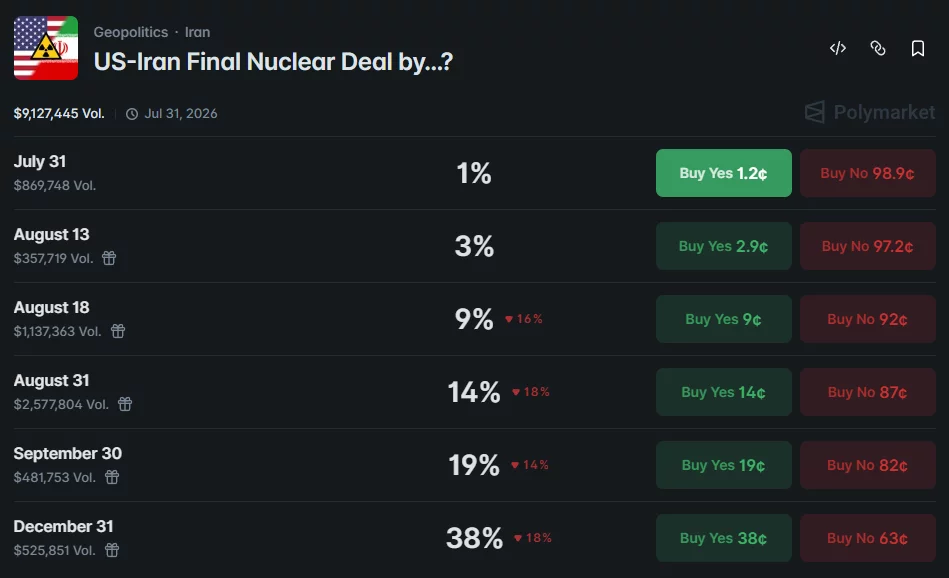
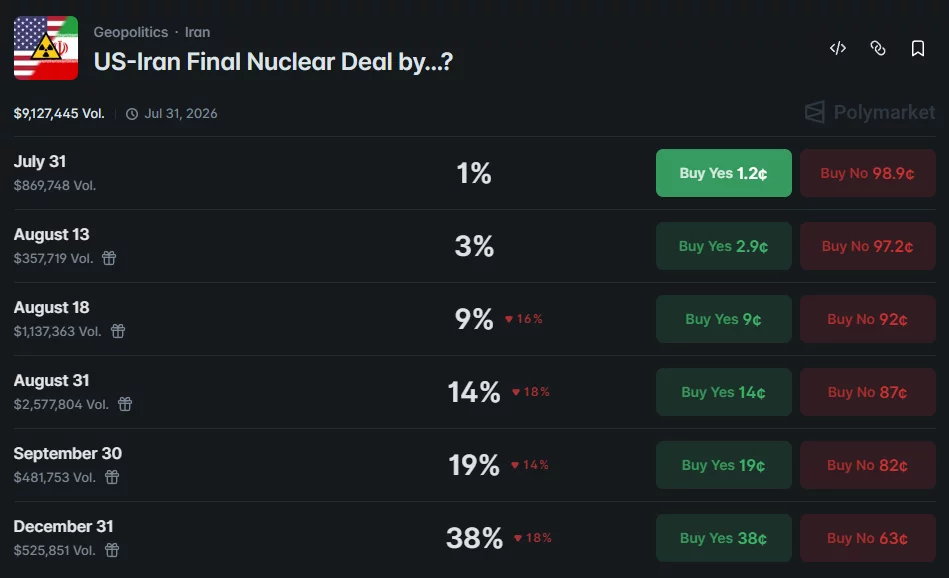
- Polymarket still places the odds of a U.S.-Iran nuclear deal by year-end at just 38%.
According to a post by President Trump on Truth Social, Iran asked to resume discussions with the United States, and Washington agreed to continue negotiations. At the same time, Trump stated that the ceasefire was over, indicating that diplomatic engagement would continue despite the end of the truce.
“The Islamic Republic of Iran has asked us to continue “talks.” We have agreed to do so, but the United States has stated to them, in no uncertain terms, that the Cease Fire is OVER!”
The cryptocurrency market reacted positively to the development. Bitcoin (BTC) rose to around $64,100, gaining nearly 2% from an intraday low near $62,000. The move extended the recovery that began after heavy selling earlier this week, when renewed military exchanges between the U.S. and Iran pushed Bitcoin below the $62,000 mark.
crypto.news had previously reported that technical discussions between U.S. and Iranian officials were expected to continue. Trump’s latest statement publicly confirmed that negotiations remain active even as military tensions have yet to fully ease. Alongside Bitcoin, several major cryptocurrencies also traded higher following the announcement.
Bitcoin recovers as diplomatic contacts continue
Market sentiment improved after Trump’s latest comments suggested that both sides remain engaged in negotiations despite recent hostilities. Earlier, the president had also stated that Iran wanted to make a deal “so badly,” adding to expectations that diplomatic channels had not completely broken down.
Even with Bitcoin reclaiming the psychological $64,000 level, traders continue to monitor geopolitical developments closely because recent market swings have been closely tied to headlines surrounding the conflict. This week’s decline below $62,000 came shortly after both countries exchanged strikes and Trump declared that the ceasefire had ended.
The recovery also follows several sessions of elevated volatility across digital assets, with investors reacting quickly to changes in geopolitical risk. Although Bitcoin has regained lost ground, price movements remain sensitive to further developments from Washington and Tehran.
Nuclear agreement expectations remain limited
Despite the renewed talks, prediction markets continue to show limited confidence that the two countries will finalize a nuclear agreement this year. According to Polymarket data, the probability of the United States and Iran reaching a deal by Dec. 31 stands at about 38%.
The nuclear program remains the central issue separating both sides. President Trump has repeatedly maintained that Iran cannot possess a nuclear weapon, while negotiations continue alongside ongoing military and political tensions.
Energy markets remain another source of uncertainty for investors. Iran has maintained that it plans to impose tolls on vessels passing through the Strait of Hormuz, a route that carries a significant share of global oil shipments. The possibility of higher transportation costs has kept traders focused on potential disruptions to crude supplies.
Earlier this week, oil prices climbed after Iran attacked three oil tankers in the Strait of Hormuz, escalating the conflict and adding fresh inflation concerns. Higher energy prices can increase inflationary pressure, a factor that financial markets often watch because persistent inflation may reduce expectations for easier monetary policy, which can weigh on risk assets such as Bitcoin.
For now, Bitcoin’s move above $64,000 suggests investors welcomed signs that diplomatic contacts remain open. Even so, the market continues to balance improving sentiment from renewed negotiations against the unresolved issues surrounding Iran’s nuclear program and the ongoing risks to global energy supplies.


Robinhood has introduced plans to let eligible U.S. customers authorize AI agents to execute cryptocurrency trades on their behalf, extending automated investing beyond stocks and options.
Summary
- Robinhood plans to let eligible U.S. users authorize AI agents to execute crypto trades.
- Robinhood Chain topped $115 million in TVL and reached $500 million in daily Uniswap volume.
- Blockchain AI payments are expanding, though onchain transaction volumes remain relatively small.
Robinhood said during a Friday presentation that the upcoming feature will allow eligible U.S.-based crypto users to connect third-party AI agents capable of managing trades within user-defined limits. The company did not announce a launch date for the crypto version but said customers in the United Kingdom will receive access after the U.S. rollout.
A Robinhood executive said users will be able to build trading strategies with predefined guardrails instead of watching their accounts continuously. According to the company, the feature is designed to let customers automate decisions while keeping control over the rules that AI agents must follow.
Robinhood expands AI automation beyond stocks
The crypto rollout follows Robinhood’s beta launch of AI-powered agentic accounts for equities and options traders in late May. During the same presentation, Robinhood said more than 70,000 agentic accounts have already been created through that program, indicating early demand for automated investing tools.
Robinhood also said the service works with AI models from third-party providers, including Anthropic, OpenAI and SpaceX’s Grok. Beyond investing, the company is extending the same technology to consumer finance by allowing eligible customers to authorize AI agents to complete credit card purchases on their behalf.
During the presentation, a Robinhood executive said automated agents could help retail investors act on information they might otherwise overlook, giving them access to capabilities that have historically been more common among institutional investors.
Outside Robinhood, several crypto executives have made similar predictions about AI-powered financial activity. Coinbase CEO Brian Armstrong and Circle CEO Jeremy Allaire have both said they expect AI agents to become major users of blockchain-based payment systems over the next few years.
Robinhood Chain gains traction alongside AI rollout
The automation announcement comes as Robinhood continues expanding its blockchain infrastructure. The company has centered recent crypto development on tokenized real-world assets and Robinhood Chain, its Ethereum layer-2 network built on Arbitrum.
Johann Kerbrat, Robinhood’s senior vice president and general manager of crypto, said the network processed 17 million transactions from nearly 350,000 wallet addresses during its first week after launching on July 1.
DeFiLlama data also shows Robinhood Chain’s total value locked climbed above $115 million after increasing 23% in 24 hours, while cumulative addresses approached 200,000. The same data places the network behind only Ethereum mainnet in 24-hour Uniswap trading volume after daily activity reached about $500 million on July 8, following more than $250 million in cumulative trading volume during its first week.
Separately, Token Terminal data shows Robinhood Chain attracted more than $70 million worth of bridged Ether within its first week. The analytics platform said continued growth could turn the network into “a meaningful new source of demand for ETH.”
AI-driven blockchain payments are also beginning to appear outside Robinhood. In May, Amazon Web Services integrated Coinbase’s x402 payments protocol into Amazon Bedrock AgentCore, allowing AI agents to settle transactions using USDC. Earlier, in April, crypto wallet startup Oobit introduced a Visa-backed virtual card that enables AI agents to make business purchases using USDT.
Even so, blockchain payment activity from AI agents remains limited. Artemis data shows the AI agent-enabled x402 protocol processed about $2 million in transaction volume during June, suggesting adoption is still in its early stages despite a growing number of product launches.

Robinhood is preparing to expand its “agentic trading” features into the company’s US crypto product, allowing eligible customers to connect third-party AI agents that can execute trades on their behalf. The move follows a similar rollout to equities and options traders, launched in a beta form in late May.
Robinhood’s leadership said customers will be able to design strategies with guardrails through AI agents, reducing the need for constant account monitoring. While the firm did not announce a specific rollout date for US crypto users, it indicated that UK customers will be next to gain access.
Key takeaways
- Robinhood will extend third-party AI agent integrations to eligible US crypto traders, enabling automated crypto trade execution under user-defined guardrails.
- The company previously introduced agentic trading for equities and options via a beta in late May, and more than 70,000 agentic accounts have been created since then.
- Robinhood did not set a US crypto launch date, but said UK customers will be next.
- Robinhood’s broader crypto agenda includes its Ethereum layer 2, Robinhood Chain, which processed 17 million transactions in its first week, according to company executives.
- Despite multiple AI-agent payment integrations across the industry, on-chain AI-agent activity remains modest—Artemis data cited only about $2 million in June volume tied to x402-enabled activity.
Agentic trading moves from equities to crypto
At a presentation on Friday, a Robinhood executive said the goal of the AI agent integration is to let users work with an agent to create strategies with specific guardrails—without requiring constant supervision of their accounts. The executive framed this as a way to help retail traders act on information they might otherwise miss.
Robinhood did not provide a calendar date for when the crypto feature will roll out to eligible US customers. However, the company noted that its UK users would receive access first, signaling that the next phase of expansion will begin outside the US before wider coverage is announced.
Earlier in the process, Robinhood offered agentic accounts to equities traders. In the equities and options market beta, Robinhood reported that over 70,000 agentic accounts were created by traders since late May—an internal adoption milestone that suggests the company expects its agentic framework to translate across asset classes.
Why Robinhood says it matters for retail traders
Robinhood positioned agentic trading as a competitive equalizer for retail investors, pointing to the ability to base trades on data and conditions that could be difficult to track manually. In the company’s view, this would bring retail users closer to the workflow advantage typically enjoyed by institutions.
The product is delivered through agentic accounts connected to third-party AI providers. Robinhood said these integrations include companies such as Anthropic, OpenAI, and Grok (via SpaceX), alongside additional AI infrastructure support through its platform.
Beyond trade automation, Robinhood also said eligible users can have credit card purchases made on their behalf by AI agents, indicating that the agentic approach is meant to expand beyond crypto order execution into broader transaction workflows.
Robinhood Chain and the company’s wider crypto push
Robinhood’s AI agent trading expansion lands within a broader crypto strategy. The company has focused on tokenization and its Ethereum layer 2 network, Robinhood Chain, which launched earlier this month.
Robinhood’s senior vice president and general manager of crypto, Johann Kerbrat, said Robinhood Chain processed 17 million transactions from nearly 350,000 wallet addresses in its first week. That network activity figure provides context for how Robinhood is building capacity for crypto rails that can support new user experiences, including automation.
For investors and traders, the implication is that Robinhood is treating agentic trading as a product layer that needs underlying infrastructure—both for transaction handling and for integrating payment and settlement flows across user-controlled on-chain actions.
Industry integrations expand—yet adoption remains limited
Robinhood’s update comes amid a broader push across the crypto industry to enable AI agents to spend stablecoins and perform transactions. Several integration announcements in recent months highlighted how AI agent systems are being connected to blockchain payment rails.
One prominent example referenced in earlier reporting is Amazon Web Services’ May integration, in which AWS connected Coinbase’s x402 payments protocol into Amazon Bedrock AgentCore. That setup enables agents to transact in USDC (USDC). In April, wallet startup Oobit also rolled out Visa-supported virtual cards designed for AI agents to spend USDt (USDT) on behalf of businesses.
Despite the growing list of integrations, the article’s cited data suggests real usage is still early. Artemis data indicated that only about $2 million in transaction volume was facilitated through the AI agent-supported x402 protocol in June. This points to a gap between infrastructure readiness and widespread agent-driven on-chain behavior.
For readers, the key question is whether products like Robinhood’s crypto agent trading will meaningfully increase the volume of AI-assisted transactions—or whether agentic features will initially remain concentrated among smaller, tech-forward user segments.
As Robinhood prepares to roll out agentic trading for eligible crypto users—starting with the UK—watch for whether the company sets a timeline for broader US access and whether adoption metrics begin to move beyond the low on-chain volumes seen in earlier x402-focused activity.

The U.S. Department of Justice is reportedly preparing to drop federal charges against Matthew Goettsche, the founder of BitClub Network, in a case that accused him of running a crypto mining “passive income” scheme that allegedly defrauded investors of $722 million between 2014 and 2019.
According to a report from Bloomberg Law, the DOJ’s deputy attorney general’s office ordered the New Jersey attorney general’s office to dismiss the case “with prejudice.” Shortly afterward, a court filing in New Jersey indicated the parties have reached “an agreement in principle” to resolve the pending charges, though additional time is needed to finalize the terms.
Key takeaways
- DOJ is reportedly seeking to dismiss charges against BitClub Network founder Matthew Goettsche after an “agreement in principle” outlined in a New Jersey court filing.
- Bloomberg Law reported the decision follows direction from Deputy Attorney General Todd Blanche’s office to end a DOJ approach described as “regulation by prosecution.”
- The original indictment dates to December 2019 and alleged wire fraud and unregistered securities offenses tied to BitClub’s investor “mining pool” pitch.
- Several former BitClub associates—Silviu Balaci, Joseph Abel, and Gordon Beckstead—have already pleaded guilty, making the case outcome a notable shift in enforcement trajectory.
- Investors and legal watchers will be looking for whether any dismissal is fully implemented and whether the broader DOJ pivot affects other ongoing crypto prosecutions.
A case built on a “mining pool” promise
Goettsche was indicted in December 2019 and, at the time, was scheduled to go to trial in October on charges including conspiracy to commit wire fraud and the sale of unregistered securities. Prosecutors alleged that BitClub operated from April 2014 to December 2019 as a Bitcoin mining pool where investors could purchase shares and earn passive returns.
In filings and allegations cited in coverage of the matter, BitClub’s model was said to rely on falsified earnings and fabricated mining data—claims that prosecutors and other court materials have treated as central to convincing investors to join and continue funding the scheme.
Earlier court submissions also reflected Goettsche’s description of the business as one built “on the backs of idiots,” according to court material referenced in previous reporting.
How the DOJ pivot appears to factor in
The reported change arrives against the backdrop of an April 2025 memo issued by Deputy Attorney General Todd Blanche. As described in that memorandum, it directed DOJ to end what was characterized as “regulation by prosecution” in relation to the digital asset industry—an approach that some critics argued had been too broad and blurred the line between criminal enforcement and broader market regulation.
Bloomberg Law reported on Friday that the deputy attorney general’s office in Washington ordered the New Jersey attorney general’s office to dismiss the Goettsche case with prejudice. The same reporting cited two sources familiar with the matter.
In a subsequent filing, Goettsche’s attorneys told U.S. District Judge Claire Cecchi that the parties “reached an agreement in principle” to resolve the charges, but that they need time to finalize the terms—language consistent with a DOJ-led shift that is moving from policy direction toward case-level resolution.
The DOJ did not provide immediate comment when Cointelegraph reached out, according to the account in the source article.
Why this outcome stands out in U.S. crypto enforcement
If the dismissal proceeds, it would represent one of the more prominent reversals in U.S. crypto enforcement history—especially because the Goettsche matter has already produced guilty pleas from several alleged co-conspirators.
Three former BitClub Network figures—Silviu Balaci, Joseph Abel, and Gordon Beckstead—have pleaded guilty in connection with their involvement in the scheme, according to the details summarized in the source reporting. A dismissal of the lead founder’s charges, therefore, would not simply end a single prosecution; it could reshape how observers interpret the effect of DOJ’s policy changes on pending or future digital asset cases.
For market participants, this distinction matters. Many crypto investors follow enforcement not only to understand individual risk, but also to infer whether agencies are recalibrating what conduct they believe is best handled through prosecution versus through other regulatory or administrative channels.
At the same time, it is not yet clear what the final disposition will look like—dismissal “with prejudice” is reported as the direction, but the court filing emphasizes that the parties still need time to finalize terms. Readers should therefore treat the development as a process in motion rather than a final resolution until the court enters an order.
DOJ enforcement remains active elsewhere
The reported BitClub shift does not appear to represent an overall retreat from crypto crime cases. Other DOJ actions in recent months have continued to target fraud and theft.
In April, a California man, Evan Tageman, was sentenced to 70 months in prison for his alleged role in a criminal enterprise that stole about $263 million worth of crypto from victims through social engineering scams and burglary, according to the source article’s summary of earlier coverage.
The DOJ has also continued to freeze large pools of crypto tied to alleged investment scammers who targeted Americans, with the source article citing efforts that resulted in freezing more than $700 million in April. It further references a separate seizure of nearly $580 million in crypto connected to a criminal scam group operating in Southeast Asia earlier in the year.
Taken together, these actions suggest that while DOJ may be adjusting its strategic stance toward parts of the industry—particularly where it believes prosecution has functioned as a substitute for regulation—the department remains willing to pursue serious criminal conduct involving fraud and coercive tactics.
That tension—between a policy shift away from “regulation by prosecution” and continued case-by-case criminal enforcement—could become a key lens for the next wave of courtroom outcomes.
For now, investors and legal observers should watch for whether the New Jersey court formally dismisses the case as reported, what conditions—if any—are included in the final terms, and whether similar DOJ adjustments surface in other pending crypto prosecutions.
Getting licensed under the European Union’s Markets in Crypto-Assets Regulation (MiCA) framework is only the beginning for crypto custodians, as regulators turn their attention from authorization to operational resilience.
The European Securities and Markets Authority (ESMA) on Wednesday launched a Common Supervisory Action (CSA) to examine the operational resilience of crypto asset service providers (CASPs), placing custody services at the center of the review.
“The signal is quite clear: for custodians, a licence is the start line, not the finish,” Sebastien Dessimoz, co-founder and managing partner at digital asset infrastructure firm Taurus, told Cointelegraph.
The review comes shortly after MiCA’s transitional period expired, marking one of the first major supervisory exercises under the EU’s new crypto framework.
From claiming security to proving it
The ESMA told Cointelegraph that the CSA will apply to a sample of authorized CASPs under MiCA. The review will assess the maturity of CASPs’ digital operational resilience frameworks for custody activities, focusing on risks including key and storage management, transaction controls, incident response and dependencies on third-party providers.
According to industry executives, the action marks a significant shift in Europe’s crypto market, where custody providers are increasingly expected to demonstrate, not simply claim, that their operational controls can withstand real-world risks.
“The shift I expect is from asserting security to evidencing it,” Dessimoz said. “This is a healthy development,” he noted, adding that digital assets are moving deeper into regulated financial infrastructure, and that requires the same security, accountability and resilience institutions expect in traditional markets.
Related: StanChart features in ESMA’s first MiCA register update since deadline
Jody Mettler, chief operating officer of BitGo and president of BitGo Trust, told Cointelegraph that institutional clients have already been asking more detailed questions about how custody providers segregate assets, manage access controls, respond to incidents and maintain business continuity during periods of market stress.
“The signal is that regulators are looking more closely at the operational standards behind digital asset services, not just whether firms are licensed,” she added.
Markus Levin, co-founder of blockchain infrastructure company XYO, said obtaining a MiCA authorization and demonstrating operational resilience are “two different tests,” adding that CASPs able to prove robust controls before regulators complete their review could gain an advantage as institutional adoption grows.
MiCA meets DORA and the debate over centralized crypto supervision
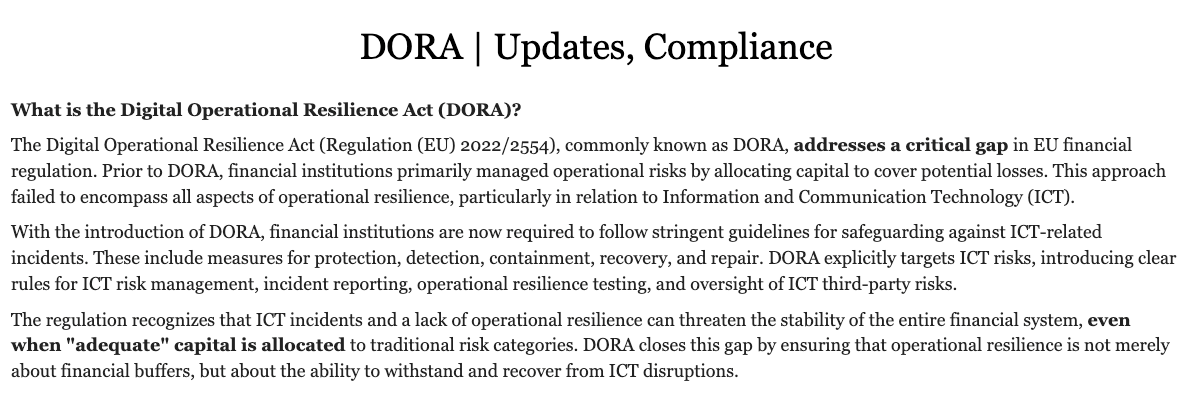
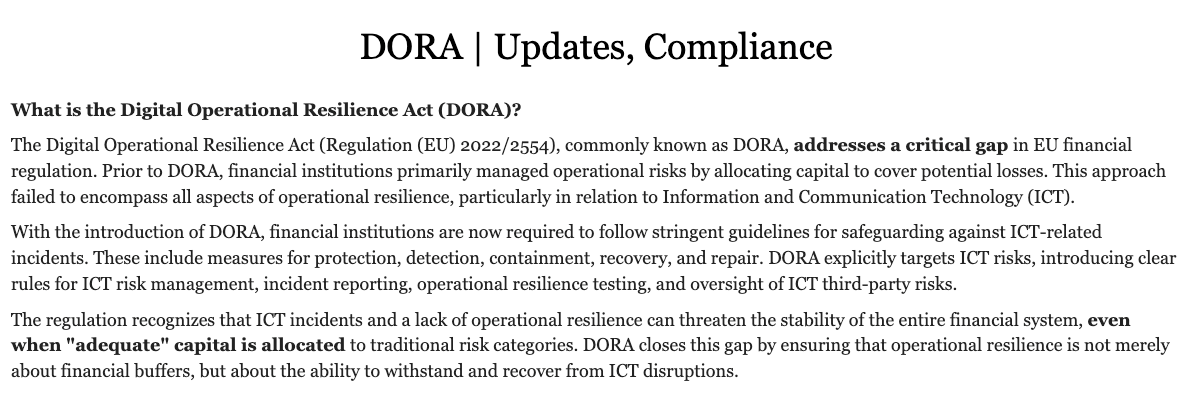
Yuriy Brisov, a lawyer at Digital & Analogue Partners, said the review sits under two EU regulatory frameworks at once: the MiCA framework, which establishes custody obligations, and the Digital Operational Resilience Act (DORA), which sets technology risk requirements for financial firms.
“Custody technology is concentrated in a handful of vendors, so one weak supplier can hit many firms at once,” the lawyer said, adding: “Proving resilience across that supply chain, under MiCA and DORA simultaneously, is the real challenge for CASPs.”
Source: Digital Operational Resilience Act
According to Brisov, the review could set a benchmark for how regulators assess MiCA-authorized custodians and influence discussions around a more centralized approach to crypto supervision in the EU.
“The findings will feed into two live debates: the review of MiCA and the proposal to move supervision of all CASPs from national regulators to ESMA,” he said.
Magazine: The biggest blockchain upgrades still to come in 2026
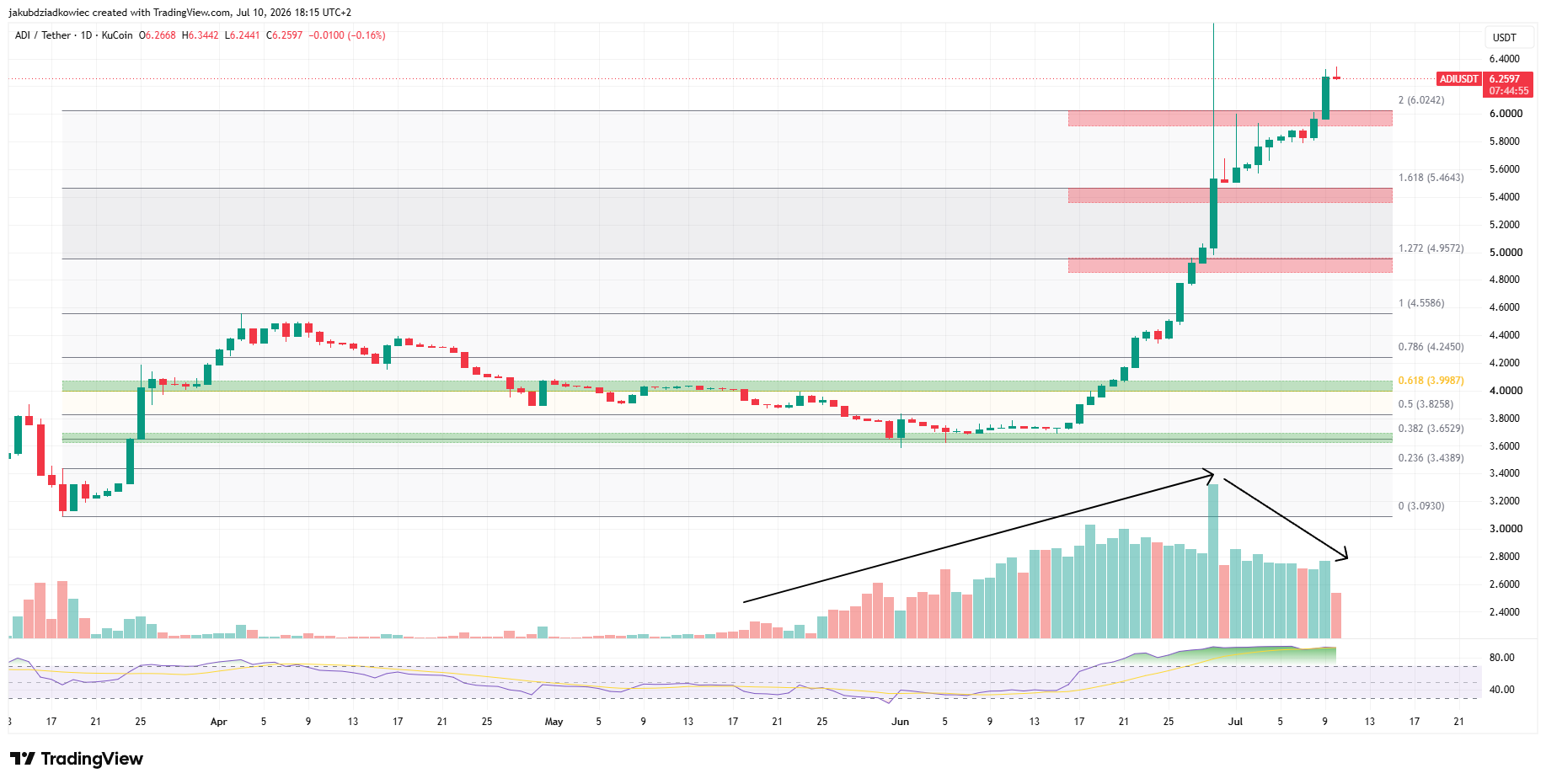
Three altcoins enter the weekend within striking distance of record prices. ADI and DeXe (DEXE) already trade in price discovery, while Rain (RAIN) sits about 11% below its all-time high (ATH).
The selection follows one criterion. These are the coins closest to their previous peaks, or already above them, and Fibonacci extension targets now define how far each rally could stretch.
ADI Clears Every Fibonacci Target, as RSI Hits 93
ADI has run its own bull market since June 16, when it bottomed at the 0.382 Fibonacci retracement near $3.65. The token then broke above its previous peak of $4.56 on June 26.
Since then, ADI has cleared all three Fibonacci extension targets at $4.96, $5.46, and $6.02. It trades around $6.25 on KuCoin, up 67.6% in 30 days, as the broader market also pushes higher.

However, two warning signs appear. A violent upside wick on June 29 printed the recorded ATH at $8.03. That level remains the one to beat, roughly 28% above the current price.
Moreover, the daily Relative Strength Index (RSI) has held extreme readings for weeks and currently prints 93. Volume has also started easing after rising throughout the rally. A pullback toward $6.02 would not break the trend, but chasing strength here carries risk.
DEXE Price Prediction Puts $38 in Play After RSI Breakout
DEXE printed a fresh ATH of $36.46 on July 10 and trades near $35.72 after a 21.5% daily gain. BeInCrypto already highlighted DEXE among this week’s top coins to watch.
The rally has followed the Fibonacci ladder almost perfectly. Price broke the previous peak of $24.20, then cleared the first target at $30.31, the 1.272 external retracement. The second target waits at $38.09, the 1.618 extension, just 6.6% above the current price.

Momentum supports the move. The daily RSI has broken out from a descending trendline drawn from the late-March peak near 87. It now reads about 78, its highest level since mid-April.
Therefore, the indicator signals a fresh bullish impulse rather than exhaustion, with no bearish divergence in sight. Volume spikes only intermittently, but as long as RSI holds above the broken trendline near 72, bulls control the trend.

RAIN Needs $0.015 to Rejoin the Altcoin ATH Race
Rain, the 13th-largest cryptocurrency with a $9.5 billion market cap, peaked at $0.01614 on June 22. The token now changes hands at $0.01443, about 11% below its record.
The structure suggests a correction phase. Price has slipped below the previous peak at $0.0150, but buyers keep attempting a bounce from this area. If the level fails, the 0.618 Fibonacci retracement at $0.0118 marks the deeper support and the invalidation line.

In contrast to ADI and DEXE, RAIN has not reached its extension targets yet. They wait at $0.01726 and $0.0201, about 19.6% and 39.6% above the current price.
Meanwhile, volume has been declining since the first impulse, and the daily RSI sits at a neutral 45. That reading leaves plenty of room for a renewed push if $0.015 flips back into support, even as Bitcoin works through its own late bear market.
A weekend reclaim of $0.015 by RAIN, a $38.09 tag by DEXE, or an $8.03 retest by ADI would each confirm the thesis. Failure at these levels would hand the initiative back to sellers.
The post 3 Altcoins That Could Reach All-Time Highs This Weekend, July 11-12 appeared first on BeInCrypto.

The US Federal Reserve named Andreessen Horowitz (a16z) co-founder Marc Andreessen to help lead a task force studying how artificial intelligence and other new technologies could affect productivity and jobs.
Andreessen will serve on the Fed’s Productivity and Jobs task force alongside Charles I. Jones, a Stanford University economics professor currently on leave at Anthropic, and Asha Sharma, Microsoft’s executive vice president and Xbox CEO.
The new task force will assess how general-purpose technologies such as AI will affect employment and productivity to better inform the central bank’s policymaking, the Fed said in a Thursday press release.
The group is one of five task forces launched under new Fed Chair Kevin Warsh, each responsible for examining important areas of monetary policy conduct. The other task forces will focus on the Fed’s policy communication, balance sheet policy, data quality and inflation frameworks.
Andreessen co-founded Andreessen Horowitz, which has become one of Silicon Valley’s most influential venture capital firms and a major backer of crypto and AI startups.
Andreessen and Warsh’s ties date back to the early 1990s at Stanford University. During a 2025 interview with CNBC, Warsh said that both Andreessen and Palantir’s Peter Thiel “have been friends from my days in college.”
Andreessen publicly supported Warsh’s appointment as Fed chairman. “I’ve known Kevin for 30 years; he combines great insight in economics and finance with keen understanding of technology and business,” he wrote in a Jan. 30 X post following US President Donald Trump’s nomination.

Source: Marc Andreessen
Warsh launches Fed task forces
Warsh revealed the leadership-driven overhaul and the creation of the five new task forces during a press conference on June 17.
“These subjects are timely, consequential, and, in my view, worthy of a fresh look,” said Warsh during the press conference, adding that each of these will be independently led by “some of the very best minds—both inside and outside the economics profession.”
Warsh also said that the central bank will strive to publish policy statements and guidance in shorter, clearer language.
Related: Hyperliquid shows how onchain perps could challenge Wall Street: Pantera
FOMC divided over AI’s economic impact
The Federal Open Market Committee (FOMC) is sharply divided over the economic impact of AI and whether it is an inflationary or disinflationary technology. Some view AI as a long-term disinflationary productivity booster, while others argue that the current spending on AI infrastructure is actively increasing inflation.
During a May 27 speech, Governor Lisa Cook said that she expects AI to further “boost productivity growth, contributing to my expectation that GDP will grow robustly,” but added that it presents the risk of “higher inflation.”
In former Fed Chair Jerome Powell’s statements from March 2026, he said that data center spending is “putting pressure on all kinds of goods and services” and is “probably pushing inflation up at the margin.”
Magazine: Strategy sells $216M Bitcoin, Bollinger bullish on BTC: Hodler’s Digest, June 29-July 6, 2026
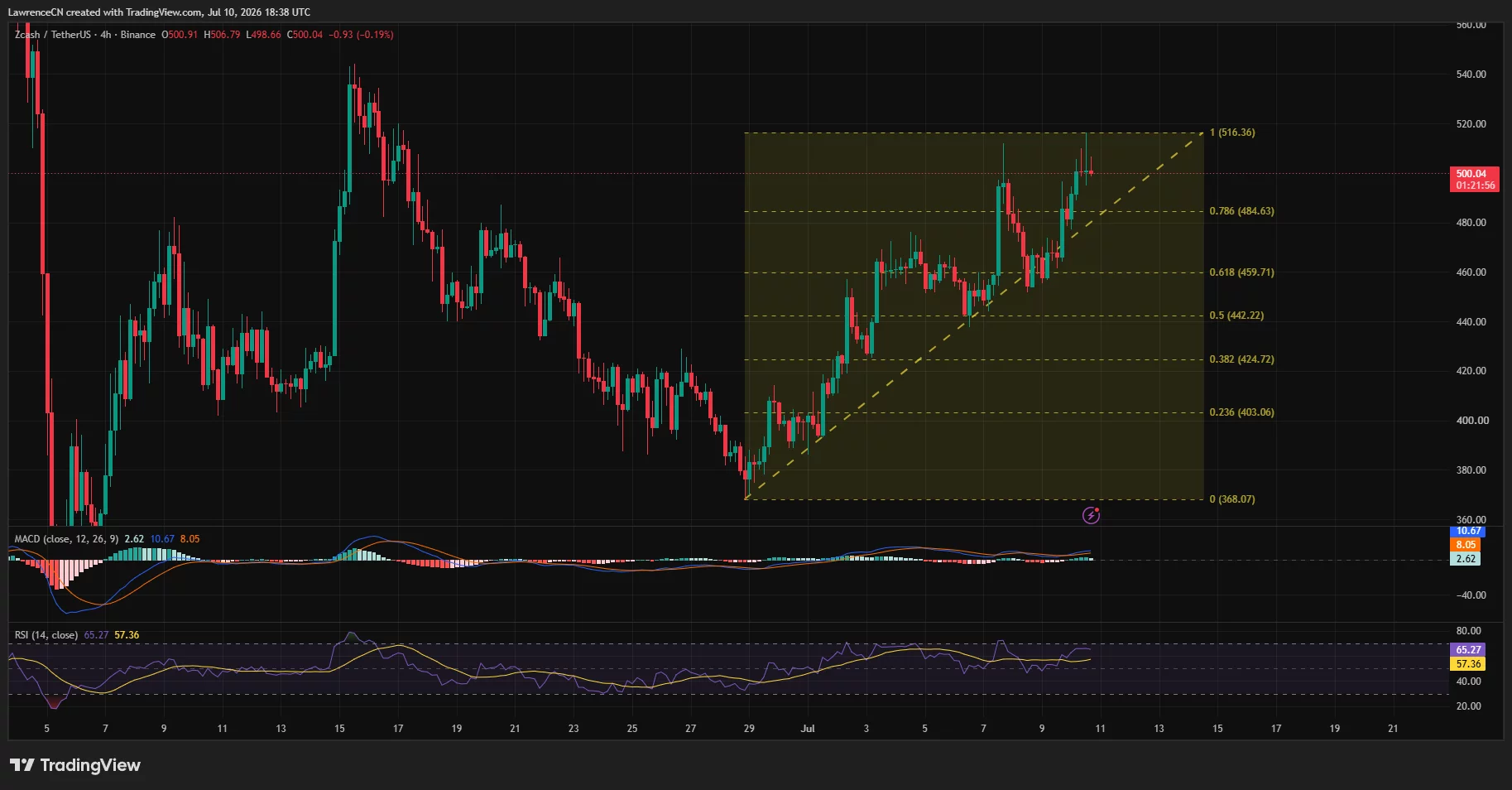
Zcash price has rallied past $500 after open interest jumped to $1.02 billion and traders accumulated positions ahead of the July 28 Ironwood upgrade.
Summary
- Zcash price climbed above $500 as traders positioned ahead of the July 28 Ironwood network upgrade.
- Futures open interest rose 27% to $1.02 billion, while trading volume jumped 49%, signaling stronger market participation.
- Technical indicators point to continued bullish momentum, with $510-$516 emerging as the next key resistance zone.
According to data from crypto.news, Zcash (ZEC) price has risen more than 7% over the past 24 hours to trade above $500, extending its weekly gain to around 10% as traders increased exposure ahead of the network’s Ironwood upgrade.
Alongside the price rally, derivatives participation has accelerated, while technical indicators point to sustained buying momentum. The latest move has also coincided with a recovery across the crypto market, where Bitcoin reclaimed the $64,000 level and improved sentiment for several major digital assets.
Network upgrade has become the key catalyst
Scheduled to activate at block 3,428,143 on July 28, the Ironwood upgrade has become the main catalyst behind renewed interest in Zcash. Zcash core developer Sean Bowe stated that the proposal has received support from major participants across the Zcash ecosystem.
The upgrade follows the discovery of a critical vulnerability in the Orchard shielded pool in May. According to the Zcash development team, the flaw could theoretically have allowed counterfeit ZEC to enter circulation without being detected, although no such exploitation was reported.
As part of Ironwood, developers will permanently retire the Orchard pool and prevent any new transactions from entering it. A redesigned shielded pool will replace it with stronger security measures, including formal verification, external security audits and quantum-resistant note designs intended to strengthen supply integrity and improve confidence in private transactions.
At the same time, improving conditions across the digital asset market have added another layer of support. Bitcoin’s recovery above $64,000 has encouraged renewed buying across altcoins, while Ether has continued moving toward its 50-day moving average near $1,800. XRP has also held support around $1.09, helping sustain positive sentiment ahead of the Zcash network upgrade.
Technical indicators continue to favor buyers
Growing participation in the futures market has reinforced the recent advance. Derivatives data shows trading volume jumped 49% to $1.98 billion, while open interest climbed 27.32% to $1.02 billion, indicating traders have continued opening new leveraged positions before the July activation.
On the technical side, ZEC has reclaimed several important resistance levels after recovering from roughly $368 in late June. The 4-hour chart shows the price moving above both the 61.8% Fibonacci retracement level at $459.71 and the 78.6% level at $484.63, leaving the recent swing high as the next obstacle.
Momentum indicators continue to support the bullish structure. The 4-hour MACD remains in positive territory with the MACD line holding above the signal line, while the RSI sits near 65, suggesting buying strength remains intact without entering deeply overbought territory.
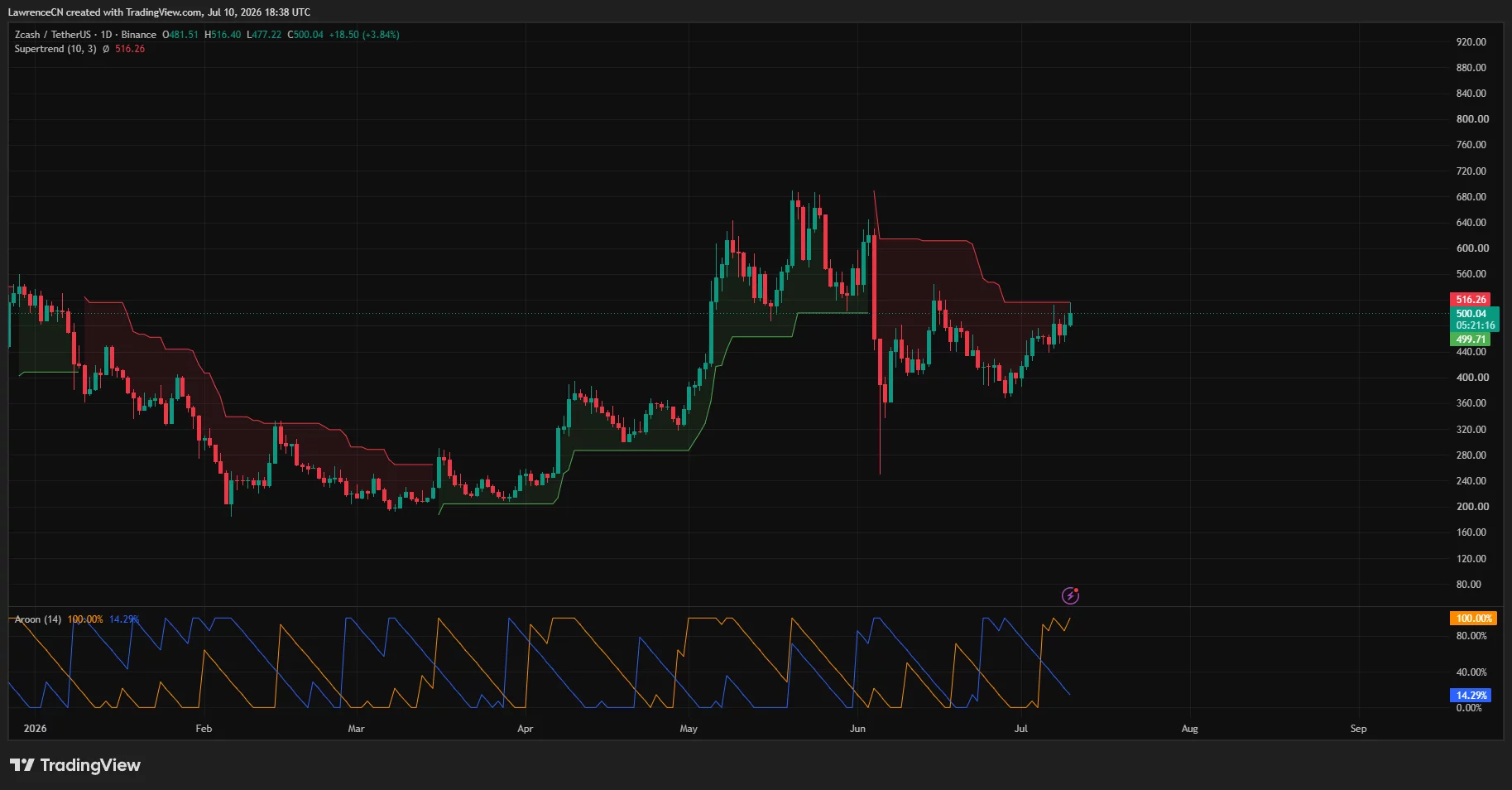
The daily chart also shows the Aroon Up indicator at 100% and Aroon Down near 14%, a combination that typically signals a strong prevailing uptrend. Even so, ZEC continues trading just below the Supertrend resistance around $516, making that zone an important hurdle before buyers can attempt another leg higher.
Commenting on the latest setup, crypto analyst Ardi noted that a decisive move above $510 would invalidate the current local swing resistance and could increase the probability of a rally toward $540.
While the analyst outlined that bullish scenario, the rapid increase in open interest also indicates leveraged positioning has become more crowded, leaving ZEC vulnerable to sharper price swings if momentum weakens near resistance.
Disclosure: This article does not represent investment advice. The content and materials featured on this page are for educational purposes only.

Federal Judge Analisa Torres, the architect of XRP’s landmark 2023 securities ruling, has handed down another closely watched decision, leaving XRP price prediction debates wide open as the token trades at $1.09. The market is showing little urgency, with traders waiting for the legal dust to settle before making bigger moves.
Torres is best known for her July 2023 split ruling in the SEC’s case against Ripple. She found that programmatic XRP sales on exchanges were not securities, while institutional sales qualified as investment contracts. That decision became one of crypto’s most cited legal precedents. Even after the SEC and Ripple settled in 2025, her opinions still carry weight.
Her latest ruling comes from a different case, yet traders are reading between the lines anyway. Crypto markets have a habit of connecting dots, sometimes before the ink dries. Whether that reaction sticks depends on how regulators and courts interpret the decision in the months ahead.
For now, XRP continues to hold its chart structure despite the legal headlines. Price action remains relatively steady, but conviction is still in short supply. As always, the market loves certainty, and right now it is getting another legal puzzle instead of a clear answer.
Discover: The Best Token Presales
XRP Price Prediction: Recover Above $1.2 This Week?
XRP has been holding between $1.07 and $1.10 over the past 24 hours, reflecting a market that still lacks a clear winner. The past week’s range stretches from roughly $1.05 to $1.16, leaving support and resistance well defined. Traders are waiting for a catalyst, and so far, the chart has offered little more than a shrug.
Recent Ripple partnership headlines have done little to shake XRP out of that range. Sometimes good news knocks politely instead of kicking the door down. Even so, the series of higher lows remains intact, keeping buyers interested while preventing sellers from taking full control.

A bullish scenario starts with XRP defending the $1.05 to $1.07 support zone before reclaiming $1.16. A convincing breakout could then open the door to $1.25, where previous selling pressure emerged. That would finally give bulls something more exciting than another day of sideways candles.
The base case remains continued consolidation between $1.07 and $1.16 until a legal or macro catalyst tips the balance. On the flip side, a decisive close below $1.05 would weaken the current structure. If that happens, traders could begin watching the $1.00 area as the next meaningful support.
Don’t Miss Out on Our $1,000 USDT Airdrop on ByBit
LiquidChain Targets Early-Mover Upside as XRP Tests Key Levels
XRP trading sideways around $1.10, after a multi-year legal saga and a settlement that already priced in the good news, raises a fair question: where does the asymmetric upside actually come from here? Established large-caps with resolved regulatory overhangs tend to grind, not explode.
Traders looking for early-stage exposure with a different risk/reward profile are rotating attention toward infrastructure presales.
LiquidChain ($LIQUID) is a Layer 3 infrastructure project built around a single thesis: fragmented liquidity across Bitcoin, Ethereum, and Solana is the primary friction point in cross-chain DeFi.
All eyes are on LiquidChain.
⟁https://t.co/vqvBcdSQYC pic.twitter.com/GsuIe1xMnJ
— LiquidChain (@getliquidchain) July 7, 2026
Its Unified Liquidity Layer fuses all three ecosystems into a single execution environment, with Single-Step Execution, Verifiable Settlement, and a Deploy-Once Architecture that lets developers access BTC, ETH, and SOL liquidity without redeploying per chain.
The presale is currently priced at $0.01478 per $LIQUID, with $890K raised to date. For traders who want to assess the technical architecture before committing capital, research LiquidChain here.
Discover: The Best Crypto to Diversify Your Portfolio
The post XRP Price Prediction: Judge in XRP Ruling Delivers Fresh Blow appeared first on Cryptonews.
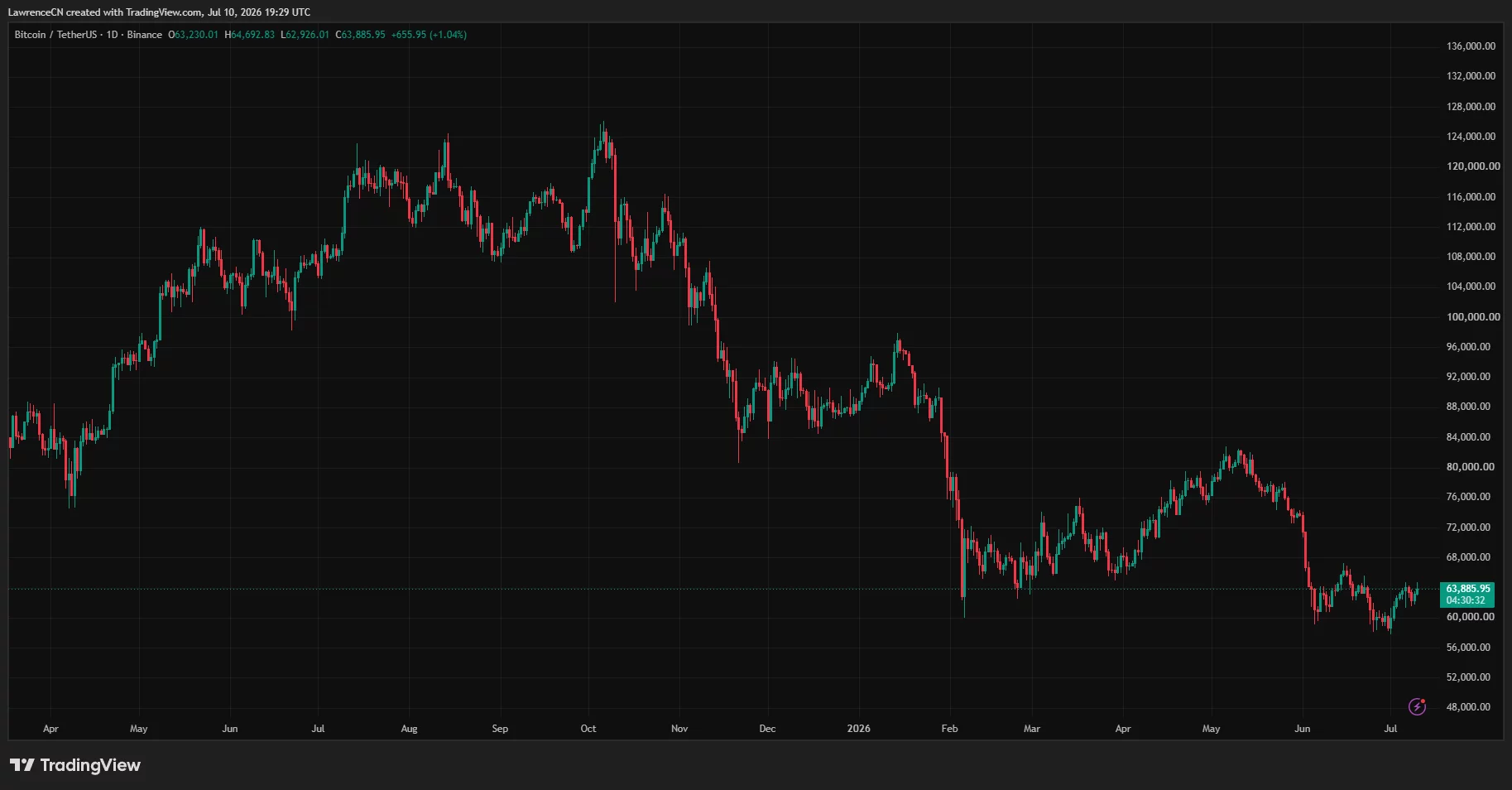
Bitcoin closed the worst half-year in its recent history near $60,000, down from $93,000 in January and fresh off a 21-month low, and almost none of the damage came from crypto itself. The Federal Reserve and record ETF outflows did it, and the same two forces meet again at the July 28-29 policy meeting that will likely decide whether the bottom is in or another leg waits below. These are the levels, the scenarios, and the honest case on both sides.
Summary
- Bitcoin enters July near $60,000, with the July 28–29 Fed meeting expected to determine whether the recent sell-off extends or a recovery begins.
- The main risks remain hawkish Fed policy and continued spot Bitcoin ETF outflows, while whale accumulation and an oversold market provide the strongest bullish arguments.
- Key levels to watch are $58,000 support and $63,800 resistance; a sustained return of ETF inflows could signal that a broader recovery is underway.
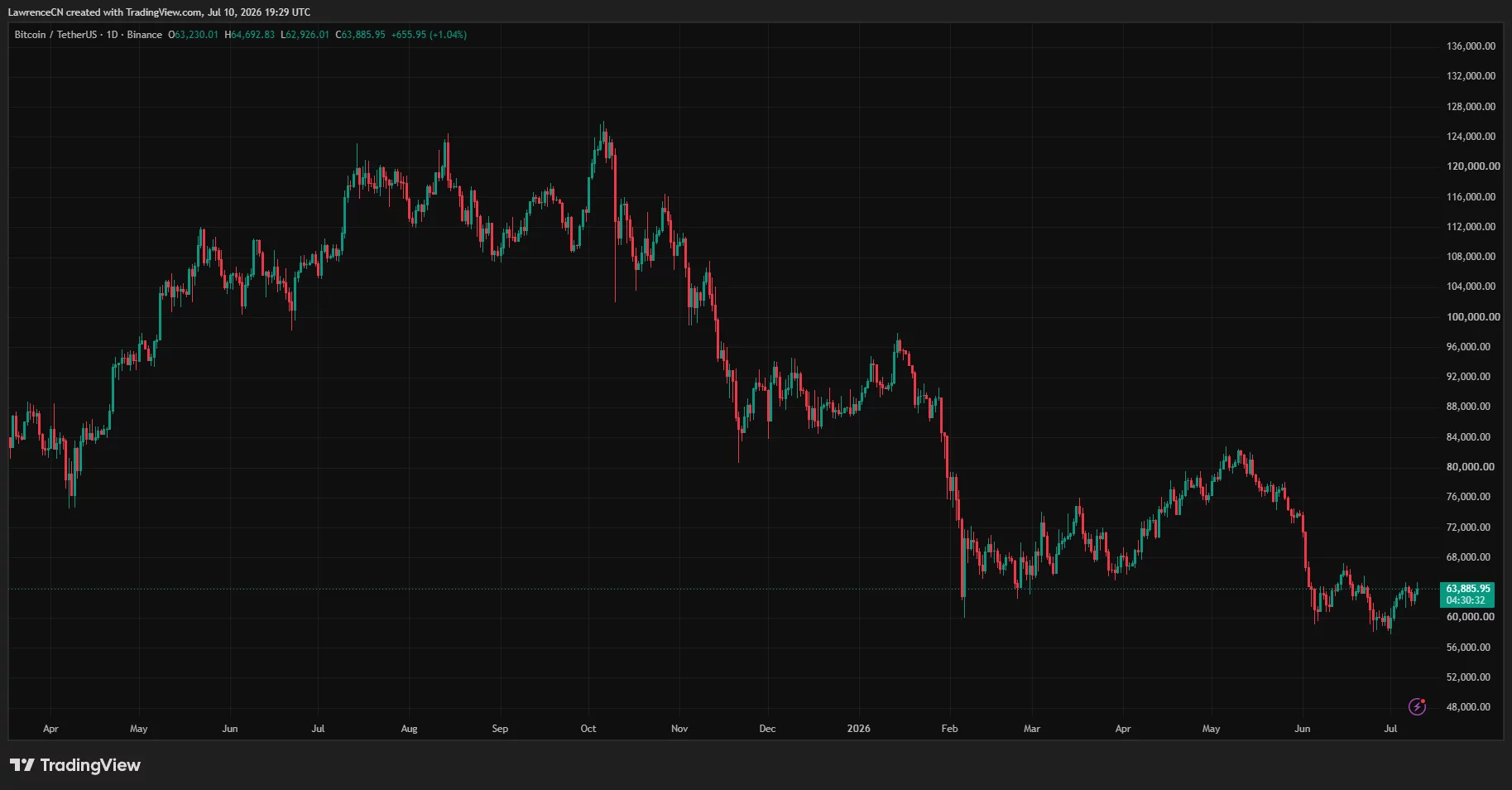
Bitcoin enters July 2026 trading near $60,000, and the number understates how strange the year has been. The largest cryptocurrency began January above $93,000, peaked at $126,000 back in October 2025, and spent the first half of 2026 grinding down to a fresh 21-month low near $58,000 in late June, a decline of more than half from the top.
What makes it unusual is the absence of a villain: Bitcoin’s historic crashes came with something breaking, the Terra collapse in 2022, the FTX failure months later, and this time nothing inside crypto broke.
No major exchange failed, no large stablecoin lost its peg, and the US Strategic Bitcoin Reserve stayed in place. The damage came almost entirely from two external forces: the Federal Reserve and the money leaving Bitcoin exchange-traded funds, and those same two forces are set to decide what happens next.
The pivotal event sits at the end of the month. The Federal Reserve meets on July 28-29, and prediction markets put roughly a 70% probability on the Fed holding rates steady, with the small remaining chance pointing toward a hike, not a cut, meaning a monetary rescue for risk assets this month looks unlikely.
Around that decision sits a market that is deeply oversold, largely deleveraged, and quietly being accumulated by long-term buyers even as ETF holders sell, a genuinely mixed setup that supports the range this piece will map rather than a confident call in either direction.
This prediction breaks down the month the way a trader would: the price levels that matter in both directions, the bearish case built on the Fed and the ETF exodus, the bullish case built on oversold conditions and whale accumulation, three concrete scenarios with the triggers that would produce each, the analyst and prediction-market targets worth knowing, and the honest bottom line on a month whose direction one meeting will largely set. None of it is investment advice, and Bitcoin’s volatility means every level here can be overrun by a single headline.
The levels that matter
Start with the map, because in a month likely to be decided by one event, the levels around that event are the whole game. Bitcoin near $60,000 sits below its 50-month exponential moving average around $65,600, a marker that has flipped from support to resistance and now caps rallies, while remaining well above its 100-month average near $40,000, which keeps the multi-year structure intact even in the current weakness.
On the downside, the first and most important floor is the late-June low near $58,115, the level that defined the month’s bottom and whose defense or failure is the single most-watched line on the chart. Below it, the $56,200 area marks a Fibonacci support that traders widely flag, and beneath that the picture opens toward the $50,000 to $53,000 zone, which aligns with the most bearish institutional forecasts and would represent the month’s worst-case territory. That lower band also sits near the long-term trendline Bitcoin has only breached during the deepest stretches of past bear markets, which is why a move into it would carry outsized psychological weight.
On the upside, reclaiming the $62,000 to $65,600 zone is the bulls’ first task, because turning that band from resistance back into support would neutralize the downtrend, and a decisive break above roughly $63,800 is the level several analysts cite as the signal that the immediate downtrend has ended. Above that, the 50-month average near $65,600 and then the $70,000 round number are the next hurdles, though reaching them in July would likely require the outside help the bull case depends on.
Held together, the structure is a market pinned below falling resistance and resting on a well-defined floor, waiting for a catalyst to resolve the tension, and the calendar says the catalyst arrives at month-end.
The bearish case: the Fed and the ETF exodus
The case for another leg down rests on the two forces that drove the first-half decline, and neither has clearly reversed. The Federal Reserve is the larger one. The new chair held rates steady at his first meeting in June and took this year’s expected rate cut off the table, and the resulting repricing of risk assets is much of what pulled Bitcoin down.
With markets assigning roughly a 70% odds to another hold on July 29 and the tail risk pointing toward a hike rather than a cut, the monetary backdrop offers Bitcoin no relief this month and possibly a fresh headwind, and a hold delivered with hawkish language, or any hint of a hike, is exactly the trigger that could push price back below the $58,115 floor.
The second force is the ETF exodus, and its scale is historic. Bitcoin ETFs posted their worst month on record in June with roughly $4.5 billion pulled, and one major bank cut its 12-month inflow forecast to zero, a stark reversal for the products that drove the prior bull run. Because ETF flows translate directly into real spot buying and selling through the creation-and-redemption machinery, sustained outflows are not sentiment noise; they are actual coins hitting the market, and until that flow turns, one of the largest sources of structural demand is instead a source of supply.
The bearish scenario also carries a wildcard: a treasury company forced into selling. Several corporate holders carry Bitcoin against financing, and a forced sale into a thin, falling market could accelerate a move toward the $50,000 to $53,000 zone, the kind of reflexive downside the first-half drawdown across the broader market already previewed.
The bullish case: oversold, deleveraged, and quietly accumulated
The case for a bottom does not rely on optimism; it rests on market structure. Bitcoin is deeply oversold on multiple timeframes, and the leverage that drove the crash has largely been flushed; the forced-selling cascade that liquidations mechanically produce is now spent, with open interest down to roughly $46.5 billion.
That matters because a deleveraged market has less fuel for cascading liquidations, which means another sharp drop would likely require a fresh fundamental trigger instead of more mechanical selling, a meaningfully different setup from the cascade that produced the June low.
Underneath the price, the on-chain picture diverges sharply from the ETF flows, and the divergence is the bull case’s strongest single point. Coins keep leaving exchanges, and whales accumulated more than 270,000 BTC over roughly two weeks around the lows, worth well over $16 billion, most of it moved through the private desks where size trades without moving the price, precisely the pattern of long-term buyers stepping in that has historically marked accumulation bottoms. That split, whales buying the low while ETFs sold, is the defining tension of the current market, and it means the selling has been concentrated in one holder class while another quietly absorbs supply.
For the bullish scenario to play out on price, Bitcoin needs a little outside help: a cooler mid-July inflation report, a return of ETF inflows for a week or more, or softer language from the Fed chair, any of which could let Bitcoin reclaim $60,000 as support and turn the oversold structure into a recovery. The bottoming signal to watch, on this side, is simple and specific: money flowing back into the ETFs for a sustained stretch, which is what a genuine turn in demand would look like first.
The macro backdrop: why a rate decision moves Bitcoin
For readers who find it strange that a central bank meeting dominates a Bitcoin forecast, the mechanism is worth making explicit, because it is the through-line of the entire year. Bitcoin trades, in the current era, as a high-beta risk asset: when the Federal Reserve tightens or signals higher-for-longer rates, the return available on safe assets like Treasuries rises, the cost of holding non-yielding assets climbs, and capital rotates out of the riskiest holdings first, with Bitcoin near the front of that queue. The first half of 2026 was a textbook demonstration, and the sequence matters.
The Fed’s new chair took office and, at his first meeting in June, held rates steady while removing the rate cut markets had priced for the year, and the repricing rippled straight through risk assets into Bitcoin, which fell from the low $70,000s toward $60,000 in the weeks that followed.
This is why the July 28-29 meeting carries such weight, and why its likely outcome is not comforting. A hold is the base expectation, but a hold is not neutral when the market had hoped for cuts; it confirms the higher-for-longer backdrop that pressured Bitcoin all year. The dangerous tail is a hawkish surprise: any hint of a hike, or a hold delivered with language pointing to more tightening ahead, would remove the last hope of monetary relief and likely send capital further out of risk.
The benign path runs the other way, through the data that precedes the meeting: a cooler mid-July inflation report would revive the case for eventual cuts, soften the dollar, ease Treasury yields, and give risk assets including Bitcoin room to breathe.
In other words, the inflation print in the middle of the month may matter nearly as much as the decision at the end of it, because it shapes what the Fed can credibly say. Bitcoin’s July is, to an uncomfortable degree, a bet on macro data it has no influence over.
The cycle debate underneath the month
Beyond July’s tactical picture sits a larger argument that colors every forecast, and it is worth understanding because it explains the extraordinary spread in analyst targets. Bitcoin has historically moved in roughly 4-year cycles tied to its halving events, with long bull markets giving way to deep bear markets in a rhythm traders have relied on for over a decade. The current drawdown, more than half off the October 2025 peak, would in the classic framework signal a bear market already well underway, pointing toward more downside and a longer winter before the next cycle.
The competing thesis, advanced by some of the most bullish institutional voices, is that this cycle is different because the buyer base has changed. On this view, the entry of ETFs, corporations, and other institutions is stretching Bitcoin’s traditional boom-and-bust rhythm into a longer, shallower, more gradual cycle, one where deep drawdowns like the current one are corrections within an extended bull market instead of the start of a multi-year winter.
The record ETF outflows of the first half complicate that story, since they show institutional money can leave as fast as it arrived, but the simultaneous whale accumulation supports it, suggesting conviction buyers view these levels as an opportunity.
The debate will not resolve in July, but it frames the month’s stakes: if the classic cycle holds, the $50,000s and lower are a waypoint on a longer decline, and if the institutional thesis holds, the current oversold, accumulated setup near multi-year support is closer to a bottom than a beginning.
July’s data will not settle the argument, but it will nudge the evidence one way or the other, which is part of why the month is being watched so closely.
Three scenarios for July
Pulling the forces together produces three coherent paths for the month.
The base case is a slow grind with a downward tilt. If nothing decisive changes before the Fed meets, Bitcoin likely chops between roughly $56,000 and $62,000, getting rejected on each push into the low $60,000s and treading water while the market waits for the July 29 outcome. This is the highest-probability path into the meeting, and it resolves only when the Fed does.
The bearish scenario opens below $58,115. A hot inflation report, a hawkish hold or hike signal from the Fed, or a forced corporate sale could break the June floor, exposing the $56,200 Fibonacci support and, if that fails, the $50,000 to $53,000 zone that aligns with the most bearish bank forecast. This is not the base expectation for July, but it is the clearly defined downside if sellers regain control.
The bullish scenario needs the outside help named above. A cooler inflation print, renewed ETF inflows, or a softer Fed tone could let Bitcoin hold above $60,000, reclaim the $62,000 to $65,600 band, and turn a break above roughly $63,800 into the signal that the downtrend has ended, opening a path toward the 50-month average and $70,000. It is the least likely path given the monetary backdrop, but the oversold, deleveraged, accumulated structure means the fuel for a sharp recovery is present if the catalyst appears.
Reading the flows in real time
Because this piece keeps returning to ETF flows as the signal that matters most, it is worth being concrete about how to read them during the month, since the daily numbers reward interpretation. The flow data publishes each trading day and measures coins genuinely created and redeemed, but single days are noise, dominated by one fund’s rebalancing or one authorized participant’s book, while multi-week trends are the real regime information.
A single green day after the June exodus means little; a sustained stretch of inflows, a week or more of consistent net creation across multiple issuers, is the pattern that would signal the demand which drove the bull market coming back, and it is the specific evidence a bottom-caller should demand before trusting a turn.
Two caveats keep the reading honest. First, a meaningful share of ETF positions belongs to basis traders holding shares against short futures to harvest a spread, and when that spread moves they redeem mechanically with no directional view, which means some of June’s alarming outflows were plumbing, not conviction selling, and some of any recovery’s inflows will be the same in reverse.
Second, flows lag price around the clock, since the ETFs trade only during US market hours while Bitcoin trades continuously, so a weekend move shows up in Monday’s flow number, not in real time. The practical habit is to watch the flow trend across a full week, weigh it against price action, and treat a durable turn in the trend, not any single print, as the tell.
Alongside the flows, the on-chain accumulation data, exchange balances and large-wallet holdings, provides the counterweight that has diverged from ETF selling all through the drawdown, and the month in which those two series finally point the same direction is likely the month the trend actually changes.
The targets on the table
The professional forecasts span an unusually wide range, which is itself information about how uncertain this moment is. On the short-term and bearish side, one major bank’s $53,000 forecast anchors the downside case, and prediction-market data leans bearish, with traders assigning roughly a 68% chance of Bitcoin reaching $65,000 by late July and a 64% chance of $60,000 holding as support, alongside only modest odds, under 20%, of Bitcoin reaching $90,000 by year-end.
On the bullish side, one major bank maintains a $100,000 year-end target and frames the sell-off as a buying opportunity rather than a cycle top, and one research firm holds a $150,000 year-end call built on the thesis that institutional ownership is stretching Bitcoin’s traditional 4-year cycle into a longer, more gradual one. Longer-dated model-based forecasts cluster in the high 5 figures to low 6 figures for late 2026 before rising in subsequent years.
The spread between a $53,000 near-term floor and a $150,000 year-end target is the honest picture: the analysts agree on almost nothing except that the second half depends on the Fed and the ETFs, the same two variables this piece has centered throughout.
For July specifically, the base-case targets cluster around $65,600 on the upside if support holds and the low-to-mid $50,000s on the downside if it does not, a range whose resolution the month-end meeting will largely dictate.
What could break the range
Because the base case is a range defined by one meeting, it is worth naming the events that could override it before or after July 29, since a month pinned on a calendar is also a month exposed to surprises. On the downside, beyond a hawkish Fed, the specific risks are a hot inflation print that removes the cooling narrative, a forced sale from a leveraged corporate treasury holder into thin liquidity, and any renewed acceleration in ETF redemptions that turns the June exodus into a quarter-long trend.
Each of these is capable of breaking the $58,115 floor independent of the Fed, and the treasury-sale risk in particular is the kind of reflexive, mechanical event that has produced Bitcoin’s sharpest single-day moves, because a holder selling from necessity, not choice, sells regardless of price.
On the upside, the overrides are mirror images: a cooler inflation report that revives cut expectations, a decisive multi-week return of ETF inflows, or a broad risk-on turn in traditional markets that lifts Bitcoin alongside equities. A geopolitical de-escalation or a softening dollar could each do it, since Bitcoin has tracked global risk appetite closely through the year.
The point of naming both sets is not to predict which fires but to frame the month correctly: the range between roughly $56,000 and $63,800 is the default, the Fed is the scheduled resolver, and the list above is the set of unscheduled events that could resolve it earlier or push it further in either direction. A disciplined reader watches the floor, the reclaim zone, the mid-month inflation data, and the ETF flow trend, and lets those four signals, not any forecast including this one, dictate the reading as the month unfolds.
The honest bottom line
July 2026 is a waiting month with a hard deadline. Bitcoin enters it oversold, deleveraged, and quietly accumulated, which limits the fuel for another forced-selling cascade, and simultaneously pinned beneath falling resistance by a Federal Reserve that has taken rate cuts off the table and an ETF complex still bleeding, which limits the fuel for a recovery. The result is a market coiled between a well-defined floor near $58,000 and a reclaim zone near $63,800, most likely grinding sideways with a downward tilt until the July 28-29 meeting forces the resolution, at which point the reaction to the Fed, and the behavior of ETF flows in the days around it, will set the tone for the rest of the summer.
The single most useful thing to watch is not the price but the flows: a sustained return of ETF inflows would be the first real evidence that the demand which drove the bull market is coming back, and its continued absence is the clearest reason to expect the grind to continue. Bitcoin has survived a half-year that erased more than half its value without a single structural break, which is either the setup for a base or the pause before another leg, and honestly, the month itself, through one meeting and a handful of data prints, will do more to answer that than any forecast can.
One final piece of perspective for anyone reading this mid-month: the hardest thing about a waiting market is that patience feels like inaction while the range holds, and then resolves faster than anyone can react once it breaks. The levels in this piece exist precisely so that the resolution, whenever it comes, is legible in advance instead of chased after the fact. The floor is near $58,000, the line that ends the downtrend is near $63,800, the scheduled catalyst is July 28-29, and the flow trend is the tell underneath all of it.
A reader who knows those four numbers going into the meeting is positioned to interpret whatever the Fed and the data deliver, which is the most any honest forecast can offer for a month this contingent: not a forecast to trust blindly, but a map to read the month against as it happens.
Disclaimer: This article is for informational purposes only and does not constitute investment advice. Cryptocurrency markets are highly volatile, and you can lose your entire investment. Price levels, forecasts, and the July 28-29 Federal Reserve meeting date reflect information current as of July 9, 2026, and are subject to change; verify current conditions before making any decision. Always do your own research.

Raven-Symoné Confirms ‘The Cheetah Girls: Next Gen’

Trump signals new Iran talks as Bitcoin surges past $64K

Fire burns 80 metres of hedge and farm in Green Hammerton


-
 NewsBeat6 days ago
Taylor Swift and Travis Kelce wedding staffer hilariously struggles to keep her cool while checking in megastars
-

 Fashion5 days ago
Open Thread: What Great Books Have You Read Recently?
-

 News Videos4 days ago
Whats Hidden Inside This Cash Register? #treasure #reselling #money
-

 Fashion2 days ago
Loro Piana Fall 2026 Enters Houston’s Art Scene
-
 Tech4 days ago
Anthropic’s new “J-lens” reveals a silent workspace inside Claude that mirrors a leading theory of consciousness
-

 Fashion7 hours ago
Weekend Open Thread: Nutriplenish Leave-In Conditioner
-

 Business5 days ago
AXT Shares Jump Nearly 14% as Semiconductor Materials Maker Rebounds on AI-Linked Indium Phosphide Demand
-

 Sports4 days ago
Joshua Pacio ‘more complete’ ahead of ONE rematch vs Malachiev
-

 Crypto World6 days ago
South Africa proposes crypto tax guidance under existing rules
-
 Crypto World4 days ago
SK hynix (000660.KS) Stock Dips as $28B Nasdaq ADR Offering Drives AI Memory Expansion
-

 News Videos5 days ago
Best Time to Enter Small Caps Right Now? Another Bull Run? | Financially Free
-

 Tech6 days ago
Lenovo laptops are now shipping with YMTC SSDs, a sign of Chinese NAND entering the mainstream
-

 Crypto World4 days ago
$1,000 Credit Alert! BlockDAG X Exchange Pre-Registration Now Officially Open, Polkadot Dips & Zcash Rebounds
-

 Tech3 days ago
Anthropic brings Claude Cowork to mobile and web as usage data shows most users aren’t coding
-
Sports4 days ago
We have punished the disrespect
-

 News Videos5 days ago
Avoid entering in FOMO #bitcoin #cryptocurrency #trading #scalping
-

 Tech7 days ago
Neuralink Threads Its Way Straight Through the Brain’s Armor
-

 Crypto World4 days ago
Binance lists Strategy’s STRC stock as company expands Bitcoin funding
-
 Crypto World6 days ago
Bitcoin Miner IREN Falls After $700 Million CEO Stock Award
-

 Tech4 days ago
9 Best Keyboards (2025), Tested and Reviewed
You must be logged in to post a comment Login