

Crypto World
Nvidia Stock’s Biggest Threat Now Costs $1,499 and Fits on a Desk?

A viral post claiming a $1,499 desktop could break Nvidia’s AI empire is racing across X.
The market is not waiting to judge it. Money is already leaving Nvidia stock. And that money could be flowing into AMD, at least for now.
A $1,499 Box and a Big Claim?
The post comes from an account called reputable researcher Bull Theory and landed on June 16.
AMD may have just broken Nvidia’s most profitable business, the renting out of AI compute in the cloud. At CES in January, AMD chief Lisa Su held up a mini PC near that price. It runs large AI models on a desk, with no cloud and no rented GPU.
Want more insights like this? Sign up for Editor Harsh Notariya’s Daily Newsletter here.
The thread frames the math as brutal for Nvidia. It cites a consultant who swapped a $2,800 monthly cloud bill for a few dollars of electricity.
Every firm that buys the box, the post argues, stops paying for cloud AI for good. Lawyers, banks, and doctors with private data are the customers it expects to switch first.

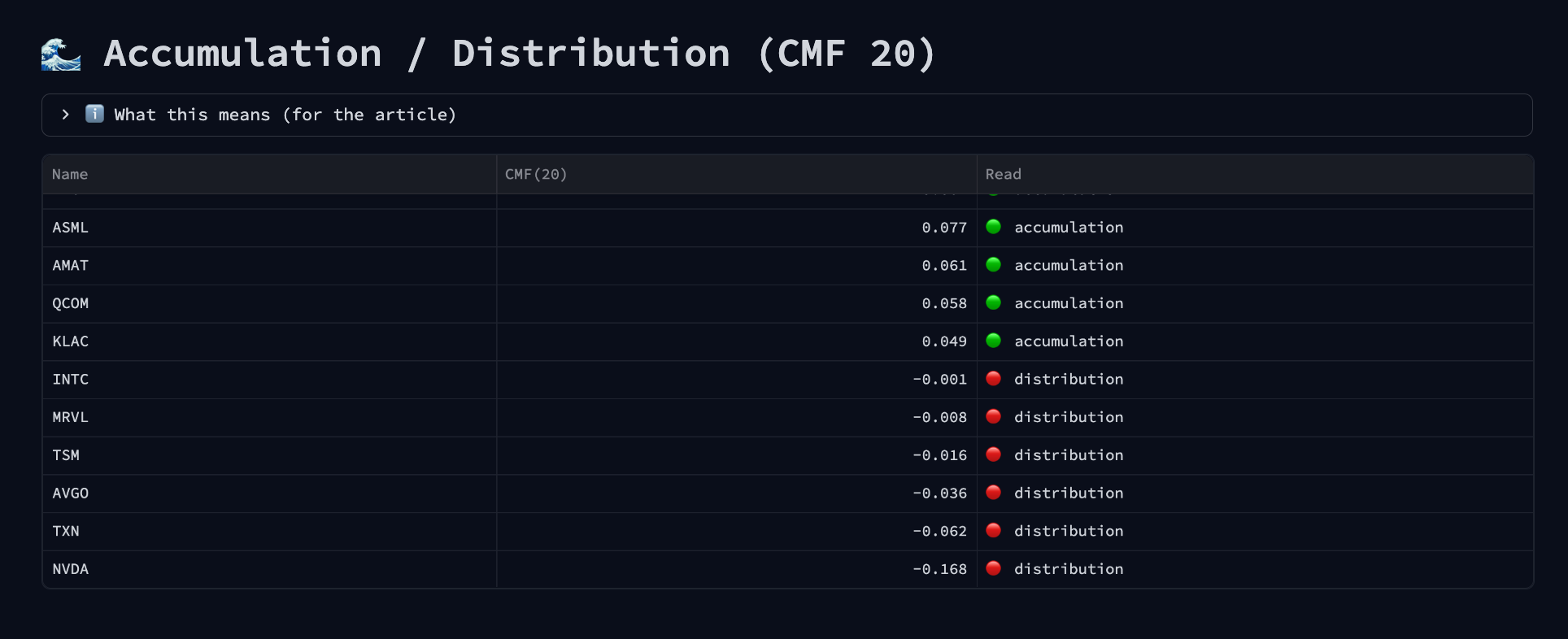
Not surprising to see that the Nvidia stock is already seeing the deepest bit of institutional capital erosion, as highlighted by the negative CMF counter. More on that later in this piece.
The Threat to NVDA Is Bigger Than One Box
The slogan oversells one box, but the trend behind it is real. The bigger threat is not on a desk; it is inside the cloud.
Nvidia’s largest customers are now building their own AI chips to lean on it less. Google has committed up to one million of its chips to Anthropic and is in talks to supply Meta.
Amazon runs its own custom silicon across its cloud at scale. Those in-house chips already make up about 28% of AI server shipments, up from roughly a fifth a year ago.
The cheaper hardware is real too. AMD’s Ryzen AI Halo box opened pre-orders this month at $3,999, below Nvidia’s competing DGX Spark at $4,699. Both trends attack the same thing, the demand for Nvidia’s chips, which is where its revenue comes from.
Nvidia still holds about 70% of the AI chip market, so this is erosion, not collapse. But for the first time, its own customers and a cheaper rival are routing around it.
The Money Has Already Picked a Side, and Its Not Nvidia
The thesis is loud, but the quieter signal is the telling one. The money is already moving. Chaikin Money Flow tracks whether cash is entering or leaving a stock. On Nvidia it has turned firmly negative at -0.168, the weakest reading of any major chip name.

AMD sits at the opposite end, with a positive +0.209, seeing one of the strongest accumulations in the AI chip group.

The trend agrees. Against the SOXX semiconductor index, Nvidia scores just 58.5 on relative strength, while AMD scores 123.
The company that defined AI compute is trailing its own sector, while the rival it once dwarfed leads it.
Nvidia Traders Are Leaning the Same Way
Positioning has turned with the story. In the options market, the Nvidia put/call ratio by volume has risen to about 0.63. Just a day earlier, it sat at a call-heavy 0.49. A rising ratio means puts are gaining on calls, a tilt toward downside hedging.The put-call ratio is still call-heavy but several bearish positions showed up post the viral mini PC post on June 16.

Crypto traders lean in the same direction. On Nansen, the smart money holds its largest chip short against Nvidia, ahead of every peer. The options desk and the perpetual market rarely agree.

Right now, both point away from the Nvidia stock as the money has already picked a side. Despite that, NVDA still manages to keep a near 10% year-to-date uptick, trading around $207 at press time.
The post Nvidia Stock’s Biggest Threat Now Costs $1,499 and Fits on a Desk? appeared first on BeInCrypto.

The first FOMC meeting with the new Federal Reserve Chair, Kevin Warsh, at the helm of the central bank didn’t provide any surprises, as the entity expectedly left the interest rates unchanged.
With the benchmark remaining between 3.5% and 3.75%, bitcoin’s price reacted with minor initial volatility, but there are some warning signs about an upcoming correction.
Recall that nearly two months ago, the Fed under then-Chair Jerome Powell left the rates unchanged for the third consecutive time. However, there were signs from Powell that rate hikes might follow suit.
Despite today’s non-event, as it was described by David Wessel, director of Brookings’ Hutchins Center on Fiscal and Monetary Policy, he also said that Kevin Warsh now finally has the power to change things at the Fed after years of “ranting about” it.
Bank of America’s fund manager survey showed that 55% anticipated Warsh would be hawkish at the press conference, but Stephen Juneau, the bank’s US economist, held the opposite view.
“The investor consensus seems to be that Warsh will lean hawkish in his press conference. We think he’ll be dovish.”
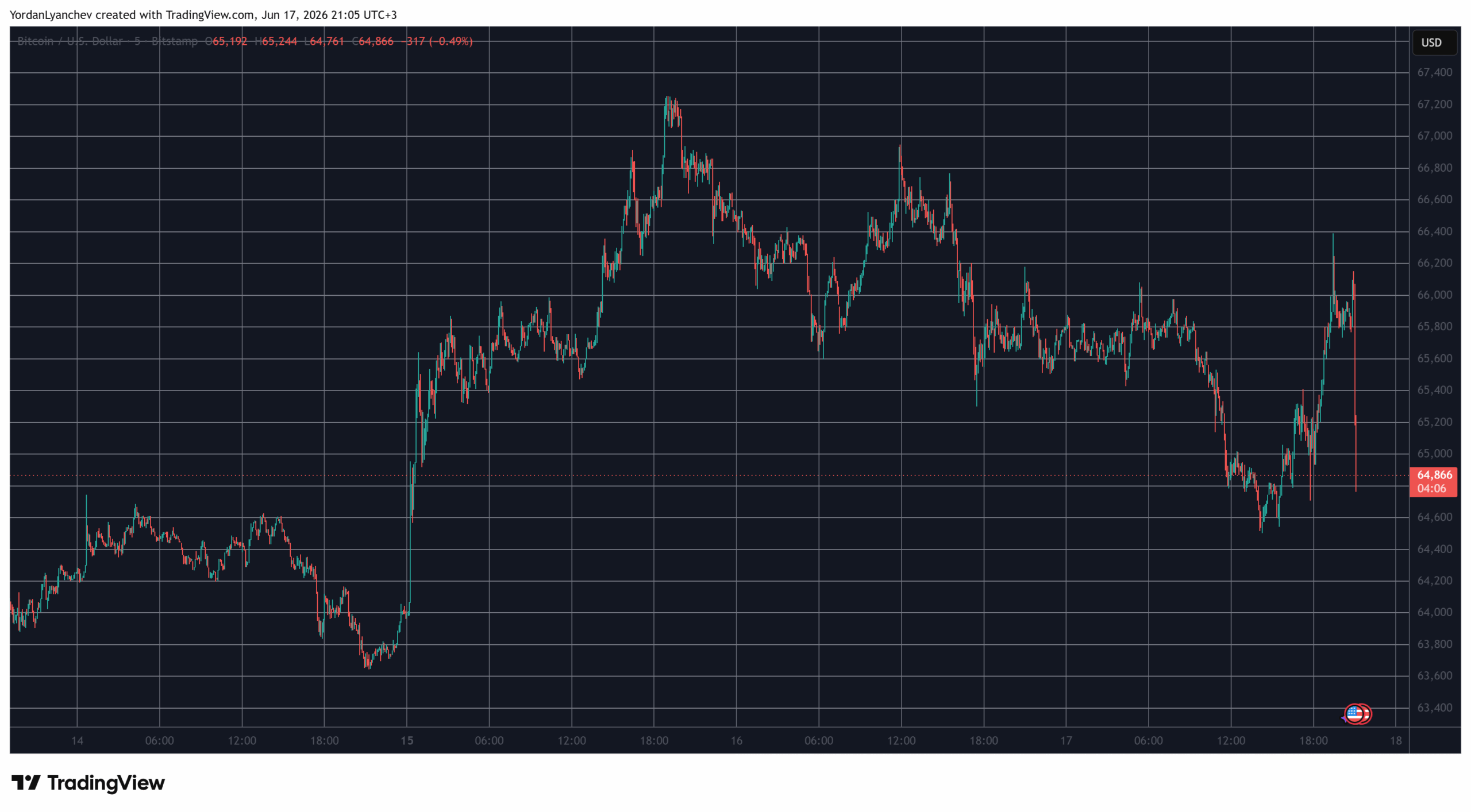
Bitcoin’s price was slightly volatile in the hours leading up to the event, going below $65,000 earlier today before it shot up to $66,400. However, it dipped by over a grand in the first minutes after the news of the unchanged rates went live.
Previous reports from crypto experts noted that the first FOMC meeting and the subsequent Warsh press conference could be one of the most important macro events for the industry.
The post BTC Price Drops as New Fed Chair Kevin Warsh Holds Rates Steady appeared first on CryptoPotato.
ASTER has surged more than 20% after Aster unveiled a new tokenomics framework that commits almost all platform fee revenue to daily token buybacks and large-scale supply reductions.
Summary
- ASTER surged over 20% after Aster committed 99% of platform fees to daily token buybacks.
- Aster plans to cut ASTER supply from 8 billion to 3 billion through ongoing reserve burns.
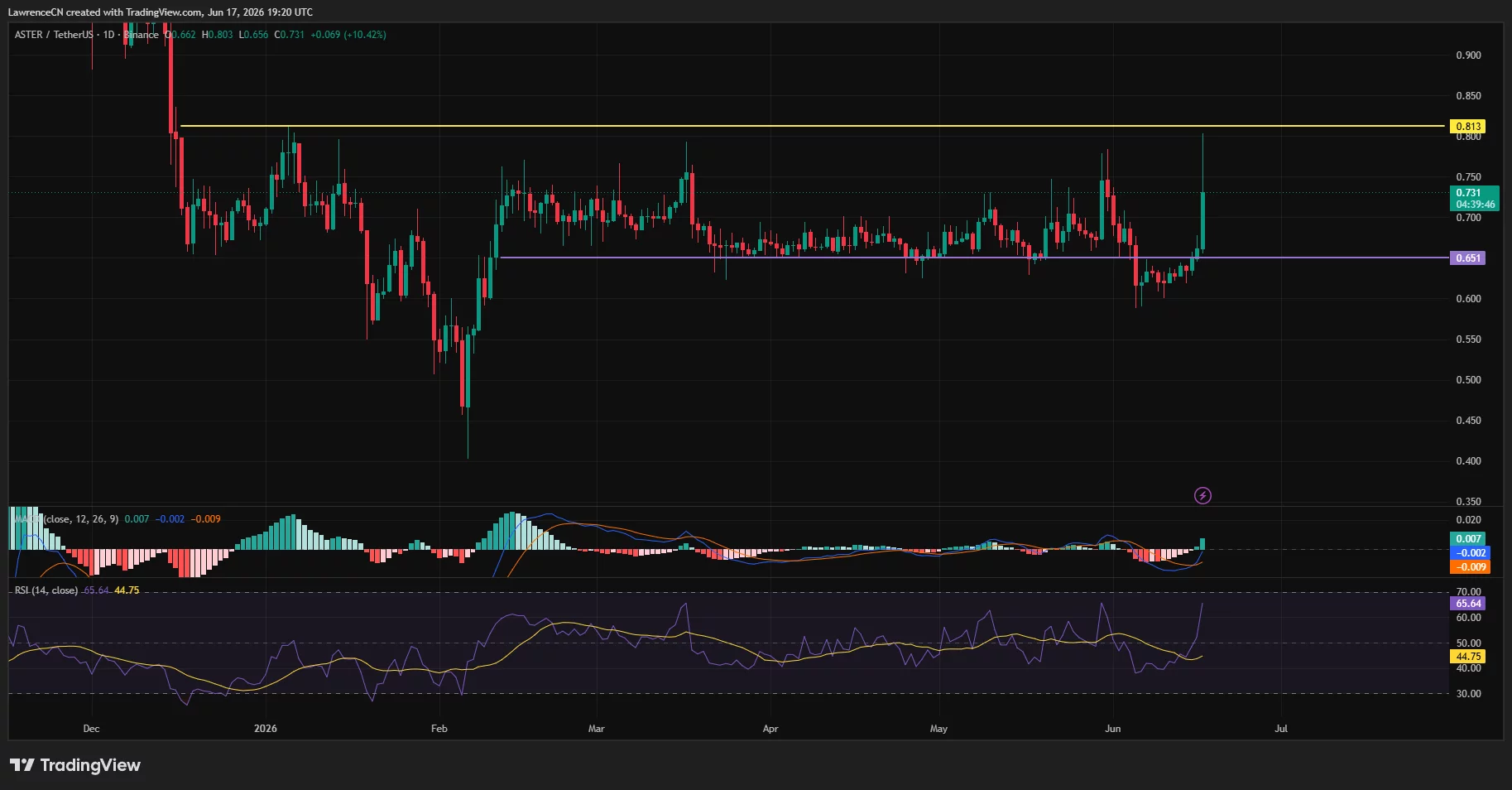
- Technical indicators turned bullish as ASTER broke above $0.65 and approached resistance near $0.81.
According to a June 17 X post by Aster, 99% of the protocol’s daily fees will now be used to purchase ASTER from the open market beginning June 17 at 12:00 PM UTC. The announcement pushed the token close to $0.80 before some profit-taking emerged, with ASTER later changing hands near $0.74, up roughly 13% over the past day.
The update introduces a second layer of supply reduction alongside the buybacks. Aster said it will remove an equal amount of ASTER from reserve holdings each day, creating what the protocol described as a 198% combined buyback-and-burn effect.
Reserve reductions will begin with the team allocation and continue until the total token supply falls from 8 billion ASTER to 3 billion.
Additional demand could also come from Aster Spot. According to the protocol, every permissionless token listing on the platform will require a 50,000 USDT fee, with all proceeds earmarked for further ASTER buybacks that will be distributed to stakers through the rewards program.
Platform fees now drive ASTER rewards
Rather than destroying purchased tokens, Aster said the acquired ASTER will be distributed to participants in its Loyalty Rewards program.
Under the revised model, each reward epoch will include a fixed allocation of 300,000 ASTER plus all tokens accumulated through daily buybacks.
Distribution will be directed to veASTER holders according to lock-weighted participation. Aster added that all buybacks will be executed through an automated daily time-weighted average price process and settled on-chain. To increase transparency, the project has also published the wallet address used for the purchases, allowing users to verify transactions independently.
By linking fee generation directly to token purchases, staking rewards and reserve reductions, the protocol has created a mechanism where higher trading activity results in larger buybacks and larger reward distributions.
Technical breakout places $0.81 resistance in focus
Market participants responded quickly to the announcement, driving ASTER above a trading range that had largely contained price action since April. On the daily chart, the token broke through support-turned-resistance near $0.65 and climbed toward the next major barrier around $0.81.
The daily chart also showed strengthening momentum indicators following the move. ASTER’s Relative Strength Index rose above 65, while the MACD produced a bullish crossover accompanied by expanding positive histogram bars, signaling stronger buying pressure.
The $0.81 region remains an important level because it coincides with several prior rejection points visible on the daily chart. A successful break above that zone could expose the token to areas not tested since late 2025, while traders may look for the former resistance near $0.65 to act as support if the rally pauses.
Disclosure: This article does not represent investment advice. The content and materials featured on this page are for educational purposes only.
This article was updated with additional details from the Federal Reserve’s latest dot plot projections and voting results.
The Federal Reserve has kept its benchmark interest rate unchanged at 3.50% to 3.75% for a fourth consecutive meeting as policymakers continue monitoring inflation risks across the U.S. economy.
Summary
- The Federal Reserve unanimously kept interest rates at 3.50%–3.75% for a fourth straight meeting.
- Fed projections showed nine officials expect at least one rate hike this year, signaling persistent inflation concerns.
- Bitcoin fell to $65,430 as investors assessed the Fed’s hawkish outlook and Kevin Warsh’s policy stance.
According to the Federal Open Market Committee, officials voted unanimously to leave rates unchanged at the conclusion of the June meeting, keeping the federal funds target range at 3.50% to 3.75%
The decision extended a pause that has remained in place throughout 2026 and matched market expectations, with investors widely anticipating no change in policy despite continued concerns about inflation.
Attention has now turned to Fed Chair Kevin Warsh’s first post-meeting press conference, where investors are looking for clues about how policymakers view inflation and whether tighter monetary policy could still be required later this year.
Inflation concerns continue to shape policy outlook
Although the Fed left rates unchanged, concerns about inflation remain central to the policy discussion. In its statement, the Committee cited ongoing uncertainty surrounding price pressures as officials weigh future decisions.
Among the firms adopting a more cautious view, Citadel Securities has warned that inflation may be becoming entrenched across the economy. As previously reported by crypto.news, the firm pointed to supportive financial conditions, labor market resilience, supply-chain disruptions, and rising investment tied to artificial intelligence as factors that could keep inflation elevated.
Citadel also highlighted recent economic data showing a growing share of core Consumer Price Index components increasing more than 3% year over year. The firm noted that headline CPI reached 4.2% in May, while Producer Price Index inflation accelerated to 6.5%, indicating continued cost pressures for businesses.
Based on those conditions, Citadel expects the Federal Reserve under Warsh to maintain a hawkish stance. The firm estimates that at least five Fed officials could signal support for future tightening and argues that an inertial Taylor Rule framework would justify roughly 75 basis points of rate increases during 2026.
Under Citadel’s forecast, rate hikes could arrive in September and December 2026, followed by another increase in March 2027. While the firm does not expect an immediate move, it said Warsh’s assessment of inflation risks will be critical for markets.
Adding to the debate, BNP Paribas recently abandoned its expectation for stable policy and now forecasts three rate hikes beginning in December. The bank cited persistent inflation, strong employment data, and inflation risks associated partly with geopolitical tensions involving Iran.
Fresh economic projections released alongside the decision suggested many policymakers remain concerned about inflation. According to the Fed’s updated dot plot, nine of 18 officials expect at least one rate hike before the end of the year.
Six of those officials projected multiple increases, while only one participant forecast a rate cut. One official did not submit a projection, a position widely assumed by market observers to belong to Chair Kevin Warsh.
Markets await signals from Warsh
Recent developments in energy markets have complicated the inflation outlook. Following the initial U.S.-Iran agreement, oil prices moved lower, reducing one source of inflation pressure. Even so, several analysts continue to argue that price increases have spread beyond energy and into other parts of the economy.
Political pressure has also remained in focus. President Donald Trump has repeatedly called for lower interest rates, although he recently suggested he would not pressure Warsh to cut rates in the same manner he publicly challenged former Fed Chair Jerome Powell.
Financial markets showed a muted reaction following the announcement, although risk assets weakened after investors reviewed the Fed’s projections. According to data from crypto.news, Bitcoin fell 0.6% over the previous 24 hours to around $65,430, while Ethereum declined 1.4% to roughly $1,770.
Most other top-100 digital assets traded near flat levels, posting only modest gains or losses. The total cryptocurrency market capitalization slipped 0.7% to approximately $2.33 trillion at press time as traders continued assessing the implications of the Fed’s decision and the possibility of future policy tightening.
Bitcoin (BTC) bounced off week-to-date lows into Wednesday’s Wall Street open as corporate sell pressure returned to the radar.
Key points:
- Bitcoin sees a new low for the current weekly candle with the Fed FOMC meeting due in hours.
- Analysis warns that markets remain concerned over Strategy potentially selling more BTC.
- Fed chair Kevin Warsh faces a tough balancing act at his first interest-rate decision.
Strategy selling still impacting Bitcoin price strength
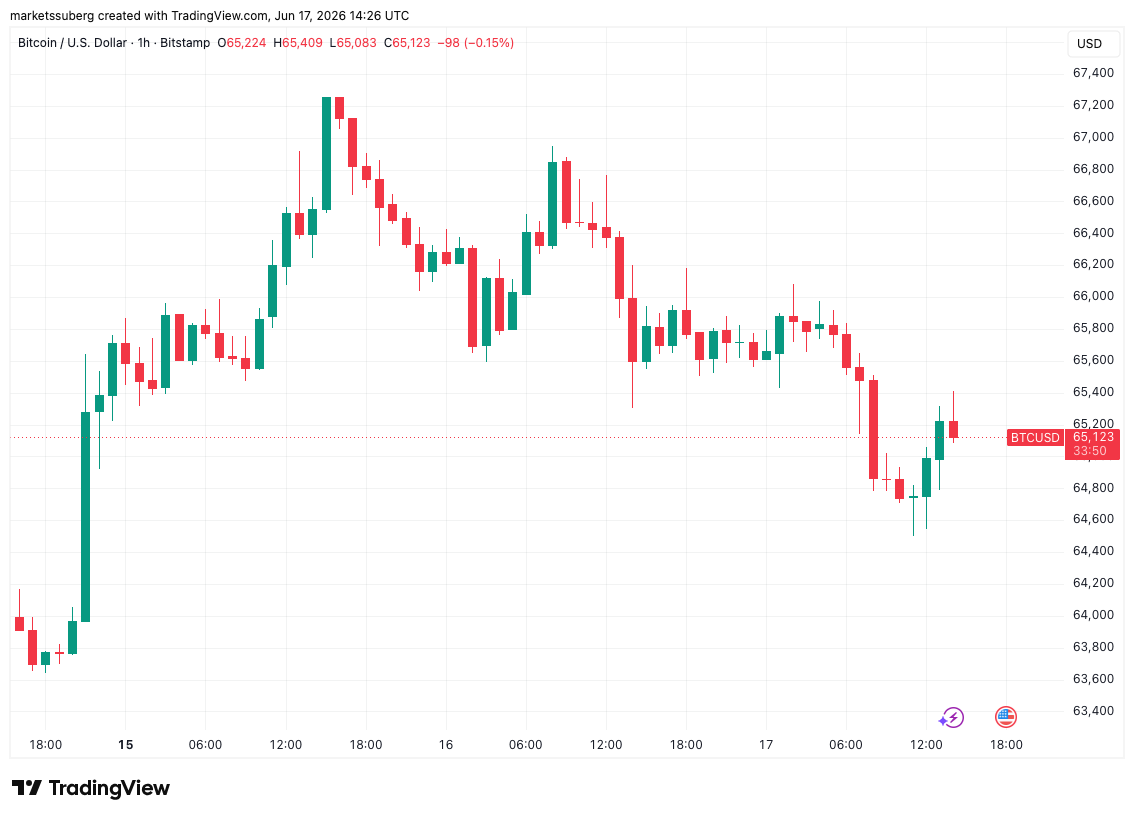
Data from TradingView showed BTC/USD heading higher after dropping to $64,500 on Bitstamp.
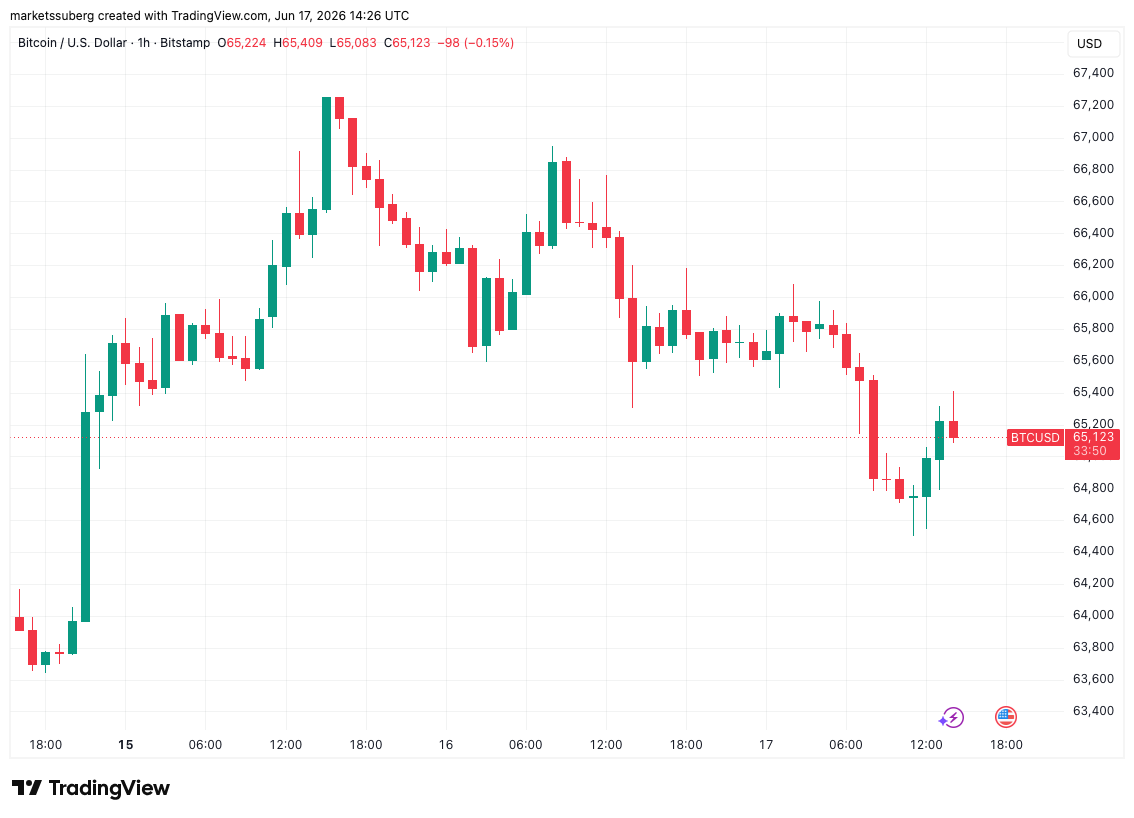
BTC/USD one-hour chart. Source: Cointelegraph/TradingView
The pair saw ongoing weakness ahead of the US Federal Reserve’s interest-rate meeting, scheduled for 2pm Eastern time. As Cointelegraph reported, such events tend to trigger BTC price downside.
In its latest Market Color analysis, trading company QCP Capital said that the BTC price outlook was clouded by more than just the Fed.
“While broader markets continue to trade higher on optimism across multiple fronts, BTC remains stuck below the 66k level,” it wrote.
“The underperformance has been driven in part by concerns that Strategy may need to sell more Bitcoin to fund dividend payments, especially after buying back $1.5 billion of its 2029 Convertible Senior Notes.”
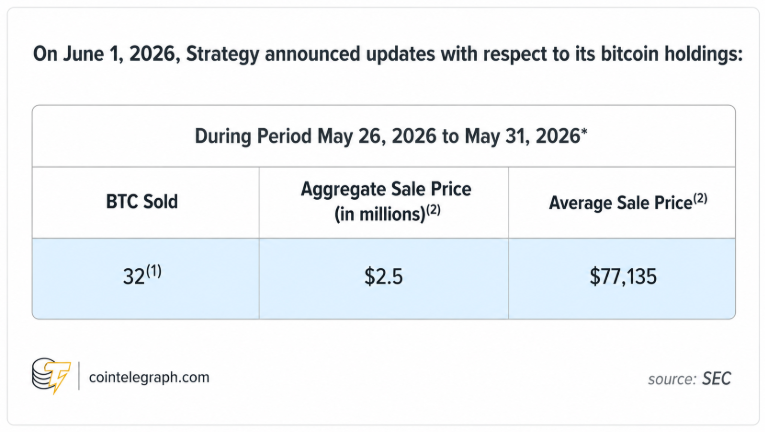
Source: Cointelegraph
QCP explained that contingency measures by technology company Strategy had “extended its runway” in terms of liquidity after selling 32 BTC in May, but markets remained wary of potential problems further down the line.
“In the short term, we think this overhang may continue to prevent Bitcoin from fully participating in the broader macro optimism. However, as Strategy continues to issue shares and lengthen its runway, that optimism may eventually catch up to BTC,” it continued.
“For now, the macro tide has turned more supportive, but Bitcoin still has one very specific overhang to work through.”
Fed’s Warsh faces “difficult opening act”
On the Fed, meanwhile, QCP joined those putting the focus on new Fed chair, Kevin Warsh.
Related: Can BTC rebound to $69K as oil price plunges? Five things to know in Bitcoin this week
“Warsh takes the stage at his first Fed meeting as Chair today,” it stressed.
“Previous expectations had positioned him as dovish and more inclined toward rate cuts, but the economic backdrop has shifted materially.”
QCP described a “difficult opening act” for Warsh, who should balance inflationary trends with pressure to cut rates from president Donald Trump.
“Today’s meeting will therefore be about more than the rate decision,” it continued, referring to outgoing chair, Jerome Powell.
“It will be Warsh’s first opportunity to secure buy-in from Powell and the rest of the Board, while establishing himself as a credible and independent Fed Chair.”
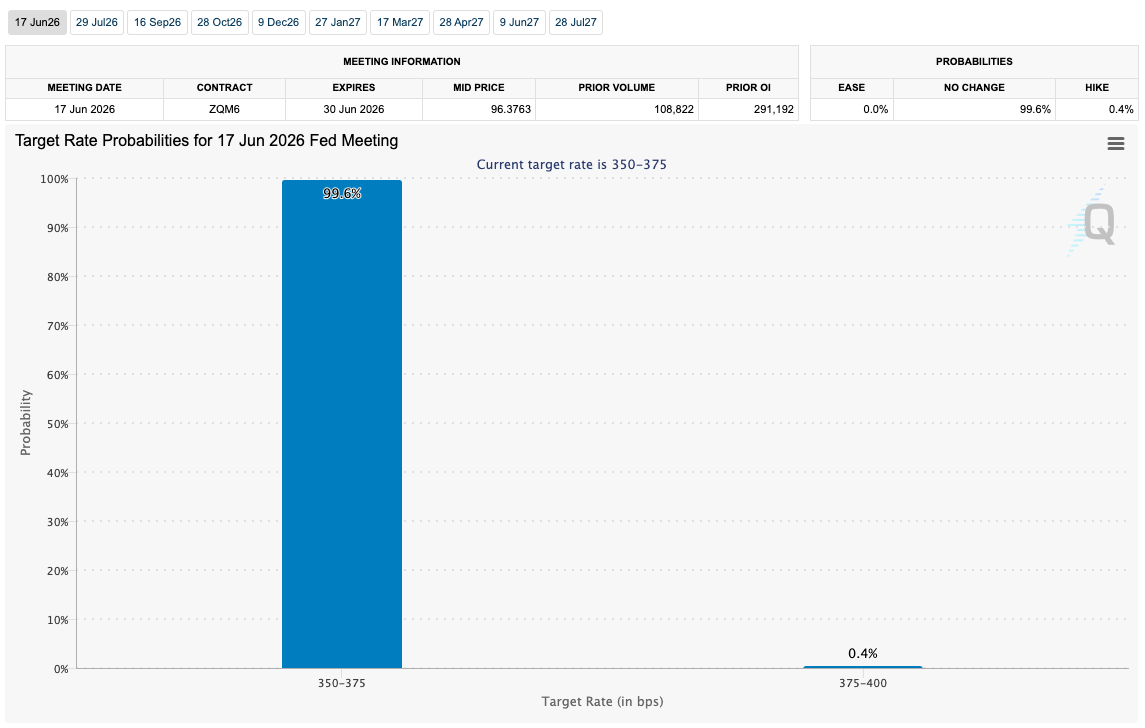
Fed target rate probabilities for Wednesday FOMC meeting (screenshot). Source: CME Group
Data from CME Group’s FedWatch Tool showed no odds of the Federal Open Market Committee (FOMC) cutting rates.
Andre Dragosch, European head of research at crypto asset manager Bitwise, noted that markets increasingly expected a rate hike by the end of the year — a clear would-be headwind for crypto and risk assets.
“IMO still a lot of monetary policy uncertainty around the question whether Warsh is rather hawkish or dovish amid the rise in inflation,” he wrote in a post on X.
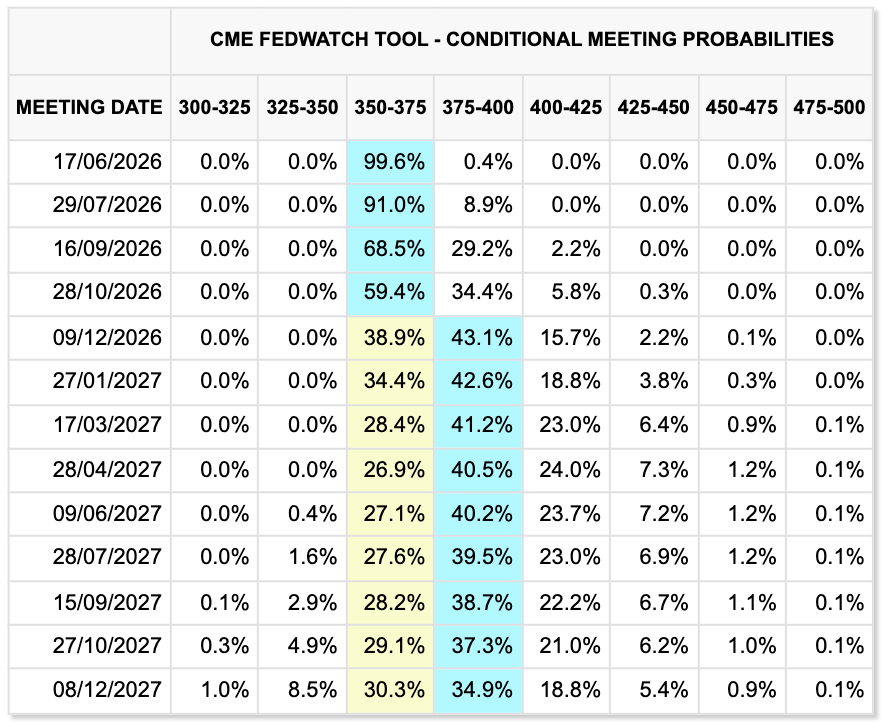
Fed target rate probabilities (screenshot). Source: CME Group
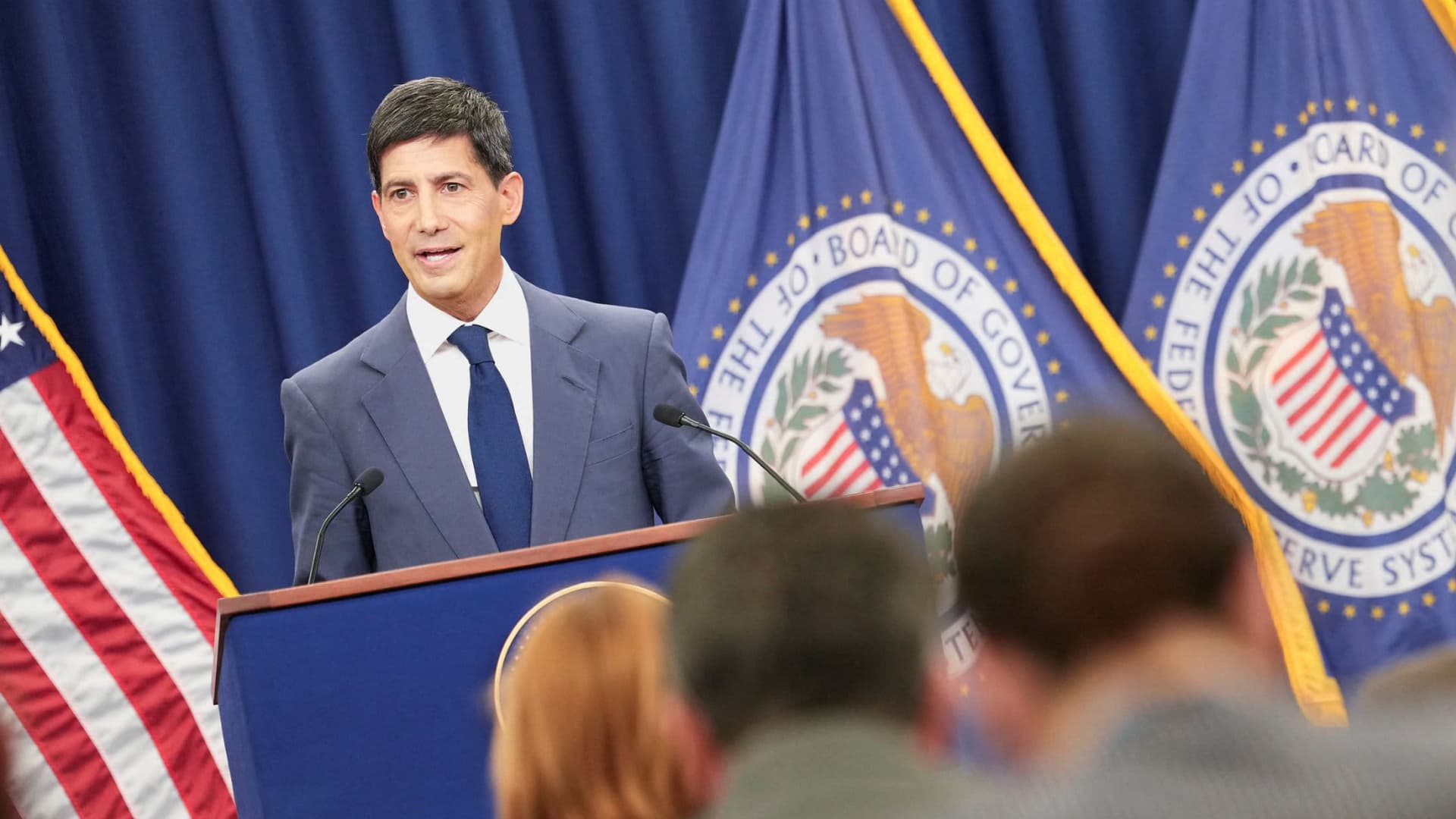
New U.S. Federal Reserve Chairman Kevin Warsh holds a press conference following a two-day meeting of the Federal Open Market Committee (FOMC), at the U.S. Federal Reserve in Washington, D.C., U.S. June 17, 2026.
Eric Lee | Reuters
Wednesday’s Federal Open Market Committee statement looked drastically different than those issued after previous meetings, offering one of the first formal signs of the changes promised by new Federal Reserve Chairman Kevin Warsh.
The statement released Wednesday contained around 130 words, down from figures above 300 recorded in each of the past two meetings, according to a CNBC analysis of the releases.
Warsh acknowledged a “difference” in the statement early in his first press conference as chair on Wednesday. He said there was no forward guidance, as it was “not well suited for the current policy conjuncture.”
“It’s a bit shorter, a bit simpler and it dispenses with some older language,” Warsh said. “That statement just gives you the facts, as best we can judge it.”
Below is a comparison of Wednesday’s FOMC statement with the one issued after the Fed’s previous policymaking meeting in April.
Text removed from the April statement is in red with a horizontal line through the middle. Text appearing for the first time in the new statement is in red and underlined. Black text appears in both statements.
Wednesday’s release contained no information on how members voted, previously an fixture at the end of releases under former Federal Reserve Chairman Jerome Powell. Instead, Wednesday’s statement indicated only that it was a unanimous vote.
The latest statement also includes less color on how the Fed views current inflation trends and where it could be going next. However, the statement did say that the Fed is committed to having stable prices.
“What Kevin Warsh is trying to do with this statement is not use the statement to give forward guidance, and I think he did a pretty good job with that,” said David Wessel, senior fellow at Brookings, on CNBC’s “Power Lunch.”
Fed watchers viewed the change as part of a “regime change” Warsh has promised for the central bank. Warsh has criticized how the Fed communicates, arguing that it leads to policy errors and entagles the central bank in markets.
“Warsh’s first FOMC statement left the clear impression that there is a new chair in town,” said Ian Lyngen, head of U.S. rates strategy at BMO.
“The statement was significantly shortened — eliminating the forward guidance,” he said. It gave “only a cursory characterization of the economy as ‘expanding at a solid pace.’”
— CNBC’s Davis Giangiulio and Yun Li contributed to this report.

TLDR:
- Moody’s brought machine-readable credit ratings to Solana through its integration with Alphaledger infrastructure.
- Solana became the first public blockchain capable of supporting Moody’s ratings directly on-chain.
- Issuers can now embed Moody’s credit data into tokenized fixed-income assets at the asset level.
- The rollout follows Moody’s earlier TIE deployment on Canton Network during March 2026.
Moody’s has expanded its blockchain strategy by bringing machine-readable credit ratings to Solana through a new integration with Alphaledger.
The move places one of the world’s most widely used credit assessment systems directly on a public blockchain network. It also marks the first time Moody’s ratings can operate at scale on a major permissionless chain.
The deployment adds another institutional finance layer to Solana’s growing real-world asset ecosystem.
Moody’s Credit Ratings Reach Solana Through Alphaledger Integration
According to a release from Moody’s Corporation, Moody’s Ratings has extended its Token Integration Engine, known as TIE, to the Solana network. The integration comes through Alphaledger, a platform focused on tokenized fixed-income assets.
The launch follows a proof-of-concept completed on Solana’s devnet in June 2025. That earlier test explored how credit ratings could become part of tokenized securities issued on-chain.
With the deployment now live, issuers using Alphaledger can choose to attach Moody’s Ratings data directly to tokenized fixed-income instruments. The information becomes available within the asset’s digital infrastructure rather than through separate external systems.
Moody’s stated that the rollout makes its ratings ready for large-scale deployment on a major public blockchain. The company also noted that TIE was designed to function across different blockchain environments rather than a single network.
The development follows Moody’s first blockchain-based ratings deployment on the Canton Network in March 2026. At the time, the company introduced ratings delivery capabilities on a permissioned institutional blockchain.
Solana RWA Market Gains Institutional Credit Infrastructure
The latest integration brings Moody’s credit data into Solana’s expanding real-world asset sector. Credit ratings play a central role in traditional fixed-income markets by helping investors evaluate risk.
Moody’s said investors increasingly transact on blockchain networks and require access to independent credit assessments in those environments. The company described TIE as a network-agnostic framework built to support that transition.
Alphaledger stated that embedding ratings directly into tokenized assets removes the need for separate credit lookups. The platform highlighted municipal debt markets as one area where integrated ratings could support institutional participation.
The Solana Foundation also addressed the launch. According to information shared by the foundation, the network now becomes the first public permissionless blockchain capable of supporting Moody’s machine-readable credit ratings directly on-chain.
The release noted that credit information can now travel alongside tokenized assets throughout their lifecycle. Market participants can access independent credit analysis within the asset structure itself rather than relying on disconnected data sources.
Moody’s indicated that additional blockchain integrations remain under consideration as digital finance adoption grows. The company plans to expand TIE coverage across more networks, business lines, and financial instruments over time.

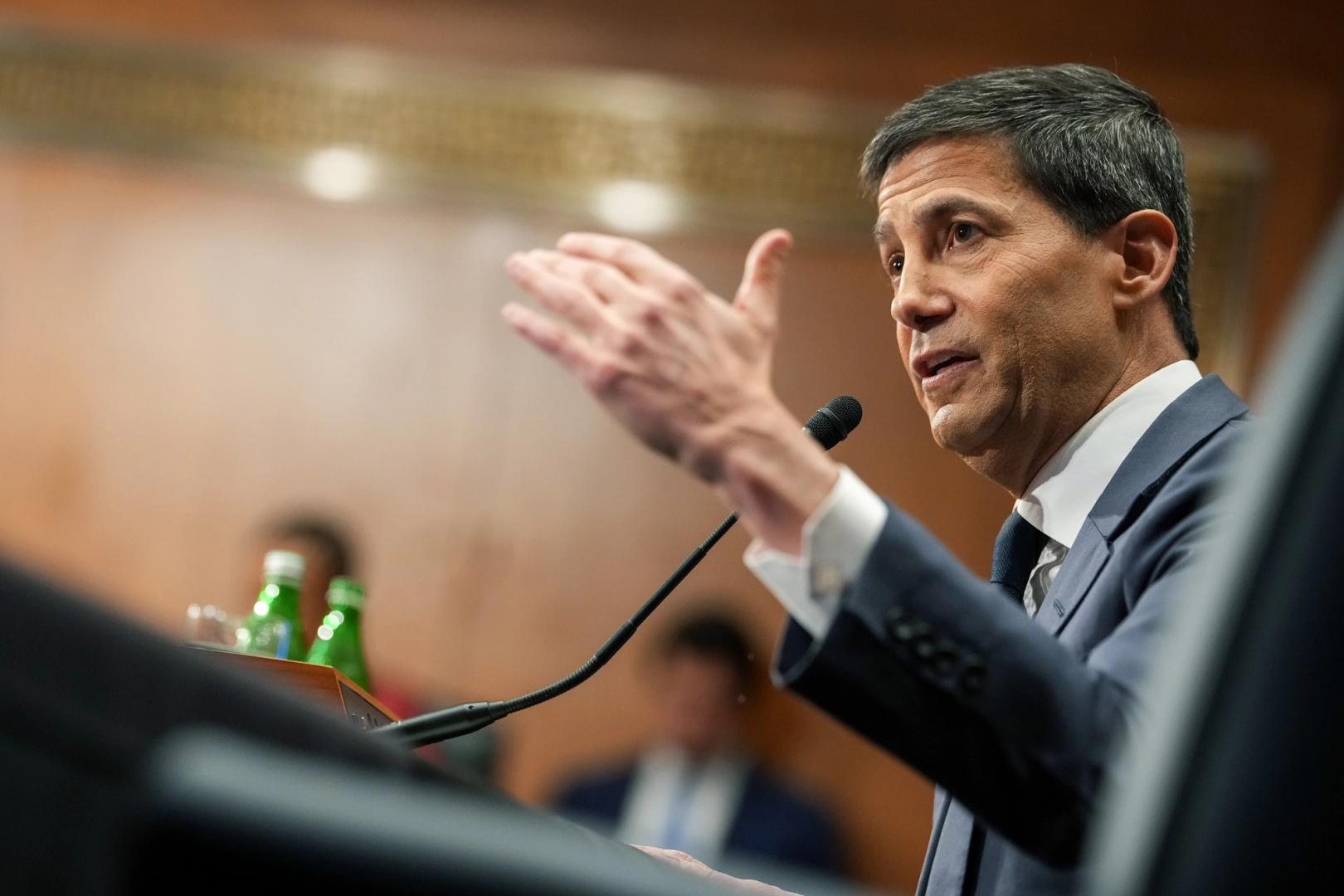
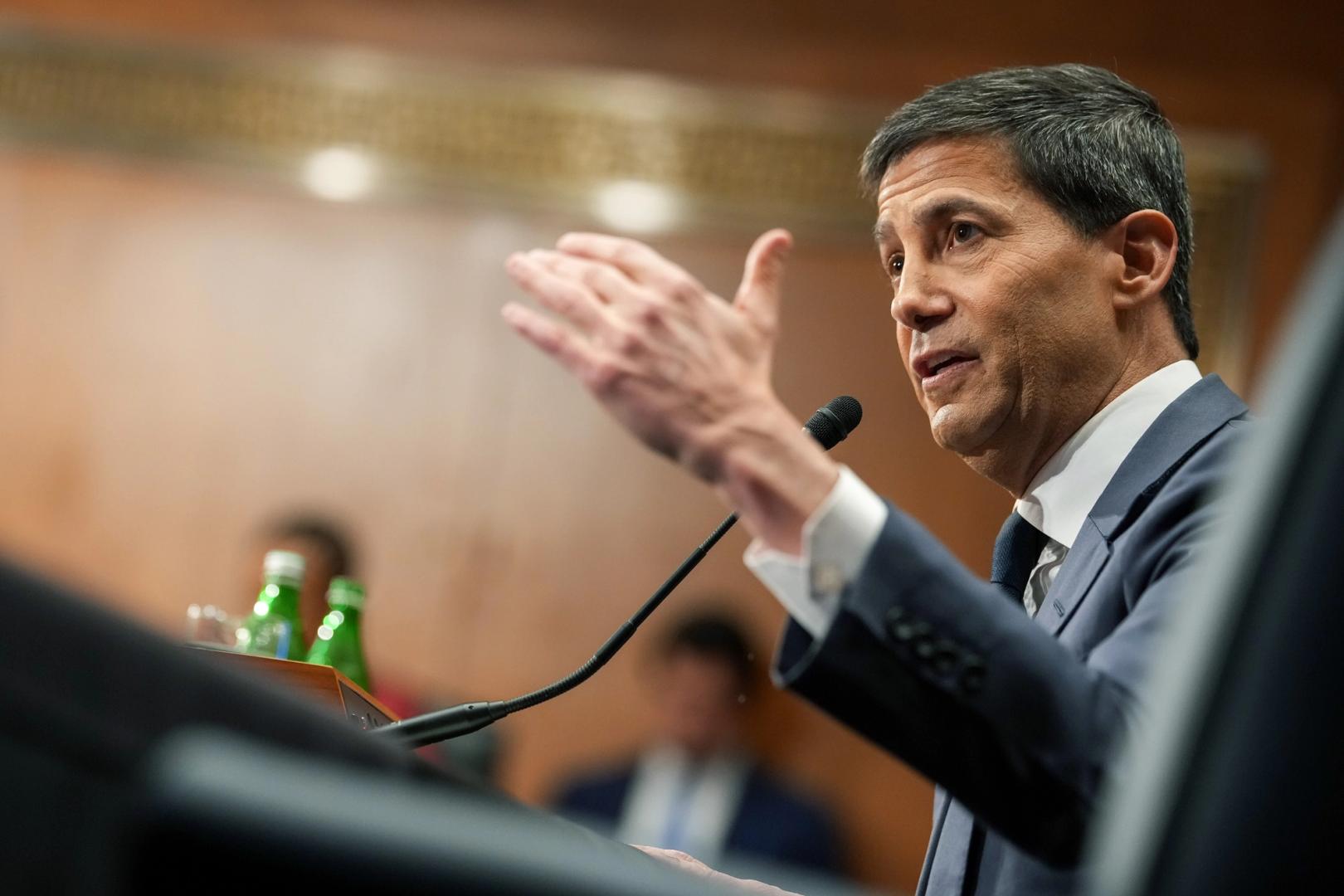
The Federal Reserve left its benchmark fed funds rate range unchanged at 3.50%-3.75% on Wednesday, a move markets had expected nearly unanimously.
“Economic activity is expanding at a solid pace despite elevated uncertainty that owes, in part, to the conflict in the Middle East,” the press release said. “Inflation remains elevated relative to the Committee’s 2 percent goal, in part reflecting supply shocks that have driven price increases in certain sectors, including energy.”
“The Committee will deliver price stability,” it added.
Policymakers are increasingly lean towards a rate hike this year, expecting the fed funds rate at 3.8% at the end of 2026, versus a 3.4% in the March projection. Easier monetary policy will not come anytime soon as they expect rates at 3.6% for 2027 and 3.4% in 2028, both higher than their previous guidance.
They also see higher inflation, with personal consumption expenditure (PCE) rising 3.6 this year and core PCE inflation at 3.3%, compared to a forecast of 2.7%-2.7% in March.
Trading around $66,000 earlier, bitcoin fell to $64,800 in the minutes following the decision, and recently stabilized around $65,300. The S&P 500 and Nasdaq 100 both dropped nearly 1%, erasing earlier gains.
Crypto World
Gaming Industry, Tribes and Unions Press Senate to Ban Sports Prediction Markets in Crypto Bill


The American Gaming Association is leading a coalition of tribal groups and hospitality unions urging the Senate to insert language into pending crypto market-structure legislation that would bar prediction markets from offering sports wagers. The push squarely targets Kalshi and Polymarket. The… Read the full story at The Defiant


Former Ripple CTO David Schwartz challenged the popular claim that stock markets and prediction markets are just casinos, arguing on X that the comparison ignores a fundamental economic divide.
Schwartz stepped back from daily operations at Ripple at the end of 2025 and became CTO Emeritus. He entered the debate on June 17, 2026, responding to users who argued that “trading” is a euphemism for gambling.
Gambling Moves Value, and Investing Grows It
The exchange began when X users argued that prediction markets and stock markets operate like casinos. Their core claim was that “trading” serves as a polished cover for placing bets. Schwartz rejected that framing.
He separated the two by their economic function. Gambling moves existing value between participants. Investing generates new value.
“A key way to see the difference is this: If you have positive expected value in gambling, something has gone very wrong. If you have negative expected value in investing, something has gone very wrong,” says Schwartz
The logic works symmetrically. A gambler who consistently beats the house reveals a flaw in the system, not a feature. An investor who consistently loses in a functioning market faces a problem with their approach or the market itself. That test shifts the burden of proof onto the system’s design.
A casino’s purpose is to redistribute money among players. A market’s purpose is to direct capital toward productive use and generate returns across the broader economy over time.
Schwartz’s Long View on Markets
The remarks carry added weight from someone who co-architected the XRP Ledger. Schwartz served as Ripple’s CTO for more than a decade before transitioning to an advisory board role at the end of 2025. He remains one of the most prominent technical voices in the XRP ecosystem.
The Ripple EX CTO also drew significant attention earlier this year for his XRP escrow price views, directly challenging viral price targets. He used market-cap math to show that many community projections rest on valuations exceeding the entire global money supply.
XRP (XRP) trades at $1.19 at the time of writing, down 3.64% over the past 24 hours. The asset holds a top-six market rank with total capitalization near $74.2 billion.
The comments also land as prediction markets face state bans across the US. At least 12 states have moved to classify event contract platforms as gambling under state law.
Whether policymakers adopt Schwartz’s value-creation framing or the casino label favored by his critics could shape how these markets are regulated in the months ahead.
The post Former Ripple CTO Draws a Sharp Line Between Investing and Gambling appeared first on BeInCrypto.
Quick Summary
- Federal Reserve Chair Kevin Warsh conducted his inaugural policy meeting with rates unchanged; investors analyzed signals about monetary direction
- SpaceX completed its acquisition of Cursor, an AI-powered coding platform, following its historic public offering
- Crude oil prices hovered near quarterly lows amid easing US-Iran tensions and improved diplomatic relations
- Commercial space companies including Rocket Lab and AST SpaceMobile sustained significant investor momentum
- Leading equity benchmarks maintained positions close to all-time peaks despite persistent inflation and monetary policy uncertainties
Investors juggled multiple significant developments today. Federal Reserve policy, a transformative SpaceX transaction, declining energy costs, and commercial space enthusiasm all captured market focus. Here’s a breakdown of the key catalysts driving today’s trading action.
Warsh Navigates Inaugural Fed Policy Meeting
Federal Reserve Chair Kevin Warsh presided over his first monetary policy gathering today.
The consensus anticipated no change to interest rates. However, market participants scrutinized every detail for clues about upcoming policy trajectory.
Price pressures continue exceeding the central bank’s desired threshold. Meanwhile, economic activity has demonstrated greater resilience than forecasters predicted.
Market observers focused intently on Warsh’s perspective regarding price stability, employment conditions, and the timeline for potential rate adjustments. His approach to leadership may define market trends through the remainder of 2026.
Central bank policy reverberates across all asset classes, influencing everything from growth equities to real estate and fixed income securities.
SpaceX Expands Technology Footprint with Cursor Acquisition
SpaceX captured attention once more, only days following its record-shattering initial public offering.
The aerospace giant revealed it has purchased Cursor, a cutting-edge AI coding platform. This transaction demonstrates Elon Musk’s ambition to expand SpaceX’s reach beyond launch vehicles and orbital infrastructure.
Market watchers are evaluating how SpaceX plans to deploy AI capabilities throughout its software systems, engineering workflows, and production operations.
This purchase reinforces the perception that SpaceX is evolving into a diversified technology conglomerate rather than remaining solely focused on aerospace.
Its stock performance since going public continues generating intense scrutiny among institutional and retail investors alike.
Energy Markets React to Diplomatic Progress
Commodity traders remained engaged as crude oil maintained prices close to three-month floor levels.
Ongoing negotiations between Washington and Tehran have diminished concerns about potential supply interruptions. Should diplomatic progress continue, additional barrels could flow into international markets.
Reduced oil prices offer multiple economic benefits, including downward pressure on inflation, decreased transportation expenses, and enhanced consumer purchasing capacity.
Companies with substantial energy dependencies also gain from reduced operational costs.
Conversely, declining crude values create financial stress for exploration and production firms requiring elevated price levels to maintain profitability.
Commercial Space Sector Sustains Investment Appeal
The SpaceX public debut has maintained heightened attention across the broader aerospace industry.
Rocket Lab, AST SpaceMobile, and Planet Labs all experienced continued robust demand from market participants throughout this trading week.
Numerous investors view these equities as vehicles for gaining exposure to commercial space expansion without direct SpaceX ownership.
While the sector has experienced significant price swings lately, buyer enthusiasm remains elevated.
Satellite connectivity, launch infrastructure, government contracts, and remote sensing applications are attracting capital from diverse investor categories.
Equity Benchmarks Hold Near Peak Valuations
Despite persistent worries surrounding monetary policy and inflation dynamics, major indexes continue trading close to historic peaks.
Technology shares have provided leadership, propelled by substantial artificial intelligence investment and strengthening market sentiment.
Numerous strategists anticipated that elevated interest rates would apply greater pressure on equity valuations.
Instead, investors have maintained their concentration on sustainable growth opportunities within AI, chip manufacturing, enterprise software, and aerospace sectors.
As 2026’s second half unfolds, the market’s dominant investment themes continue driving asset allocation decisions.
BTC Price Drops as New Fed Chair Kevin Warsh Holds Rates Steady

What time does England World Cup 2026 game against Croatia finish tonight?

Jackery’s FridgeGuard is the slimmest fridge backup battery you can buy right now


-

 Business3 days ago
No Jackpot Winner as $257 Million Prize Rolls Over to $269 Million Monday Draw
-

 Crypto World6 days ago
Oppenheimer backs SpaceX as $70 billion retail frenzy builds
-

 Fashion5 days ago
Weekend Open Thread: Tuckernuck – Corporette.com
-

 Crypto World6 days ago
Markets Rally as SpaceX IPO Looms Amid Iran Tensions and Inflation Surge
-
Crypto World3 days ago
Zimbabwe Requires Crypto Businesses to Register Annually Under New FIU Regulations
-

 Tech5 days ago
NanoClaw integrates JFrog registries to secure AI agent downloads
-

 Crypto World5 days ago
Bitget enters Argentina’s regulated crypto market through PSAV registration
-

 Tech5 days ago
This Week In Security: Microsoft On Microsoft, Register Your Domains, Linux On ARM, And FreeBSD Joins The File Cache Club
-

 NewsBeat6 days ago
El Nino has formed in the Pacific and could set records, forecasters say
-
 Tech6 days ago
Dutton Ranch star claims they ‘didn’t see any disruption’ on set following Chad Feehan’s exit from Yellowstone spinoff fueled by Taylor Sheridan clash rumors
-

 Politics6 days ago
Politics Home | Healey Resignation Is “Colossal Failure Of Government”, Says Former Labour Defence Secretary
-
 Entertainment6 days ago
Donnie Wahlberg & More Heat Up Las Vegas at Circa’s Barry’s Downtown Prime
-
 Tech6 days ago
Opendoor Ends India Operations, Fueling a Bigger Conversation About AI and Outsourcing
-

 Politics6 days ago
Belfast burns, while Met chief points finger at Iran and Russia
-

 Sports6 days ago
First Time Since 1971: Australia Register Historic Low In ODI Cricket
-

 NewsBeat5 days ago
FBI searches office of Ohio voter registration group
-

 Business6 days ago
AT&T: Verizon's 27% Outperformance Sets Up A Solid Entry Point
-
 Tech6 days ago
Anthropic is spending $150M to embed 1,000 AI fellows inside nonprofits. No degree required.
-

 Politics6 days ago
Modi thanks Trump for wishes as US attacks Indian seafarers
-
 Entertainment6 days ago
‘The Pitt’s Fan-Favorite Doctor Confirms Noah Wyle Gave His Blessing to Return [Exclusive]
You must be logged in to post a comment Login