

Crypto World
PI faces increased selling pressure, risks further decline below $0.1700



Key takeaways
- Pi Network extends losses on Thursday and could dip lower in the near term.
- The technical outlook for PI is mildly bearish as the short-term support is near $0.1687
Pi Network (PI) is edging lower on Thursday, threatening a potential bearish breakout below the $0.1700 mark.
The rise in selling pressure is likely linked to renewed mainnet migration activity, with over 1 million PI tokens being deposited on centralized exchanges (CEXs), weighing down on the PI token’s price.
CEX deposits surge amid renewed mainnet migration
Pi Network is experiencing increased selling activity as investors transfer their PI tokens to exchanges after completing their Know Your Customer (KYC) verification.
PiScan data reveals that over 36 million PI tokens were migrated to the mainnet in the past four days, coinciding with the 26.20 million PI tokens unlocked from Pi Core Team wallets.
Simultaneously, Pi-supporting exchanges saw an influx of 1.15 million tokens, indicating that large holders are reducing their exposure amid the option for an exit.
Technical outlook: PI risks deeper correction below $0.1700
The PI/USD 4-hour chart is bearish and efficient. At press time, Pi Network is trading around $0.1700, with a bearish near-term outlook.
The PI token remains well below the 50-period Exponential Moving Average (EMA) at $0.1739 on the 4-hour chart, as well as the 100- and 200-period EMAs, which are clustered between $0.1750 and $0.1767.
These moving averages, combined with the downward trendline, form a dense resistance zone that limits any upward movement.
The price is approaching the May 12 low of $0.1687, which has served as a base for short-term consolidation.
The token is trapped within a descending wedge pattern, indicating that the current structure leans bearish.
Additionally, the Relative Strength Index (RSI) is hovering near 40, slipping below the midline, while the Moving Average Convergence Divergence (MACD) line and its signal line remain marginally below zero, signaling that downside momentum is still in control.
If the bulls regain control, initial resistance lies near the 50-period EMA and the downward trendline break area around $0.1739.

However, if the selloff persists, immediate support is loosely defined around the $0.1700 region, close to the May 12 low at $0.1687.
A clear break below this level could open the door to fresh lows on the 4-hour chart, especially as the broader structure remains capped by the overhead moving averages and trendline resistances.



Coinbase (COIN) is expanding its presence on Hyperliquid (HYPE), one of crypto’s fastest-growing trading networks, by becoming the official treasury deployer of USDC on the blockchain, the companies announced Thursday.
The move gives Coinbase a central role in managing USDC liquidity on Hyperliquid through the network’s Aligned Quote Asset, or AQA, framework. The system connects stablecoin liquidity directly into Hyperliquid’s trading infrastructure and shares reserve yield revenue with the protocol.
As part of the transition, Native Markets, the developer behind Hyperliquid-native stablecoin USDH, agreed to terms granting Coinbase the right to purchase USDH brand assets. USDH will remain redeemable for USDC or fiat during the migration period before the product sunsets over time.
The deal marks another step in Coinbase’s push to expand USDC usage beyond Ethereum (ETH) and centralized exchanges as competition among stablecoin issuers intensifies.
Hyperliquid has become one of the most closely watched projects in crypto this year. The decentralized trading platform built a loyal following by offering perpetual futures trading with low fees, deep liquidity and a fast user experience that rivals centralized exchanges.
Trading activity on the network has surged in recent months as traders shifted toward onchain platforms following renewed interest in decentralized finance. USDC supply on Hyperliquid has roughly doubled year over year to around $5 billion, according to Coinbase.
The network has also become a growing center for speculative trading and token launches. That growth has turned Hyperliquid into a larger player in crypto market structure discussions. Stablecoins act as the core settlement layer for most crypto trading activity, and securing dominant liquidity on a fast-growing exchange ecosystem gives Coinbase and Circle (CRCL) broader reach for USDC adoption.
Native Markets said Coinbase’s involvement could further strengthen Hyperliquid’s position by bringing one of the largest U.S. crypto companies directly into the ecosystem.
The arrangement also reflects a broader shift in crypto infrastructure. Rather than treating stablecoins as separate products, exchanges and blockchain networks increasingly integrate them into trading, collateral and treasury systems designed to operate around the clock.
Coinbase said the partnership would help create a more unified global marketplace for onchain capital markets, where traders can move between crypto assets and fiat-backed stablecoins without leaving blockchain-based platforms.
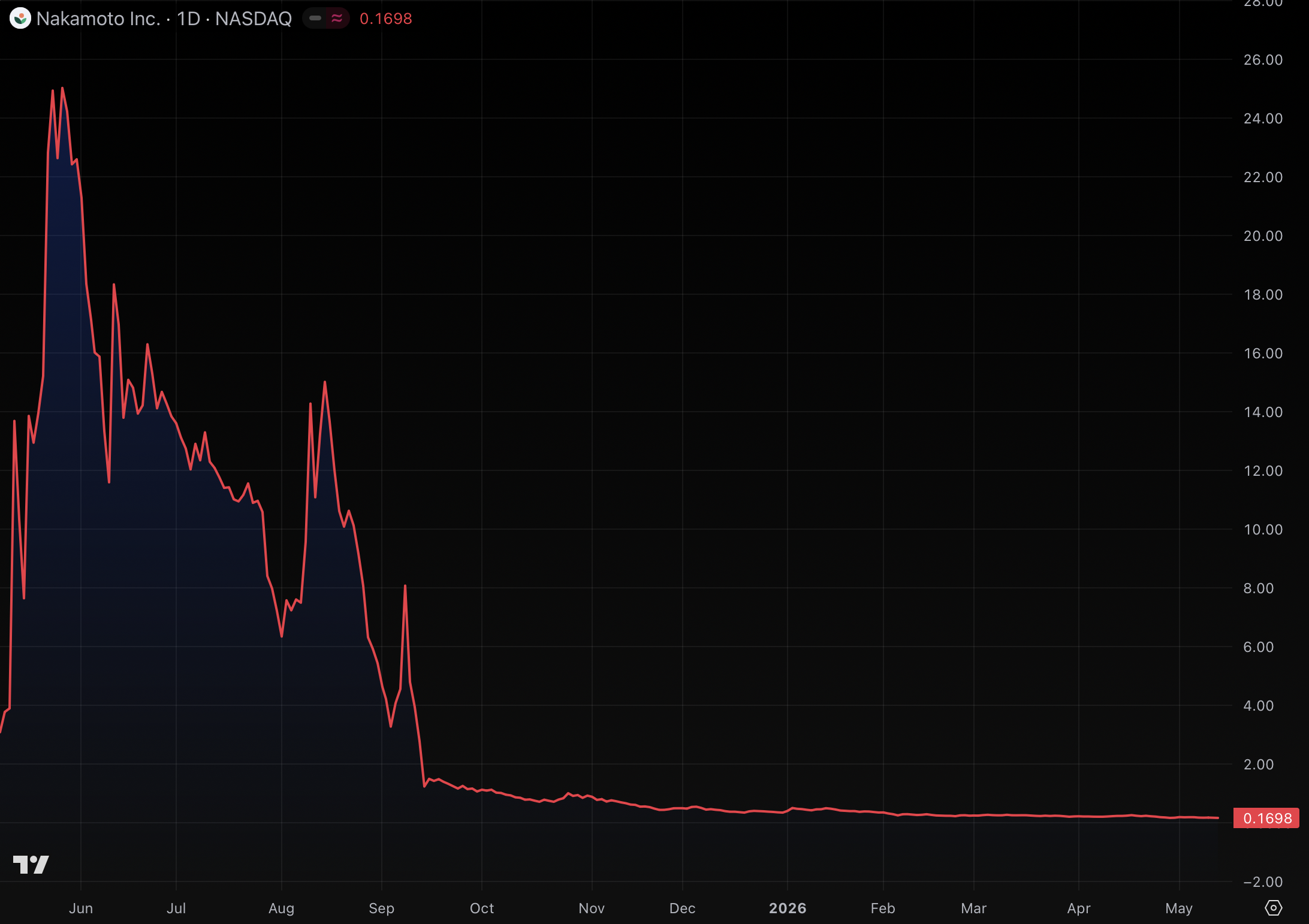
It pays to be an executive at a bitcoin (BTC) treasury company, and in David Bailey’s case, those payments come from his shareholders.
Nakamoto CEO Bailey boasted on X that his Nasdaq-listed firm closed the first quarter of 2026 holding more than 5,000 BTC worth roughly $345 million.
Yet during Q1, shareholders lost 39% of their investment, from $0.36 to $0.22 per share.
Despite Nakamoto’s $238 million net loss in Q1, compensation expenses jumped 7x. For example, a February related-party deal handed roughly 286 million newly issued shares to former owners of two private companies that CEO Bailey and Chief Investment Officer Tyler Evans controlled.
NAKA stockholders celebrated that day with a bid for shares 99% lower than their 52-week high.
Nakamoto’s executive compensation packages are staggering in light of its abysmal stock performance. One critic asked, “What about spending $23 million on salaries and compensation when $NAKA is down 98% from its high.”
Another shareholder publicly demanded that Bailey’s investor dashboard disclose “total executive compensation.”
David Bailey got rich while his shareholders got poor
Since joining the company, Bailey and his wholly-controlled consultancies have received tens of thousands of dollars per month in cash compensation in addition to massive equity awards.
Under his leadership, Nakamoto recorded a $102.5 million loss on the fair value of its BTC during Q1. The company’s 5,064 coins carry an astonishingly high cost basis of $118,273 apiece.
Within just the first three months of 2026, its $599 million investment had declined 42% to under $346 million.
Worse, the company’s coins aren’t even unencumbered assets. Instead, Bailey has allowed the firm to become heavily indebted.
Of its 5,064 coins, Nakamoto had pledged 4,405 as collateral against a $210 million USDT loan from Kraken as of March 31. The loan matures in December and requires 8% interest payments plus full principal repayment.
On social media, Bailey boasted about his company’s 5,000 BTC. Conveniently, he omitted that 87% of those coins were on loan.
Bailey also approved the company’s decision to invest in Metaplanet. That decision had lost the company at least $3.9 million by the end of Q1.
As revenue to offset these losses, all four of the company’s business divisions — media, advisory, healthcare, and asset management — generated a combined $2.7 million of total operating revenue.
Read more: Bitcoin treasury Nakamoto down 98% — still pays David Bailey lavishly
Despite shareholder losses, a windfall for management
In February, Nakamoto closed all-stock acquisitions of Bailey’s companies BTC Inc. (parent of Bitcoin Magazine and The Bitcoin Conference) and UTXO Management.
The 10-Q acknowledges that conflict in Note 11, stating that both companies “were considered related parties of Nakamoto as David Bailey, our chief executive officer and chairman of the board of directors and Tyler Evans, our chief investment officer, each had significant influence over BTC Inc and UTXO through their prior ownership of and leadership positions within BTC Inc and UTXO.”
BTC Inc equity owners received hundreds of millions of NAKA shares plus tens of millions for UTXO. Nakamoto priced the deal off the February 19 closing price of $0.2482 per share, after the stock had already collapsed roughly 99% from its 2025 high.
It then proceeded to trade even lower.
The combined consideration Nakamoto recorded was $181 million: $128.6 million of “fair value” for BTC Inc’s equity interests plus $52.8 million for “fair value” of UTXO.
After all that fair value accrued to NAKA, the stock closed yesterday within a penny of its literal 52-week low.
Shareholders left holding Bailey’s bag
Compensation expenses for labor at Nakamoto jumped 7x to $7.3 million in Q1 2026 from $1.0 million the prior year.
Stock-based compensation alone was $1.6 million. General and administrative expense rose to $9.8 million, up from just $0.6 million in Q1 2025.
Still, Bailey personally owns millions of dollars worth of Nakamoto equity. He also sat on both sides of the related-party transactions that just added hundreds of millions of new shares into the supply.
He has made millions personally as total compensation for presiding over Nakamoto’s share price decline of 99%.
Shares outstanding rose from 437.9 million on December 31 to 690 million by March 31, diluting shareholders by 58% within three months.
Stockholders also approved a reverse stock split of one-for-20 to one-for-50 on May 8, with the board to pick the exact ratio. Companies trying to dodge Nasdaq delistings typically reach for that reverse split lever.
Protos has previously documented Nakamoto’s 98% peak-to-trough collapse and its momentary, 23x valuation multiple atop its BTC holdings.
Today, the company is worth less than the BTC it holds.
Got a tip? Send us an email securely via Protos Leaks. For more informed news and investigations, follow us on X, Bluesky, and Google News, or subscribe to our YouTubechannel.

Key Highlights
- Shares of Robo.ai (AIIO) climbed more than 53% during Thursday’s premarket session following the introduction of its NeuroStream technology through Neurovia AI.
- The platform leverages bitmap vectorization to reduce 4K video file sizes by approximately 95% — transforming a 5.5GB file into just 278MB — without sacrificing resolution or frame rate.
- NeuroStream is designed for AI applications, offering potential annual savings between $1,000 and $1,500 per terabyte as storage expenses have quadrupled since 2026.
- Last week, Robo.ai completed its acquisition of Neurovia AI through a $100 million all-stock transaction to bolster its physical AI capabilities.
- From a technical perspective, AIIO shows an RSI reading of 82.14 — indicating overbought conditions — with resistance near $4.55 and support around $3.05.
Shares of Robo.ai (AIIO) surged 53.67% to $4.01 during Thursday’s premarket hours following the company’s introduction of NeuroStream, an innovative data compression solution developed by Neurovia AI, its newly acquired division.
The Dubai-headquartered firm reports that NeuroStream achieves compression of a 5.5GB 4K 60fps video file down to approximately 278MB — representing a 95% size reduction — all while maintaining the original quality and frame rate.
This capability carries significant implications. For AI systems that rely heavily on high-resolution visual information, reducing storage costs while preserving data integrity represents a substantial competitive advantage.
The technology behind NeuroStream transforms conventional bitmap data into vectorized mathematical formulas. This process produces considerably smaller files that remain fully readable by machines, eliminating the need for additional decompression tools.
Mansoor Ali Khan, Chief Technology Officer at Neurovia AI, notes that worldwide storage costs per unit have increased approximately fourfold since 2026. The company projects that every terabyte saved translates to $1,000–$1,500 in annual value for AI clients.
Details on the Neurovia Transaction
Last week, Robo.ai finalized its acquisition of Neurovia AI in an all-stock arrangement worth $100 million. The deal granted Robo.ai complete ownership of Neurovia’s equity, pending standard closing requirements.
Robo.ai positions this acquisition as a strategic move to develop infrastructure supporting the “machine economy” — an ecosystem where autonomous systems and networked devices produce massive quantities of real-world information.
NeuroStream is engineered for edge deployment, enabling conventional commercial hardware to handle substantial data volumes without requiring extensive infrastructure upgrades. The platform also functions offline, making it suitable for regulated industries including aerospace, medical diagnostics, and energy sectors.
Chart Analysis
From a technical standpoint, AIIO appears overextended. The stock currently trades 394.9% above its 20-day simple moving average and 174.5% above its 50-day SMA — indicators of an aggressive, rapid rally rather than gradual appreciation.
The Relative Strength Index registers at 82.14, placing shares deep into overbought levels.
Notably, the 20-day SMA remains positioned below the 50-day SMA — a bearish crossover pattern — suggesting the broader trend structure has yet to fully reverse.
Immediate resistance appears at $4.55, coinciding with the 100-day EMA. Downside support is identified at $3.05, matching the 100-day SMA.
Neurovia intends to deploy NeuroStream across autonomous vehicle systems, robotics applications, and smart city infrastructure. The platform is currently available through Neurovia’s official website, complete with published case studies demonstrating actual compression performance metrics.

Paybis gains MiCA authorisation and PSD2 licence, widening regulated crypto payments in the EU
Digital asset platform Paybis announced it has obtained both Markets in Crypto-assets regulation, MiCA, authorisation and a Payment Services Directive 2, PSD2, payment institution licence. The approvals, granted the same day, place the company among a narrow group of crypto firms with full EU-level CASP authorisation plus payments regulation, a combination likely to affect how crypto firms sell services to consumers and businesses across the bloc.
Industry data cited by Paybis indicates there are more than 1,200 crypto firms operating in the European Union, but only a small fraction have completed the MiCA process. According to the company, roughly 57 firms hold MiCA authorisations, and far fewer also operate under PSD2. That scarcity reflects the regulatory and compliance work required to meet the new EU framework and national payment rules.
What the licences mean
MiCA, which establishes a comprehensive regime for crypto-assets across the EU, creates a single authorisation for crypto-asset service providers, often referred to as CASPs. A MiCA authorisation lets a CASP operate across all 27 EU member states under harmonised rules, simplifying cross-border service delivery compared with national-only approvals.
PSD2 governs payment services and payment institutions. A PSD2 payment institution licence enables a firm to provide regulated payment services, connect to payment systems and hold client funds under a supervised framework. For crypto companies, PSD2 status is often seen as a bridge to traditional payment rails and banking-like functionality without necessarily becoming a bank.
Together, the two licences allow a provider to combine regulated crypto services with payments infrastructure, which can be particularly relevant for products such as fiat on- and off-ramps, stablecoin disbursements and cross-border payouts.
Market implications and business lines
For consumers, the combination of MiCA and PSD2 can increase trust in services that mix crypto and fiat flows, because firms are subject to EU-level conduct and prudential requirements as well as payment services supervision. For businesses, the licences make it easier to integrate interoperable, regulated infrastructure for token-based payouts, payroll solutions denominated in stablecoins, or cross-border settlement tied to traditional payment rails.
In practical terms, a regulated payment institution can process transfers and access payment networks, while a MiCA-authorised CASP can custody, trade and service crypto-assets. That pairing is particularly attractive to institutional clients and regulated enterprises that seek partners with clear legal standing and supervisory accountability.
Industry framing: a two-tier EU market
Regulators and industry participants have said the EU market is bifurcating. One tier consists of legacy operators that complied with anti-money laundering registration regimes, and the other is a smaller set of firms that secured full MiCA CASP authorisation. Adding PSD2 on top of MiCA further narrows the field because payment institution authorisations involve separate capital, governance and compliance standards.
That dynamic could accelerate consolidation in the European crypto sector. Firms that secure both permissions may gain preferential access to enterprise clients and payment partners. Conversely, smaller exchanges and non‑authorised platforms may face higher barriers to growth if commercial partners or regulated customers demand counterparties with EU licences.
Risks and operational commitments
While dual authorisations open new commercial pathways, they also impose ongoing supervisory obligations. MiCA and PSD2 both carry compliance, reporting and operational resilience requirements. Firms must maintain governance frameworks, manage client funds prudently and demonstrate controls that satisfy both financial regulators and national competent authorities. Compliance costs and oversight will likely increase as authorities monitor market conduct and anti-money laundering safeguards under the new regime.
Market participants and observers will be watching how quickly other players pursue similar dual licences and whether banks and payment providers deepen partnerships with authorised CASPs. The licences could also affect product design, from fiat on‑ramp offerings to tokenised asset settlement models, as providers seek to leverage regulated rails while remaining within the EU supervisory perimeter.
Paybis’s approvals are an early indicator of how firms are positioning for a regulated crypto landscape in Europe. The real test will be in deployment: how the company integrates payments functionality into its product suite, the partnerships it builds with financial intermediaries, and how customers respond to regulated offerings that combine crypto services with conventional payments.
As MiCA implementation progresses across member states and national authorities operationalise supervision, the list of fully authorised EU crypto-payment providers will remain a key metric for institutional adoption and market structure.
Crypto World
Ripple News: Ripple’s CTO David Schwartz Just Warned of AI-Cloned Executives Draining XRP Wallets, Are You at Risk?

Ripple co-founder and CTO David Schwartz has issued an urgent public warning about what he described as a ‘huge escalation lately in airdrop and giveaway scams targeting XRPL users,’ flagging a coordinated wave of XRP scam news campaigns that have grown sharply more sophisticated through AI-generated impersonation and wallet drainer technology.
The warning, posted to his 700,000-plus followers on X, arrives as XRP commands elevated institutional attention and retail volume, precisely the conditions that make its holder base a high-value phishing target. Bearish signal for ecosystem trust.
Discover: The best pre-launch token sales
Ripple News: How the Attacks Work, Fake Airdrops, Wallet Drainers, and AI-Cloned Executives
The mechanism here is worth understanding precisely. The dominant attack vector is the fake airdrop: users are directed to a fraudulent promotional site promising free XRP tokens, where connecting a non-custodial wallet triggers a malicious script, a wallet drainer, that executes a single authorized transaction to empty holdings before the user realizes what happened.
The authorization step is the trap; once signed, the transaction is irreversible on-chain.
Giveaway scams operate through a simpler but equally effective social engineering play. Fraudsters promise to return twice any amount of XRP sent to a scammer-controlled address, packaging the pitch around fabricated Ripple announcements or milestone celebrations.
The delivery infrastructure has matured significantly in 2026. Attackers are deploying AI-generated deepfake videos on TikTok and YouTube that clone Schwartz’s likeness and voice with enough fidelity to fool retail holders.
In a separate and notably sophisticated attack vector, Schwartz flagged a phishing campaign that injected fake emails into Robinhood’s infrastructure, exploiting Gmail’s dot-trick for account creation and embedding malicious HTML payloads in device names, with messages that passed SPF, DKIM, and DMARC authentication checks, making them appear as legitimate Robinhood correspondence.

Fake accounts impersonating Schwartz and Ripple CEO Brad Garlinghouse have proliferated on Instagram and Telegram, with Ripple reporting over 50 such accounts on both platforms in Q1 2026 alone.
Schwartz warned explicitly: ‘Anyone claiming to be me on Instagram, Telegram, or almost anywhere else is likely a scammer.’
Discover: The best pre-launch token sales
The post Ripple News: Ripple’s CTO David Schwartz Just Warned of AI-Cloned Executives Draining XRP Wallets, Are You at Risk? appeared first on Cryptonews.
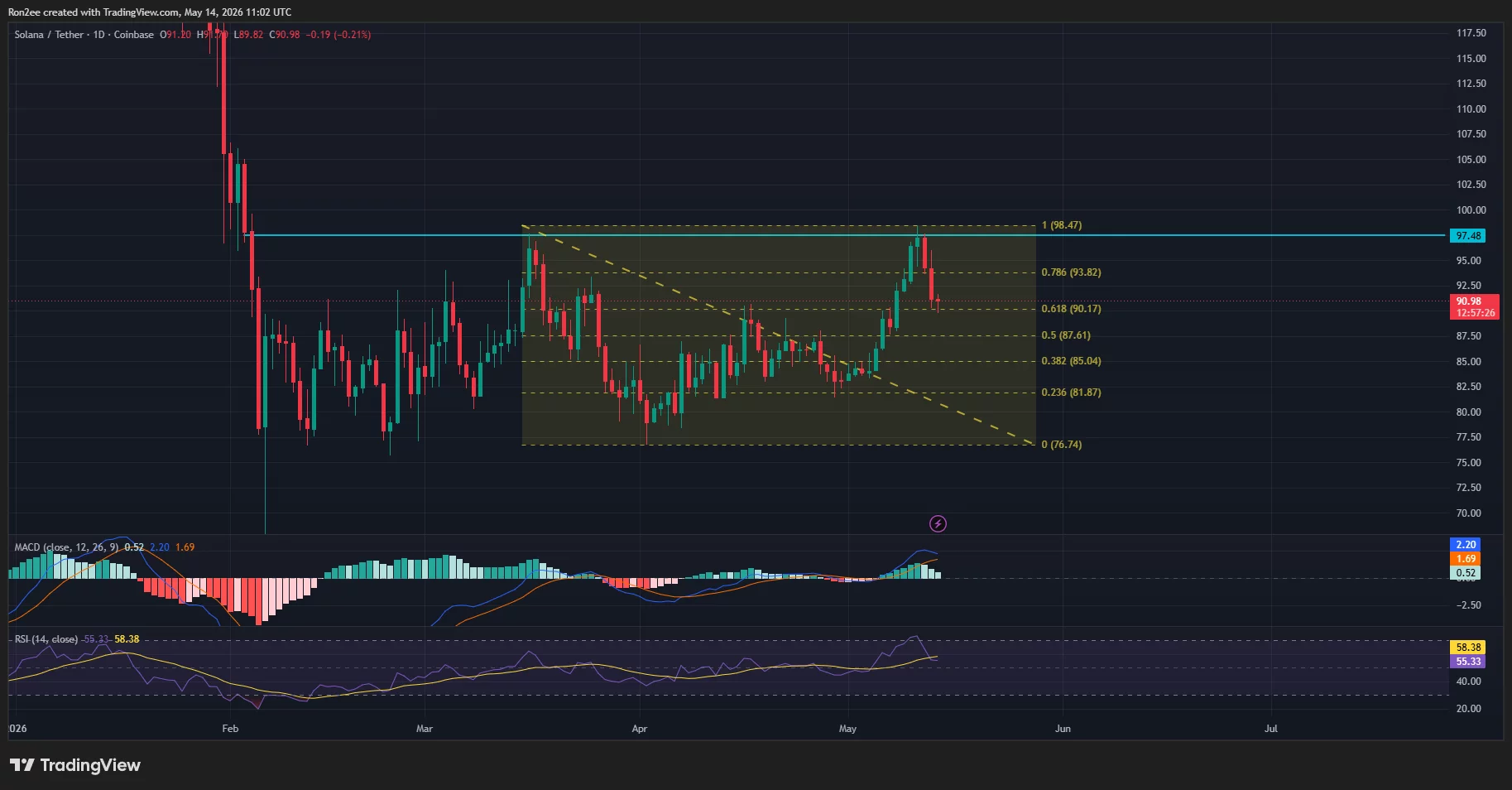
Solana price pulled back on Wednesday as bullish momentum weakened near a key Fibonacci resistance zone, while traders monitored signs of a potential bearish MACD crossover on the daily chart.
Summary
- Solana price pulled back toward the $90 support zone after facing rejection near the $94–$98 Fibonacci resistance region.
- The MACD indicator is approaching a bearish crossover on the daily chart, signaling weakening bullish momentum after SOL’s recent rally.
- Analysts are watching whether bulls can defend the $90 support level to prevent a deeper correction toward the $87 and $85 regions.
According to data from crypto.news, Solana (SOL) traded near $91 at press time on May 14 after falling from this week’s local high around $97.5. The token remains up sharply from its April lows near $76, though recent price action suggests bullish momentum may be starting to cool after the strong multi-week rally.
Solana’s rebound over the past several weeks was largely driven by improving sentiment across the broader crypto market alongside growing optimism surrounding the network’s upcoming Alpenglow upgrade and Firedancer validator developments. Renewed activity across Solana-based decentralized finance protocols and memecoin trading also helped support demand for the token.
At the same time, derivatives sentiment had strengthened notably during the recent rally, with SOL futures open interest climbing alongside positive funding rates, signaling aggressive bullish positioning from leveraged traders.
However, the latest pullback emerged after SOL faced rejection near the key Fibonacci resistance zone between the 0.786 retracement at $93.82 and the recent swing high near $98.47.
On the daily chart, Solana continues trading above the important 0.618 Fibonacci retracement support near $90.17, which now acts as the key short-term support level bulls must defend to prevent a deeper correction.
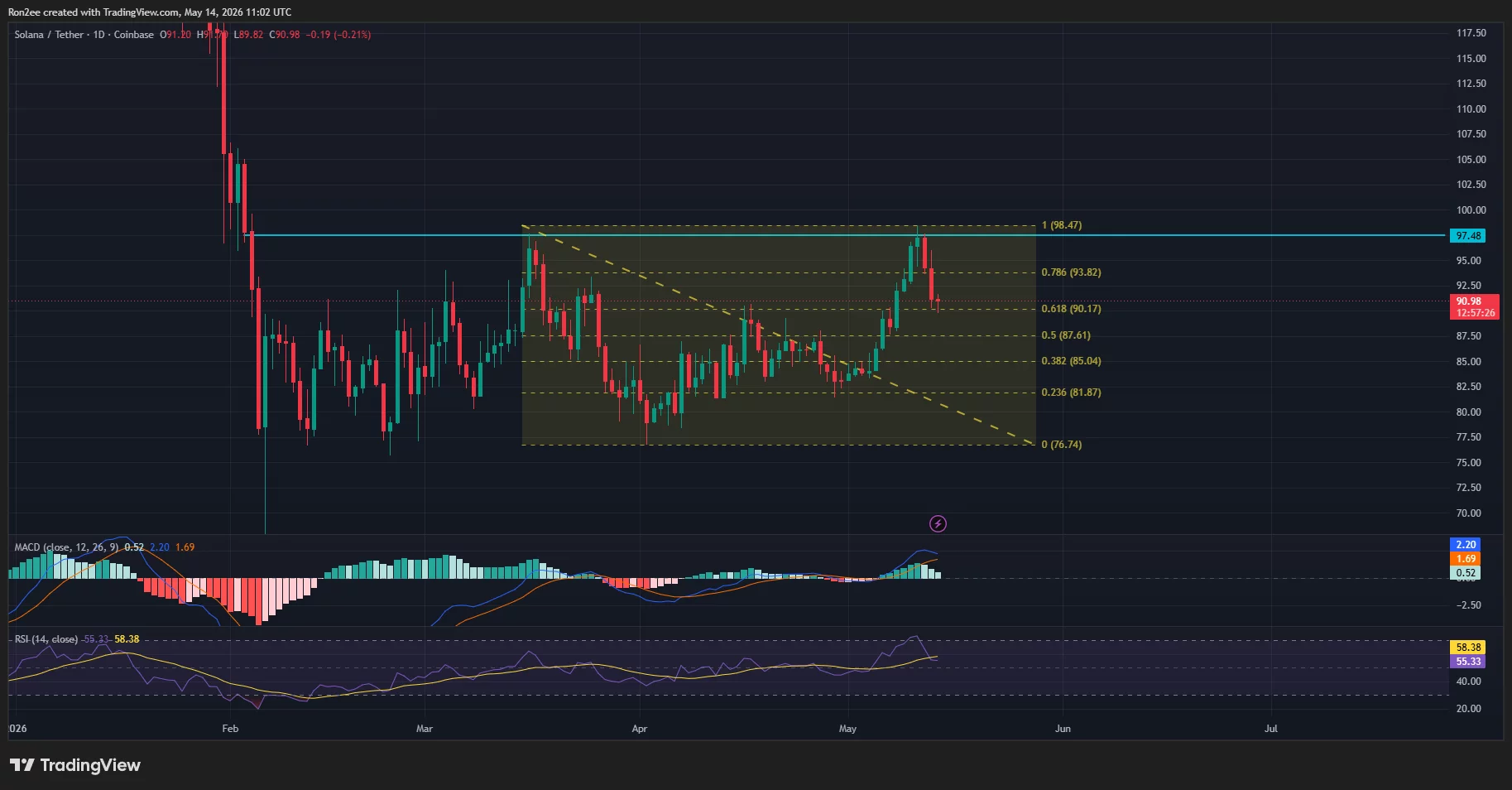
Despite the recent rejection, the broader structure still remains moderately constructive as SOL continues forming higher lows since April while holding well above the major support region between $76 and $82, where buyers previously stepped in aggressively during earlier sell-offs.
However, momentum indicators suggest bullish strength may be weakening. Notably, the MACD histogram has started declining after a strong expansion phase earlier this month, while the MACD line itself appears to be gradually approaching a bearish crossover with the signal line. Such a crossover often indicates slowing upside momentum and can precede short-term corrective phases if selling pressure accelerates.
Meanwhile, the Relative Strength Index has also started cooling from near-overbought territory and currently sits around the neutral 55–58 range, suggesting bullish momentum is fading but has not yet fully reversed.
If Solana loses the key $90 support level, sellers could attempt to push the token toward the next major support zones near $87.6 and $85, both of which align with important Fibonacci retracement levels and previous consolidation regions.
On the upside, bulls would likely need to reclaim the $94–$96 resistance area to invalidate the short-term bearish setup and restore momentum toward the psychological $100 level. A successful breakout above $100 could potentially open the door for a move toward the $103 and $106 resistance zones in the near term.
For now, traders remain focused on whether Solana can stabilize above the key $90 support region as momentum indicators continue flashing early warning signs of a possible trend slowdown.
Disclosure: This article does not represent investment advice. The content and materials featured on this page are for educational purposes only.

The Bank of England is reexamining elements of its proposed regime for sterling-denominated stablecoins after digital-asset firms warned that holding caps and reserve requirements could hinder adoption and render UK-issued tokens uneconomical. According to Cointelegraph, Deputy Governor Sarah Breeden signaled that the rule mandating at least 40% of backing assets be held as non-interest-bearing deposits at the BoE may be overly conservative, a view she discussed with the Financial Times.
The rethink comes as the UK government and regulators strive to position Britain as a competitive hub for digital assets while safeguarding bank funding and financial stability. Sterling-pegged tokens currently represent a tiny portion of the roughly $300 billion global stablecoin market, a market still dominated by dollar-based issuers. Source: DeFi Llama.
The BoE laid out detailed ownership limits in its November 2025 consultation paper on a proposed regulatory regime for sterling-denominated systemic stablecoins, building on options first aired in a 2023 discussion paper. Under the proposal, individuals would be limited to holding up to £20,000 (roughly $27,000) of a given UK stablecoin, while businesses would face a cap of about $13.5 million, at least during a transition period.
The central bank argued that caps were necessary to prevent a sudden outflow of deposits from commercial banks into tokenised money if a large stablecoin were rapidly adopted for payments. Industry groups and potential issuers countered that such caps would be operationally cumbersome, difficult to supervise across platforms, and could deter serious institutional use of regulated UK stablecoins in corporate treasury, payroll, and settlement activities.
BoE rethinks stablecoin caps after pushback
Breeden has long been among the BoE’s most cautious voices on stablecoins. In November 2025 she warned that diluting the rules too far could undermine financial stability, emphasizing that stablecoins are money-like instruments that must be as safe and robust as existing payments infrastructure. At the time, she supported stringent liquidity requirements that would require issuers to place a substantial portion of reserves at the central bank and hold the remainder in high‑quality liquid securities such as UK government bonds. Legal firms and prospective issuers argue that such a framework could compress margins and tilt competitiveness away from the UK compared with the United States or the European Union.
UK hunts for middle ground on stablecoins
The evolving stance reflects policymakers’ ongoing effort to find a middle ground as global regulatory approaches diverge. In January, UK lawmakers opened an inquiry into how fiat-backed tokens should be overseen, hearing evidence from industry participants such as Coinbase and Innovate Finance, while the BoE and the Treasury continue to refine a framework intended to sit alongside broader crypto rules and potential digital pound plans.
A more flexible approach to caps and backing requirements could determine whether systemic GBP stablecoins emerge as serious cross-border payment tools and on‑shore crypto market participants or whether activity remains concentrated in jurisdictions perceived as more accommodating. As authorities balance stability with competitiveness, the policy trajectory will shape the UK’s role in the evolving global stablecoin landscape.
Closing perspective: the path forward remains contingent on regulatory alignment and practical adaptation by issuers and banks, with ongoing scrutiny from policymakers and industry participants alike.
This is an excerpt from CoinDesk newsletter ‘Daybook.’ Sign up here, if you haven’t already.
The week’s main event for digital assets, the U.S. Clarity Act markup, is due later today. The crypto market, led by bitcoin, seems to be treating it as a non-event.
The proposed bill aims to establish a comprehensive regulatory framework for digital assets. The latest draft, released on May 11, includes several key provisions, including a ban on interest on stablecoin balances and a $5 million penalty for violations. It also adds the Treasury as a rule-making authority alongside the SEC and CFTC.
There is still no ethics language preventing government officials from issuing tokens, though observers expect it may be introduced during markup, when a Congressional committee will review, debate and amend the wording line by line.
“As the framework moves toward passage, BTC’s case as a strategic allocation with unique diversification benefits in a balanced portfolio only strengthens,” said Can-Luca Köymen, an investment strategist at Sygnum Bank.
Not everyone is happy with the current wording.
Over 100 Substack amendments were submitted ahead of a Wednesday deadline, including one proposing a ban on Federal Reserve master accounts for crypto companies.
“That could be problematic,” said Noelle Acheson, author of Crypto is Macro Now, in her latest note. She added that while progress is positive, “there is still much that could go wrong tomorrow.”
She noted that to secure passage in the Senate, the committee will need bipartisan support. Without it, she warned, the chance of the bill passing this year, about 60% on Polymarket, could fall sharply.
Despite the high stakes, BTC implied, or expected, volatility metrics remain subdued, pointing to steadier market conditions.
“Volatility expectations [in BTC] are compressed at all forward horizons, with short-dated options trading close to their year-to-date lows (with implied volatility at a historical low of 30%),” said Andrew Melville and Thahbib Rahman of Block Scholes. “There’s also no obvious event risk priced-in by either BTC or altcoin options ahead of the Senate CLARITY Act markup.”
There are, however, signs of stress in markets tied to Coinbase (COIN). “[There] we do see an embedded implied vol premium in the May-15 contract which covers the debate date, suggesting traders are clearly pricing for the bill to act as a catalyst for companies that stand to benefit from regulatory clarity, but not for BTC,” they said. Stay alert!
Read more: For analysis of today’s activity in altcoins and derivatives, see Crypto Markets Today . For a comprehensive list of events this week, see CoinDesk’s “Crypto Week Ahead.”
What’s trending
Today’s signal

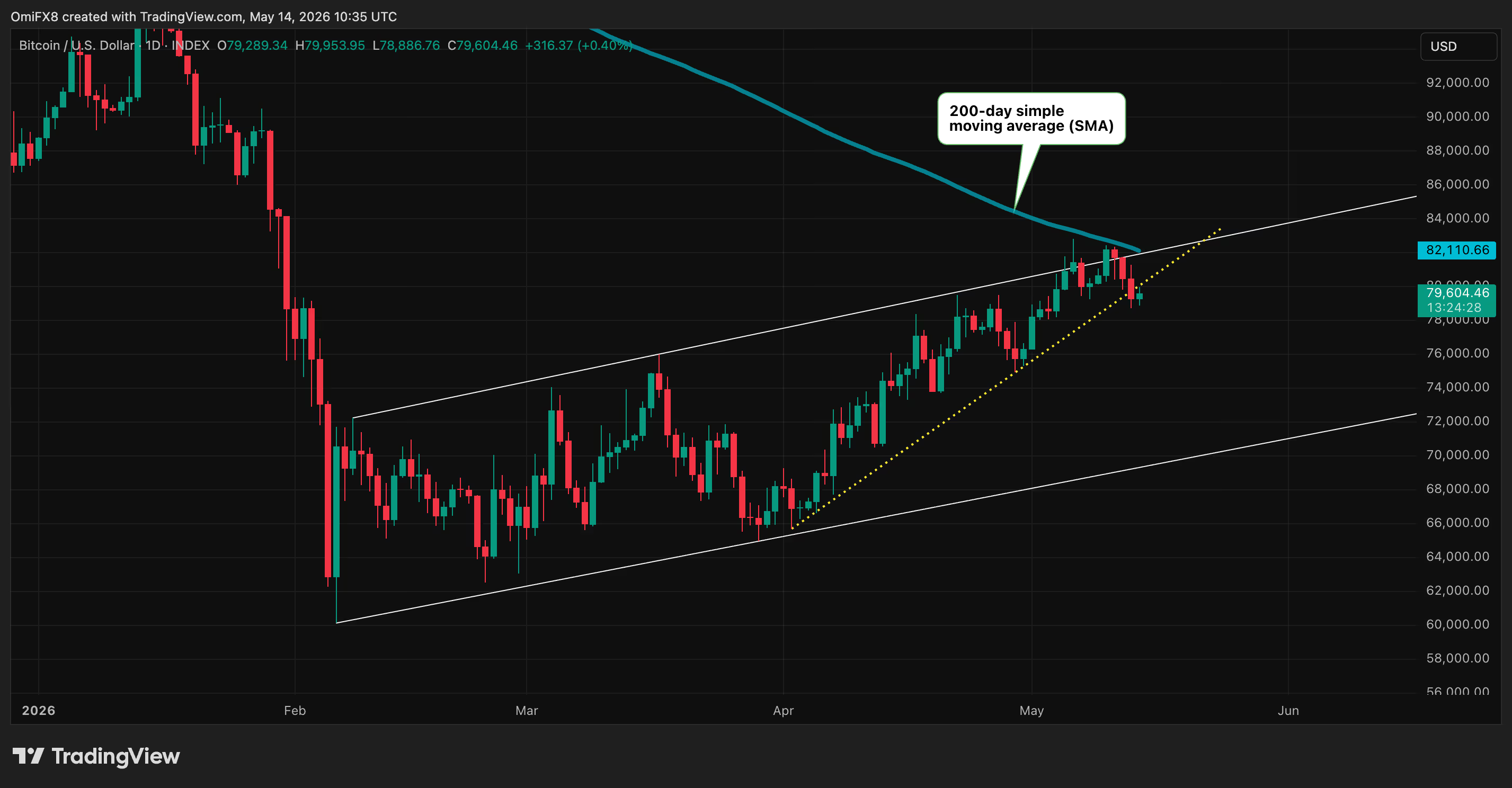
Bitcoin backed away from the confluence of the 200-day simple moving average and the upper boundary of the rising channel that has defined the recovery from February lows.
It’s not just a routine pullback from resistance.
The decline has now also pierced the short-term upward (dotted) trendline drawn from April’s lows, suggesting that the latest leg of the recovery has ended.
Taken together, these signals increase the risk of momentum-driven selling entering the market, potentially driving prices down to $75,000 or lower. On the higher side, the 200-day average placed just above $82,000 is the level to beat to revive the bullish outlook.

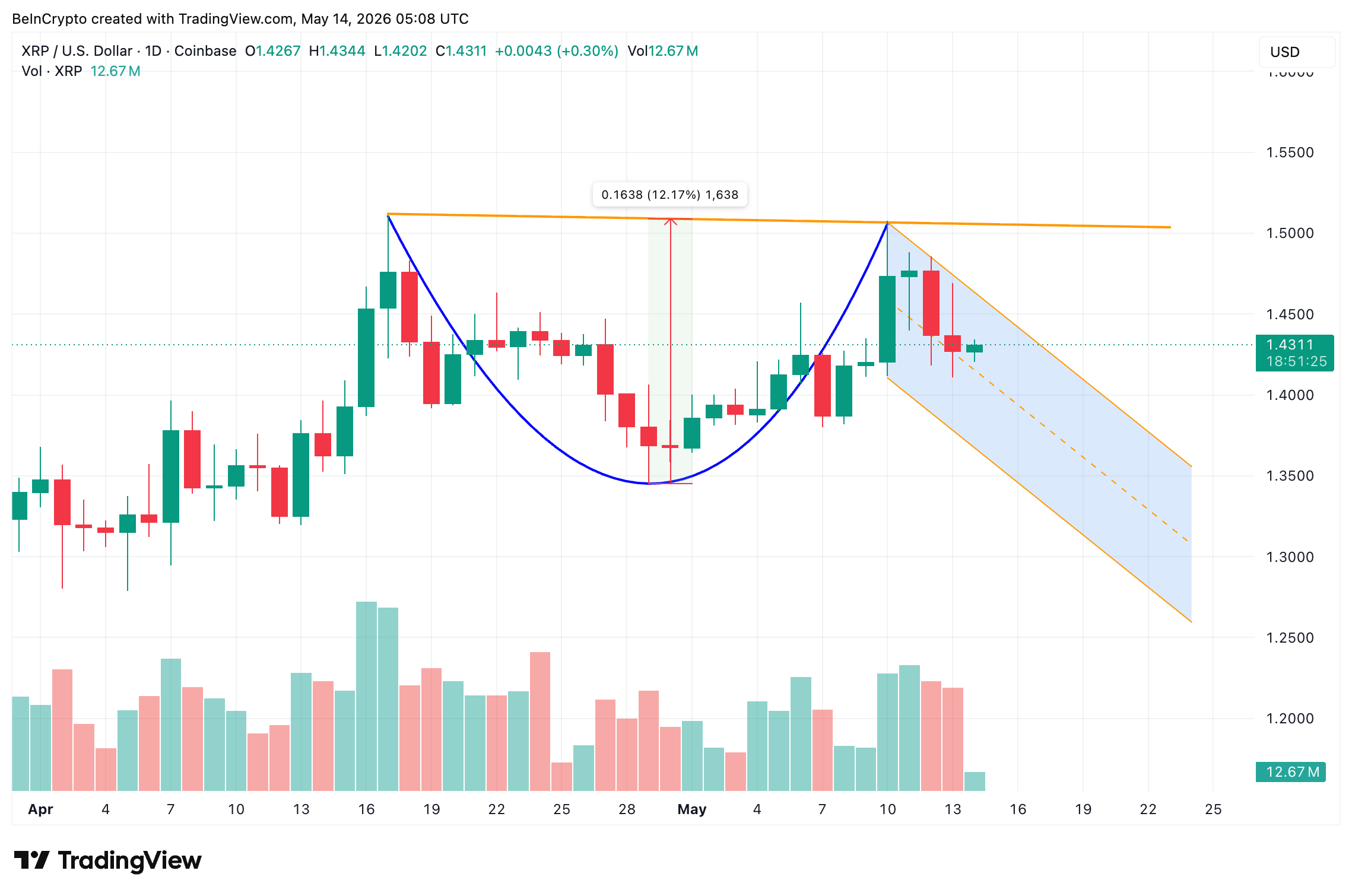
XRP price (XRP) consolidates inside a falling channel handle, holding a setup that projects a 12% breakout target if institutional demand pushes the technical pattern over the neckline.
Spot ETF inflows, smart money positioning, and a sharp drop in exchange selling pressure now stack behind the setup, raising the odds of a breakout against XRP’s history of failed cup formations.
XRP Price Builds a Bullish Pattern as Volume Cools
The XRP daily chart shows a cup and handle pattern forming between April 17 and May 10. The cup was carved out over three weeks, and a falling channel has acted as the handle since May 10. The cup measures roughly 12% from rim to bottom, projecting a matching upside if the neckline breaks.
Volume tells a constructive story. Selling volume across the handle has cooled while buyers have stepped in on dips, the kind of behavior that typically precedes a pattern continuation. Previous cup and handle setups on XRP, however, have failed to deliver, leaving execution as the open question. XRP is up 1.7% over the past seven days, suggesting buyers are holding the line without driving a fresh rally yet.
Want more token insights like this? Sign up for Editor Harsh Notariya’s Daily Crypto Newsletter here.

The next question is whether real institutional money is moving behind the pattern, and the spot ETF flow data offers a clean read.
Institutional Flows Stack Up With $65 Million in Two Weeks
XRP institutional flows through spot ETF products tell a clean recovery story. After a small $35,210 outflow in the first week of May, SoSoValue weekly data shows $34.21 million of net inflows for the week ending May 8, followed by $31.11 million for the current week, as per May 13 data.
Two consecutive weeks of inflows above $30 million land precisely as XRP price consolidates inside the handle, suggesting institutional buyers see the same setup as the chart. If the next weekly print extends the trend, the demand side of the breakout equation is in place.

ETF flows alone, however, do not confirm whether informed traders agree, which is what the smart money read tries to capture.
Smart Money Rebuilds as Exchange Selling Pressure Drops 63%
The Smart Money Index, a metric that tracks how informed traders position relative to retail flow, has rebounded from a local bottom near 2.40 and now reads 2.42 against its signal line. The setup mirrors the move that played out on April 19, when smart money positioning began rising before XRP price followed higher.

Exchange behavior reinforces the read. Glassnode Exchange Net Position Change data, which measures the net flow of XRP onto and off exchanges, shows inflows dropping from 38,088,506 XRP on May 12 to 14,067,566 XRP on May 13. That is a 63% drop in exchange-bound supply inside a single day, a sharp reduction in selling pressure.

Three signals now align. Institutional ETF inflows are running hot. Smart money positioning is rebuilding. Exchange-bound selling pressure has collapsed. Stacked together, they sketch the kind of demand backdrop a breakout setup needs to clear resistance.
With three signals stacking up behind the pattern, the price chart becomes the decider.
XRP Price Levels and the Path to a 12% Breakout
XRP price trades at $1.42 with the cup pattern’s neckline clustered around $1.50 and $1.51. A clean daily close above $1.44 would signal the first handle breakout by taking out the falling channel resistance.
From there, a convincing daily close above $1.51 confirms the cup breakout. It then opens the path to the 12% projected target at $1.68, aligning with the 1.618 Fibonacci extension at $1.67.
Intermediate technical levels stack the upside. The 0.236 Fib at $1.44 and the 0.382 Fib at $1.47 mark the next resistance pockets, with the 0.5 Fib at $1.49 and the 0.618 Fib at $1.51 acting as the neckline cluster.

Pattern caveats matter. Previous XRP cup formations have failed, and a daily close below $1.41 weakens the structure. That exposes $1.38 as the next support. A daily close beneath $1.34 fully invalidates the cup and handle and removes the breakout thesis.
For now, the $1.51 neckline separates a 12% rally toward $1.68 from a slow grind back to the $1.34 invalidation zone.
The post XRP Leans on Institutional Flows for 12% Price Breakout Push appeared first on BeInCrypto.
Crypto World
The Bank of Japan Just Triggered $635 Million in Bitcoin ETF Outflows in a Single Day: Is the Rally Over?
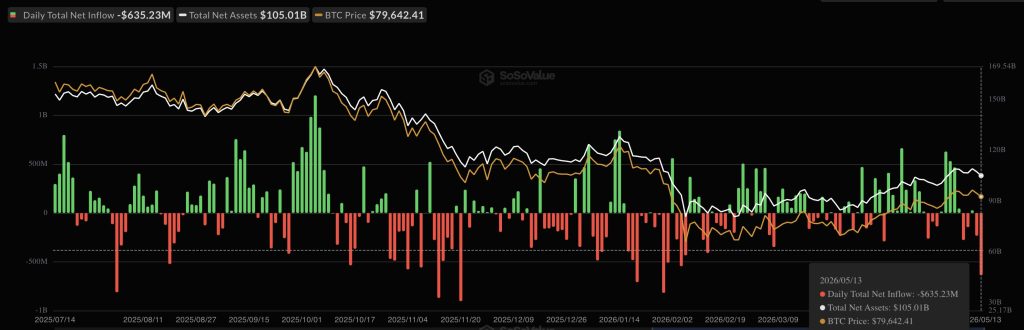
U.S. spot Bitcoin ETF products shed $635 million in a single trading session on Wednesday, the largest single-day outflow since January 29, as hawkish signals from the Bank of Japan triggered a global risk-off move that cascaded into over $500 million in crypto liquidations.
Bitcoin price dropped more than 2% in 24 hours to $79,400, stalling a rally that had carried prices from $65,000 to above $80,000 over recent weeks.
The $635 million exit brings total net outflows across the 11 U.S.-listed spot Bitcoin ETFs to $1.26 billion over five trading days, pulling cumulative net inflows since the January 2024 launch down from $59.76 billion to $58.5 billion, erasing in one week what took months to accumulate.
Discover: The best pre-launch token sales
How BOJ Hawkishness Produced a $635M Bitcoin ETF Exodus, and Why the Transmission Ran Through Leverage
The mechanism is straightforward once you trace the chain. The Bank of Japan reinforced its rate-hiking stance, strengthening the yen and forcing institutional desks holding yen-funded risk positions to reduce exposure to high-beta assets.
Crypto, sitting at the far end of the risk spectrum, absorbed a disproportionate share of that deleveraging.
— Wimar.X (@DefiWimar) May 13, 2026
 BREAKING
 BANK OF JAPAN WILL DUMP FOREIGN BONDS TODAY AT 7:50 PM ET!
LAST TIME, THEY SOLD ¥887.7 BILLION, MOSTLY U.S. BONDS.
AFTER THE US-IRAN DEAL CANCELLATION, THIS COULD HIT ¥5 TRILLION…
THIS WOULD BE REALLY BAD FOR MARKETS… pic.twitter.com/dmYo9Y36rl
Bitcoin was already technically vulnerable. The rally had run into the 200-day simple moving average positioned just above $82,000, a level that has historically acted as a momentum checkpoint.
When macro-driven selling pressure arrived at that resistance zone, leveraged long positions had nowhere to go.
Exchange data points to Binance and OKX as the primary venues for the bulk of the $500 million in long liquidations, consistent with the retail-leverage profiles of those platforms.
The ETF outflow is the institutional layer of the same story. The 11 U.S.-listed spot Bitcoin ETF products that raised $3.29 billion through March and April were driving the primary bullish flow narrative. That narrative required macro conditions to stay accommodative.
When the BOJ signaled otherwise, institutional redemptions followed, not because Bitcoin changed, but because the risk-budget calculus did.
Adam Haeems, head of asset management at Tesseract Group, framed the conditional precisely: “A persistently hot CPI, an incoming Fed under Warsh that markets read as more hawkish, or another oil shock can compress bitcoin even with positive net flows.
Discover: The best crypto to diversify your portfolio with
The post The Bank of Japan Just Triggered $635 Million in Bitcoin ETF Outflows in a Single Day: Is the Rally Over? appeared first on Cryptonews.

Erin Moriarty Rips Spike Lee Over ‘Michael’ Stance

Wes Streeting resigns as health secretary – letter in full

Starmer latest: Streeting’s scathing resignation letter to PM fires starting gun on leadership race

Manchester United reach agreement with Casemiro over contract clause amid transfer speculation

US brings back mandatory military draft registration

Steven Gerrard disagrees with Gary Neville over ‘shock’ Chelsea and Arsenal claim | Football


-
 Crypto World6 days ago
HarrisX Poll Found 52% of Registered Voters Support the CLARITY Act
-

 Fashion6 days ago
Weekend Open Thread: Marianne Dress
-

 Fashion3 days ago
Coffee Break: Travel Steam Iron
-

 Fashion3 days ago
What to Know Before Buying a Curling Wand or Curling Iron
-

 Tech4 days ago
Auto Enthusiast Carves Functional Two-Stroke Engine from Solid Metal
-

 Politics3 days ago
What to expect when you’re expecting a budget
-
 Business5 days ago
Ignore market noise, India’s long-term story intact, say D-Street bulls Ramesh Damani and Sunil Singhania
-

 Politics5 days ago
Politics Home Article | Starmer Enters The Danger Zone
-

 Tech3 days ago
GM Agrees To Pay $12.75 Million To Settle California Lawsuit Over Misuse Of Customers’ Driving Data
-

 Politics7 days ago
Simon Cowell Says He Was ‘Horrible’ To Susan Boyle During BGT Audition
-

 Entertainment7 days ago
General Hospital: Ric & Ava Bombshell – Ric’s Massive Secret Exposed!
-

 Entertainment7 days ago
Why David Letterman Called CBS ‘Lying Weasels’
-

 Crypto World4 days ago
CZ says US crypto rivals tried to block Trump pardon
-

 Sports6 days ago
Bayern Munich vs PSG UEFA Champions League SF2 live match time, streaming | Football News
-

 Entertainment6 days ago
YNW Melly Denied Bond Again Ahead Of Double Murder Retrial
-

 Tech3 days ago
GM agrees to $12.75M California settlement over sale of drivers’ data
-

 Politics7 days ago
Euphoria Creator Praises Sydney Sweeney Amid Season 3 Scenes Backlash
-
Entertainment7 days ago
Hantavirus — cause of death for Gene Hackman's wife — at the center of Dutch cruise outbreak
-

 Crypto World5 days ago
PROS explodes 48% as Upbit and Bithumb listings ignite demand
-
Crypto World6 days ago
The Hantavirus Danger: Can a Potential Outbreak Spark a New Meme Coin Frenzy?
You must be logged in to post a comment Login