
Crypto World
Polygon Reports Security Flaws Patched in Latest Hard Forks

Polygon has published details of multiple previously undisclosed security vulnerabilities that could have affected its proof-of-stake (PoS) infrastructure, including issues spanning node-to-node denial-of-service risk and validator processing bottlenecks. Polygon said the problems were addressed ahead of public disclosure through two recent hard forks and corresponding client upgrades.
In a Thursday post on the Polygon forum, Polygon Labs’ Validators Support Team outlined how flaws in the Bor and Heimdall clients were fixed via the Austin and Kyoto hard forks. The disclosure also notes that none of the vulnerabilities have been observed exploited on Polygon mainnet.
Key takeaways
- Polygon disclosed vulnerabilities affecting both Bor and Heimdall clients, with potential denial-of-service and validator processing disruption.
- The issues were reportedly resolved through Austin (Bor) and Kyoto (Heimdall) hard forks, which were tested before activation.
- Polygon stated that no exploitation was observed on mainnet, and upgrades were deployed proactively before details became public.
- Running outdated client versions after hard fork activation heights means nodes will fall out of consensus and must upgrade to rejoin.
- Polygon requires Bor v2.10.0 for PoS nodes and Heimdall v0.11.0 for validators and full nodes.
What Polygon disclosed about the Bor client
According to Polygon’s disclosure, the Austin hard fork addressed two denial-of-service related risks tied to the Bor client. Denial-of-service flaws in blockchain clients are particularly concerning because they can degrade performance by increasing resource consumption during block handling, and in severe cases could contribute to node instability.
Polygon said these Bor issues could have impacted block processing or caused nodes to crash, depending on how an attacker might have triggered the problematic behavior. Polygon did not state that the vulnerabilities were exploited in the wild, but emphasized that the fixes were deployed in advance of the public release of technical details.
The Heimdall vulnerability that could overload validator processing
The disclosure highlighted a more severe problem affecting the Heimdall client. Polygon said a specially crafted transaction could force validators to perform excessive processing work. In a PoS environment, anything that causes disproportionate workload on validators can become a network reliability issue, since validators must process consensus-related data within practical performance limits.
Polygon framed the Heimdall flaw as one that could potentially disrupt network operation by pushing validators into an inefficient or overly burdensome processing path. The issue was addressed through the Kyoto hard fork, with corresponding updates rolled out before the information was disclosed publicly.
Hard fork mechanics and why upgrades matter
Polygon’s disclosure is explicit about the operational consequences for participants who do not update. Nodes running older versions of either Bor or Heimdall past the relevant hard fork activation heights are described as falling out of consensus and needing to upgrade to return to the canonical network.
Polygon stated that Bor v2.10.0 is required for all Polygon PoS nodes, and Heimdall v0.11.0 is required for validators and full nodes. Both upgrades are reported as already active on mainnet.
For infrastructure operators, this means security preparedness is also a liveness requirement: even if a node is not directly affected by an attack scenario, outdated software can still become unable to participate in consensus after protocol changes. In practice, the operational takeaway is to confirm client versions are aligned with the post-fork requirements and monitoring is in place to catch missed upgrades.
No evidence of mainnet exploitation, but a reminder on proactive patching
Polygon said none of the vulnerabilities described in the disclosure were observed being exploited on mainnet. The company also characterized the fixes as proactive—implemented through hard forks and client upgrades before the detailed vulnerability information was released.
This approach matters because it reduces the window in which real-world attackers could attempt to take advantage of known weaknesses. However, it also raises the bar for ongoing maintenance: even when the attack surface is addressed through upgrades, participants must still keep pace with protocol and client version changes to maintain connectivity and consensus participation.
At the time of writing, Polygon’s native token (POL)—formerly known as MATIC—was trading around $0.10. CoinGecko data shows it was down about 4% over the previous week, up 44% over the past month, and up 2.3% year to date, according to CoinGecko’s price statistics.
Readers should watch for operational confirmations from validators and node operators that their Heimdall and Bor upgrades remain stable post-fork. The next practical question is whether Polygon will publish additional details or guidance on mitigation practices beyond the required version upgrades—especially given that denial-of-service and validator workload vulnerabilities can be sensitive to implementation changes and monitoring thresholds.


Polygon Labs has published details of multiple security vulnerabilities that could have threatened the reliability of its Proof-of-Stake (PoS) network—after fixing the issues via two recent hard forks and then disclosing the underlying risks.
According to a Thursday disclosure posted by Polygon Labs’ Validators Support Team, the flaws impacted the network’s Bor and Heimdall clients and ranged from denial-of-service (DoS) vectors to bugs that could interfere with validator and checkpoint-related processing.
Key takeaways
- Polygon disclosed security issues affecting both Bor and Heimdall clients, including DoS risks and validator resource exhaustion.
- The fixes were delivered through two hard forks—Austin for Bor and Kyoto for Heimdall—and were tested before activation on mainnet.
- Polygon said it has seen no evidence of the vulnerabilities being exploited on mainnet.
- After the hard fork activation heights, nodes running older client versions will fall out of consensus and must upgrade to rejoin the canonical chain.
- Upgrades are already live on mainnet: Bor v2.10.0 for PoS nodes and Heimdall v0.11.0 for validators and full nodes.
What Polygon disclosed: Bor and Heimdall risks
In its security release, Polygon described vulnerabilities that could have disrupted network operation by increasing the amount of work validators and other components had to perform, potentially leading to slowdowns or instability.
The disclosure states that Heimdall carried the most severe issue. Polygon said that a specially crafted transaction could compel validators to carry out excessive processing work, creating a realistic possibility of network disruption.
For Bor, Polygon’s disclosure highlights two separate denial-of-service risks addressed by the Austin hard fork. While the release does not expand on every implementation detail in the summary provided, it characterizes the potential impact as slowing block processing or causing nodes to crash—outcomes that can degrade throughput and availability in a validator-driven system.
Alongside these issues, Polygon also pointed to flaws tied to checkpoint and milestone processing. These components are important in PoS systems that must consistently advance state and maintain coordination across epochs and consensus-critical milestones. Errors in those flows can create cascading failures if left unpatched.
How Polygon rolled out the fixes
Polygon said the vulnerabilities were addressed through two hard forks: Austin for the Bor client and Kyoto for Heimdall. The company added that the updates were deployed privately first, with testing before activation on mainnet, and that the details were made public only after the network upgrades were already in place.
Crucially for operators, Polygon indicated that none of the disclosed vulnerabilities had been observed being exploited on mainnet. The report frames the disclosure as a proactive measure—Polygon says it pushed the fixes before publishing the full technical details.
Upgrade requirements: staying in consensus after activation
Polygon also made the practical implications explicit: nodes that continue running older versions of either client past the hard fork activation heights will no longer be in consensus with the canonical network.
To avoid being cut off from the main chain, Polygon said that:
- Bor v2.10.0 is required for all Polygon PoS nodes.
- Heimdall v0.11.0 is required for validators and full nodes.
Polygon further stated that both upgrades are already active on mainnet, meaning operators who haven’t updated need to act promptly to ensure their infrastructure remains compatible with the post-fork network rules.
Why this matters for PoS operators and users
Hard forks can feel disruptive even when they’re planned, but this disclosure underscores a different dimension of PoS security: availability and resource pressure are not theoretical. Heimdall’s described transaction-based forcing of excessive validator work highlights how adversaries can sometimes target compute limits rather than attempting to directly rewrite or steal consensus control.
Similarly, Bor DoS risks—ranging from block processing slowdowns to potential node crashes—suggest that operational stability depends on more than just validator correctness. A network can degrade even if the core consensus mechanism remains intact, simply by overwhelming nodes with workload or triggering instability.
For end users, these incidents mostly affect the system indirectly through reliability: delays, degraded performance, or node downtime can reduce how smoothly transactions propagate and are confirmed. For validators and infrastructure providers, the key takeaway is more immediate: compatibility after hard fork activation is mandatory, and the disclosed issues increase the importance of keeping client software current.
Token performance remains separate from the engineering update
At the time of writing, Polygon’s native token, POL—formerly known as MATIC—was trading around $0.10, down about 4% over the past week but up 44% over the past month and 2.3% year to date, based on CoinGecko data.
Readers should watch next for validator/operator confirmations that post-fork upgrades are stable across the network—especially because Polygon’s disclosure emphasizes resource exhaustion and processing-path bugs that, even if not exploited, are the kinds of issues that can surface as infrastructure strain under load.

Kalshi and the Commodity Futures Trading Commission (CFTC) both punished a White House teleprompter operator on Friday. Gabriel Perez had bet on Trump’s speech text before the president read it out loud.
Perez gave up $107,539.02 in profit. He paid a $65,000 fine on top. He cannot trade for three years.
Why the White House Staffer’s Fine Came In So Low
The CFTC discounted the fine and said so in the order. It credited what it called exemplary cooperation.
“Under the order, Perez must disgorge the profits he made from his unlawful trading totaling $107,539.02 and pay a civil monetary penalty of $65,000, representing a substantial discount…because of Perez’s exemplary cooperation with the CFTC,” read an excerpt in the order.
The last Kalshi case shows what that is worth. In July, the agency fined former congressman George Santos $17,500 and clawed back $17,569.98.
Santos paid roughly $1 in fines for every $1 he made. Perez paid about 60 cents.
Both men drew the same three-year ban. Their orders landed 28 days apart. On the Santos yardstick, Perez would have owed close to $107,000. He paid $65,000.
However, Perez never turned himself in. Kalshi flagged his account and sent the file to Washington. He talked only after investigators reached him.
That detail also matters, following a CFTC policy issued in May that reserves the deepest discounts for people who report themselves first. Perez did not. The order never says which tier he landed in.
Kalshi’s Warning to Everyone Else
Robert DeNault, head of enforcement at Kalshi, posted the result and issued a wider warning for users.
“It doesn’t matter who you are: violate our rules or federal law and you will face the consequences,” DeNault articulated.
Follow us on X to get the latest news as it happens
Meanwhile, these developments come only eight days after CME Group chief Terry Duffy raised this case in a clash over prediction markets. He argued that US-listed event contracts can be gamed. CFTC Chairman Michael Selig called the examples offshore.
Friday’s order answers that. Perez traded on a US exchange regulated by the CFTC. That same exchange caught him.
BeInCrypto reported the speech bets in July, when Perez still held the job.
Meanwhile, Kalshi keeps listing contracts on whatever the president says next. The warning in Friday’s order is not that the exchange catches people. It is what cooperation is worth once it does.
The post Kalshi Warns Users After CFTC Punishes a White House Staff appeared first on BeInCrypto.

Zcash has been one of the best-performing assets this year. It has managed to attract significant institutional capital. This week, asset manager Grayscale Investments launched the first exchange-traded fund that tracks the spot price of ZEC.
But interest in the privacy-focused token peaked shortly before its price reached a recent high.
Zcash Crowd Showed Up Early
Data shared by Santiment revealed that social chatter faded by the time the ZEC spot ETF launched. Grayscale converted its 2017 Zcash trust into a spot ETF, which began trading on NYSE Arca on August 25.
Ahead of the launch, the asset climbed from around $509 on August 18 to about $878 on August 23, posting a gain of roughly 72%. Social mentions reached 232 on August 22, which is around six times the usual August baseline. However, that surge in attention did not last.
Mentions had returned to their baseline level by the ETF’s launch day. According to Santiment, social activity peaked one day before ZEC’s price high, which suggested that much of the crowd interest arrived ahead of the market’s high.
Since reaching about $878, the token has pulled back to roughly $789, a decline of around 10% from the recent peak.
Zcash Challenging Bitcoin?
Grayscale Research believes ZEC could emerge as a serious challenger to Bitcoin’s network effects as demand for financial privacy grows. In a report by Head of Research Zach Pandl, the firm said Bitcoin remains dominant among digital currencies. While alternatives such as Litecoin have emerged, none has seriously challenged BTC’s position.
Grayscale, however, stated that Zcash could be different because it combines Bitcoin-like characteristics with privacy features that may become more important as AI-powered surveillance expands. The report also points to the ecosystem’s active development, which aims to address cybersecurity risks, including potential threats to traditional cryptography from quantum computing.
Another advantage is its cross-chain reach through “intents” technology built into modern blockchain wallets, which allows Zcash to function as a private asset hub without requiring broad merchant adoption. ZEC has already gained around 19 times over the past year but remains worth less than 1% of Bitcoin’s market capitalization. Grayscale said Zcash’s financial privacy and other features may be undervalued, thereby leaving room for further upside.
The post Zcash (ZEC) Social Buzz Vanished Before Its ETF Even Launched: Data appeared first on CryptoPotato.


Polygon has disclosed several previously private security vulnerabilities that could have disrupted its proof-of-stake network, after deploying fixes through two recent hard forks.
The vulnerabilities affected Polygon’s Bor and Heimdall clients and included denial-of-service risks, validator resource exhaustion and flaws affecting checkpoint and milestone processing, according to a Thursday disclosure from Polygon Labs’ Validators Support Team.
Polygon said the flaws were fixed through the Austin and Kyoto hard forks, which were deployed privately and tested before being activated on mainnet and publicly disclosed.
The most severe issue involved Heimdall, where a specially crafted transaction could force validators to perform excessive processing work, potentially disrupting the network. The Austin hard fork separately addressed two denial-of-service risks in Bor that could have slowed block processing or caused nodes to crash.
None of the vulnerabilities were observed being exploited on mainnet, according to Polygon, which said the fixes were deployed proactively before details were made public.
Nodes running older versions of either client past the hard fork activation heights have already fallen out of consensus and must upgrade to rejoin the canonical network, according to the disclosure. Bor v2.10.0 is required for all Polygon PoS nodes, while Heimdall v0.11.0 is required for validators and full nodes, with both upgrades already active on mainnet.
POL, Polygon’s native token formerly known as MATIC, was trading around $0.10 at the time of writing, down about 4% over the past week but up 44% over the past month and 2.3% year to date, according to CoinGecko data.
Magazine: SHRINCS BIP published: Quantum-secure Bitcoin comes with a catch
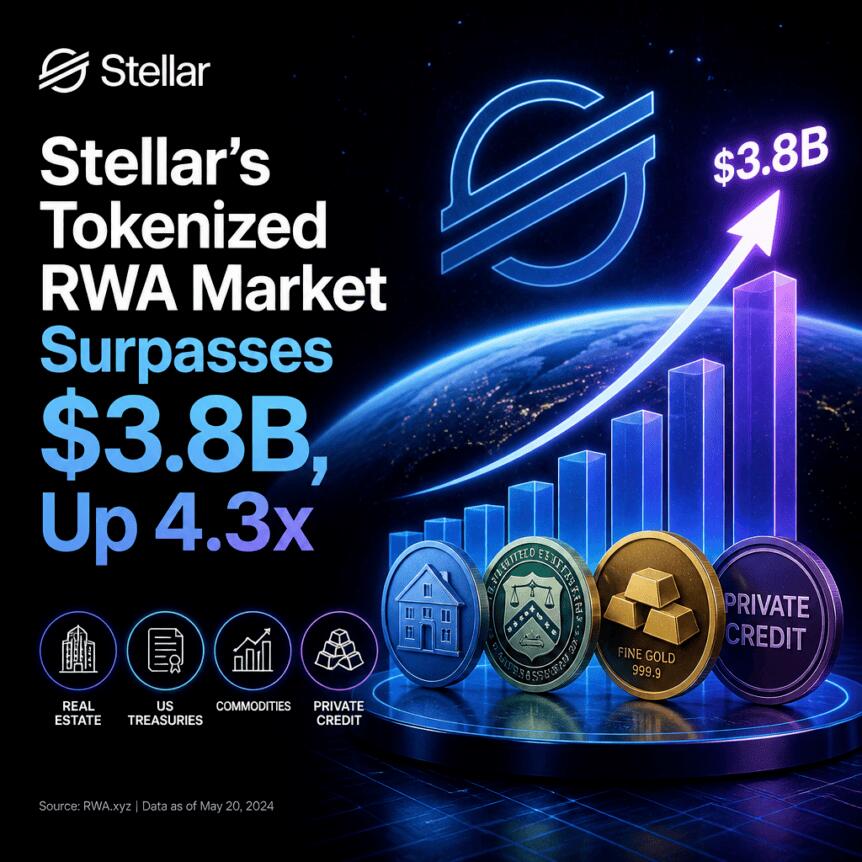
Tokenized real-world assets (RWAs) on the Stellar blockchain have surged to nearly $4 billion in 2026, according to a Dune Analytics dashboard maintained by Stellar. The jump—about 360% over the year—marks a significant acceleration in how major issuers are positioning tokenized debt and government-linked instruments on public chains.
As of Aug. 29, Stellar’s RWA market cap stood at $3.996 billion, spanning US Treasurys, private and public credit, non-US government debt, and other tokenized asset classes. However, the ecosystem’s growth has not been mirrored by Stellar’s native token: XLM is down roughly 11% year to date, trading near $0.18, according to CoinGecko data.
Key takeaways
- Stellar’s tokenized RWA market cap reached $3.996 billion as of Aug. 29, nearly $4 billion after a ~360% rise in 2026, per a Dune Analytics dashboard.
- RWA liquidity and exposure on Stellar remain concentrated: Spiko led with about $1.55 billion, followed by Realiz, Tradable, Franklin Templeton, and Ondo.
- Non-US government debt is gaining traction, with Stellar holding roughly $490 million as of Aug. 20, including tokenized Mexican CETES and Brazilian bonds issued via Etherfuse.
- Institutional integrations are a major driver, including planned DTCC connectivity that could bring tokenized assets to Stellar in the first half of 2027.
- Stellar’s RWA and payment-related expansion is progressing even as XLM underperforms on the year, suggesting broader tokenization momentum isn’t automatically translating into token price strength.
RWA market cap surges toward $4B on Stellar
The Dune Analytics dashboard indicates Stellar’s RWA value grew from $868.8 million at the end of the prior year to nearly $4 billion by late August 2026. The composition reflects the typical early pattern for RWA growth on public networks: a mix of government-linked instruments, credit products, and a smaller set of highly visible issuers.
The market remains skewed toward a handful of participants. As of Aug. 27, Spiko accounted for $1.55 billion of the total RWA value on Stellar, with Realiz at $559 million, Tradable at $548 million, Franklin Templeton at $546 million, and Ondo at $535 million. For investors and developers, the concentration matters: it can accelerate liquidity and credibility when adoption expands, but it also means momentum may be sensitive to changes at a small number of institutions.
Stellar’s overall RWA positioning also ties into broader debt tokenization themes, where on-chain issuance can streamline settlement, distribution, and compliance controls—especially when established financial players already have distribution and custody relationships.
Non-US government debt becomes a noticeable share
While tokenized Treasurys often attract the most attention, Stellar’s data highlights momentum in non-US government instruments. The Stellar Development Foundation pointed to RWA.xyz data, saying Stellar held about $490 million in non-US government debt as of Aug. 20.
That figure includes tokenized Mexican CETES and Brazilian government bonds issued via Etherfuse. The shift is important because it expands the range of sovereign-linked assets accessible on-chain and can broaden demand beyond US-centric portfolios. It also indicates that tokenization pipelines on Stellar are extending into markets where local instruments are packaged for global access.
For participants tracking adoption, the key question is whether these categories keep growing at a similar pace—and whether additional sovereign and quasi-sovereign issuances follow the same onboarding patterns.
Institutional integrations and payments push the pipeline
The RWA expansion aligns with a series of institutional moves aimed at bringing regulated tokenized products onto Stellar infrastructure. One notable thread is DTCC’s plan to connect its tokenization service to Stellar. In May, DTCC announced plans to make tokenized assets available on Stellar in the first half of 2027, with DTC-tokenized assets expected to follow that timeline. Earlier reporting associated the potential expansion with tokenized US Treasurys and broader exposure such as major index ETFs and Russell 1000-related assets.
Another step toward scaling credit offerings came in July. Tokenization platform Tradable said it plans to bring up to $1 billion in private credit assets to Stellar. The integration is designed to support compliance, investor onboarding, and asset lifecycle management, building on Tradable’s already-tokenized private credit of $1.7 billion across nearly 30 positions. That matters because credit products often require more operational work than simpler treasury-style instruments; faster lifecycle handling can reduce friction for issuers and improve the consistency of the user experience.
Stellar’s growth story also extends beyond tokenized securities into regulated dollar remittance and payment rails. In June, MoneyGram launched MGUSD, its dollar stablecoin, on Stellar. The launch allows users to hold dollar-denominated balances and move funds through MoneyGram’s global payments network, adding an everyday utility layer alongside RWA issuance.
MGUSD joins roughly $438 million in reserve-verified stablecoins already issued on Stellar, according to the same Dune dashboard. Taken together, RWA issuance and stablecoin payment capacity can reinforce each other: stablecoin balances can help with settlement and liquidity, while on-chain RWAs can create additional demand for compliant dollar exposure.
Growth in RWAs doesn’t automatically lift XLM
Despite Stellar’s rapid expansion in tokenized assets, the network’s native token has struggled to keep pace. CoinGecko data shows XLM down about 11% year to date, trading near $0.18. This divergence is a reminder that blockchain ecosystem metrics and token performance do not always move together in the short term.
Several dynamics can explain the gap: token price depends on broader market conditions, risk appetite, liquidity, and speculative flows, while RWA growth is often driven by institutional issuance schedules and product onboarding timelines. In other words, increased RWA capitalization is not necessarily the same as increased immediate demand for XLM.
What to watch next is whether upcoming institutional integrations—particularly DTCC’s planned connectivity—lead to faster onboarding of high-profile tokenized products, and whether stablecoin and payment usage continues to expand in parallel with the RWA balance sheet growth.
For readers tracking Stellar, the near-term indicators to monitor are category-level growth within the RWA dashboard (especially non-US government debt), the rollout pace for major institutional integrations expected in 2027, and whether tokenization-driven activity translates into deeper on-chain demand across liquidity and payment flows.

Just a few months after it launched its first notable cryptocurrency-focused platform, the Wall Street behemoth has expanded its offering beyond Bitcoin and Ethereum.
The giant recently announced that its Schwab Crypto trading service will add Solana (SOL), Chainlink (LINK), and Avalanche (AVAX) in the coming months.
Adding More Alts
The new additions will allow eligible company clients direct access to five cryptocurrencies after the product launched with only Bitcoin and Ethereum in May this year. What’s even more notable now is that Charles Schwab said these won’t necessarily be the last added altcoins, as it plans to introduce more digital assets over time.
“With this expansion, clients will have more choices to build a digital asset allocation alongside the investing and banking experience they know and trust at Schwab. These additions are consistent with our approach to provide clients with access to familiar cryptocurrencies backed by an ecosystem of education, tools, resources, and support to make informed decisions about how crypto might fit into their broader investing goals,” said the entity’s Head of Digital Assets, Joe Vietri.
Charles Schwab clients can view and trade their crypto holdings alongside traditional investments on its website, mobile application, and thinkorswim platform. The company explained that crypto trades carry a fee of 75 basis points on the dollar value of each transaction.
It’s worth noting that certain geographical limitations are still in place. Schwab Crypto remains unavailable to residents of New York and Louisiana, as well as customers in US territories and international jurisdictions.
The statement also clarified that support for any of the announced digital assets could still be delayed, changed, or withdrawn depending on regulatory, market, operational, or risk-related developments.
Market Revival
The BTC- and ETH-only launch of the company’s crypto platform came just ahead of the May rally, which drove the leading digital asset to almost $83,000. What followed were three months of selling pressure and new lows, with BTC dipping below $58,000 on July 1.
However, the new altcoin additions find the market in a much better state. BTC broke out of its consolidation range and rocketed to $81,000 on a couple of occasions. Most altcoins have followed suit, including the ones mentioned above. SOL is up by over 40% in the past month, LINK has gained 38%, while AVAX has added a more modest 15%.
The post Wall Street Giant Charles Schwab Makes Major Crypto Move Beyond Bitcoin and Ethereum appeared first on CryptoPotato.
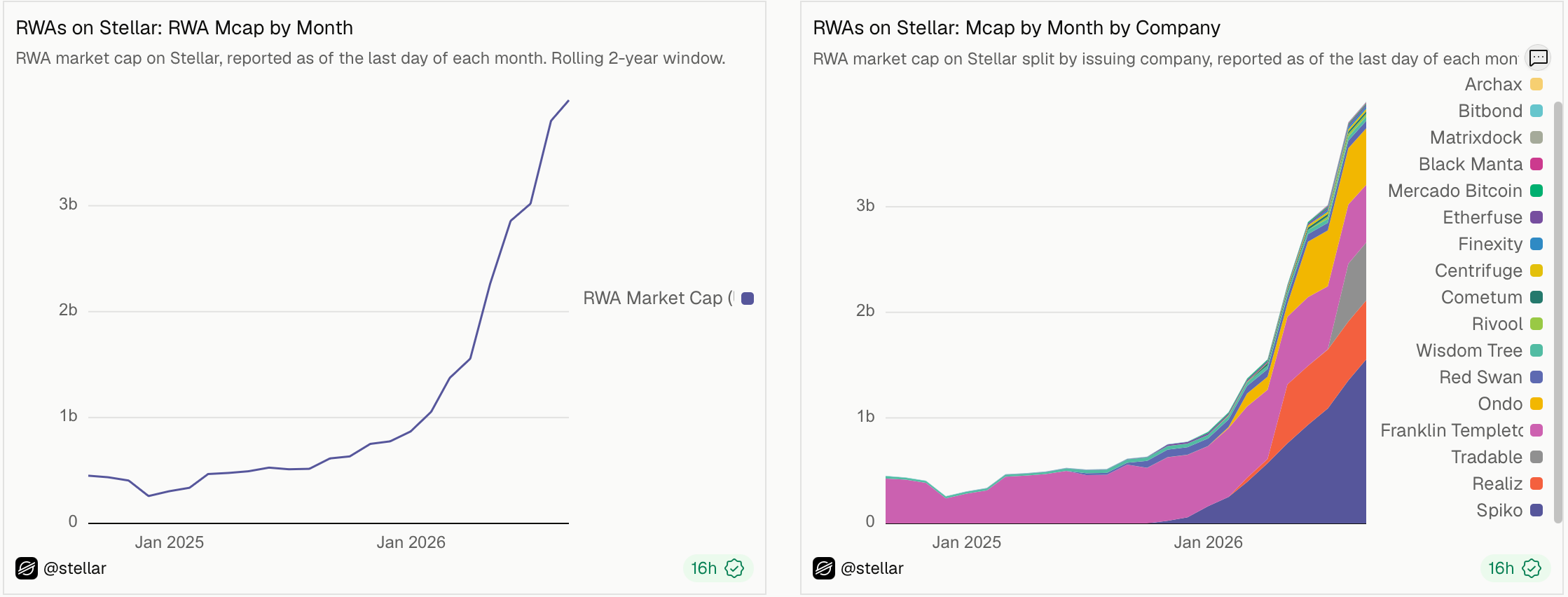
The value of tokenized real-world assets (RWA) on Stellar has climbed roughly 360% in 2026 to nearly $4 billion, up from $868.8 million at the end of last year, according to a Dune Analytics dashboard maintained by Stellar.
The network’s RWA market cap stood at $3.996 billion as of Aug. 29, spread across US Treasurys, private and public credit, non-US government debt and other tokenized asset classes.
The market is concentrated among a handful of issuers. Spiko accounted for $1.55 billion of Stellar’s RWA value as of Aug. 27, followed by Realiz at $559 million, Tradable at $548 million, Franklin Templeton at $546 million and Ondo at $535 million.
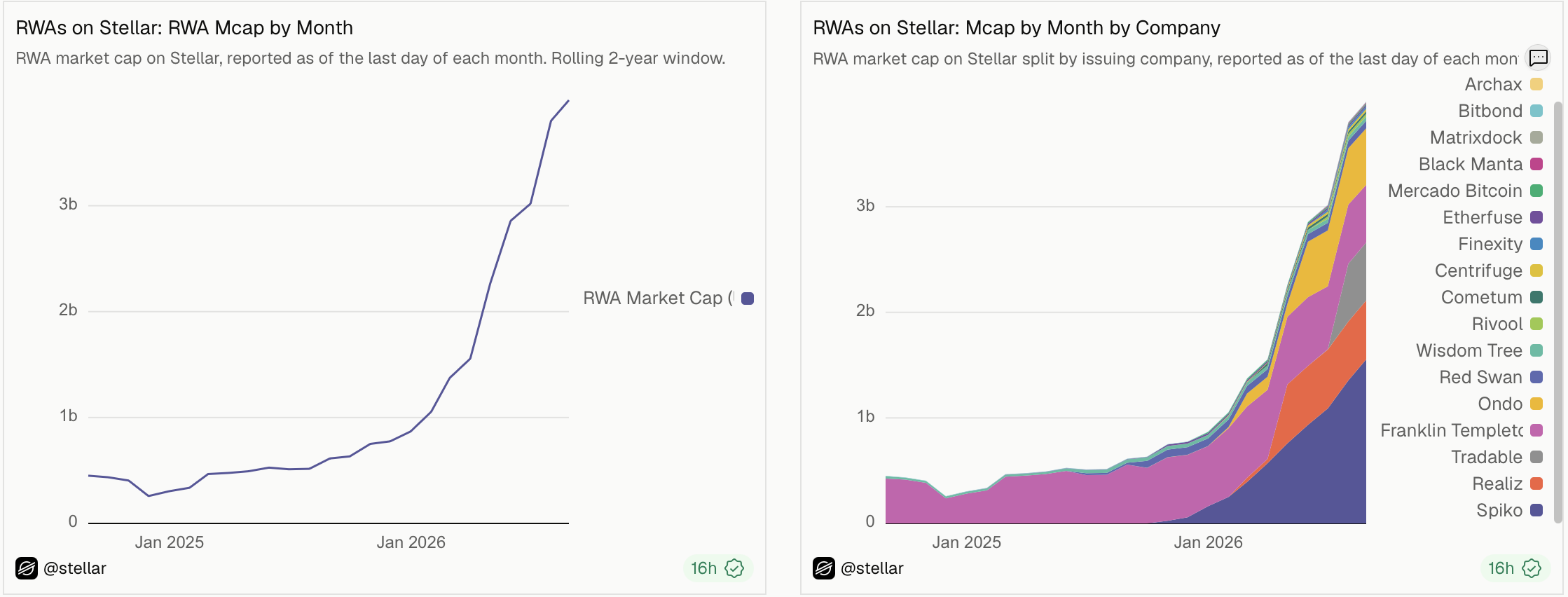
Stellar’s RWA market cap has surged in 2026. Source: Dune Analytics/Stellar
Stellar has gained ground in non-US government debt. Citing RWA.xyz data, the Stellar Development Foundation said the network held about $490 million in the asset class as of Aug. 20, including tokenized Mexican CETES and Brazilian government bonds issued through Etherfuse.
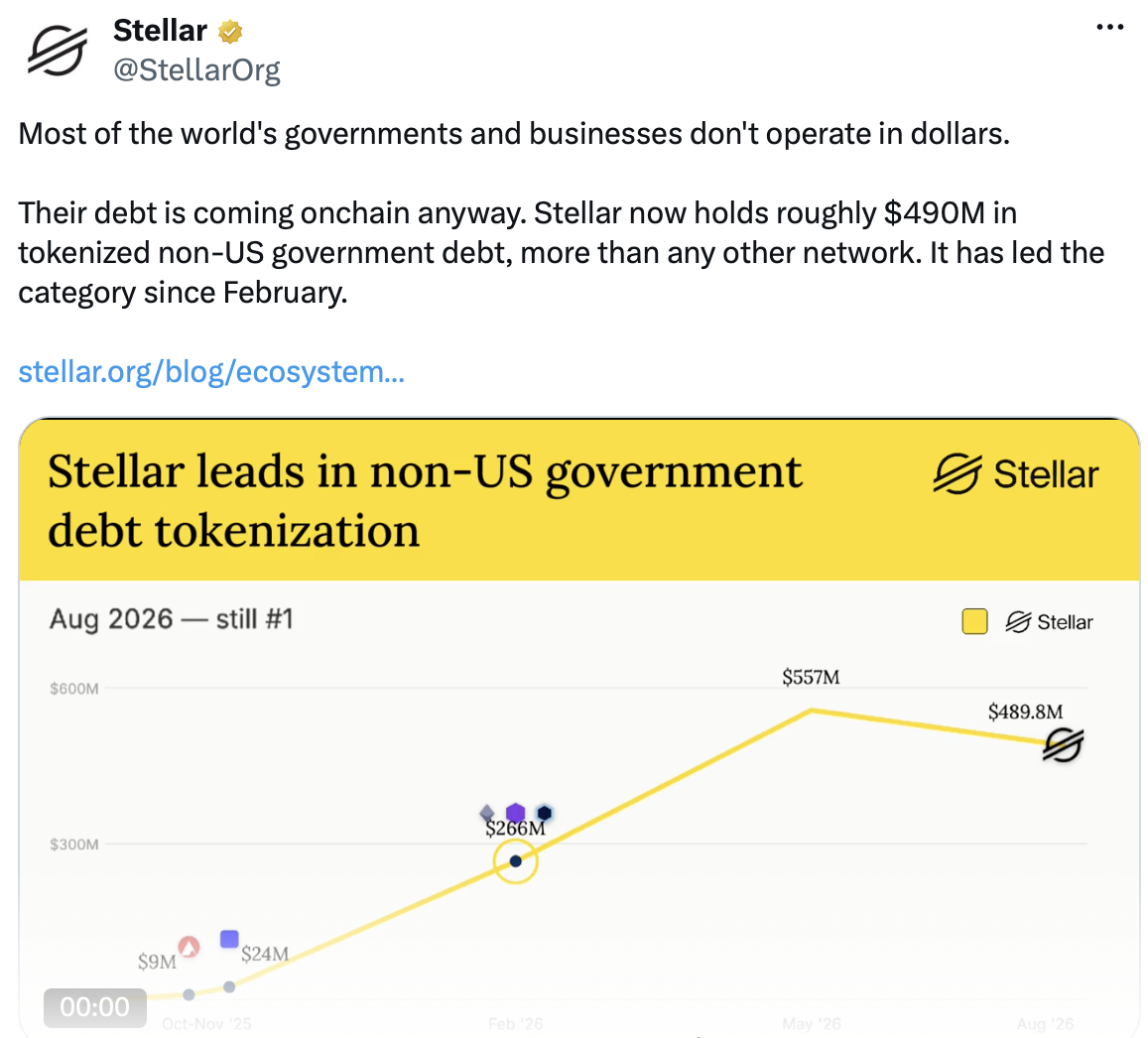
Source: StellarOrg
Despite the growth in RWAs, the blockchain’s native XLM token is down about 11% year to date, trading near $0.18, according to CoinGecko data.
Related: Coinbase tokenized stocks go live on Base with Chainlink price feeds
Institutional adoption drives Stellar’s RWA growth
The expansion comes as financial institutions and tokenization platforms deepen their use of the network.
In May, the Depository Trust & Clearing Corporation (DTCC) announced plans to connect its tokenization service to Stellar, with DTC-tokenized assets expected to become available on the network in the first half of 2027. The integration could eventually support tokenized US Treasurys, major index ETFs and stocks in the Russell 1000.
That institutional push continued in July, when tokenization platform Tradable announced plans to bring up to $1 billion in private credit assets to Stellar. The integration is designed to support compliance, investor onboarding and asset lifecycle management, building on $1.7 billion in private credit that Tradable has already tokenized across nearly 30 positions.
Stellar has also expanded its role in digital payments. MoneyGram launched its MGUSD dollar stablecoin on the network in June, allowing users to hold dollar-denominated balances and move funds through its global payments network.
MGUSD joins roughly $438 million in reserve-verified stablecoins currently issued on Stellar, according to the Dune dashboard.
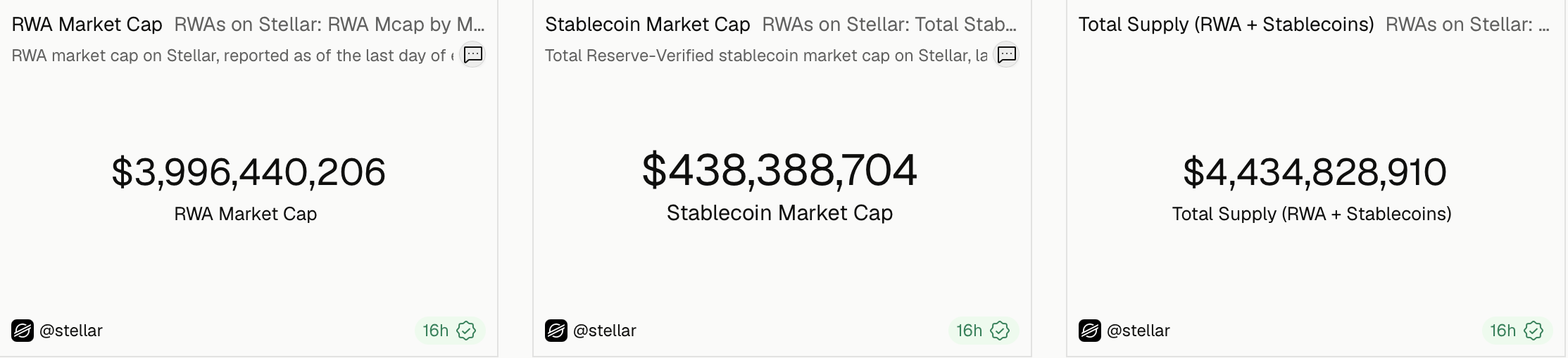
Stellar’s RWA and stablecoin market caps. Source: Dune Analytics/Stellar
Magazine: Who is legally liable when an AI agent goes rogue?

US consumer advocacy group Public Citizen reported that crypto ventures linked to Donald Trump and his family have left investors with at least $4.7 billion underwater since 2022.
Most of the losses remain unrealized.
Trump’s Crypto Empire
Public Citizen estimated that investors in Trump Digital Trading Cards, launched in December 2022, have suffered at least $9.3 million in losses, while the WLFI token has left investors at least $1 billion underwater.
The largest amount came from the TRUMP meme coin, which Public Citizen estimated had resulted in $3.2 billion in losses for investors. Since its all-time high of $73 back in January 2025, the token has lost over 97% of its value. Earlier this month, US Senators Elizabeth Warren and Richard Blumenthal asked SEC Chair Paul Atkins to investigate the meme coin. They said that it may have enabled fraud or unfairly enriched people at the expense of everyday investors.
The advocacy group put losses tied to Trump Media’s digital-asset treasury at $450 million, while it estimated no losses for USD1, which brings the total to at least $4.7 billion.
Trump is said to have made at least $1.4 billion from crypto in 2025, based on his latest financial disclosure released in June 2026. But the disclosure does not indicate that he invested any of his own money in these ventures, according to Public Citizen.
While the White House has said neither the president nor his family have engaged or will engage in conflicts of interest, the report said Trump continues to own and control his businesses. The group said his stakes in the digital trading cards, the meme coin, World Liberty Financial’s two tokens, as well as Trump Media & Technology Group, are held through a revocable trust in which the president is the sole donor and beneficiary. His eldest child, Donald Trump Jr., meanwhile, serves as the sole trustee.
Clash Over Clarity
The push to strengthen the US crypto industry and advance the Digital Asset Market Clarity Act has continued to draw criticism over the family’s financial ties to digital assets. Last week, Trump met with executives from Coinbase, Ripple, Gemini, and other crypto firms at the White House, calling on Congress to pass a “fair version” of CLARITY while adding that it would help keep the US ahead of China.
But critics, including Ben McKenzie and Chris Van Hollen, warned that the bill could leave loopholes allowing Trump to profit from his ventures.
Previously, prominent comedian and political commentator John Oliver also described crypto as “a perfect vehicle to funnel money” to the US President’s family, while adding that Trump is “exploiting crypto sketchiness for maximum profit.”
The post Trump-Linked Crypto Ventures Leave Investors at Least $4.7B Underwater: Public Citizen appeared first on CryptoPotato.
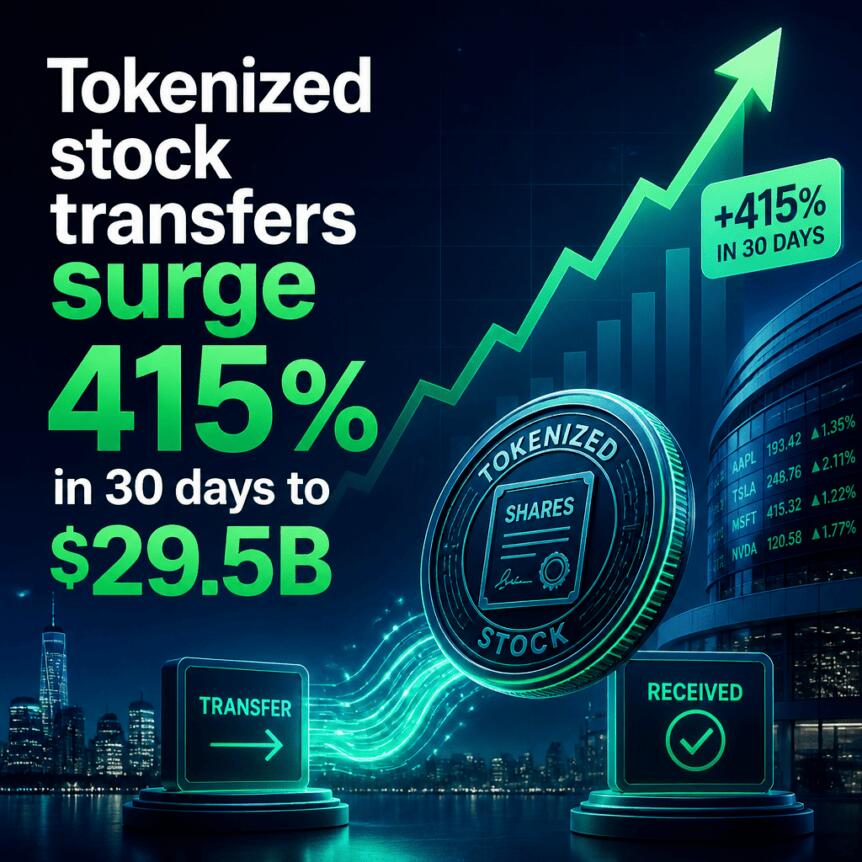
Tokenized stock markets have accelerated sharply over the past month, according to onchain analytics from RWA.xyz. Over the last 30 days, monthly transfer volume for tokenized equities rose by more than 415% to $29.5 billion, signaling that activity is moving beyond early experimentation.
RWA.xyz data also shows the ecosystem is widening: monthly active addresses jumped by more than 209% to about 1.3 million, and the number of tokenized stock holders increased 167% to 2.36 million. At the same time, the total value of tokenized stocks distributed onchain edged up to $2.54 billion—up 1.45% over 30 days and roughly 637% compared with a year earlier.
Key takeaways
- Monthly tokenized stock transfers rose more than 415% to $29.5 billion, per RWA.xyz.
- Monthly active addresses climbed over 209% to around 1.3 million, while holders grew 167% to 2.36 million.
- Total distributed tokenized stock value reached $2.54 billion, about 637% higher than a year ago.
- Ondo, Kraken, and Binance collectively accounted for roughly 81% of distributed value in the RWA.xyz dataset.
- New product launches from major crypto platforms are expanding how tokenized stocks can be traded, held, and used in DeFi-style workflows.
Activity surges across transfers, holders, and usage
The growth figures from RWA.xyz point to broad-based expansion rather than a single spike. Transfer volume is up dramatically, but that increase lines up with other engagement metrics—particularly active addresses and holder count—suggesting more wallets are participating and not just cycling through limited liquidity.
Distributed value, while smaller in percentage terms over 30 days (+1.45%), is still notable in absolute terms at $2.54 billion. Importantly, the year-over-year change indicates the market’s baseline has risen substantially: distributed tokenized stocks are up roughly 637% from $344 million a year ago, implying that the current acceleration is occurring on top of already-growing distribution.
Among individual offerings tracked on RWA.xyz, Securitize Corp. leads with about $163 million in distributed tokenized stock value. Strategy PP Variable xStock follows at $136 million, and an Ondo-tokenized version of Circle Internet Group sits around $109 million.
Big platforms dominate distributed tokenized stock value
On the platform side, the distribution is concentrated. Ondo leads with $842.8 million in distributed value, while Kraken’s xStocks account for $609.3 million and Binance’s bStocks come in at $599.9 million. Together, those three platforms represent roughly 81% of the market in the RWA.xyz dataset—underscoring that much of tokenized equities’ liquidity and distribution still flows through a handful of issuers and distribution rails.
This matters for participants because platform concentration can shape token availability, custody and wallet experiences, and integration depth with other onchain services. If activity is growing rapidly, a large share of that growth is likely benefiting the dominant platforms first—especially those that already have the widest distribution and the most straightforward pathways for token holders to move assets onchain.
Why August’s product momentum is pulling tokenized stocks deeper onchain
The latest surge aligns with a broader pattern: crypto platforms are increasingly packaging tokenized equities into onchain trading and portfolio workflows, and expanding the ways those assets can be used beyond simple buy-and-hold.
On Aug. 24, Coinbase’s tokenized US stocks launched on Base, enabling eligible non-US users to trade the assets around the clock and use them across decentralized finance applications. The B20 token set includes major companies such as Nvidia, Apple, Meta, and Alphabet, and the assets can be held in self-custody wallets—an important feature for onchain utility because it allows tokens to interact with broader wallet-based infrastructure.
A day later, Bitwise introduced automated portfolios built from Coinbase’s tokenized stocks. The offering is designed for eligible non-US investors who want exposure to preset strategies while keeping the underlying assets in their own wallets. The initial portfolios target themes such as the “Magnificent Seven,” robotics and artificial intelligence.
Other exchanges and DeFi-adjacent products have expanded similarly. In July, Bybit added tokenized shares—such as Nvidia, Apple, and Tesla—as collateral for margin loans. Meanwhile, Arcus, a Robinhood-backed decentralized exchange, launched more than 95 stock tokens and perpetual markets on Robinhood Chain, demonstrating how tokenized equities are increasingly being treated as instruments for active trading rather than standalone blockchain assets.
RWA.xyz’s activity jump appears to reflect these shifts. When tokenized equities become easier to acquire across major ecosystems, and when they can be used in more onchain-compatible ways (for example, for collateral or within structured portfolios), wallet adoption typically follows. Higher active address counts and holder growth are consistent with that expansion of onchain utility.
What to watch next as tokenized equities integrate with crypto rails
The data shows a sector that is getting more participants and more transaction volume, but it also highlights how concentrated distribution remains among a small set of major platforms. Going forward, investors and builders should watch whether activity growth continues to translate into sustained distributed value, and whether new integrations broaden beyond the current top issuers—especially as tokenized stocks are increasingly positioned for trading, portfolio automation, and collateralized lending on mainstream crypto networks.
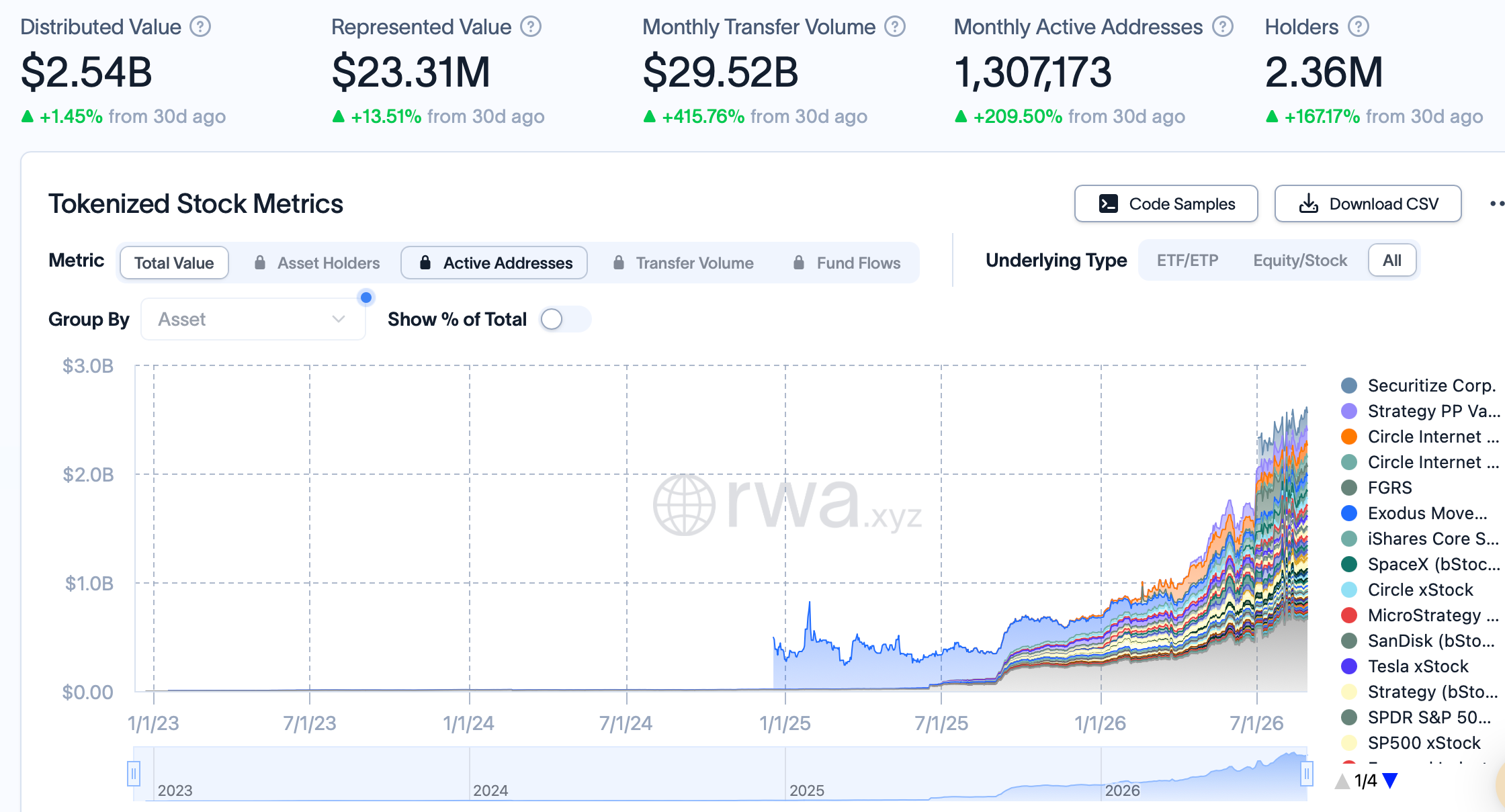
Tokenized stock activity surged over the past 30 days, with monthly transfer volume climbing more than 415% to $29.5 billion, according to data from RWA.xyz.
Monthly active addresses rose more than 209% to around 1.3 million, while the number of tokenized stock holders climbed 167% to 2.36 million over the same period. The total value of tokenized stocks distributed onchain also rose 1.45% over the past 30 days to $2.54 billion, up roughly 637% from $344 million a year ago.
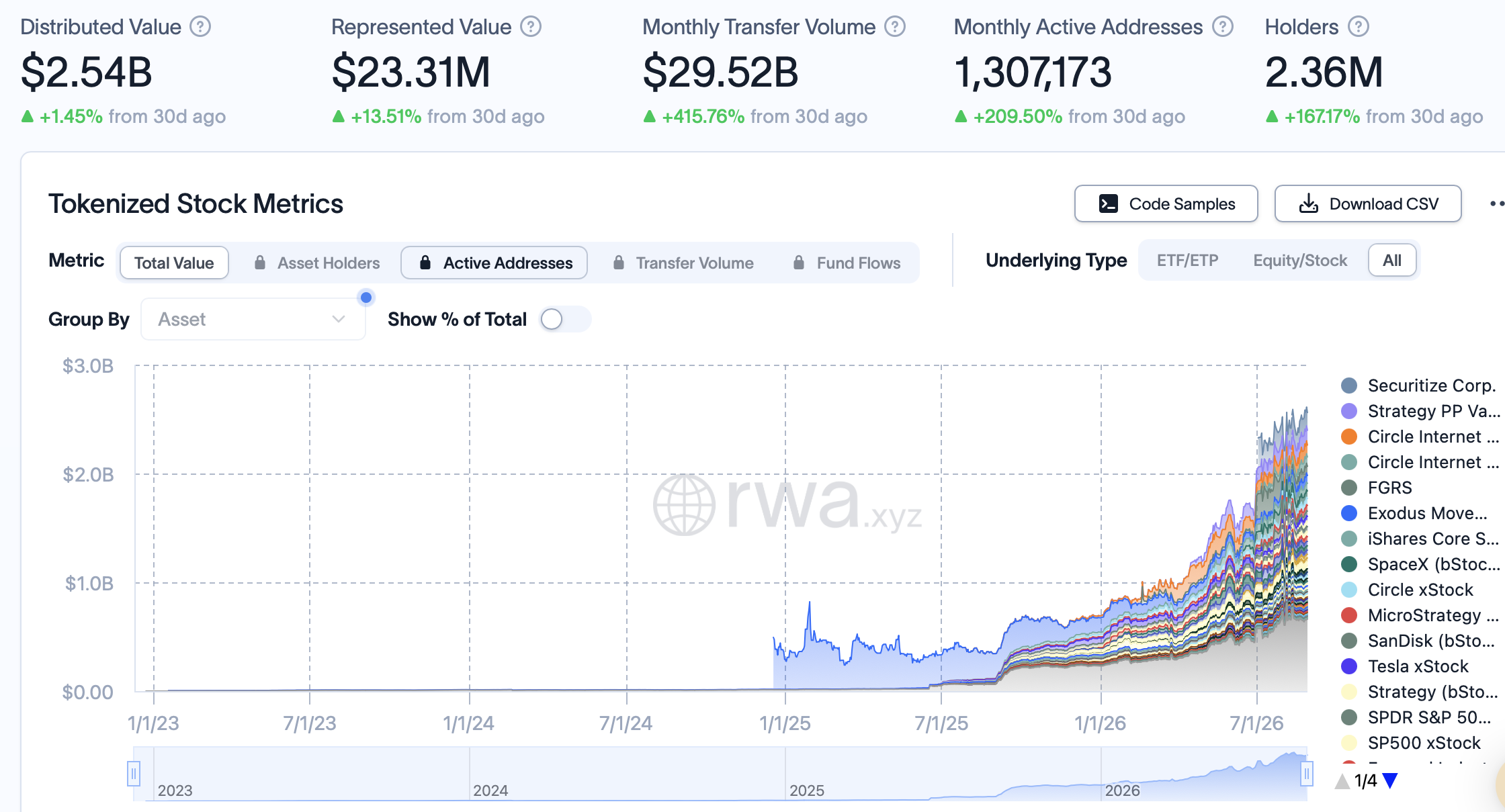
Tokenized stock activity accelerated in August. Source: RWA.xyz
Securitize Corp. was the largest individual tokenized stock tracked by RWA.xyz at about $163 million, followed by Strategy PP Variable xStock at $136 million and an Ondo-tokenized version of Circle Internet Group at $109 million.
By platform, Ondo led with $842.8 million in distributed value, followed by Kraken’s xStocks at $609.3 million and Binance’s bStocks at $599.9 million. Together, the three accounted for roughly 81% of the market.
Related: Arcus launches tokenized perp positions on Robinhood Chain
Tokenized equities move deeper into crypto platforms
The surge in activity comes as crypto platforms introduce new ways for investors to trade, hold and use tokenized equities onchain.
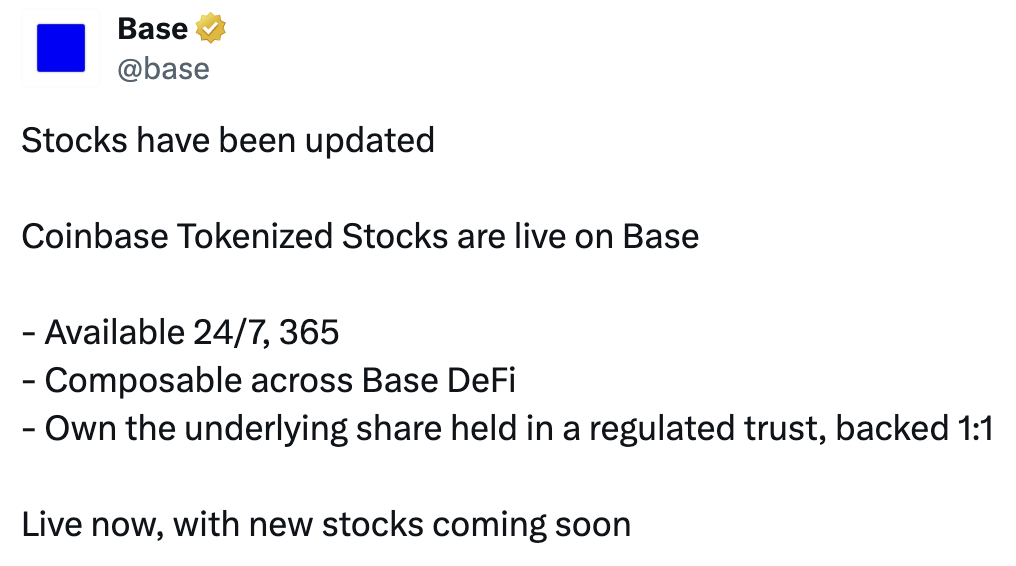
On Aug. 24, Coinbase’s tokenized US stocks went live on Base, allowing eligible non-US users to trade the assets around the clock and use them across decentralized finance applications. The B20 tokens include companies such as Nvidia, Apple, Meta and Alphabet and can be held in self-custody wallets.
Source: Base
A day later, Bitwise launched automated portfolios built from Coinbase’s tokenized stocks, allowing eligible non-US investors to follow preset strategies while keeping the underlying assets in their own wallets. The initial portfolios target the “Magnificent Seven,” robotics and artificial intelligence sectors.
Other platforms have also expanded how tokenized stocks can be used. In July, Bybit added tokenized shares of Nvidia, Apple, Tesla and other US companies as collateral for margin loans, while Robinhood-backed DEX Arcus launched more than 95 stock tokens and perpetual markets on Robinhood Chain.
Magazine: Who is legally liable when an AI agent goes rogue?

Financial Foundations

Daily horoscope August 30, 2026: Predictions for your star sign

PagerDuty, Inc. 2027 Q2 – Results – Earnings Call Presentation (NYSE:PD) 2026-08-29





-

 Crypto World4 days ago
SpaceX stock could rise 75% to $240, JPMorgan says
-

 Fashion1 day ago
Weekend Open Thread: Maeve – Corporette.com
-

 Crypto World2 days ago
Bitcoin’s 22% rally now needs real demand to outlast Treasury liquidity boost
-

 Crypto World3 days ago
Warsh Jackson Hole keynote puts financial innovation first
-

 Crypto World5 days ago
A $30 Billion AI Fund Implodes, Now the SEC Is Investigating Wall Street’s Role
-

 Business2 days ago
Salesforce Stock Soars 19% as Blowout Earnings and Agentforce AI Growth Silence Software Skeptics
-

 Crypto World4 days ago
Did Trump Just Move SpaceX Stock With One Truth Social Post?
-

 Business7 days ago
Mystery AI Model ‘Ox Alpha’ Draws Developers With Free Access as Chinese Lab Origins Remain Debated
-

 Business3 days ago
Walmart takes aim at younger shoppers with new fashion brand
-
 NewsBeat3 days ago
Lindsay Clancy jury braces for closing arguments as judge tells court: ‘You’ve heard all the evidence’ – Live updates
-

 Crypto World3 days ago
Elon Musk Grok Bot Promise: We Will Make You Whole if AI Loses Your Money
-

 Crypto World23 hours ago
Bitcoin price tests $82K resistance as Brandt stays long
-

 Business5 days ago
Moderna CEO warns China is pouring state money into mRNA technology
-

 Business5 days ago
NVIDIA Stock Drops Nearly 2 Percent to $210 on Seventh Losing Day Ahead of Critical AI Earnings
-
 Crypto World3 days ago
NVIDIA revenue hits $96.2B as AI demand doubles
-

 Business4 days ago
Thailand’s Eastern Economic Corridor Capital City (EECiti): Key Developments and Investment Opportunities
-

 Business1 day ago
iPhone 18 Pro Pre-Orders Could Shift to Saturday as Apple Reportedly Avoids September 11 Anniversary
-
 Crypto World6 days ago
$92 Billion Nvidia Earnings Could Make or Break the AI Trade
-

 Business7 days ago
Where Will Kevin Durant Play in 2027? Rockets Hold Player Option Key to His Future With Houston via Deal
-

 NewsBeat4 days ago
Trump’s trade truce with China faces test with Iran effort
You must be logged in to post a comment Login