

Crypto World
Robinhood CEO says trading is not gambling as Trump Accounts launch

Robinhood CEO Vlad Tenev has defended trading against claims that it should be treated as gambling as the brokerage takes on a role in the U.S.
Summary
- Robinhood is helping operate Trump Accounts as it seeks deeper ties with younger American investors.
- Tenev rejects labeling all trading as gambling, arguing speculation remains necessary for functioning financial markets.
- Robinhood is expanding beyond stocks and crypto into prediction markets, tokenization, banking, and global finance.
Government’s new Trump Accounts program. The accounts are designed to help children start investing early as Robinhood broadens its business beyond retail trading.
In an interview with The New York Times, Tenev said Robinhood is working with the government to operate the accounts. He also said more than 90% of his personal net worth remains invested in Robinhood shares. His comments come as the company expands into prediction markets, tokenized assets and other financial services.
Robinhood takes a role in Trump Accounts
Trump Accounts are tax-deferred investment accounts created for children. Those born from 2025 through 2028 can receive a $1,000 government contribution. Robinhood helped develop the app used to manage the program, while families can begin making contributions after account activation. The company has presented the program as an effort to bring people into long-term investing.
Tenev sees the government partnership as a way to reach a new generation of users. Robinhood became linked with younger retail traders during the pandemic, when activity in stocks, options and cryptocurrencies rose sharply. The company now wants to build a broader relationship with customers that extends beyond short-term trading and into long-term financial products.
Tenev rejects a simple link between trading and gambling
Tenev pushed back against criticism that Robinhood encourages younger users to “gamble” through financial markets. He argued that trading should not automatically be described as gambling. He said speculation plays a core role in markets because buyers and sellers make predictions about future prices when deciding where to place capital.
The debate has become more relevant as Robinhood expands its prediction market business. As reported by crypto.news, Bernstein projected that Robinhood’s prediction market revenue could reach $586 million in 2026, up from about $150 million in 2025. The growth has brought more attention to the line between regulated trading, event contracts and betting.
Robinhood works to move beyond its meme-stock image
Robinhood became closely associated with the 2021 meme-stock boom and the GameStop trading episode. Tenev said the company is now trying to move past that image and build a platform that can cover a wider range of assets and financial transactions. Its recent product launches show how far the company is extending beyond its original commission-free brokerage model.
Robinhood launched Robinhood Chain on July 1 as an Ethereum layer-2 network focused on tokenized real-world assets. The company has also gained approval for Robinhood Securities to act as an IPO underwriter, as reported by crypto.news. Those moves give Robinhood roles in trading, blockchain infrastructure and capital markets as it builds a wider financial platform.
Tenev keeps most of his wealth tied to Robinhood
Tenev told The New York Times that more than 90% of his personal net worth is held in Robinhood shares. The statement gives context to his long-term position on the company as Robinhood expands into new markets and products. The company’s shares have also drawn attention after a strong rally during its broader product push.
As reported by crypto.news, Tenev sold 375,000 Robinhood shares on July 6 through a Rule 10b5-1 trading plan adopted in September 2025. He still held more than 48.2 million Class B shares after the transaction. Robinhood’s latest strategy now combines retail trading, prediction markets, tokenization and government-backed investment accounts as the company seeks a larger role in global finance.

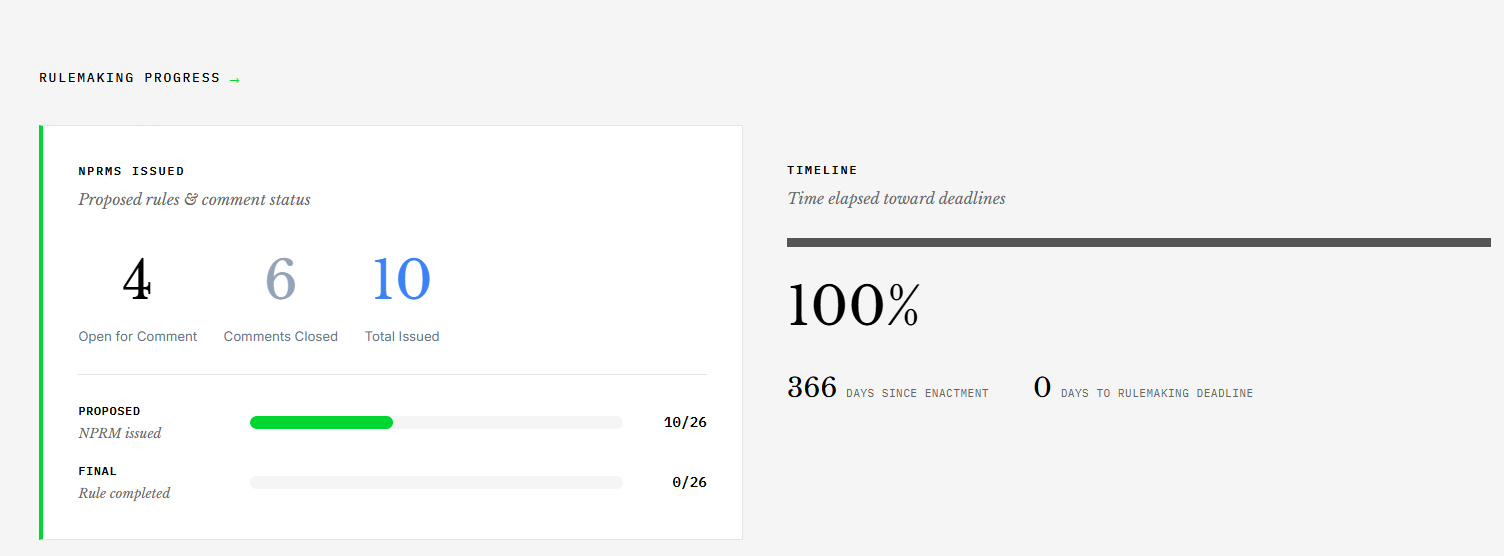
US regulatory agencies missed the rulemaking deadline under the Guiding and Establishing National Innovation for US Stablecoins (GENIUS) Act on Saturday, which marked one year since the law was signed.
Several US regulatory agencies published proposed rules and collected public feedback during the past year, but no final regulations were issued before the deadline.
These agencies include the Department of the Treasury, the Office of the Comptroller of the Currency (OCC), the Federal Deposit Insurance Corporation (FDIC) and the Federal Reserve Board, which issued proposed rules but no final rules, according to rulemaking trackers by law firm Chapman and crypto investment company Paradigm.
Missing the statutory deadline does not invalidate the GENIUS Act, but the unfinished rules may result in regulatory uncertainty for stablecoin issuers.
The GENIUS Act established the first comprehensive federal regulatory framework for stablecoins in the US. The act was signed into law by US President Donald Trump on July 18, 2025.
Related: ABA, state banking groups push back on CLARITY Act stablecoin yield provisions
Regulators issued 10 rule proposals during the GENIUS Act’s first year
Federal regulators issued 10 notices of proposed rulemaking (NPRM) in the year since the GENIUS Act was signed into law, according to Paradigm.
The Treasury Department issued four proposals covering the broader implementation of the act, including standards for determining whether state stablecoin regulatory regimes are similar to the federal framework, registration requirements for foreign stablecoin issuers and guidelines for compliance with anti-money laundering measures.
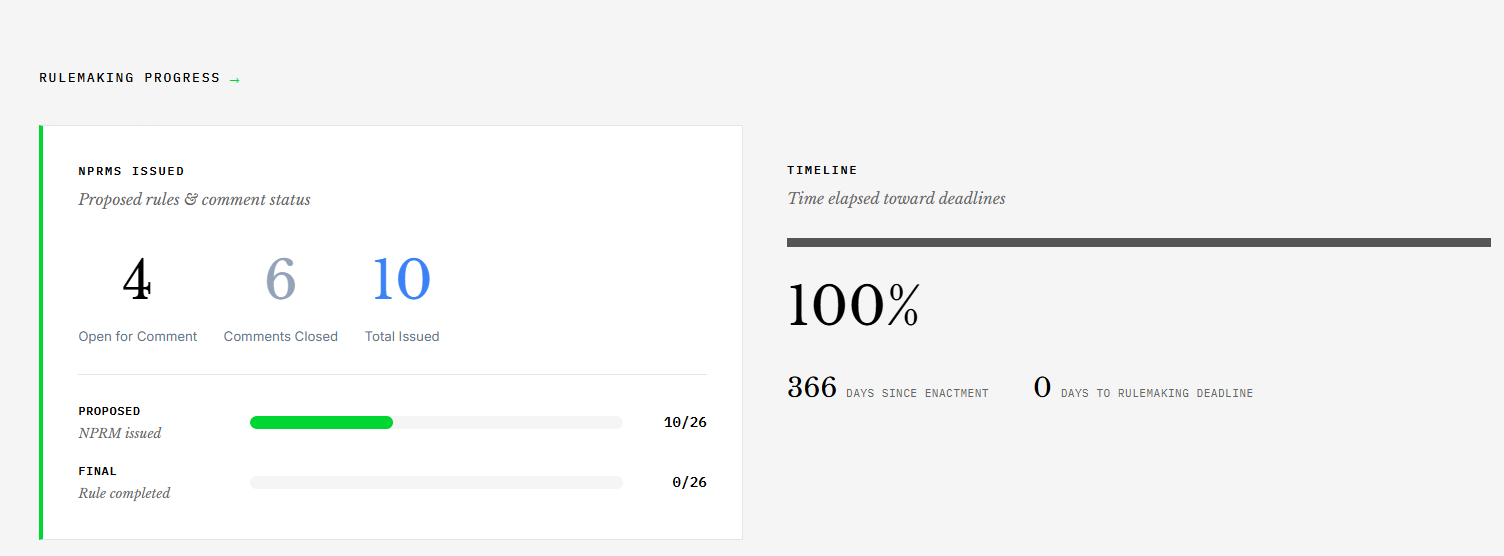
Rulemaking progress after the GENIUS Act was signed into law. Source: Paradigm.
The OCC issued two NPRMs covering nationally chartered payment stablecoin issuers, approval requirements and supervisory standards.
The FDIC issued one NPRM on FDIC-supervised institutions that issue payment stablecoins, focused on supervisory expectations and operational standards such as reserve management.
The National Credit Union Administration (NCUA) proposed rules enabling federally insured credit unions to participate in stablecoin issuance.
Finally, federal banking agencies jointly proposed an interagency implementation rule to harmonize supervision across the OCC, Federal Reserve and FDIC, aiming to ensure consistent supervisory expectations across all federal regulators.
Anchorage urges lawmakers to pass CLARITY Act
Federally chartered crypto bank Anchorage Digital has urged lawmakers to pass the Digital Asset Market Clarity Act (CLARITY).
“On GENIUS’ one-year anniversary, we’re renewing our call for Congress to pass the CLARITY Act and extend the clear market-structure rules that worked for stablecoins to the broader digital asset economy,” Anchorage Digital wrote in a Friday report.
The CLARITY Act seeks to establish the first federal regulatory framework for digital assets in the US. It cleared the Senate Banking Committee in May, though banking industry groups argued that it would allow crypto firms to offer yields on stablecoins without facing the same requirements as traditional banks.
On July 13, state banking associations, including the American Bankers Association (ABA) and the Independent Community Bankers of America (ICBA), sent a joint letter urging Senate leaders to provide more detail on the CLARITY Act’s stablecoin yield provisions and argued that new amendments need to prevent payment stablecoins from acting as deposit substitutes rather than pure transaction tools.
On June 26, Galaxy Digital cut its odds of the CLARITY Act becoming law in 2026 to 50%, citing the lack of a unified Senate Banking-Agriculture text, no firm floor schedule and a narrowing legislative window before lawmakers leave Washington.
Magazine: Gambling on random Pokémon cards: Onchain gagcha hits record high as crypto sinks

Kalshi’s logo appears on a smartphone placed on a reflective surface, with a blurry betting curve projected in the background in Creteil, France, on March 9, 2026, during a major scandal and $54 million lawsuit concerning bets related to recent strikes in Iran.
Nurphoto | Nurphoto | Getty Images
The 2026 FIFA World Cup has sent prediction market trading volumes across platforms soaring. And for Kalshi, it has delivered millions of new users.
Kalshi has brought in 3 million new users over the course of the tournament, the company shared with CNBC.
More than $1.2 billion has been traded on Kalshi’s contracts that ask traders to predict the winner of the World Cup, a record for a singular market. That market will officially close on Sunday, after Spain and Argentina compete in the final for the title.
“I don’t think there’s any game like football,” said Vijay Viswanathan, an associate dean of integrated marketing communications at Northwestern University, referring to soccer. “It’s played in about every country in the world … so in just terms of the total addressable market, there’s really nothing that comes close to the FIFA World Cup.”
Argentine fans react as their team scores against Egypt during a FIFA World Cup match watch party at Cerveceria La Tropica on July 07, 2026 in Miami, Florida. Argentina and Egypt are playing in the round-of-16 match in Atlanta.
Joe Raedle | Getty Images
Across the World Cup, Kalshi has made several moves to boost its brand. Those include a partnership with the official prediction market sponsor of the World Cup, ADI Predictstreet, to feature co-branding advertisements in stadiums. It also partnered with OpenAI last week to feature the company’s contract’s odds when users search about games in the tournament on ChatGPT.
But it also has featured a slew of advertisements with key faces in the soccer world: Croatian soccer star Luka Modric, longtime Real Madrid coach José Mourinho, and even a partnership with the Argentina national team. That deal got the company a feature in a post by superstar Lionel Messi on Instagram.
“Our volumes are where the news is at,” said Kalshi CEO Tarek Mansour, who takes on a lead role in guiding the company’s marketing strategy. “It’s a lot of the approach for the World Cup. … The most important thing is enable creativity based on what’s happening.”
Speed is key, too. One advertisement featuring former professional soccer stars playing a scrimmage with each other released on Friday was conceived, executed and released in 24 hours, Mansour said.
But Kalshi also launched ads with non-soccer celebrities around the tournament, too. An advertisement with actor Timothee Chalamet was released in June — around when he was garnering attention for his appearances at New York Knicks games during the NBA Finals — while a spot with Colombian singer J Balvin came out this month.
“This is also a way for them to say, ‘oh, but we’re also relevant to all these other people who might not be that interested in sports, too,’” said Elizabeth Johnson, executive director of the Wharton Neuroscience Initiative at the University of Pennsylvania. Johnson also teaches a visual marketing class at the university. “They’re seizing this moment to remind people about the ubiquitousness of what these prediction markets are.”
Leaning heavily into the sports event comes with risks, too. Sports event contracts are under scrutiny in a dispute between the federal government and the states. States argue those contracts are equivalent to sports betting, something state governments control.
Kalshi agrees with the federal government that the Commodity Futures Trading Commission — which regulates swaps and derivatives — has the sole power to regulate prediction markets.
Tarek Mansour, co-founder and CEO of Kalshi speaks during CNBC’s Squawk Box on June 24, 2026.
CNBC
Mansour dismissed those concerns, though, arguing its sports contracts are only under pressure from gambling companies worried about losing their dominant, incumbent positions.
Brian Sung, a partner in the derivatives and digital assets practice groups at Haynes Boone, doesn’t think the advertising strategies impact how courts may rule in the future, but said it does impact the view of prediction markets.
“It does kind of weaken their perception, in public or politics,” he said. “They are trying to push against this idea that they’re really only about sports. I mean, that is where the bulk of their activity is.”
Kalshi now moves onto turning those 3 million new users into recurring traders, which could be a challenge: volume on days when World Cup matches haven’t been played has been significantly lower than when the games are on.
Mansour added this cycle has happened before: a major event that drives volume higher, with a temporary decline after only for it to keep marching higher off of other events.
“You have to believe there’s not going to be any news after Sunday,” he said. “Maybe, … but the more probable thing is that there’s going to be like a bunch of things going on in the world, and Kalshi’s going to be there to service it.”
Disclosure: CNBC and Kalshi have a commercial relationship that includes customer acquisition and a minority investment.


Moonshot AI plans to list on the Hong Kong Stock Exchange within six months, people familiar with the matter say. The Beijing-based startup behind the Kimi chatbot has circulated a shareholder resolution to secure investor approval for the offering.
The filing follows a turbulent week for Moonshot, whose new Kimi K3 model briefly rattled global technology markets. Investors now watch whether the company can turn that momentum into a successful debut.
Kimi K3 AI Model Shakes Global Markets
Moonshot released Kimi K3 on July 16, an open-weight model built on roughly 2.8 trillion parameters. Its design uses a mixture-of-experts (MoE) architecture, which splits tasks across specialized sub-networks.
A one-million token context window helped it match several leading US models on coding benchmarks.
The launch triggered what traders called a fresh DeepSeek moment. Taiwan’s benchmark index fell more than 6%, and Japanese equities dropped 4%. The Nasdaq slid 1.5% in its worst session of the week, according to Fortune.
As a result, Hong Kong-listed rival Z.ai lost as much as 30% of its value. That marked its steepest single-day decline since its January listing. MiniMax Group shares dropped 16%, and Alibaba fell 4%, Bloomberg reported.
AI Funding Round Targets $30 Billion
Moonshot is simultaneously finalizing a round that could value the firm at more than $30 billion, sources told Bloomberg. That figure marks a nearly sevenfold jump from the $4.3 billion valuation it held in December, according to MLQ News.
In turn, the startup’s annual recurring revenue reportedly doubled to about $200 million by April. That is up from roughly $100 million in early March.
Rapid growth has fueled investor appetite even as Beijing restricts Chinese AI firms from taking foreign capital without clearance.
Restructuring Paves Way for Listing
To qualify for a Hong Kong listing, Moonshot is dismantling its offshore VIE structure. Chinese firms use that legal setup to route foreign investment around ownership limits. A joint venture model will replace it, following guidance from China’s securities regulator toward mainland-linked structures.
Moonshot is not the only lab eyeing a public debut. Rival DeepSeek is weighing an IPO after closing its first external funding round.
Meanwhile, the market reaction shows how closely AI headlines now move traditional risk assets. That echoes a June selloff that pulled Bitcoin toward $62,000.
However, Wall Street remains split on how to price the competition. JPMorgan has urged buying the dip in AI chip stocks, while Morgan Stanley favors hyperscalers instead.
If Moonshot’s listing proceeds on schedule, it will land amid Chinese developers’ continued gains. That trend is already challenging assumptions about who leads the global AI race.
The post Moonshot AI Plans Hong Kong IPO After Kimi K3 Model Debut appeared first on BeInCrypto.
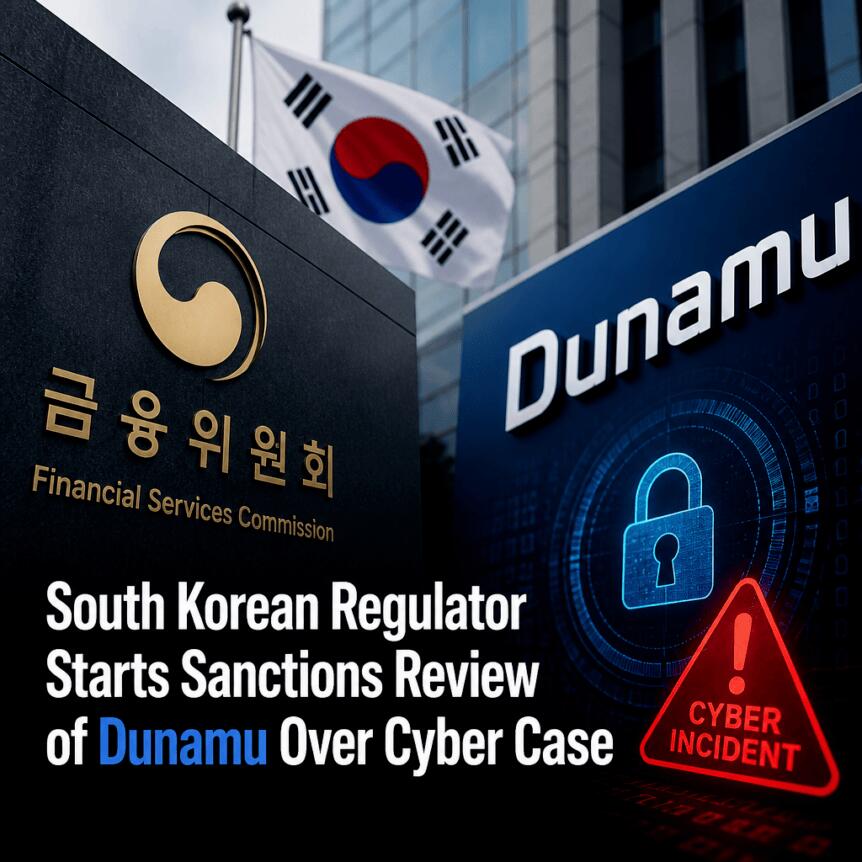
South Korea’s Financial Supervisory Service (FSS) has reportedly begun a formal sanctions process related to the November 2025 $36 million exploit on Upbit, the country’s major crypto exchange operated by Dunamu. According to Yonhap News, the regulator has sent Dunamu an inspection opinion letter following a review of the incident.
The letter effectively opens the next stage of enforcement. It also gives Dunamu an opportunity to respond to the inspection findings before the FSS moves to notify the company of any proposed sanctions.
Key takeaways
- The FSS has reportedly issued an inspection opinion letter to Dunamu, kicking off a sanctions procedure after Upbit’s November 2025 $36 million hack.
- Yonhap reported that regulators are assessing whether Upbit violated the Virtual Asset User Protection Act, even though the law reportedly lacks direct penalties for cyberattacks and computer hacks.
- Upbit previously said it reimbursed affected customers using its own balance sheet funds and froze certain assets after the breach.
- Authorities are also weighing changes to South Korea’s Digital Asset Basic Act to add sanctions and compensation provisions for hacking and system failures.
- Upbit said it upgraded its wallet infrastructure after the incident and later introduced an automatic onchain tracing service intended to support recovery efforts.
FSS inspection letter launches enforcement step
Yonhap News reported Sunday that the FSS recently sent Dunamu an inspection opinion letter connected to the $36 million exploit that affected Upbit in late November 2025. The report frames the letter as the formal start of a sanctions process, with Dunamu able to respond to the findings before the regulator issues details of any proposed penalties.
The FSS is assessing whether the exchange breached the Virtual Asset User Protection Act. However, Yonhap noted that the statute does not provide direct sanctions provisions specifically for cyberattacks or computer hacking incidents.
This creates a compliance pressure point for exchanges and operators in South Korea: even when losses originate from security failures outside traditional financial market conduct, regulators are still attempting to map the incident to existing consumer protection obligations.
Criticism focused on delayed disclosure
Yonhap said Upbit faced criticism for delaying its announcement of the $36 million hack. The breach reportedly lasted about 54 minutes, beginning at 4:42 a.m. KST on November 27, but Upbit did not publicly disclose the incident until the end of the day.
The timing of the public disclosure, according to Yonhap, coincided with a merger-related event involving Naver Financial, after which the exchange finally announced the exploit. The regulatory review described in the report suggests that disclosure timing—along with incident handling—may be a key part of the FSS’s evaluation under the user protection framework.
Cointelegraph said it approached Dunamu for comment on the matter. No further response is included in the provided text.
Regulatory gap and proposed legislative changes
Yonhap also reported that South Korean authorities are considering how to address the current legal gap. The outlet said officials plan to add sanctions and compensation provisions for hacking and computer system failures into the second phase of the Digital Asset Basic Act.
For market participants, the significance is practical: a clearer statutory basis could shift enforcement from interpretive reviews—such as whether a hack violates broader user-protection obligations—to direct, incident-specific penalties and compensation duties. In other words, the likely focus may expand from “did the operator comply with existing rules?” to “did the operator meet explicit standards designed for cyber incidents?”
Until those amendments take effect, operators may remain exposed to enforcement theories rooted in consumer protection and operational responsibility, even where the law lacks cyberattack-specific sanction language.
Upbit’s response: reimbursements, wallet overhaul, and tracing
Upbit’s public response to the November 2025 exploit emphasized customer reimbursement and infrastructure changes. In a statement released after the incident, the exchange said it froze roughly 2.3 billion won (about $1.5 million) worth of funds. Upbit also said it would fully reimburse affected customers using its own balance sheet assets.
Separately, Upbit said it initiated an overhaul of its crypto wallet architecture after the exploit and migrated all assets from the wallets implicated in the incident. The exchange’s stated objective was to reduce exposure to potential vulnerabilities that could allow similar attacks to succeed.
In December 2025, Upbit said it developed an automatic onchain tracking service called the Onchain AI Tracer System, intended to trace the path of stolen funds and support recovery efforts.
These operational updates matter in the regulator’s context because they may influence how authorities assess whether Upbit took adequate steps both immediately after the breach and in the subsequent months. Even when reimbursement addresses direct user losses, regulators may still consider whether changes demonstrate robust incident prevention, transparent communication, and effective post-incident controls.
Upbit also ranks among the larger spot crypto exchanges in South Korea and globally, according to CoinMarketCap’s exchange rankings, which use scoring that includes traffic, liquidity, and trading volume.
Going forward, the key development to watch is Dunamu’s response to the FSS inspection opinion letter, since it will shape what sanctions—if any—are ultimately proposed. At the same time, traders and users should monitor the legislative process around the Digital Asset Basic Act’s next phase, because any move toward explicit hacking-related sanctions and compensation could materially alter how compliance is judged after major security incidents.
With the latest Consumer Price Index data for June already out, all economic eyes have now turned to the United States Federal Reserve and the upcoming FOMC meeting scheduled for the end of July.
Although inflation has cooled, there are still those pushing for an interest rate hike during the next meeting. The question is: what could happen to BTC and its price stagnation if that’s the case?
Big Macro Test Ahead?
The odds declined over the past week or so after the June inflation data showed a substantial drop to 3.5%. While that might be more misleading than it sounds, given the fact that oil prices are up in July due to the ceasefire breakdown, data from CME FedWatch show that experts believe there’s an 85% probability that policymakers will leave rates unchanged. In contrast, the odds of a 25-basis-point increase stand at a more modest 15%.
Those odds shifted after the CPI announcement on Tuesday given the softer-than-expected reading, which reinforces the market’s expectation that the Fed will not pivot on its current strategy. Nevertheless, there are some who continue to sound increasingly hawkish, including new Fed Chair Kevin Warsh and Dallas Fed President Lorie Logan.
Higher interest rates have been seen as a roadblock for BTC and other risk-on assets, as investors tend to become more defensive. Higher borrowing costs strengthen the appeal of lower-risk investments such as Treasury securities, while reducing liquidity throughout financial markets.
The latest major example of bitcoin plunging following the Fed’s aggressive tightening cycle was in 2022/2023. However, today’s market differs from previous cycles.
Will BTC Indeed Crash?
A large portion of the market reaction would likely depend on whether a rate hike catches investors completely off guard. Markets overwhelmingly expect rates to remain unchanged; an unexpected 25- or, more threateningly, 50-basis-point hike could trigger a sharp sell-off across equities, cryptocurrencies, and other risk assets.
However, the longer-term picture offers a different perspective. If the central bank raised rates because the local economy was still resilient and inflation proved harder to beat, stronger economic activity could continue to support corporate earnings and institutional investment appetite. BTC has proven in the past that it can recover quickly from macro-driven shocks, particularly when long-term demand stays intact.
For now, the landscape appears quite fragile, even as markets anticipate no rate changes. However, inflation is still above the Fed’s target, and several policymakers have doubled down on more hawkish stances, which could lead to some wild price moves if the central bank surprises investors with a July hike.
The post What Happens to Bitcoin if the Fed Raises Rates in July? appeared first on CryptoPotato.
A severe Cyclospora parasite outbreak tied to supplier Taylor Farms hit Walmart and Taco Bell this week. Both companies moved fast, with Walmart issuing recalls and Taco Bell cutting menu items on Friday.
US health officials confirmed the contamination link late Thursday, tracing cases to shredded iceberg lettuce grown in central Mexico. Both stocks closed lower on Friday as the fallout spread across the food supply chain.
What Caused the Parasite Outbreak
Cyclospora is a microscopic parasite that causes cyclosporiasis, an intestinal illness known for prolonged watery diarrhea and fatigue.
The Centers for Disease Control and Prevention (CDC) traced the outbreak to shredded iceberg lettuce grown in central Mexico. Taylor Farms, one of the largest salad producers in the country, supplied the contaminated batches.
Investigators traced illnesses to Taco Bell locations across five states. Taylor Farms then said Friday it would remove all iceberg lettuce sourced from the region. Historically, food-safety scares fade within weeks; this one moved unusually fast.
The CDC has confirmed more than 1,600 cases nationwide, with thousands more reports under review. However, broader stock market sentiment across equities had already turned cautious after a string of earnings surprises this month.
How Walmart and Taco Bell Responded
Walmart (WMT) pulled four bagged salad products from shelves as a precaution. The retailer, however, reported no confirmed illnesses linked to its own products. Taco Bell removed the supplier’s lettuce entirely and cut several menu items while it verifies new sourcing.
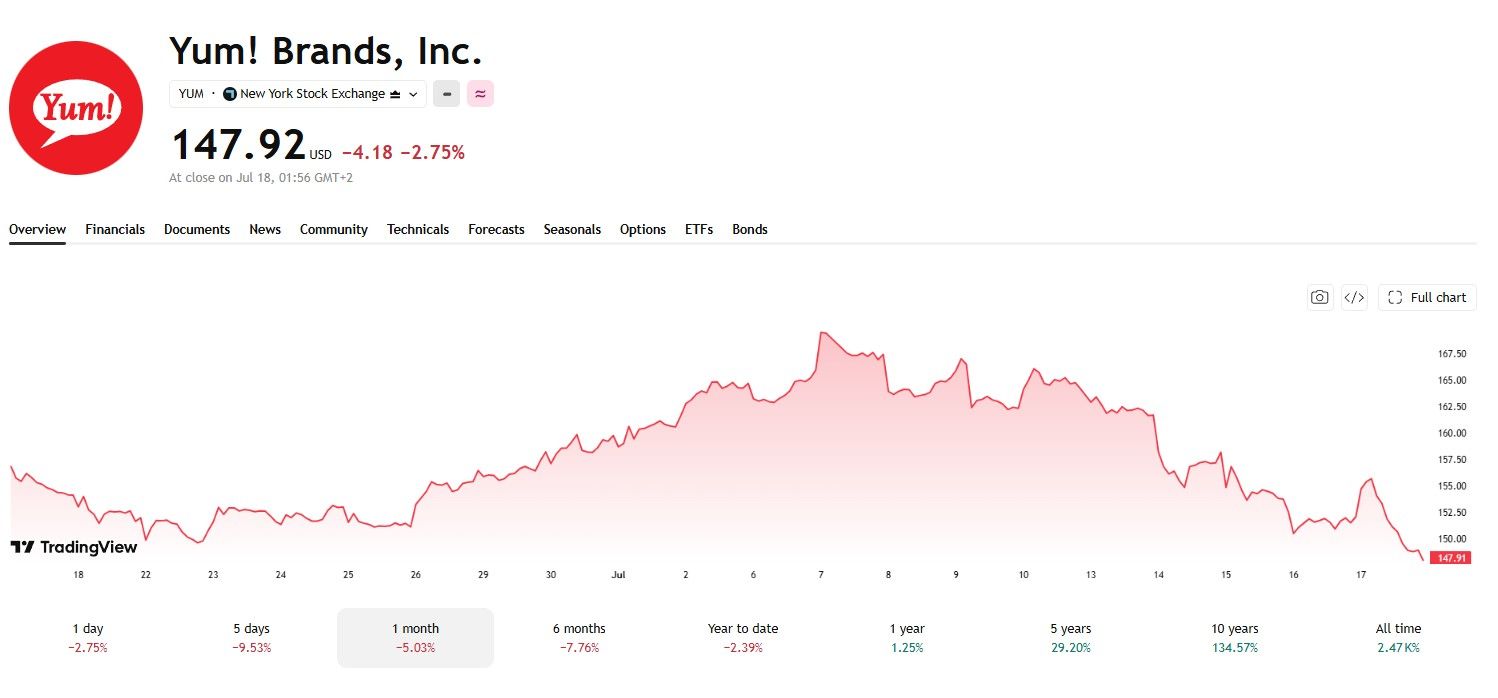
Yum Brands (YUM) shares fell 2.75% Friday to close at $147.92, and Walmart slipped 0.62% to $114.24. The reaction mirrors other sharp, single-stock swings this earnings season. Netflix shares sank after a third-quarter revenue guidance miss.
Meanwhile, Alphabet slid on a Gemini AI delay and a fresh EU order. In each case, one company-specific shock outweighed broader index calm.

Why Sweetgreen’s Rally Stands Out
Sweetgreen (SG) shares jumped 13.83% to close at $7.08. Regulators confirmed the chain does not use iceberg lettuce and was never part of the contaminated supply chain.
In contrast, Walmart and Yum Brands remain squarely inside the investigation’s scope. The stock had shed nearly 26% over the prior week as investors priced in guilt by association. That fear eased once a clearer picture emerged.

The swing recalls other abrupt reversals this year. SpaceX, for instance, saw a volatile Nasdaq-100 debut. Equity investors more broadly shifted toward record equity market exposure, even as bitcoin sat out the rally.
Sweetgreen’s next earnings report, due August 6, will show whether the relief rally reflects lasting confidence or a temporary reprieve.
Therefore, whether the sector’s swings prove temporary may depend on how quickly the Food and Drug Administration (FDA) closes its investigation. Meanwhile, investors will also watch whether other suppliers face scrutiny in the coming weeks.
The post Cyclospora Parasite Outbreak: Salad Recalls Trigger Sharp Stock Volatility appeared first on BeInCrypto.
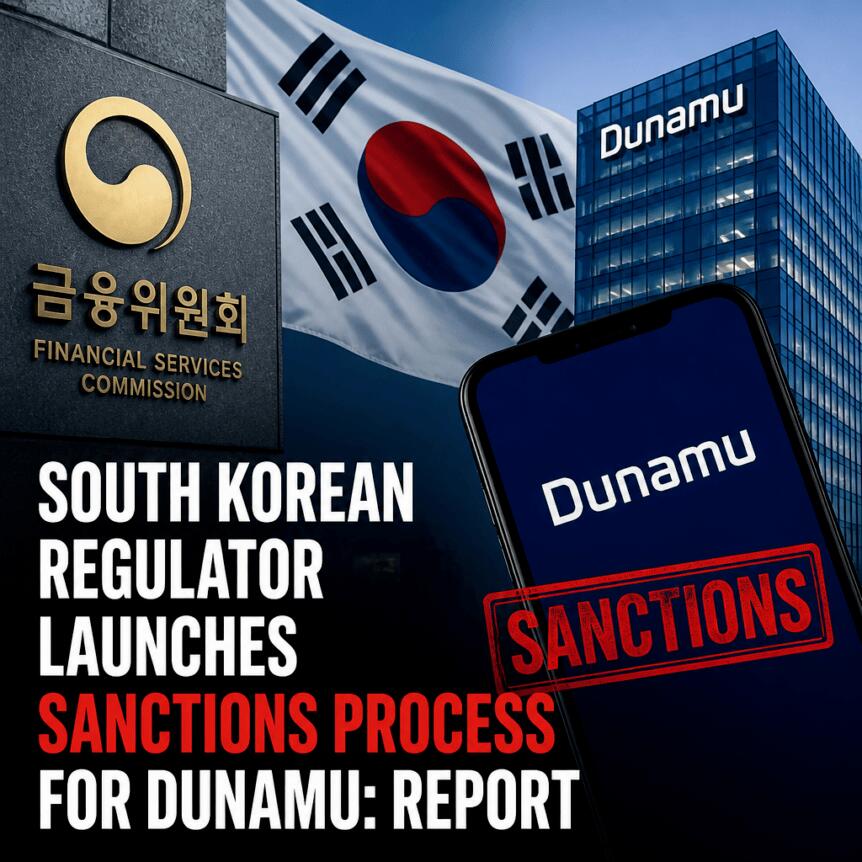
South Korea’s Financial Supervisory Service (FSS) has reportedly moved to formally examine whether crypto exchange operator Dunamu, the parent company behind Upbit, breached local rules after a $36 million hack last November. Yonhap News reported Sunday that the regulator recently sent Dunamu an inspection opinion letter—an early step that starts a sanctions process and gives the company a chance to respond to the FSS’s findings before any penalties are proposed.
At the center of the inquiry is a regulatory question about how existing South Korean law applies to cyber incidents. According to the same report, authorities are also looking at a potential legislative fix that would add clearer sanctions and compensation provisions for hacking and computer system failures.
Key takeaways
- The FSS has sent an inspection opinion letter to Dunamu, the operator of Upbit, marking the start of a formal sanctions procedure, per Yonhap News.
- Dunamu is expected to respond to the regulator’s inspection findings before any proposed sanctions are issued.
- The probe is tied to a $36 million exploit reported by Upbit in connection with a breach that lasted about 54 minutes on November 27, 2025, though the announcement came later that day.
- South Korean authorities are reviewing whether the incident violated the Virtual Asset User Protection Act, which currently lacks direct provisions for cyberattacks or computer hacks.
- The report indicates plans to address that legal gap in a second phase of the Digital Asset Basic Act by adding sanctions and compensation related to system failures.
Regulator signals sanctions after the November Upbit exploit
Yonhap News said the FSS recently sent Dunamu an inspection opinion letter following the November 2025 hack tied to Upbit. The letter effectively initiates the regulator’s step-by-step sanctions process, starting with a formal assessment and allowing the exchange operator to reply before the FSS notifies the company of any proposed penalties.
The development matters for market participants because it frames the incident not just as a security lapse, but as a compliance issue under South Korea’s financial oversight. When regulators move from incident response to sanctions procedures, it typically signals heightened scrutiny over both operational controls and communications practices around material events.
Timing of Upbit’s disclosure comes under scrutiny
Yonhap also highlighted criticism directed at Upbit regarding the timing of its public disclosure about the $36 million exploit. The report states that the breach began at 4:42 a.m. KST on November 27, 2025 and lasted roughly 54 minutes. However, Upbit did not announce the hack until the end of the day.
Yonhap attributed the delayed announcement to the conclusion of a merger-related event involving Naver Financial. That detail underscores the potential tension between corporate event calendars and the expectations regulators and users may have for timely disclosure after a major security incident.
Legal gap: current law lacks direct cyberattack sanctions
According to Yonhap, the FSS is reviewing whether the exchange violated the Virtual Asset User Protection Act. The report specifically notes that the act does not contain direct sanction provisions for cyberattacks or computer hacks.
This is a significant point for investors and compliance teams: if the law does not clearly address hacking events, regulators may have to rely on broader consumer protection obligations or other compliance standards to justify penalties. That can lead to uncertainty about outcomes—especially while case-specific interpretations develop.
Yonhap added that South Korean authorities intend to reduce this ambiguity by proposing additions for sanctions and compensation related to hacking and computer system failures in the second phase of the Digital Asset Basic Act. In practical terms, that suggests policymakers want future regulatory enforcement to be more direct and standardized when similar incidents occur.
Upbit’s response after the breach: reimbursement and wallet changes
Following the November exploit, Upbit said it froze approximately 2.3 billion won (about $1.5 million) worth of funds and would fully reimburse affected customers using its own balance sheet, according to a statement published on the exchange’s website. Upbit said it would reimburse impacted users rather than leaving them to absorb losses.
In addition to reimbursement, Upbit said it initiated an overhaul of its crypto wallet architecture to address potential vulnerabilities identified in the aftermath of the incident. The exchange also stated that it migrated all assets from wallets considered affected.
The operator’s efforts extended into onchain monitoring as well. In December 2025, Upbit said it developed an automatic onchain tracking service called Onchain AI Tracer System. The stated purpose was to follow the path of stolen funds and support potential recovery efforts.
For traders and users, these actions are relevant because they indicate how Upbit has approached both immediate risk containment and longer-term incident response. Yet regulators may still evaluate whether controls were sufficient before the breach, how the incident was managed during the window of compromise, and how promptly users were informed.
Separately, Upbit is described as ranking third in CoinMarketCap’s spot exchange rankings, based on a scoring system that includes factors such as traffic, liquidity, and trading volumes, according to CoinMarketCap’s exchange rankings page.
What to watch as the inspection and sanctions process unfolds
With the FSS inspection opinion letter now in place, the next key development will be how Dunamu responds to the regulator’s findings and what compliance arguments it presents around disclosure timing, incident handling, and the applicability of existing law. Observers should also watch the legislative track Yonhap described—if the second phase of the Digital Asset Basic Act adds cyber-focused sanctions and compensation provisions, it could materially change how future security incidents are regulated in South Korea.
Zcash founder Zooko Wilcox has explained how the network’s July 28 Ironwood hard fork will address uncertainty around a critical flaw in the Orchard shielded pool.
Summary
- Zcash will seal the old Orchard pool, limiting how much ZEC can leave after Ironwood.
- Ironwood cannot identify fake coins individually but can stop excess hidden supply from escaping Orchard.
- Temporary exchange and wallet disruptions may occur as providers prepare for Zcash’s July 28 upgrade.
The upgrade will not identify or freeze individual counterfeit coins. Instead, it will seal the old pool and limit how much ZEC can leave.
In a July 19 post on X, Wilcox explained how the planned upgrade would deal with any hidden excess supply if the flaw was exploited before developers patched it. Because Orchard hides transaction details, the network cannot prove that counterfeit ZEC was never created.
Ironwood will seal the vulnerable Orchard pool
Ironwood, also known as NU6.3, is scheduled to activate at block 3,428,143 on July 28. The upgrade will retire the current Orchard pool and introduce a new shielded pool based on the corrected circuit.
According to Zcash’s official Ironwood user update, users will no longer be able to send or receive ZEC inside the old Orchard pool after activation. Funds can leave only through the turnstile, which prevents more ZEC from exiting than legitimately entered.
The Zcash team said it believes the flaw was “unlikely to have been exploited,” but users cannot independently prove no counterfeit ZEC was created. Ironwood aims to trap any excess value inside the old pool rather than allow it to enter wider circulation.
Orchard bug left a supply question Zcash could not prove away
Security researcher Taylor Hornby discovered the Orchard flaw on May 29 while auditing the shielded system. The bug could have allowed an attacker to create counterfeit ZEC inside Orchard without leaving an obvious public record.
As reported by crypto.news, developers first disabled Orchard activity and then restored it through the NU6.2 hard fork with corrected cryptography. No evidence of unauthorized value creation was found, but Orchard’s privacy means past exploitation cannot be ruled out with complete certainty.
Crypto.news later reported that Ironwood would create a fresh shielded pool and use the turnstile to control value leaving the old one. Node operators can then verify that circulating ZEC does not exceed the amount permitted by the network’s monetary rules.
Wallets and exchanges may temporarily pause services
Zcash users do not need to take immediate action before the hard fork. However, wallets, exchanges and other providers may temporarily suspend deposits, withdrawals or related services while completing software upgrades.
The official network guidance says Orchard users will eventually need wallet support to move funds into the new pool. Funds may remain temporarily unavailable in wallets that have not added the required migration tools.
The July 28 activation also follows Zcash’s move away from the legacy zcashd client. Providers still completing that migration may need more time before fully supporting Ironwood.
Zcash adds more security checks after the flaw
The Orchard incident led to wider security work across the Zcash ecosystem. As reported by crypto.news, an AI-assisted review using Anthropic’s Mythos system found no additional serious vulnerabilities after the original flaw was disclosed.
Developers are also pursuing independent audits and formal verification for the updated cryptographic system. The work aims to reduce the risk of another hidden counterfeiting flaw and give users stronger ways to verify Zcash’s supply rules.
Ironwood addresses the unresolved supply question rather than the already-fixed bug itself. By sealing Orchard and controlling withdrawals through the turnstile, the hard fork aims to prevent any hypothetical counterfeit ZEC from entering circulation.
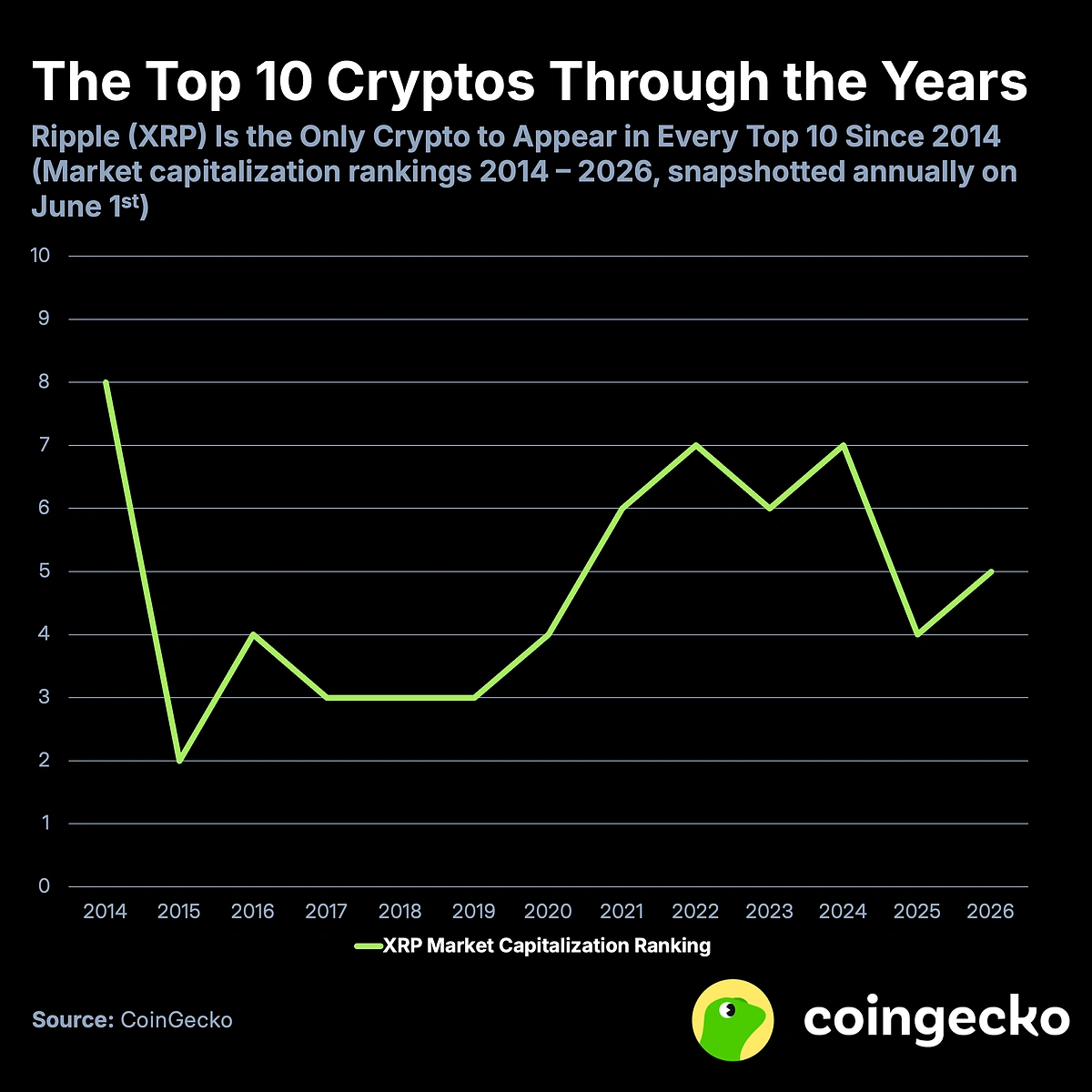
XRP just secured a record no other altcoin can claim, staying inside crypto’s top 10 by market cap every single year since 2014.
The streak spans more than a decade, from bull runs to brutal bear markets to a landmark legal battle against regulators.

The Only Altcoin Besides Bitcoin in the Top 10
A top 10 ranking measures the ten largest cryptocurrencies by market cap, the total value of all coins in circulation. XRP is the only asset besides Bitcoin to hold that position continuously since 2014.
The CoinGecko study, which excluded 2013 due to sparse data, frames the achievement in stark terms. Back in 2014, XRP ranked eighth, with a market cap of nearly $32 million, just 0.3% of the top 10’s combined market cap.
The token reached second place in 2015, right behind Bitcoin. It later held third across 2017, 2018, and 2019 before stablecoins and Layer-1 tokens reshaped the ranking.
The list of casualties makes the run even more impressive. Early giants like Litecoin, Dash, NEM, Namecoin, and Peercoin once filled the top 10 but eventually faded from view.
Follow us on X to get the latest news as it happens.

XRP, by contrast, refused to disappear entirely. It weathered every rotation of capital, narrative, and technology that pushed rivals out of the elite tier and into obscurity.
Ethereum offers a useful perspective on the feat. It has spent years in the top 10, yet its token only launched in 2015, leaving XRP alone alongside Bitcoin as a genuine 2014 survivor.
Why Does XRP’s Longevity Actually Matter
The resilience faced its harshest test between 2020 and 2023. The US Securities and Exchange Commission sued Ripple, the payments firm tied to XRP, triggering delistings across several major exchanges.
Even then, the token retained enough value to stay among the industry’s largest names. CoinGecko attributed that endurance to sustained institutional and cross-border payment demand across every market cycle.
The numbers show how far it has traveled since those early days. By 2025, XRP had reached fourth place with a market cap of nearly $127.9 billion, roughly 4.3% of the top tier.
Its trajectory mirrors both the explosive growth of crypto and its own ability to stay relevant as the industry matured around it year after year.

Legal commentator, Bill Morgan, called the record both a fact and an inconvenient truth for skeptics who still question XRP’s long-term relevance.
The achievement carries weight beyond bragging rights. Longevity signals durable demand, a quality that increasingly matters as institutions weigh which assets belong inside regulated financial products and long-term portfolios.
XRP currently trades near $1.10, holding its top-10 spot despite recent market volatility that briefly dragged the price to $1.05 before recovering.
Subscribe to our YouTube channel to watch leaders and journalists provide expert insights.
The post XRP Achieves a Milestone No Other Altcoin Has Ever Reached in Crypto History appeared first on BeInCrypto.
Circle President Heath Tarbert has defended the company’s long-term strategy after Circle shares fell sharply from their post-IPO peak.
Summary
- Circle says USDC’s scale and network effects remain difficult for new stablecoin competitors to replicate.
- Open USD adds pressure as Circle shares trade far below their post-IPO peak near $260.
- Circle keeps expanding regulated infrastructure while investors question competition, margins, and future stablecoin revenue sharing.
Speaking in a July 14 interview with FOX Business, Tarbert said management remains focused on building financial infrastructure rather than reacting to short-term moves in the stock.
The interview came as Circle faced growing investor concern over competition in the stablecoin market. CRCL had traded near $260 after its public debut before falling toward the low $60 range. Tarbert said Circle is “playing the long game” and argued that successful execution would eventually support shareholder value.
Tarbert points to USDC network effects
Tarbert said Circle’s main focus remains building a full-stack internet financial platform around USDC and related infrastructure. He argued that the company’s position cannot be measured only through daily stock movements and said the stock should “take care of itself” if Circle delivers on its wider mission.
He also defended USDC against new competitors. Tarbert pointed to roughly $73 billion in circulation and native support across 34 blockchains, saying those network effects would be “incredibly hard to replicate.” Circle describes USDC as a regulated digital dollar used across trading, payments and settlement.
Open USD adds new pressure to Circle
The comments came after Open Standard launched Open USD, a planned stablecoin backed by more than 140 participating businesses. The group includes Visa, Mastercard, Stripe, BlackRock, BNY and Coinbase. Open Standard says partners can mint and redeem Open USD without fees and receive reserve earnings after a management charge.
As reported by crypto.news, Circle shares fell 17.5% to $62.63 after Open USD entered the market and CRCL left several Russell Growth indexes. The decline added to concerns about whether new stablecoin models could pressure Circle’s economics.
Wall Street has also raised questions about that competition. Crypto.news reported that Mizuho cut its Circle price target to $50, arguing that Open USD’s revenue-sharing structure could pressure margins and raise distribution costs.
Circle faces pressure over USDC economics
Circle’s challenge extends beyond new stablecoin issuers.JPMorgan lowered earnings forecasts for Circle and Coinbase after a new revenue-sharing agreement tied to USDC balances on Hyperliquid. The bank said stronger adoption could come with lower reserve income retained by the companies.
Tarbert pushed back on the idea that competitors can quickly reproduce USDC’s reach. He also described USDC as the largest regulated stablecoin and said it leads in actual transaction volume, presenting scale and existing distribution as key parts of Circle’s competitive position.
Circle keeps expanding regulated infrastructure
Circle has continued adding regulated infrastructure despite the stock decline. On July 10, the company received final OCC approval to establish Circle National Trust. The trust bank will initially provide digital asset custody, with USDC reserve management planned as a possible future service.
As reported by crypto.news, the approval places the new entity under direct federal supervision. Circle says the structure could support wider institutional use of its digital asset infrastructure.
Tarbert’s comments frame the stock decline against a wider contest for stablecoin distribution and reserve income. Open USD brings a large group of payment and financial companies into the market, while Circle continues betting that USDC’s existing network and regulated infrastructure will support its long-term position.

American Airlines CEO lays out vision to close $3 billion profit gap

US Agencies Miss GENIUS Act Deadline for Final Stablecoin Rules

If history is indication, expect plenty of scoring in World Cup final


-
 NewsBeat3 days ago
London Mayor Sadiq Khan handed a peerage by Keir Starmer alongside 15 other Labour figures… just days before the PM leaves No10
-

 Fashion2 days ago
Weekend Open Thread – Corporette.com
-

 Politics1 day ago
The House | The City of London can help the new chancellor deliver growth in every postcode
-

 Politics4 days ago
Young campaigners urge incoming PM to act on outdoor junk food ads
-

 Crypto World4 days ago
CFTC blocks Kalshi from unwinding Michigan trades after court order
-

 Business3 days ago
Nvidia Stock Slips After Big Tuesday Rally as Huang Confirms Vera Rubin Chip Is Now in Production Today
-

 Crypto World1 day ago
Ripple Payments Joins MiCA With 14 Firms, Does It Mean Anything For XRP?
-
 Entertainment4 days ago
Disney’s Most Ambitious Failed Star Wars Attraction Is Coming to SDCC
-

 Crypto World2 days ago
Ripple wins EU-wide access as ESMA adds it to MiCA register
-

 Business3 days ago
Palantir Shares Rise After Expanded Nvidia Partnership and Fresh Analyst Upgrades Ahead of Earnings Day
-

 Crypto World3 days ago
Injective Submits SEC Transfer-Agent Registration to Onchain Ownership Records
-

 NewsBeat2 days ago
Registration is now open for March for Men with Kev 2026
-

 Tech5 days ago
Get Your ESP32 Sunny Side Up With This Solar Dev Board
-

 News Videos5 days ago
XRP BOMBSHELL… XRP OMBOARDED FOR TRANSACTIONS!!!
-
 Crypto World2 days ago
Two July Windows Left: The CLARITY Act’s Senate Fight and What Failure Means
-

 Tech5 days ago
Dark Secrets Emerge When Jailbreaking LLMs
-
 Sports4 days ago
New Cornerback Enters Vikings Trade Rumor Mill
-

 News Videos2 days ago
Money | Class 12 Economics | CBSE Board Exam 2026-27
-

 Business2 days ago
Banco Bilbao Vizcaya Argentaria, S.A. (BBVA) Discusses Global Macro Environment and Economic Outlook for Core Markets Transcript
-

 Crypto World3 days ago
Claude Fable 5 Slips to Second in AI Coding Leaderboard
You must be logged in to post a comment Login