
Crypto World
Russia Prepares Comprehensive Crypto Licensing Framework with Investment Caps


Key Highlights
- Russian lawmakers advance comprehensive digital asset legislation with stringent oversight mechanisms
- Retail investors face significant purchase restrictions while professional traders gain broader access
- Central bank receives authority to license and monitor cryptocurrency market operators
- Digital currencies granted property status while domestic transaction use remains prohibited
- New framework establishes investment thresholds and provides regulatory certainty for crypto participants
Russian legislators have progressed significant cryptocurrency legislation through its initial parliamentary stage, establishing a regulatory framework that incorporates licensing mandates, investment restrictions, and provisions for international transactions. The State Duma approved the draft legislation during its first reading, demonstrating the government’s commitment to establishing formal oversight of digital asset operations within a tightly controlled environment.
Regulatory Authorization Structure and Industry Participation
The proposed legislation establishes a comprehensive authorization system for cryptocurrency business operations under centralized regulatory control. The framework grants the Bank of Russia comprehensive powers to license and monitor all market participants. Consequently, trading platforms, brokerage firms, and custody service providers must satisfy rigorous regulatory criteria before commencing operations.
Russia established an accelerated authorization route for companies currently operating within its pilot regulatory sandbox program. Financial institutions and licensed brokers can access the cryptocurrency sector through this expedited mechanism. This strategy seeks to encourage broader industry involvement while preserving regulatory standards.
The legislation aims to eliminate unlicensed intermediaries through systematic enforcement and licensing protocols. Regulatory bodies will conduct ongoing compliance surveillance and apply sanctions for unauthorized operations. The system emphasizes transparency and responsibility throughout the cryptocurrency marketplace.
Investment Thresholds and Participant Classification
The bill implements a stratified framework that differentiates market participation based on investor qualifications. Retail participants encounter significant restrictions on cryptocurrency acquisitions under the proposed regulations. The current threshold limits purchases to 300,000 rubles, approximately equivalent to $3,900.
Russia permits qualified professional participants to conduct transactions without purchase limitations under the identical framework. This classification strategy attempts to reconcile market accessibility with protective risk management measures. Policymakers structured the system to minimize exposure for participants lacking extensive experience.
Authorities plan to ensure adherence through mandatory disclosure obligations and transaction surveillance infrastructure. These protocols guarantee that all participants function within established boundaries. Consequently, the framework encourages measured expansion while mitigating speculative hazards.
Asset Classification and International Transaction Provisions
The proposed legislation officially designates cryptocurrency as property under Russian law. This categorization provides legal safeguards in conflict resolution, insolvency proceedings, and property settlement matters. Digital assets receive explicit legal recognition within the financial infrastructure.
Domestic cryptocurrency usage for purchasing goods and services remains strictly forbidden under Russian law. The national currency maintains its exclusive status as legal tender throughout the territory. This limitation strengthens monetary policy control while constraining cryptocurrency’s function in routine commercial activities.
The legislation permits cryptocurrency utilization in international commerce under the new regulatory parameters. Businesses may execute cross-border settlements using digital assets subject to regulatory supervision. This authorization addresses external payment obstacles and facilitates international commercial activity.
Russia incorporated regulations governing cryptocurrency mining operations within its regulatory structure. Mining enterprises must utilize domestic facilities and comply with disclosure requirements. Accordingly, the nation seeks to formalize mining activities while retaining oversight of production operations and energy consumption.
The legislation requires subsequent approvals before enactment in Russia. Parliamentary members must complete second and third readings, followed by additional institutional examination. Upon approval, Russia intends to activate the framework effective July 1, 2026.




1. Mostbet ga ro‘yxatdan o‘tish: bosqichma‑bosqich
Mostbet uz kirish uchun avvalo ro‘yxatdan o‘tish kerak. Saytning asosiy sahifasida “Ro‘yxatdan o‘tish” tugmasini bosganingizda, sizga oddiy forma taqdim etiladi – ism‑familiyangiz, elektron pochta manzilingiz, telefon raqamingiz va parol.
Ma’lumotlarni kiritgandan so‘ng, tasdiqlash kodi SMS orqali keladi. Kodingizni kiritgandan keyin hisobingiz aktivlanadi va darhol kirish imkoniyati paydo bo‘ladi. Agar sizga qo‘shimcha yordam kerak bo‘lsa, mostbet uz sahifasida “Yordam” bo‘limiga murojaat qilishingiz mumkin.
2. Kirish va hisobga kirish usullari
Kirish jarayoni juda soddadir: foydalanuvchi nomi (yoki elektron pochta) va parolni kiritish kifoya. Ba’zi foydalanuvchilar mobil telefon orqali “SMS kod” bilan kirishni afzal ko‘rishadi, bu usul qo‘shimcha xavfsizlik qatlamini qo‘shadi.
Agar parolingizni unutgan bo‘lsangiz, “Parolni tiklash” tugmasini bosib, ro‘yxatdan o‘tgan telefon yoki email manziliga yuborilgan havolani kuzatib, yangi parol yaratishingiz mumkin. Kiritilgan ma’lumotlar har doim himoyalangan, SSL sertifikati orqali shifrlanadi.
3. Bonuslar va aksiyalar – boshlovchilar uchun foydali tavsiyalar
Mostbet uz kirish bilan birga, yangi foydalanuvchilarga “Welcome Bonus” taklif etiladi. Bu bonusning asosiy sharti – birinchi depozitni kamida 10 000 so‘m miqdorida amalga oshirish.
Bonusni olishdan oldin, “Wagering requirements” (bet o‘ynash talablari) ni diqqat bilan o‘rganing. Masalan, 5 x bonus miqdori talab qilinadi, ya’ni siz bonusni 5 marta o‘yinlarda qayta tiklashingiz kerak. Bu talabni bajarganingizdan so‘ng, nafaqat bonus, balki yutgan pul ham hisobga qo‘shiladi.
4. To‘lov usullari va pul yechish tezligi
Mostbet o‘z mijozlariga keng to‘lov tizimlari to‘plamini taklif etadi. O‘zbekiston foydalanuvchilari uchun qulay variantlar: Click, Payme, Uzcard, Visa/Mastercard.
Yechish jarayoni odatda 10‑30 daqiqada amalga oshadi, lekin bu tanlangan usulga qarab farq qiladi. Ba’zi usullarda kun oxirigacha to‘lovni kutish kerak bo‘lishi mumkin.
| Usul | Minimal depozit | Qayta ishlash vaqti | Komissiya |
|---|---|---|---|
| Click | 10 000 so‘m | 1‑5 daqiqa | Yo‘q |
| Payme | 5 000 so‘m | 3‑10 daqiqa | 0,5 % |
| Uzcard | 10 000 so‘m | 5‑15 daqiqa | Yo‘q |
| Visa/Mastercard | 20 000 so‘m | 10‑30 daqiqa | 1 % |
5. Mobil ilova va live casino tajribasi
Mostbet mobil ilovasi Android va iOS platformalarida mavjud. Ilova orqali siz nafaqat sportga, balki live casino o‘yinlariga ham real vaqt rejimida kirishingiz mumkin. Live dealerlar bilan o‘ynash, kartalar yoki rulet stollarida qatnashish, mobil qurilmangizdan ham professional darajadagi tajriba taqdim etadi.
Ilova interfeysi intuitiv, bir necha bosqichda depozit va pul yechish imkoniyatlari ham mavjud. Push-xabarlar orqali yangi bonuslar va turnirlar haqida xabar olish, foydalanuvchini doimo yangiliklardan habardor qiladi.
6. Mijozlarni qo‘llab‑quvvatlash va xavfsizlik
Mostbet uz kirish bilan bog‘liq savollarni 24/7 jonli chat, email va telefon orqali hal qilish mumkin. Mijozlarga xizmat ko‘rsatish jamoasi ko‘p tilli, shu jumladan o‘zbek tilida ham yordam beradi.
Xavfsizlik nuqtai nazaridan, sayt litsenziyali va regulatsiyalangan. Barcha foydalanuvchi ma’lumotlari shifrlanadi, KYC (Know Your Customer) protseduralari orqali firibgarlik va kimlik o‘g‘irlashga qarshi himoya amalga oshiriladi.
7. Qonunchilik, litsenziya va mas’uliyona gambling
Mostbet Curacao licensiyasiga ega bo‘lib, xalqaro standartlarga mos keladi. O‘zbekiston qonunchiligiga muvofiq, sayt faqat yoshi 18 yoshdan yuqori bo‘lgan foydalanuvchilar uchun mo‘ljallangan.
Mas’uliyona gambling bo‘limida o‘yinchilarga limitlar, o‘yin vaqtini nazorat qilish va o‘z hisobini o‘chirib tashlash imkoniyatlari beriladi. Bu, foydalanuvchilarni ortiqcha qimor o‘ynashdan saqlashga yordam beradi.
8. Tez-tez beriladigan savollar (FAQ)
- Mostbet uz kirish uchun minimal yosh qancha? 18 yoshdan katta bo‘lishi shart.
- Bonusni qanday olish mumkin? Birinchi depozitni amalga oshirganingizdan keyin avtomatik tarzda welcome bonus beriladi.
- Pul yechish uchun qancha vaqt kerak? Tanlangan to‘lov usuliga qarab 10‑30 daqiqada.
- Mobil ilova orqali o‘yin o‘ynash bepulmi? Ilova orqali o‘ynash bepul, lekin haqiqiy pul bilan o‘yinlar uchun depozit talab qilinadi.
Ushbu qo‘llanma “mostbet uz kirish” haqida barcha asosiy ma’lumotlarni qamrab oladi. Sizga muvaffaqiyatli o‘yinlar, foydali bonuslar va xavfsiz to‘lov operatsiyalari tilaymiz!


The U.K.’s Financial Conduct Authority (FCA) has carried out its first coordinated crackdown on illegal peer-to-peer crypto trading, targeting eight locations across London in a joint operation with His Majesty’s Revenue & Customs (HMRC) and the South West Regional Organised Crime Unit (SWROCU).
Officials issued cease-and-desist notices at each site and gathered evidence that is now feeding into several criminal investigations, according to the FCA.
The FCA stated that the sites were suspected of facilitating peer-to-peer (P2P) crypto trading, where individuals buy and sell crypto directly with one another, without the required registration or anti-money laundering controls.
Under U.K. law, anyone operating as a crypto exchange provider must register with the FCA. The regulator confirmed there are currently no registered peer-to-peer crypto traders or platforms in the country.
“Unregistered peer-to-peer crypto traders operating in the U.K. are doing so illegally and pose a financial crime risk,” said Steve Smart, the FCA’s executive director of enforcement and market oversight.
Law enforcement agencies framed the operation as part of efforts to cut off routes used to move illicit funds. DI Ross Flay of SWROCU said unregistered traders can enable criminals to “move, disguise and spend illegal money.”
The action builds on earlier enforcement steps. The FCA has prosecuted operators of illegal crypto ATMs for several years and worked with police to arrest individuals linked to an unregistered crypto exchange in 2024.
Last year, it also took action against offshore platform HTX over unlawful financial promotions and expanded oversight of social media figures promoting high-risk crypto products.
The crackdown comes as the UK prepares to roll out a broader regulatory regime for crypto by October 2027, with a licensing window expected to open in September 2026. The current framework focuses mainly on anti-money laundering compliance and financial promotions.
The FCA urged consumers to check whether firms are registered using its online register. It also warned that users dealing with unregistered P2P traders lack access to the Financial Ombudsman Service or compensation schemes and may face risks if transactions involve stolen funds.
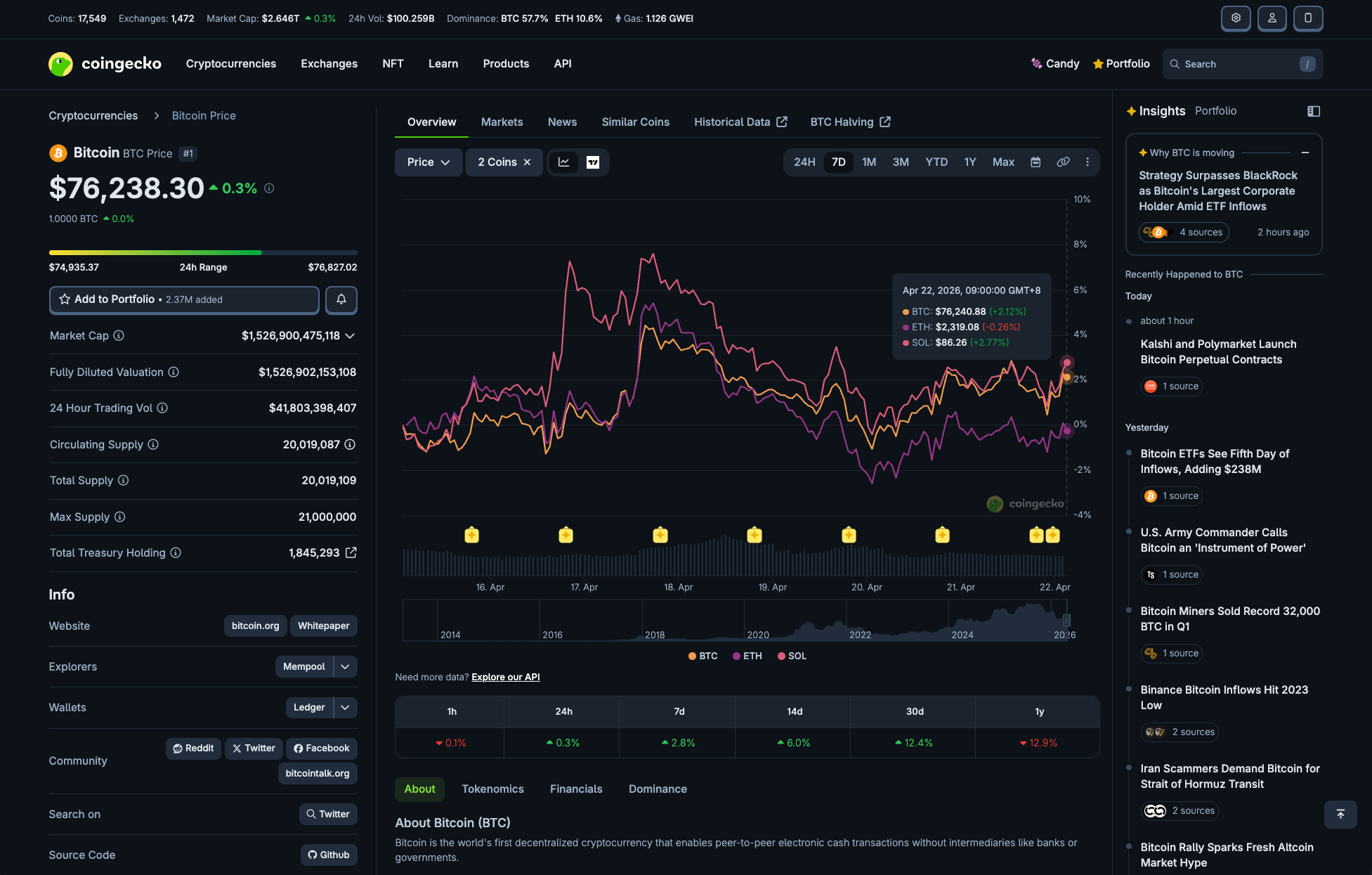
CoinGecko announced a major product expansion this week, adding market intelligence features and a unified Partner Platform to its crypto data aggregator.
The Singapore-based company said the update reflects a shift from pure price tracking toward contextual analysis for investors and growth infrastructure for Web3 projects.
AI-Powered Insights and Advanced Charting
CoinGecko’s new Market Insights feature aggregates signals from news and social media discussions, then uses AI-generated summaries to explain what is driving price movements across coins and categories.
The company also introduced Advanced Charts, which let users compare price movements across multiple cryptocurrencies in a single view.
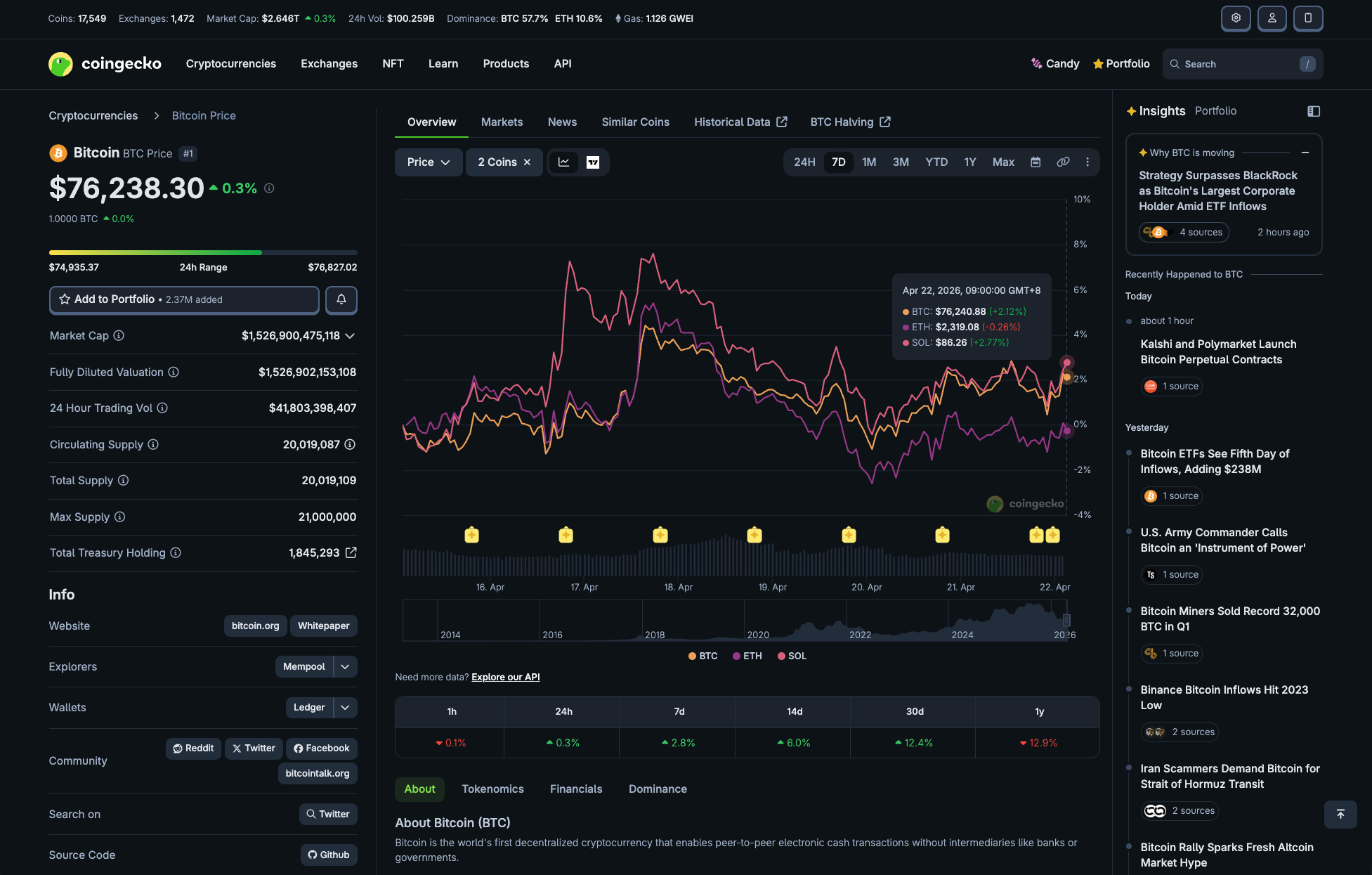
Charts are shareable and downloadable, giving investors tools previously limited to expensive terminals.
“Better data leads to better decisions, but today, data alone isn’t enough. Context is the missing layer, and that’s what we’re building,” read an excerpt in the announcement, citing Bobby Ong, co-founder and CEO of Coingecko, highlighting how the crypto market has outgrown basic data displays.
Follow us on X to get the latest news as it happens
The third consumer feature, Portfolio Insights, consolidates wallet tracking across EVM-compatible networks.
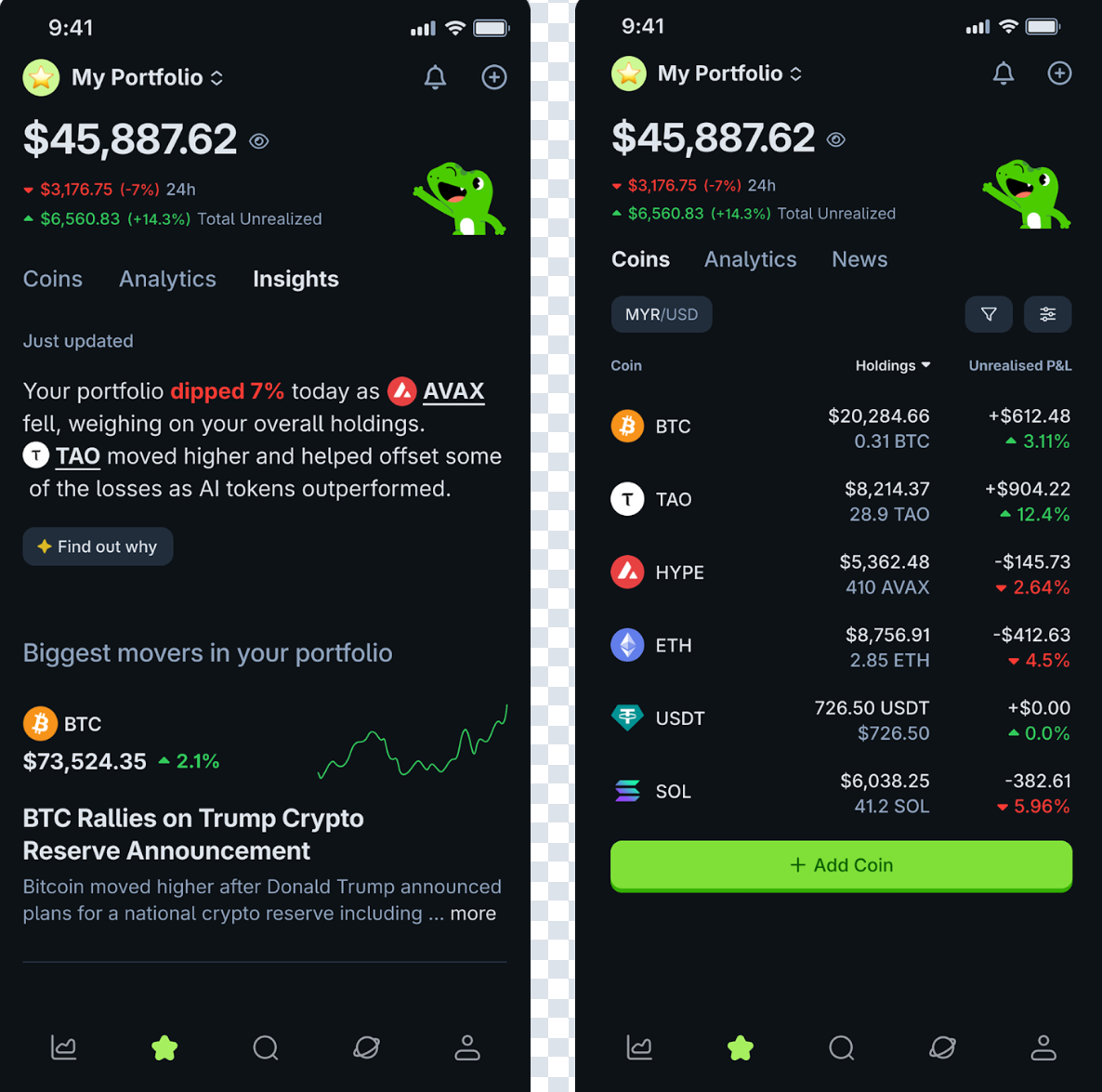
It shows profit-and-loss metrics and average buy prices, with AI-generated summaries that explain what is driving portfolio changes. Multichain support is expected in the coming months.
Partner Platform Targets Crypto Project Growth
For crypto projects, CoinGecko launched a Partner Platform that combines listing management, advertising campaigns, and performance tracking across both CoinGecko and GeckoTerminal.
The platform serves over 30 million monthly visitors and millions more on GeckoTerminal. Projects can submit listings, update token information, and use tools like Fast Pass to speed up time-to-listing.
CoinGecko plans to add deeper analytics, including pageview and watchlist data, in future updates.
The expansion follows a period of leadership restructuring and renewed product investment at CoinGecko.
With over 36 million tokens now tracked across hundreds of blockchains, the company is positioning itself as both a consumer intelligence layer and a distribution channel for the projects building on those networks.
The post CoinGecko Launches Market Intelligence Tools and Partner Platform appeared first on BeInCrypto.
Crypto World
BitMEX Launches the Trading Circuit Campaign Featuring a 100,000 USDT Weekly Prize Pool
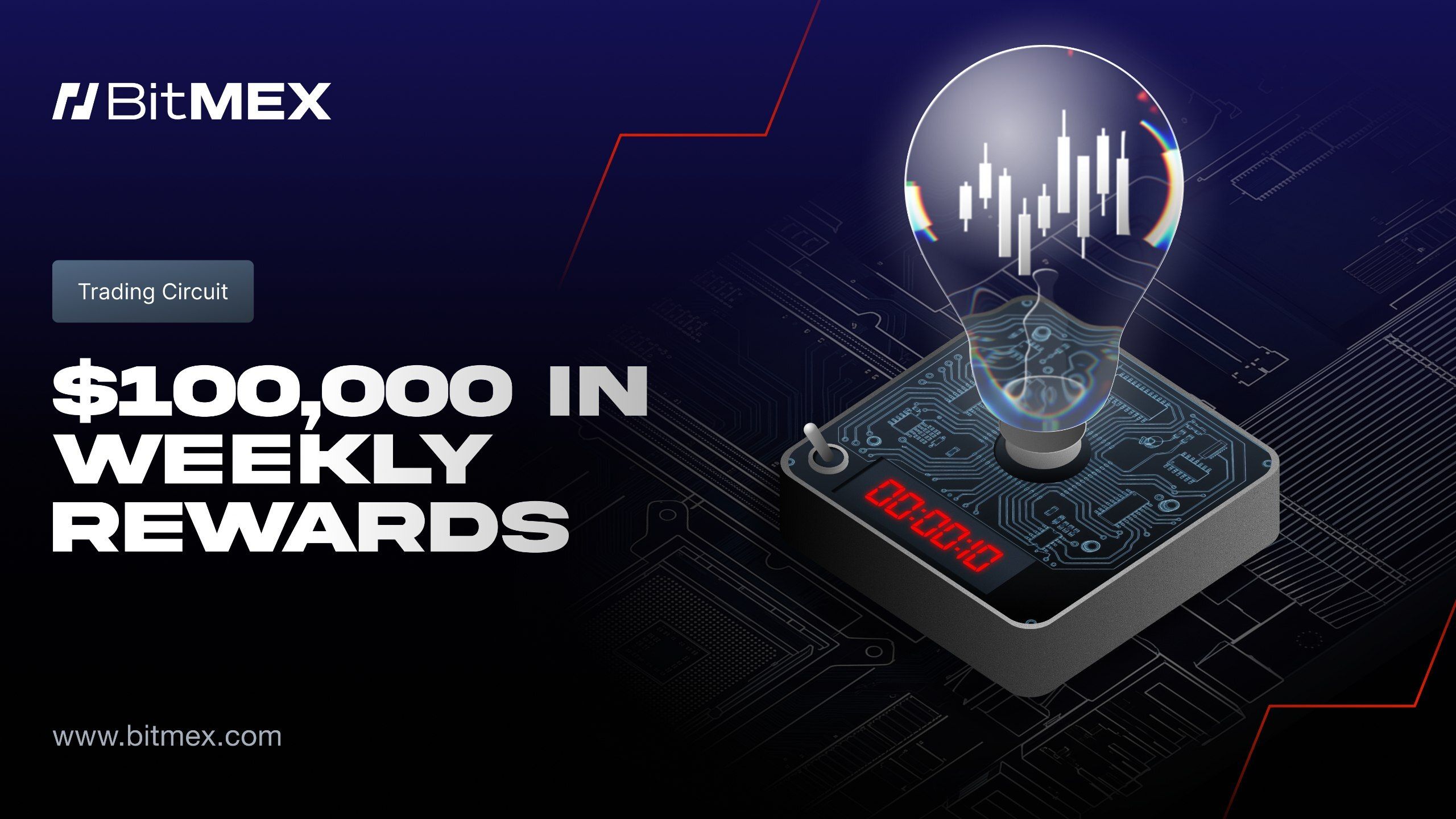
BitMEX, one of the safest crypto exchanges, announced today the launch of its Trading Circuit Campaign, allowing traders to win their share of a weekly 100,000 USDT prize pool by completing a series of trading missions.
The campaign will run from 22 April 2026 at 12:00 PM (UTC) to 13 May 2026 at 11:59 PM (UTC). Users can participate at any time during the campaign period.
Rewards will be distributed across 3 categories:
- The Running Start: All traders can claim up to $300 in rewards by reaching trading volume targets.
- The Top Traders’ Edge: By placing in the top 20 for trading volume on selected contracts, participants can claim up to $200 in rewards.
- The Sprinters’ Bonus: All participants who achieve at least two tiers for all three weeks of the campaign’s duration can claim an annual TradingView Plus subscription.
To participate in the Trading Circuit Campaign, traders must be fully verified on BitMEX. Competition details and registration can be found here.
About BitMEX
BitMEX is the OG crypto derivatives exchange, providing professional crypto traders with a platform that caters to their needs through low latency, deep crypto native liquidity and unmatched reliability.
Since its founding, no cryptocurrency has been lost through intrusion or hacking, allowing BitMEX users to trade safely in the knowledge that their funds are secure. So too that they have access to the products and tools they require to be profitable.
BitMEX was also one of the first exchanges to publish their on-chain Proof of Reserves and Proof of Liabilities data. The exchange continues to publish this data twice a week – proving assurance that they safely store and segregate the funds they are entrusted with.
For more information on BitMEX, please visit the BitMEX Blog or www.bitmex.com, and follow Telegram, Twitter, Discord, and its online communities. For further inquiries, please contact press@bitmex.com.
The post BitMEX Launches the Trading Circuit Campaign Featuring a 100,000 USDT Weekly Prize Pool appeared first on BeInCrypto.

- Justin Sun says WLFI froze 2.94 billion tokens and removed voting rights.
- Lawsuit filed after failed attempts to resolve the dispute privately.
- WLFI has introduced a Governance proposal that may lock tokens for non-consenting holders.
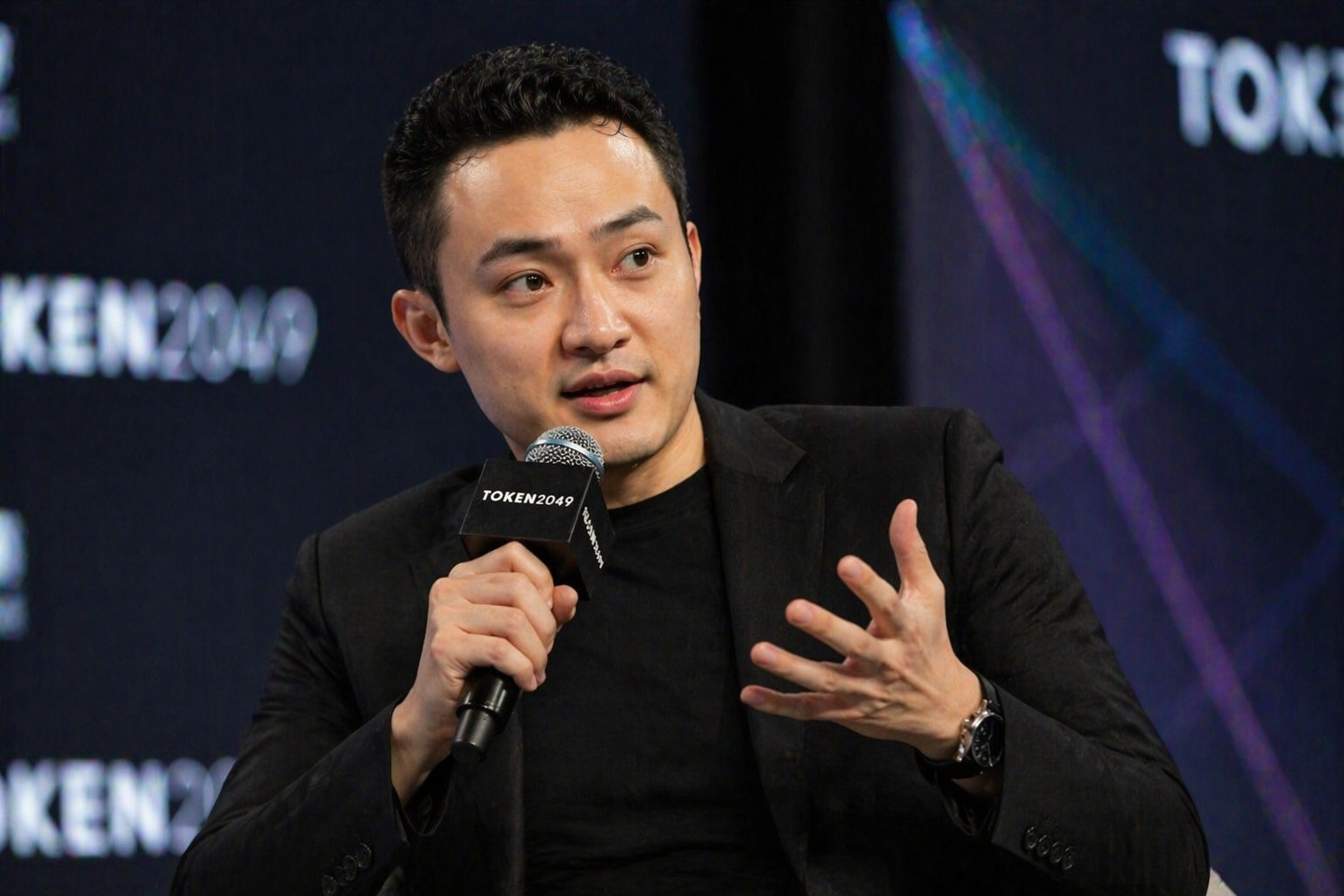
Justin Sun has filed a lawsuit in a California federal court against World Liberty Financial (WLFI), alleging that the project froze his holdings of 2.94 billion WLFI tokens and stripped him of key investor rights without justification.
The move escalates a growing dispute between one of crypto’s most recognisable entrepreneurs and a project that has positioned itself around decentralised governance and early-stage token distribution.
In his public statement, Sun confirmed that he is seeking legal protection of his rights as a WLFI token holder.
Sun also emphasised that the lawsuit does not change his political stance or his support for the Trump administration’s pro-crypto direction. According to him, the dispute is strictly about investor treatment and token governance, not politics.
Frozen tokens and removed voting rights
At the centre of the case is Sun’s claim that WLFI froze all 2.94 billion of his tokens (540 million of unlocked tokens and 2.4 billion locked tokens). He argues that this action made it impossible for him to transfer, sell, or otherwise use his holdings.
The value of the holdings has dropped from over $107 million at the September 2025, when they were frozen, to around $43–$60 million by April 2026.
Sun also alleges that WLFI removed his governance voting rights tied to those tokens. This means he was unable to participate in key decisions affecting the protocol, including recent governance changes introduced by the project team.
Sun further claims that WLFI went beyond freezing his position and threatened to permanently destroy part of his holdings through token “burning.”
According to his statement, these actions were taken without clear justification and without providing him a fair opportunity to respond.
He also says he attempted to resolve the issue privately with WLFI before taking legal action. However, he claims the project team refused to restore access to his tokens or reinstate his governance rights, leaving him with no option but to proceed to court.
Sun has described his position as straightforward: he wants to be treated the same as other early investors who received WLFI tokens, without special privileges and without restrictions that are not applied equally.
Justin Sun also disagrees with WLFI’s Governance proposal
The legal conflict comes alongside disagreement over a WLFI governance proposal released on April 15.
Sun has openly opposed the proposal, arguing that it introduces conditions that could lock users’ tokens indefinitely if they do not actively accept new terms.
The proposal reportedly includes a requirement for 10% of advisor tokens to be permanently burned. It also introduces a structure for early purchaser tokens involving a two-year cliff followed by a two-year vesting schedule.
Under the same framework, users who do not explicitly accept the new terms could have their tokens locked indefinitely.
Sun has raised concerns that this creates an uneven system where investor rights depend on active consent after the fact. He also pointed out a structural conflict in his own situation.
Because his tokens are currently frozen, he says he cannot vote either in favour of or against the proposal, despite being directly affected by it.
This has added another layer to the dispute, as governance participation is typically considered a core function in token-based systems.
World Liberty Financial (WLFI) position
WLFI has pushed back against Sun’s claims, arguing that token restrictions were applied due to internal concerns related to security and compliance.
The project maintains that its governance mechanisms include administrative controls that can be used to protect the platform and its participants.
The disagreement highlights a broader tension in crypto governance systems, particularly in projects that market themselves as decentralised while still retaining centralised control features such as token freezing or administrative overrides.
Sun’s lawsuit places the focus on whether such controls were properly disclosed and whether they can be applied to large early investors without clear procedural safeguards.
With 2.94 billion tokens at the centre of the dispute, the outcome could influence how governance authority and investor rights are interpreted in similar token-based ecosystems going forward.


Investors in the U.K. can once again hold cryptocurrency exchange-traded notes (ETNs) in a tax-free vehicle after fintech startup Stratiphy received approval to offer them in a special class of individual savings account (ISA), according to a report by the Financial Times on Wednesday.
Stratiphy, a fintech platform that allows users to personalize their investment strategies, is offering both crypto ETNs and Innovative Finance ISAs (IFISAs), the wrapper authorized to invest in them, the FT reported.
ISAs allow users to save up to 20,000 pounds ($27,000) a year without paying income tax or capital gains tax on the returns. The two most common types are cash ISAs, which pay interest, and stocks and shares ISAs, which invest in equities and exchange-traded instruments.
At the end of February, the U.K.’s tax authority, His Majesty’s Revenue and Customs (HMRC), classified crypto ETNs as instruments only available in IFISAs from the start of the current tax year on April 6.
This essentially made last year’s decision to lift the ban on retail users accessing crypto ETNs redundant because no mainstream investment platform offered IFISAs. The few that did had no plans to offer crypto products.
The decision drew criticism from some commentators, who said it risked making the U.K. an outlier among markets where exchange-traded products (ETPs) have made crypto investment available to a far broader base of retail investors.
Stratiphy will offer access to three ETNs provided by 21Shares: those covering bitcoin , ether (ETH) and one combining BTC and gold.
The London-based investment platform, which opened for business in August last year, manages 4 million pounds ($5.4 million) for 2,000 retail and corporate clients.
“We see a disproportionate level of interest in these [crypto] products,” CEO Daniel Gold said, according to the newspaper.
“It’s a really interesting way to diversify your portfolio. It’s a new asset class with low correlation to other asset classes.”
Stratiphy did not immediately respond to CoinDesk’s request for comment.
Crypto World
Crypto giant GSR launches its first ETF to give investors an easy way to bet on the big three
Crypto trading firm GSR has launched its first exchange-traded fund (ETF), entering a fast-growing segment of the digital asset market as investor demand for regulated crypto exposure continues to rise.
The GSR Crypto Core3 ETF, trading under the ticker BESO on Nasdaq, offers exposure to three major cryptocurrencies, including bitcoin , ether (ETH) and solana (SOL). The fund carries a 1% management fee and includes both active portfolio management and the ability to earn staking rewards on eligible assets.
The launch comes as crypto ETFs have gained traction with both retail and institutional investors seeking easier access to digital assets through traditional brokerage accounts. While most U.S.-listed crypto ETFs to date have focused on single assets, particularly bitcoin, some have moved to basket funds, similar to Core3, which bundles multiple tokens into a single product and adjusts allocations on a weekly basis.
GSR said the fund aims to reflect two main themes in crypto markets: bitcoin’s role as a macro asset and the growth of blockchain platforms such as Ethereum and Solana, which support applications like stablecoins and tokenized assets.
“The fund allocates actively across the three assets and rebalances weekly based on research-driven signals designed to pursue additional returns,” GSR said in a press release.
Framework Digital Advisors will serve as the fund’s investment adviser.
The move expands GSR’s business beyond trading and market making into asset management.
The firm has spent more than a decade providing liquidity and over-the-counter trading services in crypto markets and is now looking to package that expertise into investment products.
The ETF also introduces staking rewards, a feature not commonly available in traditional investment vehicles but one that has been added to some existing crypto ETFs, including the largest, BlackRock’s iShares Bitcoin Trust (IBIT). This feature the fund to generate yield from certain blockchain networks while holding assets.
“GSR has spent over a decade building efficient crypto markets, and with Core3, we are extending that expertise into a product accessible to a broader range of investors,” GSR CEO Xin Song said.
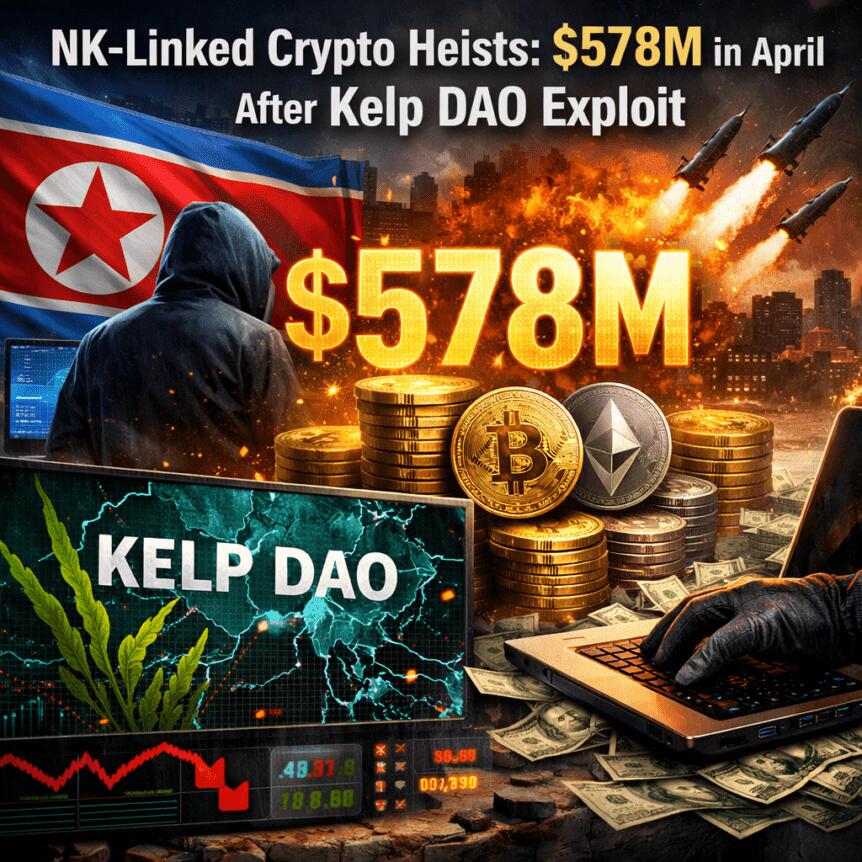
Kelp DAO’s $292 million breach on a Saturday emerged as the year’s largest crypto exploit, drawing attention to cross-chain security gaps and intensifying scrutiny of DPRK-linked cyber operations. Investigators point to LayerZero’s infrastructure as a factor, while researchers and industry players weigh the implications for DeFi security and governance models.
Kelp DAO has stated that the attack stemmed from weaknesses in LayerZero’s cross-chain messaging setup, specifically the use of a single verifier configuration to approve messages across chains. LayerZero, for its part, said preliminary indicators point to TraderTraitor, a subgroup of North Korea’s Lazarus Group, as the actor behind the breach. Independent researchers have traced stolen funds to Lazarus-linked activity, underscoring the persistent risk posed by the DPRK’s cyber operations to decentralized finance and users alike.
Key takeaways
- The Kelp DAO exploit is attributed to LayerZero’s cross-chain messaging framework and a single-verifier configuration, with initial attribution leaning toward TraderTraitor, a Lazarus Group subgroup.
- Arbitrum’s Security Council froze 30,766 ETH tied to the incident, illustrating a governance-driven move to curb losses even as it tests the bounds of decentralization and protocol sovereignty.
- North Korea-linked actors have escalated their DeFi-focused campaigns, with April’s Drift hack adding to a broader pattern that researchers say now totals hundreds of millions of dollars in attributed theft this spring.
- Retail crypto crime remains on the rise, according to the FBI’s IC3 2025 report, with losses and complaints spanning investment scams, fake job schemes, and social-engineering attacks tied to older and newer targets alike.
LayerZero, Kelp DAO and the cross-chain security debate
The Kelp DAO incident centers on how cross-chain messaging ecosystems—designed to move liquidity and data across networks—can become vectors for theft when misconfigurations align with attacker capabilities. Kelp DAO acknowledged that the breach exploited its reliance on LayerZero’s messaging framework, arguing that a single-verifier configuration enabled unauthorized cross-chain messages. LayerZero’s response framed the event as linked to the attacker cluster associated with Lazarus-linked figures, with initial signals pointing toward TraderTraitor, a subgroup identified by security researchers and industry observers.
The event surfaces a broader question: as DeFi protocols lean on sophisticated cross-chain infrastructures to unlock liquidity, how should governance and security balance between open, decentralized designs and the need for rapid, centralized interventions to prevent further harm? The Kelp episode also echoes earlier incidents where attackers leveraged infrastructure-level weaknesses rather than novel smart-contract bugs, highlighting how adversaries may increasingly target the supporting systems that enable cross-chain composability.
Independent researchers have noted that stolen funds from the Kelp breach appear to have mixed with earlier Lazarus-linked exploits, suggesting a pattern where DPRK-linked actors recycle and launder proceeds across wallets and chains. Such findings align with broader concerns that attacker ecosystems are becoming more coordinated and persistent, spanning multiple campaigns rather than isolated incidents.
North Korea’s evolving toolkit and the risk to the broader crypto ecosystem
The Kelp incident follows a string of high-profile DPRK-linked exploits in 2025 that have redirected attention to the group’s cyber espionage and fraud tactics. In April, the Drift protocol hack—an apparent North Korea-linked operation—accounted for roughly $285 million in losses, pushing the month’s attributed total to about $578 million across major incidents. Taken together with other incidents, analysts say these acts represent the most significant wave of DPRK crypto theft since the Bybit breach earlier in the year.
Security researchers and policy monitors have long warned that DPRK-backed actors blend traditional cyber-espionage playbooks with financially motivated operations. A recurring pattern involves recruiters and “IT worker” schemes designed to infiltrate legitimate tech and crypto companies, sometimes by posing as remote workers or contractors. This tactic, researchers note, funds the DPRK’s weapons-development programs, according to United Nations and other authorities cited in industry reporting.
U.S. authorities have responded with sanctions and public guidance. In March 2025, the U.S. Treasury sanctioned individuals and entities tied to North Korean IT worker fraud networks, while the FBI’s IC3 program issued guidance in mid-2025 urging employers to verify applicants’ professional histories and favor in-person verification where possible. Despite such measures, the Drift and Kelp breaches show that North Korean operatives are adapting—sometimes leveraging face-to-face interactions to build trust before initiating sophisticated cross-chain intrusions.
Beyond the headline hacks, smaller-scale incidents illustrate a broader leakage path into the retail space. For instance, Zerion reported DPRK-linked actors employing AI-assisted social engineering to steal modest sums, underscoring how crowding effects from larger hacks filter down to everyday users. The industry’s recurrent challenge remains immediate risk mitigation for users while authorities and firms continue to chase accountability for the perpetrators.
Governance, intervention and the ethics of freezing assets
One of the most consequential aspects of the Kelp episode was the Arbitrum Security Council’s decision to freeze 30,766 ETH implicated in the breach. The move—unprecedented in its explicit override of a blockchain state—has sparked a debate within the ecosystem about when, if ever, governance should intervene to preserve funds or protect users. Ledger’s chief technology officer Charles Guillemet described the outcome as “probably good, but not a comfortable one,” emphasizing that freezing the funds likely prevented further losses even as it exposed a difficult truth: decentralization does not always shield networks from governance actions in a crisis.
The Arbitrum decision, while preserving resources for affected users, illustrates the tension inherent in today’s rollup-based architectures. The governance mechanism exists by design to allow a trusted body to act when necessary, but it also challenges the ideal of credibly neutral infrastructure. In the Kelp case, the root cause was not a post-launch vulnerability in a single contract but a misconfiguration in cross-chain messaging that points to a broader risk: as ecosystems become more interconnected, the line between protocol weakness and systemic risk grows thinner.
Industry observers highlight that the Kelp incident reinforces a clear takeaway: attackers are increasingly probing the spaces between blockchains—bridges, relays, and validators—as much as they probe the individual protocols themselves. For builders, the imperative is not only to patch existing smart contracts but to harden the inter-chain fabric against cross-chain messaging failures, misconfigurations and governance overreach. For investors and users, the message is twofold: proceed with heightened caution around cross-chain liquidity, and demand transparent, timely disclosures when security incidents occur.
As these dynamics unfold, the broader market faces a persistent question: how to balance rapid recovery with principled governance? The Kelp and Drift cases provide a sobering test of whether the industry can coherently align incentives around safety, accountability, and the preservation of value when real-time decisions can alter the fate of funds that are already in motion.
Looking ahead, analysts expect continued attribution efforts and more formal investigations that could clarify whether TraderTraitor and other Lazarus-linked actors are systematically behind a wave of DeFi intrusions. Regulators may also intensify their focus on cross-chain security standards, while projects experiment with enhanced verification, multi-sig controls, and post-incident recovery playbooks to limit losses without compromising the decentralized ethos.
What to watch next: researchers will likely publish deeper analyses on LayerZero usage patterns and verifier configurations, while Arbitrum and LayerZero may roll out mitigations to reduce the likelihood of similar breaches. Stakeholders should monitor updates on governance policies, potential sanctions, and new best practices aimed at guarding users against both technical and social-engineering threats in a rapidly evolving threat landscape.
In the meantime, the fusion of infrastructure risk, state-sponsored threat activity, and governance mechanics offers a stark reminder: as DeFi grows more interconnected, securing the backbone—cross-chain messaging and related governance—will determine how quickly the sector can rebound from each major incident.
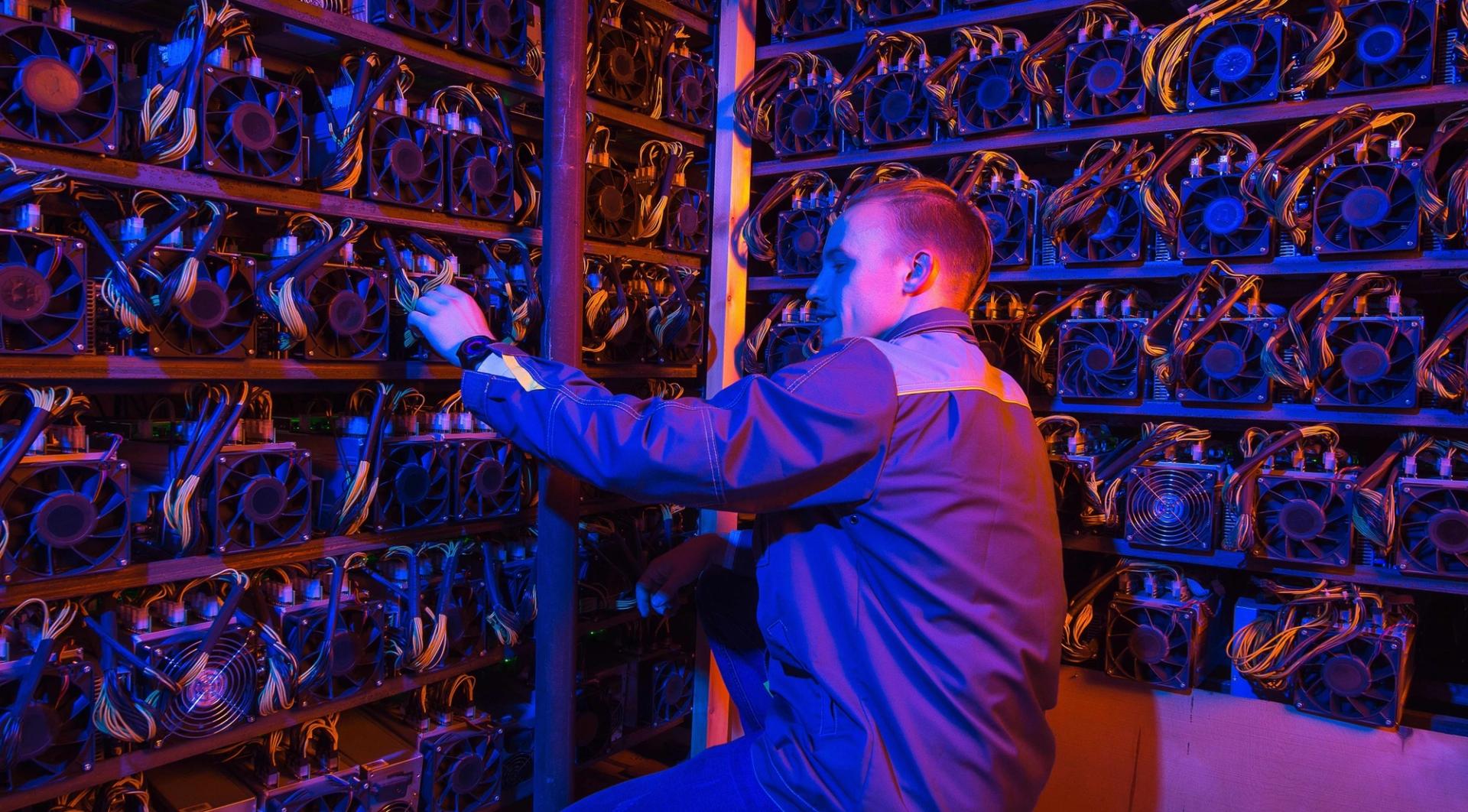
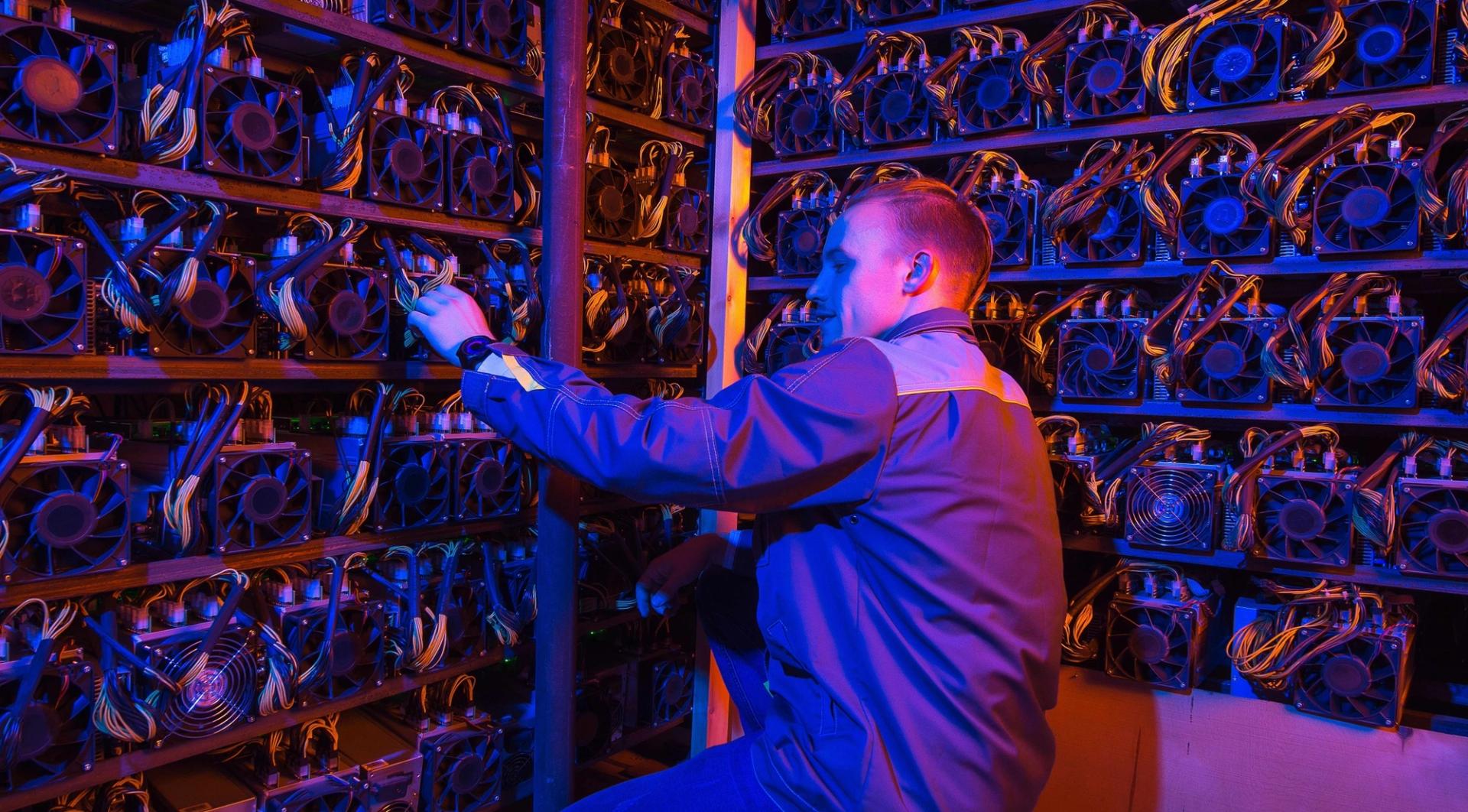
Mining firms HIVE Digital (HIVE) and Keel Infrastructure (KEEL) are doubling down on artificial intelligence (AI) infrastructure, which continues the theme of a broader shift across the sector away from bitcoin mining exclusively.
HIVE raised $115 million through a zero interest convertible note offering, with proceeds earmarked for expanding its global data center footprint and GPU capacity, according to an announcement on Wednesday.
The company has increasingly leaned into Tier III data centers across Canada, Sweden and Paraguay, positioning them for both bitcoin mining, AI and high-performance computing (HPC) workloads. The capital raise, paired with capped call protection to limit dilution, is aimed at accelerating that buildout.
Keel, meanwhile, is funding its transition by shrinking. The company completed the sale of its 70 MW Paraguay site for roughly $13 million, below initial expectations, citing deteriorating bitcoin mining economics. The move finalizes its exit from Latin America and follows its recent rebrand from Bitfarms to Keel Infrastructure.
“This is a clean exit from Latin America,” CEO Ben Gagnon said. “We are focused and committed to building the infrastructure backbone to support the AI economy in North America.”
Gagnon added that the proceeds effectively bring forward “two to three years” of expected cash flow, which will now be redeployed into Keel’s HPC and AI pipeline.
Shares of both companies have risen roughly 7%, following the announcements.
Crypto World
BTC Inc. Adds Lightning Network to Its BTCPay Server Infrastructure Ahead of Bitcoin 2026
Nashville, TN, USA — April 22, 2026 — BTC Inc., a Nakamoto Inc. (NASDAQ: NAKA) company, today announced the addition of Lightning Network payments to its existing BTCPay Server infrastructure, ahead of Bitcoin 2026 (April 27–29, The Venetian, Las Vegas). The expansion brings Lightning to conference ticketing, onsite point-of-sale, and e-commerce, and marks the first time BTC Inc. has been able to deploy Lightning consistently across all of its revenue streams under a single, unified payment stack.
Bitcoin 2026 serves as the first live deployment of the expanded infrastructure.
One Stack, Many Business Models
BTC Inc. operates across a diverse set of revenue streams — live events, media, e-commerce, vendor settlements, and treasury operations, each with distinct payment requirements. Previous Lightning integrations, while promising, proved difficult to scale across this complexity. What worked for one use case often couldn’t be adapted to another, leaving the company without a practical path to consistent Lightning adoption.
BTCPay Server’s open-source, plugin-based architecture changed that. Already running as BTC Inc.’s core payment infrastructure for over a year, it provided the flexibility to address each use case on its own terms — without requiring a separate solution for each one.
“We’ve tried to make Lightning work for us before, and the honest answer is that it was never straightforward,” said Di Lewis, CFO, BTC Inc. “The problem wasn’t Lightning itself, it was that we run a genuinely complex business. Events, ticketing, an online store, payroll, what worked for one never translated cleanly to another. BTCPay Server is the first infrastructure we’ve had that’s flexible enough to fit all of it. Extending Lightning to our conference ticketing was the last piece, and now it runs end-to-end across everything, Lightning stops being a side feature and starts being the foundation.”
“BTCPay Server has been running our payments for over a year,” said Brandon Green, CEO, BTC Inc. “What we’ve built gives us the foundation to keep expanding, and Lightning is the next layer. Free and open-source software isn’t optional for Bitcoin companies, it’s foundational.”
“BTCPay Server’s guiding principle is self-sovereignty. It is not just a headline, but a reality embedded deep in its technical design. As a result, developers and users are free to extend and use BTCPay Server in ways even we did not foresee, without needing our permission. We are thrilled to see companies like BTC Inc. lead as a prime example of that in practice!” – Nicolas Dorier, Founder, BTCPay Server
Lightning Across the Full Commerce Stack
With the addition of Lightning, BTC Inc.’s BTCPay Server infrastructure now supports instant, low-fee Bitcoin payments across three channels:
- Conference ticketing — Buyers can now complete ticket purchases at tickets.b.tc via on-chain Bitcoin or Lightning, through an integration of BTCPay Server, TicketSocket, and Strike, which provides the Lightning layer.
- Onsite point-of-sale — Lightning is live at food and beverage locations, the official merchandise store, and the bookstore across The Venetian conference floor. Attendees paying in Bitcoin can skip the line.
- E-commerce — The Lightning upgrade extends to BTC Inc.’s online store, creating a consistent payment experience across in-person and digital channels.
Building on an Established Foundation
BTC Inc. first deployed BTCPay Server at Bitcoin Asia 2024 in Hong Kong and has expanded its use at every subsequent conference. The January 2026 case study with BTCPay Server documented the results: over 5,600 in-person Bitcoin transactions, more than $1 million in vendor and staff payouts via the VendorPay plugin, and a Guinness World Record at Bitcoin Conference 2025 Las Vegas — 4,187 Lightning and NFC Bolt Card transactions processed in eight hours.
The addition of Lightning to ticketing and e-commerce extends that same infrastructure into channels where it had not previously operated. This is a significant step toward further retail adoption and support of the circular economy that Bitcoin promotes.
About BTC Inc.
BTC Inc. is the world’s leading Bitcoin media enterprise, operating Bitcoin Magazine, The Bitcoin Conference, and Bitcoin for Corporations. Through its media, events, and educational platforms, BTC Inc. delivers trusted news, research, and experiences that advance Bitcoin adoption among individuals, institutions, and enterprises worldwide.
BTC Inc. is a subsidiary of Nakamoto Inc. (NASDAQ: NAKA), a publicly held Bitcoin company that owns and operates a global portfolio of Bitcoin-native enterprises.

Ultimate Edition is out for the iPhone and iPad

Amanda Holden says ‘can’t get Chris back’ as she exposes husband’s ruthless move
All eyes on Raymond James earnings amid peer outperformance

Manchester United reach agreement with Casemiro over contract clause amid transfer speculation

Steven Gerrard disagrees with Gary Neville over ‘shock’ Chelsea and Arsenal claim | Football

US brings back mandatory military draft registration


-

 Fashion5 days ago
Weekend Open Thread: Theodora Dress
-

 Sports5 days ago
NWFL Suspends Two Players Over Post-Match Clash in Ado-Ekiti
-

 Politics5 days ago
Palestine barred from entering Canada for FIFA Congress
-
Entertainment3 days ago
NBA Analyst Charles Barkley Chimes in on Ice Spice McDonald’s Fiasco
-

 Business3 days ago
Powerball Result April 18, 2026: No Jackpot Winner in Powerball Draw: $75 Million Rolls Over
-

 Crypto World5 days ago
Russia Pushes Bill to Criminalize Unregistered Crypto Services
-

 Politics3 days ago
Zack Polanski demands ‘council homes not luxury flats for foreign investors’
-

 Tech4 days ago
Auto Enthusiast Scores Running Tesla Model 3 for Two Grand and Turns It Into Bare-Bones Go-Kart
-

 Politics2 days ago
Gary Stevenson delivers timely reminder to register to vote as deadline TODAY
-

 Tech7 days ago
‘Avatar: Aang, The Last Airbender’ Leaked Online. Some Fans Say Paramount Deserves the Fallout
-
 Business6 days ago
Creo Medical agree sale of its manufacturing operation
-

 Business5 hours ago
Rolls-Royce Voted UK’s Most Iconic Trade Mark as IPO Register Hits 150
-

 Crypto World5 days ago
Russia Introduces Bill To Criminalize Unregistered Crypto Services
-
Crypto World4 days ago
Kelp DAO rsETH Bridge Hack Drains $292M as DeFi Losses Top $600M in Two Weeks
-

 Sports6 days ago
British climbers complete new route in Swiss Alps
-

 Tech6 days ago
Ford EV and tech chief leaving automaker
-

 Sports6 days ago
“Felt Much Better Today”: Josh Hazlewood Opens Up On His Recovery Win Over LSG
-

 Entertainment7 days ago
Ruby Rose Accuses Katy Perry Of Sexual Assault, Police React
-

 Business6 days ago
Cheaper Doritos and Lays helps PepsiCo win back struggling snackers
-
 Entertainment6 days ago
Clavicular Says Streaming May Not Work Without Substances
You must be logged in to post a comment Login