

Crypto World
Saylor speaks as bitcoin plunges to $62,000



The panicky action got more so overnight, with bitcoin (BTC) careening to as low as $61,400 before quickly bouncing back to $64,000.
Ahead of the open of U.S. stocks, bitcoin is headed lower again, currently trading at $62,400, down 7% over the past 24 hours.
At the center of the plunge, Strategy Executive Chairman Michael Saylor has spoken. “Capital markets are funding the AI buildout at historic scale: ~$400B over 6 months,” Saylor posted to X minutes ago. “Bitcoin ETFs have seen ~$4B of outflows since May 14, pressuring BTC,” he continued.
“This is a capital rotation, not a Bitcoin impairment. Volatility creates opportunity,” Saylor concluded.
His comments echoed much of the conventional wisdom surrounding crypto’s general price struggles in recent months, which have become particularly acute this week after Strategy sold some of its bitcoin.
MSTR shares are lower 1.8% premarket.

Ripple’s native token has plunged alongside the rest of the crypto market, recording a steep drop in recent days.
This comes even as the company continues to expand globally and institutional interest in the asset remains solid.
Partnerships and More
Ripple has been inking strategic deals lately, and many have focused on its USD-pegged stablecoin, RLUSD. Earlier this week, the firm shook hands with the Turkish crypto platforms BiLira, Bitexen, and Bitlo, aiming to boost adoption and usage of the product.
Moreover, it partnered with Istanbul Technical University (ITU) through RLUSD funding to support research initiatives and graduate fellowships, and establish an on-campus XRPL validator.
Most recently, the global payments giant Mastercard enhanced its infrastructure to enable merchants and partners to settle transactions using various digital assets, including RLUSD.
Besides the collaborations related to the stablecoin, Ripple strengthened its presence in its homeland by opening an expanded office in Washington, D.C., thus reinforcing its “long-term commitment to constructive engagement with policymakers, regulators, and industry partners in the nation’s capital.” Speaking on the matter was Stuart Alderoty:
“Expanding our Washington, D.C. presence reflects our long-term commitment to constructive engagement, regulatory clarity, and U.S. leadership in financial innovation. As blockchain and digital assets become more integrated into the financial system, Ripple is committed to helping shape policy that protects consumers, supports responsible innovation, and keeps America competitive.”
The ETF Front
Unlike spot BTC and ETH exchange-traded funds, those with XRP as the underlying asset have attracted substantial capital lately. Data show that inflows have outpaced outflows over the past several weeks, indicating that institutional investors have increased their exposure to the token, thereby requiring the products’ issuers, including Bitwise, Canary Capital, Franklin Templeton, 21Shares, and Grayscale, to purchase real XRP.
However, June 3 finally ended the positive streak, as spot ETFs posted a daily net flow of -$5.34 million. Since their launch, these financial vehicles have generated a cumulative total net inflow of more than $1.42 billion.

XRP Price Outlook
Ripple’s cross-border token is down 10% for the week, and that shouldn’t come as a surprise. After all, the entire crypto market has been bleeding heavily, with Bitcoin (BTC) dropping to nearly $61,000 and Ethereum (ETH) tumbling to roughly $1,700.
Recent whale activity suggests the XRP bulls may suffer further pain in the near future. As CryptoPotato reported, these big investors have sold or redistributed 60 million tokens over the last seven days. Such an exodus could spark panic across the community and cause smaller players to cash out, too. Meanwhile, some analysts believe the price could slip under $1 in the short term.
The post Ripple News and XRP Price Update Today: June 4 appeared first on CryptoPotato.
Hyperliquid’s HYPE token, one of crypto’s best-performing assets this year, tumbled following its record run as longtime bull Arthur Hayes revealed he had sold his entire position just days after predicting much higher prices.
“I just dumped my entire HYPE and NEAR position,” Hayes, co-founder of BitMEX and chief investment officer at family office Maelstrom, wrote on X.
The selloff pulled HYPE back to $67 from record highs near $75, though the token remains up more than 70% since mid-May.
Hayes said the decision reflected growing caution about broader markets rather than a change in his view of Hyperliquid. He pointed to rising energy prices tied to the Iran conflict, several high-profile AI IPOs expected in the coming months and his belief that financial markets could peak between now and September.
“Time to take profit,” he wrote.”
The abrupt exit caused backlash in crypto circles because Hayes had been among Hyperliquid’s most vocal supporters. Just days earlier, he reiterated a $150 price target for HYPE and, in a March essay, laid out a roadmap for how the token could reach that level.
Arthur Cheong, founder of crypto investment firm DeFiance Capital, described the move as “the epitome of a guy that over-trades his position” in an X post.
Others questioned why investors continue to treat Hayes’ market calls as actionable signals.
Crypto trader TraderSZ, who has more than 683,000 followers on X, noted that Hayes had recently argued HYPE could be among the year’s best-performing assets before announcing the sale.
One of crypto’s biggest winners
Hyperliquid and its token, HYPE, have been standout performers over the past few weeks as the broader crypto market remained under pressure.
As bitcoin fell back to near its 2026 lows at $60,000, HYPE notched fresh all-time highs and remains up 166% year-to-date even with Thursday’s decline.
The project operates a blockchain-based onchain perpetual futures exchange, allowing users to trade cryptocurrencies and other assets through a transparent order book rather than relying on a centralized venue.
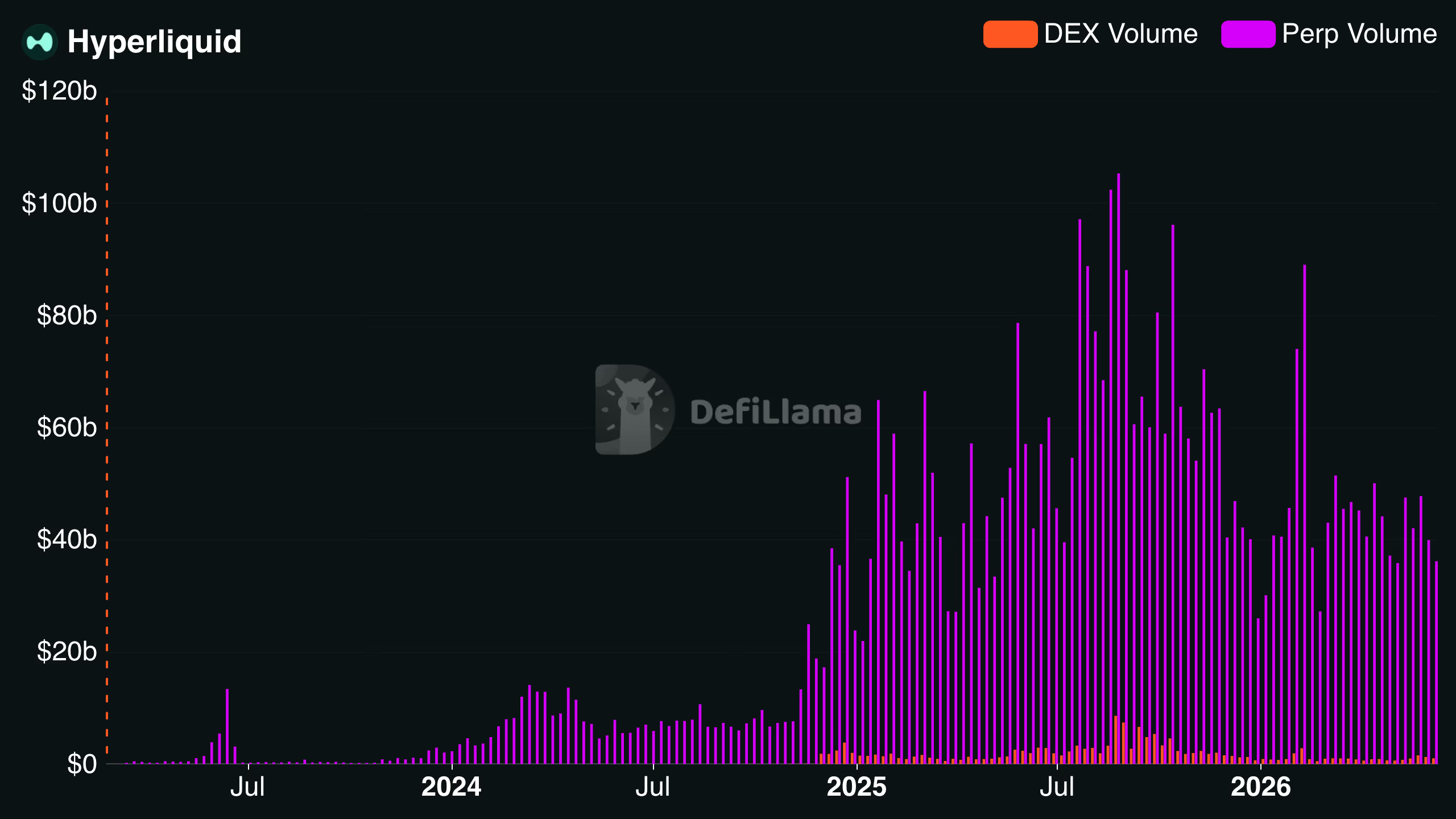
The platform has rapidly gained market share, clearing around $40 billion in weekly perp volume and $1 billion in spot assets, and has emerged as one of the closely monitored venues for weekend commodity prices and pre-IPO stocks.

HYPE rally got overheated
But the 100% gain in a month put the move overextended from the project’s fundamentals, noted Markus Thielen, founder of 10x Research.
In a report earlier this week, Thieled said Hyperliquid remained “one of the most impressive businesses in crypto,” citing its roughly 77% gross margins, fully onchain trading infrastructure and token buyback program funded by protocol revenue.
At recent highs near $75, HYPE traded at roughly 25 times projected fee revenue, near the richest levels seen over the past year, according to Thielen. Meanwhile, protocol revenue remains well below its peak, and a large token unlock scheduled for June could introduce additional selling pressure.
“We have been vocal HYPE bulls,” Thielen wrote. “But at current prices, the risk-reward has shifted.”
The long-term bull case is still compelling, he said. If trading activity recovers toward previous highs and new products attract more users, HYPE could eventually justify significantly higher prices.


Digital trading platform Moomoo said Thursday it had partnered with prediction market operator Kalshi to bring CFTC-regulated event contracts to eligible users, allowing them to trade on the outcomes of major economic, political and cultural events directly through the brokerage’s platform.
The offering gives users access to contracts linked to events such as Federal Reserve interest-rate decisions, inflation data releases, elections and the 2026 FIFA World Cup, the New York-based company said in a press release.
Event contracts are exchange-listed derivatives that allow traders to take positions on whether a specific outcome will occur. Prices range from $0.01 to $1 and represent the market’s implied probability of an event happening. The contracts are fully collateralized and integrated alongside Moomoo’s existing equities, options and exchange-traded fund (ETF) offerings.
Prediction markets have exploded in popularity since the 2024 U.S. election, evolving from a niche forecasting tool into a fast-growing corner of the retail trading market.
Platforms such as Kalshi and Polymarket have expanded beyond politics into sports, macroeconomic data and cultural events, attracting billions of dollars in trading volume. Combined monthly volume on the two largest platforms climbed from under $5 billion in September 2025 to about $24 billion by April 2026, underscoring growing investor appetite for event-driven markets.
“Our focus is on providing investors with both access and understanding,” Nate Palmer, president of Moomoo U.S., said in emailed comments. “Through event contracts and supporting educational resources, we’re giving users additional tools to analyze and engage with significant real-world events.
Kalshi, which has emerged as the dominant U.S. prediction market platform, said the partnership will broaden access to event-based trading.
The launch comes as interest in prediction markets continues to grow. By integrating Kalshi’s contracts, Moomoo joins a growing list of brokerages offering retail investors exposure to event-driven markets.
The partnership also expands Moomoo’s product ecosystem. The company recently introduced direct crypto deposits and withdrawals and launched moomoo API Skills, a feature designed to support AI-powered investing tools.
Read more: Gemini taps SpaceXAI to build a personalized prediction markets feed
In the 1990s, exchange-traded funds (ETFs) were a novel idea. Many saw them simply as a new wrapper for traditional assets – a convenient repackaging of mutual funds. In reality, ETFs triggered a market structure revolution. By introducing creation/redemption mechanisms and arbitrage-driven liquidity, ETFs fundamentally changed how markets functioned and how investors accessed assets. ETFs blurred the line between primary and secondary markets and turned arbitrage into the mechanism for holding the system together.
How does tokenization mirror the ETFs market structure revolution? In almost every key aspect.
A robust tokenized asset isn’t simply “issued” once like a stock or bond – it typically can be minted or burned on demand against some pool of underlying assets or rights. For example, when a token represents shares of a fund or stock, authorized participants (or smart contracts acting as such) should be able to deposit the underlying and mint new tokens or redeem tokens for the underlying assets.
If the token trades above the value of its underlying holdings, arbitrageurs will mint new tokens (injecting supply) until prices realign; if it trades below, they will redeem tokens (reducing supply) until the discount closes. The economic principle is identical to ETFs. The token is a wrapper on the same assets, and arbitrage keeps its price honest.
With respect to both ETFs and tokenization, the wrapper is simply a liquid representation of a basket of economic exposures. An ETF share is not the underlying securities themselves, but a standardized claim on a basket that trades efficiently because creation and redemption keep it aligned with the underlying assets. Tokenization follows the same logic. The token becomes the liquid instrument, while the underlying assets remain the economic anchor. What matters is not the form of the wrapper, but the strength of the arbitrage link between wrapper and basket.
ETFs already represented a major leap in transparency by making baskets of assets trade continuously on-exchange, with visible prices, intraday liquidity, and alignment with underlying value through arbitrage. Tokenization builds on this foundation. Where blockchains can go further is in making issuance, transfers and outstanding supply observable in near real time, potentially widening visibility into how the wrapper evolves relative to the underlying basket.
One of the most important features of tokenized markets is their ability to trade continuously, even when underlying markets are closed. For anyone who has traded ETFs globally, this is not new but a familiar and highly valuable market‑structure capability. Continuous trading outside local market hours allows prices to incorporate new information as it emerges, rather than waiting for the next open, and enables investors across time zones to transfer risk when they actually need to. These prices reflect informed expectations — built using correlated instruments, futures, FX, and broader market signals — in the same way international and cross‑timezone ETFs have operated for decades.
U.S.-listed ETFs that hold European or Asian equities already demonstrate how credible pricing can exist when the underlying cash market is closed. Those ETFs continue to trade during the U.S. session even after Europe or Asia has shut, and their market price naturally reflects updated expectations — based on futures, FX, ADRs, macro news and other correlated signals — rather than stale closing prints. In practice, authorized participants and market makers continuously estimate an “intrinsic fair value” for the ETF, including an expected next-open price for holdings in closed markets, and quote around that to keep the ETF’s market price anchored to that fair value.
The same concept can be applied to tokenized Apple stock, for example, which can trade on Saturday based on the evaluation of Apple’s likely next trading price come Monday. If big news broke on Saturday, you’d see the token react immediately. Liquidity providers would quote a price that factors in that news, likely hedging with any related instruments, such as Nasdaq futures, if available. By Monday’s open, Apple’s real stock price would likely catch up to wherever the token traded over the weekend. In effect, the token becomes a leading indicator for the underlying stock.
Market participants (especially across different time zones) don’t all operate on U.S. Eastern Time. A European investor holding a tokenized U.S. bond fund might love the ability to adjust positions at 8 p.m. CET on a Friday, rather than waiting until Monday. While providing liquidity 24/7 raises the “cost of carry” or the risk of holding a position when underlying markets are closed. In practice, this just means spreads might be a bit wider during purely off-hour trading, as they are, say, in currency markets on a holiday – but the key difference is that the digital asset market stays open. And as more participants join and risk management tools improve, these costs diminish. In the long run, a 24/7 market should become as natural as the 24/5 FX market is today.
The current tokenization dialogue closely resembles the early days of ETFs: initial skepticism, early traction in niche segments and increasing institutional involvement. That same pattern ultimately transformed ETFs into a $10+ trillion market.
I firmly believe tokenization is on the same path, because the structural forces pushing it forward are the same ones that made ETFs successful. The relevant test is not technological novelty, but whether it improves efficiency, access and system-level robustness. Where those conditions are met, tokenization is not merely comparable to the ETF evolution — it represents its logical continuation.

TLDR
- Travala launched an AI travel protocol enabling automated booking and payment execution across hotel listings.
- The system operates on Base Layer 2 and supports gasless USDC transactions with near-instant settlement.
- The protocol uses x402 standard to enable direct internet payments without manual checkout steps.
- AI concierge manages travel planning, bookings, and cancellations within a single chat interface.
- ERC-7715 session keys ensure secure transactions while users retain final wallet authorization.
Travala introduced an agentic AI travel protocol that enables automated booking, payments, and settlement across hotel properties. The system operates on Base Layer 2 and supports gasless USDC transactions for near-instant settlement. The company said the protocol allows software agents to complete travel workflows before final user authorization.
Travala Integrates Agentic AI with Base for Automated Bookings
Travala said the new Travel MCP protocol allows autonomous agents to search and reserve hotel listings without manual input. The system uses conversational AI to manage travel planning inside a single chat thread.
The company stated that the AI concierge can maintain context across bookings, cancellations, and itinerary updates. It operates through Claude while handling travel actions in sequence.
Travala confirmed that the protocol supports over 2.2 million properties across 230 countries on its platform. The system connects search, booking, and payment layers through one integrated interface.
The company explained that agentic workflows reduce friction across traditional booking processes. It added that automation removes multiple manual checkout steps for users.
Travala noted that the protocol uses ERC-7715 session keys to secure transaction requests. It said the system ensures that users retain final signing authority within their wallets.
Gasless USDC Payments and x402 Standard Power Settlement Layer
Travala said the protocol integrates the x402 open payments standard for direct internet-based transactions. The company explained that agents can complete payments without redirecting users to external checkout systems.
It stated that USDC transactions on Base execute without gas fees for end users. The firm added that settlement occurs almost instantly with costs near $0.01 per booking.
Travala said the infrastructure supports programmable payments for APIs, applications, and AI systems. It noted that this design enables continuous execution without interruption.
The company also introduced ERC-8004 as part of the protocol’s trust framework. It said the standard enables machine-verifiable tracking of performance and execution.
Travala confirmed that developers can build AI agents on the protocol and receive incentives. It stated that participants will receive a 10% rebate in cbBTC for integrations.
The firm said future updates will expand support to flights and other travel services. It added that the AVA token will continue to support its loyalty and rewards system.



Cardano’s ADA fell below $0.20 on June 4, 2026, its lowest price in more than five years. The token is down roughly 70% over the past year and more than 93% from its 2021 all-time high of $3.09.
Summary
- Cardano’s ADA fell below $0.20 for the first time in more than five years as selling pressure intensified across the crypto market.
- TapTools, a long-standing Cardano analytics platform, shut down after citing unsustainable operating conditions within the ecosystem.
- Cardano founder Charles Hoskinson warned of a potential “wave of failures” and criticized the community’s reluctance to deploy treasury funds to support projects.
The market-wide selloff that dragged Bitcoin under $62,000 explains part of it, but Cardano fell harder than its peers for reasons that are specific to Cardano.
A respected four-year-old ecosystem analytics firm, TapTools, shut down. Founder Charles Hoskinson posted an impassioned monologue warning of a coming “wave of failures” in the ecosystem.
The community voted against funding Cardano’s own flagship 2026 Summit, forcing its cancellation.
Network TVL has bled 36% in a month to around $186 million. And on June 3, Hoskinson tweeted four words that captured the mood: “I’m taking a break. TTYL.” This is not just a coin that fell with the market.
It is a coin whose own founder is openly warning that its ecosystem is in trouble. Here is what is actually happening, and what it means for what comes next.
What the price is doing
The headline number is stark. ADA broke below $0.20 on June 4, a level it had not touched in over five years, falling another 6 to 10% in 24 hours as the broader market sold off. The technical structure had already broken down days earlier, when ADA slipped under the critical $0.247 support level on June 2 and kept sliding.
Put the drawdown in context, because the scale is what matters. ADA is down around 70% over the past year. It is down roughly 77% from its early-2026 peak near $1.00. And it is down more than 93% from its all-time high of $3.09, set back in 2021. A holder who bought near the top has lost almost everything in percentage terms, and even a holder who bought at the start of 2026 is down more than three-quarters.
The next support levels traders are watching are thin. With $0.247 already gone and $0.22 breaking, analysts point to $0.18 and then the $0.162 area as the next zones if selling continues. On the upside, reclaiming $0.22 and then $0.247 would be the first signs of stabilization. But the deeper problem is that the price is now reflecting something beyond a market correction. It is reflecting a confidence crisis in the Cardano ecosystem itself.
Why Cardano fell harder than the market
Every major coin fell in early June. Cardano fell more, and the reasons are specific to it.
The first is a structural vulnerability that predates this week. ADA has a relatively small market cap and lower institutional liquidity than Bitcoin or Ethereum, which means it has higher beta to the downside. When Bitcoin sells off, ADA tends to fall harder, simply because there is less deep capital to cushion the drop. That is the baseline. But the baseline does not explain a five-year low while other large caps sit at one-year lows. The rest of the explanation is Cardano-specific, and it is about the ecosystem, not the chart.
The trigger that turned a bad week into a crisis was the shutdown of TapTools, a Cardano analytics firm that had been building on the network for four years. TapTools cited the economics of continued building, maintenance, and support as the reason it was ending.
For a respected, established project to simply give up after four years sent a signal far louder than its size would suggest: if a firm like this cannot make the economics work, who can? It crystallized a fear that had been building, that the Cardano ecosystem is not generating enough activity or revenue to sustain the businesses built on top of it.
Then the founder confirmed the fear out loud.
Hoskinson sounds the alarm
What separates this episode from an ordinary altcoin drawdown is that Cardano’s own founder publicly warned the ecosystem is failing.
In a video posted to his YouTube channel, Charles Hoskinson said the TapTools shutdown was likely not an isolated event. “This is where we’re at as an ecosystem,” he said, adding that he had predicted this at the start of the year. “I said at the beginning of the year, we’re going to see a lot of people collapse because the markets are really bad. There’s going to be a wave of failures in the ecosystem.” Coming from a project’s founder, that is an extraordinary thing to say in public. Founders typically project confidence during downturns. Hoskinson did the opposite, naming the problem directly.
His frustration centered on funding. Hoskinson said he had spent months, even years, outlining steps the ecosystem needed to take to prevent exactly this kind of collapse, including efforts to purchase and commercialize applications. But he claimed those efforts met resistance, particularly around spending the Cardano Foundation’s ADA treasury to support the ecosystem’s decentralized applications. “There doesn’t seem to be a lot of community desire to spend the treasury to take these ventures to the next level,” he said. In other words, Cardano has a treasury that could fund its way through the downturn, and the community has been voting not to use it.
That tension became concrete days earlier when the Cardano community voted against funding the network’s flagship 2026 Summit, the annual conference, which had been planned for Singapore. The vote forced organizers to cancel the event. A blockchain ecosystem canceling its own marquee conference because the community would not approve the spending is the kind of symbolic blow that compounds a confidence crisis. It tells builders, investors, and partners that the ecosystem is pulling back instead of pushing forward.
Then, on June 3, Hoskinson posted a four-word message to X: “I’m taking a break. TTYL.” The founder stepping away, however briefly, in the middle of the worst stretch the ecosystem has faced sent ADA down a further 10% and left the community without its most visible leader at the moment it most needed direction.
The governance problem underneath
Strip away the price action and the week’s events point to a deeper, structural issue: a governance and funding deadlock.
Cardano is unusual among major blockchains in how seriously it takes on-chain governance and community voting. That is, in principle, a strength, the kind of decentralized decision-making the whole industry claims to want. But this week exposed the downside. The same governance system that gives the community control over the treasury has produced a stalemate, where the community keeps voting against deploying treasury funds even as the founder warns that not deploying them is killing the ecosystem.
This is a genuine philosophical conflict, not just a funding shortfall. One camp wants to spend the treasury aggressively to subsidize developers, acquire applications, and keep the ecosystem alive through the downturn. Another camp is wary of spending down a treasury denominated in a falling asset, worried that it amounts to throwing good money after bad, or that it concentrates too much direction in the foundation and the founder. Both positions are defensible. The result of the deadlock, however, is that Cardano is entering a severe downturn with a large treasury it is choosing not to use, while the businesses built on it shut down one by one.
Hoskinson’s own framing is telling. He argued that Cardano is not losing builders because of its technology or its philosophy, but because economic conditions are making it hard for businesses to remain viable. Whether or not you accept that, it points at the central question for what comes next: can Cardano resolve its internal funding fight fast enough to stop the wave of failures its founder is warning about?
What the bulls still point to
For all the bad news, there is a counter-case, and it is worth laying out honestly rather than dismissing.
The technology argument is the durable one. Cardano has always been built on formal academic peer review, with every protocol upgrade reviewed before deployment. That philosophy has drawn persistent criticism for slow delivery, but it has also produced a chain that its supporters consider unusually well-tested and methodical. The bulls argue that the technical foundation is intact and that the current crisis is about economics and sentiment, not about the chain being broken. Hoskinson made exactly this point: the network is not losing builders over technology.
The roadmap still has catalysts. Cardano’s bulls point to Midnight, a privacy-focused project Hoskinson has said could boost network TVL after launch, along with continued development of the Hydra layer-2 scaling solution. The longer-term price scenarios that analysts sketch, in the $0.45 to $0.55 range, generally require some combination of Midnight adoption, Hydra momentum, and potential ETF traction converging at once. None of that is happening right now, but it is the bull thesis for why ADA is not a permanent zero.
There are also faint on-chain positives buried in the wreckage. Earlier in the decline, some data showed whale accumulation and positive funding rates, and technical analysts flagged ADA as deeply oversold, the kind of condition that can precede a relief bounce. The honest caveat is that “oversold” has been true for much of the slide and has not stopped it, and whale accumulation during a fall can just as easily be early buyers who are now underwater. Oversold is not the same as bottomed.
What’s next
The realistic outlook for Cardano splits into a near-term path and a structural question, and they are not the same.
In the near term, ADA’s price is largely hostage to two things it does not control: the broader crypto market and Bitcoin specifically. As long as Bitcoin keeps sliding and the market sits in extreme fear, ADA’s higher beta means it will likely keep falling harder than the majors, with $0.18 and $0.162 as the next downside zones. A market-wide stabilization or bounce would lift ADA mechanically, regardless of its internal problems. So in the short run, watching Bitcoin tells you more about ADA’s price than watching Cardano does.
The structural question is the one that determines whether Cardano recovers as an ecosystem or slowly hollows out. It comes down to whether the governance deadlock breaks. If the community shifts toward deploying the treasury to support builders, if the wave of failures Hoskinson warned about turns out to be a handful rather than a flood, and if a catalyst like Midnight delivers real activity, then the current five-year low could mark a capitulation bottom for a chain that survives and rebuilds. If the deadlock holds, if more firms follow TapTools out the door, and if the founder’s “break” turns into prolonged disengagement, then the price is reflecting something real and durable: an ecosystem contracting, not just a token in a market downturn.
The thing to watch, more than the price, is the ecosystem health. Specifically: whether more established Cardano projects announce shutdowns in the coming weeks, whether the community holds any new treasury-spending votes and how they go, and whether Hoskinson returns engaged and with a concrete plan or stays on the sidelines. Those signals will tell you whether this is a painful bottom or the start of a longer decline. Right now, the uncomfortable truth is that Cardano’s founder has told you which one he fears, and the market is listening to him. A five-year low is not, by itself, a reason to panic or to buy.
The question that matters is whether Cardano can use the resources it has to stop the bleeding its own founder is warning about, and that question has not been answered yet.
This article is for informational purposes and does not constitute financial or investment advice. Cryptocurrency markets are highly volatile. The figures and analysis described reflect data available as of June 4, 2026. Always do your own research and consult with qualified financial professionals before making investment decisions.


Hyperliquid’s native token, HYPE, dropped below $70 on Thursday after delivering an 80% gain in May. The dip comes amid renewed weakness across the broader cryptocurrency market, where Bitcoin (BTC) slipped below $63,000 and sparked a wave of risk-off sentiment among investors.
A key catalyst behind HYPE’s recent surge has been rising institutional participation. Newly launched HYPE-focused exchange-traded funds (ETFs) attracted roughly $135 million in inflows last month, highlighting growing demand from professional investors and helping drive the token into price discovery territory.
While momentum remains firmly bullish, analysts caution that the rally has become increasingly stretched, even as long-term projections point toward a potential move above the $100 mark.
Capital rotates from Bitcoin ETFs to Hyperliquid products
Institutional flows reveal a stark contrast between Bitcoin and Hyperliquid investment products.
Bitcoin ETFs recorded $396.6 million in net outflows on Wednesday, extending cumulative withdrawals to $4.37 billion over the past 13 trading days. The trend suggests waning institutional appetite for the world’s largest cryptocurrency amid broader market uncertainty.
By comparison, HYPE-focused ETFs attracted $2.99 million in inflows on Wednesday, marking their 15th consecutive day of positive flows and bringing total inflows to approximately $140 million.
The data points to a broader rotation of capital toward exchange-related tokens, as investors increasingly focus on platforms generating tangible revenue and expanding their product ecosystems.
Further reinforcing this trend is the launch of Grayscale’s HYPE-focused ETF on Thursday, a development widely viewed as another sign of growing institutional confidence in the Hyperliquid ecosystem.
Hyperliquid’s growth story extends beyond ETF demand. According to Hyperscreener data, the platform’s HIP-3 protocol—which enables 24/7 trading of tokenized real-world assets (RWAs), including publicly listed stocks, pre-IPO shares, and commodity perpetual futures—generated $62.63 billion in trading volume during May.
The milestone marks the third consecutive month in which HIP-3 volume exceeded $60 billion, underscoring the platform’s expanding role as an “everything exchange” serving multiple asset classes.
HYPE price outlook: Can HYPE reach $100?
HYPE traded above $67 at the time of writing, extending a rally that has now lasted five consecutive weeks.
Technical indicators continue to support a bullish outlook, although they also suggest the token may be approaching overheated conditions. The Relative Strength Index (RSI) sits at 82 on the weekly chart, deep in overbought territory, while the Moving Average Convergence Divergence (MACD) indicator remains firmly positive with expanding bullish momentum.
From a technical perspective, HYPE is approaching the 127.2% Fibonacci extension level at $79.40. A decisive weekly close above this resistance could pave the way for a move beyond the psychologically important $100 threshold.
Should bullish momentum continue, the next major upside target sits near the 161.8% Fibonacci extension level at $114.75, which also aligns with a long-term overhead trendline.

Despite the strong uptrend, investors should remain aware of potential downside risks. The first significant support level lies near $59.45, which previously acted as a major Fibonacci high. If selling pressure intensifies, additional support could emerge around the 78.6% Fibonacci retracement level at $47.34.
For now, sustained institutional inflows, growing trading activity, and expanding product offerings continue to support the bullish case for Hyperliquid as it attempts to establish itself as one of the crypto market’s strongest-performing assets.
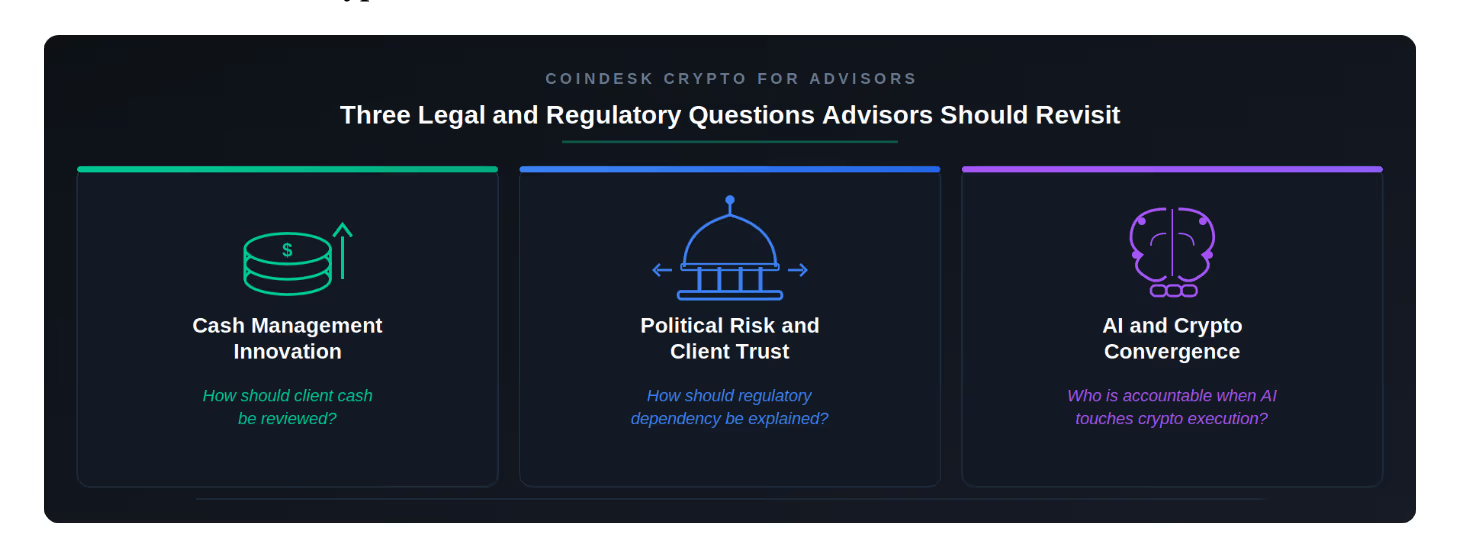
In today’s newsletter, Beth Haddock reviews the three due diligence questions advisors should be asking in 2026: how client cash is managed, how regulatory assumptions should be disclosed and how to manage liability when AI executes crypto trades.
Then, in “Ask an Expert,” Aaron Brogan reviews the GENIUS Act implementation timeline, how things will change once it’s here and what to do in the meantime.
Crypto due diligence has changed: three questions advisors should revisit
As digital money, shifting regulatory requirements and AI-enabled infrastructure mature, advisors need to revisit what legal and regulatory diligence covers. The objective is practical: meet fiduciary duties, protect client trust and adapt as the market changes. Three questions deserve more attention: how client cash is managed, how regulatory assumptions are disclosed and how AI-driven crypto infrastructure is validated.

Prepared with Claude (Anthropic) as a drafting tool; content, direction, and review by author
Diligence Question
Which clients would benefit most from evaluating digital cash management alternatives?
Institutional and cross-border payment clients are a natural place to start.
1. Cash Management Innovation
How should client cash management be reviewed? The GENIUS Act and the growth of stablecoins have opened a new chapter for cash management. Stablecoin lending markets, made accessible via platforms like Axal, offer yields with increased transparency. Tokenized money market funds and other short-term assets from issuers including BlackRock, Fidelity and J.P. Morgan now hold billions in assets, with on-chain settlement and daily liquidity.
For advisors, the question is not whether digital alternatives should replace traditional cash sweeps or money market funds. It is also whether the documented analysis reflects that the advisor considered the client’s best interests, including fees, conflicts and suitability. The SEC’s recent cash sweep enforcement actions against Wells Fargo Advisors and Merrill Lynch make the point: cash management is not a neutral decision. Stablecoins and tokenized short-term assets are not generic cash products, but that is the point: their structure may offer meaningful advantages for the right client, particularly where settlement speed, transparency, yield or cross-border movement matter. Advisors should understand the product terms, provider controls and client use case before making a recommendation.
Diligence Question
What would change a recommendation of legislation, agency leadership or enforcement posture shifts?
2. Connecting Political Risk and Client Trust
How should regulatory dependency be explained? Political support for and opposition to crypto growth remains contentious. The GENIUS Act and proposed CLARITY Act represent progress from regulation by enforcement toward more predictable frameworks. But implementation regulations, market conduct, consumer protection and global coordination remain unsettled. Stablecoin yield and ethics debates, including bank opposition and CLARITY legislative hurdles, show the sector still faces scrutiny from incumbents, private litigants and state attorneys general.
The enforcement shift under SEC Chairman Atkins illustrates why client communication matters. A platform under active enforcement one year can be cleared the next, and the reverse is possible under a future administration. Advisors should not overpromise certainty. Advisors should disclose regulatory assumptions and risks behind portfolio recommendations and update those assumptions as legislation and enforcement posture evolve.
Diligence question
Who is accountable when an agentic workflow touches client data or transaction execution?
3. The Convergence of AI and Crypto
Who is accountable when AI touches crypto execution? AI agents are beginning to settle transactions on crypto rails, while the IMF and others have flagged gaps in operational resilience and governance. Research on agentic commerce suggests validation, liability and programmable compliance remain unsettled.
This convergence should push advisors to cover four priorities. Security: do product sponsors have a credible view on quantum readiness? Substance over hype: the SEC’s AI-washing cases remind us that claims about AI capabilities must be verifiable. Validation and controls: how are AI outputs tested, supervised and authenticated before they are used in advice, trading or client communications? Are platforms that prepare transactions for users transparent user interfaces or opaque in their operations? Privacy: amended Reg S-P and the recent Fidelity data breach settlement show why client data governance matters when AI tools touch client and confidential information, including prompts, outputs and data used for training.
These trends will keep evolving. Advisors who deliver trustworthy crypto recommendations will be the ones whose diligence accounts for AI innovation, political risk and the best cash management options for their clients. Where is your practice least prepared?
– Beth Haddock, managing partner and founder, Warburton Advisers
Ask an Expert
When interacting with stablecoins, is it important to evaluate whether they are the GENIUS-compliant type, or the old MTL-only type?
The GENIUS Act was signed into law on July 18, 2025. Despite this, to date, stablecoins remain regulated under the old regime. While GENIUS will introduce cross-agency federal oversight, as well as many requirements including limiting reserve composition, current stablecoins are still issued using state money transmitter licenses (MTLs) without dedicated federal oversight.
The GENIUS Act will change the risk profile of legal stablecoins in the United States, but when will it take effect?
This will all change when GENIUS takes effect. The statute becomes effective on the earlier of January 18, 2027, or 120 days after the primary federal payment stablecoin regulators issue final implementing regulations. It separately directs the federal payment stablecoin regulators, state payment stablecoin regulators and the Secretary of the Treasury to coordinate to promulgate rulemaking by July 18, 2026. Those rulemakings are currently in progress. The rules governing foreign payment stablecoin issuers will become operative on the same effective-date timeline.
– Aaron Brogan, founder and managing attorney, Brogan Law
Keep Reading
Looking for more? Receive the latest crypto news from coindesk.com and market updates from coindesk.com/institutions.
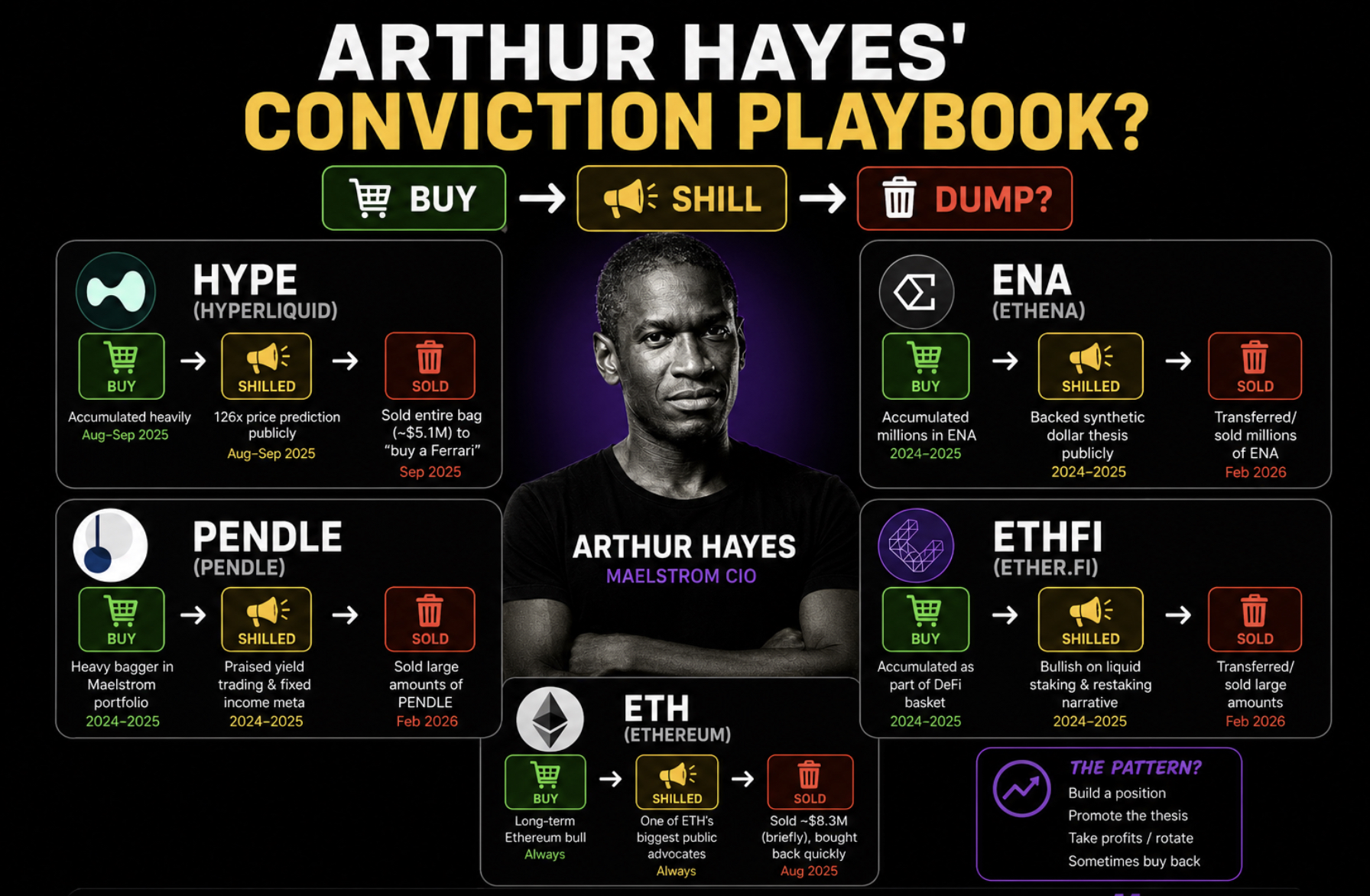
Arthur Hayes has done it again. Just now, the BitMEX co-founder and Maelstrom CIO revealed he had sold his entire HYPE and NEAR positions. Why? Rising energy prices tied to tensions in Iran, looming AI IPOs that could drain market liquidity, and a belief that markets may peak sometime between now and September. His solution is to take profits and rotate into Bitcoin.
Fair enough, but the problem is that just four days earlier, Hayes was singing a different song. Just days ago, he posted “Meow — $HYPE to $150” alongside a cat meme while continuing to promote what he called his “holy trinity” of altcoins: HYPE, ZEC, and NEAR. He even made a $100,000 charity bet with Kyle Samani that Hyperliquid would outperform every top-10 cryptocurrency by year-end.
Then came the exit. There’s nothing wrong with taking profits. The issue is that this pattern has become familiar.
Back in September 2025, Hayes was also aggressively bullish on Hyperliquid, floating a potential 126x rally and repeatedly talking up the token before later selling millions of dollars worth. At the time, he famously admitted some of the proceeds went toward buying a Ferrari.
Eventually, he bought back in, renewed his bullish outlook, and resumed promoting the trade. Fast forward to 2026, and it’s the same script all over again, fresh price targets, fresh conviction, fresh narratives, and then another exit.
Discover: The best crypto to diversify your portfolio with
Arthur Hayes vs. the Community
The community is on point. Arthur Hayes would buy a token that’s already moving, promote increasingly aggressive targets, then sell into the resulting momentum. Others questioned how someone could spend days discussing a $150 target only to liquidate an entire position almost immediately afterward.
Some Hyperliquid supporters defended Hayes’ right to trade however he wants. They’re correct. He’s under no obligation to hold forever, and nobody is forced to copy his trades.
Still, Hayes isn’t just another crypto influencer. He’s one of the industry’s most recognizable figures, a pioneer of crypto derivatives, and someone whose market commentary still carries weight. When he repeatedly builds bullish narratives around a token and then exits shortly afterward, people are naturally going to question him.
The frustration isn’t really about just this one trade. It’s becoming a pattern we’ve seen before across ETH, PEPE, ENA, HYPE, and other positions. Hayes’ wallets are public, so everyone can peek at them. But transparency alone doesn’t eliminate criticism when the same sh*t keeps repeating.
Hayes is expected to publish a longer essay explaining the decision, and perhaps his macro concerns will prove correct. Markets can change quickly, and prudent risk management is part of the game.
In all honesty, crypto doesn’t lack for bullish narratives. What it lacks is accountability when those narratives suddenly disappear the moment profits are on the table.
Discover: The best pre-launch token sales
The post Arthur Hayes Dumped HYPE and NEAR: Shill, Pump, Dump, Repeat appeared first on Cryptonews.
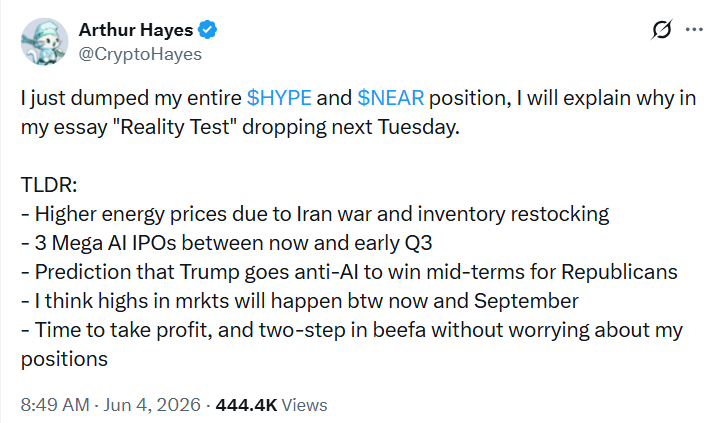
BitMEX co-founder Arthur Hayes said he dumped his Hyperliquid (HYPE) and Near Protocol (NEAR) token holdings, reversing course after previously assigning aggressive upside targets to both assets.
Hayes cited higher energy prices due to the ongoing Middle East conflict, three forthcoming “mega AI IPOs” by the third quarter of 2026 and predictions that US President Donald Trump would turn “anti-AI” to help Republicans win the US midterm elections.
“I think highs in mrkts will happen btw now and September,” wrote Hayes in a Thursday X post, adding that it was “time to take profit.”
The sales mark a drastic pivot from Hayes, who previously assigned aggressive bullish price targets for both altcoins. He predicted that HYPE could reach $150 by August and NEAR may see a 20x rally by 2027.
Blockchain data platform Onchain Lens confirmed that Hayes sold 247,334 HYPE for about $18 million and an unknown amount of NEAR, adding that the sales came shortly after Hayes publicly challenged Multicoin Capital co-founder Kyle Samani to a $100,000 charity bet, claiming that HYPE will outperform every top-10 cryptocurrency by the end of 2026.
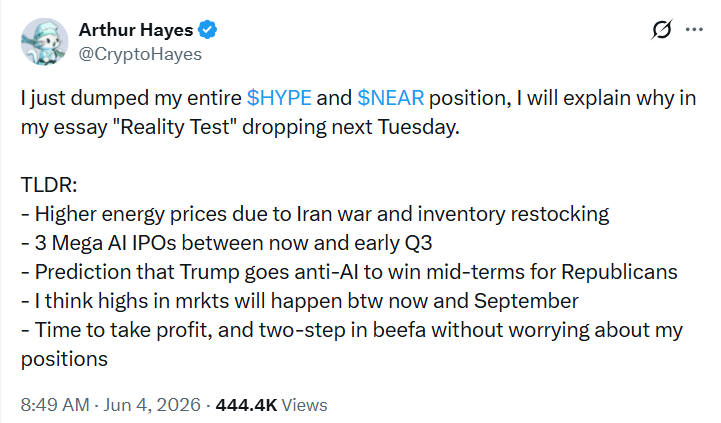
Source: Arthur Hayes
HYPE fell 8.4% to $65, while NEAR fell 17.4% to $2.34 over the past 24 hours, according to TradingView data.
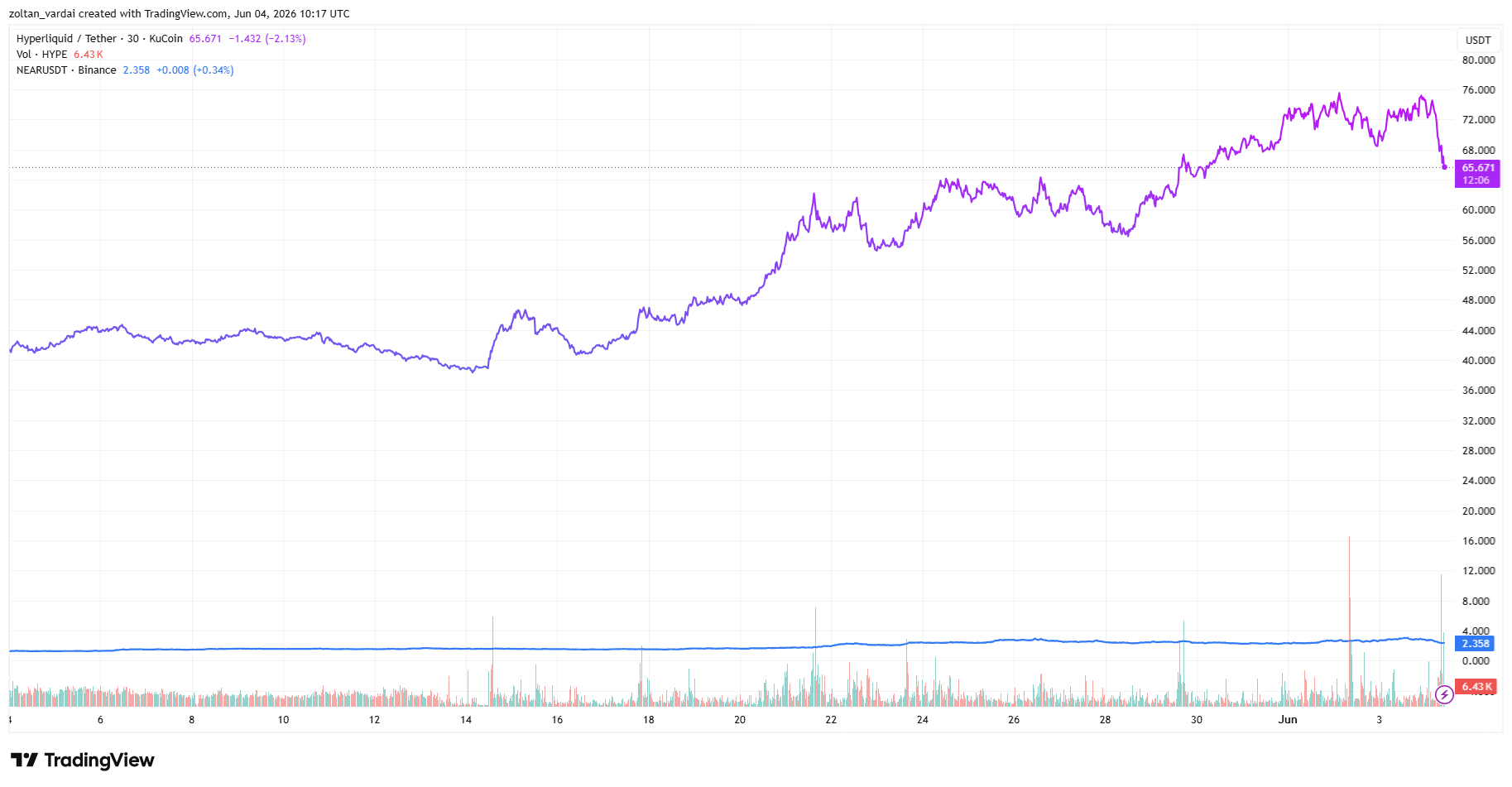
HYPE and NEAR, one-month chart. Source: Cointelegraph/TradingView
Could AI IPOs drain crypto market liquidity ahead of Q3 2026?
Hayes’s selling comes as investors eagerly anticipate three long-awaited AI company initial public offerings (IPOs), including from ChatGPT creator OpenAI, Anthropic and Elon Musk’s SpaceX.
SpaceX reportedly filed confidentially for an IPO in early April, with anonymous sources saying that the IPO could be finalized as early as June. SpaceX filed an S-1 registration statement in May, as part of its bid to become a public company on June 12.
Related: Polymarket users cry foul after Strategy sale market resolves to ‘no’
Anthropic reportedly selected Morgan Stanley, Goldman Sachs and JPMorgan Chase to lead its IPO and is weighing going public as soon as October, Bloomberg reported on Wednesday, citing people familiar with the matter.
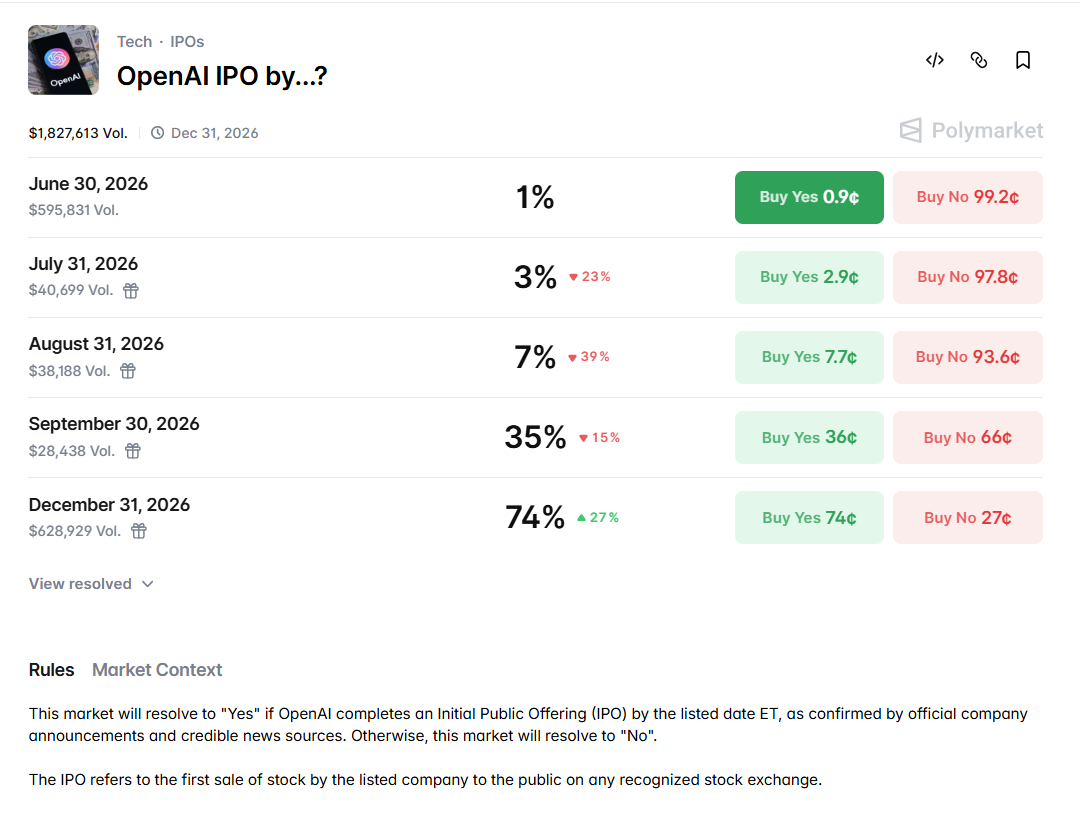
OpenAI IPO on prediction market by odds. Source: Polymarket.com
OpenAI has also been preparing a confidential IPO filing and could go public as early as September, Reuters reported on May 20.
While the timeline is still unclear, 74% of traders expect OpenAI’s IPO to occur by December 31, while only 35% expect it to occur before September 30, data from prediction market Polymarket shows.
Still, some industry participants worry that the AI IPOs could spell bad news for Bitcoin and the wider cryptocurrency markets, as the growing interest in the offerings may drain more liquidity from the cryptocurrency market.
Magazine: NEAR price may ‘grow 20X,’ Bitcoin ETFs post 10-day outflow streak: Hodler’s Digest, May 24 – 30

Former California AG Bill Lockyer Offers A Dumb And Lazy Defense Of The Paramount Warner Bros Merger

Soak up the playful spirit of the Golden State at Outernet this June

Goldman Sachs expects SpaceX’s AI revenue to surge 100-fold by 2030, FT reports



-

 Tech6 days ago
Waymo dominates autonomous vehicle registrations as Tesla trails behind
-

 News Videos6 days ago
This is BROKEN! INSANE 5x MONEY CAR WASH WEEK! The NEW GTA Online UPDATE Today! (GTA5 New Update)
-
 Tech5 days ago
SpaceX just won a second Golden Dome contract. This one is $4.16 billion.
-

 Business3 days ago
Jade Biosciences, Inc. (JBIO) Discusses Positive Interim Results From JADE101 Phase I Healthy Volunteer Study and Development Plans Transcript
-
 News Videos6 days ago
SHE IS KILLING XRP!!! WATCH URGENT AND ACT FAST
-
 NewsBeat6 days ago
FIRST NIGHT REVIEW: Take That bring the Circus back to life in spectacular sun-soaked style
-

 Business5 days ago
Is the Spurs Phenom Already Better Than Prime Diesel?
-
Crypto World6 days ago
CFTC Has Approved the First Regulated Bitcoin Perpetual Contract in the U.S.
-

 Politics5 days ago
The House | Inside Andy Burnham’s Makerfield Campaign: “Nobody Thinks This Is In The Bag”
-

 Sports2 days ago
French Open 2026 results: Alexander Zverev beats Rafael Jodar and will play Jakub Mensik in semi-finals
-
 NewsBeat6 days ago
Novak Djokovic v Joao Fonseca LIVE: French Open latest scores and results after Jannik Sinner’s shocking collapse
-
 Entertainment6 days ago
Weak ‘Supergirl’ Box Office Tracking Amid Milly Alcock Backlash
-

 Tech2 days ago
CryZENx Releases Fresh Playable Content Deep Inside Jabu-Jabu for His Ocarina of Time Remake
-
 Crypto World6 days ago
Snowflake (SNOW) Stock Rallies on Strong Q1 Results and AI Product Growth
-

 Entertainment6 days ago
Maddox Jolie-Pitt Legally Requests to Drop Brad’s Surname
-

 Business5 days ago
Demand Conditions Improve In Chemicals Sector In April 2026
-
 Entertainment5 days ago
One of the Greatest Sitcoms of All Time Shoots Up Apple TV’s Charts 11 Years Later
-

 Tech6 days ago
This Week In Security: Ubiquiti Fixes, And FreeBSD Joins The Club You Don’t Want To Join
-
 Crypto World6 days ago
MicroStrategy Moves $30 Million in BTC to Coinbase Prime: Is the Bitcoin Sell-Off Already Here?
-
 Crypto World2 days ago
Seagate (STX) Stock Surges to Record High on AI Boom and Legal Settlement
You must be logged in to post a comment Login