
Crypto World
SEC Eliminates $25,000 Pattern Day Trader Rule in Retail Trading Overhaul



The SEC on April 14 approved FINRA’s proposal to eliminate the $25,000 minimum equity requirement for pattern day traders. This removed one of the most persistent barriers to retail market participation.
The decision also removes the “pattern day trader” designation, a classification that flagged any customer who executed four or more day trades within five business days.
What the New Rules Replace
The original Pattern Day Trader (PDT) rule dates back to 2001. Regulators introduced the $25,000 threshold in response to heavy retail losses during the dot-com crash. For over two decades, it effectively prevented smaller accounts from participating in active intraday trading.
“Since 2001, if you wanted to make more than 3 day trades in a 5 day period, you needed at least $25,000 sitting in your account at all times. If you dropped below that, your broker would lock you out of day trading completely. This rule blocked millions of retail traders from actively participating in markets simply because they did not have enough capital,” Bull Theory wrote.
Under the approved changes to FINRA Rule 4210, traders will instead need to maintain equity proportional to their actual market exposure at any given point during the trading day. Customers of FINRA member broker-dealers remain subject to existing initial and regular maintenance margin requirements under Rule 4210.
Follow us on X to get the latest news as it happens
The framework also fills a gap in the previous rules by covering zero-days-to-expiration (0DTE) options. Broker-dealers get two paths for implementation. Firms can deploy real-time monitoring systems that block trades before they breach margin limits, or they can run a single end-of-day calculation to assess intraday exposure.
Accounts that repeatedly fail to meet intraday margin deficits within five business days will face a 90-day freeze on creating or increasing short positions or debit balances. Small deficits under the lesser of 5% of account equity or $1,000, and those occurring under extraordinary circumstances, are exempted from triggering the freeze.
“FINRA believes that the proposed rule change will benefit customers and members alike by reducing risks of intraday trading exposures more broadly and giving customers more freedom to participate in the markets, while reducing compliance costs for members,” the notice read.
The new rules take effect 45 days after FINRA publishes its Regulatory Notice. Firms that need additional time to upgrade their systems will have an 18-month phase-in period from the date of the Regulatory Notice.
Subscribe to our YouTube channel to watch leaders and journalists provide expert insights
The post SEC Eliminates $25,000 Pattern Day Trader Rule in Retail Trading Overhaul appeared first on BeInCrypto.


Innovation City, a Ras Al Khaimah free zone focused on artificial intelligence and Web3, has unveiled what it calls the first blockchain-based digital business identity system. In a Monday release shared with Cointelegraph, the city said every company registered there will receive a sovereign, cryptographically verifiable identity issued on OPN Chain, the public blockchain infrastructure developed by UAE-based IOPn.
The release frames the initiative as converting a traditional business license from a static document into a dynamic on-chain asset, designed to reduce reliance on central intermediaries and to cut verification uncertainty across the free zone’s ecosystem.
The move aligns with a broader UAE push to replace traditional registries with blockchain-based identity systems and AI-driven workflows, a policy direction proponents say could streamline verification and digital operations for businesses operating in the United Arab Emirates.
Key takeaways
- Innovation City will issue on-chain, cryptographically verifiable business identities to its registered firms via the OPN Chain, covering more than 1,000 companies at launch.
- The onchain identity is intended as the native business registration primitive within the free zone, not merely an optional credential layered onto a traditional registry.
- OPN Chain uses a public validator network and a hybrid data model that stores core transaction data and proofs on-chain while handling sensitive or large datasets off-chain.
- The project emphasizes security through human-in-the-loop authorization for consequential actions and designs the agent layer with adversarial scenarios as a first principle.
- External adoption remains uncertain, with no specific banks, regulators, or exchanges named as current validators or acceptors of these onchain identities; questions persist about dispute handling and credential revocation when third parties are involved.
How the onchain business IDs work
Jimi Ibrahim, co-founder and chief operating officer of IOPn, told Cointelegraph that at launch the onchain identity framework is intended to extend across Innovation City’s client base of more than 1,000 companies, with immediate live utility within the free zone’s own digital ecosystem.
He described the core value not merely as issuing a digital certificate but as establishing a cryptographically verifiable business identity to be used for access and verification across Innovation City’s touchpoints, such as the business center and selected ecosystem services, with plans to broaden to partner providers in technology, marketing and legal services over time.
OPN Chain is presented as a public network where validator participation is open to institutions, infrastructure partners and governance-approved node operators. The system uses a hybrid data model in which core transaction data and proofs stay on-chain while sensitive or large datasets are handled off-chain, balancing transparency with privacy concerns.
Company registration under this framework is described as the native primitive within the free zone rather than an optional overlay on top of a conventional registry, distinguishing it from some digital-ID schemes such as Estonia’s e-residency example.
AI security and geopolitical risks
Recent exploits have highlighted how AI agents can be socially engineered to authorize transfers from wallets they control, underscoring the fragility of autonomous workflows. Ibrahim emphasized that every agentic workflow built on these identities will require human oversight for consequential actions, and that the agent layer is designed with adversarial scenarios as a core consideration from the outset.
The timing of the launch also intersects with regional tensions and new attacks affecting the UAE. Within this broader context, observers note that UAE investors have continued to allocate capital toward AI infrastructure, software and crypto-related assets, even amid volatility, according to data cited by Cointelegraph from eToro. Deutsche Bank researchers have also argued that the conflict may spur demand for AI rather than derail it.
Regulatory and market backdrop in the Gulf
The initiative sits within a wider policy push in the United Arab Emirates to move away from traditional registries toward blockchain-based identities and AI-enabled workflows. Government and industry watchers see potential benefits in streamlined verification, faster onboarding and more seamless cross-service operations, though practical adoption will hinge on external actors — banks, regulators, and service providers — recognizing and validating onchain credentials.
That context is underscored by the absence of named external banks or regulators currently recognizing Innovation City’s onchain identities, leaving questions about interoperability and dispute resolution when third parties are involved. The launch also arrives as the UAE seeks to attract AI and crypto investment, a dynamic reflected in investor behavior and market commentary cited by industry observers.
Uncertainties and next steps for external adoption
Key questions remain around how these onchain identities will be verified by external institutions such as banks and regulatory bodies, and how disputes or credential revocations will be handled when third parties are involved. The immediate utility is clear within Innovation City’s own digital ecosystem, but external integration will determine whether the model can scale beyond the free zone and become a broader standard.
As Innovation City pilots this approach, the next chapters will reveal whether the wider Gulf region and international partners will adopt similar onchain business identity primitives, and how issues of governance, data privacy and cross-border interoperability are resolved.
Readers should watch whether banks and regulators begin recognizing these onchain IDs outside Innovation City and how revocation or dispute handling will work as adoption expands.

TLDR
- Nvidia shares are hovering near $198, reflecting a 6.9% decline across the last five trading days after struggling to maintain the $200 threshold
- Manufacturing partner Foxconn disclosed 30% year-over-year April revenue expansion, attributing growth to robust AI server demand
- Wall Street’s consensus price target stands at $269.82, suggesting approximately 35% potential gains from present trading levels
- The stock carries a forward price-to-earnings multiple of roughly 22x, significantly lower than AMD’s 40x+ valuation
- The company’s May 20 earnings release is approaching; 48 analysts maintain “Buy” ratings on the shares
Nvidia shares commenced Tuesday’s session at $198.51, marking a position approximately 6.9% beneath the level established five trading days earlier.
The chip giant’s shares escaped their $165–$195 consolidation zone last week amid semiconductor sector optimism, only to surrender those gains rapidly. The psychological $200 barrier continues to present challenges.
Market participants may need to exercise patience until May 20 — when Nvidia releases its quarterly results — before witnessing more definitive price movement.
“Nvidia’s current valuation appears reasonable, potentially even attractive,” observed Julian Koski, chief investment officer at New Age Alpha, highlighting the company’s impressive streak of 12 consecutive quarters delivering revenue expansion.
Foxconn, a critical Taiwanese manufacturing ally of Nvidia’s, provided encouraging signals Tuesday. The electronics manufacturer disclosed 30% April revenue growth versus the prior year, propelled by AI server systems and cloud networking hardware.
Foxconn indicated that “AI rack deployments should sustain their upward trajectory,” despite traditional tech hardware markets entering typical seasonal weakness.
This represents a significant indicator. Foxconn’s primary revenue generator has shifted to cloud and networking infrastructure — surpassing its longstanding reliance on Apple product assembly.
Valuation Metrics Compare Favorably Against Competitors
Trading at a forward earnings multiple hovering around 22x, Nvidia appears attractively priced relative to AMD, which commands a valuation exceeding 40x ahead of its quarterly report scheduled for Tuesday evening.
Analyst consensus points to an average price objective of $269.82 per FactSet data — representing roughly 35% appreciation potential from current price levels.
Among 54 Wall Street analysts monitored by MarketBeat, 48 assign “Buy” recommendations, four rate it “Strong Buy,” while only two maintain “Hold” positions. Zero sell ratings exist.
Morgan Stanley maintains a $260 price objective. Wolfe Research projects $275. New Street Research reduced its forecast from $307 to $275 while preserving its “Buy” stance.
Potential Challenges on the Horizon
Not every indicator points upward. CEO Jensen Huang conceded that Nvidia presently holds “zero market share in China,” a direct result of American export restrictions on cutting-edge semiconductor technology.
Additional concerns emerge around customer diversification efforts. Anthropic has reportedly entered discussions with chip newcomer Fractile, while Cerebras pursues public market listing plans — suggesting certain buyers are exploring alternative suppliers.
Regarding insider transactions, CFO Colette Kress divested 20,000 shares during March at $174.89, representing a 19.41% reduction in her stake. Board member John Dabiri similarly decreased his holdings that month.
Institutional capital, conversely, has flowed inward. PDS Planning expanded its Nvidia allocation by 3.5% during Q4. Multiple additional funds increased their positions throughout the third and fourth quarters.
Bernstein analysts characterized AI agent-driven semiconductor demand as escalating “off the charts,” with supply chains unable to satisfy requirements — a situation that directly reinforces Nvidia’s pricing authority.
Nvidia’s most recent quarterly disclosure, published February 25, revealed $1.62 earnings per share, exceeding analyst projections of $1.54. Revenue reached $68.13 billion, representing 73.2% year-over-year growth.
The semiconductor leader maintains a market capitalization of $4.82 trillion, a minimal debt-to-equity ratio of 0.05, and established a 12-month peak at $216.82.
Attention now shifts entirely toward May 20.


Introduction
Reimagining financial primitives in a trust-minimized world
Decentralized Finance (DeFi) represents one of the most ambitious attempts to reconstruct the global financial system from the ground up. Built primarily on blockchain networks like Ethereum, DeFi replaces centralized intermediaries—banks, brokers, and clearinghouses—with transparent, automated protocols governed by code.
Where traditional finance relies on institutions to enforce trust, DeFi relies on cryptography, consensus mechanisms, and smart contracts. The result is a parallel financial system that is open, programmable, and globally accessible—yet not without its own structural vulnerabilities.
Replacing Traditional Banking Primitives
At its core, finance is built on a few fundamental primitives: custody, lending, borrowing, trading, and settlement. DeFi reconstructs each of these using blockchain-based infrastructure.
Custody Without Banks
In traditional systems, financial institutions hold and manage assets on behalf of users. DeFi replaces this with self-custody through digital wallets. Users maintain direct control over their funds, secured by private keys rather than institutional guarantees.
This shift eliminates counterparty risk tied to custodians—but introduces a new responsibility: the user becomes their own bank. There is no recovery mechanism for lost keys, no customer support desk, and no safety net.
Programmable Lending and Borrowing
DeFi lending protocols, inspired by early innovations in the ecosystem, allow users to lend assets and earn interest, or borrow against collateral, without credit checks or intermediaries.
Smart contracts automatically enforce loan conditions:
- Collateral is locked on-chain
- Interest rates adjust dynamically based on supply and demand
- Liquidations occur instantly when collateral thresholds are breached
This system replaces the bureaucratic processes of traditional banking with algorithmic efficiency—but also removes human discretion, often leading to abrupt and unforgiving outcomes during volatility.
Decentralized Exchanges (DEXs)
Instead of relying on centralized exchanges to match buyers and sellers, DeFi uses liquidity pools governed by automated market makers (AMMs). These pools allow users to trade assets directly from their wallets.
Liquidity providers supply capital to these pools and earn fees from trading activity, effectively becoming micro-market makers. This democratizes participation in financial markets, but also exposes participants to risks such as impermanent loss and volatile fee structures.
Yield Generation Without Intermediaries
One of DeFi’s defining innovations is the ability to generate yield without traditional financial intermediaries. Yield farming, staking, and liquidity provision enable users to earn returns by actively participating in protocol ecosystems.
Unlike savings accounts in traditional banks—where interest rates are centrally determined—DeFi yields are:
- Market-driven
- Highly dynamic
- Often incentivized by token emissions
This creates opportunities for significantly higher returns, but also introduces complexity and instability. Yield is not generated solely by underlying economic productivity; in many cases, it is subsidized by speculative incentives, raising questions about sustainability.
Risks in a Permissionless System
Despite its promise, DeFi is not a frictionless utopia. Removing intermediaries does not eliminate risk—it redistributes and, in some cases, amplifies it.
Smart Contract Failure
Smart contracts are immutable once deployed. A flaw in the code can lead to catastrophic losses, as exploits can drain funds within seconds. Unlike traditional systems, there is no central authority to reverse transactions or compensate users.
Audits and formal verification reduce risk but cannot guarantee safety. The system’s integrity ultimately depends on the quality of its code.
Liquidity Crises
DeFi markets rely heavily on liquidity pools. In times of stress, liquidity can evaporate rapidly, leading to cascading liquidations and extreme price slippage.
Because many protocols are interconnected, a failure in one can trigger systemic effects across the ecosystem—mirroring, and sometimes exceeding, the contagion risks seen in traditional finance.
Human Greed and Speculation
While DeFi is powered by code, it is driven by human behavior. Speculative mania, herd mentality, and short-term profit seeking often dominate decision-making.
This has led to:
- Rug pulls and fraudulent projects
- Unsustainable yield schemes
- Rapid boom-and-bust cycles
The absence of regulation allows for innovation—but also creates an environment where bad actors can operate with minimal resistance.
Bitcoin: A Store of Value, Not a Financial System
No discussion of DeFi is complete without addressing Bitcoin, the first and most recognized blockchain asset.
Bitcoin was designed as a decentralized store of value and a peer-to-peer payment system. Its architecture prioritizes security, simplicity, and immutability over programmability. As a result, it does not natively support the complex smart contracts required for DeFi applications.
This creates a fundamental distinction:
- Bitcoin functions as “digital gold.”
- DeFi operates as a programmable financial layer.
Efforts have been made to bridge Bitcoin into DeFi ecosystems through wrapped assets and sidechains, but these solutions often introduce additional trust assumptions—ironically reintroducing intermediaries that DeFi seeks to eliminate.
In this sense, Bitcoin sits adjacent to DeFi rather than fully within it: a foundational asset that provides value storage, but not the infrastructure for financial experimentation.
Conclusion
DeFi represents a radical rethinking of financial systems—one that replaces institutional trust with transparent, autonomous code. It reconstructs lending, borrowing, and trading into permissionless protocols that operate without centralized control.
Yet this transformation comes with trade-offs. Efficiency replaces oversight, automation replaces discretion, and accessibility replaces protection. The risks—technical, systemic, and behavioral—are not eliminated but reshaped.
The future of finance may not lie in the complete replacement of traditional systems, but in the convergence of both models: combining the resilience and innovation of DeFi with the safeguards and stability of established institutions.
For now, DeFi remains an evolving experiment—one that is simultaneously rebuilding finance and stress-testing the limits of decentralization.
REQUEST AN ARTICLE


Toncoin (TON) is rallying as messaging app Telegram takes a more direct role in the token’s parent network and pushes for lower transaction costs, a shift that seems to be driving the move.
TON has rallied more than 36% in the past 24 hours, hitting a four-month high of $1.80, according to data from CoinDesk. It is the native token of The Open Network, a Layer 1 blockchain designed to integrate crypto payments and applications within the Telegram messaging platform.
The bullish sentiment has spread across the Telegram-linked ecosystem, with Notcoin gaining nearly 26%, Dogs rising more than 100%, and several smaller TON-based tokens posting even larger daily moves.
The market seems to be reacting to Telegram’s decision to replace the Ton Foundation as the driving force behind TON.
In an X post on Monday, Telegram founder Pavel Durov said that the messaging platform would become TON’s largest validator and take over as the driving force behind the ecosystem, with new developer tools, performance upgrades, and a refreshed ton.org expected within two to three weeks.
A validator is a specialized node or participant responsible for verifying transactions, ensuring network security, and maintaining the accuracy of a blockchain.
Becoming the largest validator is indicative of Telegram’s willingness to put its own weight behind the chain’s security and direction. This likely reduces one of TON’s biggest overhangs, namely the gap between the Telegram narrative and TON Foundation’s execution.
The story doesn’t end there. In the same X post, Durov said TON fees have fallen sixfold to near zero, after previously announcing that transaction costs would drop to 0.00039 TON, or about $0.0005, with most transactions eventually moving toward a fee-less model.
Fees in TON have dropped 6× — to nearly zero.
Next step — Telegram replaces the TON Foundation as the driving force behind TON and becomes its largest validator.
The focus shifts to tech superiority.
New https://t.co/Me0w683UiK, new dev tools, new performance upgrades.…
— Pavel Durov (@durov) May 4, 2026
Near-zero transaction costs matter most for the kinds of products Telegram can actually distribute, such as on-chain tips, games, bot payments, mini-app transactions, collectibles, and small retail transfers.
A fee that looks irrelevant to a DeFi whale can still kill a consumer app if users are moving cents or dollars at a time. Fixed, tiny costs make TON more usable for high-frequency, low-value activity, broadening its appeal as a blockchain among existing users.
Various tracking sites put Telegram’s estimated monthly users at as much as one billion, though the company has not publicly claimed or denied those figures.
But TON’s fundamentals have failed to catch up to that hype in recent years. DefiLlama data shows TON captures just over $69 million in locked value across its decentralized finance (DeFi) applications, far below its 2024 highs near $800 million. Daily chain fees sit around $3,600, DEX volume around $29 million, and app revenue near $134,000.
Data from Tonstat shows shows daily active wallet activity on TON at just under 50,000, coming from around 136,000 unique wallets. That compares with roughly 700,000 daily activities across more than 2.2 million wallets during August and September 2024, according to the data.
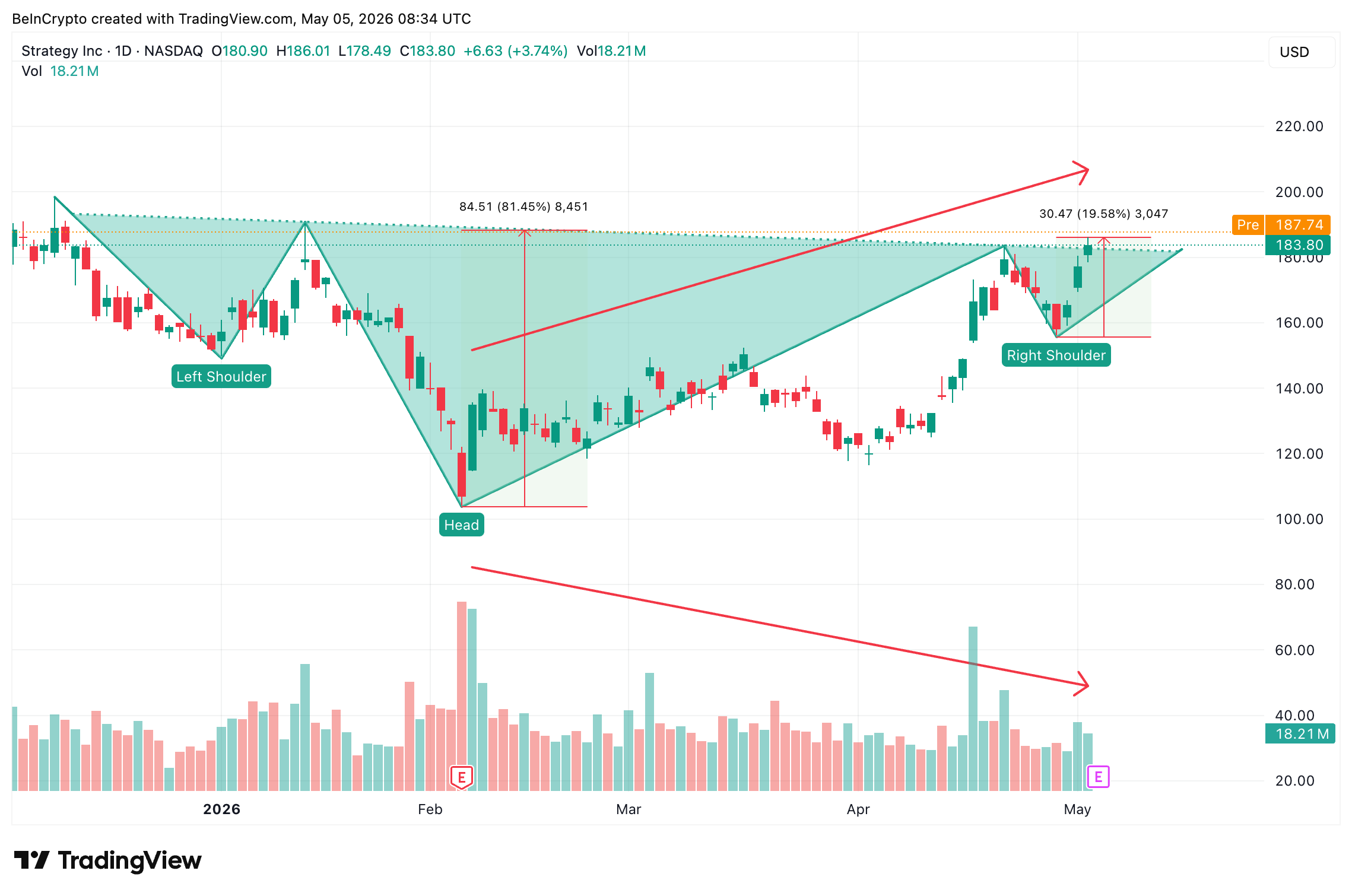
Strategy stock heads into tonight’s Q1 earnings with the chart already breaking out of an inverse head and shoulders pattern in pre-market trade, up 47% from the February lows.
The options market has flipped from defensive to bullish. Analyst price targets keep rising. But volume concerns are showing up and a key technical line still caps the recovery. Additionally, Michael Saylor paused Bitcoin purchases into the print. The breakout is happening regardless. The question is whether tonight’s number lets it hold.
Strategy Stock Built an Inverse Head and Shoulders Off the February Lows
Strategy stock (NASDAQ: MSTR) has rallied roughly 47% since the company reported a $42.93 EPS loss on February 5, 2026, when Bitcoin’s price drop forced massive mark-to-market losses through the earnings line. The recovery from that low has formed a recognizable bullish reversal pattern, an inverse head-and-shoulders.
Want more insights like this? Sign up for Editor Harsh Notariya’s Daily Newsletter here.
The pattern’s neckline sits just slightly under the May 4 close. While it seems that the Strategy share price is almost above the neckline, at press time, a longish wick is hinting at exhaustion.

The setup is textbook bullish in structure. Inverse head and shoulders patterns historically resolve upward when the neckline breaks on rising volume, and the measured move from head depth to neckline gives an 80%+ price projection well above current levels.
The problem is volume.
Though the MSTR share price has trended higher between early February and early May, daily volume has trended lower rather than higher. Bullish reversal patterns require expanding volume to confirm participation. Strategy stock has the price structure but not the volume signature.
The pattern says one thing. The volume says something else. Tonight’s earnings reaction has to resolve which signal wins.
The Options Market and Analyst Action Show the Bull Case Is Already Priced In
The shift in options positioning between February’s earnings and tonight’s print captures how heavily the recovery is already discounted into Strategy share price.
On February 5, when Strategy stock closed at $106.99 ahead of the Q4 print, the put-call volume ratio sat at 1.66. Traders were positioning for downside, and the Q4 announcement validated that defensive stance with a $42.93 EPS miss.

Heading into tonight’s print, the put-call volume ratio has collapsed to 0.60 with the stock at $183.80. The same options market that anticipated the Q4 disaster is now positioned for the Q1 reversal. A volume ratio at 0.60 reflects far more call buying than put buying, a clean shift from defensive to offensive.

Options pricing has gotten expensive heading into the print, which signals that traders expect a sharp move in either direction. Implied volatility, a measure of how big a move options traders are betting on, sits at 74.42%.
Wall Street has been raising targets in lockstep. B. Riley raised its target from $188 to $200 on April 29 with a Buy reiteration. Cantor Fitzgerald raised its target from $192 to $212 on April 21 with a Buy reiteration.

The bull case rests on Bitcoin mark-to-market accounting. Strategy holds 818,334 BTC at an average cost of $75,537. With Bitcoin trading above $80,000, the unrealized gain sits near $3.7 billion. That gain reverses Q4’s mark-to-market loss directly through the Q1 earnings line.
But Michael Saylor paused Bitcoin purchases ahead of the print. The pause is unusual. Cash conservation, capital structure adjustments, or funding model strain are all possible reads. The options market and Wall Street say the rally is justified. Saylor’s pause says caution.
Strategy Stock Price Levels Define the Earnings Reaction
Strategy stock trades at $183.80, sitting at the neckline of the inverse head and shoulders pattern at $186.46. That neckline is the immediate test after tonight’s numbers.
While the volume divergence discussed earlier puts the neckline theory at risk, the looming EMA (exponential moving average) crossover, adds the bullish angle. An Exponential Moving Average (EMA) is a type of moving average that gives more weight to recent prices. Right now, the 20-day EMA line is closing in on the 100-day EMA line. That bullish trigger can push the MSTR stock price above the 200-day EMA line.

A clean break above the 200-day EMA exposes the 0.618 Fibonacci at $205.29, the 0.786 Fibonacci at $218.69, and the 1.0 Fibonacci at $235.77. At present the 0.786 Fib level is expected to offer the most resistance as it lies above the key analyst targets we just highlighted. The ultimate target, per pattern projection, sits at $338.91.
The downside levels show what failure looks like. A daily close below $186.46 invalidates the breakout attempt and pushes price back toward the 0.236 Fibonacci at $174.81.

The level math is binary. A confirmed neckline break above $186.46 opens the path toward $218.69 over the coming weeks. A close below $174.81 cracks the pattern. Tonight’s print decides which path the chart takes, starting Wednesday.
The post Strategy Stock Heads Into May With a Bullish Pattern and Q1 Earnings Catalyst appeared first on BeInCrypto.
Crypto World
Andreessen Horowitz’s new $2.2 billion crypto fund is chasing stablecoins, DeFi, and the builders no one is watching
Venture capital heavyweight Andreessen Horowitz (a16z) has launched a $2.2 billion crypto fund, doubling down on blockchain startups amid a surge in venture capital into artificial intelligence.
The new vehicle, called “Crypto Fund 5,” will invest in crypto entrepreneurs at all stages, with capital deployed over a decade, according to a company spokesperson. The firm said it is targeting founders building practical applications on crypto infrastructure, especially in areas like payments, financial services and decentralized systems.
The firm’s partners see the current crypto market as an opportunity to invest in founders building projects that are “durable” and lasting even when the hype cycle dies down.
“We’re at one of those quieter moments now. And the signal coming through is one of the most encouraging it has been in years,” according to a blog by the firm’s partners, published on Tuesday.
“The founders we’re backing with this $2.2 billion fund are working on the part of the cycle that gets less attention and produces more of the lasting value: turning new infrastructure into products people use every day,” according to the blog.
What the fund is investing in
The fund will focus on sectors where these capabilities translate into tangible and lasting products.
One of the areas where a16z is seeing that pattern is stablecoins. The digital dollar market, which recently surged to $320 billion in market cap, has seen its adoption continue to grow through downturns, with users relying on it for cross-border payments, savings, and everyday transactions. This is particularly true when compared to legacy systems, which are “slow, expensive, and unreliable,” a16z said.
Other areas that are seeing “meaningful growth” include perpetual futures, blockchain-based lending, prediction markets and tokenized assets.
The new fund is launching at a time when venture capital firms are recalibrating their strategies amid an AI funding boom. Recent industry trends show generalist investors shifting capital toward AI startups, forcing crypto-focused funds to sharpen their positioning.
And this is where a16z is seeing the use of crypto’s role as a financial and coordination layer for AI systems, more important than ever.
“Software is getting more complex and harder to trust. AI systems are powerful and largely opaque. The infrastructure the internet runs on is more consolidated than ever. In that environment, the properties that crypto networks were designed to provide become more valuable, not less,” the blog said.
While the new fund is almost half the size of its fourth fund, which raised $4.5 billion in 2023, it’s still larger than the recent $1 billion raised by Huan Ventures (founded by a former a16z partner) and $650 million raised by another prominent crypto VC firm, Dragonfly Capital.
These recent raises are likely signs that, while sentiment is not running as high as it did in the 2021 bull market, there is a gap between the hype and underlying activity.
“We believe while sentiment may be low, the fundamentals of the crypto industry are at an all-time high,” according to the spokesperson.
Crypto World
Ethereum Price Fighting $2,400 Resistance: Tom Lee Declares Crypto Spring as Bitmine Hit 5.18 Million ETH

Ethereum is pressing hard against the $2,400 price ceiling as smart money loads up ahead of the break. ETH is hovering around $2,380, inside a tightening consolidation channel that is approaching resolution. The $2,400 resistance has rejected ETH three times in April, and a fourth test could decide the next major move.
BitMine Immersion Technologies made that decision easy. The firm, chaired by Fundstrat’s Tom Lee, disclosed that it added 101,745 ETH, worth approximately $238–242 million, in a single 48-hour window, pushing total holdings to 5.18 million ETH, or more than 4% of the circulating ETH supply. Bitmine Holding is now valued at $12.1 billion, with 4.36 million ETH, or 84% of its holdings staked.
Lee publicly declared that “crypto spring has commenced,” marking the end of the bearish phase, even as retail sentiment remains muted.
LATEST:
Tom Lee says "Crypto Spring" has begun despite muted sentiment, citing the CLARITY Act's progress and Ethereum's dual tailwinds from tokenization and AI.
Secure your sit guys. pic.twitter.com/veMUwX3KgG— Imo Mark (@ImoMark3) May 5, 2026
The backdrop matters: Bitcoin has surged back above $80,000, injecting momentum into the altcoin complex and giving ETH the macro tailwind it needed to attempt this breakout.
Discover: The best pre-launch token sales
Can Ethereum Price Break $2,400 and Target $3,000?
ETH has been range-bound between $2,200 and $2,400 since mid-April, with the $2,400 zone being the immediate wall.
However, the ETH/BTC ratio is at 0.029 and sits well below the 8-year historical average of 0.0479. This gap suggests ETH remains undervalued relative to Bitcoin on a cycle-adjusted basis.

In the near-term, if ETH can break above $2,425 on strong volume, it could as well target $2,500, then a run toward $3,000 if institutional inflows accelerate. Lee’s long-term model puts ETH at $12,000 base / $22,000 bull / $62,500 ultra-bull by 2030, with the latter tied to BTC at $1M and an ETH/BTC ratio expansion to 0.25.
Consolidation could also continue between $2,300–$2,400 as the market digests BitMine’s accumulation and awaits CLARITY Act developments. But a close below $2,200 reopens the $1,900–$2,000 support band. Unlikely given current institutional positioning, but a macro shock could force the issue. The technical setup favors bulls.
Discover: The best crypto to diversify your portfolio with
LiquidChain Targets Early-Mover Upside as Ethereum Breaks Key Levels
Ethereum price at $2,400 is a compelling trade, but it’s already a $280 billion asset. The asymmetric upside that ETH offered at $400 in 2020 simply doesn’t exist at this price point. Traders chasing outsized returns are increasingly scanning earlier on the curve, where infrastructure bets still carry genuine multiplier potential.
LiquidChain ($LIQUID) is one project drawing attention. It operates as a Layer 3 infrastructure protocol with a specific thesis: fuse Bitcoin, Ethereum, and Solana liquidity into a single execution environment.
With Liquid, developers only deploy once and access all three ecosystems with no bridges and no fragmented liquidity pools. Core architecture includes a Unified Liquidity Layer, Single-Step Execution, and Verifiable Settlement, which are designed to solve the cross-chain friction that costs DeFi users billions annually in slippage and failed transactions.
Low light…
Clear direction⟁https://t.co/vqvBcdSQYC pic.twitter.com/1ZzWdMQgET
— LiquidChain (@getliquidchain) May 4, 2026

The presale is live at $0.01456 per $LIQUID, with more than $700K raised to date.
For those who’ve followed the Ethereum institutional narrative and want earlier-stage exposure to the infrastructure enabling it, researching LiquidChain’s presale terms is a reasonable next step. And don’t forget, its 1500% APY rewards that’s only available for early buyers.
The post Ethereum Price Fighting $2,400 Resistance: Tom Lee Declares Crypto Spring as Bitmine Hit 5.18 Million ETH appeared first on Cryptonews.

Key Highlights
- The cryptocurrency exchange is eliminating 700 positions, representing a 14% workforce reduction
- Chief Executive Brian Armstrong attributed the decision to cryptocurrency market turbulence and artificial intelligence transformation
- Shares of COIN gained more than 4% during premarket hours Tuesday
- The company projects restructuring expenses between $50M and $60M, affecting second-quarter results
- First-quarter financial results are scheduled for Thursday, with projections showing adjusted EBITDA declining 50% from last year
Shares of Coinbase (COIN) advanced more than 4% during Tuesday’s premarket session following the cryptocurrency platform’s disclosure that it would eliminate approximately 700 positions, representing roughly 14% of its total employee base.
The digital asset exchange stated that these workforce reductions are intended to control operational costs amid prevailing market dynamics and to position the organization for what executives describe as the “artificial intelligence age.”
Chief Executive Brian Armstrong communicated the announcement through a memorandum published on X, characterizing the decision as essential to maintaining Coinbase’s competitive position during challenging cryptocurrency market conditions.
“We find ourselves navigating a declining market environment and must recalibrate our expense framework immediately to ensure we exit this phase more streamlined, agile, and productive,” Armstrong stated.
He identified two primary catalysts behind the restructuring: deteriorating cryptocurrency market conditions and the transformative impact of artificial intelligence on business operations.
COIN has declined approximately 10% year-to-date, pressured by a wider cryptocurrency market downturn that has erased roughly $1.6 trillion in aggregate market capitalization throughout the year.
Armstrong emphasized that Coinbase remains committed to the cryptocurrency sector. He highlighted stablecoins, prediction markets, and asset tokenization as critical catalysts for the “subsequent adoption cycle.”
Financial Impact and Upcoming Earnings
The organization anticipates total restructuring-related charges ranging from $50 million to $60 million, predominantly attributed to employee severance packages and termination benefits. Coinbase plans to recognize these expenses entirely during the second quarter.
Coinbase is scheduled to release first-quarter financial results on Thursday. Wall Street analysts polled by Bloomberg anticipate adjusted EBITDA will drop 50% year-over-year.
Armstrong additionally revealed plans to streamline the company’s organizational hierarchy, limiting management levels to a maximum of five tiers between executive leadership and the approximately 4,300 remaining employees.
History of Workforce Adjustments
This marks another instance of Coinbase reducing headcount during market downturns. The platform implemented substantial workforce reductions throughout the 2022 cryptocurrency market collapse.
The current announcement reflects broader trends throughout the technology sector. Companies including Block, Pinterest, CrowdStrike, and Chegg have recently announced workforce reductions, with multiple organizations referencing artificial intelligence as a contributing factor.
Armstrong emphasized that the objective centers on transforming Coinbase into a more efficient, AI-focused enterprise rather than retreating from cryptocurrency markets. “We must recapture the velocity and concentration of our entrepreneurial origins, with artificial intelligence as our foundation,” he remarked.
At the May 4 market close, COIN traded at $202.99, representing a 6.14% daily gain.
Crypto World
Standard Chartered expands further into crypto with stake in GSR at $1 billion valuation


Standard Chartered PLC’s (STAN) venture capital division SC Ventures invested in GSR, as the London-based multinational bank seeks to further expand its digital asset services, the crypto capital market’s firm announced Tuesday.
The investment agreement, which according to Bloomberg was $150 million at a valuation of more than $1 billion, is the first external stake into the crypto capital markets and liquidity partner firm since its founding in 2013 by former Goldman Sachs traders.
GSR and SC Ventures did not immediately respond to a CoinDesk request for comment.
In its statement, GSR said the deal is part of a broader partnership to bridge traditional finance and digital assets, and to expand access to tokenization.
“Institutional digital asset markets are maturing rapidly, and the firms best positioned to lead will be those that combine deep capital markets expertise with trusted banking infrastructure,” said Xin Son, CEO at GSR.
SC Ventures and GSR plan to develop scalable market infrastructure in light of increasing institutional demand for regulated crypto services.
“The next phase of the digital asset evolution will be defined by the strength of infrastructure,” said Alex Manson, CEO at SC Ventures.
Standard Chartered has recently made financial investments aimed at expanding its digital asset footprint. In January 2025, it launched its own digital asset custody services out of Luxembourg and introduced crypto trading for institutional clients last summer, becoming one of the first global banks to offer spot bitcoin and ether trading. Standard Chartered was recently reportedly seeking to fully acquire Zodia Custody Ltd.
In March, GSR, which claims to have over 300 liquidity partners and over $1 trillion traded since its inception, announced the $57 million acquisition of Autonomous and Architech, a move aimed at significantly expanding the firm’s tokenization services division.

CEO Jacob Walthour, Kourtney Gibson and The 49th Vice President of the United States, Kamala Harris onstage at the 2026 Power100 Honoree Dinner at Beverly Wilshire, A Four Seasons Hotel on May 3, 2026 in Beverly Hills, California.
Arnold Turner | Getty Images
The Power100 gathering on the sidelines of the Milken Institute Global Conference took on a different tone this year as its diverse leaders in finance attendees fight to reclaim the narrative about people of color and women.
“We are trying to show the world what success looks like,” said Jacob Walthour, co-founder of Power100 and founder and CEO of Blueprint Capital. “And over the course of the last year, what success looks like has been redefined in a way that has not been respectful and not truthful about the contributions of women and people of color.”
President Donald Trump, who campaigned on and speaks often about rolling back diversity, equity and inclusion measures in both the federal government and the private sector, was not mentioned at the conference, but the impact of his policies were clearly on the minds of attendees. In his first week back in office in 2025, Trump issued a series of executive orders targeting DEI initiatives at federal agencies and private-sector businesses.
The Power100 meeting — in its third year — is hosted by Blueprint Capital Advisors in Beverly Hills, Calif., convening diverse leaders in alternative capital management, a field predominantly led by white men.
According to a 2025 Government Accountability Office report, minority- and women-owned firms only manage 1.4% of the approximately $82 trillion in assets under management in the U.S.
Shundrawn Thomas, founder of the Copia Group investment firm attended for the first time this year, with the goal of building networks and opportunities to combat trends he sees as concerning.
“We’ve been through a period where there has been an implication that capital and opportunity was flowing to women and people of color that were not qualified,” he said. “Unfortunately, while these arguments are taking place, we’ve seen a dramatic decline in the amount of capital going to emerging and diverse managers.”
“Superman is not coming,” he said. “We need to be the agents of change.”
Walthour said he thinks the end of DEI is one of two macro trends affecting the alternative capital management field, along with the beginning of what many believe will be an AI revolution.
The Power100 has changed dramatically since it was started in 2024 by Walthour, Robert F. Smith of Vista Equity Partners, Ken Kencel of Churchill Asset Management and several other leaders in finance.
From the beginning, the event was positioned to be adjacent to the Milken Institute Global Conference to offer networking and access to firm and leaders that could not afford the registration fee that begins at $25,000 this year.
The Power100 event has since grown into its own destination with networking events, panels and a dinner this year that featured discussions with David Rubenstein, co-founder and co-chairman of the Carlyle Group and former Vice President Kamala Harris.
Harris addressed the theme of reclaiming the narrative at the Power100 dinner.
“An underlying assumption is that everyone has equal capacity to compete, and that is just not the case,” she said. “So the work that we have to do, make the promise if you will, of capitalism is to address disparities that exist and have increased over a period of time.”
CEO Jacob Walthour onstage at the 2026 Power100 Honoree Dinner at Beverly Wilshire, A Four Seasons Hotel on May 3, 2026 in Beverly Hills, California.
Arnold Turner | Getty Images
Walthour estimates this year’s gathering, which ended Monday, included representatives from firms with the ability to allocate approximately $24 trillion, up from more than $15 trillion in 2025.
“Capital should always flow to the best stewards, the best ideas, the best innovations and the people who can execute on business plans, Walthour said. “What we often hear is ‘I would invest with women and people of color, but I don’t know where to find them.’ We’ve raised their visibility.”
Roger Ferguson, former Federal Reserve vice chair and 2026 Power100 honoree, sees improving capital flows as an urgent issue for the broader economy.
“If we don’t get capital in the hands of folks with the best ideas, regardless of what they look like, regardless of their gender, good ideas will sit on the side and the economy can’t grow,” he said.
Jasmine Richards, head of diverse manager investing at Cambridge Associates and a 2026 honoree, said being in the room provides needed access.
“This is an extremely curated room, where you can actually get together and enjoy each other other, but you can also get together and be purposeful,” Richards said. “Not only can you build relationships but get deals done. There’s not many opportunities like that.”
Smaller investment firms and younger asset managers
This year, there has also been a greater emphasis on inviting and including smaller firms and younger participants with the goal of preparing them for opportunities of the future.
“We’ve got to accelerate their progress to moving to key seats and moving to opportunity,” Thomas said.
Austin Clements, founder of venture capital firm Slauson & Co. that was founded in 2020 said it’s essential for emerging funds and managers to get access to the connections and conversations at Power100.
“We’re always trying to bring in new voices, younger voices, people that are in tune with what the next wave of innovation, communications technology is all about,” Clements said. “Those are going to be the people that are going to lead us and make the greatest investments of the future. That’s just the way it is, that’s the way it will always be.”

The seven games which exposed the crucial difference between Man City and Arsenal

Body Language Experts Explain What The Most Commonly Misunderstood Sign Really Means

Regeneration specialist ION acquired by VINCI Construction UK

Manchester United reach agreement with Casemiro over contract clause amid transfer speculation

US brings back mandatory military draft registration

Steven Gerrard disagrees with Gary Neville over ‘shock’ Chelsea and Arsenal claim | Football


-

 Business7 days ago
Most Commercial Energy Audits Miss the Real Losses
-

 Fashion7 days ago
Kylie Jenner’s KHY Enters a New Era with ‘Born in LA’
-

 NewsBeat2 days ago
Channel 5 – All Creatures Great and Small series 7 new post
-
 Tech4 days ago
Trump’s 25% EU auto tariff breaches Turnberry Agreement that also covers semiconductors and digital trade
-
 Sports4 days ago
Paul Scholes issues Marcus Rashford reality check as agreement emerges over Man United star
-

 Business6 days ago
Barclay Brothers Avoid Bankruptcy: HSBC Drops High Court Petitions After IVA Deal
-
 Business6 days ago
Tesla Officially Registers Elon Musk’s Stock: What Investors Need to Know
-

 Tech7 days ago
Get Ready for More Brain-Scanning Consumer Gadgets
-

 Business5 days ago
Two Powerball Tickets Split $143 Million Jackpot in Indiana and Kansas
-

 Tech6 days ago
Texas Instruments made a new flagship graphing calculator: the TI-84 Evo
-
 Crypto World5 days ago
CoreWeave (CRWV) Stock Climbs 8% Despite $45M Insider Share Dump
-
Business2 days ago
Winning Numbers Drawn as Jackpot Resets to $20 Million
-
 Crypto World6 days ago
Securitize and Computershare Enable Tokenized Equity Issuance for Over 25,000 U.S.-Listed Stocks
-

 Crypto World6 days ago
Gibraltar Proposes Tokenized Funds Regulation to Bolster Compliance
-

 Entertainment5 days ago
Insider Claims Reason Behind Key & Peele Split
-

 Entertainment5 days ago
Celebrities Who Are Attending the 2026 Met Gala Event
-

 Business7 days ago
Alexandria Real Estate Equities, Inc. (ARE) Q1 2026 Earnings Call Transcript
-

 Fashion3 days ago
Mary J. Blige Vegas Residency Looks: Crystal-Embellished Fjolla Haxhismajli, Todd Fisher, and More!
-

 Crypto World6 days ago
Meta (META) starts stablecoin payout to creators in Circle’s USDC on Polygon, Solana via Stripe
-

 Tech5 days ago
Official SAP npm packages compromised to steal credentials
You must be logged in to post a comment Login