

Crypto World
Solana eyes $100 as ETF inflows hit highest level since January



Key takeaways
- Solana surged nearly 15% last week as spot SOL ETFs attracted $39.23 million in inflows — the strongest since January.
- Solana surged nearly 15% last week as spot SOL ETFs attracted $39.23 million in inflows — the strongest since January.
Solana (SOL) is trading just above $95 on Monday after rallying nearly 15% over the past week, with bullish momentum supported by strong institutional demand, improving on-chain activity, and rising derivatives participation.
Institutional demand pushes SOL above $90
Institutional appetite for Solana strengthened sharply last week, with spot Solana Exchange Traded Funds (ETFs) recording net inflows of $39.23 million, according to CoinGlass data.
The figure marked the strongest weekly inflow since mid-January, signaling renewed investor confidence in the asset. Continued inflows could provide additional upside support for SOL in the near term.
On-chain and derivatives metrics also point to a constructive outlook. CryptoQuant data indicates cooling conditions across both spot and futures markets while showing buy-side dominance in futures activity — a combination that often precedes further upside.
Although several metrics remain neutral, overall sentiment has improved considerably compared to previous weeks.
In the derivatives market, Solana’s funding rates turned positive on Sunday before climbing to 0.0067% on Monday, showing that long traders are now paying shorts to maintain positions.
Historically, similar flips from negative to positive funding rates have coincided with strong upward price moves for SOL.
Open Interest (OI) in Solana futures has also surged. CoinGlass data shows total OI rising to $6.46 billion on Monday from $4.83 billion on May 5.
The steady increase since early May suggests fresh capital continues to enter the market, reinforcing bullish momentum and signaling growing trader participation.
Solana technical forecast: Bulls target the $100 psychological level
The SOL/USD 4-hour chart is bullish thanks to Solana’s recent rally. SOL is now trading above both the 100-day Exponential Moving Average (EMA) at $93.87 and the 50-day EMA at $87.51, strengthening the bullish case.
Momentum indicators also remain supportive. The Relative Strength Index (RSI) sits at 69, reflecting strong but not yet overextended momentum.
Meanwhile, the Moving Average Convergence Divergence (MACD) indicator remains firmly positive and continues to rise.
If the rally persists, immediate resistance is seen near the 38.2% Fibonacci retracement level at $98.53.
A daily candle close above this resistance could open the door toward the $108.12–$110.62 range, where the 50% retracement level and the 200-day EMA converge.
Additional resistance levels stand near $117.71 and $120.00, while an extended rally could target the 78.6% retracement level around $131.35.

However, if the market undergoes a correction, immediate support sits near the former channel resistance around $92.11, followed by the 100-day EMA at $93.87 and the 50-day EMA at $87.52.
Losing these levels could expose the support near $86.67, while deeper pullbacks could revisit the channel floor around $77.12 and the broader cycle low area near $67.50.

The undeniable growth of the overall cryptocurrency industry over the past decade has, unfortunately and expectedly, led to an increasing number of scammers trying to exploit unsuspecting victims in various ways.
Ripple and its broader ecosystem are no exception, as they have often been targeted by such fraudsters. The latest warning came from the company’s CTO Emeritus.
Stay Safe, XRP Family
David ‘JoelKatz’ Schwartz issued the warning to his over 700,000 followers on X, indicating that there has been a “huge escalation lately in airdrop and giveaway scams targeting XRPL users.” Airdrop scams typically mean that victims are prompted to enter their blockchain wallets with the promise of receiving new (and free) tokens.
Although there are numerous legit airdrops in crypto, they go through the official channels. Ripple has never actually completed such initiatives, so Schwartz warned that “any such posts you see are likely scams.”
Giveaway scams work similarly. The bad actors urge users to send a certain amount of tokens to an address operated by them, promising to return twice the amount. In general, they promote the alleged giveaways with some promotion or celebration. It does sound lucrative and promising, perhaps that’s why a lot of users have fallen victim, but there’s no free lunch, and people who have sent tokens do not get anything in return.
Schwartz emphasized that if someone is pretending to be him on social media, they are “likely a scammer.”
SCAM ALERT: There has been a huge escalation lately in airdrop and giveaway scams targetting XRPL users lately. Any such posts you see are likely scams.
Anyone claiming to be me on Instagram, Telegram, or almost anywhere else is likely a scammer.
Stay safe XRP fam.
— David ‘JoelKatz’ Schwartz (@JoelKatz) May 14, 2026
Not the First
As mentioned above, this is not the first time the XRP community has been targeted by bad actors. CryptoPotato reported in July last year that scammers used YouTube as their main platform to impersonate Ripple’s official account and execs to promote various frauds, including giveaways and airdrops.
Months later, the company’s official X account alerted that such fraudsters had started fake Ripple or XRP livestreams and even deepfake videos, trying to scam viewers out of their tokens.
The firm’s CEO, Brad Garlinghouse, warned before the 2025 holiday season that bad actors are likely to intensify their efforts, and praised a website that provides more information on how users can protect themselves.
The post Ripple CTO Emeritus Issues Urgent Warning About XRP Scams appeared first on CryptoPotato.

BitGo Holdings reported $3.77 billion in first-quarter revenue, up 112.6% from $1.77 billion a year earlier.
Summary
- BitGo’s Q1 revenue rose 112.6%, helped by digital asset sales and stablecoin service adoption growth.
- Net loss widened to $60.7 million as Bitcoin treasury marks and IPO compensation weighed results.
- Crypto.news coverage shows BitGo entered public markets as stablecoin and custody demand grew this year.
The result marked the crypto infrastructure firm’s first quarterly earnings update since its January public listing on the New York Stock Exchange.
The company said digital asset sales remained its main revenue driver. That unit generated about $3.66 billion in Q1, while staking revenue reached $49.4 million. Subscription and services revenue stood at $25.6 million.
Net loss widens despite revenue growth
BitGo’s net loss widened to $60.7 million in Q1, compared with a loss of $25.7 million in the same quarter last year. The company linked the wider loss to non-cash mark-to-market changes tied to its Bitcoin treasury and higher stock-based compensation after its IPO.
The firm also reported an adjusted EBITDA loss of $1.7 million, compared with a $3.9 million gain a year earlier. BitGo ended March with $186.6 million in cash and cash equivalents, plus 2,449 Bitcoin valued at about $167.1 million.
Stablecoins and derivatives add new revenue lines
BitGo said its Stablecoin-as-a-Service revenue rose 43.6% from the prior quarter to $38.2 million. The company linked the increase to client adoption, new partnerships, BitGo Mint, and related stablecoin workflows.
BitGo launched BitGo Mint in April to let institutions mint, redeem, and manage stablecoins within its platform. The product started with USD1 and SoFiUSD, both supported by BitGo’s Stablecoin-as-a-Service infrastructure.
The company also launched a derivatives offering during Q1. CFO Ed Reginelli said the product generated about $3 billion in notional trading volume during the quarter. He added that reported revenue comparisons were not directly comparable because derivatives revenue is booked on a net basis, while spot trading revenue is booked on a gross basis.
BitGo’s public-market push
Crypto.news reported in January that BitGo targeted a valuation of up to $1.96 billion before its IPO, with Goldman Sachs and Citigroup leading the offering. BitGo later priced shares at $18 and raised about $212.8 million.
Related coverage also noted that YZi Labs backed BitGo’s IPO as the custodian made its NYSE debut. The report said BitGo served more than 5,100 institutional clients across more than 100 countries at the time.
CEO Mike Belshe said “BitGo delivered strong underlying business performance in Q1 despite a challenging market environment.” He added that the company is investing in stablecoins and tokenized assets as institutional adoption continues.
European currencies have moved into a corrective phase following recent gains, while market participants focus on upcoming macroeconomic data from the UK, the eurozone and the United States. After a strong upward move, both currencies returned to their previous trading ranges, signalling a shift towards consolidation ahead of important economic releases. Additional pressure on the euro and pound is coming from partial profit-taking after the earlier weakening of the US dollar.
Investors will assess data on UK GDP, industrial production and business activity across European economies. These figures may influence expectations regarding future actions by the Bank of England and the European Central Bank. At the same time, markets continue to monitor US statistics, including retail sales and jobless claims, which could affect expectations surrounding future Federal Reserve policy.
EUR/USD
EUR/USD has entered a corrective decline after recent gains and is once again trading within its previous range. Technical analysis suggests the pair may fall towards the lower boundary of the four-week range near 1.1650–1.1670, as a bearish engulfing pattern has formed on the daily timeframe. A break below these support levels could trigger a deeper downward correction. If the pair rebounds from 1.1650, a renewed test of 1.1760–1.1780 may follow.
Key Events For EUR/USD:
- today at 10:00 (GMT+3): Spain Consumer Price Index (CPI)
- today at 13:00 (GMT+3): Thomson Reuters/Ipsos Primary Consumer Sentiment Index (PCSI) in Germany
- today at 15:30 (GMT+3): US retail sales volume
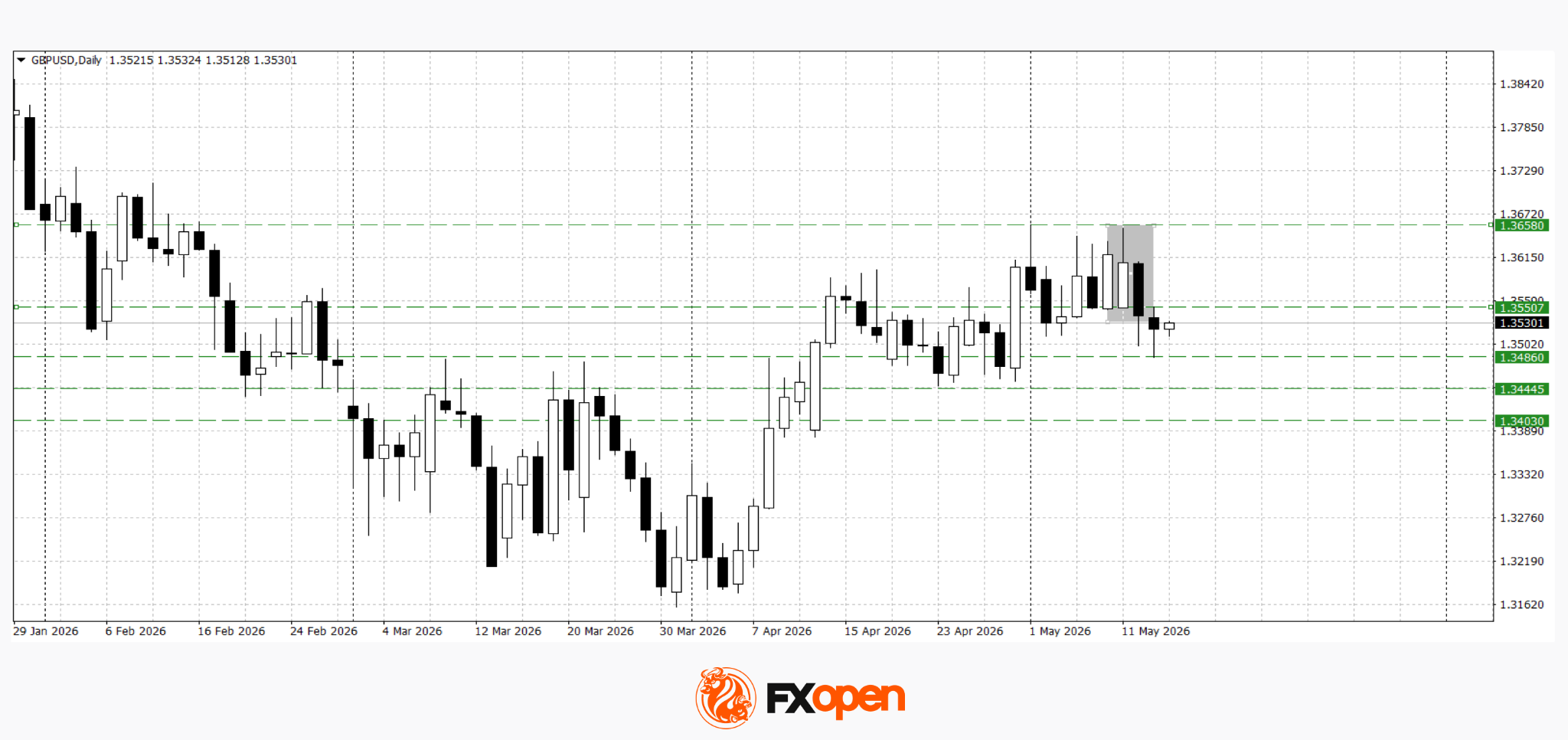
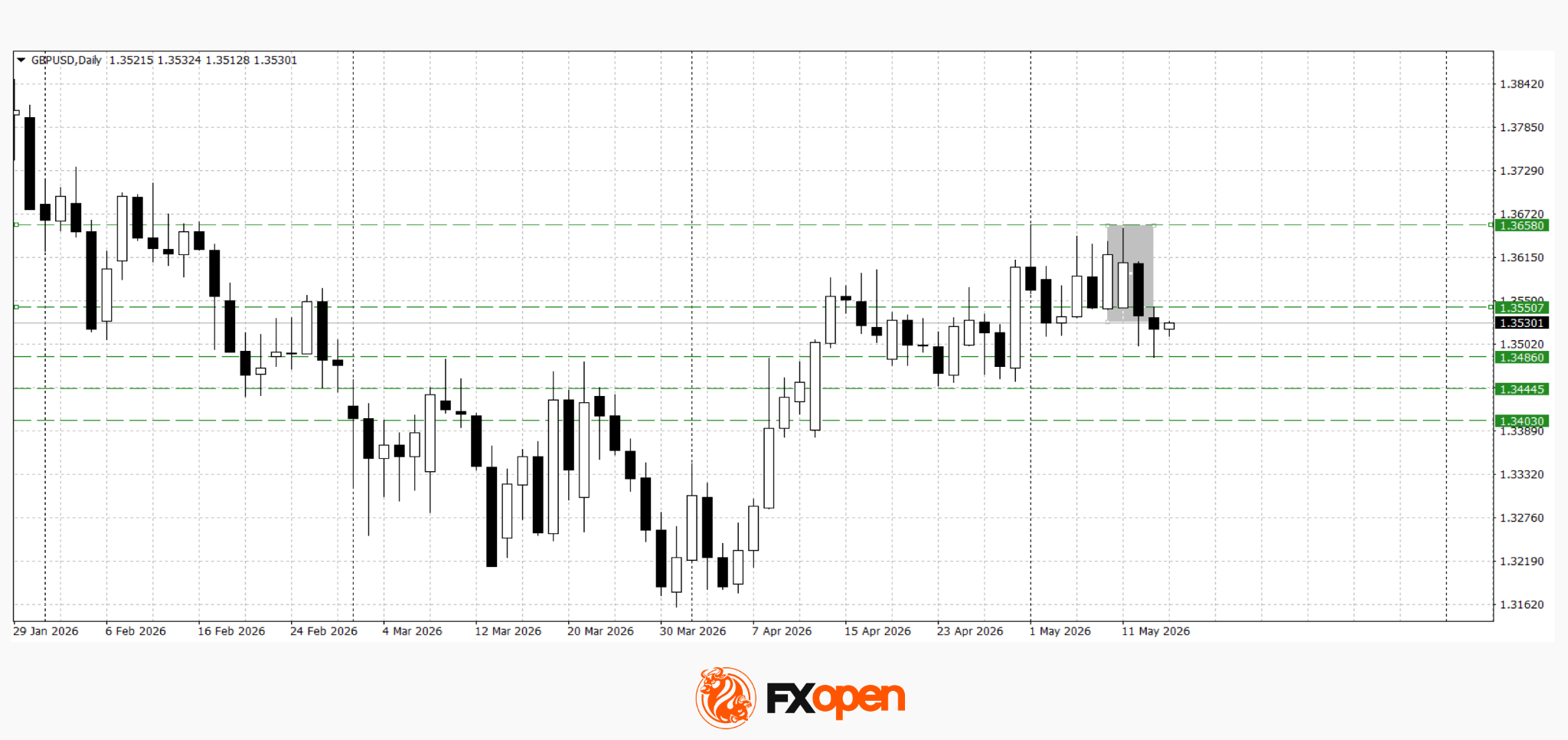
GBP/USD
GBP/USD is also correcting after its previous rally and remains within a range-bound structure. A move below yesterday’s low at 1.3490 could lead to a decline towards the 1.3400–1.3440 area. The bearish correction scenario remains valid while the pair stays below 1.3550.
Key Events For GBP/USD:
- today at 09:00 (GMT+3): UK GDP
- today at 09:00 (GMT+3): UK manufacturing production
- today at 15:30 (GMT+3): US initial jobless claims
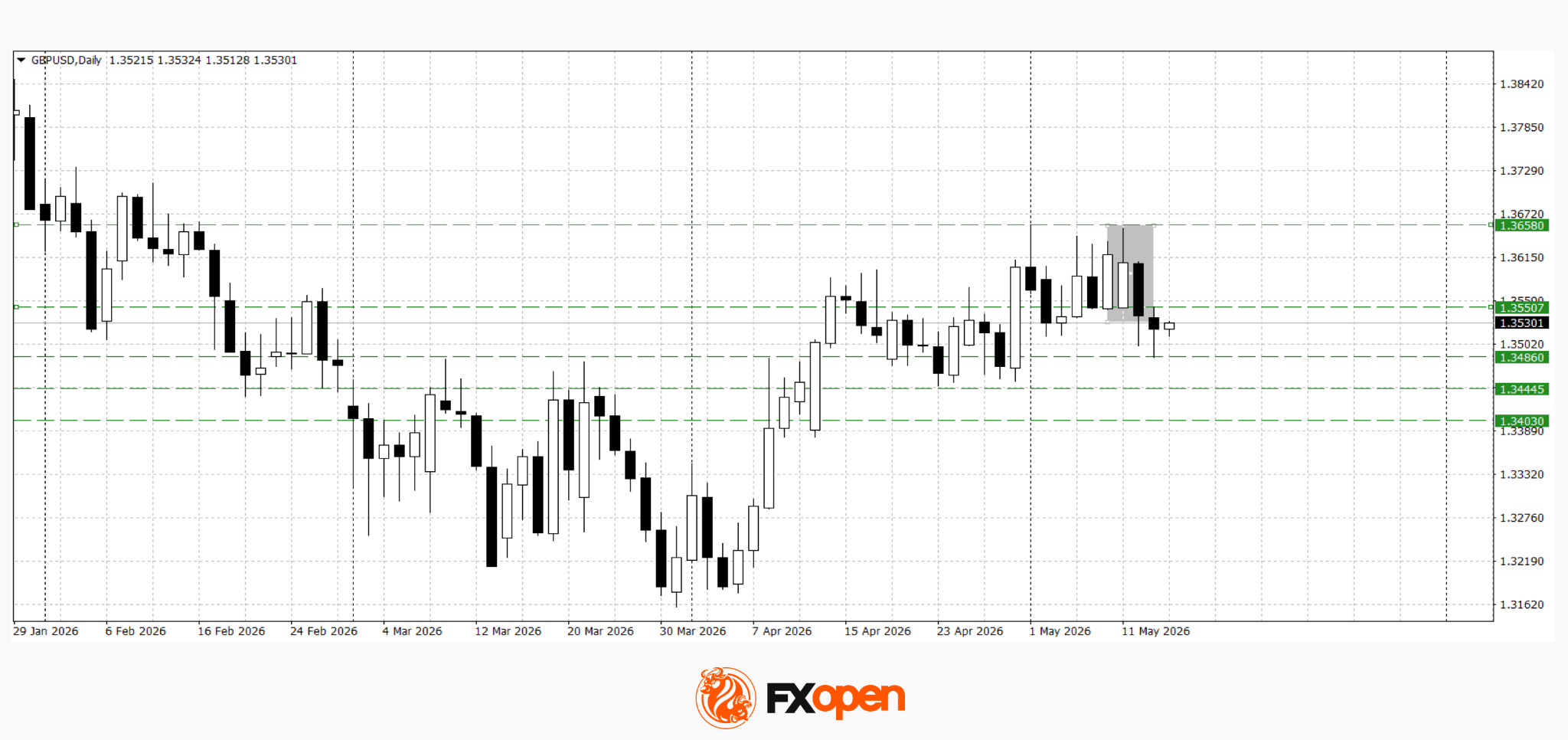
Market attention remains focused on UK economic data, including industrial production, construction output and investment activity. At the same time, the pair will continue to be influenced by US statistics and the dollar’s reaction to macroeconomic releases. If US data confirms signs of economic slowing, the dollar may come under renewed pressure, allowing GBP/USD to resume its upward movement. However, stronger US figures could intensify the current correction and keep the pair within its established range.
Trade over 50 forex markets 24 hours a day with FXOpen. Take advantage of low commissions, deep liquidity, and spreads from 0.0 pips (additional fees may apply). Open your FXOpen account now or learn more about trading forex with FXOpen.
This article represents the opinion of the Companies operating under the FXOpen brand only. It is not to be construed as an offer, solicitation, or recommendation with respect to products and services provided by the Companies operating under the FXOpen brand, nor is it to be considered financial advice.

)Major shifts toward a digitized financial architecture are edging closer to mainstream adoption, according to a forthcoming Moody’s Ratings assessment. In conversations with U.S. banks and other market intermediaries, the credit-ratings firm found a common view: tokenization will unfold in two stages—an initial slow phase that gradually accelerates into a tipping point where broader asset classes, participants, and use cases come on chain.
)Moody’s quotes industry leaders as saying broad asset tokenization is likely, but the timing and sequencing remain the big unknowns. In Moody’s words, “Across our conversations, industry leaders generally believed that broad asset tokenization will happen; the main uncertainties center around how quickly and in what sequence.”
)The report notes that near term progress is expected to be measured and focused on simpler segments—funds and short-term instruments—running in parallel with traditional processes. Yet, a growing cadre of market participants anticipates a point where adoption accelerates rapidly as infrastructure matures and more use cases prove viable, Moody’s said.
Tokenization — the on-chain representation of real-world assets or financial instruments — has long been cited as a foundational driver of institutional interest in blockchain and crypto. Moody’s underscores that, while the current activity remains modest, large banks and market intermediaries are actively building out capabilities to position themselves for a potential surge in demand. The report aligns with projections from analysts who see tokenization as a structural shift rather than a one-off trend.
Key takeaways
- Moody’s expects tokenization to proceed in a two-phase pattern: a gradual near-term ramp-up followed by a more rapid expansion as assets, markets, and participants come on chain.
- The market for tokenized real-world assets has grown rapidly, rising more than 420% since the start of 2025 and reaching about $31.6 billion, according to RWA.xyz.
- Institutional preparation is underway: virtually all large banks and major market intermediaries have created dedicated digital-asset teams and participate in pilots to test new infrastructure.
- Moody’s identifies three potential trajectories for the financial system based on tokenization pace: steady growth, constrained growth, or rapid disruption if tokenization accelerates, with meaningful implications for incumbents.
Momentum, pilots, and the coming tipping point
Despite the current quiet phase, the cross-currents pushing tokenization forward are evident. Moody’s highlights ongoing industry pilots aimed at validating new settlement rails, custody, and interoperability across networks. These efforts are described as strategic, with incumbents aiming to be ready to serve clients who demand digital asset and digital money capabilities if demand expands rapidly.
The debate about timing sits alongside other macro- and regulatory considerations. In parallel, industry observers point to a broader capital allocation shift toward tokenized assets as a potential source of efficiency improvements and transparency in settlement and record-keeping. The adoption curve remains a focal point for investors watching how quickly tokenization can scale beyond niche use cases toward mainstream financial products.
Three possible futures for a tokenized financial system
Moody’s lays out a trio of potential outcomes, tied to how quickly tokenization captures momentum. The base case, described as steady growth, envisions tokenization scaling in select assets such as stablecoins and tokenized deposits, while core banking and asset-management ecosystems retain influence. This is the scenario Moody’s views as most likely.
In a low-growth path, regulatory friction, unresolved legal questions, and tepid end-user demand could restrict tokenization to narrow uses, leaving the broader financial system largely intact and tokenization gains minimal.
The most disruptive scenario imagines rapid growth, with widespread on-chain settlement enabled by tokenized assets and digital money. In such a world, incumbents like payment processors and certain traditional interfaces could lose revenue tied to settlement delays and siloed infrastructures, while deposits at smaller banks might come under pressure as flows rechannel onto digital rails.
Industry voices outside Moody’s echo the sense that tokenization could reshape payments and settlement in meaningful ways. Macro investor Jordi Visser has suggested the tokenization reality could begin this year, highlighting the potential of tokenized assets to power more autonomous, AI-assisted payment flows. Meanwhile, international bodies have urged caution: the IMF has warned that tokenization can reduce friction and increase transparency, but also acknowledges the new risks it introduces for financial stability.
On the market-building side, demand signals are starting to coalesce around real-world assets and cross-border rails. The tokenization story intersects with the broader growth narrative around digital assets, with institutional interest sustained by pilots and strategic asset-token programs. Morgan Stanley’s ongoing crypto unit expansion, including leadership appointments and ETF/digital wallet initiatives announced earlier this year, illustrates how traditional banks are aligning with the tokenization narrative to capture a potential first-mover advantage in a more digitized financial system.
ARK Invest has positioned tokenized assets as a catalyst for a much larger digital assets market, with projections pointing toward a multi-trillion-dollar expansion by the end of the decade. While such forecasts are ambitious, the underlying premise remains: tokenization could unlock efficiencies and new liquidity pools that were previously inaccessible to traditional assets.
In regulatory and risk terms, observers will be watching how authorities balance innovation with stability. The IMF’s assessment underscores both opportunity and risk: tokenization can streamline finance, but it also demands robust oversight to avoid destabilizing side effects as on-chain markets scale.
What this means for investors and market participants
For investors and builders, the Moody’s report offers a structured view of the ecosystem dynamics shaping tokenization’s path. The near-term emphasis on funds and short-term instruments suggests early-stage opportunities exist in familiar, regulated investment vehicles that can bridge traditional finance and digital rails. Yet the longer-term potential hinges on the maturation of infrastructure—custody, interoperability, and settlement—alongside clear regulatory guardrails that unlock cross-border applicability and consumer access.
As institutions continue to assemble digital-asset teams and participate in pilots, market participants should monitor the following developments:
- Speed of expansion beyond niche asset classes into broader securities, funds, and possibly tokenized deposits.
- The pace at which stablecoins and central-bank digital money concepts gain credibility as reliable on-chain settlement options.
- Regulatory clarity and risk management frameworks that enable cross-border flows without compromising financial stability.
- Evidence from pilots on interoperability and settlement efficiency that could translate into measurable cost savings and improved liquidity.
For readers tracking the arc of this transition, the next phases will hinge on real-world deployments and the outcomes of ongoing pilots across major banks and asset managers. The Morgan Stanley crypto unit developments, public-facing product initiatives, and the evolving stance of international bodies will be key indicators of whether tokenization moves from aspiration to widespread practice in the near term.
Further coverage from Moody’s, along with continued industry pilots and regulatory updates, will illuminate how quickly the tipping point may arrive and which segments stand to gain or recede as tokenization reshapes the financial landscape.
Readers should stay tuned for updates on grand-scale pilots, cross-border settlement experiments, and any regulatory milestones that could accelerate or slow the tokenization trajectory.

Blockchain networks are designed to process transactions securely and transparently. But during periods of heavy activity — especially in crypto bull markets — networks can become congested. When this happens, users often experience high fees, delayed transactions, and slower application performance.
For beginners entering the crypto space, blockchain congestion can feel confusing and frustrating. One moment, a transaction costs a few cents, and the next it suddenly costs $20 or more. Understanding why this happens is essential for anyone using cryptocurrencies, decentralized finance (DeFi), NFTs, or blockchain-based applications.
Understanding Blockchain Congestion
Blockchain congestion happens when the number of transactions waiting to be processed exceeds the network’s available capacity.
Every blockchain has limits:
- The maximum number of transactions it can process per second (TPS)
- A limited block size or computational capacity
- A fixed block production speed
When too many users attempt to send transactions simultaneously, the network becomes overloaded.
Think of it like highway traffic 🚗
If only a few cars are on the road, traffic flows smoothly. But when thousands of vehicles enter the highway at once, congestion builds up, and everything slows down.
The same thing happens on blockchains.
Why Congestion Happens
Blockchain congestion is usually triggered by spikes in demand. Common causes include:
1. Bull Market Activity
During bull runs, trading activity increases dramatically. More people buy, sell, transfer, and interact with crypto applications all at once.
Popular networks such as Ethereum have historically experienced major congestion during periods of intense market speculation.
2. NFT Launches and Meme Coin Frenzy
Large NFT mint events or viral meme coin launches can flood networks with transactions.
Users compete to get their transactions processed first, creating bidding wars for block space.
3. DeFi Activity
Decentralized finance applications require constant blockchain interactions:
- Swaps
- Lending
- Yield farming
- Staking
- Liquidations
When DeFi activity surges, transaction volume can overwhelm the network.
4. Limited Network Throughput
Some blockchains prioritize decentralization and security over raw speed. This can reduce the number of transactions processed per second.
For example:
- Some networks process only a few dozen TPS
- Traditional payment systems can process thousands
This difference becomes noticeable during periods of high demand.
Gas Fees During Congestion
One of the biggest effects of congestion is rising gas fees.
Gas fees are payments users make to validators or miners for processing transactions.
When the network is busy:
- Users compete for limited block space
- Higher fees receive priority
- Transactions with low fees remain pending longer
This creates a fee market.
On networks like Ethereum, gas prices can rise dramatically during congestion events.
Example Scenario
Imagine:
- Normal transaction fee: $1
- Heavy congestion fee: $50+
During major NFT launches, some users have paid hundreds of dollars just to complete a single transaction.
This can make smaller transactions impractical.
Slow Confirmations
Congestion also slows transaction confirmations.
Normally:
- Transactions are processed quickly
- Confirmations happen within seconds or minutes
But during overload:
- Transactions wait in the mempool (pending queue)
- Confirmation times increase
- Some transactions fail entirely
Users may experience:
- Delayed token transfers
- Failed swaps
- Stuck withdrawals
- Frozen DeFi interactions
This creates a poor user experience, especially for beginners unfamiliar with blockchain mechanics.
What Is the Mempool?
The mempool is a temporary waiting area for pending blockchain transactions.
When you submit a transaction:
- It enters the mempool
- Validators or miners select transactions
- Higher-fee transactions usually get processed first
During congestion, the mempool becomes crowded.
This backlog can create long delays across the entire network.
Network Overload and Its Effects
Congestion affects more than just individual users.
It can impact entire ecosystems.
Common Effects of Blockchain Overload
Increased Costs
Applications become expensive to use due to high gas fees.
Reduced Accessibility
Small users may be priced out of the network.
Slower Applications
Blockchain-based games, DeFi platforms, and NFT marketplaces may lag or fail.
Failed Transactions
Users can lose gas fees even if the transaction fails.
Poor User Experience
New users may become discouraged by delays and unpredictable costs.
Real-World Examples of Blockchain Congestion
Several major congestion events have shaped crypto history.
Crypto Bull Runs
During intense market rallies:
- Exchanges become overloaded
- Wallet activity spikes
- Trading volume surges
Networks often struggle to keep up.
NFT Minting Wars
Popular NFT collections have caused massive traffic spikes.
Thousands of users compete simultaneously, overwhelming the blockchain infrastructure.
Meme Coin Surges
Speculative trading around viral tokens can rapidly increase transaction demand.
This often creates temporary fee explosions and slower confirmations.
How Blockchains Try to Solve Congestion
Blockchain developers continuously work on scaling solutions to improve performance.
These upgrades aim to:
- Increase transaction speed
- Lower fees
- Improve scalability
- Reduce bottlenecks
Here are the main approaches.
Layer 2 Scaling Solutions
Layer 2 networks process transactions outside the main blockchain while still benefiting from its security.
Popular methods include:
- Rollups
- Sidechains
- Payment channels
These systems reduce congestion on the main network.
Examples connected to Ethereum include:
Layer 2 solutions have become increasingly important for reducing gas fees and improving transaction speed.
Increasing Block Capacity
Some blockchains increase:
- Block size
- Throughput
- Transaction limits
This allows more transactions per block.
However, larger blocks can create trade-offs involving decentralization and hardware requirements.
Alternative Consensus Mechanisms
Different consensus systems can improve scalability.
For example:
- Proof-of-Stake networks often process transactions more efficiently than older Proof-of-Work systems
- Some blockchains use parallel processing architectures
These designs aim to handle larger transaction volumes.
Sharding
Sharding divides blockchain activity into smaller sections called shards.
Instead of every validator processing every transaction:
- Different groups process different shards
- Workload becomes distributed
This can significantly improve scalability.
Why Congestion Matters
Blockchain congestion is more than a technical issue.
It directly affects:
- Transaction costs
- User adoption
- Developer activity
- Market sentiment
- Network competitiveness
A blockchain that cannot scale efficiently may struggle during periods of mass adoption.
That is why scalability remains one of the most important challenges in the crypto industry.
Final Thoughts
Blockchain congestion is a natural result of growing demand. When too many users interact with a network at once, transaction queues grow, fees rise, and confirmation times slow down.
While congestion can frustrate users, it also highlights something important: people are actively using the network.
As blockchain adoption grows, scaling solutions such as Layer 2 networks, sharding, and improved consensus mechanisms will continue playing a major role in making crypto faster, cheaper, and more accessible.
Understanding congestion helps beginners navigate the crypto ecosystem more confidently — especially during fast-moving bull markets where network activity can surge overnight. 🚀
REQUEST AN ARTICLE


With the rapid development of artificial intelligence technology, more and more industries are entering the era of intelligentization, and the digital asset field is also undergoing new changes.
Recently, XRP Power officially launched its global AI-powered app, integrating AI data analysis, automated systems, and intelligent yield models to bring a more efficient and convenient digital asset participation experience to users worldwide. Compared to the traditional model that relies on frequent trading and manual operation, XRP Power emphasizes intelligent, automated, and long-term stable system operation logic.
It is understood that XRP Power’s new AI system optimizes the overall operational efficiency of the platform through real-time market data analysis, intelligent risk control mechanisms, and automated task scheduling. Users can participate in the platform’s intelligent yield system through the app without complicated operations, reducing the time, technical, and experience barriers faced in traditional digital asset participation.
In the current market environment, more and more users are shifting from “short-term trading” to a “structured yield” model. Compared to the uncertainty brought by high-frequency trading, some users prefer participation methods with clear rules, transparent processes, and automated system operation. The addition of AI technology is further driving this trend.
XRP Power AI Intelligent System Core Advantages
- Simplified User Experience: Users can quickly participate and manage through an intelligent interface without complex learning processes, lowering the barrier to entry.
- AI Intelligent Analysis and Automated Execution: The system can dynamically analyze real-time data and automatically complete operation scheduling and task management, improving overall efficiency.
- On-Chain Transparency Mechanism: Key data supports on-chain queries, making operational logic and information records more open and transparent, enhancing user trust.
- Multi-Layer Real-Time Risk Control System: The platform combines intelligent monitoring and risk warning mechanisms to continuously optimize overall security and system stability.
- Real-Time Data Synchronization System: Account information, earnings records, and system status can be updated in real time, making the overall experience clearer and more intuitive.
- 24/7 Intelligent Operation Mechanism: The AI system runs continuously 24 hours a day, ensuring platform stability and automated execution capabilities.
Join the XRP Power AI Intelligent Experience
- Account Creation: Users can register using their email address to quickly create a personal account. The entire process is simple and efficient, supporting convenient access to the platform for users worldwide. (New users can also receive rewards)
- Participate in AI Smart Contracts using Cryptocurrency – Users can flexibly choose AI smart contracts with different periods using cryptocurrency payments to participate in the platform’s intelligent profit system.
- Daily Profits Automatically Returned to Account – During contract execution, the system will automatically settle profits through an AI intelligent mechanism and distribute them to the account balance daily in real time.
- Flexible Management and Free Operation – Account balances can be managed at any time. Users can apply for withdrawals or continue to participate in other AI smart contracts, achieving a more flexible and efficient digital asset management experience.
About XRP POWER
XRP POWER is building a safer, more efficient, and intelligent digital service system through its AI intelligent system, new energy ecosystem, and global APP services.
The platform continuously optimizes overall operational efficiency and user experience, providing global users with a more convenient and stable digital service experience. With the continuous upgrading of AI technology and the global ecosystem, more and more users are beginning to pay attention to more intelligent and automated digital service models.
Users can learn more about the AI intelligent system, global APP services, and related functions through the official XRP POWER platform.
Risk Warning
Before participating in any related services, users should carefully review the contract terms and participate rationally based on their own risk tolerance.
Furthermore, users are advised to plan their financial allocation reasonably, enhance their risk awareness, and participate in compliance with relevant local laws and regulations.
Learn more on our official website: https://xrppower.com
Official Email: info@xrppower.com
The post XRP Power Launches Global AI-Powered App, Creating an Intelligent Daily Yield System appeared first on Cryptonews.


A new poll shows just 4% of Americans would weigh a candidate’s crypto stance at the ballot box. This ranks the issue at the bottom of voter concerns ahead of the 2026 midterms.
The result undermines the industry’s central pitch, which casts everyday digital asset investors as a powerful voting bloc. That premise has helped justify hundreds of millions in political spending across the 2026 cycle.
Voters Rank Crypto Below Housing and Fraud
The POLITICO Poll, conducted with Public First, found that even among 19% Americans who have traded digital assets, only 7% say a candidate’s crypto stance would sway their vote.
“Lawmakers in both parties have spent much of the past two years fixated on enacting sweeping new cryptocurrency legislation. Their work…is of little interest to voters,” POLITICO wrote.
Follow us on X to get the latest news as it happens
The survey highlighted that 18% of respondents want lawmakers to prioritize cryptocurrency rules. That trails housing affordability at 49% and consumer fraud protection at 36%.
Public support for legitimizing crypto as a mainstream financial asset sits at 27%. By contrast, 31% oppose government action, and 42% remain neutral or undecided.
An earlier survey found 45% of Americans consider crypto investing not worth the risk. These findings suggest crypto remains a low-priority issue for most voters despite the industry’s growing political influence. They also reflect lingering public skepticism toward digital assets as a mainstream investment class.
Subscribe to our YouTube channel to watch leaders and journalists provide expert insights
The post Only 4% of US Voters Care About Crypto at the Ballot Box, New Poll Finds appeared first on BeInCrypto.


A viral X post is claiming Claude ‘cracked’ a forgotten bitcoin wallet to recover 5 BTC from a user’s computer.
But don’t get caught in the hype as that is not what happened. Anthropic’s AI simply helped the owner search their own computer for an old wallet file, which was then decrypted with a password the owner already had written down in a notebook.
User cprkrn posted the recovery on Wednesday, calling it “the most obvious opening ever” once they figured out what had happened.
The owner had been trying for eight weeks to brute-force the password on their current Blockchain.com wallet, testing roughly 3.5 trillion combinations using the btcrecover service on a rented computing chip.
The recovery happened when the user “dumped my whole college computer into Claude” as a last-ditch effort, and the assistant located an old wallet backup from December 2019 that was encrypted with a password the user already had written down in a notebook.
The old password decrypted the old backup, which contained the same private keys controlling the current funds, since bitcoin private keys never change.
The password itself was “lol420fuckthePOLICE!*:)” per the user’s own X disclosure. Total Vast.ai GPU spend on the failed brute-force attempts was around $15, with the recovery effectively a file search.
For context, breaking bitcoin’s actual cryptography would require either a working quantum computer running Shor’s algorithm or a flaw in elliptic-curve cryptography that has not been found in 16 years of public scrutiny.
CoinDesk’s post-quantum security series earlier this year covered the timeline expectations for that threat, with most researchers placing the cryptographically relevant quantum computer at least five to ten years out.
But the user’s experience opens up a further door for AI inside crypto. Forgotten wallets from bitcoin’s early years now hold serious value, and recovery tools like btcrecover have existed for years to help users test password variations against encrypted wallet files.
The problem has always been that most recovery work requires technical expertise that the average lost-bitcoin owner does not have.
That is where AI assistants can step in. Instead of manually sorting through folders, timestamps, and backup files across years of accumulated drive clutter, owners can hand the search to an LLM and have it identify patterns, narrow the search space, and surface candidate files.
Millions of bitcoin are believed to remain inaccessible because owners lost passwords, drives, or recovery phrases during the early years.
With bitcoin trading around $79,000, a forgotten laptop in a closet could be holding six figures. Back up wallet data carefully, store recovery phrases somewhere that is not your memory, and check old hardware before you sell it.


Metaplanet booked a ¥114.5 billion ($725 million) net loss for the first quarter of fiscal 2026.
Accounting valuation losses on its Bitcoin (BTC) holdings drove the decline after the cryptocurrency posted its worst Q1 since 2018.
Bitcoin’s Worst Q1 Since 2018 Hits Metaplanet’s Treasury
Bitcoin fell roughly 22% during the first quarter of 2026. The drop marked Bitcoin’s weakest first quarter in eight years. The decline hit major corporate holders, including Metaplanet.
“The ordinary loss and quarterly net loss attributable to owners of parent were primarily attributable to accounting valuation losses resulting from the decline in Bitcoin prices at the end of the first quarter and reflect short-term mark-to-market fluctuations,” the firm said.
Despite the dip, the Tokyo-listed firm increased its Bitcoin holdings to 40,177 BTC. BTC holdings per fully diluted share rose 2.8% QoQ to 0.0247319, with Metaplanet holding ~87% of all BTC held by Japanese listed companies as of May 2026
Moreover, operating performance also moved in the opposite direction. Net sales climbed 251% year-over-year while operating profit jumped 282% to ¥2.27 billion ($14.4 million).
Follow us on X to get the latest news as it happens
Metaplanet’s Preferred Share Listing Faces Two Hurdles
In addition to the fiscal results, Metaplanet CEO Simon Gerovich also addressed delays in the company’s perpetual preferred share listing on X. Gerovich outlined two key considerations.
Japanese listing rules require preferred dividends to be supported by sustainable cash flows across multiple market scenarios.
“Metaplanet already has a six-quarter track record in its Bitcoin Income Generation Business, and we believe it is important to continue demonstrating that the business can generate stable, recurring cash flows across both strong and weak Bitcoin market conditions,” he said.
In addition, Metaplanet plans monthly dividends, well above Japan’s typical once or twice-yearly cadence. Implementing this requires substantial work on record-date procedures, shareholder identification, dividend calculation, and recurring shareholder notice operations.
Gerovich pointed out that few listed preferred shares currently trade in Japan. If approved, Metaplanet’s offering would become only the seventh in the market and the country’s first perpetual preferred share.
Subscribe to our YouTube channel to watch leaders and journalists provide expert insights
The post Metaplanet Books $725 Million Q1 Loss as Bitcoin Stack Hits 40,177 BTC appeared first on BeInCrypto.

TLDR
- Metaplanet reported a net loss of 114.5 billion yen or $725.6 million in the first quarter of fiscal 2026.
- The company recorded 116.4 billion yen in bitcoin valuation losses due to lower prices at quarter’s end.
- Revenue rose 251.1% year over year to 3.08 billion yen during the quarter.
- Operating profit increased 282.5% to 2.3 billion yen, driven by bitcoin income strategies and hotel operations.
- Metaplanet added 5,075 BTC in the quarter, bringing total holdings to 40,177 BTC as of March 31.
Metaplanet reported a net loss of 114.5 billion yen, or $725.6 million, for the fiscal 2026 first quarter. The company recorded heavy unrealized Bitcoin valuation losses, which offset higher revenue and operating profit. It released the figures in its consolidated financial report for the quarter ended March 31.
Metaplanet Records Bitcoin Markdowns Despite Higher Revenue
Metaplanet booked 116.4 billion yen, or $737.6 million, in bitcoin valuation losses during the quarter. The company said the losses stemmed from mark-to-market adjustments tied to lower Bitcoin price at quarter’s end. It stated that these losses reflect short-term fluctuations in the value of its holdings.
However, revenue rose to 3.08 billion yen, or $19.5 million, up 251.1% year over year. Operating profit increased to 2.3 billion yen, or $14.4 million, marking a 282.5% rise. The company attributed the operating growth to its bitcoin income generation business and hotel operations.
The firm said its bitcoin income strategies include options-based approaches linked to its BTC reserves. It reported that these activities contributed to improved operating performance during the period. At the same time, hotel operations continued to generate steady earnings.
Management reiterated its focus on bitcoin as a core treasury asset. The company described Bitcoin as the “world’s first truly decentralized monetary asset.” It maintained that accounting losses reflect price movements at the reporting date.
Bitcoin Holdings Expand Under Treasury Strategy
Metaplanet increased its Bitcoin reserves during the quarter. The company added 5,075 BTC to its balance sheet between January and March. As a result, total holdings reached 40,177 BTC as of March 31.
The company stated that it adopted a “Bitcoin Standard” in April 2024. Under this policy, it designated bitcoin as its primary treasury reserve asset. It said this move made it the first listed Japanese company to take that step.
Metaplanet reported that it holds about 87% of all bitcoin owned by listed companies in Japan as of May 2026. The company continued accumulating bitcoin during the quarter despite price volatility. It did not disclose the average purchase price for the added coins.
The quarterly filing showed that bitcoin markdowns drove the overall net loss. However, operating metrics improved compared with the prior year period. The company confirmed its total bitcoin holdings stood at 40,177 BTC at the end of March.


M5 Max 16-inch MacBook Pro vs Samsung Galaxy Book6 Ultra: Compared

London politics LIVE: Labour meltdown as Rayner prepares to join Starmer leadership fight which could start today

Meta smart glasses sales soar despite mounting privacy backlash

Manchester United reach agreement with Casemiro over contract clause amid transfer speculation

US brings back mandatory military draft registration

Steven Gerrard disagrees with Gary Neville over ‘shock’ Chelsea and Arsenal claim | Football


-
 Crypto World6 days ago
HarrisX Poll Found 52% of Registered Voters Support the CLARITY Act
-

 Fashion6 days ago
Weekend Open Thread: Marianne Dress
-

 Crypto World7 days ago
Upbit adds B3 Korean won pair as Base token gains Korea access
-
 NewsBeat7 days ago
NCP car park operator enters administration putting 340 UK sites at risk of closure
-

 Fashion3 days ago
Coffee Break: Travel Steam Iron
-

 Tech4 days ago
Auto Enthusiast Carves Functional Two-Stroke Engine from Solid Metal
-

 Fashion3 days ago
What to Know Before Buying a Curling Wand or Curling Iron
-

 Politics2 days ago
What to expect when you’re expecting a budget
-
 Business5 days ago
Ignore market noise, India’s long-term story intact, say D-Street bulls Ramesh Damani and Sunil Singhania
-

 Politics5 days ago
Politics Home Article | Starmer Enters The Danger Zone
-

 Tech3 days ago
GM Agrees To Pay $12.75 Million To Settle California Lawsuit Over Misuse Of Customers’ Driving Data
-

 Politics7 days ago
Simon Cowell Says He Was ‘Horrible’ To Susan Boyle During BGT Audition
-

 Entertainment6 days ago
General Hospital: Ric & Ava Bombshell – Ric’s Massive Secret Exposed!
-

 Entertainment7 days ago
Why David Letterman Called CBS ‘Lying Weasels’
-
Entertainment7 days ago
Hayden Panettiere reveals she's estranged from mom, addresses brother Jansen's sudden death: 'I was floored'
-
 Entertainment7 days ago
Paramount+’s ‘Landman’ Season 3 Gets Promising New Update From Returning Director
-

 Sports6 days ago
Bayern Munich vs PSG UEFA Champions League SF2 live match time, streaming | Football News
-

 Entertainment5 days ago
YNW Melly Denied Bond Again Ahead Of Double Murder Retrial
-

 Tech2 days ago
GM agrees to $12.75M California settlement over sale of drivers’ data
-

 Politics7 days ago
Euphoria Creator Praises Sydney Sweeney Amid Season 3 Scenes Backlash
You must be logged in to post a comment Login