

Crypto World
South Korea crypto tax repeal petition hits 50k signatures


South Korea’s planned 22% tax on crypto investment gains is moving into a new phase as a petition against the regime surpasses the threshold for a formal review. The petition, calling for scrapping or revising the tax, has crossed 50,000 signatures and now sits above 52,000, triggering the Finance and Economic Planning Committee to consider objections to the new framework. The tax is slated to take effect in January 2027, a timeline critics say could burden investors and curb innovation at a time when Korea remains a major crypto hub in the Asia-Pacific region.
The petition’s authors argue that taxing crypto gains at 22% while granting other asset classes preferential treatment undermines Korea’s competitiveness in the global crypto market. In a translated statement included with the petition, they warned that short-term revenue motives could backfire, leading to long-term losses for the economy as talent and capital move abroad.
“If taxation is enforced in order to secure short-term tax revenues, it is likely to lead to greater losses in the long term, namely, a contraction of industry and an outflow of capital and talent abroad.”
The growing support for the petition underscores a broader debate about how to tax digital assets without stifling growth in a sector that many investors view as a strategic pillar for the country’s future fintech ecosystem. The petition’s momentum comes alongside other policy headlines and a broader tightening of regulatory controls on crypto activity.
Key takeaways
- Petition against the 22% crypto tax has surpassed 52,000 signatures, meeting the threshold that triggers official consideration by Korea’s Finance and Economic Planning Committee.
- The tax is scheduled to begin in January 2027, with critics arguing it imposes burdens on investors and could dampen Korea’s crypto innovation and talent retention.
- Market data show a notable contraction in Korea’s crypto sector, even as the country remains a regional hub; total holdings and trading volumes have declined since late 2024.
- Tighter AML/KYC measures are tightening the regulatory envelope, including automatic flagging of crypto transfers above 10 million won to or from foreign wallets.
- Ownership remains sizable but fragile: Yonhap reported about 32% of the population owned crypto as of March 2025, a figure under pressure as prices and regulations weigh on participation.
Policy review in motion as petition grows
At the heart of the current debate is a straightforward question: how should Korea tax gains from digital assets in a manner that preserves competitiveness while funding public needs? The petition asserts that the 22% levy, which would apply to investment gains on crypto assets, would add a disproportionate burden on individual investors and could distort tax equity when compared with other asset classes. The petition’s authors contend that a rushed or overly aggressive approach could deter participation in Korea’s crypto markets and push builders and capital toward friendlier jurisdictions.
The formal review triggered by the petition does not guarantee a change in policy, but it does elevate the policy discussion to the legislative stage. Stakeholders across the crypto industry—exchanges, wallets, and advisory firms—have been watching closely as the country tests a balance between tax stability, consumer protection, and market vitality.
Market dynamics amid tighter rules and a cooling market
Even as policy discussions intensify, industry data paints a picture of a sector under pressure. Korea has long been a major crypto participant, but several metrics point to a contraction in recent years. Yonhap, citing local data, reported that ownership of cryptocurrencies stood at about 32% of the population in March 2025. While that figure signals broad familiarity with digital assets, it also sits against a backdrop of price volatility and regulatory scrutiny that has tempered enthusiasm.
Numbers on market size and activity illustrate the trend. Industry data show that the total value of crypto held by Koreans declined from around 121.8 trillion won (approximately $83.3 billion) in January 2025 to about 60.6 trillion won (roughly $41.4 billion) in February 2026. In the same period, daily trading volumes on the country’s five largest exchanges—Upbit, Bithumb, Coinone, Korbit, and Gopax—fell sharply, from about $11.6 billion in December 2024 to around $3 billion in February 2026. Analysts describe a move toward the broader stock market or other asset classes as part of a shifting investment calculus amid regulatory tightening and crypto price pressure.
Analysts and industry observers point to a tightening regulatory regime as a key factor. In particular, Korea’s Financial Services Commission (FSC) and the Financial Intelligence Unit (FIU) proposed measures in March 2026 that would require automatic flagging of crypto transactions above 10 million won ($6,630) sent to or from foreign wallets. While policymakers argue these steps improve AML outcomes and market integrity, critics say the operational burden could dampen exchange activity and complicate cross-border trading for ordinary investors. Industry associations have pushed back against such reporting requirements, cautioning that they could impose substantial compliance costs and hinder everyday usage of crypto services.
South Korea’s regulatory trajectory sits within a broader regional context where jurisdictions are recalibrating how to treat digital assets—balancing consumer protection, tax revenue, and market growth. The effect on korean exchanges, liquidity, and competitiveness will be an important reference point for other markets watching for federal or provincial-level policy templates.
What comes next for policy and participation
With the petition now positioned to prompt formal consideration, observers will be watching not only for a potential revision to the tax rate but also for any adjustments to enforcement timelines, reporting requirements, or grace periods that might accompany a policy shift. The government’s stance remains that tax policy should reflect risk management, revenue needs, and fair treatment of different asset classes; the counterargument emphasizes the need to protect Korea’s market share as a leading crypto hub and to avoid inadvertently driving activity underground or abroad.
Readers should monitor statements from the Finance and Economic Planning Committee, as well as updates from the FSC and FIU, for signals about any forthcoming amendments or clarifications. In parallel, industry groups and users will likely rally behind or challenge specific provisions, particularly around reporting obligations and the treatment of gains versus other investment instruments.
For context, Korea’s policy environment continues to evolve in tandem with related developments, including reported moves toward tokenized securities rules slated for July and ongoing debates about how best to tax and regulate digital assets. As the landscape shifts, market participants will weigh how any potential changes could affect holdings, liquidity, and the practicalities of trading across borders.
Related reading: coverage of Korea’s tokenized securities framework and broader regulatory stance offers additional context for how crypto policy is evolving in one of Asia’s most active markets.
In the near term, the main watch is how the Finance and Economic Planning Committee interprets and acts on the petition, and whether policymakers offer adjustments that could steer the tax regime toward a balance between revenue needs and market vitality. The outcome will likely influence not only investors’ approach to Korea’s crypto markets but also the strategic considerations of exchanges, developers, and users navigating Korea’s increasingly complex regulatory terrain.

Crypto World
XRP POWER launches its intelligent app, enabling global users to earn $7,700 in passive income daily


Disclosure: This article does not represent investment advice. The content and materials featured on this page are for educational purposes only.
XRP POWER launches AI-powered app in 2026 to simplify digital finance and automation for global users.
Summary
- XRP POWER launches new AI-driven app combining automation and digital ecosystem tools for global users.
- The platform highlights security framework including ISO 27001, SOC 2, GDPR, KYC, 2FA, and AML compliance systems.
- It also integrates AI risk control and decentralized architecture to improve transparency, traceability, and security.
In 2026, AI technology continued its accelerated development, and artificial intelligence is rapidly transforming the global digital finance and automation ecosystem. More and more users are exploring new digital income models through intelligent platforms, hoping to obtain more flexible and efficient long-term income opportunities amidst market changes and increasing pressure on traditional income.
Against this backdrop, XRP POWER officially launched its new intelligent app, combining an AI automation system with the digital ecosystem to provide global users with a more convenient intelligent service experience. The platform, through intelligent AI system automation and data management, further lowers the barrier to entry for complex operations, attracting increasing attention from ordinary users and digital investors.
XRP POWER’s AI intelligent security system
XRP POWER continues to integrate AI intelligent risk control technology with international security standards to create a more stable, secure, and transparent global digital ecosystem, providing users with a higher level of security and intelligent service experience.
Regarding data security and privacy protection, the platform strictly adheres to international security and data protection standards such as ISO/IEC 27001, SOC 2 Type II, and GDPR, comprehensively strengthening its capabilities in user information security, account protection, and privacy management.
Simultaneously, XRP POWER introduces an AI-powered intelligent risk identification system, combined with AML anti-money laundering mechanisms, KYC identity verification, and 2FA two-factor authentication, continuously optimizing risk control and account security management through a multi-layered intelligent security protection system.
In terms of underlying technical architecture, the platform combines decentralized technology with AI intelligent algorithms to achieve data transparency, transaction traceability, and tamper-proof mechanisms, further enhancing the platform’s overall transparency, security, and global user trust.
XRP POWER intelligent AI registration process
XRP POWER offers various AI smart contracts with different periods and models, allowing users to flexibly choose the product solution that best suits their needs.
After selecting the corresponding contract, simply complete the payment using a mainstream cryptocurrency to quickly activate and begin your daily experience with the AI-powered smart system.
During contract operation, the platform will automatically settle earnings daily and return them to your account balance. Users can freely choose to withdraw funds or continue participating in other smart contract products, making the overall operation more convenient and flexible.
Partial list of profitable contracts
Contract Name: Dogecoin [AI Smart Quantitative] Investment Amount: $5,000, Term: 15 days, Daily Yield: $70.50, Total Profit: $1,050.50, Principal Returned at Maturity: $5,000
Contract Name: Bitcoin/Bitcoin Cash [AI Global Smart Ecosystem] Investment Amount: $25,000, Term: 23 days, Daily Yield: $417.50, Total Profit: $9,602.50, Principal Returned at Maturity: $25,000
Click to view more details on contract period returns
About XRP POWER
Currently, XRP POWER has over 3 million users worldwide, covering 189 countries and regions. With the continuous development of its AI-powered smart app and the ongoing improvement of its digital ecosystem, more and more users are experiencing smarter, more convenient, and more efficient digital ecosystem services through XRP POWER
Leveraging its AI-powered intelligent system, global operating model, and continuously optimized platform services, XRP POWER is constantly improving user experience and ecosystem stability. Against the backdrop of rapid global digital finance development, the platform continues to attract attention and participation from users in different countries and regions.
For more details, please visit the official website or download the iOS and Android apps.
Disclosure: This content is provided by a third party. Neither crypto.news nor the author of this article endorses any product mentioned on this page. Users should conduct their own research before taking any action related to the company.

Bitcoin is treading near a critical price frontier around $80,000, as a confluence of derivative pressure and technical signals hints at a potential shift in the risk balance. Data tracked by CoinGlass indicate that the lion’s share of leveraged exposure sits above the current price, with more than $4 billion in short positions exposed to a move into the $80,000 area. That looming container of risk sits against a backdrop of support around $76,100 that BTC defended for two consecutive days, while bullish signals emerged on shorter timeframes.
In recent sessions, Bitcoin briefly retested the $78,000 mark after hovering near the $76,100 support level. On the chart, a bullish divergence between price action and the relative strength index on the one-hour timeframe has appeared, accompanied by higher lows that hint at underlying buying strength. Traders will be watching whether BTC can clear the $78,000 threshold and push toward the $80,000 region, where the literature suggests a cluster of liquidity could be exposed and a potential shift in the near-term trajectory could unfold.
Key takeaways
- More than $4 billion in short positions sit above the current price, meaning a move toward $80,000 would likely trigger substantial short-liquidation pressure.
- A downside risk exists as roughly $3 billion in long liquidations could be triggered if BTC slides toward $75,000, underscoring asymmetric risk around the current range.
- The price action is forming patterns that traders interpret as a possible pre-breakout setup—an inverse head-and-shoulders under a descending trendline with a $78,000 threshold to clear before testing higher levels.
- Liquidity appears split: weak spot demand alongside rising futures activity, characteristic of leveraged-driven upside in the near term.
- Futures-driven momentum may dominate near-term moves, but the confluence of FVGs and liquidity clusters at the $79.5k–$80.3k zone suggests a defined near-term retest area that bears watching for a sustainable breakout or a rejection.
Liquidity cliff at the $80,000 mark
The near-term risk landscape centers on how large a move into the $80,000 zone could become for liquidations. CoinGlass data show the largest concentration of leveraged risk sits above current price levels; a move toward $80,000 would expose more than $4 billion in cumulative short liquidations. By contrast, a drop toward $75,000 would expose roughly $3 billion in long liquidations, presenting a skew toward downside pressure as well, but with a potentially sharper upside impulse if a short squeeze develops.
The technical setup reinforces the narrative. On the one-hour chart, Bitcoin formed a bullish divergence between price and RSI, with momentum improving as price held above the $76,100 support. The market has also been shaping an inverse head-and-shoulders pattern beneath a descending trendline, a structure that market participants often interpret as a softening bearish bias before a breakout. A sustained move above $78,000 could bring the fair-value gap (FVG) in the range of $79,500 to $80,300 into focus—a low-liquidity territory created during a previous selloff that price could revisit to fill before continuing its next leg.
In practical terms, a climb into the high $70s and into the $80k zone would test short positions with a potentially rapid unwind, while a move lower could trigger additional long liquidations. The dynamic highlights the asymmetric risk the market faces in the near term: a relatively small move in BTC price could force outsized liquidations on one side of the book depending on direction.
Derivatives activity versus spot behavior
Derivatives markets appear to be driving the recent upside more than immediate spot demand. In the latest 24-hour window, liquidations accelerated markedly, with CoinGlass data showing 103,963 traders liquidated and total liquidations amounting to $286.08 million. Short positions accounted for nearly $175 million of that total, underscoring the magnitude of risk concentrated in the short side of the book. The largest single liquidation hit Binance’s BTC/USDT pair at $3.04 million.
Open interest data from CryptoQuant painted a picture of risk posture shifting as volatility spiked. Bitcoin-denominated open interest stood near 116,800 BTC, down from roughly 120,000 BTC a day earlier. The drop suggests that traders were trimming leveraged exposure during the recent volatility, a sign that risk is being managed rather than aggressively escalated at current levels.
Spot market participation remained comparatively tepid as price reclaimed the $78,000 vicinity. The aggregated spot volume delta (CVD), which measures net buying versus selling pressure, registered at about -$483 million, signaling a degree of selling pressure in the spot arena. Conversely, the futures CVD nudged into modest positive territory, around +$34 million, complemented by persistently elevated funding rates that imply a short-term bullish tilt in the futures market. Taken together, the data indicate a liquidity split: fewer buyers in the spot market and a contingent, levered buyer presence in the futures space that has helped push prices higher in the near term.
The confluence of a cooling open interest, a quantifiable tilt toward futures-driven upside, and the looming $80,000 liquidity stack suggests traders should prepare for a decision point at the upper boundary of the current range. If price action can decisively clear the $78,000–$80,000 zone and sustain it, the market could test the FVG-retransmission zone and possibly push toward new highs in the current cycle. If, however, the bid support fails to materialize, a retest of the mid-$70s could reintroduce the risk-off dynamic that characterized earlier weeks.
For context, reports and data from market analytics providers corroborate the scene: liquidations and open-interest dynamics are consistent with a transition in momentum from cautious accumulation to a more aggressive, levered move when price passes key levels. The broader takeaway is that while spot demand remains spotty, the pull of the futures market—and the liquidity patch around $80k—could determine the near-term path for BTC.
What this means for traders and builders
From an investor and trader perspective, the current configuration emphasizes two themes. First, liquidity concentration at the $80,000 zone makes it a high-stakes battleground for leveraged traders. A break above that level could unleash a sizable short squeeze, given the $4 billion exposure to shorts, while a rejection could provoke an equally rapid unwind in long positions that now sit at risk around the mid-$70s.
Second, the divergence between futures activity and spot participation signals that a subset of market participants remains willing to deploy leverage to chase upside, while broader flow remains cautious. This dynamic can sustain a volatility regime where prices drift higher on a thin bid in spot while futures sustain the move and liquidations discipline risk management in both directions. For developers building on-chain risk analytics or traders constructing hedges, the current environment offers a meaningful test case for the reliability of funding-rate signals and the predictive value of short-term chart patterns such as the inverse head-and-shoulders and the FVG framework.
As ever, readers should monitor price action through the near-term lens of $78,000 as a pivot. A clear breakout above $80,000, supported by robust spot demand and a balanced liquidations profile, could open room for further upside. Conversely, failure to sustain momentum at that zone may invite a reevaluation of long exposure and a reversion toward key supports around $76,000–$77,000, where demand historically re-emerges during risk-off spells.
For ongoing context, traders and enthusiasts can track liquidation data and funding signals across industry analytics outlets, with CoinGlass highlighting the current concentration of risk above the price level and CryptoQuant offering a view of open-interest shifts that accompany moves in BTC pricing.
What remains uncertain is whether the upcoming price action will be primarily driven by macro sentiment, retail positioning, or continued leverage in the futures market. The next few sessions will be decisive in uncovering whether the $80,000 barrier acts as a cap or becomes a doorway to the next leg higher.


The CLARITY Act would formally treat Ethereum as a digital commodity under CFTC oversight if it becomes law, stripping the SEC of latitude to call ETH a security and ending years of jurisdictional ambiguity.
Summary
- The bill creates a three-part taxonomy: digital commodities, investment contract assets and payment stablecoins.
- Ethereum is explicitly named as a digital commodity if its network meets “mature blockchain” criteria.
- The Act shifts spot ETH oversight to the CFTC while leaving securities-style fundraising under SEC rules.
Coincidentally or not, the political class has finally admitted what the market already assumed: Ethereum is not a stock.
The Digital Asset Market Clarity Act of 2025 (the CLARITY Act) is a U.S. market‑structure bill that classifies most blockchain‑native tokens, including ether, as “digital commodities” rather than securities if their underlying networks are sufficiently decentralized and functional.
Under the bill’s taxonomy, digital commodities are “digital assets whose value is intrinsically linked to and derives its value from the programmatic operation of a crypto system,” while securities remain under SEC jurisdiction and payment stablecoins sit in a separate category Critically, policy analyses note that the Act explicitly names Ethereum (ETH) among 16 tokens treated as digital commodities, putting ether in the same bucket as bitcoin and placing its spot markets under the Commodity Futures Trading Commission rather than the SEC.
Clearer classification for ETH
So what actually changes for Ethereum if the CLARITY Act passes?
First, the legal question of whether ETH is a security effectively dies. The bill draws a bright line: if a network is “sufficiently decentralized” and passes a “mature blockchain” test—no single entity controlling more than 20% of supply or governance, functioning protocol, and value tied to network usage rather than issuer promises—its token is a digital commodity.
In practice, that means Ethereum’s base asset would fall under CFTC jurisdiction for spot and cash markets, with exchanges, brokers and dealers in ETH required to register as digital commodity platforms rather than as securities venues. The SEC’s reach would still extend to Ethereum‑adjacent activity that looks like traditional securities—initial token offerings, structured products, ETH‑linked notes or funds that clearly qualify as investment contracts—but not to vanilla spot ETH trading on compliant platforms.
That shift matters because it collapses the SEC’s favorite fudge: hinting that ETH might be a security without formally saying so, then using that ambiguity to threaten exchanges and DeFi projects. Once ETH is hard‑coded into statute as a digital commodity, the SEC cannot wake up under a future chair and decide that the asset itself is suddenly a security—any more than it can declare oil or gold to be securities by fiat.
Market structure and DeFi on Ethereum
The CLARITY Act is not just about labels; it rewires market structure.
By giving the CFTC “exclusive regulatory jurisdiction over spot and cash markets for digital commodities,” the bill forces any serious U.S. venue that lists ETH pairs—centralized exchanges, OTC desks, broker‑dealers—to register with the CFTC and live under a commodities‑style rulebook.
For Ethereum’s DeFi stack, the bill does two things at once.
On one hand, it explicitly protects non‑custodial activities—running nodes, validating transactions, building and publishing smart contracts, and operating genuinely decentralized protocols—from being treated like regulated intermediaries. On the other, it drags centralized front‑ends and intermediaries that plug into DeFi—custodial exchanges, yield platforms, brokers—into a registration and compliance regime if they custody customer assets or intermediate trades in digital commodities.
That bifurcation is blunt but clarifying for Ethereum builders. If you stay at the protocol and infrastructure layer, the Act largely keeps the state out of your code. If you hold customer assets, run order books or wrap DeFi exposure into retail products, you are squarely in the CFTC’s crosshairs and will be expected to meet risk management, cybersecurity and AML standards.
ETH, ETFs and funding markets
For Ethereum’s capital markets story, the CLARITY Act is an explicit green light.
Once ETH is a statutorily defined digital commodity, the path for spot ether exchange‑traded products, ETH‑backed notes and derivatives becomes cleaner, because issuers no longer have to worry that the underlying could be reclassified as a security halfway through the product’s life.
The bill also introduces a tailored disclosure and capital‑raising framework for digital asset projects that are not yet “mature blockchains,” creating a structured path for projects to migrate from SEC oversight to CFTC oversight as they decentralize.
Ethereum’s core network is already on the far end of that spectrum; the bigger impact will be on Layer‑2s and application‑layer tokens that ride on top of Ethereum and aspire to the same commodity status over time.
The catch is that, as of May 2026, the CLARITY Act is still not law. It passed the House of Representatives in July 2025 by a 294‑134 vote, but has stalled twice in the Senate and is now headed into a contentious markup process in the Banking Committee. Until the bill clears both chambers and is signed, Ethereum’s status remains de facto commodity by enforcement practice, not de jure commodity by statute—meaning the SEC can still use ambiguity as leverage.
If the Act does pass in something close to its current form, Ethereum effectively graduates into the same legal category as bitcoin: a statutorily recognized digital commodity with CFTC‑regulated spot markets, protected protocol‑level activity, and a cleaner runway for on‑chain finance to plug into U.S. capital markets without constantly looking over its shoulder.


State Street Corporation has sharply increased its exposure to Strive Asset Management after buying nearly 1 million shares in the Bitcoin-focused asset manager.
Summary
- State Street Corporation increased its exposure to Strive Asset Management by 770% after purchasing nearly 1 million ASST shares valued at about $17.7 million.
- Strive Asset Management added 381.61 BTC between May 13 and May 18, raising its corporate Bitcoin holdings to 15,391 BTC, according to company filings.
- Analysts at TD Cowen and H. C. Wainwright & Co. raised their ASST price targets as Strive expanded its Bitcoin treasury strategy and SATA preferred stock program.
According to a recent Bitcoin Treasuries report, the $5.6 trillion asset management firm purchased around 1 million shares of Strive’s publicly traded ASST stock in a deal valued at roughly $17.7 million. The latest filing lifts State Street’s total stake in the company to nearly one million shares, now estimated to be worth close to $20 million at current market prices.
The disclosure points to a 770% jump in State Street’s exposure to Strive, which has increasingly tied its corporate strategy to Bitcoin accumulation. Premarket data showed ASST shares edging up 0.34% following the announcement. Earlier on May 20, the stock closed at $16.98 after gaining more than 5% during the trading session.
Previously, Vanguard Group had also taken a sizable position in the company, adding to growing institutional interest surrounding Strive’s Bitcoin treasury model.
How large has Strive’s Bitcoin treasury become?
Earlier this week, Strive disclosed additional Bitcoin purchases made between May 13 and May 18. Company filings showed the firm acquired 382 BTC during that period at an average purchase price of about $79,348 per Bitcoin, excluding transaction-related costs.
Following the latest purchases, Strive’s corporate treasury now holds 15,391 BTC, according to company disclosures. The total places the firm among the largest public corporate Bitcoin holders globally and puts it close to the holdings reported by Hut 8, which currently holds roughly 300 BTC more than Strive.
At the same time, the company reported cash and cash equivalents of about $87.3 million as of May 18. Regulatory filings also showed Strive held nearly $49.8 million worth of Variable Rate Series A Preferred Stock issued by Strategy.
Separately, the filings confirmed that Strive had issued approximately 63.66 million Class A common shares and around 9.87 million Class B shares. The company additionally disclosed the sale of 5.24 million shares tied to its SATA preferred stock offering.
Why are investors watching Strive’s Bitcoin strategy closely?
In recent days, Strive introduced daily dividend payments connected to its SATA preferred stock program. According to the company, proceeds generated from those preferred share sales are being directed toward additional Bitcoin purchases.
The approach has drawn attention from equity analysts covering the stock. Investment bank TD Cowen recently lifted its price target on ASST shares to $30, citing growth in the company’s Bitcoin reserves. Meanwhile, brokerage firm H.C. Wainwright raised its own target to $38 as Strive continued expanding its treasury holdings.
Founded by Vivek Ramaswamy, Strive has increasingly positioned itself alongside firms using Bitcoin as a treasury reserve asset rather than treating the cryptocurrency as a passive investment. As institutional ownership rises, investors are now closely tracking whether continued Bitcoin accumulation can sustain momentum in the company’s stock.


Bybit has launched a new perpetual trading product tied to SpaceX ahead of the aerospace company’s expected public listing in June.
Summary
- Bybit launched the SPCXUSDT perpetual contract with up to 10x leverage, giving traders round-the-clock exposure to SpaceX ahead of its planned IPO.
- SEC filings showed SpaceX holds 18,712 BTC, exceeding earlier blockchain estimates and surpassing Tesla’s reported Bitcoin balance.
- SpaceX is targeting a valuation of up to $2 trillion and a $75 billion raise, which could make it the largest IPO in market history.
According to the exchange, the newly listed SPCXUSDT perpetual contract gives traders exposure to SpaceX with leverage of up to 10x. The contract is already live on the platform and is settled in USDT, allowing users to trade continuously without an expiry date or rollover requirement.
The launch arrives as SpaceX moves closer to what several market reports describe as one of the largest stock market debuts ever attempted. Regulatory filings reviewed ahead of the planned Nasdaq listing show the company is seeking a valuation between $1.75 trillion and $2 trillion while targeting a capital raise of roughly $75 billion.
If completed at that level, the offering would exceed the record set by Saudi Aramco during its 2019 IPO, which raised approximately $29.4 billion.
Why is SpaceX attracting so much market attention?
Fresh filings submitted to the U.S. Securities and Exchange Commission have also revealed that SpaceX currently holds 18,712 Bitcoin on its balance sheet. The figure was disclosed in the company’s S-1 registration filing and exceeded earlier blockchain-tracking estimates that had placed the company’s holdings closer to 8,285 BTC.
The filing further showed that SpaceX now holds more Bitcoin than Tesla, which currently reports 11,509 BTC according to BitcoinTreasuries data. Both firms are linked to Elon Musk, who has publicly supported Bitcoin during previous market cycles.
Beyond its cryptocurrency holdings, SpaceX continues to expand its commercial operations. Company disclosures stated that Starlink, its satellite internet unit, reached more than 8 million active subscribers worldwide and generated about $7.7 billion in revenue during 2024.
Recently, the company also acquired xAI, Musk’s artificial intelligence venture. The deal combined SpaceX’s satellite and launch businesses with AI infrastructure and connectivity operations under a single corporate structure.
How does Bybit’s SpaceX contract work?
Bybit stated that the SPCXUSDT perpetual contract is based on SPCX and references an estimated share count of about 11.87 billion shares. Unlike traditional equity trading, the product remains available around the clock, including weekends and holidays.
Exchange documentation noted that traders can maintain positions indefinitely because the contract carries no fixed settlement date. Alongside leveraged access, Bybit said the platform includes professional charting tools, integrated custody systems, and insurance protections for users trading the contract.
Meanwhile, SpaceX’s SEC filing described the company’s total addressable market across space transport, internet connectivity, and artificial intelligence as roughly $28.5 trillion. The filing stated that the company sees opportunities across what it called the largest actionable market in “human history.”
Although the filing confirmed the company’s Bitcoin holdings, SpaceX did not disclose whether it plans to increase, reduce, or maintain its cryptocurrency exposure after going public. For now, investors appear focused on how the IPO, Bitcoin holdings, Starlink growth, and AI expansion could shape trading activity surrounding the company in the months ahead.

The US Commodity Futures Trading Commission (CFTC), under the sole leadership of Republican Michael Selig, announced a memorandum of understanding with the National Hockey League to “protect the integrity of professional hockey and maintain fair and transparent prediction markets.”
In a Thursday announcement, Selig said the move was intended to protect prediction market users from “insider trading, fraud, and other abuse” as the CFTC continues to maintain what it calls its “exclusive jurisdiction” over platforms like Kalshi and Polymarket.
The agency signed a similar agreement with Major League Baseball in March, at the same time the league announced Polymarket would be its Official Prediction Market Exchange.
According to the CFTC, the NHL agreement would allow the two entities to “share information and coordinate to protect the integrity of both professional hockey and related event contracts” on platforms. The NHL’s 2026-27 season is scheduled to begin in September, but as of Thursday, Kalshi and Polymarket listed event contracts for the Stanley Cup playoffs, which began in April.

Source: CFTC
Under Selig, who remains the CFTC chair and the agency’s sole commissioner, the financial regulator has repeatedly claimed that it alone has the right to oversee and regulate prediction markets. At the chair’s direction, the CFTC has filed legal actions against state authorities in Ohio, Connecticut, Illinois and New York over prediction markets, and recently in Minnesota over what it called a US state’s “first outright ban” of the platforms.
Related: House committee leaders urge Trump to nominate CFTC members, citing CLARITY Act
The CFTC’s leadership is expected to consist of a bipartisan panel of five commissioners, but Selig has been serving as the only member since December. Despite urging from lawmakers, US President Donald Trump had not publicly announced any nominations to fill the seats as of Thursday.
Polymarket filed to ‘list combinatorial outcome contracts’
On Wednesday, the prediction markets company filed a product self-certification letter to CFTC Secretary Christopher Kirkpatrick. According to the company, this would allow Polymarket to combine two or more underlying event contracts on the platform.
Magazine: 5 tech predictions the mainstream media got horribly wrong

Binance launched perpetual futures contracts tied to the expected valuations of private companies ahead of their public listings, starting with a SpaceX-linked product settled in Tether’s USDt (USDT).
Binance said pre-IPO perpetual contracts are expected to reflect publicly available IPO pricing indicators, including announced valuation ranges and final offering prices, before a company begins trading publicly. After a listing, the contracts would transition to tracking live market prices.
The first contract, SPCXUSDT Pre-IPO Perpetual, is tied to SpaceX’s expected public market valuation, with additional pre-IPO perpetual contracts to follow over time.

Source: Binance
The products do not represent ownership of the underlying shares and instead allow traders to speculate on expected valuations before and after a company’s public debut.
According to Binance, contracts may later transition into a more standard perpetual futures structure once a stable reference price can be derived from the publicly traded shares. Contracts tied to IPOs that are delayed or canceled may also be delisted and settled under a separate process outlined by the exchange.
Related: Senator Elizabeth Warren questions Elon Musk about X Money
Crypto companies expand SpaceX-linked investment products ahead of IPO
The launch comes as Elon Musk’s aerospace company prepares for a public listing that could become one of the largest IPOs in US market history. In April, SpaceX confidentially filed for an initial public offering with the US Securities and Exchange Commission and could move forward with the listing as early as June. This week, the company confirmed plans to sell shares of its stock to the public.
According to reports, SpaceX could seek a valuation above $1.75 trillion and raise as much as $75 billion in the offering, a size that would surpass the roughly $29 billion raised in Saudi Aramco’s 2019 IPO.
In recent months, crypto companies have increasingly launched products tied to SpaceX and other private technology companies ahead of potential public listings. In March, tokenized equities platform xStocks partnered with Fundrise to bring a fund holding private shares in companies including SpaceX, Anthropic and Databricks onchain.
In April, crypto exchange Bitget launched IPO Prime, a platform for pre-IPO investment products, starting with a SpaceX-linked offering called preSPAX. The product gave retail users economic exposure tied to the company’s potential public debut without direct ownership of the underlying shares.
On Wednesday, an SEC filing showed SpaceX held 18,712 Bitcoin (BTC) purchased at an average of $35,320 per coin, more than the 11,509 Bitcoin held by Tesla.
If the company were publicly traded today, it would rank seventh among public corporate Bitcoin holders, ahead of Coinbase Global’s 16,492 Bitcoin and behind Bullish’s 24,300, according to industry data.
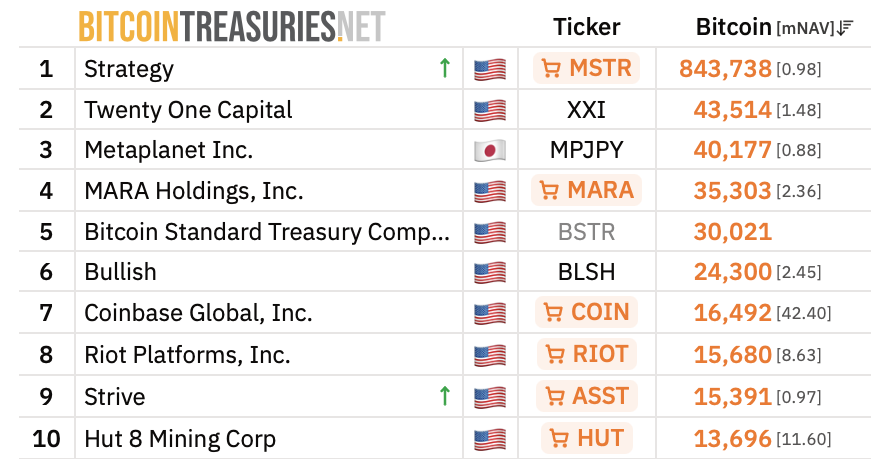
Top 10 Bitcoin treasury companies. Source: BitcoinTreasuries.NET
Magazine: eToro founder timed Bitcoin top perfectly due to belief in 4 year cycles
Coinbase announced it will launch perpetual-style equity index futures in the U.S. on June 8, 2026. The new product allows traders to go long or short on equity sectors and market trends using a perpetual futures structure, similar to crypto derivatives products. The move extends Coinbase's reach… Read the full story at The Defiant
Crypto World
SEC Commissioner Peirce Clarifies Scope of Proposed Innovation Exemption for Onchain Stock Trading


SEC Commissioner Hester Peirce clarified the scope of a proposed innovation exemption for onchain trading of tokenized NMS stock, cautioning against mischaracterization of the initiative. Peirce stated the exemption would be limited and facilitate trading only of digital representations of the same… Read the full story at The Defiant


Bitcoin options open interest on Deribit has reached $31.3 billion, overtaking BlackRock’s IBIT ahead of a $6.25 billion expiry.
Summary
- Deribit’s Bitcoin options open interest hit $31.3 billion on May 21, overtaking BlackRock’s IBIT at $27 billion, according to Checkonchain data.
- A total of 80,535 contracts worth $6.25 billion are set to expire on Deribit on May 29, with $75,000 as the max pain level.
- The put/call ratio of 0.86 is modestly bullish, but max pain sitting $2,000 below current price creates a gravitational pull toward $75,000.
Deribit’s Bitcoin options open interest climbed to $31.3 billion on May 21, overtaking BlackRock’s IBIT at $27 billion. The reversal comes after IBIT briefly surpassed Deribit in April for the first time since ETF options launched in November 2024.
A total of 80,535 contracts worth $6.25 billion are set to expire on Deribit on May 29. The $75,000 strike holds the largest put concentration at $394 million, while the $80,000 call strike dominates with $532 million.
Why the $75,000 max pain level is the number to watch
The put/call ratio of 0.86 reflects a modestly bullish market stance. With max pain sitting roughly $2,000 below Bitcoin’s current price near $77,000, a gravitational pull toward $75,000 remains a real risk heading into the May 29 settlement.
Max pain is the price level where option buyers lose the most and sellers profit the most. Market makers typically hedge toward this level as expiry approaches, which can act as a soft price magnet in the days before settlement.
Crypto.news has tracked the $75,000 level as a persistent battleground throughout 2026. The April expiry saw a similar dynamic, with heavy positioning around key strikes as settlement approached.
What the Deribit versus IBIT battle signals for Bitcoin markets
The swing back toward Deribit’s dominance reflects how quickly positioning can shift between regulated ETF options and crypto-native derivatives. IBIT options carry longer average maturities than Deribit contracts, pointing to different investor profiles between the two venues.
Traders piling into $82,000 call options ahead of May 29 suggest some participants are positioned for an upside breakout through the current call wall. Crypto.news has reported on how Bitcoin options expiry dynamics shape short-term price action.
Whether Bitcoin clears $80,000 or gravitates toward $75,000 will determine which side absorbs the larger loss at the May 29 settlement. The Bitcoin (BTC) price page tracks live movements as that expiry approaches.
Lennar Corporation’s SWOT analysis: stock faces headwinds

XRP POWER launches its intelligent app, enabling global users to earn $7,700 in passive income daily

Alex Eala, Janice Tjen bring ‘sense of pride’ to French Open


-

 Crypto World6 days ago
BloFin War of Whales 2026 Grand Prix opens registration for $5M trading championship
-

 Fashion6 days ago
Weekend Open Thread: Theory – Corporette.com
-

 Crypto World6 days ago
E-Estate Announces 1 Year Live: Washington DC Summit as Real Estate Tokenization Enters Its Next Phase
-

 Tech7 days ago
Tech Moves: Microsoft AI leader jumps to OpenAI; former AI2 exec joins Meta; and more
-

 Tech6 days ago
Google reimburses Register sources who were victims of API fraud
-

 Business7 days ago
H&R Real Estate Investment Trust (HR.UN:CA) Q1 2026 Earnings Call Transcript
-

 Entertainment7 days ago
David Letterman Returns to Late Show, Blasts Cancellation
-

 Sports6 days ago
Napoleonic enters 2026 Doomben 10,000 field via Abounding withdrawal
-

 Crypto World6 days ago
BeInCrypto 100 Institutional Awards Nomination: KAST for Best Digital Assets Neobank and Best Digital Assets Fintech
-
 Crypto World6 days ago
Bitcoin Battles US Bond Nerves With BTC Price Dip Toward New May Lows
-

 Crypto World6 days ago
ICE and CME urge US regulators to curb Hyperliquid energy trading
-
 Crypto World6 days ago
Wall Street’s Boldest Gold Prediction Has Russians Rushing to Buy
-

 Fashion5 days ago
On the Scene at Gucci’s Cruise Show in New York City: Mariah Carey, Kim Kardashian, Lindsay Lohan, Iman, and More!
-

 Fashion6 days ago
Trending Western Style Vests Perfect for Summer
-

 Crypto World6 days ago
IREN closes $3 billion convertible notes deal amid AI infrastructure expansion
-

 Politics6 days ago
Watch: far-right flag-fanatics run over victim, attack locals – Setup By the Left wing for your entertainment
-

 Fashion7 days ago
Creative Ideas for Custom T-Shirts
-

 Fashion5 days ago
Amazon Sundays: Memorial Day Hosting
-
 Fashion7 days ago
Philip Jones Wedding Jewellery For Women
-

 Crypto World10 hours ago
Blockchain.com files with SEC for U.S. IPO
You must be logged in to post a comment Login