
Crypto World
Swiss bank AMINA brings Canton Coin into regulated finance



Swiss crypto bank AMINA has become the first FINMA-regulated lender to offer custody and trading support for Canton Coin.
Summary
- AMINA has become the first FINMA-regulated bank to support Canton Coin trading and custody services.
- Institutional clients can now access the Canton Network infrastructure through a regulated Swiss banking platform.
According to AMINA, the new integration gives clients regulated access to the Canton Network, a blockchain built for capital markets activity such as tokenized assets, collateral management, repo transactions, and settlement. Digital Asset developed the network, while backers include the Depository Trust & Clearing Corporation, Visa, BitGo, Goldman Sachs, and Citadel.
Institutional investors using AMINA’s banking platform can now hold and trade Canton Coin without relying on crypto-native custodians or exchanges. The bank said the setup could support firms using Canton Network infrastructure for tokenization and financial settlement operations.
From Zug, Switzerland, AMINA has continued adding regulated crypto services across multiple jurisdictions over the past year. In November 2025, the bank received a Type 1 license uplift from Hong Kong’s Securities and Futures Commission, allowing its local subsidiary to provide crypto trading and custody services to institutional investors in the city. At the time, AMINA said Hong Kong had become one of Asia’s most active regulated crypto markets for professional investors and family offices.
Under the Hong Kong approval, AMINA expanded support for 13 digital assets, including Bitcoin, Ethereum, USD Coin, and Tether. Michael Benz, head of AMINA Hong Kong and APAC, said the regulatory clearance would help the bank meet institutional demand for regulated crypto access and tokenized financial products.
Canton pushes deeper into institutional markets
Canton Network has been building infrastructure tailored for traditional finance firms rather than retail crypto users.
Institutional activity around the network has increased in recent months. In April, BitGo expanded its Canton-related services to include trading and on-chain settlement after previously supporting custody functions alone.
S&P Dow Jones Indices also brought its US Treasury Index benchmark onto the Canton Network, allowing institutions to access benchmark fixed-income data through tokenized systems.
Competition in the institutional blockchain sector has intensified as regulated financial firms experiment with tokenized assets and settlement rails. R3’s Corda continues targeting banks and regulated markets through privacy-focused permissioned infrastructure, while Hyperledger Fabric has maintained adoption among financial institutions and enterprise firms running blockchain-based internal systems.
AMINA has also expanded its regulated digital asset footprint in Europe. Earlier in November 2025, Austria’s Financial Market Authority approved the bank’s Austrian subsidiary under the European Union’s MiCA framework, allowing it to offer crypto trading, custody, and portfolio management services across the European Economic Area.
Beyond geographic expansion, the bank has added institutional-focused products tied to Ripple’s RLUSD stablecoin, Polygon staking services, and USD Coin reward accounts as competition among regulated crypto banks continues to grow.

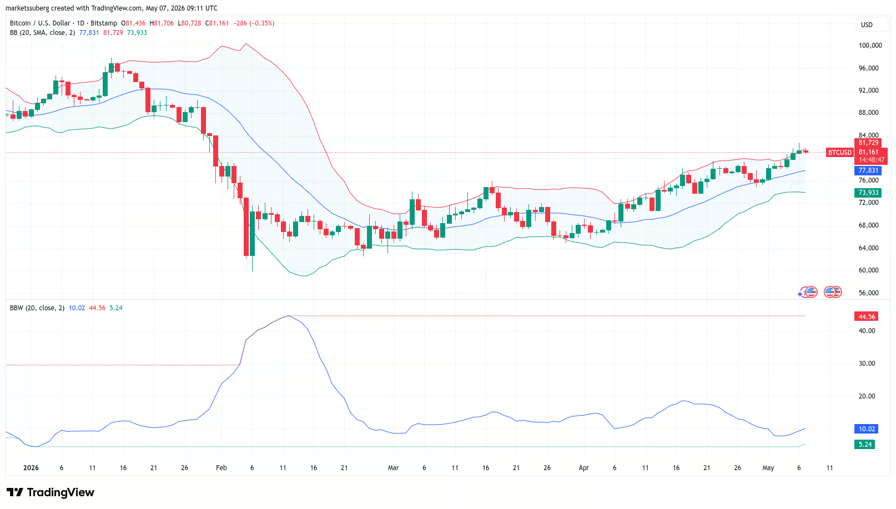
Bitcoin (BTC) is attempting its first Bollinger Bands breakout in months, while creator John Bollinger is more bullish than some traders.
Key points:
- Bitcoin faces stiff resistance as it attempts daily candle closes above the upper Bollinger Band.
- Volatility comes on cue after the Bands’ tightest-ever conditions last month.
- Creator John Bollinger takes advantage of positive trading signals as part of his investment program.
Responses mixed as Bitcoin tests Bollinger Bands ceiling
Data from TradingView confirms that on Wednesday, BTC/USD saw its second daily close above the upper Bollinger Band on the daily chart, something it has not achieved since mid-January.
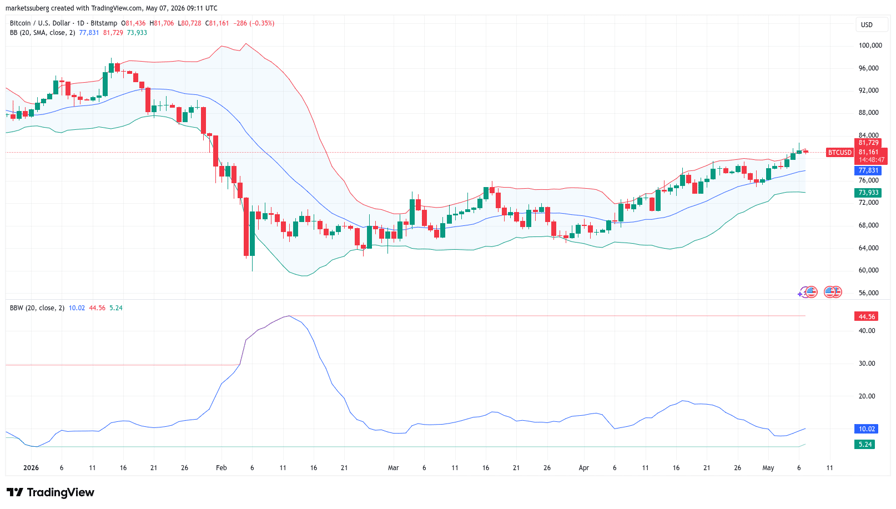
BTC/USD one-day chart with Bollinger Bands data. Source: Source: Cointelegraph/TradingView
The Bollinger Bands indicator, used to assess both volatility and momentum, recently saw the narrowest gap between its constituent trend lines ever recorded for Bitcoin.
This led to predictions of a breakout move, with the direction open to debate, as well as heightened volatility to come.
Commenting on the visit to the upper band, however, trader SuperBro noted that the price was now in an area full of potential points of rejection.
“Closed above the upper Bollinger Band, above the trendline on closing prices, but just below the log trendline on wicks,” they wrote in a post on X.
SuperBro added that most potential liquidations now belonged to long positions below the price, with shorts already taken out.
“There are relatively few short liquidations remaining up to 85K compared to long liquidations down to 74K,” they continued.
“However, bulls still have the momentum advantage and I don’t yet see a good reversal setup. Despite the liquidation imbalance, I’m holding tight to see if we can blast through.”
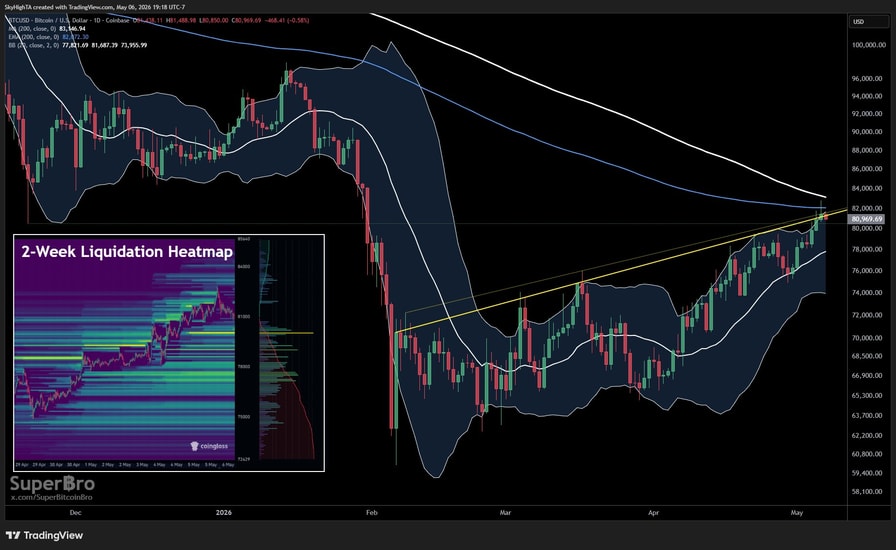
BTC/USD one-day chart with order-book liquidity data. Source: SuperBro/X
Bollinger, the indicator’s creator, revealed that one of his investment fund’s proprietary trading models had flipped positive on Bitcoin, and had taken a position accordingly.
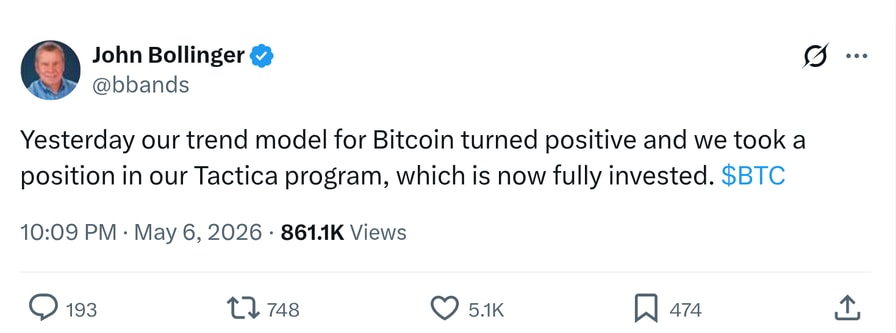
Source: John Bollinger/X
“Overheated” Bollinger signal returns after 18 months
Wednesday also saw another Bollinger Band milestone, this time concerning the market value to realized value (MVRV) ratio for speculative investors.
Related: Bitcoin can crash to $50K if ‘most critical’ bear market test fails: Analysis
The metric, recently covered by Cointelegraph, compares Bitcoin’s market cap to the price at which the supply last moved, also known as its “realized cap.”
A Bollinger Bands derivative entered “overheated” territory for the first time since late 2024, the X analytics account Frank Fetter noted.
At the time, BTC/USD was building its first visit to $100,000 in history.
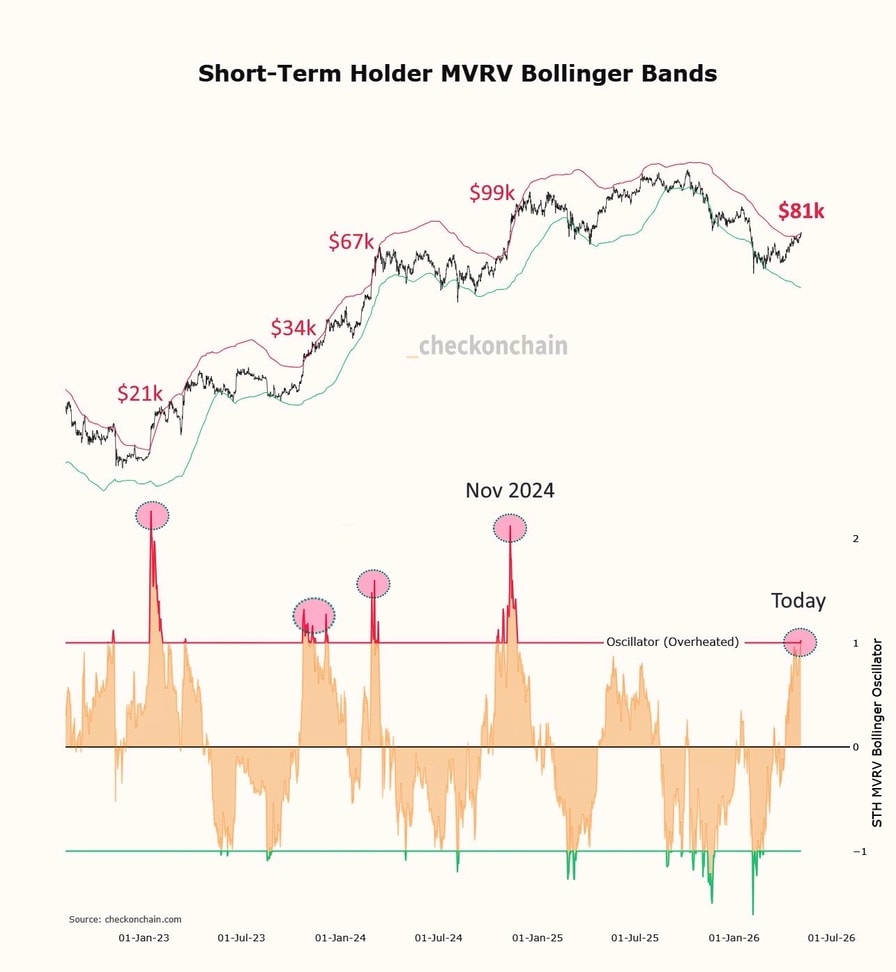
Bitcoin short-term holder MVRV ratio with Bollinger Bands oscillator. Source: Frank Fetter/X
Asked whether “overheated” conditions implied a price reversal, the account said this was “not necessarily” a given outcome.
A 20-year-old California man has been sentenced to six and a half years in federal prison for his role in a crypto theft ring that defrauded victims of more than $250 million.
Marlon Ferro, of Santa Ana, known online as “GothFerrari,” was sentenced to 78 months in prison alongside three years of supervised release and $2.5 million in restitution, the US Attorney’s Office for the District of Columbia said Wednesday. Ferro pleaded guilty in October 2025 to participating in a Racketeer Influenced and Corrupt Organizations (RICO) conspiracy.
“Marlon Ferro served as the criminal enterprise’s instrument of last resort,” US Attorney Jeanine Ferris Pirro wrote, adding that when co-conspirators couldn’t talk victims into surrendering their crypto or hack into their accounts remotely, they sent Ferro to break in physically and steal the hardware wallets storing the funds.
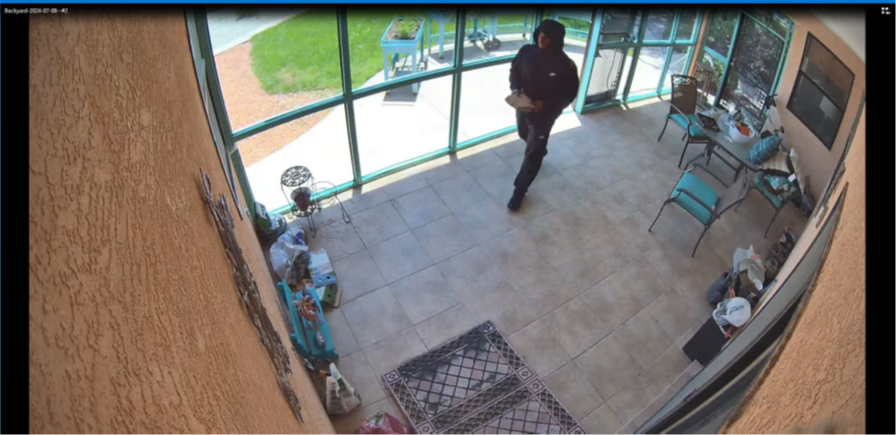
In a February 2024 incident, he traveled to Winnsboro, Texas, broke into a home and walked out with a hardware wallet holding about 100 Bitcoin worth more than $5 million at the time. Months later, he flew to New Mexico, spent days staking out a residence and used a brick to smash his way inside while co-conspirators monitored the victim’s location through his iCloud account. A home surveillance camera caught him in the act.
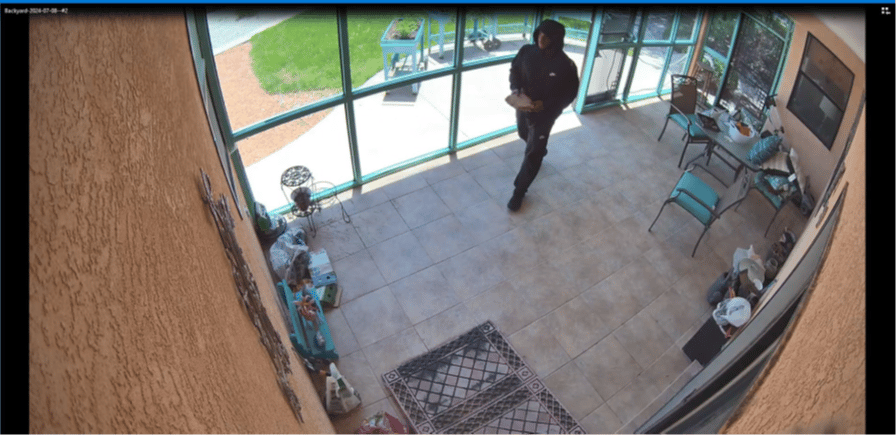
Ferro using a brick to break into a victim’s home. Source: Justice
Related: Coinbase faces lawsuit over frozen funds from $55M crypto theft
When hacking didn’t work, they sent a burglar
The conspiracy ran from late 2023 to early 2025, with members across California, Connecticut, New York, Florida and overseas. The conspirators each had a role, including hacking databases, identifying targets, making fraudulent calls and laundering money. When victims kept their funds on hardware wallets that couldn’t be accessed remotely, the gang turned to Ferro.
Ferro and his co-conspirators spent the stolen funds on luxury items, including Hermès Birkin bags, watches priced up to $500,000, private jets and exotic cars worth as much as $3.8 million. Nightclub tabs alone reached $500,000 in a single evening.
Ferro also laundered money using fake identification documents, purchased over $255,000 in designer goods for co-conspirators, and helped a jailed conspiracy leader by converting crypto to cash to cover legal fees.
The investigation was led by the FBI and IRS Criminal Investigation.
Related: Law enforcement freezes $41M connected to $150M crypto Ponzi collapse
Crypto hack losses top $630 million in April
April was the worst month for crypto hacks in over a year, with losses totaling $629.7 million, according to DefiLlama. KelpDAO’s $293 million exploit and Drift Protocol’s $280 million hack drove the bulk of the damage, together accounting for more than 90% of monthly losses.
According to Chainalysis security head Yaniv Nissenboim, April’s hack surge reflects a shift toward sophisticated attacks targeting the infrastructure connecting onchain protocols to offchain systems.
Magazine: AI-driven hacks could kill DeFi — unless projects act now

Key Highlights
- AMINA becomes pioneering regulated financial institution to offer Canton Coin trading services
- Swiss crypto bank introduces regulated custody solutions for Canton Coin holdings
- AMINA broadens institutional digital asset offerings with Canton Coin integration
- Canton Network infrastructure receives boost as AMINA launches trading and custody
- AMINA advances tokenized asset access through Canton Coin platform support
Swiss digital asset bank AMINA has introduced regulated custody and trading capabilities for Canton Coin throughout its institutional banking infrastructure. This strategic expansion reinforces AMINA’s standing in blockchain-based financial services and tokenized asset solutions. The integration provides institutional clients with direct Canton Network access under comprehensive regulatory supervision.
Swiss Bank Broadens Canton Network Institutional Reach
AMINA achieved a milestone as the inaugural FINMA-regulated banking institution to deliver custody and trading capabilities for Canton Coin. The Swiss bank broadened regulated entry points to blockchain technology designed specifically for capital markets functions. This integration facilitates tokenized asset management, collateral operations, repurchase agreement activity, and financial settlement processes.
AMINA rolled out these new capabilities via its regulated banking infrastructure headquartered in Zug, Switzerland. Institutional clients can now maintain and execute Canton Coin transactions directly through the bank, eliminating reliance on third-party crypto custodians or trading platforms. These services specifically address institutions leveraging blockchain technology for settlement operations and asset tokenization processes.
Canton Network maintains its appeal among established financial services companies seeking privacy-oriented blockchain solutions. The network presently facilitates approximately $9 trillion in digitized assets throughout financial markets infrastructure. Digital Asset engineered this infrastructure with backing from prominent financial institutions and cryptocurrency industry participants.
Canton Network Strengthens Position in Institutional Finance
AMINA unveiled Canton Coin capabilities amid intensifying institutional blockchain adoption throughout worldwide financial markets. Canton Network consolidated its role in tokenized finance and compliant settlement infrastructure. The platform emphasizes privacy preservation, operational control, and atomic settlement capabilities for regulated financial entities.
Numerous established finance organizations currently utilize Canton Network infrastructure spanning various market categories. Participating institutions include Visa, BitGo, Goldman Sachs, Citadel, and the Depository Trust & Clearing Corporation. Their involvement demonstrates rising institutional appetite for regulated blockchain frameworks and settlement technologies.
Institutional engagement with Canton Network experienced notable growth throughout recent periods across diverse financial instruments. Earlier in the year, BitGo extended its Canton-focused offerings beyond custody functions into trading and blockchain-based settlement. Furthermore, S&P Dow Jones Indices incorporated its US Treasury Index benchmark into the network for tokenized fixed-income product access.
Swiss Bank Extends Regulated Digital Asset Operations
AMINA has systematically developed its regulated cryptocurrency operations throughout Asia and Europe during the previous year. In November 2025, regulatory authorities in Hong Kong granted enhanced licensing authorization for AMINA’s regional subsidiary. This authorization enabled institutional cryptocurrency trading and custody capabilities within Hong Kong’s financial markets.
The Hong Kong authorization additionally broadened AMINA’s support for numerous prominent digital currencies and stablecoins. Approved digital assets encompassed Bitcoin, Ethereum, USD Coin, and Tether throughout institutional banking platforms. Consequently, AMINA fortified its regulated digital asset portfolio for professional market participants and family office clients.
AMINA simultaneously extended its European footprint through additional regulatory clearances under the European Union’s MiCA regulatory framework. Austria’s Financial Market Authority granted approval to the bank’s Austrian entity for cryptocurrency trading and custody operations. Moreover, AMINA launched institutional financial products connected to Ripple’s RLUSD stablecoin, Polygon staking mechanisms, and USD Coin yield-generating accounts.

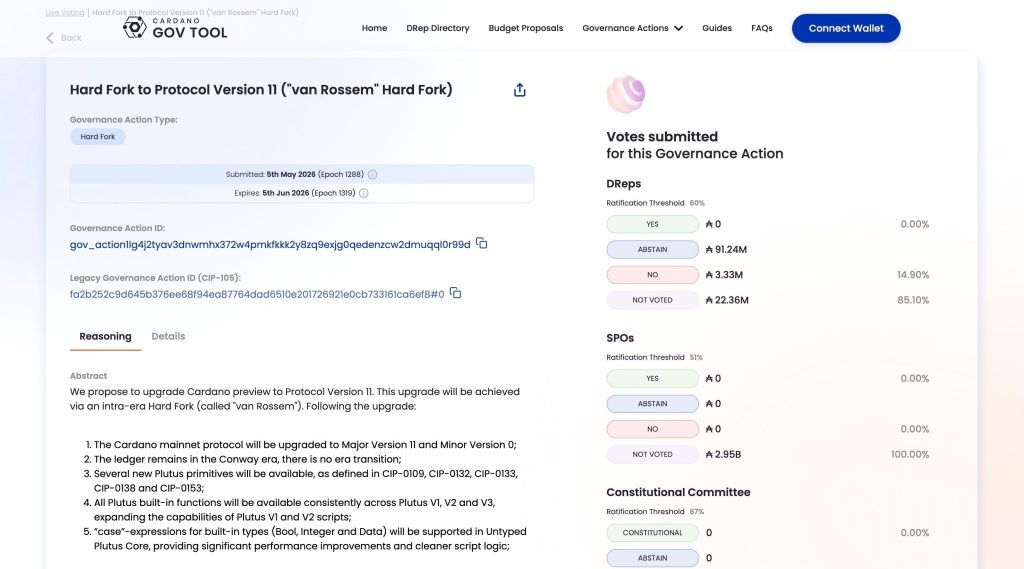
Cardano van Rossem hard fork news landed on the preview test network on May 5, with Intersect, the member-based organization coordinating Cardano’s technical roadmap, confirming both the governance action submission and the release of Cardano Node version 11.0.1 Pre-Release simultaneously.
The upgrade moves Protocol Version 11 one step closer to mainnet, with the critical variable now shifting entirely to SPO (Stake Pool Operator) readiness: at least 85% of stake pools by active stake must upgrade before ratification can proceed.
For ADA holders watching the Voltaire era governance machinery run in real time, this is the preview phase working exactly as designed.
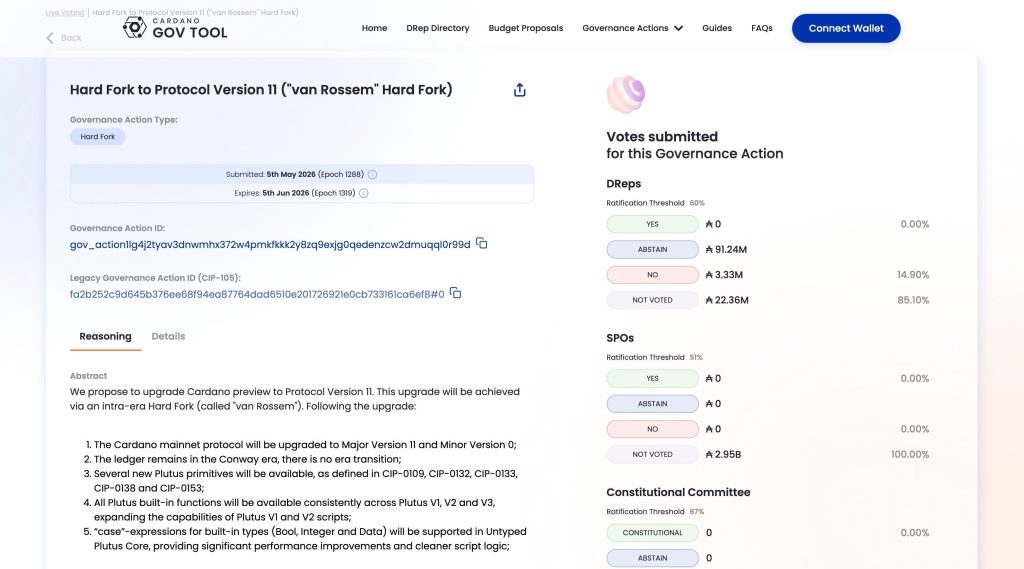
Node 11.0.1 is the first release to formally support Cardano’s intra-era hard fork mechanism – meaning the chain upgrades protocol version without triggering an era transition out of Conway.
Transaction shape doesn’t change. Ecosystem disruption is structurally minimized. The release also bumps cardano-api and cardano-cli to their 11.0 series and advances the experimental hard fork target to protocol version 12, signaling the development pipeline is already looking beyond the current upgrade.
The upgrade bundles five new Plutus primitive sets, defined in CIP-0109, CIP-0132, CIP-0133, CIP-0138, and CIP-0153, and unifies built-in functions across Plutus V1, V2, and V3. That last point matters: existing V1 and V2 scripts gain access to the full expanded built-in set after the fork, which expands DApp capabilities without requiring contract rewrites.

Discover: The best crypto to diversify your portfolio with
What are the 85% SPO Threshold News Triggers for Cardano
The 85% active-stake threshold is not a soft target; it is a constitutional requirement embedded in Cardano’s governance framework.
Under the rules established through the Voltaire era’s on-chain governance model, the hard fork governance action cannot be ratified until SPOs representing at least 85% of active stake have upgraded to a node version supporting Protocol Version 11.
DReps (Delegate Representatives) and the Constitutional Committee must also vote before the action is enacted on-chain.
The threshold logic exists to prevent a chain split. If a critical mass of block-producing nodes hasn’t upgraded, the network risks producing incompatible blocks at the fork boundary, the same failure mode that caused a mainnet chain partition in late 2025 when a malformed delegation transaction forced emergency SPO upgrades to node 10.5.3.
That incident made clear that SPO coordination isn’t procedural theater; it’s the actual security layer.
The current SPO upgrade percentage on preview is not yet publicly confirmed at a precise figure, but the historical pattern from prior Cardano hard forks, including the Chang upgrade cycle, suggests the initial wave of large, professionally run pools upgrades within the first 72 to 96 hours of a preview release.
Smaller home-hosted pools typically lag by one to two weeks. Community tracking tools, including Cardano Scan and PoolTool, are the live data sources to watch as the count climbs toward the 85% mark.
Intersect’s announcement was direct:
“ATTENTION
The van Rossem Hard Fork GA has been submitted to the Preview test network today. Cardano Node version 11.0.1 Pre-Release is also now available. This version is an essential requirement to safely cross the hard fork. SPOs, DApps, and developers are urged to upgrade immediately.”
The Chang hard fork experience – where exchange and dApp lags delayed mainnet activation even after SPOs crossed the initial threshold – means the pressure is now on the full ecosystem stack, not just pool operators.
Discover: The best pre-launch token sales
The post Cardano News: Preview Network Milestone Tracking the 80% SPO Threshold for Mainnet appeared first on Cryptonews.
Crypto World
Bitcoin Operates Outside the Regulatory System: Arthur Hayes Take on Crypto and Clarity Act

Arthur Hayes told Consensus 2026 that the Clarity Act fundamentally misunderstands what Bitcoin is, and any attempt to fold it into a federal regulatory framework destroys the only thing that makes it valuable.
The argument landed while BTC traded above $82,000, with institutional ETF inflows accelerating, suggesting the market and the ideology are currently pointing in opposite directions.

Arthur Hayes Opinions Matter
Hayes argues that Bitcoin’s value derives from operating outside any regulatory apparatus, and he also noted that legislation like the Clarity Act doesn’t clarify anything .
“This is the value that bitcoin provides outside of the regulatory apparatus,” Hayes told the audience. “It’s precisely the reason that it does not adhere to the regulatory regime that some of you wish to put it under with bills like the Clarity Act and other things.”
On price, Hayes kept it equally blunt. “If you want to talk about the price of bitcoin and what the fair value is, all that matters is how many units of fiat there are today.” His year-end BTC target sits at $125,000, tied entirely to global monetary expansion, not legislative outcomes. Regulation, in his framework, is simply irrelevant to the price calculation.
LATEST: — CoinMarketCap (@CoinMarketCap) May 6, 2026
 Arthur Hayes told Consensus Miami 2026 that fiat money creation, not politics or regulation, is the only driver of Bitcoin's price. pic.twitter.com/AD94CtJwtO
Hayes went further, arguing that enthusiasm for the Clarity Act inside the industry reflects the interests of centralized incumbents with Washington lobbying operations, not the decentralized ecosystem Bitcoin was built to circumvent. “People who own centralized companies want regulation because it benefits their business,” he said. In Hayes’s view, the DeFi ecosystem and privacy-focused infrastructure get nothing from this bill except a federal licensing framework they cannot technically comply with.
“People who own centralized companies want regulation because it benefits their business.”
His position stands in direct contrast to the dominant tone at Consensus 2026. Ripple CEO Brad Garlinghouse has been lobbying aggressively for the Senate to advance the legislation before the May 21 Memorial Day recess.
Discover: The best crypto to diversify your portfolio with
Does the Bitcoin Agree With Hayes?
Bitcoin climbed 8% in a week to $82,600 following Hayes’s remarks at Consensus Miami 2026, extending a run that has kept BTC above $80,000 through weeks of legislative uncertainty. Spot Cumulative Volume Delta surged 199% over the same window, showing aggressive buy pressure.
Bitcoin ETFs added $532M in a single session as the Clarity Act advanced through committee, pushing cumulative ETF AUM past $59 billion with total institutional exposure exceeding $106 billion.
An anonymous analyst noted that Bitcoin is entering a commodity supercycle driven by structural monetary debasement, which aligns with Hayes’s fiat-supply thesis even as the ETF narrative suggests that institutional players want the regulatory architecture Hayes opposes.
Bitcoin trading above $81,000 with record ETF inflows doesn’t prove Hayes wrong.
Discover: The best pre-launch token sales
The post Bitcoin Operates Outside the Regulatory System: Arthur Hayes Take on Crypto and Clarity Act appeared first on Cryptonews.
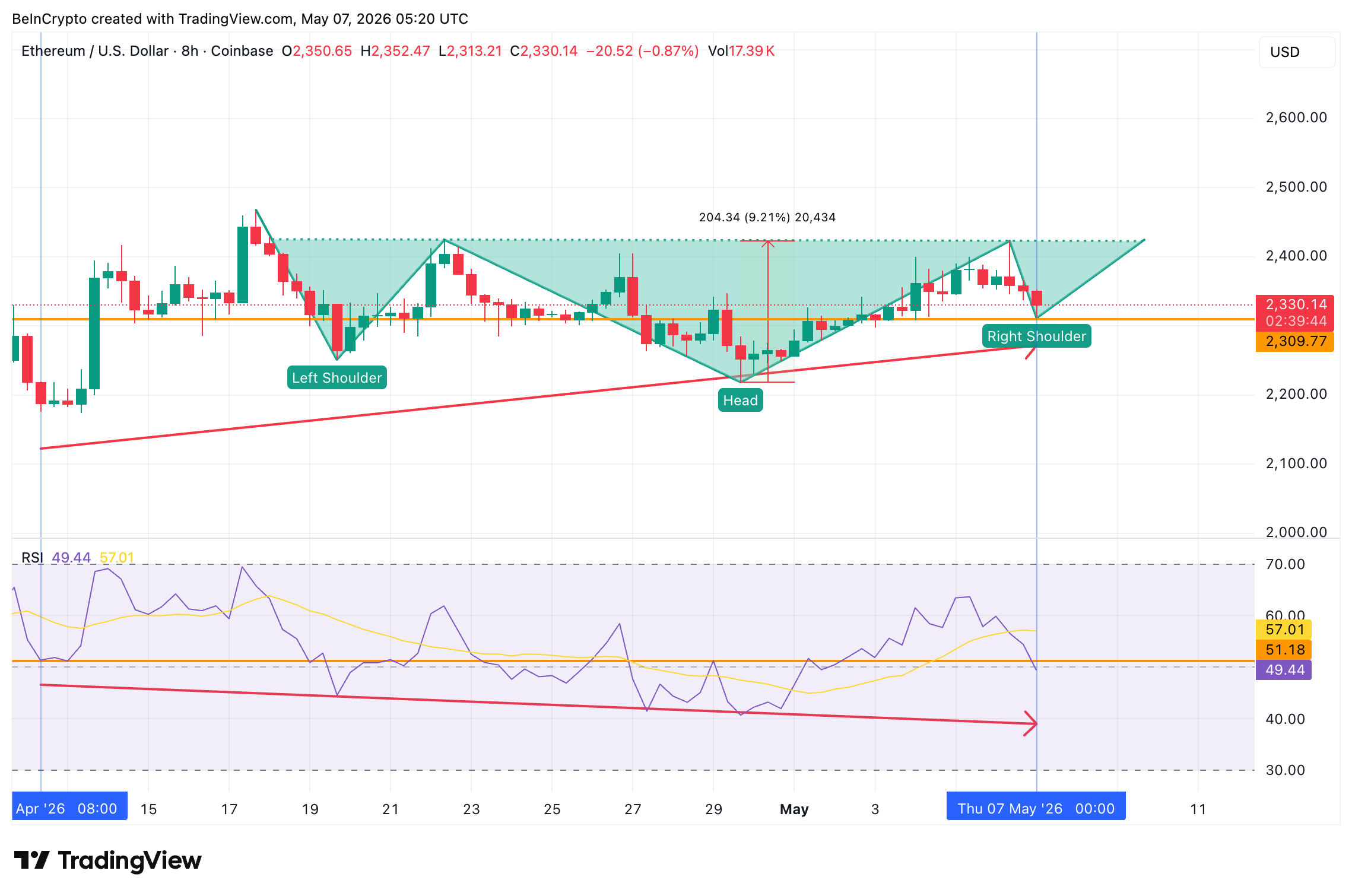
Ethereum (ETH) price hovers near $2,330 mid-week with sellers fading sharply, leaving an 8-hour reversal structure one candle away from confirming a possible bounce.
The setup ties together a textbook bottoming pattern, an exhaustion signal on momentum, and an 85% drop in coins flowing onto exchanges. Whether ETH delivers the bounce depends on a single candle holding the line.
Ethereum Price Builds Reversal Structure as Momentum Quietly Diverges
The 8-hour chart shows ETH carving an inverse head-and-shoulders since mid-April. The pattern prints a low (left shoulder), a deeper low (head), and a higher low (right shoulder). The right shoulder formation is close to being confirmed now.
Want more token insights like this? Sign up for Editor Harsh Notariya’s Daily Crypto Newsletter here.
Sitting under that price action is a developing hidden bullish divergence. ETH price has made a higher low between mid-April and early May, while RSI (relative strength index), a momentum gauge, is close to printing a lower low over the same window. Hidden bullish divergence often signals exhaustion of selling pressure, not the start of a fresh leg down.

The trigger is binary. If the next candle holds above the current right-shoulder floor ($2,309 to be exact), the divergence confirms and the pattern stays alive. If sellers force a break, both the structure and the divergence collapse together.
That setup, however, needs validation from on-chain flows before it earns the right to a projected 9% price target.
Sellers Retreat as Mid-Term Holders Build Their Stack
Glassnode data shows the exchange net position change, a metric that tracks tokens flowing in and out of exchanges, eased sharply this week. The reading peaked at 78,930 ETH on May 3, when fresh inflows pointed to selling pressure rising. By May 6, that figure had dropped to 11,504 ETH, an 85% reduction.
The collapse suggests whoever was offloading ETH around the right shoulder may be running out of supply.

A second on-chain layer reinforces the read. Glassnode’s HODL waves group supply by how long holders have kept their coins. The 6-month to 12-month cohort sat at 18.12% of supply on April 22. By May 6, that share had climbed to 21.49%.
The data suggests mid-term holders are adding to their position even as price stays compressed. This cohort often re-engages near cycle bottoms.

Both flows lean in the same direction as the chart pattern. The price chart now becomes the decider on whether buyers convert that backdrop into a measurable move this week.
Ethereum Price Levels That Decide the Mid-Week Move
With the pattern, divergence, and on-chain flows aligned, the focus shifts to the price ladder on the 8-hour chart. The current right-shoulder floor sits at $2,309, marked as the 0 Fibonacci anchor.
The first hurdle is $2,358. ETH then needs to reclaim $2,388 (0.382 Fib) and $2,412 (0.5 Fib). The 0.5 level briefly capped price on May 6 before sellers stepped in.
The neckline sits at $2,423, lining up between the 0.5 and the 0.618 Fibonacci at $2,436. A clean break above this band activates the pattern. The measured move projects roughly 9% upside from the neckline. That target lines up with the 1.618 Fibonacci extension at $2,642.

The downside ladder is just as defined. Failure to reclaim $2,358 followed by a loss of $2,309 would invalidate the right shoulder. Below that, $2,218, the head’s low, is where the entire pattern unwinds.
Hidden bullish divergence and falling exchange inflows both lean toward the bounce read, but neither replaces a confirmed close. Ethereum managing to stay above $2,309 separates a 9% Ethereum price bounce toward $2,642 from a slide to the $2,218 invalidation floor.
The post Ethereum Price Eyes Mid-Week Bounce as Selling Pressure Craters 85% appeared first on BeInCrypto.

Ripple (XRP) posted a minor increase in the last 24 hours, pushing the asset’s monthly surge to 7%. Despite this, the $1.45 level remains a major hurdle for the asset.
Against this backdrop, data suggest that there has been a clear shift in the behavior of major investors over recent months.
XRP Selling Pressure Indicator
According to CryptoQuant’s latest analysis, whale inflows of XRP to Binance have dropped to their lowest level since November 2021. The firm explained that the 30-day cumulative inflow indicator, also known as Sum 30D, climbed to around 2.6 billion XRP at the beginning of March, which was indicative of a strong movement of tokens from whales toward the exchange.
Large transfers of crypto assets to centralized trading platforms are often linked to increased selling activity or portfolio repositioning by major holders. However, since reaching that peak, the indicator has steadily moved lower and has now fallen to nearly 736 million XRP.
As such, CryptoQuant stated that this is the lowest level recorded for the metric in more than three years. The decline essentially points to exchange-related selling pressure from whales easing considerably compared to earlier months. The analysis also revealed that the continued drop in inflows during a period of broader market volatility may reflect a more cautious stance among large investors as uncertainty remains across the crypto market.
It is important to note that lower whale inflows to exchanges are generally viewed as a positive signal because they reduce the risk of sudden sell-offs caused by large token transfers. Hence, if the trend continues and inflows remain low while demand and price conditions improve, the data could support XRP in building a more stable price base over time as selling pressure from major holders continues to weaken.
Institutional Demand and Global Expansion
On the institutional front, US spot XRP ETFs have shown renewed momentum. After seeing more than $31 million in outflows during March, the products rebounded sharply in April with $81.6 million in inflows. The positive trend has continued into May, as the funds have attracted more than $28 million in fresh inflows so far this month.
Meanwhile, Ripple has continued expanding its activity across several markets in recent months. The company recently partnered with OKX for the listing of its RLUSD stablecoin and also joined efforts with the Crypto ISAC network to share information related to North Korean cyber threat actors targeting the crypto sector.
It has additionally expanded its regional presence in the Middle East and Africa through new office openings.
In South Korea, the company signed a partnership agreement with internet-only lender KBank to move blockchain remittance testing beyond early-stage trials and focus on real-world integration and scalability. The agreement was signed at KBank’s headquarters in Seoul with executives from both firms in attendance, including Ripple Asia-Pacific Managing Director Fiona Murray.
Prior to that, Ripple had entered another South Korean partnership with Kyobo Life Insurance to work on institutional digital asset infrastructure tied to tokenized government bond transactions.
The post Major Ripple (XRP) Metric Just Hit a Level Not Seen Since 2021 appeared first on CryptoPotato.
Toobit is one of the most popular international cryptocurrency exchanges, and it has just announced the publication of its most recent Proof of Reserves report, which was independently verified by Hacken.

Over 100% Collateral Ratio
The assessment conducted by Hacken confirms that the exchange is maintaining a collateral ratio of more than 100% across all in-scope digital assets. These include BTC, ETH, USDT, and USDC.
This audit confirms that there’s a safe 1:1+ backing for every trader deposit. The findings also verify that there is a reserve surplus that ensures all trader liabilities are fully over-collateralized.
Additionally, the verification process validated the individual balances of more than 640,000 accounts. This was achieved by cross-referencing loads of internal data against legal documentation, as well as against official statements from third-party institutional custodians to guarantee the highest level of accuracy.
Report Mechanics
To deliver full transparency, Hacken used a multi-stage methodology that was focused on three key stages. First, the auditors performed a Proof of Liabilities. To do so, they verified the total balances of more than 600,000 liability holders to make sure that there was an accurate representation of client deposits.
The second stage was Asset Verification. During this, auditors compared the total reserve balances against the client liability report to verify whether they covered them in full. Last but not least, the process included Operational Oversight, aiming to review information flow and custodial reporting, which ensures all data remains authentic and unaltered.
In conjunction with the audit results, Toobit has launched an upgraded Proof of Reserves page, which moves beyond static reporting to a dynamic transparency model. This hub is designed to ensure that traders are able to monitor live reserve ratios for major tokens and access historical audit data through a user-friendly and accessible interface.
Merkle Tree Technology
A critical component and part of this portal is the integration of Merkle Tree technology. By consolidating trader balances into a singular and secure Merkle root hash, the crypto exchange is able to offer a transparent and tamper-proof method for everyone to verify that their specific account balance was actually included in the audit.
This cryptographic proof is designed to ensure accountability while also maintaining privacy for all traders.
It’s important to note that the full audit report is readily available for public review. The detailed documentation regarding the audit scope, methodology, and technical findings can be found on the official website of Hacken.
With all of the above said, it’s crucial to understand that cryptocurrency exchanges have entered a maturation phase, which is largely driven by independent verification.
Industry leaders maintain reserve coverage ratios between 124% and 125%, far exceeding the 100% safety benchmark. Moreover, as frameworks such as MiCA intensify supervision, long-term operational stability is defined by “compliance by design,” integrating Proof of Reserves and transparent disclosures into core infrastructure.
The post Toobit Confirms Over 100% Asset Backing in Latest Hacken Proof of Reserves Report appeared first on CryptoPotato.
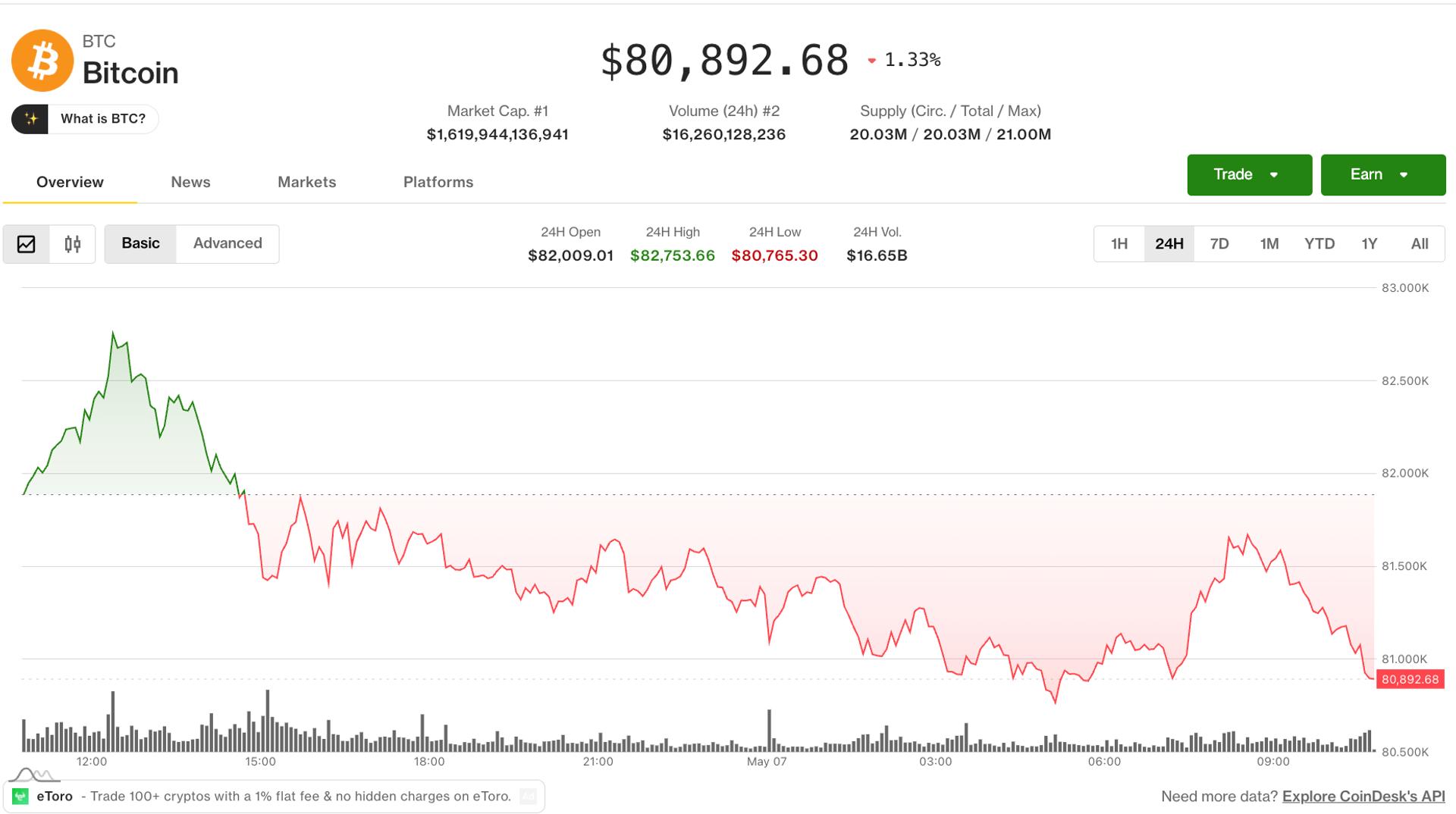
The crypto market dropped back on Thursday with bitcoin losing around 0.7% since midnight UTC following Wednesday’s rally to a three-month high of $82,800.
Ether lost around 1% during Asia and European hours, now trading at $2,325 having briefly topped $2,420 on Wednesday.
The broader market is showing early signs of a bullish reversal following a two-month consolidation pattern between February and April, although it’s worth noting that bitcoin needs to break $98,000 in order to break its current cycle of lower highs and lower lows.
The altcoin market continues to indicate investor rotation, with the likes of ALGO and TON rising by between 8% and 9% since midnight UTC.
U.S. equity futures are flat on Thursday while the dollar index (DXY) is down by around 0.1% as investors remain hopeful over a deal to end the war in Iran.
Derivatives positioning
- Crypto futures market activity remained relatively subdued over the past 24 hours, with total futures volume rising just 3% to $216 billion, while aggregate open interest (OI) declined 3% to $133 billion. The divergence between suggests that positioning is being reduced rather than expanded, pointing to deleveraging across the market.
- BTC open interest fell to 762K BTC from 793K BTC a day earlier, ending a three-day streak of sustained positioning growth. Among major assets, DOGE recorded the sharpest decline in OI, down 6%, while XRP OI slipped roughly 1%. The declines across these assets suggest capital outflows and reduced speculative appetite in the near term.
- DOGE positioning appears particularly weak. Funding rates remain negative at an annualized rate of around 6%, indicating that short positions are paying longs to maintain exposure. At the same time, DOGE’s 24-hour cumulative volume delta (CVD) is the most negative among major tokens, signaling aggressive selling pressure from market participants using market orders.
- BTC funding rates, meanwhile, remain broadly neutral after averaging around minus 4% annualized in recent weeks. The normalization in funding suggests that excessive bearish positioning has largely been flushed out of the market. Some observers view this reset as constructive for BTC price action.
- In contrast, ETH and SOL both recorded OI increases of 1% or more despite weakening spot prices. Rising open interest alongside falling prices typically suggests fresh short positioning is entering the market, indicating traders may be positioning for additional downside in these tokens.
- TON continues to stand out on the positioning front. Open interest climbed more than 10% to another record high, signaling continued capital inflows into the asset. TON’s price briefly reached $2.90 earlier today, its highest level since September, and the token is now up 93% on the week. The simultaneous rise in both price and OI points to strong directional participation.
- TON, TRX, and ZEC are currently the only top-30 tokens posting OI-adjusted positive cumulative volume delta readings. This suggests buyers are driving trading activity through aggressive market orders rather than passive limit bids. Most other major assets, including BTC, ETH, and XRP, continue to show negative CVD readings.
- In the options market, bullish sentiment remains evident on Deribit, where call options at strike levels above $80,000 continue to dominate 24-hour volume rankings. According to Glassnode, dealers with short gamma exposure may buy into a potential BTC move above $82,000 to maintain hedges. That could further add to momentum.
- Meanwhile, the one-month volatility risk premium, which measures the gap between implied volatility (IV) and realized volatility (RV), has turned positive again, per Glassnode. This shift indicates renewed demand for short-dated optionality and suggests traders are increasingly willing to pay for near-term volatility exposure after a prolonged period of compressed expectations.
Token talk
- CoinDesk’s DeFi Select Index (DFX) and the CoinDesk MemeCoin Select Index (CDMEME) are the best performing benchmarks on Thursday, rising by 2.5% apiece as speculative trading begins to come into effect.
- The Bitcoin-weighted CoinDesk 5 (CD5) and CoinDesk 20 (CD20) indices are flat since midnight UTC, while the broader CoinDesk 100 (CD100) was also marginally in the red.
- CoinMarketCap’s “altcoin season” indicator is now at 45/100, its highest level since late March having risen from 32/100 since this time last month.
- Despite the wider altcoin market being optimistic, popular DeFi token MORPHO lost 4.6% of its value since midnight UTC and 6.1% over the past 24 hours. it is currently trading at $2.13 with investors taking profits following a rally earlier in the week that lifted it from $1.95 to $2.33.
Crypto World
Ethereum price confirms bullish setup as institutional demand holds firm, breakout ahead?
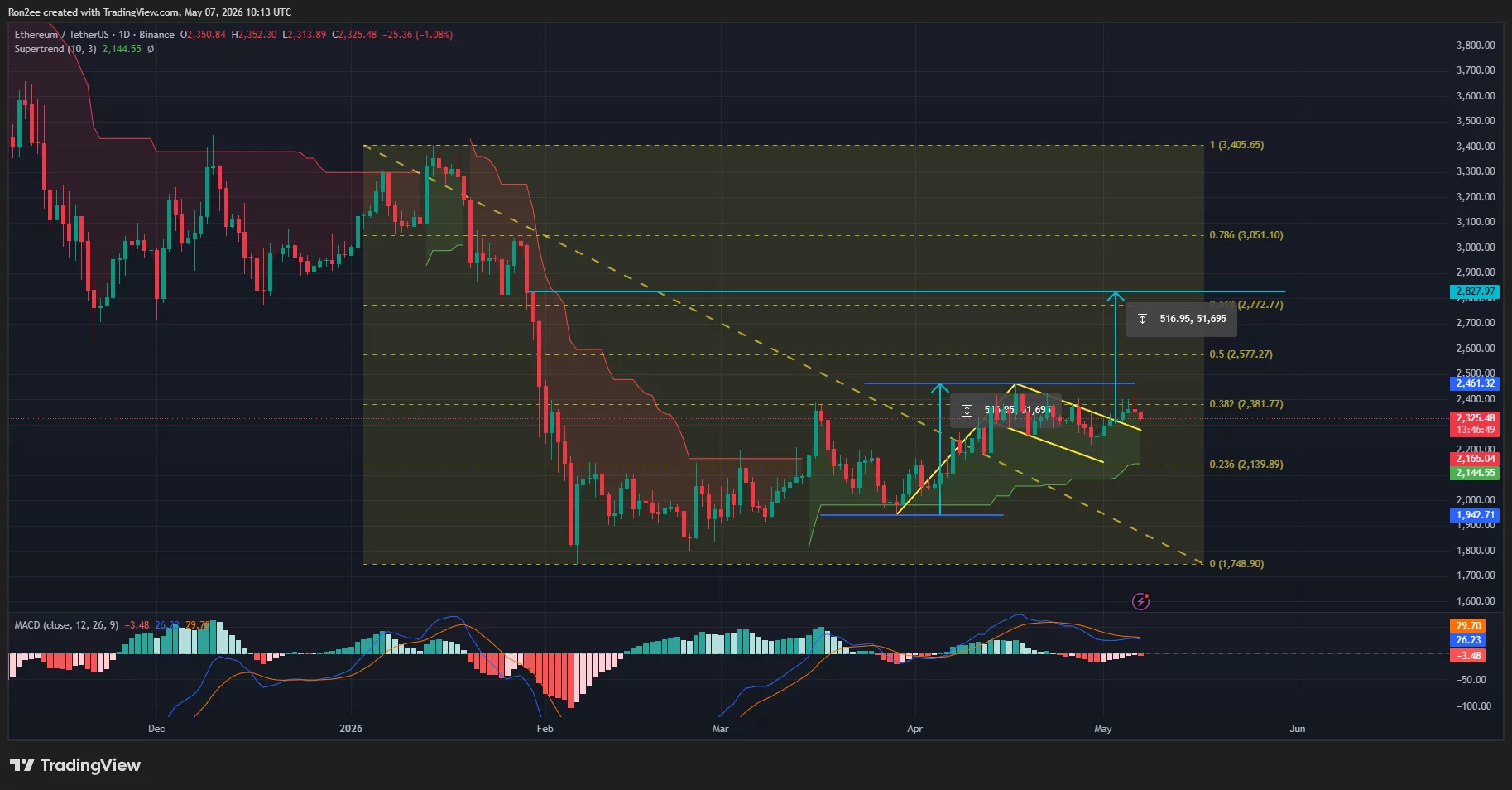
Ethereum price has pared off some gains after facing resistance at $2,400 this week. A confirmed bullish pattern on the chart, however, positions it for strong upside in the coming sessions.
Summary
- Ethereum climbed to a weekly high above $2,400 before stabilizing near $2,300 as broader crypto markets reacted to easing geopolitical tensions.
- Spot Ethereum ETFs recorded a fourth straight day of inflows, with more than $270 million added, signaling continued institutional demand.
- Ethereum confirmed a bull flag pattern on the daily chart, with technical indicators pointing toward a potential breakout above the $2,800 resistance zone.
According to data from crypto.news, Ethereum (ETH) price rose nearly 7% to a weekly high of $2,411 on Wednesday before stabilizing over $2,300 at press time.
Ether, along with the broader crypto market, has entered a period of cautious calm as Iran is reportedly pondering a U.S. proposal to end the war and open up the Strait of Hormuz, bringing balance once again to global energy supply chains and trade.
Despite this investor uncertainty, institutional investors continue to stack their positions in the token. Data from SoSoValue shows that spot Ethereum ETFs extended their inflow streak to the fourth day with over $270 million drawn in the period. This persistent demand from deep-pocketed investors suggests their belief in the token’s future potential and often pulls in fresh capital from retail investors over time.
On the daily chart, Ethereum price has confirmed a bull flag pattern and is eyeing a move above the 38.2% Fibonacci retracement level at $2,381. A decisive break above the flag’s upper boundary could accelerate the rally towards the $2,800 resistance zone or onwards to $3,000 if the current momentum sustains.
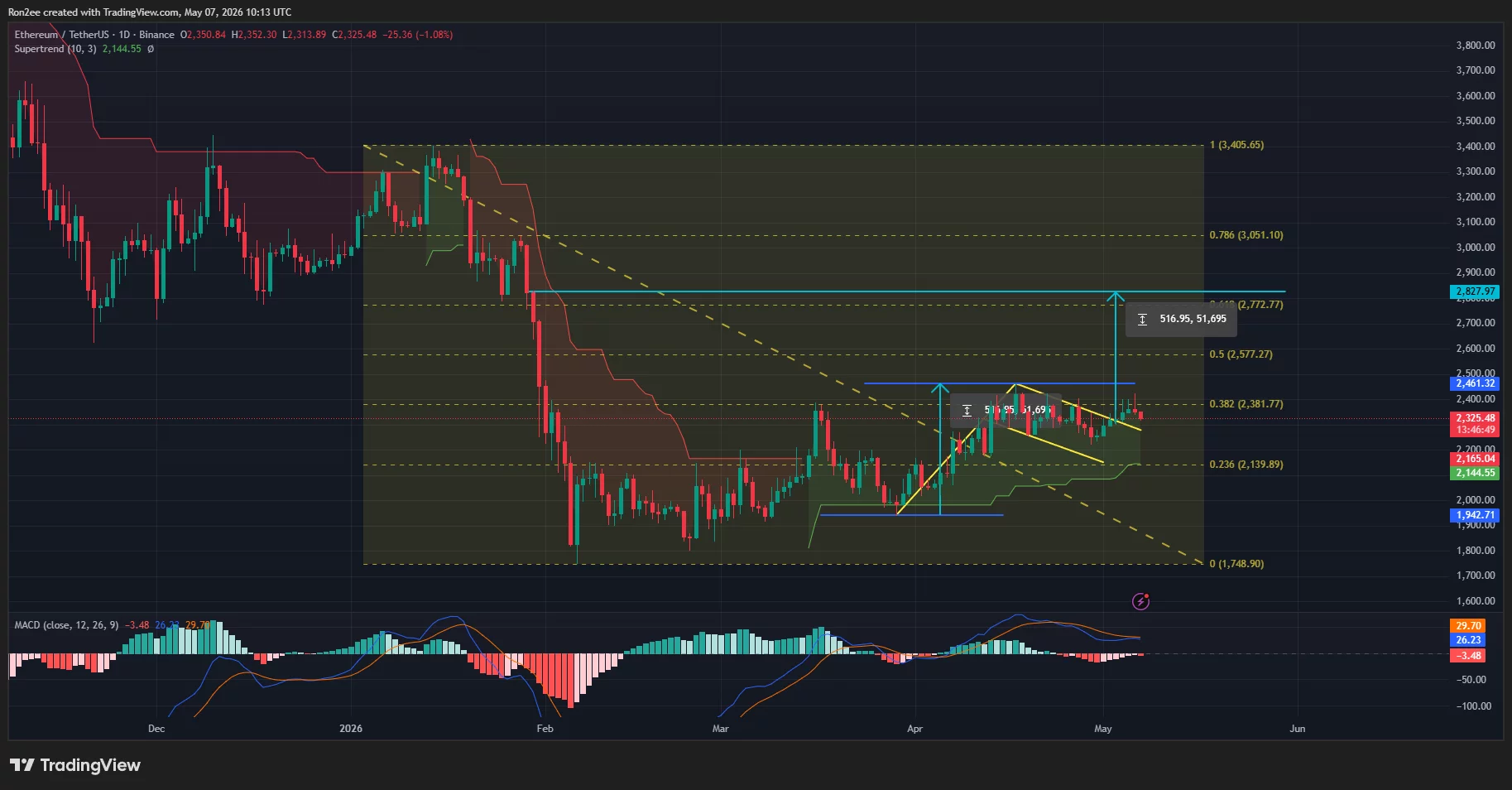
Momentum indicators seem to support such a bullish outlook as the Supertrend has remained in the green, indicating a healthy uptrend. At the same time, the MACD lines are close to forming a bullish crossover, which typically signals that the bulls are ready to take back control of the market.
On the contrary, a failure to hold current levels could see Ethereum drop back toward the $2,200 support level, where buyers would likely step in to defend the primary trend.
Disclosure: This article does not represent investment advice. The content and materials featured on this page are for educational purposes only.

Simba Hybrid Pillow & Duvet Review: Is The Temperature-Regulating Technology Worth It?
“Jersey Shore” star Ronnie Ortiz-Magro addresses mental health struggles, interview clip of him 'nodding off'

LISA MONEY Lyrics (Color Coded Lyrics)

Manchester United reach agreement with Casemiro over contract clause amid transfer speculation

US brings back mandatory military draft registration

Steven Gerrard disagrees with Gary Neville over ‘shock’ Chelsea and Arsenal claim | Football


-

 NewsBeat4 days ago
Channel 5 – All Creatures Great and Small series 7 new post
-

 Crypto World3 hours ago
Upbit adds B3 Korean won pair as Base token gains Korea access
-
 Tech6 days ago
Trump’s 25% EU auto tariff breaches Turnberry Agreement that also covers semiconductors and digital trade
-
 NewsBeat4 hours ago
NCP car park operator enters administration putting 340 UK sites at risk of closure
-
 Sports6 days ago
Paul Scholes issues Marcus Rashford reality check as agreement emerges over Man United star
-

 Entertainment6 days ago
Met Gala 2026 Rumored Guest List Is Turning Heads
-

 Business6 days ago
Strait of Hormuz Blockade Persists Amid US-Iran Standoff, Sending Oil Prices Soaring
-
Entertainment6 days ago
New on Prime Video in May 2026 — Full List of Movies and Shows
-

 Sports5 days ago
Cavaliers vs. Raptors Game 6 live score, updates, highlights from 2026 NBA playoffs first-round series
-
 Sports5 days ago
David Benavidez responds to team Canelo saying the fight will never happen
-

 Tech6 days ago
Meta ends Sama contract after Kenyan workers report seeing intimate footage from Ray-Ban smart glasses users
-

 Entertainment5 days ago
Kylie Jenner Hit With Second Lawsuit From Ex-Housekeeper
-

 Entertainment5 days ago
Young and the Restless Next Week: Cane Arrested & Matt’s Deadly New Scheme!
-
Entertainment5 days ago
New Netflix Movies in May 2026 — My Top 3 Picks to Stream
-
 Sports5 days ago
IPL 2026: ‘Love you darling’- Hardik Pandya’s reaction to MS Dhoni steals the show |Watch | Cricket News
-
Crypto World5 days ago
Pi Network Mandates Protocol 23 Upgrade for All Mainnet Nodes Before May 15 Deadline
-

 Business4 days ago
Luka Doncic Injury Update: Doncic’s Hamstring Recovery Slows Lakers’ Hopes Against Thunder: Can He Run Yet?
-

 Sports6 days ago
What Preity Zinta Said After Punjab Kings’ First Defeat Of IPL 2026
-

 Crypto World4 days ago
Bitcoin mining equities rise in 2026 as BTC lags behind
-

 Sports6 days ago
Bayern won’t hand bottom side Heidenheim ‘gifts’ despite PSG game
You must be logged in to post a comment Login