You could argue, and people have, that the top gay dating apps are now optimized for monetization and juicing engagement loops. Increasingly overrun with bots, they are at times even devoid of actual connection.
Grindr, with its 15 million monthly active users, is drowning in ads while pushing expensive upsells on users. (In February, as part of its “gAI” overhaul, the company announced a new premium monthly subscription tier for $500.) Sniffies was beloved by cruisers until the seismic reaction in April to Match Group’s $100 million investment sparked concerns that another queer space could get absorbed into a larger dating conglomerate.
As public backlash against popular queer apps continues to mount, a batch of tech entrepreneurs are scrambling to meet the demand by doubling down on privacy-conscious, community-driven alternatives.
Calum Bowden, who posts under the internet persona @donjackoghue, launched MeetMarket in March. Currently only available as a web app, MeetMarket includes all the core features of your typical hookup app—a customizable profile, a grid of nearby users—with one major difference. It was built on a decentralized identity system, meaning MeetMarket doesn’t store users’ emails, passwords, or personal information. Users store everything on their device, giving them full control and ownership over their data and how it’s shared. Messages on the platform are end-to-end encrypted, and Bowden says it will always be ad-free, even for nonpaying members. (A monthly membership costs €12, or $13.99.)
Advertisement
“Decentralization and data privacy make a lot of sense for queer people in general, and especially in hostile legal environments or in the US right now, where you don’t really know what digital platforms actually have your best interest in mind,” says the 34-year-old PhD student in Berlin who studies the sociology of technology and organization.
Within the first 48 hours of MeetMarket’s launch on March 24, over 12,000 people had signed up, and some 60,000 people have used it since. The app averages 5,000 weekly visitors, according to Bowden, though there is not a lot of concurrent activity in the same cities. “It’s become more social than necessarily driving an immediate hookup.” But casual encounters do still happen, he says. “The Midwest bottom jockeys are eating meet market up,” one user noted on X.
Bowden didn’t anticipate public sentiment would sour on Sniffies just a few weeks after his launch. Still, the timing of it couldn’t have been more serendipitous. “When Sniffies announced their investment from Match Group, I was like, how are they fueling my fire?” he asks. “This is exactly the model that venture capital leads to. This is exactly why these economic models for technology are so bad, because they basically force the gentrification of a digital platform.” Sniffies did not immediately respond to a request for comment.
A self-described “utopian conspirator,” Bowden is the cofounder of Trust, a nonprofit that operates as a kind of incubator to prototype ideas “as a critique of technology and the status quo,” he says. With MeetMarket, he wanted to create an app that gave users more agency over their experience without cheapening it.
Advertisement
It can sometimes seem like Big Dating wants people to believe that it is the only answer to cure their romantic woes—Bumble CEO Whitney Wolfe Herd recently told Axios that there isn’t much longevity in niche apps—but the opposite is proving just as true, as people seek out more specificity and intention in their online dating experience.
“Gay men have tribes, subcultures, aesthetics, and different ways they want to be seen,” says Justin Finnegan, a 35-year-old software engineer in Toronto who last year created Chunkr, a gay hookup app that has resonated with the bear community despite originally being for all gay men.
LG’s best OLED yet? The OLED65G6 delivers an excellent picture performance across a range of sources. There are a few flaws and aspects I’m not fond of, but this is a strong start to LG’s 2026 TV line-up
Bright, colourful, accurate-looking HDR picture
Impressive upscaling
Anti-reflection panel
Robust gaming performance
Wealth of entertainment options
Sound system is just ‘fine’
Apps ringfenced webOS sign-up
Dolby Vision x Filmmaker mode doesn’t seem to ‘adapt’
Anti-glare panel produces purple colour
Game mode is a little too bright and sounds a too sharp
SQUIRREL_PLAYLIST_10208579
Advertisement
Key Features
Hyper Radiant Colour Tech
2nd Gen panel of the Primary RGB OLED panel
Advertisement
LG Shield Security
Secures data, offers multi-year updates
Advertisement
Dolby Atmos FlexConnect
Supports wireless immersive sound
Advertisement
Introduction
Another year, another G-series OLED from LG. But don’t assume that this is another rehash because there have been changes under the hood.
LG has bet big on OLED with only Samsung as its main challenger, while others have placed their chips on alternatives such as Mini LED and RGB TVs.
The reasoning behind Mini LED/RGB is that they offer higher brightness, wider colour range and better performance in bright rooms. LG disagrees.
Advertisement
Advertisement
And with the OLED G6, it’s taking on the naysayers to disprove the notion that OLED may be inferior.
This is LG’s brightest OLED yet, and more than a decade after it launched its first OLED, it wants customers to know that OLED is still the best in the business.
So the gloves are off (again). Can LG’s G6 OLED knock its RGB rivals out, or is this going to go the distance?
Design
Stand or wall-mount version
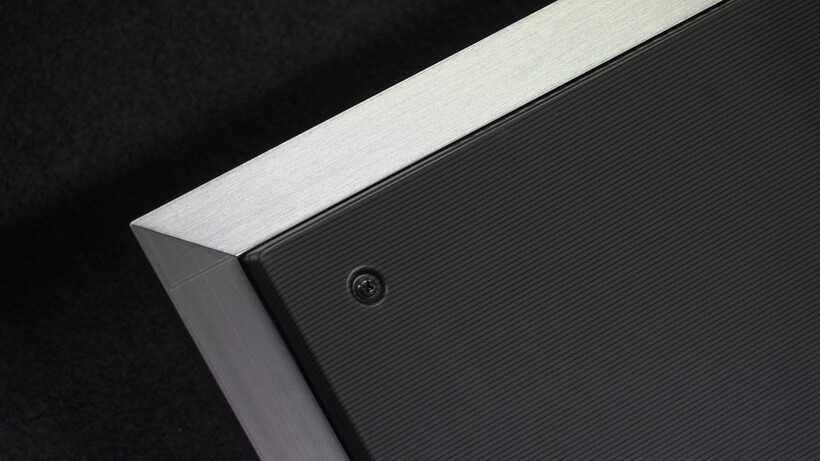
Vanta Black Anti-Reflective panel
Strong viewing angles
There haven’t really been any significant changes to LG’s design of the G6-series in years – ‘if it ain’t broke, don’t fix it’.
Advertisement
Advertisement
The stand takes about four minutes to assemble, but it seems to be the same as the G5 and G4 stands. Of course, if you buy the wall-mounted version, you just deal with hanging it up on your preferred surface. Connections are side- and downward-facing for feeding sources to the TV.
Image Credit (Trusted Reviews)
The stand is adjustable. You can hang it in its low orientation, or if you want to put a soundbar below, put the stand into its high position.
The OLED65G6 features LG’s Vanta Black Anti-Reflective coating to reduce reflections and maintain black levels in a bright room. Black levels remain strong, but I don’t find the G6 necessarily as good as Samsung’s glare-free OLEDs at mitigating glare and reflections. That said, the S95H does raise blacks slightly in a dark room but the OLED G6’s panel does create a purple tinge to reflections.
Wide angles are very strong, and while brightness and colour saturation do tail off, you’d have to be very wide and far to notice this.
Image Credit (Trusted Reviews)
Advertisement
User Experience
Five-year software updates
LG webOS platform
LG’s webOS interface still fundamentally looks like the webOS it’s been for the last few years. There’s no room for Freely but all the UK catch-up and on-demand apps are provided, side-by-side with the big global apps such as Disney+, Netflix and Apple TV.
Accessing these apps requires an LG account. In previous years, this was ring-fenced to some but not all apps; now it’s required for all apps. It’s not a change most will like unless they already have an LG account.
Advertisement
Image Credit (Trusted Reviews)
You get five years of updates with LG’s Re:New program that guarantees four major software updates.
The interface itself is swift and responsive. Scrolling down to the bottom doesn’t take long, the interface free from clutter or meaningless diversions. There are ads, of course, but I don’t find them intrusive. Flick to the left and you’ll be received by LG’s Information Board, which offers weather updates, Google Calendar and any smart tech in your Home Hub.
Advertisement
Image Credit (Trusted Reviews)
Given this is the G-Series TV (which once upon a time stood for Gallery), there is LG’s Gallery+ app, where you turn the G6 into a picture painting (not to be confused with LG’s Gallery TV, which can also do the same thing). A subscription is required, but there’s free content alongside AI-generated… things.
With the LG Sports app, you can keep track of your favourite teams across a range of sports, as well as access content via Prime Video, YouTube, Apple TV, and DAZN. Currently, there’s a spotlight on the World Soccer Festival (you can guess what that is).
Image Credit (Trusted Reviews)
Gaming
Cloud gaming
4K/165Hz for PC gaming
AMD and Nvidia VRR
LG still pushes the G-Series as a gaming TV despite its more lifestyle focus, and I measured input lag remains quick at 12.9ms. All four HDMI 2.1 inputs support ALLM, VRR and 4K/120Hz.
Advertisement
Advertisement
PC gamers get a boosted 165Hz refresh rate with both AMD FreeSync Premium and Nvidia G-Sync included. There’s also Dolby Vision Gaming (4K/120Hz) and the HGIG standard, which covers off most of the gaming HDR formats aside from HDR10+ Gaming.
Image Credit (Trusted Reviews)
For further tweaking, press the Settings button when the TV is in its game mode, and the Game Optimiser pop-up allows for deeper customisation, including adjusting black levels or switching the Game Genre setting to optimise for specific game types.
Head to LG’s gaming portal and that has cloud gaming options in GeForce NOW (which supports 4K/120Hz in the cloud), Amazon Luna, Xbox app, Utomik, and Blacknut, while Twitch broadcasting is built in too.
Connectivity
Four HDMI 2.1 inputs
Bluetooth
If this feels like Déjà vu, then that’s because nothing much has changed on the connectivity front. There are four HDMI 2.1 inputs, one of which supports eARC for a sound system. Other HDMI 2.1 features include QFT to reduce latency during gaming and QMS, which eliminates black screens when switching to other HDMI sources.
Advertisement
The rest covers a headphone output, digital optical output, two RF aerials for broadcasts, Ethernet, three USB 2.0 inputs, and a CI+ 1.4 common interface slot.
Advertisement
Image Credit (Trusted Reviews)
That’s virtually the same as it’s been for the last few years, which is fine, though the Hisense UR9 drops a HDMI input for a DisplayPort, which is different from the accepted norm.
This is the second year of LG Display’s Primary RGB Tandem panels, and the G6 is upping brightness further.
Advertisement
This year, it boasts what LG calls its Hyper Radiant Colour Tech, and along with the Alpha 11 AI Processor Gen3, it says it can boost peak brightness by 3.9 times.
That sounds like the usual marketing mumbo jumbo that doesn’t mean much to most people. I wasn’t able to record the figures of the OLED65G5 as I didn’t have the necessary equipment, but now I do and the OLED65G6 is one of the brightest OLEDs I’ve tested. In its Standard mode it registers the following:
Advertisement
HDR Window (%)
Nits
2
2668
5
2499
10
2458
100
400
The OLED65G6 can go even brighter, registering above 3000 nits in Filmmaker and Vivid modes, while very briefly reaching 4000 nits in the latter. If you’re of the opinion that OLEDs aren’t bright enough to watch during the day, the OLED G6 rebuffs that. And I suspect that when the G7 turns up, it’ll be even brighter.
HDR support covers HDR10, HLG, and Dolby Vision, and LG says there’s Dolby Vision x ambient Filmmaker mode, though as I’ll get to later, I’m not entirely convinced this is the case.
The 4.2-channel system has 60W of power at its disposal. On paper, it’s the same as the OLED65G5 model, but LG has re-tuned it to sound warmer and offer more bass. As always, we’ll hear whether that’s the case.
Advertisement
Advertisement
Image Credit (Trusted Reviews)
LG’s α11 AI Sound Pro feature claims to up-mix Dolby Atmos sound to 11.1.2 virtual channels, and I’d recommend using it – it’s a much more expansive sound when enabled.
WOW Orchestra combines the TV’s speakers with an LG soundbar to create a bigger sound, but the OLED65G6 also supports Dolby Atmos FlexConnect and will work with the Sound Suite speaker system LG launched in 2026.
The G6 features AI experiences powered by Google Gemini and Microsoft Copilot, which you can mostly (if not completely) avoid. LG’s Shield security system protects your data through the cloud and in real-time.
Picture Quality
Crisp, clear, detailed 4K images
Not the brightest Dolby Vision performance
Slick motion processing
There’s been a lot of kerfuffle surrounding the launch of LG’s new 2026 TVs. Reviewers have mentioned different issues, different firmware updates – it’s all been a slightly messy rollout.
Advertisement
On my part, the G6 OLED I received seemed to have firmware dating back to 2024, which I couldn’t believe and thought I’d misread, but I updated the TV anyway. I’ve not experienced the issues some have, but there is one issue I’d like to point out.
Advertisement
I don’t think the Dolby Vision x Filmmaker mode is working properly.
On its website, LG notes it is the ‘ambient’ version of Filmmaker mode, but this is either not true, or it’s not working. Dolby Vision x Filmmaker mode is dark – and it’s meant to be like that as it’s tuned for watching with the lights off. The problem is that when the TV asks you to watch in this mode, it doesn’t compensate for ambient light. In a bright room, it’s so dark that detail is missing. I’ve turned on the AI Brightness mode in the settings, and that’s had zero effect.
Dolby x Filmmaker
Dolby Vision Home Cinema
Advertisement
Whether it was night-time scenes in Civil War, Dune or Sinners; detail is lost to the darkness in a bright room. Switching to Dolby Vision Home Cinema fixed this, but every time the LG G6 OLED receives a Dolby Vision signal, it’ll ask to watch in Filmmaker mode. My advice is to decline unless you’re watching in a dark room.
Aside from that, the LG OLED65G6 looks terrific in virtually all its picture modes. It’s not a massive increase in a real-world sense from the G5, but it is better.
Advertisement
Advertisement
Colours are rich, punchy, varied, but also seem accurate out of the box. Compared to a Hisense UR9 sat alongside it for the majority of testing, colours, shades and tones always seem to strike a better expression on the LG, with a more convincing performance.
Sharpness and detail are excellent; the OLED65G6 wrings every last bit of detail from the dank corridors and rusty surfaces of the Romulus station in Alien: Romulus; better than the Hisense UR9, which is softer, not as sharp and not as defined.
Image Credit (Trusted Reviews)
Where the LG loses points is with dark detail, which, while good across the films I demo on the OLED65G6, there are instances where black levels are a little impenetrable. But overall, black levels are rich and rock solid. There’s not a raised black in sight, even in a brightly lit test room. The pixel-perfect control of black levels means OLED TVs still reign over backlit LCD TVs.
In Disney’s Soul when Joe falls into The Great Beyond, highlights are rendered brightly, the sense of contrast from the TV is greater than the Hisense UR9, the pixel-perfect dimming also means it’s more precise with the starfield, picking out the varying brightness of the stars clearly and sharply.
Image Credit (Trusted Reviews)
Advertisement
It’s even more notable with Interstellar as they travel through the wormhole into another galaxy. As the camera pans past stars, the LG picks up more stars – and therefore more detail – than is visible on the Hisense.
Advertisement
With HDR10 content, the LG can feature white tones that are a little less bright – especially the ‘Construct’ scene in The Matrix Resurrections where Neo wakes up in a white room. Full-screen brightness is an area where Mini LEDs still have the advantage.
The Vivid mode features colours that are punchy, pure and rich – a boost in colour volume over the Home Cinema mode with a wider range of colours, and a performance that’s more balanced than it has been in recent years.
Image Credit (Trusted Reviews)
Brightness is excellent, contrast is terrific, detail levels are excellent and motion is handled with few issues. The Vivid mode boosts brightness and colours in all the right places, and it does so without adding distracting noise or garish colours. There are moments where it is oversaturated, but this the best Vivid mode I’ve seen on an LG TV.
A brief note on the Game Optimiser mode. It’s a little too bright to my eyes, and seems to introduce some clipping (loss of detail) with bright sources.
Advertisement
Advertisement
Upscaling
Impressive levels of detail
While the LG G6 OLED handles HDR content impressively well, most tend to watch in HD rather than 4K. It’s a good thing the OLED65G6 continues its excellent performance in this area.
With a Blu-ray of Mad Max: Fury Road, colours strike the right look (the red-orange of the ‘wasteland’, the blue skies, the white tones of the clouds). The LG uncovers more detail than the Hisense UR9 with a clearer sense of sharpness and finer detail visible. The LG retrieves more detail in the characters’ clothing, revealing more of the wear and tear they’ve been through.
Image Credit (Trusted Reviews)
The same is true with a Blu-ray of Pacific Rim – colours are consistently better on the LG than on the Hisense, complexions feature more colour and life, and the dark detail performance is the opposite of its HDR picture, offering more insight into dark scenes than the Hisense.
Colours have more punch, solidity and range. It’s a very pleasing HD image.
Advertisement
With a DVD of There Will Be Blood, the LG handles noise well, although it doesn’t eliminate all of it; it balances noise reduction without affecting film grain better than the Hisense.
Advertisement
Image Credit (Trusted Reviews)
Sharpness and detail are good enough for a DVD source, and I noticed the LG picked out more detail with Plainview’s beard than the Hisense UR9 did. There’s a touch more definition on the LG, colours – again – seem more accurate, with a richer and punchier feel for colours.
Sound Quality
Warm delivery
Clear dialogue
AI Sound Pro with Atmos
LG’s taken the G6 OLED in a different direction with its sound, responding to customer feedback.
The issues ‘fixed’ with the G6 aren’t the ones I’d have gone for. While the G5 sported a thinner sound, it was clear and sharp, especially with the highs. The G6 carries more bass and a warmer tone, but the highs have dulled and it’s not as detailed.
Advertisement
The built-in system isn’t very loud at my usual listening levels, and has to be pushed to close to 80 to have an impact. You won’t want to listen to stereo programming with AI Sound Pro as the processing can make it sound harsh. If it’s a Dolby Atmos soundtrack, enable AI Sound Pro; otherwise, use Standard mode for everything else.
Image Credit (Trusted Reviews)
For stereo content, the Standard mode is a good choice. Watching The Capture on iPlayer, and it’s clear, with a big, broad soundstage, good bass, and decent dynamism.
Switch to Atmos in AI Sound Pro, and there’s a warmer tone with richer bass and a smoother performance. Despite the emphasis on more bass, the LG can sound a bit tubby at times –in Blade Runner 2049, the lows can sound muddled and soft, and the highs aren’t the sharpest.
Advertisement
Image Credit (Trusted Reviews)
With Civil War, the LG isn’t the most energetic, coming across as tepid and quiet at half volume. Pump the volume up and there’s slight distortion but regardless the action scenes sound sluggish. It’s fine but not exciting.
Advertisement
Dialogue is clear and, for the most part, natural, though there have been times when the warmth of the sound renders male voices a little bassy. Watching series two of Daredevil: Born Again, and there are moments where the tone of voices isn’t quite right.
Nevertheless, sound is spread across the screen, and at times you can hear effects pushed out from the frame, widening the soundstage even further.
When playing games on the PS5, the sound system goes for a sharper response, and I find it too crisp and sharp in Game Optimiser mode.
Advertisement
SQUIRREL_PLAYLIST_10208579
Should you buy it?
It’s too soon to say whether this is the best OLED of 2026, but the LG G6 OLED delivers impressive picture across a range of sources
Advertisement
The Dolby Vision x Filmmaker mode isn’t quite working
If the Filmmaker mode is meant to be adaptive, changing its performance with regards to the amount of light in a room, then it’s not working properly.
Advertisement
Final Thoughts
The G6 OLED is another excellent effort from LG. The picture quality is brighter, slightly more colourful, punchier, and feels like it’s more accurate.
The Dolby Vision x Filmmaker mode isn’t working as advertised in terms of its ambient function. It’s preferable to play in Dolby Vision Home Cinema in a room with lots of ambient light (if you’re in a dark room, Filmmaker mode is preferred).
Even though LG has given the sound system a retune, it still struggles with volume and is not the most exciting delivery. I also wish LG hadn’t locked all apps behind an account sign-up, either.
But the LG remains great for gaming, and there’s a wealth of entertainment options (if you get past the sign-up). RGB Mini LEDs are brighter, but they don’t offer the same level of contrast and control as far as black levels go. At least not yet.
Is it the best OLED? It depends on what you want. In terms of respecting the source, I’d say it’s the Sony Bravia 8 II. For sheer spectacle and mitigating reflections, it’s the Samsung S95H.
The LG G6 OLED finds itself in between those two, delivering accurate but great-looking HDR images without the slightly raised blacks of Samsung’s S95H.
LG’s best OLED yet? Absolutely, and a contender for one of 2026’s best TVs.
Advertisement
How We Test
The 65-inch LG G6 OLED TV was tested over a month with real-world use and benchmark tests that included measuring brightness, input lag and using the Spears and Munsil Benchmark UHD disc to test viewing angles and colour accuracy.
Advertisement
Tested with real world use
Tested for a month
Benchmarked with Spears and Munsil disc
FAQs
Does the LG G6 OLED come in sizes bigger than 77-inches?
At the time of review, the LG G6 OLED is only available in 48, 55, 65, and 77-inch models.
Test Data
LG OLED65G6
Contrast ratio
Infnity
Input lag (ms)
12.9 ms
Peak brightness (nits) 5%
2499 nits
Peak brightness (nits) 2%
2668 nits
Peak brightness (nits) 10%
2458 nits
Peak brightness (nits) 100%
400 nits
Set up TV (timed)
240 Seconds
Full Specs
LG OLED65G6 Review
UK RRP
£3099
Manufacturer
LG
Screen Size
65.4 inches
Size (Dimensions)
1441 x 263 x 910 MM
Size (Dimensions without stand)
826 x 1441 x 24.3 MM
Weight
27.3 KG
Operating System
webOS
Release Date
2026
Model Number
OLED65G62LW
Model Variants
OLED65G66LS
Resolution
3840 x 2160
HDR
Yes
Types of HDR
HDR10, HLG, Dolby Vision, Dolby Vision x Filmmaker
Refresh Rate TVs
48 – 165 Hz
Ports
Four HDMI 2.1, three USB, ethernet, optical digital out, CI+, two RF tuners
HDMI (2.1)
eARC, ALLM, VRR, 4K/165Hz, QFT, QMF
Audio (Power output)
60 W
Connectivity
Wi-Fi, Google Cast, AirPlay 2, WiSA, Bluetooth 5.3
The 2026 World Cup is rolling out two layers of technology that most of its 10 million visitors will actually touch: a consumer-AI layer led by Google, and a biometric-identity layer that turns a fan’s face into a ticket. This is the quieter half of the tournament’s tech, the half aimed at fans rather than threats.
Across 16 host cities in the US, Canada, and Mexico, neither layer comes with a robot dog attached. Both, though, are likely to outlast the final.
Google’s Gemini goes to the World Cup
Google has made Gemini and its Pixel phones official sponsors of several national teams, among them France, Argentina, Morocco, Iraq, Turkey, and the United States. Pixel is the official phone of the French squad, which is also using Gemini for team communications.
For fans, Google is pushing tournament features across Search, Maps, Waze, and the Gemini app: live score tracking, AI-generated tactical diagrams, and match highlights the app assembles on demand. It is also making its AI Mode Pro visuals free over the summer, timed to the tournament. For Google, the World Cup is a global launchpad for Gemini, dressed as fan service.
At the gate, the bigger change is biometric. At Gillette Stadium near Boston, fans can opt into facial recognition that links their face to a digital wallet, so they enter and pay without a ticket or card. Several venues are testing similar face-based entry.
Advertisement
Around the stadiums, cities are wiring up wider surveillance. In Seattle, officials connected stadium-district CCTV and automatic licence-plate readers to a Real-Time Crime Center, after a public fight over when the cameras switch on and whether they would track immigration status. None of this is unprecedented: Qatar ran the 2022 World Cup with around 22,000 cameras across eight venues. The new element is the consumer-facing pitch, that handing over your face is simply faster.
This biometric layer sits alongside the more visible security hardware TNW has already covered, the robot dogs, hunter drones, and AI cameras, but it is the part fans will queue up and opt into themselves. And the core technology is fallible: facial recognition is something independent studies have shown misidentifies women and people of colour more often than white men, and which TNW has long flagged as a civil-liberties risk once it scales.
Even the referee is now a camera
The AI reaches the pitch too. FIFA’s body-worn ‘Ref Cam’, trialled at the 2025 Club World Cup, is now written into the Laws of the Game and will be available in every match, with selected moments fed to broadcasters and stadium screens. FIFA’s partner Lenovo is using AI to clean up the footage, claiming up to 50 per cent less motion blur from a sprinting referee.
The pitch is transparency. The effect is one more live, AI-processed feed in the broadcast.
Advertisement
The bill falls on the fans
More than 120 civil-society groups, including the ACLU and Amnesty International, have issued a travel advisory for the tournament. They warn of racial profiling, device searches, social-media screening, and facial recognition, and advise some travellers to remove face-unlock from their phones before flying.
In February, ICE said its agents would play a ‘key part’ in tournament security.
The face-payment systems are, for now, opt-in. The question the tournament leaves open is what happens on 20 July, the day after the final. Stadium facial recognition, licence-plate networks, and AI video analytics rarely disappear when the crowds do.
The World Cup is where the softer half of this infrastructure gets normalised, in front of 10 million people, as the price of getting through the gate.
This article is crossposted from IEEE Spectrum’s careers newsletter. Sign up now to get insider tips, expert advice, and practical strategies, written in partnership with tech career development company Parsity and delivered to your inbox for free!
There is no shortage of people telling recent engineering graduates that their degree was a mistake and that AI is coming for their jobs before they even land one. I respectfully disagree.
I have been a software engineer for 12 years, done well over 100 interviews on both sides of the table, and run Parsity, an AI engineering program. A few patterns emerge consistently in who actually breaks through in today’s job market. Here’s why I think the job market isn’t as dire as it looks, and what I would do if I were looking for my first tech job.
The Numbers Need Context
The Federal Reserve Bank of New York recently placed unemployment for recent CS graduates in the United States at 6.1 percent, with computer engineering graduates at 7.5 percent. Compared to philosophy majors at 3.2 percent and art history graduates at 3.0 percent, those figures look alarming. They require more context than most headlines provide.
Advertisement
When researchers factor in underemployment (graduates working jobs that don’t require a college degree), then engineers are doing relatively well, coming in below 20 percent, against a 42 percent average across all recent graduates. Many majors reporting lower unemployment are achieving that figure by accepting work entirely unrelated to their field. Scored across unemployment, underemployment, and early-career earnings together, CS and computer engineering still rank among the top fields for overall labor market outcomes.
The degree is not the problem. The hiring pipeline is. Job postings labeled “entry-level software engineer” grew roughly 47 percent between late 2023 and late 2024, while actual hiring into those roles dropped approximately 73 percent in the same window. So-called “ghost jobs,” used to create an illusion of company growth, are everywhere. This makes the front door harder to find, but it exists.
Here Is What To Do About It
Do a broad search of your (real-life) network. Roughly 26 percent of job offers come through referrals. Look at your actual network—classmates, professors, past internship contacts, relatives—and identify people at companies that might be hiring. The goal is a warm introduction to someone who is or knows a decision maker. One introduction carries more weight than a hundred cold applications through a portal.
Find symmetric risk. A junior engineer is a risky hire by definition. A startup carries a matching risk profile, meaning potentially lower compensation, no certainty of longevity, and higher performance expectations. But that shared risk creates mutual interest. The learning curve is steep, the exposure is broad, and the track record transfers directly. For engineers whose longer-term goal is a large organization, a startup is not a detour. It can be how you build the experience those organizations eventually want to see. The first job is for validation and learning. It is not a life sentence.
Advertisement
Manufacture experience rather than waiting for it. Employers want experience but will not hire you to get it. The way through is to create it: a deployed project, an open-source contribution, building something real for a small business or family member. Recruiters are skeptical of toy projects. A deployed application solving a real problem, combined with the ability to talk clearly about the decisions you made and why, still moves the needle.
Gain practical AI engineering skills, not just AI tool fluency. Using Cursor or Copilot is now a baseline expectation. What differentiates candidates is going one level deeper. Most working engineers, including senior ones, have not built a RAG pipeline or designed a multi-agent system. Understanding how to chunk documents, generate embeddings, store and query them from a vector database, and wire it into a production application puts a candidate ahead of a significant portion of the market on a skill in rapidly growing demand. AI and data science roles grew 163 percent in job postings in 2025. The engineers who understand how these systems actually work, not just how to prompt them, are in the shortest supply.
Stop optimizing around conditions you cannot predict. Nobody anticipated the 2021 hiring boom. Nobody predicted this correction. Build durable skills. The demand for engineers who can reason clearly about systems is not going away. Where you start is not where you end.
—Brian
Advertisement
More major workforce reductions are on the horizon at Big Tech companies: Meta announced it will cut 10 percent of its workforce, or about 8,000 employees, and Microsoft plans to offer buyouts for 7 percent of its U.S. employees in a voluntary retirement program. The cuts are understood by many to be linked to AI. But is AI really to blame? For The Conversation, two academics at the University of Sydney give their two cents.
Tom Burick got his start as a roboticist. But when a financial downturn forced him to close his robotics business, he thought of the effect teachers had on his life and decided to pay it forward. Burick now works as a technology instructor at a school for students with autism, where he recently led a project building a full-scale replica of ENIAC, an historic computer celebrating its 80th anniversary this year.
Across several industries, the United States has been moving toward limiting the use of sensitive technology made in China. Now, legislation has been introduced to extend the trend to ground robots, including humanoids, dogs, and crawlers. This could benefit some U.S.-based robotics firms—but many of these companies still rely on Chinese-made components. “The U.S. robotics industry is in a pickle,” writes Spectrum tech policy editor Lucas Laursen.
Legora is already hiring to fill its new offices, with plans to grow its combined EMEA headcount to 700.
Swedish legal AI start-up Legora is expanding its footprint with a new engineering hub in London alongside new offices in Madrid, Milan and Paris. The expansion comes just months after the company raised $550m in a Series D round which valued Legora at $5.5bn.
Founded as Leya in 2023, Legora is an agentic AI platform supporting legal professionals with research, review and document drafting. It is used by more than 100,000 legal professionals at more than 1,200 law firms and in-house legal teams across more than 50 markets, according to the company.
The Madrid, Milan, and Paris offices will serve as regional hubs for customer success, go to market functions and legal engineering, while the new London engineering hub will be co-located with Legora’s existing presence in the city.
Advertisement
The new offices will open during Q3 this year and represent Legora’s most concentrated Europe, Middle East and Africa (EMEA) investment to date, the company said.
Legora is already hiring for positions to fill the new offices, with plans to grow its combined EMEA headcount to 700 within the next year. According to its website, Legora currently employs more than 400.
“Our customers in these countries have built Legora into the way they work,” said Max Junestrand, the CEO and co-founder of Legora. “Opening offices in Madrid, Milan and Paris means we can be genuinely close to them as we build the future of the platform together.
“Engineers who understand how AI applies in professional contexts are disproportionately concentrated in London,” said Junestrand added. “People here have built things that have to perform under real legal and regulatory constraints. That’s a different problem from building a consumer product, and it’s precisely the problem we’re solving.”
Advertisement
The new offices will bring Legora’s global footprint to 16 cities including Munich, Chicago, Houston, San Francisco, Toronto, Bengaluru and Sydney, as well as the recently announced offices in Singapore and Tokyo, the company said. Legora also has existing engineering hubs in Stockholm and New York.
Legora’s March Series D round was led by Accel, with participation from the likes of Benchmark, general Catalyst, Y Combinator, Menlo Ventures and Salesforce Ventures – taking the legal-tech’s total raise to date to $815m.
The company, at the time, said it planned to use the newly raised funds to further expand across the US, including with new offices in Texas and Illinois, as well as new local hubs. Legora plans to expand its US headcount to more than 300 by the end of 2026.
Engineering teams building agentic coding pipelines now have a concrete open-source alternative to managed models like Claude Fable 5 — one that runs on a single H100. The tradeoff: Cohere’s North Mini Code, which launched Tuesday, generated three times the output tokens of comparable models in independent testing, a verbosity cost that compounds in high-volume production workloads.
The new open-source model is a 30 billion parameter mixture-of-experts (MoE) model with 3 billion parameters active per token, built for agentic software engineering including sub-agent orchestration, architecture mapping, code review and terminal work. The model supports a 256,000 token context window with a 64,000 token maximum generation length, and is available on Hugging Face under an Apache 2.0 license.
What North Mini Code can do
North Mini Code targets the full agentic coding stack. Here is what the model does and what it runs on.
Software engineering. Cohere built North Mini Code specifically for agentic software engineering, not adapted from a general-purpose base. It has integrated tool-use capabilities and supports interleaved thinking, which Cohere says improves performance across multi-step agentic work.
Advertisement
Architecture mapping and code review. North Mini Code can analyze and map systems architecture, surface dependencies and perform code review across large codebases. With a 256,000 token context window, it can hold substantial multi-file projects in a single context pass.
Terminal-based agentic tasks. The model is trained for terminal environments, handling shell interactions, package scripts and command-line tooling. Cohere benchmarked it on Terminal-Bench v2, which tests agents in real terminal environments rather than synthetic code generation tasks.
How it was built
North Mini Code is a sparse mixture-of-experts model with 128 experts, of which 8 activate per token. The compute requirement at inference time is closer to a 3 billion parameter model despite 30 billion total parameters. Nick Frosst, co-founder of Cohere, demoed it running on a Mac Studio via MLX at around 20 gigabytes of RAM, the same machine he uses for his own local coding work.
Cohere trained the model through two stages of supervised fine-tuning followed by reinforcement learning with verifiable rewards across more than 70,000 verifiable tasks spanning approximately 5,000 repositories, deduplicated against SWE-Bench.
Advertisement
Rather than optimizing against a single agent scaffold, Cohere trained across three. SWE-Agent uses a rich CLI with specialized commands. Mini-SWE-Agent uses a single bash tool with raw shell output. OpenCode uses individually typed tools returning structured JSON. Cohere reports a 10 percentage point gain on OpenCode evaluation from the multi-harness approach while maintaining SWE-Agent performance.
Where it fits
North Mini Code enters a market that now includes Mistral Devstral Small 2, GitHub Copilot, Cursor, and Claude Fable 5 — each with distinct cost and deployment tradeoffs.
Cohere’s primary benchmark comparison is against Mistral Devstral Small 2, a 24 billion parameter dense model. In vendor-reported internal tests, Cohere claims 2.8x higher output throughput and a 30% inter-token latency advantage over Devstral Small 2 in internal tests under identical hardware configurations. Cohere also claims, in its Hugging Face technical post, that North Mini Code outperforms open-source models up to four times its parameter count on its reported benchmarks, including models at 120 billion parameters.
Artificial Analysis independently ranks it eighth of 127 comparable open-weight models on output speed at 210 tokens per second, with a time to first token of 0.25 second against a class median of 1.95 seconds. It places 18th of 127 on the Artificial Analysis Intelligence Index. One flag from the same data: the model generated 75 million output tokens to complete the Intelligence Index against a class median of 25 million. In high-volume agentic pipelines, that verbosity compounds into inference cost and latency.
Advertisement
“Suddenly people are thinking like hey, am I getting enough economic value out of the tokens from a model?” Frosst said during the launch video. “Local deployment is one way of empowering people and making AI really something that works for them.”
GitHub Copilot, Cursor and Claude Code operate on per-usage or subscription pricing with no on-premises option. Anthropic’s Claude Fable 5, now the most capable publicly available managed coding model, runs at $50 per million output tokens. For Frosst, the model is the polar opposite of Fable.
“Its small, cost effective, apache 2.0, and locally deployable. This is the way LLMs should go. small, open source, transparent and sovereign, vs large, expensive, proprietary and hegemonic,” Frosst wrote in a post on X.
What this means for enterprises
For teams building production agentic coding pipelines, North Mini Code’s release clarifies a set of decisions that have been forming for months.
Advertisement
Purpose-built agentic training is now a baseline to evaluate against. The distinction between models fine-tuned for code and models trained specifically for agentic workflows, with verified tool calls and multi-harness robustness, is now a material factor in pipeline decisions. Any model vendor claiming agentic coding capability should be able to answer whether its training used verifiable agentic tasks or was adapted from a general-purpose base.
Verbosity is a hidden pipeline cost that benchmarks do not surface. Artificial Analysis measured North Mini Code generating three times the output tokens of comparable models. That verbosity compounds across inference cost and latency in high-volume pipelines. Throughput testing against actual workload volume is the evaluation step the benchmark rankings skip.
The frontier pricing split is now a real architectural decision. Fable 5 at $50 per million output tokens and North Mini Code on a single H100 represent a genuine tradeoff between cost control and data residency on one side, and managed infrastructure overhead on the other. Teams running high-volume agentic coding pipelines should model both cost paths against their actual workload before committing to either.
AI is rapidly expanding across finance, but most agentic offerings have yet to reach core production systems. Only 10% of enterprises are using AI tools in a meaningful, production-grade way. Not because of a lack of interest, but because connecting AI to core systems to trade capture, risk, and surveillance is still a work in progress.
These systems offer the greatest opportunity for AI to simplify finance operations through efficient workflows and live trading queries. Yet, legacy systems force this technology to operate in isolation. The volume of architecture connected to traditional platforms often creates this constraint.
Andrew George
Managing Director and Solutions Architect at 3forge.
The financial services industry has forced firms to adapt core architecture rather than replace it, preserving operations, but limiting AI compatibility. Now, the challenge is incorporating AI into these existing systems without forcing an infrastructure replacement that would cause platforms to pause or fail.
Latest Videos From
To bridge the gap between existing systems and modern demands, firms need an architectural layer to help bridge legacy access, implement a governed AI gateway, and introduce AI-native workflows within trusted guardrails. With the right foundation, firms can extend these capabilities directly into production systems and utilize the full value of AI.
Advertisement
Taming the legacy stack without rewiring it
Years of regulations, acquisitions, asset-class specialization, and incremental development without a shared core have created an extensive stack of internal software required to keep operations running – a stack that was never designed to support responsive, AI-driven interaction.
Rather than rebuilding these systems, financial institutions are introducing an architectural layer that unifies access across fragmented infrastructure. This virtualized approach eliminates the need for costly rewiring while allowing organizations to consolidate access to both static and streaming data.
Instead of adding complexity, it creates a simpler path to deploying AI within existing environments.
Advertisement
Sign up to the TechRadar Pro newsletter to get all the top news, opinion, features and guidance your business needs to succeed!
IT teams can start this process by establishing a single abstraction layer across fragmented systems, allowing technology integration while applying entitlements at the data layer. In practice, this would allow:
Natural-language interrogation: Organization-specific data through chatbots and AI assistants.
Virtualization of systems: Abstraction of all systems behind a permission-aware access point.
Safe interaction: AI accessible touchpoints within operational infrastructures.
When organizations effectively apply abstraction layers to existing legacy architecture, AI can improve functions while interacting with internal systems through a controlled, permission-aware layer.
A controlled gateway for AI interaction
Abstraction layers are most effective when financial institutions apply them with gateways for AI access. When organizations apply these models together, this infrastructure creates a controlled AI interaction layer that provides a deliberate medium for producing deterministic, repeatable outputs.
Advertisement
Agents can then access data exclusively through the created pathway. This architecture creates transparency and provides for the application of a consistent set of data and functional access controls.
Ultimately, it allows stakeholders to gain confidence and trust, allowing agentic solutions to migrate from an assistive layer to an operational one capable of coordinating workflows, executing logic, and interacting with live systems.
Through this channel, agents can operate within defined policies and fully log all outputs, verifying repeatability and providing compliance teams with unified oversight of operations. A single control plane can grant permissions, log events, and instantly kill defective outputs, assuaging regulatory concerns.
Advertisement
These capabilities allow AI to expand financial institution growth in production-ready technological environments.
Accelerating development inside trusted boundaries
Once these foundations are in place, AI development can accelerate inside trusted boundaries. By doing so, organizations can reduce code surface area and shorten audit cycles.
Within these types of environments:
Advertisement
AI is equipped with proper boundaries for successful development.
Agents can generate layouts, workflows, and full applications.
AI can operate inside transparent and fully auditable runtimes.
Advanced coding can often power this controlled scale, offering development workflows that promote multimodal interaction, including voice, visual, and text. These capabilities further facilitate AI to fully operationalize efficient workflows across financial organizations.
However, when implementing AI adoption pathways, many organizations are now working through how to scale these capabilities consistently across systems. Financial firms facing this dilemma should follow the example of other industries.
The shift from rebuilding to building on top
Other industries have already solved a similar challenge of rebuilding their technology stacks much earlier in the development process. When this issue arose, they standardized their foundation across their industry, focusing on differentiated delivery rather than excessive rebuilding.
This often meant establishing application engines, a feature now used in gaming (Unity/Unreal), E-Commerce (Shopify), and general CRM (Salesforce).
Advertisement
If IT teams adopted these systems, purpose-built for finance, financial firms could focus primarily on delivery.
An engine could lay the foundation for virtualized legacy access, AI-governed gateways, and AI-native development within trusted guardrails, avoiding a full infrastructure replacement and establishing a safe way to integrate technology that reduces manual reconciliation.
A new foundation in financial systems
As AI moves deeper into core financial systems, the opportunity is not just in deploying models but rethinking how software is built and operated. Application engines provide a path forward by allowing firms to integrate AI into live systems, scale workflows, and generate new functionality from human intent, all within a governed environment.
This article was produced as part of TechRadar Pro Perspectives, our channel to feature the best and brightest minds in the technology industry today.
The views expressed here are those of the author and are not necessarily those of TechRadarPro or Future plc. If you are interested in contributing find out more here: https://www.techradar.com/pro/perspectives-how-to-submit
NASA has named Randy Bresnik, Luca Parmitano, Frank Rubio, and Andre Douglas as the crew for Artemis III, which has been reworked from a moon-landing mission into a roughly two-week Earth-orbit test of lunar landers being built by SpaceX and Blue Origin. NBC News reports: Randy Bresnik, Luca Parmitano, Frank Rubio and Andre Douglas are expected to launch into Earth orbit next year, with the goal of testing two commercially developed lunar landers that are slated to carry astronauts to the surface of the moon during the Artemis IV mission in 2028. Bresnik will be the mission’s commander, with Parmitano, an Italian astronaut with the European Space Agency, serving as the pilot. Douglas and Rubio will be mission specialists, and Bob Hines will train with the crew as a backup member. “This test flight will enable us to prove we can carry out highly choreographed operations with our partners across hardware interfaces, software propulsion systems and life support elements with crew in the high-stakes space environment,” Jeremy Parsons, NASA’s Artemis program manager, said during NASA’s announcement on Tuesday.
Bresnik has been to the International Space Station twice, most recently as commander of an expedition in 2017. A retired U.S. Marine colonel, he was selected as a NASA astronaut in 2004. Bresnik has helped oversee development and testing of spacecraft for the Artemis program as an assistant to the chief of the Astronaut Office, which manages astronaut training and operations. Parmitano has also done two stints on the ISS and served as commander of an expedition in 2019. He has completed a total of six spacewalks and also performed the first live DJ set in orbit. Before becoming an astronaut, Parmitano was a test pilot for the Italian air force.
For Rubio, a physician with 28 years of service in the Army, Artemis III will be his second trip to space. From 2022 to 2023, he spent 371 days on the space station, breaking the record for longest-duration spaceflight by an American, according to NASA. Douglas is the only crew member making his spaceflight debut. An engineer who previously worked on space exploration and robotics at Johns Hopkins University Applied Physics Lab, he became a NASA astronaut in 2022. Douglas was the backup crew member for the Artemis II mission around the moon earlier this year. He told NBC News in an interview after Tuesday’s announcement that the role had at times been a challenge. “It was hard to figure out how do you balance getting ready to go, not go, all that stuff,” he said. “But to go now is just fantastic.”
Back in January of this year, RFK Jr. clearly strong armed the CDC into changing the childhood vaccination schedules in America to mimic those of Denmark. The public messaging was crafted to sound as reasonable as possible and amounted to a claim that America was going to revise vaccination schedules to match those of another successful, industrialized, peer country. There were a couple of problems with the move.
For starters, Kennedy did his usual move of trying to make this change completely outside of the normal process for such things. There was no indication that any of this was done at the behest of his reformed ACIP panel. It didn’t go through the normal scientific checks and balances. And even if it had, the courts later put a stay on all such changes, because Kennedy didn’t follow the American Procedure Act in either those revised schedules or even the formation of ACIP itself. The Trump administration has appealed that decision.
The other main issue with the change was the obvious one: America is not Denmark. Calling Denmark a peer nation to America is laughable for many reasons. As one Danish official pointed out at the time: Denmark has a homogeneous population, universal free healthcare, lower serious outcomes from infectious diseases that they don’t vaccinate for, and a population that actually largely trusts government institutions. America doesn’t have any of that, in large part because the party of Trump doesn’t want us to have it.
Donald Trump doesn’t know how to take an “L”, though, so of course he simply picked up a pen recently and is attempting to executive order his way to trying to change those same vaccination schedules.
Advertisement
While the federal government is appealing that injunction, the new executive order on Friday reaffirms Kennedy’s plans to adopt Denmark’s strategy, calling for “realigning” US vaccine policy with “best practices from peer, developed countries.”It states that the scientific assessment written by Høeg and Kulldorff is a “guiding resource for the Federal Government” and that the CDC shall ” take any appropriate steps to update the United States childhood and adolescent vaccine schedule.”
As before, the AMA is strongly against the unilateral change made without backing from scientific evidence.
“Altering [the vaccine schedule] without clear, evidence-based justification risks continued confusion for parents and patients, undermining trust in vaccines, and ultimately lowering vaccination rates,” Mukkamala said. “That would put more children and communities at risk of preventable illness.”
The American Medical Association (AMA) wasn’t the only one to come out against this top-down edict. The American College of Physicians (ACP) likewise pushed back on the EO publicly, stating unequivocally that it must not be implemented or there would be severe negative health outcomes for American children.
As did, hilariously, scientists in Denmark itself.
Advertisement
Anders Hviid, who leads research on vaccine safety and effectiveness at the Statens Serum Institut, Denmark’s equivalent of the CDC, told The New York Times in December that it did not make sense to compare the US to Denmark. “It’s not at all fair to say look at Denmark unless you can match the other characteristics of Denmark,” he said.
Hviid also told the Times that the US public health policies under Kennedy “get crazier and crazier” by the month. “It is surreal, and it is difficult, from a Danish perspective, to understand what’s going on.”
Trust me, dear Anders, it’s difficult to understand from within the American borders, too.
Now, neither Trump nor Kennedy give a flying damn about Denmark, of course. That much is obvious to anyone with a working frontal cortex. The country’s vaccination schedules are merely being used as a prop to reduce the vaccination schedules for American children because that’s all Kennedy really wants. Over the objections, it turns out, of Danish scientists themselves.
I’m sure the AMA, ACP, or the American Academy of Pediatricians (AAP) will be filing lawsuits over this Executive Order. And I see no reason why the courts shouldn’t put a hold on its implementation, as it did to Kennedy.
Advertisement
But the real mystery is why the do-nothings in Congress just can’t be bothered to push back directly on all of this.
MSP says it is ‘absolutely devastated’ as woman arrested on suspicion of murder
Neil Muller, newly appointed Group CEO of managed service provider Node4, has died after an alleged stabbing at his home. He was 54.
Muller, a well-respected and long-serving figure in Britain’s tech supply chain, was found with chest wounds at his residence in Claverdon, Warwickshire, in the early hours of June 7.
Advertisement
Warwickshire Police said in a statement: “We received a report from ambulance services at 6.15am about a man in his 50s who required emergency medical care following a stab wound in his chest. Sadly, he was declared deceased at the scene at 6.37am.”
A 55-year-old woman from Birmingham was arrested on suspicion of murder at 7.33am and has since been released on bail. Police confirmed an investigation is underway and said there is “no wider risk to the public.”
Muller had only taken on the Group CEO role at Node4 this month, tasked with refining its strategy and expanding its AI-augmented managed services platform. The MSP said it was “absolutely devastated” by his death, adding: “Although Neil only recently joined Node4, he made a meaningful impact in a short space of time. Our thoughts are with Neil’s family at this very difficult time.”
Before Node4, Muller led Digital Space for seven years, and prior to that he was chief exec at telecoms biz Daisy Group, whose B2B ops merged with Virgin Media O2 last year. Muller started his career at Computacenter – one of Europe’s largest services-based resellers – rising through sales and operations to become UK and Ireland managing director during a 21-year tenure.
Advertisement
Mike Norris, Group CEO at Computacenter and a close friend of Muller, told The Register that he was “deeply saddened from a personal point of view.”
Norris was not alone: many in Britain’s tech business community expressed shock. Charles Bligh, former TalkTalk chief operating officer, wrote on LinkedIn: “Just so shocked to hear this terrible news. Neil was a class act and he filled the room with his energy and leadership. My condolences to his family and his children should know their father was a respected, liked and thought leader in the business community. I know this is cold comfort. Neil you will be missed terribly and RIP.”
Muller is survived by his wife and two children. ®
Even before the recent nationwide rise in gas prices in response to geopolitical circumstances in the Middle East, fuel economy has always been one of the biggest factors that buyers consider when choosing a new vehicle. Whenever gas prices go up, the differences in fuel efficiency ratings between different models matter more to people.
Yet even with elevated fuel prices, the popularity of pickup trucks in America seems unlikely to fade. And while these vehicles may not be as efficient as your average sedan or crossover, recent fuel economy gains have been impressive. So which trucks are the most efficient? If you’re looking for maximum pickup truck efficiency overall, Rivian is the truck brand that gets the win, but its all-electric models are not directly comparable to internal combustion models.
Advertisement
When it comes to traditional pickup trucks with internal combustion engines, a few models come out on top in the fuel economy rankings, though their efficiency is heavily dependent on which engine option you choose. Thanks in particular to the growth of the hybrid truck market, many of these pickups have far better MPG figures than you might assume — we’ve highlighted the standouts below.
Advertisement
Ford Maverick
Sure, you could put an asterisk next to the Ford Maverick’s inclusion in this list because it’s not a “real” body-on-frame pickup and instead uses a more car-like unibody platform with front-wheel drive being the standard drivetrain layout. Buyers don’t seem to mind, though, and the Maverick has been an absolute hit as far as sales figures go.
When it comes to gasoline use, the Maverick is the most fuel-efficient pickup choice out there, by a significant margin. In its front-wheel-drive hybrid form, the Maverick delivers an incredible 38 MPG combined rating from the EPA, with the all-wheel-drive hybrid version coming in just behind that. Maverick buyers can also opt for non-hybrid models with the more powerful 2.0-liter turbocharged engine, and though the fuel efficiency ratings for the 2.0 Maverick aren’t as high, they are still quite good by pickup truck standards.
As our testing has found, though, there’s more to the Ford Maverick than just great MPG. The truck has also won over buyers who like its compact size, and the Maverick’s affordable price tag is another huge draw at a time when many feel that pickup truck prices are ballooning out of control. When looking for a sensible truck, the potential to save serious money at the gas pump is just one part of the Maverick’s compelling formula.
Advertisement
Chevy Silverado 1500 and GMC Sierra 1500
One might assume that full-size half-ton pickup trucks would be pretty far down a list like this, well behind the smaller mid-size trucks, but that’s not actually the case. Per the EPA’s fuel economy ratings, the truck that comes in second place to the Ford Maverick for fuel efficiency is the Chevrolet Silverado 1500, along with its GMC twin, the Sierra 1500.
More specifically, it’s the Silverado and Sierra powered by the stellar 3.0-liter Duramax inline-six turbodiesel engine. When equipped with this engine, the two-wheel drive Silverado and Sierra 1500 both deliver a combined EPA rating of 25 MPG. The engine’s stout horsepower and torque numbers aside, this is a number that was formerly unheard of when it comes to full-size pickups.
Advertisement
However, when talking about fuel efficiency and saving money on gas, it’s important to note that diesel prices are often higher than gasoline, and even more so under current conditions. You can, of course, get Silverados and Sierras with gasoline engines like the 2.7-liter turbocharged four-cylinder. Despite its lower fuel economy rating, the gas 2.7 could end up being cheaper to fuel than the more efficient turbodiesel models, and even the EPA’s official estimates show the expected annual fuel costs of the two engines are nearly identical.
Advertisement
Ford F-150
The Ford F-150 pickup isn’t just a perennial bestseller, depending on powertrain options, it can also be one of the most fuel-efficient trucks on the road. When equipped with its available hybridized 3.5-liter V6 engine, the F-150 PowerBoost is actually the most fuel-efficient non-diesel full-size truck you can buy right now.
The F-150 PowerBoost has an EPA combined rating of 23 MPG, which includes an especially high rating of 22 MPG in city driving — and better yet, that’s the rating for a four-wheel drive model. The Chevy and GMC Duramax diesel half-ton trucks might have the edge in pure fuel efficiency, but per the EPA, the gasoline-powered F-150 Hybrid should be significantly cheaper to fuel up than a comparable Duramax truck.
In our review of the 2025 F-150 Hybrid, we found the added efficiency of the F-150’s hybrid option to be well worth its extra cost, which also buys you a nice bump in horsepower and a fairly substantial boost in torque over the non-hybrid 3.5 EcoBoost F-150. Ford of course, offers other less efficient powertrains in the F-150, including the Raptor R’s gas-guzzling supercharged V8 — but when it comes to balancing performance and fuel economy, the PowerBoost version is hard to beat.
Advertisement
Toyota Tacoma
If you are in the market for a mid-sized pickup truck and place a high value on fuel economy, the Toyota Tacoma is going to be difficult to top. Toyota currently offers the Tacoma with two different engines — a standard 2.4-liter turbocharged four-cylinder or a hybrid i-Force Max version of that same engine, which is available on the truck’s upper trim models.
Toyota has been greatly increasing hybrid options across its vehicle lineup in recent years, but the hybrid Tacoma is less about raw fuel efficiency and more about the added horsepower and torque compared to the non-hybrid version. In our review of the 2024 Toyota Tacoma TRD Pro, we found the engine’s impressive 326 hp and 465 lb-ft of torque to be a significant improvement over the base, non-hybrid versions.
Advertisement
However, if you’re simply looking for the most fuel-efficient Tacoma, there actually isn’t a massive difference between the Tacoma Hybrid 4WD’s 23 MPG combined EPA rating, and the non-hybrid 4WD model’s 21 MPG combined rating. If you factor in the added cost of the hybrid powertrain, the money-saving math probably won’t work out in the hybrid’s favor, but that’s not surprising. As mentioned a moment ago, the i-Force Max version of the Tacoma is more about driving performance than saving money at the pump.
Advertisement
Ford Ranger
Not to be overlooked between the compact Ford Maverick and the larger F-150 is the mid-sized Ford Ranger, which also offers strong fuel-efficiency numbers for its class. Unlike some of the other trucks on this list, the Ranger gets these numbers not from a hybrid or upmarket turbodiesel powertrain, but with its base 2.3-liter turbocharged EcoBoost four-cylinder.
In its two-wheel-drive spec, the 2.3-liter Ranger earns an EPA rating of 23 MPG combined, which, for the money, is about as good as you’ll find in any body-on-frame pickup truck on sale right now. Our review of the current generation Ranger XLT found that the truck’s real-world economy backs those numbers up, which we found very impressive for a non-hybrid, base engine. Those looking for more power from their Ranger can opt for the larger 2.7-liter EcoBoost V6 engine, but as you’d expect, that drops overall fuel economy numbers by a few miles per gallon.
Beyond that, there’s the much more powerful Ford Ranger Raptor, which, not surprisingly, drops that combined EPA rating down even further to 17 MPG. Given recent electrification trends, perhaps at some point Ford will add a hybrid Ranger option similar to the F-150, which would likely take the Ranger’s already-strong fuel economy numbers to a new level.
Advertisement
Methodology
When putting this list together, we used official EPA fuel ratings as our primary source to pick five of the best-performing, current pickup trucks with internal combustion engines. We also used our first-hand experience on most of these models to back up the selection with real-world fuel economy and performance observations. We all allowed current truck models with either gasoline, hybrid, or turbodiesel engines.




























































You must be logged in to post a comment Login