
Crypto World
The proof-of-human war nobody is winning yet



Two projects have verified roughly 18 million humans each, by completely different methods, for the same prize: becoming the identity layer of an internet overrun by AI. Worldcoin scans irises with orbs and has Vercel, Zoom, and Tinder integrating its ID. Pi Network verified its users with documents and social trust and just opened the system for business. Both tokens are down catastrophically. Here is the honest comparison of who is positioned to win, and why the market believes neither.
Summary
- Pi Network and Worldcoin have each verified around 18 million users using different approaches to build proof of human identity for the AI era.
- Worldcoin leads in enterprise integrations while Pi Network is betting on its new PiVerify service to create real demand for its token.
- Both projects face the same challenge of turning verified users into sustainable revenue as their tokens remain far below previous highs.
The internet is filling up with things that are not people. By one widely circulated Fundstrat compilation, non-human accounts now generate about 75% of trading volume on Polymarket, 53% of web traffic, 47% of email, and 44% of US equity buy-side execution, and the AI agents behind those numbers are getting more convincing every quarter. In that world, the ability to cryptographically attest that an online actor is a real, unique human stops being a niche crypto experiment and becomes basic infrastructure, the kind of primitive that login systems, exchanges, dating apps, and payment rails all eventually need.
Two crypto projects have spent years and enormous resources building exactly that attestation, and by a strange coincidence they arrive in mid-2026 with almost identical headline numbers and opposite methods. Worldcoin, the Sam Altman-founded project now called World, has verified about 18 million humans by scanning their irises with a chrome device called the Orb, inside an app ecosystem claiming over 40 million users across 160 countries. Pi Network has verified more than 18 million of its users across 200-plus countries using a hybrid of document KYC, machine automation, and human validators drawn from its own community, and on June 28 it opened that system to outside businesses as a paid product called PiVerify. Both projects call the same trend their reason to exist. Both tokens have been demolished, WLD down roughly 80% over seven months at its trough and PI down about 96% from its peak to an all-time low this month.
That combination, identical scale, opposite architectures, shared narrative, mutual price collapse, makes the comparison worth doing properly. This piece sets the two systems side by side: how each verifies a human and what that method costs, who is actually integrating each ID today, how each converts verification into token demand, the privacy and regulatory exposure each carries, and the shared, unsolved problem that explains why the market currently prices both near despair.
Two answers to one question
The technical question both projects answer is called proof of personhood: how do you prove that an online account belongs to a real, unique, living human, without a central authority vouching for everyone? The two answers could not be more different.
Worldcoin’s answer is biometric. A user visits an Orb, a purpose-built imaging device that scans the iris and converts it into a cryptographic code confirming uniqueness, the premise being that irises cannot be duplicated or mass-produced the way documents, phone numbers, or social accounts can. The resulting World ID lives in the World App and can be presented to any integrated service as a zero-knowledge attestation, proving humanity and uniqueness without revealing identity. The strengths are real: biometric uniqueness is the hardest possible Sybil defense, one person physically cannot enroll twice, and the zero-knowledge design means integrating services learn nothing about who the user is. The weaknesses are equally structural. Orbs are hardware that must be manufactured, distributed, and staffed, making enrollment slow and geographically lumpy; iris collection has drawn regulatory bans and investigations in multiple jurisdictions; and the whole scheme depends on trusting the device and the entity that built it.
Pi’s answer is social and documentary. Its 18 million verifications come from an in-house KYC pipeline combining automated document checks with human validators recruited from the network itself, validators who have processed over 526 million verification tasks, layered on top of the trust graph produced by Security Circles, the small groups of three to five personally known people every user vouches for, the mechanism at the heart of Pi’s consensus design. The strengths mirror Worldcoin’s weaknesses: no hardware, near-zero marginal cost, enormous geographic reach including regions no Orb will visit for years, and a verification that carries actual identity, which is what regulated businesses performing KYC legally need. The weaknesses mirror back: documents can be forged and purchased at scale in ways irises cannot, human validators are themselves a trust assumption, and a social graph is only as Sybil-resistant as its weakest circles. Where World proves you are a unique human while hiding who you are, Pi proves who you are, which makes the two products less interchangeable than the shared narrative suggests: one is anonymous personhood, the other is identity.
The adoption scoreboard
Verification counts are inputs. The scoreboard that matters is who integrates each ID, because integrations are what convert a verified-human database into a business, and here the two projects are at visibly different stages.
Worldcoin’s integrations are live, external, and increasingly mainstream. World ID is being wired into Vercel’s agentic infrastructure, where the developer platform’s chief product officer frames verified digital identity as the way humans become first-class citizens of the internet again, and companies including Zoom, Tinder, Coinbase, Razer, Okta, Exa, and Browserbase are implementing proof-of-human standards using the World network. The strategic pivot announced by the World Foundation, providing identity checks for AI-agent platforms so that human verification gates agent execution, targets exactly the demand trend the Fundstrat numbers describe. None of this has rescued the token, but as evidence that external, non-crypto businesses will adopt a crypto-native identity layer, Worldcoin’s roster is the strongest that exists.
Pi’s integrations are, as of this month, an opening bid. PiVerify launched on June 28 as a KYC-and-identity service external businesses can buy, alongside Pi Sign-in, which lets third-party sites offer Pi accounts as a login, and SoloHost, which points the network’s 420,000-plus nodes at distributed AI compute. The commercially crucial detail is the billing model: third-party clients pay for PiVerify in PI tokens, making it the most direct token-demand mechanism the project has ever shipped. What Pi does not yet have is a disclosed roster of paying clients; the products are weeks old, the integrations prospective, and the market’s cold reception of the pivot reflected exactly that gap between shipped infrastructure and proven demand. Pi’s founders have also been explicit that they are entering a race with named competitors, telling the community at the mainnet anniversary that KYC-as-a-service would compete with Worldcoin and with Humanity Protocol, the palm-recognition entrant that rounds out the field.
Scored honestly: Worldcoin leads decisively on external adoption and brand-name integrations; Pi leads on reach, verification depth, and, arguably, on having a billing model that routes revenue to the token at all. Neither has disclosed revenue that would register on any income statement.
Tokenomics: two different ways to disappoint holders
Both tokens have collapsed, and the mechanics of the collapses differ in instructive ways.
PI’s problem is supply. The token carries a 100 billion maximum supply against roughly 11 billion circulating, and the migration of users to mainnet plus daily unlocks continuously converts locked balances into sellable ones, over 127 million tokens in the current thirty-day window alone, with roughly 100 million entering circulation monthly on some projections into 2029. The community’s own most-wanted milestones, faster migration, bigger exchange listings, mechanically enlarge the sellable float, a supply treadmill this publication has quantified. Demand from PiVerify, priced and paid in PI, is the first mechanism that could in principle run the treadmill backward, and it starts from zero against roughly $30 million a month of new supply at current prices.
WLD’s problem has been emission against sentiment. The token spent seven consecutive months falling for a cumulative 80% before a modest recovery, and the foundation has responded on the supply side with a tokenomics revamp cutting daily token release by 43% to slow inflation. Worldcoin also carries a listed-company subplot: Eightco Holdings holds one of the largest private WLD stakes, and the token trades in the gravitational field of Sam Altman’s other ventures, with WLD watchers openly tracking the OpenAI IPO as a sentiment catalyst. Neither dynamic depends on the identity product succeeding; both illustrate that WLD’s price is, for now, a bet on narrative and scarcity engineering rather than on verification revenue.
The shared truth is uncomfortable for both: no proof-of-personhood project has yet proven that verifying humans generates token demand at a scale visible against its own supply. Worldcoin has adoption without a strong token sink; Pi has a token sink without adoption. The winner of the category, if there is one, is whichever closes its missing half first.
Privacy, regulation, and the trust question
Identity infrastructure lives or dies on trust, and each architecture concentrates its trust problem in a different place.
Worldcoin’s exposure is biometric and regulatory. Collecting iris scans from millions of people, disproportionately in lower-income countries during the bootstrapping phase, has produced suspensions, investigations, and bans across multiple jurisdictions, and the objection is not hypothetical: a database of biometric uniqueness, however cleverly hashed, is a honeypot whose breach cannot be remediated, because irises cannot be reissued. The zero-knowledge presentation layer genuinely protects users from integrating services; it does not protect them from the system itself, and regulators have consistently focused on exactly that gap. Every jurisdiction that restricts Orb operations also caps enrollment, which is why World’s verified count, for all its integration momentum, sits at 18 million rather than the hundreds of millions its ambitions require.
Pi’s exposure is the mirror image: it holds conventional identity documents for 18 million people, processed partly by community validators, under the data-protection laws of 200-plus countries, and its verification depends on the honesty of both the documents and the humans checking them. Document KYC is a mature, regulated industry precisely because it fails in known ways, and Pi entering it as a vendor means competing not only with Worldcoin but with the incumbent compliance providers that exchanges and fintechs already use, firms with audit trails, insurance, and enterprise sales teams. Pi’s countervailing asset is that its verification is the legally useful kind: a business that must perform KYC cannot satisfy the requirement with an anonymous personhood proof, which walls off a segment of the market from Worldcoin entirely and gives Pi a lane where its main competitors are not crypto projects at all.
The deepest shared risk is architectural: both systems are, in practice, operated by their founding organizations, and an identity layer for the open internet run by a single company is a contradiction the crypto industry has not resolved. Whichever project first makes its verification genuinely decentralized, auditable, and portable will have an argument the other cannot copy quickly.
The third contenders, and the decentralization question
Framing the race as a duel flatters both duelists, because the proof-of-personhood field is wider than two projects and the strongest long-term objection applies to the whole crypto side of it.
Humanity Protocol is the most direct third entrant, attacking the same problem with palm-recognition biometrics converted into zero-knowledge proofs, a design that tries to keep Worldcoin’s uniqueness guarantee while shedding the iris scan’s visceral regulatory baggage; palms feel less dystopian than eyes, and the hardware is cheaper. The project earned a top-tier valuation on exactly that pitch before a major hack earlier this year damaged both its token and its credibility, a reminder that identity infrastructure carries security stakes ordinary DeFi does not: a lending protocol that gets exploited loses money, while an identity protocol that gets exploited loses the only thing it sells. Beyond Humanity sit the non-token approaches that may matter more than any of the coins: government digital-identity schemes advancing across the EU, India, and elsewhere; device-level attestation from Apple and Google that can silently prove a real human holds real hardware; and the incumbent KYC industry, which processes more verifications in a quarter than all crypto identity projects have performed in their lifetimes and which will integrate whatever standard wins instead of losing its enterprise contracts.
Against that field, the crypto projects’ shared pitch is portability and user ownership: a credential the user controls, presentable anywhere, revocable by no platform, and that pitch collides with an awkward fact about how both leaders are actually built. World ID issuance depends on hardware manufactured, distributed, and updated by one foundation; Pi’s verification depends on a pipeline operated by one core team, with validator rewards, KYC rules, and the trust graph’s parameters all set centrally. Neither credential is meaningfully portable outside its issuer’s ecosystem today, neither verification process is independently auditable end to end, and both projects therefore ask users and integrators to trust a company in exactly the way decentralized identity was supposed to make unnecessary. The objection is not fatal, every young network centralizes before it decentralizes, if it ever does, but it defines the endgame: the durable version of proof-of-personhood is a standard, not a product, and standards historically get captured by consortia, regulators, or platform owners rather than by the startup that shipped first. The scenario in which one of these tokens captures the category’s full value requires its issuer to decentralize the credential before a consortium standardizes around something else, and neither team has published a credible roadmap for doing so.
There is also a quieter question about what the tokens are for at all. World ID could function identically if WLD did not exist; PiVerify’s pay-in-PI model is the exception that proves how rare a genuine token sink is in this category. Identity is infrastructure, infrastructure gets paid for in dollars, and every integrator that would rather invoice in fiat than hold a volatile token is a small vote against the thesis that verification demand must flow through a coin. The projects’ answer, that tokens bootstrap distribution no dollar-denominated startup could match, is historically respectable; forty million app downloads and a fifty-million-strong mining community are things marketing budgets cannot buy. Whether bootstrapped distribution converts into token value is the open question this entire market has spent 2026 answering in the negative, and it is the question the next disclosed PiVerify client or World ID enterprise deal will begin to answer properly.
The demand curve both are racing
Step back from the two projects and look at the market they are racing toward, because the size and shape of proof-of-human demand is what determines whether either token’s collapse is a terminal verdict or a mispricing.
The demand is arriving from three directions at once. The first is platform integrity: every consumer service that matches humans to humans, dating apps, marketplaces, social networks, gig platforms, is watching AI-generated accounts erode the assumption its product depends on, and Tinder and Zoom appearing on Worldcoin’s integration roster is early evidence that mainstream platforms will pay for a fix. The second is agentic infrastructure: as AI agents gain wallets and act autonomously, the systems they act through need a way to distinguish an agent operating for a verified human from an agent operating for nobody, which is exactly the gate Vercel is building World ID into and exactly the future in which autonomous agents transacting on-chain stops being a demo and becomes traffic. The third is regulatory: financial services must already verify identity by law, the compliance-KYC market runs to billions of dollars annually, and it is the one segment where demand does not need to be evangelized, only won from incumbents.
Each direction favors a different architecture, which is the subtlest reason the Pi-Worldcoin comparison resists a clean winner. Platform integrity mostly needs uniqueness, favoring the orb’s anonymous personhood. Regulated finance needs identity, favoring Pi’s document-based verification. Agentic infrastructure needs both, plus programmability, plus the neutrality that neither a Sam Altman-adjacent foundation nor a single core team obviously provides. It is entirely coherent to believe the proof-of-human market becomes enormous and that it fragments along these lines, with different providers winning different segments and no single token capturing the category premium the maximalists on each side imagine.
The scale question also deserves sober treatment. Eighteen million verified humans sounds vast until it is set against the systems that would rely on it: the internet has more than five billion users, the largest platforms count billions of accounts each, and a verification layer that covers well under one percent of the online population is a proof of concept, not a standard. Worldcoin’s hardware throttle and Pi’s validator throughput both cap how fast the coverage gap closes, and the gap is the opening through which non-crypto competitors, government digital-ID schemes, Apple and Google device attestation, the incumbent KYC industry, can walk while the two crypto projects fight each other. The bull case for the whole category requires believing that a decentralized, portable, user-owned credential beats those alternatives on trust and reach; the bear case requires only that platforms choose the vendors they already have contracts with.
What the demand curve does settle beyond argument is direction. The Fundstrat-style non-human-share numbers only rise from here, every quarter of AI progress makes synthetic accounts cheaper and detection harder, and the willingness of names like Coinbase, Okta, and Zoom to integrate a crypto-native ID in 2026 would have been unthinkable in 2023. The market both projects are racing toward is real and growing. The race itself, on the evidence of two collapsed token charts, has barely produced a first lap time, and the broader pattern of engagement-first token models struggling to convert attention into demand hangs over both contestants as the thing each must disprove.
Who wins, and what would prove it
The comparison resolves into a clean asymmetry. Worldcoin has solved distribution to businesses and not to humans: its integrations are enviable, its enrollment is hardware-throttled, and its token lacks a demand mechanism tied to usage. Pi has solved distribution to humans and not to businesses: its verified base was built at software speed across geographies Orbs cannot reach, its token has a direct pay-in-PI sink, and its client roster is currently a promise. The projects are, in effect, attacking the same fortress from opposite walls, and the Fundstrat-style demand data suggests the fortress is worth taking: proof-of-human is one of the few crypto narratives whose underlying demand is growing regardless of crypto’s own cycle.
The scoreboard to watch is short and public. For Pi: named external clients paying for PiVerify, PI-denominated revenue visible on-chain, and Pi Sign-in appearing on services outside the Pi ecosystem. For Worldcoin: enrollment growth resuming despite regulatory friction, the emission cut showing up in float math, and World ID integrations converting from announcements into measurable verification volume. For both: any move toward decentralizing the verification layer itself, and any sign that a major platform mandates proof-of-human at scale, the single event that would reprice the entire category overnight.
The market’s current verdict, two tokens near their lows, is not a judgment that the problem is fake. It is a judgment that neither solution has yet earned the problem’s value, and on the evidence assembled here, that verdict is harsh but fair. Eighteen million verified humans, twice over, is a remarkable foundation. It is also, for now, exactly that: a foundation, on which the internet’s identity layer may be built by one of these projects, both, or, as the incumbent compliance industry would quietly insist, neither.
A closing thought on timing. Categories like this one tend to have long quiet periods and then a forcing event, a platform mandating verification at scale, a regulator blessing one credential format, a breach that discredits an architecture overnight, and the forcing event, when it comes, will reprice both tokens in hours on positioning built over years. Worldcoin is positioned for a world that mandates anonymous uniqueness; Pi is positioned for a world that mandates portable identity; the likeliest world mandates both in different places, which is the quiet argument that this war ends not with a winner but with a border. Investors treating either token as a lottery ticket on the whole category should at least know which half of the category their ticket covers.
And for holders of either token, the practical checklist is mercifully short: one disclosed enterprise client with a dollar figure attached, one quarter of verification revenue visible in either ecosystem’s accounts, one integration that a non-crypto user actually encounters in the wild. Until at least one of those exists on either side, every price move in WLD and PI is sentiment trading a story, and the story, for all its genuine promise, remains one that neither project has yet made anyone outside crypto pay for.
The safest forecast in the whole comparison is the boring one: both projects will still be here in two years, because both hold the one resource that does not bleed away with a token chart, a verified human base that took years to assemble and that no competitor can replicate quickly. What their tokens will be worth depends on conversions neither has yet made, but the underlying registries, 18 million identities each, are assets in the plain business sense, and assets of that kind tend to find their buyer, their partner, or their business model eventually, even when their first custodians do not.
Disclaimer: This article is for informational purposes only and does not constitute investment advice. Digital asset markets are volatile and you can lose your entire investment. Figures are current as of July 8, 2026, and may change. Always do your own research.

Strategy has increased its US dollar reserve and expanded its preferred-stock repurchases. The otherwise Bitcoin-focused company is moving to strengthen its balance sheet.
The firm added $250 million to its cash reserve, bringing the total to $4 billion. It also repurchased approximately $81 million worth of its Variable Rate Series A Perpetual Stretch Preferred Stock (STRC).
Strategy increased its USD Reserve by $250M and repurchased $81M of $STRC. This increased USD Duration by 57 days to 2.3 years and tightened STRC’s BTC Credit by 5 bps. As of 8/2/26, we hold ₿842,138 in our BTC Reserve and $4.0B in our USD Reserve. $MSTR https://t.co/t7bGZJ8Q3o
— Michael Saylor (@saylor) August 3, 2026
The transaction builds on the firm’s recently introduced Digital Credit Capital Framework. The company intends to use its dollar reserve primarily to cover preferred-stock dividends and debt interest, reducing the need to sell Bitcoin during periods of market stress.
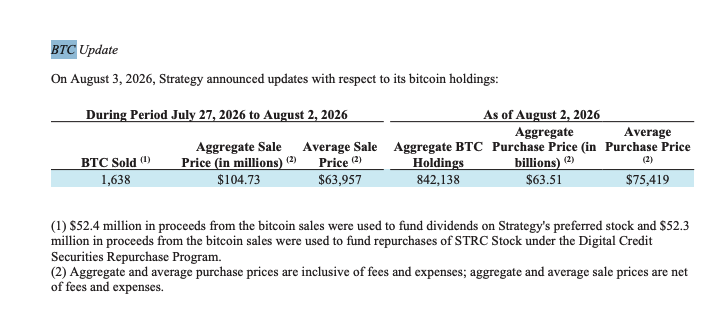
What Saylor failed to mention in the tweet was that the firm also sold some 1,638 BTC for approximately $105 million between July 27 and August 2 at an average price of $63,957 – according to the official filing.
The post Strategy Sold Over $100 Million in Bitcoin, Buys Back More STRC appeared first on CryptoPotato.
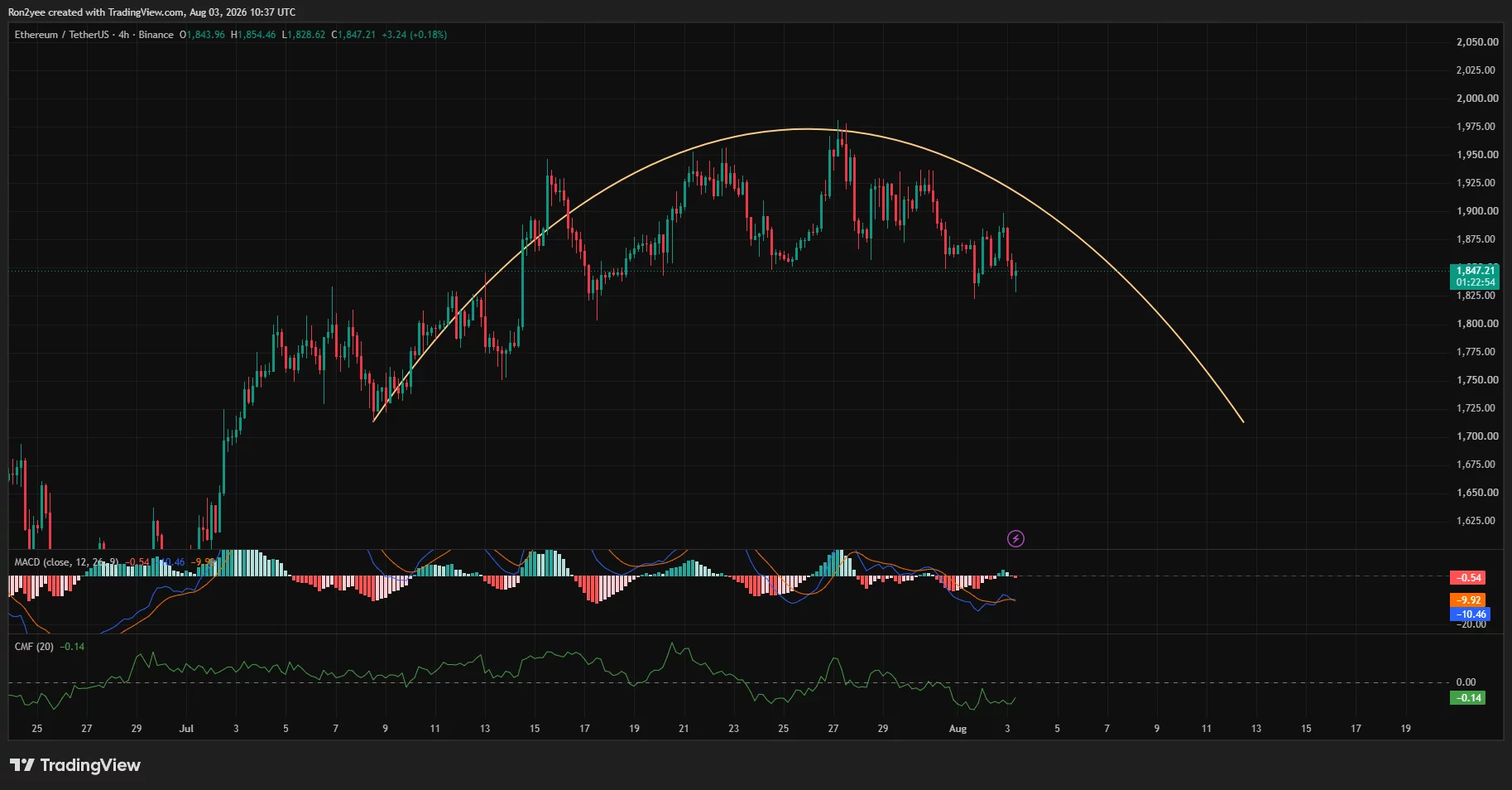
Ethereum price fell 2% to around $1,847 on Aug. 3 after another rejection near key moving averages left the $1,800 support zone exposed.
Summary
- Ethereum price fell 2.04%, reaching an intraday low of $1,828.
- ETH remains below its 50-day and 100-day moving averages at $1,889 and $1,927.
- 4-hour MACD and Chaikin Money Flow readings show weak momentum and continued selling pressure.
- A break below $1,800 could bring $1,785 and $1,700 into focus.
ETH slides after failing to reclaim $1,900
According to data from crypto.news, Ethereum (ETH) price traded at $1,847 at the time of writing, down 2.04% over the previous 24 hours. The token moved between an intraday high of $1,886 and a low of $1,829 on Binance.
The decline extended ETH’s retreat from its July 27 high near $1,975. Buyers have now failed several times to sustain a move above the resistance zone between $1,950 and $1,975.
ETH briefly rebounded after touching $1,828, but the recovery stalled around $1,850. That left the token near the lower end of its recent trading range and inside the closely watched $1,800–$1,850 support area.
The broader daily structure also remains defensive. Ethereum trades below its 50-day simple moving average at $1,889, its 100-day SMA at $1,927, and its 200-day SMA at $2,089.
Weak liquidity deepens Ethereum’s sell-off
The immediate pressure came from Ethereum’s failure to reclaim the moving-average resistance between $1,889 and $1,927. Sellers entered after the latest attempt faded, pushing ETH below $1,850 and toward its Aug. 3 low.
The 4-hour chart shows the price rolling over after forming a broad curved top below $1,975. Lower highs since late July suggest that buying demand has weakened, although ETH must still break below $1,800 to confirm a larger bearish continuation.
Momentum indicators support the cautious outlook. The 4-hour Moving Average Convergence Divergence remains below zero, with the MACD line near -10.46 and the signal line at about -9.92.
Chaikin Money Flow stands at -0.14. The negative reading indicates that selling volume has outweighed buying volume over the indicator’s measurement period.
Ethereum also faces broader liquidity pressure. A sharp weekly decline in Binance stablecoin netflows suggests less immediately available capital is entering the exchange, potentially reducing the buy-side liquidity available during market declines. However, exchange flows can change quickly and do not determine price direction alone.
Longer-term concerns include weaker institutional demand for Ethereum products relative to Bitcoin and lower mainnet fee revenue as activity shifts toward Layer-2 networks. These factors have weakened Ethereum’s investment narrative, but the current move remains primarily tied to the chart rejection and wider risk-off positioning.
Losing $1,800 could expose ETH to $1,700
The first support range sits between $1,828 and $1,800. ETH has already attracted buyers near the upper part of that zone, but repeated tests could weaken the remaining demand.
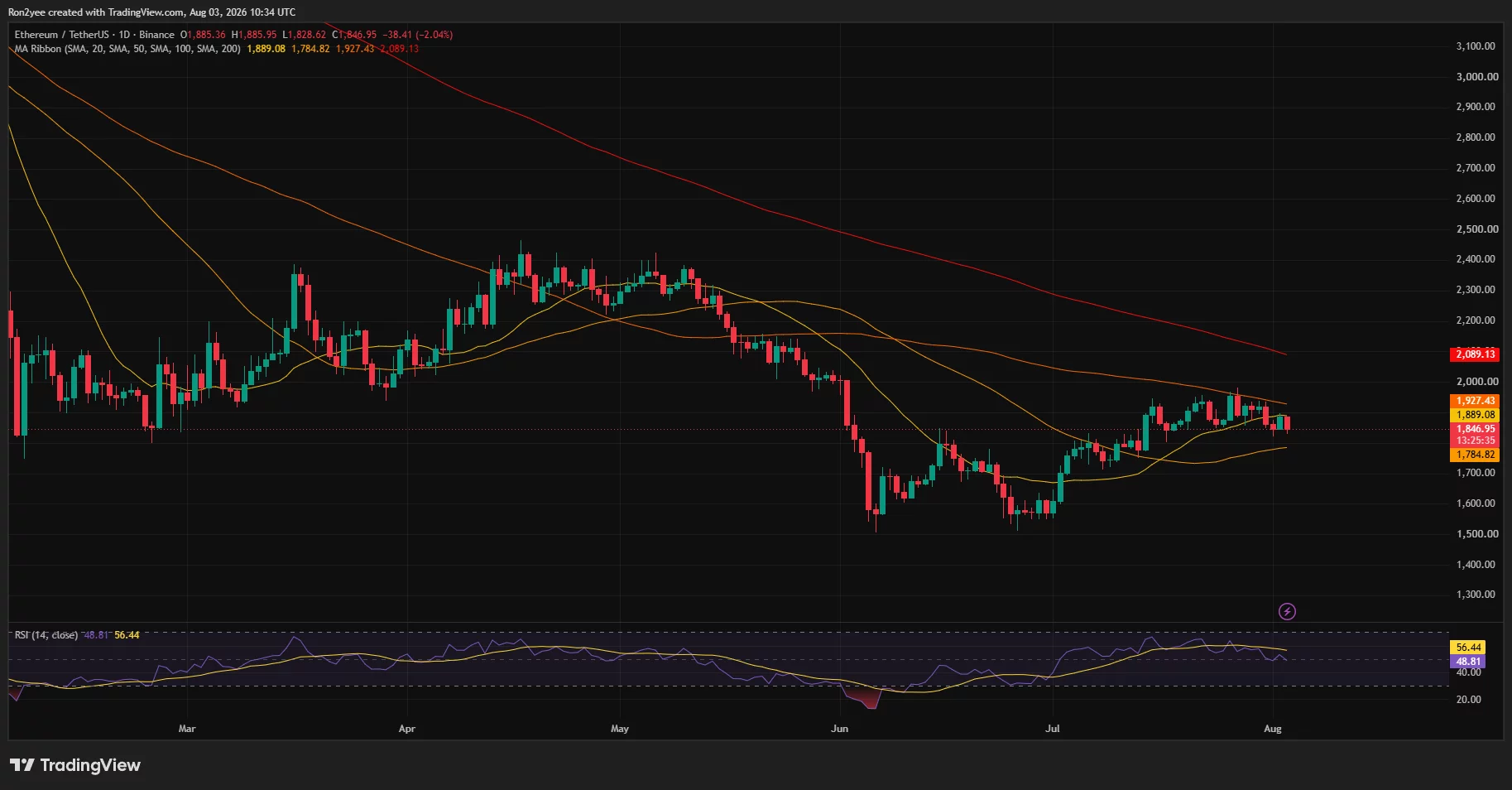
Ethereum’s lower daily moving-average ribbon stands near $1,785. A daily close below that level would strengthen the bearish setup and expose $1,700, followed by the June accumulation region around $1,550–$1,600.
CoinGlass’ 24-hour liquidation heatmap shows nearby leveraged-position clusters around $1,840, $1,820 and $1,810. A move through those levels could liquidate leveraged long positions and accelerate short-term volatility.
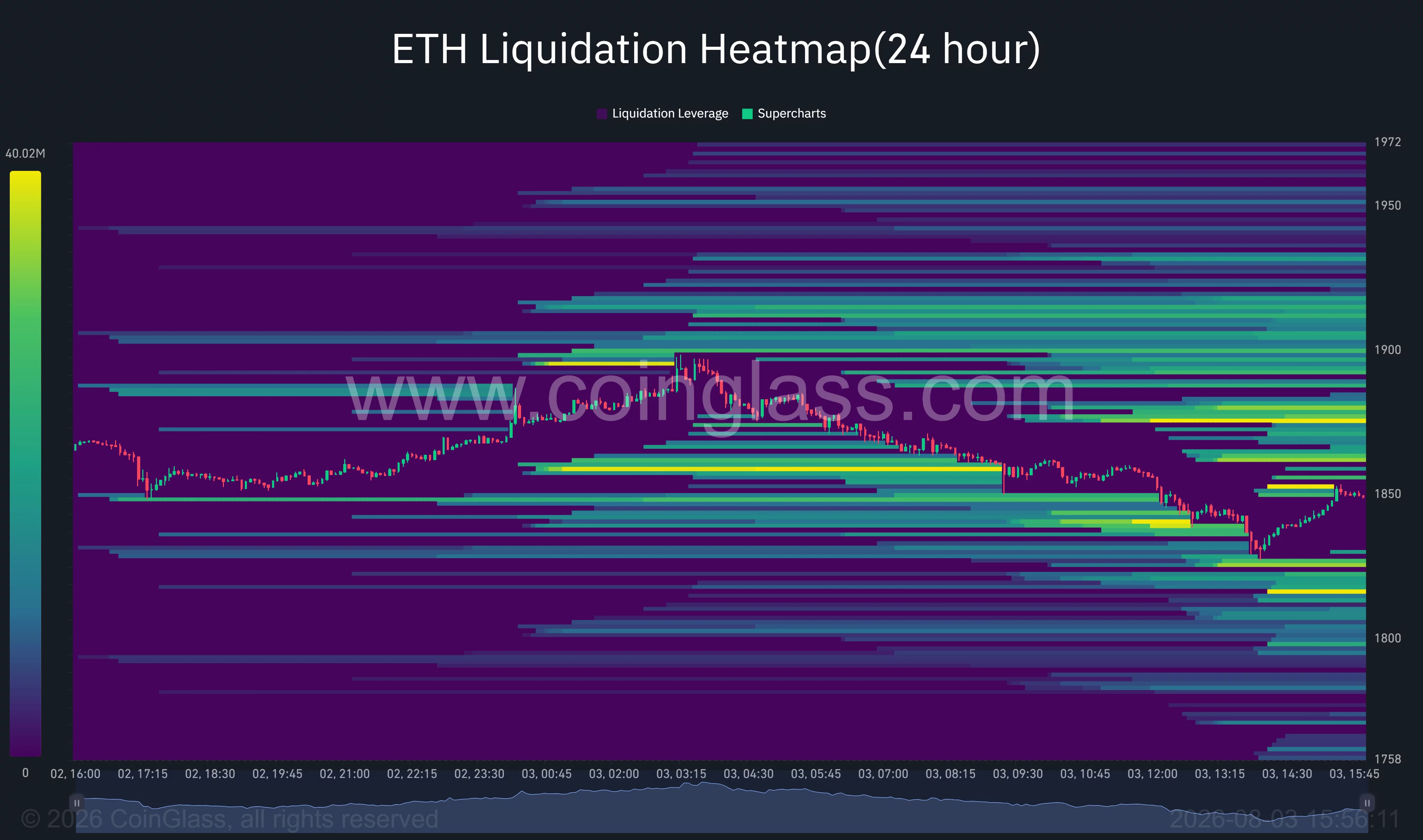
The map also shows overhead liquidity around $1,860–$1,875. If ETH rebounds above that range, short liquidations could help drive the price toward $1,890 and $1,920.
On the upside, Ethereum must first reclaim its 50-day SMA at $1,889. A daily close above the 100-day SMA at $1,927 would improve the setup, while a breakout above $1,975 would invalidate the current sequence of lower highs and place $2,000 back in focus.
The daily Relative Strength Index stands at 48.81, below its signal average of 56.44. The reading points to weakening momentum but remains well above oversold territory, leaving room for further selling if $1,800 fails.
Analyst sees Ethereum at a critical support zone
Crypto analyst Ted Pillows described the current support range as decisive for Ethereum’s next move.
“ETH is currently in the $1,800–$1,850 support level,” Pillows said. “This is very crucial for Ethereum to hold, or else it could drop towards $1,700.”
His chart presents two potential paths. Holding the current zone could allow ETH to recover toward $1,950 and then $2,050, while a confirmed breakdown could send the price toward $1,700.
The forecast aligns with the support levels visible on the daily chart, but the $1,700 target would require ETH to lose both the psychological $1,800 level and support near $1,785.
Fed outlook adds pressure on US crypto investors
Changing expectations for US monetary policy remain an additional risk for Ethereum and other speculative assets. Higher Treasury yields and a stronger dollar can reduce investor demand for crypto by increasing the relative appeal of dollar-denominated assets.
Slower-than-expected Federal Reserve rate cuts would keep financial conditions tighter and could limit institutional risk-taking. Ethereum may therefore remain sensitive to upcoming US inflation, employment and Fed policy signals.
For US investors, the near-term setup depends on whether ETH can defend $1,800 as macro liquidity remains constrained. A recovery above $1,927 would improve the technical outlook, but a daily close below $1,785 would shift attention toward $1,700.
Disclosure: This article does not represent investment advice. The content and materials featured on this page are for educational purposes only.
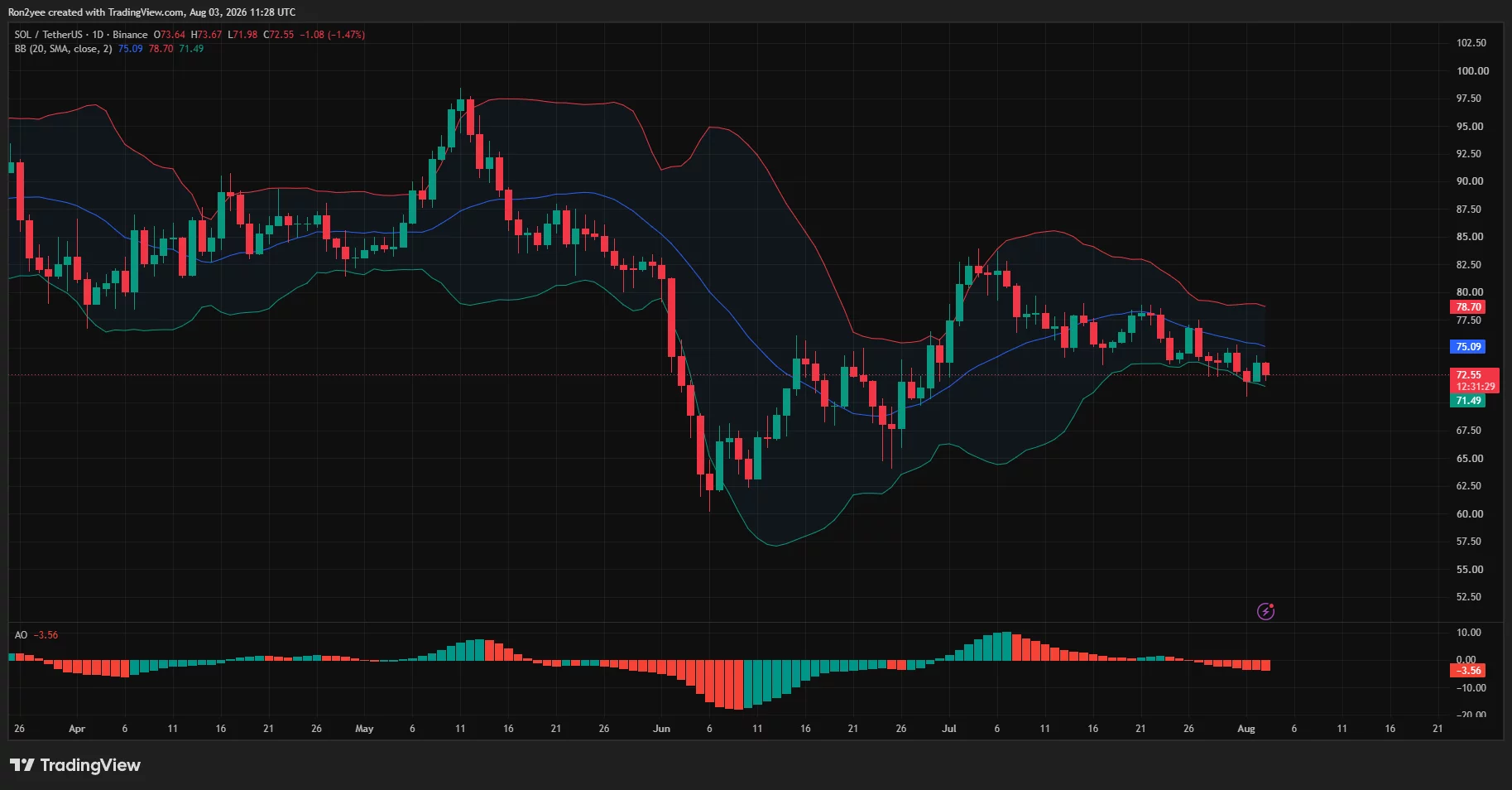
Solana price slipped below $73 on Aug. 3 as weak spot demand and sustained capital outflows raised the risk of a drop toward $70.
Summary
- Solana price fell 1.47% to $72.55, placing the token near its daily lower Bollinger Band.
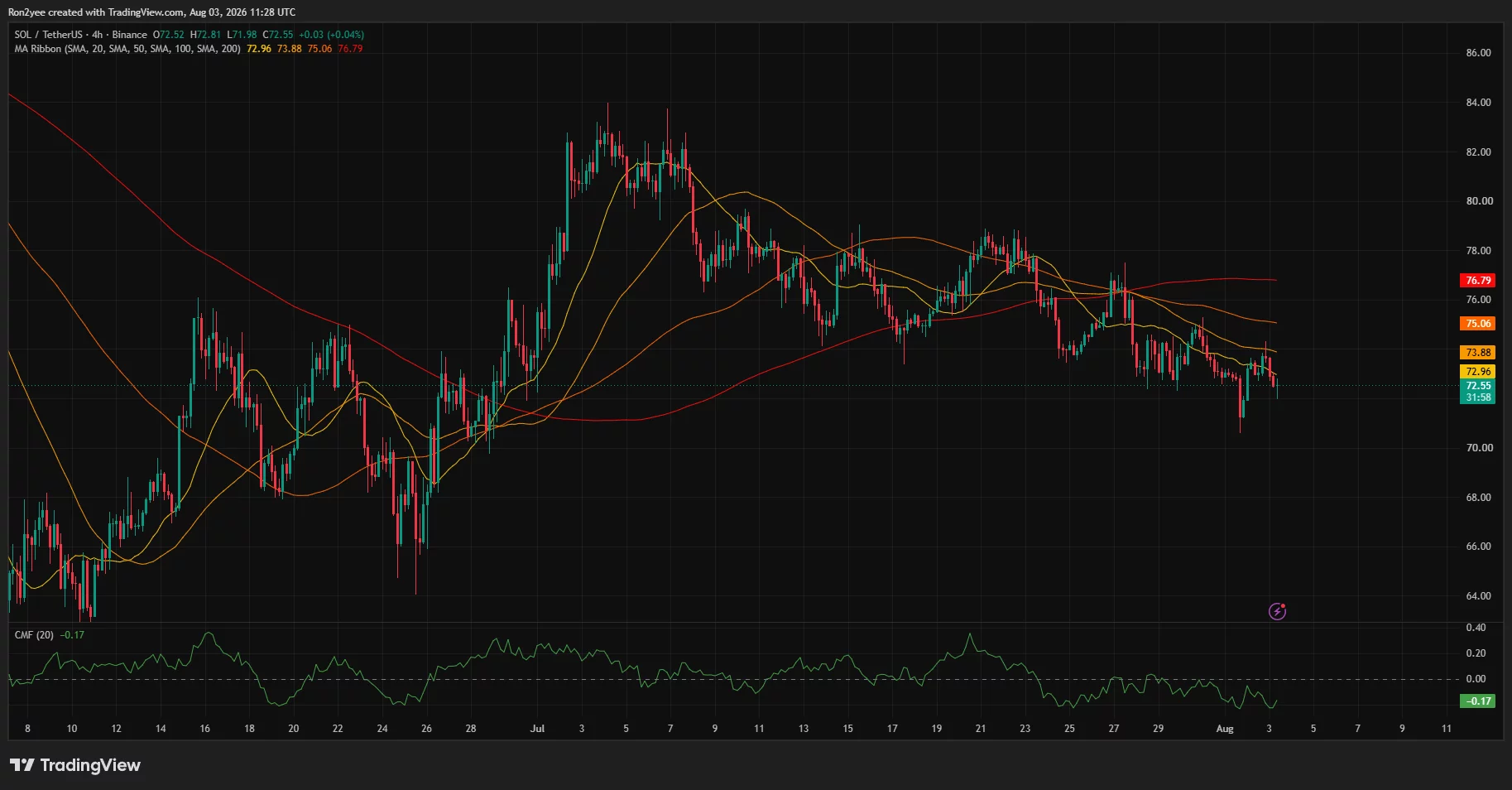
- The 4-hour chart shows SOL below all four tracked moving averages, with the 200-period SMA at $76.79.
- Chaikin Money Flow dropped to -0.17, indicating that selling pressure continued to outweigh buying demand.
- Liquidation liquidity is concentrated near $73.50–$74.50, making that zone the first major upside test.
Solana price extends its decline below $73
According to data from crypto.news, Solana (SOL) price traded at $72.55 on Aug. 3, down 1.47% on the daily chart after moving between an intraday high of $73.67 and a low of $71.98.
The decline extended a broader pullback from the July high near $82.50. SOL has formed a sequence of lower highs since that peak, with sellers defending rebounds around $78 and then $76.
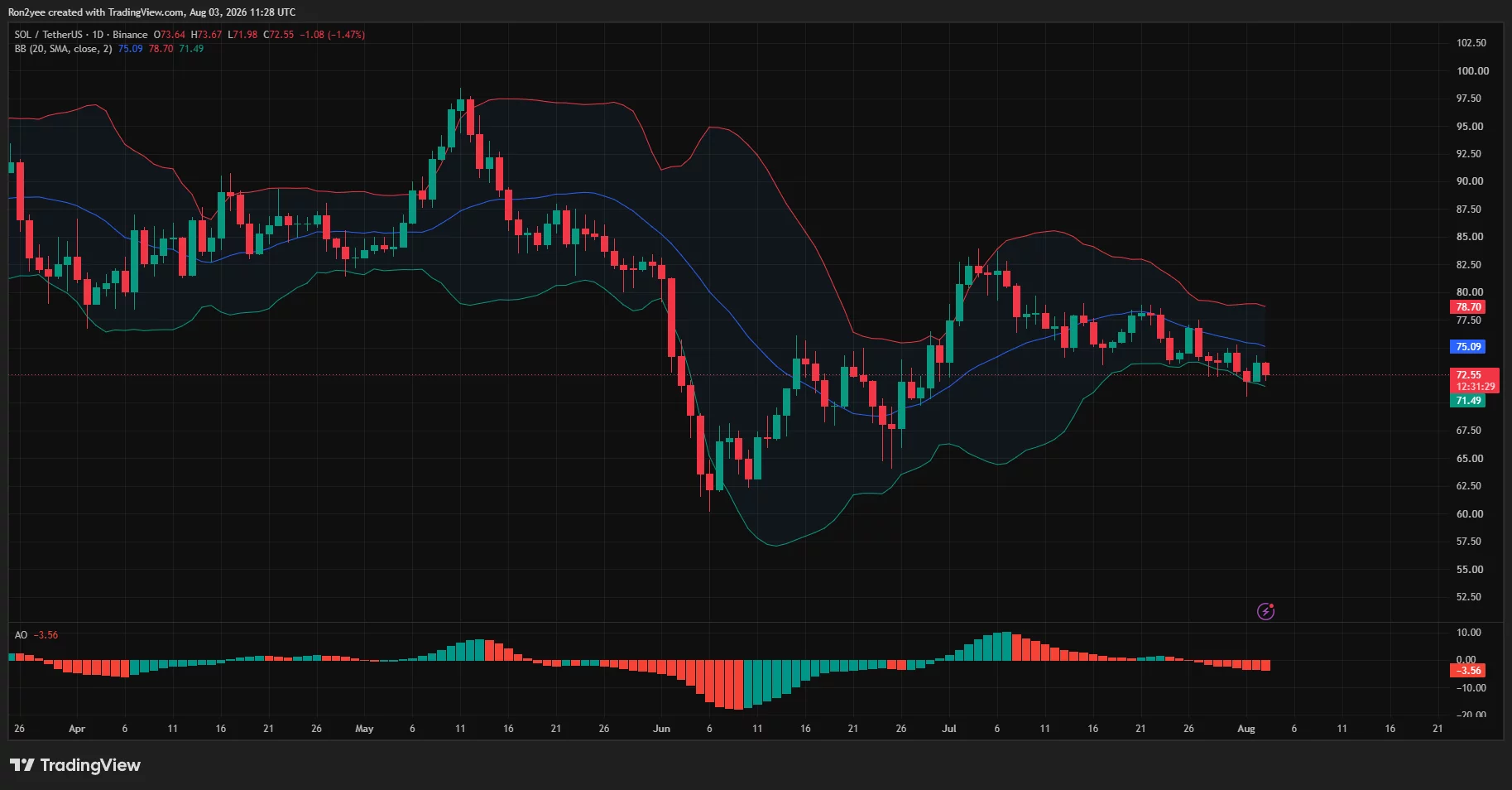
Price has now fallen below the daily Bollinger Band midpoint at $75.09. This level previously acted as support but has turned into the first major resistance area.
SOL briefly moved below the lower Bollinger Band at $71.49 before recovering above $72. That reaction shows buyers remain active around $71.50–$72, but the limited rebound suggests they have not regained control.
The Awesome Oscillator stood at -3.56, with its red bars expanding below zero. That reading points to strengthening bearish momentum on the daily timeframe rather than an immediate trend reversal.
Flat spot demand weakens SOL’s recovery
Solana attempted to rebound after falling toward $71 on Aug. 2, but spot demand failed to recover alongside price.
Analyst Ted Pillows described the divergence as a sign of weakness.
“$SOL is bouncing back. But spot demand is flat. Sign of weakness.”
The 4-hour Chaikin Money Flow reading supports that view. CMF fell to -0.17, meaning more capital was leaving SOL than entering it during the measured period.
Declining spot participation can leave a rebound dependent on leveraged derivatives positions. Such moves are more vulnerable to reversals because they lack the direct buying pressure needed to absorb new selling.
The weakness also comes as activity tied to speculative Solana tokens cools from previous peaks. Lower decentralized exchange activity and weaker fee generation would reduce one source of demand for SOL, which traders need to pay network fees and interact with on-chain applications.
Four-hour indicators keep sellers in control
Solana remains below every major moving average displayed on the 4-hour chart. The 20-period SMA stands at $72.96, followed by the 50-period SMA at $73.88 and the 100-period SMA at $75.06.
The 200-period SMA, currently near $76.79, represents the strongest overhead technical barrier. SOL would need to reclaim that level to weaken the current sequence of lower highs.
The moving averages are also bearishly ordered, with each shorter-term average sitting below the longer-term measures. That structure suggests the decline is established across several trading horizons.
A move above $72.96 could open a retest of $73.88. The $73.88–$75.06 range is particularly important because it combines two moving averages with liquidity visible on the three-day liquidation heatmap.
Failure to reclaim that area would leave SOL exposed to another test of $71.50. A daily close below the lower Bollinger Band could bring $70 into focus, followed by the June support region near $67.50.
Liquidation clusters could increase volatility
CoinGlass’ three-day liquidation heatmap shows the largest nearby concentration of leveraged positions above the current price, particularly around $73.50–$74.
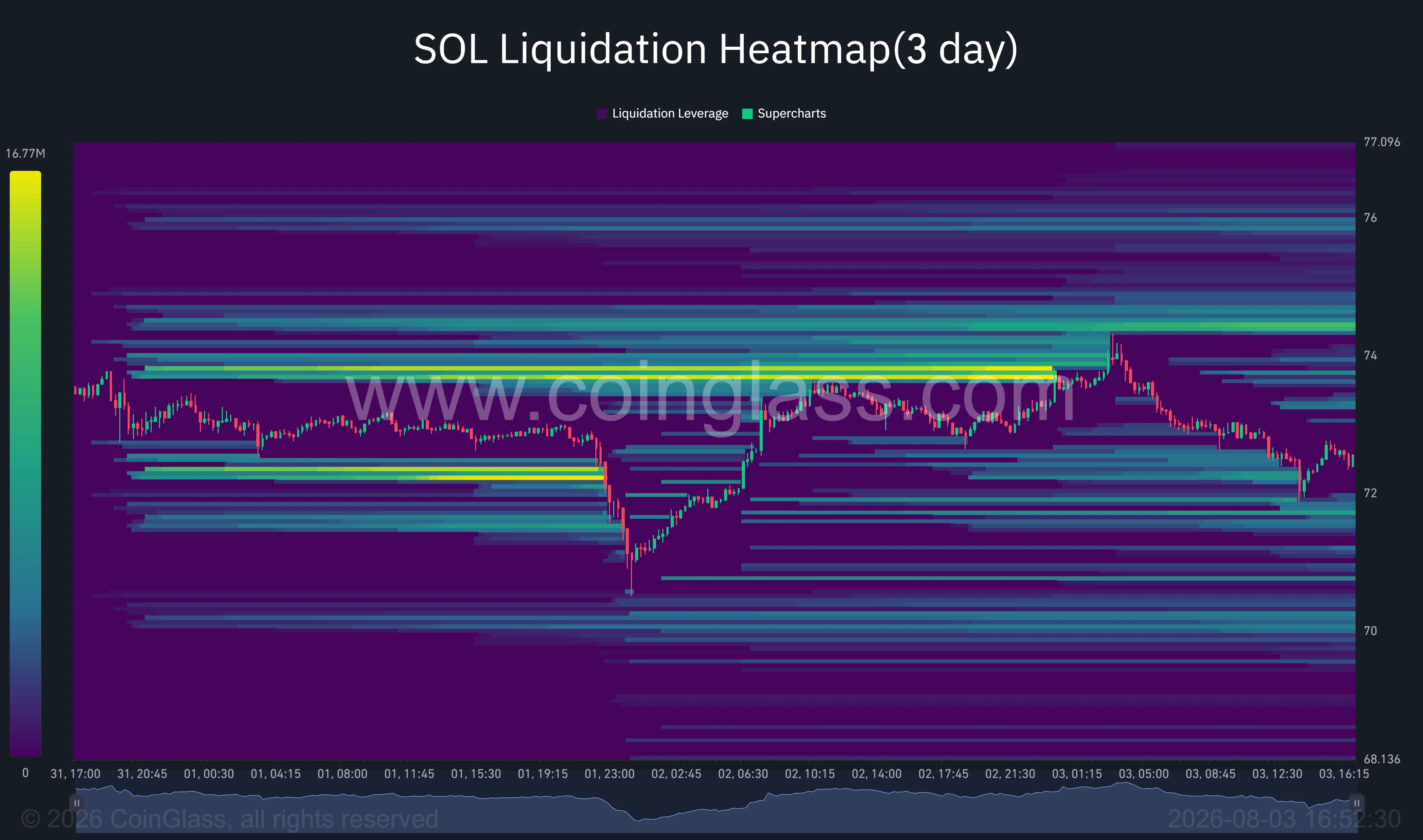
Additional liquidity appears near $74.50 and $76, creating potential targets if SOL begins a short-covering rebound. A move into these clusters could force bearish traders to close positions, accelerating the recovery.
However, liquidity also appears below the market around $71.50 and $70. These clusters could attract price if support near $72 fails.
This leaves SOL between competing liquidity zones. The closer upside concentration could produce a short-term bounce, but the weak CMF reading and bearish moving-average structure suggest any recovery must be confirmed by stronger spot buying.
Fee-burn vote offers Solana a potential catalyst
SolanaFloor reported that proposals addressing Solana’s fee burn and token disinflation were set to enter an initial vote on Aug. 3.
According to the report, the measures would double annual disinflation to 30%, remove about $1.36 billion in projected token issuance over six years and increase daily burns from roughly 650 SOL to 9,000 SOL.
Those figures remain projected outcomes rather than confirmed changes. The proposals must progress through governance before they can alter SOL’s supply dynamics.
For US investors, the immediate backdrop also remains tied to broader risk appetite. High-beta tokens such as SOL can face added pressure when elevated Treasury yields make lower-risk dollar assets more attractive. A shift in Federal Reserve expectations or US yields could therefore affect whether buyers return at the current support zone.
The short-term outlook remains bearish below $75.06. Reclaiming that level would improve the setup and expose $76.79, while a confirmed break below $71.49 would increase the risk of a move toward $70.
Disclosure: This article does not represent investment advice. The content and materials featured on this page are for educational purposes only.
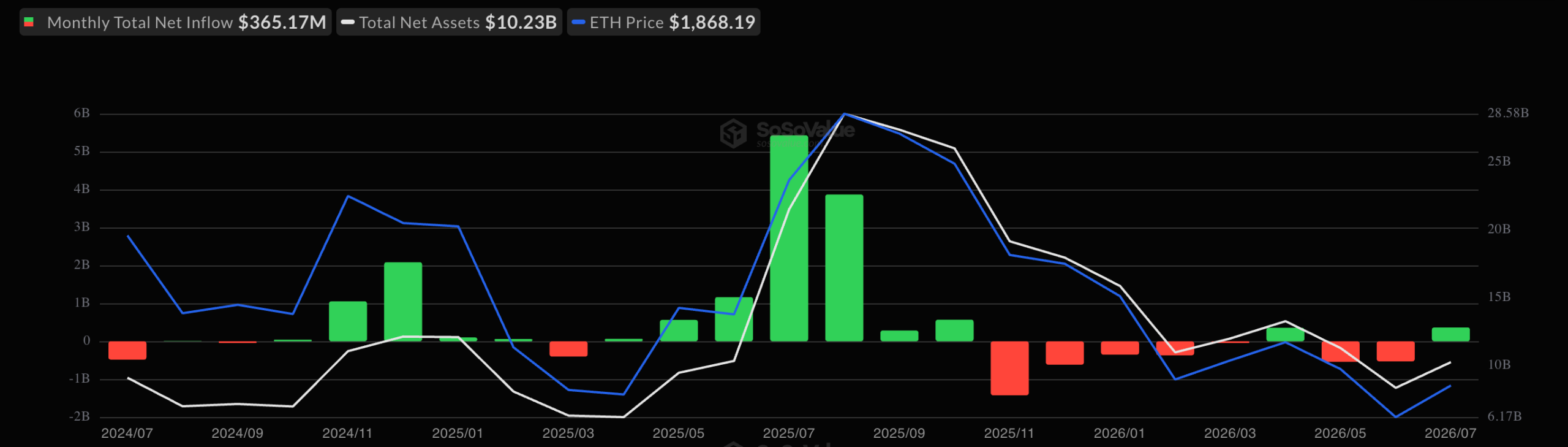
Ethereum (ETH) spot ETFs recorded their strongest month since October 2025. Yet the ending week of July raises concerns about whether institutional appetite is already fading.
Inflows dropped 74% in the final week as the Federal Reserve held rates steady. The pullback raises a key question over whether the demand will carry into August.
Ethereum ETF Inflows Hit 9-Month High Before Buyers Retreat
Ethereum funds attracted $365.17 million in July, their best showing in 9 months, per SoSoValue. The total came after back-to-back redemptions of $540.88 million in May and $528.99 million in June.
Follow us on X to get the latest news as it happens

The recovery lost steam fast, though. Weekly inflows collapsed from $103.9 million to $27.42 million in the week ending July 31.
Price action offered little help. ETH touched $1,967 on July 27, its highest level in nearly two months, before sliding to about $1,863 by Friday, CoinGecko data shows.
Demand also slowed across other ETF products. Bitcoin (BTC) funds shed $61.53 million during the week, snapping three straight weeks of net buying.
Hyperliquid (HYPE) products bled for a third consecutive week, losing $14.75 million. XRP (XRP) ETFs added $14.86 million, pushing cumulative inflows past $1.5 billion.
Fed Hold and Hike Odds Put August Demand in Question
Macro caution appears central to the retreat. The Federal Reserve voted 9-3 on July 29 to keep the interest rate at 3.50%-3.75%.
Three regional presidents, Beth Hammack, Neel Kashkari, and Lorie Logan, dissented in favor of a hike with inflation still above target. Markets now price in a 64% chance of a quarter-point hike in September, keeping tightening risk alive for risk assets.
“I want to stress, of course, that decisions by this committee matter a great deal, and where necessary and appropriate, we will not hesitate to act,” Fed Chair Kevin Warsh said.
If investors stay risk-off into August, the late-July slowdown may extend and erase the month’s progress. However, a revival in demand would confirm July’s rebound as the start of a broader recovery rather than a one-month bounce. The Fed’s Jackson Hole symposium in late August may offer the next signal.
Subscribe to our YouTube channel to watch leaders and journalists provide expert insights
The post Ethereum ETFs Post Best Month Since October 2025 but Fed Hold Chills Demand appeared first on BeInCrypto.


Strategy (MSTR) raised $104.73 million last week with the sale of 1,638 bitcoin, and raised an additional $290.6 million via the sale of common stock.
Alongside, the company repurchased 912,143 shares of its high-yielding preferred stock STRC for $81.2 million, according to an SEC filing Monday morning.
The bitcoin sales reduced Strategy’s holdings to 842,138 BTC, acquired for $63.51 billion at an average price of $75,419. The company lifted its USD reserve by $250 million.
The company announced over the weekend that it would maintain STRC’s annual dividend rate at 12%, saying it does not intend to recommend a reduction until the shares trade consistently near their stated $100 value.

In XRP news today, the XRP Ledger released xrpld 3.2.1 on July 31 after a validator manifest flood was detected hitting nodes that same day, with Ripple Director of Engineering Vijay Khanna issuing an urgent call on August 1–2 for all node operators to upgrade immediately.
The ledger continued closing normally throughout the incident, with no confirmed fund losses and no consensus failure, but unpatched nodes remain exposed to resource-exhaustion risk until operators complete the two-step upgrade process.
This news dropped as XRP USD fell 1.5% from $1.10 to $1.06 over the past 24 hours, with daily trading volume of $791M. This follows a worrying trend in which Ripple has crashed -4% over the past seven days.
XRP News: What the Manifest Flood Actually Did
The attack exploited a structural gap in how XRPL nodes handled validator manifests: before the patch, nodes would accept, cache, and rebroadcast an unlimited number of manifests tied to unknown validator keys with no ceiling on volume or storage.
An attacker could generate junk manifests at scale, forcing nodes to burn memory, disk space, and bandwidth processing data they would never act on.
The mechanism is closer to a denial-of-service resource drain than a consensus attack; the network’s transaction processing was never disrupted, but the exposure was real for any operator running unprotected infrastructure.
The development team confirmed the problem was specifically tied to how XRPLF nodes handled validator manifests, though as of publication the root cause and full exploitation details have not been publicly disclosed.
A technical post-mortem is forthcoming from XRPL Operations, which should clarify attacker behavior, traffic volumes, and any additional hardening steps.
For those tracking broader blockchain security vulnerabilities and attack vectors, the manifest flood fits a pattern where unbounded auxiliary data channels become leverage points even when consensus logic holds.
— Crypto Michael
 Urgent XRPL Update: Node Operators Told to Install Critical Fix
Ripple engineering director Vijay Khanna is urging XRP Ledger node operators to upgrade to **xrpld version 3.2.1**, which includes a hotfix designed to prevent a manifest flood attack observed on the network.…
 Dinarian888 (@Dinarian888) August 2, 2026
Discover: The Best Crypto to Diversify Your Portfolio
Four Safeguards Introduced in the Hotfix
The hotfix introduces four discrete protections targeting different points in the manifest handling pipeline. Oversized manifests are now rejected outright before full decoding. Incoming manifest batches per network message are capped.
The volume of manifest data shared with new peers is limited. And the unknown-key manifest cache is hard-capped at 100 entries, preventing unbounded growth from unrecognized validator identities.
Beyond those four caps, unknown validator manifests are no longer written to disk. That change means any pre-patch flood data is cleared on restart rather than persisting in storage, which is precisely why the upgrade requires a specific two-step sequence.
Firstly, install 3.2.1, let the server run for one to two minutes, then perform a second restart to purge any manifests retained from before the patch. Skipping the second restart leaves stale flood data in place. Operators should also verify their systems trust Ripple’s current GPG signing key, rotated February 18, 2026, or automatic upgrades may fail silently.
Trade XRP on Bybit and Get a Chance to Win Our $1,000 USDT Airdrop
Who Needs to Act and Why It Matters Now
—
 $XRP's momentum fades, but the bullish structure holds firm: price is drifting back into 6YR support that guided all breakouts since 2020 — each green-arrow marked previously triggered expansion; compression within a falling wedge is setting the stage for a major repricing
  pic.twitter.com/Es1Mae0poz
 ChartNerd
  (@ChartNerdTA) August 3, 2026
In other XRP news, exchanges, custodians, wallet back ends, data providers, and any business running its own XRPL server must complete the node upgrade. Ordinary XRP holders do not need to move funds or change keys.
The urgency is compounded by upgrade adoption lag: xrpld v3.2.0, the larger June 15 release that renamed the reference server and required infrastructure config change, spread faster among validators than across the broader node network, meaning a cohort of operators may still be running older versions that are now doubly exposed.
The network security response here was operationally sound: a targeted hotfix, clear operator instructions, and a pending post-mortem that signals the team is treating this as a formal security incident rather than routine maintenance.
In the broader XRP ecosystem, the incident comes as the ledger scales; the network added nearly 490,000 new accounts in the first half of 2026, per supplementary data from Coinpaper, pushing total accounts past 8.4 million.
That growth trajectory makes robust infrastructure hardening a structural necessity, not an edge-case concern. Institutional developments, including Aviva’s tokenized liquidity fund on XRPL and growing enterprise adoption, raise the stakes for any operator still delaying the patch.
Discover: The Best Token Presales
The post XRP News: xrpld 3.2.1 Hotfix Patches Manifest Flood Draining XRPL Node Resources appeared first on Cryptonews.


Trump-linked Bitcoin miner produced a record 932 BTC in the second quarter, lifting mining revenue 8% as its net loss narrowed from the previous quarter.


South Africa has proposed new rules requiring cross-border crypto transfers to pass through authorized providers and be reported to the central bank, expanding the country’s effort to bring digital assets under its financial control framework.
Summary
- South Africa has proposed rules requiring cross border crypto transfers to go through authorized service providers and be reported to the central bank.
- The draft says only transfers to offshore providers or private wallets would qualify as regulated cross border crypto transactions.
- Individuals would be allowed to move crypto offshore only within South Africa’s existing foreign currency allowances.
- The proposal builds on earlier plans to bring crypto under the country’s foreign exchange control framework.
- Public comments on the draft Crypto Asset Manual will remain open until Sept. 30.
According to local media, South Africa’s National Treasury and the South African Reserve Bank (SARB) on Monday released a draft Crypto Asset Manual setting out when crypto transactions become regulated cross-border events and how they must be handled. The proposal forms part of the country’s ongoing overhaul of its capital flow rules first introduced in April.
South Africa has defined when crypto transfers become reportable
Under the draft, moving crypto offshore will only qualify as a cross-border transaction in specific situations. A report to the SARB’s Financial Surveillance Department (FinSurv) would be required when crypto assets move from a locally authorized Crypto Asset Service Provider (CASP) to an offshore CASP or into a privately controlled non-custodial wallet.
The proposal says people who wish to transfer crypto abroad would have to use an authorized provider instead of sending assets directly through unregulated channels. FinSurv would receive reports of those transactions as part of the country’s foreign exchange monitoring process.
Domestic crypto activity would remain outside those reporting requirements. Buying or selling crypto in South African rand through a local authorized provider would not be treated as a cross-border event under the proposed framework.
For now, the draft allows only individuals to move crypto assets offshore, and only within South Africa’s existing foreign currency allowances. The SARB also said the framework does not recognize crypto assets as legal tender and currently does not distinguish between different categories of digital assets because additional research is still underway.
Interested parties can submit comments on the draft until Sept. 30.
Crypto rules build on South Africa’s earlier capital flow proposal
The new manual follows South Africa’s Draft Capital Flow Management Regulations released in April, which proposed bringing crypto assets into the country’s foreign exchange control system for the first time.
The National Treasury and SARB said in April that crypto assets would be treated as a form of capital moving across borders, placing them alongside other regulated assets under the country’s capital flow regime. The proposal was also designed to replace South Africa’s Exchange Control Regulations dating back to 1961 while aligning the country’s framework with recommendations from the Financial Action Task Force and the Organisation for Economic Co-operation and Development.
The April proposal introduced the concept of authorized crypto service providers, transaction reporting, declaration requirements and administrative penalties for non-compliance. Treasury officials said at the time the policy would focus on reporting, traceability and risk-based oversight instead of relying only on transaction-by-transaction approvals.
The draft Crypto Asset Manual now explains how those principles would work in practice by defining the point at which crypto movements become cross-border transactions that fall under financial surveillance rules.
Authorities have linked the framework to financial crime controls
According to Reuters, the reporting framework is intended to stop crypto assets from being used to bypass South Africa’s existing financial controls while helping authorities identify illicit financial flows.
By limiting offshore transfers to authorized service providers, regulators would receive transaction data through FinSurv instead of relying on transfers conducted outside the regulated financial system.
The proposal arrives as crypto adoption continues to grow in South Africa. Reuters, citing blockchain analytics firm Chainalysis, said the country already has hundreds of licensed virtual asset service providers, while several major banks are developing crypto products for institutional clients.
South Africa has become one of Africa’s largest digital asset markets in recent years. Earlier industry estimates placed annual crypto transaction value in the country among the highest on the continent, while blockchain investment has continued to attract institutional interest.
Crypto oversight has expanded beyond capital controls
The latest consultation follows another crypto policy proposal published in July by the South African Revenue Service (SARS), which released draft guidance explaining how existing tax laws apply to digital assets.
Unlike the latest capital flow proposal, the SARS draft focused on taxation rather than foreign exchange regulation. It confirmed that crypto assets are treated as intangible assets instead of legal tender or foreign currency under existing tax law and explained how income tax and capital gains tax could apply depending on each taxpayer’s circumstances.
The tax authority also outlined how activities including crypto trading, token swaps, staking, mining, decentralized finance participation and crypto payments may trigger taxable events under current legislation.
At the same time, South Africa has begun implementing the Crypto-Asset Reporting Framework (CARF), under which crypto service providers will collect and report selected customer and transaction information to SARS. The first reporting period runs from March 1, 2026, through Feb. 28, 2027.
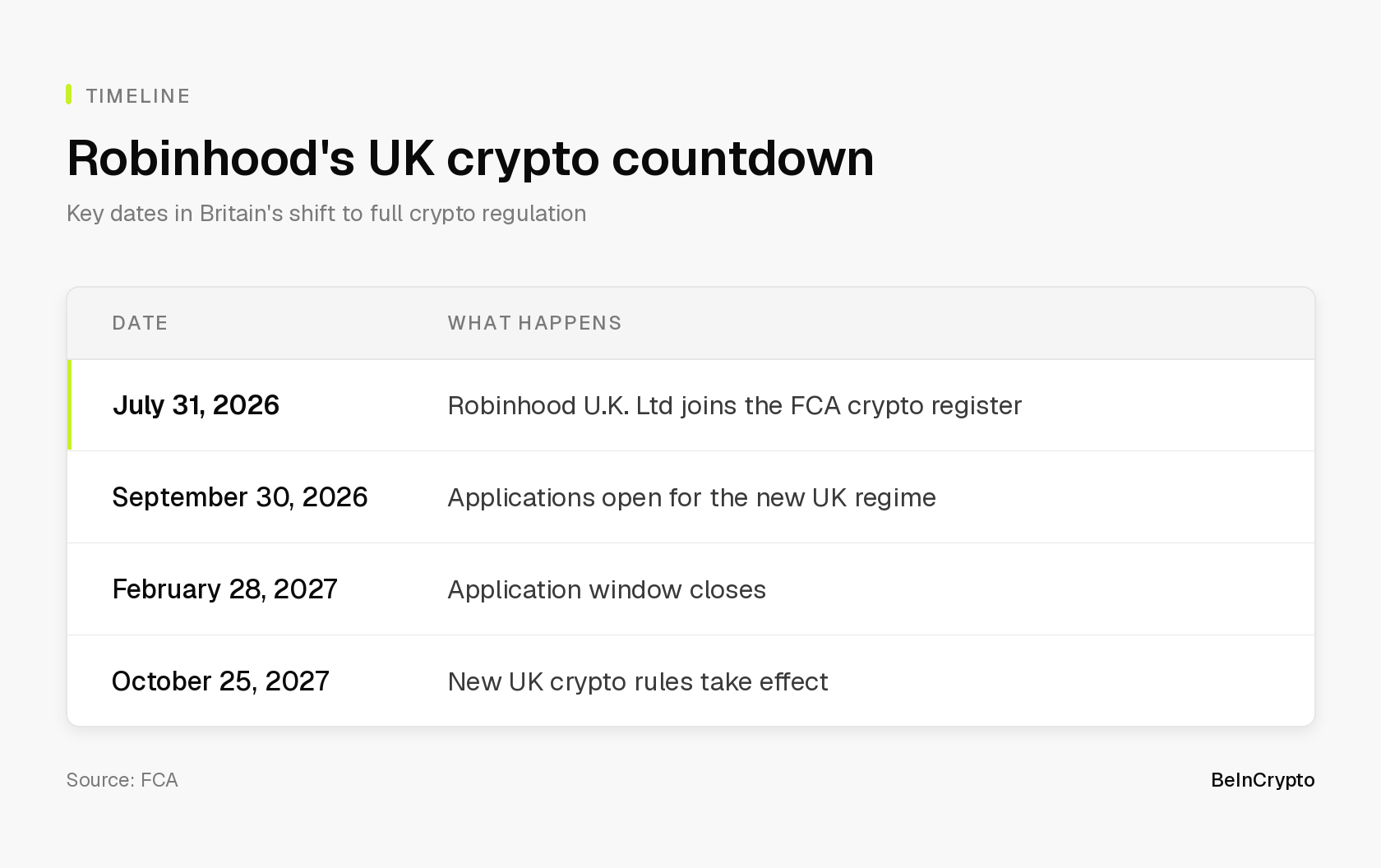
Robinhood Markets won UK crypto approval on July 31. The surprise is everything the approval does not allow.
The Financial Conduct Authority (FCA) added Robinhood U.K. Ltd to its crypto register. The company may pass customer orders to other firms. It cannot hold anyone’s coins.
What the FCA actually approved
Robinhood has been an FCA-approved stockbroker in Britain since August 2019. Crypto is new ground. The regulator added it to the crypto register on July 31, 2026.
Two limits took effect the same day, with the first one mattering most:
- Robinhood UK may only arrange crypto trades.
In plain terms, it takes your order and hands it to someone else to finish.
UK crypto rules cover two other jobs. One is running an exchange. The other is holding coins for customers. Robinhood got neither.
- The second limit bans crypto cash machines unless the FCA agrees in writing.
The register also says the firm cannot hold client money. Even this much is hard to win. FCA figures show 291 firms applied between January 2020 and October 2022. Only 38 made the register. Another 155 gave up before a decision.
One point matters for customers. Being on the register is not a safety net. The FCA warns that crypto services are unlikely to be protected if something goes wrong.
Britain’s compensation scheme rarely covers crypto losses. The financial ombudsman usually cannot help either.
Rivals Got There First, With More Freedom
Robinhood is late. The register opened in 2020.
Kraken’s UK arm, Coinbase, and Revolut are all on it. Several also hold e-money licences, which let them handle customer cash. Robinhood UK does not.
It already owns one company on the list. Bitstamp UK Ltd joined years earlier, and Robinhood bought its parent for $224 million in June 2025.
That makes Bitstamp the obvious place for UK orders to land.
Robinhood has also tried and failed here before. It agreed to buy British crypto app Ziglu in April 2022. Ten months later it walked away. The $12 million it had already sent Ziglu was written off.
So the new approval looks like housekeeping rather than a launch. Robinhood told investors in July it plans to start UK crypto soon.
Its own small print still says UK customers get no crypto trading or custody. Elsewhere the company keeps building, including its Robinhood Chain public testnet.
Why October 2027 Decides What Survives
This approval is temporary. Tougher UK crypto rules start on October 25, 2027.
Every firm on today’s register must apply again. Nothing carries over.

The window is five months long. Firms that miss it must stop most crypto work. The FCA has warned that today’s registration counts for nothing at that stage.
That deadline has driven Britain’s crypto policy debate all year, alongside UK stablecoin payment plans.
For investors, any reward is years away. Crypto revenue fell 38% to $100 million in Robinhood’s second quarter. Total revenue still hit a record $1.31 billion.
The market shrugged on Monday. HOOD closed Friday at $86.56, then traded at $87.22 before the bell, up 0.76%. Its 52-week high is $153.86.

The real test comes with that 2027 application. Robinhood sells trading, custody, and staking across Europe. An arranging license supports none of it.
What the company asks for will show how serious it is about Britain.
The post Robinhood Cleared for UK Crypto, But There Are Major Limits appeared first on BeInCrypto.
Crypto World
Solo Bitcoin (BTC) miner nets $200,000 as Coldcard wallet hack rocks sentiment: Crypto Daily


A solo miner scored a major win even as the broader market frets over a multimillion-dollar Coldcard hardware wallet exploit.
According to mempool data, an independent miner successfully packaged block 960,804 early Monday. The block reward of 3.157 BTC is valued at approximately $199,300. Details on the specific hardware used remain unknown.
The success came just three weeks after another solo miner, running a single hobbyist-grade Bitaxe device, struck block 957,382, pocketing 3.1382 BTC, worth roughly $200,000 at the time.
These back-to-back wins highlight a broader trend. Solo miners have already claimed 13 blocks this year. While individual operators continue to defy the odds with relatively modest setups, the wider Bitcoin mining sector has come under stress due to tight margins. That has prompted several large mining companies to pivot toward artificial intelligence data centers and related infrastructure in search of sustainability.
Meanwhile, small BTC holders continue to express frustration over the Coldcard incident, which has led to the loss of long-held Bitcoin savings. Over the weekend, onchain data showed signs of some BTC holders moving millions of dollars worth of coins to exchanges.
JIO FINANCIAL SERVICE NEWS | JIO FINANCIALS LATEST NEWS | Market support

Iran denies Trump’s claim that new talks will begin on Monday

Hershey planning ‘action-packed’ second half of 2026


-

 Business5 days ago
Why Trees Belong on the Risk Register
-

 Fashion3 days ago
Weekend Open Thread: Wit & Wisdom
-

 Politics3 days ago
Meta enters AI-training agreement with far-right ‘propaganda rag’ Newsmax
-
 Entertainment6 days ago
‘Stargate’ Creator’s New Sci-Fi Series Returns for Season 3 Tomorrow
-

 Crypto World2 days ago
MicroStrategy Post-Earnings CLARITY Act Push Could Add New Catalyst for Its Stock
-

 Politics6 days ago
The Part of the Electric Transition Nobody Wants to Discuss
-

 Business5 days ago
Major shareholder moves on Canyon
-

 Crypto World2 days ago
XRP Ledger v3.3.0 brings five institutional features
-

 News Videos4 days ago
Bitcoin Enters the 3rd Stage of the Bear Market
-

 Crypto World6 days ago
Kraken Enables Retail Access to Jersey Mike’s IPO via Tokenized Shares
-

 Tech6 days ago
New macOS Sequoia & Sonoma security updates for older Macs
-

 Politics4 days ago
Luke Littler’s dominance sparks GOAT debate
-

 News Videos6 days ago
Claude: Build Financial Dashboards in Minutes (2026)
-

 Business6 days ago
Johnson & Johnson agrees to $5.5B settlement over talc cancer claims
-

 Sports4 days ago
Seema Kaliramna Wins Discus Throw Bronze, Takes India’s CWG Medals Tally To 17
-

 Crypto World1 day ago
Crypto PAC spending tops $2M in Michigan House race
-

 Business3 days ago
Trump Announces Hamas Disarmament Agreement as Iran Strikes Kuwait Air Base and US Attacks Pause Overnight
-

 Tech5 days ago
Gemini can now summarize the messiest comment threads in Google Docs
-

 Tech1 day ago
ESET tracks rise in malicious AI skills and adaptable malware
-

 NewsBeat4 days ago
Four people die trying to cross Channel in small boats
You must be logged in to post a comment Login