
Crypto World
The question isn’t whether privacy. It’s what sort of privacy



Blockchains were built as public networks in the best tradition of open-source technology. But their future is private. And that future is arriving faster than most people realize.
This month, Tempo — the Stripe-backed payment blockchain that raised $500 million at a $5 billion valuation, with Visa, Mastercard, Paradigm, and UBS among its backers — published a detailed architectural proposal for private enterprise stablecoin transactions. Tempo is not a scrappy privacy-native project. It is arguably the most institutionally credentialed blockchain launch in years, built by people who deeply understand what banks, payment processors, and enterprises actually need. When a network with that pedigree makes privacy a launch-week priority, it isn’t a signal. It’s a verdict.
The question of whether or not institutional chains will be private has been settled. What remains is the harder one: what kind of privacy are we actually building?
The problem with public chains
Bitcoin solved a problem that had stumped computer scientists and bankers for decades: how to transfer value between strangers without a trusted intermediary. Ethereum took blockchains further, offering programmable value alongside value transfer — smart contracts that could encode agreements, automate settlement, and eliminate entire categories of middlemen. Then came stablecoins, which married programmability to the stability of the dollar, and from there, the migration of real-world assets to onchain protocols began.
Each wave has brought added institutional interest, capital, and ambition. And now, as regulatory clarity emerges, institutions are ready to deploy resources onchain.
But there’s one thing holding them back — a fundamental flaw that becomes more consequential the larger the numbers get.
Everything is visible. Every wallet. Every balance. Every transaction, in real time, is readable by anyone with a browser. In financial markets, this is not a feature. It is an existential problem. Imagine if every hedge fund’s positions, every corporate treasury’s holdings, every pension fund’s rebalancing trade appeared on a public screen the moment it was executed. Sophisticated counterparties would front-run. Competitors would map your strategy. Criminals would identify targets. The financial system as it exists today would seize up overnight.
Blockchains have been asking institutions to accept exactly that. Tempo’s announcement on April 16 is the clearest possible signal that institutions have finally said: no.
Architecture is destiny
Here is where the conversation gets more consequential — and more nuanced.
Tempo’s solution is Zones: private parallel blockchains connected to the main network. Within a Zone, participants transact privately. The public sees only cryptographic proofs of validity, not underlying data. Compliance controls travel with the token automatically. Assets remain interoperable with Tempo Mainnet. For enterprises running payroll, treasury operations, or settlement workflows, it is a thoughtful and practical design.
But Tempo’s privacy model is operator-visible. The Zone operator — an enterprise or infrastructure provider — sees all transactions within its Zone. The public sees nothing. The operator sees everything. For many regulated institutions, this is acceptable, and may even be required. But it means privacy is contingent on trusting an intermediary. You have moved the visibility problem; you have not eliminated it.
This is not a criticism of Tempo. It is a description of a genuine architectural choice — one with real consequences for anyone thinking carefully about risk.
Zero-knowledge cryptography offers a different path. ZK proofs allow a party to prove that a transaction is valid without revealing the underlying data. A new generation of ZK-native blockchains builds this privacy-preserving functionality into the execution layer itself. Accounts execute transactions locally, with the chain storing only a cryptographic commitment. Nothing sensitive ever touches a public ledger. Transaction history is not browsable. And crucially, no operator has a god’s-eye view — privacy is enforced at the base layer, not delegated to an intermediary.
If Bitcoin gave us trustless transfer and Ethereum gave us programmable trust, ZK-native blockchains offer verifiable privacy: the ability to prove that everything happened correctly without revealing what actually happened.
Compliance without full transparency
The obvious objection is regulatory. Privacy and compliance have long been framed as incompatible — oil and water. That framing is becoming obsolete.
Regulatory compliance does not require that everyone can see your transactions. It requires that the right parties, under the right conditions, can verify that your transactions were legitimate. That is a meaningful distinction, and it is one that ZK cryptography is uniquely positioned to enforce. Selective, programmable disclosure — revealing what regulators need to see, nothing more — is not a workaround. It is a more precise implementation of what compliance actually demands.
Tempo’s model handles this at the operator level. ZK-native approaches handle it at the cryptographic level. Both satisfy the compliance requirement. But they distribute trust very differently.
The question that matters
The financial industry knows it needs to move onchain. It now knows — Tempo’s announcement makes this undeniable — that it cannot do so on fully public infrastructure. The era of public-by-default blockchains as the assumed standard for institutional finance is ending.
What comes next depends on a choice the industry is only beginning to make clearly: privacy through trusted operators, or privacy through cryptographic guarantees that require no trust at all.
Both are legitimate answers. But they are not equivalent. The privacy model you choose determines your risk surface, your compliance posture, and your exposure to the failure modes of the intermediaries you depend on. Architecture is not a technical detail to be resolved later. It is the decision that determines everything else.
The question for the industry is not whether privacy. That debate is over.
The question is what sort of privacy — and who, if anyone, you are willing to trust with the view.



Shares of American Bitcoin, the Trump family-linked mining company, surged approximately 12% on April 22 after the firm announced it had completed the deployment of 11,298 new ASIC miners at its Drumheller, Alberta site, expanding its active fleet to roughly 89,242 machines.
Summary
- American Bitcoin deployed 11,298 new ASIC miners at its Drumheller facility, adding 3.05 exahash per second of capacity and pushing total hashrate to 28.1 EH/s.
- The stock jumped approximately 12% to $1.38 on the news, extending a broader recovery as Bitcoin prices climbed.
- The expansion reinforces American Bitcoin’s decision to double down on Bitcoin mining while many rivals pivot capital toward AI data centers.
American Bitcoin Corp., the Bitcoin mining and treasury firm co-founded by Eric Trump and backed by the Trump family, sent its stock up roughly 12% to $1.38 on April 22 after announcing the completion of a major fleet expansion. The company deployed 11,298 ASIC miners at its Drumheller, Alberta facility, adding approximately 3.05 exahash per second of mining capacity and pushing its total owned fleet to around 89,242 machines representing 28.1 EH/s.
American Bitcoin Mining Expansion Defies the AI Pivot Trend
The newly deployed machines operate at an efficiency of approximately 13.5 joules per terahash, which the company says lowers its electricity cost per coin and improves the profitability of its mining operations even as Bitcoin network difficulty continues to rise. The expansion completes a fleet buildout that was first announced in March, making American Bitcoin one of the more aggressive scale-up stories among publicly traded miners in 2026. “Scaling hashrate is one of the ways we strengthen our position in Bitcoin,” Eric Trump, the company’s co-founder and chief strategy officer, said in a statement. “Bringing these miners online at Drumheller reflects exactly how we intend to lead: moving quickly, allocating capital with discipline, and growing our Bitcoin exposure efficiently at institutional scale.”
A Deliberate Bet on Mining as Rivals Shift to AI
The deployment represents a strategic statement as much as an operational update. Several major publicly traded Bitcoin miners have been redirecting capital and infrastructure toward artificial intelligence and high-performance computing data centers, where margins and demand have attracted significant institutional interest. American Bitcoin has chosen the opposite path, committing to large-scale mining as its core value driver. The company’s Bitcoin treasury now sits at approximately 7,000 BTC, and its business model is built around accumulating Bitcoin below spot price through scaled mining operations. As crypto.news reported at the company’s September Nasdaq debut, American Bitcoin positions itself as an institutional-grade vehicle for Bitcoin exposure, leveraging Hut 8’s infrastructure for mining and at-market purchases to maximize Bitcoin per share. The stock has faced significant volatility since listing, falling from a peak near $13 to around $1 before Tuesday’s rally.
What the Expansion Means for American Bitcoin’s Market Position
With its fleet now at 89,242 machines and an operational capacity of 25 EH/s across nearly 59,000 active units, American Bitcoin is deepening its structural advantage over competitors that have diluted their mining focus. The new hardware operates at above-average efficiency relative to the company’s existing fleet, which the firm says will lower its overall cost basis per Bitcoin mined. As crypto.news tracked, the stock has faced multiple pressure points since going public, including a sharp lockup expiry-driven selloff in December 2025, making the current recovery meaningful context for investors watching whether the operational expansion can translate into sustained price support.
American Bitcoin has scheduled its first quarter 2026 earnings call for May 6, where investors will be watching for updated Bitcoin production figures, treasury size, and the company’s cost-per-coin metrics following the completed Drumheller expansion.
Bitcoin climbed above $79,000 on Wednesday, hitting its strongest level since early February as a long-awaited breakout attempt gathered momentum.
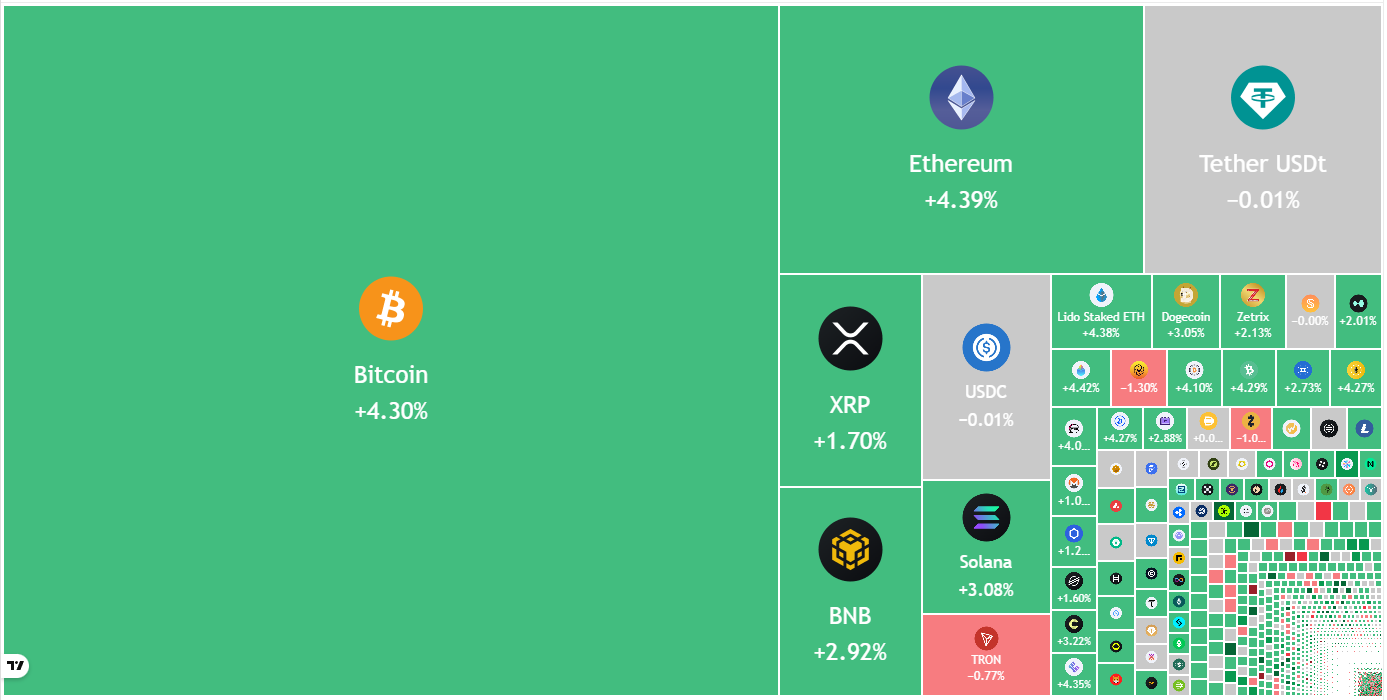
The largest crypto rose 4.5% over the past 24 hours, leading major altcoins ether (ETH), BNB , Solana (SOL) and XRP higher. The broad-market CoinDesk 20 Index advanced 3.5%.
Crypto-linked stocks also rose. Strategy (MSTR), the largest corporate BTC holder, jumped 10% while stablecoin issuer Circle Internet (CRCL) gained 9% and crypto exchange Coinbase (COIN) rose 6%. Bitcoin miners MARA Holdings (MARA) and Riot Platforms (RIOT) added 6%-7%.
The broader macro backdrop also turned supportive. The S&P 500 rose 0.9%, and the Nasdaq added 1.3% to record highs, extending the risk-on environment.
The gains followed U.S. President Donald Trump’s remark late Tuesday that he would extend the Iran ceasefire while maintaining a naval blockade of the Strait of Hormuz. Still, uncertainty around peace talks remains.
“BTC’s near-term direction remains highly dependent on macro and geopolitical developments,” said Paul Howard, a senior director at Wincent. He pointed to $72,000 as key support, with upside potentially could be capped near $80,000 range as traders take profits.
Bitcoin short squeeze potential
While macro risks are still in place, derivatives positioning could fuel the rally higher.
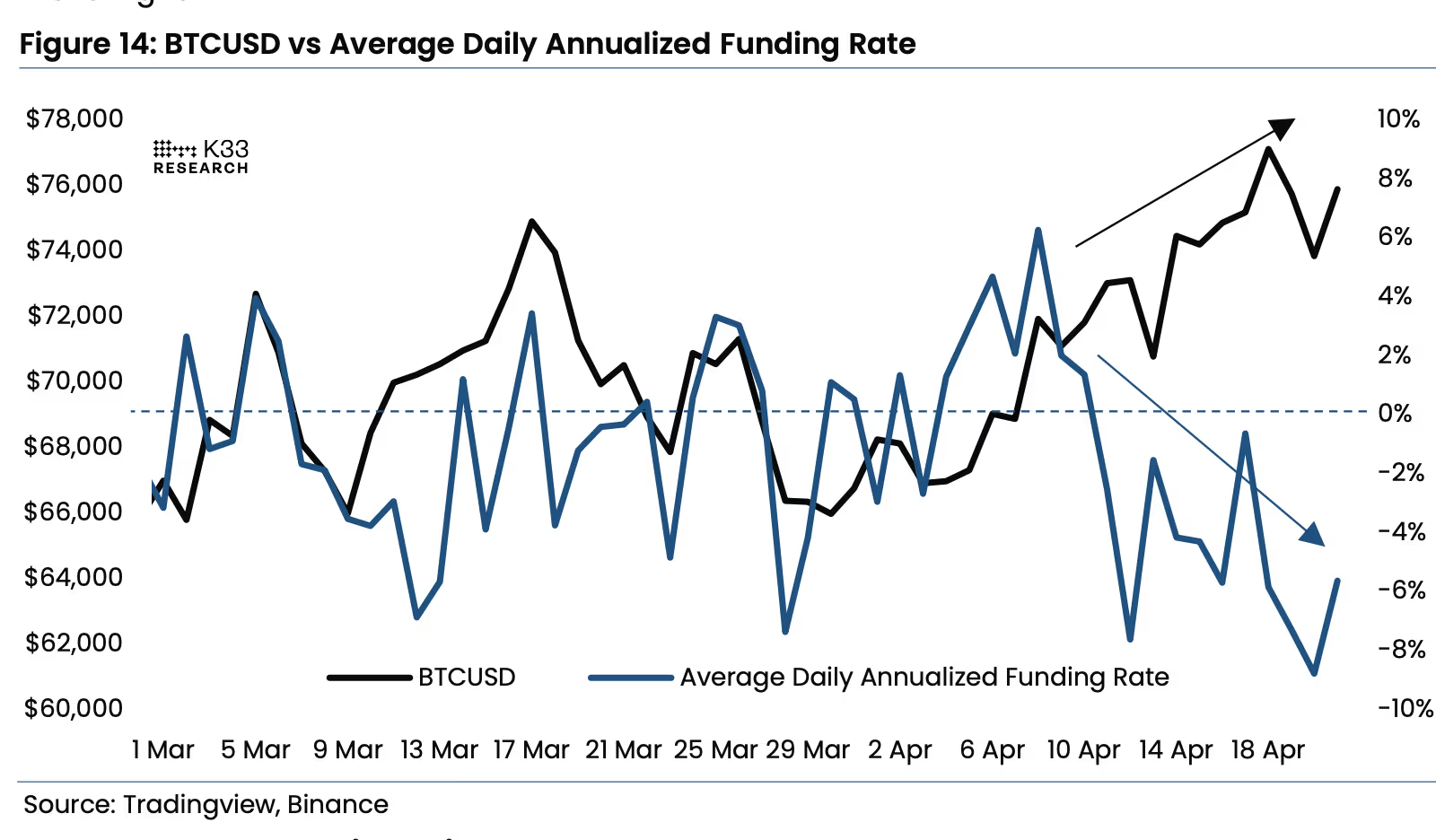
Perpetual swap traders remain heavily skewed bearish, with seven-day funding rates at near three-year lows, noted Vetle Lunde, head of research at K33 Research. At the same time, open interest continues to trend higher, suggesting fresh leverage is entering the market.

“Rising leverage alongside deeply negative funding suggests shorts are steadily building in perps, increasing both the likelihood and potential magnitude of a short squeeze,” he wrote.
“We continue to see strong breakout potential for BTC, with concentrated shorts providing ample fuel for a move higher,” Lunde added.
The $80,000 area, however, carries additional weight for bitcoin. It aligns with the short-term holder realized price — a measure of the average cost basis for newer market participants, who tend to be more sensitive to volatility and more likely to sell into strength.
For now, BTC is testing that hurdle. A clean move above it could signal stronger conviction behind the rally, but failing to hold could invite renewed selling pressure and profit-taking from shorter-term holders.

Welcome to banger casino , the ultimate destination for thrilling online gaming in Bangladesh! Whether you’re looking to enjoy free play or dive into real money games, Banger Casino has it all. Experience seamless access with Banger Casino login and explore a world of excitement right at your fingertips.
Download the Banger Casino app today and take your gaming experience to the next level. With the Banger Casino app download, you can enjoy free play anytime, anywhere. Looking for the APK? Get the Banger Casino app download apk and start playing instantly!
Join the Banger Casino Bangladesh community and discover why players are raving about the Banger app. Don’t miss out on the action – Benger Casino is here to redefine your gaming journey in 2025!
Banger Casino Online in Bangladesh 2025 – Your Ultimate Gaming Destination
Discover the thrill of gaming with Banger Casino Bangladesh, your go-to platform for endless entertainment. Whether you’re a fan of free play or real money games, Banger Casino offers a seamless experience tailored for players in Bangladesh. Download the Banger Casino app APK and enjoy a world of exciting games right at your fingertips.
With the Banger app, you can easily access your favorite games anytime, anywhere. The Banger Casino login process is quick and secure, ensuring you can dive into the action without delay. Experience the convenience of the Banger Casino app free play mode, perfect for trying out new games or honing your skills.
Don’t miss out on the ultimate gaming experience – get the Banger app download today and join the Benger Casino community. Whether you’re using the Banger Casino app or the desktop version, you’ll find a wide variety of games designed to keep you entertained for hours. Banger Casino is your ultimate gaming destination in 2025!
Discover the Thrill of Free Play and Real Money Games
Experience the excitement of Banger Casino Online in Bangladesh 2025, where free play and real money games come together for endless entertainment. With the Banger Casino login, you can access a world of thrilling slots, table games, and live dealer options. Whether you’re a casual player or a high roller, there’s something for everyone.
Download the Banger Casino app today and enjoy seamless gaming on the go. The Banger Casino app download APK is quick and easy, allowing you to dive into your favorite games instantly. For those who prefer free play, the Banger Casino app free play option lets you explore games without any risk.
In Banger Casino Bangladesh, players can enjoy a secure and user-friendly platform. The Banger app download ensures you never miss out on the action, whether you’re at home or on the move. Join Benger Casino now and discover why it’s the top choice for online gaming enthusiasts in Bangladesh.
Why Banger Casino Stands Out in the Online Gaming Industry
Banger Casino has quickly become a top choice for online gaming enthusiasts in Bangladesh. With the banger casino app download, players can enjoy seamless access to a wide range of games, including free play and real money options. The banger casino app download apk ensures compatibility with most Android devices, making it easy for users to dive into the action anytime, anywhere.
One of the key features that sets Banger Casino apart is its user-friendly interface. Whether you’re using the banger casino app or logging in via the website, the banger casino login process is quick and hassle-free. This convenience is especially appreciated by players in banger casino bangladesh, where reliable gaming platforms are in high demand.
For those new to online gaming, the banger casino app free play option is a fantastic way to explore games without any risk. Experienced players, on the other hand, can take advantage of the platform’s advanced features and competitive bonuses. The banger app download also ensures that users stay updated with the latest promotions and game releases.
Banger Casino’s commitment to security and fair play further solidifies its reputation in the industry. Whether you’re accessing the platform through the banger app or the website, you can trust that your data and transactions are protected. This focus on quality and reliability makes Banger Casino a standout choice for gamers in Bangladesh and beyond.
Explore a Wide Range of Exciting Casino Games
At Banger Casino, players in Bangladesh can dive into a thrilling world of casino games. Whether you prefer classic slots, live dealer games, or table games like blackjack and roulette, Banger Casino has it all. With the Banger Casino login, you can access these games instantly and start playing for free or real money.
For those on the go, the Banger Casino app download offers seamless gaming on your mobile device. The Banger app is designed for smooth performance, ensuring you never miss a moment of excitement. Download the Banger Casino app download apk to enjoy your favorite games anytime, anywhere.
Banger Casino Bangladesh brings you a unique gaming experience with exclusive bonuses and promotions. Whether you’re a seasoned player or new to online casinos, the Banger Casino app makes it easy to explore and enjoy a variety of games. Don’t wait – join Benger Casino today and start your adventure!
Secure and Convenient Payment Options for Bangladeshi Players
At Banger Casino Bangladesh, we prioritize your safety and convenience when it comes to transactions. Whether you’re using the Banger Casino app download APK or accessing your account via Banger Casino login, our platform offers a variety of trusted payment methods tailored for Bangladeshi players.
| Bkash | Instant deposits and withdrawals, widely used in Bangladesh. | Nagad | Secure and fast transactions for Banger Casino app free play. | Rocket | Convenient mobile banking for Banger Casino app download users. | Credit/Debit Cards | Accepted globally for seamless Banger Casino login transactions. | Cryptocurrency | Anonymous and secure payments for Banger App users. |
With Banger Casino, you can enjoy real money games or free play with peace of mind. Download the Banger app today and experience hassle-free payments!
Join Banger Casino Today and Claim Exclusive Bonuses
Experience the thrill of online gaming with Banger Casino Bangladesh! Whether you’re a fan of free play or real money games, Banger Casino offers an unmatched experience. Start your journey today and unlock exclusive bonuses designed just for you.
- Banger Casino App Download: Get the Banger app on your device and enjoy seamless gaming on the go. The Banger app download is quick, easy, and free!
- Banger Casino App Free Play: Try out your favorite games without spending a dime. The Banger Casino app free play feature lets you explore and practice before diving into real money action.
- Banger Casino Login: Access your account instantly with the Banger Casino login. Enjoy a secure and user-friendly platform tailored for players in Bangladesh.
Why wait? Join Banger Casino today and take advantage of these incredible benefits:
Don’t miss out on the ultimate gaming experience. Download the Banger app now and start playing with Banger Casino Bangladesh!


Bitcoin climbed above $78,000 on April 22, reaching its highest price in 11 weeks, as a wave of short liquidations and improved macro sentiment following Trump’s ceasefire extension combined to push the asset to a key technical level that had resisted multiple breakout attempts.
Summary
- Bitcoin broke above $78,000 on April 22 for the first time in 11 weeks, with CoinGlass data showing approximately $180 million in short liquidations clustered above the level.
- The move coincided with improved risk sentiment after Trump extended the Iran ceasefire, alongside a broader altcoin rally led by higher-beta assets.
- Analysts warn the move is driven by short-term positioning dynamics rather than a fundamental shift in capital allocation or market structure.
Bitcoin rose above $78,000 on April 22 for the first time since early February, touching an 11-week high as easing geopolitical tensions and a concentrated cluster of short liquidations above the level combined to push price through resistance that had turned back multiple attempts in recent weeks. According to Fortune’s April 22 price data, BTC was trading at $78,194 as of 9:15 a.m. ET, up approximately $2,293 from the prior morning.
Bitcoin 11-Week High Fueled by Short Liquidations and Macro Relief
CoinDesk reported that approximately $180 million in short futures positions were sitting above the $78,000 level heading into the session, according to CoinGlass liquidation heatmap data, creating significant upside fuel if price could clear the threshold. The broader catalyst was Trump’s extension of the Iran ceasefire announced on April 21, which lifted risk sentiment across equities and crypto simultaneously. Crypto futures open interest rose more than 4% to $126 billion in the 24 hours surrounding the move, with funding rates flipping positive across most major tokens, signaling renewed demand for leveraged long exposure.
Diana Pires, Chief Business Officer at sFOX, said, “Bitcoin reaching an 11-week high and testing the $78,000 level is being framed as a macro-driven move, but the move appears largely driven by positioning, with a significant amount of short liquidations sitting above the market. This is a squeeze dynamic more than a fundamental shift in demand.”
Altcoins Join the Rally, But the Breadth Tells Its Own Story
The Bitcoin move pulled altcoins higher across the board, with memecoins leading gains and higher-beta assets outperforming. As crypto.news documented, a similar dynamic played out during the earlier $225 million short squeeze in mid-April, where forced buying in derivatives markets accelerated a price move that ultimately failed to hold. The current rally’s altcoin participation pattern drew cautious readings from analysts watching for signs of genuine capital reallocation versus tactical risk-on positioning.
According to Diana, “Participation is expanding into altcoins, but it’s concentrated in higher-beta, more speculative segments. That’s consistent with a short-term risk-on reaction, not a broad reallocation of capital.”
Whether the Move Can Hold Is the Real Question
Bitcoin spent more than 46 consecutive days below $76,000 before this week’s move, building up one of the largest concentrations of short positioning in recent history, as crypto.news tracked. K33 Research head of research Vetle Lunde noted that comparable risk-off regimes with negative funding and rising open interest have historically preceded significant recoveries once short sellers were forced to unwind. That structural setup provided the technical conditions for the current move, but analysts are watching closely whether spot demand can sustain price above $78,000 once the immediate liquidation fuel is exhausted. The FOMC meeting on April 28 and 29 is the next major macro test, with rate cut expectations still largely absent from the near-term calendar.
“What matters now is whether this move can sustain without continued positioning support. Liquidity conditions remain tight, and capital is still selective in how it allocates to risk assets. Until that participation deepens and proves durable, this type of price action is more reflective of short-term positioning than a broader shift in market structure,” Diana explained.
The gold vs silver divergence has widened sharply this month. Silver (XAG/USD) is up 15.47% against gold’s (XAU/USD) 6% gain as Brent crude slides below $99 on continuing de-escalation talks.
The gap is not random. Proprietary indicators, options flows, and chart structure all lean the same way, though one structural force still defends gold’s downside.
Three Forces Are Separating Gold from Silver
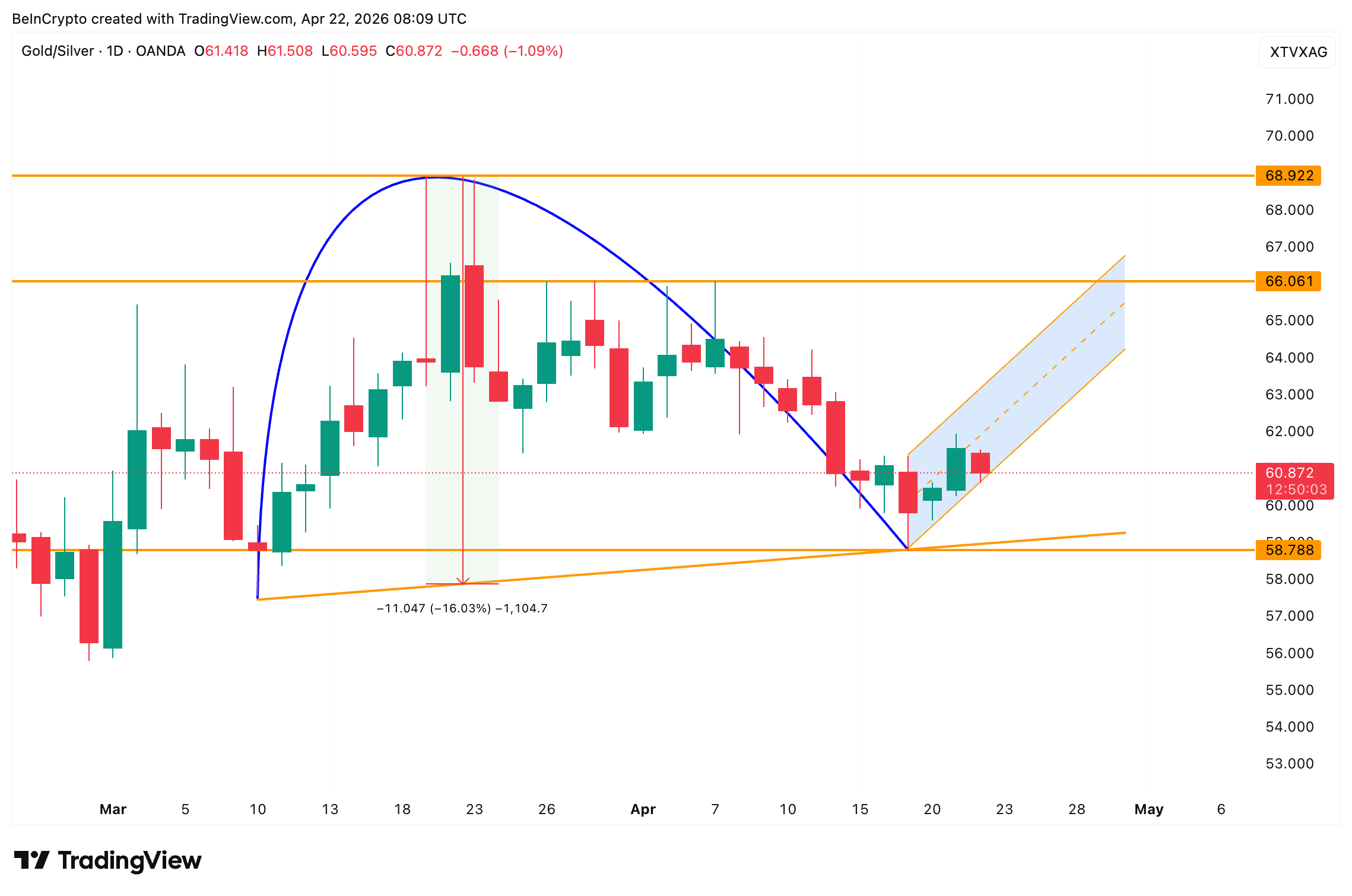
The gold-silver ratio has formed an inverted cup and handle since late March. The ratio now presses against the handle’s lower trendline. A clean breakdown would extend silver’s lead, while a reclaim of the pattern’s upper bound would neutralize the silver-friendly setup.
Its handle low sits near 58, and a break below that level targets a further 16% compression, meaning silver extends the lead. A reclaim of 68 flips it back toward gold.
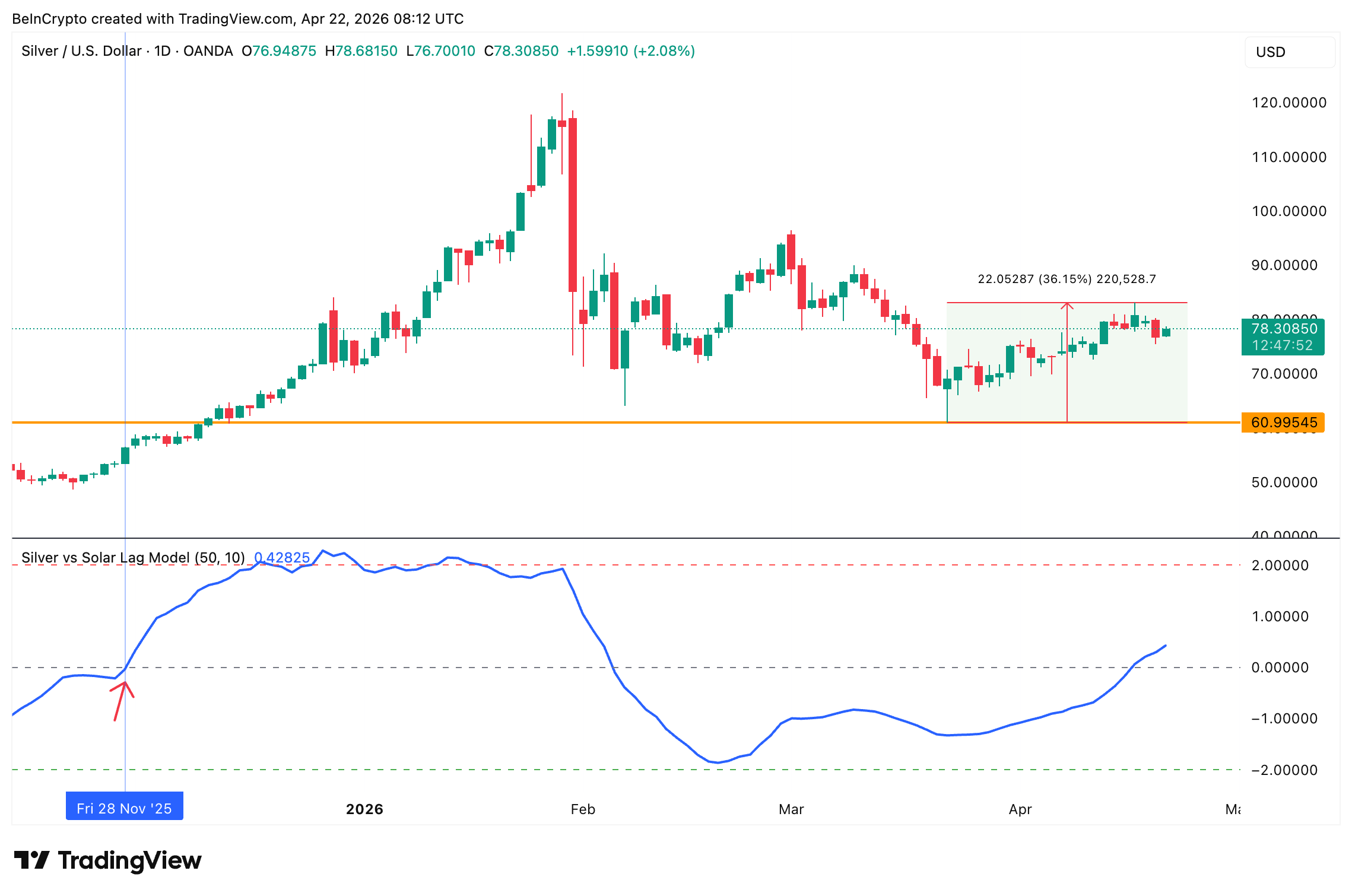
Silver’s Solar Lag Model, which tracks silver against solar-demand-driven industrial flows with a 10-day lag, has crossed above zero for the first time since late 2025. The November 28 cross preceded silver’s multi-week rally.
Gold’s Real Yields Lag Model, BeInCrypto’s proprietary indicator, which measures gold’s path against 10-year real yields, is rolling the other way. It peaked at 2.685 earlier this month and now reads 0.308. Its slope mirrors the February rollover that broke below zero and bottomed at -3.497 during gold’s correction.
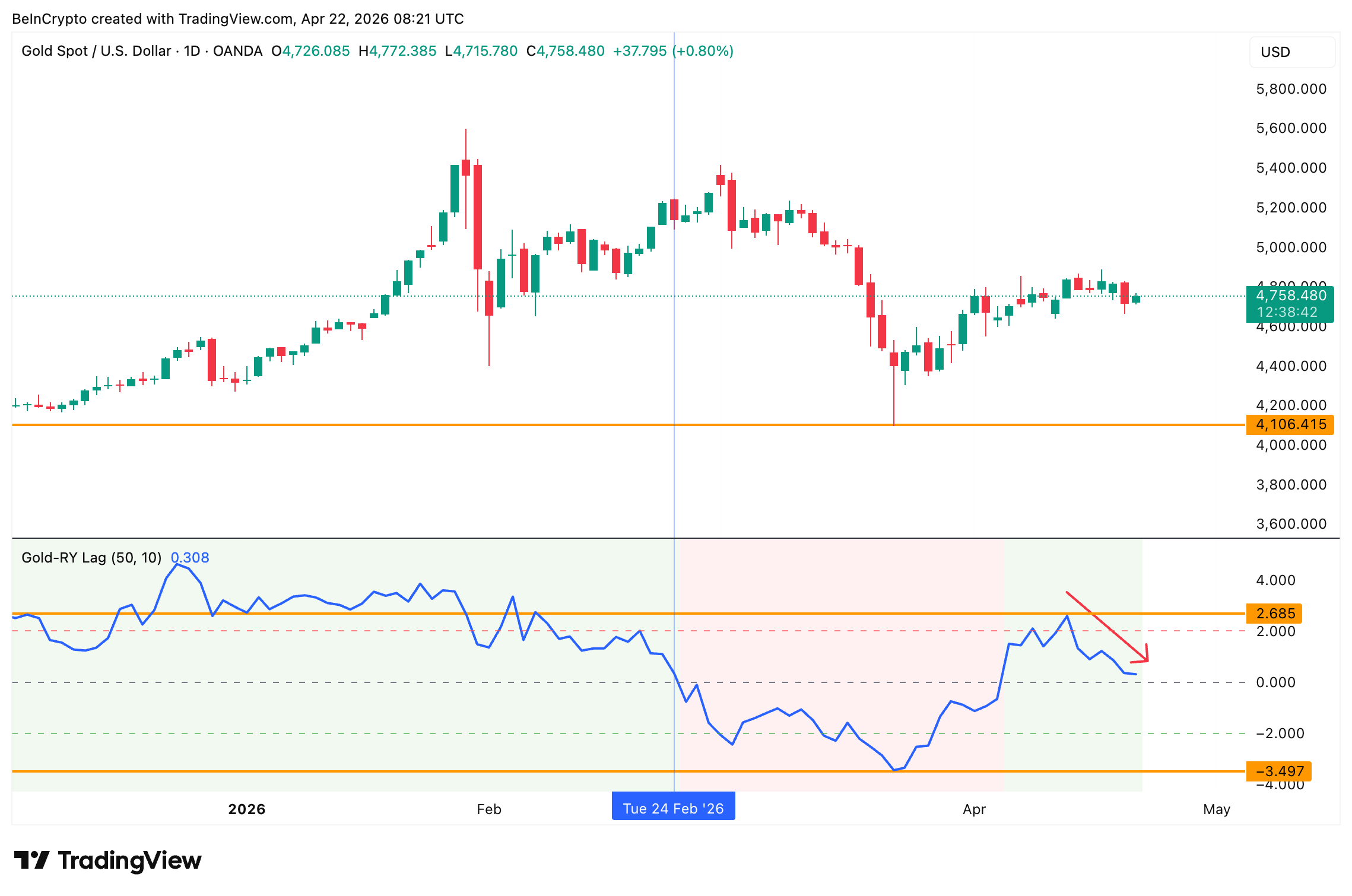
One structural force still defends gold. Central banks now hold roughly 38,666 tons, about 17% of all gold ever mined, according to data cited by The Kobeissi Letter. Even if gold loses the relative race to silver, its downside is cushioned by a buyer base that does not respond to short-term macro rotations.
Taken together, the ratio is compressing in silver’s favor, silver’s industrial lag model is climbing, and gold’s monetary premium is fading, while central bank demand keeps gold’s floor intact rather than lifting it higher. The scoreboard reads three forces for silver, one defensive line for gold.
Positioning data shows whether options traders are reading the divergence the same way.
Options Traders Stack Long on One, Stay Balanced on the Other
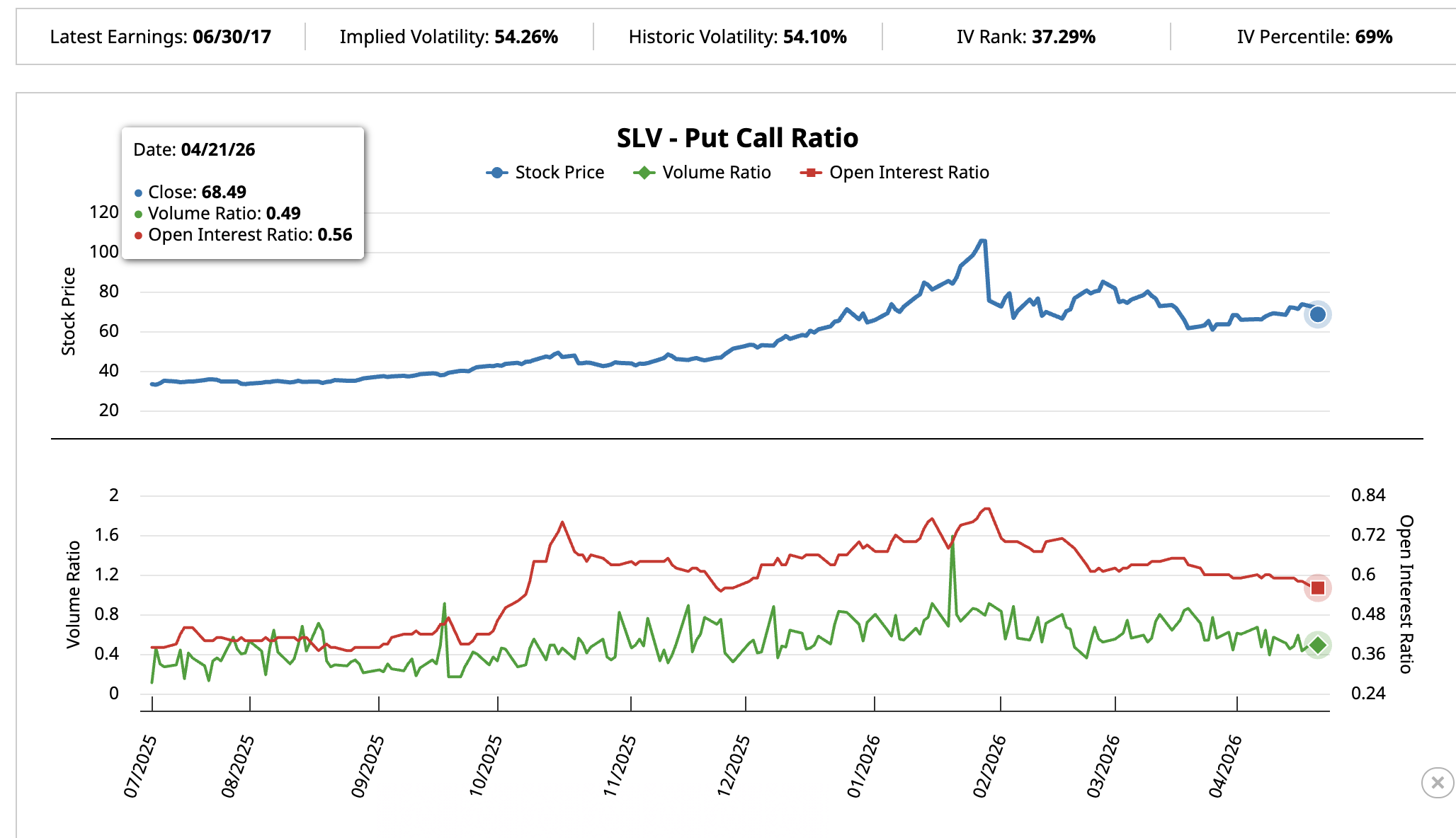
Options activity on the iShares Silver Trust (SLV ETF), the largest silver-backed fund and the main proxy traders use to position on silver without touching futures, has turned sharply bullish since late March.
The put-call volume ratio, where a reading below one means calls outnumber puts, has dropped from 0.77 on March 26 to 0.49 on April 21. The open interest ratio has fallen from 0.60 to 0.56 over the same window. Call activity is outpacing put activity on both intraday and structural horizons.
SLV implied volatility sits at 54.26% with an IV Percentile of 69%, meaning options are pricing expected movement above most of the past year’s range. Traders are leaning long and paying up for the range.
Want more insights like this? Sign up for Editor Harsh Notariya’s Daily Newsletter here.
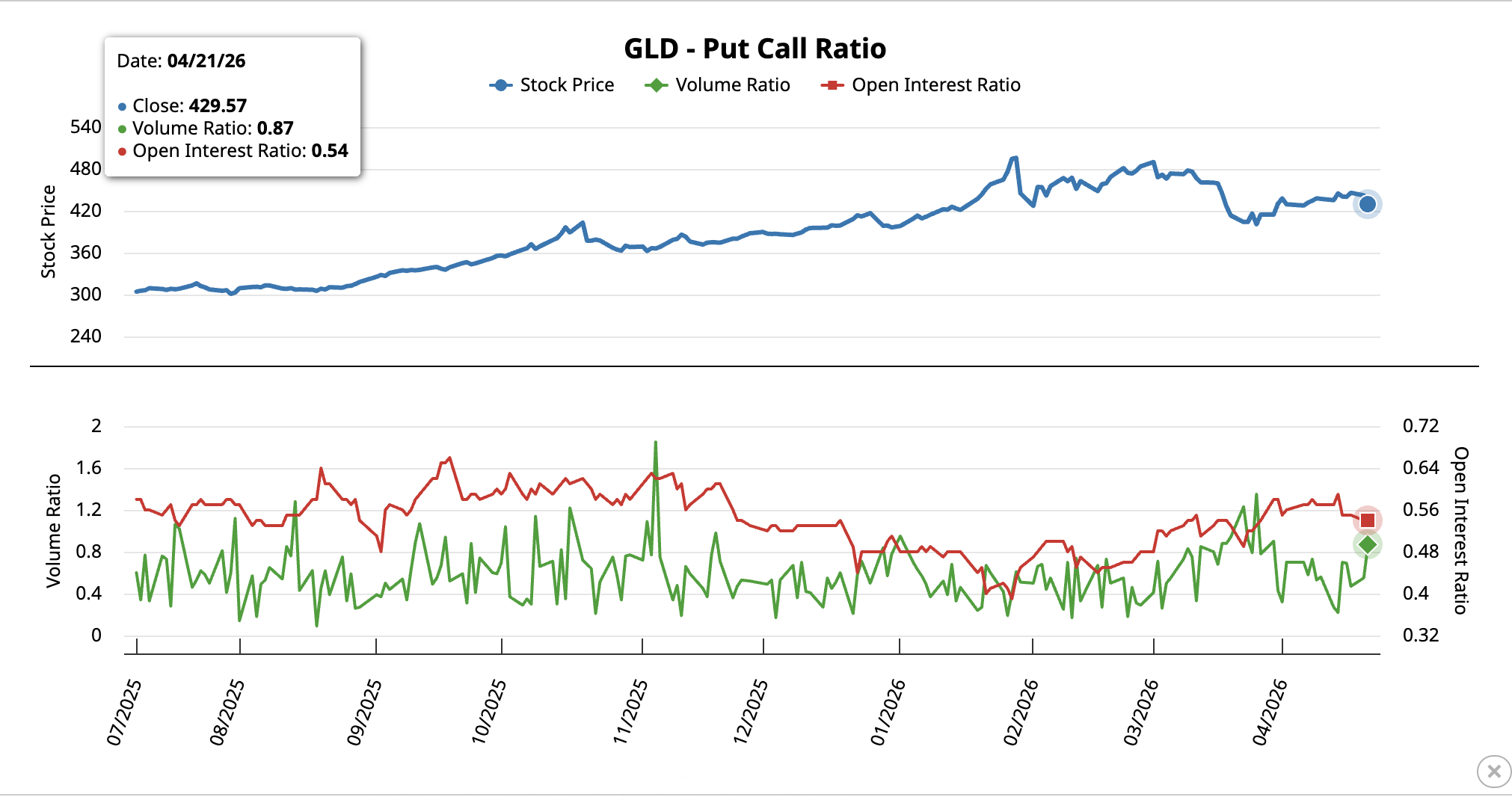
Positioning on the SPDR Gold Shares (GLD ETF), the equivalent physical-backed vehicle for gold exposure, looks different. The volume ratio has dropped from 1.35 on March 26 to 0.87, a shift from bearish to mildly bullish. The open interest ratio has barely moved from 0.53 to 0.54. Traders have stopped stacking downside protection on gold but have not rotated into aggressive call accumulation either.
With indicators and positioning pointing the same way, the charts become the decider.
The Gold vs Silver Verdict Rests on Two Inverse Setups
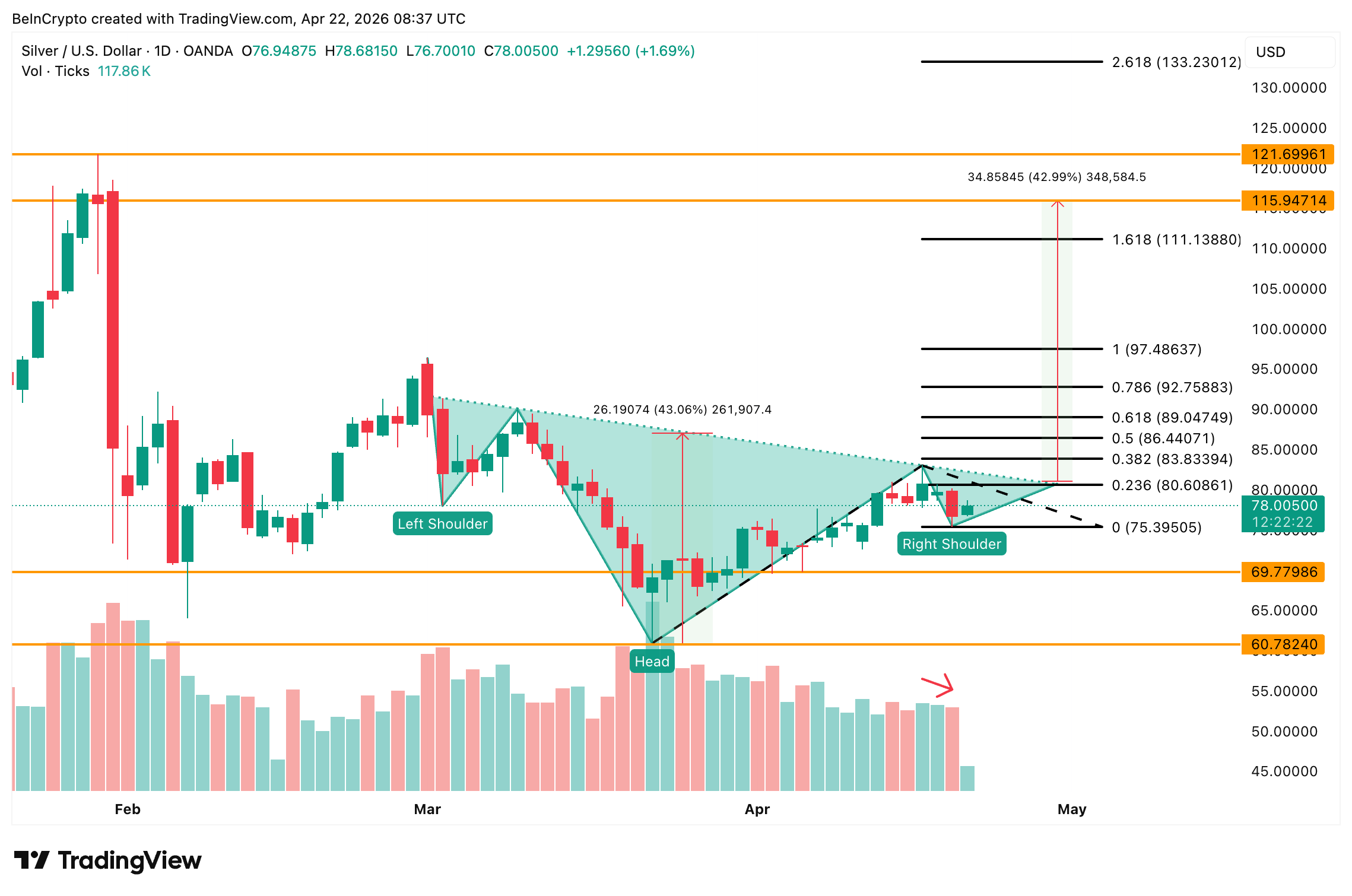
The silver price (XAG/USD) daily chart has been carving out an inverse head and shoulders, a bullish reversal shape made of three lows with the middle one being the deepest. The pattern’s head sits near $60, and the neckline runs close to $80. The right shoulder’s buying volume sits marginally above its matching selling volume, offering subtle confirmation of strength
A clean break above the $80 to $83 zone would activate a 43% projection toward roughly $115, pushing price near the $121 all-time high. The optimistic extension sits at $133 as a stretch target. A drop below $75 weakens the structure, a move under $69 risks invalidation, and a breach of $60 ends the bullish thesis.
Gold price is building the same pattern but with weaker confirmation. The right shoulder’s selling volume pillar sits above the matching buy volume, the opposite of silver’s read, showing weaker strength. The neckline sits near $4,848, and a confirmed break above that level opens a 24% path to $5,934 from the neckline. That upside is roughly half of silver’s measured move.
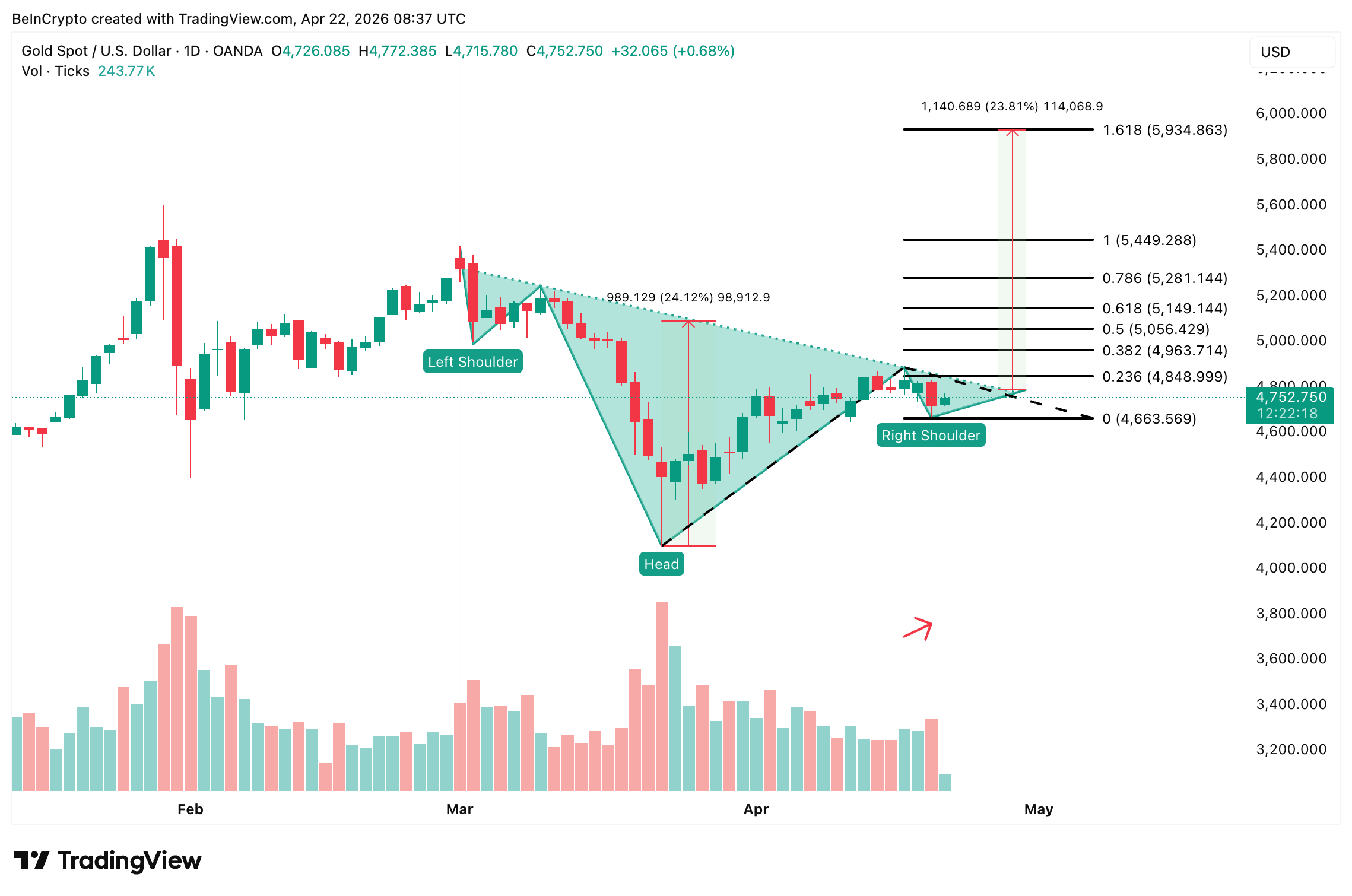
The gold-silver ratio from earlier provides the deciding context as the pattern too favors silver for now.
In the gold vs silver race, silver holds the volume confirmation, the cleaner options flow, and the larger projection. However, gold’s safe haven floor rests on central bank demand. Silver’s break above $80 opens a path to $115 and extends the lead. But a rejection there and a loss of $75 could hand momentum back to gold.
The post A 43% Projection Is Calling the Gold vs Silver Winner as Oil Cools appeared first on BeInCrypto.
Crypto World
Clarity Act Markup Slips to May as Tillis Seeks More Time, But OCC Advances Stablecoin Rules


The Senate Banking Committee’s Clarity Act markup is tracking toward May after Sen. Thom Tillis (R-NC) told reporters he does not expect the committee to act in April.
Tillis, the lead negotiator on stablecoin yield provisions, wants more time to hear from banking stakeholders. The delay pushes the earliest possible window to the week of May 11.
Bank Lobbying Pressures Tillis on Stablecoin Yield
Tillis’s office has faced a coordinated pressure campaign from bank lobbying groups, including the North Carolina Bankers Association.
Banks have objected to details of a stablecoin yield compromise reached earlier this month between select crypto firms and banks, even though the full text has not been publicly released.
“It’s very important to me not to accelerate things, to hear everybody, and give them a rational basis for what we do accept,” Sen. Thom Tillis, reportedly told reporters.
However, Sen. Cynthia Lummis (R-WY) pushed back sharply, warning that “further delay is unacceptable” and that the offshore risk is real.
The Digital Chamber also sent a letter to Banking Committee leadership urging immediate action.
The trade group noted more than 270 days have passed since the House passed the Clarity Act.
OCC Advances GENIUS Act Stablecoin Framework
Meanwhile, the Office of the Comptroller of the Currency (OCC) is moving forward with its proposed rule to implement the GENIUS Act.
The rule would establish licensing, reserve, and redemption standards for payment stablecoin issuers under federal oversight. The public comment period closes May 1.
The parallel tracks highlight a split in the pace of US crypto regulation. While the OCC builds out stablecoin supervision, the broader market structure bill faces growing political friction.
The post Clarity Act Markup Slips to May as Tillis Seeks More Time, But OCC Advances Stablecoin Rules appeared first on BeInCrypto.
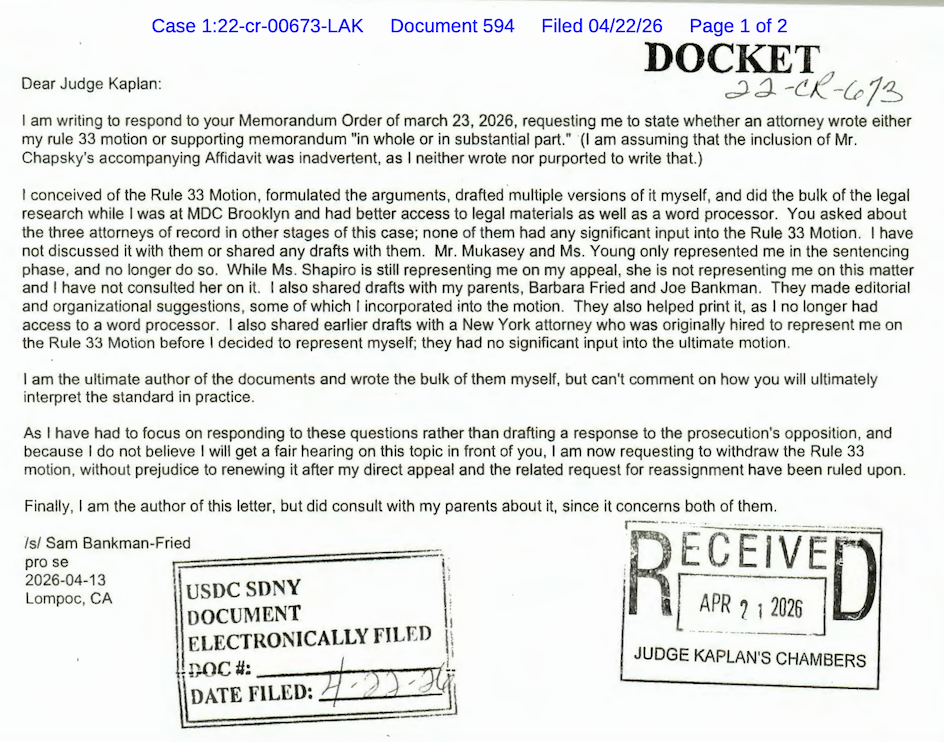
Former FTX CEO Sam Bankman-Fried, serving a 25-year sentence for his role in misusing user funds at the crypto exchange, has dropped a motion in federal court requesting a new trial for his criminal case, but still has a pending appeal of his conviction and sentence.
In a Wednesday filing in the US District Court for the Southern District of New York, Bankman-Fried responded to a March 23 letter from Judge Lewis Kaplan ordering the former FTX CEO to answer whether he received any assistance from lawyers for a pro se motion — a filing on his own behalf without an attorney. Kaplan’s order followed US prosecutors raising doubts whether the convicted company founder filed for an extension of his request for a new trial by himself in March, just a few days after his mother, Barbara Fried, though lacking standing, sent a letter to the court on her son’s behalf.
“I am the author of this letter, but did consult with my parents about it, since it concerns both of them,” said Bankman-Fried, referring to an extension to file for a Rule 33 motion for a new trial, adding:
“As I have had to focus on responding to these questions rather than drafting a response to the prosecution’s opposition, and because I do not believe I will get a fair hearing on this topic in front of you, I am now requesting to withdraw the Rule 33 motion, without prejudice to renewing it after my direct appeal and the related request for reassignment have been ruled upon.”

Bankman-Fried requested in February that a different judge rule on his motion for a new trial, claiming that Kaplan showed “extreme prejudice.” He also awaits a decision on his appeal of his conviction and sentence in the US Court of Appeals for the Second Circuit. Neither filing was apparently affected by Bankman-Fried’s letter, posted to the public docket on Wednesday.
Related: Interview with SBF’s parents drops chance of pardon on betting markets
Bankman-Fried, known as SBF, was once the CEO of one of the largest crypto exchanges globally before he was convicted of fraud and charges related to his misuse of customer funds in 2023 and later sentenced to 25 years in prison. As of Wednesday, he was housed at the Federal Correctional Institution, Lompoc I, in California.
Is SBF still seeking Trump pardon?
Following his incarceration, the former FTX CEO has made several public statements through interviews and his social media accounts signaling plans to apply for a presidential pardon from Donald Trump.
His request for a new trial included claims that former US President Joe Biden’s Justice Department “threatened multiple witnesses into silence or into changing their testimony“ at his criminal trial. He has also posted to X praising Trump’s crypto policies and the president’s military actions in Iran.
In a January New York Times interview, Trump said that he had no intention of pardoning the convicted former FTX CEO.

Former FTX chief Sam Bankman-Fried has formally withdrawn a Rule 33 motion seeking a new trial in his criminal case, a development that sits alongside the ongoing direct appeal of his conviction and sentence. The procedural maneuver underscores the complexity of post-trial relief in a high-profile crypto-firm collapse and highlights how federal courts manage pro se filings in tandem with formal appeals. Bankman-Fried was convicted of fraud and related charges tied to the misuse of customer funds and was subsequently sentenced to 25 years in prison. He is currently incarcerated at the Federal Correctional Institution in Lompoc, California.
In a Wednesday filing with the U.S. District Court for the Southern District of New York, Bankman-Fried responded to a March 23 order from Judge Lewis Kaplan that asked whether he had received any assistance from lawyers for a pro se motion. The order followed prosecutors’ questions about whether he had filed for an extension of his Rule 33 motion on his own, and after his mother, Barbara Fried, submitted a letter on his behalf—though she lacked standing. Bankman-Fried stated that he authored the letter but consulted with his parents because the matter concerns both of them. According to Cointelegraph, the letter was publicly posted on the docket on Wednesday.
“I am the author of this letter, but did consult with my parents about it, since it concerns both of them,” he wrote, adding: “As I have had to focus on responding to these questions rather than drafting a response to the prosecution’s opposition, and because I do not believe I will get a fair hearing on this topic in front of you, I am now requesting to withdraw the Rule 33 motion, without prejudice to renewing it after my direct appeal and the related request for reassignment have been ruled upon.”
The filing also notes that Bankman-Fried had previously requested that a different judge decide whether to grant a new-trial relief, arguing that Kaplan demonstrated “extreme prejudice.” He remains subject to an appellate review of his conviction and sentence by the United States Court of Appeals for the Second Circuit. Neither the withdrawal of the Rule 33 motion nor the public letter appears to have altered the status of the ongoing appeal or the scheduled considerations in the Second Circuit.
Bankman-Fried’s case—once at the helm of a major crypto platform before his 2023 conviction—continues to draw attention for the procedural intricacies of post-conviction relief in financial-crime prosecutions tied to the crypto sector. The defense strategy around pro se motions, potential reassignment, and the timing of any renewed Rule 33 filing all carry implications for how similarly situated defendants may approach post-conviction relief in high-stakes crypto litigation.
Key takeaways
- The Rule 33 motion seeking a new trial has been withdrawn without prejudice to renewal after the direct appeal and potential reassignment rulings.
- The withdrawal follows a court order requiring Bankman-Fried to address whether he received legal assistance for a pro se filing and after prosecutors questioned whether he filed for an extension independently.
- The public nature of the pro se motion and related filings continues to shape the procedural landscape of Bankman-Fried’s post-conviction efforts, including potential reassignment to a different judge for future proceedings.
- Bankman-Fried remains imprisoned while the Second Circuit reviews his conviction and sentence, with no immediate change to the appellate trajectory indicated by the filings.
- Separately, Bankman-Fried has signaled a desire to seek a presidential pardon, a line of inquiry that intersects with political considerations surrounding crypto enforcement and regulatory policy.
Procedural developments in the SDNY case
The core of the latest filings centers on Rule 33 of the Federal Rules of Criminal Procedure, which governs motions for a new trial. By withdrawing the pro se motion, Bankman-Fried preserves his right to pursue post-trial relief at a later stage, provided the direct appeal and any requested reassignment advance. The court’s March order—prompted by questions from prosecutors about self-representation in the motion—highlights the careful scrutiny federal judges apply to pro se requests in high-profile cases where the government has raised concerns about the basis and timing of relief efforts.
Bankman-Fried’s legal strategy has frequently referenced the possibility of procedural remedies beyond the direct appellate route. The defendant had previously urged that a different judge oversee the motion, alleging that Kaplan’s conduct could prejudice the proceedings. The record indicates that, while the defendant and his representatives have sought to challenge procedural aspects, the substantive grounds of his conviction remain the central issue on appeal. The public docket release of the letter underscores the transparency expectations in cases of such notoriety, and it frames the ongoing dialogue between defense, prosecution, and the court on how to handle post-conviction requests.
Appeals trajectory and potential case reassignment
The Second Circuit remains the focal point for Bankman-Fried’s efforts to overturn his conviction and sentence. The appellate review assesses the sufficiency of the evidence, the conduct of the trial, and the integrity of the proceedings, among other considerations. The current withdrawal of the Rule 33 motion does not conclude the post-trial relief discussion, as a renewed motion could be pursued after the appellate process and any reconsideration of judicial assignments. The fact pattern here illustrates how a defendant may compartmentalize different post-trial avenues—an immediate appeal, a potential new-trial motion, and a potential reassignment—without all being resolved simultaneously.
The procedural arc also reflects broader regulatory and enforcement themes in crypto-related cases. Courts have increasingly grappled with how to manage complex financial-law claims connected to digital assets, with outcomes bearing implications for how firms structure governance, risk controls, and executive accountability within the sector. The SBF case, in particular, continues to inform debates about the boundaries of post-conviction relief in tech-enabled financial markets and the extent to which procedural vehicles can be used to challenge or refine prosecutions in crypto-adjacent offenses.
Public pardon discourse and broader political context
Beyond the courtroom, Bankman-Fried has publicly signaled interest in seeking a presidential pardon, a possibility he has discussed in interviews and on social platforms. Such actions intersect with political narratives around crypto regulation and enforcement. Bankman-Fried has claimed that statements by individuals associated with the federal government affected witnesses, a line that aligns with his broader public posture regarding the trial process. He has also posted public remarks praising former President Donald Trump’s cryptocurrency policies and expressing support for Trump’s broader policies in certain geopolitical areas.
High-profile political stances in relation to crypto enforcement can influence regulatory expectations and political risk for crypto firms and investors, even though they do not determine the outcomes of criminal proceedings. Trump, for his part, has publicly indicated that he would not pardon Bankman-Fried, a stance reported in major outlets and part of the public discourse surrounding post-conviction possibilities. The interplay between executive clemency discussions, ongoing legal challenges, and regulatory oversight underscores how political developments may intersect with legal processes in crypto markets.
In sum, Bankman-Fried’s latest filings reveal a cautious approach to post-trial relief, while maintaining a broader strategy that includes appellate review and potential reconsideration of procedural avenues. The case continues to serve as a touchstone for regulatory policy, enforcement actions, and the evolving framework governing crypto entities and their leadership in an era of intensified oversight.
Looking ahead, observers will monitor the Second Circuit’s handling of the direct appeal and any renewed Rule 33 motion, as well as any developments related to reassignment procedures. The unfolding sequence will contribute to the jurisprudence shaping post-conviction relief in crypto-related prosecutions and will inform institutional compliance practices as regulators adapt to a rapidly evolving market structure.
Key points:
-
Bitcoin’s rise above the $78,333 resistance opens the door for a rally to $84,000.
-
Several major altcoins are attempting to rise above their resistance levels, signaling aggressive buying at lower levels.
Bitcoin (BTC) rallied above $79,000, indicating that the bulls are back in the game. Crypto market intelligence platform Decode said in a post on X that BTC was ready for a short squeeze, waiting for the bulls to light a fuse in a loaded cannon.
Select analysts expect the current relief rally to pick up strength. CryptoQuant analyst CW8900 said in a post on X that BTC’s adjusted Net Unrealized Profit/Loss (NUPL), the difference between total profits and losses currently held by investors, has turned positive. That suggests BTC’s downtrend has ended and the “real rally of this cycle has begun.”

The sharp recovery off the $60,000 level has pushed the Bitcoin Bull Score Index (BSI) into neutral territory for the first time since the bear market began. However, there was a word of caution from CryptoQuant contributor Julio Moreno, who said in a post on X that the BSI had entered neutral territory for a week during March 2022 but had resumed its decline later.
Could BTC and select major altcoins extend their recovery? Let’s analyze the charts of the top 10 cryptocurrencies to find out.
Bitcoin price prediction
BTC turned up from the 20-day exponential moving average ($73,758) on Monday and rose above the $78,333 level on Wednesday, indicating an advantage to the bulls.

If the BTC price remains above the $78,333 level, the likelihood of a rally to $84,000 increases. Such a move suggests that the BTC/USDT pair may have bottomed out at $60,000.
The 20-day EMA is the critical level to watch out for on the downside. Sellers will have to pull the price below the 20-day EMA to invalidate the bullish setup. The pair may then collapse to the 50-day simple moving average ($70,934).
Ether price prediction
Ether (ETH) rebounded off the 20-day EMA ($2,273) on Monday, indicating a change in sentiment from selling on rallies to buying on dips.

The upsloping moving averages and the RSI in the positive zone signal that the path of least resistance is to the upside. If buyers clear the $2,465 hurdle, the ETH/USDT pair may surge toward the resistance level and then toward $2,800.
The first sign of weakness will be a break and close below the 20-day EMA. That signals the bulls are booking profits. The ETH price may then slump to the 50-day SMA ($2,157) and later to the support line.
XRP price prediction
XRP (XRP) turned up from the moving averages on Monday, indicating that the bulls are viewing the dips as a buying opportunity.

Buyers will attempt to push the XRP price to the downtrend line of the descending channel pattern, where the bears are expected to sell aggressively. If the price turns sharply down from the downtrend line, it suggests that the XRP/USDT pair may spend more time inside the channel.
Buyers will get back into the driver’s seat if they propel and sustain the price above the downtrend line. The pair may then climb to the $2 level, signaling a short-term trend change.
BNB price prediction
BNB (BNB) turned up from the 20-day EMA ($623) on Monday and rose above the $649 resistance on Wednesday.

If buyers sustain the price above $649, the BNB/USDT pair may surge toward $687. Sellers are expected to mount a strong defense at $687, but if the bulls pierce the resistance, the recovery may extend to $790.
On the other hand, if the BNB price turns sharply lower from the overhead resistance and breaks below the moving averages, it suggests the pair may remain within the $687 to $570 range for a while longer.
Solana price prediction
Solana (SOL) continues to trade near the moving averages, indicating a balance between supply and demand.

If the price rises above $91, the SOL/USDT pair may climb to the overhead resistance at $98. Sellers are expected to fiercely defend the $98 level, but if the bulls prevail, the uptrend may reach $117.
Alternatively, if the SOL price turns down from the overhead resistance and breaks below the moving averages, it suggests that the range-bound action may extend for a few more days.
Dogecoin price prediction
Dogecoin (DOGE) turned up from the moving averages on Monday, indicating that the bulls are attempting a comeback.

The DOGE price may rise to the psychological level of $0.10, where the bears are expected to step in. However, if buyers do not give up much ground to the bears, the prospects of a rally to the $0.12 overhead resistance increase.
Time is running out for the bears. They will have to swiftly pull the price back below the $0.09 level to retain the advantage. If they do that, the DOGE/USDT pair may slump to the Feb. 6 low of $0.08.
Hyperliquid price prediction
Hyperliquid (HYPE) bounced off the 50-day SMA ($38.41) on Tuesday, indicating that the bulls are buying the dips.

The 20-day EMA ($40.90) is flattening, and the RSI is near the midpoint, indicating weakening bullish momentum. That increases the likelihood of a range formation in the near term.
The 50-day SMA is the crucial support to watch out for on the downside, as a close below it may deepen the pullback to $34.45. On the upside, bulls will need to push the HYPE/USDT pair above $45.77 to signal a resumption of the uptrend.
Related: ‘Powerful move’ looms for Bitcoin price, says Bollinger Bands indicator
Cardano price prediction
Cardano (ADA) has risen to the stiff resistance zone between the 50-day SMA ($0.26) and the downtrend line.

If buyers push and sustain the ADA price above the downtrend line, it signals a potential short-term trend change. The ADA/USDT pair may then rally to $0.32, then to $0.37.
On the other hand, if the price turns sharply down from the downtrend line and breaks below the $0.22 level, it suggests the pair may remain within the descending channel for some time.
Bitcoin Cash price prediction
Bitcoin Cash (BCH) has broken above the 50-day SMA ($454), indicating solid demand at lower levels.

The moving averages are on the verge of a bullish crossover, indicating that the bulls have the upper hand. Buyers will attempt to strengthen their position by pushing the BCH price above the $486 resistance. If they succeed, the BCH/USDT pair may rally to $520.
Contrary to this assumption, if the price turns down from the current level or the overhead resistance and breaks below the moving averages, it suggests that the pair may form a range for some time.
Monero price prediction
Monero (XMR) surged and closed above $382 on Tuesday, but bulls are struggling to sustain the gains.

If the price remains above the $382 level, the XMR/USDT pair may initiate a new uptrend toward the pattern’s target of $462.
Contrary to this assumption, if the XMR price closes below $382, it suggests that the bears are selling on rallies. The pair may then pull back to the moving averages, which are likely to act as strong support. If the price rebounds off the moving averages, the bulls will again attempt to initiate the uptrend.
This article does not contain investment advice or recommendations. Every investment and trading move involves risk, and readers should conduct their own research when making a decision. While we strive to provide accurate and timely information, Cointelegraph does not guarantee the accuracy, completeness, or reliability of any information in this article. This article may contain forward-looking statements that are subject to risks and uncertainties. Cointelegraph will not be liable for any loss or damage arising from your reliance on this information.
Crypto World
Trump-linked American Bitcoin’s shares rise by over 12% after deploying nearly 11,300 more rigs
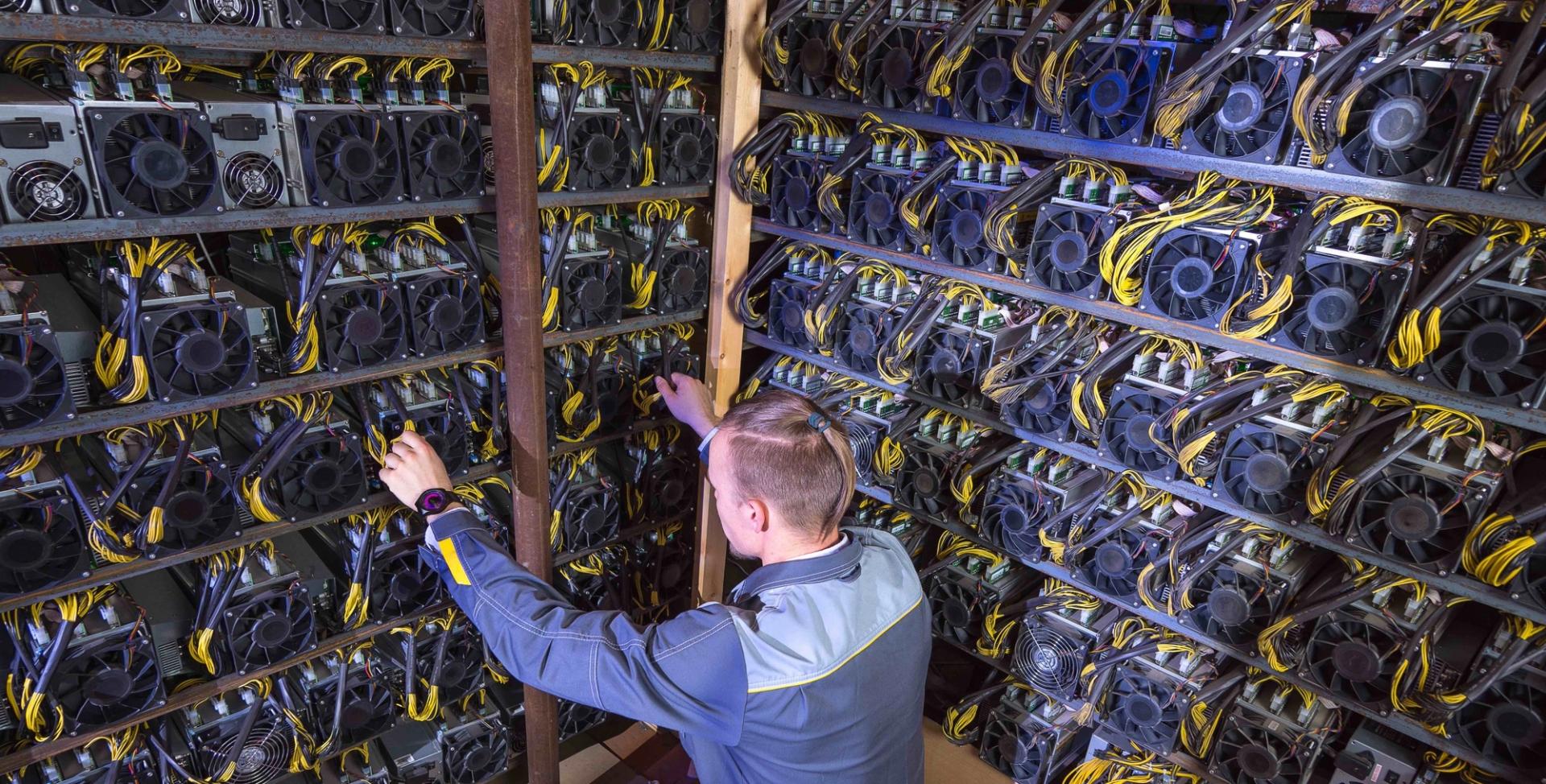
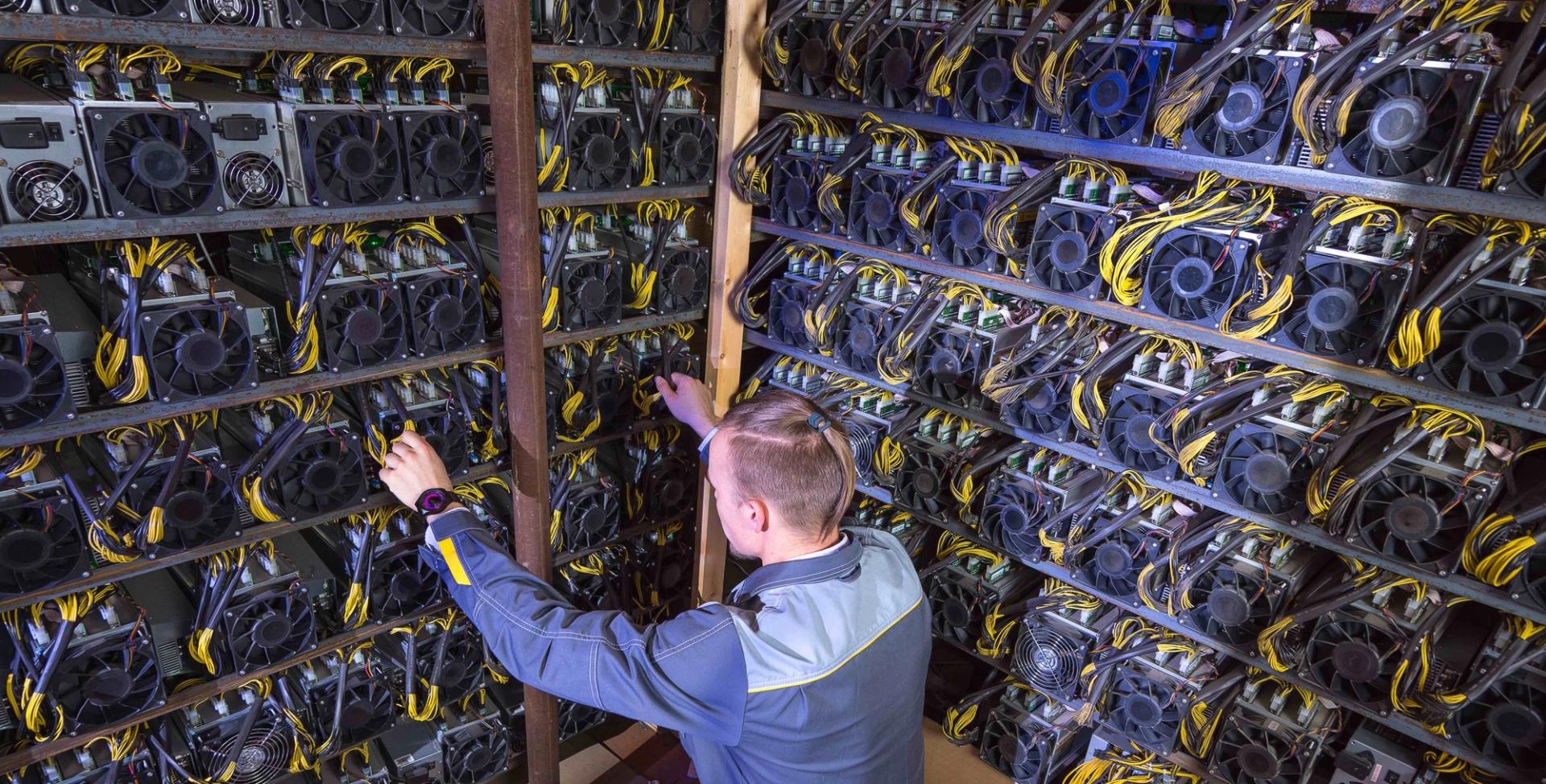
American Bitcoin (ABTC), a mining and treasury firm tied to the family of U.S. President Donald Trump announced on Wednesday it had added nearly 11,300 bitcoin mining rigs at its Drumheller site. The news caused its share price to rise by about 12% to $1.38.
The firm said the miners were fully deployed at its facility in Alberta, Canada, increasing its fleet of ASICs (application-specific integrated circuits) to roughly 89,242. It also said that the new bitcoin mining rigs contribute an incremental 3.05 exahash per second (EH/s) at an efficiency of 13.5 joules per terahash (J/TH) to its current operational fleet.
This high efficiency rating (13.5 J/TH) is critical because it lowers the company’s electricity cost per coin, allowing ABTC to remain profitable even as rising network difficulty makes Bitcoin harder to mine, the firm explained in its statement. “Scaling hashrate is one of the ways we strengthen our position in Bitcoin,” the firm said.
“Bringing these miners online at Drumheller reflects exactly how we intend to lead: moving quickly, allocating capital with discipline, and growing our Bitcoin exposure efficiently at institutional scale,” said Eric Trump, co-founder and chief strategy officer at American Bitcoin, in a statement.
The American Bitcoin statement added that the new units at Drumheller represent the operational completion of a fleet expansion first announced on March 3, 2026, a sign that the company has decided to double down on bitcoin mining operations even as several other miners pivot capital and infrastructure to artificial intelligence and AI data centers.
On March 18, American Bitcoin raised its BTC holdings to 6,899, becoming the 16th-largest bitcoin holder, overtaking Mike Novogratz’s Galaxy Digital. By March 30, the Trump-backed firm raised its BTC treasury to 7,000.

Takeaways from RFK Jr’s gauntlet of congressional hearings
Earnings call transcript: Develop Global’s Q3 2025 performance boosts stock

American Bitcoin Stock Jumps 12% on Miner Expansion

Manchester United reach agreement with Casemiro over contract clause amid transfer speculation

Steven Gerrard disagrees with Gary Neville over ‘shock’ Chelsea and Arsenal claim | Football

US brings back mandatory military draft registration


-

 Sports6 days ago
NWFL Suspends Two Players Over Post-Match Clash in Ado-Ekiti
-

 Fashion5 days ago
Weekend Open Thread: Theodora Dress
-

 Politics5 days ago
Palestine barred from entering Canada for FIFA Congress
-
Entertainment3 days ago
NBA Analyst Charles Barkley Chimes in on Ice Spice McDonald’s Fiasco
-

 Business3 days ago
Powerball Result April 18, 2026: No Jackpot Winner in Powerball Draw: $75 Million Rolls Over
-

 Tech4 days ago
Auto Enthusiast Scores Running Tesla Model 3 for Two Grand and Turns It Into Bare-Bones Go-Kart
-

 Politics4 days ago
Zack Polanski demands ‘council homes not luxury flats for foreign investors’
-

 Crypto World5 days ago
Russia Pushes Bill to Criminalize Unregistered Crypto Services
-

 Politics2 days ago
Gary Stevenson delivers timely reminder to register to vote as deadline TODAY
-

 Tech7 days ago
‘Avatar: Aang, The Last Airbender’ Leaked Online. Some Fans Say Paramount Deserves the Fallout
-
 Business6 days ago
Creo Medical agree sale of its manufacturing operation
-

 Politics5 hours ago
Disabled people challenge government SEND proposals over segregation concerns
-

 Business14 hours ago
Rolls-Royce Voted UK’s Most Iconic Trade Mark as IPO Register Hits 150
-

 Politics5 hours ago
Making troops accountable for war crimes threatens US alliance, ex-SAS colonel warns
-

 Crypto World5 days ago
Russia Introduces Bill To Criminalize Unregistered Crypto Services
-

 Politics6 hours ago
Starmer handler McSweeney to be dragged from shadows by Foreign Affairs Committee
-

 Politics6 hours ago
Zack Polanski responds to home secretary’s taser threat
-
Politics7 hours ago
Wings Over Scotland | How To Get Away With Crimes
-

 Politics4 hours ago
‘Iran is still a nuclear threat’
-

 Tech7 days ago
Ford EV and tech chief leaving automaker
You must be logged in to post a comment Login