
Crypto World
Tom Lee Drops Silver, Gold & Bitcoin Truth Bomb

Welcome to the US Crypto News Morning Briefing—your essential rundown of the most important developments in crypto for the day ahead.
Grab a coffee and settle in—markets are moving in ways that leave even seasoned investors squinting at charts. Gold and silver are surging, crypto is wobbling, and Washington’s policy plays are stirring uncertainty. But according to Tom Lee, somewhere in the chaos, a turning point may be quietly forming.
Crypto News of the Day: Tom Lee Says White House Front-Loading Midterm Wins Is Wrecking Markets
Fundstrat Global Advisors’ Tom Lee is sounding a cautious yet optimistic note for crypto investors, arguing that recent turbulence in Bitcoin and Ethereum may be temporary.
Sponsored
Sponsored
Appearing on CNBC’s Squawk Box, Lee attributed the early-year surge in gold and silver prices to Washington, D.C.’s policy maneuvers.
He says the White House’s plays have temporarily “hijacked” risk appetite, creating a “vortex” that drew capital away from crypto despite strong fundamentals.
Gold spiked to $4,954.99 per ounce, a 6.5% daily jump, while silver surged 13.66% to $87.53. This marks the largest single-day gains for both metals since the 2008 financial crisis.
Lee tied this frenzy to crypto’s ill-timed deleveraging in October 2025.
“The crypto industry doesn’t have any leverage right now,” he said. “Gold and silver’s performance sucked all risk appetite towards the precious metals trade.”
Lee also highlighted Washington politics as a central driver of market uncertainty. With midterms approaching, he criticized the White House for “deliberately picking more winners and losers early,” front-loading its agenda and keeping markets “hostage.”
Speculation around the next Federal Reserve chair adds further volatility, with Lee warning that markets will test the appointee’s resolve on policy and rates, echoing patterns seen with former chairs Janet Yellen and Jerome Powell.
While the consensus expects Republicans to lose the House, Lee noted that a GOP retention could deliver a “positive surprise.”
Sponsored
Sponsored
Signs Point to a Crypto Bottom Amid Gold and Silver Frenzy
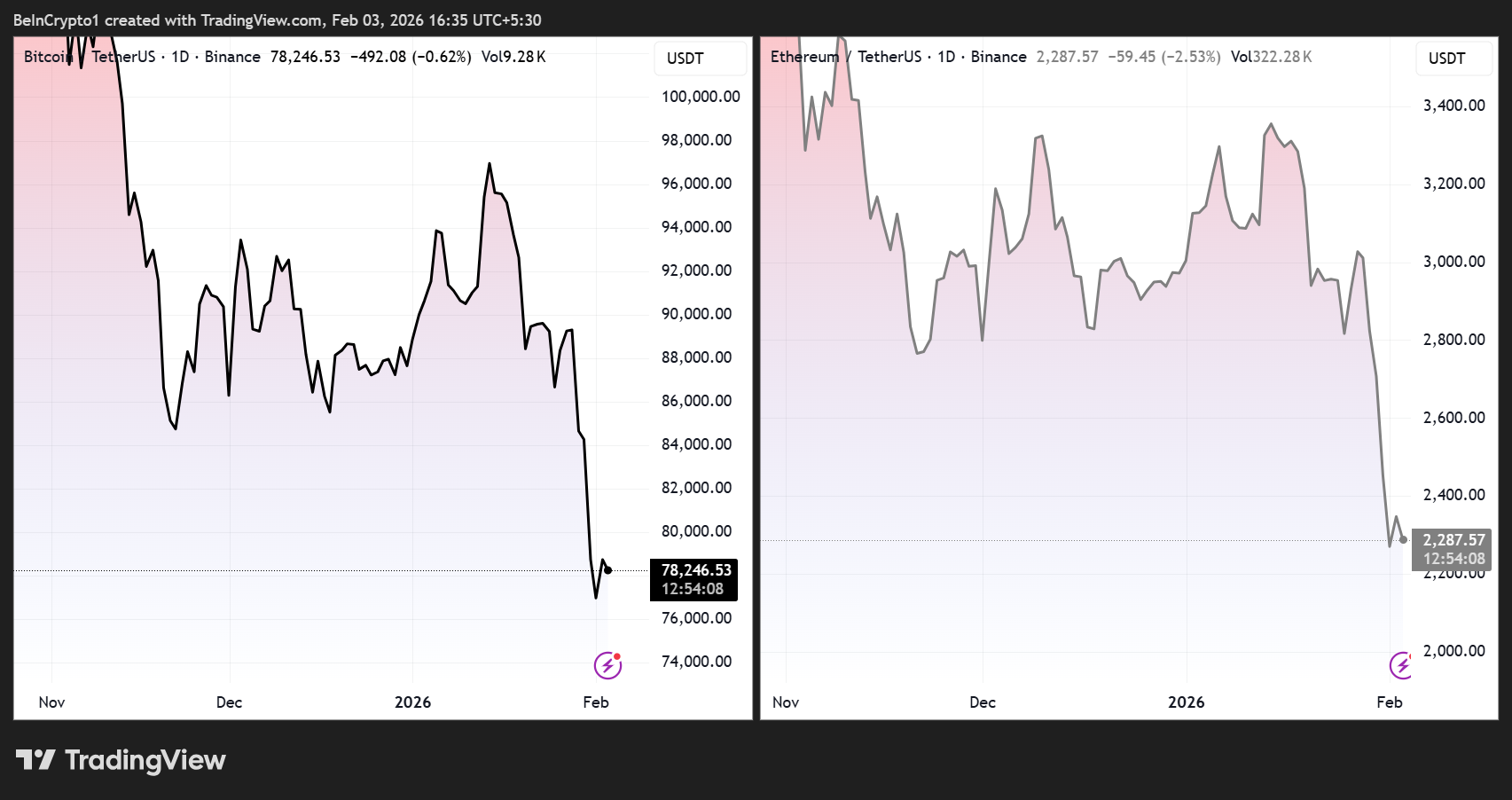
Despite near-term headwinds, Lee sees signals that crypto may be bottoming. Fundstrat advisor Tom DeMark believes “time and price” alignment has been reached, with Bitcoin back above $78,000 and Ethereum nearing $2,300.
Lee added that Ethereum’s active addresses are “going parabolic,” as Wall Street increasingly integrates digital assets.
“All the pieces are in place for crypto to be bottoming right now,” he said, contrasting price weakness with network activity.
This view aligns with analysts’ notes on potential capital rotation, with some highlighting gold’s 11% rebound from recent lows, adding $3.07 trillion, and silver’s 20% surge, reclaiming $800 billion.
Analyst Bull Theory compares this setup to August 2020, when gold topped at $2,075, Bitcoin fell 20%, then rallied 559% over eight months as capital flowed back into risk assets.
With the ISM Manufacturing Index at 52.6%, the analyst suggested a similar rotation may be underway:
“Gold likely topping, and Bitcoin already having corrected, we could now see a rotation into risk-on assets,” they said.
Sponsored
Sponsored
However, not all commentary is bullish. Analyst Wimar.X warns that the metals’ surge signals a “broken system,” echoing pre-crash conditions in 2000, 2007, and 2019.
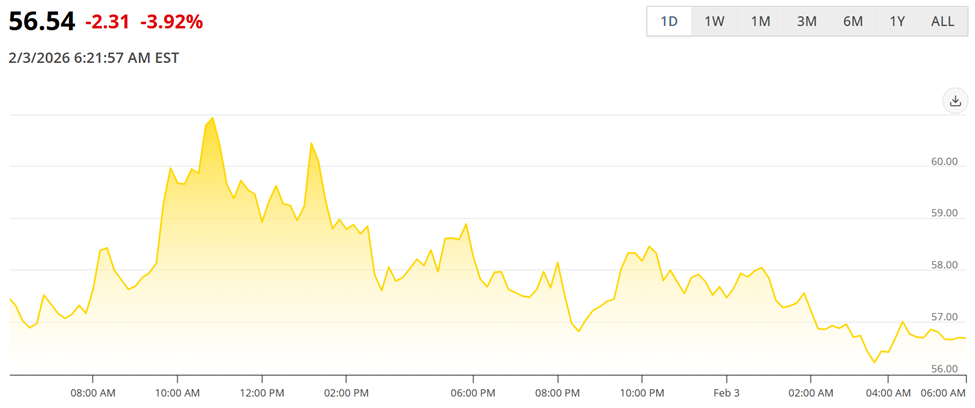
With the gold-to-silver ratio near 56, they argued that institutions are “exiting the casino,” potentially foreshadowing a 2026 collapse.
Lee, however, emphasized that the broader economic backdrop remains strong. Stocks were up 1% in January, historically correlating to 18% annual S&P gains in similar periods since 1950.
Even as AI and tech valuations may mean-revert, he sees precious metals taking a “breather” as healthy for markets, potentially clearing the way for crypto’s next move.
The question now is whether Washington-driven flows will continue to favor metals or if Bitcoin and Ethereum are ready for a rebound.
Chart of the Day
Sponsored
Sponsored
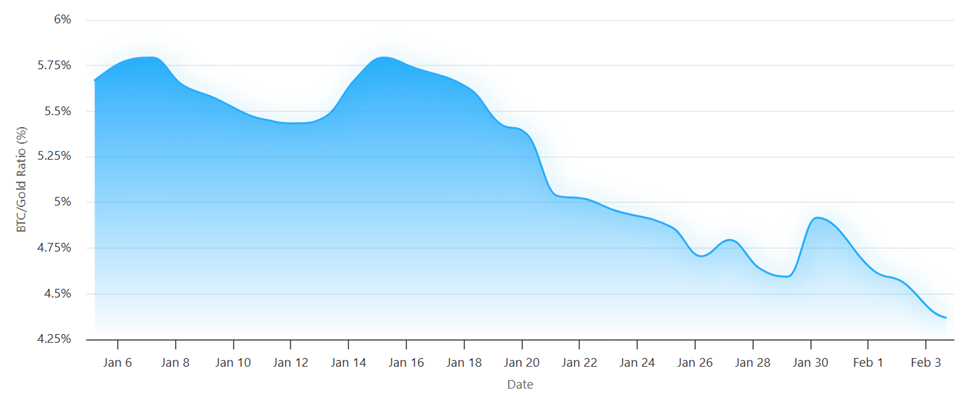
The Gold to Bitcoin dominance ratio compares the market cap of both assets.
Byte-Sized Alpha
Here’s a summary of more US crypto news to follow today:
Crypto Equities Pre-Market Overview
| Company | Close As of February 2 | Pre-Market Overview |
| Strategy (MSTR) | $139.66 | $140.80 (+0.82%) |
| Coinbase (COIN) | $187.86 | $189.53 (+0.89%) |
| Galaxy Digital Holdings (GLXY) | $26.44 | $26.95 (+1.93%) |
| MARA Holdings (MARA) | $9.12 | $9.18 (+0.66%) |
| Riot Platforms (RIOT) | $15.32 | $15.53 (+1.37%) |
| Core Scientific (CORZ) | $17.87 | $18.05 (+1.01%) |


TLDR
- SEC staff issued conditional guidance for crypto trading apps on April 13.
- Platforms must act as neutral tools and avoid executing or advising on trades.
- The framework requires clear fee structures and conflict disclosures.
- The staff position will expire in five years unless replaced.
- The SEC is advancing the proposed Reg Crypto framework under federal review.
U.S. Securities and Exchange Commission (SEC) has outlined conditions that allow certain crypto trading apps to operate without broker registration. The agency’s Division of Trading and Markets issued a staff statement on April 13. The guidance defines when platforms may function as neutral tools instead of regulated intermediaries.
SEC Defines Limits for Crypto Trading Apps Under Broker Rules
The SEC staff said “Covered User Interface Providers” may avoid broker-dealer registration if they act as neutral interfaces. They must not recommend trades or provide investment advice. They must not promote specific tokens or trading routes. Instead, they must rely on objective criteria such as price or speed when displaying options.
The staff also barred providers from executing trades or handling customer assets. They cannot negotiate transactions or structure deals on behalf of users. The statement said such activities would trigger broker status under federal securities law. Therefore, platforms must restrict their role to displaying information and routing user instructions.
The guidance requires consistent and transparent fees across assets and execution paths. Providers cannot adjust fees based on selected tokens or venues. If a platform maintains ties to a trading venue, it must disclose that relationship clearly. It must also treat affiliated and non-affiliated venues in a fair manner.
The staff imposed strict disclosure standards on covered providers. Platforms must disclose their non-registered status and explain how their systems function. They must outline fee models, conflicts of interest, and cybersecurity controls. They must also describe technical limits and risks tied to the interface.
The statement clarified that it reflects staff enforcement views, not binding law. However, it signals how the SEC may approach enforcement during the next five years. The framework will sunset after five years unless the agency replaces it. Until then, firms may rely on this conditional no-action position.
SEC Advances Reg Crypto Proposal for Token Offerings
The SEC is also advancing a broader “Reg Crypto” framework under Chair Paul Atkins. The proposal is currently under review by the Office of Information and Regulatory Affairs. It seeks to update rules governing token fundraising and decentralized finance activities.
Under the draft plan, early-stage crypto startups may receive limited exemptions. The framework would allow structured token offerings under the Securities Act of 1933. It would also create a safe harbor pathway for tokens that transition out of securities status. The SEC aims to clarify when digital assets no longer qualify as securities.
The proposal also calls for coordination with the Commodity Futures Trading Commission. The SEC plans to align oversight standards across agencies. The agency seeks to streamline compliance for token issuers and trading platforms. Officials have not yet released a final timeline for adoption.
Chair Atkins has stated that the agency wants clearer boundaries for digital asset markets. The SEC continues to review public input on the Reg Crypto framework. The proposal remains under federal review as of April 13. Further updates will follow once OIRA completes its assessment.



The Iran escalation threat that legal experts have called a potential war crime is back on the table Monday as Trump’s naval blockade goes live and his earlier threats to destroy Iran’s power plants, bridges, and water desalination facilities remain publicly unretracted, with oil markets already pricing in the worst-case scenario for civilian infrastructure strikes.
Summary
- Trump threatened in an expletive-laden April 5 Truth Social post to make “Tuesday Power Plant Day and Bridge Day” in Iran, warning that Iranians would be “living in Hell” if the Strait was not reopened by his deadline; the ceasefire announced April 7 temporarily shelved the threat, but the Islamabad collapse and Monday’s blockade have returned the escalation question to the center of the conflict.
- Legal experts told PBS that targeting power plants and bridges serving civilian populations constitutes “collective punishment” and an “indiscriminate attack” under the laws of war, which are binding on US military personnel regardless of presidential direction; Iran’s military command warned in response that any strikes on civilian targets would produce “much more devastating and widespread” retaliation.
- Iran’s water desalination infrastructure is not a theoretical target: Kuwait reported that Iranian drone attacks put one of its own water desalination stations offline during the conflict, demonstrating that both sides have already struck civilian-adjacent infrastructure and that the escalation risk runs in both directions.
As CNBC reported Monday, the blockade itself has already reignited market fears beyond just the oil price reaction, with analysts warning that Hormuz closure combined with infrastructure strikes could send Brent crude toward $150 per barrel. White House spokeswoman Karoline Leavitt told reporters the administration “will always act within the confines of the law,” without addressing the specific legal concerns raised about power plant and water infrastructure targeting. Annie Shiel, US Director at Center for Civilians in Conflict, called Trump’s earlier threats “appalling,” saying: “President Trump is threatening to destroy infrastructure that is essential for civilian survival.”
The threat creates a risk calculation for oil markets that goes beyond the current blockade price. A strike on Iranian power infrastructure would likely trigger retaliatory strikes on Gulf Arab energy facilities, several of which Iran has already targeted during the conflict, and would pull China, India, and allied nations more directly into the confrontation.
Power plant and bridge strikes inside Iran would represent a qualitative escalation beyond anything the US and Israel have struck so far in the conflict. Iranian power infrastructure is shared between military and civilian uses, which is precisely why legal experts say individual target-by-target analysis is required before any strike can be lawful under the laws of war. A blanket threat to take out all power plants, as Trump’s Truth Social post implied, would not meet that standard, according to retired Lieutenant Colonel Rachel VanLandingham, who called it a threat of “indiscriminate attack” on PBS.
What Iran Has Said It Would Do in Response
Iran’s central military command stated publicly that attacks on civilian targets would produce retaliation “much more devastating and widespread” than anything seen so far in the conflict. Iran still has functioning drone and missile capacity, Gulf Arab energy facilities remain within range, and Houthi forces in Yemen have the capability to resume attacks on Red Sea shipping through the Bab el-Mandeb Strait. Any combination of those responses would add a new energy supply shock on top of the Hormuz disruption already in the market.
Why Markets Are Watching the April 22 Ceasefire Expiry as the Key Trigger Date
The ceasefire that temporarily shelved the power plant threat expires April 22. If talks do not resume and the blockade intensifies without a diplomatic off-ramp, the infrastructure threat becomes the next available escalation lever. Markets have priced in conflict continuation but have not yet priced in bilateral civilian infrastructure strikes at scale. The gap between current oil pricing around $103 and the $150 estimate for a full blockade plus infrastructure escalation is the market risk that the coming nine days will either resolve or crystallize.
Key takeaways:
-
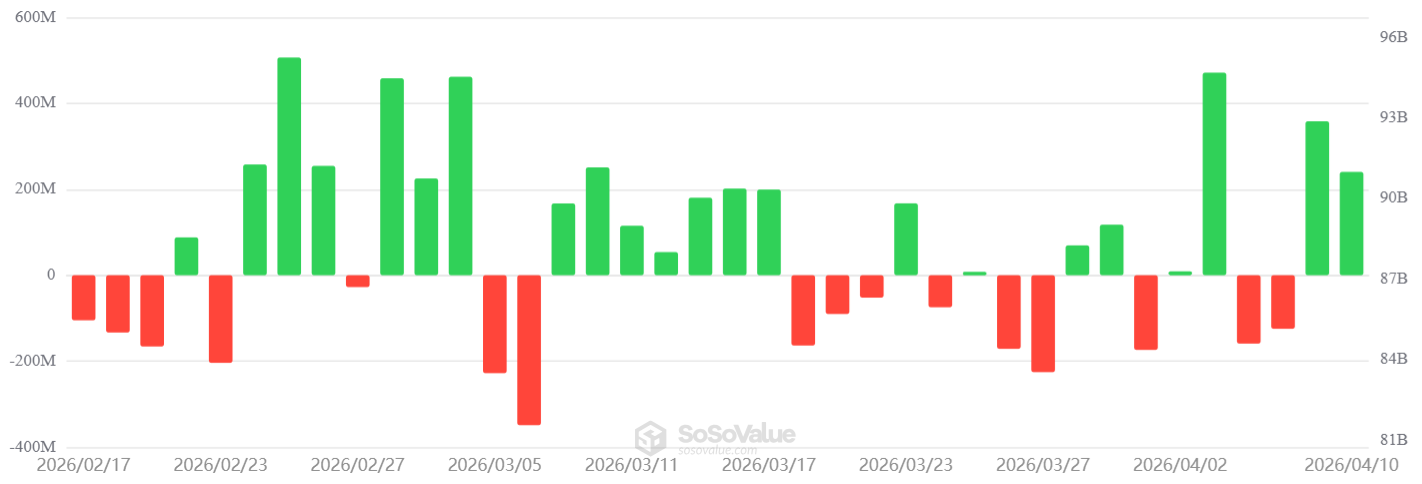
Despite strong ETF inflows, Bitcoin remains tied to the S&P 500 and sensitive to global macroeconomic developments.
-
Bitcoin futures premiums and miner selling suggest that the bear market persists despite Bitcoin trading above $74,000.
Bitcoin (BTC) reclaimed the $74,000 level on Monday following slight gains in the S&P 500 index after US President Donald Trump ordered a US blockade of the Strait of Hormuz. Traders appear to be gradually gaining confidence following strong net inflows into US-listed spot Bitcoin exchange-traded funds (ETFs) and continued accumulation by Strategy (MSTR US) but is the bear market over?

The US-listed spot Bitcoin ETFs accumulated $615 million in net inflows between Thursday and Friday, reversing the trend from the previous two days. In parallel, Strategy announced it had acquired 13,927 BTC over the past week. The $1 billion in purchases were funded through its yield-bearing instrument, Stretch (STRC US).

Despite growing demand from institutional investors, Bitcoin remains highly correlated with the S&P 500 and the broader macroeconomic movements of the US economy. Bitcoin dropped to $70,500 over the weekend after the failed US-Iran ceasefire negotiations. However, Brent crude oil prices eventually retreated to $99 on Monday, paving the way for gains in risk assets, including Bitcoin.
Bitcoin displayed strength at $74,000, but derivatives metrics have yet to flip bullish.

Bitcoin monthly futures traded at a 2% annualized premium relative to regular spot markets, indicating a lack of demand for bullish leverage. Under neutral conditions, the indicator should hold between 4% and 8% to compensate for the cost of capital. Regardless of performance over the past couple of weeks, Bitcoin is down 18% in 2026, while the S&P 500 remains relatively flat year-to-date.
Regulatory clarity may back Bitcoin’s rally
While it is impossible to pinpoint the rationale for the sharp Bitcoin correction in late January, the lack of support from US lawmakers regarding the regulatory landscape likely played an important role. US Senator Cynthia Lummis has urged her colleagues to approve the CLARITY Act, which could define how stablecoin issuers operate and establish thresholds for tokens to be deemed decentralized.
The bill is currently facing a critical window in the Senate Banking Committee. Major exchanges have recently voiced concerns about late-stage additions to decentralized finance (DeFi) restrictions and the exact scope of tokenized assets. US Securities and Exchange Commission (SEC) Chairman Paul Atkins has also stated that “it is time” for Congress to advance with the regulation.

USD stablecoins traded at a 0.4% discount to the official US dollar-to-yuan exchange rate on Monday, a typical sign of excessive demand to exit cryptocurrency markets. Balanced demand usually results in a 0.5% to 1.5% premium to compensate for the costs of traditional FX remittance and the regulatory friction caused by China’s capital controls.
Related: How Bitcoin and gold reacted differently to the Iran war shock
Bitcoin miners’ sell pressure, US macroeconomic uncertainty
Given the strong correlation with traditional markets and weak derivatives metrics, there is no basis to claim that Bitcoin’s bear market is over based solely on ETF inflows and accumulation from a handful of companies, especially as publicly listed miners have recently reduced their positions.
MARA Holdings (MARA US) sold 15,133 BTC, while Riot Platforms (RIOT US) reduced its exposure by 2,325 BTC and Cango (CANG US) sold 2,000 BTC in the past 30 days.
For now, Bitcoin’s path to $80,000 is largely dependent on a more favorable risk perception, although short-term momentum relies mostly on the status of the US and Israel-Iran War.
This article is produced in accordance with Cointelegraph’s Editorial Policy and is intended for informational purposes only. It does not constitute investment advice or recommendations. All investments and trades carry risk; readers are encouraged to conduct independent research before making any decisions. Cointelegraph makes no guarantees regarding the accuracy or completeness of the information presented, including forward-looking statements, and will not be liable for any loss or damage arising from reliance on this content.
Crypto World
China exports miss estimates in March, imports post best growth in more than four years

A cargo ship loaded with foreign trade containers sails towards the open sea in Jiaozhou Bay, Qingdao, Shandong, China, on April 13, 2026.
Costfoto | Nurphoto | Getty Images
China’s export growth slowed in March as manufacturers grappled with surging commodity and energy costs due to the Middle East conflict disrupting supplies, while imports logged the strongest growth in more than four years.
Exports grew at their slowest pace in six months at 2.5% in U.S. dollar terms last month from a year earlier, Chinese customs data showed Wednesday, missing Reuters-polled analysts’ median estimate for a 8.6% growth, and weakening from the combined 21.8% surge in the first two months of the year.
Imports surged 27.8% in March from a year ago, marking the strongest growth since November 2021, sharply beating expectations for a 11.2% growth, and quickening from 19.8% in the prior two months.
China releases combined trade data for January and February due to fluctuations around the Lunar New Year, the country’s biggest holiday, which follows the agrarian calendar.
The world’s second-largest economy has remained reliant on trade for its growth despite rising tensions with the U.S. and higher tariffs. Net exports accounted for about a third of China’s economy last year.
While Beijing’s strategic oil stockpiles, a diversified energy mix, and tight price controls have cushioned the blow from surging oil prices, the export-reliant economy remains vulnerable to a global economic downturn resulting from a prolonged closure of the Strait of Hormuz.
In a press briefing on Tuesday, Wang Jun, China’s customs vice minister, said that global oil prices have experienced “fierce fluctuation,” creating a “complex and severe” trade environment.
Higher commodity and energy prices stemming from the conflict have started feeding into Chinese manufacturers’ input costs, threatening to weigh on firms’ already thin margins. Factory-gate prices in the country rose by 0.5% in March, climbing for the first time in more than three years.
However, the consumer price index rose by a slower-than-expected 1% from a year ago, as domestic demand remained under pressure.
The country is due to report its first-quarter gross domestic product on Thursday. Analysts polled by Reuters estimate a 4.8% increase, compared to a 3-year low of 4.5% in the fourth quarter of 2025.
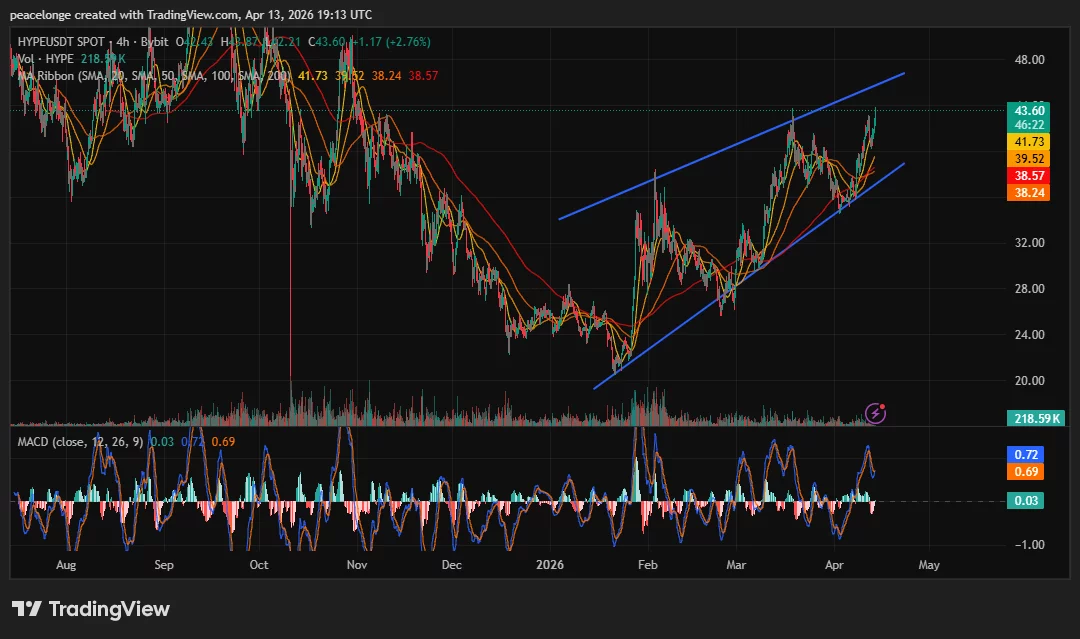
Hyperliquid is trading at $43.60 on April 13, up 2.76% on the 4H session, after printing a high of $46.22 that marks the upper boundary of an ascending channel built from the December 2025 lows near $22. The 4H MACD histogram has compressed to just 0.03, raising the question of whether momentum can sustain a breakout above channel resistance or whether a pullback toward mid-channel support is the more likely outcome.
Summary
- Hyperliquid price is trading at $43.60 on April 13, up 2.76%, after a session high of $46.22 aligning precisely with the upper boundary of a 4H ascending channel from December 2025.
- The MACD (12,26,9) shows the MACD line at 0.72, signal at 0.69, and histogram at just 0.03, indicating momentum is thinning significantly at channel resistance while all four SMAs remain bullishly stacked below price.
- A confirmed 4H close above $46.22 targets the $50 psychological level; a rejection at the upper channel risks a pullback to the SMA 20 at $41.73, with the $38 to $39 SMA cluster as the structural floor.
Hyperliquid (HYPE) price is trading at $43.60 on April 13, up 2.76% on the 4H chart, as a clear ascending channel from the December 2025 lows near $22 carries price into contact with the upper boundary at the $46.22 session high. The MA ribbon is bullishly arranged: SMA 20 at $41.73, SMA 50 at $39.52, SMA 100 at $38.57, and SMA 200 at $38.24 are all stacked below current price. The 4H MACD histogram reading of 0.03 suggests the channel advance is losing upside velocity precisely as it meets its most significant resistance since the channel formed.
The 4H chart shows Hyperliquid tracing a defined ascending channel across roughly four months, with two parallel upward-sloping trendlines connecting the December 2025 base near $22 to the current upper boundary near $46.22. Each retest of the lower channel trendline produced a recovery, and price has printed successive higher lows that have remained above the full SMA ribbon throughout the advance.
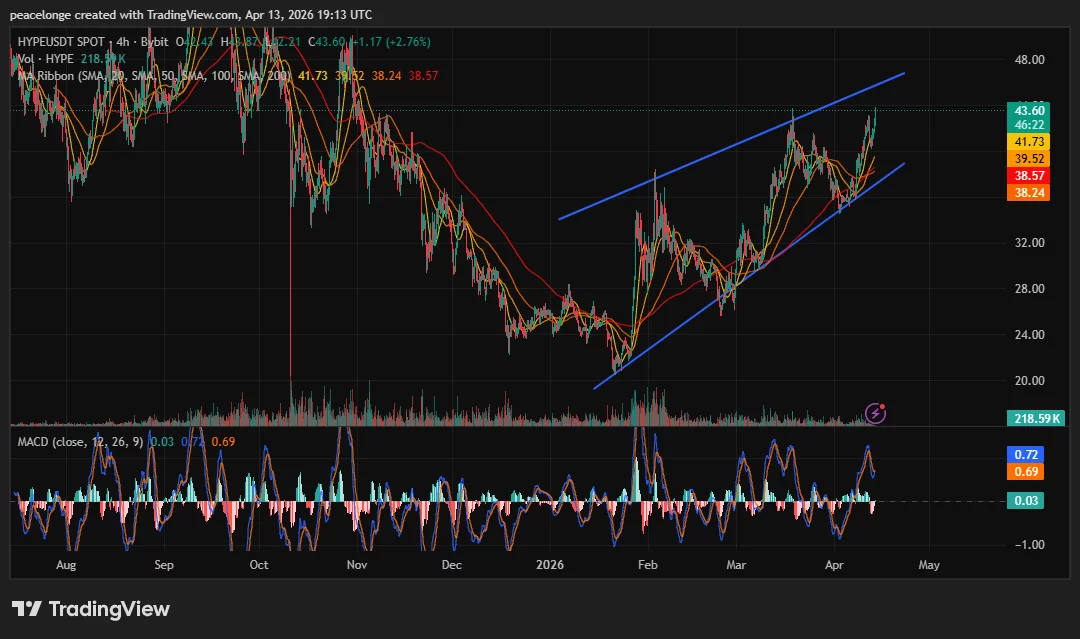
The MACD (12,26,9) signals caution at the current level: the MACD line at 0.72 is barely above the signal at 0.69, producing a histogram of just 0.03. This is a sharp deceleration from the momentum readings that drove the channel advance through March and early April. A histogram this close to zero at a known resistance level can precede either a brief consolidation before a breakout, or a rejection back toward mid-channel support. The bullish flag breakout confirmed on April 8 at $39.50 with a target of $44 has now been achieved, placing price at the next structural test.
Arthur Hayes stated publicly that he projects Hyperliquid could reach $150 by August 2026, citing the platform’s real revenue generation and its ability to take market share from centralized exchanges. Hyperliquid currently holds approximately 40% of total decentralized perpetual trading volume globally.
Key Levels: Support, Resistance, and Price Targets
The immediate resistance is $46.22, the 4H session high and upper channel trendline. A confirmed 4H close above it confirms a channel breakout and opens $50 as the first major target. An extended move above $50 brings the September 2025 all-time high at $59.30 into the medium-term picture.
On the downside, the SMA 20 at $41.73 is the first dynamic support. A 4H close below it brings the SMA 50 at $39.52 into focus alongside the SMA 100 at $38.57 and SMA 200 at $38.24, which together form a dense support cluster between $38 and $39. This zone also aligns with the lower boundary of the ascending channel, making it the critical structural defense for the bull case.
Invalidation: a daily close below $38.24 confirms a channel breakdown and shifts the near-term bias bearish.
On-Chain and Market Data Context
Hyperliquid open interest stands at approximately $1.53 billion per Coinglass data, reflecting sustained derivatives participation. Futures volume over the past 24 hours reached approximately $715 million, consistent with the elevated activity the platform has maintained since HIP-3 expanded its offering to include gold, silver, and crude oil perpetuals. Tokenized assets now represent 33% of total weekly trading volume on Hyperliquid, a record share per Blockworks data, with the protocol’s Assistance Fund directing up to 97% of trading fees into HYPE buybacks.
High Stakes Capital fully exited a 602,421 HYPE position worth $22.9 million near $38, a level now sitting at the SMA cluster and lower channel boundary. The proximity of that whale exit to the current support zone adds structural significance to the $38 to $39 zone as a key floor beneath the ascending channel.
If Hyperliquid secures a 4H close above $46.22, $50 is the immediate target. A rejection at the upper channel with continued MACD compression points to a pullback toward the SMA 20 at $41.73, with the $38 to $39 cluster as the level that must hold for the ascending channel structure to remain intact.
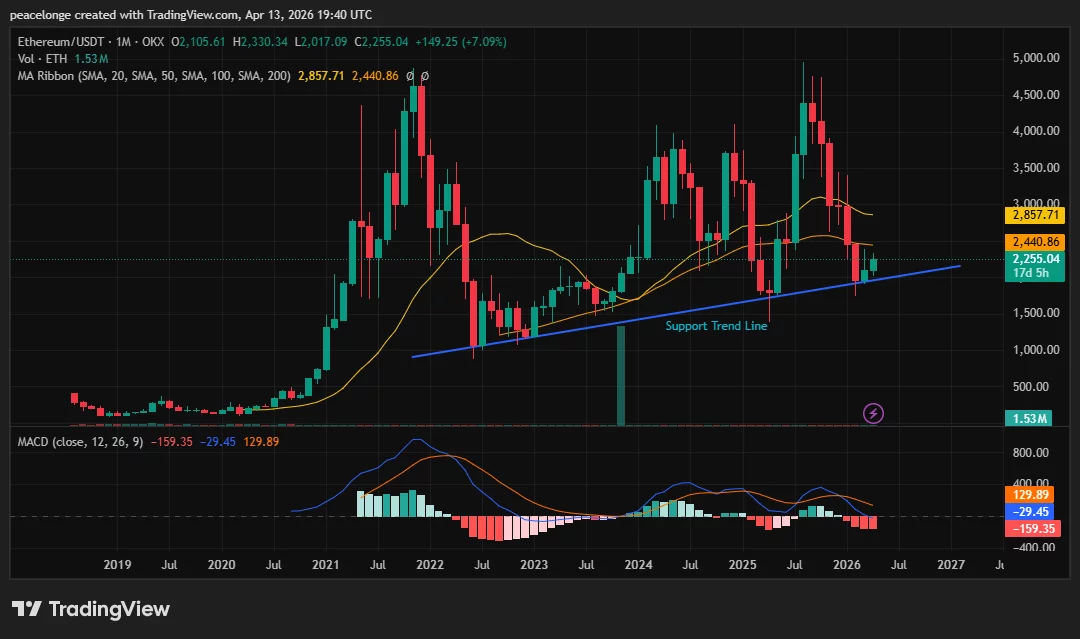
Ethereum is trading at $2,255.04 in April 2026, up 7.09% on the monthly chart, after the $2,017.09 monthly low tested and held the ascending support trendline connecting Ethereum’s major lows since 2019. The monthly MACD histogram has turned positive at 129.89, marking the first constructive macro momentum signal since the late 2025 decline from the $4,800 peak.
Summary
- Ethereum price is at $2,255.04 in April 2026, up 7.09% on the monthly chart, after the $2,017.09 monthly low tested the ascending support trendline visible on the OKX monthly chart since 2019.
- The monthly MACD (12,26,9) histogram reads a positive 129.89, with the MACD line at -29.45 trading above the signal at -159.35, confirming improving macro momentum at the trendline test.
- The immediate bull case targets the SMA 50 at $2,440.86; a monthly close below $2,017 breaks the trendline and exposes $1,500 as the next structural reference.
Ethereum (ETH) price is at $2,255.04 in April 2026, up 7.09% on the monthly close, after the monthly low of $2,017.09 tested and held the ascending support trendline annotated on the chart connecting Ethereum’s lows from the 2019 base through the current cycle. Both SMAs remain overhead: the SMA 50 at $2,440.86 is the nearest resistance and the SMA 20 at $2,857.71 is further above. The April monthly candle is printing a long lower wick at the trendline, a candlestick structure that historically signals demand absorption at a structurally significant level.
The ascending support trendline on the monthly chart connects Ethereum’s bear market lows in 2019, the 2020 pre-rally base, and the 2022 cycle bottom, making this the deepest and most tested structural level on Ethereum’s price history. The $2,017.09 monthly wick is the most significant test of that trendline in the current correction, and it has held without a monthly close below it. Price has since recovered to the $2,255 area, forming a positive monthly body above the trendline.
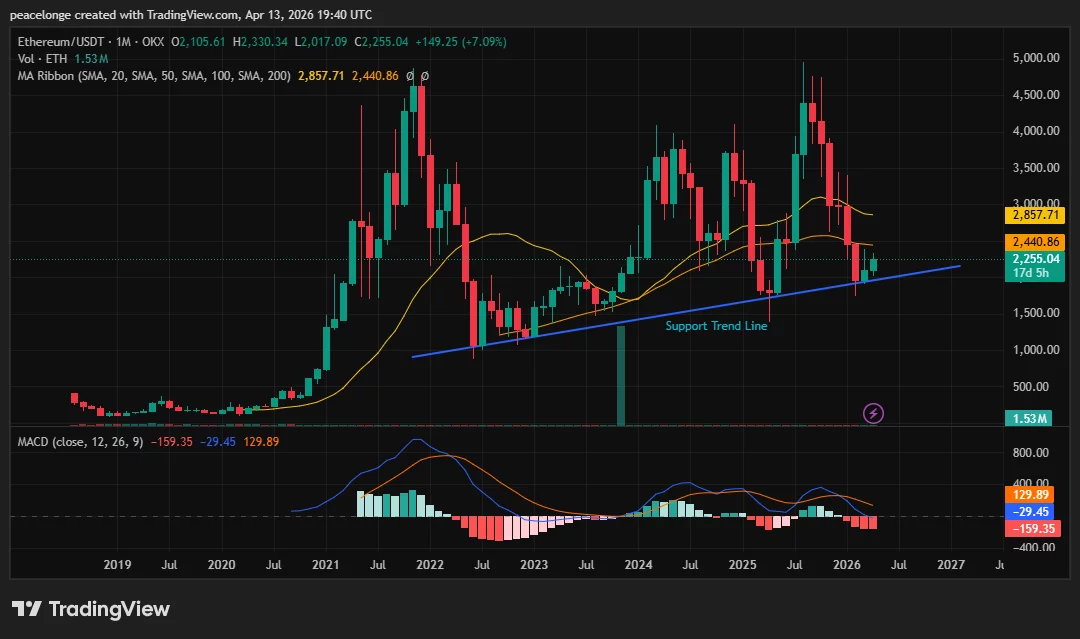
The monthly MACD (12,26,9) provides the critical secondary signal. The MACD line at -29.45 is now 129.89 points above the signal at -159.35, producing a positive histogram. While both lines remain in negative territory, indicating the macro trend has not reversed, a histogram turning positive at a multiyear trendline test is consistent with momentum inflecting before price does on the longer timeframe. This is the first positive monthly histogram reading since Ethereum’s descent accelerated from its August 2025 high near $4,800.
Crypto analyst Leshka wrote on X that ETH “will 3x-4x in the next six months,” pointing to a supply squeeze developing on centralized exchanges as evidence of a structural base forming at the trendline level, a view that gains more technical grounding with the monthly MACD now confirming improving momentum.
Key Levels: Support, Resistance, and Price Targets
The multiyear ascending trendline, currently intersecting around $2,000 to $2,100, is the structural floor on a monthly closing basis. The $2,017.09 monthly low is the concrete level to hold: a monthly close below it breaks the trendline and exposes $1,500, which aligns with the 2023 accumulation zone and represents the last major demand area before untested territory.
On the upside, the SMA 50 at $2,440.86 is the immediate recovery target. A monthly close above it shifts the SMA ribbon from fully bearish and begins reclaiming the moving average structure. The SMA 20 at $2,857.71 is the extended objective and represents a return toward where both SMAs converged before the 2025 breakdown.
Invalidation: a monthly close below $2,017.
On-Chain and Market Data Context
Perpetual futures on Ethereum showed a slightly positive funding rate as of April 12, indicating measured but persistent long-side demand is returning. The Ethereum Foundation staked 45,000 ETH on April 5, nearing a target of 70,000 ETH, reducing immediate circulating sell pressure while generating an estimated $3.9 to $5.4 million annually in yield. Whales withdrew over 120,000 ETH from centralized exchanges in early March, the largest outflow since October 2025, per CryptoQuant contributor Arab Chain, a pattern consistent with accumulation near structural support.
Upgrade Pipeline Provides Forward Catalyst
Ethereum’s Glamsterdam upgrade, scheduled for H1 2026, targets a significant increase in the gas limit, parallel transaction execution, and enshrined proposer-builder separation. The upgrade continues the scalability work started by the Fusaka hard fork and is expected to materially reduce Layer-2 transaction costs, strengthening the fundamental case for ETH at current prices.
If Ethereum holds the multiyear trendline on a monthly close basis and the MACD histogram continues to expand, the SMA 50 at $2,440 is the first recovery target, with the SMA 20 at $2,857 as the extended bull case. A monthly close below $2,017 breaks the trendline and shifts the macro structure bearish.
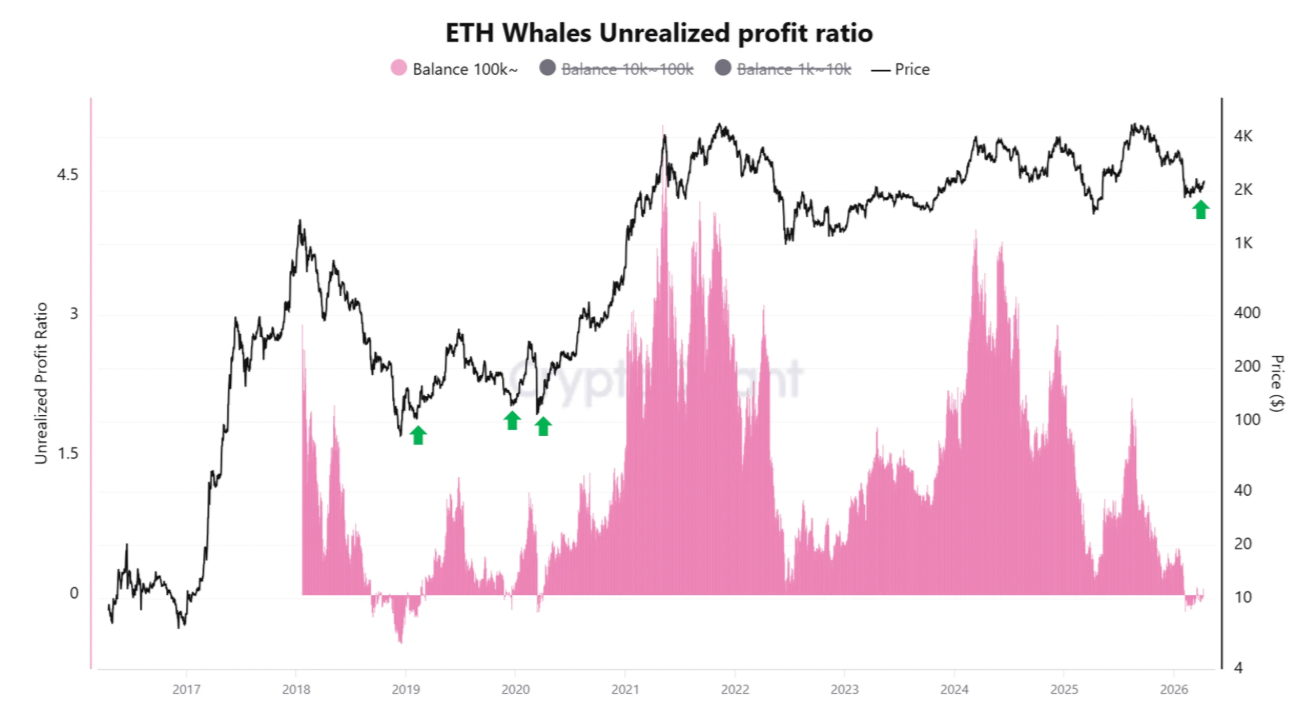
Ether’s (ETH) rebound to $2,300 over the weekend put large investors back into profit but is this a sign that ETH may rally to $3,000?
Data from TradingView shows that Ether’s price rose 20% to $2,330 on Saturday from its local low of $1,940 reached on March 29.
The recovery was fueled by the US and Iran’s announcement of a two-week ceasefire and a strengthening market structure. The rebound has also pushed ETH whales into profitability, according to data from CryptoQuant.
ETH whales’ unrealized profit ratio reveals that wallets holding over 100,000 ETH are “profitable state again,” CryptoQuant analyst CW8900 said in a Quicktake note on Monday, adding:
“In the history of $ETH, every point where they turned from loss to profit was at the rally start point.”

ETH investors double down on buying
The shift in whale profitability shows accumulation at lower levels, signaling long-term investor confidence.
Data from CryptoQuant shows that ETH accumulation began in late 2025 and has proceeded more aggressively throughout 2026.
Accumulation addresses are wallets that continuously receive ETH without making any outgoing transactions. They may belong to long-term holders, institutional investors, or entities strategically accumulating Ether rather than actively trading it.

As a result, the total ETH held by these long-term holders reached a record 26.3 million. That marks a 32% jump in 2026 despite ETH price declining by 25% over the same period.

Large spikes in inflows to these addresses often signal strong confidence in Ether’s long-term potential, with past trends showing that such surges frequently precede price rallies.
For example, on June 22, 2025, Ethereum accumulation addresses recorded a then-all-time high daily inflow of over 380 million ETH. Nearly 30 days later, ETH price rallied by almost 85%. A similar price increase succeeded November 2025’s inflow spike into the accumulation addresses.
Ether’s technical set-up points to $3,000
Ether’s price action has formed a rounded bottom chart pattern on the 12-hour chart. The price is retesting the $2,140 support, where the chart’s support line and the 20-day exponential moving average (EMA) converge.
Bulls will now attempt to push ETH/USD above the neckline of the governing chart pattern at $2,400, paving the way toward the measured target at $2,940, 32% above the current price.

The daily relative strength index (RSI) has risen to 57 from near-oversold levels at 36, suggesting ETH bulls are returning to the market.
However, Ether’s cost basis distribution data shows that investors hold about 7.6 million ETH at an average cost of between $2,750 and $2,850, creating a potential resistance zone. This concentration suggests that many investors may sell at breakeven, potentially stalling Ether’s upward momentum.

“Ethereum is heading, in my opinion, toward its next major resistance at $2,800,” said analyst TagadoBTC in a recent X post, adding:
“The $2,000 zone remains the one to hold, otherwise we risk falling back to the bottom of the channel.”

As Cointelegraph reported, Ether’s potential for a rally will improve once the altcoin breaks above the $2,400 resistance level. If that happens, the ETH/USDT pair may surge to $2,800.
This article is produced in accordance with Cointelegraph’s Editorial Policy and is intended for informational purposes only. It does not constitute investment advice or recommendations. All investments and trades carry risk; readers are encouraged to conduct independent research before making any decisions. Cointelegraph makes no guarantees regarding the accuracy or completeness of the information presented, including forward-looking statements, and will not be liable for any loss or damage arising from reliance on this content.
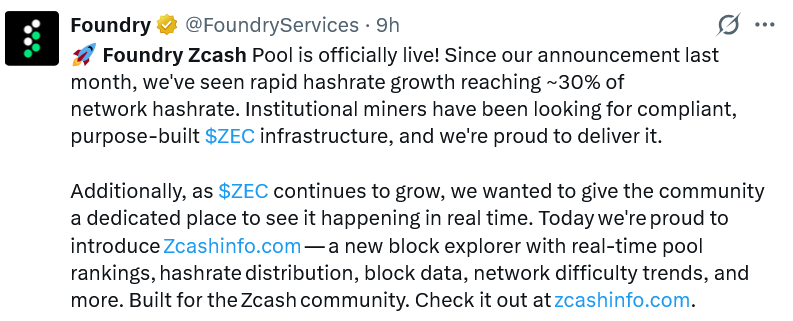
Crypto mining pool operator Foundry Digital has launched a pool for the privacy-focused cryptocurrency Zcash, which the company says has secured nearly 30% of the Zcash network hashrate through partnerships with multiple institutional mining clients.
“Institutional and public miners are seeking a compliant, purpose-built Zcash mining solution,” Foundry said on Monday, a month after announcing its plan to create the Foundry Zcash Pool.

Foundry, which is also the largest mining pool on the Bitcoin blockchain, did not disclose which institutional miners it had onboarded to reach a 29.2% hashrate share.
Mining pools secure proof-of-work blockchains by pooling computing power from commercial miners and others to share rewards proportionally with the aim of reducing variance.
Foundry added that it launched a Zcash block explorer, which shows that the Foundry Zcash Pool has mined 2,344 blocks since it launched earlier this month.
Zcash blocks are mined roughly every 75 seconds, paying a block subsidy of 1.25 Zcash (ZEC) tokens in reward for solving blocks, which equates to about $458 at current market prices.
While Foundry said it launched the Foundry Zcash Pool earlier this month, Zcashinfo.com data suggests that it started accumulating hashrate on or around March 4, about a week before it was first announced.
Foundry’s rise in hashrate share has cut into ViaBTC’s dominance, which has fallen from 68.1% on Feb. 27 to 37% at the time of writing.

Related: Dash Evolution chain integrates Zcash Orchard privacy pool
Crypto exchange Coinbase flagged ViaBTC’s hashrate dominance as a security risk to the network in September 2023.
ZEC has been one of the better-performing cryptocurrencies over the last year, rising 1,050%, including a 77.2% rally over the last month following Foundry’s initial announcement.
It is now the fifth-largest proof-of-work token at $6.2 billion market cap, trailing Bitcoin (BTC), Dogecoin (DOGE), Bitcoin Cash (BCH) and competitor privacy coin Monero (XMR).
Magazine: 2026 is the year of pragmatic privacy in crypto: Canton, Zcash and more


StarkWare is restructuring into two business units and cutting staff as it pivots from scaling Ethereum toward building revenue-generating products of its own — a shift forced by a more than 99% collapse in revenue on its flagship Starknet network.
The changes were outlined during a company-wide town hall hosted by CEO Eli Ben-Sasson, where he told employees StarkWare would restructure into two independent units and focus on building revenue-generating products in-house. A transcript of the address to staff was reviewed by CoinDesk.
Starknet chain revenue, which peaked near $6 million in a single month in late 2023, stood at roughly $48,000 through the first half of April 2026, according to DefiLlama data. The decline is partly industry-wide, with Starknet’s competitors equally impacted, as Ethereum’s EIP-4844 upgrade in March 2024 slashed Layer 2 fee revenue across the board.
Total Value Locked (TVL), however, remains above $200 million.
Ben-Sasson told employees the company now needs to “take our technological superiority… and convert it into meaningful revenue, meaningful usage,” signaling a shift away from a pure infrastructure focus toward building products that can drive demand directly.
He added that StarkWare would prioritize building “things that can be done by no other team, in no other way,” focusing resources on products with “immense potential revenue” rather than broad experimentation.
“I started in this field in 2013, almost 13 years ago, and I’ve seen quite a number of winters,” Ben-Sasson said at the town hall. “I think what marks this winter is that there’s a very clear vacuum in leadership across blockchain, and it affects even things like Bitcoin and Ethereum.”
The company will spin up a new revenue-focused Applications unit led by researcher Avihu Levy.
Levy’s promotion comes days after he published a paper outlining Quantum Safe Bitcoin, or QSB, a method for making bitcoin transactions resistant to quantum attacks without requiring changes to the protocol.
The approach replaces traditional signature schemes with hash-based proofs but comes with significant tradeoffs, requiring extensive off-chain computation and costing an estimated $75 to $200 per transaction, versus roughly $0.33 for a standard bitcoin payment.
QSB offers an alternative to BIP-360, a long-pending proposal to add quantum resistance to Bitcoin at the protocol level that was merged to Bitcoin’s improvement proposal repository in February but could take years to activate.
Ben-Sasson did not name Bitcoin or quantum safety as the Applications unit’s target, saying only that StarkWare would focus on products “that cannot be done by any of our competitors” and build with “minimal dependencies on external L1s or external application teams.”
More details, he told staff, would come next week.
A spokesperson for StarkWare declined a request to comment.


The Bank of Korea is pushing to install stock-market-style circuit breakers on the country’s cryptocurrency exchanges, a proposal that would bring crypto under the same trade-halting rules used by the Korea Exchange.
The recommendation appears in the central bank’s annual Payment and Settlement Systems Report, published April 13, and calls for automatic halts when crypto prices swing sharply or abnormal orders hit the book. The central bank said the rules should be folded into the pending Digital Asset Basic Act.
The catalyst for the policy suggestion comes from an incident at Bithumb in February when an employee running a promotion entered the reward unit as “BTC” instead of “KRW,” distributing roughly 60 trillion won ($43 billion) in phantom bitcoin before supervisors caught the error 20 minutes later. Panic selling crashed BTC on Bithumb by a 17% drop while the token continued to trade at market prices on other venues.
Upbit, Bithumb and Korea’s three other licensed exchanges already run high-speed matching engines with price collars and fat-finger checks built in. CME Group runs a similar system on bitcoin futures, halting trading for two minutes when prices move 10% inside a 60-minute window.
The harder question is whether halts would work, given the global nature of BTC trading. If Upbit paused for 20 minutes, bitcoin would keep trading on Binance, Coinbase and dozens of others — and Upbit’s price would snap to wherever global markets moved when it reopened.
Circuit breakers are a familiar tool from traditional finance, a visible signal that markets are being brought under control. But crypto does not have a single venue to stop, and the problems regulators are trying to solve do not neatly map to price volatility.

Candidates Chess: Is joint-leader Vaishali ready for final push? | Chess News

Brooke Hogan Speaks About Dad Hulk Hogan’s Death
SEC Issues Framework for Crypto Trading Apps and Brokers


-

 Politics3 days ago
US brings back mandatory military draft registration
-
 Sports3 days ago
Man United discover Nico Schlotterbeck transfer fee as defender reaches Dortmund agreement
-

 Fashion3 days ago
Weekend Open Thread: Veronica Beard
-

 Tech6 days ago
How Long Can You Drive With Expired Registration? What Florida Law Says
-

 Politics2 days ago
World Cup exit makes Italy enter crisis mode
-

 Crypto World5 days ago
Canary Capital Files SEC Registration for PEPE ETF
-

 Business3 days ago
Tesla Model Y Tops China Auto Sales in March 2026 With 39,827 Registrations, Beating Cheaper EVs and Gas Cars
-

 Politics4 days ago
Malcolm In The Middle OG Turned Down ‘Buckets Of Money’ To Appear In Reboot
-

 Crypto World6 days ago
Bitcoin recovers as US and Iran Agree a Ceasefire Deal
-

 Fashion6 days ago
Let’s Discuss: DEI in 2026
-
 NewsBeat1 day ago
Pep Guardiola and Gary Neville agree over Arsenal title problem that benefits Man City
-

 Crypto World9 hours ago
The SEC Conditionalises DeFi Platforms to Be Avoided for Broker Registration
-

 Business4 days ago
OpenAI Halts Stargate UK Data Centre Project Over Energy Costs and Copyright Row
-

 Business2 days ago
Ireland Fuel Protests Enter Day 5 as Blockades Spark Shortages and Government Prepares Support Package
-

 Politics4 days ago
LBC Presenter Mocks Trump Over Iran War Failures
-

 Crypto World3 days ago
Federal judge blocks Arizona from bringing criminal charges against Kalshi
-

 Tech4 days ago
A version of Windows 10 released a decade ago is now eligible for additional security patches
-

 Crypto World6 hours ago
SEC Signals Exemption for Crypto Interfaces From Broker Registration
-
 NewsBeat2 days ago
JD Vance announces ‘no agreement’ with Iran over nuclear weapons fear
-

 Business3 days ago
IMF retains floor for precautionary balances at SDR 20 billion
You must be logged in to post a comment Login