
Crypto World
TON’s Weekly Gains Reach Triple Digits as BTC Rebounds From $81K: Market Watch

Bitcoin’s price ascent that began after the FOMC meeting last week drove the asset to a multi-month peak at almost $83,000 before it was stopped and pushed south by a couple of grand.
Most larger-cap alts have declined by up to 3-4% over the past day, except BNB, SOL, and ADA.
BTC Finds Support at $81K
As mentioned above, BTC’s price slipped below $75,000 last Wednesday after the completion of the third FOMC meeting for the year, in which the US Federal Reserve kept the interest rates unchanged. Although this decision was highly anticipated, it still brought some volatility to the market.
However, the following few days were a lot more positive for bitcoin, which jumped to almost $79,000 on Friday after the first peace proposal was sent from Tehran to Washington. It was rejected, and so was the second one on Sunday, but BTC still remained above $78,000.
The bulls initiated a more impressive leg up on Monday morning, driving the cryptocurrency to a three-month peak at just over $80,000. Although BTC was stopped there at first, its run resumed on Tuesday and Wednesday, driving it to another local peak at almost $83,000.
After gaining $8,000 in a week, BTC was due for a correction, which took place in the following hours. It dipped to $80,800, where it found support and now sits above $81,500.
Its market cap is up to $1.635 trillion, while its dominance over the alts remains above 58.5% on CG.

TON Keeps Rocking
While some regarded Pavel Durov’s announcement as a rise toward centralization, the reality is that Toncoin’s TON exploded after Telegram said it would replace the TON Foundation as the largest validator and reduce the fees by up to six times. TON has soared by another 30% in the past 24 hours, bringing its weekly gains to over 120% as of press time.
The other double-digit gainers over the past day include VIRTUAL, SIREN, VVV, NEAR, and ICP. BNB, SOL, and ADA have posted more modest increases, while ETH, XRP, DOGE, HYPE, BCH, and ZEC have lost some traction.
The total crypto market cap has remained inches below $2.8 trillion on CG.

The post TON’s Weekly Gains Reach Triple Digits as BTC Rebounds From $81K: Market Watch appeared first on CryptoPotato.

Crypto World
Bitcoin Operates Outside the Regulatory System: Arthur Hayes Take on Crypto and Clarity Act

Arthur Hayes told Consensus 2026 that the Clarity Act fundamentally misunderstands what Bitcoin is, and any attempt to fold it into a federal regulatory framework destroys the only thing that makes it valuable.
The argument landed while BTC traded above $82,000, with institutional ETF inflows accelerating, suggesting the market and the ideology are currently pointing in opposite directions.

Arthur Hayes Opinions Matter
Hayes argues that Bitcoin’s value derives from operating outside any regulatory apparatus, and he also noted that legislation like the Clarity Act doesn’t clarify anything .
“This is the value that bitcoin provides outside of the regulatory apparatus,” Hayes told the audience. “It’s precisely the reason that it does not adhere to the regulatory regime that some of you wish to put it under with bills like the Clarity Act and other things.”
On price, Hayes kept it equally blunt. “If you want to talk about the price of bitcoin and what the fair value is, all that matters is how many units of fiat there are today.” His year-end BTC target sits at $125,000, tied entirely to global monetary expansion, not legislative outcomes. Regulation, in his framework, is simply irrelevant to the price calculation.
LATEST: — CoinMarketCap (@CoinMarketCap) May 6, 2026
 Arthur Hayes told Consensus Miami 2026 that fiat money creation, not politics or regulation, is the only driver of Bitcoin's price. pic.twitter.com/AD94CtJwtO
Hayes went further, arguing that enthusiasm for the Clarity Act inside the industry reflects the interests of centralized incumbents with Washington lobbying operations, not the decentralized ecosystem Bitcoin was built to circumvent. “People who own centralized companies want regulation because it benefits their business,” he said. In Hayes’s view, the DeFi ecosystem and privacy-focused infrastructure get nothing from this bill except a federal licensing framework they cannot technically comply with.
“People who own centralized companies want regulation because it benefits their business.”
His position stands in direct contrast to the dominant tone at Consensus 2026. Ripple CEO Brad Garlinghouse has been lobbying aggressively for the Senate to advance the legislation before the May 21 Memorial Day recess.
Discover: The best crypto to diversify your portfolio with
Does the Bitcoin Agree With Hayes?
Bitcoin climbed 8% in a week to $82,600 following Hayes’s remarks at Consensus Miami 2026, extending a run that has kept BTC above $80,000 through weeks of legislative uncertainty. Spot Cumulative Volume Delta surged 199% over the same window, showing aggressive buy pressure.
Bitcoin ETFs added $532M in a single session as the Clarity Act advanced through committee, pushing cumulative ETF AUM past $59 billion with total institutional exposure exceeding $106 billion.
An anonymous analyst noted that Bitcoin is entering a commodity supercycle driven by structural monetary debasement, which aligns with Hayes’s fiat-supply thesis even as the ETF narrative suggests that institutional players want the regulatory architecture Hayes opposes.
Bitcoin trading above $81,000 with record ETF inflows doesn’t prove Hayes wrong.
Discover: The best pre-launch token sales
The post Bitcoin Operates Outside the Regulatory System: Arthur Hayes Take on Crypto and Clarity Act appeared first on Cryptonews.
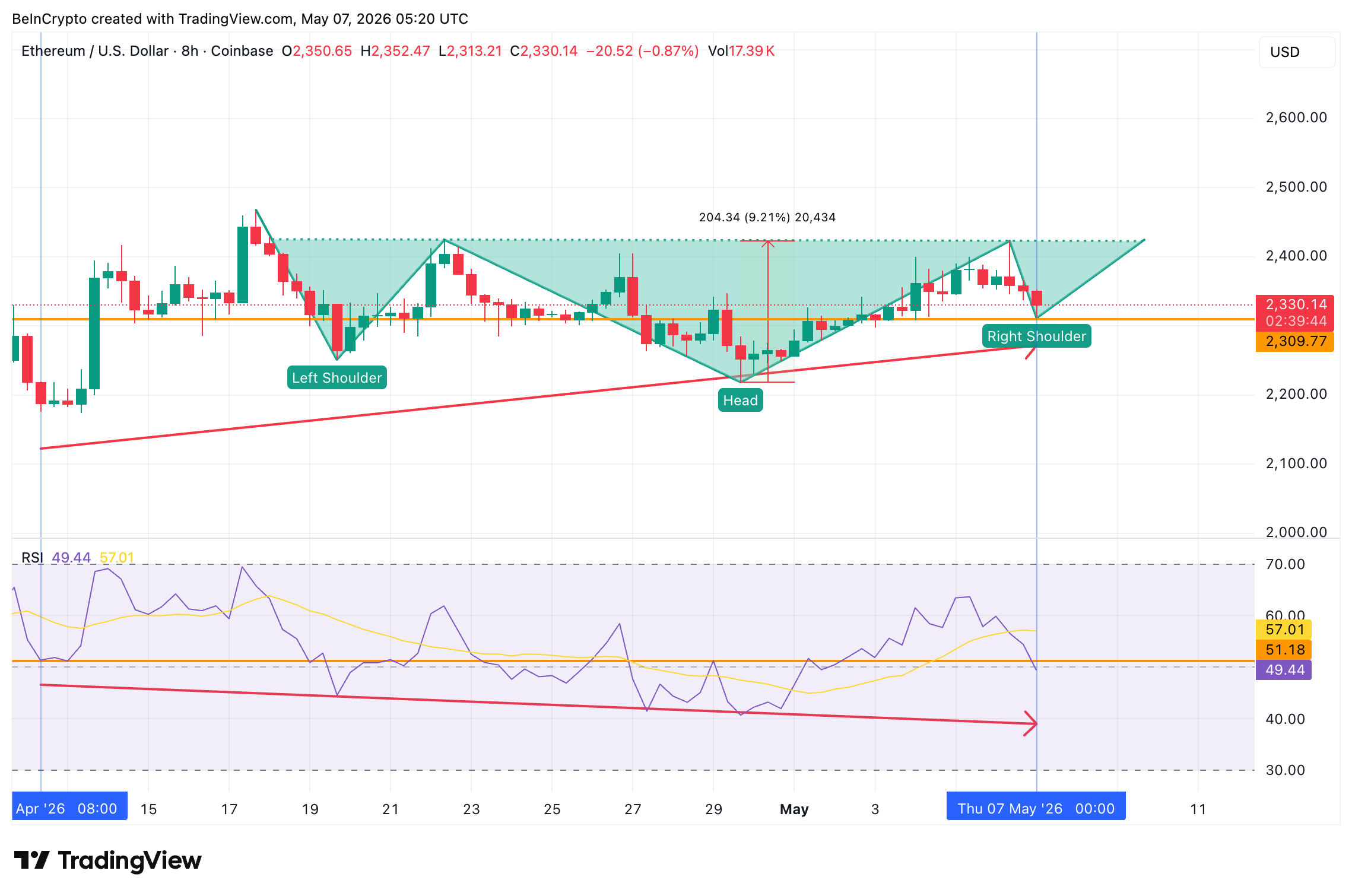
Ethereum (ETH) price hovers near $2,330 mid-week with sellers fading sharply, leaving an 8-hour reversal structure one candle away from confirming a possible bounce.
The setup ties together a textbook bottoming pattern, an exhaustion signal on momentum, and an 85% drop in coins flowing onto exchanges. Whether ETH delivers the bounce depends on a single candle holding the line.
Ethereum Price Builds Reversal Structure as Momentum Quietly Diverges
The 8-hour chart shows ETH carving an inverse head-and-shoulders since mid-April. The pattern prints a low (left shoulder), a deeper low (head), and a higher low (right shoulder). The right shoulder formation is close to being confirmed now.
Want more token insights like this? Sign up for Editor Harsh Notariya’s Daily Crypto Newsletter here.
Sitting under that price action is a developing hidden bullish divergence. ETH price has made a higher low between mid-April and early May, while RSI (relative strength index), a momentum gauge, is close to printing a lower low over the same window. Hidden bullish divergence often signals exhaustion of selling pressure, not the start of a fresh leg down.

The trigger is binary. If the next candle holds above the current right-shoulder floor ($2,309 to be exact), the divergence confirms and the pattern stays alive. If sellers force a break, both the structure and the divergence collapse together.
That setup, however, needs validation from on-chain flows before it earns the right to a projected 9% price target.
Sellers Retreat as Mid-Term Holders Build Their Stack
Glassnode data shows the exchange net position change, a metric that tracks tokens flowing in and out of exchanges, eased sharply this week. The reading peaked at 78,930 ETH on May 3, when fresh inflows pointed to selling pressure rising. By May 6, that figure had dropped to 11,504 ETH, an 85% reduction.
The collapse suggests whoever was offloading ETH around the right shoulder may be running out of supply.

A second on-chain layer reinforces the read. Glassnode’s HODL waves group supply by how long holders have kept their coins. The 6-month to 12-month cohort sat at 18.12% of supply on April 22. By May 6, that share had climbed to 21.49%.
The data suggests mid-term holders are adding to their position even as price stays compressed. This cohort often re-engages near cycle bottoms.

Both flows lean in the same direction as the chart pattern. The price chart now becomes the decider on whether buyers convert that backdrop into a measurable move this week.
Ethereum Price Levels That Decide the Mid-Week Move
With the pattern, divergence, and on-chain flows aligned, the focus shifts to the price ladder on the 8-hour chart. The current right-shoulder floor sits at $2,309, marked as the 0 Fibonacci anchor.
The first hurdle is $2,358. ETH then needs to reclaim $2,388 (0.382 Fib) and $2,412 (0.5 Fib). The 0.5 level briefly capped price on May 6 before sellers stepped in.
The neckline sits at $2,423, lining up between the 0.5 and the 0.618 Fibonacci at $2,436. A clean break above this band activates the pattern. The measured move projects roughly 9% upside from the neckline. That target lines up with the 1.618 Fibonacci extension at $2,642.

The downside ladder is just as defined. Failure to reclaim $2,358 followed by a loss of $2,309 would invalidate the right shoulder. Below that, $2,218, the head’s low, is where the entire pattern unwinds.
Hidden bullish divergence and falling exchange inflows both lean toward the bounce read, but neither replaces a confirmed close. Ethereum managing to stay above $2,309 separates a 9% Ethereum price bounce toward $2,642 from a slide to the $2,218 invalidation floor.
The post Ethereum Price Eyes Mid-Week Bounce as Selling Pressure Craters 85% appeared first on BeInCrypto.

Ripple (XRP) posted a minor increase in the last 24 hours, pushing the asset’s monthly surge to 7%. Despite this, the $1.45 level remains a major hurdle for the asset.
Against this backdrop, data suggest that there has been a clear shift in the behavior of major investors over recent months.
XRP Selling Pressure Indicator
According to CryptoQuant’s latest analysis, whale inflows of XRP to Binance have dropped to their lowest level since November 2021. The firm explained that the 30-day cumulative inflow indicator, also known as Sum 30D, climbed to around 2.6 billion XRP at the beginning of March, which was indicative of a strong movement of tokens from whales toward the exchange.
Large transfers of crypto assets to centralized trading platforms are often linked to increased selling activity or portfolio repositioning by major holders. However, since reaching that peak, the indicator has steadily moved lower and has now fallen to nearly 736 million XRP.
As such, CryptoQuant stated that this is the lowest level recorded for the metric in more than three years. The decline essentially points to exchange-related selling pressure from whales easing considerably compared to earlier months. The analysis also revealed that the continued drop in inflows during a period of broader market volatility may reflect a more cautious stance among large investors as uncertainty remains across the crypto market.
It is important to note that lower whale inflows to exchanges are generally viewed as a positive signal because they reduce the risk of sudden sell-offs caused by large token transfers. Hence, if the trend continues and inflows remain low while demand and price conditions improve, the data could support XRP in building a more stable price base over time as selling pressure from major holders continues to weaken.
Institutional Demand and Global Expansion
On the institutional front, US spot XRP ETFs have shown renewed momentum. After seeing more than $31 million in outflows during March, the products rebounded sharply in April with $81.6 million in inflows. The positive trend has continued into May, as the funds have attracted more than $28 million in fresh inflows so far this month.
Meanwhile, Ripple has continued expanding its activity across several markets in recent months. The company recently partnered with OKX for the listing of its RLUSD stablecoin and also joined efforts with the Crypto ISAC network to share information related to North Korean cyber threat actors targeting the crypto sector.
It has additionally expanded its regional presence in the Middle East and Africa through new office openings.
In South Korea, the company signed a partnership agreement with internet-only lender KBank to move blockchain remittance testing beyond early-stage trials and focus on real-world integration and scalability. The agreement was signed at KBank’s headquarters in Seoul with executives from both firms in attendance, including Ripple Asia-Pacific Managing Director Fiona Murray.
Prior to that, Ripple had entered another South Korean partnership with Kyobo Life Insurance to work on institutional digital asset infrastructure tied to tokenized government bond transactions.
The post Major Ripple (XRP) Metric Just Hit a Level Not Seen Since 2021 appeared first on CryptoPotato.
Toobit is one of the most popular international cryptocurrency exchanges, and it has just announced the publication of its most recent Proof of Reserves report, which was independently verified by Hacken.

Over 100% Collateral Ratio
The assessment conducted by Hacken confirms that the exchange is maintaining a collateral ratio of more than 100% across all in-scope digital assets. These include BTC, ETH, USDT, and USDC.
This audit confirms that there’s a safe 1:1+ backing for every trader deposit. The findings also verify that there is a reserve surplus that ensures all trader liabilities are fully over-collateralized.
Additionally, the verification process validated the individual balances of more than 640,000 accounts. This was achieved by cross-referencing loads of internal data against legal documentation, as well as against official statements from third-party institutional custodians to guarantee the highest level of accuracy.
Report Mechanics
To deliver full transparency, Hacken used a multi-stage methodology that was focused on three key stages. First, the auditors performed a Proof of Liabilities. To do so, they verified the total balances of more than 600,000 liability holders to make sure that there was an accurate representation of client deposits.
The second stage was Asset Verification. During this, auditors compared the total reserve balances against the client liability report to verify whether they covered them in full. Last but not least, the process included Operational Oversight, aiming to review information flow and custodial reporting, which ensures all data remains authentic and unaltered.
In conjunction with the audit results, Toobit has launched an upgraded Proof of Reserves page, which moves beyond static reporting to a dynamic transparency model. This hub is designed to ensure that traders are able to monitor live reserve ratios for major tokens and access historical audit data through a user-friendly and accessible interface.
Merkle Tree Technology
A critical component and part of this portal is the integration of Merkle Tree technology. By consolidating trader balances into a singular and secure Merkle root hash, the crypto exchange is able to offer a transparent and tamper-proof method for everyone to verify that their specific account balance was actually included in the audit.
This cryptographic proof is designed to ensure accountability while also maintaining privacy for all traders.
It’s important to note that the full audit report is readily available for public review. The detailed documentation regarding the audit scope, methodology, and technical findings can be found on the official website of Hacken.
With all of the above said, it’s crucial to understand that cryptocurrency exchanges have entered a maturation phase, which is largely driven by independent verification.
Industry leaders maintain reserve coverage ratios between 124% and 125%, far exceeding the 100% safety benchmark. Moreover, as frameworks such as MiCA intensify supervision, long-term operational stability is defined by “compliance by design,” integrating Proof of Reserves and transparent disclosures into core infrastructure.
The post Toobit Confirms Over 100% Asset Backing in Latest Hacken Proof of Reserves Report appeared first on CryptoPotato.
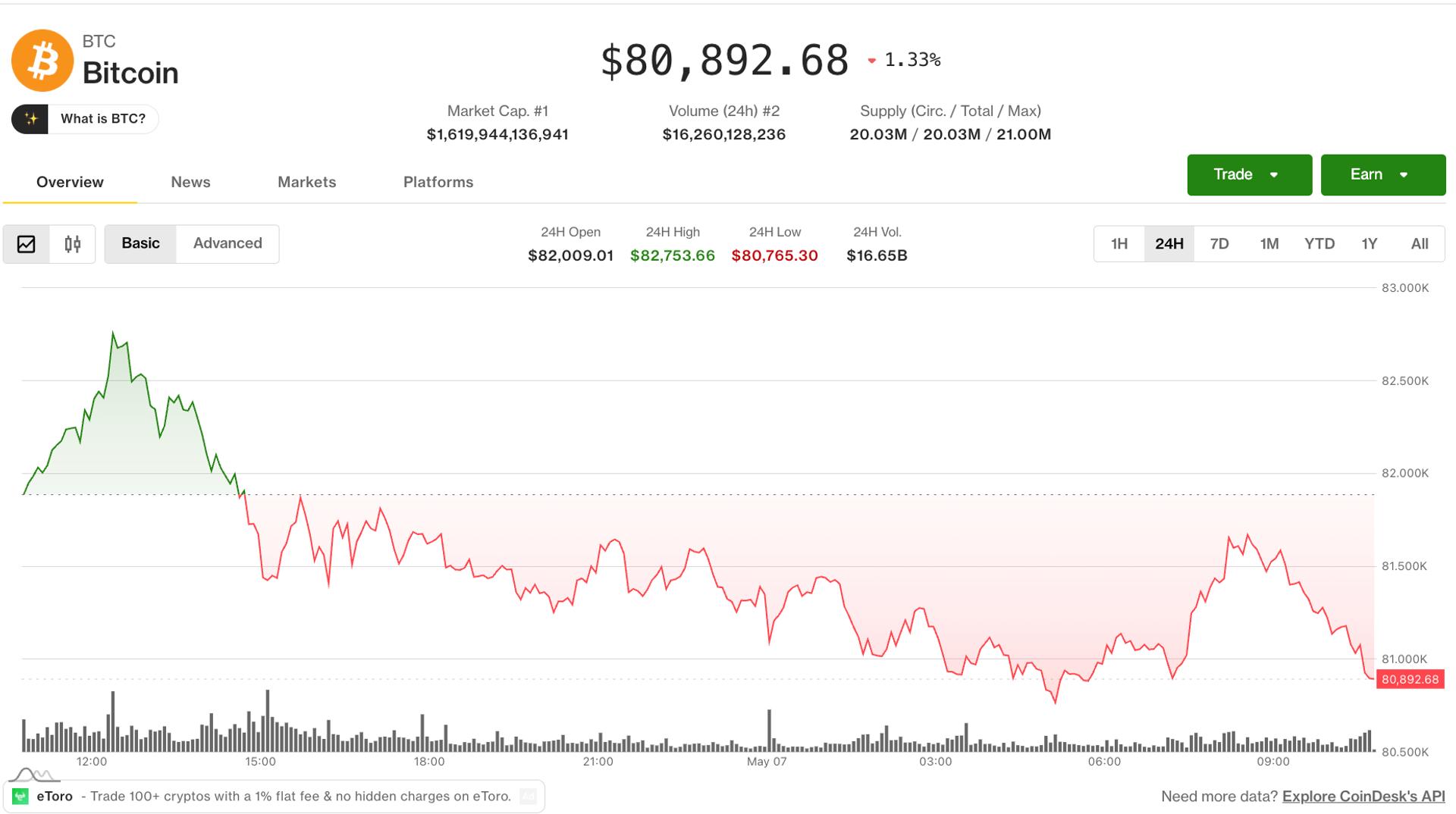
The crypto market dropped back on Thursday with bitcoin losing around 0.7% since midnight UTC following Wednesday’s rally to a three-month high of $82,800.
Ether lost around 1% during Asia and European hours, now trading at $2,325 having briefly topped $2,420 on Wednesday.
The broader market is showing early signs of a bullish reversal following a two-month consolidation pattern between February and April, although it’s worth noting that bitcoin needs to break $98,000 in order to break its current cycle of lower highs and lower lows.
The altcoin market continues to indicate investor rotation, with the likes of ALGO and TON rising by between 8% and 9% since midnight UTC.
U.S. equity futures are flat on Thursday while the dollar index (DXY) is down by around 0.1% as investors remain hopeful over a deal to end the war in Iran.
Derivatives positioning
- Crypto futures market activity remained relatively subdued over the past 24 hours, with total futures volume rising just 3% to $216 billion, while aggregate open interest (OI) declined 3% to $133 billion. The divergence between suggests that positioning is being reduced rather than expanded, pointing to deleveraging across the market.
- BTC open interest fell to 762K BTC from 793K BTC a day earlier, ending a three-day streak of sustained positioning growth. Among major assets, DOGE recorded the sharpest decline in OI, down 6%, while XRP OI slipped roughly 1%. The declines across these assets suggest capital outflows and reduced speculative appetite in the near term.
- DOGE positioning appears particularly weak. Funding rates remain negative at an annualized rate of around 6%, indicating that short positions are paying longs to maintain exposure. At the same time, DOGE’s 24-hour cumulative volume delta (CVD) is the most negative among major tokens, signaling aggressive selling pressure from market participants using market orders.
- BTC funding rates, meanwhile, remain broadly neutral after averaging around minus 4% annualized in recent weeks. The normalization in funding suggests that excessive bearish positioning has largely been flushed out of the market. Some observers view this reset as constructive for BTC price action.
- In contrast, ETH and SOL both recorded OI increases of 1% or more despite weakening spot prices. Rising open interest alongside falling prices typically suggests fresh short positioning is entering the market, indicating traders may be positioning for additional downside in these tokens.
- TON continues to stand out on the positioning front. Open interest climbed more than 10% to another record high, signaling continued capital inflows into the asset. TON’s price briefly reached $2.90 earlier today, its highest level since September, and the token is now up 93% on the week. The simultaneous rise in both price and OI points to strong directional participation.
- TON, TRX, and ZEC are currently the only top-30 tokens posting OI-adjusted positive cumulative volume delta readings. This suggests buyers are driving trading activity through aggressive market orders rather than passive limit bids. Most other major assets, including BTC, ETH, and XRP, continue to show negative CVD readings.
- In the options market, bullish sentiment remains evident on Deribit, where call options at strike levels above $80,000 continue to dominate 24-hour volume rankings. According to Glassnode, dealers with short gamma exposure may buy into a potential BTC move above $82,000 to maintain hedges. That could further add to momentum.
- Meanwhile, the one-month volatility risk premium, which measures the gap between implied volatility (IV) and realized volatility (RV), has turned positive again, per Glassnode. This shift indicates renewed demand for short-dated optionality and suggests traders are increasingly willing to pay for near-term volatility exposure after a prolonged period of compressed expectations.
Token talk
- CoinDesk’s DeFi Select Index (DFX) and the CoinDesk MemeCoin Select Index (CDMEME) are the best performing benchmarks on Thursday, rising by 2.5% apiece as speculative trading begins to come into effect.
- The Bitcoin-weighted CoinDesk 5 (CD5) and CoinDesk 20 (CD20) indices are flat since midnight UTC, while the broader CoinDesk 100 (CD100) was also marginally in the red.
- CoinMarketCap’s “altcoin season” indicator is now at 45/100, its highest level since late March having risen from 32/100 since this time last month.
- Despite the wider altcoin market being optimistic, popular DeFi token MORPHO lost 4.6% of its value since midnight UTC and 6.1% over the past 24 hours. it is currently trading at $2.13 with investors taking profits following a rally earlier in the week that lifted it from $1.95 to $2.33.
Crypto World
Ethereum price confirms bullish setup as institutional demand holds firm, breakout ahead?
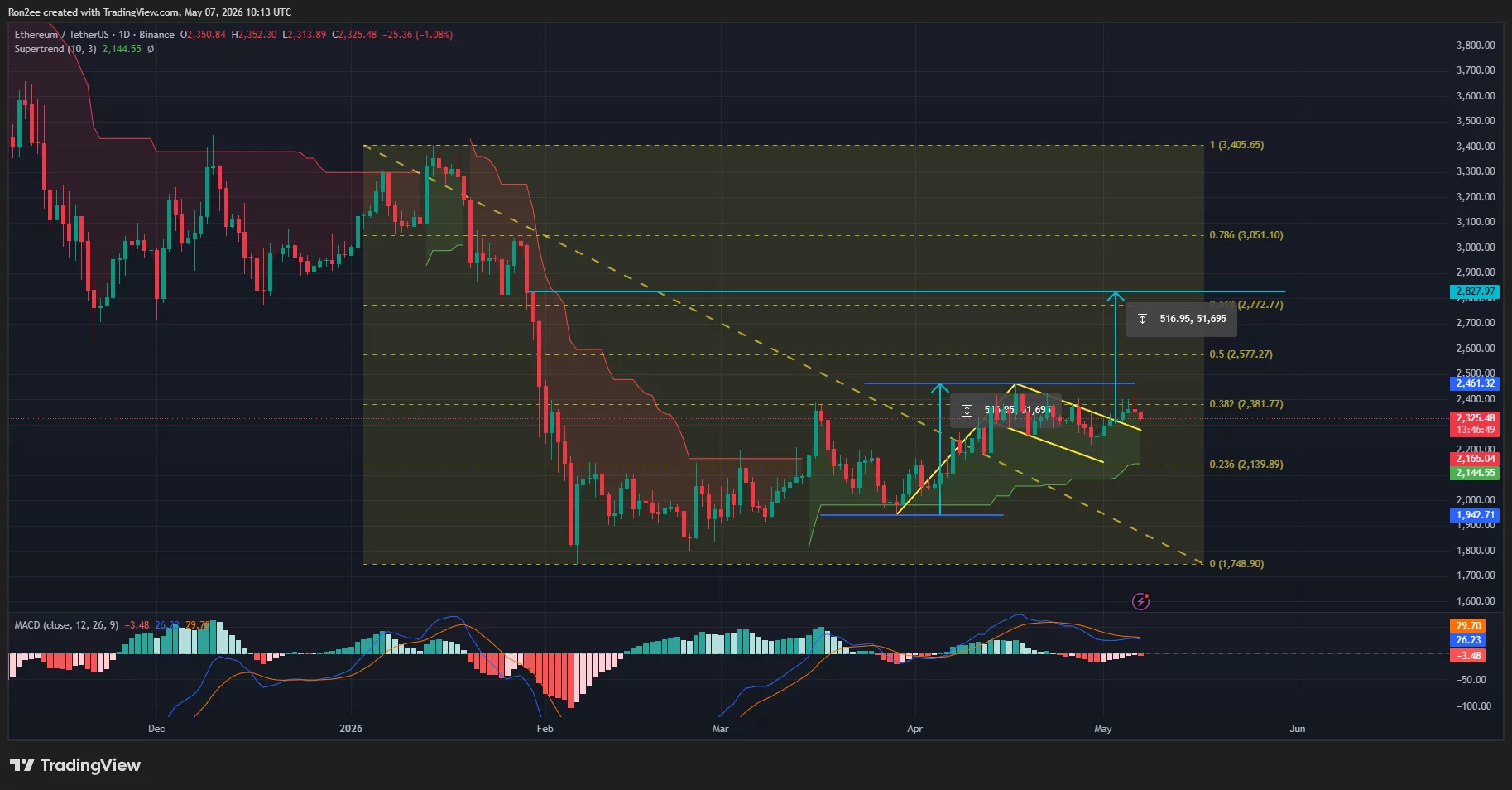
Ethereum price has pared off some gains after facing resistance at $2,400 this week. A confirmed bullish pattern on the chart, however, positions it for strong upside in the coming sessions.
Summary
- Ethereum climbed to a weekly high above $2,400 before stabilizing near $2,300 as broader crypto markets reacted to easing geopolitical tensions.
- Spot Ethereum ETFs recorded a fourth straight day of inflows, with more than $270 million added, signaling continued institutional demand.
- Ethereum confirmed a bull flag pattern on the daily chart, with technical indicators pointing toward a potential breakout above the $2,800 resistance zone.
According to data from crypto.news, Ethereum (ETH) price rose nearly 7% to a weekly high of $2,411 on Wednesday before stabilizing over $2,300 at press time.
Ether, along with the broader crypto market, has entered a period of cautious calm as Iran is reportedly pondering a U.S. proposal to end the war and open up the Strait of Hormuz, bringing balance once again to global energy supply chains and trade.
Despite this investor uncertainty, institutional investors continue to stack their positions in the token. Data from SoSoValue shows that spot Ethereum ETFs extended their inflow streak to the fourth day with over $270 million drawn in the period. This persistent demand from deep-pocketed investors suggests their belief in the token’s future potential and often pulls in fresh capital from retail investors over time.
On the daily chart, Ethereum price has confirmed a bull flag pattern and is eyeing a move above the 38.2% Fibonacci retracement level at $2,381. A decisive break above the flag’s upper boundary could accelerate the rally towards the $2,800 resistance zone or onwards to $3,000 if the current momentum sustains.
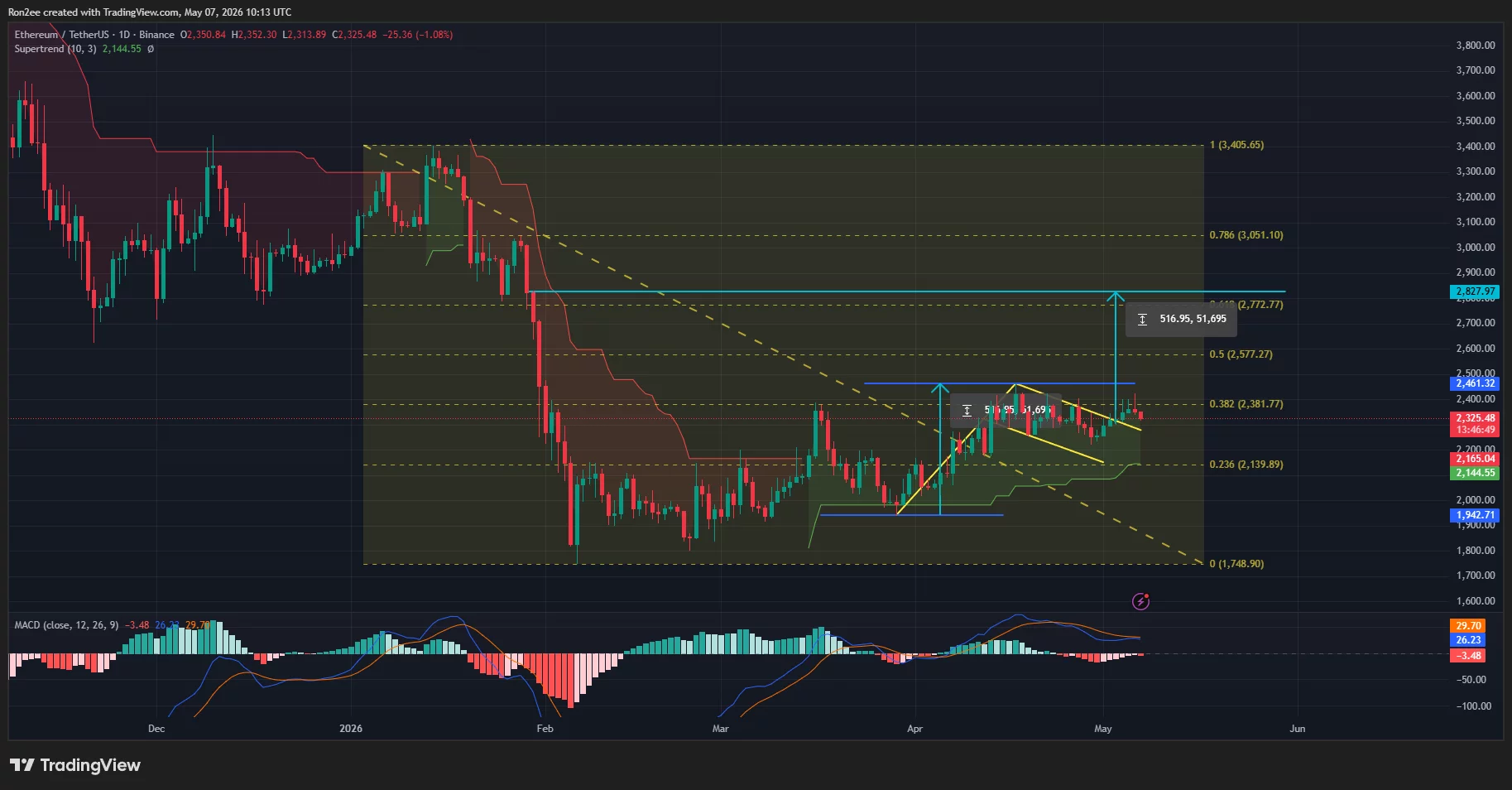
Momentum indicators seem to support such a bullish outlook as the Supertrend has remained in the green, indicating a healthy uptrend. At the same time, the MACD lines are close to forming a bullish crossover, which typically signals that the bulls are ready to take back control of the market.
On the contrary, a failure to hold current levels could see Ethereum drop back toward the $2,200 support level, where buyers would likely step in to defend the primary trend.
Disclosure: This article does not represent investment advice. The content and materials featured on this page are for educational purposes only.


Core Scientific (CORZ) reported a $347.2 million first-quarter loss even as revenue rose to $115.2 million, as the former bitcoin mining heavyweight sold 2,385 bitcoin for $208.3 million and wrote down $266.5 million of mining-related assets.
The company said the bitcoin sales were used to fund capital expenditures and other cash needs, extending a pattern of miners selling BTC to fund AI data centers.
The company also closed a $3.3 billion offering of 7.75% senior secured notes, proceeds it plans to use for data center development and to repay a $1 billion term loan facility. The bond sale was aimed at funding its shift from crypto mining to AI-focused data center operations.
Colocation revenue, the company revealed, rose to $77.5 million from $8.6 million a year earlier, making it Core Scientific’s largest business line, according to the company’s earnings release.
Crypto mining revenue fell to $30.1 million from $67.2 million, driven by a 45% drop in bitcoin mined and an 18% drop in the average bitcoin price, CORZ said.
The company operated 10 data centers across seven U.S. states at the end of March, representing about 1.9 GW of gross utility power capacity and 1.3 GW of leasable customer power capacity, according to its latest 10-Q.
Core Scientific said in its filing that its first high-density colocation contract with CoreWeave was later expanded to 590 MW of leased customer power capacity.
A February 2025 expansion brought CoreWeave’s contracted infrastructure with Core Scientific to about 590 MW across six sites and lifted projected revenue to $10.2 billion over 12-year terms.
Customer concentration remains high. Core Scientific’s 10-Q said one colocation customer generated 67% of total revenue in the first quarter, up from 11% a year earlier.
Core Scientific’s AI pivot has been under investor scrutiny since CoreWeave’s failed roughly $9 billion all-stock takeover attempt. The company emerged from Chapter 11 in 2024 and has since become one of the main examples of bitcoin miners trying to turn access to power into contracted AI infrastructure revenue.
It ended March with $1.04 billion of liquidity, including $1.01 billion of cash and $37.3 million of bitcoin.

South Korean crypto exchange Bithumb is expanding its overseas push through a new partnership in Vietnam as the country moves toward licensing its first domestic digital asset trading platforms.
Bithumb said it signed a memorandum of understanding (MoU) with SSI Digital (SSID), a subsidiary of Vietnam’s largest securities company, SSI Securities, to cooperate on establishing and operating a virtual asset exchange in the country.
The agreement, signed in Hanoi in March but announced Thursday, also leaves the door open for Bithumb to make a strategic equity investment in an SSID-designated entity, subject to Vietnam’s regulatory approvals.
The move positions Bithumb for Vietnam’s pilot program for licensed domestic digital asset trading platforms, creating a potential entry point into one of Southeast Asia’s fastest-growing crypto markets.
Vietnam’s tight crypto pilot race
Vietnam’s five-year crypto asset pilot, unveiled in September 2025, requires exchange operators to be Vietnamese entities with at least 10 trillion dong ($380 million), in charter capital and caps foreign ownership at 49%. Authorities are also drafting rules that could restrict trading on unlicensed overseas platforms.

Bithumb and Vietnam’s SSID Collaborate. Source: Bithumb
Competition for licenses is already intensifying. A Finance Ministry document cited by Reuters in March said five firms, including affiliates of private banks Techcombank, VPBank and LPBank, along with broker VIX Securities and conglomerate Sun Group, have already cleared an initial qualification round.
Related: Bank of Korea floats crypto ‘circuit breakers’ after Bithumb blunder
One of the most advanced bids is VPBank-linked CAEX, which secured backing from OKX Ventures and HashKey Capital in April to help meet Vietnam’s minimum charter capital threshold for the pilot. Bithumb’s Vietnamese partner, SSI Securities, is one of the country’s largest brokers and set up SSI Digital Technology JSC to spearhead its push into digital assets in 2022. Vietnam was ranked fourth in global crypto adoption in 2025 by blockchain forensics firm Chainalysis.
According to Bithumb’s press statement, the company and SSID plan to collaborate across exchange technology, wallet and custody systems, security and risk management, regulatory support and institutional business development. No timeline has been given for a formal license application or final investment decision, and Vietnam has not yet approved any fully licensed crypto exchange under the pilot.
Cointelegraph reached out to Bithumb for comment but had not received a response by publication.
Korea headwinds raise stakes
The expansion plan comes as Bithumb faces heightened scrutiny in its home country following a high-profile payout error and a delayed listing timeline.
The exchange has pushed back its initial public offering (IPO) to sometime after 2028, with management saying it needs to strengthen accounting policies and internal controls after earlier regulatory sanctions.
In February, Bithumb mistakenly credited customers with 620,000 Bitcoin instead of 620,000 won during a promotional event, briefly creating more than $40 billion in notional balances and triggering sharp price swings on the platform. The firm says it recovered 99.7% of the funds and is now pursuing legal action to reclaim the remaining 7 BTC.
Magazine: Bitcoin will not hit $1M by 2030, says veteran trader Peter Brandt
Bitcoin (BTC) miners reported widening net losses in the first quarter of 2026 as declining Bitcoin prices, broader market pressures, and other factors weighed on the firms.
Hut 8 (HUT), Core Scientific (CORZ), American Bitcoin (ABTC), Cipher Digital (CIFR), and Riot Platforms (RIOT) all reported losses.
Bitcoin Miner Q1 Losses Hit Sector
According to its latest press release, HUT posted a net loss of $253.1 million in the first quarter of 2026. The losses widened from $134.3 million recorded during the same period last year.
“Net loss for the period included $295.7 million of primarily unrealized losses on digital assets, compared to $112.4 million in the prior year period,” the firm noted.
Follow us on X to get the latest news as it happens
Meanwhile, American Bitcoin, the Bitcoin mining and treasury company co-founded by Eric Trump, reported an $81.8 million net loss for the first quarter, up from a $59.5 million loss in the previous quarter.
Again, the company’s digital asset holdings were the main drag, contributing to $117.18 million in losses.
“We produced Bitcoin at a 52% gross margin despite a 22% decline in Bitcoin price, reflecting meaningful cost improvements that partially offset the price headwind. Our cost to mine fell to approximately $36,200 per Bitcoin, down from roughly $46,900 in Q4 2025,” Matthew Prusak, President of American Bitcoin, said.
Core Scientific reported a net loss of $347.2 million, primarily due to $266.5 million in non-cash impairment charges. The company was also impacted by a $30.8 million non-cash loss tied to changes in the fair value of warrants and contingent value rights.
Cipher Digital’s $114 million loss followed the Black Pearl mining wind-down, a fair-value decline on its power contract, and higher interest expense from new debt facilities. Lastly, Riot Platforms’ quarterly loss exceeded $500 million.
Miner Stock Reactions
Meanwhile, mining stocks posted modest declines in after-hours trading following the disclosure of losses. Google Finance data showed that HUT surged 35% to $108.94 during regular trading on May 6 before slipping 1% in after-hours trading.
CORZ rose 11% to $24.63 during the session, then fell 7.2% to $22.85 after hours. ABTC gained 1.6% to $1.25 in regular trading before erasing those gains in pre-market activity.
AI Data Center Pivot Reshapes the Sector
The earnings reports landed alongside fresh AI data center moves at every firm. Hut 8 unveiled a $9.8 billion Beacon Point lease.
Cipher Digital signed its third hyperscale lease in Q1. Riot Platforms booked $33.2 million of data center revenue. Core Scientific continues repurposing mining facilities for colocation services.
Whether the pivot offsets pressures on the underlying mining business will become clearer in the time ahead.
Subscribe to our YouTube channel to watch leaders and journalists provide expert insights
The post Bitcoin Miners’ Q1 Losses Mount as AI Pivots Accelerate appeared first on BeInCrypto.


A US judge has sentenced a California man known as GothFerrari to 78 months in prison for his role in a crypto social engineering ring that turned to home burglaries when victims could not be deceived online.
Marlon Ferro, 20, of Santa Ana, also faces $2.5 million in restitution and three years of supervised release.
Inside the $250 Million Crypto Theft Ring
A multi-year federal investigation revealed that the enterprise drained more than $250 million in cryptocurrency from victims between late 2023 and early 2025. Its members operated out of California, Connecticut, New York, Florida, and overseas.
The crew specialized in roles that included database hacking, target identification, fraudulent phone calls, and money laundering. When social engineering failed, the ring sent Ferro to physically steal hardware wallets from victims’ homes.
“Marlon Ferro served as the criminal enterprise’s instrument of last resort… they turned to Ferro to break into homes and steal hardware wallets outright,” US Attorney Pirro said.
Follow us on X to get the latest news as it happens
Brick-Through-Window Crypto Burglaries and Designer Spending
According to the press release, in February 2024, Ferro broke into a home in Winnsboro, Texas, and stole a hardware wallet. The device held roughly 100 Bitcoin (BTC), then valued at more than $5 million.
That July, Ferro went to New Mexico and surveilled a residence with a hidden cell phone. He smashed a window with a brick when co-conspirators tracking the victim’s iCloud account signaled the home was empty.
Beyond burglaries, Ferro laundered funds for the ring. Using fake identification from a foreign national, he opened a geo-blocked payment card account. The setup funneled over $255,000 in designer clothing to co-conspirators.
Stolen money also bankrolled extravagant spending. Court papers cite nightclub tabs of up to $500,000 per night and Hermès Birkin bags. Private jets and exotic cars valued up to $3.8 million were also part of the haul.
Authorities arrested Ferro in May 2025 with two firearms in his possession. He pleaded guilty in October 2025 to one count of conspiracy to participate in a racketeering-influenced and corrupt organization
Subscribe to our YouTube channel to watch leaders and journalists provide expert insights
The post Crypto Burglar Known as ‘GothFerrari’ Draws 78-Month Prison Term appeared first on BeInCrypto.
Bitcoin Operates Outside the Regulatory System: Arthur Hayes Take on Crypto and Clarity Act

Jake Hall, TOWIE Cast Member, Has Died Aged 35

Yuzvendra Chahal vaping on flight? PBKS spinner takes a dig at Riyan Parag Controversy | Cricket News

Manchester United reach agreement with Casemiro over contract clause amid transfer speculation

US brings back mandatory military draft registration

Steven Gerrard disagrees with Gary Neville over ‘shock’ Chelsea and Arsenal claim | Football


-

 NewsBeat4 days ago
Channel 5 – All Creatures Great and Small series 7 new post
-

 Crypto World2 hours ago
Upbit adds B3 Korean won pair as Base token gains Korea access
-
 Tech6 days ago
Trump’s 25% EU auto tariff breaches Turnberry Agreement that also covers semiconductors and digital trade
-
 NewsBeat4 hours ago
NCP car park operator enters administration putting 340 UK sites at risk of closure
-
 Sports6 days ago
Paul Scholes issues Marcus Rashford reality check as agreement emerges over Man United star
-

 Entertainment6 days ago
Met Gala 2026 Rumored Guest List Is Turning Heads
-

 Business6 days ago
Strait of Hormuz Blockade Persists Amid US-Iran Standoff, Sending Oil Prices Soaring
-
Entertainment6 days ago
New on Prime Video in May 2026 — Full List of Movies and Shows
-

 Sports5 days ago
Cavaliers vs. Raptors Game 6 live score, updates, highlights from 2026 NBA playoffs first-round series
-
 Sports5 days ago
David Benavidez responds to team Canelo saying the fight will never happen
-

 Tech6 days ago
Meta ends Sama contract after Kenyan workers report seeing intimate footage from Ray-Ban smart glasses users
-

 Entertainment5 days ago
Kylie Jenner Hit With Second Lawsuit From Ex-Housekeeper
-

 Entertainment5 days ago
Young and the Restless Next Week: Cane Arrested & Matt’s Deadly New Scheme!
-
Entertainment5 days ago
New Netflix Movies in May 2026 — My Top 3 Picks to Stream
-
 Sports5 days ago
IPL 2026: ‘Love you darling’- Hardik Pandya’s reaction to MS Dhoni steals the show |Watch | Cricket News
-
 Crypto World5 days ago
Pi Network Mandates Protocol 23 Upgrade for All Mainnet Nodes Before May 15 Deadline
-

 Business4 days ago
Luka Doncic Injury Update: Doncic’s Hamstring Recovery Slows Lakers’ Hopes Against Thunder: Can He Run Yet?
-

 Sports6 days ago
What Preity Zinta Said After Punjab Kings’ First Defeat Of IPL 2026
-

 Crypto World4 days ago
Bitcoin mining equities rise in 2026 as BTC lags behind
-

 Sports6 days ago
Bayern won’t hand bottom side Heidenheim ‘gifts’ despite PSG game
You must be logged in to post a comment Login