

Crypto World
trade faster with intraday automation



Disclosure: This article does not represent investment advice. The content and materials featured on this page are for educational purposes only.
AI day trading bots are reshaping stock trading in 2026 with faster signals, automation, and real-time analysis.
Summary
- BulkQuant joins leading AI day trading bot platforms as traders seek faster stock analysis tools in 2026.
- AI-assisted stock trading platforms like BulkQuant aim to simplify intraday market monitoring and execution.
- BulkQuant targets beginner traders with AI-driven stock monitoring and strategy execution support tools.
Stock day trading in 2026 is becoming more data-driven, faster, and more difficult to manage manually. Intraday price movements can be influenced by earnings updates, inflation reports, Federal Reserve expectations, AI-sector momentum, ETF flows, analyst ratings, and sudden changes in market liquidity. For traders watching multiple tickers, the challenge is not only finding opportunities, but also reacting with discipline when markets move quickly.
This is one reason AI-assisted trading tools are attracting more attention. Some platforms help traders scan stocks in real time. Others focus on technical alerts, strategy testing, broker execution, or custom algorithm development. These tools are often described as AI day trading bots, but their functions can vary widely.
A useful day trading bot does not simply promise speed. It should help traders build a clearer workflow: monitoring stocks, filtering signals, testing rules, managing alerts, and supporting execution decisions. At the same time, traders should remember that AI tools do not remove market risk. Intraday trading can lead to losses, especially when strategies are poorly tested or used during volatile conditions.
This guide looks at eight AI day trading bot platforms for stocks in 2026, including BulkQuant, Trade Ideas, TrendSpider, StockHero, Tickeron, SignalStack, Alpaca, and QuantConnect. The goal is not to declare one platform as suitable for everyone, but to compare how each tool may fit different trading styles.
Quick comparison: AI day trading bot platforms for stocks in 2026
| Platform | Primary Use Case | Automation Focus | Suitable For |
| BulkQuant | AI-assisted trading workflow | Market monitoring and strategy execution support | Beginners and users exploring simplified automation |
| Trade Ideas | Real-time stock scanning | AI-driven intraday alerts and trade ideas | Active day traders |
| TrendSpider | Technical analysis automation | Chart alerts, strategy triggers, and webhook workflows | Technical traders |
| StockHero | No-code stock bot building | Bot setup, paper testing, and broker-connected workflows | Traders who prefer no-code tools |
| Tickeron | AI stock signals and pattern recognition | AI robots, forecasts, and signal discovery | Signal-based traders |
| SignalStack | Alert-to-order workflow | Connecting alerts to broker orders | Traders with existing signal systems |
| Alpaca | Trading API infrastructure | Custom execution and market data access | Developers and algo traders |
| QuantConnect | Algorithmic research and testing | Backtesting, research, and live strategy deployment | Advanced traders and quants |
1. BulkQuant — AI-assisted trading workflow and strategy execution support
BulkQuant is included in this list for traders who want to explore AI-assisted market monitoring and simplified trading workflow support. Instead of focusing only on stock alerts or chart signals, BulkQuant presents itself as a platform that helps users access AI-driven strategy tools across different markets, including stocks, crypto, and forex.
For stock day traders, the appeal of a platform like BulkQuant is its attempt to reduce some of the repetitive work involved in monitoring market conditions. Intraday trading often requires traders to follow price movement, react to changing volatility, control position exposure, and avoid emotional decision-making. A system that organizes these steps into a more structured workflow may be useful for users who do not want to build everything manually.
BulkQuant may be especially relevant for users who are new to AI-assisted trading tools and want a simpler entry point. Rather than requiring users to code strategies or configure complex technical indicators from the beginning, the platform focuses on accessibility, market monitoring, and strategy execution support.
That said, traders should still review the platform carefully before using real capital. Important details include risk controls, account terms, supported markets, cost structure, withdrawal rules, and how the platform handles strategy execution. Trial access or promotional credits can help users explore the interface, but they should not be interpreted as proof of future performance.
Where BulkQuant may fit
BulkQuant may suit traders who want:
- A more guided AI-assisted trading workflow
- Exposure to stock trading automation tools
- Market monitoring support
- Strategy execution features
- A beginner-friendly interface
- Access to multiple asset classes from one platform
BulkQuant is not necessarily the right choice for traders who want full control over every line of strategy logic. Developers or highly technical traders may prefer platforms such as Alpaca or QuantConnect. But for users who want a more accessible way to explore trading automation, BulkQuant is one of the platforms worth reviewing.
New users can register and receive rewards
2. Trade Ideas — real-time AI stock scanning for active traders
Trade Ideas is widely known among active stock traders for real-time market scanning and AI-assisted trade discovery. It is not designed as a simple one-click trading tool. Instead, it helps traders identify stocks that may be moving, forming setups, or matching certain intraday conditions.
For day traders, scanning speed is important. During the first hour of the trading session, hundreds of stocks may show unusual volume, price gaps, momentum changes, or breakout attempts. Manually watching every ticker is unrealistic. Trade Ideas helps users filter the market more efficiently and focus on stocks that meet specific conditions.
Its AI assistant, Holly, is often discussed as one of the platform’s better-known features. The tool can generate trade ideas and signal-based suggestions, but users still need to evaluate whether those ideas match their own strategy, risk tolerance, and trading plan.
Where Trade Ideas may fit
Trade Ideas may be useful for traders who want:
- Real-time stock scanning
- Intraday trade alerts
- AI-generated stock ideas
- Entry and exit signal references
- A research-heavy workflow for active trading
Compared with BulkQuant, Trade Ideas generally requires more active decision-making from the trader. It may be better suited to users who already understand day trading setups and want a faster way to discover opportunities.
The platform may feel overwhelming for beginners because it is built around active market participation. Traders need to know how to interpret alerts, manage risk, and decide whether a signal is worth acting on.
3. TrendSpider — Technical analysis automation and strategy alerts
TrendSpider focuses on technical analysis automation. It is useful for traders who rely on chart patterns, trendlines, indicators, price levels, and multi-timeframe conditions.
Instead of manually drawing levels or constantly checking whether a stock has reached a technical setup, traders can use TrendSpider to automate parts of the chart-monitoring process. This can be especially helpful in day trading, where timing matters, and conditions can change quickly.
TrendSpider also supports alert-based workflows. Traders can create alerts based on technical criteria, and those alerts may be connected to other execution tools through webhooks. This makes the platform useful for traders who already have a defined strategy and want to reduce manual chart watching.
Where TrendSpider may fit
TrendSpider may suit traders who want:
- Automated technical analysis
- Chart-based alerts
- Multi-factor trade conditions
- Strategy testing features
- Webhook-supported workflows
- A structured approach to technical setups
TrendSpider is not necessarily a beginner-first platform. It is most useful when the trader already understands technical analysis and knows which conditions they want to monitor. Automating a weak or unclear strategy will not improve the strategy itself.
For traders who are comfortable with charts and want more automation around technical signals, TrendSpider can be a practical part of an intraday trading workflow.
4. StockHero — No-code bot building for stock traders
StockHero is designed for traders who want to create stock trading bots without writing code. This makes it different from developer-first platforms such as Alpaca or QuantConnect.
For users who have a basic trading idea but do not want to build a system from scratch, StockHero provides a more visual way to create and test bot logic. Traders can set up strategies, connect supported brokers, and test ideas through paper trading before considering live use.
Paper trading is particularly important for day trading. A strategy that looks promising in theory may behave differently in live conditions because of spreads, slippage, delayed reactions, or sudden price reversals. Testing a bot in a simulated environment can help users understand how the rules behave before exposing real capital.
Where StockHero may fit
StockHero may be useful for traders who want:
- No-code bot creation
- Paper trading and strategy testing
- Broker-connected trading workflows
- A more visual way to build automated stock strategies
- A middle ground between manual trading and coding
StockHero still requires user judgment. Traders need to define strategy rules, review bot behavior, and understand when a setup may not be suitable for live trading. The platform can reduce technical barriers, but it does not remove the need for risk management.
5. Tickeron — AI stock signals and pattern recognition
Tickeron focuses on AI-generated stock signals, pattern recognition, trading robots, forecasts, and market idea discovery. It may appeal to traders who want AI-assisted research rather than a complete trading workflow.
For day traders, signal discovery can be useful because it helps narrow down the market. Instead of manually searching through many stocks, traders can review AI-generated signals and pattern-based ideas. This may help users find potential setups faster, especially during active trading sessions.
However, signal-based platforms should be used carefully. A signal is not the same as a trading plan. Traders still need to consider entry timing, position size, stop-loss levels, broader market conditions, and whether the trade fits their strategy.
Where Tickeron may fit
Tickeron may suit traders who want:
- AI-generated stock signals
- Pattern recognition tools
- Forecast-style market ideas
- Trading robot categories
- Decision support for stock research
Tickeron may be less suitable for users who want simplified execution support or a more guided trading workflow. It is better understood as an AI-assisted research and signal platform.
For traders who like to compare multiple signals and use them as part of a broader decision process, Tickeron may be worth reviewing.
6. SignalStack — Alert-to-order automation for existing trading systems
SignalStack is different from most other platforms in this list. It is not mainly an AI stock picker or charting platform. Instead, it helps traders connect alerts from other platforms to live broker orders.
This can be useful for traders who already have a signal source. For example, a trader may use TradingView, TrendSpider, or another alert system to identify a setup. SignalStack can help convert that alert into an order workflow, reducing the delay between signal and execution.
For day trading, this matters because timing can affect results. If a trader receives an alert but takes several minutes to place an order manually, the setup may change. An alert-to-order tool can help create a more consistent execution process.
Where SignalStack may fit
SignalStack may suit traders who want:
- Alert-to-order automation
- Broker-connected execution workflows
- No-code order routing from alerts
- Faster response to existing trading signals
- A bridge between chart alerts and trade execution
SignalStack should not be confused with a complete AI trading bot. It does not replace strategy development or signal generation. Traders still need a reliable source of trade logic, clear risk parameters, and a plan for monitoring execution.
It may be most useful for traders who already have a working alert system and want to reduce manual steps in the execution process.
7. Alpaca — API infrastructure for custom stock trading bots
Alpaca is a developer-focused trading API platform. It is not a ready-made AI day trading bot for beginners, but it can be used as infrastructure for building custom trading systems.
Developers and algorithmic traders may use Alpaca to connect strategy logic, market data, and order execution. This gives users more flexibility than many no-code tools, but it also requires more technical skill.
For AI-assisted stock trading, Alpaca can serve as the execution layer. A trader or developer may build a machine learning model, signal engine, or rule-based intraday strategy, then connect it to Alpaca for order placement.
Where Alpaca may fit
Alpaca may suit users who want:
- Trading API access
- Custom bot development
- Market data integration
- Paper trading environments
- Developer control over strategy logic
- Broker execution infrastructure
Alpaca is not ideal for traders who want a simple interface and guided setup. Users need to handle coding, testing, error management, order logic, risk controls, and monitoring.
For developers, however, Alpaca can be a flexible foundation for building AI-assisted or rule-based stock trading systems.
8. QuantConnect — Algorithmic research and strategy testing
QuantConnect is designed for algorithmic trading research, backtesting, and live strategy deployment. It is one of the more advanced platforms in this list and is generally better suited to users with coding or quantitative trading experience.
For day traders, QuantConnect can be useful because it allows users to test intraday strategies before using them in live markets. Traders can research momentum systems, mean reversion strategies, opening range breakouts, volatility filters, or other systematic approaches.
The platform gives users significant control, but that control comes with complexity. A trader needs to understand data quality, strategy assumptions, backtesting limitations, execution behavior, and live trading risks.
Where QuantConnect may fit
QuantConnect may suit users who want:
- Algorithmic strategy research
- Historical backtesting
- Custom trading models
- Live strategy deployment
- Multi-asset strategy development
- A more technical quant environment
QuantConnect is not the easiest choice for beginners. It may be more appropriate for traders who already understand coding, data analysis, and systematic strategy design.
For advanced users, however, it can be a powerful environment for testing and refining stock day trading systems.
How to choose an AI day trading bot for stocks
Choosing an AI day trading bot should depend on a trading style, technical ability, and risk tolerance.
A beginner may prefer a platform with simpler onboarding, clearer workflow support, and fewer technical barriers. In that case, BulkQuant or StockHero may be easier to review than developer-heavy platforms.
An active trader who already understands intraday setups may prefer Trade Ideas for scanning or TrendSpider for technical alerts.
A trader who already has alerts but wants faster execution may consider SignalStack.
A developer or quant trader may be more interested in Alpaca or QuantConnect because these platforms offer more control over strategy logic and execution design.
The key is to avoid choosing a platform only because it uses the word “AI.” Traders should ask practical questions:
- Does the platform provide signals, execution, or both?
- Can strategies be tested before live use?
- Are risk controls clearly explained?
- Does the platform support the trader’s broker or preferred workflow?
- Is the user expected to build the strategy manually?
- Are fees, limitations, and order behavior transparent?
- Does the platform match the trader’s experience level?
A good tool should support a trading process, not replace basic judgment.
What makes a useful AI day trading bot in 2026?
A useful AI day trading bot should help traders manage speed, structure, and risk. In fast markets, the value of automation is not just about placing trades quickly. It is about creating a repeatable workflow.
Important features include:
Real-time market monitoring
Day traders often need to track many stocks at once. AI-assisted scanning tools can help filter the market and highlight stocks that match certain conditions.
Clear signal logic
A trading tool should help users understand why a signal appears. Black-box signals may be difficult to evaluate, especially for beginners.
Testing tools
Paper trading, backtesting, or trial access can help users observe how a strategy behaves before using real funds.
Execution support
Some traders need alerts, while others need order-routing tools. The right choice depends on whether the user wants research support or execution workflow support.
Risk controls
Stop-loss rules, exposure limits, position sizing, and drawdown awareness are important for intraday trading. A platform that ignores risk management may encourage poor trading habits.
Usability
A platform may be powerful but still unsuitable for a beginner. Traders should choose tools that match their knowledge level.
Transparency
Users should understand costs, limitations, supported markets, account rules, and how the platform handles trades or alerts.
Risks of using AI day trading bots
AI day trading tools can support faster analysis and more structured workflows, but they also introduce risks.
False signals
Intraday markets are noisy. A stock may appear to break out and then reverse quickly. AI tools and technical scanners can still misread short-term price action.
Overtrading
Automation can make it easier to take too many trades. Without strict rules, this may increase transaction costs and losses.
Slippage
The price shown when a signal appears may differ from the actual execution price, especially during volatile periods.
Overfitting
A strategy may perform well in historical tests but fail in live trading because market conditions change.
Technical issues
API errors, broker delays, platform outages, or incorrect settings can affect execution.
User misunderstanding
Some traders may rely too heavily on automation without understanding order types, drawdowns, position sizing, or market conditions.
For these reasons, traders should test carefully, start small, review performance regularly, and avoid treating any AI trading bot as a guaranteed solution.
Platform-by-platform summary
| Platform | How Traders May Use It | Key Consideration |
| BulkQuant | Explore AI-assisted market monitoring and strategy execution support | Review risk settings, terms, and platform workflow before live use |
| Trade Ideas | Scan stocks quickly and review AI-generated intraday ideas | Better suited to active traders who can interpret signals |
| TrendSpider | Automate technical analysis and chart-based alerts | Requires understanding of technical setups |
| StockHero | Build and test no-code stock trading bots | Strategy logic still depends on the user |
| Tickeron | Review AI-generated stock signals and pattern ideas | Signals should be evaluated, not followed blindly |
| SignalStack | Connect alerts to broker order workflows | Requires a separate signal source |
| Alpaca | Build custom trading bots through APIs | Requires coding and technical risk management |
| QuantConnect | Research, backtest, and deploy algorithmic strategies | More suitable for advanced users |
FAQs
What are AI day trading bots for stocks?
AI day trading bots for stocks are software tools that may help traders scan markets, generate signals, automate alerts, test strategies, or support order execution. Some tools are beginner-friendly, while others are designed for developers or advanced traders.
Can AI day trading bots remove trading risk?
No. AI tools do not remove market risk. Stock prices can move unpredictably, and automated systems can still produce losses. Traders should use risk controls, test strategies, and avoid relying entirely on any tool.
Is BulkQuant suitable for beginners?
BulkQuant may be worth reviewing for beginners who want a more accessible AI-assisted trading workflow. It focuses on market monitoring, strategy execution support, and simplified access, but users should still review all terms, risks, and platform settings before trading.
Which platform is better for active day traders?
Active day traders may prefer Trade Ideas for real-time stock scanning or TrendSpider for technical analysis automation. The better choice depends on whether the trader relies more on market scanning or chart-based setups.
Which platform is better for developers?
Developers may prefer Alpaca or QuantConnect. Alpaca provides API infrastructure for building custom trading systems, while QuantConnect offers a more advanced environment for backtesting and algorithmic strategy research.
Are no-code trading bots useful?
No-code trading bots can be useful for traders who want to test rule-based strategies without programming. However, users still need to understand trading logic, risk controls, and market behavior.
Final thoughts
AI day trading bots are becoming part of the modern stock trading workflow, but they are not all built for the same type of user. Some platforms help traders find intraday ideas. Some automate chart alerts. Some support order execution. Others provide infrastructure for custom algorithmic systems.
BulkQuant may be considered by users who want a more accessible AI-assisted trading workflow with market monitoring and strategy execution support. Trade Ideas and TrendSpider may appeal to more active traders who prefer scanning and technical analysis. StockHero may fit users who want no-code bot creation, while Tickeron focuses more on AI-generated signals. SignalStack, Alpaca, and QuantConnect are more specialized tools for execution workflows, API-based systems, and advanced algorithmic research.
The right platform depends on the trader’s experience level, preferred workflow, technical ability, and risk tolerance. In 2026, the more practical approach is not to look for a tool that claims to do everything, but to choose one that supports a clear, disciplined, and testable trading process.
Disclosure: This content is provided by a third party. Neither crypto.news nor the author of this article endorses any product mentioned on this page. Users should conduct their own research before taking any action related to the company.

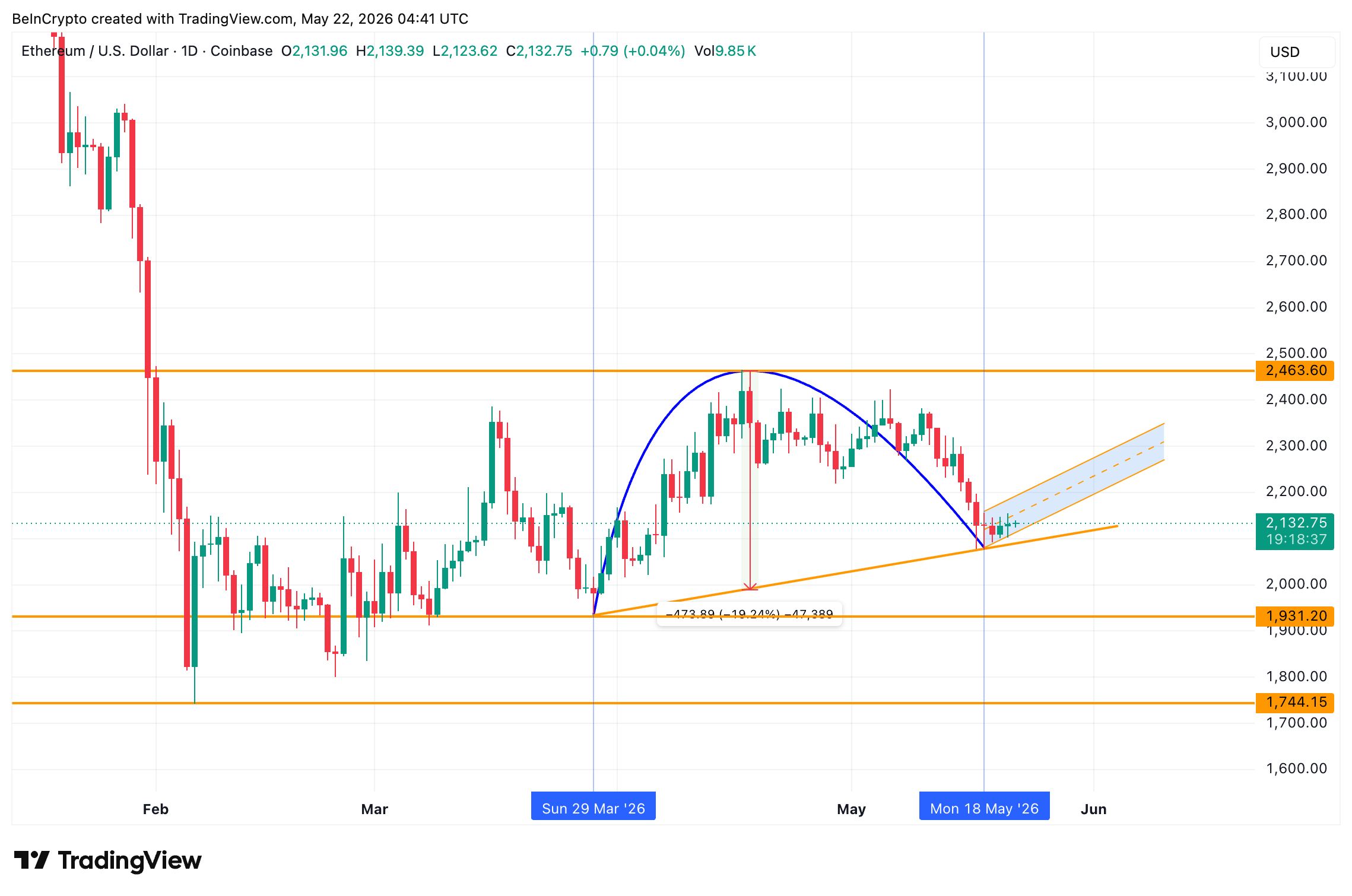
Ethereum (ETH) price trades at $2,132 on May 22, holding flat after a small rebound off recent lows. The action masks a deeper split between two on-chain cohorts pulling in opposite directions.
The price chart, whale supply data, and conviction holder behavior each tell different stories. Resolving the conflict points to one of two outcomes for Ethereum in the coming sessions.
Price Pattern and Whale Exit Point to Downside Risk
Ethereum has been trading inside an inverted cup and handle since March 29. The pattern is a bearish reversal formation where price climbs in a rounded arc before rolling over. The cup completed near May 18, with the small rebound since then forming the handle.
If the handle gives way, the measured move points to a 19% correction. The downside math would set up a cycle reset for Ethereum back to early February territory.
Want more token insights like this? Sign up for Editor Harsh Notariya’s Daily Crypto Newsletter here.

Ethereum whales have been adding pressure to that scenario. Santiment data shows the supply held by whales (exchanges excluded) sat at 125.36 million ETH on May 17. The reading has since drifted to 125.02 million. This is a drop worth $725 million at the current ETH price.

The whale exit started in mid-May, coinciding exactly with the cup completion phase. That timing suggests the largest stack is rotating out as the pattern matures.
The whale read validates the bearish technical setup, but a separate cohort tells a contradictory story.
Smart Money Stays Bearish While Hodlers Build Aggressive Positions
The Smart Money Index measures informed-investor conviction by comparing trading patterns. The reading currently sits below its zero line. That signals institutional and informed buyers have not returned, even with the small rebound since May 18.

This reinforces the bearish read from the pattern and the whale exit.
However, Ethereum hodlers, ones with a stash older than 155 days, moved in the opposite direction. The Hodler Net Position Change rose from 77,978 ETH on May 16 to 151,890 ETH by May 21. That works out to a 95% jump in conviction-holder accumulation over five days.

Whales sell, smart money waits, hodlers stack. The hodler buying looks paradoxical, but the cost basis distribution map explains why.
Ethereum Price Levels Hinge on Handle Support and the Cost Basis Cluster
The Glassnode cost basis heatmap shows a concentrated cluster at the $2,059 to $2,075 zone. Roughly 1.378 million ETH sits at that Ethereum cost basis range, the only meaningful supply cluster anywhere near the current price.
Hodlers are defending this floor. If the price holds above the cluster, their positions stay green, and the bid keeps showing up. If the cluster breaks, the conviction wave likely reverses.

The handle’s structural support sits at $2,102. A clean loss of $2,102 sends the price directly into the cost basis cluster. Below $2,059, the next stops are $2,017 and $1,896, with the full measured move target at $1,697.
That $1,697 reading sits below the February 6 ETH cycle low of $1,744. A move there would mark a true cycle reset, fresh territory for the current leg.

For the bullish thesis to gain traction, the Ethereum price needs to clear $2,292 first. A daily close above $2,462 would invalidate the inverted cup and handle. The $2,102 level separates a hodler defense holding the line from a full cycle reset to $1,697.
The post $725 Million in Ethereum (ETH) Just Left Whale Wallets: The Timing Is Suspicious appeared first on BeInCrypto.

Key Takeaways
- Billionaire Mark Cuban liquidated approximately 80% of his Bitcoin position following disappointing performance
- During the US-Iran geopolitical tensions, gold reached $5,000 while Bitcoin declined in value
- Cuban maintains his Ethereum holdings, emphasizing its practical applications in DeFi and smart contracts
- The investor characterized the majority of alternative cryptocurrencies as worthless
- Bitcoin supporters counter that the asset has gained more than 16% since tensions escalated, depending on measurement period
Billionaire entrepreneur Mark Cuban, known for owning the Dallas Mavericks, has divested approximately 80% of his Bitcoin portfolio. In an interview on the Front Office Sports podcast “Portfolio Players,” Cuban revealed that Bitcoin’s performance during recent geopolitical instability contradicted his investment hypothesis.
JUST IN: Billionaire Mark Cuban says he sold “most” of his Bitcoin.
“Bitcoin has lost the plot.” pic.twitter.com/8xbRbcPBpC
— Watcher.Guru (@WatcherGuru) May 21, 2026
For years, Cuban championed Bitcoin as an improved alternative to gold. He frequently cited its capped supply and decentralized framework as advantages that positioned it as a superior wealth preservation tool. Just months ago, in January 2025, Cuban publicly stated his preference for Bitcoin over gold during economic downturns.
His perspective has undergone a dramatic shift.
The Reasoning Behind Cuban’s Bitcoin Exit
“When all this hit the fan with the Iran war, bitcoin was always the best alternative to fiat currency losing its value,” Cuban explained. “Gold just blew up and went to $5,000. Bitcoin dropped.”
Cuban’s rationale centered on a straightforward expectation: whenever the U.S. dollar weakened, he anticipated Bitcoin would appreciate. The reality proved different. While gold rallied amid geopolitical uncertainty, Bitcoin experienced a decline.
Prior to 2026, Cuban’s digital asset allocation consisted of approximately 60% Bitcoin, 30% Ethereum, and 10% various other tokens. He previously stated he had never liquidated his Bitcoin holdings. That longstanding commitment has now dramatically shifted.
“Not the hedge I expected it to be, and that was really disappointing,” he remarked.
Cuban labeled most alternative digital currencies as worthless while noting his continued confidence in Ethereum.
Ethereum Retains Cuban’s Support
Despite his Bitcoin exit, Cuban retains his Ethereum position. He has repeatedly highlighted its smart contract capabilities and its foundational role in powering decentralized finance platforms and non-fungible tokens.
Cuban draws a clear distinction between Bitcoin, which he primarily evaluated as a value storage mechanism, and Ethereum, which he considers to have more tangible practical applications.
His recent statements indicate this differentiation has become increasingly significant in his investment framework.
Bitcoin Advocates Challenge Cuban’s Assessment
Cuban’s interpretation of recent market behavior hasn’t gone unchallenged.
Cryptocurrency proponents highlight that from the initial escalation of US-Iran tensions in late February, Bitcoin has appreciated over 16% while gold has declined more than 15%. The comparative performance varies significantly based on the selected timeframe.
Bitcoin currently trades around $77,500, representing approximately a 38% decrease from its October 2025 peak of $126,080. Gold is valued near $4,500 per ounce, having retreated from its $5,000 high.
Cuban’s decision appears isolated from wider institutional trends. Bitcoin spot exchange-traded funds collectively manage over $100 billion in assets, demonstrating sustained institutional appetite for the cryptocurrency.
Cuban’s portfolio adjustment represents an individual investment choice rooted in his specific expectations about Bitcoin functioning as a macroeconomic hedge — expectations he now believes the asset has not fulfilled.

Fundamental Background
The RBA’s third consecutive interest rate increase to 4.35% reflects the regulator’s concern over rising inflation: the conflict in the Middle East is increasing energy costs and putting upward pressure on prices. Annual consumer inflation stood at 4.6% in March. Analysts at CBA believe this rate hike should be sufficient, with the base-case scenario pointing to rates remaining unchanged until the end of 2026, provided neither the federal budget nor second-quarter inflation data deliver major surprises.
At the same time, the Australian dollar failed to hold near its May highs, as rising demand for safe-haven assets amid global uncertainty weighed on risk-sensitive currencies.
AUD/USD Technical Picture
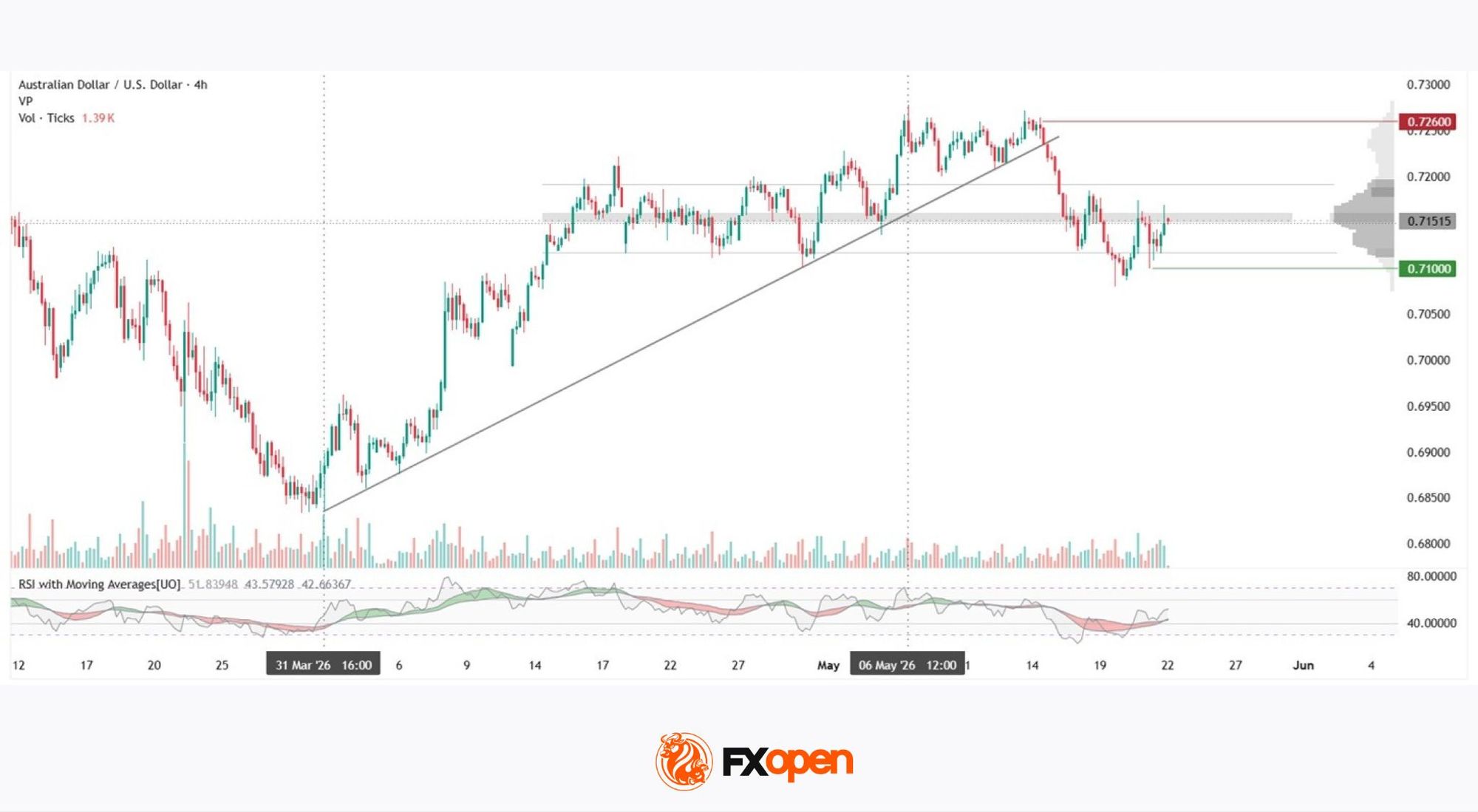
On the 4-hour AUD/USD chart, the upward movement from late March to early May is clearly visible, forming a pronounced trend with a characteristic wave structure. In mid-May, the trend was broken and the price declined towards the 0.7100 area, ultimately forming a green support level. The Point of Control (POC) zone is currently being tested from below, while the horizontal volume profile boundaries cover the 0.7120–0.7190 range — the corridor where the bulk of market activity is concentrated.
The 0.7190 level could act as resistance in the event of recovery attempts within the profile. The red resistance level at 0.7260 — the local May high — may remain an important reference point should the pair test the upper trend levels. The RSI + MAs indicator currently shows readings of 51 / 43 / 42, reflecting the market’s restrained and neutral character.
Key Takeaways
The key driver for the pair remains the balance between expectations for further RBA action and demand for safe-haven assets — for now, both forces continue to compete with one another. The RSI picture offers no clear advantage to either side, while price action remains close to the POC zone within a relatively narrow market profile.
Trade over 50 forex markets 24 hours a day with FXOpen. Take advantage of low commissions, deep liquidity, and spreads from 0.0 pips (additional fees may apply). Open your FXOpen account now or learn more about trading forex with FXOpen.
This article represents the opinion of the Companies operating under the FXOpen brand only. It is not to be construed as an offer, solicitation, or recommendation with respect to products and services provided by the Companies operating under the FXOpen brand, nor is it to be considered financial advice.

A fresh read on on-chain and derivatives signals suggests institutional appetite for crypto has cooled further, with the Coinbase premium slipping deeper into negative territory. The metric, which tracks the gap between Bitcoin prices on Coinbase (a venue favored by U.S. institutions) and Binance (more retail-oriented), slid to its lowest level this month at -0.0983% on May 21, underscoring renewed selling pressure from professional investors.
The premium has remained negative since late April, but the pace of decline picked up over the last week. CryptoQuant analyst Darkfost characterized the move as a heightening of selling pressure among institutional traders. “Institutional selling pressure has intensified recently,” Darkfost said. “This suggests that the population of institutional and professional investors trading on Coinbase Advanced is selling more aggressively than investors trading on Binance.”
Beyond the Coinbase premium, the broader macro backdrop appears to bolster a cautious stance among institutions. Gold—historically viewed as a hedge—has fallen about 5.8% over the past month, while equities across the S&P 500 and Dow Jones have shown gains since early April. That mix points to a risk-on tilt in traditional markets and a reallocation that may be weighing on crypto demand at the margin.
Key takeaways
- The Coinbase premium sits negative, with the May 21 reading at -0.0983%, signaling intensified institutional selling pressure on Coinbase Advanced relative to Binance.
- Analysts tie the shift to hedging behavior amid macro uncertainty, with institutions repositioning and possibly taking profits, which could dampen near-term crypto momentum.
- Bitcoin ETF outflows in the United States accumulate, totaling about $1.3 billion over four trading days since May 14, while derivatives demand shows signs of waning.
- Open interest in Bitcoin futures and perpetuals declined by roughly $1.5 billion in the week, suggesting a reset of leveraged bets and a potential reliance on actual spot demand for the next move.
- Bitcoin itself has fallen about 4.5% over the past week, trading near $77,600 after a monthly low just above $76,000, roughly 38% below its October peak.
Institutional positioning and the “premium” signal
The Coinbase premium has long been monitored as a proxy for the behavior of sophisticated buyers in the U.S. market. When the premium turns negative, it implies Coinbase’s price is softer than Binance’s, which can reflect a withdrawal of U.S. institutions from spot exposure or a shift toward hedging strategies. In this cycle, the trend toward negative readings has persisted for weeks, but the steep drop over the last seven days has heightened concerns about whether a larger cohort of funds is stepping back from fresh exposure to Bitcoin.
Nick Ruck, research director at LVRG, offered a cautionary angle: the drop in the premium could signal “the emergence of net selling pressure from larger holders,” potentially indicating profit-taking or portfolio rebalancing. He warned that such dynamics might weigh on near-term price momentum across major crypto assets, especially if spot demand remains lackluster as institutional selling persists.
By contrast, some market participants view the divergence between Coinbase and more retail-oriented venues as a gauge of sector rotation rather than a pure directional bet on price. Still, the current signal aligns with a broader pattern of institutions slowing or pausing fresh allocations while macro clarity remains elusive.
ETF outflows and dwindling derivatives activity
The latest data on U.S. spot Bitcoin ETFs adds another layer to the selling narrative. CoinGlass reports four consecutive trading days of outflows totaling roughly $1.3 billion since May 14. The pace of withdrawals suggests institutions are reallocating capital away from spot exposure or consolidating risk in other assets amid ongoing uncertainty.
Concurrently, operator activity in the derivatives market is cooling. Bitfinex noted that open interest—the aggregate value of outstanding Bitcoin futures and perpetual contracts—dropped by around $1.5 billion during the week. That retrenchment follows a period in which leveraged positioning had been building as Bitcoin moved toward the $82,000 region. The exchange framed the current environment as a transition: “With short-side fuel exhausted and long positioning reset lower, the next major move likely depends on spot demand.”
Bitcoin itself has retraced recently, posting a 4.5% decline over the past week and touching a monthly low just above $76,000 on Tuesday. At the time of writing, the asset hovered around $77,600, about 38% below its October peak. The combination of ETF withdrawals, falling open interest, and a still-fragile spot bid paints a picture of a market waiting for a catalyst—whether macro clarity, stronger institutional demand, or a sustained shift in risk sentiment.
Implications for traders and builders
These indicators point to a market environment where institutional demand remains tepid and price action is predominantly contingent on spot-buying vigor rather than leveraged bets. For traders, the deterioration in the Coinbase premium and the uptick in ETF outflows suggest a cautious stance: any upside move will likely require a tangible uptick in spot demand rather than relief rallies driven by derivatives leverage.
From an infrastructure and product perspective, the signals reinforce the importance of robust on-ramp options, transparent liquidity channels for institutions, and clarity on how macro shifts might influence hedging behavior. For developers and builders, evolving custody and settlement workflows, regulatory clarity, and improved access to compliant institutional products could help bridge the gap between retail enthusiasm and institutional participation.
Looking ahead, observers will be watching two intertwined threads: whether spot demand strengthens enough to absorb the existing overhang from hedgers and large holders, and how ETF and derivatives flows respond to fresh macro data and regulatory signals. If institutional selling persists and the premium remains negative, risk assets, including Bitcoin, could face the near-term pressure that many market participants already anticipate.
In the near term, investors should monitor whether spot demand improves or whether the current dynamics prolong the consolidation phase. The coming weeks will be telling for whether the dip in the Coinbase premium and ETF outflows translate into a broader regime shift or a temporary pause before renewed interest from institutional buyers returns.
What remains uncertain is how incoming macro developments—ranging from inflation data to regulatory updates and central-bank policy—will shape the risk appetite of large funds with crypto exposure. As ever, the market’s next move is likely to hinge on the delicate balance between hedging needs, liquidity availability, and the evolving appetite for risk across traditional and digital asset classes.
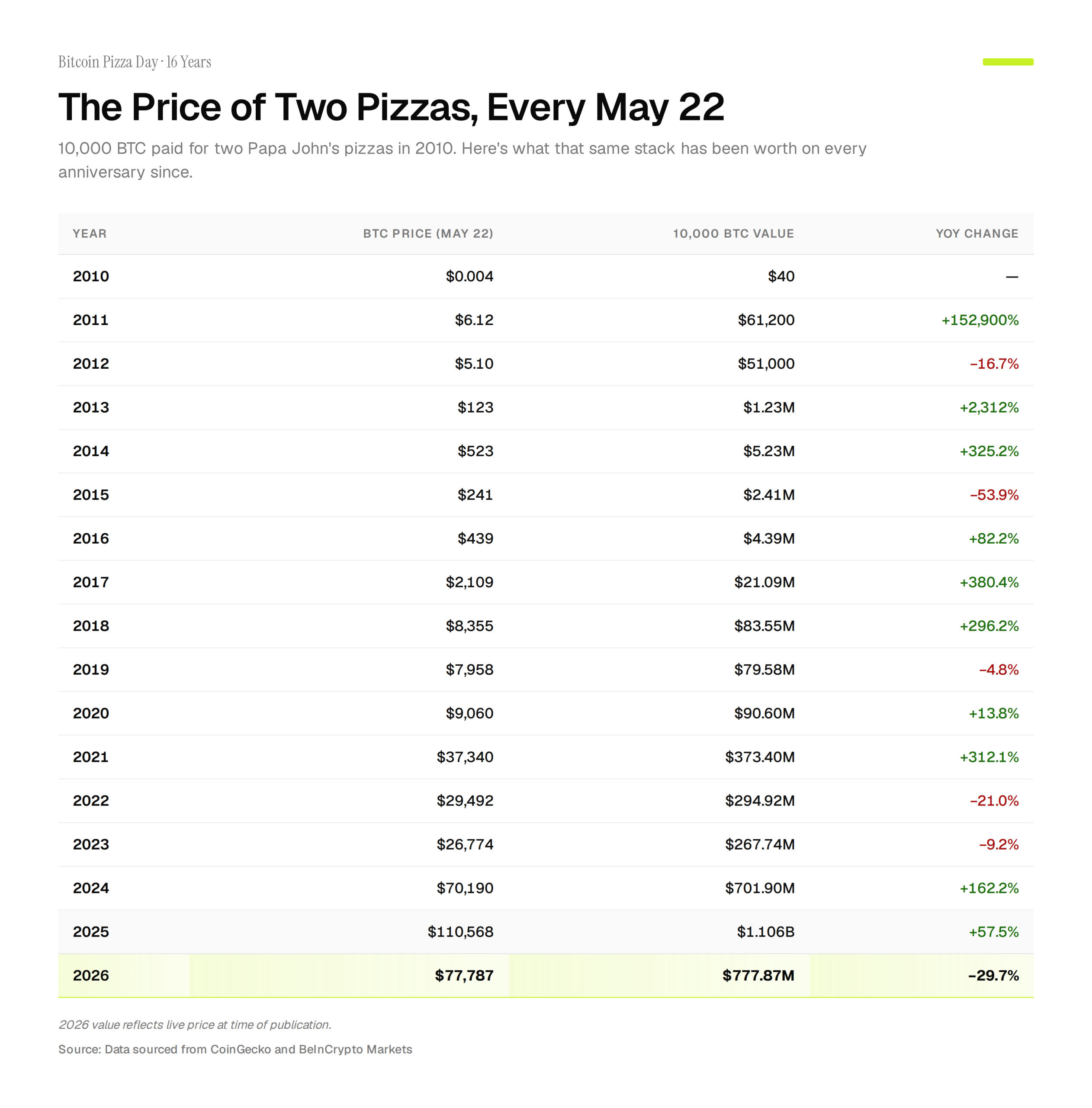
Bitcoin Pizza Day arrived with a $328 million loss this year. The 10,000 Bitcoin (BTC) that bought two Papa John’s pizzas in 2010 is now worth $777.87 million, down from $1.106 billion on the 15th anniversary in 2025.
The 29.7% year-over-year decline is the steepest drop in any Bitcoin Pizza Day stack since 2015, when the cryptocurrency fell 54% during a bear market.
Follow us on X to get the latest news as it happens

From a Billion-Dollar Stack to $777 Million
Last year’s anniversary arrived during a clear bull run. Bitcoin traded at $110,568 on May 22, 2025, setting new all-time highs at the time. Programmer Laszlo Hanyecz’s original 10,000 BTC stack had a notional value of $1.106 billion, per CoinGecko data.
Bitcoin extended that rally through the summer and into October. The cryptocurrency hit a new all-time high of $126,000 on October 6, 2025, amid strong institutional flows and muted retail participation.
That run ended four days later. On October 10, President Donald Trump announced 100% tariffs on Chinese imports, triggering nearly $200 billion in losses in the crypto market. Bitcoin fell from $122,000 to $107,000 following the announcement.
Bitcoin’s Journey From All-Time High to Worst Opening Quarter
Bitcoin spent the rest of 2025 below its October peak. By the time 2026 began, the rally that had powered Pizza Day 2025’s record valuation had broken.
Q1 2026 became the worst opening quarter since 2018. Bitcoin closed the period down 22.2%, with spot Bitcoin exchange-traded funds (ETFs) losing a net $496.5 million amid Iran tensions.
Q2 has brought partial relief. Bitcoin has climbed roughly 14% over the quarter. Nonetheless, the cryptocurrency remains in the red year-to-date.

Bitcoin traded near $77,787 on Pizza Day 2026. That sits 29.7% below last year’s $110,568 price and 38% below October’s $126,000 record.
The price has now fallen in six of 16 anniversaries. 2026 marks the largest absolute dollar drop in that streak.
Subscribe to our YouTube channel to watch leaders and journalists provide expert insights
The post Bitcoin Pizza Day 2026 Arrived Over $300 Million Lighter Than Last Year appeared first on BeInCrypto.


Polymarket, the world’s largest decentralized betting platform, has gone dark for users in India. The website says, “This site can’t be reached. Check if there is a typo in polymarket.com.”
Refreshing the page does not resolve the connection issue.
The outage follows an April 25 advisory from the Ministry of Electronics and Information Technology (MeitY) directed at VPN service providers. The advisory warned that local users were continuing to access “illegal and blocked prediction market and online betting platforms” despite “domestic prohibitions.”
According to the directive, internet service providers were required to terminate access to prediction markets, with Polymarket among the primary targets.
While Kalshi, a platform regulated by the U.S. Commodity Futures Trading Commission (CFTC), is currently still accessible, it may soon face a similar fate. Local media reports, citing an anonymous source within MeitY, claim the agency has “already issued a blocking order to Polymarket and are in the process of issuing an order to Kalshi as soon as Friday.”
CoinDesk reached out to Polymarket and Kalshi for a comment.
Prediction markets enable users to wager real money on the outcomes of binary events, such as referendums, financial asset price movements, and election results. These platforms saw a massive surge in global popularity during the 2024 U.S. presidential election, becoming a primary venue for investors to hedge or bet on political outcomes.
However, the Indian government classifies the activity on these platforms as online money gaming. As a result, they fall under a category that is completely prohibited under the Promotion and Regulation of Online Gaming Act 2025.
The Indian government has maintained a consistently “risk-averse” and prohibitive stance toward the cryptocurrency sector, prioritizing financial stability and capital control over industry growth. New Delhi has utilized a “shadow ban” strategy through punitive taxation, including a 30% flat tax on gains and a 1% tax deducted at source (TDS) on all transactions, which has effectively throttled domestic trading volumes.
The Ministry of Finance has focused on bringing the sector under strict Anti-Money Laundering (AML) and Counter-Strike Financing (CFT) oversight via the Financial Intelligence Unit (FIU). This regulatory environment has pushed many local crypto startups to relocate to more friendly jurisdictions like Dubai or Singapore, as the government and the Reserve Bank of India continue to signal that it views private cryptocurrencies more as speculative “money games” than legitimate financial innovation.
India’s Parliamentary Standing Committee on Finance met crypto exchanges Binance, WazirX and Zebpay in Delhi on May 20 to discuss regulations and taxation for what it calls a virtual digital assets (VDA) industry.
The committee expressed concerns over massive outflows from the country via the crypto channel.
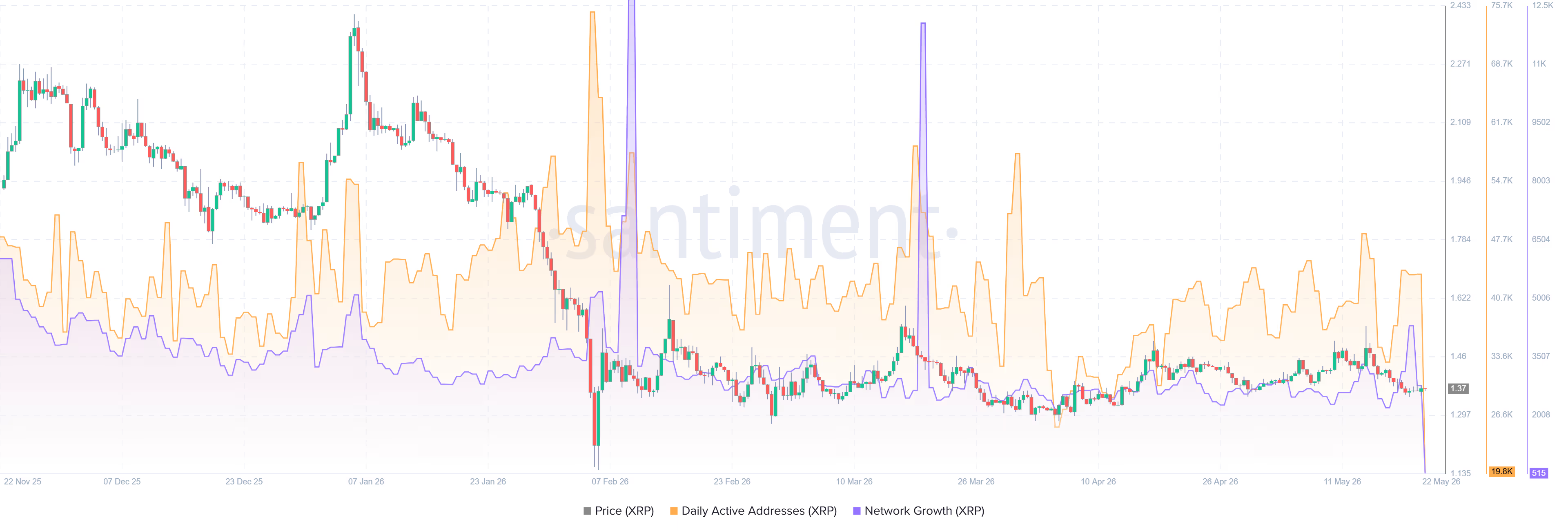
XRP held near $1.37 by midday Hong Kong time on Thursday, according to CoinDesk market data, with fresh ETF and on-chain data suggesting some investors may be rotating into XRP. Meanwhile, market leader bitcoin hovered around $77,400 and ether (eTH) remained under pressure.
CoinGlass data shows XRP-linked funds pulled in $8.88 million in the latest session, extending a streak of positive flows that includes $18.52 million on May 14 and $10.87 million on May 15. Across the past week, XRP products have attracted roughly $42 million in net inflows.
This has caught analysts’ attention because money has been leaving the largest listed crypto products. Bitcoin ETFs lost another $100.9 million in the latest daily session, following redemptions of $648.6 million, $331.1 million, and $290.4 million earlier in the same stretch. Ether products also remained under pressure, losing $32.6 million in the latest session.
The data suggests a selective appetite for alternative crypto exposure, though XRP’s broader network growth trend remains weaker than late 2025 levels.
Onchain activity offers a second, though less definitive, signal.
XRP recorded the fourth-largest daily spike in wallet creation this year, with 4,300 new wallets added in 24 hours, according to Blockchain analytics firm Santiment.

Fresh wallet creation can sometimes point to new network participation, particularly when paired with capital inflows.
But the broader Santiment chart suggests caution.
XRP’s network growth has generally trended lower since late 2025, making the latest move look more like a sharp one-day spike than clear evidence of sustained adoption.
For traders, the question is whether XRP is seeing the early stages of a broader rotation trade, or simply a short-lived burst of speculative positioning while the wider crypto market remains under pressure.


Binance CEO Richard Teng has rejected a new Wall Street Journal report, saying it contains wrong claims about the exchange’s sanctions controls.
Summary
- Richard Teng said Binance did not allow sanctioned individuals to transact on its platform.
- The WSJ report adds pressure after Binance’s $4.3 billion U.S. settlement and monitorship.
- Binance says its sanctions exposure fell 96.8% as it expanded compliance and law-enforcement work.
Teng said in a post on X that the WSJ report contains “fundamental inaccuracies” about Binance and its compliance program. He said Binance did not permit transactions with sanctioned individuals and that the transactions mentioned by the publication happened before the people involved were sanctioned.
The WSJ reported that Iranian-linked networks used Binance accounts to move large sums, including funds allegedly tied to sanctioned activity. The report said the activity involved accounts connected to financier Babak Zanjani and crypto firm Zedcex. Binance disputed the claims and said the information was inaccurate.
Teng says Binance reviewed the matter
Teng said Binance had already reviewed the issues before the WSJ contacted the company. He also said Binance gave those details to the publication, but they were not included in the report.
He added that Binance has “zero-tolerance for illicit activity” and will continue working with U.S. and global law-enforcement agencies to fight financial crime. The comment keeps Binance’s defense focused on timing, internal review, and cooperation with authorities.
Compliance record stays under review
The latest dispute follows earlier reports and government questions about Binance’s sanctions systems. In March, Binance formally denied allegations that it allowed transactions linked to Iran and said media reports cited in a U.S. Senate inquiry contained false claims about its compliance program.
Binance said at the time that it requires identity checks for every user and bars people located in Iran from using the exchange. The company also said it uses more than 25 monitoring tools to screen users and review transactions.
Past settlement shapes the debate
The issue remains sensitive because Binance pleaded guilty in 2023 to U.S. anti-money-laundering and sanctions violations. The Justice Department said Binance agreed to pay more than $4.3 billion and retain an independent compliance monitor as part of that resolution.
U.S. officials said the case included failures that allowed transactions between U.S. users and users in sanctioned jurisdictions, including Iran, between 2018 and 2022. Binance has since said it rebuilt parts of its compliance system and improved its monitoring.
Binance points to stronger controls
Binance has repeatedly pointed to recent metrics as proof of progress. Earlier reports said the exchange claimed sanctions-related exposure fell 96.8% between January 2024 and July 2025, from 0.284% of total exchange volume to 0.009%.
The company also said more than 1,500 workers now support compliance, sanctions screening, investigations, and risk functions. Binance said it processed more than 71,000 law-enforcement requests in 2025 and helped authorities recover funds linked to illicit activity.
U.S. Securities and Exchange Commission Commissioner Hester Peirce has pushed back against expectations that the agency could soon open the door to unrestricted tokenized stock trading through a proposed “innovation exemption.”
Summary
- SEC Commissioner Hester Peirce said any tokenized stock exemption would likely apply only to on-chain versions of existing public equities.
- Synthetic stock tokens that track share prices without shareholder rights are not expected to qualify under the proposed SEC framework.
- Industry executives from Superstate and Securitize said a narrower approach could reduce fragmentation risks in tokenized equity markets.
According to comments Peirce posted on X on Thursday, any exemption under consideration would apply only to on-chain versions of existing equity securities that already trade in public secondary markets.
She said she has always expected the proposal to remain “limited in scope,” adding that it would facilitate trading only for “digital representations of the same underlying equity security that an investor could purchase in the secondary market today.”
Her clarification arrived days after Bloomberg reported that the SEC was exploring a conditional exemption framework that could allow certain tokenized securities products to operate with modified regulatory requirements.
Fox Business journalist Eleanor Terrett described Peirce as “tempering expectations” around the proposal and narrowing its focus to “onchain equity products, not synthetic tokens that mimic stocks without giving investors the same shareholder rights.”
Peirce’s comments also appear to rule out synthetic stock-style tokens under the contemplated exemption. Such products typically track the price of equities without granting holders ownership rights tied to the underlying shares.
SEC discussions focus on shareholder rights
As previously reported crypto.news, SEC officials have discussed permitting tokenized equities only if the tokens preserve the same economic and governance rights attached to traditional shares, including voting rights and dividend access.
People familiar with the matter said the agency has gathered feedback from hundreds of market participants while shaping the proposal. The report added that discussions remain ongoing and the final terms could still change before any exemption is approved.
Concerns over synthetic stock products surfaced soon after the news surfaced. Brett Redfearn, president of tokenization firm Securitize, warned that allowing third parties to tokenize stocks without issuer involvement could create fragmentation problems across the market.
Other industry figures have also backed Peirce’s narrower interpretation.
Robert Leshner, CEO of tokenization platform Superstate, said on X that limiting tokenized trading to properly structured on-chain equities would allow decentralized finance and tokenization markets to grow “without compromising the standards that make the USA the center of capital markets.”
Meanwhile, Carlos Domingo, CEO of Securitize, has argued that restricting the exemption to genuine equity-linked assets would reduce risks tied to synthetic products.
“This is good, we want to do on-chain trading, but for the right assets, and not to help proliferate those derivatives that are fragmenting the market and introducing additional risks,” Domingo said.
Even with rising interest from crypto firms and financial institutions, tokenized equities remain a relatively small corner of the digital asset sector, though it is expected to grow.
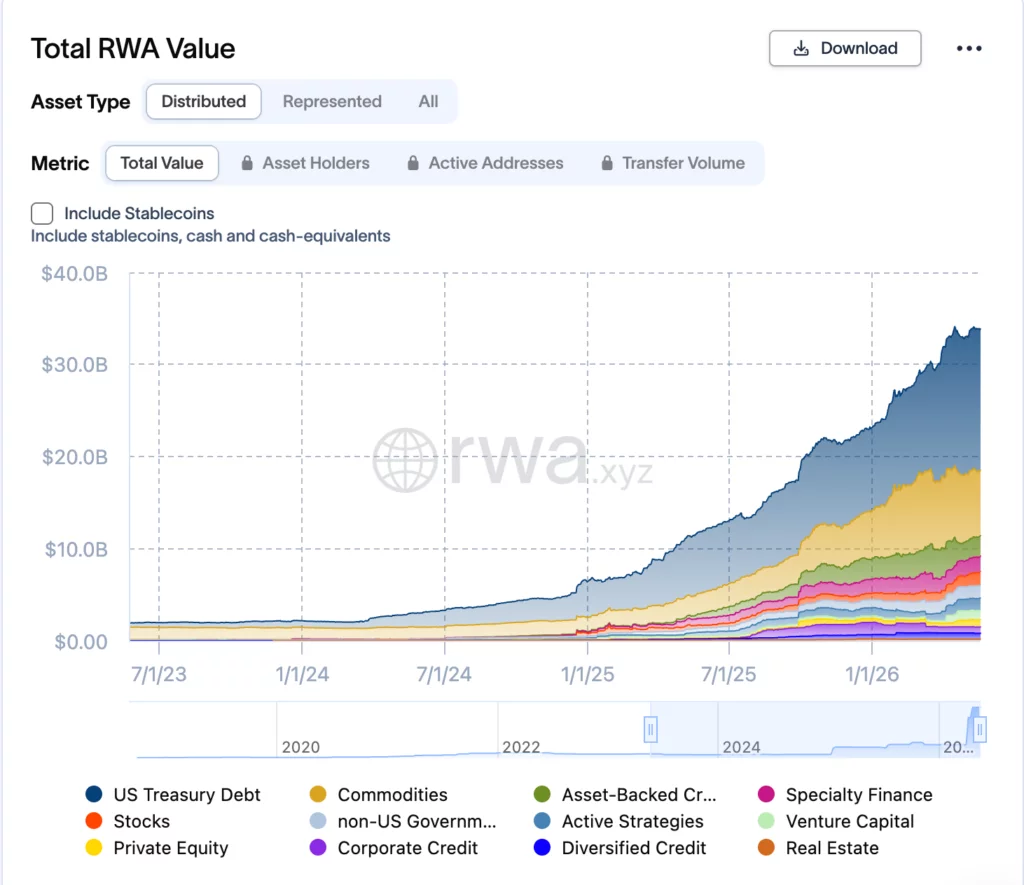
Data from RWA.xyz shows that tokenized stocks currently account for roughly $1.48 billion in on-chain assets. Existing offerings include tokenized exposure tied to companies such as Circle, Strategy, and Google.
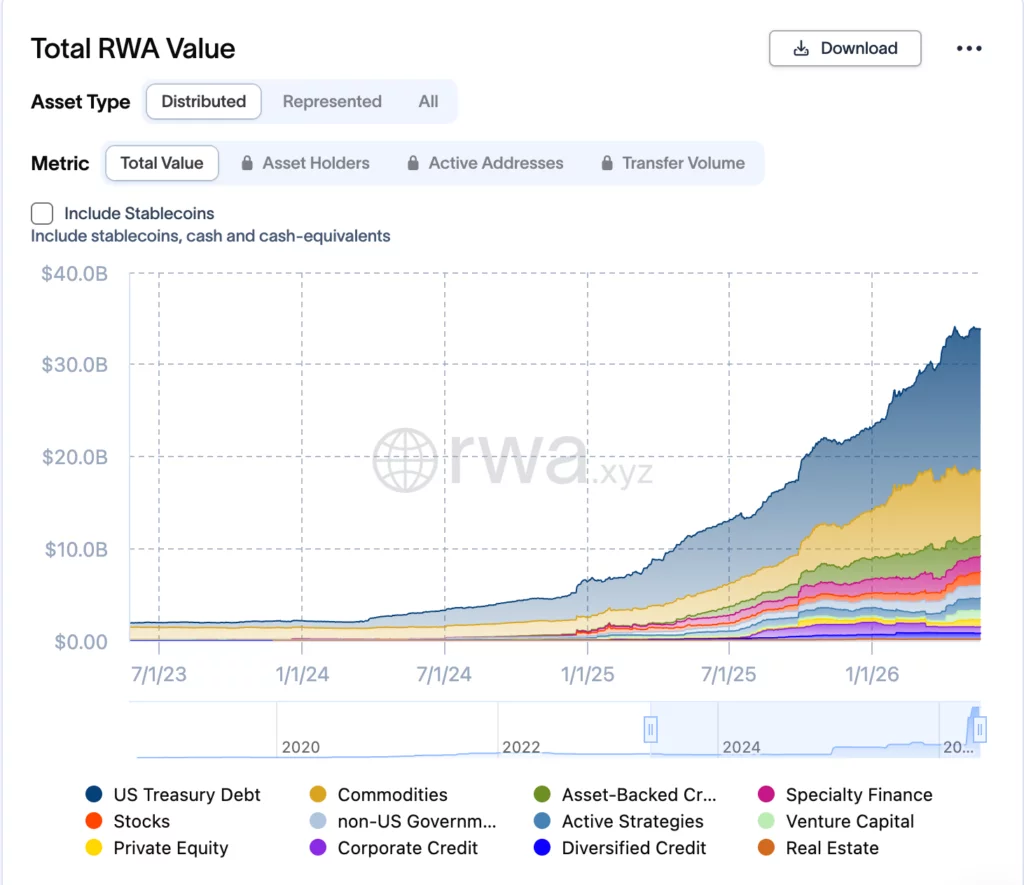
Total RWA market value. Source: RWA.xyz
Previously, it was also reported that some SEC officials remain hesitant about allowing tokenized stock trading at all, despite ongoing discussions around a possible exemption.


Trump Media & Technology Group (TMTG) moved 2,650 Bitcoin (BTC) worth roughly $205 million to Crypto.com.
The deposit marks the second major outflow from TMTG’s Bitcoin wallets this year. Analytics firm Lookonchain flagged the movement, though exchange transfers do not always confirm a sale.
Follow us on X to get the latest news as it happens
TMTG’s Bitcoin Treasury Sinks Deeper Below Cost Basis
Trump Media originally accumulated 11,542 BTC at an average cost of $118,522 per coin, deploying about $1.37 billion of corporate capital into the asset.
However, Bitcoin currently trades near $77,700, leaving the holdings roughly 34% below the entry price. The position now reflects an unrealized shortfall of about $455 million.
TMTG’s first major outflow occurred four months ago, when 2,000 BTC, valued at about $175 million, left company wallets at $87,378 per coin, according to Lookonchain data.
The company’s official treasury figure dropped to 9,542 BTC after that move, according to its Q1 earnings disclosure. The new 2,650 BTC transfer has further shrunk the stash to roughly 6,889 BTC.
The deposit follows a $406 million net loss reported earlier this month. Of that figure, $368.7 million stemmed from unrealized markdowns on digital assets and equity securities.
TMTG also holds 756 million Cronos (CRO) tokens, valued at about $2.64 million, as part of its broader treasury strategy.
The next on-chain settlement window should clarify whether the latest transfer ends in another confirmed sale.
Subscribe to our YouTube channel to watch leaders and journalists provide expert insights
The post Trump Media’s Bitcoin Stash Shrinks Again as 2,650 BTC Lands on Crypto.com appeared first on BeInCrypto.

Netflix’s Wild New Comedy ‘Mating Season’ Is Even More Unfiltered Than ‘Big Mouth’

‘Bond Market Fire Alarm’ The Next Financial Crisis | Bhatia & Consorti

‘Bungling doctors spent 7 years treating me for terminal cancer I never had’


-

 Crypto World6 days ago
BloFin War of Whales 2026 Grand Prix opens registration for $5M trading championship
-

 Fashion7 days ago
Weekend Open Thread: Theory – Corporette.com
-

 Crypto World7 days ago
E-Estate Announces 1 Year Live: Washington DC Summit as Real Estate Tokenization Enters Its Next Phase
-

 Tech6 days ago
Google reimburses Register sources who were victims of API fraud
-

 Business7 days ago
H&R Real Estate Investment Trust (HR.UN:CA) Q1 2026 Earnings Call Transcript
-

 Entertainment7 days ago
David Letterman Returns to Late Show, Blasts Cancellation
-

 Sports6 days ago
Napoleonic enters 2026 Doomben 10,000 field via Abounding withdrawal
-

 Crypto World6 days ago
BeInCrypto 100 Institutional Awards Nomination: KAST for Best Digital Assets Neobank and Best Digital Assets Fintech
-
 Crypto World6 days ago
Bitcoin Battles US Bond Nerves With BTC Price Dip Toward New May Lows
-

 Crypto World6 days ago
ICE and CME urge US regulators to curb Hyperliquid energy trading
-
 Crypto World6 days ago
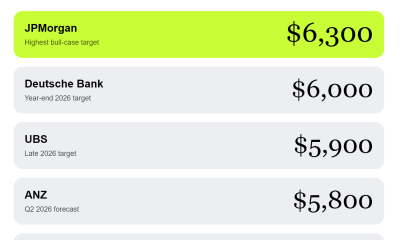
Wall Street’s Boldest Gold Prediction Has Russians Rushing to Buy
-

 Fashion5 days ago
On the Scene at Gucci’s Cruise Show in New York City: Mariah Carey, Kim Kardashian, Lindsay Lohan, Iman, and More!
-

 Fashion6 days ago
Trending Western Style Vests Perfect for Summer
-

 Crypto World6 days ago
IREN closes $3 billion convertible notes deal amid AI infrastructure expansion
-

 Politics6 days ago
Watch: far-right flag-fanatics run over victim, attack locals – Setup By the Left wing for your entertainment
-

 Fashion7 days ago
Creative Ideas for Custom T-Shirts
-

 Fashion5 days ago
Amazon Sundays: Memorial Day Hosting
-

 Crypto World13 hours ago
Blockchain.com files with SEC for U.S. IPO
-
 Fashion7 days ago
Philip Jones Wedding Jewellery For Women
-

 Crypto World6 days ago
Crypto Market Structure Bill Clears Committee; Senate Vote in Focus
You must be logged in to post a comment Login