
Crypto World
U.S. Jobs, Circle, Galaxy, American Bitcoin earnings: Crypto Week Ahead



Bitcoin started the week just below $63,000, with Friday’s U.S. jobs report the biggest macro event likely to determine whether the July rebound continues, though developments in Iran may take on greater significance in the coming days.
A muted rise in U.S. hiring could be the best outcome for risk assets like crypto. Such a rise would ease fears of an economic slowdown, but wouldn’t push the Federal Reserve closer to raising interest rates.
IG market analyst Tony Sycamore said a gain of around 88,000 jobs with unemployment unchanged at 4.2% would strike that balance in a “Goldlocks-type print.”
The U.S. government’s borrowing plans are another macro focus. JPMorgan strategist Jay Barry said the Treasury is likely to keep its regular debt sales unchanged, which would avoid adding pressure to interest rates. Larger-than-expected sales could raise borrowing costs for households and companies and weigh on crypto.
Traders will also watch earnings from Circle, Galaxy, Block and six bitcoin miners. BIP-110, a proposal to temporarily limit non-financial data stored on the Bitcoin blockchain, is expected to enter its required miner-signaling period.



Bitget has begun withdrawing services for residents of Japan, stopping new account registrations immediately and setting a timeline that will lead to mandatory account restrictions later this year.
Summary
- Bitget has stopped new registrations from Japan and will begin restricting resident accounts from Nov. 1.
- Users who believe they were wrongly classified as Japan residents must complete address verification before the deadline.
- Japan’s regulators had repeatedly warned Bitget over providing services without local registration before the exchange announced its exit.
- The move follows Bitget’s recent practice of limiting access in markets where it does not hold the required local authorization.
Bitget announced on Monday that it has stopped accepting new registrations from residents of Japan and will begin applying account restrictions from Nov. 1 as it exits the market. The exchange also said any positions that remain open on Dec. 31 will be closed automatically as part of the withdrawal process.
Under the plan, users who believe they have been mistakenly identified as residents of Japan must complete Level 2 identity verification, including address verification, before Nov. 1. Bitget said accounts that fail to complete the process by the deadline will continue to be classified as belonging to residents of Japan and will become subject to the restrictions.
Users affected by the changes will receive further instructions by email explaining the required procedures and available options for managing or withdrawing their assets, according to the announcement.
Japan action follows repeated regulatory warnings
The latest decision comes after several warnings issued by Japanese regulators over the past few years.
Japan’s Financial Services Agency first warned Bitget in March 2023 for allegedly offering cryptocurrency services to Japanese residents without registration. The regulator repeated that warning in November 2024, again stating that the exchange had continued operating without obtaining the required authorization.
Regulatory scrutiny continued in June 2025 when the Kanto Local Finance Bureau, a regional bureau of Japan’s Ministry of Finance, issued a separate warning to BTG Technology Holdings Limited. The bureau said the company, which it identified as operating under the Bitget name, had solicited online over-the-counter derivatives transactions without registration.
Rather than announcing plans to seek local authorization in Japan, Bitget has now outlined a timetable for ending services to residents, with new registrations already closed and existing accounts moving toward phased restrictions.
Bitget continues separating markets under local rules
The Japan withdrawal follows a pattern that Bitget has adopted across several jurisdictions, where product availability depends on local regulatory status instead of a single global operating model.
In July, the exchange formally stated that it is not licensed, approved, registered or supervised by the Monetary Authority of Singapore. Bitget also confirmed Singapore remains a prohibited jurisdiction under its terms of use, saying it neither offers nor targets its services to residents there while restricting platform access from the country.
At the same time, Bitget has continued seeking registrations and approvals in markets where it intends to operate. Last month, the company completed registration on New Zealand’s Financial Service Providers Register across several financial service categories and joined the country’s Insurance and Financial Services Ombudsman dispute resolution scheme.
However, New Zealand’s Companies Office states that registration on the FSPR does not by itself represent government approval or active regulatory supervision. Certain financial activities may still require separate authorization from the Financial Markets Authority or the Reserve Bank of New Zealand.
Commenting on the company’s regulatory strategy in previous statements, Bitget CEO Gracy Chen said the exchange would continue pursuing local regulatory requirements as it expands internationally.
Expansion plans continue outside restricted jurisdictions
While reducing access in markets where it lacks local authorization, Bitget has continued preparing for expansion elsewhere.
As previously reported by crypto.news, the company plans to establish a separate U.S. entity before launching services in the country. According to her comments, Bitget intends to secure money-transmitter, broker-dealer and derivatives approvals before entering the U.S. market, regardless of whether Congress ultimately passes the CLARITY Act.
The exchange has also been expanding its tokenized investment products. Chen previously said tokenized traditional assets accounted for between 20% and 30% of Bitget’s spot trading volume during the previous quarter, while more than half of its users held both cryptocurrencies and stocks.
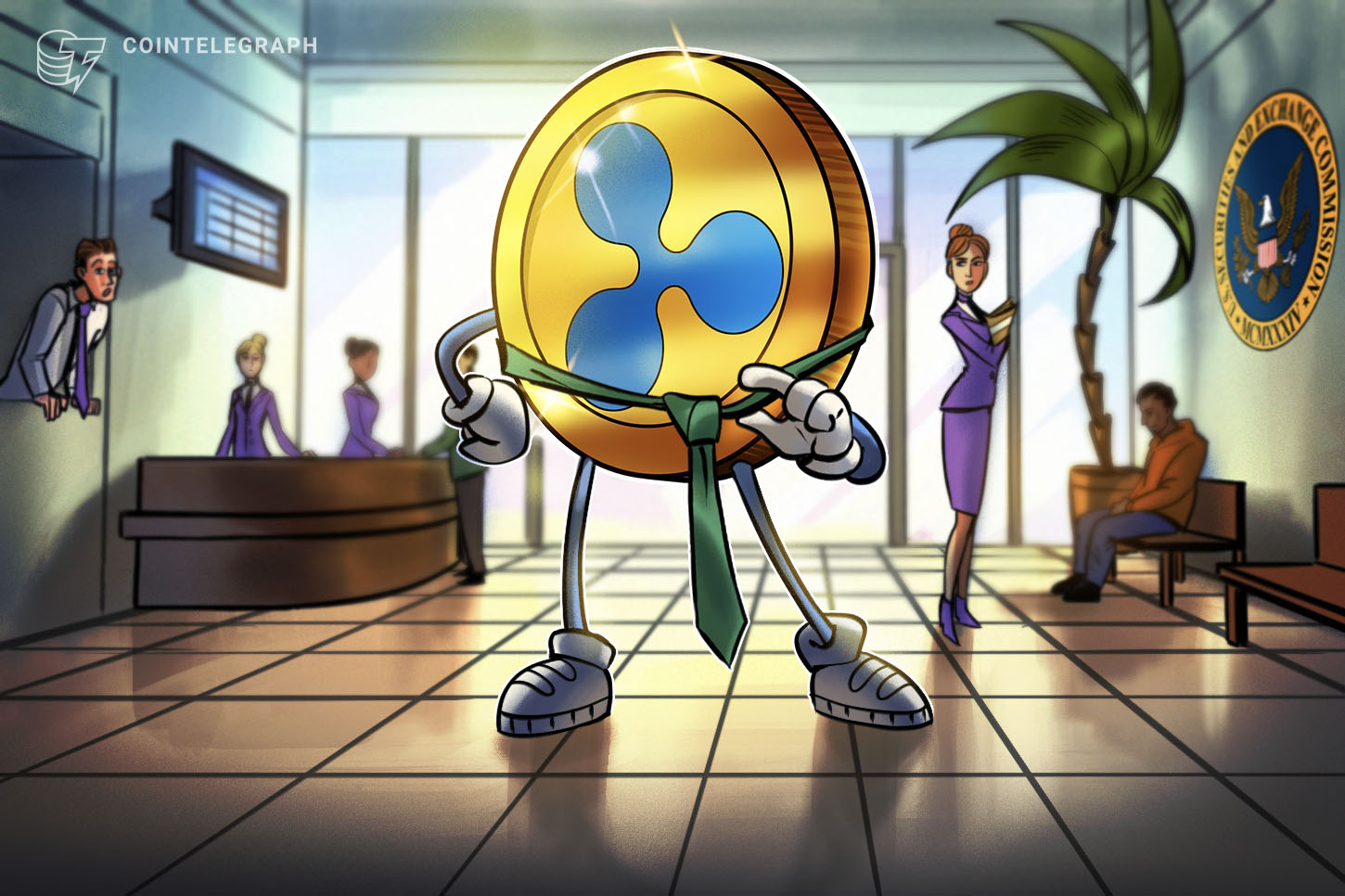
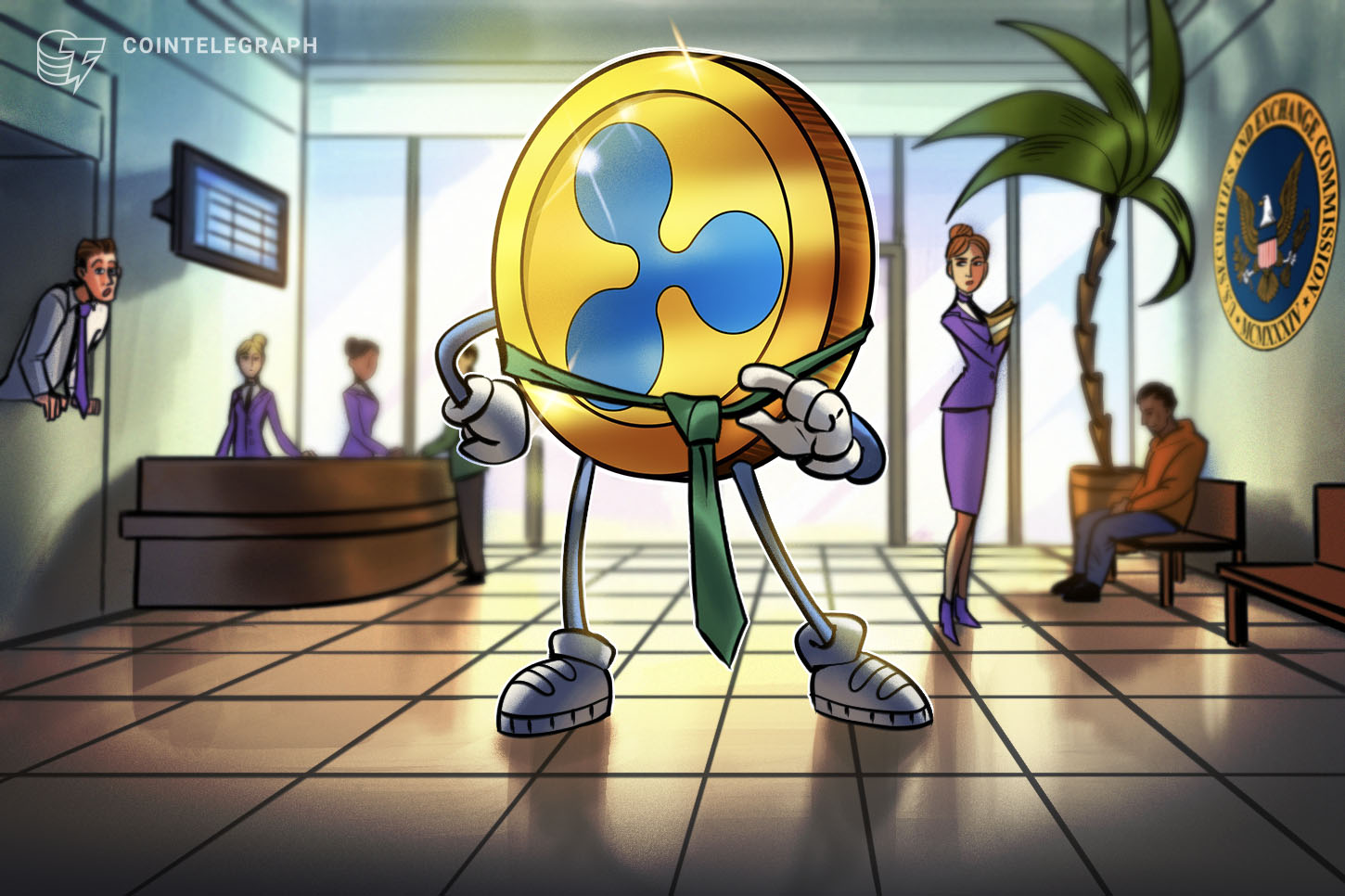
Ripple announced two new strategic investments as the blockchain-focused fintech seeks to expand access to tokenized financial assets on its blockchain ledger.
The company said it made strategic investments in Zilo, which provides global transfer agency asset solutions for wealth managers, and in Licuido, a tokenization solutions provider regulated by the UK Financial Conduct Authority, according to a Monday announcement.
Financial details for the investments were not provided. UK-based Zilo has raised $58.7 million in total equity funding, according to data compiled by Traxcn. Licuido is also based in the UK.
Ripple expects these deals to bring regulated transfer agency, issuance, and collateral mobility to its XRP Ledger (XRPL) infrastructure.
Combining the investments aim to help Ripple address the issues tied to idle collateral by enabling tokenized funds to be used as collateral from the point of issuance. The announcement came a week after London-based asset manager Aviva Investors launched a tokenized share class of its US Dollar Liquidity Fund on XRPL, after receiving approval from the Central Bank of Ireland.
Last month, Ripple launched Ripple Mint, a platform that gives institutions new ways to access, mint, redeem and manage its US dollar-pegged stablecoin, Ripple USD (RLUSD).
XRPL is the 11th-largest blockchain network with $368 million in tokenized real-world assets (RWAs). Ethereum ranked first with $17.1 billion in tokenized RWAs, according to data provider RWA.xyz.
Total RWA holders increased by 50% to 1.57 million during the past 30 days, while the total value of tokenized assets rose by 1.5% to $37.3 billion.
Magazine: What NYSE’s exploration of onchain systems means for financial markets

SHANGHAI, CHINA – JUNE 29, 2026 – Chinese and foreign tourists visit historical buildings at night near the Bund in Shanghai, China on June 29, 2026. (Photo credit should read CFOTO/Future Publishing via Getty Images)
Cfoto | Future Publishing | Getty Images
China’s domestic tourism market is weakening faster than expected, clouding one of the few bright spots in the country’s sluggish consumer economy.
Hilton China said last week it now expects revenue per available room (RevPAR) to fall by low single digits this year, worse than expectations earlier this year for a flat performance. The hotel group’s RevPAR swung from 1.3% growth in the first quarter, to a 2.2% fall in the second quarter.
“The China economy is sputtering, and I mean it’s growing, but not consistent with what prior growth rates have been,” Christopher Nassetta, President and CEO of Hilton, said in the group’s earnings call on Tuesday, according to a FactSet transcript.
A weekend night in August at a Hilton resort in Dali, Yunnan province, popular with domestic Chinese tourists, runs at $173. But other options recommended on travel booking site Trip.com are less than half the price, with one around $50.
Across China, hotel RevPAR has tumbled 6% year-on-year through late July, following a 1% drop in June, according to Smith Travel Research data cited by Goldman Sachs on Tuesday. That’s after RevPAR rose mildly this spring, the data showed.
A three percentage point drop in occupancy along with a 1% decline in average daily rates versus a year ago dragged down revenue, the Goldman report indicated.
The downturn reflects how China’s post-Covid tourism boom is fading after three years, amid a broader slowdown in the economy and retail sales.
Gary Ng, senior economist at Natixis, noted that there has been a “sharp decline of per-capita spending” on tourism since the third quarter of 2025.
“While tourism is still a bright spot, [it] cannot escape this broad macro trend,” he said, adding that consumers in China increasingly seek more unique or premium experiences, amid slower wage growth.
BAOSHAN, CHINA – JUNE 04: Tourists take photos at a viewing platform overlooking coffee plantations on June 4, 2026 in Baoshan, Yunnan Province of China. Xinzhai Village in Baoshan, known as “China’s First Coffee Village,” has over 70 years of coffee planting history and offers visitors experiences including picking, processing, roasting and brewing. (Photo by Li Jiaxian/China News Service/VCG via Getty Images)
China News Service | China News Service | Getty Images
Trip.com data showed price competition was clear in the three most-popular Chinese regions for travel this summer — Shanghai, Xinjiang and Yunnan.
An August weekend stay in China can cost anywhere from 40 yuan (US$6) to 18,000 yuan (US$2,633) per night, according to a CNBC analysis of Trip.com listings.
One-night stays saw a median price of just 192 yuan (US$28) in Kashgar, Xijiang, 373 yuan (US$55) in Dali, Yunnan, and 595 yuan (US$88) in Shanghai. Although premium rooms costing thousands of yuan lifted the averages, typical prices were far lower, with inexpensive options widely available in all three destinations.
KASHGAR, CHINA – OCTOBER 10: Tourists enjoy the picturesque scenery of the Bandir Blue Lake on October 10, 2025 in Kashgar Prefecture, Xinjiang Uygur Autonomous Region of China. (Photo by Bao Gansheng/VCG via Getty Images)
Vcg | Visual China Group | Getty Images
China’s retail sales have remained sluggish since the pandemic, with spending dipping in May from a year ago. Consumer prices have likewise been subdued, with a slower-than-expected 1% rise in June from a year ago.
Reflecting a sequential decline, the travel sub-index – part of the broader consumer price index – dropped by 0.6% in June from the prior month, according to China’s National Bureau of Statistics. In accompanying commentary, chief statistician Dong Liquan also pointed to sharp price drops in hotel rates and airfares.
The foreign luxury boost
While sentiment towards the domestic tourism market remains dim, inbound travel is emerging as a source of hope for the industry.
Thanks to China’s policy of allowing in travelers visa free from a growing number of countries, including in Europe, visitors from economies with far higher per capita income than China‘s are coming.
Upscale U.S. hotel operator Hyatt on Thursday reported an 18% increase in U.S. visitors into China, and 24% from Europe in the past quarter.
This premium end of the market offers a far brighter picture than the rest of the industry.
“China luxury properties were up 11% this past quarter in China. Lot of it’s leisure. So China is on fire,” Mark Hoplamazian, Hyatt president and CEO, said on the earnings call, according to a FactSet transcript.
Hyatt’s Greater China RevPAR rose 7.2% year-on-year in the second quarter, as Hoplamazian cited “leisure luxury” as a key driver.
Inbound travelers offer modest support for China’s tourism market. Overseas visitors account for 12% to 13% of total tourism spending, according to Natixis estimates.


Two French crypto investors have been held captive in London for more than 52 hours in a kidnapping and extortion case that ended with five men convicted after the victims were forced to transfer $30,000 in cryptocurrency.
Summary
- Five men were convicted after two French crypto investors were held captive in London for more than 52 hours and forced to transfer $30,000 in cryptocurrency.
- Prosecutors said the victims were tortured and threatened during the ordeal, while the alleged mastermind remains at large.
- Police rescued the victims after tracing a forgotten mobile phone and arrested several suspects following a high speed chase.
The Daily Mail, citing proceedings at Inner London Crown Court, reported that the two French cryptocurrency investors, both in their 20s, were abducted while visiting London and subjected to more than two days of confinement, violence and threats before officers from the Metropolitan Police’s Flying Squad rescued them.
Prosecutors told the court the victims’ lavish lifestyle, much of it documented on social media, may have drawn the attention of the group behind the attack. The prosecution argued that their public online presence made them attractive targets for criminals looking to extort digital assets.
Convictions follow London crypto kidnapping
A jury found Gerson Borges and Mohamed Osman guilty of conspiracy to blackmail and false imprisonment, while Julius George, Isaac Bakoya and William Adebisi were convicted of false imprisonment. The defendants were cleared of kidnapping, possessing an imitation firearm and sexual assault charges.
Court proceedings also identified Ibrahim Mohamed, known as “Nino,” as the alleged organizer of the operation. Prosecutors said he directed members of the group from overseas through WhatsApp and Snapchat and remains at large.
One of the victims alleged that he had been sexually assaulted during the ordeal. The jury acquitted the defendants on those allegations, but UK reporting restrictions prevent identification of two defendants because of laws protecting alleged victims in sexual offence cases.
Victims said torture was used to force crypto transfers
According to evidence presented in court, the victims traveled from France to London and were staying in Kensington before arranging to buy cannabis in east London.
After leaving their rented Mercedes in Shadwell, prosecutors said they were confronted by three masked men carrying a gun and a knife before being forced back into the vehicle and driven to an apartment in Canning Town.
The victims told investigators they were held inside the flat for about 52 hours. During that time, they said they were stripped naked, bound with tape and cable ties, beaten, burned with cigarettes and scalded with boiling water, including on their genitals.
Prosecutors said the gang also threatened to mutilate them, force them into sexual acts and attack one victim’s girlfriend unless they handed over cryptocurrency.
The court heard the group initially demanded $150,000 in crypto. The victims ultimately transferred about $30,000 before the attackers concluded no more funds were immediately available.
Evidence presented during the trial stated that one victim was released, while the second remained captive. In a recorded police interview played to jurors, the remaining victim said he believed he had been “sold” to another criminal group that intended to continue the extortion.
The victims also described harsh treatment during their confinement. Court testimony stated they received only one spicy chicken wing from a KFC meal while members of the gang ate the remaining food. One victim also alleged he was forced to drink toilet water.
Police tracked the gang through a forgotten phone
The prosecution said the investigation turned after a friend who had traveled with the victims escaped during the ambush.
Although he was pulled from the Mercedes by the attackers, his mobile phone remained inside the vehicle without the gang noticing. After reaching a McDonald’s in Earl’s Court, he persuaded a security guard to call emergency services.
Using the phone’s location together with CCTV footage, officers from the Metropolitan Police’s Flying Squad identified the location where the victims were being held.
Police intercepted the suspects after a vehicle pursuit through residential London streets that reportedly reached speeds of about 70 mph.
When officers rescued one of the victims from the suspects’ car, prosecutors said his hands were still tied and visible cigarette burns covered parts of his face, including his forehead and cheek.
The victims later declined to testify in person during the trial, telling the court they remained afraid of the group after the attack.
Crypto kidnapping cases continue to draw attention
The London convictions add to a series of violent crimes targeting cryptocurrency holders, with criminals increasingly relying on physical coercion rather than online attacks to steal digital assets.
Earlier this year, two Texas brothers pleaded guilty in a U.S. federal case after admitting to holding a Minnesota family at gunpoint for more than eight hours and forcing the transfer of more than $8 million in cryptocurrency. Investigators later traced the suspects using physical evidence, rental records and surveillance footage.
Security researchers commonly describe such incidents as “wrench attacks,” where victims are threatened or assaulted to surrender access to digital assets instead of having their wallets hacked remotely.
France has also experienced a rise in crypto-linked violent crime. Interior Minister Laurent Nuñez said on June 30 that authorities had recorded 77 cases involving kidnapping, unlawful detention, extortion or attempted offences connected to the crypto sector in 2026, compared with 45 cases during 2025.
Nuñez said around 200 people had been arrested following attacks or preventive operations, while the government has expanded cooperation between law enforcement agencies and the country’s digital asset industry. French officials have also warned that organized criminal groups increasingly target individuals whose crypto wealth is visible through social media or public activity.
The circumstances described by prosecutors in the London case closely match that pattern, with the court hearing that the victims’ online display of wealth may have contributed to them being selected by the gang.

Stablecoin transfers from South Korea to overseas crypto platforms surged again in June, underscoring how much demand from local users continues to flow outside domestic rails. According to Financial Supervisory Service (FSS) data cited by Yonhap News Agency, South Korea recorded stablecoin outflows of 560.3 billion won (about $367 million) to foreign exchanges—marking an 18-month streak of net outflows.
The same FSS data, obtained by People Power Party lawmaker Lee Jong-wook, points to a large volume of cross-border movement through the country’s five major exchanges: Upbit, Bithumb, Coinone, Korbit and Gopax. In June, these platforms transferred 2.7 trillion won (about $1.81 billion) in stablecoins offshore while receiving 2.2 trillion won (about $1.44 billion) from foreign platforms.
Key takeaways
- South Korea’s stablecoin outflows hit 560.3 billion won in June, extending a net outflow streak to 18 straight months.
- The FSS figures cited by Yonhap show South Korean exchanges both exported and imported large stablecoin volumes in June, with exports exceeding imports.
- Yonhap market participants linked the outflows to overseas products that may be restricted or unavailable domestically, including derivatives and certain DeFi and staking offerings.
- Lawmakers and regulators are reviewing investor protection and cross-border supervision as authorities seek to finalize a broader digital-asset framework.
- Regulatory discussions also include expanding crypto transfer reporting and tightening scrutiny of unregistered overseas exchanges.
Why stablecoins are leaving: availability and product access
In commentary collected by Yonhap, market participants attributed the cross-border stablecoin transfers to practical access differences between local and offshore venues. They pointed to demand for products that are either restricted or unavailable on South Korean exchanges, such as overseas derivatives, tokenized real-world assets (RWAs), and various decentralized finance (DeFi) and staking products.
That framing matters because it suggests the outflows aren’t simply about holding stablecoins abroad—they’re tied to the ability to deploy them in specific strategies. If domestic platforms cannot offer comparable products under current rules, users may prefer the regulatory and product availability advantages of offshore exchanges.
Investor protection concerns rise as outflows persist
Lawmaker Lee Jong-wook used the June figures to argue that South Korea needs to re-examine how it safeguards investors across borders. As reported by The Korea Times, Lee called on the government to “comprehensively examine its investor protection and supervisory frameworks again and move swiftly to improve regulations.”
The core concern is that stablecoin users may be exposed to risks that aren’t fully addressed by domestic oversight once funds move to jurisdictions with different licensing and supervision standards. The persistent nature of the outflows—net outflows for 18 months—also increases pressure on policymakers to ensure the new regulatory framework can address the real-world behavior of market participants, not just domestic activity.
Policy work continues: phased stablecoin rules and a new digital-asset framework
The latest outflow data arrives as South Korea continues building a broader legal structure for digital assets. A policy report released this week recommended that authorities introduce interim licensing guidance and phase in stablecoin regulation before the Digital Asset Basic Act is finalized, according to earlier coverage on Cointelegraph.
If enacted, the proposed act would be South Korea’s first comprehensive digital asset framework, covering areas such as stablecoin issuance, required disclosures, and rules governing market activities. However, the reporting also highlighted that lawmakers are still negotiating how the framework should work in practice—particularly which institutions should be permitted to issue won-pegged stablecoins. Disagreements on that point have contributed to delays, leaving a window where the regulatory environment may still be incomplete for some market participants.
For users and investors, the uncertainty has direct implications: when licensing, issuance rules, and market-activity requirements are not fully aligned, offshore venues can remain more attractive—especially if they already support the products users want.
Reporting expansion and tighter scrutiny of offshore venues
Beyond stablecoin-specific rules, South Korea’s regulators are also targeting cross-border compliance. Cointelegraph previously reported that the Financial Intelligence Unit (FIU) sought to broaden reporting requirements for crypto transfers. On June 22, the FIU proposed extending Travel Rule reporting requirements to transactions below 1 million won (roughly $650).
The FIU also urged stronger enforcement against unregistered overseas exchanges serving South Koreans. The agency argued that uneven licensing and supervision across jurisdictions can create opportunities for regulatory arbitrage—effectively allowing users to route activity to less constrained environments.
That enforcement argument dovetails with the persistent outflow trend. If domestic supervision tightens while offshore compliance remains uneven, policymakers may expect some shift back toward regulated channels. But the data cited by Yonhap suggests the decision to move stablecoins offshore is also driven by product access; enforcement alone may not be enough if users still perceive offshore platforms as offering functionalities they cannot obtain at home.
As South Korea moves toward interim licensing and broader stablecoin regulation ahead of the Digital Asset Basic Act, investors and market participants should watch for two things: whether the promised phased approach closes gaps that currently push activity offshore, and whether expanded Travel Rule reporting and offshore enforcement meaningfully reduce regulatory arbitrage without constraining legitimate domestic market development.


South Korea’s largest crypto exchange Bithumb said Monday it is preparing for a 2028 initial public offering (IPO) following a major internal reorganization to strengthen control and adoption of international account standards.
Seoul-based Bithumb did not reveal where it plans to launch the IPO. However, it did say it is working with domestic and international securities, law and account firms on the IPO process. Last year, Bithumb was said to be considering a NASDAQ listing, and later changed its plans to a listing on South Korea’s Kosdaq first.
CoinDesk approached Bithumb via email for more information, including where it plans to list its IPO, but had not received a response as of press time.
The crypto trading platform also said it plans to complete its risk management systems assessments and meet domestic and international account standards by the end of 2026. It then plans to apply for a preliminary listing review in 2027, with the IPO targeted for 2028.
Bithumb said the timetable could change depending on market conditions and regulators’ reviews.


Crypto and stock trading platform Robinhood has secured UK crypto registration ahead of the country’s new licensing framework.
Summary
- Robinhood has secured FCA registration to offer cryptocurrency services in the United Kingdom.
- The approval comes before the UK’s new crypto regulatory framework begins rolling out in late 2027.
- Robinhood had previously said it planned to launch crypto services in the UK after reporting its second quarter results.
- The company joins more than 50 crypto firms already registered under the FCA’s anti money laundering regime.
According to a recent announcement, Robinhood has received approval to offer cryptocurrency services in the United Kingdom after its UK subsidiary was added to the Financial Conduct Authority’s register of cryptoasset firms on July 31.
Under the FCA’s existing crypto registration regime, the approval confirms that Robinhood meets the regulator’s anti-money laundering requirements, allowing the company to operate crypto services before the UK’s new regulatory framework begins taking effect.
Robinhood gains an early position before new UK rules
Since 2020, the FCA has required crypto businesses operating in the UK to register under its anti-money laundering framework. More than 50 companies currently appear on the regulator’s register, including Ripple, Kraken, BlackRock and BNY.
Robinhood’s latest approval comes before the UK introduces its new crypto authorization regime. According to the announcement, applications under the updated framework will open at the end of September and close at the end of February next year, with the full regulatory system scheduled to take effect in October 2027.
“Today marks the beginning of a new chapter for Robinhood, and we’re excited to take the first important step towards bringing our investing platform to customers in the U.K. I’m thrilled to be a part of Robinhood and our effort to expand into a new international market.”
– Wander Rutgers, President, Robinhood International.
Because Robinhood already holds registration under the current framework, the company may have completed part of the regulatory work before the transition begins. Further, the announcement noted that firms already registered under the existing regime could enter the new authorization process with much of that groundwork already in place.
The approval follows Robinhood’s earlier statement that it planned to expand its crypto business into the UK.
During its second-quarter earnings release on July 29, the company said it intended to launch cryptocurrency offerings in the country but did not provide a timeline. The latest FCA registration now gives Robinhood the regulatory approval needed to move ahead with those plans.
Robinhood’s crypto business has continued to expand even as trading activity softened during the second quarter. The company reported crypto transaction revenue of $100 million, down 38% from a year earlier, although it launched Robinhood Chain, introduced Stock Tokens in more than 120 countries, rolled out Robinhood Earn and completed its acquisition of WonderFi during the same period.
Crypto becomes one part of Robinhood’s expansion
Robinhood has increasingly diversified its business outside traditional crypto trading.
Its second-quarter results showed total net revenue rose 32% year over year to $1.31 billion, supported by growth in event contracts, options and equities. Event contracts generated $156 million in revenue during the quarter, making them the company’s fastest-growing transaction business.
Separately, The Wall Street Journal reported in July that Robinhood had discussed adding Crypto.com’s event contracts to its prediction markets hub. Neither company confirmed an agreement, and the report said the talks could still end without a deal.
Robinhood has already expanded its prediction market network through Kalshi, ForecastEx and Rothera, the exchange it operates through a joint venture with Susquehanna International Group. According to the company, working with multiple exchanges helps provide customers with a wider selection of contracts while reducing dependence on a single supplier.
Registration arrives before a new regulatory phase
The UK’s upcoming crypto framework will replace the current registration system with a more comprehensive authorization process covering crypto firms operating in the country.
The registration window under the new framework will remain open for only a limited period before the new rules fully take effect in October 2027. Companies seeking to continue serving UK customers will need to obtain authorization under that system.
Robinhood enters that process after already obtaining FCA registration under the existing anti-money laundering regime. While the company has not announced when its UK crypto services will become available, the latest approval removes an important regulatory requirement ahead of the country’s transition to its next phase of crypto oversight.


The market that dragged bitcoin off $65,000 this week didn’t sell it hard. It just stopped showing up.
Bitcoin closed the week near $62,600 after failing to reclaim $65,000, and Yusuf Fakhro, a partner at Bahrain-based ARP Digital, reads that through the market’s plumbing rather than the Fed headline that nudged it lower. The ETF bid that powered July’s recovery has stalled, flipping to net outflows of nearly 4,000 BTC on the week after a run of steady inflows.
The rest of the tape has gone quiet to the point of dormancy. July logged the lowest average daily spot volume since November 2023. CME open interest sits at 2023 levels. Perpetual-futures positioning has stalled near 300,000 BTC.
It’s a market that has stopped participating, Fakhro said, and even Strategy has paused its bitcoin buying for a fifth straight week, so the biggest structural buyer is sitting on its hands too.
The July 29 Fed meeting held rates and offered no easing signal, stripping out the catalyst bulls had leaned on.
The week’s real jolt came from custody. A Coldcard firmware flaw dormant since 2021 was exploited to drain roughly 1,367 BTC, about $89 million, from thousands of self-custodied wallets, and some holders have since moved coins back onto exchanges and into regulated products.
Bitcoin traded near $62,700 on Monday, down 3.5% on the week. Watch the next inflow print: if the ETF bid stays flat while price holds, Fakhro’s exhaustion read is right, and if fresh outflows can’t push it under $60,000, the sellers really are done.


David Schwartz, an XRP Ledger co creator and current Ripple board member, proposed a Bitcoin inheritance setup on Aug. 3 that separates access to duplicate hardware wallets from the PIN needed to unlock them.
Summary
- David Schwartz proposed giving two duplicate Bitcoin wallets and their shared PIN to separate people.
- The setup uses one seed across devices, so it remains a single signature wallet structure.
- Four suspected Coldcard waves moved about 1815 BTC from more than five thousand addresses overall.
- Coinkite says fixed firmware protects new seeds but cannot repair phrases generated on affected devices.
- Multisignature inheritance systems require separate keys, unlike duplicate devices sharing one recovery phrase between them.
His post followed a renewed debate over paper backups after the Coldcard firmware failure. Ripple identifies Schwartz as an original XRP Ledger architect, while its current leadership page lists him as a board member.
Schwartz described the idea as “one way” to handle inheritance, not as a finished product or guaranteed security model. He suggested loading the same 24 word recovery phrase onto two additional cold wallets, setting the same PIN on both, giving one device to each of two relatives, and sharing the PIN with two trusted friends who would disclose it after the owner’s death. The post did not name a wallet model or use the “nuclear briefcase” label.
How the Bitcoin inheritance plan would work
The proposed setup creates two physical copies of the same wallet. Each relative would hold a signing device but lack the PIN. Each friend would know the PIN but hold no device. Under normal conditions, neither group could access the Bitcoin without cooperating with someone from the other group.
Schwartz’s argument came during a discussion about whether paper backups are simpler than hardware wallets. Paper avoids firmware exposure, but it remains vulnerable to theft, fire and accidental destruction. Bitcoin Design notes that metal backups offer greater physical durability, while hardware wallets isolate recovery phrases and private keys from connected devices.
Meanwhile, the arrangement does not create a multisignature wallet. Both devices contain the same recovery phrase, so each represents the same signing authority. One relative and one friend could therefore gain full control together. A leaked PIN paired with a stolen device could create the same result.
True multisignature systems use separate keys and require more than one signature before funds move. Unchained describes a common two of three structure where one compromised key cannot spend the Bitcoin alone. Schwartz’s proposal instead divides one complete credential into a physical component and a knowledge component.
Coldcard losses make seed quality the central risk
The debate follows a Coldcard flaw that weakened randomness during seed generation on affected firmware. Coinkite has released corrected versions, but updating firmware cannot repair an earlier recovery phrase. Affected users must create a new seed and move their Bitcoin. Coinkite says sufficient private dice entropy or a strong passphrase may provide additional protection in some cases.
Block’s security team traced the issue to a deterministic software fallback and limited reseeding process. It cautioned that it had “not done full empirical testing to confirm exploitability,” while reporting that active theft was underway. The findings show why copying a wallet is safe only when the original seed was generated securely.
As crypto.news reported, a fourth suspected attack wave moved 448.7 BTC from 709 possible victim addresses. Four observed waves may total about 1,815.75 BTC across 5,294 addresses if there is no overlap. Those figures remain onchain estimates rather than losses confirmed by every wallet owner, Coinkite or law enforcement.
A complete inheritance plan needs legal steps
Schwartz’s outline addresses access, but inheritance also requires clear instructions, legal ownership records and a process that heirs can execute under stress. Unchained advises documenting the security model and ensuring an executor or trustee understands how to use the relevant keys. In related coverage, crypto.news noted that self custody can leave assets permanently inaccessible when owners fail to prepare heirs.
The setup also depends on relatives and friends remaining reachable, trustworthy and capable of coordinating. Device failure, forgotten PINs, disputes or premature disclosure could still disrupt the transfer. The claim that heirs are “guaranteed” to receive the funds would therefore be too strong.
Schwartz’s post did not announce a commercial service, audit or formal technical specification. Independent review would need to compare the approach with multisignature wallets, time based controls and professional estate planning. Any recovery process should also be tested with a small balance before it is trusted with long term Bitcoin savings.
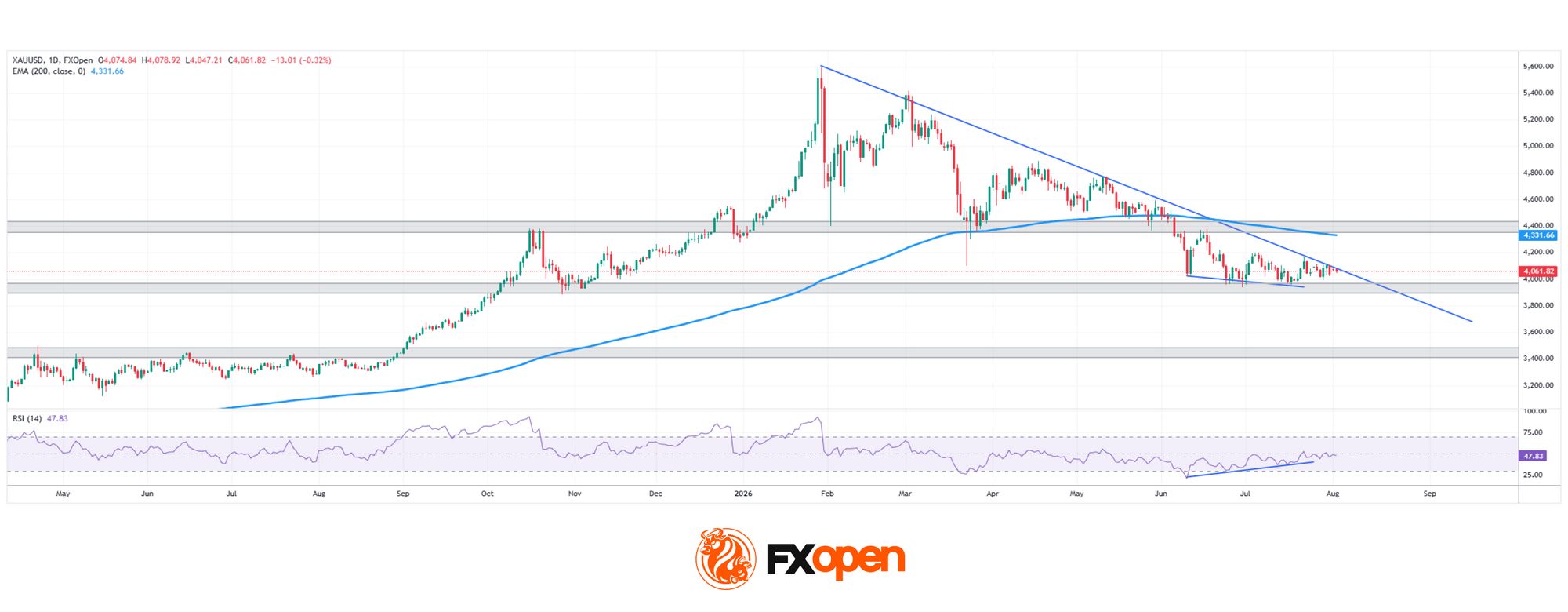
Gold has had a rough year. After hitting an all-time high near $5,602 in January, the metal has since dropped roughly 27% from that peak, weighed down by rising Treasury yields, a firmer dollar, and cooling demand for safe-haven assets.
This week brought a fresh twist. Gold climbed back above $4,050 on Monday after President Trump signaled that peace talks with Iran would resume, following pressure from regional allies like Saudi Arabia to pause military strikes. The news pushed oil prices lower and eased inflation fears, but it also reduced some of the safe-haven demand that had been supporting gold.
Despite the sharp correction, most analysts still expect gold’s long-term uptrend to eventually reassert itself. In the near term, though, all eyes are on Friday’s US jobs report, the week’s key catalyst: a weak print could revive rate-cut expectations and give gold fresh support, while a strong one could extend the current pullback.
Technical Analysis of XAU/USD Chart
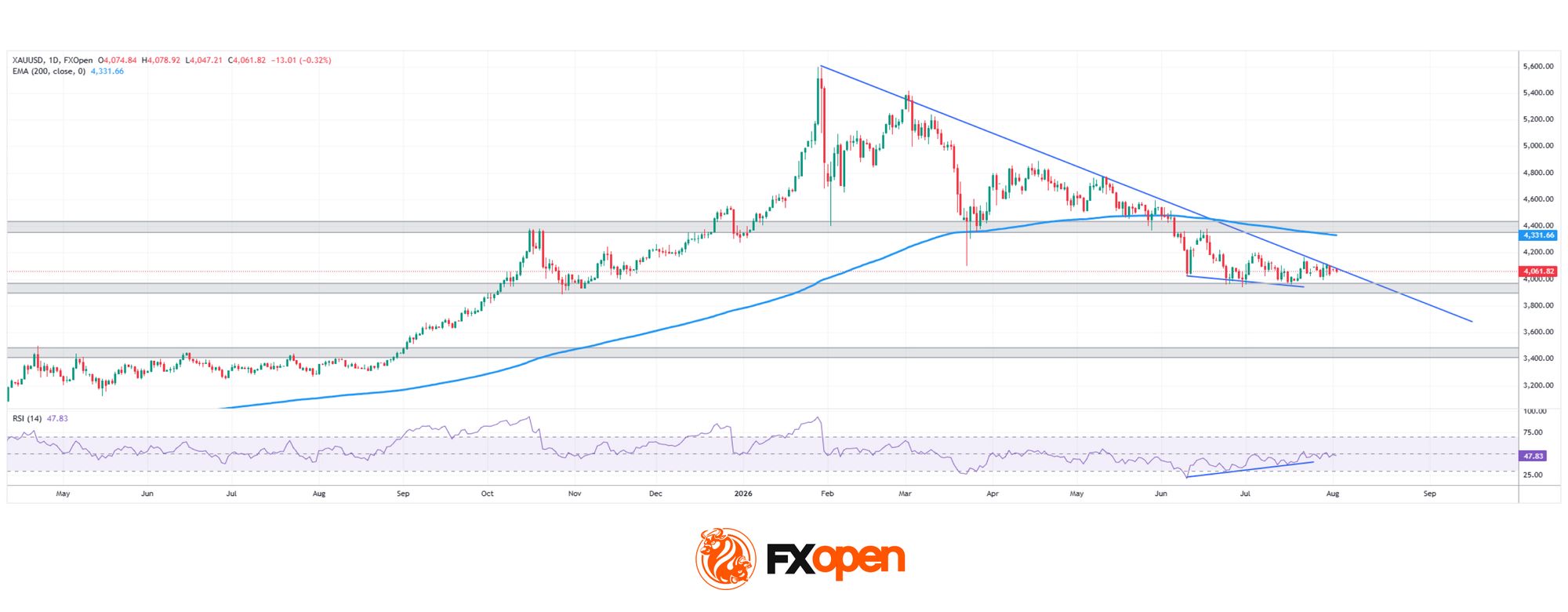
As the XAU/USD chart shows, gold remains locked in a broader downtrend since January’s record high, currently testing the descending trendline from below while holding just above the 3,900-4,000 support zone.
Bullish Scenario
Gold has already shown signs of life bouncing from the 3,900-4,000 support, and the RSI divergence lends some credibility to this reaction. Should price break decisively above the descending trendline, the next real test becomes the 4,400 resistance zone, where the 200-period EMA also converges—a level that has proven highly significant over recent months. A confirmed break above this confluence would mark a meaningful shift in gold’s broader structure.
Bearish Scenario
Should gold instead reject the trendline once again, price risks getting trapped between resistance above and support below. In that scenario, Friday’s NFP report looms as a potential catalyst: a strong print could tip the balance, breaking the 3,900-4,000 support and opening the path toward the next meaningful level, the former resistance-turned-support zone at 3,400-3,500.
With price squeezed between a stubborn trendline and a battle-tested support, and a major data release just days away, gold’s next move could finally answer the question traders have been asking since January’s peak: is the correction over, or just catching its breath?
Start trading commodity CFDs with tight spreads (additional fees may apply). Open your trading account now or learn more about trading commodity CFDs with FXOpen.
This article represents the opinion of the Companies operating under the FXOpen brand only. It is not to be construed as an offer, solicitation, or recommendation with respect to products and services provided by the Companies operating under the FXOpen brand, nor is it to be considered financial advice.

Bitget to end crypto services for Japan residents after regulatory warnings

Netflix’s The Inbetweeners Reunion Movie: What We Know

Brie Bella injury update: Sister says she’s ‘in a lot of pain’


-

 Business5 days ago
Why Trees Belong on the Risk Register
-

 Fashion3 days ago
Weekend Open Thread: Wit & Wisdom
-

 Politics3 days ago
Meta enters AI-training agreement with far-right ‘propaganda rag’ Newsmax
-
 Entertainment6 days ago
‘Stargate’ Creator’s New Sci-Fi Series Returns for Season 3 Tomorrow
-

 Crypto World2 days ago
MicroStrategy Post-Earnings CLARITY Act Push Could Add New Catalyst for Its Stock
-

 Politics6 days ago
The Part of the Electric Transition Nobody Wants to Discuss
-

 Business5 days ago
Major shareholder moves on Canyon
-

 Crypto World2 days ago
XRP Ledger v3.3.0 brings five institutional features
-

 News Videos4 days ago
Bitcoin Enters the 3rd Stage of the Bear Market
-

 Crypto World5 days ago
Kraken Enables Retail Access to Jersey Mike’s IPO via Tokenized Shares
-

 Tech6 days ago
New macOS Sequoia & Sonoma security updates for older Macs
-

 Politics4 days ago
Luke Littler’s dominance sparks GOAT debate
-

 News Videos6 days ago
Claude: Build Financial Dashboards in Minutes (2026)
-

 Business6 days ago
Johnson & Johnson agrees to $5.5B settlement over talc cancer claims
-

 Sports3 days ago
Seema Kaliramna Wins Discus Throw Bronze, Takes India’s CWG Medals Tally To 17
-

 Crypto World1 day ago
Crypto PAC spending tops $2M in Michigan House race
-

 Business3 days ago
Trump Announces Hamas Disarmament Agreement as Iran Strikes Kuwait Air Base and US Attacks Pause Overnight
-

 Tech5 days ago
Gemini can now summarize the messiest comment threads in Google Docs
-

 Tech1 day ago
ESET tracks rise in malicious AI skills and adaptable malware
-

 News Videos5 days ago
LIVE: XRP BULL RUN CONFIRMED! Donald Trump & Brad Garlinghouse Discuss Ripple
You must be logged in to post a comment Login