
Crypto World
Upbit Listing Pushes Onyxcoin (XCN) to Highest Level in 3 Months

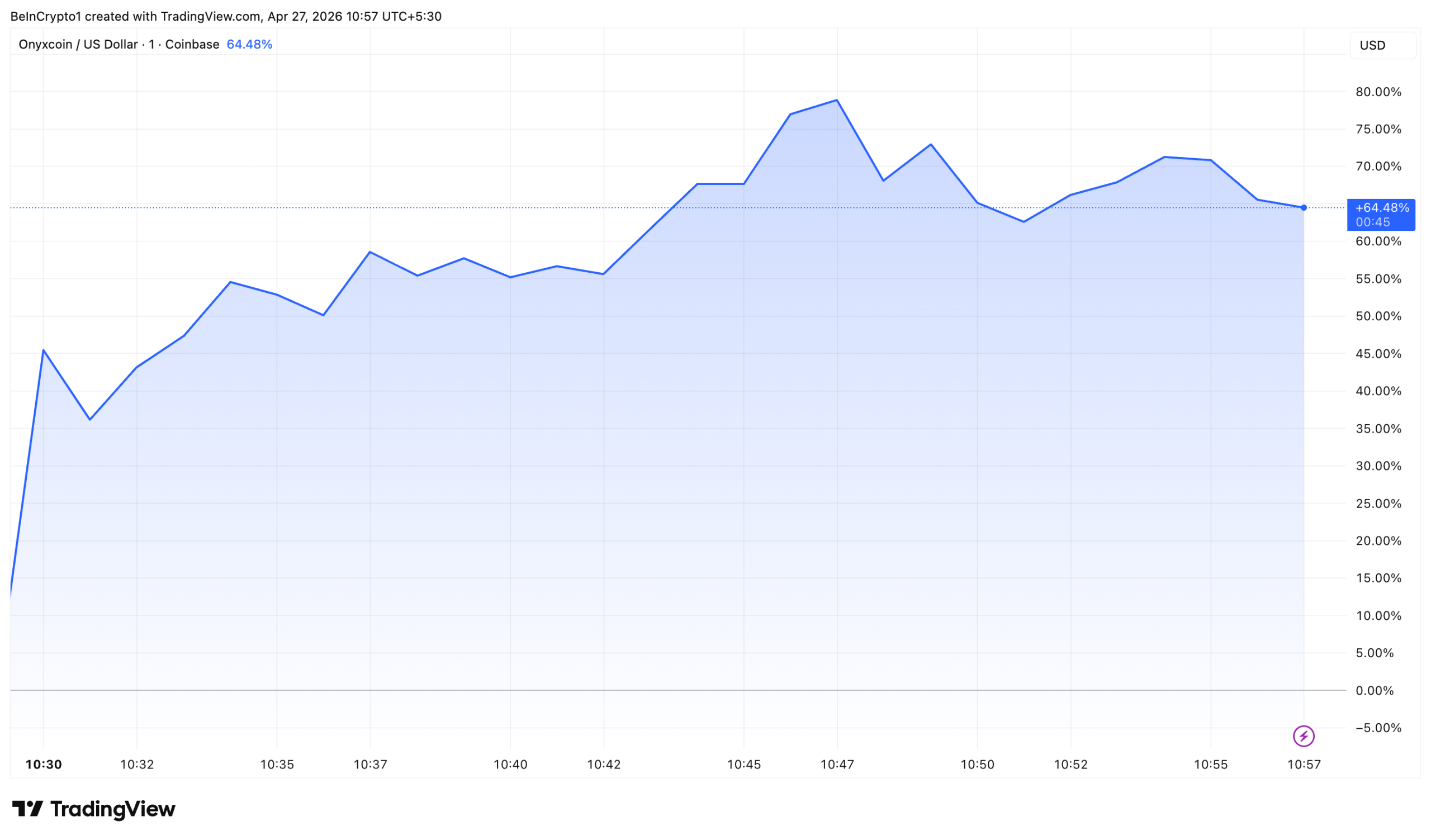
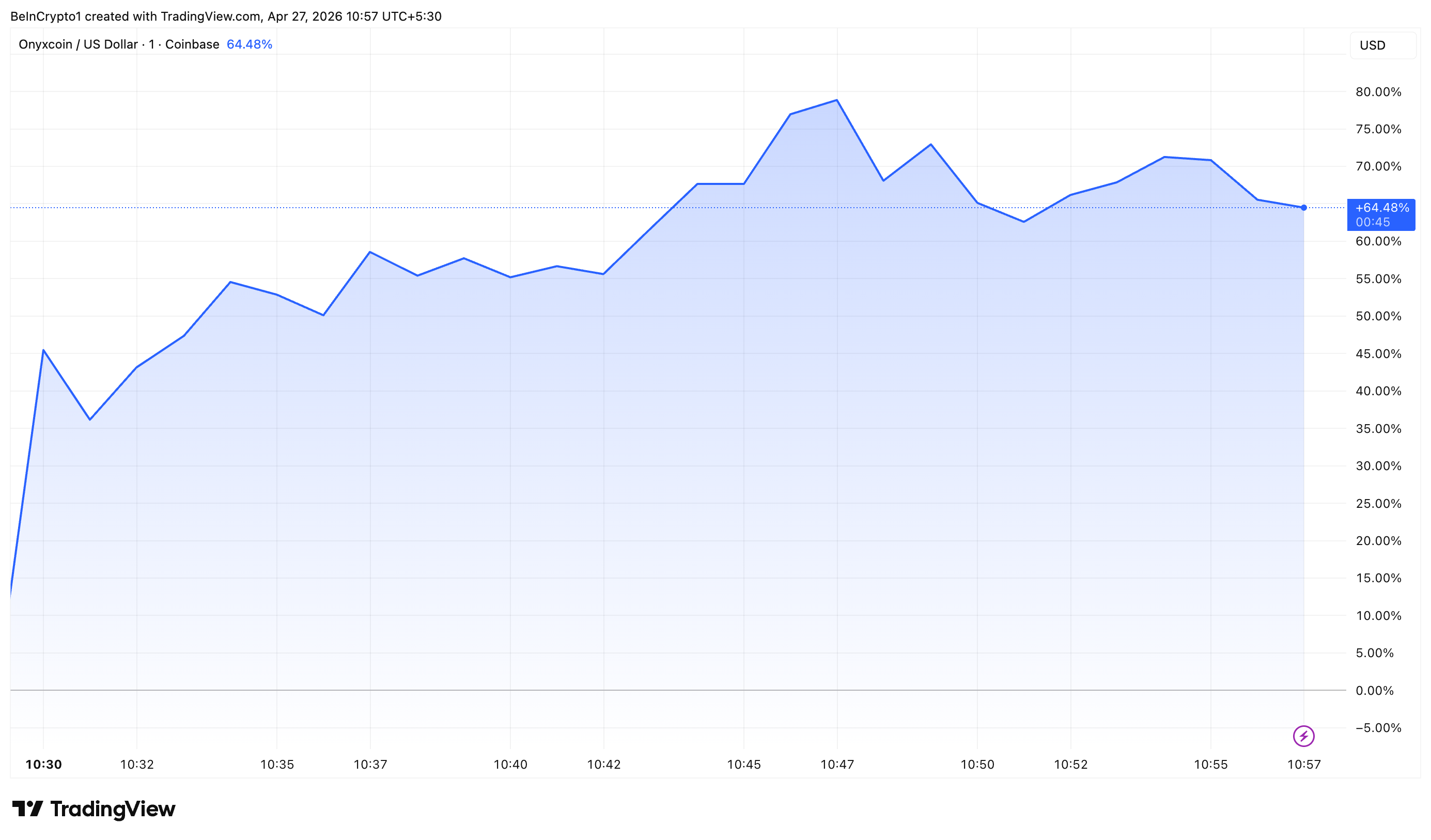
Onyxcoin (XCN) climbed to a 3-month high after South Korean exchange Upbit confirmed it will list the token today.
The altcoin saw a notable price surge after the announcement, reaching an intraday peak of $0.0086, its strongest level since mid-January.
Onyxcoin (XCN) Price Jumps to January Highs Ahead of Upbit Debut
At press time, XCN was trading at $0.0077, up 64.48% since the announcement. The sharp rally has propelled the token to the top of the gainers’ list among the 1,000 largest cryptocurrencies by market capitalization on CoinGecko.
Follow us on X to get the latest news as it happens
The daily trading volume also jumped 629% to reach $37 million. South Korea’s second-largest crypto exchange accounted 25.45% of the total volume. Historically, Upbit listings have produced sharp short-term price reactions in newly listed altcoins.
Meanwhile, the exchange revealed that XCN trading will start at 16:00 Korean Standard Time (KST). The altcoin will be available to trade against two pairs: the Korean Won (KRW) and Tether (USDT).
“Please be sure to verify the network before depositing digital assets. Deposits and withdrawals through networks other than the one specified are not supported,” the notice read.
The exchange also noted that it will apply short-term trading restrictions. For the first five minutes after trading opens, traders will not be able to place buy orders, and sell orders priced more than 10% below the previous day’s closing value will be blocked.
Additionally, the exchange will permit only limit orders for approximately two hours after trading support begins. The temporary measures are meant to reduce volatility and ensure a fair, controlled start to XCN trading.
Subscribe to our YouTube channel to watch leaders and journalists provide expert insights
The post Upbit Listing Pushes Onyxcoin (XCN) to Highest Level in 3 Months appeared first on BeInCrypto.


Key Takeaways
- Scallop Protocol experienced a security breach resulting in approximately $142,000 (150,000 SUI tokens) stolen on April 26, 2026
- The vulnerability existed in an outdated V2 rewards contract originally deployed in November 2023
- A critical flaw involving an uninitialized “last_index” variable enabled the attacker to drain the entire rewards balance
- User deposits and primary protocol functions remained secure; normal operations continued within a two-hour window
- The perpetrator has proposed returning 80% of the stolen assets in return for a white-hat reward
A DeFi lending platform operating on Sui Network, Scallop Protocol, suffered a security breach that resulted in approximately $142,000 in SUI tokens being stolen on Sunday following an exploit of a legacy rewards smart contract.
The security incident occurred on April 26, 2026, with Scallop making the breach public at 12:50 UTC through an announcement on X (formerly Twitter).
Rather than compromising the primary protocol infrastructure, the perpetrator focused their attack on an obsolete auxiliary contract connected to Scallop’s sSUI spool—a rewards distribution mechanism designed for SUI token depositors.
The vulnerable smart contract was a V2 spool package that had been deployed in November 2023, making it over 17 months old at the time of exploitation.
On the Sui network, smart contracts become immutable once deployed. Previous versions remain active and accessible unless developers implement explicit version-based access restrictions. This architectural characteristic allowed the legacy contract to persist as an exploitable vulnerability.
The critical security weakness centered on an uninitialized variable named “last_index.” This parameter is designed to monitor accumulated rewards for participants in the staking system. Since this variable was never properly initialized during new account creation, the attacker could join the pool and extract rewards as though they had participated from inception.
The malicious actor staked approximately 136,000 sSUI tokens. Over the preceding 20 months, the spool index had accumulated to roughly 1.19 billion.
This discrepancy enabled the attacker to allocate themselves approximately 162 trillion reward points. Since the rewards distribution system operated on a one-to-one exchange ratio, the entire balance of 150,000 SUI was extracted in a single blockchain transaction.
Blockchain records show the transaction hash 6WNDjCX3W852hipq6yrHhpUaSFHSPWfTxuLKaQkgNfVL documenting the on-chain withdrawal.
Following the theft, the stolen assets were rapidly transferred through a privacy-focused mixing protocol on Sui, comparable to Tornado Cash, significantly complicating recovery efforts.
Team Response and Service Restoration
Scallop’s development team acted swiftly to freeze the compromised contract within minutes of detecting the exploit. Importantly, the core lending and borrowing infrastructure was not suspended. Customer deposits across all other Scallop markets remained fully protected.
The protocol’s leadership confirmed they would absorb 100% of the financial loss using treasury reserves. No reduction in user yield rates will occur as a result of this incident.
By 14:42 UTC, Scallop had reactivated the primary contracts. Standard withdrawal and deposit functionality was restored to normal operation in less than two hours from the initial breach.
Subsequently, the attacker initiated contact with the development team, proposing to return 80% of the stolen funds in exchange for recognition as a white-hat hacker with an associated bounty. The team is currently examining how this vulnerability evaded detection during previous security audits conducted by OtterSec and MoveBit.
DeFi Losses Continue Mounting in April 2026
This security breach comes on the heels of a comparable exploit targeting Volo Protocol earlier this month, which resulted in approximately $3.5 million in losses. Both incidents exploited peripheral contract infrastructure rather than core protocol mechanisms.
April 2026 has witnessed over $600 million in cryptocurrency thefts across 12 significant security incidents. By mid-April, cumulative losses for the month had surpassed $750 million.
Kelp DAO and Drift Protocol together represented approximately 95% of April’s total losses. The Kelp attack independently generated $177 million in bad debt on the Aave lending platform.
Scallop’s team has yet to release a comprehensive post-incident analysis. They have announced plans for an exhaustive security review of all remaining legacy contract packages.
As of this publication, neither the Sui Foundation nor Mysten Labs has issued an official statement regarding the security incident.


About 3.5% of informed traders, including market makers and skilled takers, capture over 30% of profits on prediction platforms, while about 67% of users absorb the entirety of losses.


Cross-border B2B stablecoin payments have been projected to reach $5 trillion by 2035, according to a new report from Juniper Research.
Summary
- Cross-border B2B stablecoin transactions are projected to reach $5 trillion by 2035, rising from $13.4 billion in 2026, according to Juniper Research.
- Juniper Research estimates that B2B flows will account for 85% of total stablecoin transaction value as enterprise adoption expands.
The report published on April 27 has estimated that the total cross-border B2B stablecoin transaction value will climb from $13.4 billion in 2026, with enterprise payments expected to dominate usage over the next decade.
Looking at the data, business-to-business flows are set to account for 85% of all stablecoin transaction value by 2035.
Usage is moving beyond retail trading activity, with companies integrating these tokens into treasury operations, supplier payments, and cross-border settlements where speed and cost remain critical factors.
Cross-border B2B use cases drive growth
Juniper’s findings point to inefficiencies in traditional correspondent banking as a key reason behind this rise. Conventional systems rely on multiple intermediaries, which often leads to delays, foreign exchange costs, and messaging fees.
Stablecoins, by contrast, settle on-chain almost instantly, cutting down both processing time and transaction costs. This makes them particularly useful for high-value corporate transfers, especially in corridors where dollar-backed tokens act as a neutral settlement layer.
“Stablecoins are not replacing payments infrastructure; they are being adopted where the advantages are most pronounced,” said Research Analyst Jawad Jahan.
“Cross-border B2B is where those advantages are greatest, and where we expect the most sustained volume growth over the forecast period.”
Juniper added that payment providers and issuers looking to capture this growth will need to focus on enterprise integrations and partnerships tied to treasury management systems.
Stablecoin activity spans multiple segments, including person-to-person transfers, business payments, consumer transactions, and card-linked usage. Even so, corporate flows are expected to take a clear lead as adoption matures.
Growth narrative meets regulatory caution
Across global policy circles, the rapid rise of dollar-backed stablecoins has drawn closer scrutiny, with central bankers warning that these instruments, while efficient, may introduce risks if they continue to expand outside established financial safeguards.
At a recent seminar in Tokyo, Pablo Hernández de Cos warned that U.S. dollar stablecoins could carry “material consequences” for global economic policy, pointing to concerns around how these assets are structured and redeemed.
He noted that major tokens such as USDt and USDC operate in ways that resemble investment products rather than liquid cash, with redemption conditions and fees that differ from traditional money systems.
De Cos warned that a sudden surge in redemptions could force issuers to liquidate reserve assets such as government debt and bank deposits, potentially creating pressure in underlying markets.
European officials have moved to tighten oversight under frameworks such as MiCA, warning that regulatory gaps could allow issuers to shift operations across jurisdictions during periods stress.
Banks are also testing alternatives that keep digital money within regulated systems, with Swiss institutions including UBS launching pilot projects for franc-denominated stablecoins that combine blockchain efficiency with existing financial controls.


French authorities have indicted at least 88 people over alleged wrench attacks targeting crypto owners.
Summary
- French prosecutors charged 88 people, including ten minors, over alleged crypto wrench attacks on holders.
- Authorities said 75 suspects remain in pre-trial detention as 12 investigations continue in Paris.
- Prosecutors warned crypto holders to avoid online overexposure that could make them physical targets.
The group includes ten minors, said Vanessa Perrée, France’s national prosecutor for organized crime.
The cases relate to 12 investigations handled by specialized judges at the Paris Judicial Court. Prosecutors said 75 of the accused remain in pre-trial detention as law enforcement continues to examine the networks behind the attacks.
Crypto owners face physical extortion threats
Wrench attacks involve physical threats or violence used to force victims to transfer crypto assets. French authorities have linked such crimes to home invasions, kidnappings, extortion attempts and forced wallet access.
PNACO has recorded a sharp rise in these cases. The agency tracked 18 incidents in 2024, 67 in 2025 and 47 so far in 2026, showing how physical crypto-related crime has grown in France.
Perrée said the crimes carry serious legal weight because they involve abduction, detention, extortion and attempts to force crypto transfers. She said the acts were serious because of “the harm caused to individuals” and the methods used.
Investigators have merged several cases after finding repeated links between some suspects. Perrée said these links revealed “the existence of structured networks,” with authorities still working to identify the organizers and money flows.
Security warnings grow for crypto users
The rise in wrench attacks has renewed warnings for crypto holders. Perrée urged users and relatives to stay careful and avoid “overexposure on social networks” that may make them targets.
Security experts have also warned that public displays of crypto wealth can create personal risk. Blockchain security firm CertiK said physical crypto attacks worldwide rose 75% in 2025 from the previous year.
Casa chief security officer Jameson Lopp has tracked wrench attacks worldwide since 2014. His public list shows 29 incidents so far this year, including five cases recorded in April.
Blockchain intelligence firm TRM Labs said such attacks have increased because criminals can connect public wealth signals with personal data found online. The firm also cited the perceived privacy of crypto transfers as a factor behind the rise.
Telegram founder Pavel Durov also commented on the situation in France. He suggested that the rise in attacks may be linked to alleged misuse of crypto investor tax data by a former tax official.
French investigators said their work remains active. Authorities are trying to identify all attackers, trace financial routes and break up the groups involved in the crypto wrench attack cases.
Key Highlights
- Over 17,000 ETH valued at roughly $49 million was unstaked by the Ethereum Foundation last Saturday
- The withdrawal utilized Lido’s unstETH mechanism and will become tradable ETH following queue completion
- This action occurred mere steps away from the Foundation hitting its 70,000 ETH staking milestone
- Foundation has remained silent on rationale, fueling speculation about potential market sales
- Recent history includes a 10,000 ETH private sale transaction with Bitmine Immersion Technologies
Blockchain analytics from Arkham Intelligence revealed that the Ethereum Foundation withdrew 17,035 ETH, valued at approximately $49 million, during the past weekend. The operation involved converting wrapped staked ETH (wstETH) through Lido’s unstETH smart contract mechanism, processing approximately 811 wstETH per transaction batch.
Following completion of Lido’s withdrawal queue, these assets will transition back to standard liquid ETH format. To date, the Foundation has issued no official communication regarding the purpose of this withdrawal.
The sequence of events has attracted significant attention. This unstaking activity occurred precisely when the Foundation neared its self-imposed benchmark of 70,000 staked ETH. Prior to initiating the withdrawal, approximately 69,500 Ethereum tokens were staked, placing the organization tantalizingly close to achieving that threshold.
The Foundation’s aggressive staking campaign commenced in February 2026. Initial deposits included 2,016 ETH, followed by an additional 22,517 ETH throughout March, culminating in over 45,000 ETH staked during the early part of this month.
This staking strategy was formally implemented in June 2025. The declared objective centered on generating returns to support protocol advancement, development initiatives, and community grant programs.
Market Concerns About Potential Liquidation
The unstaking event has reignited apprehension regarding potential selling pressure. Several community observers have highlighted the Foundation’s recent engagement in private market transactions, notably including a 10,000 ETH transfer to Bitmine Immersion Technologies.
“The largest ETH distributor remains those who initially built ETH,” commented one market participant online.
Market watchers are closely monitoring the $2,300–$2,400 price zone for ETH, identified as a critical threshold that could determine immediate price trajectory.
Ethereum co-creator Vitalik Buterin has historically cautioned that significant staking positions held by the Foundation might introduce governance challenges during divisive protocol upgrades.
Parallel DeFi Crisis Unfolds
In a separate development, the wider Ethereum DeFi sector is navigating consequences from a $293 million security breach affecting the Kelp restaking protocol. Attackers extracted over 116,000 restaked ETH tokens and leveraged them as loan collateral, creating approximately $195 million in uncollateralized debt on Aave.
An emergency alliance dubbed “DeFi United,” spearheaded by Aave, has committed more than 43,500 ETH (valued around $101 million) toward stabilizing rsETH. Contributing organizations include Lido DAO, Golem Foundation, EtherFi Foundation, and Mantle.
The Ethereum Foundation’s latest verifiable blockchain activity remains the $49 million unstaking transaction executed on Saturday, April 26, 2026.
The crypto market has staged a recovery following the US–Israeli strikes on Iran. While the market remains below its early 2026 highs, total capitalization has rebounded by over 14% since February 28.
Amid this recovery, three data points show investors are stepping back into crypto markets after months of risk-off positioning.
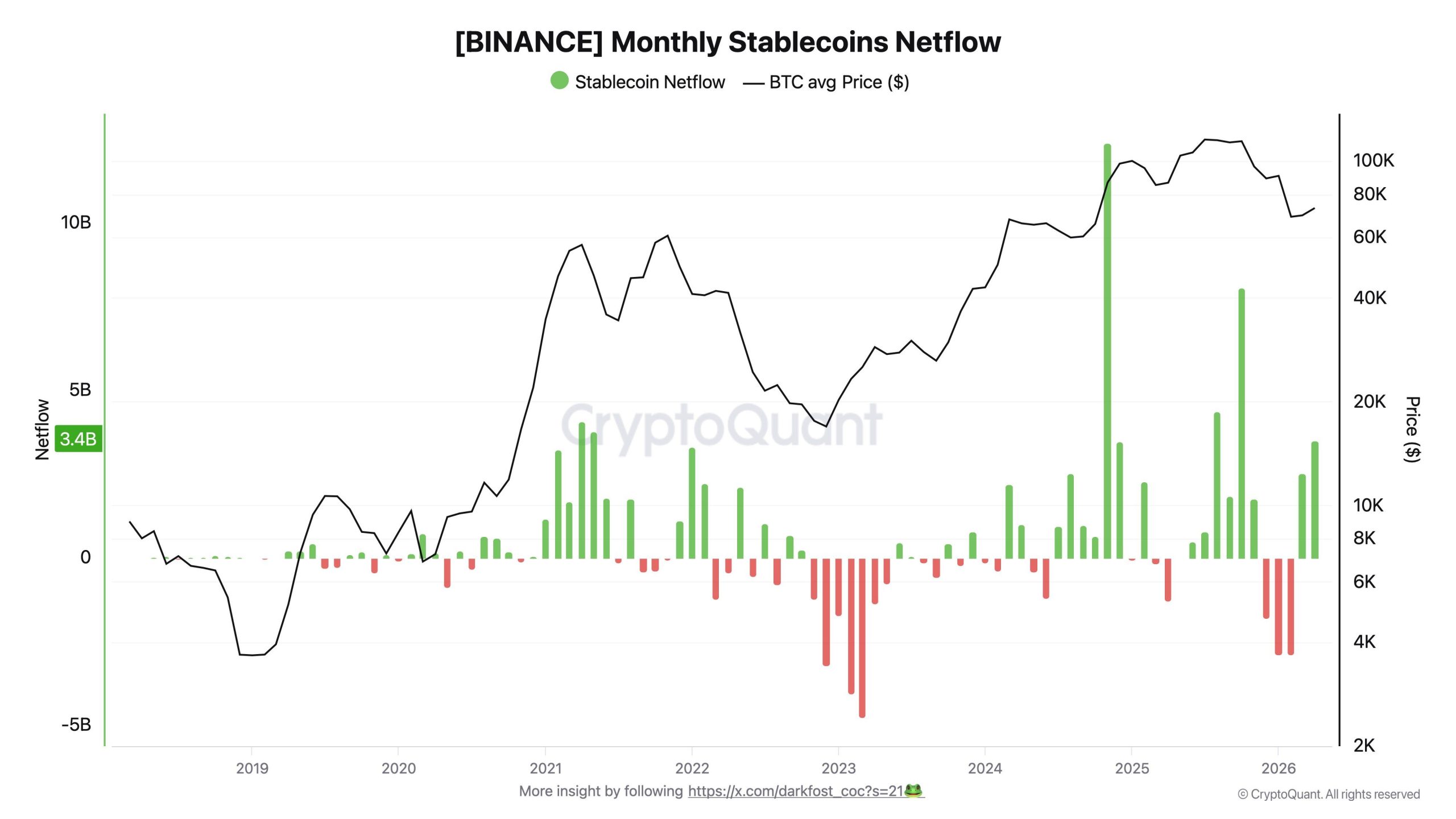
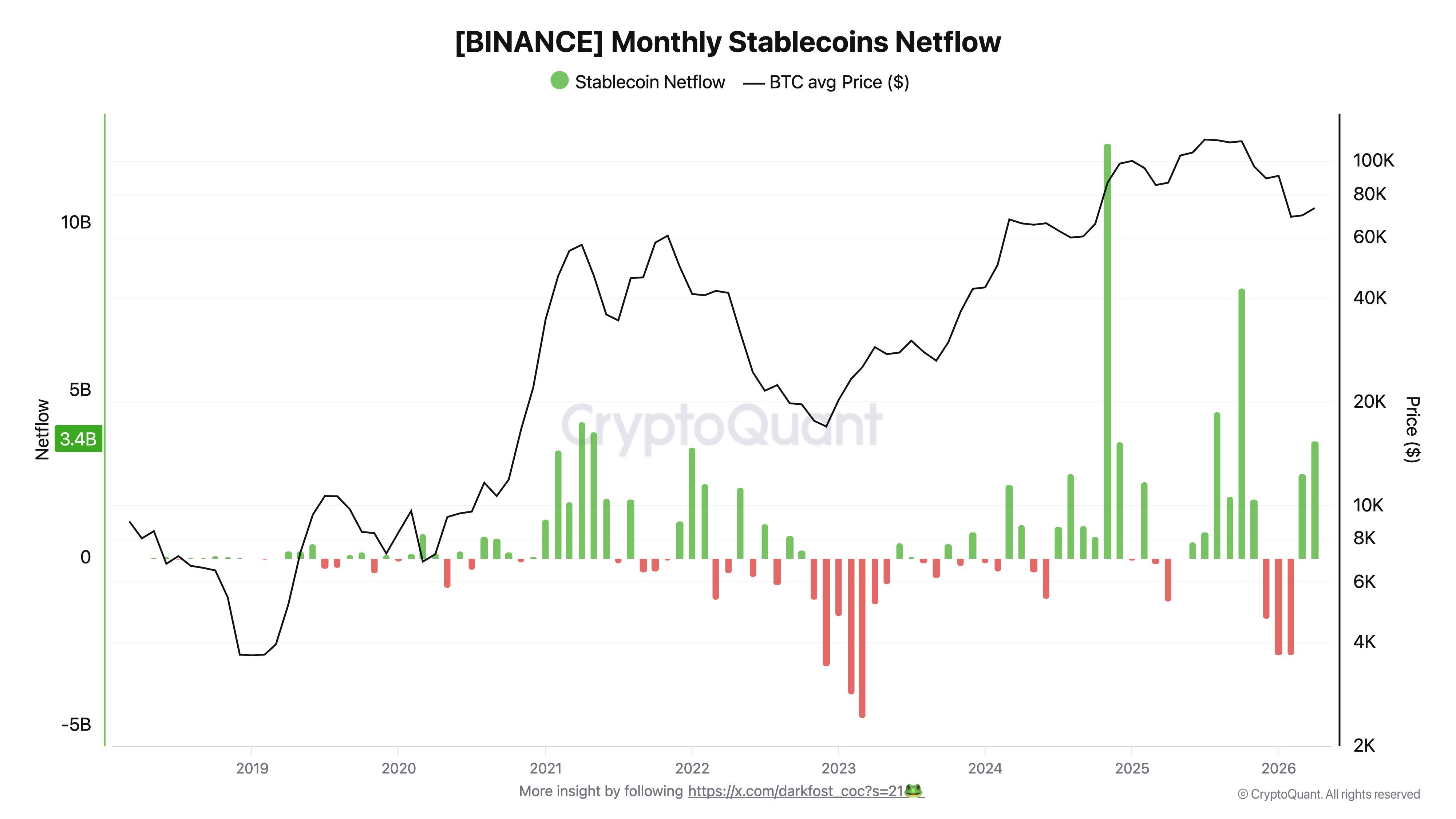
Binance Stablecoin Reserves Swell by $6 Billion
In a post on X, on-chain analyst Darkfost flagged nearly $6 billion in net stablecoin inflows to Binance across March and April. The figure marks a clear directional shift.
April alone accounted for roughly $3.5 billion of that total. In contrast, the prior period had recorded approximately $7.6 billion in net outflows from the same exchange.
Stablecoin inflows are often interpreted as “dry powder.” They represent capital that has already entered the crypto ecosystem but has not yet been deployed into assets such as Bitcoin (BTC) or Ethereum (ETH).
“When inflows exceed outflows on a major exchange, it suggests that part of the market is beginning to reposition in order to participate in the gradual recovery that has been underway for nearly two months,” the analyst said.
Follow us on X to get the latest news as it happens
While stablecoin inflows can precede rallies, not all translate into immediate purchases, as investor sentiment, market conditions, and risk appetite ultimately determine whether this capital is deployed or remains sidelined
Sentiment and Institutional Demand Reinforce the Signal
Notably, the Crypto Fear and Greed Index has climbed to 47, marking a shift into neutral territory after languishing at 12 just a month ago. The sharp improvement highlights a steady recovery in market sentiment, moving away from extreme fear toward a more balanced outlook.
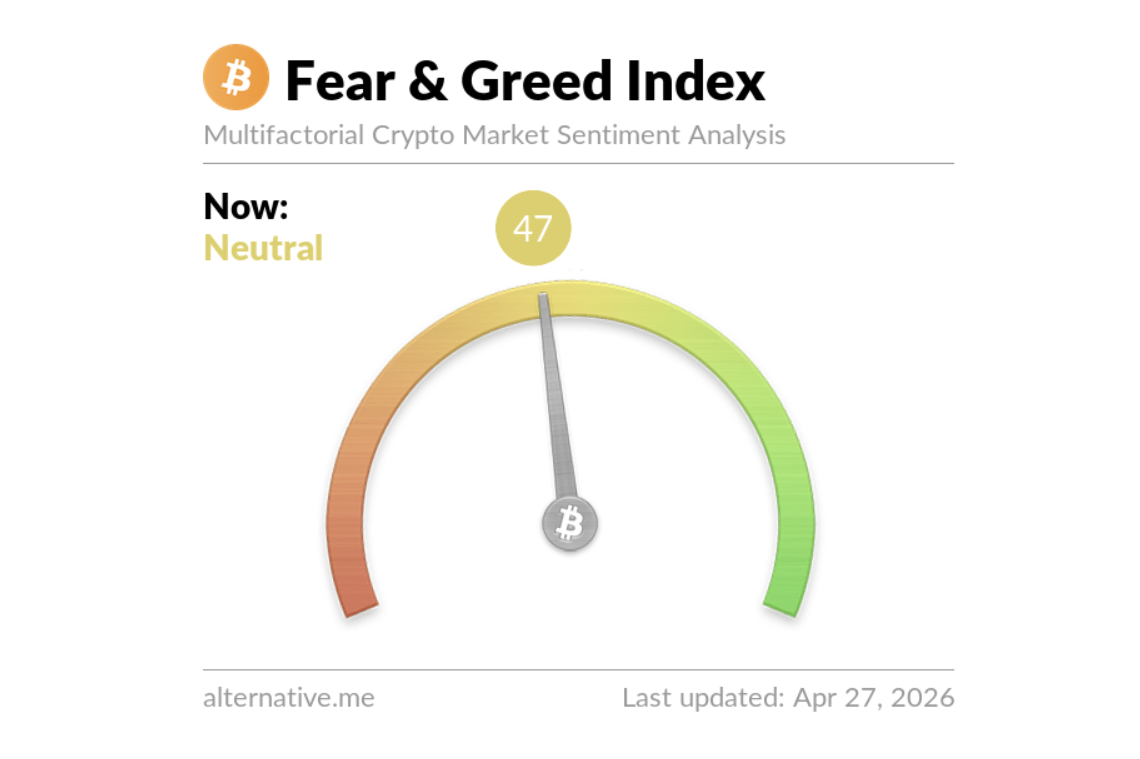
At the same time, institutional capital appears to be returning. Spot crypto exchange-traded funds recorded their strongest weekly inflows since mid-January in the week ending April 17, reinforcing signs of renewed confidence among large investors.
The positive trend has extended across major assets: Bitcoin ETFs have posted four consecutive weeks of inflows in April, followed by three-week inflow streaks for Ethereum, XRP, and Chainlink, while Solana ETFs have recorded two straight weeks of net inflows.
Taken together, rising stablecoin reserves, improving sentiment, and sustained ETF inflows suggest a measured return of capital to crypto markets. While conditions point to rebuilding confidence, the recovery remains tentative, with broader macro trends and investor conviction likely to determine whether this momentum translates into a sustained uptrend.
Subscribe to our YouTube channel to watch leaders and journalists provide expert insights
The post 3 Signs Smart Money Is Repositioning in Crypto Right Now appeared first on BeInCrypto.
Quick Overview
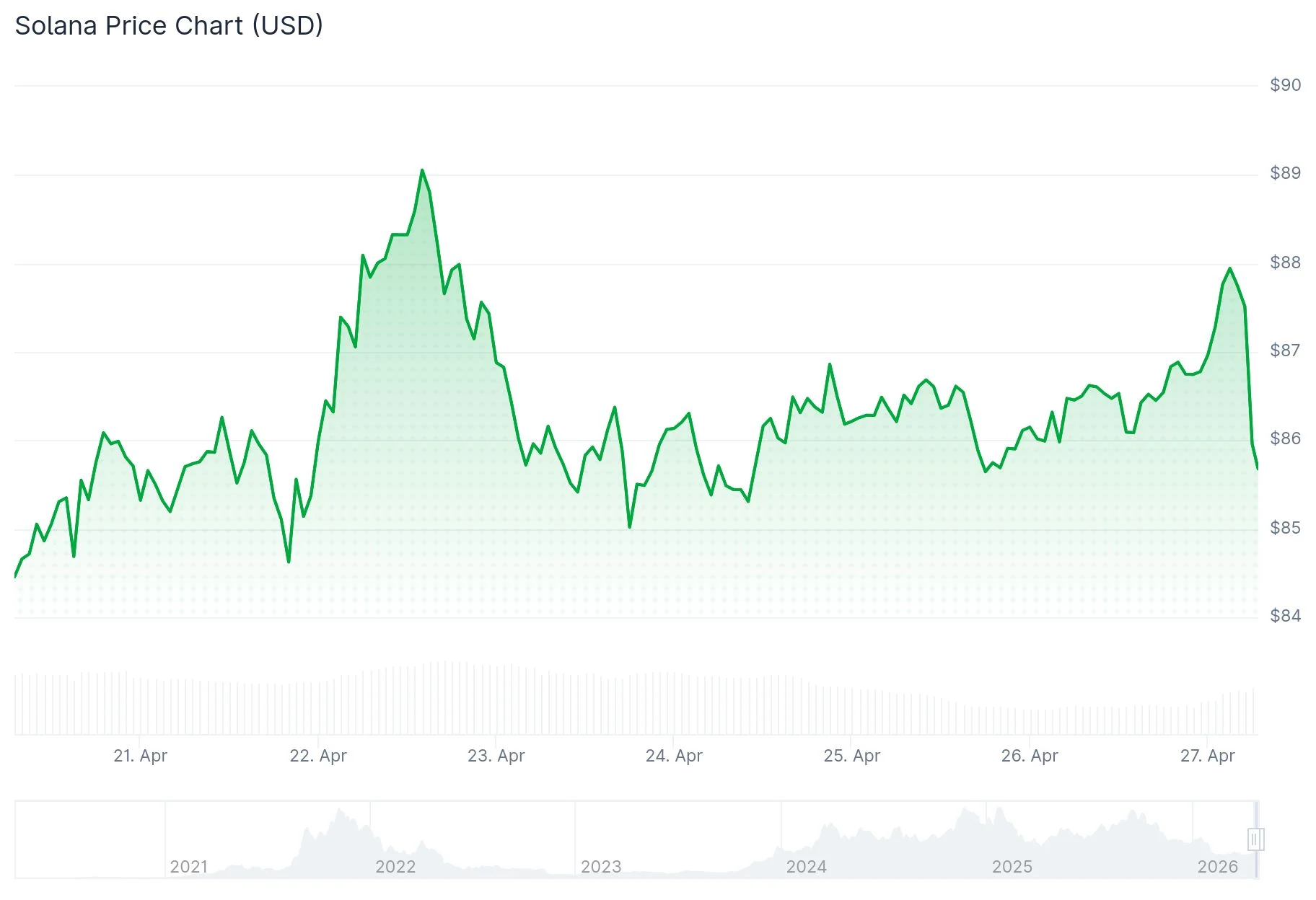
- SOL maintains stability around $87–$88, positioned above its 50-day EMA with critical resistance forming at $90–$94
- Crypto analyst Ali Martinez identified a compressed Bollinger Band pattern spanning $77 to $94 on the 3-day timeframe
- SOL-focused ETFs attracted $9.44 million in weekly net inflows, contributing to a five-day streak totaling roughly $1.45 billion
- Goldman Sachs revealed exposure of approximately $108 million in SOL holdings
- Breaking decisively above $94 could trigger a rally toward $100; falling beneath $77 may signal extended downside
Solana (SOL) is currently exchanging hands around the $87–$88 range on Monday, maintaining ground above its 50-day Exponential Moving Average (EMA) positioned at $87.04. Following a rebound from recent lows near $84.55, the asset is now challenging a significant resistance area.
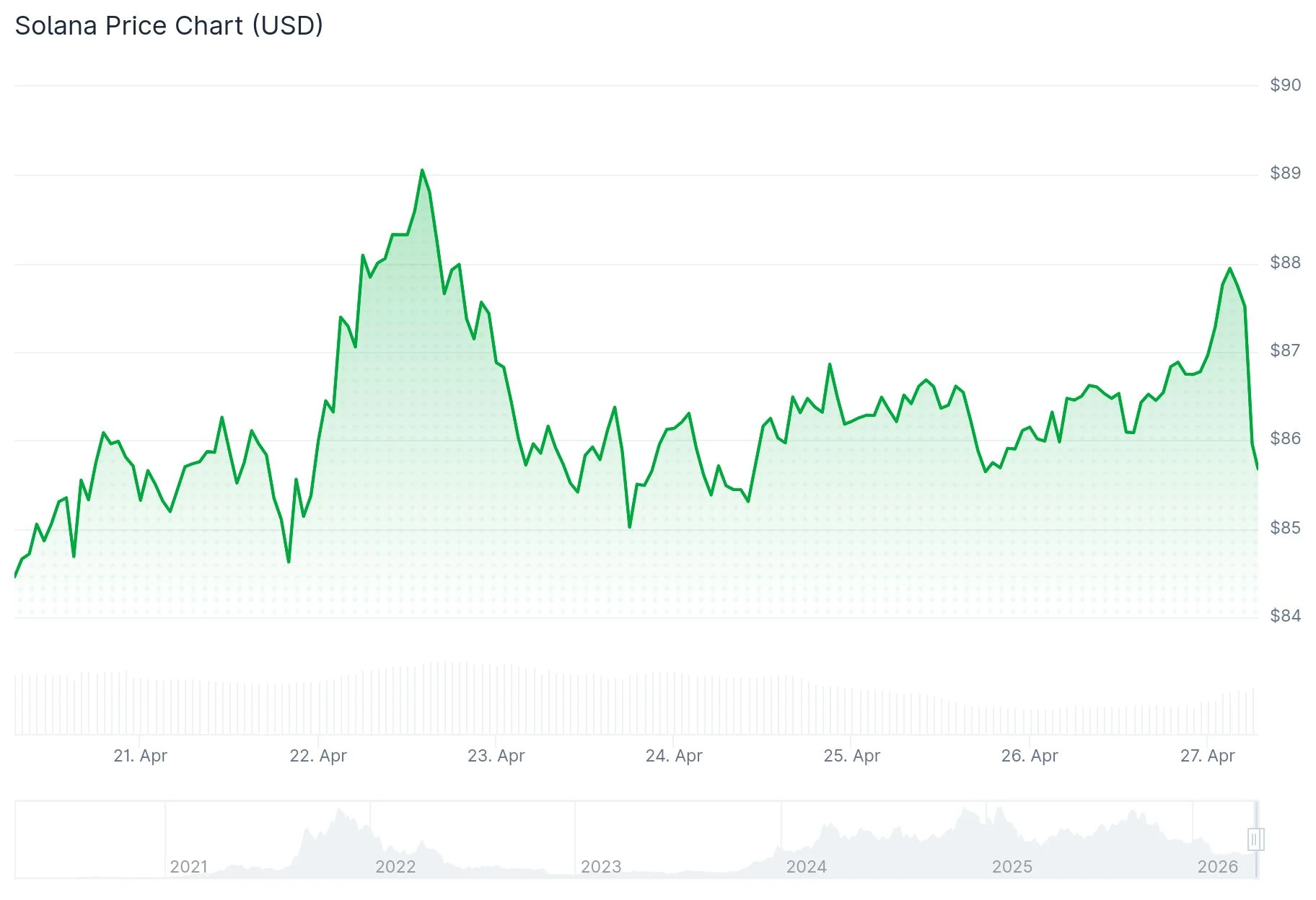
The digital asset has pushed past the 50% Fibonacci retracement mark derived from its latest decline between $89.34 and $84.55. Technical charts reveal a developing bullish trend line providing support around $86.50 on the hourly timeframe.
Near-term resistance appears at $88.20, corresponding with the 76.4% Fibonacci threshold. Beyond this, major obstacles emerge at $90, with additional resistance waiting at $92.
Crypto market analyst Ali Martinez pointed out that SOL is currently confined within a compressed Bollinger Band corridor on the 3-day chart, spanning from $77 to $94. He characterized this region as a “no-trade zone,” cautioning that attempting to trade within this confined range often results in whipsaw losses. Martinez emphasized that traders should wait for a definitive 3-day candle closure beyond these bands before considering any directional move as legitimate.
Trading volume has declined by over 23% throughout this consolidation period. While reduced volume during lateral price movement is typical, any breakout attempt above $94 will require significantly stronger trading activity to validate a push toward the $100 milestone.
Technical Indicators Show Emerging Bullish Bias
The Relative Strength Index (RSI) currently stands at 55, climbing above the neutral 50 mark on the daily timeframe. Both the MACD and its corresponding signal line have crossed into positive territory, indicating that buying pressure is presently dominant.
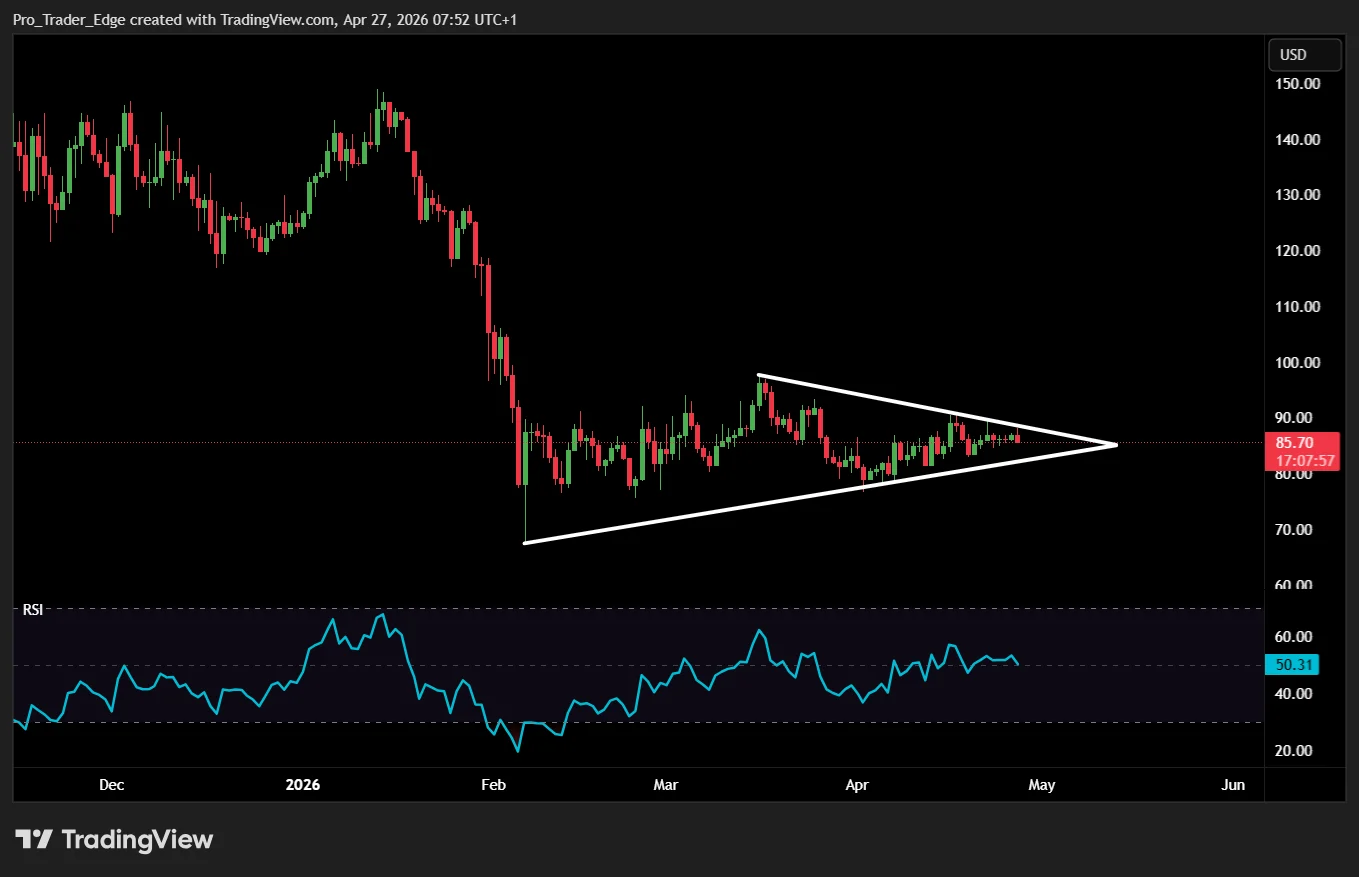
SOL is testing the upper boundary of a symmetrical triangle formation near $89.00 on the daily chart. A convincing breakthrough above this threshold would open the door to the psychologically important $100 level, followed by the 200-day EMA stationed at $113.
Regarding downside scenarios, the 50-day EMA at $87.04 represents the initial support layer. A daily closure underneath the ascending trendline around $85.99 would compromise the current bullish framework.
Institutional Capital and ETF Activity
Solana-focused exchange-traded funds captured $9.44 million in net weekly inflows, down from $35.17 million during the previous week. Despite the weekly decline, five straight days of positive net inflows have accumulated to approximately $1.45 billion.
Goldman Sachs made headlines by revealing a stake valued at nearly $108 million in Solana, representing another significant institutional validation that market participants are monitoring closely.
SOL futures Open Interest climbed more than 2% within 24 hours to reach $5.23 billion. Meanwhile, the funding rate jumped to 0.0095%, demonstrating that traders are willing to pay elevated premiums to maintain long exposure.
Should SOL prove unable to penetrate the $90–$94 resistance band, immediate support levels lie at $86.50, followed by $85. A decisive close beneath $78 could accelerate selling pressure toward the $72 zone.


Long-time Bitcoin developer Paul Sztorc has been trying to overhaul Bitcoin’s architecture since 2015, but the broader community hasn’t budged.
So now he has proposed a dramatic step, called eCash hardfork, that involves copying Bitcoin’s code to launch a separate version in August, while giving existing bitcoin holders equivalent tokens in the new network for free.
The community, however, is criticizing the funding part, which involves reassigning coins linked to Bitcoin’s missing founder, Satoshi Nakamoto.
What is a hard fork?
Think of a hard fork like a railway line splitting into two. Trains start from the same station, but at some point the line splits, helping trains reach completely different destinations.
When a group of developers cannot reach consensus on a proposed change to Bitcoin’s code, they copy the existing blockchain and launch it as a separate chain, which shares Bitcoin’s entire history up to the point of the split, but diverges after the split, moving forward with its own rules, features, token and direction.
That’s precisely what happened in 2017 when the debate over Bitcoin’s block size reached a tipping point, culminating in a chain split and the creation of the Bitcoin Cash blockchain with its native token, BCH.
The technical dispute centered on Bitcoin’s 1MB block size limit, which caps the number of transactions that can be processed every 10 minutes when new blocks are added to the blockchain. Hence, some favoured increasing the block size, but the community remained divided, eventually leading to a chain split.
Sztorc’s eCash hard fork
The proposed hard fork will create a new chain called eCash with native eCash tokens. “Hold 4.19 BTC at the time of the fork, get 4.19 eCash. You can sell it, keep it, or ignore it entirely,” he said on X.
The fork is scheduled for Bitcoin block height 964,000 in August 2026. A coin-splitter tool will be released to help holders cleanly separate their BTC from their new eCash.
The new chain will be a near-copy of Bitcoin’s existing blockchain, with one critical addition called Drivechains, a scaling architecture Sztorc first proposed in 2015 and formally submitted to Bitcoin developers as BIP300 and BIP301 in 2017 and 2019, respectively.
Drivechains are sidechains tethered to the Bitcoin blockchain, allowing seamless movement of BTC between the main chain and sidechains without changing Bitcoin’s base layer. Each sidechain can operate under its own rules and features, essentially allowing developers to build new capabilities on top of Bitcoin without requiring the entire network to adopt those changes.
Think of Drivechains as service roads attached to the main highway. When the highway is congested, drivers can exit the highway and travel on the service road at different speed limits, then re-enter the highway when it’s clear. This way, the highway never changes, yet more traffic is handled more efficiently, and the journey becomes more flexible for everyone.
Seven Drivechains are already in development, Sztorc said on X, including a privacy chain modelled on Zcash, a prediction market called Truthcoin, a decentralised exchange called CoinShift, and a quantum-resistant chain called Photon.
The controversial part linked to Satoshi coins
Sztorc wants to use coins that would have gone to Satoshi Nakamoto’s equivalent addresses on the new eCash chain to bring investors on board before the fork goes live, a decision he calls necessary but which has riled the community, with some calling it outright theft.
A potential hard fork would bring Bitcoin’s entire transaction history to the new chain. So every bitcoin balance, including Satoshi’s 1.1 million bitcoin, sitting untouched in wallets that have noved moved these coins, would show up as an equivalent eCash balance on the new chain.
As per the plan, fewer than half of the Satoshi-equivalent eCash coins will be assigned to investors today. The precise mechanism of how it’s being done remains unclear. But since eCash doesn’t yet exist, the pre-hard fork assign seems to be a promised credit following a successful hard fork.
The plan, he argues, will ensure collaborators have a tangible incentive to get involved early, building momentum and completing work ahead of launch. Without this mechanism, the project can turn into a “zombie project” that ships unfinished. Worse, it could become a centralized project, where a small group of developers gains outsized control over the chain’s direction.
The industry response, however, has been negative.
“Taking Satoshi coins is theft and disrespectful, and eCash is already used for Lightning payments with Cashu and Fedi. Those are poor choices,” Bitcoin advocate Peter McCormack said.
Josh Ellithorpe, chief technology officer at Pixelated Ink, expressed concerns about the precedent it sets and how it could eventually be a risk to everyone’s BTC holdings.
“eCash, setting the precedent that they can and will steal coins. Now it’s Satoshi, but it could be anyone later. Also misrepresenting the BCH fork, stealing another project’s name, and not having replay protection,” Ellithorpe said.
Key Takeaways
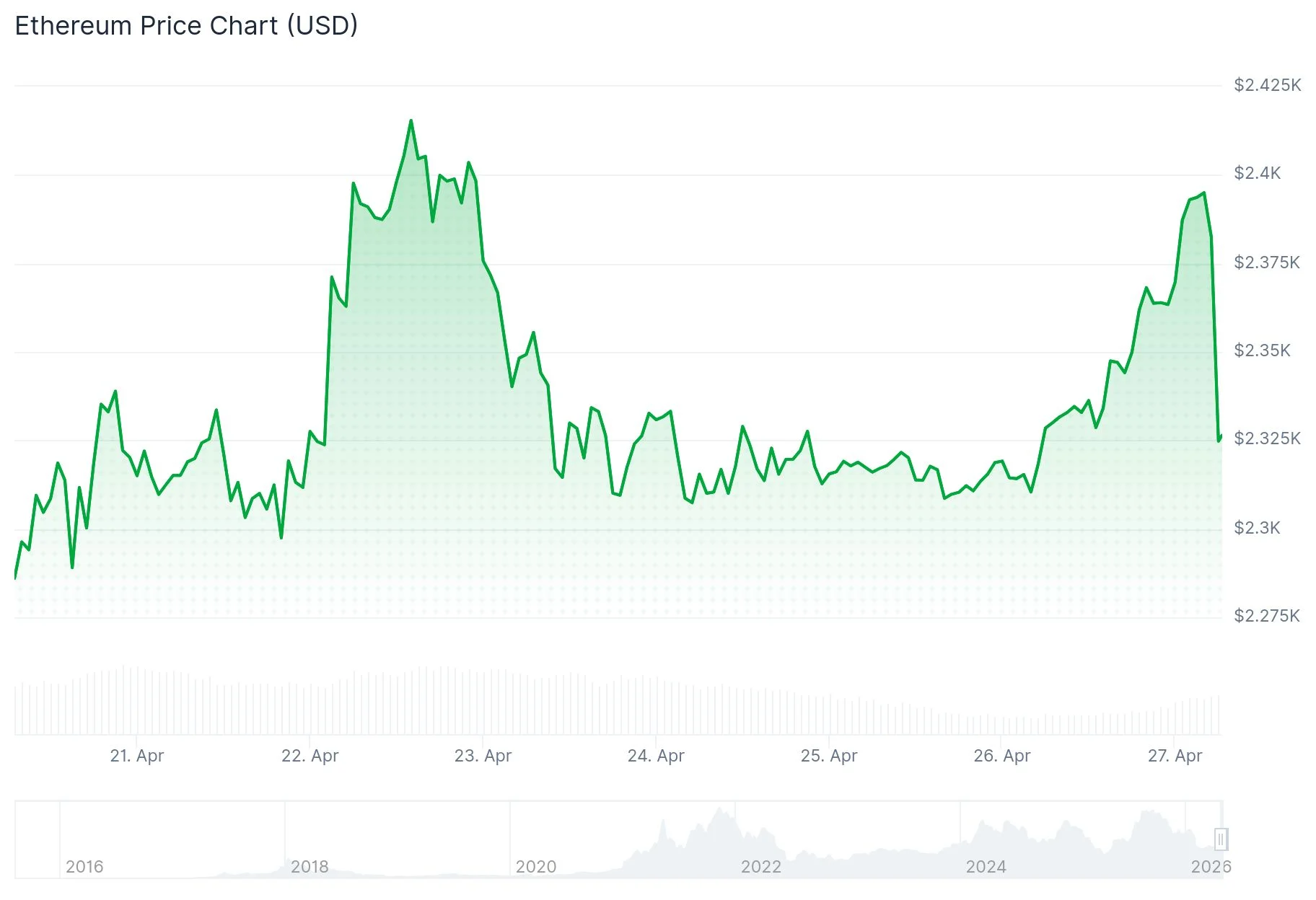
- Ethereum has corrected approximately 50% from its October 2025 peak of $4,700 to current levels around $2,300, yet accumulation patterns suggest institutional buying
- The taker buy/sell ratio climbed to levels not seen since January 2023, indicating strong demand pressure
- Network activity shows smart contract deployments hit an all-time high on a 180-day moving average basis
- Spot Ethereum ETFs recorded $155 million in net inflows last week, marking the third consecutive week of positive flows
- Critical price zones: $2,400 represents overhead resistance while $2,200 serves as downside support
Ethereum’s price has experienced a significant downturn, shedding approximately half its value from the October 2025 peak near $4,700 to trade around $2,300 today. However, beneath the surface volatility, blockchain metrics reveal a different narrative—one of strategic accumulation.
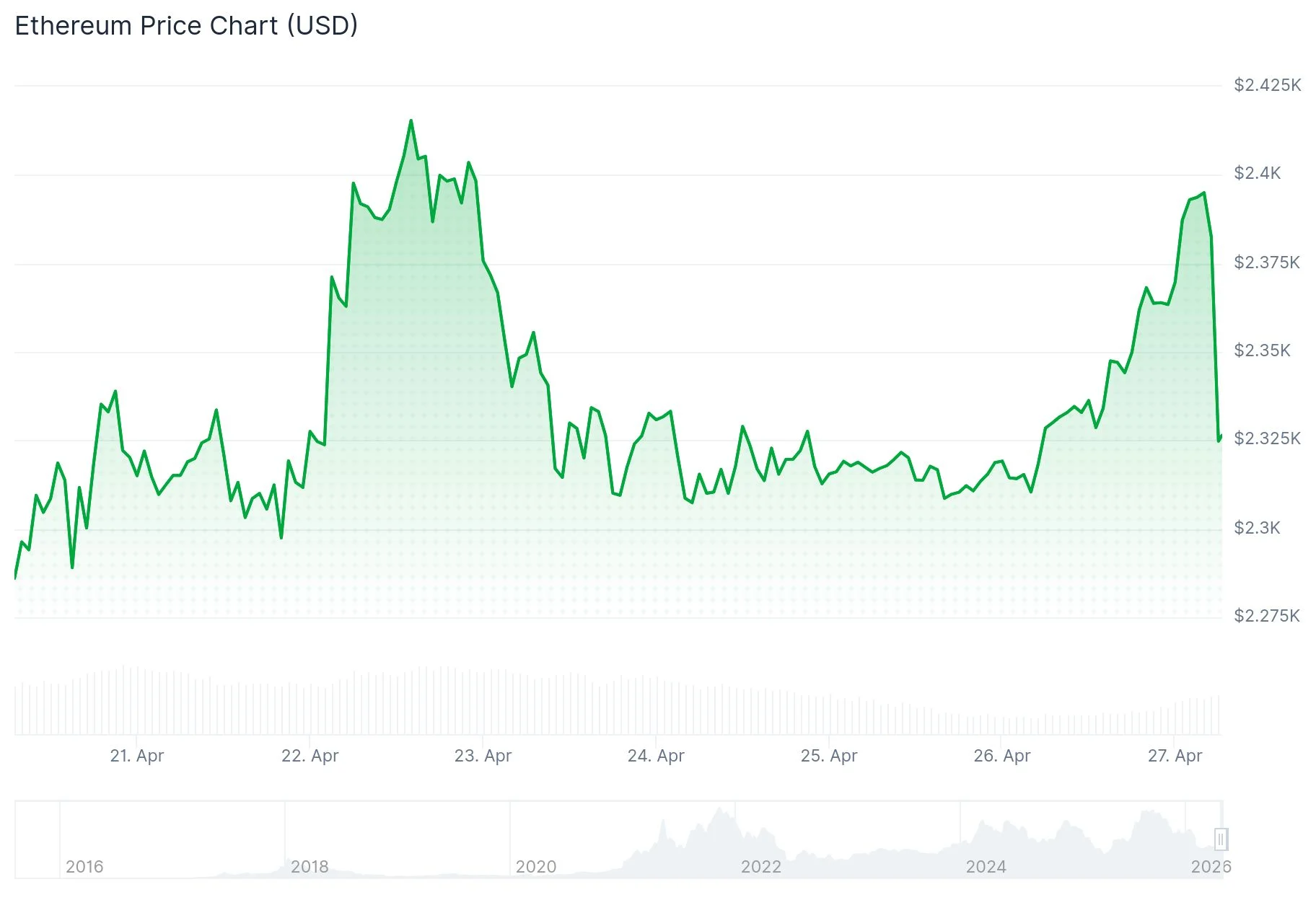
According to metrics from CryptoQuant, the 30-day moving average of the taker buy/sell ratio has climbed to its most elevated reading since the beginning of 2023. This indicator measures the intensity of market orders on the buy side relative to sell-side pressure.
The data suggests that market participants are aggressively acquiring ETH even as downward price momentum persists. Such patterns typically indicate sophisticated investors methodically building positions during periods of market weakness.
Network Growth Contradicts Price Weakness
Additional analysis from CryptoQuant reveals that the 180-day moving average for newly deployed smart contracts has reached an unprecedented peak. This demonstrates that developer engagement continues to expand despite bearish price action.
Historical patterns show that surges in smart contract deployment activity have frequently foreshadowed price reversals. The current disconnect between robust network utilization and suppressed token valuation indicates that fundamental strength may not yet be reflected in market pricing.
According to SoSoValue data reported by Odaily, Ethereum spot exchange-traded funds attracted $155 million in net new capital during the week spanning April 20–24. This represents the third consecutive week of positive institutional flows.
BlackRock’s ETHA dominated inflows with $138 million for the period, pushing its cumulative net inflow to $11.97 billion. BlackRock’s ETHB contributed an additional $60.9 million. Conversely, Grayscale’s ETHE experienced the largest outflow at $49.2 million. Combined net assets across all Ethereum spot ETF products currently total $13.79 billion.
Market analyst Ted (@TedPillows) observed that ETH remains range-bound and cautioned that the collapse of US-Iran peace negotiations could introduce heightened volatility in the coming days. He highlighted that a successful reclaim of $2,400 could unlock the $2,470–$2,500 liquidity region, whereas a breakdown below $2,300 might trigger a retest of the $2,150–$2,200 zone.
Technical Outlook and Critical Zones
Examining the hourly timeframe, Ethereum successfully breached a descending triangle formation with resistance positioned at $2,320. The rally extended to $2,404 before entering a consolidation phase. Currently, ETH maintains its position above both $2,370 and the 100-hour simple moving average.
The nearest resistance barrier stands at $2,400, followed by $2,420 and $2,450. A decisive break above $2,450 could catalyze momentum toward $2,500 and potentially extend to the $2,550–$2,565 range.
For downside protection, $2,330 represents the initial support level. Below that threshold, $2,285 and $2,200 emerge as critical defensive zones.
In a notable development, Bitmine Immersion Technologies, linked to market strategist Tom Lee, disclosed plans to purchase 10,000 ETH directly from the Ethereum Foundation through an over-the-counter transaction valued at $23.9 million. This acquisition would elevate the firm’s total Ethereum holdings to 4.98 million ETH.
Key Takeaways
- Republican Senator Thom Tillis has withdrawn his opposition to Kevin Warsh’s Federal Reserve chair nomination following the conclusion of a DOJ investigation into Jerome Powell
- The Senate Banking Committee is set to vote on Warsh’s confirmation on April 29, with a full Senate floor vote potentially occurring the week of May 11
- Jerome Powell’s term as Fed chair concludes May 15; Warsh may assume the role shortly after Senate approval
- Financial markets indicate a 99% likelihood the Federal Reserve maintains interest rates at 3.50%–3.75% during the April 28–29 policy meeting
- Market projections suggest no rate reductions until September 2027, based on CME FedWatch analysis
The path to Federal Reserve leadership has cleared significantly for Kevin Warsh after a critical Republican lawmaker withdrew his opposition to the nomination.
North Carolina Senator Thom Tillis announced Sunday that he would no longer obstruct Warsh’s confirmation proceedings. The senator had previously stalled the nomination due to an ongoing Department of Justice inquiry into current Federal Reserve Chair Jerome Powell concerning a multibillion-dollar headquarters renovation project.
With the DOJ having concluded its three-month investigation, Tillis felt comfortable moving forward. In a statement posted on X, the senator described the investigation as “a serious threat to the Fed’s independence” and emphasized that its resolution was necessary before he could support the nomination.
As a member of the Senate Banking Committee, Tillis’s support carries significant weight. The committee has scheduled its confirmation vote for April 29.
Following committee approval, the nomination will advance to the full Senate chamber. While no official date has been announced, sources indicate a floor vote could take place during the week of May 11.
Powell’s tenure as Federal Reserve chair officially ends on May 15. Should Warsh receive Senate confirmation, he could be sworn in within days of Powell’s departure.
While Powell retains eligibility to serve on the Federal Reserve’s Board of Governors through 2028, historical patterns suggest he may opt for retirement once his chairmanship concludes.
Federal Reserve Rate Expectations
The upcoming April 28–29 Federal Open Market Committee meeting will mark Powell’s final gathering as chair. Market participants anticipate a steady course.
According to CME Group FedWatch data, there is a 99% probability that the Federal Reserve will maintain its current rate range of 3.50%–3.75%. The likelihood of a rate increase stands at merely 1%.
Matthew Luzzetti, Chief Economist at Deutsche Bank, anticipates the Fed will maintain its current messaging, signaling policymakers’ intention to hold rates steady for a considerable duration.
Market pricing does not reflect anticipated rate cuts until September 2027. At that juncture, there exists a 38.6% probability of rates declining to the 3.25%–3.50% range.
Global tensions, particularly developments involving Iran, are creating additional economic headwinds. Rising energy prices are fueling inflationary pressures, while economic uncertainty is dampening corporate investment appetite.
Warsh’s Views on Cryptocurrency and Monetary Policy
Warsh has traditionally been characterized as hawkish regarding monetary policy. This orientation generally favors maintaining elevated interest rates for extended periods, which tends to negatively impact risk-oriented assets such as cryptocurrencies.
Nevertheless, Warsh has recently emphasized his commitment to Federal Reserve independence, stating that President Trump has not attempted to influence his views on interest rate policy.
Regarding digital assets, Warsh disclosed holdings in over 30 cryptocurrency projects, including notable positions in Solana and the decentralized trading platform dYdX.
Warsh has also expressed skepticism about the Federal Reserve’s substantial holdings of Treasury securities and mortgage-backed securities, a portfolio expansion that originated from the 2008 financial crisis response.
The April 29 Senate Banking Committee vote represents the initial formal milestone in his confirmation journey.
Scallop Protocol Suffers $142K Security Breach on Sui Blockchain

ONE SAMURAI 1: “I need it so badly”

2026 Green Powered Challenge: A Portable Solar Panel, Made Better

Manchester United reach agreement with Casemiro over contract clause amid transfer speculation

US brings back mandatory military draft registration

Steven Gerrard disagrees with Gary Neville over ‘shock’ Chelsea and Arsenal claim | Football

The Money – Davido ft. Olamide (Official Music Video)

#women#school#uttarpradesh#students#books#money#sad#memes#shorts#trending#telugumemes#viralshorts

“Trump Will Make Crypto EXPLODE” Cathie Wood on Bitcoin in 2026 + BIG XRP NEWS!
-

 Politics6 days ago
Gary Stevenson delivers timely reminder to register to vote as deadline TODAY
-

 Fashion3 days ago
Weekend Open Thread – Corporette.com
-
Crypto World2 days ago
Hyperliquid $HYPE Rally Builds Momentum as AI Sector Enters Prove-It Phase
-
Crypto World7 days ago
Bank of Hawai’i (BOH) Q1 2026: Net Income Drops to $57.4M as Net Interest Margin Expands
-

 Politics5 days ago
Making troops accountable for war crimes threatens US alliance, ex-SAS colonel warns
-

 Politics5 days ago
Disabled people challenge government SEND proposals over segregation concerns
-

 Business5 days ago
Rolls-Royce Voted UK’s Most Iconic Trade Mark as IPO Register Hits 150
-

 Business3 days ago
Patterson-UTI Energy, Inc. (PTEN) Q1 2026 Earnings Call Transcript
-

 Politics5 days ago
Zack Polanski responds to home secretary’s taser threat
-
 Sports19 hours ago
IPL 2026: Ruturaj Gaikwad registers slowest fifty of the season, enters all-time unwanted list | Cricket News
-
 Crypto World6 days ago
Five Value Stocks with Recovery Potential in 2026: PayPal (PYPL), Nike (NKE), and More
-
Politics5 days ago
Wings Over Scotland | How To Get Away With Crimes
-

 Politics5 days ago
Starmer handler McSweeney to be dragged from shadows by Foreign Affairs Committee
-

 Crypto World5 days ago
New York sues Coinbase, Gemini over prediction market offerings
-
 Business5 days ago
HCL Tech share price tank over 9% after weak Q4. JPMorgan, HSBC & 3 others cut target price
-

 Politics4 days ago
‘Iran is still a nuclear threat’
-
Entertainment6 days ago
Sydney Sweeney cameo cut from “The Devil Wears Prada 2”, source explains why (exclusive)
-

 Fashion6 days ago
Kilkenny Design New Beauty Arrivals for Spring 2026
-

 Crypto World5 days ago
Crypto’s great hope in Senate’s Clarity Act still has a path to survive tight calendar
-
 Sports4 days ago
Tim Bradley names the current best in the world: “Better than Inoue and Usyk”
You must be logged in to post a comment Login