

Crypto World
Crypto Funds Extend Sell-Off With $1.67B Weekly Outflows

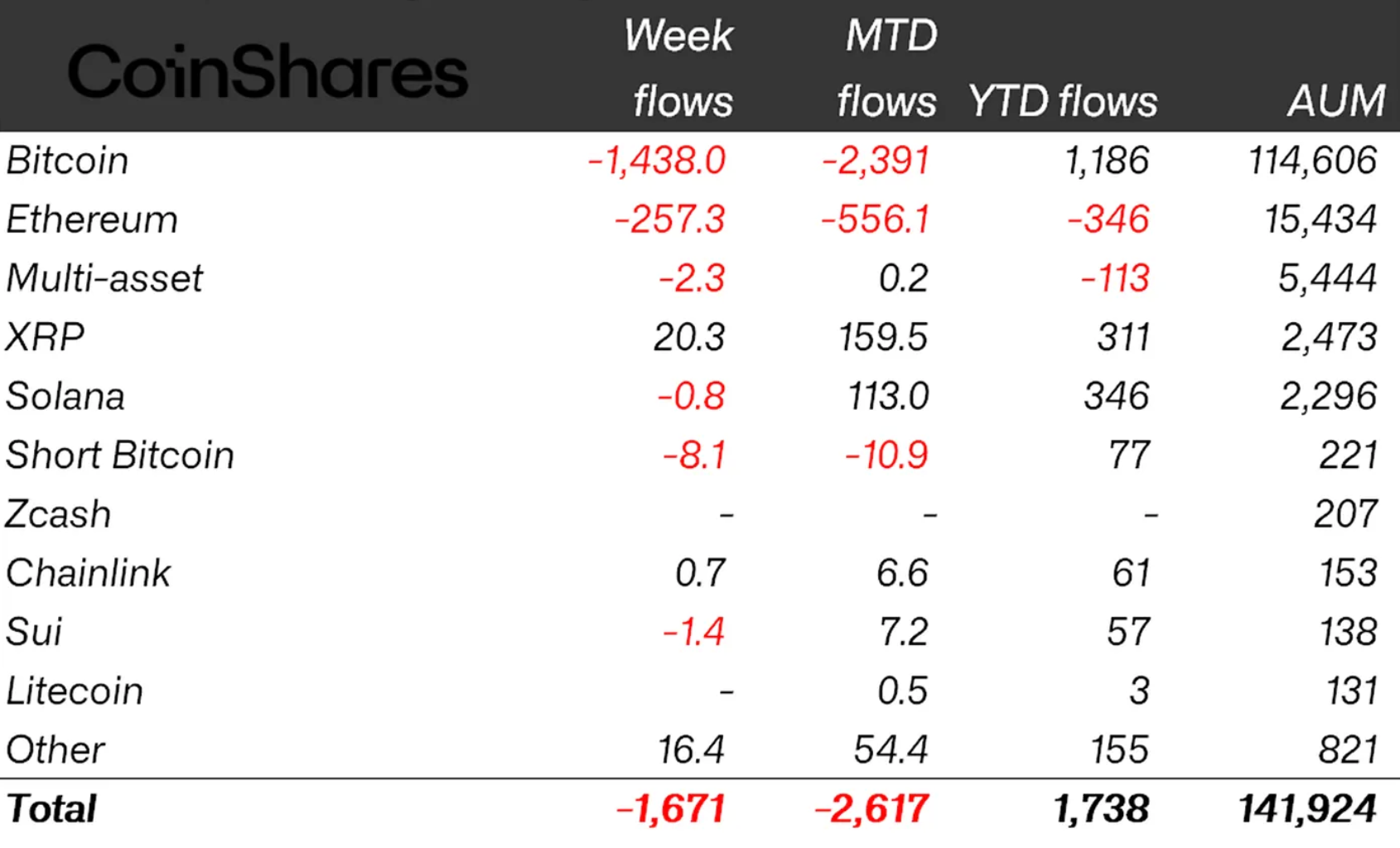
Crypto investment products extended losses to three straight weeks last week amid ongoing selling pressure in markets and limited institutional demand.
Crypto exchange-traded products (ETPs) recorded $1.67 billion in outflows last week, the second-largest weekly withdrawal of 2026, CoinShares reported on Monday.
The fresh outflows bring three-week losses to $4.21 billion, with total assets under management dropping to $141 billion, the lowest level since early April.
CoinShares head of research James Butterfill attributed surging outflows to an Iran-related risk-off move that has now overwhelmed any cushioning effect from CLARITY Act progress. “The pattern is reminiscent of the January-February episode that delivered five consecutive negative weeks,” he said.
Bitcoin sees the largest weekly outflow of 2026
Bitcoin (BTC) ETPs led weekly outflows by a wide margin, with $1.44 billion leaving the funds, marking the largest weekly outflow so far this year.
The funds were $2.4 billion down month-to-date but still had about $1.2 billion in inflows year-to-date, while assets under management fell to $114.6 billion.
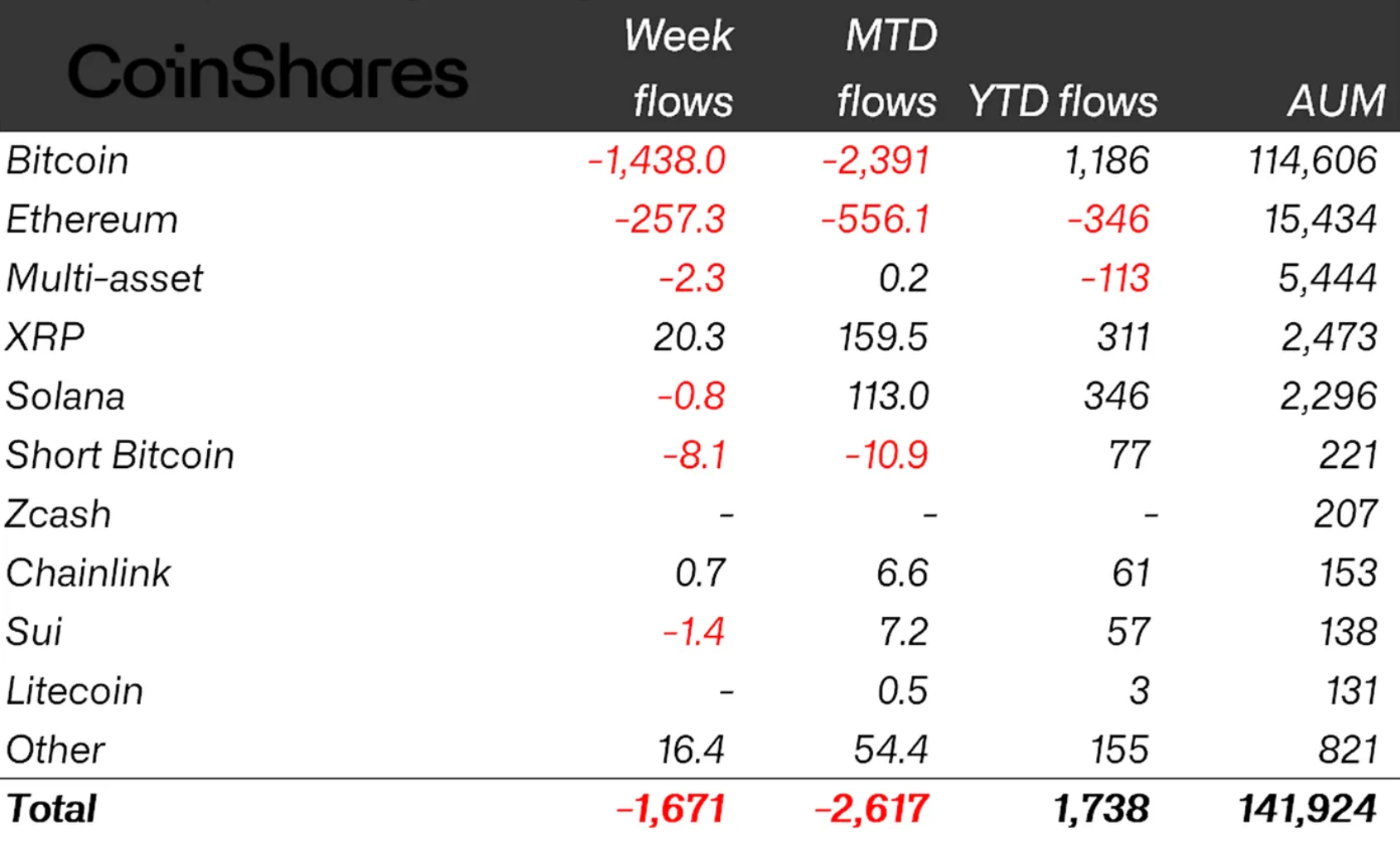
Crypto ETP flows by asset (in millions of US dollars). Source: CoinShares
Ether (ETH) funds continued to see selling pressure with $257.3 million in outflows, bringing year-to-date losses to $346 million.
Altcoin participation also collapsed, CoinShares’ Butterfill said, referring to only five assets recording substantial inflows above $1 million, down from nine a week prior.
XRP (XRP) again led positive momentum with $20.3 million in inflows, while Hyperliquid (HYPE) and Near (NEAR) followed with $10.8 million and $7.6 million, respectively.
US drives losses with $1.63 billion of outflows
Regionally, the United States drove the global outflow story with $1.63 billion of outflows, aligning with $1.42 billion in outflows from US-listed spot Bitcoin exchange-traded funds (ETFs), according to SoSoValue data.
Germany joined the risk-off sentiment with $25.7 million of outflows, while Sweden and Hong Kong saw $6.6 million and $4.5 million in outflows, respectively. The Netherlands again was the only country to see inflows above $1 million, with $1.3 million in inflows, down from $6.6 million a week prior.
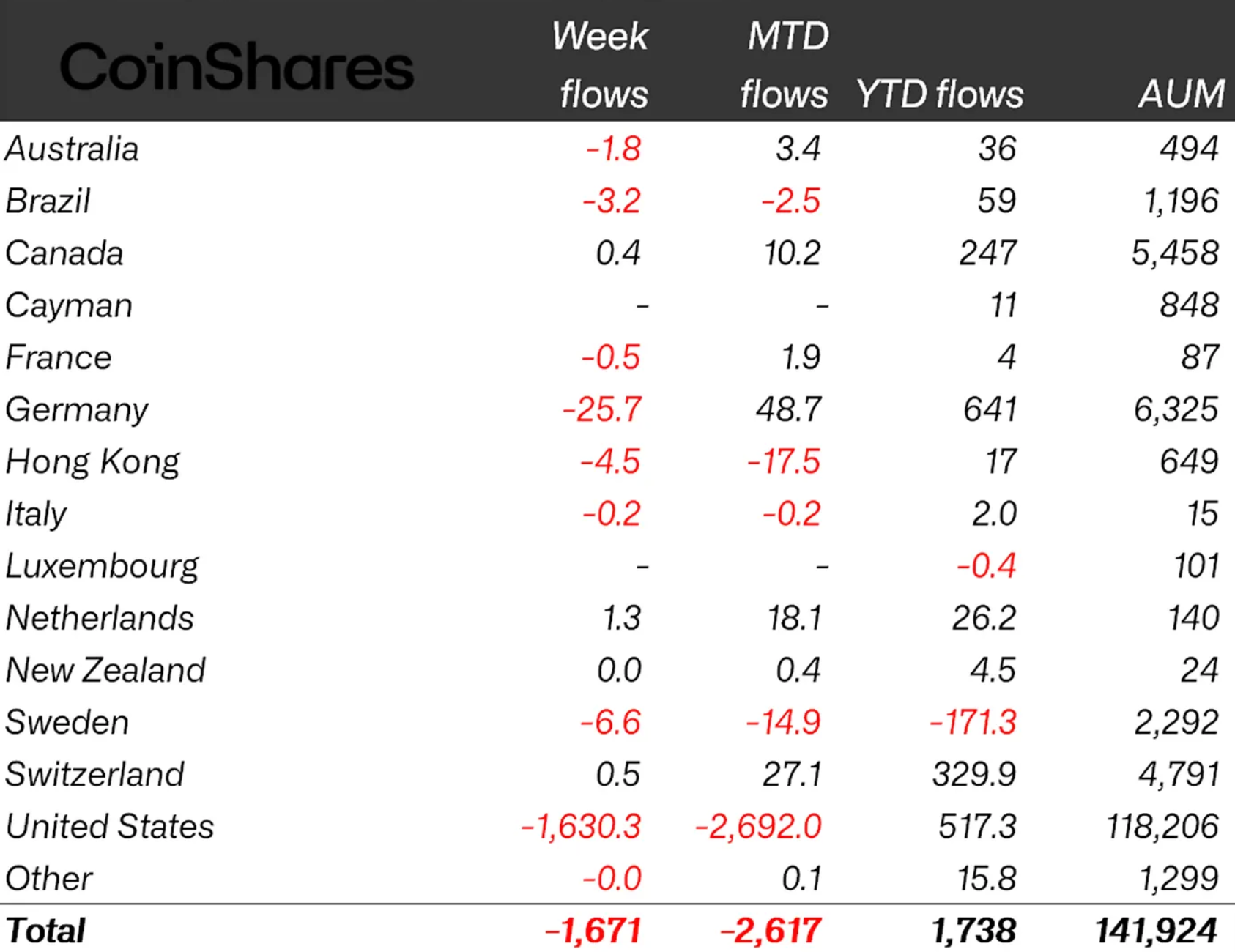
Crypto ETP flows by country (in millions of US dollars). Source: CoinShares
According to the derivatives trading desk at Laser Digital, the crypto sell-off last week came without a clear catalyst and was affected by underperforming equities.
Related: Strategy’s Michael Saylor teases BTC buy with ‘working better’ tweet
The unit cited a lack of demand, including Michael Saylor’s Strategy announcing that it did not purchase any BTC between May 18 and May 24.
“With STRC still trading below par and the continued lack of interest from retail buyers, BTC is expected to remain weak for the time being,” it said in a statement seen by Cointelegraph.
Magazine: HYPE chases $100 target, ETH could dump below $1800: Market Moves

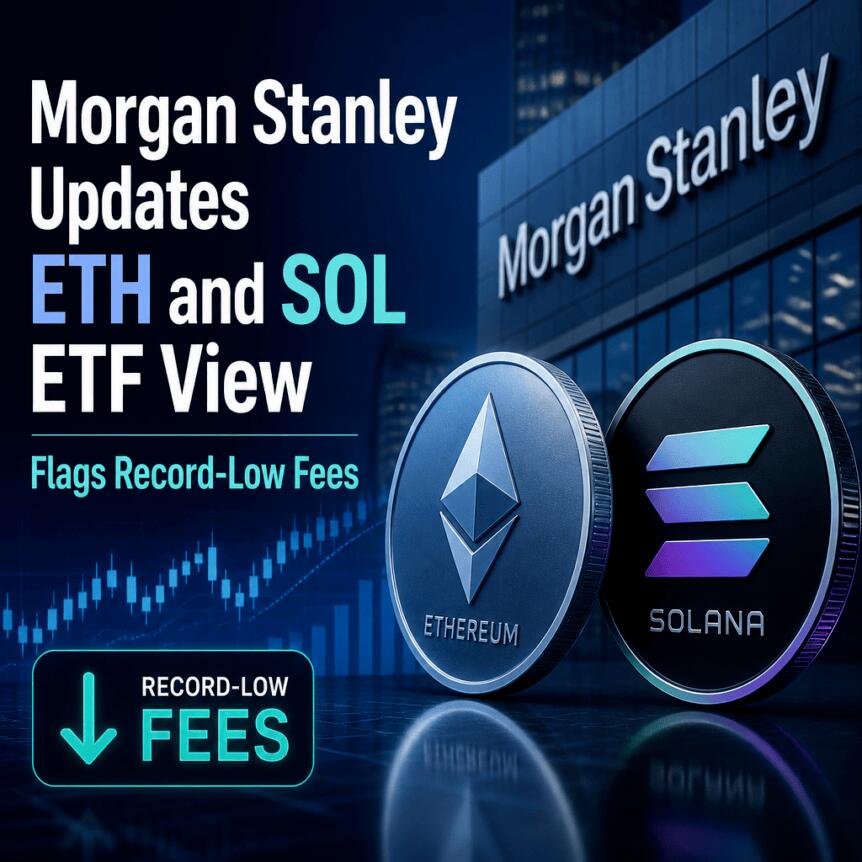
Morgan Stanley has amended its filings for spot Ether and spot Solana exchange-traded funds, setting fees it says are designed to be the lowest available in the US market for comparable products. The updates—made via amended Form S-1 statements—signal the firm is continuing to move toward an SEC decision that would allow the funds to begin trading.
According to the SEC filings lodged Thursday, Morgan Stanley plans to charge a fee of 0.14% for each ETF. If approved, the funds would expand Morgan Stanley’s presence in the fast-growing US spot crypto ETF lineup.
Key takeaways
- Morgan Stanley amended its SEC filings for both a spot Ether and a spot Solana ETF, targeting 0.14% fees.
- Farside Investors data cited in the article indicates existing lowest-fee spot products currently charge 0.15% for Ether and 0.19% for Solana.
- Amendments to Form S-1 have often been interpreted by the market as a sign of advancing SEC review and potential approval.
- Earlier, Morgan Stanley’s spot Bitcoin ETF launched with a 0.14% fee—matching its approach to undercut peers.
- Staking services for the proposed funds are set to involve Figment, Galaxy Blockchain Infrastructure, and Coinbase Canada, with a 5% staking fee on rewards.
Fees take center stage as SEC review advances
The core detail in Morgan Stanley’s latest updates is pricing. In the amended filings for each fund, the company states it intends to charge 0.14% annually. The move is particularly notable because it would place Morgan Stanley’s products at the low end of the fee spectrum for spot crypto ETFs in the US.
As background, Farside Investors data referenced in the article shows the current lowest-fee spot Ether ETF in the US is the Grayscale Ethereum Staking Mini ETF at 0.15%. For Solana, the lowest-fee spot offering cited is Franklin Templeton’s Franklin Solana ETF (SOEZ) at 0.19%, also based on Farside Investors’ figures.
Market watchers typically treat fee positioning as a proxy for how actively an issuer expects to compete for new assets. Lower expense ratios can make a fund more appealing to long-term allocators, especially when multiple spot crypto vehicles aim to track the same underlying assets.
Spot Ether and Solana proposals: what Morgan Stanley filed
The firm submitted amended Form S-1 statements for both proposed products on Thursday, as linked in the filings. The updates are the second set of amendments since Morgan Stanley first filed for the ETFs in January.
In practice, amendments are often read by the market as progress in negotiations and technical review—particularly because they generally appear closer to the moments when an issuer moves from preliminary review toward potential approval.
While the final SEC outcome is not guaranteed, the article notes that approval would add to the already expanding shelf of spot crypto products in the US, potentially bringing Morgan Stanley’s spot Ether ETF count to the 11th and spot Solana ETF count to the 7th among similar offerings, as described in the original coverage.
The specific fund naming and trading targets outlined in the article include:
- Morgan Stanley Ethereum Trust with ticker MSSE
- Morgan Stanley Solana Trust with ticker MSOL
Why “cheap” matters: Morgan Stanley’s Bitcoin playbook
Morgan Stanley has already used low fees as a market entry strategy in spot Bitcoin. Its Bitcoin ETF, launched in April, set its fee level at 0.14%, positioned below Grayscale’s 0.15% fee on its mini Bitcoin product, as noted in the article.
That fee decision appears to have been part of the firm’s early traction. The article references Cointelegraph coverage stating the fund recorded first-day inflows of $30.6 million and that total inflows have since reached $331 million, outpacing ETFs from Invesco, Franklin Templeton, and CoinShares that launched in January 2024.
Importantly, while inflow performance can be affected by many variables beyond fees—such as distribution reach, investor base, and timing—the repetition of a 0.14% expense ratio suggests Morgan Stanley is intentionally carrying forward a “competitive cost” approach across its crypto ETF expansion.
Staking services and the 5% reward fee
Morgan Stanley’s amended filings also address operational details tied to staking. The article says the filings indicate Figment, Galaxy Blockchain Infrastructure, and Coinbase Canada will provide staking services for each of the ETFs.
Under the structure described, each fund would apply a 5% staking fee to rewards earned by the product. This matters for investors because staking-related fees can change the effective return experienced by shareholders, particularly for spot products where staking can influence yield dynamics compared with a simple spot exposure approach.
Even with a low base expense ratio, staking economics can differ from the headline management fee. Investors generally look at both the fund’s stated expense level and any additional costs associated with custody, network participation, and reward allocation.
What to watch next
With Morgan Stanley’s spot Ether and Solana ETFs moving through an active amendment cycle—and with fees positioned at the low end versus currently available rivals—the next steps for investors are to monitor SEC feedback and any further filing updates that often precede approval decisions. The open question remains whether the SEC’s review will conclude in a timeframe that brings these products to market, and how staking-related costs ultimately shape investor outcomes versus existing offerings.
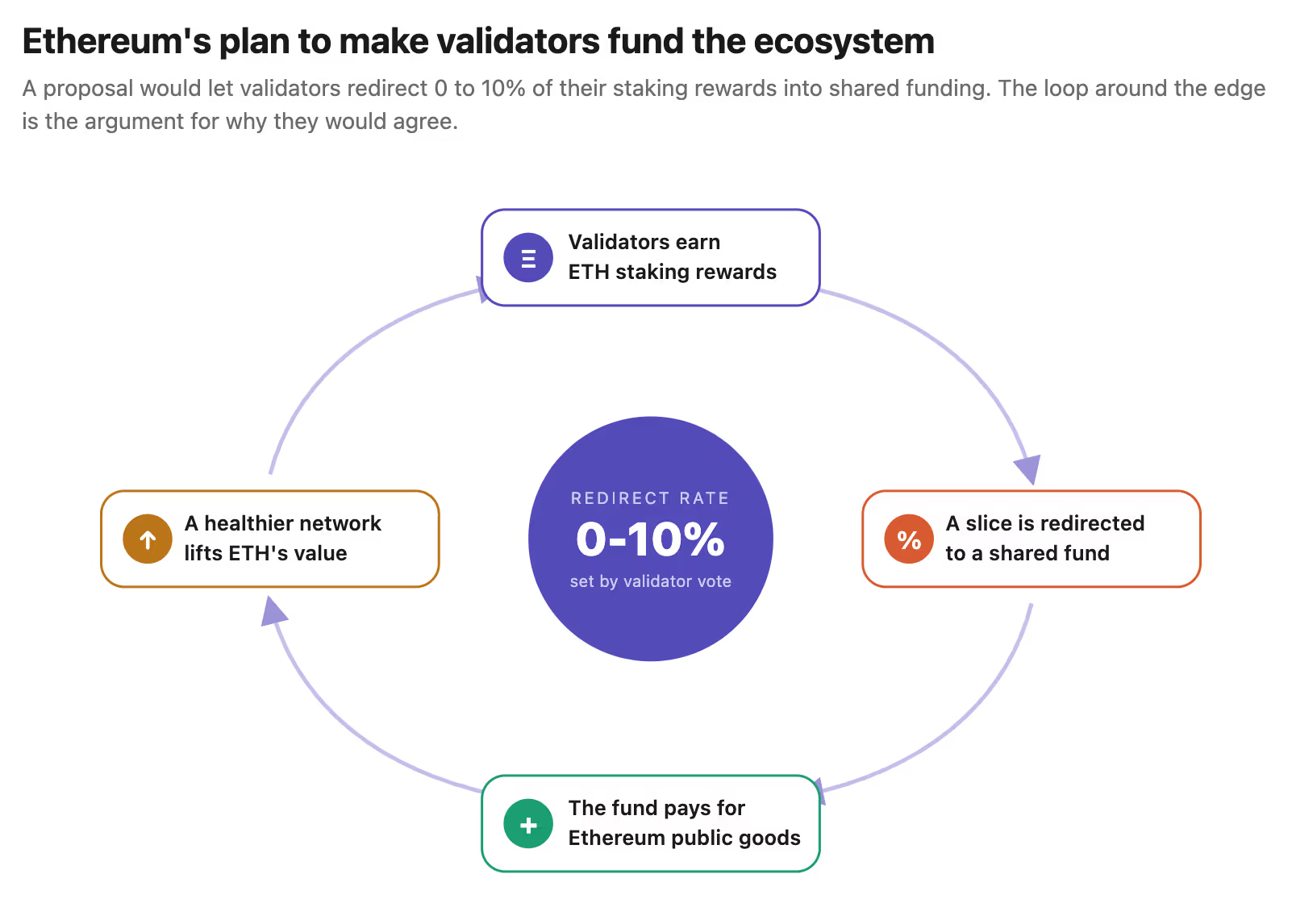
Validators are entities that keep Ethereum running by locking up ether (ETH), checking transactions and earning staking rewards for doing so. Funding, in this context, means paying for the shared work Ethereum relies on, such as developer tools, security research, public infrastructure and other projects that help the network but do not always have a direct business model.
The proposal seeks to shift that burden toward validators, who earn ETH rewards for securing the network and benefit when Ethereum becomes more valuable.
It argued that validators are natural long-term stakeholders because better ecosystem funding can increase network activity, ETH burn and the value of staked ETH.

Validators could also select preferred funding recipients under the proposal. Those preferences would be combined into a ‘splitter’ contract that distributes redirected funds among chosen addresses. The design is meant to let validators “set and forget” their preferences rather than vote on every grant.
At current staking levels, the post estimated that validators receive roughly 700,000 ETH a year in rewards. A 5% to 10% redirect could send about 50,000 to 70,000 ETH a year toward ecosystem funding. That equates to about $120 million at ether’s current market prices.
The idea is likely to be controversial, however.


For years, users looking to speed up their transactions on the Bitcoin blockchain relied on a handy optional feature that essentially says, “I might want to replace this transaction with a higher fee.”
But what started as a helpful tool has become redundant and a small privacy issue, prompting some developers to discuss possible ways to do away with it.
Let’s first take a look at the so-called replace-by-fee (RBF) signaling, then discuss the developers’ proposals.
Replace by fee (RBF) signaling
Imagine sending a paper check through the mail, but the postal system is stretched and congested. To ensure your payment doesn’t get stuck, the check has a small checkbox that says, “I reserve the right to cancel this check and write a new one with a higher rush fee if it gets delayed.” (The higher fee, of course, is an incentive for the postal system to prioritize your transaction.)
Such a feature is called Replace-by-Fee (RBF) in the Bitcoin ecosystem. For years, when you sent bitcoin, your wallet let you flip a switch, signaling to the network that you might want to “fee-bump” to speed up your transaction later.
Crypto World
Ethereum Layer 2 Taiko Urges Users to Withdraw Funds From Bridges, Confirms Security Breach

Taiko, the Ethereum layer 2 blockchain, has urged users to withdraw their funds from all bridges deployed on the network immediately.
This follows a confirmation of a security breach involving the network’s chain state verification mechanism.
We have confirmed a compromise of Taiko’s chain state verification mechanism. As a result, the security assumptions of all bridges deployed on Taiko can no longer be relied upon.
The team confirmed they are actively working with the Security Council and various ecosystem partners to contain the incident, pause the affected system wherever possible, and take both technical and legal actions.
So far, there’s no information on the amount of funds in jeopardy or if something has been stolen.
According to data from PeckShield, the exploit resulted in a loss of $1.7 million, while the attacker has already transferred 1.99 million TAIKO tokens, worth slightly less than $200K, to MEXC.
#PeckShieldAlert @taikoxyz has been exploited for ~$1.7M.
The exploiter has already transferred 1.99M $TAIKO (~$189.12K) to #MEXChttps://t.co/uJhqTYrqHH pic.twitter.com/Sl9kesSSUM
— PeckShieldAlert (@PeckShieldAlert) June 22, 2026
The post Ethereum Layer 2 Taiko Urges Users to Withdraw Funds From Bridges, Confirms Security Breach appeared first on CryptoPotato.


Altura will begin winding down its stablecoin yield vault after a sharp rise in withdrawal requests over the weekend.
Summary
- Altura processed more than 8.5m USDT in instant redemptions before announcing the stablecoin vault wind-down.
- Withdrawal pressure followed Main Street’s msUSD depeg, though Altura said it had no direct exposure.
- Some portfolio positions need standard settlement periods, so redemptions will continue as underlying capital returns.
CEO Ranveer Arora said the protocol processed more than 8.5 million USDT in instant redemptions over 24 hours before deciding to close the vault in an orderly way.
Arora said the team made the move because of “sustained withdrawal demand and current market sentiment.” He added that Altura’s priority was user capital and that the team wanted all redemptions completed in a “fair, transparent, and efficient manner.” The announcement marks a sharp change for a vault built around stablecoin yield on HyperEVM.
Altura stablecoin vault positions now being unwound
Altura has notified counterparties and partners about the decision and started unwinding positions across the vault portfolio. Arora said those positions include allocations held on exchanges, private credit opportunities and real-world asset strategies.
Some positions can return capital quickly, while others need standard settlement and redemption periods. Arora said the team is working with counterparties to speed up the process where possible, and that capital will return to users as underlying positions are redeemed. He said the team will keep posting updates as more liquidity becomes available.
Main Street depeg fuels market concern
The wind-down followed wider concern across yield-bearing stablecoin markets after Main Street’s MSUSD lost its peg. The token fell sharply after Accountable, its proof-of-solvency provider, ended its service agreement with MainStreet and said the project was “unable to meet our verification standards.”
MainStreet later said its assets remained fully backed and blamed the market stress on the shutdown of a third-party proof-of-reserves dashboard. As previously reported by crypto.news, MSUSD traded far below its intended $1 peg while lending liquidity on the Morpho msY/USDC market tightened.
Altura blames misinformation and speculation
Altura said earlier that it had no direct exposure to Main Street or its strategies. It also said its HyperEVM lending vault, Alpha USDT Prime, the related USDT/AVLT market and borrowers using its Ethereum vault remained unaffected by the Main Street event.
Arora said Altura had worked around the clock through the weekend to process withdrawals and speak with partners and users. He criticized what he called “misinformation and speculation,” saying unfounded narratives had added to market fear and withdrawal pressure.
Stablecoin vault risks return to focus
DefiLlama data showed Altura with about $32.36 million in total value locked on Hyperliquid L1, with one tracked yield pool and an average APY near 17.49%. The vault had reached a peak total value locked of about $39 million on HyperEVM.
The case comes as demand for tokenized real-world asset and stablecoin yield products grows. Crypto.news recently reported that Plume and Ether.fi launched a $100 million yield-bearing RWA vault, while separate coverage of MSUSD showed how a proof-of-reserves dispute can quickly move into wider liquidity concerns.
Altura said it will keep giving updates as redemptions progress and new liquidity becomes available. For users, the main questions now are the speed of settlements, how much capital returns in each stage and whether the process can avoid rushed sales of slower portfolio positions. The protocol has not set a final completion date, leaving the redemption timeline tied to each position’s settlement terms.
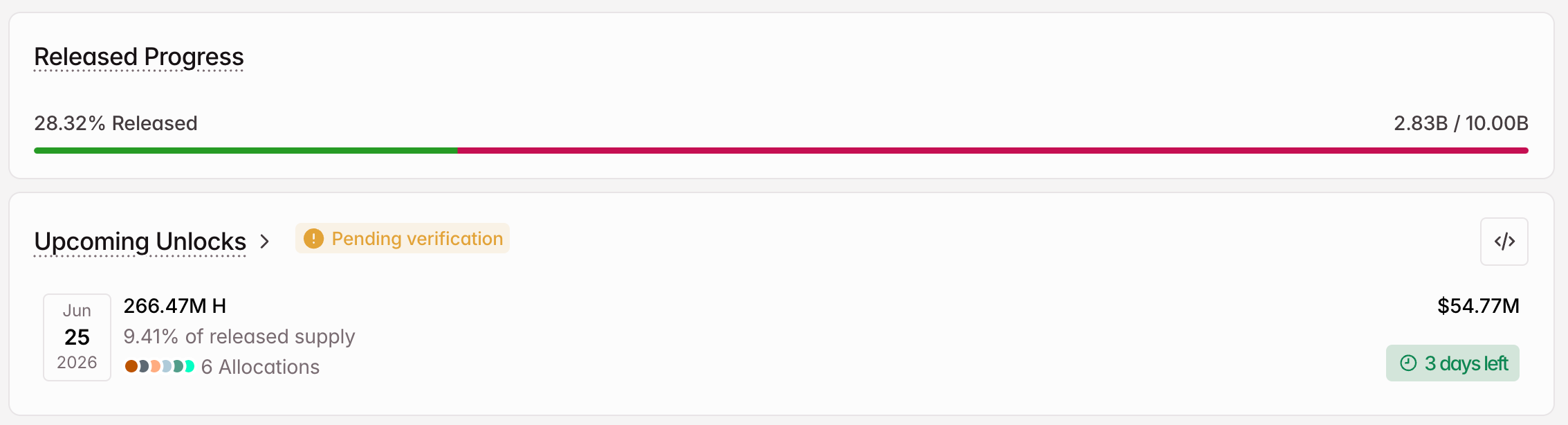
The crypto market will welcome tokens worth more than $735 million in the final week of June 2026. Major projects, including Humanity (H), MegaETH (MEGA), and Sahara AI (SAHARA), will release significant new token supplies.
These unlocks could introduce market volatility and influence short-term price movements. So, here’s a breakdown of what to watch.
1. Humanity (H)
- Unlock Date: June 25
- Number of Tokens to be Unlocked: 266.47 million H
- Released Supply: 2.8 billion H
- Total supply: 10 billion H
Humanity (H) is a decentralized identity protocol that utilizes biometric palm recognition, zero-knowledge proofs, and blockchain to verify the authenticity of real human users without exposing their personal data. It features a native Proof of Humanity (PoH) consensus mechanism.
On June 25, the protocol will unlock 266.47 million tokens. The tokens are worth $54.77 million and account for 9.41% of the released supply.

The unlock comes after the protocol suffered an exploit that resulted in losses exceeding $30 million. The H token plunged sharply following the incident. Although it recorded a notable recovery in the days that followed, the downtrend has since resumed amid growing macroeconomic and geopolitical pressures.
The team will split the released supply six ways. The ecosystem fund will receive 50 million H. Furthermore, Humanity will allocate 42.86 million altcoins to identity verification rewards and 12.50 million to the foundation operations treasury.
Additionally, early contributors will receive 79.17 million H. Investors will gain 55.56 million tokens. Finally, the Human Human Institute Strategic Reserve will receive 26.39 million H.
2. MegaETH (MEGA)
- Unlock Date: June 23
- Number of Tokens to be Unlocked: 250 million MEGA
- Released Supply: 757.5 million MEGA
- Total supply: 10 billion MEGA
MegaETH is an Ethereum Layer 2 network built for high-speed transaction processing. The network uses mini-blocks produced roughly every 10 milliseconds and targets over 100,000 transactions per second.
The network will release 250 million tokens on June 23, worth approximately $13.54 million. The unlock accounts for 32.8% of the released supply.

The team will direct the entire unlocked supply toward the Mainnet Campaign (Terminal).
3. Sahara AI (SAHARA)
- Unlock Date: June 26
- Number of Tokens to be Unlocked: 1.03 billion SAHARA
- Released Supply: 3.41 billion SAHARA
- Total supply: 10 billion SAHARA
Sahara AI is a full-stack, AI-native blockchain platform built to democratize the development and monetization of artificial intelligence. The network combines data services, AI tools, and a marketplace into one ecosystem.
On June 26, Sahara AI will unlock 1.03 billion SAHARA. The supply is worth $14.75 million. The tokens represent 30.10% of the released supply.

Sahara AI will direct 534.9 million tokens to early backers. The core team and contributors will get 406.25 million SAHARA. In addition, the team will allocate 53.02 million altcoins to ecosystem development and 31.25 million tokens for community incentives.
The unlock follows the token’s drop of over 50% earlier this month. The network said a “futures-led liquidation cascade” caused the price volatility.
In addition to these, other prominent unlocks that investors can look out for in the final week of June include Plasma (XPL), Soon (SOON), Newton Protocol (NEWT), and more.
The post 3 Token Unlocks to Watch in the Final Week of June 2026 appeared first on BeInCrypto.


Taiko has urged users to withdraw funds from all bridges deployed on its network after confirming a compromise of its chain state verification mechanism.
Summary
- Taiko urged users to withdraw bridge funds after confirming a chain verification mechanism compromise.
- Blockaid said flawed source-signal proof checks enabled unauthorized releases from Taiko’s ERC20 Vault on Ethereum.
- Taiko also stopped proposers from producing blocks and asked exchanges to suspend TAIKO deposits immediately.
The Ethereum Layer 2 project said the security assumptions behind its bridge system could no longer be relied upon.
The notice followed alerts from blockchain security firm Blockaid, which said its exploit detection system found an ongoing attack on Taiko’s ERC20 Vault on Ethereum. Blockaid put losses at more than $1 million and shared the victim contract, attacker wallet and exploit transactions.
Blockaid points to Taiko proof validation flaw
Blockaid said the likely root cause was a flaw in Taiko bridge source-signal proof validation. The firm said crafted message proofs were accepted as valid on Ethereum L1 even though there were no matching legitimate “MessageSent” events on the Taiko source chain.
That allowed the attacker to register and later retrieve fraudulent bridge messages, leading to unauthorized asset releases from the ERC20 vault. Taiko later confirmed a broader verification problem and said it was working with the Security Council and ecosystem partners.
Moreover, Taiko also said all proposers had temporarily stopped producing new blocks while the team investigates and resolves the issue. The project asked centralized exchanges to suspend TAIKO deposits immediately and said deposits should resume only after an official notice.
The team published several attacker addresses as part of its update. It said it would take technical and legal steps where needed, but did not give a timeline for restoring bridge security or restarting block production.
Bridge risks remain in focus
Taiko is a Type 1 Ethereum-equivalent ZK-EVM rollup designed as a based rollup, where Ethereum L1 validators are expected to help order transactions. The network launched mainnet in May 2024 and supports Ethereum-compatible smart contracts and tools.
Meanwhile, crypto.news recently reported that cross-chain bridge exploits caused $28.6 million in May losses, or about 42% of that month’s total reported by CertiK.
The incident comes after other cross-chain security failures this year. As previously reported by crypto.news, Verus Protocol’s Ethereum bridge lost more than $11.5 million in a forged-transfer exploit, while Axelar disabled Secret Network bridge routes after a $4.7 million exploit.
Moreover, as crypto.news earlier reported, an old Aztec Connect contract lost about $2.1 million after a verification mismatch let unbacked balances move through Ethereum settlement records.


Venture capital funds have poured $12.3 billion into defense technology startups since the start of 2026, nearly double the amount raised over the same stretch last year.
Conflicts in Ukraine and the Middle East have exposed an urgent demand for weapons systems that are cheaper and faster to build. That demand has turned military hardware into one of the year’s most sought-after bets.
VC Funds Pour $12.3 Billion Into Defence Tech in 2026
According to the Financial Times, the figure already exceeds the $9.95 billion the sector attracted across all of 2025. This signals how quickly investor appetite for drones, autonomous vessels, and battlefield artificial intelligence has grown.
The capital is concentrated among a small group of active investors. According to PitchBook, Gaingels, Alumni Ventures, and Andreessen Horowitz ranked among the most prolific check writers in the first quarter.
Daniel Rudnicki Schlumberger, head of JPMorgan’s security and resiliency initiative for Europe, the Middle East, and Asia, noted that the surging valuations come as funds increasingly treat defense as a lasting opportunity.
“We’re seeing the most important change in the way wars are being fought arguably ever,” Schlumberger said.
Follow us on X to get the latest news as it happens
Crypto Venture Funding Moves the Other Way
The defense rush stands in contrast to crypto, where venture investment has cooled sharply. Galaxy Research found that VCs deployed about $4 billion across 355 crypto deals in the first quarter.
That marked a 50% drop in capital from the prior quarter, though deal count fell only 16%.
“The decline from Q4’s spike was driven primarily by a drop in very large, later-stage financings. The number of completed deals fell much less than the amount of capital invested, indicating that smaller early-stage and seed rounds continued to get done even as Q1 lacked Q4’s concentration of mega-rounds,” Galaxy Research wrote.
Annualized, the pace implies roughly $16 billion in 2026, below last year’s near-$20 billion total. Meanwhile, new fund formation also stalled.
Crypto-focused venture funds drew about $1.1 billion in the first quarter, spread across just eight vehicles. That count marked the slowest quarter for new fund launches since the third quarter of 2020.
Galaxy attributed part of the shift to spot exchange-traded products and digital asset treasury firms, which now compete with venture funds for allocator capital. Still, the firm affirmed that “crypto venture activity remains relatively healthy overall.”
Subscribe to our YouTube channel to watch leaders and journalists provide expert insights
The post Wars Have Driven $12.3 Billion in VC Investment Into This Sector appeared first on BeInCrypto.
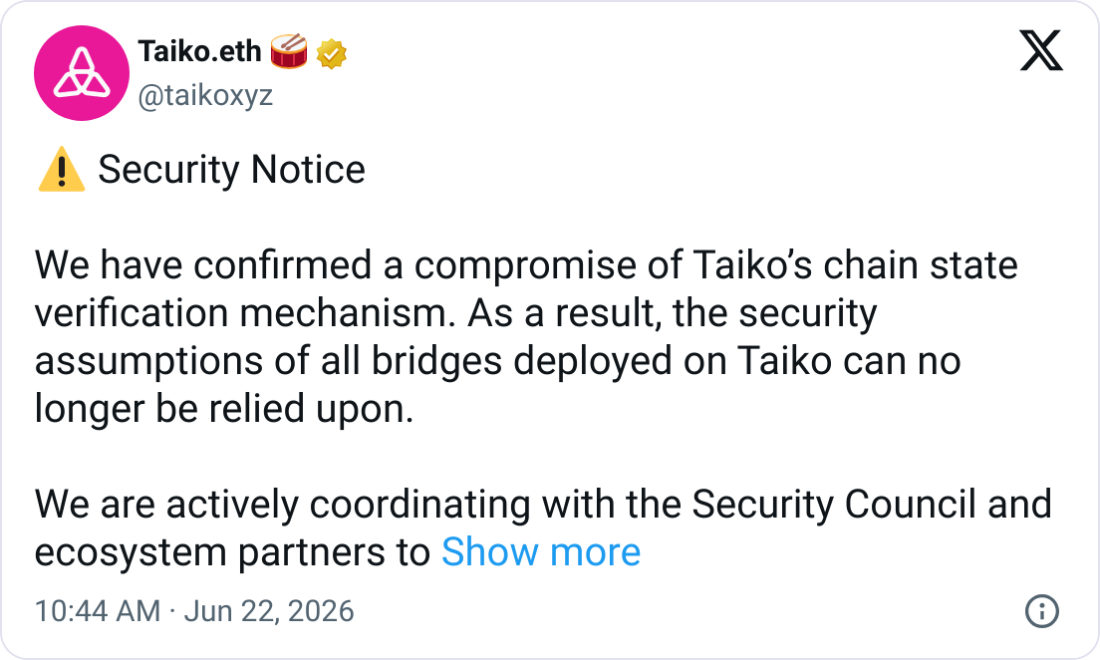
Taiko, an Ethereum layer-2 blockchain, has urged its users to withdraw assets from the network’s bridges after an exploit on one of its bridge protocols saw attackers make off with $1.7 million in the latest decentralized finance hack this month.
“We have confirmed a compromise of Taiko’s chain state verification mechanism,” Taiko posted to X early on Monday. “As a result, the security assumptions of all bridges deployed on Taiko can no longer be relied upon.”
“We strongly advise all users to withdraw their funds from all bridges deployed on Taiko immediately,” it added.
It is the latest in a series of crypto protocol exploits this month, which now number at least 23, according to DeFiLlama. The Humanity Protocol and Syscoin Bridge, which lost over $30 million and $8 million, respectively, have been the largest two exploits so far in June.
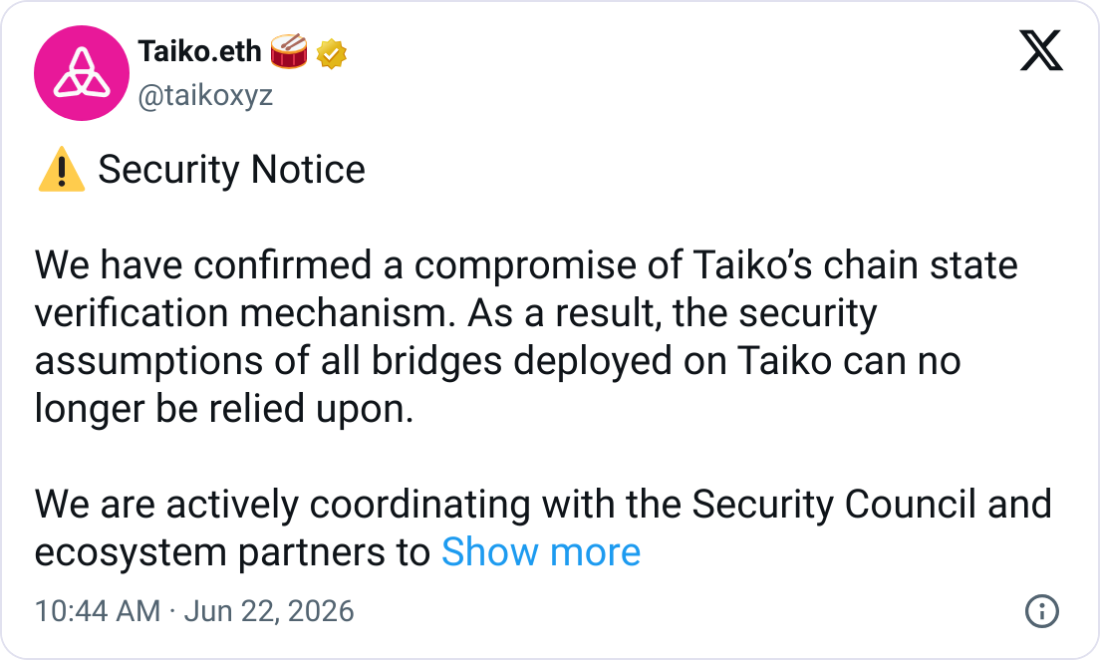
Source: Taiko
Taiko said it was coordinating partners to contain the incident and had paused affected systems.
Crypto security firm Blockaid said that the root cause appears to be a flaw in how the Taiko bridge validated source signals.
It said that message proofs were accepted as valid on Ethereum without corresponding legitimate proofs on the Taiko blockchain.
“This allowed the attacker to register and later retrieve fraudulent bridge messages, resulting in unauthorized asset releases from the ERC20 vault,” Blockaid said.
Blockaid estimated that at least $1 million had been stolen, while Lookonchain and PeckShield suggested the value of assets stolen could be as high as $1.7 million.
The exploiter has already transferred 1.99 million Taiko (TAIKO) tokens worth around $189,000 to MEXC, stated PeckShield. TAIKO is currently trading down 98% from its 2024 peak at $0.084, according to CoinGecko.
Related: Secret Network bridge exploited for $4.7M with ‘infinite mint’ bug
Blockchain intelligence firm Arkham shows Taiko exploiter wallets holding around $1.5 million, primarily in Ether (ETH).
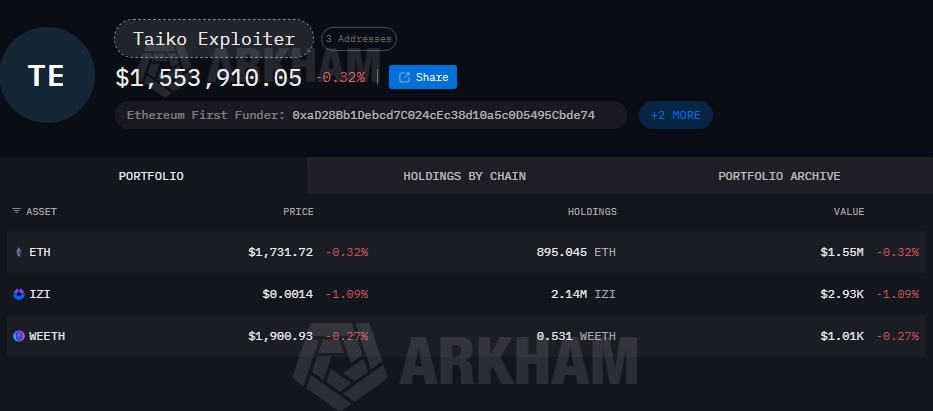
The Taiko exploiter account holds more than $1.5 million in ETH. Source: Arkham Intelligence
Exploits in June are mounting up
The attack comes just days after the discovery on Friday of a smart contract exploit on the Secret Network, which resulted in the theft of $4.67 million worth of assets.
On Saturday, around $1.1 million was drained from the OLPC/LABUBU liquidity pool on PancakeSwap. LABUBU is a memecoin inspired by the popular toys of the same name.
Other notable exploits in June include Aztec Connect, RetoSwap, Raydium AMM, and the largest one so far this month, Humanity Protocol.
Magazine: Bitcoin decouples from tech stocks, Ether eyes ‘selling wave’: Market Moves

Crypto markets spent the weekend in the red as hopes for a peace deal between the US and Iran remain fragile.
US equity market futures have opened lower as investors await details of US-Iran talks in Switzerland, according to the Kobeissi Letter.
Meanwhile, President Trump has ramped up the rhetoric again, posting on Truth Social on Sunday:
“Iran must immediately stop their highly paid proxies in Lebanon from causing trouble. If they don’t, we’ll hit Iran very hard again, just like we did last week, only harder!!!”
Economic Events June 22 to 26
The week kicks off with June’s S&P Global PMI data on Tuesday, and May’s new home sales figures are out on Wednesday.
However, all eyes are on the May Personal Consumption Expenditures (PCE) report, the Federal Reserve’s preferred inflation measure, due on Thursday.
The data follows last week’s FOMC meeting, where policymakers held interest rates steady while signaling a more inflation-focused monetary policy stance.
If PCE comes in hotter than expected, which is likely given that energy prices are rising, markets could price in fewer rate cuts, and risk assets may face pressure.
“The June FOMC meeting, with half of the committee leaning toward a tighter policy path, sent a hawkish jolt through markets,” said Bloomberg analysts.
“Even though Warsh didn’t submit his own dot for the dot plot, his tone at the news conference seemed notably hawkish to us. A hot PCE inflation reading will likely reinforce that hawkish message.”
The current odds for a rate hike at the Fed’s next meeting in late July are around 40%, according to the CME Fed Watch tool.
More economic data follows on Thursday with the US first-quarter GDP report, shedding light on the rate of economic growth.
June’s Michigan consumer sentiment data and inflation expectations data are due out on Friday, rounding off a busy week for economic reports.
Key Events This Week:
1. June S&P Global PMI data – Tuesday
2. May New Home Sales data – Wednesday
3. May PCE Inflation data – Thursday
4. US Q1 2026 GDP data – Thursday
5. June MI Consumer Sentiment data – Friday
6. June MI Inflation Expectations data – Friday
The…
— The Kobeissi Letter (@KobeissiLetter) June 21, 2026
Crypto Market Outlook
Crypto markets spent the weekend mostly flat, with total capitalization hovering around $2.3 trillion. More volatility is expected this week, and the path of least resistance is downwards.
Bitcoin has been trading tightly around $64,000, where it is at the time of writing on Monday morning in Asia. There has been a quick dip towards $63,000, but it recovered quickly. The weekly close was at $63,267, forming a support base.
Ether prices remain at multi-year lows, struggling to make any headway above $1,700, while most altcoins are still in retreat.
The post 4 Things That Could Move Crypto Markets This Week appeared first on CryptoPotato.

Joe Hart backs Arsenal star’s surprise World Cup snub | Football

South Korean Stocks Advance as KOSPI Climbs 0.73 Percent to 9,118.50 on Tech Resilience

Morgan Stanley Updates ETH and SOL ETF View, Flags Record-Low Fees


-
 Crypto World7 days ago
Crude Oil Plunges Over 4% as US-Iran Agreement Reopens Hormuz Strait
-
 Tech6 days ago
The Adder At The Heart Of Intel’s 8087 FPU
-

 Fashion3 days ago
Weekend Open Thread: Miami – Corporette.com
-
 Business2 days ago
Wall Street Week Ahead: Investors see Micron earnings as pulse check of AI rally momentum
-

 Crypto World2 days ago
HIVE shares jump as $220M AI deal speeds Bitcoin mining pivot
-

 Sports3 days ago
FIFA World Cup 2026: Canada beat 9-men Qatar 6-0 to register first ever win | FIFA World Cup 2026
-

 Crypto World2 days ago
Jake Chervinsky accuses CME of protecting derivatives monopoly
-

 Business1 day ago
MHP SE 2026 Q1 – Results – Earnings Call Presentation (OTCMKTS:MHPSY) 2026-06-20
-

 Crypto World4 days ago
Anthropic’s Dario Amodei Urged AI Unity at G7, Even as US Banned His Models
-

 Business3 days ago
Brexit cost 6% of UK economy, Bank of England company data suggests
-

 Business1 day ago
Soccer-U.S. defends Iran World Cup travel restrictions, says discussions ongoing
-
 Crypto World2 days ago
Can Charles Hoskinson Really Rescue Cardano?
-

 Tech4 days ago
Weeks Of In-The-Field Testing And A Verdict
-

 Tech4 days ago
Adobe adds its AI assistant to Premiere, Illustrator and InDesign
-

 Politics2 days ago
Andy Burnham and the meaning of Makerfield
-

 Entertainment1 day ago
Renter of Home in Anne Heche Crash Denies Settlement With Son
-
 Crypto World4 days ago
Iren (IREN) Stock Surges on Jefferies Buy Rating: AI Infrastructure Play Gains Momentum
-

 Tech3 days ago
Instagram Now Lets You Add A Unique Caption To Each Carousel Slide
-

 Politics3 days ago
BBC Reporter Discusses Cross Party Criticism Of Trumps Iran Deal
-

 News Videos3 days ago
Nightcore – MONEY ON THE DASH (Soft Rock Version) (Lyrics)
You must be logged in to post a comment Login