

Crypto World
Will XRP Explode as CLARITY Act Passes Senate Stage? ChatGPT Sees One Big Catch


After months of negotiations and delays, a US Senate panel on Thursday finally approved the CLARITY Act with a 15-9 vote.
Although there’s still a long way to go until the bills become law, since there’s a lot of opposition left and it would need to clear the full Senate, the cryptocurrency market already experienced a notable price boost once the news went live on Thursday.
The question we asked ChatGPT is what sort of impact would the CLARITY Act’s potential approval have on XRP, since many analysts in the past have noted that the asset requires further regulatory clarity (no pun intended) to unlock its next major phase up.
Impact on XRP
The bill’s structure is designed to finally clarify one of the most controversial and important questions in the cryptocurrency industry: when is a token a security, and when it is not. Given Ripple’s (and XRP’s) history with the US SEC on the topic and how much it haunted them for years, it’s safe to say that the cross-border token and the company behind it should look forward to the most for a clear answer.
As mentioned above, analysts are adamant that XRP will be among the most spectacular beneficiaries, with some expecting multi-billion-dollar inflows toward the spot ETFs tracking its performance. ChatGPT agreed to a large extent, as Ripple has always positioned XRP as a utility asset and a cross-border liquidity tool. It’s infrastructure for payments rather than a traditional investment contract, the company says.
“XRP’s underperformance in recent months or even years on broader scales was caused less by technology weakness and more by regulatory pressure… Remove that pressure, and the narrative changes fast,” said the AI tool.
Will the Price Explode?
The bullish scenario for XRP is if the bill continues to progress, while the overall market sentiment remains positive and institutions interpret the asset as safer from future SEC attacks, said ChatGPT. Then, the token could see “renewed exchange activity, increased institutional interest, and potentially a major breakout attempt.”
The first major psychological line for XRP would be the $2.00 resistance: flipping it into support “could happen surprisingly quickly if momentum accelerates.”
However, there’s a big catch, the AI platform warned. If XRP indeed relies on the CLARITY Act’s full approval, then the fact that it might take months or even years for the complete resolution could spell trouble or consolidation for the asset.
As such, ChatGPT concluded that passing Senate now was a “huge milestone,” but it’s far from “being the finish line.”
The post Will XRP Explode as CLARITY Act Passes Senate Stage? ChatGPT Sees One Big Catch appeared first on CryptoPotato.

Ethereum’s recent recovery phase has weakened considerably after repeated failures beneath the $2.4K major resistance level. The latest price action suggests bearish momentum is gradually building, while buyers struggle to maintain control above important support regions.
Ethereum Price Analysis: The Daily Chart
On the daily timeframe, ETH has experienced a notable bearish rejection after multiple unsuccessful attempts to reclaim the key resistance zone around $2.3K-$2.4K. This region remains highly significant as it has acted as an important supply area where sellers continue to defend aggressively.
The latest decline has pushed the price back toward the 100-day MA, making it the next dynamic support level. A confirmed breakdown below this moving average could trigger another bearish leg toward the crucial demand zone around $1.8K-$1.85K. Meanwhile, the broader structure still resembles a corrective phase beneath the descending 200-day MA near the $2.6K region, suggesting the higher timeframe trend remains fragile.
Unless Ethereum manages to reclaim the $2.4K resistance and stabilize above it, bearish continuation toward lower support levels currently appears to be the more probable scenario.

ETH/USDT 4-Hour Chart
On lower timeframes, ETH recently broke the lower boundary of its ascending wedge formation, providing one of the clearest bearish signals observed in recent weeks. Following the breakdown, price accelerated lower and reached the first highlighted demand region around $2.18K-$2.22K.
The reaction at this support zone will likely determine Ethereum’s next directional move. If buyers succeed in defending the current region, short-term consolidation or a temporary rebound toward the broken wedge boundary near $2.3K becomes possible. However, failure to hold the $2.2K support would expose the next major demand zone around $2.05K-$2.1K.
Notably, the recent breakdown also invalidates much of the prior bullish recovery structure, indicating sellers have regained control over short-term momentum. Unless ETH quickly reclaims the broken trendline and returns above the $2.3K region, further downside pressure remains likely in the coming sessions.

Sentiment Analysis
The Taker Buy Sell Ratio measures the balance between aggressive buyers and aggressive sellers in the futures market. Values above 1 indicate buy-side dominance, suggesting market participants are executing more market buy orders, while readings below 1 reflect stronger selling pressure and bearish sentiment. As a result, this metric is often used to evaluate short-term momentum shifts and trader conviction.
Recently, the indicator has remained persistently below the neutral 1 threshold, currently hovering around the 0.96–0.97 region. This suggests that sell-side activity continues to dominate derivatives markets, aligning closely with Ethereum’s recent bearish price action and the breakdown observed on lower timeframes.
Although minor rebounds in the ratio have appeared, buyers have repeatedly failed to regain sustained control. This ongoing weakness implies that aggressive demand remains limited, increasing the probability of continued downside pressure in the coming weeks.
If the Taker Buy Sell Ratio remains below 1 while ETH trades beneath key resistance levels around $2.3K-$2.4K, the bearish scenario discussed in the technical analysis could strengthen further, potentially driving the price toward lower support zones around $2.1K and eventually the critical $1.8K region.

The post Ethereum Price Prediction: Is ETH Setting Up for a Drop to the $1.8K Zone? appeared first on CryptoPotato.

Warsh takes the helm as market and policy questions mount
Kevin Warsh was confirmed this week as the 11th chair of the Federal Reserve in a 54-45 Senate vote, ending a contentious transition and setting the stage for a potentially different policy posture at the central bank. The confirmation was unusually partisan, and comes after a delay that followed an inquiry into his predecessor. Jerome Powell will remain on the Board of Governors, marking the first time in roughly 75 years that a former chair has continued as a voting governor.
What it means for crypto: Warsh has previously described bitcoin as a form of digital gold for younger investors and has signaled skepticism toward central bank digital currencies while voicing support for private stablecoin frameworks. Those views offer a degree of structural validation for the industry. At the same time, several committee members have signaled that rate hikes remain on the table, and Warsh inherits an environment where cuts are not yet priced in by markets. Less accommodative monetary policy tends to compress liquidity across risk assets, and bitcoin, which has recently traded like a risk asset, may be vulnerable to those dynamics in the near term.
Markets will be watching Warsh’s first Federal Open Market Committee meeting, scheduled for June 16-17, for early clues about the new chair’s approach to inflation, employment, and market liquidity.
Senate committee advances Clarity Act, but path to passage remains uncertain
The Senate Banking Committee voted 15-9 to advance the Digital Asset Market Clarity Act, a comprehensive market-structure bill that would reshape how US authorities regulate crypto trading venues and stablecoins. The measure proposes several notable changes: it seeks a jurisdictional split between the Securities and Exchange Commission and the Commodity Futures Trading Commission, mandates 1:1 stablecoin backing in high-quality, short-duration Treasury instruments, and creates a registration pathway for digital commodity exchanges.
Legislative hurdles: The bill still must be reconciled with a parallel text in the Senate Agriculture Committee, and significant points of contention remain—most prominently an ethics provision that would restrict public officials from profiting from crypto holdings. The White House has signaled it favors broad ethics rules but objects to provisions that single out the president. Final passage would also require overcoming the Senate’s 60-vote threshold, meaning bipartisan support will be essential.
If enacted, the Clarity Act would reduce regulatory uncertainty around market infrastructure and stablecoins, potentially easing compliance pathways for exchanges and issuers. However, the bill faces opposition from institutions worried about stablecoin yield provisions and from law enforcement and labor groups concerned about illicit finance and financial stability risks. Those debates will shape the bill’s final form.
THORChain suspends operations after suspected $10M exploit
THORChain halted trading on Friday after detecting a suspected exploit that the protocol estimates at about $10 million, affecting assets across Bitcoin, Ethereum, BNB Smart Chain and Base. Two addresses linked to the theft were identified and the native token RUNE declined roughly 15% on the news.
This is the latest incident in a history of security and solvency challenges for the cross-chain protocol: THORChain suspended its ThorFi lending operations earlier this year amid significant defaulted obligations, and last fall the protocol’s founder reported funds drained from a personal wallet. On-chain analysis cited by the protocol indicates unusually high weekly volume—approximately $394 million in daily throughput—driven in part by activity tied to laundering from a prior breach.
Broader implications: Cross-chain bridges and swap mechanisms remain prime attack surfaces in decentralized finance. The very mechanisms that enable seamless asset flows between chains also expand the avenues for exploitation and money movement following thefts. THORChain’s recurring incidents highlight the trade-offs between permissionless interoperability and operational resilience, and they are likely to attract heightened scrutiny from users, counterparties and regulators until technical details are disclosed and remediation steps are completed.
AI-assisted research cracks Apple M5 protections, underscoring rising software risk
Security researchers at startup Calif reported using a preview of Anthropic’s Claude Mythos to accelerate development of a kernel exploit that bypassed Apple’s Memory Integrity Enforcement on M5 silicon, escalating from an unprivileged user to root on macOS 26 in under a week. The team delivered a 55-page technical report to Apple in person. According to the researchers, Mythos identified candidate kernel vulnerabilities quickly, while human engineers designed the bypass and exploit chain.
Project Glasswing, Anthropic’s program for enterprise partners, has placed Mythos with select organizations including Apple, major cloud providers and security firms. In controlled testing cited by Anthropic, Mythos identified hundreds of vulnerabilities in large software targets and completed simulated multi-stage cyberattacks.
Why crypto stakeholders should care: The incident illustrates how advanced generative AI tools can compress vulnerability discovery timelines. For crypto, that raises pressure on software wallet providers, custodial services and smart-contract audit practices. While hardware-level protections and transaction-signing isolation can limit exposure, the security community increasingly argues that defenses will need to shift toward hardware-backed and multi-layered approaches if AI continues to accelerate exploit development.
Takeaway: This week combined major policy developments with fresh reminders of operational risk. Warsh’s confirmation and the Clarity Act’s committee progress could reduce regulatory uncertainty over time, but monetary policy and the bill’s final form will materially affect market liquidity and institutional participation. At the same time, repeated DeFi exploits and the advent of AI-accelerated vulnerability research increase the imperative for robust security standards and for market infrastructure that can withstand faster, more automated threat actors. Investors and infrastructure providers should monitor the June FOMC meeting, the Senate’s legislative calendar, and ongoing technical disclosures from THORChain and the security research community for signals on risk and resilience.

TLDR:
- Bitcoin has gained 25% from recent lows despite rising yields and Middle East tensions signaling notable strength.
- Bitcoin ETFs reached a new all-time high in AUM and holders, reflecting sustained institutional accumulation over time.
- The Bitcoin-to-Gold RSI hit its lowest reading ever, with prior similar readings each preceding the start of a bull market.
- Analysts warn new lows would invalidate the 200-week MA, a level only breached in 2022 amid FTX and Luna collapses.
Bitcoin continues to hold above key support levels despite broader market volatility. As of writing, BTC trades at $78,235.79, reflecting a 0.47% gain in 24 hours.
Weekly performance shows a 3.20% decline, yet analysts argue the broader picture tells a different story. Crypto analyst Michaël van de Poppe notes that Bitcoin’s behavior since recent geopolitical tensions began points more toward underlying strength than weakness.
Bitcoin Holds Ground as Macro Pressures Mount
Bitcoin is up 25% from its recent lows, which formed when Middle East tensions escalated alongside rising bond yields.
That kind of recovery, under those conditions, is not typical of a weakening asset. Most risk assets struggled during that same period, making Bitcoin’s rebound stand out considerably.
Van de Poppe pointed out that Bitcoin losing the 21-day moving average does not confirm a downtrend toward new lows.
The asset is still trading above $76,000, which he considers a show of resilience. A CME gap sitting at $79,100 also remains a near-term reference point for traders.
The analyst further suggested the recent sell-off may stem from a concentrated correction tied to Strategy’s dividend data.
This would make it a technical event rather than a change in market direction. That distinction matters when assessing whether momentum has genuinely shifted.
Rising yields have historically triggered sharp Bitcoin corrections. However, this time, markets have not reacted with the same degree of panic. That measured response, according to van de Poppe, adds weight to the bullish case.
ETF Inflows and On-Chain Data Support a Longer-Term Outlook
Bitcoin ETFs have reached a new all-time high in both assets under management and total holders. This reflects sustained institutional participation rather than speculative retail activity.
Van de Poppe noted that so-called “smart money” continues to accumulate, while retail participants and early OGs are the ones reducing exposure.
The Bitcoin-to-Gold ratio recently recorded its lowest RSI reading in history. Looking back, the three closest comparable readings all preceded the start of bull markets, not bear markets. That data point alone carries weight for traders studying long-term cycles.
For Bitcoin to confirm a bear market, it would need to invalidate the 200-week moving average. That level has held through every major correction except 2022, when FTX and Luna collapsed and triggered a systemic CeFi crisis. No comparable structural failures are present in today’s market.
Van de Poppe acknowledged that a test of the $70,000 level remains possible. Still, he maintains that new lows are unlikely given current conditions.
The combination of ETF growth, macro resilience, and historical RSI data all point toward continuation rather than capitulation.

Crypto World
Justoken Tokenizes $2 Billion in Electricity on XRP Ledger, Driving Structural XRP Demand
TLDR:
- Justoken has tokenized over $2 billion in real electricity production as digital assets on the XRP Ledger.
- Every tokenized asset transaction on XRPL requires XRP for fees, generating constant and measurable network demand.
- New accounts and trust lines formed around tokenized energy assets lock XRP reserves, reducing circulating supply.
- XRP serves as a bridge asset on XRPL’s native DEX, routing liquidity for tokenized electricity trades and settlements.
XRP Ledger has reached a new milestone in real-world asset tokenization. Justoken has placed over $2 billion worth of electricity production onto the XRPL blockchain.
The tokenized assets represent physical energy flowing through power grids. This move turns real energy output into tradable digital financial instruments.
The development creates measurable, ongoing demand for XRP across multiple network functions.
Justoken Brings Physical Energy Assets to XRPL
Justoken has converted real electricity production into digital assets on the XRP Ledger. These are not synthetic instruments or yield-bearing DeFi products.
They represent actual energy generated and distributed through physical power infrastructure. Each tokenized unit carries genuine economic value tied to real-world commodity output.
As X Finance Bull noted in a recent post, “Over $2 billion in electricity is now tokenized on XRP Ledger. Not crypto. Not DeFi yield. Electricity.”
The statement draws attention to the nature of the asset class involved. Energy tokenization at this scale moves XRPL beyond speculative use cases. It positions the network as infrastructure for commodity markets.
Every transaction involving these tokenized assets requires XRP to cover network fees. Issuing, moving, trading, settling, and managing tokens each consume a fraction of XRP.
With $2 billion in tokenized electricity on the network, transactional activity generates constant fee-based demand. That demand is ongoing and tied directly to commodity market activity.
New accounts created to hold or manage these assets also require XRP reserves. More companies, brokers, and settlement wallets mean more accounts.
Each account locks a set amount of XRP just to exist on the ledger. This reserve mechanism removes XRP from circulation with every new market participant.
Trust Lines and Liquidity Routing Drive XRP Demand Further
XRPL tokens operate through a system called trust lines. Each trust line between two parties requires XRP to be held as a reserve.
Thousands of trust lines are expected to form around $2 billion in tokenized energy assets. Each one locks additional XRP in reserve, reducing the circulating supply.
Beyond reserves, the native decentralized exchange on XRPL creates further demand. XRP functions as a bridge asset within payment paths and exchange routes.
When tokenized electricity is traded or settled, liquidity often routes through XRP. This places XRP at the center of commodity-linked financial flows.
The bridge asset function becomes more active as tokenized asset volume grows. More trading pairs, more settlement routes, and more financing activity all pass through XRP.
This is a structural demand driver built into the protocol itself. It operates independently of market sentiment or speculative cycles.
X Finance Bull summarized it directly: “This is not a partnership announcement. This is $2 billion in real-world commodity value creating measurable, ongoing demand for XRP.”
The tokenization of physical energy on XRPL marks a shift in how blockchain infrastructure connects to traditional commodity markets.


USDC users are again asking whether Circle should offer a clearer recovery process for mistaken token transfers.
Summary
- USDC users are questioning Circle’s recovery options after claims of mistaken transfers to inaccessible contracts.
- Tether’s official recovery page says some mistaken USDT deposits may be reviewed case by case.
- Tether freezes far more stablecoin value than Circle across blacklist cases globally.
The debate followed posts from users who said they sent USDC to addresses or contracts they could not access.
One user, Weilin Li, asked on X whether Circle provides a service similar to Tether’s token recovery process after sending USDC to a self-deployed contract.
Blockchain investigator ZachXBT replied that recovery may be technically possible in some cases involving native USDC, but he also criticized Circle’s approach. His comment was an opinion posted on X, not an official finding.
Circle terms warn transfers can be final
Circle’s USDC terms state that once a transaction has been initiated, it cannot be reversed, except as set out in the terms. The company also says USDC transactions are generally nonrefundable.
The same terms warn that sending USDC to a wallet or address that does not support USDC can lead to permanent loss. Circle also says it bears no responsibility for losses from sending USDC to unsupported addresses.
Circle still has address control tools in some cases. Its terms say the company may block certain USDC addresses and freeze related USDC if it links the address to illegal activity or a breach of its rules. Circle also says USDC follows its blocklisting policy.
Tether recovery policy draws comparison
Tether’s official recovery page says Tether token recovery is a process for returning mistakenly deposited Tether tokens. The page warns that sending tokens to the wrong destination can still cause a total loss.
Tether says it may try to help in specific cases at its sole discretion. Its examples include certain contracts that do not correctly support withdrawals, token operation contracts, or other destinations Tether decides may be recoverable.
That difference is central to the current debate. Users are not asking for normal blockchain transfers to be reversed. They are asking whether a stablecoin issuer can freeze trapped tokens and reissue new tokens after identity checks and proof of error.
Crypto.news data shows different issuer behavior
Crypto.news reported that Tether froze about $3.3 billion between 2023 and 2025, compared with about $109 million frozen by Circle. The report said Tether used a freeze, burn, and reissue model in some cases, while Circle mainly acted under court or regulatory orders.
A later report said Tether froze over $514 million USDT across 370 addresses in 30 days, with its 2025 blacklist total reaching $1.26 billion.
Circle has also faced criticism from ZachXBT in other cases. Crypto.news reported in April that he accused Circle of failing to freeze stolen USDC during the Drift Protocol exploit.


Artificial intelligence has ushered in a bull run in stocks that has taken the broader market to new heights. Companies that have tied workforce reductions to the new technology, however, haven’t always fared so well.
CNBC compiled a list of 23 S&P 500 firms across multiple sectors and industries to see how their stocks fared following layoffs linked to AI. Specifically, we looked for companies that explicitly cited artificial intelligence or hinted at increased use of the technology when announcing the workforce reductions.
As of May 15, 13 of those companies, or 56%, have traded in the red from the time of their layoff announcements. For corporations whose shares fell after their AI-linked layoffs, the average decline was about 25%.
Footwear giant Nike cut nearly 800 workers in January, citing a plan to accelerate “automation” at its U.S. distribution centers. As of May 15, the stock was trading down nearly 35% from the time of its workforce reduction.
Similarly, Salesforce has shed about 32% since news of its AI-driven layoffs became public around the end of last summer. The customer relationship management company slashed head count by 4,000 workers in September, noting that its AI-powered team of customer service bots called “Agentforce” had replaced some support engineers.

CRM 1yr chart
Later that month, online marketplace Fiverr also laid off 30% of its staff to become “an AI-first company that’s leaner, faster, with a modern AI-focused tech infrastructure” and a smaller team, according to CEO Micha Kaufman. The stock has plunged 54% from that time to May 15.
While only a small sample size, the data underscores an uncomfortable reality: Investors don’t know what to make of AI and its potential impacts, even as usage of the technology widens, Daniel Keum, associate professor of management at Columbia Business School, told CNBC.
“AI is sort of what we call a sort of macro shock,” Keum said. “There’s a lot of uncertainty in what it will do. No one really has a good grasp of … [its] mid- to long-term impact.”
What’s certain is that AI is being used to cut labor costs in the “vast majority” of cases, despite makers of the technology touting its other applications, he said.
“There’s a zero sumness to productivity gains, meaning yes … I’m using new technologies … to cut staff … but my competitors are doing the same,” Keum said. “If everybody’s sort of improving, then the baseline is just shifting and no one is more profitable.”
Blaming AI?
As AI has attracted buzz, so too has the idea that companies could use the technology to eliminate jobs and otherwise cut costs.
By one estimate, at least 112,000 jobs losses can be tied to AI adoption since the start of 2025. In a study released in November, the Massachusetts Institute of Technology also found that AI can already do the job of 11.7% of the U.S. labor market and save companies as much as $1.2 trillion in wages in a variety of sectors.
However, investors have struggled to discern whether firms are truly making decisions informed by AI or simply using the technology as a way to explain away old-fashioned cost cutting or balance-sheet blunders, according to Ally Warson, partner at AI-focused venture capital firm UP.Partners.
The concept is so top of mind for investors and other members of the public that there’s even a name for it: “AI washing.”
“Companies will leverage whatever is in the media or the accepted narrative to potentially cloak why or why not they may lay people off,” Warson told CNBC.
Investors are also grappling with how to measure the influence of AI on companies as several geopolitical and macroeconomic issues also weigh on their stocks, according to Keum.
“Huge geopolitical shocks” such as the Iran war have led to layoffs, while President Donald Trump’s tariffs unveiled last year have added to pressures to cut costs, Keum said. And, an unwinding of pandemic-era over-hiring also remains at play.
“Then, there’s the true shock of AI,” Keum said. “How much we can attribute to each … everyone’s guessing.”
‘Job cuts aren’t enough’
Amid those uncertainties, investors are looking beyond layoffs to other ways AI can boost bottom lines, according to Noah Hamman, CEO and founder of investment management firm AdvisorShares.
“The job cuts aren’t enough,” Hamman said. “People are looking at what … [companies are] spending and then trying to figure out who’s going to actually get successful returns out of all those investments.”
The investor cited Google, which is owned by publicly traded Alphabet, as an example of a firm that is boosting its business with AI. Its generative AI tool Gemini has contributed to cloud revenue, strengthened search and boosted user engagement across the Google ecosystem, he noted.
GOOGL 1yr
The emerging tech is also powering robotics designed for manufacturing, industrial and construction companies, according to Warson, who invests in physical AI startups. Those robots can make dangerous tasks like window washing or wind turbine inspections more efficient and reduce costly workplace injuries, potentially boosting businesses’ bottom lines.
One thing is clear, though: Layoff announcements tied to great use of artificial intelligence may not be enough to boost a company’s stock price — at least long term.
TLDR:
- OpenAI raised $4B to launch a consulting firm competing directly with Deloitte, PwC, and Ernst & Young
- Anthropic countered with a $1.5B consulting venture backed by Blackstone and Goldman Sachs within weeks
- Goldman Sachs reports software P/E multiples fell to 20x, the lowest absolute reading recorded since 2014
- 88% of organizations running AI agents reported at least one security incident over the past twelve months
The enterprise software sector is undergoing a structural shift as artificial intelligence reshapes how businesses buy and deploy technology.
Valuations across public SaaS companies have declined sharply, with 90% of stocks trading 30–80% below their 52-week highs.
Meanwhile, leading AI labs are moving beyond model development into hands-on consulting. The combined moves signal a broader realignment of where value is created in the software industry.
Low-End SaaS Tools Are Being Replaced by AI Workflows
The first segment to feel the pressure has been lightweight, single-function software products. Tools priced around $49 per seat per month are losing ground to AI agents that replicate their functions automatically.
Businesses no longer purchase a dedicated tool for a narrow task — they describe what they need, and AI builds and executes it.
Milk Road AI noted on X that “the low end of the market is basically finished,” citing investor Chamath Palihapitiya’s recent diagnosis of the sector.
The seat-based pricing model that built the SaaS industry does not translate to this new transaction type. As a result, the economic foundation of many small business software products is eroding.
Goldman Sachs data reflects the broader damage. Software forward price-to-earnings multiples dropped from 35x to 20x — the lowest level since 2014.
That multiple is also the smallest premium to the S&P 500 since 2010, pointing to a sector-wide reassessment of growth prospects.
Mid-market point solutions without proprietary data assets face a similar trajectory. Products that lack defensible data flywheels or deep vertical integration are increasingly vulnerable to displacement by general-purpose AI systems.
AI Labs Are Now Competing Directly With Top Consulting Firms
At the high end of the market, the challenge is different — but no less serious. OpenAI recently raised $4 billion from investors including TPG, Brookfield, Bain, and McKinsey to launch a consulting division. The venture targets direct competition with firms like Deloitte, PwC, Ernst & Young, and Accenture.
The structure of the deal is notable. Investors were guaranteed a 17.5% annual return — roughly $700 million per year — from a company projected to lose $14 billion in 2026.
The move came after OpenAI’s enterprise LLM market share dropped from 50% to 25% between late 2023 and mid-2025, with Anthropic rising to 32%.
Anthropic responded almost immediately with a competing $1.5 billion consulting venture, backed by Blackstone, Goldman Sachs, and Hellman & Friedman.
Together, the two labs committed $5.5 billion to human-powered enterprise deployment within a single month. The scale of that spending reflects how difficult real-world AI implementation remains.
Data supports that difficulty. Some 88% of organizations running AI agents reported a security incident in the past year.
Additionally, 42% of C-suite executives said AI adoption is generating internal organizational conflict. Average year-one implementation costs through consulting run $228,000 — nearly three times the platform-based alternative.


Japan’s major brokerage groups are preparing crypto investment trust products as regulators work toward allowing funds to hold digital assets by 2028.
Summary
- SBI and Rakuten are preparing in-house crypto investment trusts for Japanese retail investors.
- Nomura, Daiwa, SMBC and Mizuho-linked firms are studying crypto fund products as rules evolve.
- Japan’s 2028 roadmap could allow investment trusts and ETFs to hold Bitcoin and Ether.
SBI Securities and Rakuten Securities are already developing products inside their own groups, according to a Nikkei report.
The planned products could give retail investors crypto exposure through regular securities accounts. Today, many Japanese users still need exchange accounts or wallets to buy crypto directly. Investment trusts would reduce that barrier and place Bitcoin and Ethereum exposure inside a familiar fund structure.
SBI and Rakuten build in-house products
SBI Securities plans to sell products developed by SBI Global Asset Management. The funds are expected to focus on highly liquid assets such as Bitcoin and Ethereum, with both exchange-traded funds and investment trusts under review.
Rakuten Securities is also preparing crypto investment trust products through Rakuten Investment Management and other group firms. The company wants users to trade the products directly through smartphone apps, according to the report.
Moreover, Nomura and Daiwa have also announced plans to develop crypto investment trusts once the regulatory framework becomes clear. SMBC Group, including SMBC Nikko, has formed a task force to study possible products, while Asset Management One under Mizuho Financial Group has started early research.
A survey cited in market updates said 11 of 18 major Japanese brokerage firms may offer crypto investment trust products after approval. That shows broad interest from traditional finance, even before the rules are complete.
Japan’s crypto fund roadmap advances
Japan’s Financial Services Agency is expected to revise rules under the Investment Trust Act by 2028. The change would add crypto assets to the list of assets that investment trusts can hold.
Crypto.news reported that Japan recently reclassified crypto as a financial instrument under the Financial Instruments and Exchange Act. The change adds stronger market rules, including annual disclosure requirements and insider trading restrictions.
The same policy shift supports Japan’s plan to approve spot crypto ETFs by 2028. Crypto.news reported earlier that Nomura Holdings and SBI Holdings are expected to be among the first major firms to develop crypto-linked ETF products.
SBI’s broader crypto activity also continues. Market updates from crypto.news said the group has pursued Bitbank subsidiary talks and launched a Visa card offering Bitcoin, Ethereum and XRP rewards. Those moves show how Japan’s brokerage groups are building retail crypto access across funds, exchanges and payment products.
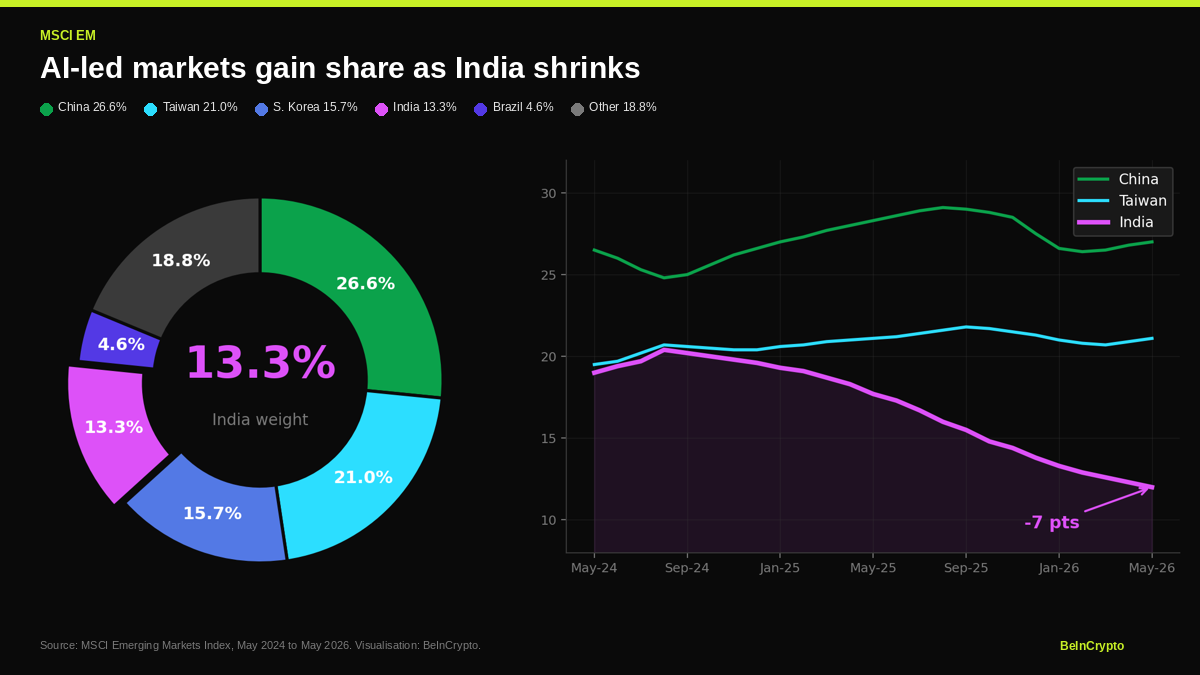
Global investors are rerouting capital away from India and into Asian markets tied to AI infrastructure, leaving the country at risk of falling out of the world’s five largest stock markets for the first time in three years.
The shift goes beyond one quarter of weak earnings. It reflects a structural change in how AI exposure now drives capital allocation across emerging markets, with India holding a few of the names global funds want to own right now.
Capital Flight Pulls India Down the MSCI Rankings
India’s weight in the MSCI Emerging Markets index has dropped to about 12% from roughly 19% a year ago, according to index provider data.

Reports indicate that foreign investors have withdrawn a net $21 billion from Indian equities so far in 2026.
Goldman Sachs estimates foreign ownership of the market sits at a 14-year low and now trails domestic institutions for the first time in more than two decades.
Roughly two-thirds of the reallocation reflects AI positioning, M&G Investments said.
Since the country’s market value peaked near $5.73 trillion in September 2024, about $924 billion has been erased from Indian equities.
Taiwan and South Korea Absorb the Capital India is Losing
Taiwan’s TAIEX has climbed roughly 42% year-to-date, while South Korea’s KOSPI has set fresh highs on AI chip strength, according to exchange data. Together, the two markets have added several trillion dollars in equity value over the past year.

Their listed champions, led by TSMC, Samsung, and SK Hynix, sit directly on the AI buildout that Indian companies do not supply.
The same rotation is bleeding into newer products such as a hybrid crypto-equity benchmark from S&P Global that pairs large-cap stocks with leading AI-linked tokens.
GenAI Squeezes India’s IT Services Giants
The Nifty IT index has fallen about 26% in 2026, while the broader Nifty 50 is down close to 9%.

Tata Consultancy Services and Infosys, which anchor India’s $315 billion IT services sector, hit fresh 52-week lows after OpenAI announced a new enterprise deployment unit.
Generative AI tools are automating the coding, testing, and back-office work that those firms have built their margins on.
Some 15 million Indians work in IT services and global capability centers, putting an entire layer of the economy in the path of AI-driven agents.
Indian policymakers are pushing semiconductor incentives, data center expansion, and a national AI mission. However, the next several quarters will show whether those bets can stop the structural drift away from the country’s equity market.
The post India is Losing Investors Fast Amid Global AI Boom appeared first on BeInCrypto.
TLDR:
- China, the US, and UAE conducted their first-ever joint law enforcement operation targeting crypto fraud in Dubai.
- Authorities dismantled nine fraud compounds and arrested 276 suspects involved in romance-based crypto scams.
- Fraudsters built fake romantic relationships on social media before pushing victims into fraudulent crypto projects.
- China’s Ministry of Public Security pledged deeper global cooperation to combat telecom and cryptocurrency fraud networks.
Police authorities from China, the United States, and the UAE recently carried out their first joint international law enforcement operation in Dubai.
The operation targeted telecom and online fraud networks running cryptocurrency romance scams. Together, the three nations dismantled nine fraud compounds and arrested 276 suspects.
The groups used fake romantic relationships to pull victims into fraudulent crypto investment schemes, causing widespread financial losses globally.
Three Nations Unite Against Crypto Fraud Networks
The joint operation marked a historic step in cross-border law enforcement cooperation. China’s Ministry of Public Security confirmed the details on Sunday through an official statement. The coordinated effort brought together agencies from three major world powers for the first time.
Investigations revealed that the fraud rings operated through social media platforms. Suspects built romantic relationships with unsuspecting victims over time. Once trust was established, they pushed victims toward fake high-return cryptocurrency projects.
These schemes are widely known in the crypto space as “pig-butchering” scams. The term refers to how fraudsters fatten victims financially before draining their funds completely. Victims often lose life savings through these elaborate deceptions.
Xinhua News Agency confirmed the scale of the operation through an official post on X, stating that police from the three nations “dismantled nine fraud dens and captured 276 suspects in the operation.”
Operation Targets Nine Fraud Compounds Across Dubai
The law enforcement teams moved simultaneously across multiple locations in Dubai. Nine fraud compounds were dismantled during the course of the operation. A total of 276 suspects were taken into custody following the raids.
A Chinese Ministry of Public Security official described the operation as a major achievement in international policing.
The official further stated, “Chinese police will continue to deepen pragmatic cooperation with more countries, carry out joint crackdowns, thoroughly dismantle telecom fraud dens.” The statement reflected a firm commitment to sustained cross-border enforcement.
The official added that authorities would “make every effort to apprehend suspects involved in such crimes to effectively safeguard the legitimate rights and interests of people in all countries.”
That position signals a long-term enforcement strategy beyond this single operation. Protecting victims across borders remains a stated priority for Chinese law enforcement.
Crypto romance scams have grown rapidly over the past several years. Fraudsters exploit trust and emotional connection to manipulate victims financially.
Law enforcement agencies worldwide have been working harder to track and shut down these operations. This Dubai operation shows that international coordination is now producing concrete results on the ground.

Emmerdale’s Jimmy King to be ‘killed off’ after 22 years

Who Is the Greatest Rapper? Debate Rages On in 2026

Ryan Seacrest Reportedly Loves His ‘New Face’ Despite Concerns

Manchester United reach agreement with Casemiro over contract clause amid transfer speculation

US brings back mandatory military draft registration

Steven Gerrard disagrees with Gary Neville over ‘shock’ Chelsea and Arsenal claim | Football

Always remember #funny #money #finance #budgeting #shorts

All the pieces are in place for crypto to be bottoming right now, says Fundstrat’s Tom Lee

‘It’s just not worth it’: Financial expert on Labor’s housing changes | Sunrise
-

 Crypto World2 days ago
BloFin War of Whales 2026 Grand Prix opens registration for $5M trading championship
-

 Fashion2 days ago
Weekend Open Thread: Theory – Corporette.com
-

 Crypto World2 days ago
E-Estate Announces 1 Year Live: Washington DC Summit as Real Estate Tokenization Enters Its Next Phase
-

 Fashion6 days ago
Coffee Break: Travel Steam Iron
-

 Fashion6 days ago
What to Know Before Buying a Curling Wand or Curling Iron
-

 Politics6 days ago
What to expect when you’re expecting a budget
-

 Tech2 days ago
Tech Moves: Microsoft AI leader jumps to OpenAI; former AI2 exec joins Meta; and more
-

 Tech6 days ago
GM Agrees To Pay $12.75 Million To Settle California Lawsuit Over Misuse Of Customers’ Driving Data
-
Crypto World4 days ago
Bitcoin Suisse expands with Digital Asset License and Investment Business Act Registration Approval in Bermuda
-

 Tech6 days ago
GM agrees to $12.75M California settlement over sale of drivers’ data
-

 Politics5 days ago
Pakistan to enter Chinese capital market as war inflation bites
-

 Crypto World5 days ago
Bitcoin Suisse expands with Digital Asset License and Investment Business Act Registration Approval in Bermuda
-
 Crypto World3 days ago
Google’s Gemini AI Predicts Incredible Solana Price by the End of 2026
-

 Tech2 days ago
Google reimburses Register sources who were victims of API fraud
-

 Business2 days ago
H&R Real Estate Investment Trust (HR.UN:CA) Q1 2026 Earnings Call Transcript
-
 Entertainment7 days ago
Prime Video’s Forgotten but Brilliant 2-Part Horror Anthology Is a Perfect Binge
-
 Entertainment7 days ago
‘Rivals’ Season 2 Is Bigger, Better, and Raunchier Than Ever
-
 Tech7 days ago
University of Michigan’s $20M early OpenAI investment now worth $2B as Musk trial documents reveal endowment bet
-

 Sports2 days ago
Napoleonic enters 2026 Doomben 10,000 field via Abounding withdrawal
-
 Tech6 days ago
Over-Engineered Cardboard PC Case Houses a Full Computer Without Compromising Style or Performance
You must be logged in to post a comment Login