

Crypto World
XRP POWER launches its intelligent app, enabling global users to earn $7,700 in passive income daily



Disclosure: This article does not represent investment advice. The content and materials featured on this page are for educational purposes only.
XRP POWER launches AI-powered app in 2026 to simplify digital finance and automation for global users.
Summary
- XRP POWER launches new AI-driven app combining automation and digital ecosystem tools for global users.
- The platform highlights security framework including ISO 27001, SOC 2, GDPR, KYC, 2FA, and AML compliance systems.
- It also integrates AI risk control and decentralized architecture to improve transparency, traceability, and security.
In 2026, AI technology continued its accelerated development, and artificial intelligence is rapidly transforming the global digital finance and automation ecosystem. More and more users are exploring new digital income models through intelligent platforms, hoping to obtain more flexible and efficient long-term income opportunities amidst market changes and increasing pressure on traditional income.
Against this backdrop, XRP POWER officially launched its new intelligent app, combining an AI automation system with the digital ecosystem to provide global users with a more convenient intelligent service experience. The platform, through intelligent AI system automation and data management, further lowers the barrier to entry for complex operations, attracting increasing attention from ordinary users and digital investors.
XRP POWER’s AI intelligent security system
XRP POWER continues to integrate AI intelligent risk control technology with international security standards to create a more stable, secure, and transparent global digital ecosystem, providing users with a higher level of security and intelligent service experience.
Regarding data security and privacy protection, the platform strictly adheres to international security and data protection standards such as ISO/IEC 27001, SOC 2 Type II, and GDPR, comprehensively strengthening its capabilities in user information security, account protection, and privacy management.
Simultaneously, XRP POWER introduces an AI-powered intelligent risk identification system, combined with AML anti-money laundering mechanisms, KYC identity verification, and 2FA two-factor authentication, continuously optimizing risk control and account security management through a multi-layered intelligent security protection system.
In terms of underlying technical architecture, the platform combines decentralized technology with AI intelligent algorithms to achieve data transparency, transaction traceability, and tamper-proof mechanisms, further enhancing the platform’s overall transparency, security, and global user trust.
XRP POWER intelligent AI registration process
XRP POWER offers various AI smart contracts with different periods and models, allowing users to flexibly choose the product solution that best suits their needs.
After selecting the corresponding contract, simply complete the payment using a mainstream cryptocurrency to quickly activate and begin your daily experience with the AI-powered smart system.
During contract operation, the platform will automatically settle earnings daily and return them to your account balance. Users can freely choose to withdraw funds or continue participating in other smart contract products, making the overall operation more convenient and flexible.
Partial list of profitable contracts
Contract Name: Dogecoin [AI Smart Quantitative] Investment Amount: $5,000, Term: 15 days, Daily Yield: $70.50, Total Profit: $1,050.50, Principal Returned at Maturity: $5,000
Contract Name: Bitcoin/Bitcoin Cash [AI Global Smart Ecosystem] Investment Amount: $25,000, Term: 23 days, Daily Yield: $417.50, Total Profit: $9,602.50, Principal Returned at Maturity: $25,000
Click to view more details on contract period returns
About XRP POWER
Currently, XRP POWER has over 3 million users worldwide, covering 189 countries and regions. With the continuous development of its AI-powered smart app and the ongoing improvement of its digital ecosystem, more and more users are experiencing smarter, more convenient, and more efficient digital ecosystem services through XRP POWER
Leveraging its AI-powered intelligent system, global operating model, and continuously optimized platform services, XRP POWER is constantly improving user experience and ecosystem stability. Against the backdrop of rapid global digital finance development, the platform continues to attract attention and participation from users in different countries and regions.
For more details, please visit the official website or download the iOS and Android apps.
Disclosure: This content is provided by a third party. Neither crypto.news nor the author of this article endorses any product mentioned on this page. Users should conduct their own research before taking any action related to the company.

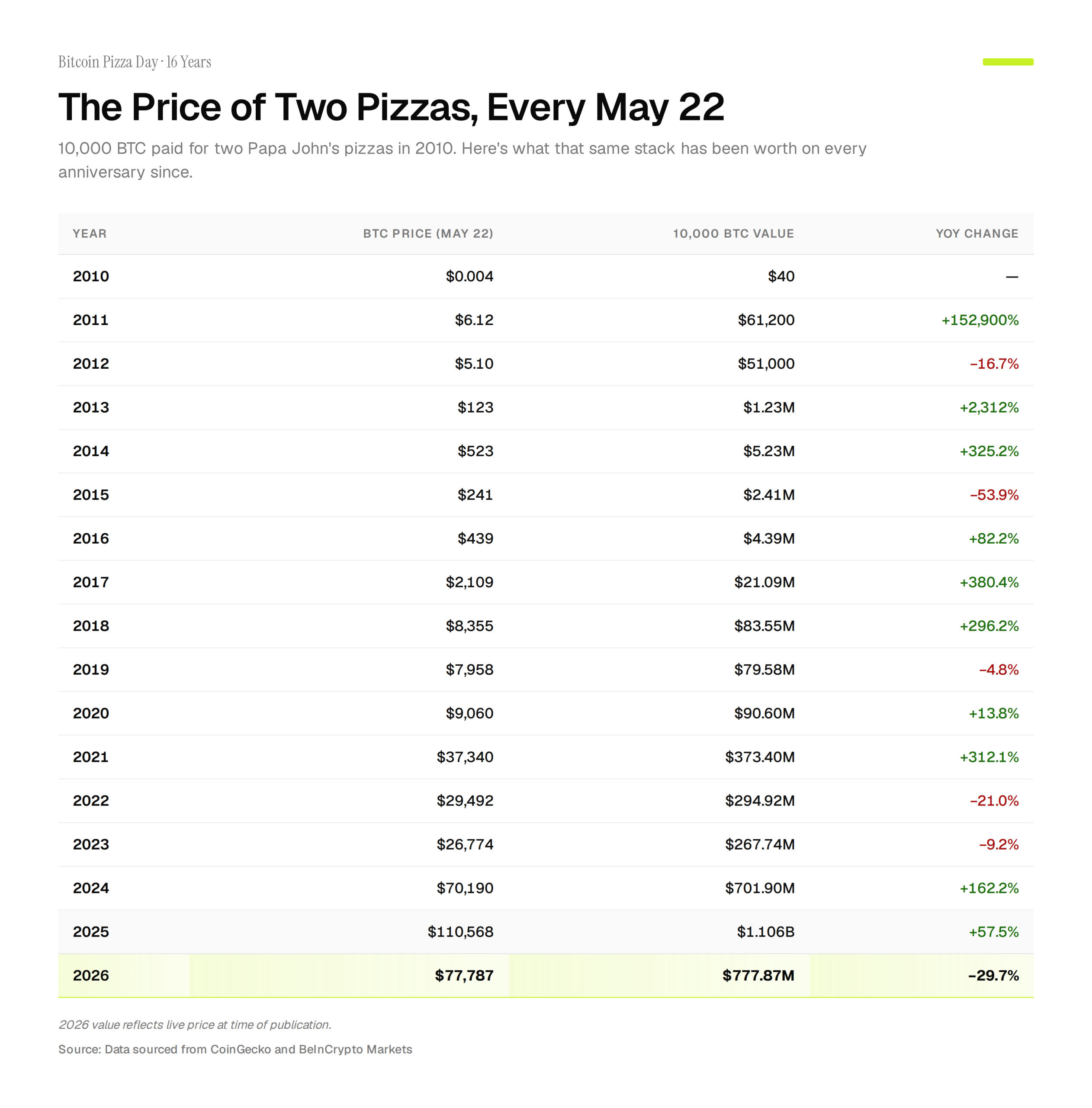
Bitcoin Pizza Day arrived with a $328 million loss this year. The 10,000 Bitcoin (BTC) that bought two Papa John’s pizzas in 2010 is now worth $777.87 million, down from $1.106 billion on the 15th anniversary in 2025.
The 29.7% year-over-year decline is the steepest drop in any Bitcoin Pizza Day stack since 2015, when the cryptocurrency fell 54% during a bear market.
Follow us on X to get the latest news as it happens

From a Billion-Dollar Stack to $777 Million
Last year’s anniversary arrived during a clear bull run. Bitcoin traded at $110,568 on May 22, 2025, setting new all-time highs at the time. Programmer Laszlo Hanyecz’s original 10,000 BTC stack had a notional value of $1.106 billion, per CoinGecko data.
Bitcoin extended that rally through the summer and into October. The cryptocurrency hit a new all-time high of $126,000 on October 6, 2025, amid strong institutional flows and muted retail participation.
That run ended four days later. On October 10, President Donald Trump announced 100% tariffs on Chinese imports, triggering nearly $200 billion in losses in the crypto market. Bitcoin fell from $122,000 to $107,000 following the announcement.
Bitcoin’s Journey From All-Time High to Worst Opening Quarter
Bitcoin spent the rest of 2025 below its October peak. By the time 2026 began, the rally that had powered Pizza Day 2025’s record valuation had broken.
Q1 2026 became the worst opening quarter since 2018. Bitcoin closed the period down 22.2%, with spot Bitcoin exchange-traded funds (ETFs) losing a net $496.5 million amid Iran tensions.
Q2 has brought partial relief. Bitcoin has climbed roughly 14% over the quarter. Nonetheless, the cryptocurrency remains in the red year-to-date.

Bitcoin traded near $77,787 on Pizza Day 2026. That sits 29.7% below last year’s $110,568 price and 38% below October’s $126,000 record.
The price has now fallen in six of 16 anniversaries. 2026 marks the largest absolute dollar drop in that streak.
Subscribe to our YouTube channel to watch leaders and journalists provide expert insights
The post Bitcoin Pizza Day 2026 Arrived Over $300 Million Lighter Than Last Year appeared first on BeInCrypto.


Polymarket, the world’s largest decentralized betting platform, has gone dark for users in India. The website says, “This site can’t be reached. Check if there is a typo in polymarket.com.”
Refreshing the page does not resolve the connection issue.
The outage follows an April 25 advisory from the Ministry of Electronics and Information Technology (MeitY) directed at VPN service providers. The advisory warned that local users were continuing to access “illegal and blocked prediction market and online betting platforms” despite “domestic prohibitions.”
According to the directive, internet service providers were required to terminate access to prediction markets, with Polymarket among the primary targets.
While Kalshi, a platform regulated by the U.S. Commodity Futures Trading Commission (CFTC), is currently still accessible, it may soon face a similar fate. Local media reports, citing an anonymous source within MeitY, claim the agency has “already issued a blocking order to Polymarket and are in the process of issuing an order to Kalshi as soon as Friday.”
CoinDesk reached out to Polymarket and Kalshi for a comment.
Prediction markets enable users to wager real money on the outcomes of binary events, such as referendums, financial asset price movements, and election results. These platforms saw a massive surge in global popularity during the 2024 U.S. presidential election, becoming a primary venue for investors to hedge or bet on political outcomes.
However, the Indian government classifies the activity on these platforms as online money gaming. As a result, they fall under a category that is completely prohibited under the Promotion and Regulation of Online Gaming Act 2025.
The Indian government has maintained a consistently “risk-averse” and prohibitive stance toward the cryptocurrency sector, prioritizing financial stability and capital control over industry growth. New Delhi has utilized a “shadow ban” strategy through punitive taxation, including a 30% flat tax on gains and a 1% tax deducted at source (TDS) on all transactions, which has effectively throttled domestic trading volumes.
The Ministry of Finance has focused on bringing the sector under strict Anti-Money Laundering (AML) and Counter-Strike Financing (CFT) oversight via the Financial Intelligence Unit (FIU). This regulatory environment has pushed many local crypto startups to relocate to more friendly jurisdictions like Dubai or Singapore, as the government and the Reserve Bank of India continue to signal that it views private cryptocurrencies more as speculative “money games” than legitimate financial innovation.
India’s Parliamentary Standing Committee on Finance met crypto exchanges Binance, WazirX and Zebpay in Delhi on May 20 to discuss regulations and taxation for what it calls a virtual digital assets (VDA) industry.
The committee expressed concerns over massive outflows from the country via the crypto channel.
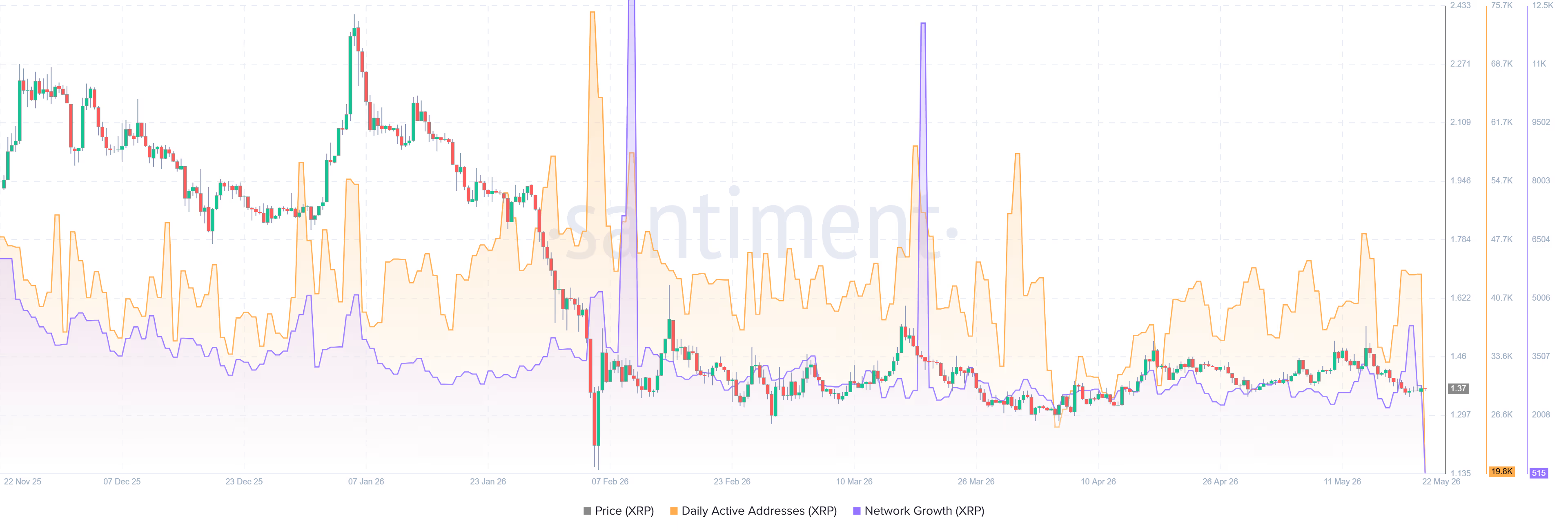
XRP held near $1.37 by midday Hong Kong time on Thursday, according to CoinDesk market data, with fresh ETF and on-chain data suggesting some investors may be rotating into XRP. Meanwhile, market leader bitcoin hovered around $77,400 and ether (eTH) remained under pressure.
CoinGlass data shows XRP-linked funds pulled in $8.88 million in the latest session, extending a streak of positive flows that includes $18.52 million on May 14 and $10.87 million on May 15. Across the past week, XRP products have attracted roughly $42 million in net inflows.
This has caught analysts’ attention because money has been leaving the largest listed crypto products. Bitcoin ETFs lost another $100.9 million in the latest daily session, following redemptions of $648.6 million, $331.1 million, and $290.4 million earlier in the same stretch. Ether products also remained under pressure, losing $32.6 million in the latest session.
The data suggests a selective appetite for alternative crypto exposure, though XRP’s broader network growth trend remains weaker than late 2025 levels.
Onchain activity offers a second, though less definitive, signal.
XRP recorded the fourth-largest daily spike in wallet creation this year, with 4,300 new wallets added in 24 hours, according to Blockchain analytics firm Santiment.

Fresh wallet creation can sometimes point to new network participation, particularly when paired with capital inflows.
But the broader Santiment chart suggests caution.
XRP’s network growth has generally trended lower since late 2025, making the latest move look more like a sharp one-day spike than clear evidence of sustained adoption.
For traders, the question is whether XRP is seeing the early stages of a broader rotation trade, or simply a short-lived burst of speculative positioning while the wider crypto market remains under pressure.


Binance CEO Richard Teng has rejected a new Wall Street Journal report, saying it contains wrong claims about the exchange’s sanctions controls.
Summary
- Richard Teng said Binance did not allow sanctioned individuals to transact on its platform.
- The WSJ report adds pressure after Binance’s $4.3 billion U.S. settlement and monitorship.
- Binance says its sanctions exposure fell 96.8% as it expanded compliance and law-enforcement work.
Teng said in a post on X that the WSJ report contains “fundamental inaccuracies” about Binance and its compliance program. He said Binance did not permit transactions with sanctioned individuals and that the transactions mentioned by the publication happened before the people involved were sanctioned.
The WSJ reported that Iranian-linked networks used Binance accounts to move large sums, including funds allegedly tied to sanctioned activity. The report said the activity involved accounts connected to financier Babak Zanjani and crypto firm Zedcex. Binance disputed the claims and said the information was inaccurate.
Teng says Binance reviewed the matter
Teng said Binance had already reviewed the issues before the WSJ contacted the company. He also said Binance gave those details to the publication, but they were not included in the report.
He added that Binance has “zero-tolerance for illicit activity” and will continue working with U.S. and global law-enforcement agencies to fight financial crime. The comment keeps Binance’s defense focused on timing, internal review, and cooperation with authorities.
Compliance record stays under review
The latest dispute follows earlier reports and government questions about Binance’s sanctions systems. In March, Binance formally denied allegations that it allowed transactions linked to Iran and said media reports cited in a U.S. Senate inquiry contained false claims about its compliance program.
Binance said at the time that it requires identity checks for every user and bars people located in Iran from using the exchange. The company also said it uses more than 25 monitoring tools to screen users and review transactions.
Past settlement shapes the debate
The issue remains sensitive because Binance pleaded guilty in 2023 to U.S. anti-money-laundering and sanctions violations. The Justice Department said Binance agreed to pay more than $4.3 billion and retain an independent compliance monitor as part of that resolution.
U.S. officials said the case included failures that allowed transactions between U.S. users and users in sanctioned jurisdictions, including Iran, between 2018 and 2022. Binance has since said it rebuilt parts of its compliance system and improved its monitoring.
Binance points to stronger controls
Binance has repeatedly pointed to recent metrics as proof of progress. Earlier reports said the exchange claimed sanctions-related exposure fell 96.8% between January 2024 and July 2025, from 0.284% of total exchange volume to 0.009%.
The company also said more than 1,500 workers now support compliance, sanctions screening, investigations, and risk functions. Binance said it processed more than 71,000 law-enforcement requests in 2025 and helped authorities recover funds linked to illicit activity.
U.S. Securities and Exchange Commission Commissioner Hester Peirce has pushed back against expectations that the agency could soon open the door to unrestricted tokenized stock trading through a proposed “innovation exemption.”
Summary
- SEC Commissioner Hester Peirce said any tokenized stock exemption would likely apply only to on-chain versions of existing public equities.
- Synthetic stock tokens that track share prices without shareholder rights are not expected to qualify under the proposed SEC framework.
- Industry executives from Superstate and Securitize said a narrower approach could reduce fragmentation risks in tokenized equity markets.
According to comments Peirce posted on X on Thursday, any exemption under consideration would apply only to on-chain versions of existing equity securities that already trade in public secondary markets.
She said she has always expected the proposal to remain “limited in scope,” adding that it would facilitate trading only for “digital representations of the same underlying equity security that an investor could purchase in the secondary market today.”
Her clarification arrived days after Bloomberg reported that the SEC was exploring a conditional exemption framework that could allow certain tokenized securities products to operate with modified regulatory requirements.
Fox Business journalist Eleanor Terrett described Peirce as “tempering expectations” around the proposal and narrowing its focus to “onchain equity products, not synthetic tokens that mimic stocks without giving investors the same shareholder rights.”
Peirce’s comments also appear to rule out synthetic stock-style tokens under the contemplated exemption. Such products typically track the price of equities without granting holders ownership rights tied to the underlying shares.
SEC discussions focus on shareholder rights
As previously reported crypto.news, SEC officials have discussed permitting tokenized equities only if the tokens preserve the same economic and governance rights attached to traditional shares, including voting rights and dividend access.
People familiar with the matter said the agency has gathered feedback from hundreds of market participants while shaping the proposal. The report added that discussions remain ongoing and the final terms could still change before any exemption is approved.
Concerns over synthetic stock products surfaced soon after the news surfaced. Brett Redfearn, president of tokenization firm Securitize, warned that allowing third parties to tokenize stocks without issuer involvement could create fragmentation problems across the market.
Other industry figures have also backed Peirce’s narrower interpretation.
Robert Leshner, CEO of tokenization platform Superstate, said on X that limiting tokenized trading to properly structured on-chain equities would allow decentralized finance and tokenization markets to grow “without compromising the standards that make the USA the center of capital markets.”
Meanwhile, Carlos Domingo, CEO of Securitize, has argued that restricting the exemption to genuine equity-linked assets would reduce risks tied to synthetic products.
“This is good, we want to do on-chain trading, but for the right assets, and not to help proliferate those derivatives that are fragmenting the market and introducing additional risks,” Domingo said.
Even with rising interest from crypto firms and financial institutions, tokenized equities remain a relatively small corner of the digital asset sector, though it is expected to grow.
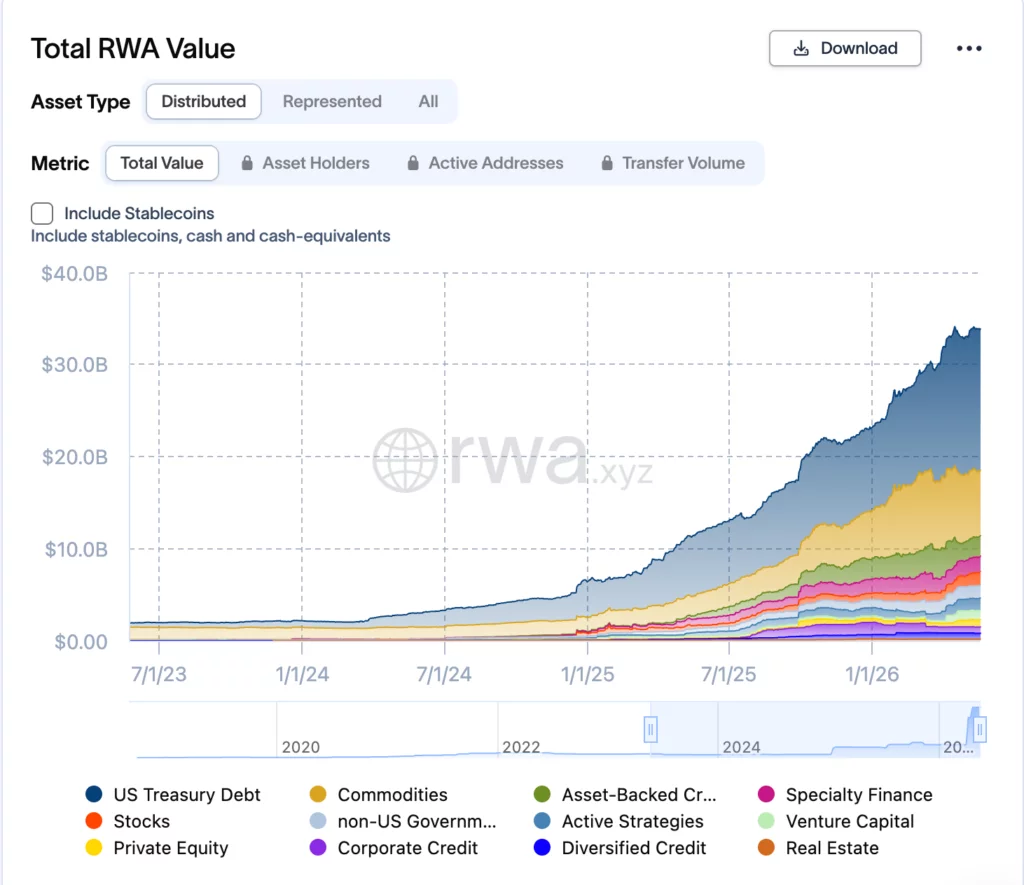
Data from RWA.xyz shows that tokenized stocks currently account for roughly $1.48 billion in on-chain assets. Existing offerings include tokenized exposure tied to companies such as Circle, Strategy, and Google.
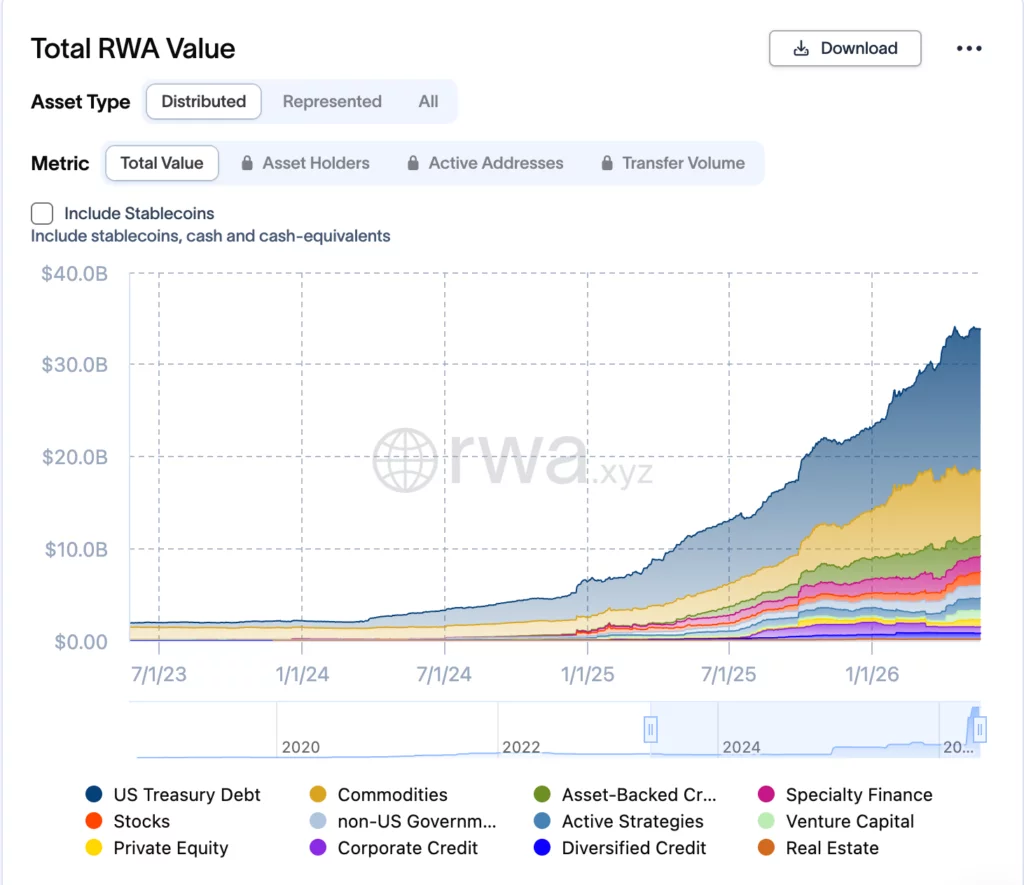
Total RWA market value. Source: RWA.xyz
Previously, it was also reported that some SEC officials remain hesitant about allowing tokenized stock trading at all, despite ongoing discussions around a possible exemption.


Trump Media & Technology Group (TMTG) moved 2,650 Bitcoin (BTC) worth roughly $205 million to Crypto.com.
The deposit marks the second major outflow from TMTG’s Bitcoin wallets this year. Analytics firm Lookonchain flagged the movement, though exchange transfers do not always confirm a sale.
Follow us on X to get the latest news as it happens
TMTG’s Bitcoin Treasury Sinks Deeper Below Cost Basis
Trump Media originally accumulated 11,542 BTC at an average cost of $118,522 per coin, deploying about $1.37 billion of corporate capital into the asset.
However, Bitcoin currently trades near $77,700, leaving the holdings roughly 34% below the entry price. The position now reflects an unrealized shortfall of about $455 million.
TMTG’s first major outflow occurred four months ago, when 2,000 BTC, valued at about $175 million, left company wallets at $87,378 per coin, according to Lookonchain data.
The company’s official treasury figure dropped to 9,542 BTC after that move, according to its Q1 earnings disclosure. The new 2,650 BTC transfer has further shrunk the stash to roughly 6,889 BTC.
The deposit follows a $406 million net loss reported earlier this month. Of that figure, $368.7 million stemmed from unrealized markdowns on digital assets and equity securities.
TMTG also holds 756 million Cronos (CRO) tokens, valued at about $2.64 million, as part of its broader treasury strategy.
The next on-chain settlement window should clarify whether the latest transfer ends in another confirmed sale.
Subscribe to our YouTube channel to watch leaders and journalists provide expert insights
The post Trump Media’s Bitcoin Stash Shrinks Again as 2,650 BTC Lands on Crypto.com appeared first on BeInCrypto.
Bitcoin (BTC) has dropped nearly 7% from its local peak of $82,800, as several groups of wallet holders switched from accumulation to distribution. Data suggests that this distribution, combined with increasing realized losses, points to a potential shift in momentum.
Key takeaways:
- Whale absorption of newly mined BTC supply drops to all-time lows below -150%.
- Bitcoin holders shift from accumulation to distribution after BTC price drop
- Bitcoin realized losses surged above $600 million in a single day as BTC price fell to $76,000.
Bitcoin whales absorbing at all-time lows
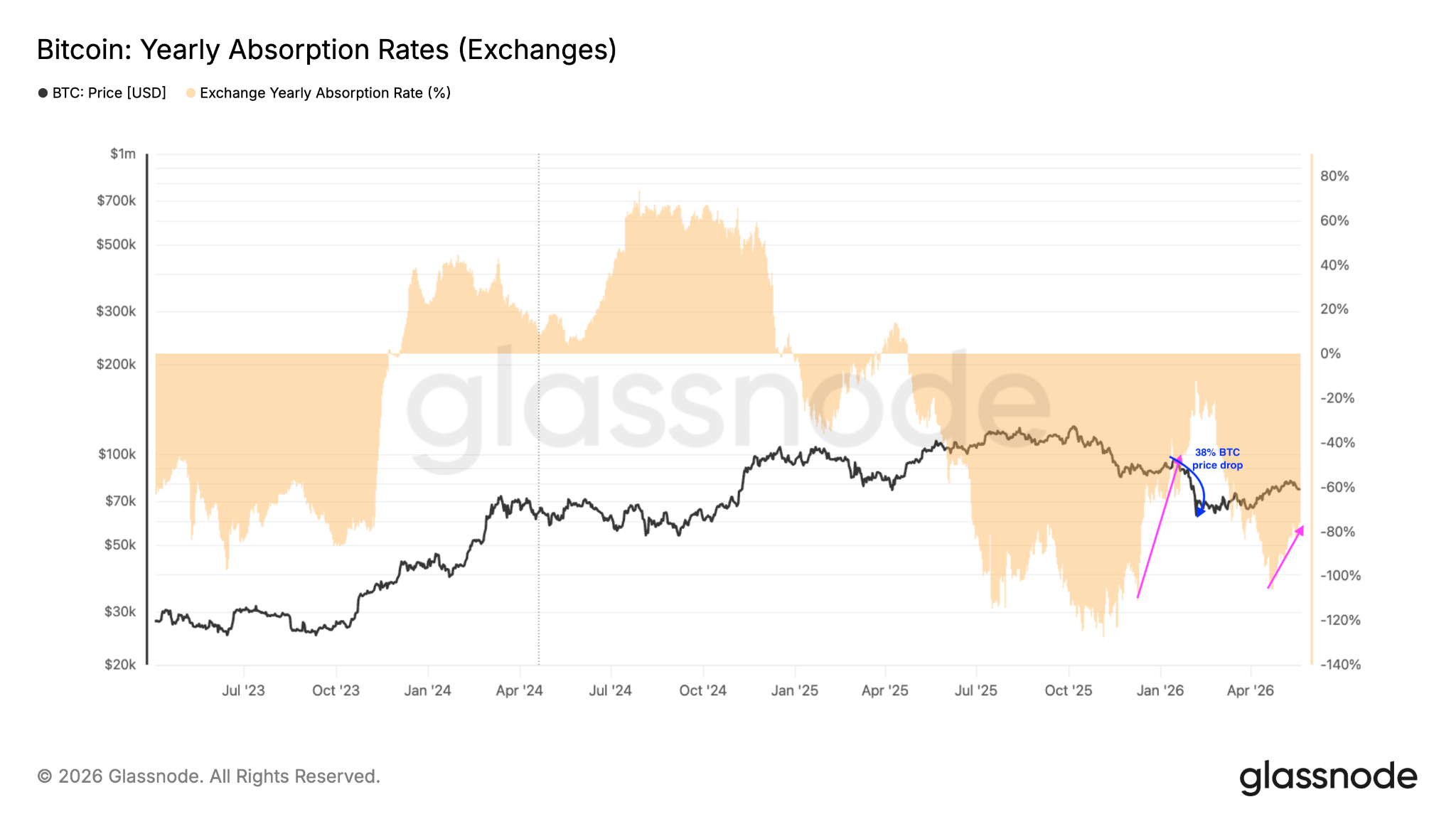
The yearly absorption rate measures the amount of new BTC issued that has been absorbed by the market over the past year. Currently, the absorption rate by exchanges is improving while whales are losing coins at a historic pace.
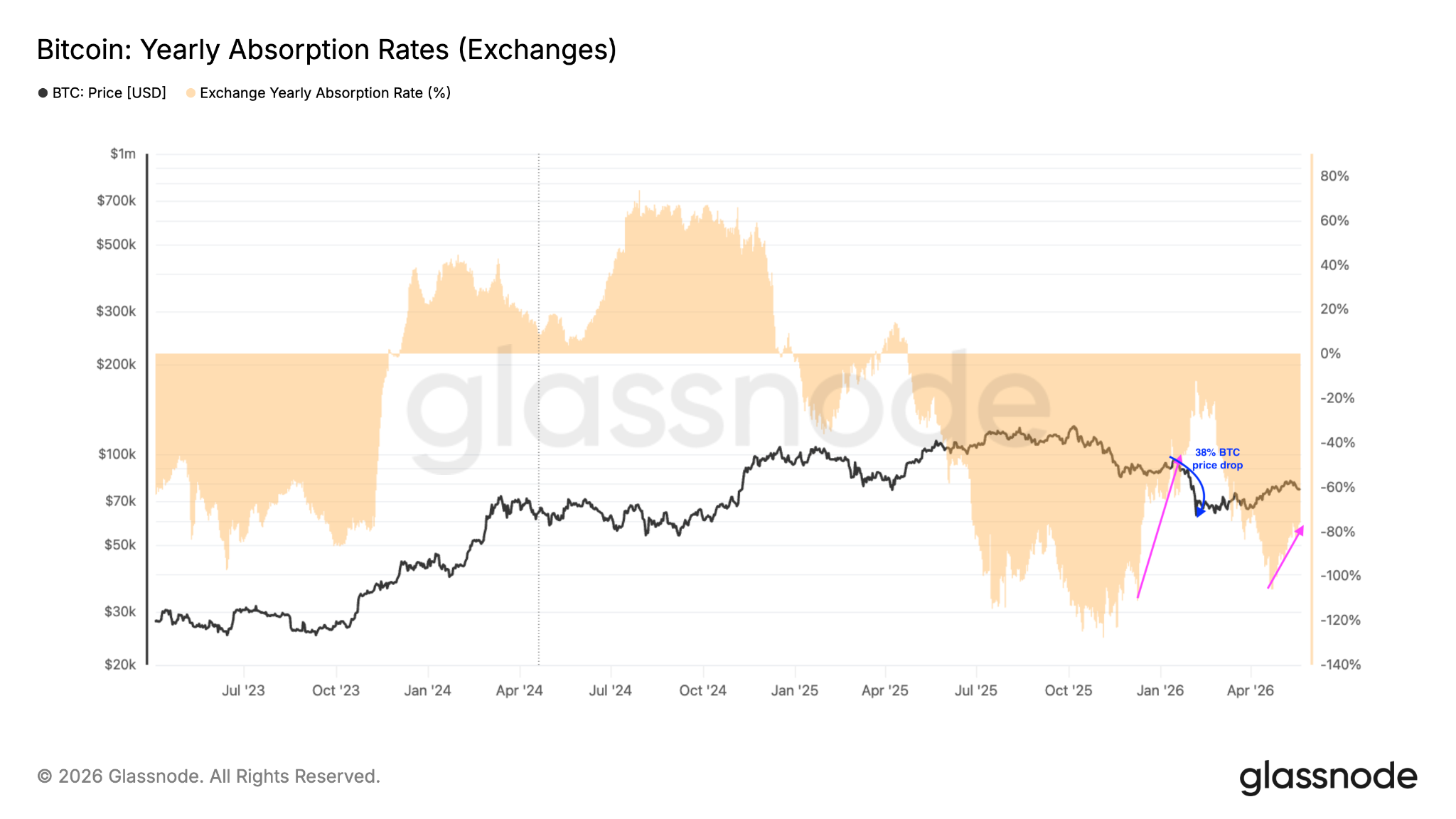
Notably, Bitcoin’s yearly absorption rate by exchanges has improved to -75 % from below -100% in April as inflows continue.
Bitcoin yearly absorption rates. Source: Glassnode
The chart above shows that a similar jump in the exchange absorption rate in January preceded a 38% BTC price decline to $60,000 from $98,000.
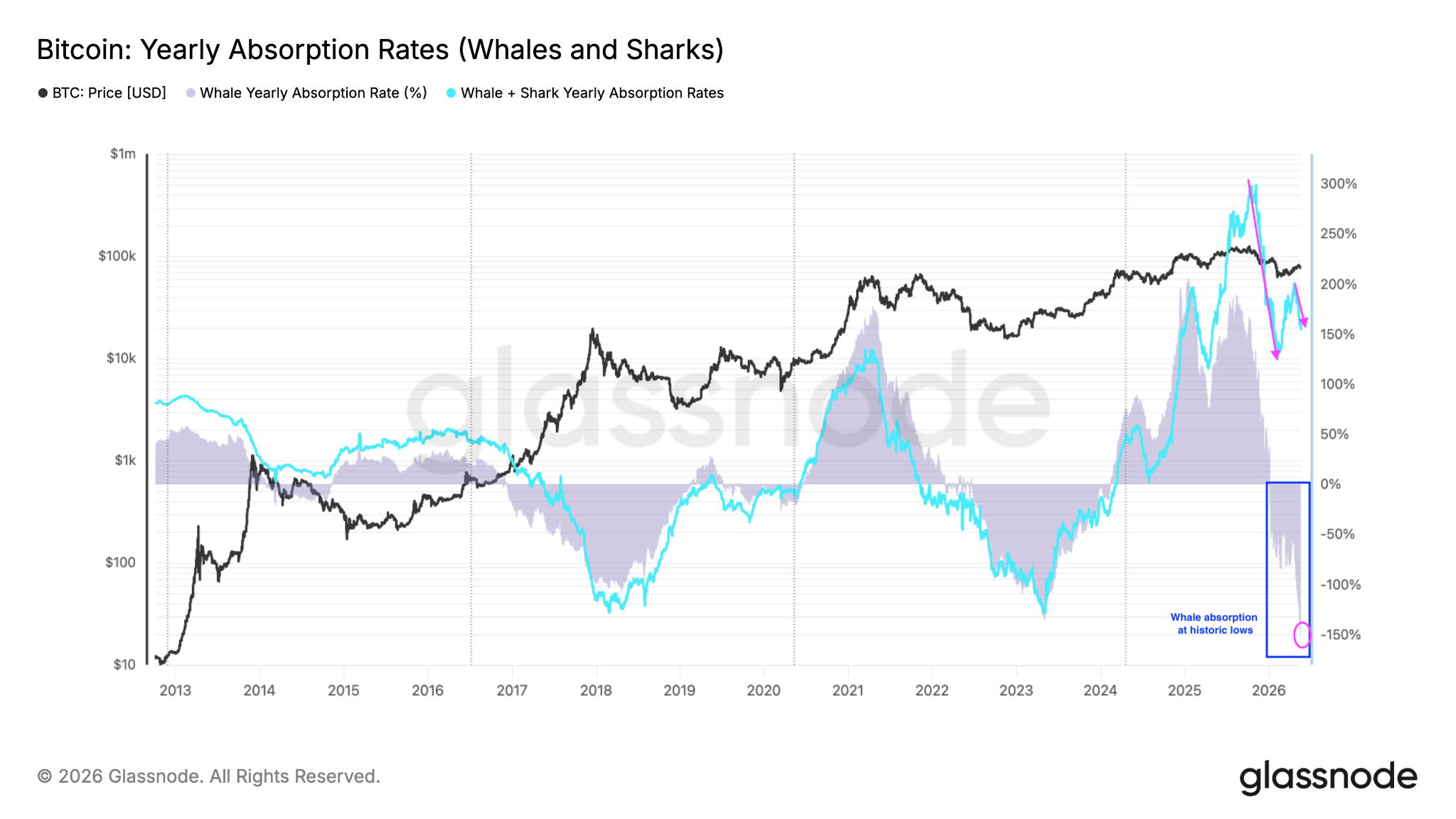
While large holders (100–1,000+ BTC) are scooping up more than 150% the new issuance, the rate has dropped sharply since mid-April and is significantly below the record levels seen in November 2025.
Meanwhile, the rate of accumulation among whales (entities holding more than 1,000 BTC) has dropped to -151%, its lowest in Bitcoin’s history.
Bitcoin yearly absorption rates by whales and sharks. Source: Glassnode
This marks a shift in institutional sentiment, particularly with heavy outflows from spot Bitcoin’s exchange-traded funds, reflecting a reduction in long-term conviction among large holders.
All Bitcoin holder cohorts are “taking profits”
Bitcoin investors went risk-off, distributing their BTC as the price dropped to $76,000.
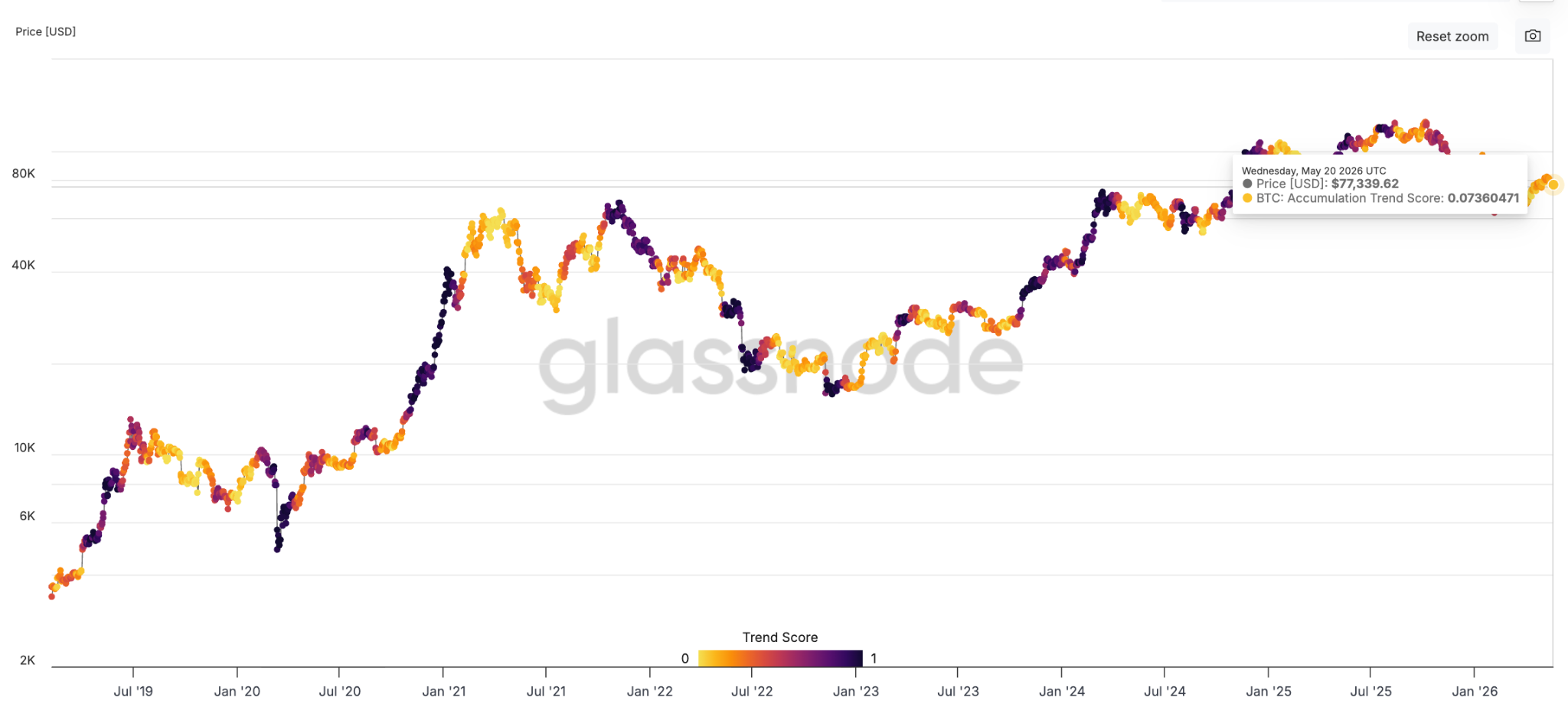
Glassnode’s Accumulation Trend Score (ATS) is near zero (light yellow), indicating that whales are selling BTC or not accumulating.
Related: Bitcoin retakes $71K as US sends Iran 15-point ceasefire plan
The drop in the trend score indicates a transition from accumulation to distribution across almost all cohorts. This shift mirrors a similar pattern observed in mid-January 2025, which aligned with Bitcoin’s drop to $60,000 in February.
Bitcoin accumulation trend score. Source: Glassnode
Additional data from Glassnode reveals a shift toward distribution or inactivity across all investor cohorts, as seen in the chart below.
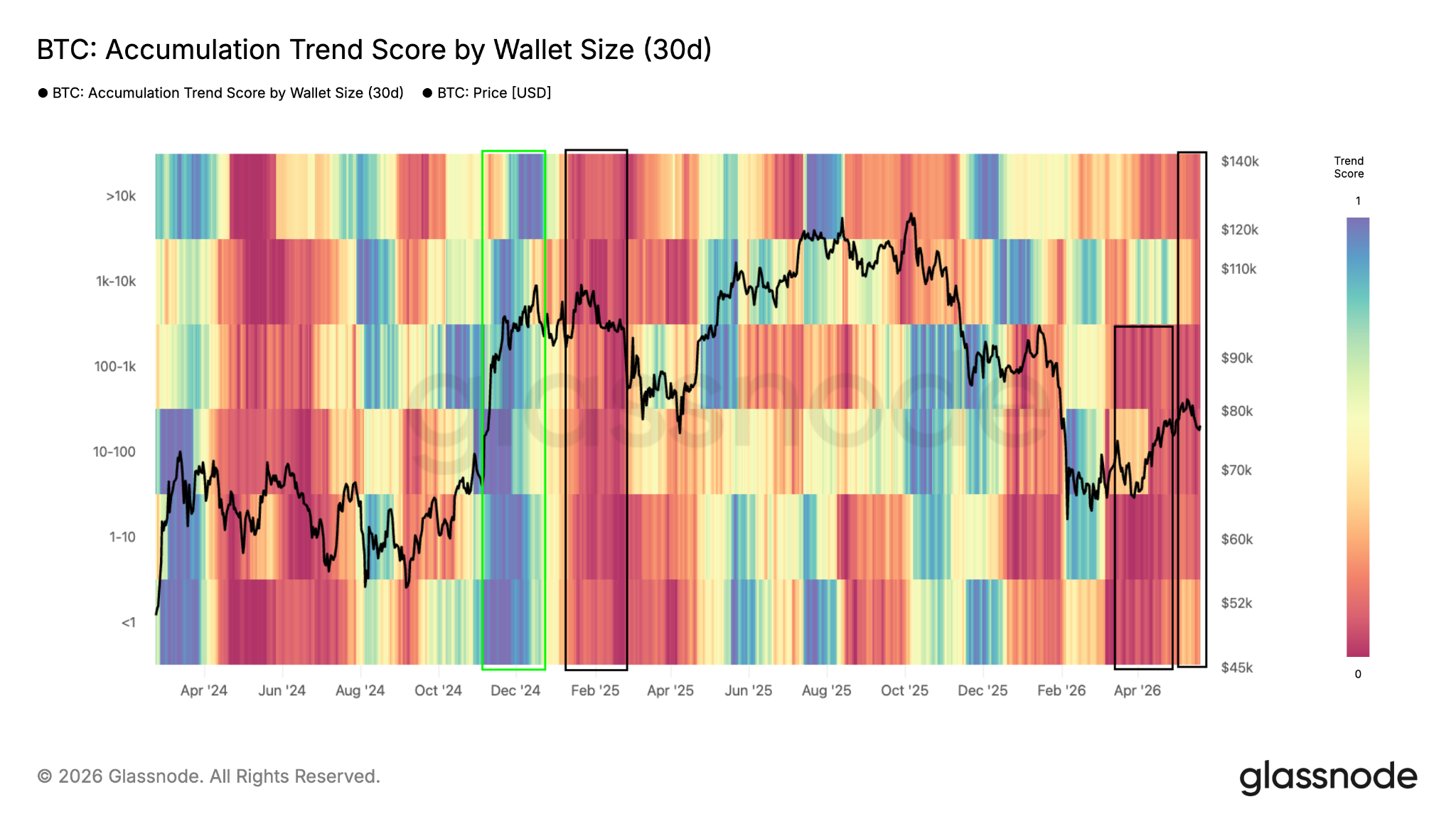
Bitcoin accumulation trend score by cohort. Source: X/Glassnode
This is in contrast to Q4 2024, where broad cohort accumulation preceded a sustained rally that saw BTC/USD trade above $100,000 for the first time in history, fueled by the 2024 US Presidential elections.
CryptoQuant analyst Woominkyu highlighted “continued selling pressure” from whales who sent more than 8,000 BTC to exchanges on Monday.
“As Bitcoin rallied to a peak of $82,196, whales began sending coins back to exchanges,” the analyst said in a QuickTake note on Thursday, adding:
“This is a classic sign of smart money selling into strength — taking profits while retail FOMO was building.”
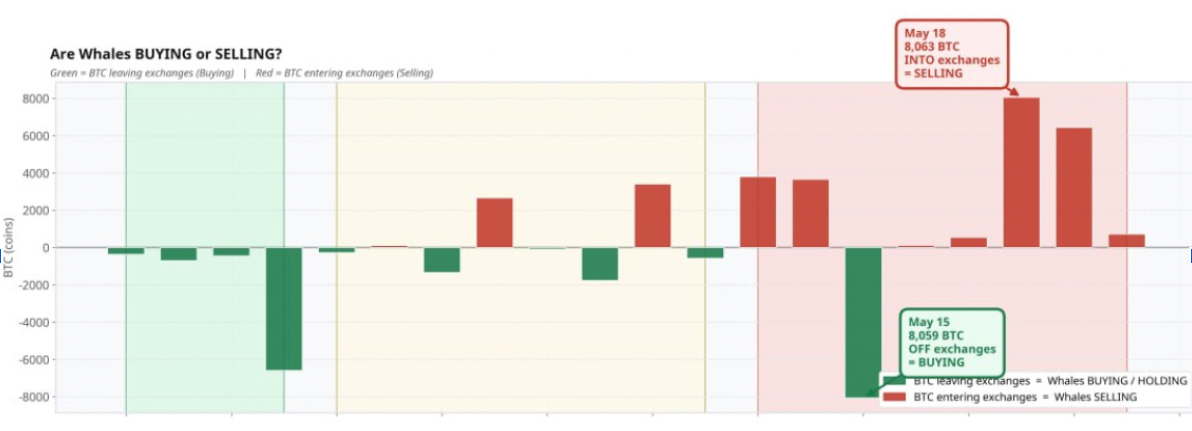
Bitcoin whale activity. Source: CryptoQuant
Bitcoin’s realized losses jump to $600 million
Bitcoin’s latest correction triggered a sharp spike in realized losses. The losses by long-term holders (LTHs) reached $513.6 million on Tuesday, while losses by short-term holders (STHs) reached $101.8 million.
The aggregate realized losses across all holders reached $616 million after Bitcoin dropped to $76,000 on Monday.
This marked the highest single-day loss realization since March and an over 1,500% jump in less than two days, compared with $41.5 million on Sunday.
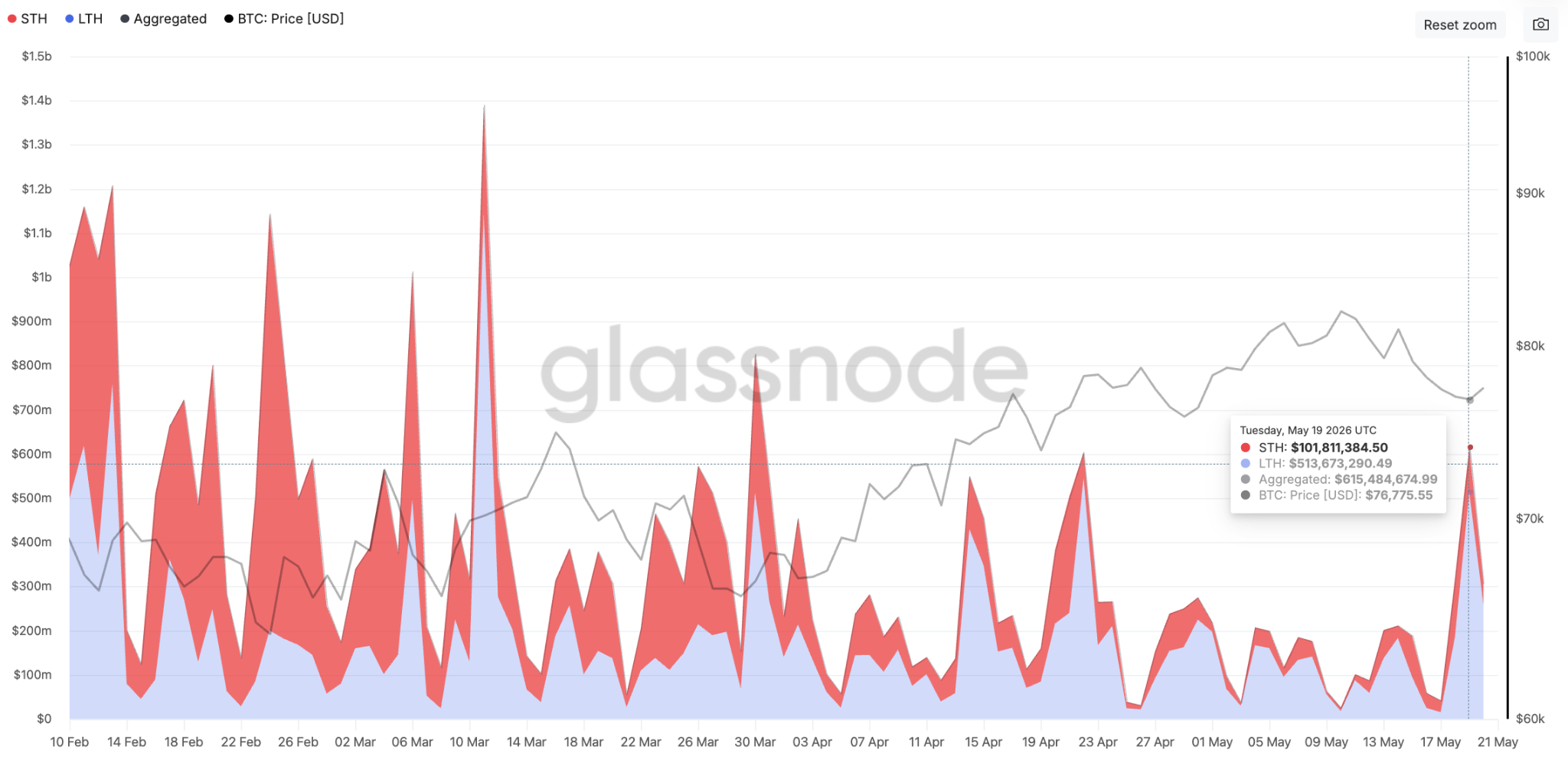
Bitcoin realized losses by LTHs and STHs. Source: Glassnode
LTHs account for the bulk of the losses, while STH losses stay comparatively contained, indicating that the stress is largely on older buyers.
As Cointelegraph reported, Bitcoin investors who have held their coins for over six months could sell near their entry price after extended drawdowns, creating strong overhead pressure that may stall Bitcoin’s recovery.
One year after launching XRP futures, data from the Chicago Mercantile Exchange (CME) show the product has gained steady traction in the derivatives market.
Since trading began on May 19, 2025, the exchange has recorded almost $63 billion in notional trading volume across its XRP futures suite as of May 15, 2026.
XRP Sees Heavy Derivatives Demand
CME introduced two products at launch. First was a standard XRP futures contract representing 50,000 tokens, and then a smaller micro contract representing 2,500 XRP. Both were designed to give traders exposure to the asset’s price movements without requiring direct ownership of the crypto asset itself.
The contracts are cash-settled and track the CME CF XRP-Dollar Reference Rate, which allows market participants to trade XRP exposure through a regulated marketplace. Over the past year, traders exchanged 1.32 million contracts, equivalent to 28.6 billion XRP. The figures point to strong activity around XRP-linked derivatives, particularly among investors using futures for hedging, speculation, or leveraged trading strategies.
Unlike spot trading, futures contracts also allow traders to take both bullish and bearish positions depending on market expectations. CME has since expanded the lineup with XRP options and Spot-Quoted XRP futures, amidst demand for XRP-related products on institutional trading platforms.
XRP Price Weakness
Amid broader market turmoil, US-based spot XRP ETFs have also continued to rake in inflows. So far in May, these investment funds have recorded inflows of over $98 million. Even so, XRP has failed to replicate the same growth trajectory in terms of its price. The token is over 26% down so far this year and is trading near $1.35 at the time of writing.
At the same time, exchange-flow data tracked by CryptoQuant indicated that XRP trading activity may also be entering a different phase. The analytics platform found that heavy deposit activity previously concentrated on Bybit has started to cool, while Binance and Coinbase are now seeing stronger withdrawal-side transactions.
The change could hint at easing sell-side pressure compared to the trend observed over the past several weeks.
The post XRP Futures on CME One Year Later: $63B in Trading Volume and Counting appeared first on CryptoPotato.
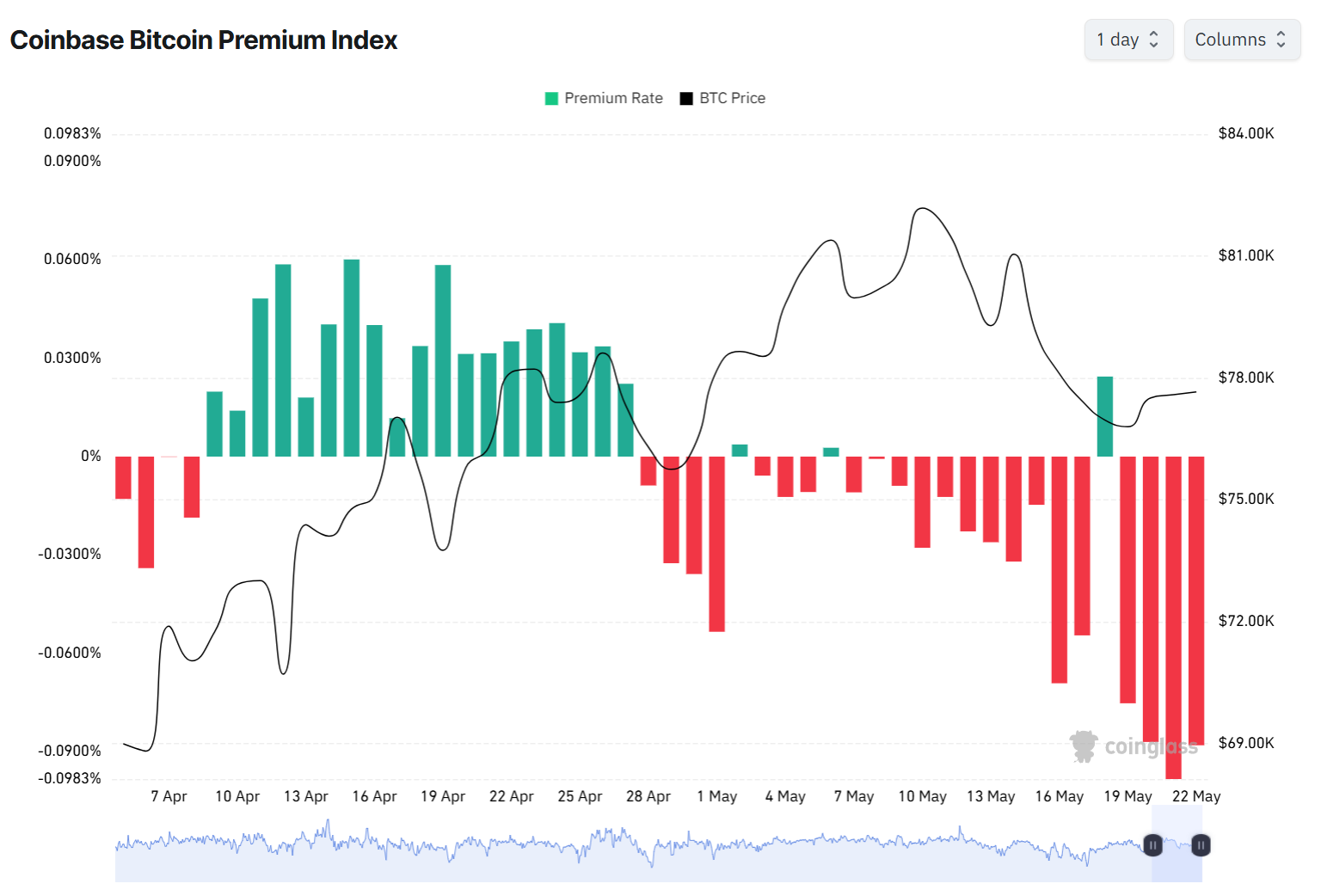
A key indicator of institutional crypto market participation, the Coinbase premium has fallen deeper into negative territory, indicating increased selling pressure from institutions.
The Coinbase premium has been mostly negative since late April, but it has fallen much faster over the past seven days and recorded its lowest level this month at -0.0983% on May 21.
“Institutional selling pressure has intensified recently,” CryptoQuant analyst Darkfost said on Thursday.
“This suggests that the population of institutional and professional investors trading on Coinbase Advanced is selling more aggressively than investors trading on Binance.”
Institutional investors are also shying away from store-of-value assets such as gold, which is down 5.8% over the past month, favoring stocks with the S&P500 and Dow Jones indexes trending up since the beginning of April.
Analyst Axel Adler said the results suggest “zero confirmation from US spot demand.”
The Coinbase premium is a measure of the difference between Bitcoin prices on Coinbase, which is used more by US institutions, and Binance, favored more by retail investors.
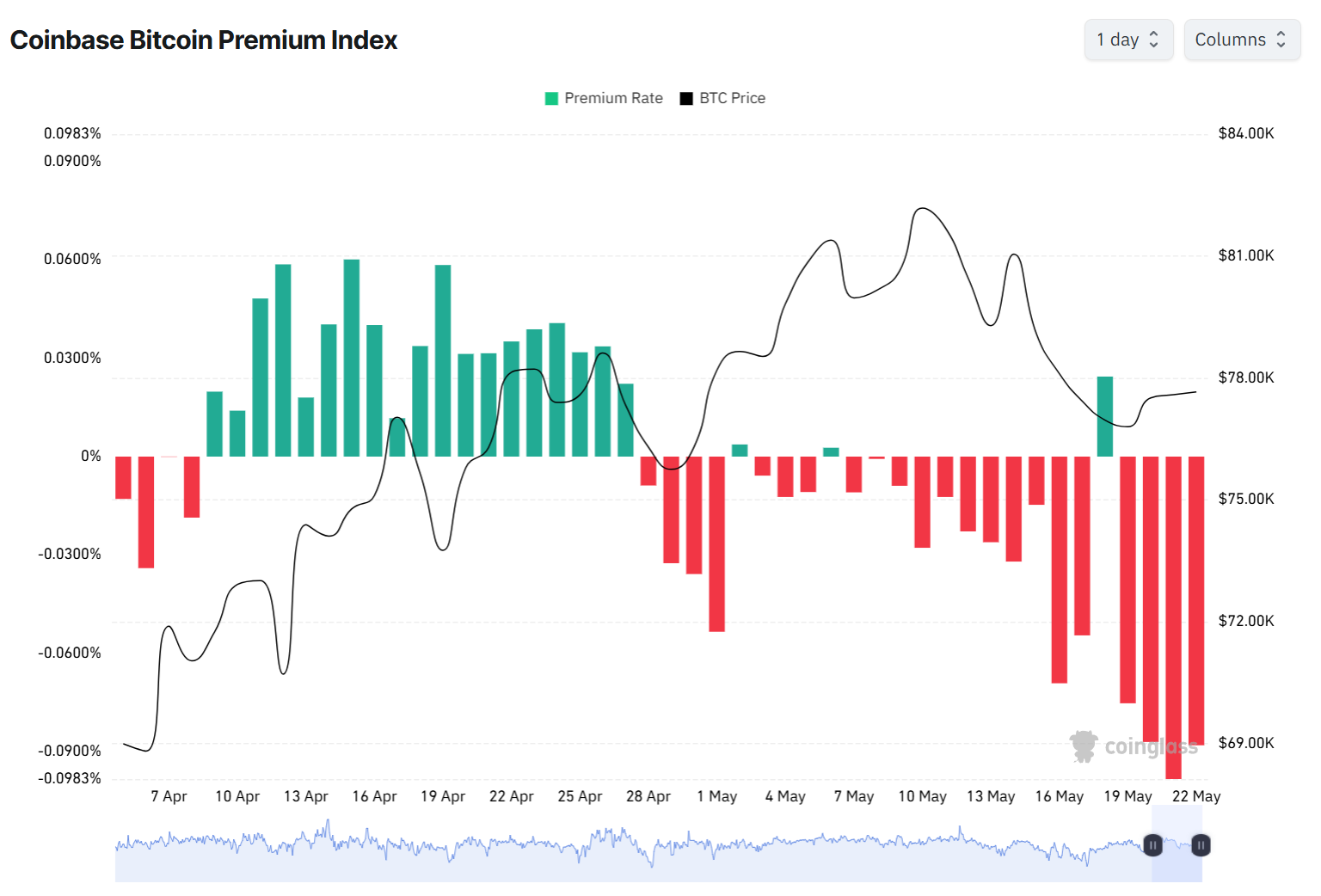
Coinbase premium falls to its lowest level this month. Source: Coinglass
Institutions are repositioning
“The uncertainty surrounding the current macro environment appears to be pushing institutions toward hedging strategies while waiting for greater clarity,” Darkfost said.
LVRG research director Nick Ruck told Cointelegraph the decline of the Coinbase premium could also reflect the “emergence of net selling pressure from larger holders,” and suggest institutions are taking profits or repositioning, which “could weigh on near-term price momentum across major crypto assets.”
Bitcoin ETF outflows accelerate, derivatives decline
Another signal of institutional selling pressure is US spot Bitcoin exchange-traded funds, which have seen four trading days of outflows totaling $1.3 billion since May 14, according to CoinGlass.
Related: Bitcoin longs soar despite weak US macroeconomic data: Is $82K BTC next?
Derivatives demand also appears to be weakening, with open interest, or the value of open Bitcoin futures or perpetual contracts, dropping by around $1.5 billion this week, “clearing much of the leverage built up during Bitcoin’s move toward $82,000,” said Bitfinex.
“With short-side fuel exhausted and long positioning reset lower, the next major move likely depends on spot demand,” it added.
Bitcoin has declined 4.5% over the past week, hitting a monthly low just above $76,000 on Tuesday. It was flat on the day at $77,621 at the time of writing, down 38% from its October peak.
Magazine: Crypto scammers face death, Aussie CGT makes Asian hubs attractive: Asia Express


Bitcoin traded near $77,733 by midday Hong Kong time, according to CoinDesk data, little changed over the past 24 hours, after sliding as low as $76,685 and failing to hold above $78,000 during U.S. trading hours.
Derivatives positioning suggested the recent selloff may have been more of a leverage flush than the start of a broader market breakdown. Open interest, a measure of outstanding leveraged futures positions, held relatively steady while funding rates stayed low or negative, a sign that traders were not aggressively piling into bullish bets before the drop.
“There was no massive accumulation of leveraged longs prior to this, meaning most of those liquidated in this drop were leveraged funds attempting short-term bottom-fishing. Second, this signals that we are not in the middle of a structural trend reversal downward. The temporary bottom of $75,000–$77,000 remains well-defined,” Tim Sun, senior researcher at HashKey Group, told CoinDesk
The bigger problem, he said, is macro: investors are de-risking as long-term yields rise, oil and inflation risks remain in focus, and there is “currently no compelling reason for new capital to enter the market.”
CoinGlass data showed $200 million in crypto liquidations over the past 24 hours, split almost evenly between long and short positions, suggesting the move was less a one-sided capitulation than a volatile market whipping both directions.
Sun pointed to the U.S. 30-year Treasury yield, which recently pushed above 5%, as the more important pressure point. Higher long-term yields tend to weigh on speculative assets by raising the opportunity cost of holding non-yielding assets like bitcoin while tightening broader financial conditions.
The next catalyst may come from geopolitics.
Sun said a meaningful de-escalation in U.S.-Iran tensions could cool oil prices and inflation expectations, easing pressure on yields and giving bitcoin room to rebound.
But if yields remain elevated and geopolitical risks persist, bitcoin may stay stuck in what he described as a defensive, range-bound market, with the $75,000 to $77,000 zone serving as the key near-term support level.

Towering statue of Pele unveiled in Guadalajara ahead of FIFA World Cup | FIFA World Cup 2022

E-Fortune Cookie Will Humble, But Never Crumble

CRYPTO JUST FELL FAST – HERE’S WHY


-

 Crypto World6 days ago
BloFin War of Whales 2026 Grand Prix opens registration for $5M trading championship
-

 Fashion7 days ago
Weekend Open Thread: Theory – Corporette.com
-

 Crypto World7 days ago
E-Estate Announces 1 Year Live: Washington DC Summit as Real Estate Tokenization Enters Its Next Phase
-

 Tech6 days ago
Google reimburses Register sources who were victims of API fraud
-

 Business7 days ago
H&R Real Estate Investment Trust (HR.UN:CA) Q1 2026 Earnings Call Transcript
-

 Entertainment7 days ago
David Letterman Returns to Late Show, Blasts Cancellation
-

 Sports6 days ago
Napoleonic enters 2026 Doomben 10,000 field via Abounding withdrawal
-

 Crypto World6 days ago
BeInCrypto 100 Institutional Awards Nomination: KAST for Best Digital Assets Neobank and Best Digital Assets Fintech
-
 Crypto World6 days ago
Bitcoin Battles US Bond Nerves With BTC Price Dip Toward New May Lows
-

 Crypto World6 days ago
ICE and CME urge US regulators to curb Hyperliquid energy trading
-
 Crypto World6 days ago
Wall Street’s Boldest Gold Prediction Has Russians Rushing to Buy
-

 Fashion5 days ago
On the Scene at Gucci’s Cruise Show in New York City: Mariah Carey, Kim Kardashian, Lindsay Lohan, Iman, and More!
-

 Fashion6 days ago
Trending Western Style Vests Perfect for Summer
-

 Crypto World6 days ago
IREN closes $3 billion convertible notes deal amid AI infrastructure expansion
-

 Politics6 days ago
Watch: far-right flag-fanatics run over victim, attack locals – Setup By the Left wing for your entertainment
-

 Fashion7 days ago
Creative Ideas for Custom T-Shirts
-

 Fashion5 days ago
Amazon Sundays: Memorial Day Hosting
-

 Crypto World13 hours ago
Blockchain.com files with SEC for U.S. IPO
-
 Fashion7 days ago
Philip Jones Wedding Jewellery For Women
-

 Crypto World6 days ago
Crypto Market Structure Bill Clears Committee; Senate Vote in Focus
You must be logged in to post a comment Login