

Entertainment
Yellowstone’s Marshals Ends With Possible Cast Exit, Deaths

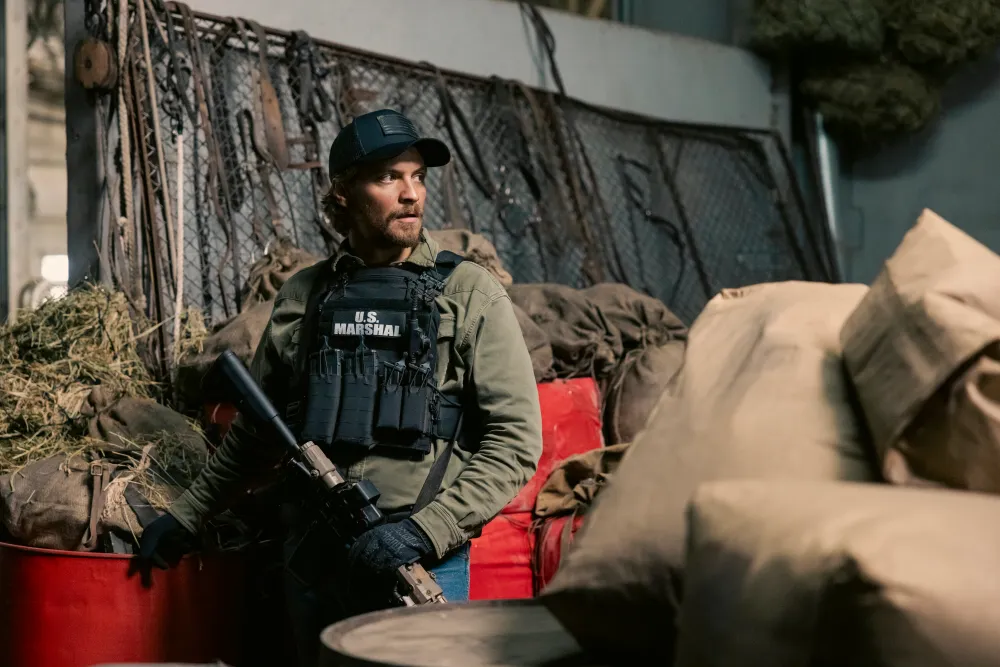
Yellowstone‘s Marshals spinoff left several cliffhangers — including hints at a cast exit and possible main character deaths.
During the Sunday, May 24, episode of the hit CBS series, Andrea (Ash Santos) was offered an opportunity that created distance between her and the rest of the U.S. Marshals. The final scene of the show, meanwhile, showed Belle (Arielle Kebbel) and Cal (Logan Marshall-Green) getting ambushed — with Tom Weaver (Chris Mulkey) planning the possibly deadly situation.
Kayce (Luke Grimes), however, didn’t know that Dolly’s Weaver (Ellyn Jameson) dad was scheming against him. Even worse, Tom was with Tate (Brecken Merrill) as the episode came to an end while Kayce remained in the dark of how much chaos was taking place.
Paramount Network’s Yellowstone, which aired from 2018 to 2024, introduced Us to Kayce and his wife, Monica (Kelsey Asbille), who remained at the center of the show until the finale.
After teaching at a local school on the Broken Rock Indian Reservation, Monica went on to become a professor at Montana State University while navigating life with Kayce, who moved them back to the Yellowstone Ranch following his past tension with dad John (Kevin Costner).
Following John’s death, Kayce, a former U.S. Navy SEAL, became the new owner and operator of the Yellowstone Ranch. Kayce and Monica ended the show alive — and were still together — before Marshals began.

When the series premiered in March, however, fans learned Monica had died after battling cancer.
“Kayce had such a perfect ending in Yellowstone,” showrunner Spencer Hudnut told TVLine at the time. “His dreams had finally come true. As we were trying to figure out how to tell the next chapter in Kayce’s story, it felt like he really needed to be shaken out of that. Unfortunately, tragedy tends to find Kayce, so something bad was going to happen for him one way or the other. It just sort of played out that it was going to be Monica.”
Hudnut said Monica’s death will continue to drive Kayce, adding, “To me, Monica is really guiding Kayce through this first episode, trying to help him find his new path. And if you actually break it down, Tate is at that rally to honor his mother, and Kayce goes there to protect Tate. So if not for Monica, Kayce never would have been in that position and may not have found this path.”


He concluded: “We really wanted to be respectful of the way that we said goodbye to her. I also didn’t want to step on the ending of Yellowstone, because what they had was a beautiful ending. Unfortunately, real life intervened.”
Asbille, 34, has not yet broken her silence on Monica’s onscreen death. She did grant access for her likeness to be used on the show, which allowed Marshals to show photos of the fictional character on screen.
Marshals is streaming on Paramount+.

Continue Reading
Entertainment
Callum Turner’s 100% RT Time-Travelling Sci-Fi Mystery Sets Sail on Rough Waters in New Images
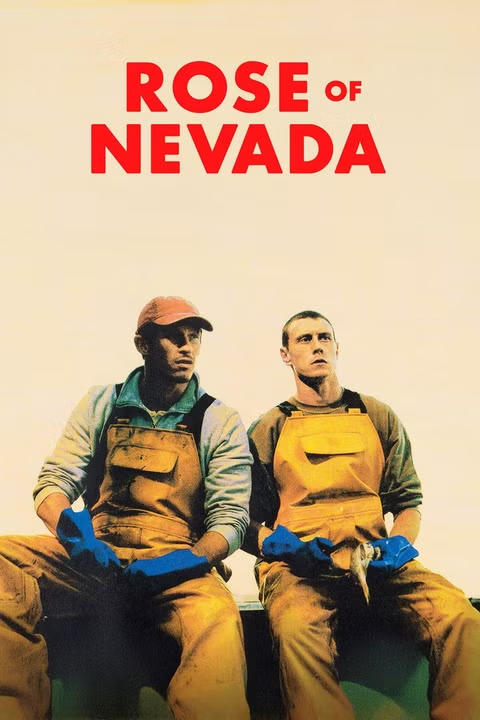
Callum Turner may be best known for his efforts in the sky in Apple TV’s Masters of the Air, but this summer, he’s heading out to sea on the good ship Rose of Nevada. This will be no normal voyage, though. The film tells the story of the titular fishing vessel that ventured out to sea only to be supposedly lost to the waves. However, 30 years later, it mysteriously returns to shore, unmanned, but bringing with it promises of fortune anew for a small harbor town and, in particular, two men played by Turner and BAFTA nominee George MacKay. Ahead of its U.S. theatrical release, we’re excited to kick off the film side of Collider’s Exclusive Summer Preview series with two new images teasing the choppy seas ahead for the duo aboard this potentially cursed ship.
Our stills showcase the analog aesthetic that director Mark Jenkin brings to Rose of Nevada, making this seafaring mystery feel even more like a folk tale pulled out of time. It also adds to the oppressive air and ethereal nature surrounding the boat. At the center of one haunting shot is desperate family man Nick (MacKay), backed by a misty dark blue sky with the rusty chains of the Rose framing him in his yellow raincoat. The calm seas evidently don’t last long, as the two leading men rush to save another member of the crew who’s fallen overboard. Stormy nights and crashing waves are just the beginning of the sailors’ problems, as their voyage will descend into mystery and a bit of creeping terror.
Rose of Nevada quickly sails into sci-fi territory when, on just their first voyage, both Nick and Liam (Turner) are thrust through time. Upon their return to the harbor, they find nothing as they remember it, and they’re mistaken for members of the original crew. It’s a nightmare scenario for Nick, especially given that he came aboard the Rose to provide for his young family. Yet, for the mysterious drifter Liam, who’s just trying to outrun his past, the situation may be exactly what he needed and spark a bit of tension between the two men over how and whether they get home.
Who Else Is on Board ‘Rose of Nevada’?
Rounding out the cast of this sea-faring mystery alongside Turner and MacKay are Rosalind Eleazar, Francis Magee, Mary Woodvine, and Edward Rowe. In addition to directing, Jenkin also penned Rose of Nevada, bringing a similar aesthetic to the feature as his 2022 horror flick Enys Men, which also starred Woodvine and Rowe. His latest premiered at the Venice International Film Festival last year to widespread acclaim and has only since been further hailed upon its U.K. debut in April. It currently holds a Certified Fresh 100% on Rotten Tomatoes, with especially high praise for Jenkin’s direction, which mixes the analog with the surreal, and for his captivating storytelling.
Rose of Nevada premieres in U.S. theaters on June 19. Check out our exclusive images in the gallery above and stay tuned here at Collider for more new looks at the hottest upcoming films from our summer preview series.

- Release Date
-
April 24, 2026
- Runtime
-
114 minutes
- Director
-
Mark Jenkin
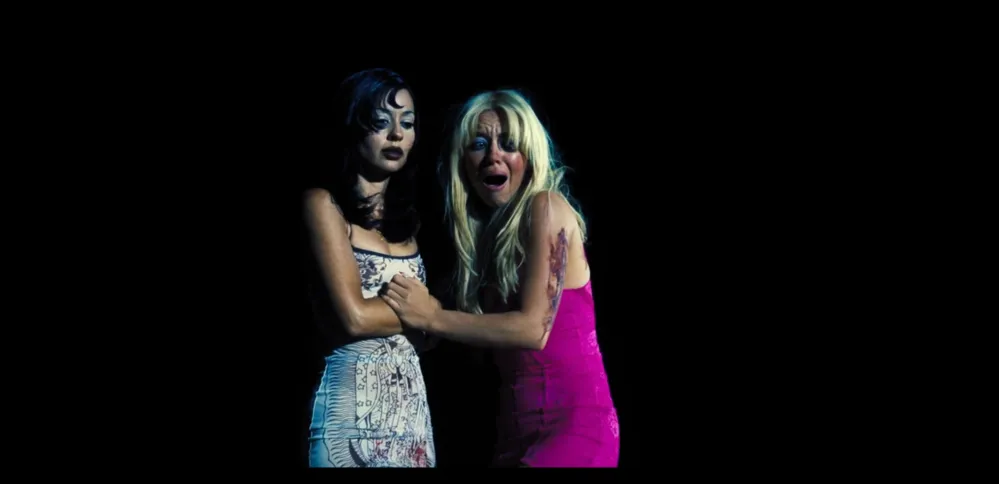
Euphoria has caused a lot of confusion for viewers throughout the seasons — and now they are asking what exactly took place between Maddy and Alamo.
Ahead of the season 3 finale, Maddy (Alexa Demie) had to ask Alamo (Adewale Akinnuoye-Agbaje) for money after Cassie (Sydney Sweeney) found out that Nate (Jacob Elordi) only had 72 hours to live. Alamo made Maddy put on a bathing suit and get in the hot tub while complimenting her.
Alamo ultimately agreed to help Maddy get the $1 million needed to save Nate and the scene cut off. Viewers, meanwhile, wondered if the scene hinted at Maddy having to sleep with Alamo to secure the deal but that wasn’t clarified.
Later in the episode, Alamo made sure to tell Maddy that he’s going to get 20 percent of her future earnings. This revelation was made worse when they found Nate’s body and Maddy realized her deal was for nothing.
“That was a cool way to go. Nate was someone who has made so many mistakes and made so many dark choices,” Elordi explained in a segment that aired after the Sunday, May 24, episode. “It’s cool to see it all come to what it’s come to.”
Elordi recalled having to film in a coffin, adding, “My shoulders were touching the side and they couldn’t move my arms. Then they would drill the lid on it and it would get dark.
It was really nice, actually. It was quite peaceful in there.”

The stunt team, meanwhile, stressed how important it was to make sure the actor had oxygen. They praised Elordi for agreeing to spend “minimal time in the coffin.” Viewers may be surprised, however, to find out that creator Sam Levinson “wanted to shoot it with a real snake” so a rattlesnake and a boa constrictor were both featured on screen.
“Snakes were rattling, which was really alarming when you are locked in a box,” Elordi noted. “They had a boa constrictor that they put a fake rattler on the end of it.”
He continued: “He was super cute. He was really cuddly. So he kind of just sidled up next to me and it was nice. But he was really sleepy. He was a sleepy snake. I had to kind of nudge him to get him to come up. And that was it.”

Euphoria fans have watched the cast change on and off screen since the series first debuted. Based on the Israeli series of the same name, Euphoria follows troubled high school student Rue (Zendaya) as she struggled to remain sober after rehab. The series also explores topics including mental illness, toxic relationships, sexuality and more. After […]
At the end of the segment, Elordi reflected on his time playing Nate.
“It’s a bittersweet thing,” he said. “This show is a massive part of — not just my career — but my life. It’s been amazing and I’m so proud of being a part of this.”
Elordi has played Nate since the show premiered in 2019. Before the show returned, Elordi teased how viewers would meet Nate again in the third and likely final season.
“I finished filming a new season just recently, and it’s a completely different thing,” he shared on a December 2025 episode of Variety’s Actors on Actors interview. “I really do think [he will be nicer].”
Elordi continued: “Whether it works or not — I don’t know. There’s a chance that what I’ve done is not good.”
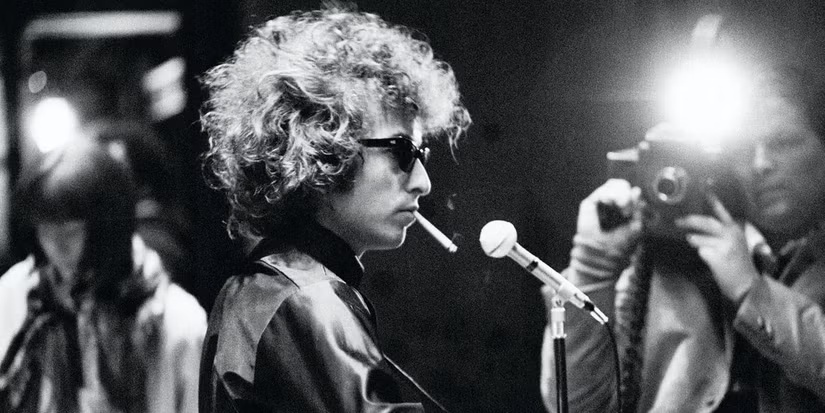
The Auld Lang Syne had been one of the only key New Year’s tunes since its publication in the 1700s, until 1974. This was the year that Bob Dylan released his fourteenth studio album, Planet Waves, including his hit song “Forever Young” in January. Since the song’s release, it has become the unofficial anthem for the New Year, although the song has personal origins that bear no relation to the New Year at all.
What is Bob Dylan’s “Forever Young” About?

Dylan wrote and recorded “Forever Young” in 1973, and addressed the song to his oldest son, Jesse, who was born in 1966. He wrote the song, which was meant to be a lullaby, about a father’s hopes that his child will remain happy and strong while undergoing life’s biggest challenges. In a demo version released as part of his compilation album Biograph, Dylan can be heard saying that he was “thinking about” one of his sons while recording “Forever Young” and “not wanting to be too sentimental”.
Dylan released two versions of “Forever Young” on the 1974 album Planet Waves, one being a lullaby and the other being a rock track. Despite its personal and sentimental meaning, Dylan did not perform the song as much as he did his other songs, but he still performed “Forever Young” quite a lot. His most memorable performances include a duet with Bruce Springsteen in 1995 and his and The Band’s farewell concert, The Last Waltz, in 1976.
The “Blowin’ In The Wind” singer’s biographer, Clint Heylin, wrote that “Forever Young” was also written as a response to another classic rock artist. Dylan did not see eye-to-eye initially with Neil Young, as he felt that Young borrowed his style. Heylin stated that Dylan wrote “Forever Young” as a response to Young’s “Heart of Gold” as Dylan had said in 1985, “[I’d] turn on the radio, and there I am, but it’s not me.”
Why Is Bob Dylan’s “Forever Young” An Unofficial New Year’s Anthem?
Although it is a lullaby addressed to his son, Dylan’s “Forever Young” has lyrics that encompass the theme of evolving and dreams that relate to the new year. Lyrics such as “May God bless and keep you always, may your wishes all come true” and “May you build a ladder for the stars and climb on every rung” echo the optimism that is always felt and highlighted when people ring in the New Year. These lyrics also capture the spirit of hopes, dreams, and wishes coming true, which is relatable to the New Year, as many hope to achieve their goals.
Dylan is constantly hoping in the song that his son, Jesse, will stay “Forever Young”, which is also embraced in the New Year, while people age. While “Forever Young” is a lullaby about staying happy and strong in the face of unspeakable challenges, the song also speaks of staying young and holding on to innocence, happiness, and strength. “Forever Young” being an unofficial New Year’s anthem makes sense, as the song encourages people to stay happy, strong, and young in the face of fresh new challenges and to hold onto their youth and innocence as people will age in the New Year.
While it is widely believed that “Forever Young” is an unofficial New Year’s anthem, others argue that it does not relate to the New Year, and it is a song about kindness instead. Lyrics such as “May you always do for others and let others do for you” magnify that Dylan is encouraging his son to stay kind and righteous. Though the song does speak of being kind, it is hard to ignore the ongoing themes and ideas that directly relate to the New Year celebrations. “May you have a strong foundation when the winds of changes shift” exhibits that listeners should always stay strong as the new year brings new difficulties, with some harder to overcome.
Bob Dylan’s “Forever Young” is a Classic Despite Low Chart Success
Dylan’s “Forever Young” is a classic, but it was not a huge success on the charts, as it was not a huge hit until its live versions were released years later. It was also not as well known at the time of its release for the same reasons, and Joan Baez’s version, which was released as a single in the same year, was the most recognised. She scored the highest on the charts in the US, as it peaked at 13 on the US Adult Contemporary Chart on Billboard.
“Forever Young” has been covered by many artists, including Michael Jackson’s sister, Rebbie Jackson, and The Pretenders, which hints at the song being a classic. However, what makes “Forever Young” truly a classic is the timeless message that resonates among listeners from all walks of life, and the song being fitting for any occasion other than just the New Year’s celebration. Many songs by Dylan are classics, like “Tangled Up In Blue”, “Like a Rolling Stone”, and “Knockin’ On Heaven’s Door”, but “Forever Young” is a gem in his discography, with a heartwarming message that can be heard for many years to come.
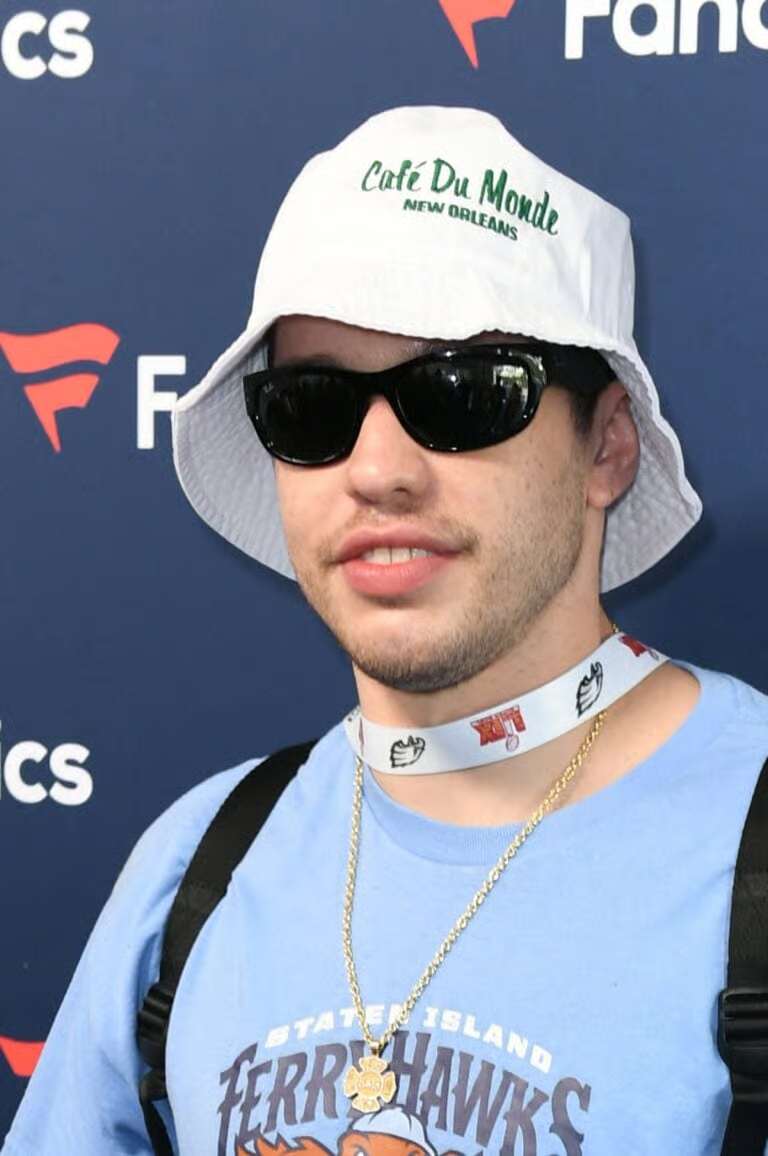
Pete Davidson’s whirlwind romance with Elsie Hewitt moved at lightning speed from the start. Within months of going public, the comedian and model announced they were expecting a baby together, surprising even people close to the couple.
Now, just months after welcoming daughter Scottie Rose, the relationship has reportedly ended. While insiders say Pete genuinely wanted the romance to survive, those around the former couple admit the cracks had been visible long before the breakup.
Sources now claim the pair simply “clashed too much” behind the scenes.
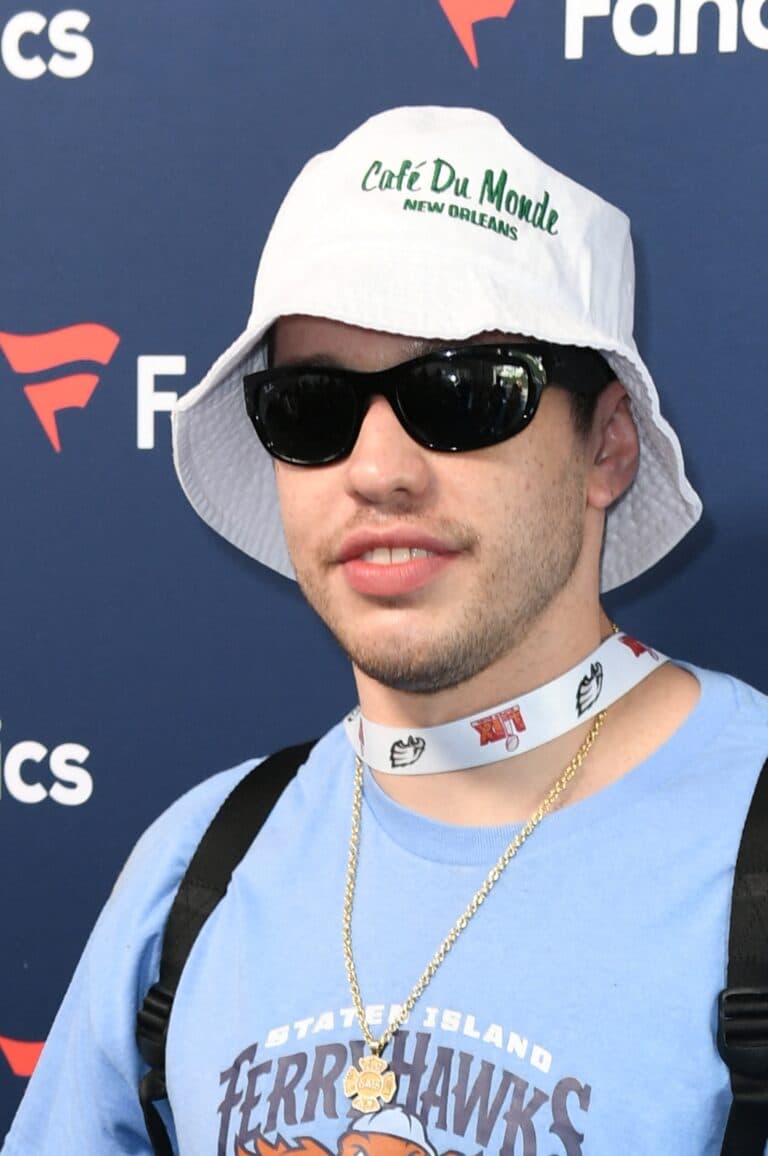
Pete Davidson has built a reputation for diving headfirst into intense relationships, and his romance with Elsie Hewitt followed a similar pattern.
The comedian famously got engaged to Ariana Grande in 2018 after only a few weeks of dating, but even some of his close friends reportedly did a double take when he and Hewitt announced they were expecting a child just four months into their public relationship.
“I was happy for them,” one insider told Page Six, adding, “They seemed pretty strong” during the excitement surrounding the pregnancy. Still, people close to Pete now admit they are far less shocked by the breakup itself.
“This should be the most exciting time for him,” another friend explained. According to one insider, the relationship struggled under pressure after the couple welcomed their daughter Scottie Rose.
“The two of them maybe clashed too much. Having a baby is difficult — no one can prepare you for what happens after you have a baby,” the source said.
However, another source stressed that the breakup was not caused by their daughter. “Their issues were not related to the baby,” the insider clarified, adding there were already signs the pair “weren’t compatible” before Scottie’s birth.
Pete Was Reportedly Blindsided By Hewitt’s Social Media Posts

Tension surrounding the breakup intensified after Elsie Hewitt turned to social media for help earlier this month.
As The Blast reported, the model posted an Instagram Story on May 15, searching for “an assistant / mother’s helper / nanny type / basically right hand person.”
She followed that message with a TikTok video in which she quietly admitted, “I have a baby to take care of. I have to work and make money. I’m doing it on my own, which is hard.”
Sources close to Pete Davidson claim the posts left many people in his circle confused because they insist the comedian has continued supporting both Hewitt and their daughter financially and emotionally.
“Pete’s main priority right now is making sure that Elsie and Scottie are looked after, so it’s utterly confusing to everyone who knows them why she would possibly post anything about him not supporting her,” an insider previously told Page Six.
The source also claimed the 32-year-old has continued paying the rent, their living expenses and their health insurance. According to the insider, Pete has additionally “arranged his schedule to prioritize being in the city” so he can remain physically present in Scottie’s life.
Pete Davidson Always Dreamed Of Becoming A Father

Multiple sources close to Pete say fatherhood has long been one of his biggest goals.
The “Saturday Night Live” alum lost his father, New York City firefighter Scott Davidson, during the September 11 attacks, which later inspired the couple’s decision to name their daughter Scottie.
“It’s something he’s always wanted and really looked forward to,” a source close to Pete shared, describing the breakup as “a sad situation for everyone.”
Amid the breakup, Pete’s mental mental health has been of great concern to fans. Over the years, the comedian has openly discussed his struggles with PTSD, depression, borderline personality disorder, and substance abuse.
His personal hardships often appeared alongside the collapse of past relationships.
After his breakup from Ariana Grande, Pete alarmed fans when he posted online, “I really don’t want to be on this earth anymore. I’m doing my best to stay here for you but I actually don’t know how much longer I can last.”
Insiders Say Pete Is In A Much Better Place Now

Although Pete Davidson’s past breakups often coincided with public struggles, insiders insist this chapter looks very different for the comedian.
The “Dog Man” actor checked into treatment around the time of his split from Kaia Gerber in 2020. In 2023, he entered a Pennsylvania wellness facility after crashing a Mercedes into a Beverly Hills home while dating Chase Sui Wonders. He also returned to rehab in 2024 around the time his relationship with Madelyn Cline ended.
This time, however, people close to Pete say he appears far more stable and focused. “He’s almost two years out of [his last stint at] rehab. Things have been well. He’s working really hard at it,” one source close to the former couple said.
Friends believe fatherhood has given Pete a stronger sense of direction. “He has a great team and people around him that really love him and support him,” another friend explained.
According to insiders, Pete’s biggest motivation right now is being present for Scottie while maintaining peace with Hewitt. “He’s [Davidson] a good guy. He’s very much about not disrespecting women,” one source added.
Pete Davidson And Elsie Hewitt’s Romance Escalated Quickly

Hewitt reportedly met Pete through mutual friends, and insiders say sparks flew immediately. In March 2025, the pair were photographed kissing in the ocean during a romantic Palm Beach getaway.
Shortly afterward, Hewitt officially debuted the relationship on Instagram with a video featuring the “King of Staten Island” actor wearing a bathrobe.
The romance escalated quickly, with the duo announcing Hewitt’s pregnancy that July. Sources admitted there was hope the baby would strengthen the relationship despite ongoing differences.
An insider said Hewitt and Pete “had their differences,” but there was optimism Scottie would “solidify their relationship.” Unfortunately, the situation went the opposite way.
Although reconciliation reportedly appears unlikely, insiders insist Pete remains committed to co-parenting peacefully.
According to one source, the actor is also determined to move forward positively while continuing to support Hewitt and their daughter.
“He’s got a thick skin and good head on his shoulders – he’s just focused on being happy and healthy and is rooting for her [Hewitt] to be successful too,” they shared.
Entertainment
Jamie-Lynn Sigler reveals the story she regrets telling about James Gandolfini on “The Tonight Show”
:max_bytes(150000):strip_icc():format(jpeg)/jamie-lynn-sigler-james-gandolfini-051326-a8c6d8484cd141f19bb833c628bcb049.jpg)
The actress wrote about her bond with the late “Sopranos” star in her new memoir.

If there’s one genre that has proven to blend perfectly with action over the decades, it’s fantasy. It’s quite easy for these tales of magic, mythical creatures, and grand quests to incorporate some kind of action into the mix. Regardless of whether it’s large-scale combat scenes between rival armies, a swordfight between a hero and a villain, or a literal housefly fighting the man who wronged it, fantasy-action films are some of the most fun of each of those two genres.
But while there have been many great fantasy action movies over the years, only a handful can be considered genuine masterpieces to the full extent of the term. Whether it’s a comedy like Eega, an animated family film like How to Train Your Dragon, or a blockbuster epic like the now-iconic Lord of the Rings trilogy, these movies are definitive proof that fantasy and action are partners in crime like no other duo of genres.
10
‘Eega’ (2012)

The Telugu-language Indian dramedy Eega is probably the wildest fantasy action masterpiece ever made, and that constantly works in its favor. Directed by S. S. Rajamouli, one of the greatest filmmakers currently working in India, the story follows a man who’s murdered by a wealthy magnate over the love of a woman. The protagonist then reincarnates as a housefly who has to take revenge and protect the woman he loves from this obsessive villain.
It’s not that Rajamouli takes the concept of a vengeful fly seriously, since he definitely has tons of ridiculous fun with it, but he does take the premise earnestly.
It may sound like the premise of a so-bad-it’s-good cult classic, but Eega is genuinely one of the best low-budget fantasy movies ever made. It’s not that Rajamouli takes the concept of a vengeful fly seriously, since he definitely has tons of ridiculous fun with it, but he does take the premise earnestly. This distinct approach makes for a surprisingly moving and high-stakes revenge thriller whose 100% rating on Rotten Tomatoes is well-deserved.
9
‘The Crow’ (1994)

Alex Proyas‘ The Crow is today perhaps best known for Brandon Lee‘s tragic on-set death after a prop gun failed during filming. Even so, the greatest show of respect that one can offer Lee’s legacy is to appreciate that The Crow is, in fact, one of the best R-rated fantasy movie masterpieces ever made. Dark, stylish, and energetic, it’s a film that deserves far more recognition for its own merits.
Bolstered by the tremendous power of Lee’s now-mythic performance, the film has a sort of campy charm that never overshadows its bleak atmosphere or the edgy, stylish-to-a-fault tone. The Crow is a cold, urban, Gothic rock revenge story unlike any other, and the way the fantasy and supernatural elements of the plot blend with the intensity of the action sequences is as seamless as it is compelling.
8
‘Kung Fu Hustle’ (2004)

Roger Ebert once described Stephen Chow‘s martial arts comedy Kung Fu Hustle as “Jackie Chan and Buster Keaton meet Quentin Tarantino and Bugs Bunny,” and frankly, there’s no better possible way to describe this action fantasy extravaganza. Full of the same kind of over-the-top humor and physics-defying action that you’d expect to see in a cartoon, it’s easily among the goofiest action movies the world has ever seen.
Chow has full control over that goofiness, however, resulting in a martial arts spectacle that’s absolutely hilarious while also being unexpectedly emotionally compelling. It’s definitely one of those genre movies that favor style over substance, but in the case of movies like Kung Fu Hustle, the style is the substance. After all, nowhere else will fans of action fantasy get combat sequences even remotely similar to what this comedic masterpiece has to offer.
7
‘Pirates of the Caribbean: Dead Man’s Chest’ (2006)
Disney had made other movies based on their iconic theme park rides before they released Pirates of the Caribbean: The Curse of the Black Pearl in 2003, but never with the same level of success. A franchise stemming from this beloved fantasy swashbuckler was inevitable. When Dead Man’s Chest finally hit theaters three years after its predecessor, it was very famously disliked by critics in general, but audiences loved it so much that it became one of Disney’s highest-grossing live-action films in history.
Two decades later, it’s time to officially admit it: critics got this one wrong, as Pirates of the Caribbean: Dead Man’s Chest is easily one of the best adventure movies of the 21st century. It’s the last true swashbuckler epic of its kind produced in Hollywood, a perfectly-paced two-and-a-half-hour parade of showstopping action sequences, emotionally stirring character moments, absurdist humor, and delightful plot twists.
6
‘Vampire Hunter D: Bloodlust’ (2000)

Based on the 1985 novel Vampire Hunter D: Demon Deathcase by Hideyuki Kikuchi, Vampire Hunter D: Bloodlust is one of the best anime movies of the 2000s. This dark fantasy vampire adventure was made with the intention of showing it specifically in American theaters, which is why it was only released theatrically in an English-language version. Even when it came out in Japan, it was in English with Japanese subtitles. This singular approach makes it the highest-grossing Japanese film ever in a language other than Japanese.
Vampire Hunter D: Blodlust is a darkly gorgeous, uniquely surreal action horror film unlike anything else that cinema has seen since. It’s a film as spooky as it is badass, full of stunning visuals and immersive sound design. Indeed, it is a true triumph of the animated medium that should appeal to fans and non-fans of the source material alike, making it a must-see for all those who love vampire action.
5
‘How to Train Your Dragon’ (2010)

Only a handful of 2010s fantasy movies are true masterpieces, and DreamWorks Animation’s How to Train Your Dragon is right up there as one of the best. It’s one of the greatest family fantasy films of modern times, a nearly-perfect adventure which understands that there’s plenty of room in children’s media for dark tones, emotional complexity, and artistic merit.
With its impressive score of 99% on Rotten Tomatoes, How to Train Your Dragon remains the most critically acclaimed film in DreamWorks Animation’s catalog, and for good reason. It’s a rousing father-son story, a celebration of forbidden friendship, and a love letter to Viking fantasy. Its visuals have aged beautifully, John Powell‘s score is one of the best of the 21st century as a whole, and the sense of nostalgia permeating the tale of Hiccup and Toothless remains unbeatable, with very few modern animated films achieving the same level of emotional storytelling.
4
‘Castle in the Sky’ (1986)

For all those who are even the slightest bit familiar with anime, neither Studio Ghibli nor Hayao Miyazaki should need any introduction. The former are arguably the leading studio in anime filmmaking, and the latter is among the greatest Japanese filmmakers in history. You could tell how great he was from very early on in his career: Castle in the Sky was only his third-ever movie, yet it’s still one of the most beloved masterpieces in the history of anime cinema.
Castle in the Sky is one of those underrated fantasy movie masterpieces that everyone should watch at least once. Its blend of fantasy, action, and steampunk aesthetics has aged like fine wine, resulting in a story that’s beautifully imaginative in its worldbuilding yet also refreshingly human in its storytelling. Action fantasy is frequently at its best when it’s within the nearly limitless medium of animation, and Castle in the Sky is proof of why.
3
‘The Lord of the Rings: The Fellowship of the Ring’ (2001)

The concept of The Lord of the Rings originated as a simple sequel to J. R. R. Tolkien‘s legendary 1937 children’s book The Hobbit, but soon evolved into a far larger work. Devised as a single high fantasy epic but published in three volumes, Tolkien’s trilogy remains the most important and groundbreaking work of literary fantasy from the 20th century. Anyone would have assumed that it was impossible to live up to such a huge legacy with a big-screen adaptation—but that was before Peter Jackson and his team came onto the scene.
The Lord of the Rings: The Fellowship of the Ring might be the weakest of the three Lord of the Rings films, but it’s still one of the greatest fantasy films ever made, which only speaks to the unprecedented quality of this entire trilogy. If this went on to become the best blockbuster trilogy in movie history, it’s largely because Fellowship laid the foundations as perfectly as it did. Marvelously written, technically faultless, and full of memorable moments, it’s action fantasy at its most imaginative.
2
‘The Lord of the Rings: The Two Towers’ (2002)

Sandwiched in between two of the greatest fantasy epics in history is another one of the greatest fantasy epics in history, The Lord of the Rings: The Two Towers. It may be best remembered for the Battle of Helm’s Deep, easily one of the best climaxes of any epic movie, but this sequel is defined by far more than just its final act.
The Lord of the Rings: The Two Towers is full of emotionally stirring character arcs, jaw-dropping action sequences, and admirably perfect bits of writing. It’s Hero’s Journey storytelling at its very best, gorgeously expanding the world and the enthralling story of Fellowship while also gorgeously adapting Tolkien’s work. Furthermore, it set the stage for the final chapter of the trilogy and offered plenty of a distinct and now-iconic spice.
1
‘The Lord of the Rings: The Return of the King’ (2003)

There’s really not much question about it. With a whopping 11 Academy Awards under its belt, The Lord of the Rings: The Return of the King is tied with Ben-Hur and Titanic as the biggest Oscar winner in history, and for good reason. We’re talking about not just the most perfect adventure movie of the last 40 years, but perhaps even the greatest fantasy film of modern times.
At the very least (emphasis on very), The Lord of the Rings: Return of the King is the peak of action fantasy filmmaking. Incredibly long ending be damned: this trilogy-capper succeeds at bringing every element of its predecessors to a cathartic close while still standing on its own two feet as an individual film. It’s visually impressive, boosted by Howard Shore‘s score, packed with stunning action sequences, and full of beautiful conclusions to deeply compelling character arcs. Fantasy movies don’t get much better than this.
Entertainment
‘Masters of the Universe’ Is Officially Doing What Modern Fantasy Movies Forgot How To Do
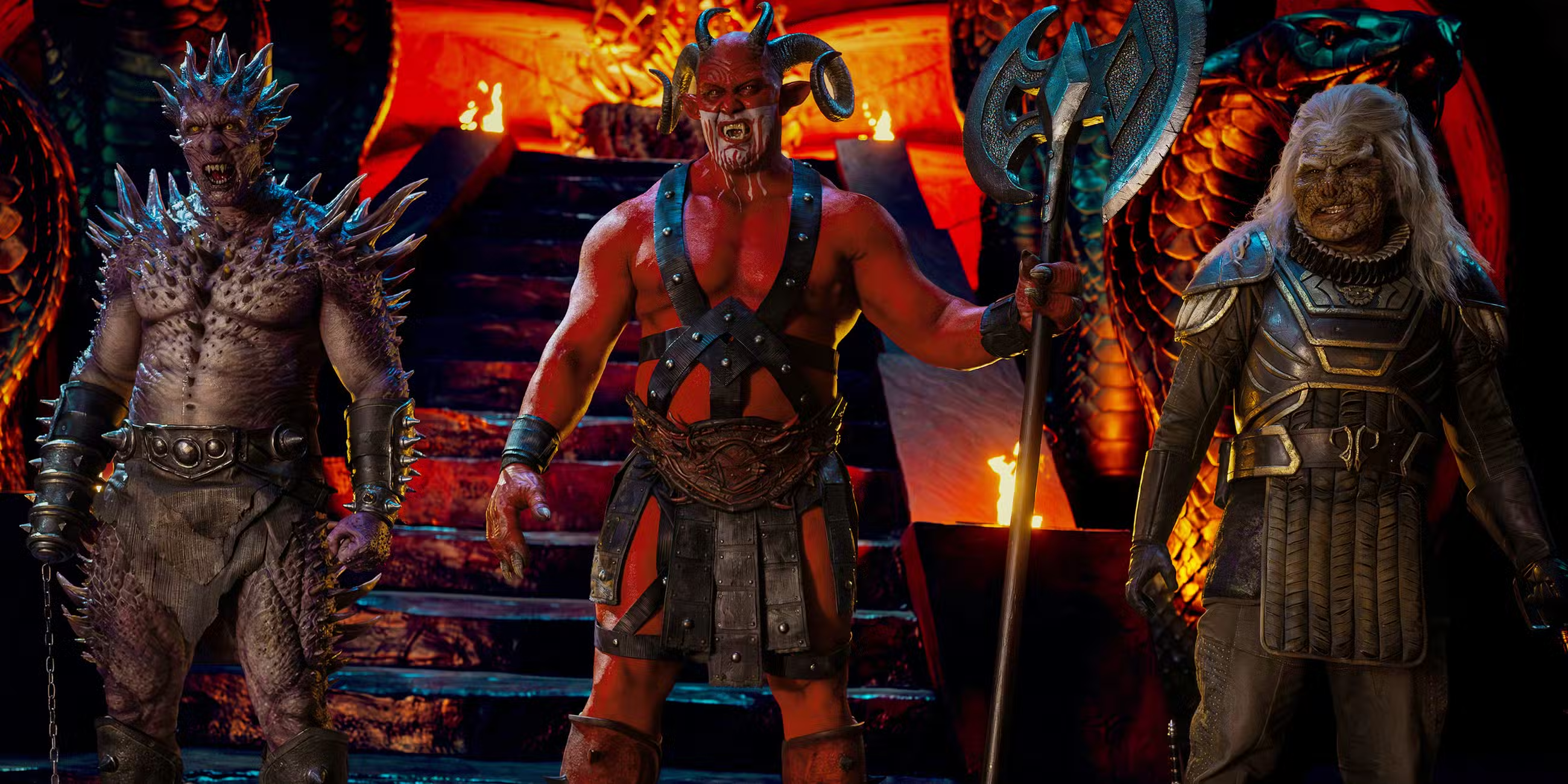
On May 21, 2025, at around 11 AM BST, I discovered that it actually is possible to make a movie that is full of color. In fact, it is quite easy to take the vibrant source material of a cartoon like He-Man and translate that not only into live-action, but onto the silver screen where movies are now far more likely to vacillate between poorly-lit shades of grey and beige. Couple this with the realization that Travis Knight’s Masters of the Universe was using practical sets, awe-inspiring creature work and prosthetics, and highly-detailed costumes, and it became apparent that Amazon MGM Studios and Mattel had chosen the right creative team to steward this project to fruition.
If you have read any of my reviews published throughout the last 5 years on Collider, you will recognize this oft-mentioned and incredibly un-fun factoid: the world as we know it is rapidly losing color. Not only have we been in a downward spiral since the ‘80s, but no one seems to care about bringing back what we have lost. For over a decade, audiences and critics have made their feelings about poorly-lit movies and series well-known. And yet, filmmakers continue to make it impossible to see and truly enjoy their hard-earned work. One pervasive theory is that the dimmer lighting allows filmmakers to better conceal the seams in the final product — particularly in cases where overworked, underpaid visual effects teams are being tasked with creating entire set pieces, costumes, and worlds within the confines of entirely green-screened sets.
I was relieved to learn that this wasn’t the case for Masters of the Universe. That’s not to diminish the film’s stunning visual effects, crafted by the talented teams at companies like Industrial Light & Magic, Rodeo FX, and DNEG under the guidance of visual effects supervisors Tim Burke and David Vickery. But those effects are built upon highly detailed practical sets, designed by the film’s two-time Academy Award-nominated production designer, Guy Hendrix Dyas. Together, the production design and visual effects teams worked in tandem to create a world that feels fully realized — and the results speak for themselves.
How ‘Masters of the Universe’ Remained Faithful to the Animated Series’ Color Scheme
Last spring, Dyas joined the bevy of journalists on the set of Masters of the Universe to discuss how they brought Eternia to life for the film. Before we even set foot on the actual sets, the sketches on the walls around us showcased a colorful, immersive world that was reminiscent of the animated series that many of the film’s creatives grew up with. Dyas readily admitted that he “fanatically” watched He-Man as a child growing up in Devon, England, and that childhood obsession had a clear throughline into the level of detail in each of his designs.
“What I’ve tried to do in every case is make sure that all the vehicles adhere to the original color schemes of the toys in the animation. Which has been really, honestly quite amazing for me as a designer who normally would always do spaceships in the classic sort of steel or gray.” Dyas explained while showing us his red-accented concept art for the Rotons — the intimidating saw-like vehicles used by Skeletor’s lackeys. “We all know spaceships are always gray, right? Not in this world.”
Among the sketches on the walls were the highly-detailed designs Dyas drafted for Eternia’s capital city, Eternos, which revealed a city that looked almost real. The designs factored in day-to-day life, with functional egress and ingress, and a clear understanding of how a civilization develops and evolves throughout its rise and eventual fall.
Dyas credited some of the city’s inspiration to famed concept artist Ralph McQuarrie, who provided uncredited concept art for Gary Goddard’s 1987 live-action adaptation. “I kept in mind [his] gestures of the domes, but I changed them into glass. I felt that if they were stone, it would start to look too much like a Star Wars world.” While McQuarrie’s designs were inspirational, they also lacked something that is integral to the ethos of He-Man. “I obviously ramped up the color because colors are a very, very big deal for Masters of the Universe. It’s not a world that shies away from vivid color, and that’s a very healthy thing.”
McQuarrie is, of course, best-known for his Star Wars concept art, but the connection between He-Man and Star Wars goes deeper than that. In 1976, Mattel passed on George Lucas‘ offer to produce a toy line for his emerging franchise, which led to Kenner’s iconic action figures — and also the inception of He-Man. Mattel’s lead designer, Roger Sweet, created the character as a sort of Conan the Barbarian meets Star Wars, and the end result was a character that remains undeniably recognizable forty years later. What set He-Man apart from the rest of its peers was the franchise’s bright color scheme, as Dyas said:
“When you look at most science fiction films, they do tend to lean into a singular palette. If you go and see Patrice [Vermette]’s work in Dune, it’s beautiful, but it’s all going to be kind of yellow and brown. If you go and look at Star Wars, it’s going to go more into the gray palette, that whole sort of Doug Chiang thing. So, what is the palette for this world? Well, one thing’s for sure, it’s not short on color. Our forests are absolutely vivid and beautiful.”
Later we went to see part of the forest that Dyas and his team were building, where the only color restriction was “no green.” A choice that may seem surprising for a forest, but once you see the film you will understand why the restriction was put into place. “I removed the color green because it just does something very weird to your brain. You’re looking at it, and you’re going, ‘I believe everything here, and yet there’s something amiss.’”
How ‘Masters of the Universe’ Takes Its Costumes and Props to the Next Level

“I’ve never done a job that is so intertwined with prosthetics before,” Masters of the Universe’s costume designer Richard Sale admitted. Sale has an expansive career designing costumes for Marvel and DC films, including Guardians of the Galaxy, Wonder Woman: 1984, Doctor Strange in the Multiverse of Madness, and Aquaman and the Lost Kingdom, but none of those movies have utilized prosthetics quite like this one. “One of the really cool things about this job has been the hopefully seamless work with Barrie [Gower]. It’s a joy to emphasize each other’s work.”
We were shown models and finalized prosthetics for characters like Goat Man, Spikor, and Pig-Head that featured a level of detail and care that made them look more like war trophies than examples of made-for-screen prosthetics. Of course, the most impressive example of the seamless partnership between costumes and prosthetics is Masters of the Universe’s iconic villain Skeletor (Jared Leto).
As Sale told us, “because he’s predominantly a prosthetic, our work couldn’t start until we had a signed-off prosthetic, and we didn’t have that until two weeks before filming. They needed a long time to make the suit to Jared’s size. So at that point, we did all the artwork with all of the detail, and we did the belt design and all the [smaller] bits. All of that can go along, but it’s not until you finally get him in the room, in [the prosthetics], that we can really start work on it.”
He explained how they went through several months of testing different cloaks and shades of purple, before they settled on the final version that looked best in-camera. Skeletor is a make-or-break character for a film like Masters of the Universe, and the end result is perhaps the film’s most impressive feat. The secret, Sale revealed, was not to one-to-one replicate the costumes from the animated series and toy line, but rather build onto the concepts they established.
“One of the choices I made early on when we designed Skeletor was to not have the cross strap, which is from the costume with the bones, because it became too similar in a way that just became a negative of each other. Again, we were trying to move away slightly from the bone idea — just for Skeletor. He lives in Snake Mountain, so he should be more snake-like. But then we used a lot of snake skeletons in the design, so we kept the bone thing alive, but just having it a little bit more referential to his detail.”
The film’s prop master, Steven Morris, made a point to highlight how much time it takes to craft props for a film as large-scale as Masters of the Universe, particularly when the scenes are filled with background performers that all need to be armed with weaponry with the same level of detail as the main cast’s weapons. “I’ve never been involved in a project of this size and scope, and the sheer volume of what has to be built from scratch, which is pretty much everything. You can touch all these things. You’ll see certain things have different weights. That’s purposely for the actors and for what we need out of the scene.” And these prop pieces weren’t outsourced — Masters of the Universe kept everything in-house, and that only strengthened the synergy between departments.
“Keep in mind, our movie takes place 20% on Earth, 80% on Eternia. You cannot walk into a Target or a Best Buy or any store and say, ‘Hey, can you show me the Eternian section? We’ve got to buy a bunch of shit for our movie.’ Every single solitary prop, costume, belt buckle, and gun is bespoke to this movie. Everything. We were not able to and would not take it from somewhere else. We built it from scratch. We have a 40,000 square foot factory across the street that is literally manufacturing these things in-house, so we can design something on set and basically have it by the end of the day in some sort of form, all under one roof.”
In a production filled with He-Man fans, it wasn’t surprising to learn that departments like Morris’ were focused on fan expectations. “We always knew that this is a movie that’s going to get judged — even though it’s huge — by the very [small] details that make up the film. So, we’ve been concerned about details from day one. Our art department has created a language, an Eternia language with a grid, with letters, and we have plastered throughout the sets and on Teela’s ship, different phrases that, if you take the time, and you want to nerd out, and you want to follow the grid [you can].”
Morris continued, “The super nerds out there — who are looking for everything that we’re doing online — all of that stuff, it’s important to them. The first comments we started getting back [when the first look was released] were about this: the patina, the weathering. Because it feels like it’s being used. It doesn’t feel like Star Wars, where everything was so clean and didn’t have that tactile response. They’re zeroing in on the details.”

No one sets out to make a bad film, but if you spend enough time on sets, you can often sense that people know that what they’re making isn’t going to be great. But on Masters of the Universe it was the complete opposite. Everyone knew what they were making was going to be a visual treat for He-Man fans — and even newcomers to the franchise. From department heads to the background performers on their smoke breaks between takes, there was a palpable belief that Masters of the Universe was going to defy the odds of most big-budget fantasy movies. And Morris credited that hopeful attitude to one person on set.
“From the tip of the spear down, I’ll tell you the reason this movie’s going to work, and I believe it, is because Travis [Knight], our director, not only wanted to make this movie, he needed to make this movie. These were more than toys; they were characters that became his friends. He literally came up in this universe, never knowing that now he was in charge of it and in control of it. And thank God he is, because there is not a better steward to be running that brand and all of these things.”
Travis Knight’s Stop-Motion Background Is ‘Masters of the Universe’s Secret to Success
Nearly a year to the date of the set visit, I find myself sitting across from Travis Knight at the junket for Masters of the Universe, a day after the world premiere in LA. After seeing the film fully embrace the vibrant colors we witnessed on set, I ask how he managed to achieve something many of his peers seem to struggle with: creating a film that is not only richly colorful, but also impeccably lit. His answer is far from surprising.
Travis Knight isn’t just a He-Man super-fan, he is the CEO of LAIKA — the world-famous stop-motion animation studio behind Coraline, ParaNorman, Kubo and the Two Strings, and the upcoming Wildwood, two of which Knight also directed. Stop-motion animation, like any form of animation, is incredibly intentional about even the most minute detail, especially where color and lighting is concerned.
“It starts when you have source material like the Filmation cartoon, which was this riot of color,” he explains. “It was polychromatic splendor. It was insane, their use of color in that cartoon. That was essentially my North Star. I kept going back to the art department, and naturally, you go in that direction, and people think, ‘No, this is crazy. This looks insane. We’ve got to throttle back from that.’ And look, you do have to make things look believable, but it is an alien planet, and I wanted it to be a really rich, vibrant experience. So, as you work on a process, things tend towards gray, and you’ve got to always push it back. I’m really, really pleased with where we arrived because the movie is kind of a rich, colorful, kaleidoscopic riot, and it’s just so much fun.” He explained:
“It helps that I come from a background in animation, which is an accommodation of practical stuff and digital stuff, and so it’s the blend of those things. It’s a little bit different in live action, but it’s fundamentally the same thing.”
Knight echoed the same sentiments we heard Dyas and Sale make a year prior. Every department worked together to create cohesive designs that worked in concert with each other. “The thing that I hadn’t really done to this extent was work in prosthetics, and I didn’t have appreciation for how time-consuming and how difficult it was,” Knight explained. “But I lucked out. My prosthetics lead is a guy named Barrie Gower, who is absolutely extraordinary, and he’s a huge He-Man fan, which helped too.”
Knight went on to praise Gower and his team for the passion they brought to the production and the ways they found creative solutions to expand the world of the film. “He and his team, they put so much of themselves into this movie. They went above and beyond. They created things that are like, ‘Well, we can’t afford to put Merman in the movie,’ so they created a little Merman mask and put a guy in the background, so we got Merman in the back somewhere. I mean, they put so much of themselves into the movie.”
He also highlighted how that meeting of minds led to a film that feels set apart from the last decade of sci-fi and fantasy projects. “I think that the physical, the practical stuff, the special effects, the combination of visual effects, when those things blend together in a harmonious way, and it doesn’t happen easily, it creates a magical spell. I’m delighted with the work that went into the movie.”
What became clear over the course of both the set visit and my conversation with Knight nearly a year later is that Masters of the Universe was never approached as just another toy adaptation or effects-heavy franchise film. It was built by artists and craftspeople who understood exactly why this world resonated with audiences in the first place — not just because of He-Man or Skeletor.
In an era where so many blockbusters feel visually interchangeable, Masters of the Universe dares to look distinct. It embraces color, texture, practical artistry, and sincerity without apology. Whether the film ultimately succeeds with audiences remains to be seen, but one thing is undeniable: every frame reflects a creative team that genuinely believed in what they were making, and that passion is impossible to fake.
Masters of the Universe is in theaters on June 5, 2026.

Masters of the Universe
- Release Date
-
June 5, 2026
- Director
-
Travis Knight
- Writers
-
Chris Butler
- Producers
-
Jason Blumenthal, Robbie Brenner, Steve Tisch, Todd Black
:max_bytes(150000):strip_icc():format(jpeg)/STERLING-K.-BROWN-STEVE-MARTIN-QUINTA-BRUNSON-030626-056d2f7c6c4d4aaca38722d2501297b5.jpg)
EW’s guide to the top comedies and dramas on the streamer, for when you’re struck with analysis paralysis.

General Hospital’s Kate Mansi will exit the daytime soap opera.
In an interview with SoapSteph’s Daytime Dish, Mansi, 38, confirmed that her run as Kristina Corinthos-Davis came to an end last month when her last day of filming occurred. “I’ve made the very difficult decision to leave General Hospital,” Mansi told the outlet in an article published on Sunday, May 24.
Mansi, who joined the long-running soap in 2023, added that new projects required her “full attention” as did the need to support her husband, Matt McInnis. “With my husband currently producing a series filming primarily abroad, I needed the flexibility to travel while continuing to develop and work in Los Angeles,” she said.
The interview also included a note of gratitude from Mansi. “I’m incredibly grateful to Frank [Valentini, the show’s executive producer], ABC, and our writers for the care they gave Kristina,” she said. “It’s been such a meaningful and unforgettable ride. I’ve loved being a fiery Corinthos-Davis girl in such a phenomenal family.”

General Hospital star Kate Mansi has a lot to celebrate after her engagement to Matt McInnis. Apparently today is a holiday, but I think July 3rd was even better,” McInnis, 40, announced via Instagram on Thursday, July 4, sharing a photo of the couple hugging. They spent Independence Day with beautiful views of trees and […]
Valentini, 63, responded to Mansi’s departure, telling the outlet that he was happy for her fresh start. “We love Kate and support her decision to leave. The door is always open, and we appreciate all that she added to the show these past three years,” he told the outlet.
Mansi, who rose to fame as Abigail Deveraux in Days of Our Lives from 2011 to 2020, also discussed with the outlet why she was originally drawn to joining the General Hospital cast. “When Frank first approached me about the role, two things deeply resonated with me: the opportunity to show my support for the queer community by playing an LGBTQ+ character, and to help tell an endometriosis storyline,” the actress said. “Together, I truly feel we honored both of those stories in a way that mattered.
She concluded, “Now, it feels like the right time for both Kristina and me to step into new adventures.”

Kirsten Storms set the record straight about her break from General Hospital amid rumors of behind-the-scenes drama at the ABC soap. “I’m still under contract and have every intention of returning when the break (I was fortunate enough to be granted) is over,” Storms, 41, confirmed to fans via Instagram on Wednesday, July 9. Storms […]
Earlier this year, fellow General Hospital star Steve Burton announced that he would take a short break from portraying Jason Morgan on the show as he chose to embrace a new marriage and family time. At the time, Valentini again showed his support. “We love Steve and I am glad the show worked it out so he can get some personal time with his family,” Valentini told Soap Opera Digest in a statement. “We have some great Jason stories leading up to spring and look forward to his return in the summer.”
The General Hospital door has swung both ways in recent times, with Kirsten Storm returning to the role of Maxie Jones in February following a leave of absence after learning she had a brain aneurysm.
Westerns hook you in a different rhythm than most genres. And they have a pretty niche audience I must say. So for instance, unless you’re watching the best ones, it’s hard to sit through a western anyway unless you love the whole cowboy vibe. They do not always sprint. The great ones know how to stalk. You are watching pressure ripen through the slightest quirks of the genre and that’s the beauty of it.
These 10, however, are the kind of westerns that you would sit through and actually enjoy them regardless of whether you like the genre or not. That’s how good they are and how well they hook. And they are not all fast in the same way. Some are tense. Some are grand. Some are brutal. Some are funny in dry, lethal little bursts. But they all understand propulsion.
10
‘Open Range’ (2003)

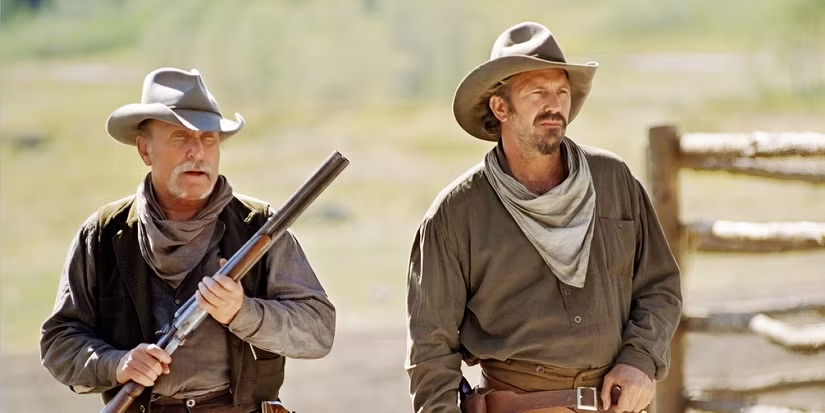
What I love about Open Range is how confidently it lets its pace breathe without ever letting your attention wander. That is a hard balance, and it gets it exactly right. The early sections are full of ordinary frontier routines, men living out on the land, eating, talking, moving cattle, handling small tensions before they curdle into bigger ones. But none of that feels like stalling. It feels like the movie quietly teaching you what kind of life is being threatened. Boss Spearman (Robert Duvall) and Charley Waite (Kevin Costner) are are men who have made a working moral arrangement with the world, and once that arrangement gets violated by Denton Baxter’s (Michael Gambon) cruelty, the film starts humming with contained anger.
And that anger is what keeps the whole movie hooked into you. Duvall gives Boss such lived-in authority, while Costner makes Charley feel like a man who has spent a long time trying not to become the version of himself violence keeps calling back into existence. The romance thread never drags the movie down either, because it is tied to the larger question of whether a man like Charley can ever belong to ordinary life again. Then that final gunfight justifies every bit of the slow-burn structure.
9
‘3:10 to Yuma’ (2007)

This movie is one of the best examples of a western understanding that movement itself can be suspense. Get Ben Wade (Russell Crowe) to the train. That is the engine. Such a simple goal, and it gives the whole film shape immediately. The beauty is that the shape keeps getting more complicated the longer it runs. Dan Evans (Christian Bale) is trying to hold onto his own idea of himself in front of his son, his debt, his humiliation, and his half-broken place in the world. Ben is not just a prisoner either. He is funny, intelligent, observant, dangerous, and weirdly interested in the weaknesses of the men around him. So the film keeps turning the escort plot into an emotional duel.
3:10 to Yuma never lets either man flatten into an easy type. Dan and Ben’s scenes together are the movie’s real action, even before the bullets start flying. Then once the final race to Contention begins, the film becomes almost unbearably tight. The movie is so exciting by then — the moral stakes have become inseparable from the physical ones.
8
‘The Magnificent Seven’ (1960)

The Magnificent Seven hooks you because it understands one of cinema’s oldest pleasures: assembling the right people for the wrong job under the right amount of pressure. The village is under threat. The bandits keep returning. Protection must be bought somehow. Then the film starts bringing in these gunmen, each with a distinct rhythm, ego, sadness, or streak of fatalism, and suddenly you are in a community-building story, a men-in-search-of-purpose story, and a “what does skill mean once the world has stopped paying for it honorably” story. That is rich fuel.
And the film never loses momentum because every phase has its own charge. The recruitment is fun. The training and defense preparation are fun. The uneasy bond between the villagers and the gunmen deepens things without killing pace. Calvera (Eli Wallach) is also a huge reason the movie moves so well, because he gives the threat personality without turning him into a cartoon. You understand exactly why the villagers are terrified of his return. Then the final stand lands because the film has done the essential western work: it has made protection costly and belonging temporary. You stay hooked because the movie keeps asking what these men are actually fighting for once the paycheck becomes the least interesting answer.
7
‘High Noon’ (1952)

This one is all tension design. There is almost no wasted motion in High Noon. The film follows a marshal (Gary Cooper) who learns that a man he once sent away is coming back on the noon train, revenge is clearly the mission, and instead of riding out, he stays and tries to gather help from a town that keeps finding more respectable ways to abandon him. That setup is brilliant because it turns suspense into moral exposure. The danger is not just Frank Miller (Ian MacDonald) arriving. The danger is time revealing who the town really is. Every clock shot is not just countdown mechanics. It is accusation.
Cooper’s Will Kane does not feel invincible or swaggering. He feels tired, uneasy, stubborn, and almost humiliated by how badly he needs support from people who keep retreating into excuses. That emotional exposure is what keeps the film hooked into you so hard. The church debate, the deputies backing off, the new bride caught between principle and love, all of it tightens the noose.
6
‘Tombstone’ (1993)

There is a reason Tombstone remains so insanely rewatchable. It has that rare big-cast western electricity where every entrance feels like it might start another movie you would also happily watch. Wyatt Earp (Kurt Russell) is looking for something like peace or at least profitable semi-retirement, and the film knows how funny and doomed that sounds in a place like Tombstone.
The town is already humming with vice, swagger, gang pressure, and men whose personalities seem too large for civilization to contain comfortably. That means the movie never struggles to generate momentum. It is already overheated before the shooting properly starts. And then Doc Holliday (Val Kilmer) gives the whole film a pulse too alive to ignore. He does not just steal scenes. He changes the rhythm of them. Suddenly wit, death drive, loyalty, sickness, elegance, and self-destruction are all in the room at once. Russell is excellent because he keeps Wyatt grounded enough that the larger-than-life material still has a spine. What keeps the movie hooked from start to finish is how well it knows escalation. It never feels like random cowboy incident. It feels like a town moving toward inevitable combustion, and every joke, romance, betrayal, and gunfight is feeding that combustion.
5
‘The Proposition’ (2005)

The Proposition hooks you like a fever. It is not fun in the same register as some of the others on this list, but it is so tense and so poisoned from the beginning that it becomes impossible to look away. The proposition itself is already a perfect piece of western cruelty: capture or kill your older brother and your younger brother lives. That is savage story architecture. It turns family, law, colonial authority, masculine violence, and moral compromise into one single blade. Then the Australian frontier setting makes everything even harsher.
What makes the film so gripping is that nobody gets to remain clean inside the premise. Captain Stanley (Ray Winstone) is trying to perform civilization through force. Charlie Burns (Guy Pearce) is caught between survival and blood. Arthur Burns (Danny Huston) is less a man than a dreadful magnetic center pulling everyone toward him. The movie is full of heat, flies, dust, and this awful sense that the social order being imposed is already rotten at the root. You stay hooked because the film keeps asking who will finally become monstrous first, and the answer keeps spreading.
4
‘Unforgiven’ (1992)

This film hooks you by making you wait for violence while teaching you, scene by scene, exactly why violence should no longer be trusted. That is one of the hardest tricks in the genre, because western audiences are trained to anticipate the gunfighter’s return, the old killer riding again, the legend proving itself one more time. Unforgiven knows that expectation is sitting there and uses it against you. William Munny (Clint Eastwood) does not come back into the story as some cool dormant monster waking up. He comes back as a tired farmer, a failing widower, a man telling himself he is not that man anymore while money, need, pride, and old reflexes begin pulling at him.
And every character deepens that pull. The Schofield Kid (Jaimz Woolvett) is all fantasy and nerves. Ned Logan (Morgan Freeman) brings memory and decency. Little Bill Daggett (Gene Hackman) is civilization as bullying performance, a man convinced that order justifies any ugliness if he is the one imposing it. The movie keeps widening the emotional cost of violence long before the final eruption arrives. So when the saloon sequence finally happens, it lands with the force of reckoning rather than payoff. That is why the movie is so gripping. It understands that suspense in a western can come not only from what might happen, but from dreading what will happen once a man stops pretending he left his old self behind.
3
‘The Wild Bunch’ (1969)

The Wild Bunch grabs you immediately because it feels like a world already coming apart before the plot has properly started. Pike Bishop (Sam Peckinpah) opens with children watching scorpions consumed by ants, then erupts into one of the most chaotic and violent openings in western history, and the film never lets the sensation of collapse leave your body after that. The Bunch are not just outlaws on one last score. They are men out of time, dragging old codes through a modernizing world that no longer has room for their kind of criminal honor or even their kind of brutality. That gives every movement in the story an undertow of extinction.
And the movie keeps you hooked because it understands contradiction so well. These men are cruel, loyal, funny, exhausted, pathetic, dangerous, and occasionally noble in ways that never cancel out the rest. Pike Bishop (William Holden) is the center of that contradiction, a leader carrying enough self-knowledge to understand the life is doomed and still unable to imagine another one. The train robbery, the border politics, the Angel situation, the final walk, all of it works because the movie keeps turning momentum into destiny. You are not just watching a gang movie but a species of man head toward its own ritual end.
2
‘Django Unchained’ (2012)

Djano Unchained stays entertaining from start to finish because it has one of the most powerful propulsion systems any western has ever built: love plus revenge plus liberation. Django (Jamie Foxx) is not just trying to survive the frontier or outdraw another man or protect a town. He is trying to get his wife back from hell. That gives everything, every conversation, every deception, every bit of comic cruelty, and every gunshot a bigger emotional engine. Quentin Tarantino knew how to exploit that engine. The film can be funny, grotesque, suspenseful, indulgent, outrageous, and still never lose the clean forward movement of Django getting closer to Candieland and closer to the world that stole Broomhilda from him.
And what makes the movie so sticky is how well its different tones feed each other rather than cancel each other out. Dr. King Schultz (Christoph Waltz) gives the film such verbal lightness and moral complexity that he turns every explanatory scene into play. Calvin Candie (Leonardo DiCaprio) is a perfect late-film accelerator because he makes the house itself feel like a theater of violence pretending to be sophistication. Then Foxx keeps Django’s emotional line clean enough that the whole movie never drifts into pure showboating. Yes, it has that modern western swagger. Of course it does. But it also has focus, and that focus is what makes the entertainment feel complete rather than scattered.
1
‘The Good, the Bad and the Ugly’ (1966)

The Good, the Bad, and the Ugly may be the most gloriously sustained piece of western entertainment ever made. Not the saddest. Not the most morally profound. Not the most intimate. The most sustained. It is almost absurd how completely it keeps hold of you for its entire running time. Leone understands that a western can be huge and leisurely and still never feel slack if every scene is charged correctly. Blondie (Clint Eastwood), Tuco (Eli Wallach), and Angel Eyes (Lee Van Cleef) are not just three men in a hunt for buried gold. They are three perfectly calibrated narrative energies. One cool and withholding. One frantic and shameless and weirdly lovable. One deathly patient and professional in the ugliest way. Put them into the same story and the film almost cannot stop generating momentum.
And then there is the scale. Civil War wreckage, prison camps, desert crossings, betrayals, reunions, shifting alliances, the bridge sequence, the cemetery, the score, every part of the movie keeps enlarging the journey without losing the dirty little pleasure of wanting to know who gets the money and how. That is the secret of its greatness as entertainment. It is epic, yes, but it never stops being mischievously invested in character friction and game mechanics. Then the final three-way showdown arrives and somehow pays off not just the plot, but the entire accumulated rhythm of the movie. That is why it sits at the top. It does not merely hold your attention. It owns it.

NewsBeat1 minute ago
Hottest May day record broken as London area hits 33.5C

Sports3 minutes ago
‘He’s human’: Dale Steyn makes big statement on Jasprit Bumrah’s poor IPL 2026 season | Cricket News

Tech4 minutes ago
Drone speed record falls again as Blackbird hits 453 mph using custom carbon fiber propellers

Politics1 month ago
US brings back mandatory military draft registration

NewsBeat2 months ago
Steven Gerrard disagrees with Gary Neville over ‘shock’ Chelsea and Arsenal claim | Football

Tech4 weeks ago
Register Renaming | Hackaday

News Videos16 minutes ago
How To Actually Make $180/day Trading Crypto For Beginners

News Videos25 minutes ago
How to Become a Crorepati | Business vs Job Motivation in Tamil | Financial Freedom Tips#viraltamil

News Videos40 minutes ago
Trump administration sparks MAJOR shift toward Bitcoin home loans
-

 Crypto World4 days ago
Blockchain.com files with SEC for U.S. IPO
-

 Fashion3 days ago
Holiday Weekend Open Thread – Corporette.com
-

 Crypto World3 days ago
Bitcoin Accumulation Weakens as BTC Realized Losses Hit $600M
-

 Business3 days ago
Dell Technologies DELL Stock Surges 15% on AI Server Momentum and Analyst Upgrades in 2026
-

 Crypto World3 days ago
Space X IPO Is ‘Bad News’ for Tech Stocks: But What About Bitcoin?
-

 Politics3 days ago
Makerfield: a tale of two social-media histories
-

 Crypto World2 days ago
Robinhood crypto COO Tanya Denisova exits
-

 Crypto World3 days ago
MicroStrategy’s Saylor Says Miners No Longer Set Bitcoin Price, Another Force Has Taken Over
-

 Business20 hours ago
NYT Strands Answers May 24 2026 Revealed for Puzzle No. 812 Theme Summer Essentials
-

 Crypto World3 days ago
AI infrastructure race heats up as IREN pitches full-stack strategy, WhiteFiber lands $160M deal
-
 Tech3 days ago
A 0.12% parameter add-on gives AI agents the working memory RAG can’t
-

 Tech4 days ago
WhatsApp ads could make Irish debut after discussions with DPC
-

 Tech3 days ago
You Can Now Add ChatGPT To PowerPoint
-

 Business3 days ago
Trump Invests $1M-$5M in Kura Sushi USA Chain With 27 California Locations
-
 Crypto World7 days ago
Revolut Launches Dogecoin Debit Card Across UK and EU
-
 NewsBeat4 days ago
Charity run by Reform leader Malcolm Offord accused of ‘law breaking’ over Scottish registration
-

 Sports4 days ago
2026 CJ Cup Byron Nelson leaderboard: Brooks Koepka finds putting stroke in Round 1
-

 Crypto World3 days ago
Trump Media’s Bitcoin Stash Shrinks Again as 2,650 BTC Lands on Crypto.com
-
Business3 days ago
Goldman Sachs reinstates Ageas stock coverage with neutral rating
-

 Crypto World5 days ago
Exa Labs raises $250 million in funding led by a16z
You must be logged in to post a comment Login