

Britain faces one of its hottest days on record today as temperatures could hit 38C and rail passengers were urged to only make essential journeys.
The Met Office has extended the area of its rare 15-hour amber ‘extreme heat’ warning – only its second since 2022 – which came into force at 9am this morning.
The warning initially covered parts of central and southern England, but at 10am it was extended further west – where the highest temperatures are now expected.
The whole of England is separately under a UK Health Security Agency (UKHSA) amber heat health alert until tomorrow night, which warns of a ‘rise in deaths’.
Chiltern Railways and East Midlands Railway both told passengers to ‘only travel if essential’ with the UK’s sixth heatwave of the year expected to cause delays.
Reduced services were also confirmed by c2c, CrossCountry, Great Western Railway, Northern, Transport for Wales and West Midlands Railway as temperatures soar.
A 38C (100F) high today would make it Britain’s joint fifth hottest day on record – tying with that same temperature in Norfolk on June 26, which is the current 2026 high.
It comes as fire chiefs said 1,017 wildfires have been recorded in England and Wales so far in 2026, the same as the record-breaking total for the whole of last year.
Prime Minister Andy Burnham chaired a meeting of the Government’s emergency Cobra committee yesterday in response to the ongoing hot and dry weather.
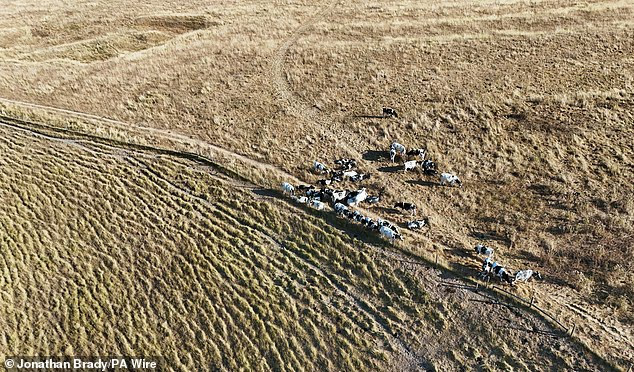
Cattle graze near the Oxfordshire village of Uffington this morning as the heatwave continues

The updated area within the Met Office amber warning for ‘extreme heat’ from 9am to midnight

A person walks through a parched park in Birmingham today as the hot weather continues

White Horse Hill in Uffington, Oxfordshire, is still green in places but surrounded by dry fields

People stand beside St Michael’s Tower on Glastonbury Tor to watch sunrise this morning

A beautiful sunrise over the Oxfordshire countryside at Dunsden Green this morning


Met Office forecaster Alex Burkill said: ‘Temperatures could reach highs of around 36C, 37C, possibly 38C.
‘Now when you get these sorts of high temperatures, well that’s when we could see impacts to our infrastructure, our railway lines, our roads, they are not designed for this sort of heat.
‘And more people are likely to be impacted by how hot it is with regards to their health.’
He added: ‘It could be the hottest day of the year so far if we get above 38C, and if we get above 38.5C, well it could be the hottest August day on record, but that’s actually pretty unlikely.’
Drivers are being warned that the extreme heat is putting the UK’s already deteriorating roads under strain.
| 1 | 40.3C | July 19, 2022 | Coningsby, Lincolnshire |
| 2 | 38.7C | July 25, 2019 | Cambridge |
| 3 | 38.5C | August 10, 2003 | Faversham, Kent |
| 4 | 38.2C | July 18, 2022 | Pitsford, Northamptonshire |
| 5 | 38.0C | June 26, 2026 | Lingwood, Norfolk |
| 6 | 37.8C | July 31, 2020 | London Heathrow |
| 7 | 37.1C | August 3, 1990 | Cheltenham, Gloucestershire |
| 8= | 36.7C | August 9, 1911 | Raunds, Northamptonshire |
| 8= | 36.7C | July 1, 2015 | London Heathrow |
| 8= | 36.7C | June 25, 2026 | Merryfield, Somerset |
The AA said air temperatures in the low-to-mid 30Cs could translate into much higher road surface temperatures as the dark asphalt absorbs and stores heat, causing some roads to soften and leading highways authorities to go out with gritters to stabilise the surface.
Edmund King, AA president, said: ‘In prolonged hot weather, some road surfaces can soften, become sticky and, in places, start to rut under heavy traffic.
‘The main risk for drivers isn’t that roads suddenly melt everywhere, but that already vulnerable patches can become tacky, uneven or start to deteriorate.
‘That can affect braking, steering and grip, and can throw up loose material.’
He said the UK already had a major pothole problem and extreme weather – hot summers as well as cold winter conditions – ‘doesn’t help’.
‘This is more than an inconvenience or a repair bill. Potholes and deteriorating surfaces are a road-safety issue,’ he warned.
Drivers are being urged to slow down on poorer local and rural roads, look well ahead, leave extra space and expect to encounter substandard surfaces.
Motorcyclists and cyclists should take particular care, Mr King said, as hitting a pothole or suddenly encountering an uneven or softened surface can have very serious consequences for people travelling on two wheels.
The National Fire Chiefs Council (NFCC) confirmed England and Wales have already seen as many wildfires this year as in the whole of 2025.
Crews from Hampshire and Isle of Wight Fire and Rescue Service have continued battling a blaze which hit protected heathland in the New Forest.
The fire service said crews are expected to spend at least another three days at the scene, where a van caught fire on the A31 near Ringwood on Sunday.


Met Office satellite views show the transformed landscape from May (left) to Monday (right)
Most major UK supermarkets have stopped sales of disposable barbecues in recent weeks in line with voluntary guidance from the NFCC.
Mr Burnham has urged all shops to stop selling them and indicated an outright ban could be considered in future summers.
The Prime Minister also said there had been a ‘significant number of excess deaths from heat this summer already’ and urged the public to follow health advice, including checking in on elderly friends and relatives.
Baroness Smith said today the Government is doing more to stop wildfires than just requesting shops to stop selling disposable barbecues.
Speaking to LBC, the skills minister insisted ‘quite a lot more’ came out of yesterday’s Cobra meeting.
She said: ‘(There is) additional funding for firefighters with equipment and training to help with some of the wildfires that we’ve seen. We’ve already invested in new reservoirs, for example, to help to protect our water supply.’
The minister added that the Government was investing in nine new reservoirs and is working with farmers to help with irrigation issues.
She continued: ‘I think it is fair enough for the Prime Minister to highlight that all of us have got a responsibility in these really sort of quite difficult, hot times to look after our neighbours, to make sure that you know, we’re keeping our homes cool, and there’s advice about how to do that, and frankly, not having fires or using disposable barbecues where that might be setting fire to things.’
NFCC chairman Phil Garrigan said: ‘Most wildfires in the UK are caused because of human behaviours, careless, accidental or unfortunately intentional acts.
‘But as climate change brings more frequent periods of hot, dry weather, the conditions for wildfires are becoming more dangerous, increasing their scale and intensity.
‘Hot, dry weather and drought are turning parts of the UK into tinderbox landscapes, allowing fires to spread faster, burn longer and place greater pressure on fire and rescue services.
‘Wildfires are becoming part of our new reality and we need to be honest about both the causes and the conditions that are driving them.
‘While over 1,000 wildfires have been recorded so far this year, the incident numbers alone do not tell the full story.
‘They do not capture the scale, duration and complexity of these incidents, or the impact they have on communities, the environment and fire and rescue services.
‘As their impact grows, we must work with all stakeholders to ensure we have the right capabilities needed to protect our communities and to respond effectively when wildfires occur.’
Major wildfires have hit areas such as the Pennines, the Cairngorms in Scotland, Llanwonno in the Rhondda Valleys, South Wales and Dunwich Heath in Suffolk.
Two record-breaking heatwaves in May and June led to more than 2,800 excess deaths.
The Royal College of Nursing has warned that nurses are collapsing at work and are being forced to care for patients in temperatures in excess of 30C.
Others have reported seizures and ‘dripping with sweat from head to toe’, and nurses have said patients are being cared for in hospitals which have been described as ‘unbearably hot’ and ‘not fit for humans’.
On the trains, ticket restrictions were eased by some operators who told passengers to check for travel updates before setting off and carry water to stay hydrated.
Heat-related issues affecting the railway can include buckled rails, sagging overhead electric wires and lineside fires. Steel rails can hit 50C in an air temperature of 30C.
Chiltern Railways said temperatures are expected to reach highs of 38C (100F) on parts of its network. It will operate a reduced timetable between 11am and 8pm.
Among the changes are:
- Off-peak services between London Marylebone and Birmingham Moor Street will operate hourly instead of half-hourly.
- Some services between London Marylebone and Oxford will be cancelled.
- No Chiltern Railways services will operate from Birmingham Snow Hill from 10.15am until the end of the day.
Michael Stewart, commercial and customer strategy director at Chiltern Railways, said: ‘We are asking customers to travel only if essential on Thursday because of the exceptionally high temperatures forecast across our network.

The UK Health Security Agency (UKHSA) has issued amber heat health alerts across England


A UK heatwave is official when a location records at least three consecutive days of daily maximum temperatures which meet or exceed a specified threshold – which varies by region
‘By operating a reduced timetable during the hottest part of the day, we can provide a more reliable and comfortable service for customers.’
East Midlands Railway said services between Liverpool Lime Street and Norwich will run between Sheffield and Norwich only.
It added that regional services between Nottingham and Worksop and Nottingham and Leicester will be suspended from noon.
Philippa Cresswell from East Midlands Railway said: ‘The hot weather means we’ll need to make some temporary changes to our services to keep the railway operating safely.
‘If you do need to travel and the journey is essential, we’d recommend travelling before midday and checking your journey before setting off.
‘We appreciate these changes may inconvenience some customers and we’d like to thank everyone for their patience and understanding while we work to keep people moving safely.’
Another operator, Northern, said it will run fewer trains than normal on some routes in the North West and Yorkshire tomorrow because of extreme heat.
It told passengers: ‘High temperatures increase the risk of issues on the railway and with the reliability of our trains, which means we have to make adjustments to our usual timetable to keep trains running.’
These Northern routes are expected to have a reduced service all day:
- Rochdale to Blackburn
- Manchester Oxford Road / Wigan Wallgate to Southport
- Alderley Edge to Manchester Piccadilly
- Buxton / Hazel Grove to Manchester Piccadilly
- Rose Hill / Hadfield to Manchester Piccadilly
- Leeds to Skipton / Ilkley / Bradford Forster Square
- Leeds to York via Harrogate
- Liverpool Lime Street to Wigan North Western
Sheffield / Doncaster and Hull, although a full timetable is still expected to operate between Hull and Scarborough
In addition, the route between Rochdale and Leeds will have a reduced service from 10.15am to 4.40pm. The Sheffield to Leeds ‘Yorkshire Flyer’ fast service will not run from 9.45am to 3.45pm, but the stopping services will still operate.


c2c, which operates trains between London and Essex, said it had cancelled at least 20 services this afternoon and evening.
CrossCountry warned a ‘heavily reduced service’ would be operating between Birmingham New Street and Cardiff Central.
Great Western Railway said that some services will be revised to run non-stop between London Paddington and Reading.
Trains between Truro and Falmouth Docks were reduced to an hourly service; and no trains were running between Exeter St Davids and Okehampton.
Transport for Wales warned some trains would be cancelled between Manchester Piccadilly and Cardiff Central; Shrewsbury and Aberystwyth; Cheltenham Spa and Cardiff Central.
No Transport for Wales trains will run between Llandudno Junction and Blaenau Ffestiniog; Shrewsbury and Swansea; or Shrewsbury and Birmingham International.
West Midlands Railway warned of a reduced service on routes through Birmingham Snow Hill.
Buses will replace trains between Rugeley Trent Valley and Hednesford between 11.30am and 9.30pm; and between Stourbridge Junction and Stourbridge Town from 12pm to 7pm.
Some 45million people across England are now in drought-stricken areas, and 27million customers are under hosepipe bans as rivers and reservoirs run low.
Parts of southern England including Hampshire, the Isle of Wight and West Sussex have now gone more than 60 days without rainfall, and there are no downpours in the immediate forecast.
Nearly three-quarters of England and the whole of Wales are in drought, after a record dry July and very dry start to August has combined with high temperatures to put pressure on water resources.
Southern Water has applied for a rare non-essential use ban drought order, which, if imposed, would mean businesses must stop using water for activities such as cleaning cars and filling non-domestic swimming pools.
Record-breaking heatwaves in May and June led to the deaths of more than 2,800 people, while parts of the country were hit with further heatwaves last month as England and Wales endured their driest July since records began in 1836.
A fifth heatwave of the year was declared early last week – and the Met Office has said summer 2026 is on course to be the hottest on record.























































You must be logged in to post a comment Login