LAS VEGAS (AP) — Closing statements are scheduled Monday in one of hip-hop’s most anticipated trials for the man accused of orchestrating the death of Tupac Shakur.
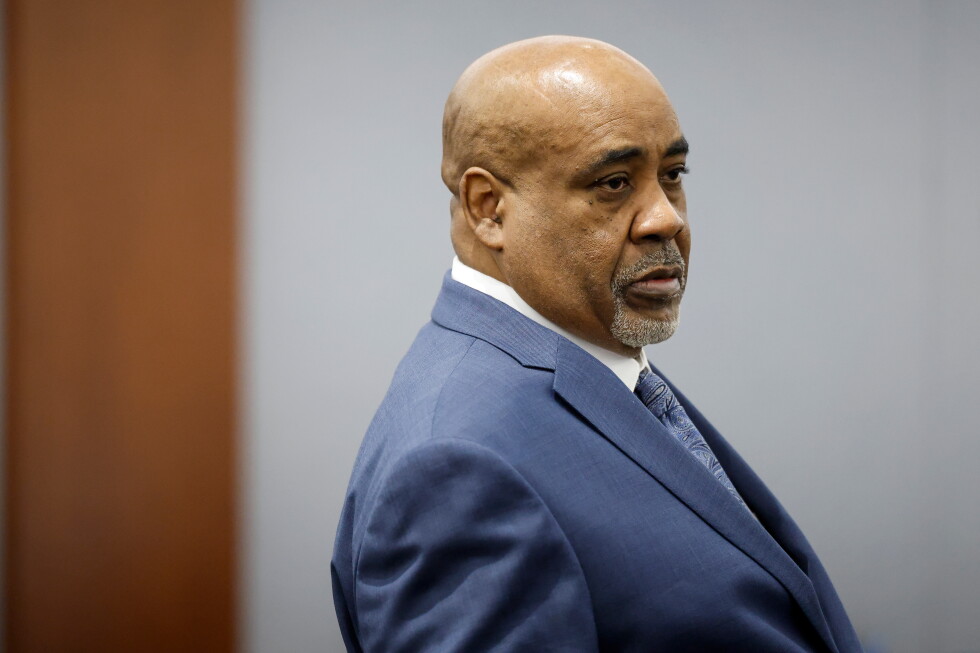
Duane ”Keffe D” Davis, 63, faces a single count of murder with a deadly weapon with the intent to promote, further or assist a criminal gang in the killing of Shakur in Las Vegas nearly 30 years ago.
A panel of 16 jurors, four of whom will be alternates, heard 24 witnesses prosecutors called and three witnesses defense called over nine days. The trial was expected to take longer, with prosecutors originally planning to call 35 to 45 witnesses.
The prosecution was expected to hammer home their arguments that Davis called the shots for the attack on Shakur that night based on Davis’ own statements, while Davis’ defense attorney will likely reiterate his claim that prosecution’s narrative is fiction, and that they failed to back up Davis’ claims with evidence.
Advertisement
The trial brings to a head a decades-long case that for years has drawn the eyes of hip-hop fans and true crime experts alike. Shakur, who was considered one of the most influential rappers of all time, was in Las Vegas on Sept. 7, 1996, and stopped at a red light when a white Cadillac pulled up beside him, and shots were fired. Shakur died six days later from his wounds. Death Row Records co-founder Marion “Suge” Knight was also wounded, but survived.
For years, nobody had been charged in the rapper’s death until Davis began making public statements, saying he was in the Cadillac and gave the gun to others in the backseat. Davis, a self-proclaimed leader of the South Side Compton Crips at the time, described the shooting as an act of retaliation after Knight and Shakur’s entourage beat up Davis’ nephew in the MGM Grand hours before the shooting.
Prosecutors don’t claim Davis was the one who pulled trigger, but rather that he orchestrated the killing. Under Nevada law, someone who helps another person commit murder can be convicted of the crime. Davis is the only person still alive who was in the Cadillac.
Davis’ own words are front and center
The state has relied on Davis’ own statements he gave to police, documentarians and interviewers, in which he admitted to playing a role in the shooting. Davis also co-authored a book called “Compton Street Legend,” which Davis described as the “real truth” in an interview played for jurors.
Advertisement
In multiple interviews, Davis said he handed the gun to the back seat, with some details vary slightly on different occasions. Sometimes Davis said Deandre “Freaky” Smith had the gun but didn’t want it, so Anderson took it and pulled the trigger. In other interviews as well as his own book, Davis either wouldn’t say who pulled the trigger, or that he didn’t know.
Prosecution’s witnesses included a gang expert who described Davis as the shot caller that younger gang members had to obey. Witnesses also testified regarding the heated gang rivalry between South Side Compton Crips and Mob Piru, which were associated with dueling record companies Bad Boy Records and Death Row Records.
Lack of physical evidence, defense says
Davis’ defense attorney Michael Sanft has told jurors that his client’s words were braggadocio and were meant to make Davis money, not to tell the truth.
Sanft, who took on the case without pay, argues there is a lack of physical evidence tying Davis to the crime, such as phone records or bills.
Advertisement
During the trial investigators said a Las Vegas hotel bill was found at Davis’ residence during a police search, but it wasn’t clear when it was dated — or where that evidence is currently located.
The case is nearly 30 years old, and its age has affected the kind of evidence presented in court. Prosecutors warned jurors that material collected in the ’90s is different from what law enforcement collects today.
Still, prosecutors played for jurors surveillance footage collected from the MGM Grand that showed Shakur, wearing a gold dress shirt, walking briskly on the casino floor with his entourage struggling to keep up with him. Footage showed the fight between Shakur’s entourage with Davis’ nephew, Orlando “Baby Lane” Anderson.
A ritual once practiced in our county, supposedly gave people psychic power over horses. Cambridgeshire is filled with wacky tales and historic beliefs.
Advertisement
From the ‘lantern man’ being spotted around Wicken Fen to the ‘Shug Monkey’ who is said to stalk the roads close to the village of West Wratting, our county has a lot of folklore to its name.
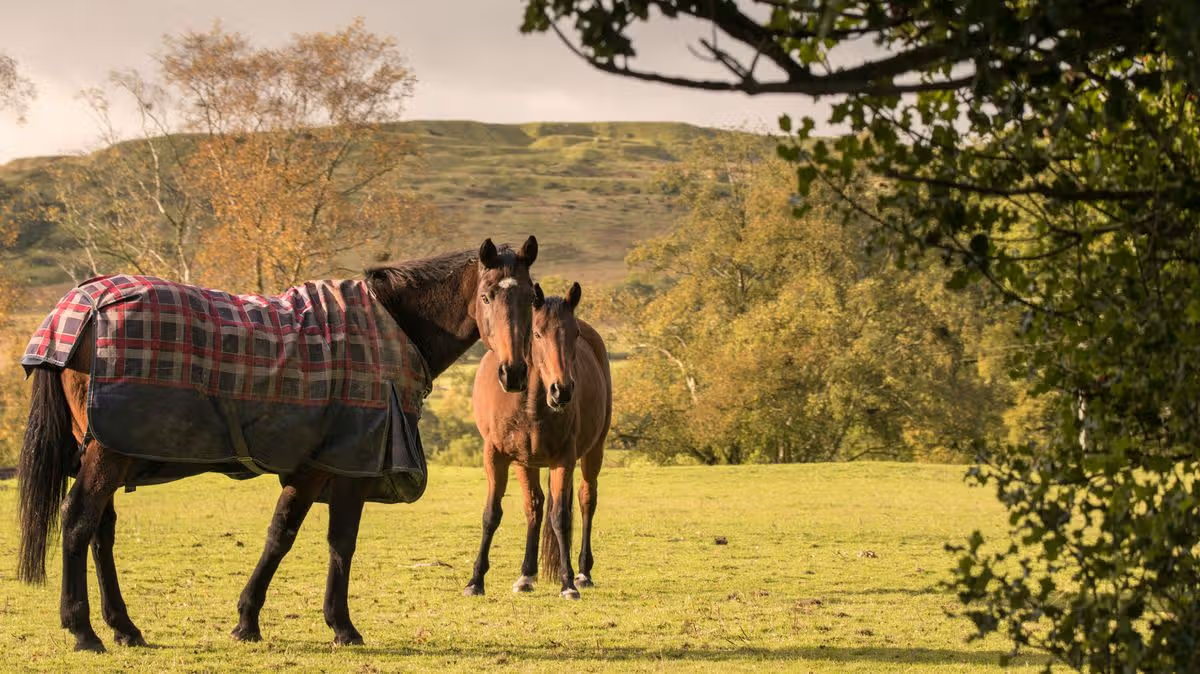
One particular tale of a ‘toadman’ is a sacrilegious legend of a ploughman from 19th-century Cambridgeshire. A toadman according to Fenland folklore, is someone who made a deal with the devil which gives them control over horses. The bizarre tale gets its name from an unsettling ritual that someone would perform involving a toad.
The initial ceremony involved catching a male toad, hanging it from a thorn bush or pegging it to an anthill until its bones had been picked clean. People would then carry the bones until dried. Even more peculiar, the bones were then thrown into a running stream on a full moon at midnight. Supposedly, all except one would be swept downstream.
As unsettling as it sounds, after this appalled ritual the last remaining small fork-shaped bone would then, through insane means, grant its holder psychic control over horses, according to the local legends.
Advertisement
This eerie attempt at gaining power was also used in Lincolnshire. The toadman’s powers were believed to enable them to instantly calm wild or dangerous horses or alternatively turn them into an unmanageable animal.
Shark attack survivor Leah Stewart describes how she willed herself back to life when she lay dying on Coogee Beach – and her first words to her mother when she woke from her coma
A brave mother who fought off a shark to make sure her baby didn’t ‘grow up without a mum’ revealed her first words when she woke from a coma were ‘I love you’.
Leah Stewart, 35, spent ten days in a coma after being viciously mauled in the first shark attack at Sydney‘s Coogee Beach in over a century on June 13, 2026.
A little over two months later, the determined mother has recovered enough to sit down and tell her tale.
Ms Stewart retains vivid memories of the attack, fighting off the shark with her bare hands, her rescue, and the rush to hospital.
Advertisement
However, she prefers to look back on the moment when she woke in St Vincent’s Hospital’s intensive care unit to find her mother by her side.
‘I love you,’ were the first words out of Ms Stewart’s mouth following her ordeal, she told 60 Minutes on Sunday.
Ms Stewart, a teacher and mother to one-year-old daughter August, was a regular swimmer at Coogee Beach and was relatively close to shore when she was attacked by the great white shark.
She recalled coming face-to-face with the four-metre beast and seeing its ‘black little beady eyes’ moments before it sunk its razor-sharp teeth into her thigh and arm.
Advertisement
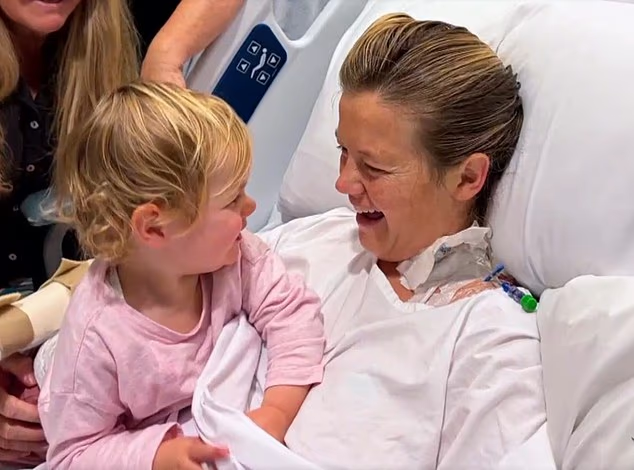
Leah Stewart (pictured in hospital with her daughter, August, shortly after waking from a coma) survived a horror shark attack at Coogee Beach on June 13
Ms Stewart (pictured with her partner, Fernando) recalled thinking of her daughter and deciding to fight for her life
The confident swimmer was dragged under the water and was convinced she would die, but then she thought of her daughter.
Advertisement
‘She’s not going to have a mum. She’s going to grow up without a mum’ she recalled thinking, which became a turning point and she fought back even harder.
‘I twisted myself around, and I just started punching it over and over and over again, just punch, punch, punch,’ Ms Stewart said.
‘It was like fighting a dinosaur, it was so big. It was like punching a brick wall.
‘I was like, ”You ugly f***er, you are not taking me away from my daughter.”’
Advertisement
World champion paddleboarder Charlie Verco was training near Ms Stewart when he spotted her struggling in the water.
He helped prop her on his board with one arm while using the other to slowly paddle them, backwards, to shore. He recalled being unable to know where the shark was under the water because it had turned red with blood.
Off-duty surf lifesaver Ben Heenan then saw the pair and rushed to help them, while his partner, doctor Kassandra McGregor, called Triple Zero.
Several off-duty lifesavers and medical personnel happened to be on Coogee Beach on the day of the attack (pictured are emergency services at the scene)
Advertisement
Frontline trauma specialist Dr Ian Ferguson was grabbing a coffee nearby when he heard the screaming on the beach.
The impromptu medical team managed to keep Ms Stewart alive using tourniquets to stem the blood loss. Dr Ferguson also drilled into the bone marrow of her shoulders to give her infusions of fluid and blood because they could not find a vein due to the blood loss.
‘I was hopeful that she would survive to hospital, but I didn’t think it was a given at that point,’ Ferguson recalled.
Ms Stewart described the moment she felt herself almost slipping away as she was on the sand.
Advertisement
‘I… just felt like everything was leaving my body and I was going somewhere,’ she said.
‘Just as I was about to reach the end of the tunnel, I got a vision of August. I just knew I couldn’t leave her.
‘I said ”I can’t die right now, I can’t.” I know it sounds strange, but I sort of willed myself back.
‘And I opened my eyes and I could see everyone around me at that point.’
Advertisement
Ms Stewart’s (above) first words after waking from her coma were to her mother: ‘I love you’
Staff at the hospital were similarly sceptical about Ms Stewart’s odds of surviving.
For 10 torturous days, her loved ones waited to see if she would pull through the coma.
During that time, the 35-year-old underwent 11 surgeries for the extensive injuries to her left thigh and right arm. Her left arm had to be amputated.
Advertisement
Ms Stewart’s partner, Fernando, and her mother, Christine – a nurse, were constantly by her side.
She finally woke from her coma on June 23 and recalled feeling ‘really annoyed’ by a breathing tube down her throat.
‘I was waving to the nurses and anyone that was around, miming like ”Take it out, take it out, because it’s horrible,” and obviously they didn’t know what I was saying,’ Ms Stewart said.
‘Then my mum arrived. I just saw my mum and I just felt, ‘Okay, I’m alive, and Mum’s here.”
Advertisement
Christine was emotional when recalling the moment her daughter finally spoke.
Ms Stewart’s was the first shark attack at Coogee Beach (above) in over a century
‘Up until that point she’d been pretty sleepy, she hadn’t actually been looking in my eyes, but this time her eyes were fully aware, looking at me,’ she said.
‘Once they got the tube out, she just looked at me and she said, ”I love you.”’
Advertisement
Ms Stewart has spent the months since learning to walk and write again.
Thankfully, she didn’t suffer cognitive injury from the severe blood loss.
However, she still struggles to come to terms with her new disability.
‘There’s good days and bad days. For me, I’m still coming to terms that (my arm’s) not there,’ Ms Stewart said.
Advertisement
‘I get really frustrated. August will put up her hands and she’ll want me to pick her up. I’m just desperate too, I just can’t.’
But she’s doing her best to focus on the ‘small wins’.
‘It’s about like the little things, like now I can brush my teeth,’ Ms Stewart said.
‘I’m really proud of that. It’s so nice to brush your own teeth, not someone else doing it for you.’
WARNING: GRAPHIC CONTENT One man went for a walk in the Dinokeng Game Reserve and never walked back out when he was mauled to death by a roaming lion that tore his skin from his head in a fatal attack
A man was shredded to death by a lion while on a walk at night during his shift at work but, unfortunately for him, during the big cat’s prime hunting time.
Advertisement
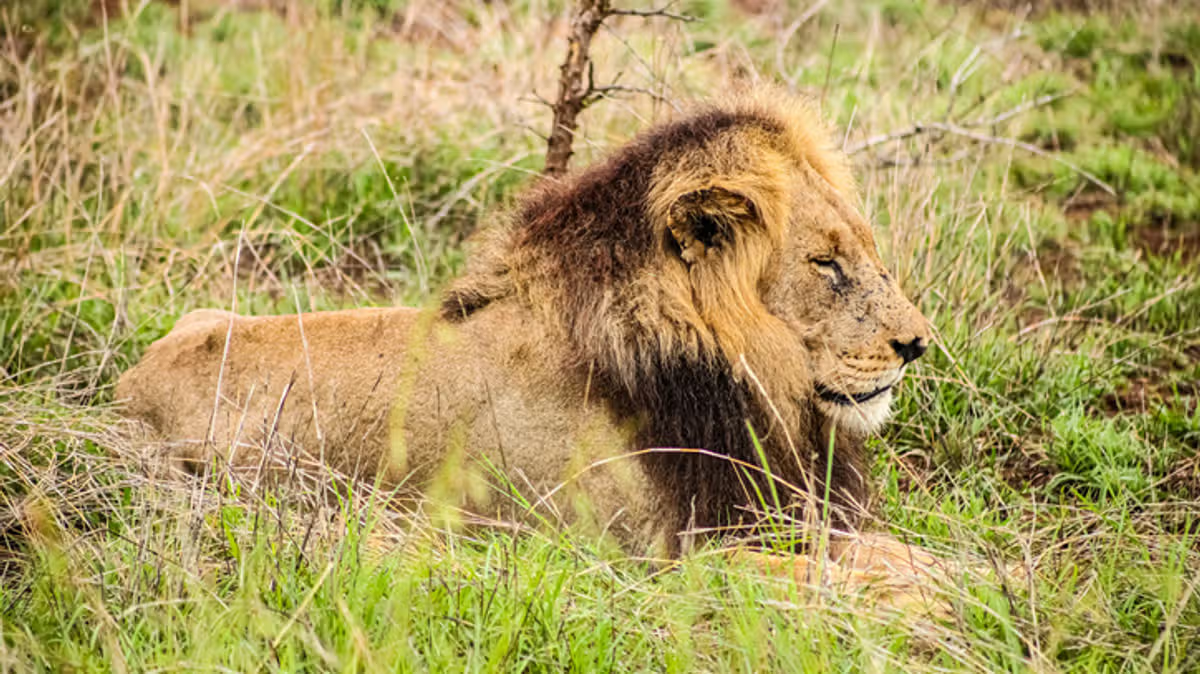
At 30, Johannes Matshe was an employee, working for a landowner at the Dinokeng Game Reserve in Gauteng, South Africa, when he was killed on shift. It was a Sunday night, August 13, 2023, when he was dramatically torn apart by the lion, and his remains were found the following Monday morning.
The animal pounced on him and tore apart the flesh from his bones, as though the man were simply food for the night. Although, it was later revealed by the reserve’s spokesman Hartogh Streicher that employees are strictly prohibited from wandering through the park after sunset.
Images have shown the exact graphic details which appear to display the lion scalping the skin from his skull. The undisclosed graphic pictures were also thought to reveal his leg bone was poking out of his work boots, completely stripped of flesh.
He explained: “Lions are nocturnal animals, driven by their natural instinct and hunting patterns, and may perceive a person as a normal prey species.”
According to Streicher, the employee’s remains were stumbled upon by an operations manager at the reserve, around the animal’s breakfast time at 10.37am on a Monday morning.
The spokesperson further shared in a statement: “The individual was tragically attacked and killed by lions while attempting to navigate the reserve on foot after dark…The operations manager responded promptly, confirming the unfortunate loss of life.”
At the time, the reserve shared their concerns with the welfare of their other employees and what consequences the lion should be faced with.
Advertisement
The statement added: “Concerning the management of the lions responsible for this killing, no decision has been reached whether they have become unnaturally dangerous, but the reserve is receiving expert advice to make the most responsible decision possible for all parties concerned.”
It’s not the first time that the South African reserve made headlines with a devastating animal death. Just a few years earlier, in 2018, a woman who was at the reserve interviewing the manager, Kevin Richardson, about his work as ‘the lion whisperer’ was killed under very similar circumstances.
The 22-year-old visitor, Megan van der Zwan, was mauled to death by a lion, which pounced on her in a ‘conversation zone’, which doesn’t enable access to the general public.
Advertisement
Richardson, who has appeared in a number of films as a part of his unique relationships to wild animals, shared his thoughts on the incident in 2018.
He said: “Myself and an experienced colleague took three lions walking in the reserve, as we do on a weekly basis, as part of their exercise and stimulation regiment,” he explained.
“We assessed the landscape for other Big Five animals and, as per procedure, sent out a notification that we were walking in the reserve.
“One of the lionesses charged off after an impala and must have run 2 to 2.5km, where she encountered the 22-year-old outside the car. I am devastated, and my heart goes out to this young woman’s family.”
Advertisement
Following the brutal attack, paramedics were called out, but it was too late, and the young woman was pronounced dead at the scene.
“Since the crash there have been a lot of news articles about how the airline continues to not uphold good safety standards,” Sharma tells The Independent. “Maybe because of extra scrutiny, and maybe these things happen with every airline, but the fear factor has kind of set in.”
Her concerns reflect a broader shift in passenger attitudes towards Air India on the India-UK route in particular, according to data shared exclusively with The Independent by Cirium, an aviation analytics company.
Advertisement
The data shows a sharp drop in Air India’s performance on the route. The airline had posted strong year-on-year growth in passenger traffic in the first five months of 2025 but the crash reversed the trend.
Between January and May 2025, Air India flew 18 to 32 per cent more passengers on the India-UK route a month than in the corresponding months of 2024. While the numbers were still marginally higher year-on-year in July 2025, they fell every month from August to December.
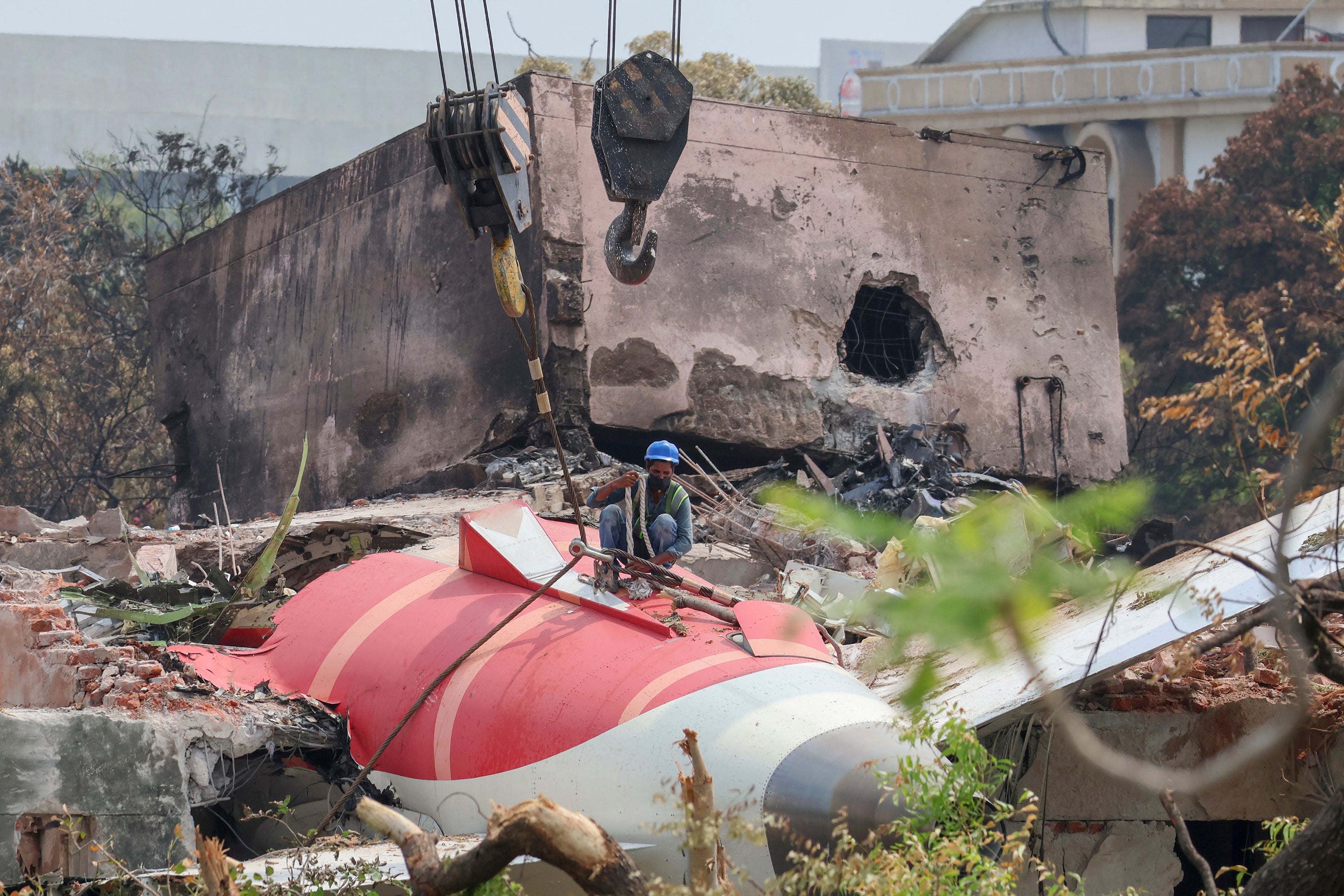
The wreckage of an Air India aircraft that crashed in Ahmedabad, India, on 14 June 2025 (AFP/Getty)
The decline was particularly pronounced between August and October. Air India carried 85,024 flyers on the route in August 2025, down from 96,576 a year earlier. In September, the number fell from 100,559 to 81,291, before dropping by 14 per cent in October. The figures suggest that the fall in demand was greater than the reduction in Air India’s capacity on the route.
In August and September, the number of seats operated by Air India fell by 4 per cent year-on-year, while passenger numbers declined by 11 per cent and 19 per cent respectively.
In October, the contrast was starker. The airline operated slightly more seats than a year earlier but carried nearly 14,000 fewer passengers.
Advertisement
There were signs of a partial recovery during the winter season. The number of flyers rose to 107,568 in November 2025, leaving Air India only 0.7 per cent below the level recorded in the same month the previous year. In December, the number was 7 per cent lower year-on-year.
“That period is a heavy travel season – Christmas and holiday season – so the spike is noticed,” says Rajiv Mehra, general secretary of the Federation of Associations in Indian Tourism and Hospitality.
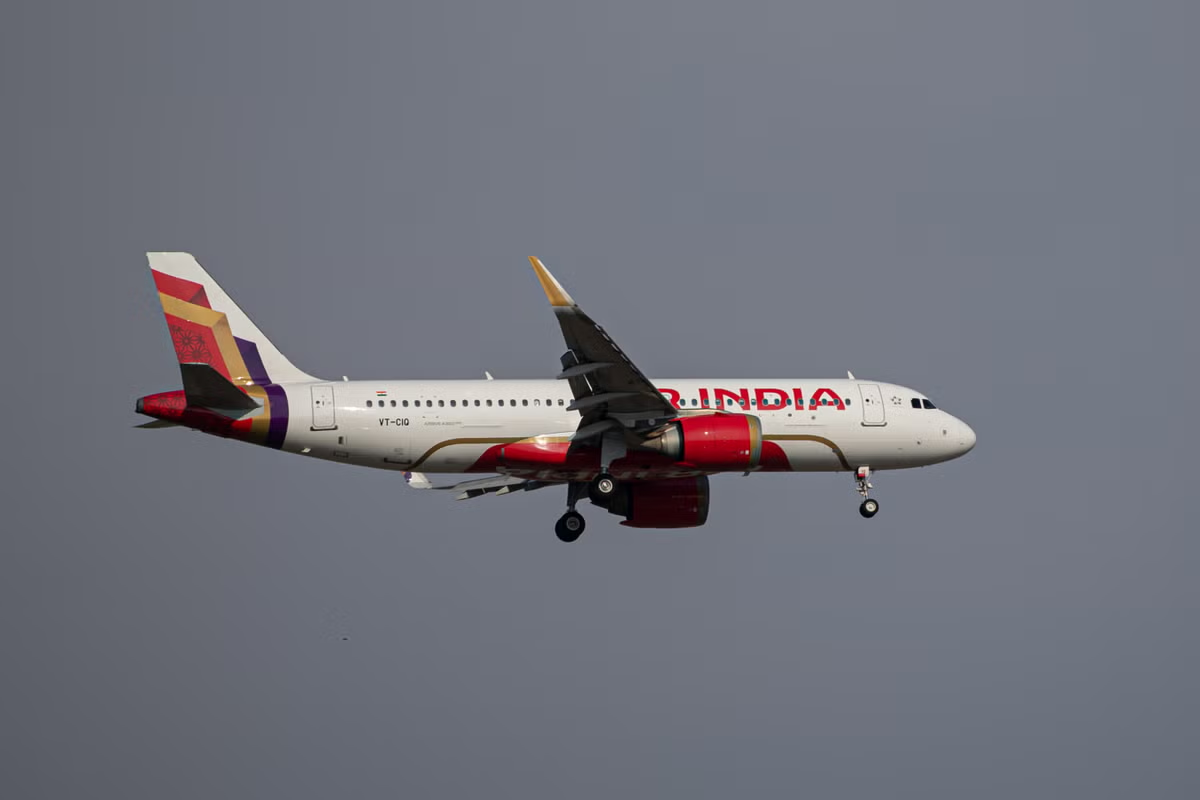
An Air India aircraft at the Mumbai airport in India on 8 December 2025 (AFP/Getty)
For passengers such as Asha Raj, the Indigo disruption was indeed the reason to use Air India. Raj, who works in corporate communications, had been a loyal IndiGo customer but switched to the competitor in the wake of the disruption.
“I knew about the Air India crash but I think the Indigo strike probably turned me off more,” she says.
Advertisement
“I had friends who were gonna come in for a music festival and there were so many people who were stranded during that time. It was very difficult and there was a lot of uncertainty,” she continues.
“There was a lot of money lost. So after that I remember when I was travelling, I actively chose not to take Indigo.”
Why is she still choosing Air India? “One of the main reasons I do Air India is because of their pricing,” Raj says. “Even during the Indigo crisis, they kept it on time and didn’t really inflate the costs.”
In spite of a competitor’s troubles, Air India maintained a year-on-year passenger deficit in November and December. Fellow international carriers on the India-UK route, on the other hand, saw substantial growth. Their passenger numbers rose by 11.9 per cent year-on-year for both months, while capacity increased by 10.3 per cent and 10.99 per cent respectively.
Advertisement
The data for 2026 suggests Air India is yet to return to the pre-crash rapid growth. Passenger numbers were lower year-on-year in each of the first five months for which figures were made available.
The decline was relatively modest in January, February and March before widening sharply in April and May.
In April, Air India carried 77,822 passengers on the India-UK route, about 27 per cent fewer than in April 2025, despite reducing the number of seats by less than 10 per cent.
The pattern continued in May, when the number of passengers fell almost 25 per cent year-on-year, to 74,499, while capacity only dropped about 11 per cent.
Advertisement
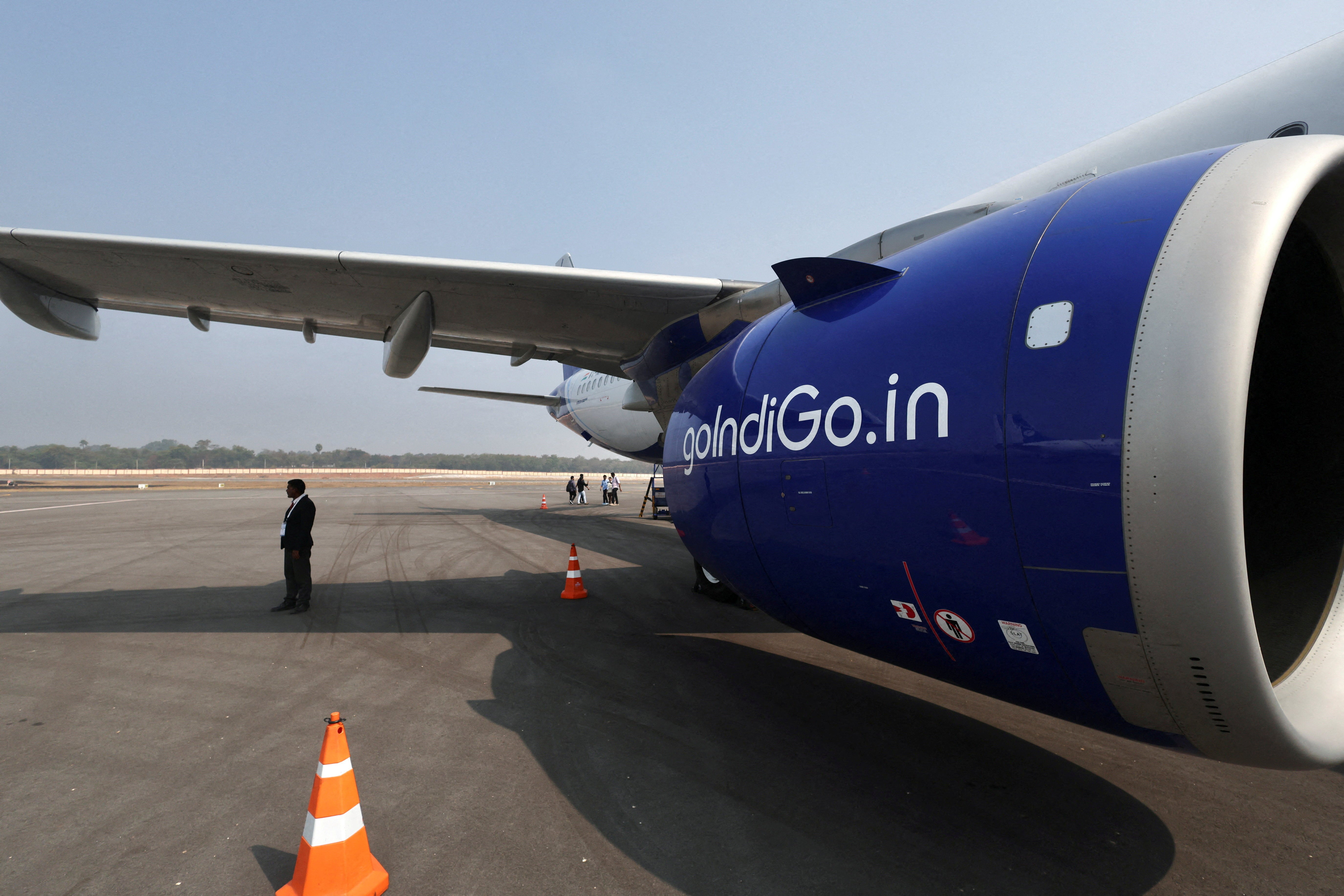
IndiGo aircraft is displayed during the Wings India 2026 civil aviation show at the Begumpet airport in Hyderabad, India, on 29 January 2026 (Reuters)
Mehra argues that the recent decline cannot be attributed to the crash alone, pointing to geopolitical tensions and restrictions on Indian carriers using Pakistani airspace. “Clearly the Iran-US war and the continued closure of Pakistani airspace to Indian carriers have contributed to this situation. Foreign airlines are not constrained by restrictions on use of Pakistani airspace, so they have been impacted much less.”
According to data released this month by India’s aviation regulator, DGCA, Air India’s global passenger carriage plunged 36 per cent in the April-June quarter.
The Air India Group, comprising Air India and the low-cost carrier Air India Express, carried about 2.76 million international passengers to and from the country during the quarter, down from 4.33 million in the same period last year. In contrast, foreign airlines saw their passenger carriage to and from India rise by 7 per cent. Emirates carried 1.48 million passengers during the quarter as against 1.28 million the year before, while Lufthansa carried 370,000, up from 350,000. Etihad’s traffic remained broadly stable at about 850,000 passengers.
“I know Air India will save me about six hours because my layover in Dubai is six hours, but I still choose Emirates because I am a very nervous flier and on top of that, sitting in an Air India plane does not help,” says Sharma.
Air India, unlike many of its more popular foreign rivals, offers direct flights between Delhi and London.
Advertisement
Namit Kabra, a consultant at Ernst and Young, preferred Air India for flights from India to London, or Birmingham before the crash because of its “price compatibility”. But, he says, he no longer trusts the airline since the crash.
“I don’t think they have made anything significantly better so that their passengers can ease out on the anxiety. Apart from reducing prices after the crash, I do not feel there is any difference in how the staff treated you before and now,” he complains. “Other airlines are far better.”
Falling passenger traffic only increases the financial pressure as Air India attempts a sweeping overhaul of its operations.
The airline is reportedly seeking about $1.5bn in fresh equity from its owners, Tata Sons and Singapore Airlines, months after posting a record annual loss.
Advertisement
Air India and Air India Express posted combined losses of $2.33bn in the financial year ended March, more than double the losses recorded the year before.
The Independent has contacted Air India for comment.
N Chandrasekaran, the outgoing chair of Tata Sons, previously said that Air India’s turnaround could take up to a decade, citing persistent supply-chain disruptions and the need to overhaul the carrier’s legacy systems, culture and fleet.
The airline nevertheless continues to invest heavily in expansion and fleet modernisation. It plans to add about 100 aircraft across the group in 2027 and 2028 and is retrofitting 16 Boeing Dreamliners.
Advertisement
“See, Indian aviation is growing and booming,” Mehra explains the expansion plans. “Yes, there are temporary blips, but long-term growth remains intact. That explains the order for the new aircraft.”
The Access to Neighbouring Land Act 1992 gives neighbours the right to enter your property in certain circumstances to carry out essential preservation work, including those that require scaffolding.
One 9 Scaffolding, a commercial scaffolding company, is urging homeowners to be aware of their legal obligations and to communicate clearly with neighbours if such a situation arises.
John Khan, a home maintenance expert at One 9 Scaffolding, said: “Nobody wants to hear that their neighbour needs to use their garden for building work, especially when it could mean scaffolding, builders and equipment turning up next door.
Advertisement
“But it’s worth knowing that simply saying no isn’t always the end of the story.
“There are some situations where the law can allow access for essential repairs, although that doesn’t mean your neighbour can just walk into your garden whenever they like.
“If scaffolding is needed, the best thing to do is talk through what’s needed, where it’ll go and how long it’ll be there.
“Getting everything clear from the start can save a lot of awkwardness and help stop a small job turning into a neighbourly dispute.”
Advertisement
The company recommends several steps for homeowners if a neighbour requests access to their garden.
These include asking why access is needed, how long the work will take, and exactly where scaffolding will be placed.
It also advises discussing how any garden features—such as lawns, plants, fences, or patios—will be protected throughout the project.
Advertisement
One 9 Scaffolding suggests keeping a written record of anything agreed, even if relations with the neighbour are friendly, to avoid potential disputes later.
The main message is not to refuse access outright without understanding the legal context, as there are circumstances where entry can be granted by law.
However, communication remains key to preventing misunderstandings and ensuring that both parties are clear about what will happen and for how long.
Recommended Reading
Advertisement
The company warns that failing to reach an agreement early on can turn a simple repair job into a source of ongoing tension.
By approaching the situation calmly and constructively, homeowners and neighbours can reach solutions that work for both sides.
Did you know about this law? Let us know in the comments.
Only four people have claimed redress for mistreatment under the pre-2000 “gay ban” in the armed forces, according to data from the charity Fighting With Pride.
Fewer women veterans are also believed to have come forward than expected, the charity said.
Fighting With Pride, which advocates on behalf of the LGBT forces community, in June launched its “Battle for Lost Veterans” campaign, urging those yet to come forward to apply for financial redress.
It believes there are approximately 1,000 people eligible for the scheme yet to have made a claim.
Advertisement
Former Darlington MP Peter Gibson, Fighting With Pride chief executive, said: “At Fighting With Pride, we’re determined to find every last veteran who’s owed justice. Nobody should be left behind.
“As the only LGBTQ+-specific armed forces charity, we will help anyone impacted by the ban to apply for what is rightfully yours, before it’s too late.
Former Darlington MP Peter Gibson (Image: THE NORTHERN ECHO)
“If you know anyone who served and suffered under this outrageous historic policy, please help us find everyone. We can be contacted via our Fighting With Pride website.
“We’re determined to restore pride and dignity in service.”
Advertisement
The charity has also called on more women veterans to make applications for the scheme.
Some 61 per cent of women who took part in a judge-led inquiry into the ban reported mistreatment under the ban, yet less than half of those who have come forward so far are women.
Dawn Loynes, a Royal Navy veteran who was unlawfully dismissed in 1994, encouraged other women to come forward to claim redress.
Royal Navy veteran Dawn Loynes was unlawfully dismissed in 1994. (Image: Dawn Loynes/PA Wire)
She said: “The mistreatment I experienced as a young female sailor had a profound and lasting impact on my life. While nothing can undo what happened, reconnecting with my military family, receiving my beret, and having my experiences recognised have all been important steps in my healing.
Advertisement
“I know that for many people affected by the ban, coming forward can feel daunting. Revisiting painful memories and reliving experiences that many have spent years trying to move beyond can be difficult and deeply emotional. Everyone’s journey is different, but it is important to know that you do not have to face that journey alone, and support is available throughout the process.”
The veteran added: “If sharing my story gives even one person the confidence to take that first step, then speaking publicly will have been worthwhile.
“Your experiences matter, your service matters, and what happened to you deserves to be recognised.
“Please do not leave it too late. If you think you may be eligible, I encourage you to explore your options and seek advice soonest.”
Advertisement
Almost £20 million of the £75 million the Government has set aside for the redress scheme is yet to be distributed.
LGBT servicemen and women face the ever-nearing deadline of December 12 to apply for the Government’s financial redress scheme, which awards £50,000 discharge payments, and up to £20,000 in additional impact payments.
Under the ban, which was in place between 1967 and 2000, men and women in the army, navy, and air force were subjected to brutal interrogation and bullying, and forced out of service, often with long-term impacts on their life and careers.
Speaking to Fox News, Trump called the Iranian government ‘violent, evil people’ and repeated that they could never have a nuclear weapon, saying that both Israel and the entire region would be wiped off the map.
‘If they had a nuclear weapon, Israel would be gone. If I weren’t President, Israel would be gone and there would probably be no Middle East,’ he said.
Advertisement
Trump explained that Iran has now angered all of its allies and those who were ‘sort of neutral, got along with them’ once the war began.
‘As soon as the shooting started, they started aiming at Saudi Arabia, Qatar, at UAE, at Bahrain, at Kuwait, everybody was shocked. I was surprised.’
Trump admitted that it was a positive from his perspective because the Iranians ‘lost all of the support they had.’
However, he fears that Iran’s turncoat behavior against its neighboring nations means ‘if they would have had a nuclear weapon, they would have fired it.’
Advertisement
Donald Trump said that if he weren’t President, both Israel and the entire Middle East ‘would be gone’ as he defended the war in Iran
‘If they had a nuclear weapon, Israel would be gone. If I weren’t President, Israel would be gone and there would probably be no Middle East,’ Trump claimed
‘I think the Middle East would have essentially been gone but Israel definitely would have been gone and I guess we would be next, or Europe or someplace,’ he added.
Advertisement
Trump reaffirmed his promise, however, that ‘you cannot let them have a nuclear weapon and they won’t have a nuclear weapon.’
Israeli Prime Minister Benjamin Netanyahu ruled out any diplomatic deal with Iran as he backed Donald Trump’s new economic campaign earlier this week.
Speaking at an event in Jerusalem for Israeli settlers in the occupied West Bank, Netanyahu said he told Trump in a meeting at the White House last month: ‘I doubt that an agreement can be reached with that group there, with those savages.
‘I tell you – an agreement cannot be reached.’
Advertisement
Netanyahu added the two also discussed renewing military action against Iran: ‘We will not allow Iran to attack us, and if, God forbid, they attack us, they will suffer a blow beyond anything they have imagined– far stronger than anything they have suffered until now’
The prime minister also hailed the US president’s new campaign after Trump on Monday declared ‘economic D-Day’ aimed at destroying Iran’s economy.
The President stressed earlier this week that he’s ‘not in a hurry’ to get Iran back to the negotiating table, and he continues making the case that the Islamic Republic’s leadership is on the ropes.
Israeli Prime Minister Benjamin Netanyahu (pictured left) ruled out any diplomatic deal with Iran as he backed Donald Trump’s new economic campaign earlier this week
Advertisement
Iran’s supreme leader, Ayatollah Mojtaba Khamenei (pictured), urged rulers of Muslim nations to ‘know your real enemy, understand its plans and confront it,’ and called the US and Israel enemies of all Islamic nations Sunday
‘They’re not paying their troops. They’re in deep trouble. They have very little capacity,’ Trump told reporters Thursday. ‘We don’t want to speak to them. We’re not looking to meet or anything,’ he said.
Iran’s supreme leader, Ayatollah Mojtaba Khamenei, urged rulers of Muslim nations to ‘know your real enemy, understand its plans and confront it,’ and called the US and Israel enemies of all Islamic nations Sunday, the official IRNA news agency reported.
Six months after the US and Israel attacked Iran, killing Khamenei’s father and other senior leaders, the younger Khamenei still has not been seen publicly.
Advertisement
His comments came in a letter to religious leaders attending a conference in Tehran.
US forces made their first strikes at Iran in over a month Sunday, firing at two rocket launchers on the Strait of Hormuz, with Tehran responding by attacking American forces in Jordan.
The fresh fury erupts after forces with the Islamic Revolutionary Guard Corps (IRGC) were seen preparing to launch rockets with sea mines into the strait, Central Command spokesman Captain Tim Hawkins confirmed to The Daily Mail.
‘US forces are monitoring the area closely and remain prepared to protect the free flow of commerce through this essential waterway,’ Hawkins said.
Advertisement
The US military last week completed clearing sea mines from the strait’s international shipping routes, he added. Iranian news outlets reported sounds of explosions near Larak Island on the strait.
Crowds fill a street during celebrations marking Prophet Muhammad’s birthday in Tehran, Iran, Sunday
The IRGC in a statement carried by Iran’s state broadcaster noted ‘the martyrdom and injury of several of our fighters and compatriots.’
The statement said the attack will ‘result in punishment of the aggressor.’
Advertisement
Shortly following the US strikes, Fox News reported that Iranian forces were attacking American troops stationed in Jordan.
Almost all of the incoming missiles have been intercepted and there have been no significant impacts, Fox said.
The fighting comes just days after the Trump administration said it would turn its focus to increasing economic pressure – rather than military action – to try to end its war with Iran.
Secretary Scott Bessent told Reuters Sunday that the Treasury Department is likely to unveil new secondary sanctions aimed at increasing economic pressure on Iran.
Advertisement
Bessent announced the measure after imposing penalties on the United Arab Emirates branches of Egypt’s Banque Misr on Friday over alleged financial links to Iran.
The shifting strategy centers on threats to punish any country or entity that continues to conduct business with Tehran.
Sailors conduct night flight operations aboard USS George Washington (CVN 73) as the ship sails in regional waters supporting operations in the Middle East
Forces with the Revolutionary Guard Corps were seen preparing to launch rockets with sea mines into the strait
Advertisement
Join the discussion
Should the US risk greater conflict to protect Israel and the Middle East from Iran’s nuclear ambitions?
The turn to using sanctions as the cudgel of choice comes as the administration weighs diminished munitions stockpiles after months of war, sparking concerns that the prolonged conflict could undermine US military readiness in other parts of the globe.
Trump has consistently emphasized that the US and Israel campaign has been devastating for Iran´s navy and air force.
Advertisement
Iranian officials have said the country has suffered $270 billion in direct and indirect damage.
Israeli military strikes in the first weeks of the war wiped out much of the theocratic government’s leadership structure.
But Iran has found leverage through its own strikes in the critical Strait of Hormuz where relatively few vessels carrying oil and liquefied natural gas are risking passage.
Iran still has enough drones and missiles to fire at vessels transiting the vital energy waterway, through which 20 percent of the world’s oil normally flows, effectively controlling much of the traffic in the strait.
Advertisement
Trump has repeatedly declared that the ‘Strait of Hormuz is open,’ saying 24 vessels passed through last week. But that´s a fraction of the roughly 130 vessels that passed through the vital waterway daily before the war began.
Earlier on Sunday, a multinational coalition overseen by the US Navy said commercial traffic through the strait remained at ‘reduced levels.’
And a monitoring agency run by the British military said an unknown projectile struck a tanker ship on Saturday north of Khasab, Oman, in the strait.
The United Kingdom Maritime Trade Organization said the ship had been moving inbound and no casualties or environmental impact had been reported.
Advertisement
It cited unspecified military authorities. There was no immediate claim of responsibility.
A return to open conflict would be dangerous for the region, where Iran has targeted US military bases and infrastructure in Gulf countries since the war began on February 28.
The last time the US military confirmed targeting Iran was on July 29, when it announced a ‘heavy wave of strikes’ on dozens of Revolutionary Guard targets including coastal surveillance and defense sites.
On August 1, Trump said he would order the military to hold off on new strikes at the urging of Gulf allies Qatar, Saudi Arabia and the United Arab Emirates.
Shailene Woodley has revealed that she filmed three scenes as Mary Jane Watson for The Amazing Spider-Man 2, but was told a year later that her character had been cut so she could be introduced in a planned third film that was never made.
The Divergent star was cast as Mary Jane Watson in 2013 and spent three days filming with Andrew Garfield as Peter Parker for the 2014 sequel. Her scenes were cut while the film was in production, with director Marc Webb saying he had decided to streamline the story around Peter and Emma Stone’s Gwen Stacy.
Sony had announced a third film, initially scheduled for 2016 and later moved to 2018, but it was never made.
Advertisement
Shailene Woodley has revealed that she filmed three scenes as Mary Jane Watson for The Amazing Spider-Man 2 (AP)
During a career retrospective for the SAG-AFTRA Foundation’s Conversations series, Woodley talked about the “fun phone call” in which she was told she was no longer in the film.
“I was cast as Mary Jane for Spider-Man, which was my dream because Spider-Man’s my favourite superhero. Mary Jane was my favourite character growing up,” she said. “So, when I got it, I was like, ‘This is so exciting.’”
She added that she had filmed “ three scenes together” with Garfield, but was told a year later that she had been dropped from the film.
“I was like, ‘What? What do you mean?’ And they were like, ‘We’ve introduced a lot of new characters in this last one, and we’re going to wait for whatever happens between Emma [Stone] and Andrew [Garfield],” Woodley said.
The Amazing Spider-Man 2 follows Peter Parker struggling to balance his relationship with Gwen with his life as Spider-Man while battling the super-powered Electro (Jamie Foxx) and his former friend Harry Osborn (Dane DeHaan), who becomes the Green Goblin. In the film, after Harry abducts Gwen and takes her to a clock tower, Peter defeats him but fails to save Gwen when she falls to her death.
Advertisement
Watch Apple TV+ free for 7 day
New subscribers only. £9.99/mo. after free trial. Plan auto-renews until cancelled.
ADVERTISEMENT. If you sign up to this service we will earn commission. This revenue helps to fund journalism across The Independent.
The Amazing Spider-Man 2 follows Peter Parker struggling to balance his relationship with Gwen with his life as Spider-Man while battling the super-powered Electro (Getty)
Woodley explained that the film’s team intended to “wait for [Gwen] to die and then we’ll introduce Mary Jane”. “Which made sense. But then they didn’t make that film,” Woodley said.
“But again, who knows what the truth is. I could have been terrible and they’re like, ‘We can’t do this,’” she joked.
Advertisement
Webb told The Hollywood Reporter in 2013 that he “made a creative decision to streamline the story and focus on Peter and Gwen and their relationship”, adding that Woodley was “an incredibly talented actress”.
Woodley also said at the time that she understood the decision, telling Entertainment Weekly: “Of course I’m bummed,” but adding that she was “a firm believer in everything happening for a specific reason” and understood “the need for holding off on introducing [Mary Jane] until the next film”.
Andrew Garfield’s version of Peter Parker was dropped, and Tom Holland was cast in the role that June, making his debut in Captain America: Civil War before starring in Spider-Man: Homecoming in 2017.
Advertisement
Holland has since played Peter in three solo films, most recently Spider-Man: Brand New Day, which was released in July 2026 and sees Peter fighting crime full-time in a world that no longer remembers him.
Chinese authorities said 261 foreign nationals from 23 countries were missing in the Tibet autonomous region. The missing include 15 British citizens, 104 Nepalis, 49 Indians, 33 people from Latvia and 18 Americans.
The latest figures mean 48 British nationals are now reported missing on both sides of the Nepal-China border.
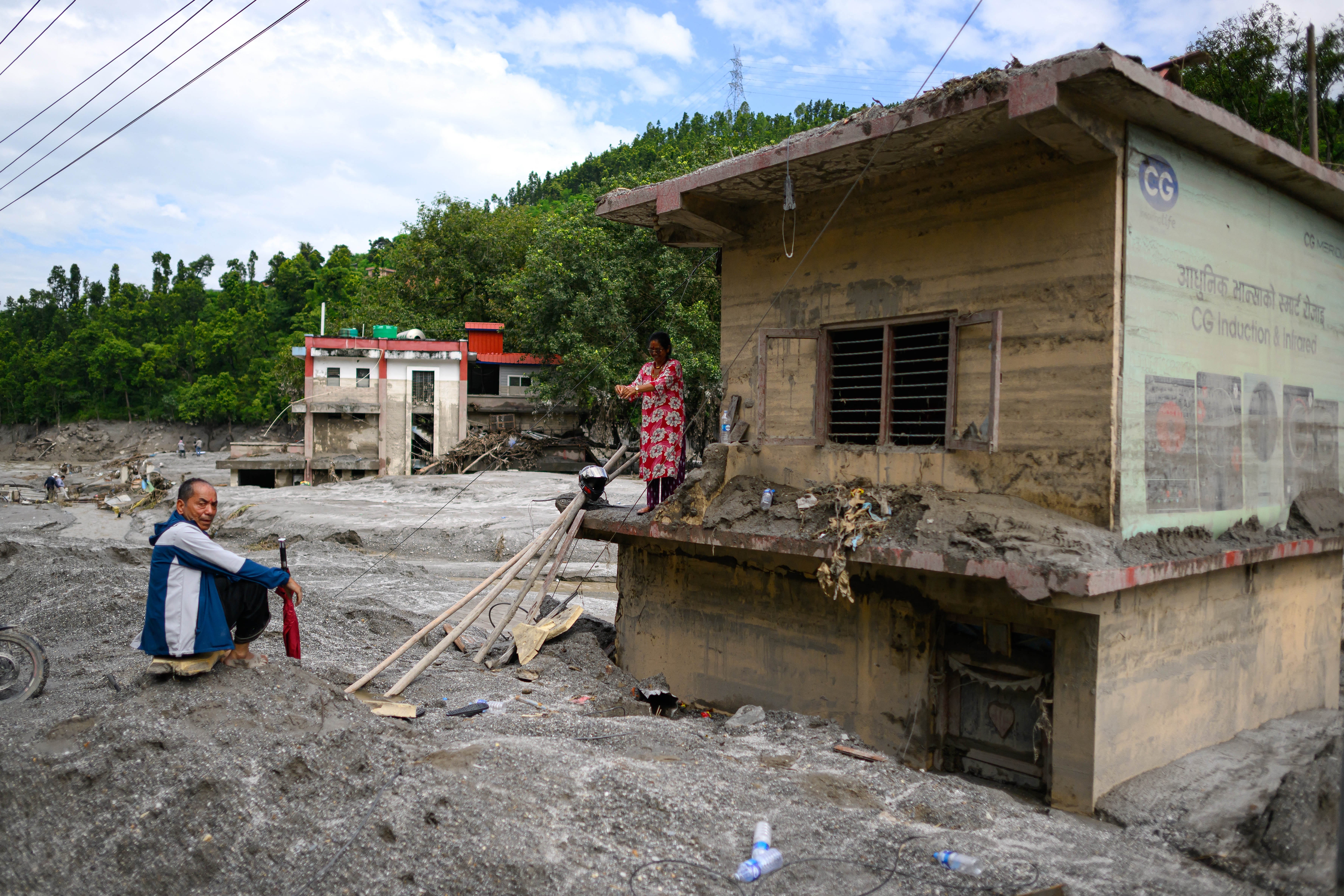
A woman (R) stands atop her house covered in mud in the aftermath of flash floods at Baireni in Nepal’s Dhading district on 30 August 2026 (AFP/Getty)
Some of those missing in Nepal were believed to have been visiting the region on pilgrimage.
Advertisement
Among them are sisters Hemangini Jitendra Patel and Hema Sunil Amin, who were last known to have been seen at the Friendship Bridge linking Nepal and China, the Guardian reported.
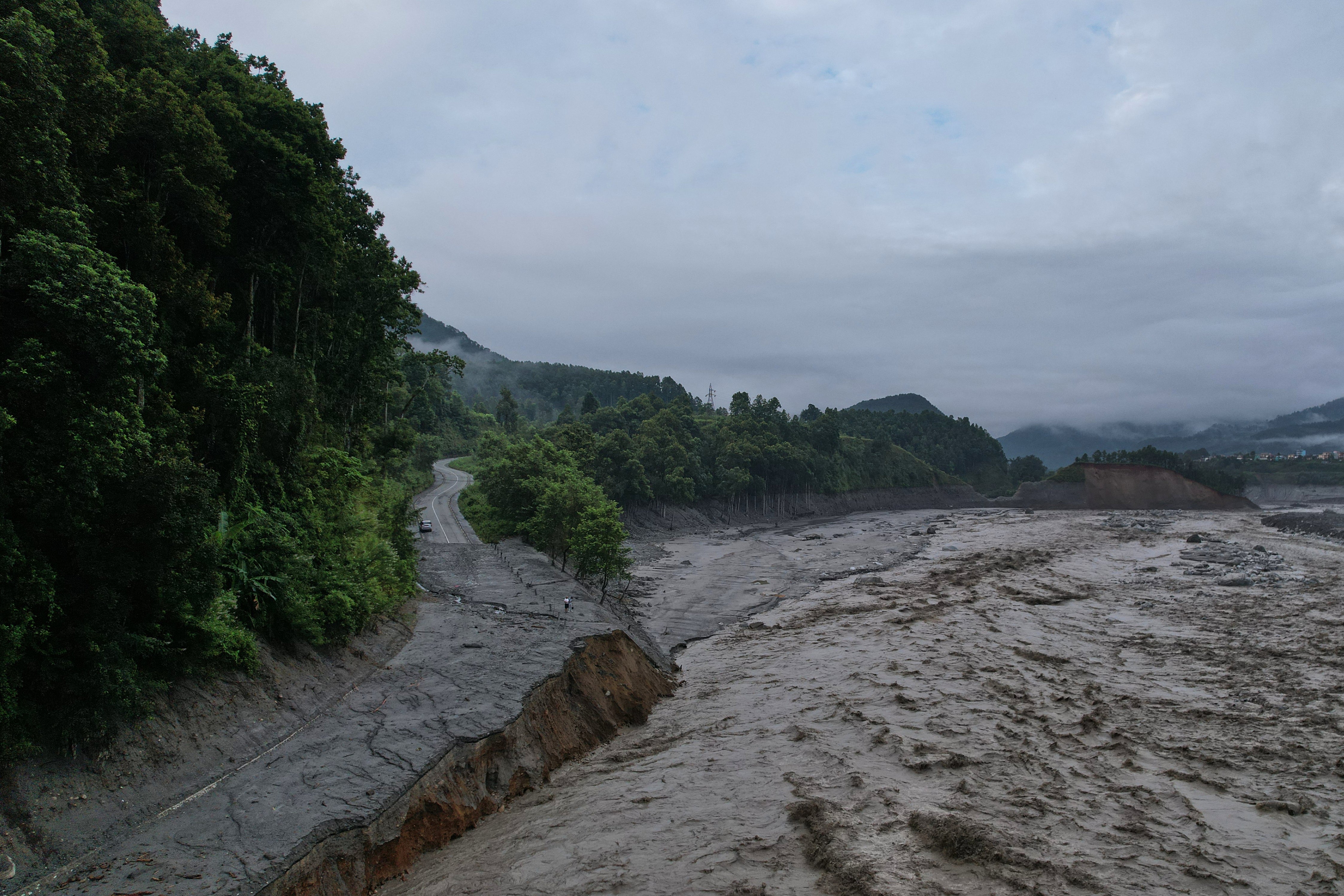
The disaster began on Wednesday after a massive glacier collapse in the Himalayas triggered flash floods that swept through communities and engulfed the Gyirong port area on the border.
At least 903 people have now been confirmed dead in Nepal and China, according to figures released by authorities on Sunday, while more than 3,000 people remain unaccounted for.
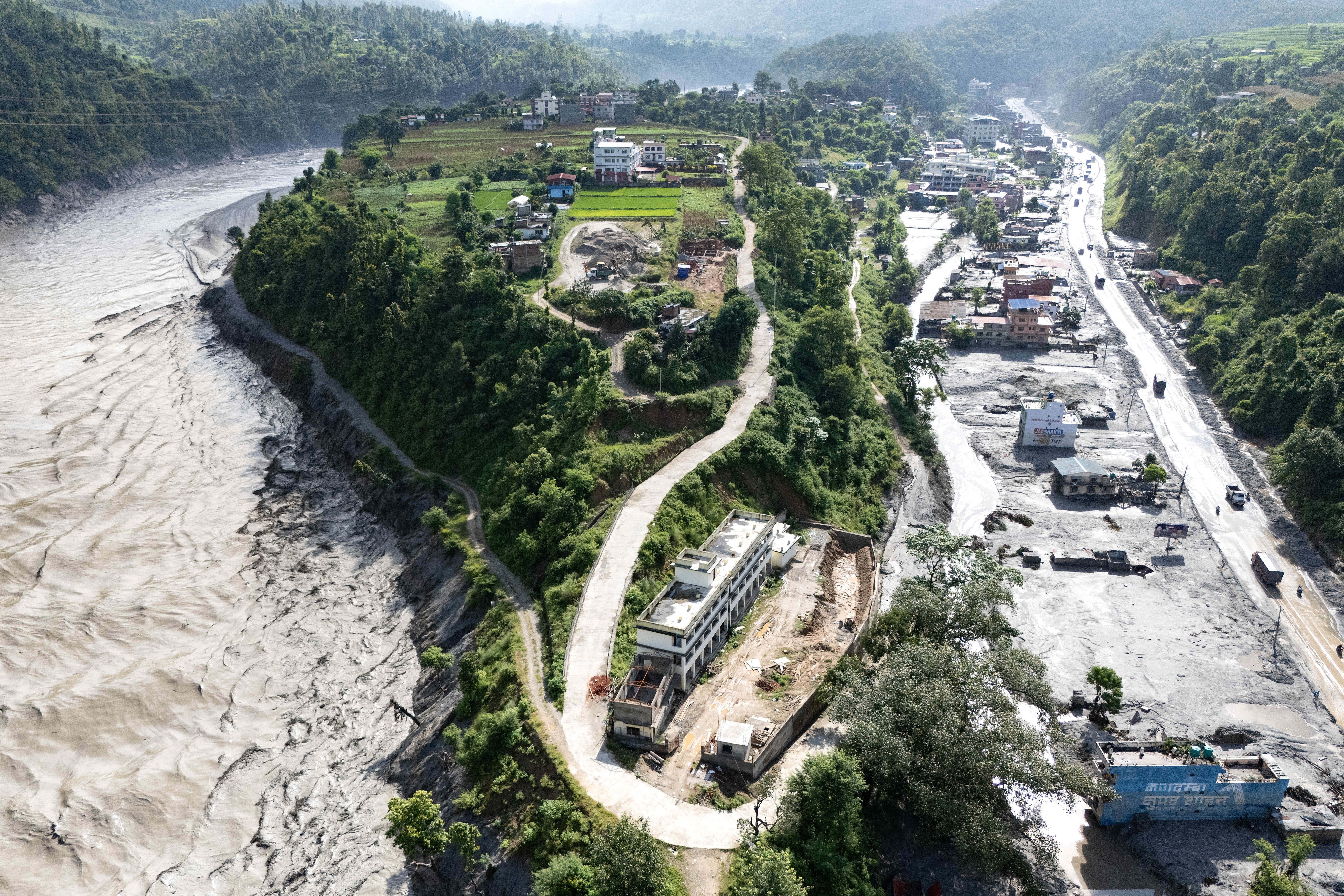
A drone view shows a major section of Pasang Lhamu highway washed away along swollen Trishuli river by recent flash floods cutting off Rasuwa district from Nuwakot area, Nepal, Monday, 31 August 2026 (AP)
The number of missing Americans has also become the subject of conflicting figures. China reported 18 missing US nationals, while the US state department said at least 85 American citizens were unaccounted for.
Tommy Pigott, a state department spokesperson, said it had been difficult to obtain reliable information from the affected region, “made even more so by the devastation and the remoteness that we see”.
Advertisement
Chinese authorities have reported at least 16 deaths on their side of the border.
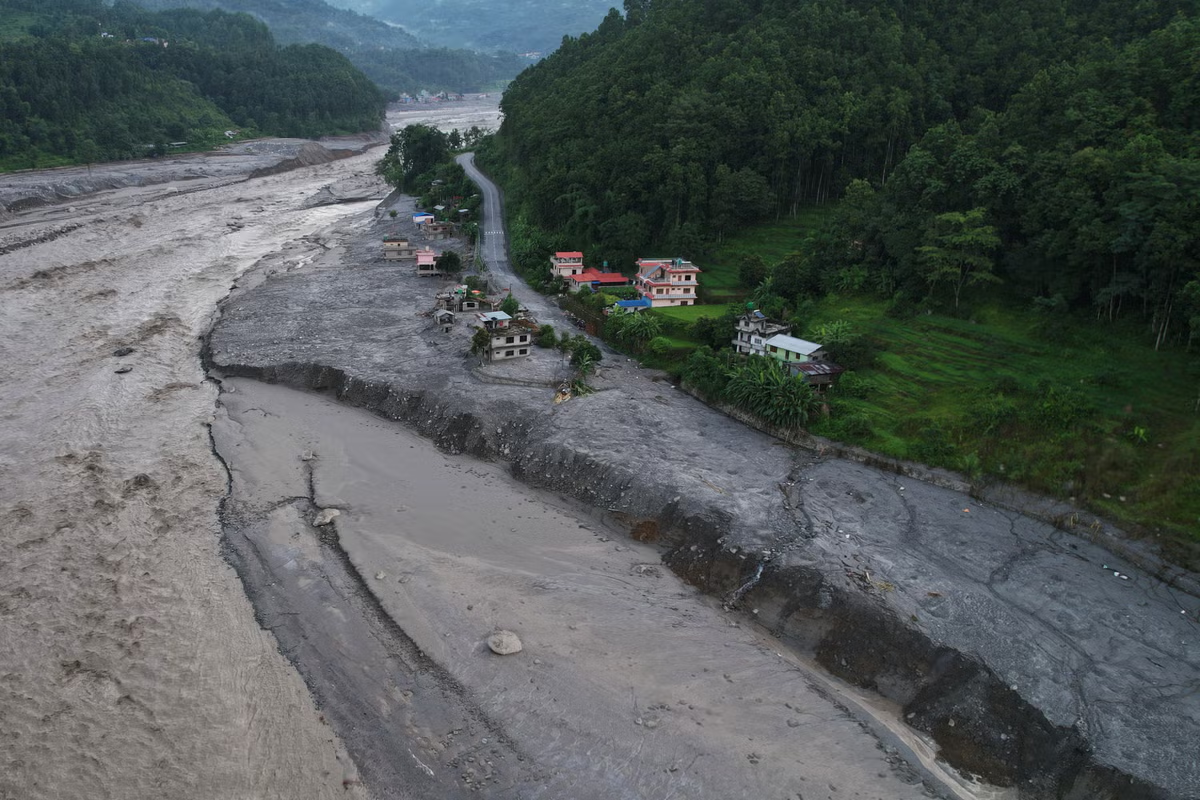
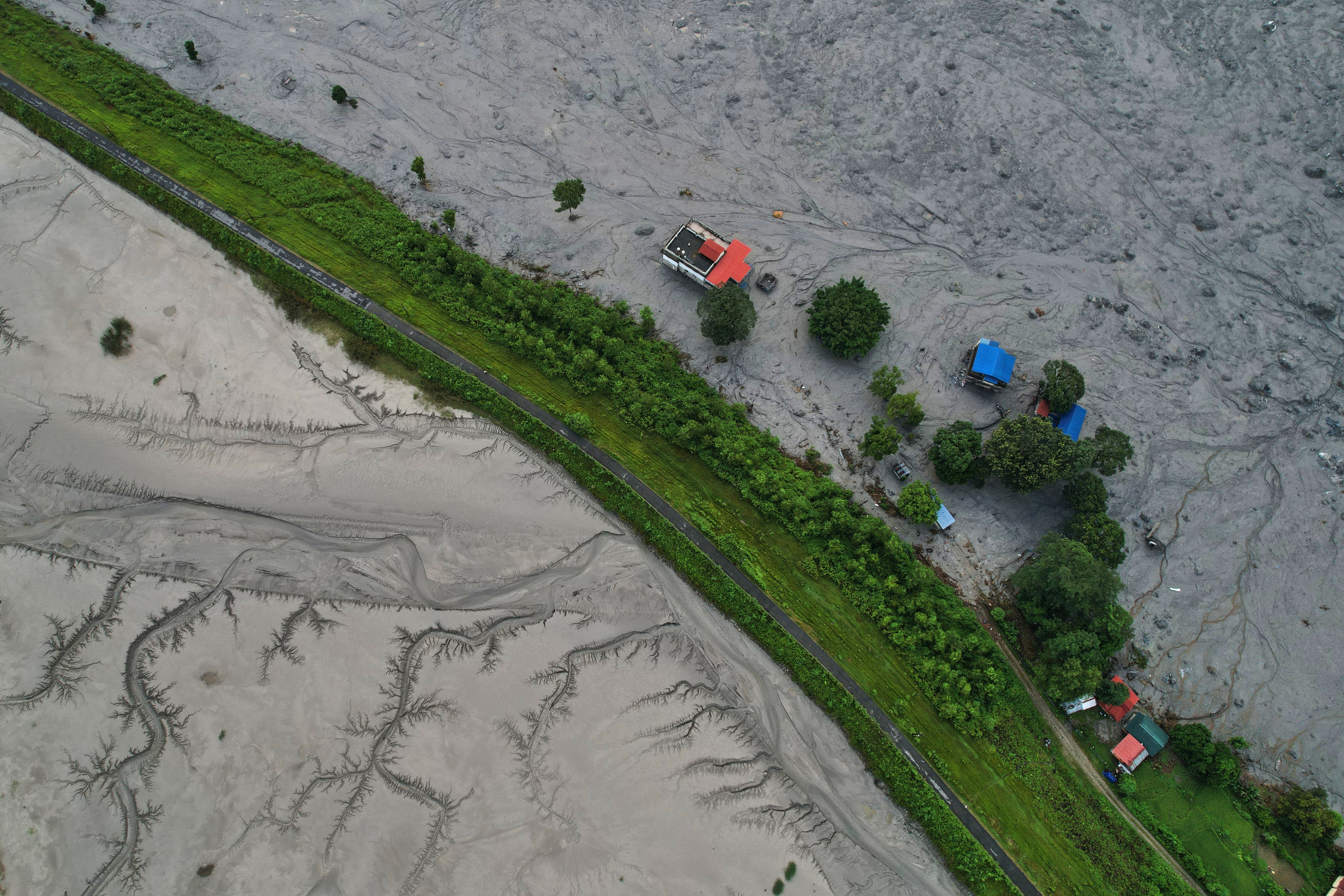
This aerial photograph shows an overflowing Trishuli River (L) and houses covered in mud (R) in the aftermath of flash floods at Baireni in Nepal’s Dhading district on 30 August 2026 (AFP/Getty)
However, concerns have been raised about the transparency of casualty figures from China, where authorities have restricted the circulation of footage showing the extent of the flooding.
Search and rescue operations have been complicated by severe weather, the risk of landslides and uncertainty over whether some missing people were in Nepal or China when the floods struck.
China has deployed more than 2,100 rescue workers to the affected area, according to state television, along with specialist equipment to locate people trapped beneath debris. Supplies and equipment have also been delivered by air.
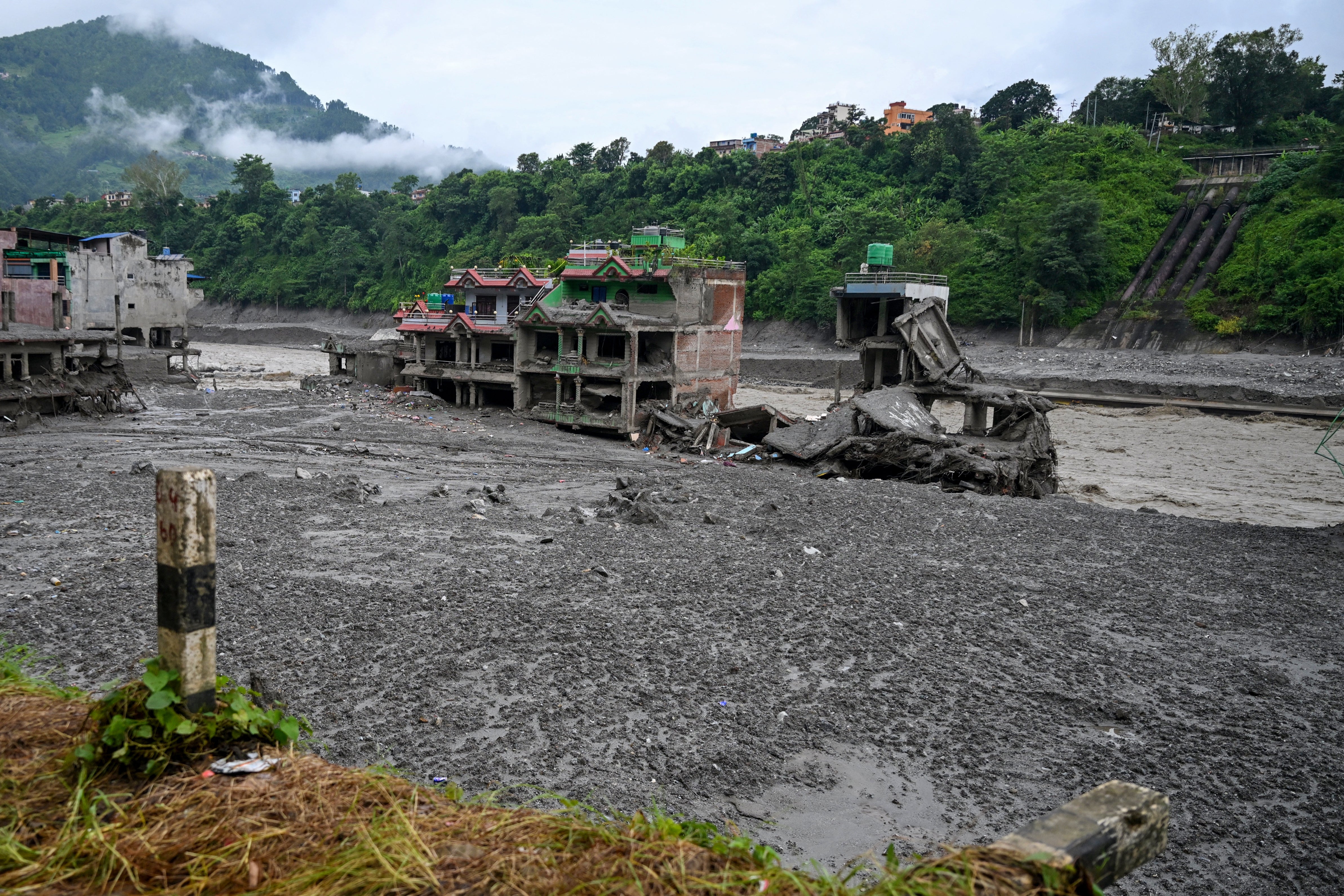
Damaged houses lie deluged in sludge after flash floods at Trishuli Center in Nepal’s Nuwakot district on August 31, 2026. Nepal was buried on 31 August, with hundreds of bodies retrieved after a deadly, tsunami-like flood crashed through the Himalayan region, sweeping away villages and leaving thousands still missing. Distraught families have packed rescue stations and hospitals in search of their missing relatives, while others have faced the grim task of identifying bodies at overflowing morgues (AFP/Getty)
Chinese premier Li Qiang has travelled to the region as rescue and relief operations continue.
Chinese president Xi Jinping said on Monday that China was making every effort to find people missing after a mudslide near the Tibet-Nepal border, Xinhua reported.
Advertisement
On the Nepalese side, police said 794 people had been confirmed dead and at least 2,742 injured. Authorities have warned residents in several areas to remain prepared for further flooding and possible evacuations.
A drone view shows a major section of Pasang Lhamu highway washed away along swollen Trishuli river by recent flash floods cutting off Rasuwa district from Nuwakot area, Nepal, Monday, 31 August 2026 (AP)
The British government has sent a rapid deployment team to Nepal and committed £5m in aid.
A UK Foreign Office spokesperson said: “We are working around the clock to support British nationals and their families affected by the devastating floods on the Nepal-China border. We are coordinating closely with the Nepali and Chinese authorities and have deployed consular support staff to the region to ensure British nationals can access support.”
Rescue teams are continuing to search for missing people as authorities face difficult conditions and a rapidly evolving situation across the mountainous border region.
Right around the corner, everyone’s stripping off (Picture: Getty Images)
If travelling light is high on your list of holiday priorities, especially if you want to avoid extra-baggage charges, why not consider a clothing-optional resort?
Residents and visitors go about life — dining at beachfront restaurants, grabbing a coffee, or simply strolling around — in the nude, all within a designated, controlled area.
There are very few places of this scale in Europe, indeed the world, and the vibe is unashamedly, er, libertine.
Once I overcame my initial fear and embarrassment, I realised that even the most seemingly perfect bodies are imperfect in some way.
As a prolific sex columnist and the host of the podcast Sex Advice for Seniors (self-explanatory), Suzanne Noble is always up for a naturist getaway (Picture: Suzanne Noble)
Fat or thin, tall or short, we are all different.
If body confidence is an issue, I can highly recommend spending time among hundreds of naked people: it is a surprisingly effective way to overcome shame or whatever’s going on in your head.
Advertisement
Ask Metro
Use AI to go deeper into the stories you care about – powered by Metro and trusted publications.
The growing popularity of naturist holidays reflects a broader interest in experiences that offer freedom from body-image pressures, the chance to spend time outdoors without worrying about dress codes, and a more relaxed approach to socialising.
Advertisement
For some, it is about reconnecting with nature. For others, it is simply the novelty of trying a holiday where clothes are optional and judgment is meant to be left at the gate.
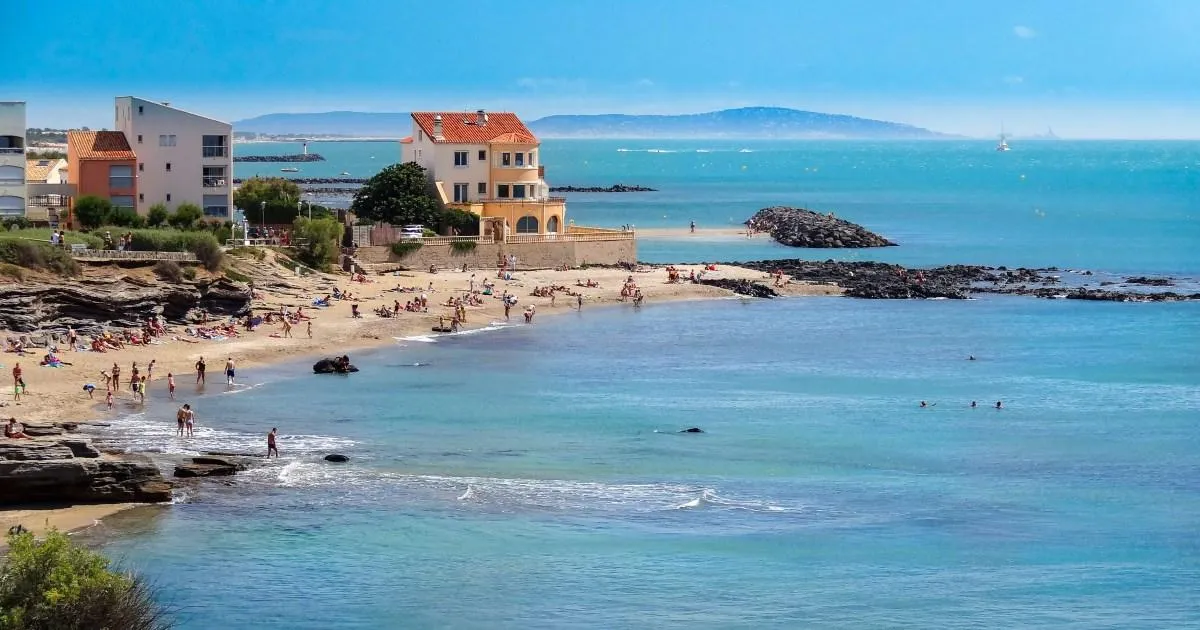
Tucked away to the west of the French Riviera, Cap d’Agde began as a campsite in 1956, established by French brothers René and Paul Oltra.
The story goes that, after work, they enjoyed skinny-dipping in the Mediterranean alongside German holidaymakers.
They decided to turn their land into a holiday destination for like-minded people who preferred doing things nude.
Advertisement
In 1963, as part of a local government tourism initiative, the Languedoc-Roussillon region oversaw the creation of the seaside resort of Cap d’Agde and the campsite’s transformation into a fully-fledged naturist village.
Naturism has its roots in Germany in the 1890s, when ‘free body culture’, emerged as a reaction to rapid urbanisation (Picture: Suzanne Noble)
Today, it features large Brutalist blocks of flats, shopping arcades and restaurants.
Think The Hunger Games meets Blackpool, with full English breakfasts, pizza and rotisserie chicken on offer.
It is not to everyone’s taste, but visitors are unlikely to be there for the cuisine or architecture.
Now celebrating its 70th anniversary, the René Oltra campsite remains a key destination for naturists.
Advertisement
It offers pitches for tents and motorhomes, as well as chalets, mobile homes and wooden cabins.
Guests get a pass based on the length of their stay, together with a token allowing entry to the village.
Inside the walled resort, which can accommodate up to 40,000 at its busiest, you can shop everywhere from patisseries and charcuteries to stores selling local red, white and rosé wines from the Languedoc region, France’s third-largest wine-producing area…completely in the buff.
There is plenty of fun to be had browsing shops selling skimpy evening wear and fetish gear, both of which are commonplace here.
Advertisement
Ah, the French… nothing if not phallic (Picture: Suzanne Noble)
Cheap, stretchy polyester and nylon are the order of the day: the shorter and more revealing, the better.
Those seeking full-on fetish wear will be spoilt for choice, while sex toys, whips and floggers are also widely available.
Penis-shaped key rings and bottle openers are impossible to miss.
When the sun goes down, the village quickly changes from naked to outrageously clothed.
Clubs line the streets, advertising foam parties, BDSM workshops and opportunities for couples to play with others in one of the many venues around the resort.
Coq’in House (Picture: Suzanne Noble)
Having visited Cap d’Agde seven times over more than two decades, I have become fond of the people-watching.
It is not simply voyeurism: the village brings together people who would rarely meet elsewhere, from older couples and lifelong naturists to first-time visitors, swingers and people experimenting with a more liberated version of themselves, the average age being somewhere around 50.
Sitting at a café, you can watch people move between ordinary holiday routines and flamboyant evening performances, often with a confidence that seems to grow as the day goes on.
I recall on a previous visit I invited a friend, a 6’4” tall Yorkshireman, aged 55, to accompany me to the village for a weekend break.
Advertisement
Having never tried naturism before, he was taken aback when I asked him to strip off on entrance to the village.
By the end of the day, he was fully committed to the lifestyle and announced the trip as the most fun he’d ever had.
That is part of the appeal of people-watching at Cap d’Agde. You see how quickly people can move beyond the roles and appearances they occupy in everyday life.
When I feel more daring, I walk to the far end of the 1.5km beach, where some adults have sex outdoors.
Advertisement
Something for everyone (Picture: Suzanne Noble)
There are usually more spectators than participants, visible from up to a quarter of a mile away by the circles they form, sometimes five or six men deep.
Further along are separate areas for gay men and families who regard naturism as a way of life.
For first-timers, the resort is best approached with an open mind and a clear understanding of its rules.
Daylight hours are generally devoted to ordinary holiday pleasures – swimming, sunbathing, shopping and eating – while the atmosphere becomes more sexually charged later in the day.
Naturism is expected, but consent, privacy and respect remain essential.
Advertisement
If you can accept the mix of families, traditional naturists and adult entertainment, Cap d’Agde Naturist Village offers a holiday unlike almost anywhere else: part French seaside escape, part social experiment and part unabashed spectacle.
The essentials
Suzanne Noble travelled with Ryanair to Bezier Airport, 20 minutes by taxi to the Naturiste Village.
Entrance to the village costs €11.50 for a single pedestrian and €27 for a day pass with a vehicle (including 2 people).
For those who have booked accommodation in the village, discounted rates apply.
Advertisement
Suzanne Noble is the host of Sex Advice for Seniors, a ‘stigma-free’ sex advice podcast for people who refuse to let age define their desires.




























































You must be logged in to post a comment Login