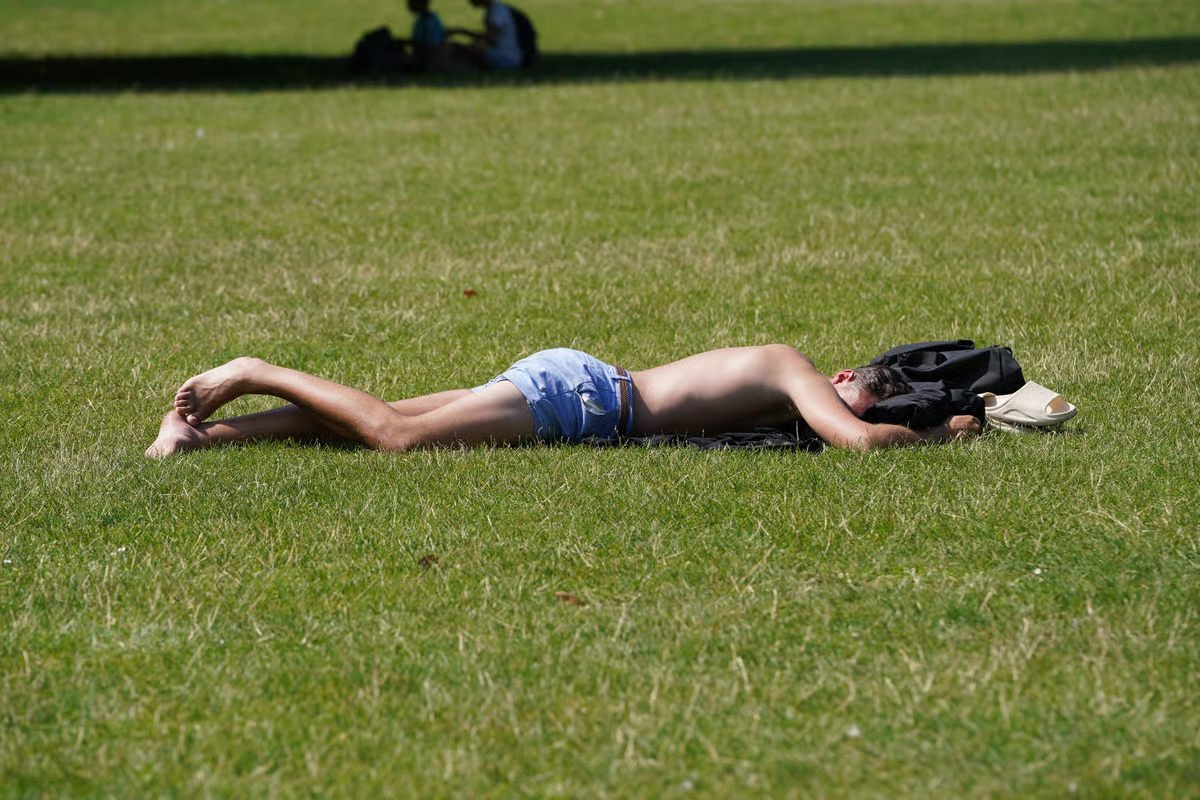
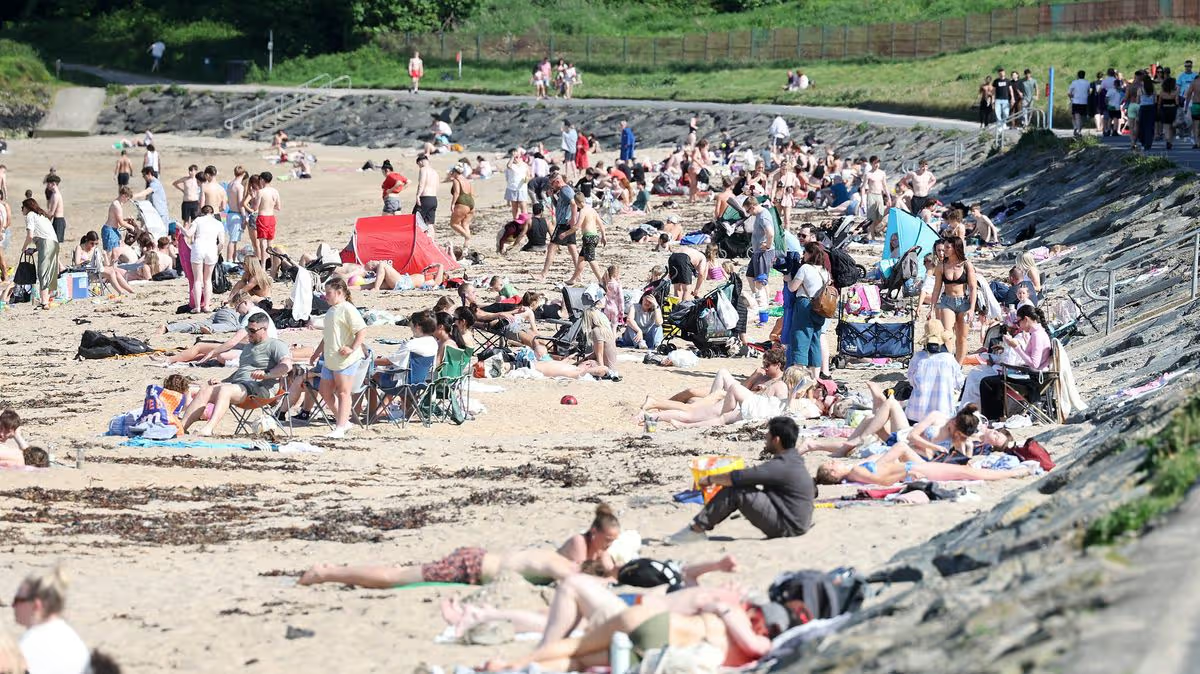
It’s hot, no? As journalists reach for words untouched at other times of year – soaring, blistering, searing etc. – we all react like children to the weather being very sunny and very warm. We associate hot weather with holidays, so there’s an unmistakable excitement about the prospect of sandals and sunhats and floaty cotton dresses. Inside, we’re mentally carrying a bucket and spade and thinking ice-cream for tea. And there’s the usual jeering at other countries for being less hot than here. Posh and Becks in Ibiza? Pah! It’s hotter in Kew Gardens.
The last time it was around this temperature for Whit Weekend, it was 32.8 degrees in 1940, which must have made the situation in Dunkirk that bit more disagreeable. But now we’re contemplating this as the permanent condition of England: blistering, scorching, searing summers.
If this indeed the case, we’re going to have to change our ways, and we could start by looking to actually hot countries, where hot weather is the norm, for guidance. So here are some suggestions, large and small, for living with heat.
Stay indoors in the heat of the day
Advertisement
As the saying goes, only mad dogs and Englishmen go out in the midday sun; we shouldn’t.
In really hot places they wear layers of natural fabric rather than in the British fashion, as little as possible. Yesterday in the crowds at Reading station (the train from the west country unexpectedly decanted all the passengers) I found myself staring at the angry, red, naked shoulders of pale women after one day of heatwave. Cover up!
A minister has criticised the ‘obsession with laughing at people’ who get sunburn (Alamy/PA)
Alamy/PA
Cover yourself in cologne
Advertisement
In places like Spain supermarkets to sell industrial quantities of cheap, citrussy cologne, which you douse yourself and your clothes with for instant uplift. To get through the heatwave buy a giant bottle of 4711 and keep it in the fridge.
Start the day before it gets too warm
In hot countries people start the day early before the sun gets too hot. Children go to school at 7.30am and shops open by 8am. So, from the middle of May to the start of September, why not start the working day an hour earlier – at, say, 8am rather than 9am? Same would go for shops and schools. The Spanish siesta, an opportunity for a long lunch and closed shops, doesn’t work here, where so many people work far from home, but an early start would make it possible to leave work earlier, and be home for the cool of the evening.
Rethink our public spaces and our architecture
Advertisement
Think Victorian: the Metropolitan Drinking Fountain and Cattle Trough Association in 1859 installed drinking water fountains around London for men and beasts; we could do with lots more of those, even if we shy away from the communal cups on chains they used to have. It beats buying water in bottles.
Parisians drink from a water fountains to cool down in their hot Summers
Getty Images
Countries in the Near and Middle East have stratagems for capturing coolness. Think dark inner courtyards in buildings, where the warm air has room to rise, with plants (decorative palms, say) and fountains. In Dickensian London similarly, courtyards were standard elements of public space. Even now, the coolest places in London, in both senses, are those City churchyards with places to sit in the shade of the adjoining church, with shelter from the sun and dappled shade among the plants. There’s a lovely one belonging to the little church of St Vedast, which is a haven in the summer.
Use more glazed tiles when building
Advertisement
If you want a lesson in how it’s done, make for the newly renovated Arab Hall in Leighton House in Kensington, where that eminent Victorian, Lord Leighton, recreated some of the features of the buildings he visited in the Levant, notably Turkish decorative tiles. If you want the full Ottoman effect, we could adopt the wooden lattice screens that allow filtered sunlight to enter rooms, while keeping out the blaze.
REUTERS
And while at it, build thicker walls
As anyone knows who has visited castles, thick walls are brilliant for excluding heat. You can shiver inside them in the hottest summers. What that suggests is that we should not be adopting the paper-thin walls favoured by contemporary architects, but building much thicker ones.
Bring back narrow alleyways
Advertisement
Medieval streetscapes are good for combating heat: narrow alleyways, once commonplace in London, provide shade from adjoining buildings. These are preferable to the grandiose plazas around tall buildings which are such a feature of showoff modernism. As for sheet glass, which is a feature of pretty well every contemporary building I hate most, it is by its nature likely to attract and trap heat, unless there are very clever compensating devices. How about just not using sheet glass? And ostracising those architects who do?
These are all doable changes. But my favourite is the simplest:
Make windows that open, in buildings and on public transport
Why rely on air-conditioning when we could have the ventilation natural to man by simply letting the air in? Give us windows that open and shut: it’s that simple.
London City Lionesses are attempting to pull off the biggest transfer in WSL history as they chase the two-time Ballon d’Or winner.
Whether other clubs are also in discussions is unclear, but London City have been linked with a move for Putellas for some time and are the favourites to bring her in.
They are willing to pull out all the stops to boost their ranks, including offering her wages that would reflect her status as one of the greatest players of all-time.
They have been braced for a big summer, starting conversations with several players in January, with the view to boosting the squad at the end of the season.
Advertisement
London City have ambitions of breaking into the WSL’s top three and qualifying for the Champions League in the not-too-distant future, and a signing like Putellas would be a huge step towards that.
Putellas, who only lifted the Champions League trophy with Barcelona on Saturday, is also the blockbuster name billionaire owner Michele Kang craves.
Kang also owns Lyon, who Barcelona beat in Saturday’s final, and she will know all too well what qualities Putellas possesses and the heights she can help London City reach.
This year’s WSL newcomers are not your average club – an independent outfit, backed by seemingly unlimited funds from Kang and a desire to grow a women’s football team from scratch. That makes them an intriguing project.
Advertisement
With Spanish coach Eder Maestre at the helm, close friend Jana Fernandez thriving there, and Barcelona team-mate Mapi Leon also expected to join London City, there are draws for Putellas.
However, going from her childhood club, who she has just captained to her fourth European title, to a team who finished mid-table in the WSL this season would be a drop down.
It further highlights the draw of the WSL and its rapid growth as more of the world’s best players view England as a strong league.
Putellas is a player every club in the world would surely be happy to accept so if London City Lionesses can pull it off, it would be a remarkable achievement for the WSL club.
The outer black pieces were designed by Kevin Germanier, who is known for his sustainable approach to fashion, while the gold dress was custom made by Nike.
“Sometimes people say athletes are in show business or entertainers or whatever,” Osaka said.
“For me, Grand Slam walk-ons are the only time that I possibly feel like I’m an entertainer.”
At the Australian Open in January, Osaka made a statement entrance in a jellyfish-inspired outfit which she dedicated to her two-year-old daughter Shai.
Advertisement
Former British number one Annabel Croft said a lot of players “would not be able to live up to the expectation” of walking out in custom made outfits like Osaka’s.
“If you out there in an extraordinary outfit, you’ve got to live up to that and have the confidence to play in it and give the crowd the tennis as well as the outfit,” she said on BBC Radio 5 Sports Extra.
“Naomi can handle it. She really loves it and she’s not fazed by it.”
Since the birth of her daughter in 2023, Osaka has re-established herself in the world’s top 20 and she reached the semi-finals at the US Open in September.
Advertisement
The former world number one will face Croatia’s Donna Vekic in the next round.
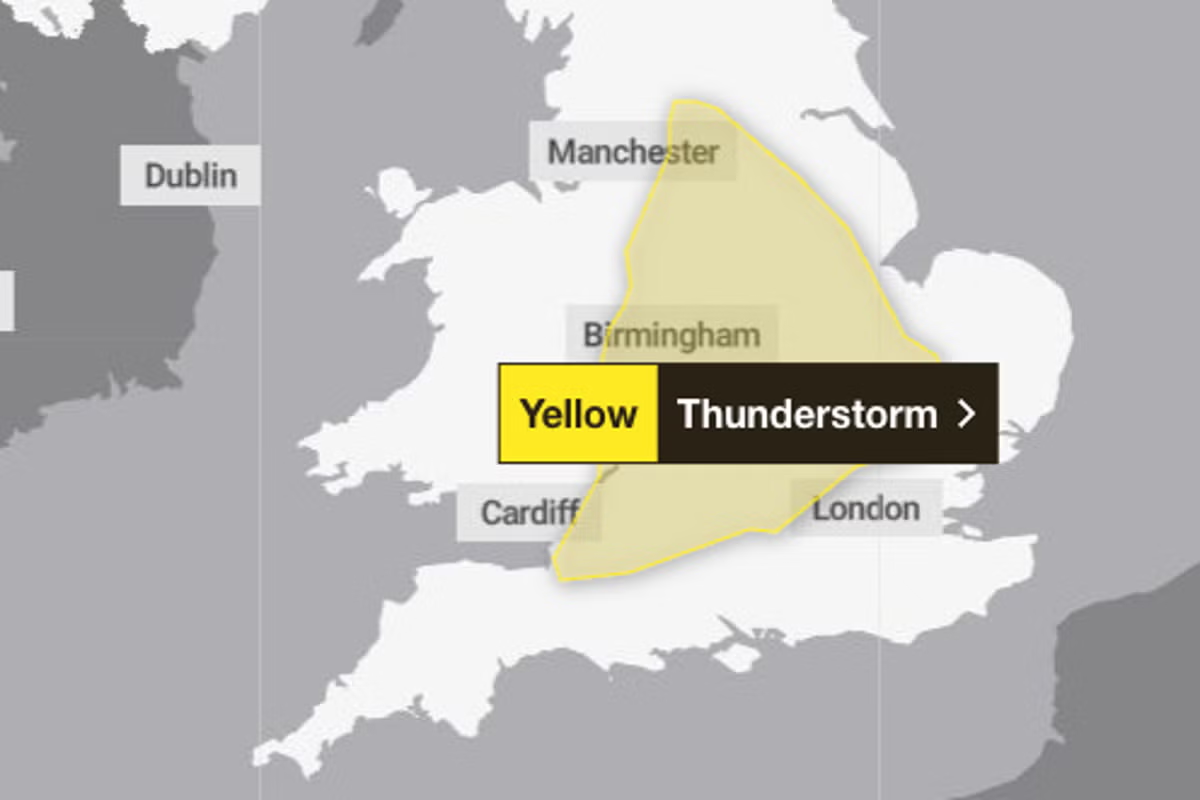
A yellow weather warning is in place across parts of England this evening as thunderstorms are expected to follow a record-breaking heatwave.
Forecasters declared a heatwave in multiple parts of the country on Tuesday, with amber heat health alerts issued in large swathes of England.
But the hot weather is expected to break on Tuesday evening, with the Met Office warning “isolated intense thunderstorms” could bring disruption to some places.
A yellow weather warning is in place until 10pm on Tuesday (Met Office)
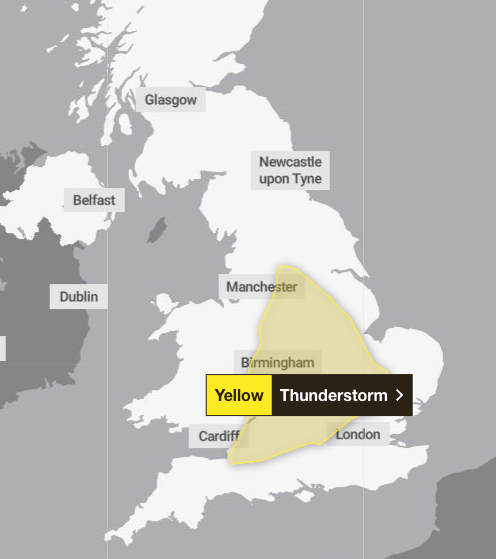
The Met Office has issued a yellow weather warning for thunderstorms covering parts of the south west, the midlands, the north west of England, and Yorkshire and the Humber. The warning came into force at 3pm and is in place until 10pm on Tuesday.
Forecasters said there is a chance of delays and some cancellations to train and bus services in areas where storms occur.
Advertisement
Temperatures reached 35C at Kew Gardens in London, breaking the highest minimum temperature in May for a third consecutive day. The figure also provisionally marks a new all-time hottest meteorological spring temperature, beating the record set on Monday.
The health warnings mean there is likely to be a “significant” impact on health and social services, and a rise in deaths, with alerts in place until 5pm on 27 May.
Met Office Chief Forecaster Andy Page said: “The exceptional late-spring heat is set to continue for much of this week.
“Last night provisionally recorded the warmest May night on record, and we’re likely to see further very warm nights in the south over the coming days. There is a chance a few places will experience a ‘tropical night’ in the south of England and in Wales tonight, which is where temperatures don’t fall below 20°C.
Advertisement
“While many places will stay dry and sunny, the heat and humidity mean that a few isolated thunderstorms have developed with more possibly developing later today, particularly across parts of England. Looking further ahead, the focus for the highest temperatures will shift westwards on Wednesday, with northern areas feeling more of the warmth on Thursday.
“We’ll then see a gradual change later in the week, with temperatures easing slightly, though still above average, before a more marked change to near-normal temperatures by Sunday and an increased chance of showers and some longer spells of rain.”
A heatwave has been declared in eight locations in southeast England, which have now met the threshold of 27C for three consecutive days of hot weather.
The Met Office listed 12 locations where the record was topped on Monday – ranging from Suffolk to Berkshire to Warwickshire – while 97 of its monitoring sites reached or surpassed 30C.
Advertisement
The UK’s previous warmest May night was measured on Sunday when temperatures did not fall below 19.4C at Kenley Airfield.
Those forecasts span the Midlands, the south-east and south-west of England, East Anglia and South Wales.
Here’s what the weather authority has forecast over the coming days:
Advertisement
Tuesday
Another very hot day across much of England and Wales with strong sunshine. Fresher across northern areas with sunny spells. A yellow weather warning is in place for thunderstorms until 10pm across much of England.
Wednesday
Dry on Wednesday with sunny spells for many. Cloudier in the northeast but some bright spells slowly developing. Very warm in the southwest, but feeling fresher elsewhere.
Advertisement
Thursday to Saturday
Staying hot across parts of the south through the next few days. A risk of a few thundery showers at times, but largely dry for many.
The 44-year-old man visited his ex-girlfriend’s house on multiple occasions, despite having a restraining order
A man broke the window of his ex-girlfriend’s home, despite her having a restraining order against him. Curtis Saunderson, 44, was handed a restraining order in December 2025, banning him from contacting his ex-girlfriend and visiting her home in Peterborough until May 2027.
Advertisement
However, between April 21 and May 19 of this year, Saunderson breached his order by making multiple attempts to contact her by phone and turned up at her house on different occasions.
During one of these visits, Saunderson was caught on a video doorbell using a concrete tile to break the victim’s front windows. Cambridgeshire Police arrested him on May 20 and charged him with criminal damage and five counts of harassment.
Saunderson, of no fixed address, was jailed for 56 weeks and ordered to pay £250 in compensation after admitting the offences at Cambridge Magistrates’ Court on Friday (May 22). This included the activation of a six-week suspended sentence he received for theft offences in April.
Detective Sergeant Louis Scott said: “Saunderson’s relentless attempts to contact the victim showed his disregard for the previous court orders. I would like to thank the victim for her ongoing cooperation and bravery for reporting this harassment.”
(Left to right) Bereaved parents Liam Walsh, Lorin LaFave, Mariano Janin, Ellen Roome, Lisa Kenevan, Ruth Moss, and Stuart Stephens speak to the media in Downing Street, central London, following their meeting with Prime Minister Sir Keir Starmer (Stefan Rousseau/PA)
In 1959, a young doctor named David Sackett stumbled on a clinical trial that would change his life – and most of ours. The study showed that conventional wisdom on bed rest in medicine was wrong. And it helped lead Sackett and others to develop evidence-based medicine, in which doctors today make decisions based on rigorous scientific research.
It was a necessary corrective. The history of medicine is littered with practices once assumed to work but which were later shown by research to be useless or harmful – as I discovered in the five years it took me to research my book, Beyond Belief: How Evidence Shows What Really Works.
Sackett was a precocious young doctor in his final year of medical school at Cook County Hospital in Chicago, when he noticed something odd. Most medical advice was based on received wisdom or the opinion of the most senior doctor in the room (an approach now called eminence-based medicine). This was unsatisfying to Sackett, who realised he lacked the information to determine which treatments worked best for his patients.
Then, one day, a teenager set Sackett on a new path. The adolescent had an enlarged liver as a result of infectious hepatitis, which Sackett later ascribed to hepatitis A. Back then, everyone thought that a patient with hepatitis must be kept resting in bed until the liver returned to normal. It was conventional wisdom, and no one really questioned why.
Advertisement
But Sackett’s patient did question why. He felt energetic after a few days, and he demanded to get up. Soon, a battle was raging between an increasingly sulky adolescent and a stubborn doctor who predicted permanent liver damage if the young man dared to get out of bed.
Seeking more information, Sackett went to the library and started scouring medical journals. Here, he found the remarkable bed rest trial. It had been published in 1955 by Thomas Chalmers, a doctor and pioneer in clinical trials.
In the early 1950s, during the
Korean war, Chalmers was based at a US army hospital in Kyoto, Japan. The US military used Japan as a base for treating soldiers evacuated from the front, and the hospital was dealing with a big outbreak of infectious hepatitis among its patients.
Strictly enforced bed rest meant that soldiers were in hospital for about two months, creating a drain on the army. So Chalmers decided to test whether resting this long was necessary using a randomised controlled trial – an unusual experiment at the time.
Chalmers identified men with similar hepatitis symptoms and then randomly assigned them to one of two groups. In one group, men were kept to strict bed rest – so strict, in fact, that they were allowed only one trip to the latrine each day and a once-weekly shower. Men in the other group were prescribed “ad lib rest”, which meant that they could do largely what they wanted as long as their boisterousness didn’t break the ward rules.
The results of this trial showed that the men recovered just as quickly when they were active as when they were confined to bed. Chalmers recommended that hepatitis patients should be allowed to get up earlier – presumably a relief for hundreds of restless soldiers. In 1955, Chalmers also wrote up his findings in one of the most detailed clinical trial reports ever published, at 73 pages long.
As Sackett read this epic paper in the Chicago library, he immediately saw that conventional wisdom on hepatitis treatment was wrong. He convinced his supervisors to let the bedbound teenager get up – and sure enough, the patient recovered just fine. But the incident left a bigger mark on Sackett. It showed him that other standard practices in medicine could be wrong too, and that randomised trials had the power to show which ones had a beneficial effect.
In the short term, this meant that Sackett became a self-professed troublemaker. Now, when senior doctors told him to treat patients because of conventional wisdom, he challenged what they said. He became notorious for interrupting senior doctors whenever they were pontificating about what to do.
Advertisement
But the aftershocks were greater than this. A few years later, Sackett joined the newly established medical school at McMaster University in Ontario, Canada. Here, he and his colleagues started teaching student doctors to solve problems using evidence from research – such as randomised trials – rather than just doing what eminent physicians said.
This approach eventually became known as evidence-based medicine, a term first published in the medical literature in 1991.
Today, it seems obvious that doctors should base their decisions on rigorous scientific evidence. It is remarkable – and not widely known outside academia – that evidence-based medicine is such a recent phenomenon, which is one reason I wanted to write my book. By helping spark this change, the bed rest trial has indirectly benefited everyone who has received modern medical treatment.
Advertisement
Of course, evidence-based medicine is imperfect and rightly continues to evolve. Evidence is often complex, flawed and contradictory, and new studies can come along that overturn existing ideas. But it can help people do more of what works and less of what doesn’t. It’s a hard-earned lesson we shouldn’t forget.
This article features references to books that have been included for editorial reasons, and may contain links to bookshop.org. If you click on one of the links and go on to buy something, The Conversation UK may earn a commission.
Donald Trump has been discharged from Walter Reed Military Medical Center after a routine presidential health check
Abigail Hunt Content Editor and Kirstie McCrum
18:55, 26 May 2026Updated 18:56, 26 May 2026
Donald Trump has left his biannual check-up declaring it went “perfectly”, thanking medical staff for their care.
On Truth Social, the US President posted: “Just finished my 6 month physical at Walter Reed Military Medical Center. Everything checked out PERFECTLY. Thank you to the great Doctors and Staff! Heading back to the White House. President DJT”.
Advertisement
This marked the fourth occasion Trump has publicly revealed details of a medical examination since beginning his second term in office. The divisive American leader, who turns 80 next month, attended Walter Reed National Military Medical Center on Tuesday (May 26).
The White House has reportedly maintained it was standard “preventive healthcare” as scrutiny over his wellbeing has grown.
“The visit will include the president’s routine annual dental and medical assessments as part of his regular preventive healthcare,” the White House confirmed on May 11.
This follows Trump’s consistent dismissal of worries regarding his age and fitness, referencing past test outcomes that he described as “perfect”, reports the Daily Star.
Advertisement
According to Forbes, Trump recently informed reporters: “I feel the same as I did 50 years ago. It’s crazy. I know many people that all they do is watch their weight… and then they kick the bucket. And here we are, I feel great.”
Earlier this month, he also stated in the Oval Office: “My health is perfect.”
In January, Trump told The Wall Street Journal: “I will know when I am ‘slowing up,’ but it’s not now!”
Advertisement
The appointment marked his third scheduled trip to Walter Reed in roughly 13 months and his fourth publicly revealed medical assessment since re-entering the White House. The White House physician, Dr Sean Barbabella, has stated Trump is in “excellent health” and “fully fit” to serve.
Following an examination in October 2025, Dr Barbabella also purportedly said that the president demonstrated “strong cardiovascular, pulmonary, neurological, and physical performance”. Trump has additionally maintained he “aced” cognitive tests during his assessments, frequently drawing comparisons with Joe Biden.
In July 2025, the White House confirmed Trump had been diagnosed with chronic venous insufficiency, a widespread condition associated with blood pooling and swelling in the legs. Photographers have likewise repeatedly documented noticeable bruising on his hands, which Dr Barbabella has put down to regular handshaking coupled with a daily 325mg aspirin dose taken for cardiac prevention.
Critics have similarly highlighted occasions where Trump seemed to doze off or “rest his eyes” during official engagements. Concerns have broadened to include mental sharpness.
Advertisement
Earlier this month, a group of 30 psychiatrists and doctors signed a statement in the British Medical Journal describing Trump as “mentally unfit”, citing alleged “deterioration in cognitive functioning” and “impaired judgment”. Despite this, a 2025 memo claimed Trump’s “cardiac age” was 65, some 14 years younger than his actual age at the time, while reports have indicated he has shed around 20lbs (9kg) since 2020 — something his team has attributed to an “active lifestyle”.
Ensure our latest stories always appear at the top of your Google Search by making us a Preferred Source. Click here to activate or add us as your Preferred Source in your Google search settings.
In a holdall was £580 worth of cigarettes and vapes along with cash and coins totalling just over £60
A West Belfast man caught red-handed breaking into a convenience store was today jailed for nine months.
Advertisement
Judge Mark Reel told Conor Martin Gallagher that he will spend a further nine months on supervised licence on his release from custody.
The 38-year-old, formerly of Cherry Park in Dunmurry, had previously pleaded guilty to a single charge of burglary of a non-dwelling with intent to steal.
Belfast Crown Court heard police received a report of a break-in at Jack’s Convenience Store at Broom Park in Dunmurry at around 1.30am on Monday, June 9, 2025.
The report said a man was seen scaling the wall of the shop and climbing on to the roof. Prosecution barrister Gareth Purvis said police attended the scene and noticed the shop’s silent alarm had been activated.
Advertisement
He said a hole had been made in the roof after a number tiles had been removed, thrown to the ground and smashed. He was arrested for the offence of burglary and later told police in an unsolicited comment: ‘I did it. You caught me bang to rights
Mr Purvis said: “Shortly afterwards a male was observed exiting through the hole in the roof carrying a black and pink holdall. He attempted to evade arrest by jumping on to the roof of another building. After a short stand-off, he surrendered.
“He was noted to be wearing black trousers, a white hoodie, a black body warmer and a single glove.”
In the holdall was £580 worth of cigarettes and vapes along with cash and coins totalling just over £60. The court heard it cost the shopkeeper £150 to replace the drawer on the till.
Advertisement
Asked by Judge Reel how much damage was caused during the break-in, Mr Purvis said he didn’t have an exact figure but it was “significant”, the place was in “disarray”, the main roof required re-plastering and the electrics on the shutters had been destroyed.
It was the second time in the space of two months that the shop had been targeted for burglary, the court was told.
During police interviews, Gallagher said he didn’t want legal representation and made full admissions to the burglary.
The court heard Gallagher has 34 convictions on his criminal record, including three for burglary. He is currently serving a sentence in Magilligan Prison for a previous burglary offence.
Advertisement
Judge Reel said: “For the defendant, this may have looked like a simple offence of modest enough value, but his actions caused great difficulty and expense for the victim.
“He clearly thought nothing of those whose livelihoods and businesses he was damaging. And this is the reason why significant custodial sentences are appropriate for this offence.”
Imposing an 18-month determinate custodial sentence, the judge told Gallagher: “Your offending is so serious that neither a fine nor a community sentence could be justified and only immediate custody is appropriate.”
Three men aged 21, 23 and 28 were arrested following the incident after being stopped in a vehicle.
17:18, 26 May 2026Updated 17:40, 26 May 2026
Three men suffered serious injuries following an assault on Helen’s Bay beach which police are treating as a racially-motivated hate crime.
The incident took place on Monday May 25 at around 9pm on the popular North Down beach and allegedly involved three men in their 30s being assaulted by three men in their 20s following a verbal altercation. The victims suffered serious injuries in the attack.
Three men aged 21, 23 and 28 were arrested following the incident after being stopped in a vehicle. They remain in police custody, with police saying the assaults are being treated as racially motivated hate crimes.
Advertisement
Ards & North Down District Chief Inspector Hutchinson said: “At 9pm, we received a report that three men aged in their thirties had been assaulted on the beach by three other men, following an earlier verbal altercation. They sustained a number of serious, but non-life threatening, injuries.
“A short time later, three men aged 28, 23 and 21 were stopped in their vehicle and arrested on suspicion of assault occasioning actual bodily harm and possession of an offensive weapon.
“A search of the vehicle led to the discovery of a quantity of suspected class A and class B drugs, and the 23 year old was subsequently further arrested on suspicion of possession of class A and class B drugs. The three remain in custody at this time.”
Chief Inspector Hutchinson continued: “This matter is being treated as a racially-motivated hate crime. We know that this was shocking for those enjoying the evening sunshine on the beach and want to reassure the local community that our investigation is progressing at pace.
Advertisement
“We had an increased police presence in the area to ensure that everyone left the beach safely, and were on the scene quickly – but want to commend members of the public who helped to prevent the altercation escalating further.
“As our enquiries continue, we would appeal to anyone who may have witnessed this assault, or the events leading up to it, to contact police on 101, quoting reference 1721 25/05/26.
“We’re particularly keen to hear from anyone who may have recorded footage of the incident.”





















































You must be logged in to post a comment Login