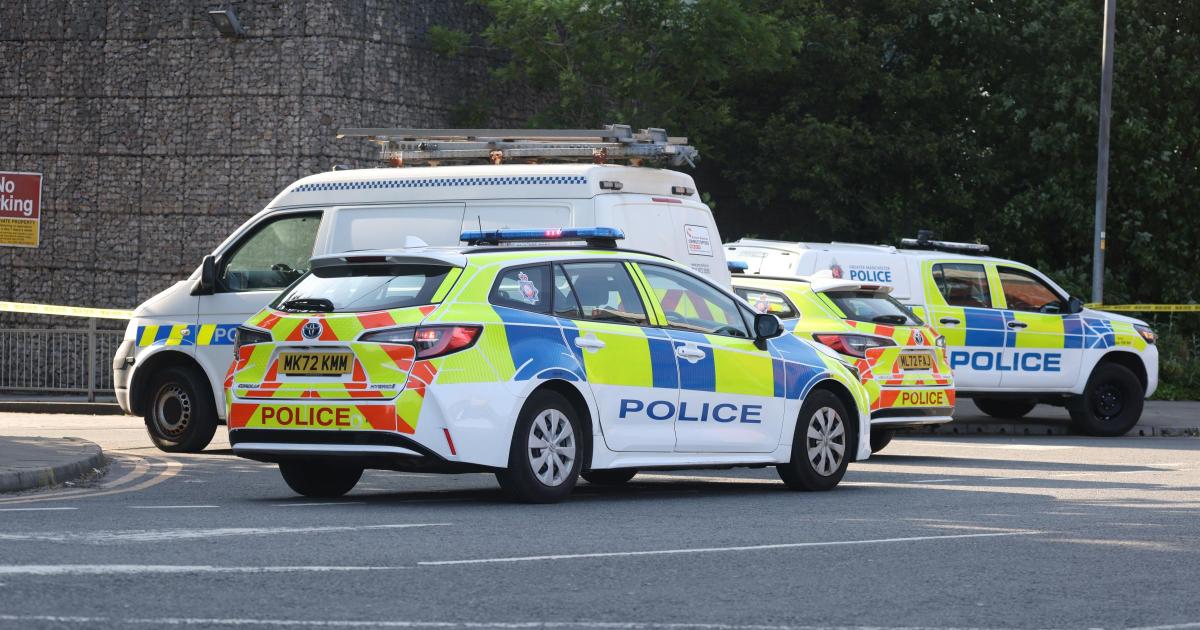
Greater Manchester Police, Greater Manchester Fire and Rescue Service (GMFRS) and North West Ambulance Service have reportedly been in attendance since around 11pm last night, with specialist negotiators understood to be involved.
The incident is centred around the multi-storey car park at the junction of Rochdale Road and Derby Way.
A spokesperson for GMFRS said: “At around 10.55pm last night ( 26 May), fire crews were called to the rescue of a person at The Rock in Bury.
“Two fire engines from Bury and Whitefield stations alongside the aerial ladder platform from Bolton Central, the hydraulic platform from Manchester Central and the Technical Response Unit from Leigh quickly attended the scene.
Advertisement
“Working alongside Greater Manchester Police and North West Ambulance Service, firefighters implemented appropriate safety measures and remained on standby while the incident was managed by partner agencies. Crews remain in attendance.”
The incident comes just days after emergency services were called to a separate welfare concern at the same car park earlier this month on May 23 and May 19.
Emergency services at the scene earlier this month (Image: Dan Dougherty)
As of around 9:45pm on Wednesday evening, emergency services were still at the scene with a small cordon in place around part of the car park area.
Witnesses reported seeing multiple police vehicles, fire engines and ambulances parked along Rochdale Road throughout the day.
Advertisement
One eyewitness said: “Fire appliances are still here and the rest of the emergency services. They have cordoned off the rear of the car park.”
Incident commanders were involved (Image: Phil Taylor)
Another witness confirmed an individual remained on the top floor of the car park during the incident.
A GMP spokesperson earlier confirmed officers were “dealing with a welfare incident there today”, although police have not yet confirmed whether the situation has been resolved.
Despite the large emergency service presence, no roads were closed and traffic in the area remained only moderately affected throughout the day.
Priced at £42,645 on the road, this five-seat electric crossover aims to deliver Sportage-sized practicality with zero-emission credentials and an impressive 313-mile range.
Built on Kia’s dedicated E-GMP platform, the EV5 cuts a distinctive figure with its boxy, purposeful silhouette.
At 4,610mm long and 1,875mm wide, it’s fractionally larger than the petrol-powered Sportage, and the design exploits this with squared-off wings and bold vertical lines. The front adopts Kia’s signature ‘tiger face’ with three-dimensional Star Map LED daytime running lights, whilst the rear features near-full-length LED lights creating an eye-catching night-time signature.
The Kia EV5 ‘GT-Line’ has a distinctive look
The GT-Line specification tested here adds 19-inch alloy wheels, gloss black accents on the door mirrors, wheel arches and side sills, plus LED headlights with Adaptive Driving Beam. Active Air Flaps in the front bumper automatically optimise cooling and aerodynamics, helping achieve a respectable 0.30Cd drag coefficient.
Advertisement
Inside, the EV5 impresses with a lounge-like cabin that draws heavily from its larger EV9 sibling. The panoramic wide display spans three screens: dual 12.3-inch displays for the instruments and infotainment, plus a 5.3-inch climate control touchscreen.
Two-tone artificial leather upholstery enhances the premium feel, whilst heated front and outer rear seats add comfort.
Practicality is exceptional for the class. Boot capacity stands at 566 litres with all seats upright, expanding to 1,650 litres when the 60:40 split rear seats fold completely flat. There’s also a useful 44-litre frunk under the bonnet for cable storage. The centre console offers 16.5 litres of storage across multiple compartments, including a sliding rear tray that extends into the second row.
Kia EV5 ‘GT-Line’
All EV5 variants utilise the same 81.4kWh lithium-ion polymer battery feeding a 160kW (214bhp) front-mounted motor producing 295Nm of torque.
Advertisement
Acceleration from 0-62mph takes 8.4 seconds, which feels acceptable but far from blistering, with a maximum speed limited to 102mph. The GT-Line achieves a WLTP combined range of 313 miles, with city range extending to 448 miles.
Charging capability is comprehensive. Using a 350kW DC fast charger, the battery replenishes from 10-80% in just 30 minutes, whilst a 50kW charger requires 1 hour 10 minutes for the same charge. The standard 11kW onboard charger accepts both single-phase and triple-phase AC inputs, taking 7 hours 20 minutes for a 10-100% charge.
Kia EV5 ‘GT-Line’
The GT-Line comes generously equipped with wireless Apple CarPlay and Android Auto, Bluetooth connectivity, and free Kia Connect services for seven years. Over-the-air updates keep the software current without dealership visits. GT-Line models gain Vehicle-to-Load capability with a 3-pin power socket, enabling the EV5 to power external devices with 3.6kVA capacity.
Driver assistance systems are comprehensive, including Highway Driving Assist 2.0, Smart Cruise Control 2.0 with stop-and-go functionality, Forward Collision Avoidance Assist 2.0, and Blind-Spot Collision Avoidance Assist. Front and rear parking sensors plus a reversing camera are standard across the range. Kia’s i-Pedal 3.0 regenerative braking system offers four levels of brake regeneration controlled by steering wheel paddles, with automatic mode and one-pedal driving functionality for smooth urban manoeuvring.
Advertisement
The Kia EV5 GT-Line delivers exactly what modern families need from an electric SUV: genuine practicality, respectable range, fast charging, and comprehensive equipment. Whilst performance is adequate rather than exhilarating, the 313-mile range and 30-minute rapid charging capability address the key concerns of EV sceptics.
Two teenagers, including one who was carrying a machete, have been jailed after another teenager was stabbed. The 17-year-old boys, from Huntingdon and Peterborough, attacked the victim, who was also 17, with a knife and machete along an underpass in Cowgate, Peterborough, on January 8.
Advertisement
The teenagers swung the blades towards the boy’s head, leaving him with significant facial injuries, including a wound to his chin. The boy managed to get away and receive medical attention, while the attackers fled the scene.
However, the offenders, who cannot be named for legal reasons, were soon identified and arrested. Police later found out the attacker from Peterborough had been involved in an altercation with the victim in the city centre three days before.
On the day of the attack, they were seen on CCTV meeting and shaking hands in the moment leading up to it. Both attackers admitted wounding with intent and possession of a bladed article in a public place.
On Friday (May 22), the two boys appeared in Cambridge Crown Court. The boy from Peterborough was jailed for 40 months, having also pleaded guilty to affray and an additional count of possession of a bladed article relating to the first incident. The boy from Huntingdon was sentenced to 35 months in prison.
Advertisement
DC Andrew Holland said: “It was sheer luck that this incident didn’t result in a fatality. The two boys swung their weapons towards the victim’s head and throat, with a matter of inches being the difference between a nasty facial injury and hitting a vital artery. I’m pleased they were swiftly identified, arrested and have now been jailed for their actions.
“Both locally, and nationally, we have seen the tragic consequences of knife crime and tackling it is a priority.”
The black vehicle was the subject of investigations
Armed police cordoned off an area in Salford as a car was searched amid an incident on Wednesday evening (May 27). Part of Loganberry Avenue, near the shopping precinct was taped off at around 9pm.
Advertisement
Fire crews were in attendance and assessed the black vehicle. Clips shared publicly on Snapchat showed multiple emergency vehicles at the scene.
This followed reports of a suspected hazardous incident. The substance was ‘assessed and controlled’ by fire crews, but no further details have yet been confirmed.
Click here to get the biggest stories straight to your inbox in our Daily Newsletter
A spokesperson for Greater Manchester Fire and Rescue Service (GMFRS) said: “At around 9pm this evening (Wednesday 27 May), fire crews were called to reports of a suspected hazardous substance on Hankinson Way in Salford.
Advertisement
“Two fire engines from Salford quickly attended the scene and worked alongside Greater Manchester Police to safely assess and control the substance.
“Crews were in attendance for around 45 minutes before handing the incident over to the Police.”
Greater Manchester Police have been contacted for a full statement on the incident.
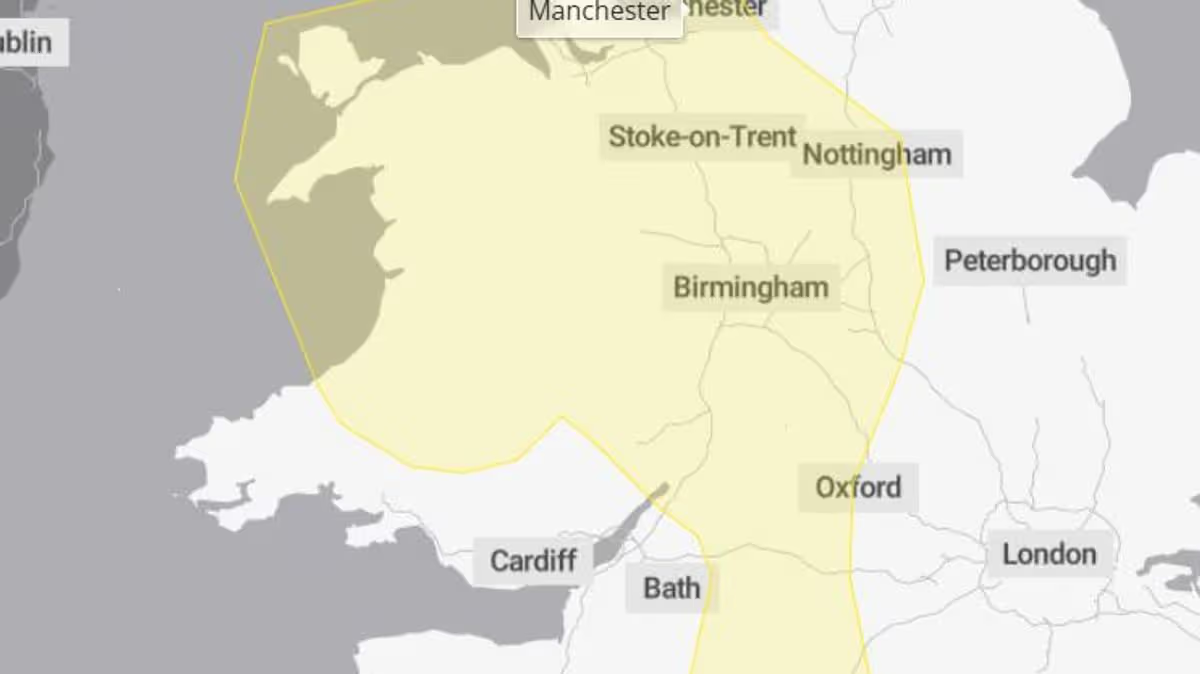
The Met Office warning is in force until 4am on Thursday
Tom Burnett Content Editor
00:16, 28 May 2026
The Met Office has issued a weather warning for thunderstorms across areas of England and Wales on Thursday morning (May 28).
The yellow weather warning is in place from midnight until 4am and covers Greater Manchester.
Advertisement
It states: “Thunderstorms will continue to affect parts of England and Wales and are likely to become increasingly confined to northern and eastern parts of the warning area during the course of the early hours. While many places will miss the worst conditions, where thunderstorms do occur frequent lightning and heavy downpours are likely. Hail and strong, gusty winds may also affect a few places.”
Click here to get the biggest stories straight to your inbox in our Daily Newsletter
The following 42 areas are covered by the weather warning on Thursday morning:
The Royal Life Saving Society issued a plea for everyone to “stop and think” before getting into water in response to the deaths, most of whom were children. It said that “warmer weather unfortunately correlates to an increase in accidental drownings”.
Advertisement
The society says that “water temperatures remain very cold” despite the warmer conditions. Tuesday saw the hottest weather conditions recorded for both England and Wales, the Met Office said.
Declan Sawyer, 15, died after getting into trouble at Swanholme Lakes, Lincoln, on Sunday. Also on Sunday, a 72-year-old woman died after being pulled from the water at West Angle Bay beach in Pembrokeshire, Wales, at around 3.15pm.
A 13-year-old boy, understood to be Reco Puttock, died after getting into difficulty at Leadbeater Dam, near Halifax, West Yorkshire, on Monday, while the body of a teenage girl was recovered from the water at Kingsbury Water Park, Warwickshire.
Advertisement
The same day, a man in his 60s died of cardiac arrest after entering the sea at Tregirls Beach, Padstow, to help two family members who were in difficulty, Devon and Cornwall Police said. The body of a teenager was recovered from the water at Rother Valley Country Park, in Rotherham, in the early hours of Tuesday morning, South Yorkshire Police said.
Another body has been found in the search for a teenage boy who went missing after he was last seen swimming at Hawley Lake on the Hampshire/Surrey border on Tuesday afternoon.
On Tuesday evening, Lancashire Police said a body had been recovered from the River Ribble after a 12-year-old boy got into difficulty while swimming with friends at Ribchester. On Wednesday, Cheshire Constabulary said the body of a 17-year-old boy was found after he went missing in Pickmere Lake at Marston, Northwich.
Advertisement
Along with nine deaths in the UK, the Gardai in Ireland also said a teenage girl died in the sea at Burrow Beach, a popular swimming spot near Howth, on Sunday. The RNLI have warned of the “very real risk” of swimming in open water during the heatwave.
Visits to NHS web pages have also surged during the heatwaves as people sought advice on how to stay safe in the hot weather. NHS England said there were 20,092 visits to its heatstroke advice page on bank holiday Monday, compared to just 488 the previous Monday.
Over the whole weekend, there were 36,724 hits. Elsewhere, people looking for tips on how to deal with sunburn led to 5,342 visits to NHS webpages, with a total of 10,314 over the whole weekend.
Advertisement
Parents also sought advice on how to keep their babies safe, with visits to NHS web pages for baby first aid and sun safety tips surging by almost 3,500% on Monday, with 4,728 hits. While many people enjoyed the sunny bank holiday weekend, older people and babies can be particularly vulnerable.
There is also a risk of dehydration and heat exhaustion, which is caused by the body losing too much water and salt, and can lead to heatstroke, a life-threatening illness. Temperatures are expected to cool slightly in parts of the UK in the coming days but health officials have confirmed that heat health alerts would be extended for 24 hours.
The UK Health Security Agency said amber alerts for the South West, South East, London, East and West Midlands and the East of England will remain in place until 5pm on Thursday, with yellow heat-health alerts for the North West and North East.
The Met office have also issued a yellow thunderstorm warning for much of Wales, the South West of England and parts of the Midlands for 3pm to 11.59pm on Wednesday.
Advertisement
The warning stretches from Plymouth up to Holyhead and could bring torrential downpours of rain, frequent lightning, large hail and strong, gusty winds.
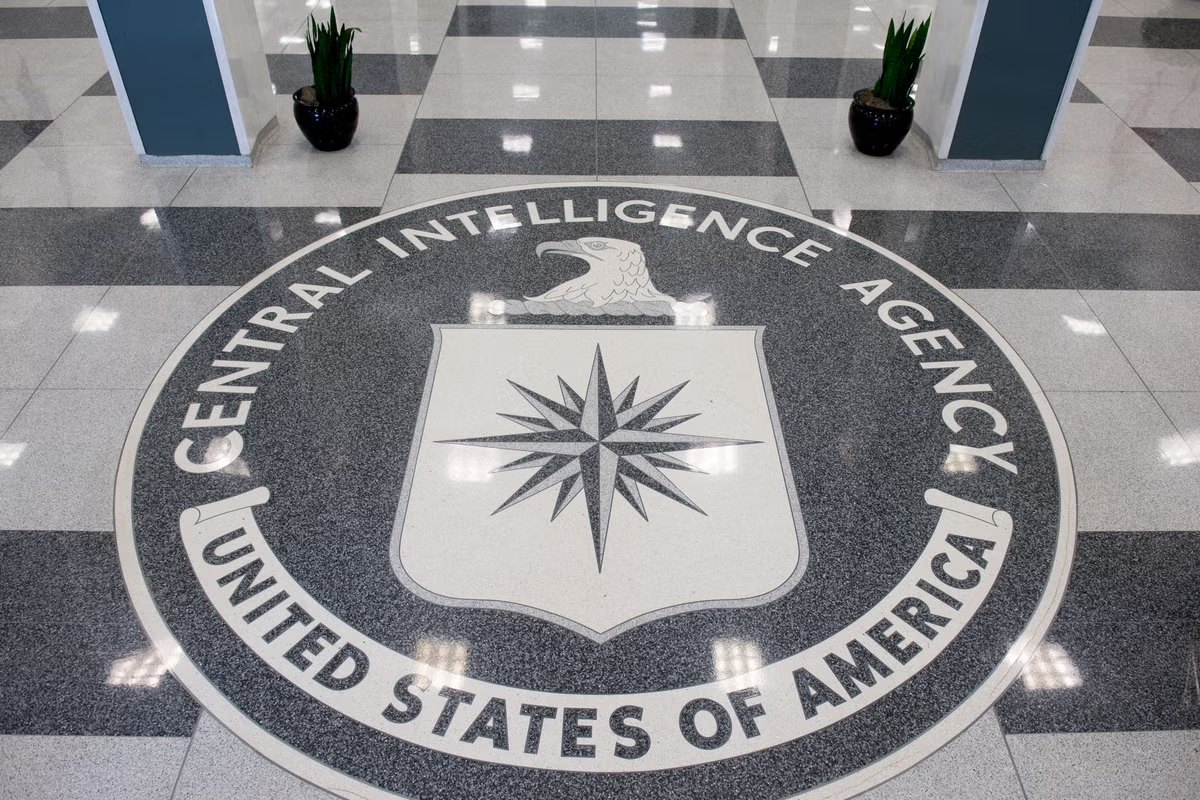
A former senior CIA official with top-secret clearance is accused of stealing hundreds of gold bars worth over $40 million from the federal government.
David Rush was arrested last week in Virginia, charged with criminal theft of public money, court filings confirm.
An FBI agent’s affidavit alleges that from November to March, Rush requested and received “tens of millions of dollars in gold bars for work-related expenses.” The gold was reportedly stashed in his home.
His intended use for the funds remains unclear, though a portion was found near his office in a storage space.
Advertisement
His intended use for the funds remains unclear, though a portion was found near his office in a storage space (AP Photo/Carolyn Kaster)
Federal officials searched his home on May 18 and seized more than 300 gold bars with an estimated value of more than $40 million, according to the affidavit. They also seized roughly $2 million in U.S. currency and some 35 luxury watches, many of them Rolexes. Rush was arrested the next day, the FBI said.
The FBI affidavit concludes that there’s probable cause to believe that Rush “knowingly embezzled, stole, purloined, or knowingly converted a thing of value of the United States” for his personal use.
The FBI said it was working with the CIA and Department of Justice in its investigation.
Rush’s lawyer declined to comment Wednesday.
It’s not clear what role Rush had at the CIA or when he left the agency. He’s described in court filings simply as a “former senior executive service-level employee at a United States government agency.” Spokespersons for the FBI declined to comment further, and the CIA didn’t respond to an email.
Advertisement
The FBI affidavit also notes that Rush appears to have lied for years about his education and military background. The bureau’s investigation found he had falsely claimed to be a Navy pilot and that he’d graduated from Clemson University in South Carolina and Rensselaer Polytechnic Institute in New York.
Instead, they found he had enlisted in the Navy in 1997 and then served in the U.S. Navy Reserves from 2004 until 2015, when he was honorably discharged as a lieutenant. The affidavit states he does not appear to have underwent any evaluations as a pilot during that time, and he did not attend either college.
Rush is being held in custody pending a hearing Friday in federal court in Alexandria, Virginia.
These fresh strikes were aimed at a military site believed to have posed a threat to American forces and commercial traffic in the Strait of Hormuz, a key oil passageway in the Middle East, a US official told Reuters Wednesday.
Despite the latest attack, the fragile ceasefire between the U.S. and Iran that has held for nearly two months is still considered to be in effect, a U.S. official told CBS News.
Earlier this week, the U.S. Central Command announced what it called “self-defense” strikes, targeting Iran’s missile launch sites and mine-laying boats in the Strait of Hormuz.
Advertisement
The U.S. has launched new strikes on Iran, days after targeting the country’s missile sites and mine-laying boats, according to officials (AFP via Getty Images)
“U.S. forces conducted self-defense strikes in southern Iran today to protect our troops from threats posed by Iranian forces,” CENTCOM spokesperson Captain Tim Hawkins said Monday evening.
“U.S. Central Command continues to defend our forces while using restraint during the ongoing ceasefire,” Hawkins added.
The Independent has reached out to CENTCOM for comment on the new strikes.
The fresh strikes came after President Donald Trump threatened to “finish the job” if Tehran and Washington couldn’t reach an agreement that he was satistified with.
“Iran is very much intent, they want very much to make a deal,” he said at a White House cabinet meeting Wednesday.
Advertisement
“So far, they haven’t gotten there. We’re not satisfied with it, but we will be. We will be — either that or we’ll have to just finish the job,” he added.
KAMPALA, Uganda (AP) — Uganda on Wednesday ordered the closure of its border with Congo, where suspected cases of a rare type of Ebola are surging, and as cases have been confirmed at home after Ugandan health workers were exposed to the disease from Congolese patients.
The measure, which goes against the guidance by the World Health Organization, underscores growing fears of contagion in East Africa from Bundibugyo, a rare type of the Ebola virus that is behind this outbreak and that has no approved medicines or vaccines.
Like Congo, Uganda has faced Ebola outbreaks in the past. A local Ugandan task force made the decision on the border closure. The Ugandan health workers were exposed to the virus by Congolese patients who had crossed the border before the outbreak was declared in eastern Congo on May 15.
The border closure was temporary, with “immediate effect,” Dr. Diana Atwine of the Ugandan Ministry of Health, told journalists. Border crossings will be authorized only in emergency cases, including for the outbreak response, humanitarian, cargo or security reasons, she added.
Advertisement
Anyone entering from Congo under emergency circumstances will be taken into mandatory isolation for 21 days.
Congo says over 100 cases have been confirmed
Tracing and isolating Ebola contacts is seen as key to stopping the spread of the disease, which usually manifests as hemorrhagic fever. The virus is spread through close contact with sick or deceased patients’ bodily fluids. Experts say healthcare workers and family members caring for patients face the highest risk.
The number of suspected cases in eastern Congo is nearing 1,000, with at least 220 suspected deaths. Congo’s health ministry on Tuesday said 101 cases have been confirmed, and they are looking into over 3,000 possible contacts.
On Wednesday, Congolese authorities said that the first person who recovered from the Bundibugyo virus has been released home from a treatment center in Rwampara, one of the towns in eastern Congo at the heart of the outbreak.
Advertisement
WHO has discouraged border closures with Congo while acknowledging that neighboring countries are at high risk of contagion. The U.N. health agency has declared this outbreak a public health emergency of international concern.
Closures “push the movement of people and goods to informal border crossings that are not monitored, thus increasing the chances of the spread of disease,” the agency said.
The Uganda-Congo border is several hundred miles long and crossed by numerous footpaths beyond formal border posts. Many people come and go in the course of a day to visit families or to trade.
Congolese health authorities are struggling to contain the outbreak, which WHO says is outpacing them. The rare type of Ebola was confirmed weeks late as tests were carried out for a more common type. Challenges also include the threat from armed groups in eastern Congo, a large number of displaced people and poor infrastructure.
Advertisement
WHO’s Director-General Tedros Adhanom Ghebreyesus called on Wednesday for a ceasefire in eastern Congo to allow safe access for responders and others, saying on social media that “attacks on health facilities make tracking cases and their contacts nearly impossible.”
Responders in Congo have said they are underprepared and under-protected for this outbreak, while conflict-traumatized residents, long wary of outsiders, have attacked a number of clinics and hurled stones and abuse at volunteers trying to make people aware of the virus and its risks.
Infected people or those have been in contact should not undertake international travel unless it’s a medical evacuation, WHO has said. On Wednesday, the Trump administration said it is planning to send Americans who are exposed to Ebola to a new facility in Kenya instead of flying them to the United States.
Uganda is concerned about exposed health workers
Uganda has reported seven cases of Ebola, including the first case of a 59-year-old man who died in Kampala, the country’s capital, on May 14. While the Ebola case load is not spiking, the number of locals exposed to infection via health workers has been rising.
Advertisement
“They have families, and so the number has been increasing,” Atwine, the Ugandan health official, said of the health workers.
She also said she was dismayed to see some Ugandans forming crowds to celebrate Arsenal as British Premier League champions. The team has a large following in Uganda. Atwine urged people to be vigilant, avoid shaking hands and use sanitizer.
Congo has had 17 Ebola outbreaks. Health experts say aid cuts last year by the U.S. and other rich nations are devastating for eastern Congo, in part because of the region’s unique problems.
Aid groups fighting this outbreak say they don’t have the equipment they need, including face shields and suits to protect health workers from infection, testing kits and body bags needed to safely bury victims.
Advertisement
___
Associated Press writer Jean-Yves Kamale in Kinshasa, Congo, contributed to this report.
The Associated Press receives financial support for global health and development coverage in Africa from the Gates Foundation. The AP is solely responsible for all content. Find AP’s standards for working with philanthropies, a list of supporters and funded coverage areas at AP.org.
“Lotus Homes is delighted to confirm that planning approval has now been granted for Phase 2 of the Watson’s Fort development in Newry.”
21:20, 27 May 2026Updated 21:21, 27 May 2026
A major housing development has been given the go-ahead for its next huge phase.
An amended Loftus proposal for 176 homes will see Watson’s Fort massively increase from 22 houses in Phase 1 to just under the originally approved 200 units.
A spokesperson for Lotus said: “ Lotus Homes is delighted to confirm that planning approval has now been granted for Phase 2 of the Watson’s Fort development in Newry.
Advertisement
“Following strong demand and a positive response to Phase 1, this next phase will deliver a further collection of high-quality family homes in one of Newry’s most sought-after residential locations.”
WASHINGTON (AP) — U.S. military contractors need at least three years to replenish stockpiles of three key weapons systems used heavily in the Iran war, according to an analysis released Wednesday, adding to concerns that American forces would have limited firepower in any future conflict with China.
The weapons systems are Tomahawk cruise missiles, which are used to strike targets deep inside enemy territory, and Patriot and THAAD interceptors that defend against incoming missiles and drones.
“The United States has enough munitions for any plausible scenario in the Iran war, but the depleted inventories have created a window of vulnerability for a potential Western Pacific conflict,” the Center for Strategic and International Studies said in its new report, provided to The Associated Press. “The time needed to rebuild those inventories has thus become a major concern.”
China has a stated goal of ensuring its military is capable of taking Taiwan by force if necessary by 2027, which experts see as more aspirational than a hard deadline. But Chinese President Xi Jinping warned this month that if Washington mishandles its relations with the self-governing island, the U.S. and China could end up clashing or even in open conflict.
Advertisement
Trump administration is boosting funding, but production takes time
The analysis by the Washington think tank factors in the Republican Trump administration’s historic $1.5 trillion defense budget proposal for 2027, which significantly accelerates spending on high-end munitions that began under the Democratic Biden administration. While there’s bipartisan agreement in Congress to boost inventories, “the problem today isn’t money; it’s time,” the report said.
“It takes time to expand production capacity and to build these complex systems,” the report said, adding that the window of vulnerability will last “for several years until inventories return to their previous levels and another several years before they get to the levels that war planners desire.”
Although munitions inventories are classified, CSIS said sufficient public information exists in Pentagon budget materials to estimate production timelines.
President Donald Trump and Defense Secretary Pete Hegseth have insisted the U.S. is capable of fighting any war. They have pushed defense contractors to speed up munitions production, with Hegseth telling lawmakers last month that military spending under Trump will help manufacturers double or even triple their capacities.
Advertisement
During Trump’s Cabinet meeting Wednesday, Hegseth lauded the president’s efforts to expand the nation’s defense manufacturing sector, with private contractors investing in new plants and production lines “so that we’re getting weapons faster than ever.”
Acting Under Secretary of Defense and Comptroller Jules Hurst III, Defense Secretary Pete Hegseth and Chairman of the Joint Chiefs of Staff Gen. Dan Caine arrive to testify at a Senate Appropriations subcommittee on defense hearing on the budget request for the Department of Defense, Tuesday, May 12, 2026, in Washington. (AP Photo/Alex Brandon)
Advertisement
Acting Under Secretary of Defense and Comptroller Jules Hurst III, Defense Secretary Pete Hegseth and Chairman of the Joint Chiefs of Staff Gen. Dan Caine arrive to testify at a Senate Appropriations subcommittee on defense hearing on the budget request for the Department of Defense, Tuesday, May 12, 2026, in Washington. (AP Photo/Alex Brandon)
Advertisement
Advertisement
Advertisement
Chief Pentagon spokesman Sean Parnell said in a statement that the military “has everything it needs to execute at the time and place of the President’s choosing.”
“We have executed multiple successful operations across combatant commands while ensuring the U.S. military possesses a deep arsenal of capabilities to protect our people and our interests,” Parnell said.
Some military experts have pushed back. Pentagon officials “knew the reality of our military stockpiles and hopefully told someone, ‘Hey, if we go to this fight, even in the most conservative estimates, we are drawing down our stockpiles to a critical level,’” said Virginia Burger, a senior defense policy analyst at the Project On Government Oversight watchdog group and a former Marine officer.
Advertisement
Concerns about diminished stockpiles were a theme at recent congressional hearings. For Democrats, the munitions supply is a damning metric against the Iran war, which Trump launched without lawmakers’ approval. Some Republicans argue that the problem stems from the U.S. sending Patriot missile defense systems to Ukraine after Russia invaded in 2022, although several American allies use those systems.
Acting Under Secretary of Defense and Comptroller Jules Hurst III, Defense Secretary Pete Hegseth and Chairman of the Joint Chiefs of Staff Gen. Dan Caine arrive to testify at a Senate Appropriations subcommittee on defense hearing on the budget request for the Department of Defense, Tuesday, May 12, 2026, in Washington. (AP Photo/Alex Brandon)
Advertisement
Acting Under Secretary of Defense and Comptroller Jules Hurst III, Defense Secretary Pete Hegseth and Chairman of the Joint Chiefs of Staff Gen. Dan Caine arrive to testify at a Senate Appropriations subcommittee on defense hearing on the budget request for the Department of Defense, Tuesday, May 12, 2026, in Washington. (AP Photo/Alex Brandon)
Advertisement
Advertisement
Advertisement
Advertisement
The roots of the predicament can be traced to the end of the Cold War, said Mark Cancian, a retired Marine colonel and senior adviser at CSIS who co-authored the study with research associate Chris H. Park.
After the fall of the Soviet Union in late 1991, the U.S. assumed future wars would be short and regional with little need for large numbers of such high-end weapons, Cancian said in an interview. The Pentagon ordered relatively low numbers, assuming the military would not need many of them. Military contractors responded in kind, relying on a relatively small manufacturing footprint to build them.
Russia’s war with Ukraine showed that wars could be protracted and require deep inventories of advanced weapons, Cancian said. At the same time, U.S. military strategists were war-gaming possible conflicts in the western Pacific.
“The thinking started to change, but it just takes time to build inventories,” Cancian said, adding that part of the challenge is bringing up to speed a complicated web of supply chains and subcontractors that produce very novel components.
Advertisement
President Joe Biden’s administration should get some credit for starting conversations with the defense industry, putting money into the industrial base and ramping up production, said Cancian, who oversaw acquisitions of military hardware at the Office of Management and Budget under Presidents George W. Bush, a Republican, and Barack Obama, a Democrat.
“A lot of people in the Trump administration are inclined to say that everything was terrible until they arrived, and that’s not true,” Cancian said. “Now, it is true that the Trump administration really increased funding.”
How long it will take to rebuild key stockpiles
The U.S. fired 1,000-plus Tomahawk missiles at Iran, and it could take until late 2030 to fully replenish the prewar inventory, CSIS estimates show.
Fewer than 200 Tomahawks are made a year because of small orders in the past, the report says. However, manufacturer Raytheon has a goal of ramping up capacity to more than 1,000 per year.
Advertisement
RTX, Raytheon’s parent company, declined to comment on the CSIS findings because it had not yet seen the report. But RTX pointed to investments of several billion dollars to boost production, including expanding facilities in Alabama and Arizona.
For in-demand air defense systems, replacing as many as 290 THAAD, or Terminal High Altitude Area Defense, interceptors that shot down incoming Iranian drones and missiles could take until the end of 2029, CSIS estimates. Replenishing more than 1,000 Patriot interceptors should wrap up in mid-2029.
Lockheed Martin is significantly boosting production of rounds for both systems, while deliveries of THAADs “were apparently re-sequenced to prioritize U.S. needs over those of allies and partners,” CSIS noted.
“Patriot deliveries pose a dilemma for the United States because of the need to replenish its own inventories, help Ukraine defend against Russian missile attacks, and meet the needs of 17 other countries that use the interceptor,” the report said.
Advertisement
Lockheed Martin said in a statement that it’s investing $9 billion through 2030 and “is already delivering tangible results to meet heightened munitions demand, including a new facility in Alabama announced last week along with more than 20 others across the United States.”
In the meantime, CSIS said a potential conflict with China is “not all bleak,” with the U.S. military recently displaying its capabilities against Iran, Venezuela and the Houthi rebels in Yemen.
“China is deeply aware that it has no recent combat experience and that it performed poorly in its last war — against Vietnam in 1979,” the report said. “That difference in experience may preserve deterrence until munitions inventories are restored.”

























































You must be logged in to post a comment Login