One in seven people in England were prescribed antidepressants last year, worrying figures show.
It comes amid a sharp rise in mental health problems such as depression and anxiety since the pandemic.
A record 9.1million patients were given the drugs by their doctor in the last 12 months, an increase of more than 15 per cent in five years.
There is a stark regional divide with antidepressant use highest in North Cumbria and South Yorkshire, and almost double the rates seen in affluent parts of London.
People in England’s most deprived communities received around a third more prescriptions than those in the least disadvantaged parts of the country.
Some 96million antidepressant prescription items were dispensed last year, up 21 per cent on the 79.4million handed out five years earlier, according to the NHS Business Services Authority.
Patients treated under the North East and North Cumbria Integrated Care Board had the highest rate of antidepressant use, with 200 in every 1,000 prescribed medication.
Around 5.9million of all those given the drugs last year were women, accounting for 65 per cent of patients.
The figures come amid a sharp rise in mental health problems such as depression and anxiety – two of the main conditions antidepressants are used to treat – since the pandemic.
The proportion of adults suffering significant symptoms of depression remains almost twice as high as before Covid, rising from 9.7 per cent in 2019 to 18 per cent in April 2025 – equivalent to almost one in five adults – according to the Office for National Statistics (ONS).
Rates are even higher among younger adults, with 26 per cent of those aged 16 to 29 affected – more than one in four. Dr John Read, professor of clinical psychology at the University of East London, said the figures revealed an ‘epidemic of overprescribing’.
He added that doctors were increasingly being expected to treat wider social and life problems with medication.
Women are around twice as likely to be diagnosed with depression and prescribed antidepressants as men, although experts disagree on how much of the gap reflects biological differences and how much is due to women being more likely to seek help and discuss their symptoms.
Children have also been affected, with rates of mental illness continuing to rise since the pandemic.
By 2023, one in five eight-to-16-year-olds had a probable mental disorder, up from around one in six in 2020.
Meanwhile, 1.35million working-age people who were out of work because of long-term sickness reported suffering from depression, anxiety or mental health problems in 2023 – a 40 per cent rise since before the pandemic.
Professor Dame Clare Gerada, former chairman of the Royal College of General Practitioners, believes the evidence suggests more people are feeling dissatisfied with life
More recent figures show around 2.8million people remain out of work because of long-term sickness overall, compared with just over 2million before Covid.
Around 20.5million working days were lost to poor mental health in 2024, the ONS found.
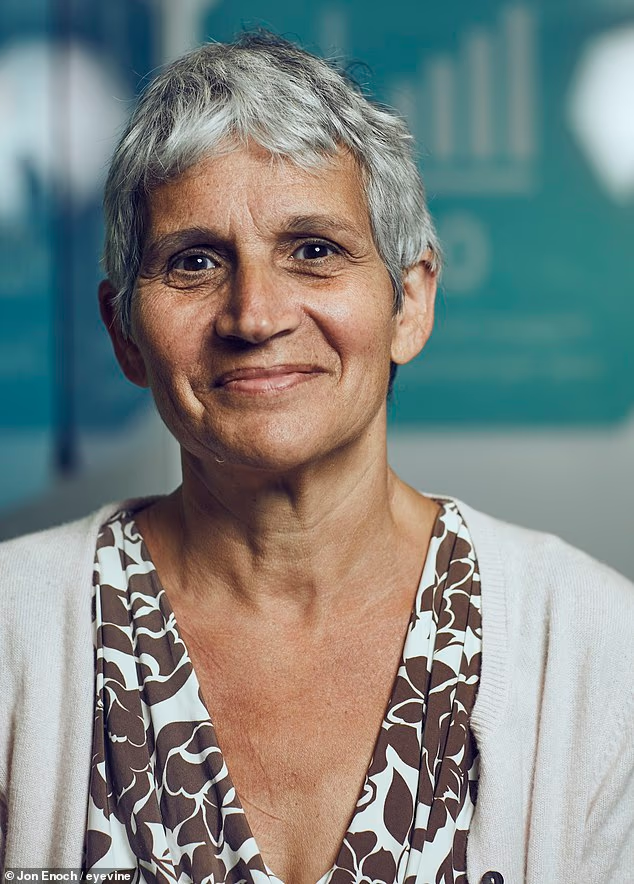
Professor Dame Clare Gerada, former chairman of the Royal College of General Practitioners, said the figures reflected wider changes in society rather than overprescribing.
‘All the evidence suggests people are more stressed and more anxious than ever,’ she said.
‘People go to their GPs and say they’re not sleeping, eating, and have felt really low for weeks and often ask whether antidepressants might help.
‘It is not the fault of the profession, per se, but I am worried about these numbers.’
For the first time in four years, the number of children prescribed antidepressants rose, from 62,601 in 2024-25 to 63,609 last year.
The increase comes despite commonly prescribed antidepressants carrying warnings about an increased risk of suicidal thoughts and behaviour in children, adolescents and young adults.
GPs are advised not to start antidepressant treatment in under-18s without specialist assessment, while the National Institute for Health and Care Excellence (NICE) recommends that the drugs should be given alongside psychological therapy.
For adults, NICE also advises that the drugs should not be offered as a first-line treatment for less severe depression unless that is the patient’s preference.
The most commonly prescribed antidepressants are selective serotonin reuptake inhibitors (SSRIs), which increase levels of serotonin – a chemical involved in regulating mood – in the brain.
Dr Joanna Moncrieff, a professor of psychiatry and consultant psychiatrist, said the figures suggest patients were remaining on antidepressants for longer than initially intended
The rise has been particularly striking for some individual drugs.
Prescriptions for sertraline, one of the most commonly used antidepressants, have increased by around 120 per cent over the past decade.
Dr Joanna Moncrieff, a professor of psychiatry at University College London and consultant psychiatrist at North East London NHS Foundation Trust, said the figures suggest patients were remaining on antidepressants for longer than initially intended.
NHS guidance recommends that people should continue taking antidepressants for six months after their symptoms improve, before considering gradually reducing their dose.
However, separate NHS data suggests half of those prescribed medications have been taking them for more than two years, while a quarter – around 2million people – have used them for more than five.
Dr Moncrieff said growing numbers were turning to antidepressants to cope with difficult periods in their lives.
Doctors could also find it difficult to send distressed patients away without treatment, she added, particularly when they were asking for medication.
Psychological therapies such as cognitive behavioural therapy are also recommended treatments for depression, and NICE advises that antidepressants should not routinely be the first option for less severe cases unless the patient prefers medication.
But access to talking therapies can involve lengthy waits, while antidepressants can be prescribed immediately by a GP.




































































You must be logged in to post a comment Login