Connect with us
DAPA Banner

NewsBeat

Greater Manchester’s most truanted schools revealed – including one in Salford among England’s worst

Published

on

Manchester Evening News

New data has revealed the schools in the country with the highest rates of truancy – with two in Greater Manchester in the top 20.

Pupils at state-funded secondaries in Greater Manchester missed the equivalent of around one in 26 days through unauthorised absences in the 2024/25 academic year – a rate of 3.8 percent.

That rate of lost “school sessions”, to use the official term, was above the national average of 3.2% – which itself is almost double that of pre-pandemic levels, when just 1.8% of sessions were lost to unauthorised absences in the 2018/19 academic year.

Click here to get the biggest stories straight to your inbox in our Daily Newsletter

Advertisement

You can use our interactive table to find out the truancy rates at every state-funded secondary school in England.

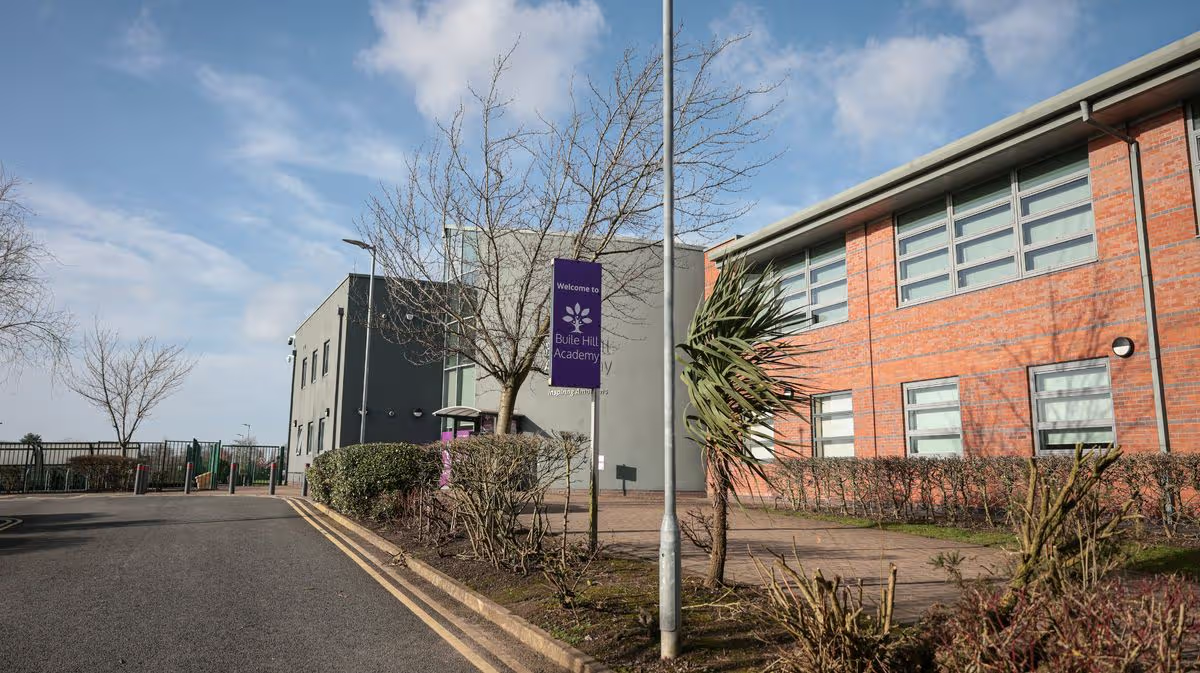
Buile Hill Academy in Salford had the highest rate in Greater Manchester, with more than one in every nine school sessions last year (11.7%) were lost due to unauthorised absences. That saw the school ranked ninth in the whole of England.

When contacted for a comment, the school said: “Buile Hill Academy has undergone rapid and significant improvement since joining Northern Education Trust.

“GCSE performance has risen dramatically: the proportion of students achieving grade 5+ in English and maths has surged from around 16% in 2024 to nearly 50% in 2025. Overall attainment has strengthened too, with English and maths 4+ increasing from 33% to 65.1% and 5+ rising from 16.8% to 49.4%.

Advertisement

“Attendance is also improving, and DfE data now places the academy among the ten most improved schools in the North West. Throughout this transformation, the academy has maintained a clear commitment to being both outcomes‑focused and child‑centred.”

Denton Community Academy in Tameside had the region’s next highest rate of unauthorised absences at 11.2%, ranking 14th in the country. That was followed by Dixons Brooklands Academy in Manchester at 10.8%, and Manchester Enterprise Academy also at 10.8, ranked at 21 and 22.

Advertisement

When contacted for comment, Denton Community Academy said: “Northern Education Trust Denton Community Academy has also undergone a rapid transformation since joining the trust.

“Their results have doubled in a short space of time, with the proportion of students achieving a grade 5 or above in English and maths rising from 26% to 52%.

“Attendance at Denton has also improved and overall absence has reduced. It is important to recognise that attendance is a national issue facing all schools, and describing this simply as ‘truancy’ does not reflect the full picture.

“As with all trust academies, Denton has clear and consistent systems in place, alongside strong pastoral support and works closely with families, to ensure students attend regularly and are well supported.

Advertisement

“These improvements were recognised in the school’s most recent Ofsted letter, which highlighted strengths in education, behaviour and the wider school culture.”

But it was Tameside that had the highest rate of unauthorised absences of any borough last year, with one in every 20 sessions (5.1%) lost to unauthorised absences. That puts Tameside just ahead of Salford (5.0%), Rochdale (4.8%) and Manchester (4.3%).

By contrast, just 1.5% of school sessions at state-funded secondaries in Trafford were lost to unauthorised absences last year. That’s the lowest rate in the county ahead of Wigan (3.2%), Bolton (3.4%) and Stockport (3.5%).

Advertisement

Fir Vale Academy in Sheffield was England’s most truant secondary school last year with 17.1% of sessions missed through truancy. The Co-op Academy in Leeds has the next highest rate in the country with 13.3%, followed by Saint Edmund Arrowsmith Catholic Academy in Knowsley with 13.1%.

That’s followed by The Basildon Upper Academy in Essex at 12.8%, Alsop High School in Liverpool at 12.7%, Leeds East Academy in Leeds at 12.5%, and Aylesbury UTC in Buckinghamshire at 12.3%.

Greater Manchester’s 10 highest rates

9. Buile Hill Academy, Salford: 11.7%

Advertisement

14. Denton Community Academy, Tameside: 11.2%

21. Dixons Brooklands Academy, Manchester: 10.8%

22. Manchester Enterprise Academy, Manchester: 10.8%

47. Werneth School, Stockport: 9.3%

Advertisement

81. The Albion Academy, Salford: 8.4%

83. Rayner Stephens High School, Tameside: 8.4%

124. Co-op Academy Manchester, Manchester: 7.8%

168. Cedar Mount Academy, Manchester: 7.1%

Advertisement

172. Hyde High School, Tameside: 7.1%
Source link

Continue Reading
Click to comment

You must be logged in to post a comment Login

Leave a Reply

NewsBeat

ITV announces major TV star has signed up to be quizzed on The Assembly

Published

on

Wales Online

ITV’s The Assembly has returned for its second series and a big name is set to appear in an upcoming instalment

ITV has announced the sixth celebrity preparing to be interrogated in the second series of The Assembly.

Advertisement

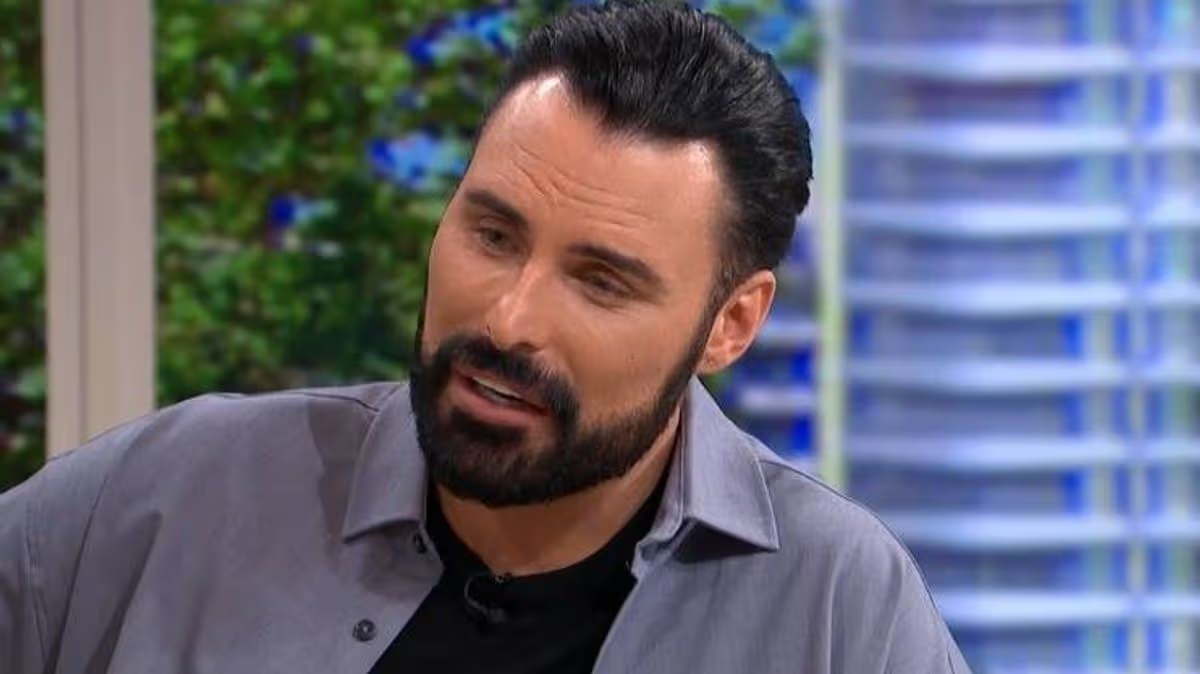
TV and radio personality Rylan Clark – known for shows including This Morning, Strictly Come Dancing spin-off It Takes Two and his travel programme with Rob Rinder – will be occupying the hot seat in an upcoming instalment of the ITV programme.

The BAFTA-nominated series features a panel of curious interviewers – who are autistic, neurodivergent and/or learning disabled – posing their distinctive questions to well-known personalities.

The second series started earlier this month and has already featured the likes of national treasure Sir Stephen Fry, former Scottish First Minister Nicola Sturgeon, comedy icon Sir Lenny Henry and Motherland actress Anna Maxwell Martin.

The fifth episode on April 22 will showcase BRIT award-winning rapper and I’m A Celebrity star Aitch facing questions, while Rylan’s episode is scheduled to broadcast in May, reports the Mirror.

Advertisement

READ MORE: Rylan Clark undergoes ‘invasive’ procedure as transformation causes a stirREAD MORE: Rylan Clark marks This Morning return after outrage over immigration comments

He will be filmed responding to questions from the panel, where no question is forbidden and no subject is off-limits.

The identities of the remaining celebrities participating in this series were announced in March, though Rylan’s involvement has only just been disclosed.

Advertisement

The Assembly, an adaptation of French format Les Rencontres du Papotin, premiered last year and proved enormously popular.

The inaugural series featured prominent personalities including EastEnders icon Danny Dyer, Rivals star David Tennant and Little Mix vocalist Jade Thirlwall facing questions from the panel of interviewers.

Following the announcement of the second series line-up, Katie Rawcliffe, director of entertainment, reality and daytime commissioning at ITV, commented: “This line-up really does offer something for everyone – The Assembly’s no-holds-barred questions throw up all kinds of surprising revelations.”

Advertisement

David Smyth, entertainment commissioning editor at ITV, remarked: “The Assembly are raring to go and with such a unique mix of famous faces to interview, they will have a ball coming up with their next set of questions.

“These celebrities really do need to be ready for anything,” he continued.

Rylan’s episode of The Assembly will air next month across ITV1 and ITVX, STV and STV Player. Both the first series and opening five episodes of series two are available to stream now.

Source link

Advertisement
Continue Reading

NewsBeat

Urgent scam warning over HMRC calls and new way to check

Published

on

Urgent scam warning over HMRC calls and new way to check

HMRC has refreshed its official guidance to help Brits spot genuine calls, and avoid fraudsters pretending to be tax officials.

This follows a spate of scams, preying on vulnerable people – particularly pensioners concerned about changes to the Winter Fuel Payments.

What real HMRC calls look – and sound – like

HMRC has confirmed it does contact some people by phone, but only in specific situations.

Advertisement

For example, you may get an automated or recorded call if you’re behind on tax payments.

These calls will:

  • Explain what you need to do about your debt
  • Direct you to official payment options or helplines
  • Never ask for personal or financial details

If a caller asks for bank details, passwords or urgent payments – that’s a major red flag.

New HMRC calls happening right now

Between April 20 and May 18, some people may also receive calls from Verian, which is working with HMRC on research into tax fraud awareness.

These calls are legitimate – but optional – so if you aren’t sure, it’s fine to decline.

Advertisement

You may be asked to take part in a survey, but:

  • Your answers will be anonymous
  • Participation is voluntary
  • You will not be asked for financial information

How to spot a scam call

Fraudsters often pretend to be HMRC – especially during busy tax periods.

Warning signs include:

  • Pressure to act immediately
  • Threats of arrest or legal action
  • Requests for payment via unusual methods (like gift cards or crypto)
  • Asking for sensitive personal or banking details

If a call feels suspicious, hang up and check independently in the new HMRC guidance .


Recommended reading:


How to check if a call is genuine

HMRC now publishes a list of recent phone contact campaigns so you can verify whether a call is real.

Advertisement

If the call you received isn’t listed, you should treat it with caution and check official contact routes.

You can also report suspicious calls directly to HM Revenue & Customs to help tackle scams.

A quarter of adults targeted by scams

This comes as new research from Yorkshire Building Society reveals that more than one in four adults (27%) have been targeted by a financial scam in the past three years alone. The figure rises to over a third (35%) among 18–29-year-olds, highlighting the growing reach of fraud and scams across all age groups.

Among those who had been targeted, over half (56%) encountered an impersonation scam, where fraudsters posed as trusted organisations such as banks, HMRC, energy companies, delivery firms or even family members to request money, personal information or access to accounts.

Advertisement

The findings are being highlighted to mark Take Five Week (27 April – 3 May), a national campaign from UK Finance, encouraging people to stop, challenge and protect themselves against fraud.

More information on how to protect yourself from fraud and scams is available at takefive-stopfraud.org.uk .

Hannah Bingle, Financial Crime Specialist at Yorkshire Building Society , said: “These scams are often designed to create a sense of urgency, pushing people to act quickly without verifying the source, but by stopping and taking a moment to ask yourself if a message, call or email is genuine, you could protect yourself.

Advertisement

“If you receive a call out of the blue, be wary. Companies won’t request financial or password details, so never share them. If you suspect fraud or feel pressured, hang up and contact the company directly using their official phone number.

“If you receive a message, text or email that appears to be from a trusted source, take the time to ask – is it genuine?

“Be particularly wary of messages that request personal details, include a link to a form, or pose as someone you trust asking for money.”

Advertisement

Source link

Continue Reading

NewsBeat

Warning as dog collapses and dies after suspected snake bite near beach

Published

on

Daily Mirror

Jo Bowen-Jones, from Anglesey, believes her dog Baxter died after a suspected adder bite – the only venomous snake native to the UK – at common land beside RAF Valley near Rhosneigr

A dog owner believes her beloved pet died after being bitten by a snake near a Welsh beach.

Jo Bowen-Jones, from Anglesey, suspects her dog Baxter was bitten by an adder – the only venomous snake native to the UK – on common land beside RAF Valley near Rhosneigr.

Ms Bowen-Jones, a grandmother living in Rhosneigr, told North Wales Live how on the morning of Tuesday, 31 March, the pair had crossed a wooden bridge over Afon Crigyll when their walk came to an abrupt halt after Baxter, a Springer-Cocker spaniel, lifted his paw and started limping.

Advertisement

“I was on a track heading back to the car, not too far from the bridge, when I saw Baxter suddenly stop and lift his front paw,” she said. “He didn’t yelp and after some coaxing he came to me. But he was struggling to walk. I had to half carry him over the bridge.”

READ MORE: Ricky Gervais restores faith in humanity after terrified dog thrown off city wallREAD MORE: Dog trainer names 4-word phrase that ‘will make pet’s behaviour worse’

Unable to get her dog home unaided, she asked a passing campervan owner to keep watch over him while she retrieved her car. “I was only gone five minutes,” she said. “But in the time I’d been away he’d vomited and pooed himself. There wasn’t any swelling but I felt his paw and there was a tiny mark.”

Advertisement

Having rung ahead to Bodrwnsiwn Vets in Mona, Ms Bowen-Jones and the campervan owner lifted Baxter into her estate car. She arrived at the veterinary practice within 30 minutes of the suspected bite, reports Wales Online.

“They carried him in on a rug – there was no way he could walk,” she said. “His breathing was ragged, his tummy was taut and his eyes were not good.” Baxter was administered anti-histamines and paracetamol and placed on a hydration drip. Vets also suspected an adder bite, though anti-venom medication was not administered.

“It can cause anaphylactic shock and other side effects,” Ms Bowen-Jones said. “As Baxter’s breathing was so laboured, it was decided anti-venom was too risky.”

She made arrangements to collect Baxter at 6pm, planning to transport him to Colwyn Bay, Conwy, for overnight care, as no such provision has been available for pets on Anglesey since June 2024.

Advertisement

“I got a phone call from the vets at 5pm to say Baxter had taken a turn for the worse,” she said. “His heart had stopped and, by the time I got there, he had died.

“I knew he was going downhill and I was losing him but it was still a shock. He was a fit and healthy five-year-old dog. As he had deteriorated so quickly it made me wonder if he’d had an underlying condition.

“I can’t fault the vets. They did their best and they were very clearly very upset. We’re 80%-plus sure it was an adder bite that killed him.

“He didn’t swell, as often happens, but every dog reacts differently. Soon after I read an adder had been seen in the same area around the same time.”

Advertisement

Keen to alert other pet owners to the danger, she posted a cautionary message on Facebook. “Dog owners often associate adders with coastal dunes but this happened on grassland,” she said. “They can be found in any open, sunny habitat.

“This year they seem to have come out early. Usually they will do their best to avoid people and dogs. But early in the year, as they emerge from hibernation, they can be a little drowsy and might not be so quick to get away, so extra care is needed.”

Despite a considerable surge in the UK’s dog population, adder bites remain uncommon and fatalities are exceptionally rare. While nearly all dogs that are bitten display symptoms, 95.4% reportedly pull through with prompt veterinary treatment. Fatalities typically result when the bite goes untreated, and tend to be more common among smaller breeds.

Source link

Advertisement
Continue Reading

NewsBeat

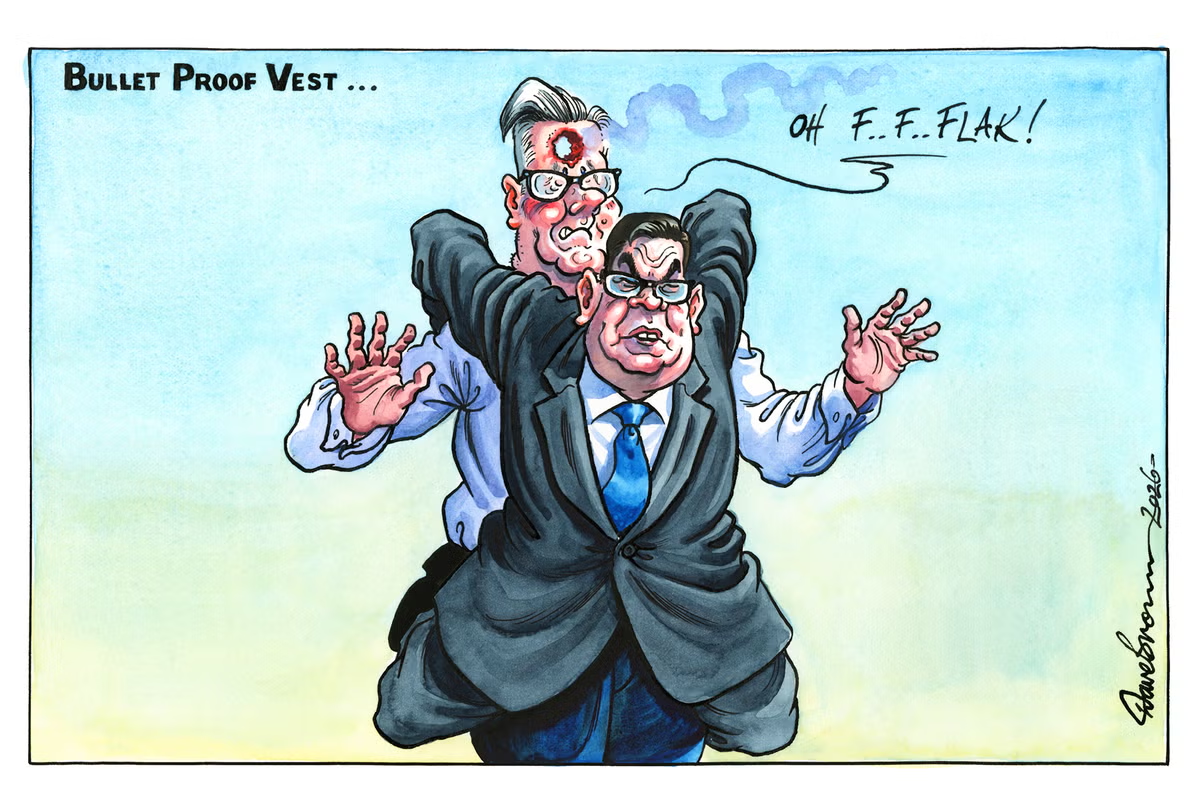
Newscast – Keir Starmer v The Civil Service

Published

on

Newscast - Epstein Files: New Mandelson and Andrew Allegations

Available for over a year

Today, Keir Starmer has sent a “real chill throughout the civil service.” That’s according to a senior union official following his decision to sack the lead civil servant in the Foreign Office, Olly Robbins.

James and Chris are joined by Senior Fellow at the Institute for Government, Catherine Haddon, to discuss the recent turbulence in the relationship between the government and the Civil Service over the appointment of Peter Mandelson and whats next for the institution.

And, economics editor Faisal also joins us to discuss why the inflation rate has increased 3.3% in March.

Advertisement

You can now listen to Newscast on a smart speaker. If you want to listen, just say “Ask BBC Sounds to play Newscast”. It works on most smart speakers.

You can join our Newscast online community here: https://tinyurl.com/newscastcommunityhere

Newscast brings you daily analysis of the latest political news stories from the BBC. It was presented by James Cook. It was made by Chris Gray with Jem Westgate. The social producer was Joe Wilkinson. The technical producer was Mike Regaard. The assistant editor is Chris Gray. The editor is Sam Bonham.

Programme Website

Source link

Advertisement
Continue Reading

NewsBeat

As Trump blinks first on Iran, a glimmer of hope emerges for peace in the Middle East

Published

on

As Trump blinks first on Iran, a glimmer of hope emerges for peace in the Middle East

Just as Donald Trump was supposed to rain more fire and fury down on Iran by destroying its bridges and power plants, killing its civilians, and – though it seems immaterial to him – thus explicitly committing war crimes, the president has done another “Taco”. He has proved, once again, the value of the conventional wisdom that he always chickens out.

For an unpredictable man, the pattern of behaviour first identified by Wall Street investors has proved a reliable enough guide in the context of US foreign policy. This is a strategic weakness for the United States, because its enemies – in this case Iran – are able to exploit it.

On balance, and provided it’s not upset by some early-hours social media tantrum by the president, the announcement of an extension to the ceasefire in the Iran war is encouraging. This time, as they say, it’s different. Or at least, it should be.

The extension of the ceasefire is now indefinite, so the world, and especially the Iranian people, will be spared the regular trauma of seeing whether Mr Trump will or won’t change his mind – it is never completely a given. Had the US president ordered more bombing raids on Iran, then Iranian retaliation would inevitably have followed, centred on the Gulf states and, in particular, US bases and other assets in the region. The disruption to the world economy, now becoming severe, would have intensified even further.

Advertisement

It is reassuring that the markets’ response to the news was mildly positive, with the assumption being – in financial circles at least – that the crisis may be stabilising, if not entering its endgame. The moments of maximum danger, in other words, may have passed.

Still, those risks remain. The US-Iran peace talks hosted in Islamabad by the Pakistani government have stalled once again. The Iranians now want the president to call off his blockade of maritime traffic going to and from their ports, while keeping their stranglehold on the Strait of Hormuz. By its actions so far in the region, the US has unilaterally ensured that this internationally crucial waterway will be controlled and taxed for ever.

For obvious reasons, Iran would like the “Tehran tollbooth” to be a permanent fixture. In recent days, its military has not hesitated to attack civilian shipping, with one Greek and three Panamanian-flagged vessels seized. On the American side, the US Navy is keeping up its own blockade in a different part of the Persian Gulf. The net effect is to prevent vital supplies of oil, natural gas, helium, fertiliser, aluminium and much else from flowing to and from global markets.

Unlike so many other regions afflicted by wars and disputes, where fighting winds down into an uneasy truce and long-term stagnation, the Persian Gulf – and the Red Sea and Suez Canal route, for that matter, menaced by the Houthi rebels – cannot be closed indefinitely. It has to be opened before the truly devastating effects on the world economy, concentrated on the poorer nations of Africa and Asia, become irreversible and a depression is triggered. That is the scale of pressure that should, and will, be brought to bear on the US to properly de-escalate its illegal and unnecessary war.

Advertisement

Other pressure will be brought to bear by the major economy that stands to lose the most from a global downturn – China. The consequences of the US Navy being involved in a stand-off with its Chinese counterpart hardly bear thinking about. For all his bellicose instincts, President Trump knows, to borrow his argot, that he cannot mess with Xi Jinping, a man with whom he claims to have a very friendly and respectful relationship.

The industrial and financial realities that lie behind these nations’ respective approaches to foreign policy should prevent that fatal escalation from happening – but it will require the Americans to quietly soften their Iranian blockade. China’s influence on Iran – the former being America’s most important international partner – should also help soften their attitude. Hostile public opinion in the US and the looming midterm elections will also concentrate Maga Republican minds, and push Mr Trump towards jaw-jaw rather than war-war.

For his part, all Mr Trump is demanding from Tehran these days is that it submit a “peace plan”. There is no more talk of “regime change”, “unconditional surrender”, or even ending Iran’s support for terrorist proxies in the region. The president would still, and rightly, expect Iran to renounce its nuclear ambitions, which, ironically, were under some control before this calamitous war was launched at the request of the Israelis. Given that Tehran has in the recent past signalled some willingness to do so, that is not a totally fanciful request.

For their part, the Iranians should insist on Israel ending its invasion of Lebanon and supporting the peace talks to that end, which are proceeding slowly in Washington. The chances of that actually transpiring are probably slim, given that Hezbollah isn’t involved and cannot be relied on to obey Iran if asked to do so. Nonetheless, the outlines of some sort of tacit agreement to end the war and free up world trade again are gradually hoving into view.

Advertisement

It’s rarely wise to be optimistic about the Middle East and US-Iran relations, and there’s no doubt that the world would be better off if the war had never started; but the fact is that the stage wherein Iran and America have more to lose by prolonging the conflict than by ending it is surely approaching. Meanwhile, Mr Trump should take a break from social media.

Source link

Continue Reading

NewsBeat

Liam Rosenior sacked: Chelsea owners have built monument to decline

Published

on

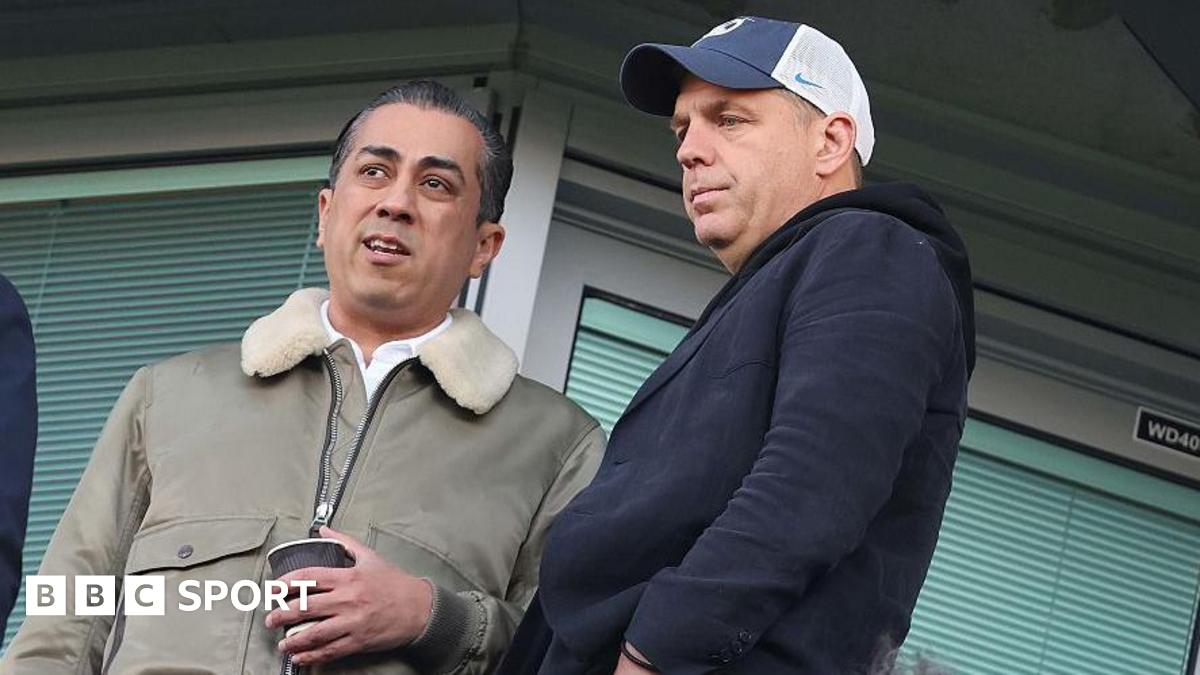
Chelsea owners Behdad Eghbali (left) and Todd Boehly

Rosenior’s dismissal may solve one problem, but those in Chelsea‘s boardroom must take the major share of the blame for a club that looks increasingly out of control.

Chelsea‘s recent losses eclipsed Manchester City‘s £197.5m deficit in 2011, despite bringing in £490.9m in revenue, which the club says is the second highest total in its history.

Since the current ownership took control in 2022, Chelsea have spent around £1.5bn on players, focusing on securing a raft of younger players on long-term contracts.

In this time, they have sacked Champions League winner Tuchel at the end of their first 100 days at the helm, then his successor Graham Potter seven months later.

Advertisement

Frank Lampard had a short second spell in charge as interim boss before former Tottenham Hotspur manager Mauricio Pochettino took charge, leaving by mutual consent after one season.

Enzo Maresca took over, but was sacked in January, less than six months after winning the Club World Cup to add to the Uefa Conference League.

If the final straw for Rosenior was criticism of his players, Maresca’s departure came amid friction with Chelsea‘s hierarchy, stunning key figures at the club after a 2-0 win against Everton in December by stating “many people” had made it his “worst 48 hours” since joining the club.

Cryptic, perhaps, but the beginning of the end for the Italian, as those in charge at Chelsea took a dim view of his public expression of discontent.

Advertisement

Those with knowledge of Maresca’s views, though, said he had grown unhappy at a multitude of factors, including encouragement over which players should start and which substitutions should be made during matches.

It led to the Rosenior experiment, which backfired on BlueCo, who may reflect on the number of managers hired and fired during their tenure and finally think: “It’s not them. It’s us.”

Former Chelsea winger Pat Nevin told BBC Radio 5 Live: “You would have to be a bit simple to be surprised at the situation with all the evidence in front of you.

“This is four seasons the new ownership has been in. This is manager number six. When you change it that amount of times, you have to ask the question – is the problem really the manager?”

Advertisement

Source link

Continue Reading

NewsBeat

I’m A Celebrity’s Jimmy Bullard confirms final status amid fresh Adam Thomas ‘feud’ claims

Published

on

Manchester Evening News

One ITV campmate has claimed that not all of the former footballer and actor’s arguement was shown

I’m A Celebrity South Africa star Jimmy Bullard has confirmed whether he will be at the final of the ITV reality show amid fresh claims from one of his campmates about his ‘feud’ with Adam Thomas.

Advertisement

Former footballer Jimmy left fans of the series divided on Tuesday night (April 21) as the campmates fought for their place in camp. Moments after Coronation Street icon Beverley Callard had to leave on medical grounds, the rest of the campmates were placed into pairs.

This led to an explosive row between former Emmerdale actor Adam, who has already issued a statement about boxer David Haye’s treatment of him, and Jimmy, with the latter deciding to quit the show and put Adam’s place in the competition at risk.

Click here to get the biggest stories straight to your inbox in our Daily Newsletter

The former Fulham player was seen watching the Bushtucker trail before he told his team: “Boys, I don’t think I’ve got it in me.” Jimmy then apologised to Adam and said ‘I’m A Celebrity… Get Me Out Of Here’, which caused the trial to end for everyone and meant that contestants must forfeit the stars they had won.

Advertisement

Adam then stormed over to Jimmy during a heated exchange and said: “Taking the f****** piss, are you taking the f****** piss?” He added: “I’m in there getting covered in f****** ants!” Jimmy responded by telling him to “calm down” and described his outburst as “pathetic”.

Due to Jimmy not attempting the challenge, Ant and Dec asked the campmates if they wanted to keep Adam in, who unanimously voted for the actor to remain on the show. When hearing that his campmates had voted to keep him in, Adam burst into tears, and said: “I appreciate that, guys. Thank you and I’m so sorry for the way that I acted as well, it was just emotions are really running high.”

Reports have since emerged that Jimmy would not be attending the final due to the dramatic scenes. Filmed last year, the live final is set to air on Friday night (April 22). Broadcast from London, the former campmates are set to be in attendance to see who follows in Myleene Klass’ footsteps and is crowned the latest I’m A Celebrity ‘Legend’.

Advertisement

With the fallout of the incident making headlines, singer Sinitta took to Instagram on Wednesday (April 22). According to the singer, who is also taking part in the series, the C-word was shouted during the argument.

Sinitta said: “There was a big argument, I can hear c-word, c-word, shouting c-word, you c-word. What on earth is going on? And I’m also thinking – can we get on with the race because I’m winning?

“I’m literally frozen in position like ready to carry on from where we’ve left off, but no. And it’s this massive fight and, of course, it was one of these things that if whoever lost the game, the team were off the show so Adam and Jimmy are going and I suddenly think, wait a minute this isn’t fair.”

Taking to the comments section of Sinitta’s post, former Soccer AM host Jimmy not only claimed that the full argument was not shown, but that he will be attending the final after all.

Advertisement

“Wow thanks @thesinittaofficial shame that wasn’t shown! My version will be told Friday! Can’t wait to see you all….well some of yous,” he wrote.

Source link

Continue Reading

NewsBeat

Knaresborough – man arrested after police stand-off

Published

on

Knaresborough - man arrested after police stand-off

It took place at a house in Marbled White Place, Knaresborough, after a man refused to leave or allow a woman to leave the property.


Recommended reading:


North Yorkshire Police said they were called to the scene just after 8am this morning and its officers raised a cordon.

Advertisement

In a statement just after 3pm, a force spokesperson said: “Following negotiations the man, who is in his 40s, has been arrested on suspicion of false imprisonment and has been taken to hospital for treatment, where he remains under close police supervision.

“Officers are emphasising that the incident has now concluded and is being treated as isolated.

“There has been a police presence in the area to deal with the incident and neighbourhood policing team officers will be on patrol to provide continued support to the local community this evening.”

Advertisement

Source link

Continue Reading

NewsBeat

Police increase patrols following Tonge Moor stabbing

Published

on

Police increase patrols following Tonge Moor stabbing

Bolton police have confirmed there is no wider threat to the community, and that this is being treated as an isolated incident.

Two men were treated for stab wounds after emergency services were called to Tonge Moor Road in Bolton at around 10.30am.

A man in his 50s was arrested on suspicion of assault and remains in custody for questioning.

The Bolton News understands that the man was was taken to hospital for an assessment and is now in custody as investigations continue.

Advertisement

Detective Chief Inspector Mike Sharples said: “We currently have a man detained and officers are conducting extensive enquiries as part of a comprehensive investigation.

“We fully appreciate that the local community will be concerned but I would like to reassure them that there is no wider threat, and that this is being treated as an isolated incident.”

He acknowledged the circulation of a video related to the incident and the concerns it may raise.

Police standing at a door on the row of houses. (Image: NQ)

DCI Sharples said: “We are aware of a video circulating online in relation to this incident, and we appreciate that people will have concerns and worries regarding it.

Advertisement

“You will notice we have extra patrols in the area; I encourage anyone with concerns to please speak with our officers who are there to support.

“If you are concerned about crime in your area, you can report it to police on 101 or via our LiveChat service at gmp.police.uk.

“Alternatively, you can contact the independent charity Crimestoppers, anonymously, on 0800 555 111.”

Enquiries remain ongoing.

Advertisement

Source link

Continue Reading

NewsBeat

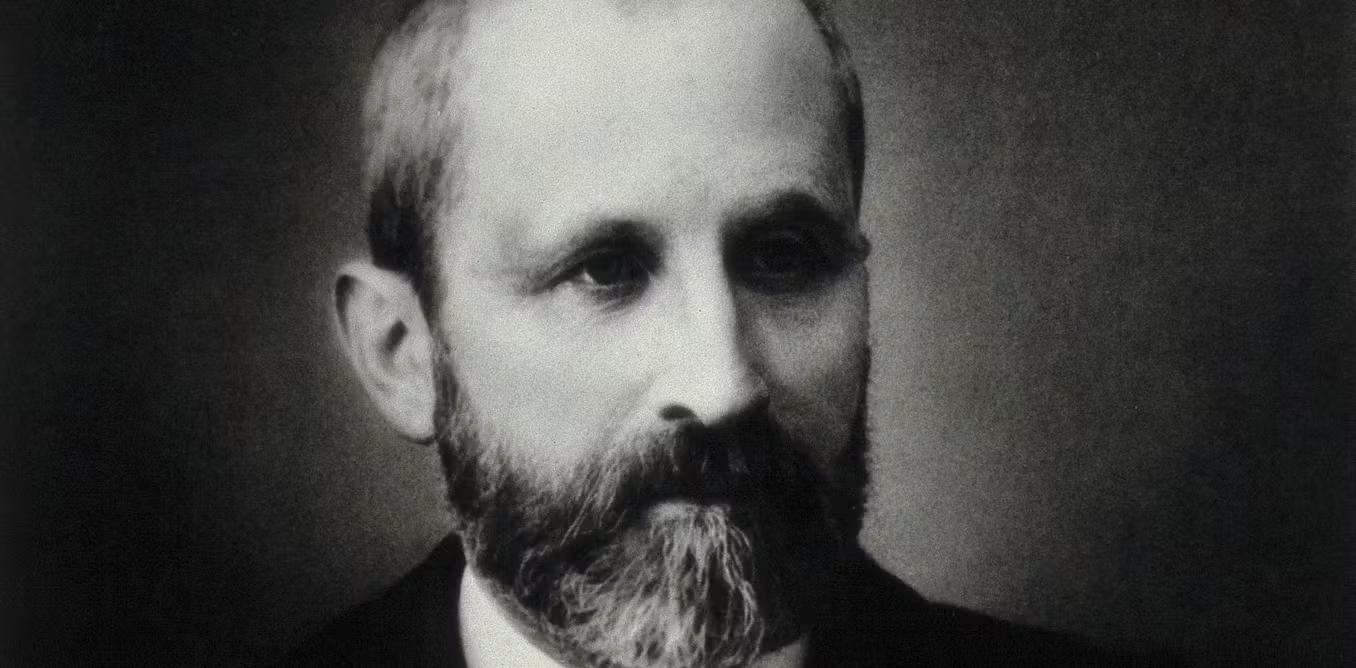
Friedrich Miescher, the man who discovered DNA

Published

on

Friedrich Miescher, the man who discovered DNA

Whether through TV crime dramas or cinema blockbusters about dinosaur theme parks, DNA is a staple of modern popular culture – its double-helix structure one of science’s most iconic visualisations.

Yet remarkably, the young Swiss scientist who discovered DNA in the first place is largely forgotten.

Born in Basel in 1844, Friedrich Miescher only began his career as a researcher after developing a hearing impairment that forced him to shelve plans to be a doctor like his father. Working in the medieval castle that overlooks the old German town of Tübingen, Miescher’s aim was a grand one – to uncover the chemical nature of life itself.

But his working environment was rather different to today’s molecular biology laboratories. The University of Tübingen’s conversion of the castle kitchens into laboratories appears to have involved little more than swapping pots and pans for beakers and alembics used for distillation.

Advertisement

Working in what he likened to the laboratory of a medieval alchemist, the first stage of Miescher’s research was the unsavoury task of scraping pus from discarded surgical bandages, obtained from the local hospital.

The laboratory where Miescher isolated nuclein was located in the vaults of an old castle in Tübingen.
Paul Sinner via Wikimedia

Pus offered him a rich source of white blood cells, which were much easier to isolate and prepare than cells from solid human tissue. So, they were particularly well suited for analysing what molecules human cells are made of.

Over the winter of 1868-9, Miescher discovered a novel cellular substance with properties unlike anything else known at that time. Its chemical behaviour was significantly different to proteins, which were by then understood to be key structural and functional components of cells.

Advertisement

Unlike proteins, Miescher’s substance was rich in the element phosphorus. Observing that it was found almost exclusively within each cell’s nucleus, he called it “nuclein” – a term that was largely retained within its modern name of deoxyribonucleic acid, or DNA.

Little was known about the functions of the cell’s nucleus at the time, although several biologists suspected it to be central to cell growth and division. Miescher was convinced that nuclein must be closely involved in these processes.

Miescher's landmark paper

Miescher’s landmark paper was published in 1871.
Ralf Dahm, Author provided (no reuse)

He announced the discovery of DNA in 1871 in a paper titled On the Chemical Composition of Pus Cells. While it hardly sounded (or indeed read) like a page-turner, his studies of pus would prove a landmark moment in the history of science.

Nearly a century later, it led to the Nobel-winning discovery of DNA’s double-helix structure. The date of that landmark paper by James Watson and Francis Crick is now marked each year on April 25 as DNA Day. Yet Miescher’s contribution is largely unacknowledged.

Advertisement

From pus to salmon

The Swiss scientist’s move back to his home town in 1871 brought him a rich new source of nuclein that meant no longer having to scrape pus from old bandages.

Each year, salmon swim from the North Sea to their breeding grounds in the upper Rhine river, where the city of Basel is located. In preparation for mating, the male salmon’s testes grow massively and become laden with DNA.

Rising in the dark and cold of a winter morning, Miescher would walk down to the banks of the Rhine to catch salmon, then extract their DNA in his laboratory. This image gave us the title of our biography of Miescher, The Dawn Fisherman, to be published in June 2026.


Frank Malina beside a rocket

This series is dedicated to lesser-known, highly influential scientists who have had a powerful influence on the careers and research paths of many others, including the authors of these articles.

Advertisement

The intensity with which Miescher carried out his research was formidable. One of his students recalled that, on the day of Miescher’s wedding, friends had to drag him from his lab bench to attend the church.

His commitments grew. As well as researching Rhine salmon for the local fishing industry, Miescher worked for the Swiss government to improve the diets of prison inmates. And after founding Basel’s first institute of anatomy and physiology in 1885, there were the growing administrative burdens of being its director.

All these commitments brought a growing sense of frustration that he was spending less time on DNA. Looking to classical mythology for images of futility and despair, Miescher compared himself to rolling the boulder of Sisyphus up the mountain.

These strains took their toll on his health. In 1890, having contracted tuberculosis, he became a resident at a sanatorium in the alpine resort of Davos.

Advertisement

A second great insight

But during the final years of his life there, Miescher had his second great insight. Citing Charles Darwin’s speculations about the mechanism of heredity, Miescher proposed that the variation in biological traits of all living organisms might arise through variation in the physical structure of a large molecule – which he thought was most likely to be a protein.

Limited by the concepts and methods of his time, Miescher did not make the connection that nuclein (DNA) was, in fact, this very molecule.

He died in 1895 aged 51, burdened by a painful sense of failure and opportunities missed. “I will never know the happiness that belongs to the man who has lived up to their station in a harmonious way to the satisfaction of themselves and others,” Miescher wrote.

But his former mentor, the distinguished physiologist Carl Ludwig (1816-1895), was more confident that the achievements of his protégé would one day be recognised. “However often the cell will be studied and examined during the centuries to come,” he assured Miescher as he lay in the Davos sanatorium, “the grateful descendants will remember you as the ground-breaking researcher”.

Advertisement

Ludwig’s prediction turned out to be only partly accurate. DNA-based technologies have transformed what we understand about life and disease. Yet Miescher is scarcely acknowledged as the scientist whose pioneering work led to them.

This article features references to a book that have been included for editorial reasons, and contain links to bookshop.org. If you click on one of the links and go on to buy something from bookshop.org The Conversation UK may earn a commission.

Source link

Advertisement
Continue Reading

Trending

Copyright © 2025