Connect with us
DAPA Banner
DAPA Coin
DAPA
COIN PAYMENT ASSET
PRIVACY · BLOCKDAG · HOMOMORPHIC ENCRYPTION · RUST
ElGamal Encrypted MINE DAPA
🚫 GENESIS SOLD OUT
DAPAPAY COMING

NewsBeat

‘I can’t go out on my own after what my ex did to me’

Published

on

Wales Online

Rhys Chalmers subjected his ex-partner to a sickening string of abuse

Advertisement

A woman whose ex-partner made her life hell has told how she can no longer leave the house on her own. Rhys Chalmers, 46, of Penrhys, Rhondda Cynon Taf, was in a relationship with the mother when he repeatedly assaulted her.

Things got so disturbing that he poured urine over her from a bottle, Merthyr Tydfil Crown Court heard on Wednesday. The court heard how the defendant would regularly physically abuse his then-partner, usually after he’d drank excessive amounts of alcohol.

Bethan Evans, prosecuting, told the court how when the pair got together there didn’t seem to be any major issues but she told how Chalmers gradually began to become angry after drinking.

She detailed the first violent incident on January 18, 2025, when the couple had both been in her room drinking alcohol when Chalmers became more and more intoxicated. Ms Evans said his demeanor changed and he began using aggressive words.

Advertisement

The next thing the woman remembered was being on the floor and Chalmers punching her face two or three times, causing injuries to her eyes. She said that kind of incident became so frequent she was unable to recall exact dates or times for each incident.

The court heard how on May 12, 2025, the couple had been drinking in the bedroom when she left the room and Chalmers followed her with a bottle of yellow liquid which she later realised was urine. Ms Evans told the court Chalmers forced the woman down and poured the bottle over her.

A few weeks later, on June 21, 2025, the couple had been drinking together in the bedroom again when he suddenly punched her to the face. On July 16 he kicked and punched her off the bed, causing eye injuries which she had to use make-up to hide.

Ms Evans also told the court that during the course of the relationship Chalmers damaged his partner’s belongings, including smashing two TV screens. She said he would also use derogatory language towards her and made false accusations about her being unfaithful.

Advertisement

Chalmers wouldn’t let his partner go anywhere alone and would take her belongings and not give them back to her, including her bank cards, the court heard.

In a victim impact statement which Ms Evans summarised to the court, it was heard how as a result of her relationship with Chalmers, the woman now has to be escorted by her son or mum wherever she goes. She also said she couldn’t see herself engaging in an intimate relationship or trusting a man again.

Chalmers, of Heol Mair in Penrhys, has three previous convictions for four offences including for causing actual bodily harm and criminal damage. His last appearance before the courts was in 2024.

He pleaded guilty to one count of controlling and coercive behaviour of a physical nature and one count of controlling and coercive behaviour of a non-physical nature.

Advertisement

Solomon Hartley, representing Chalmers, said his client had worked all his life and did not have a bad record. He added that this recent offending had related to “a recent downturn in his life” which had caused his alcohol problem to spiral.

Judge Lucy Crowther said: “It seems you have been overwhelmed by an unhealthy addiction to alcohol and you do not have an understanding of what a healthy relationship is.”

Judge Crowther sentenced Chalmers to 25 months in prison. She also issued a restraining order in respect of his former partner for three years.


Source link

Advertisement
Continue Reading
Click to comment

You must be logged in to post a comment Login

Leave a Reply

NewsBeat

Man in 70s dies after lorry crash on Clapham High Street as supermarkets closed

Published

on

Daily Mirror

Emergency services raced to the crash this morning on Clapham High Street, London and a man in his 70s was tragically pronounced dead at the scene

A man in his 70s has died after a collision involving a lorry on a busy London street.

The emergency services raced to the incident at about 11.05am today on Clapham High Street. The man was tragically pronounced dead at the scene.

The road was closed between Nelsons Row and Tremadoc Road while experts carried out ‘accident investigation work’, according to travel website Inrix.

Advertisement

Footage shared on X, formerly known as Twitter, showed police taped off that section of the road, with a blue tent clearly visible in the middle.

There is a Sainsbury’s and an M&S Foodhall near the scene, both of which were closed, My London reports.

Content cannot be displayed without consent

The man was pronounced dead at around 11.35am with his family informed, says the Metropolitan Police. An appeal has been made for anyone with information or dashcam footage to get in touch.

A spokesperson for the force said: “On Friday, May 22, at 11.03am, police were called to reports of a road traffic collision between a pedestrian and a HGV on Clapham High Street, Clapham Officers attended alongside the London Ambulance Service and London’s Air Ambulance.

Advertisement

“A man in his 70s was assessed and treated at the scene by paramedics. Despite the efforts of the emergency services, the man was sadly pronounced dead at 11:36hrs.

“His next-of-kin have been informed. An investigation is ongoing and anyone with information or dashcam footage is asked to contact police on 101, quoting CAD2859/22MAY26. Alternatively, you can call the North Serious Collision Investigation Unit witness line on 0207 960 8044.”

A London Ambulance Service spokesperson said: “We were called at 11.05am today (Friday, May 22) to reports of a road traffic collision on Clapham High Street, SW4.

“We sent resources to the scene including ambulance crews, paramedics in fast response cars, an incident response officer and dispatched London’s Air Ambulance.

Advertisement

“Very sadly, despite the best efforts of our crews, a person was pronounced dead at the scene.”

This is a Breaking News story. You’ll be more likely to see our stories when any big news breaks in future by simply by clicking this link . You can also join The Mirror’s WhatsApp Community or follow us on Google News , Flipboard , Apple News , TikTok , Snapchat , Instagram , Twitter , Facebook , YouTube and Threads – or visit The Mirror homepage .

Source link

Advertisement
Continue Reading

NewsBeat

Suspect shot by armed cop after ‘failing to stop and driving directly at police’

Published

on

Manchester Evening News

The driver of the car was taken to hospital for an injury to his arm which is not believed to be life threatening

A man has been shot by an armed police officer after ‘failing to stop and driving directly at police’, Greater Manchester Police have said

Advertisement

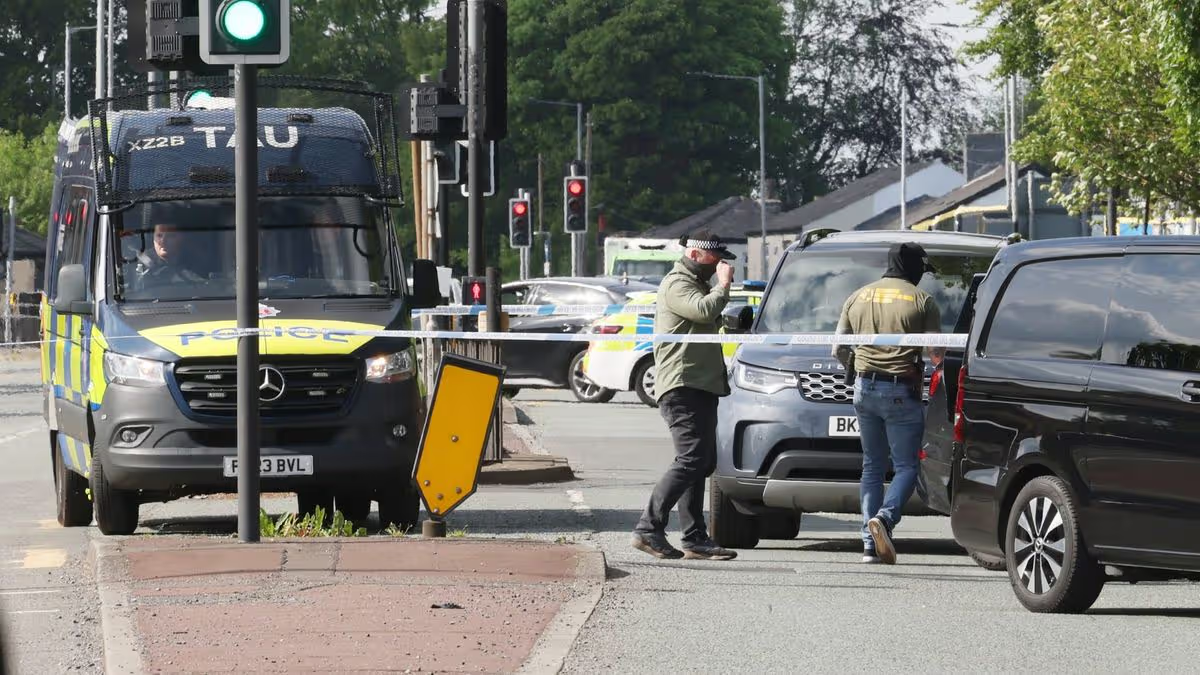
Police attempted to stop a vehicle on Bury New Road in Whitefield, Bury, at 3pm on Friday, May 22. The car failed to stop and ‘drove directly’ at officers in an attempt to get away, the force said.

In response, a shot was fired by a GMP firearms officer, a spokesperson for GMP has said.

Click here to get the biggest stories straight to your inbox in our Daily Newsletter

The driver of the car was taken to hospital for an injury to his arm, which has been described as neither life-threatening nor life changing. No police officers were injured in the incident.

Advertisement

Investigations are ongoing and a scene remains in place on Bury New Road.

The force said that a 20-year-old white British man has since been arrested on suspicion of being concerned in the supply of Class A drugs.

The incident is not being treated as terror related and has ‘no relevance’ to the Manchester Arena bombing anniversary. It is understood the reason for initial attempts to stop the vehicle were ‘unrelated to the local area’. GMP has referred itself to the Independent Office for Police Conduct (IOPC) as per standard procedure.

Advertisement

Detective Superintendent Joe Harrop from GMP’s Serious Crime Division said: “We know people in the area will be concerned by what has happened and the visible increase in police officers in the local area as our investigations continue.

“Thankfully no members of the wider public, or officers were harmed in the incident this afternoon and we thank people for their patience while we remain at the scene.

“Should anyone have any concerns, please speak with our officers who are out in the local area, they are there to listen and assist where possible.”

Advertisement

Source link

Continue Reading

NewsBeat

Whitefield incident LIVE updates after suspect shot by armed cops on Bury New Road

Published

on

Manchester Evening News

A spokesperson for Greater Manchester Police said: “At 3pm today (Friday 22 May 2026), we attempted to stop a vehicle on Bury New Road in Whitefield, Bury.

“The car failed to stop and drove directly at our officers to get away.

“In response, a shot was fired by a GMP firearms officer. The driver of the car was taken to hospital for an injury to his arm, which has been described as neither life-threatening nor life changing. No police officers were injured in the incident.

Advertisement

“Investigations are ongoing.

“A 20-year-old white British man has been arrested on suspicion of being concerned in the supply of Class A drugs.”

Source link

Advertisement
Continue Reading

NewsBeat

Piadina, Italian flatbread recipe

Published

on

Piadina, Italian flatbread recipe

Diana Henry is the Telegraph’s much-loved cookery writer. She shares recipes each week, for everything from speedy family dinners to special menus that friends will remember for months. She is also a regular broadcaster on BBC Radio 4, and her journalism and recipe books, including Simple and How to Eat a Peach, are multi-award-winning. A mother of two sons, Diana can satisfy even the fussiest of eaters.   

Source link

Advertisement
Continue Reading

NewsBeat

New Sunderland Mayor, Mayoress and Deputy appointed

Published

on

New Sunderland Mayor, Mayoress and Deputy appointed

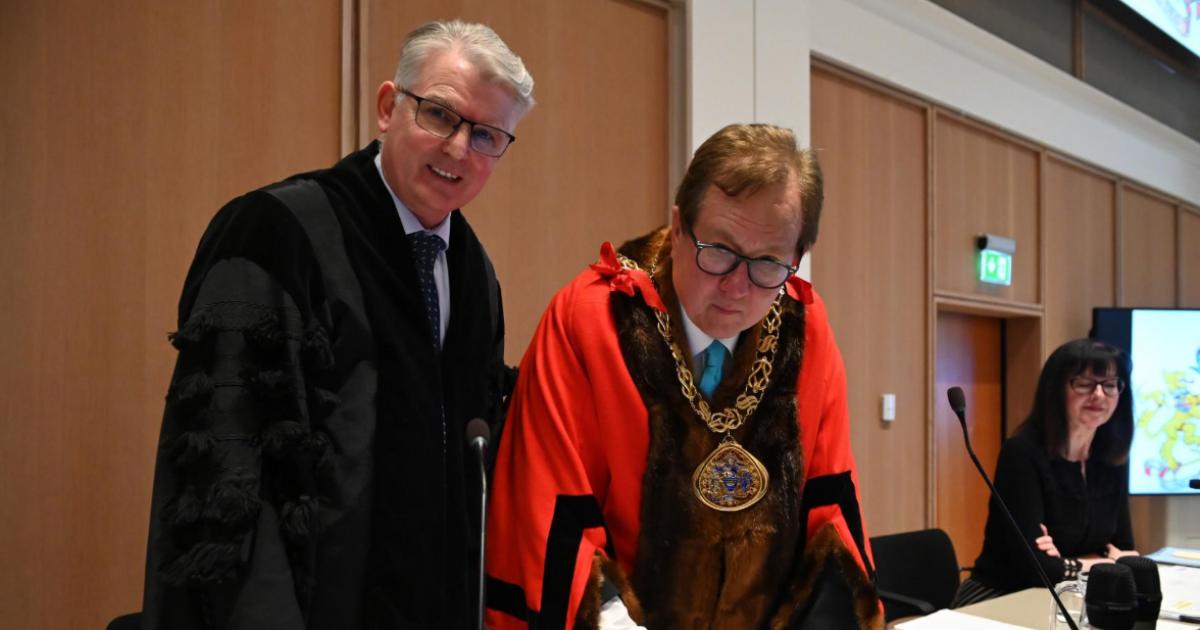
Councillor Robert Hutchinson was officially sworn in as Mayor of Sunderland on Wednesday, May 20, taking over the chains of office from Councillor Ehthesham Haque.

Councillor Glenda Hall was also sworn in during the ceremony and will serve alongside him as Mayoress.

Cllr Hutchinson, who represents the Farringdon and Silksworth ward, said: “In Sunderland, we have a beautiful coastline, great heritage, and above all, the friendliest people in the world.

Advertisement

“Being Mayor is the honour of my life, and I will not let you down.”

He began his first business, Optic Innovation, at just 17 years old.

Cllr Hutchinson also worked with the late Geoff Docherty, who brought major bands to Sunderland in the 1960s and 70s.

He is a member of the Sunderland Antiquarian Society and was elected to Sunderland City Council earlier this month.

Advertisement

Cllr Hall, who represents the Tunstall and Humbledon ward, was also elected to the council in May.

Cllr Hutchinson and Cllr Hall will select Wearside charities to support during their year in office.

Southwick ward councillor Jannine Morrow was sworn in as Deputy Mayor for 2026-2027, alongside her husband Mr George Morrow, who will serve as Deputy Consort.

Cllr Morrow is a retired Customer Services Officer who previously worked for Durham County Council.

Advertisement

Cllr Haque, the outgoing Mayor, reflected on his year in office and wished his successor well.

He said: “It has been the honour and privilege of my life to serve as the Mayor of this great and ancient city.

“I have had the great privilege of meeting the most incredible people.

“There are so many memorable occasions I will remember forever.

Advertisement

“To mention a few, the opening of the Women’s Rugby World Cup, the opening of the Keel Crossing footbridge, and supporting our military with flag-raising ceremonies and the Remembrance Day parade.

“Unfortunately, it would be impossible to mention every single one, but I can honestly say being Mayor will always be one of the most special times – and the best memories – of my life.

“I’d like to say congratulations to our new Mayor and Deputy Mayor, I wish you both all the best and of course, the same goes to all of our newly elected members.”

During his term, Cllr Haque raised £26,600 for his chosen charities.

Advertisement

Source link

Continue Reading

NewsBeat

‘We shot ourselves in foot, but things are looking rosy’ says Northern Ireland legend

Published

on

Belfast Live

Keith Gillespie believes Northern Ireland can “punch above our weight” again and return to tournament football at Euro 2028.

The 86-time capped star admitted it was disappointing that the tournament would not be co-hosted in Belfast, as per the original bid that had a redeveloped Casement Park as one of the venues along with stadiums in Dublin, and across England, Scotland and Wales.

But he insisted that under Michael O’Neill, the team was going in the right direction – and that O’Neill’s decision to turn down a permanent deal at Blackburn was good news for Northern Ireland.

“Fingers crossed,” he told Belfast Live. “We are a small nation so we are not going to qualify for every single major tournament.

Advertisement

“But looking back at (Euro) 2016, qualifying for that, going close in 2020, close again and then obviously the (World Cup) play-offs this time, you want to play in every big tournament.

“I think these players have really improved over the last few years. It’s a young squad and they’ve gained so much experience playing international football.

“That will stand them in good stead coming into qualifying.”

Gillespie, who was speaking at Wembley as BT unveiled a new fan-inspired poem featuring comedian and lifelong football fan Frank Skinner, reflected on Northern Ireland’s recent World Cup woes.

O’Neill’s side clinched a play-off place through the Nations League, but were handed one of the most difficult draws when they were paired away to Italy.

Two second-half goals in Bergamo in March sent the Azzurri through to the play-off decider, where they lost away to Bosnia and Herzegovina.

Advertisement

“It was (disappointing),” said Gillespie of the defeat, “but I think you’ve just got to remember that we’re a small nation and it’s very difficult to compete at times against those bigger nations.

“We probably couldn’t have gotten a worse draw for the play-offs, getting Italy.

“I think with the way it is in terms of the way it all works, it favours the bigger nations, as opposed to the smaller nations, because ultimately I think they want the bigger nations there.

“So for us to get Italy away, it’s very difficult when you’ve only got that one game.

Advertisement

“It might have been different if it was played over two legs. But win that game and you were going to play another team away – Bosnia or Wales – so it is always very difficult.

“But looking back we probably shot ourselves in the foot when we conceded in the last minute against Slovakia (in November), because we might have had an easier draw.

“But we are a very young squad, improving all the time, and I think things are looking rosy.

Advertisement

“It’s great news that Michael O’Neill has decided to stay as well, because the job he has done, bringing that young side through, has been remarkable.”

Looking ahead to Euro 2028, a failure to agree funding to redevelop Casement Park cost Northern Ireland co-hosting rights.

Asked if that was a disappointment, Gillespie replied: “Yeah, of course. It just didn’t work out in the end.

“It would have been great if we could have been (co-hosting). It’s something that doesn’t come around all the time, so to be a part of that would have been great for Northern Ireland in a sense to be hosting something like that.

Advertisement

“Unfortunately it didn’t. But that’s just the way it is.”

But with the tournament being played so close to home, he said: “Certainly if Northern Ireland were to qualify they would be travelling in their thousands, without a doubt.”

* BT has become the Official Telecommunications Partner of Euro 2028 and the poem brings together voices from across the UK to capture what football means now. Thirty years on from co-writing Three Lions, Frank Skinner collaborated on the poem using fan responses and insights from across England, Scotland, Wales and Northern Ireland to inspire the final piece

Click here to sign up to our sport newsletter, bringing you the latest sports news, headlines and top stories

Advertisement

Source link

Continue Reading

NewsBeat

Could sodium replace lithium as the dominant ingredient in batteries?

Published

on

Could sodium replace lithium as the dominant ingredient in batteries?

The world we live in today runs on batteries. But the lithium ion batteries that dominate the market are expensive and environmentally demanding to extract. The raw materials for lithium ion batteries are scarce and concentrated in a few geographical regions. This places continued pressure on supply chains.

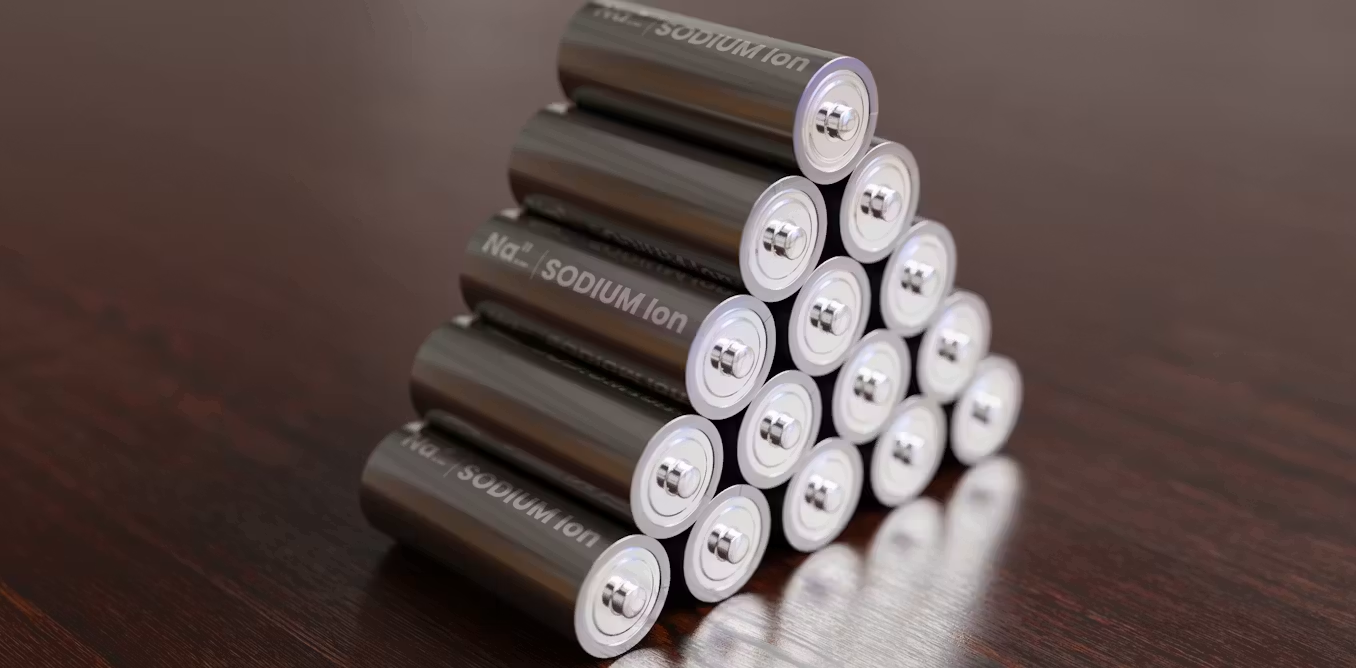
Sodium-ion batteries are a promising alternative because they use abundant materials. But sodium has shortcomings that have blocked it from being used as a replacement for lithium.

In work carried out at the University of Limerick’s Bernal Institute, my team has now produced a battery that combines the strengths of sodium and lithium. This could lead to more sustainable batteries that reduce the supply chain pressures associated with lithium. The results have been published in the journal Nano Energy.

Sodium-ion batteries lag behind lithium ones in their energy density. Energy density is the amount of energy stored in a battery relative to its weight or size. Lower battery energy densities have an impact on the devices and machines they power.

Advertisement

If electric vehicles used battery modules with lower energy densities, it would limit the distance they could travel before needing to be recharged. Lowering the energy densities of batteries would also make tablet devices and laptops heavier.

As an energy storage researcher, this paradox gnawed at me. How could we harness sodium’s sustainability without sacrificing performance? The tension feels like the ancient philosophical concept of yin and yang. This idea describes how seemingly opposing forces are actually complementary and connected.

In this case, sodium is abundant but weak, while lithium is powerful but scarce. Inspired by this dichotomy, I wondered whether the two technologies could work in harmony rather than competing.

This led us to produce the first full cell battery with two electrodes – one positive, one negative – that uses two charged atoms or molecules (ions). In this case the charged atoms are sodium and lithium. Batteries that use different positively charged ions to store and transfer energy are known as dual cation batteries.

Advertisement

Why sodium ions fall short

A standard battery is made up of one or more cells. The cell converts chemical energy into electrical energy. In the cell are two electrodes, or terminals: a positive terminal called a cathode and a negative terminal called the anode.

When the battery is used to power an electronic device, negatively charged electrons flow through the circuit and reach the battery’s positive terminal. The chemical medium between the anode and cathode is called the electrolyte.

I decided to combine lithium and sodium in a half cell, which has one electrode immersed in an electrolyte rather than two. Just a modest amount of lithium salt added to a sodium-dominant electrolyte radically changed the way the battery behaved.

Syed Abdul Ahad (L) and Hugh Geaney are shown with the experimental set-up.
University of Limerick

It roughly doubled the storage capacity of our half cell compared with an equivalent state-of-the-art sodium based battery. It was also stable up to 1,000 charge-discharge cycles at higher charging currents. Charge-discharge cycles measure how many times a battery can drain from 100% to 0% and recharge to 100% before its capacity degrades.

Advertisement

For someone who had previously watched sodium-ion batteries fade after a few dozen cycles, these results felt like witnessing a miracle.

Behind the scenes, a fascinating chemical ballet between lithium and sodium was taking place. Lithium ions are smaller than sodium ions, so they can move more easily through the anode material. Their movement helps open smoother pathways for sodium, lowering the “diffusion barrier” – resistance at the anode that normally slows sodium batteries down. This allowed more ions to enter the anode, allowing it to store more charge.

Just as importantly, sodium helped prevent lithium from getting trapped inside the material after discharge. This back-and-forth exchange kept the reaction reversible, giving the battery both higher capacity and better cycle stability. In this yin–yang interplay, neither ion dominated; instead, they worked in harmony.

Powering clean energy

Half-cell tests are the first step towards real world applications. For the next step, I demonstrated how a mixture of lithium and sodium worked in a full battery cell.

Advertisement

Battery capacity retention measures the percentage of the energy originally stored in a battery that remains available after a given period of usage. The full cell delivered a battery capacity retention of 70% after 200 cycles. This is far better than the sodium-only electrolyte, which started to fail after about 50 cycles.

The full cell performance was particularly satisfying, as sodium remains the dominant charge carrier. This ensures that the battery is still fundamentally a sodium-ion system.

This breakthrough could help power the world’s clean-energy transition by reducing reliance on cobalt- and nickel-rich cathodes, which are common, but expensive, supply-constrained and linked to environmental concerns. Our design keeps sodium as the main working ion and pairs it with a more sustainable iron sulphide cathode.
Because sodium and iron are more abundant than many conventional battery metals, the chemistry could be cheaper and easier to scale.

The small amount of lithium acts mainly as a performance booster rather than the main resource. That makes the battery both higher performing and potentially less dependent on costly critical materials. Furthermore, it represents a new route to storing renewable energy on the grid, which can help communities and industries transition to a greener future.

Advertisement
Electric car being charged
Switching to sodium-ion batteries could make electric vehicle batteries more sustainable.
Unai Huizi Photography

Despite the success of our prototype, much work remains to be done. The anode in our cell and half-cell was made of germanium, which is expensive. The next challenge is to replace germanium with cheaper anode materials. One candidate is silicon, which can reversibly host both lithium and sodium ions during charging and discharging, but also provide the battery with a higher storage capacity.

This boost would increase the energy density of sodium-dominated batteries. We also need to pair the anode with a cathode capable of producing higher voltages than we currently have.

I have already been exploring alternative and sustainable pairings of different ions, such as lithium–magnesium and potassium–sodium. I am also experimenting with new electrolyte formulations.

My team’s research shows that by embracing the yin-yang of lithium and sodium, we can move towards batteries that show both high performance and sustainability. This raises the prospect of a world where your phone, car and even the grid will draw power from cheap, abundant sodium ions – gently assisted by a whisper of lithium.

Advertisement

Source link

Continue Reading

NewsBeat

SEND- York council unveils reforms amid national changes

Published

on

SEND- York council unveils reforms amid national changes

York Council’s SEND Reform Plan, which is backed by £3.6 million in Government funding, is set to go before the authority’s executive on Tuesday, June 2.

It includes proposals to create a new team of professionals including speech and language therapists, psychologists and others to provide early support to children.

Cllr Bob Webb, the council’s Labour children’s spokesperson, said the plan aimed to ensure that all children are valued, included and supported to fulfil their own potential.

It follows the unveiling of national SEND reforms by the Government in February.

Advertisement

RECOMMENDED READING:


Education Secretary Bridget Phillipson said the current SEND system was broken and left families fighting for entitlements on paper that did not get them additional support.

She added the Government’s new plans would see SEND children go from being sidelined and excluded to being seen, heard and included.

National reform proposals include digitising Education, Health and Care Plans (ECHPs) and Individual Support Plans (ISPs), updating the school complaints process and putting special schools under a new regulatory regime.

Advertisement

City of York Council stated the reforms represented the most significant change for children’s services and education in more than a decade.

Plans for York include using funding to support mainstream schools to be more inclusive while working alongside specialist provision.

A new £1.3 million Experts at Hand service would see professionals provide support in mainstream schools.

There are also plans to support staff across early years, schools and post-16 to complete a national training programme which includes identifying children who need support early.

Advertisement

York’s plans would be subject to checks from the Department for Education before their final approval.

Cllr Webb said they wanted to make improvements for SEND children happen.

Cllr Bob Webb, Labour executive member for children, young people and education on York Council (Image: City of York Council)

The executive member said: “School should be a place where all children and young people feel that they belong and this is something that we want to make happen.

“This draft Local Reform Plan sets out how we, along with schools, can ensure that they are valued, included, and supported to achieve their full potential.”

Advertisement

Speaking after the unveiling of national reform proposals, Education Secretary Ms Phillipson said how a child grows up should not dictate where they end up.

The secretary of state said: “The SEND system designed 10 years ago for a small number of children is now broken.

“Parents end up fighting tooth and nail for entitlements on paper that don’t see them getting additional support, children’s educations and lives have suffered.

“Today’s plans will see every child get the brilliant support they deserve, when they need it, as routine and without a fight.”

Advertisement

Source link

Continue Reading

NewsBeat

West Ham vs Leeds: Prediction, kick-off time, TV, live stream, team news, h2h results, odds

Published

on

West Ham vs Leeds: Prediction, kick-off time, TV, live stream, team news, h2h results, odds

West Ham head into the final game of the Premier League season against Leeds hoping for a miracle in order to stave off relegation.

The Hammers know that victory over Daniel Farke’s Leeds might not even be enough to stay in the Premier League.

Source link

Continue Reading

NewsBeat

Apricot and almond tart recipe

Published

on

Apricot and almond tart recipe

Diana Henry is the Telegraph’s much-loved cookery writer. She shares recipes each week, for everything from speedy family dinners to special menus that friends will remember for months. She is also a regular broadcaster on BBC Radio 4, and her journalism and recipe books, including Simple and How to Eat a Peach, are multi-award-winning. A mother of two sons, Diana can satisfy even the fussiest of eaters.   

Source link

Advertisement
Continue Reading

Trending

Copyright © 2025