

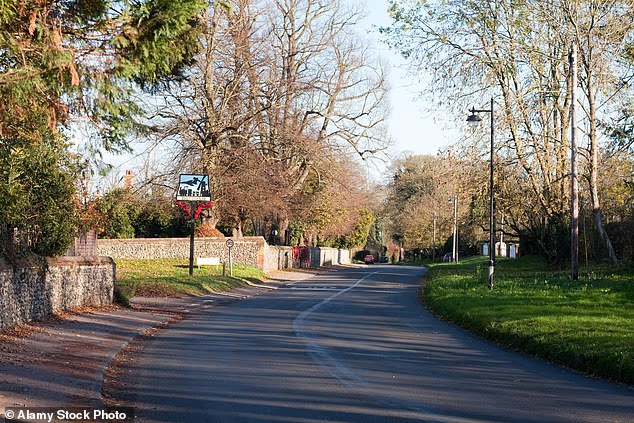
A quintessential English village earmarked to host 1,250 asylum seekers at a nearby military base is sending a delegation to Piddington this week for a council of war to discuss holding their own independence referendum.
Barnham in Suffolk is considering copying the defiant Oxfordshire village’s high-profile in/out vote amid fury at the scheme, which would more than double the local population.
Last week’s vote in Piddington over Home Office plans for MoD Bicester saw 90 per cent of locals opt to secede from the UK.
Now the residents of Barnham are eyeing up a similar stunt that, while symbolic and not legally binding, will focus public scrutiny of the controversial scheme which is designed to reduce the number of migrants in hotels.
Parish council chairman John Bauer, 66, told the Daily Mail he was among a group of villagers heading to Piddington on Tuesday, having already been in contact with his counterpart in there.
The government’s lack of interest in locals’ concerns meant the ‘oxygen of publicity’ could provide a vital part of the defence of the community’s way of life, he explained.
‘They don’t care about the people of Barnham. They don’t care that it will increase by two-and-a-half times the population of a village, with single men mostly of fighting age not contained within the site,’ Mr Bauer said.
Barnham in Suffolk is sending a delegation of residents to Piddington in Oxfordshire on Tuesday to look at the possibility of its own independence referendum

Residents have been told the nearby military base, RAF Barnham, has been earmarked to take at least 1,250 asylum seekers

The 580 villagers fear their community could be swamped by the migrants from the nearby base
‘Barnham is a small village with about 580 people. There’s a number of children of varying ages. People are worried about that and the womenfolk as well.
‘Piddington have been incredibly successful in raising their profile. They’ve gained national attention and that of ministers and the Prime Minister. It’s gained international attention.’
He added: ‘I can’t say honestly I’ve spoken with anyone – and I’ve spoken to a lot of people – who’s said “I’m happy for them to come here”.
‘To send a message to the government, I wouldn’t be surprised if 90 per cent voted [to secede from the UK].’
The village has a hall, church and primary school but no other amenities such as a shop or pub where migrants – who will be able to come and go from the base as they please – will be able to kill time.
Protests have taken place outside RAF Barnham since the controversial plans for the base, as well as the one in Bicester and a third site in Linton-on-Ouse, North Yorkshire, were announced in June.
Tensions increased after details of a private meeting between Home Office officials and councillors in Norfolk, which borders RAF Barnham, were leaked in which the government department admitted ‘a lot more’ migrants could be housed at the facilities than had been admitted.
Violent disorder also broke out over several nights two miles away from Barnham in Thetford, Norfolk, last month, after it emerged the Home Office was looking to quadruple the number of asylum seekers placed in private accommodation.

Piddington, in Oxfordshire, held a referendum on Tuesday last week over concerns about plans to house migrants in MoD Bicester

Around 90 per cent of those who voted in the referendum chose to secede from the UK – although the poll has no legal standing

An aerial view of part of the base at MoD Bicester
Barnham residents turned out en masse at the village hall on Wednesday last week – the day after Piddington held its referendum – to discuss their resistance movement.
Until now, it has focused on an ‘evidential’ approach involving planning issues such as environmental concerns.
The base was once used to store nuclear and chemical weapons and there are concerns the land could be contaminated.
The site is also a nesting ground for stone curlews, a species of bird so endangered that any development within 1,500m is forbidden.
But there is an increasing feeling that time is running out and a more emphatic, headline-grabbing approach may be needed, as the Home Office is expected to announce its decision this autumn – with asylum seekers moving in before Christmas.
Mother-of-two Collette Skelly, 58, who has lived in the village for 15 years and was at the meeting, said: ‘It’s a good way of raising publicity.
‘At the moment, there is nothing on the news about Barnham. So Piddington had to do it as a publicity stunt to raise attention.’
A man in his 60s added: ‘It’s on the news, they’re questioning the prime minister about Piddington today, so it’s working, isn’t it. I’d absolutely support it.’
Adrian Whittle, the leader of Reform UK at West Suffolk Council, declared he would support the village’s right to hold a referendum.
‘It raises the profile that people haven’t just given up, they want their country back, they want their lives back.’
Some locals were less certain, however, fearing it would act as a distraction from the formal planning approach.
James Hollins said: ‘The referendum is rubbish, it can’t go anywhere, it’s got no legal standing.
‘We can demonstrate but they’re not going to listen.’
Announcing the referendum result on Wednesday last week, Piddington Parish Council chairman Mr McNally said: ‘We have given a message to the world.’
Vice-chair Susannah Parden added: ‘We are Piddington, the village that roars.’
Shadow Home Secretary Chris Philp said the vote should be a ‘wake-up call’ for the government.
Barnham was last year unveiled as the site where evidence of the earliest known human-made fire had been uncovered.
Researchers found baked earth together with the earliest known Stone Age ‘lighter’ – a flint that was hit against pyrite, a rock also known as fool’s gold, to create a spark – that dated back 400,000 years.
The village also appeared in the Domesday Book of 1086, which recorded that it housed 35 families – a large village by the standards of the time.















































You must be logged in to post a comment Login