A proposal by Belfast’s Deputy Lord Mayor will go to the City Hall Planning Committee
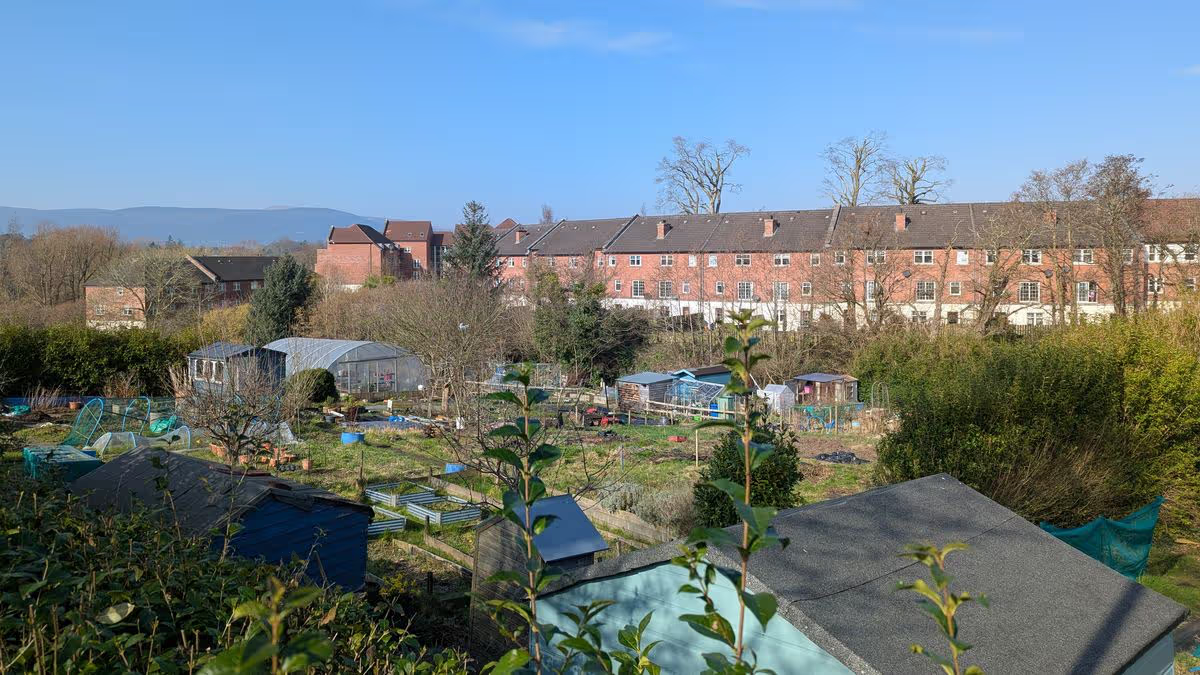
Two Belfast independent councillors are calling for City Hall to adopt a plan making it a requirement for developers to include community food growing procedures in certain planning applications for housing in the city.
The motion, titled “Embedding Community Food Growing in the Planning Process for New Housing Developments” states the council “recognises Belfast’s status as a Right to Food City and affirms that the planning system has an important role to play in building healthier, more sustainable and more food-resilient communities.”
The motion says that housing developments should not only provide homes, “but should also contribute to the long-term health, wellbeing, sustainability and resilience of the communities in which they are built.”
A Right to Food city is one that has formally committed to treating access to adequate and nutritious food as a legally protected human right, and believes that citizens should not be dependent on emergency charity.
Such cities in theory should be pushing for governments to be held legally accountable for ensuring citizens do not go hungry. Belfast officially became a Right to Food city in October 2023, following a successful motion at Belfast City Council by Councillor Doherty.
The Doherty motion adds: “The council notes that Belfast’s existing policy framework already recognises the importance of open space, residential amenity, placemaking, biodiversity, climate resilience, health and wellbeing, and council strategies also acknowledge the value of allotments, community gardens and local food growing.”
Advertisement
The proposal tasks council officers with making a report examining how Belfast Council, through its planning processes, could introduce a planning requirement to ensure appropriate space for community food growing in new social and private housing developments.
This would include allotments, community gardens, orchards, raised beds, edible landscaping and other forms of productive green space. The motion states: “This would represent a practical and innovative next step in giving meaning to Belfast’s status as a Right to Food City, placing food resilience, health and community wellbeing at the heart of how our city is planned and developed.”
The Deputy Lord Mayor left the SDLP following a major disagreement over a council vote on a Bobby Sands statue in April this year. Councillor Doherty said it was on a “matter of principle” after SDLP councillors left the chamber before a vote took place on a DUP motion to reopen an investigation into the erection of the statue in West Belfast.
Paul McCusker announced he left the SDLP in March 2023, citing frustration with political progress, particularly regarding his core issues of homelessness, addiction, and poverty. Not long after leaving the party, he successfully retained his council seat as an independent candidate in May 2023.
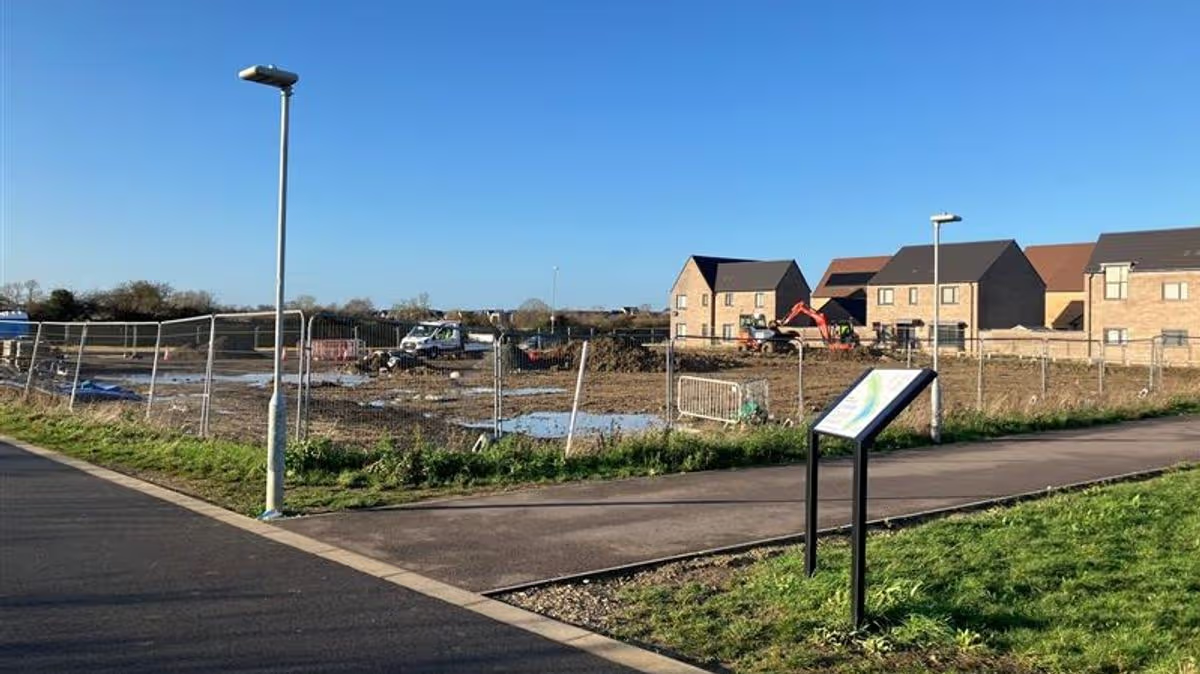
The group will be recommended for a 999-year leasehold agreement at the council’s scrutiny and overview meeting on June 4, before a final decision is made at a cabinet meeting on June 23.
Councillor Dr Lisa Redrup, lead cabinet member for healthy communities for the council, said: “This is an important milestone for Northstowe as the new town continues to grow and develop.
“We’ve taken a thorough and transparent approach to assessing proposals, including public feedback, to ensure the best outcome for residents. Northstowe Church Network submitted the highest-scoring bid, and we are recommending them to take forward this first faith and community site.“
She continued: “Spaces like this play a vital role in bringing people together, supporting wellbeing, and fostering a strong sense of belonging. This is just the first opportunity of several, and we look forward to working with a range of groups as more sites come forward in future phases of Northstowe’s development.”
Advertisement
In 2020, the council adopted the Northstowe Faith and Community Land Allocation policy, providing a fair and transparent process for land allocation. In December 2024, the cabinet agreed to initiate a bidding round for the first parcel of land.
Alongside the Northstowe Church Network, the Hindu Samaj Northstowe submitted the other bid. The two proposals were assessed against the agreed policy and criteria by an eight‑member panel, including six District Council officers, alongside two external specialists.
The bids were also open for comment in a public survey. It received 440 responses, including 14 responses made on behalf of groups.
Councillor Natalie Warren-Green said: “Reaching this point is an important step for Northstowe, and I’d like to thank both groups who engaged with the process so thoughtfully.
Advertisement
“We recognise the time, effort and passion that goes into bids like these, and that this will be a disappointing outcome for those who were not selected. The panel followed a robust and fair assessment process, considering both expert input and community feedback.
“As Northstowe continues to grow, there will be further opportunities for faith and community groups in future phases, and we remain committed to supporting a diverse and inclusive range of spaces that bring people together.”
Cllr Hansraj added: “It’s great to see progress towards creating a dedicated faith and community space in Northstowe, which will play a vital role in bringing people together in this growing and diverse town.
“Places like this are so important for building connections, supporting one another, and creating a strong sense of belonging. Thank you to everyone involved in putting forward bids and contributing to the process – it really reflects the strength of community spirit here.”
Advertisement
This is the first of four opportunities for faith and community groups to secure land in Northstowe. In the future, there will be further land or floorspace within the town centre on phase two, plus two more opportunities within phase three.
The new community at Northstowe is planned as a new town of 10,000 homes. Currently around 1,700 homes are occupied.
Police have warned people to stay out of the former Stradey Park Hotel in Llanelli after a rise in reports of trespassing linked to social media activity over the bank holiday weekend. Dyfed-Powys Police said officers received a number of calls about people entering the building, with concerns that some individuals were accessing the site to create online content. Full details here
The force said enquiries are underway into alleged criminal damage and burglary offences, and officers are in contact with those believed to have been involved.
Pride & Prejudice is coming to the grounds of Castle Howard this summer.
The special outdoor cinema screening, organised by Adventure Cinema, will take place on Sunday, July 19, running from 6.30pm until 10.15pm at the stately home north of York.
People should bring their own seating to settle in the grounds of the North Yorkshire historic estate for the adaptation of Jane Austen’s second published novel, starring Keira Knightley and Matthew Macfadyen.
The romantic classic features the Bennet family and follows one of the daughters, Elizabeth Bennet, as she navigates social expectations, family pressures, and her initially misjudged relationship with the wealthy, reserved Fitzwilliam Darcy.
The event is open to all ages, with children required to be accompanied by an adult. Under twos can attend for free.
A range of ticket options is available. Standard tickets for under 12s are priced at £10.92, while premium tickets, costing £25.48, include a luxury deck chair in a prime viewing position.
Advertisement
A higher-tier “Director’s View” package, which includes front-row seating, a blanket, themed treat bag and a copy of the novel, has already sold out.
The screening is expected to last around three hours and 45 minutes, including the film and event timings.
Outdoor cinema events have grown in popularity across North Yorkshire in recent years, with historic venues such as Castle Howard providing a dramatic setting for classic films during the summer months.
WARNING, GRAPHIC CONTENT: A scientist scalped by an industrial machine while working in a converted paper mill factory has spoken of her ordeal
Abigail Hunt, Adam Care and Abigail Hunt Content Editor
08:16, 28 May 2026Updated 08:17, 28 May 2026
A scientist who suffered a horrific scalping injury from an industrial machine has recounted the harrowing moment she walked into her lab clutching her own scalp.
Dr Pia Winberg endured a nightmare scenario when her hair became caught in a high-powered drive shaft while working in a converted paper mill factory. The 55 year old had her scalp torn clean from her skull in the appalling accident.
Advertisement
Despite losing substantial amounts of blood, Pia succeeded in extricating herself from the machinery, retrieved her detached scalp and made her way 200 metres to a neighbouring laboratory to request a colleague summon an ambulance. The scientist has revealed how the devastating day played out.
“I was wearing my factory cap, protective eyewear and hearing protection,” Pia, from Narrawallee, Australia, told creatorzine.com. “I assumed that the small ball grip at the end of the valve handle unthreaded, and rolled under the machine. Why else I would have been on my knees with my head just above floor level?
“That’s where I found myself. The next memory was a just sense of frustration, as I tried to work out why my hair felt like it was tangled in two directions in something. I brought my hands down in front of me.”, reports the Daily Star.
“In confusion, I wondered why my hands were completely covered in red – that was when my memory stopped again. I must have managed to extract my hair, remove my scalp and its hair from the machine, and walked, holding it, 200 metres to the lab building. I opened the door and said my colleague Rachel’s name, after which my memory stops.”
In February 2019, the scientist was developing seaweed-based gels designed to restore damaged tissue and improve wound recovery. The accident happened at a pilot facility she’d set up in a disused 1950s paper mill in New South Wales.
Rachel described Pia as eerily composed despite being soaked in blood. Pia recalled: “I turned and walked down the corridor to my office chair. Rachel ran after me and it was then that she could see my skull sticking out of the top of my head, and my scalp and mobile phone in my hands in my lap. She understood then that it was me who had had the accident and she acted fast.”
Four ambulances arrived within 10 minutes, followed by a rescue helicopter. Paramedics worked for hours attempting to stabilise her blood pressure before she could be airlifted to Sydney’s St George Hospital.
Advertisement
Medical staff attempted to reattach her scalp during six hours of emergency operations, but the blood vessels had sustained excessive damage. Instead, surgeons carried out a split-skin graft utilising skin removed from her thigh, fastening it directly to her skull while vacuum pressure encouraged the tissue to fuse.
Without viable tissue, her skull bone would have perished. Yet, in a remarkable twist, the scientist reckons her own seaweed-based research contributed significantly to her recovery.
Pia revealed: “When the dressings could be removed a week later, I went straight into using my seaweed gel moisturiser across the whole mesh graft site, and it healed so well that I say I had baby skin across my head and not a single scar from the mesh skin pattern.
“Not that having a baby’s bottom effect across my head was ideal, but it was still amazing. I kept using the cream, until a year later, because skin remodelling takes as long as that after trauma.”
Advertisement
Throughout the subsequent year, she underwent six further reconstructive procedures as doctors progressively expanded remaining scalp tissue across her skull using inflatable expanders topped up weekly with saline solution.
Pia explained: “They approached this by implanting expander bags under the side patch of hair and scalp tissue that remained on one side. These bags were expanded to stretch the scalp with hair on it slowly, by injecting 10ml of saline each week.
“After the bag was filled to a litre of water and I had a giant hair balloon on the side of my head, a fourth surgery could remove the balloon, detach 90% of the baby skin graft tissue, and extend the stretched, real, scalp tissue with hair over to the other side of my skull to reattach once again.
Advertisement
“After this, another two surgeries tidied it up, and today there is just one four centimetre patch of baby skin, thigh graft tissue on my skull. The rest is extended true scalp with my own hair, thinned a bit, but with feeling and better thickness than thigh skin, which was thin and with no nerves or sensation.”
Her present research now focuses on SXRG84, a seaweed-based gel that appears to mimic molecules involved in human tissue repair, hydration and collagen production.
Pia explained: “Before the accident, I thought of the scalp mainly as the place that held hair. After losing mine, I learned that the scalp is far more than that. It’s a living, sensory, vascular organ wrapped over the skull, thick, richly innervated, full of hair follicles, blood vessels, glands and connective tissue.
“The scalp helps protect the skull and brain, regulates heat, senses touch and temperature, and anchor the hair that shields us from sun, cold and environmental exposure. Losing my scalp changed more than my appearance. I experienced vertigo and a strange disconnection from the top of my own head.
Advertisement
“Hair movement activates nerve endings around the follicle, making hair-covered skin sensitive to light touch, brushing, air movement and subtle environmental contact. I had to relearn touch, pressure and position across my skull.
“The map of my head had been redrawn. I could feel my brain learning where I was again. That experience changed the way I understood skin.”
Scientists at PhycoHealth, the company Pia founded, are investigating whether the marine gel could help burns victims, chronic wounds and tissue harmed by chemotherapy.
Pia continued: “Skin is not wrapping paper, it’s an organ of sensation, immunity, temperature control, communication and repair. The scalp, in particular, is a remarkable interface between the brain and the outside world. It tells us about pressure, wind, warmth, danger, touch and even the subtle presence of our body in space.
“I became, unwillingly, a patient inside the very clinical world I was trying to help and experiencing the challenge from the frontline. I saw the brilliance of surgeons and emergency clinicians, but also the limits of what medicine currently has available when large areas of complex tissue are lost.
“A split-skin graft can save life and cover bone, but it does not replace full scalp tissue, hair follicles, thickness, sensation, glands, elasticity or the original sensory map of the body. That’s why our research now matters to me in a completely different way.
“We’re investigating how these marine glycans can support skin repair, collagen protection, inflammation control, microbiome balance and even 3D-printed full-thickness skin models. What began as ecological science, cultivating seaweed to transform waste nutrients into valuable biology, became deeply personal.
Advertisement
“I now understand skin as one of the most intelligent organs of the body. And I understand healing not only as closing a wound, but as restoring structure, sensation, identity and connection to the world.”
People were woken up as far apart as Rochdale, Stockport and Wigan
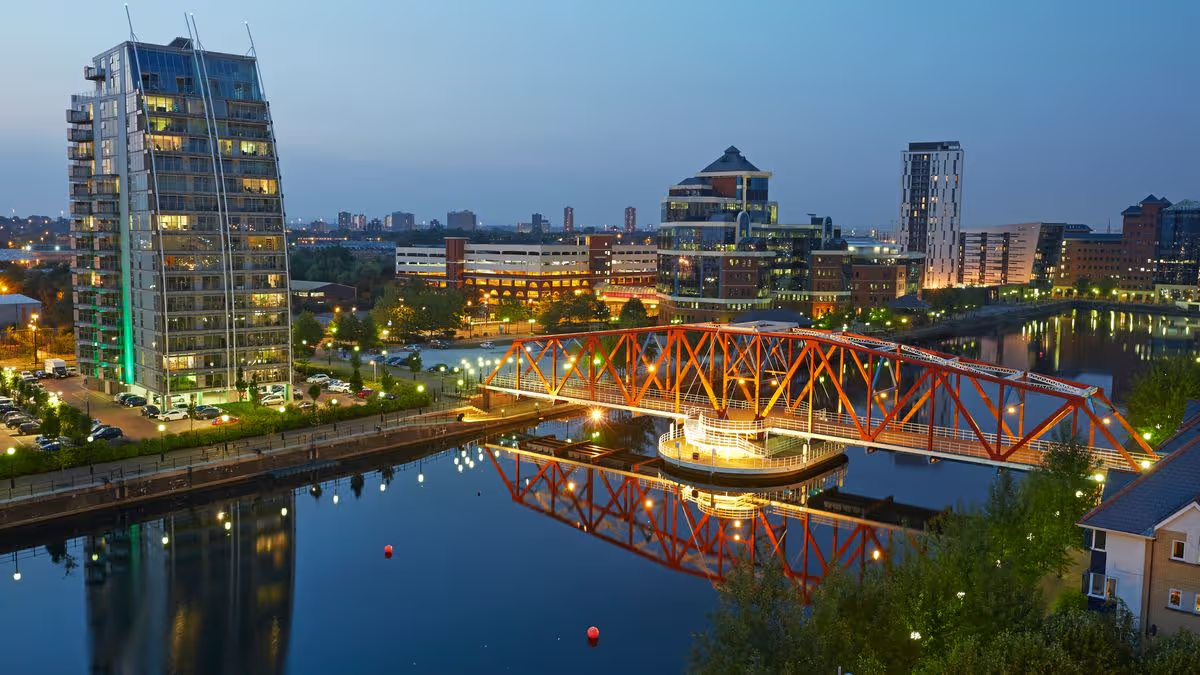
Residents across Greater Manchester were woken in the night as a huge and intense storm battered the region. There were reports of intense thunder from 2am on Thursday (May 28), as far apart as Rochdale, Stockport and Wigan.
Advertisement
The storm comes after the Met Office placed a yellow weather warning in across England and Wales yesterday (May 27). It covered large areas of the UK between midnight and 4am.
Click here to get the biggest stories straight to your inbox in our Daily Newsletter
Footage of the strikes were posted across social media as lightning illuminated residential streets, disrupting sleep after days of intense heat. Heavy rain also fell throughout Greater Manchester.
There have also been reports of the storm in Merseyside, West Midlands, North Wales and Lancashire.
Advertisement
One resident in Wigan posted on social media: “So, everyone else heard that loud bang at 3am too? What the hell was it?”
Another, in Heywood, wrote on Facebook: “It was so loud! I have never heard thunder as loud as last night I thought it was something else because of how loud it was.” A second Heywood resident added: “Nothing normally wakes me up but that did, looked out the window and thought I was dreaming.”
Just down the road in Middleton, one local wrote: “Early hours here in Middleton lightning first a few times then came the thunder .Hopefully it has cleared the air and got rid of that pollen.”
Over in Stockport, a young resident told the Manchester Evening News: “I had left the curtains and windows open to allow cold air into the room after the heatwave, without realising storms were in the forecast. Overnight I was woken up by a huge flash that lit up the room. At first I thought someone was moving a car on the driveway but quickly realised the noise was actually heavy rain.
Advertisement
“I then heard rumbling thunder in the distance, which must have carried on for hours, even after the rain eased. Now I’m shattered and running on around four hours of sleep.”
And in Middleton, a local told the M.E.N: “I thought it was a load of people kicking my bins about – it went on for ages. It was so loud, like a bomb going off.
“A lovely 2am thunderstorm waking them up is just what everyone needed after a week of sleepless nights thanks to the heatwave.”
Prior to the downpour, the Met Office said: “Thunderstorms will continue to affect parts of England and Wales and are likely to become increasingly confined to northern and eastern parts of the warning area during the course of the early hours.
Advertisement
“While many places will miss the worst conditions, where thunderstorms do occur frequent lightning and heavy downpours are likely. Hail and strong, gusty winds may also affect a few places.”
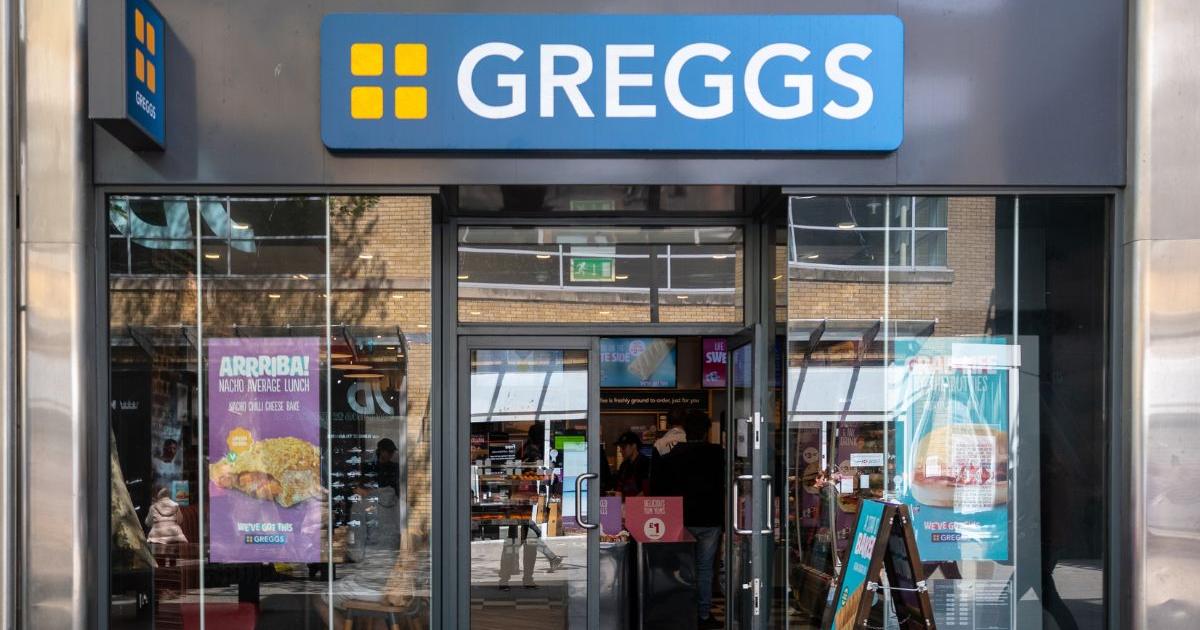
The bakery chain is trialling Greggs Express, a self-service unit which allows customers to quickly grab their favourite treats on the go.
The first unit opened at Motor Fuel Group’s (MFG) petrol forecourt outside Glasgow Airport.
Tony Rowson, property director at Greggs, said: “Greggs Express is our latest concept being trialled to help us enhance our customer experience, focusing on convenience and speed.
Advertisement
“The units allows customers to grab their favourite bake or serve coffee themselves, ideal for customers on the move.
“Working with MFG, the trial will help us understand how this format can support our growth ambitions alongside our broader estate growth plans while continuing to deliver the great-tasting food and value our customers expect.”
Customer behaviour is being analysed, with a small number of other self-service units planned to be rolled out across MFG locations in the coming months.
Jamie Constable, head of operations – food service at MFG, said: “At MFG, we are committed to delivering the highest level of convenience and choice across our forecourt estate.
Advertisement
“The self-service format of Greggs Express is perfectly suited to the fast-paced, on-the-go needs of our customers, and we’re delighted to be Greggs partner of choice for this exciting trial.”
The development comes just weeks after Greggs announced they were locking away their items behind the counter at some stores in a trial to combat theft.
The trial is running across six stores which they said are exposed to ‘higher levels of anti-social behaviour’.
Greggs also recently introduced Bitesize Greggs, a smaller shop format designed for limited-space locations, with three currently open.
With Iran’s official cultural presence on the international stage increasingly uncertain, the 6th Iranian Contemporary Art Biennale in London, With My Roots, carries significance that extends well beyond the gallery walls.
Held at Mall Galleries from May 22–30, it brings together more than 100 Iranian artists from 17 countries, with over 180 works spanning painting, photography, sculpture, installation and video. Despite its scale, the exhibition feels intimate: a space where Iranian culture emerges not as a single story, but as a field of tensions, inheritances and unresolved attachments.
Iran’s withdrawal from the Venice Biennale earlier this year exposed how fragile national representation has become, at a moment when art and geopolitics are increasingly difficult to separate.
Against that silence, this biennale tells a different – and in many ways more urgent – story. It shows how Iranian art continues to circulate when official platforms falter, and why independent cultural infrastructures matter in moments of political and material crisis.
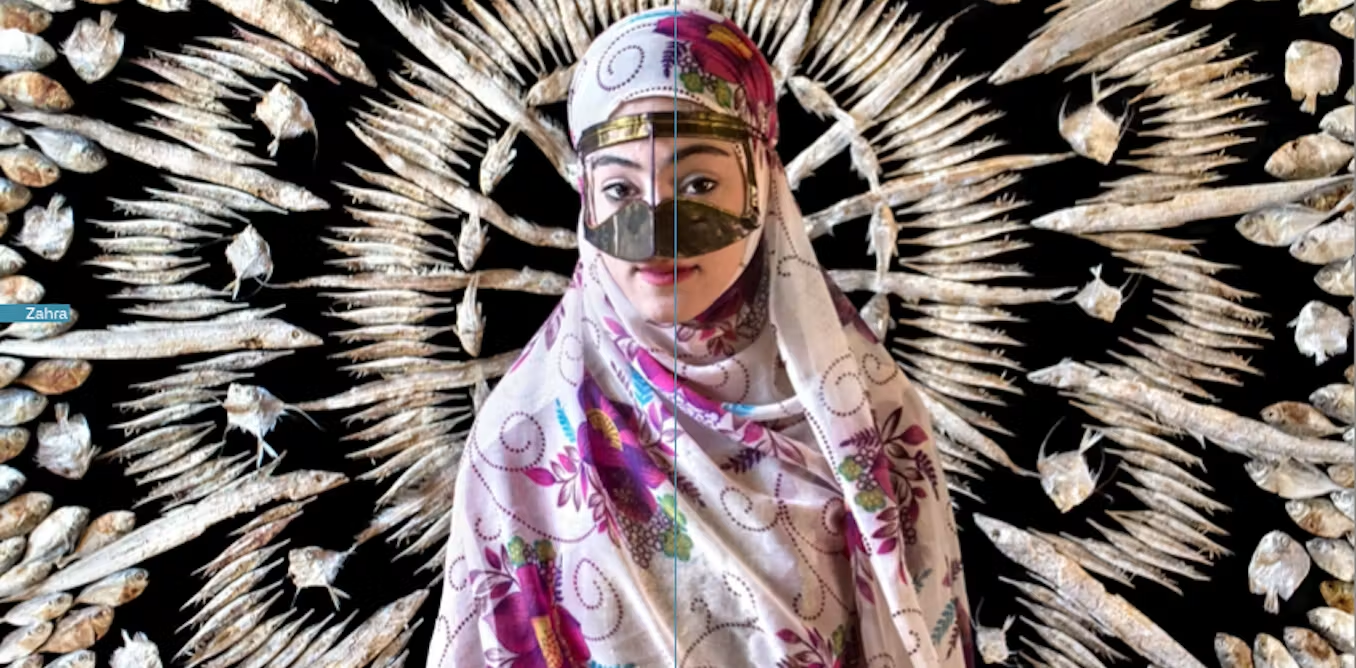
Unseen Narrative by Donya Aby. Mall Galleries
Founded in 2016 by curator Marina Panahi through the gallery Capital Art London, the Iranian Contemporary Art Biennale has become a rare meeting point for artists inside Iran and across the diaspora. It brings together communities separated by migration, sanctions, censorship and political borders.
The biennale foregrounds tensions central to Iranian modern and contemporary experience: homeland and exile, tradition and modernity, visibility and erasure. These curatorial themes reflect the realities of artists working inside Iran. Censorship, economic pressure and restricted mobility shape their daily practice.
Advertisement
These themes also reflect those in the diaspora for whom distance can be both a wound and a resource. Their work often carries the pull of elsewhere: the longing for Iran, the act of translation, and the unsettled feeling of belonging in more than one place. The biennale brings such experiences together without collapsing them into a single story.
But this year, these tensions have sharpened. War, internet restrictions, disrupted phone lines, suspended flights and mounting economic pressure made even the movement of artworks from Iran to London difficult.
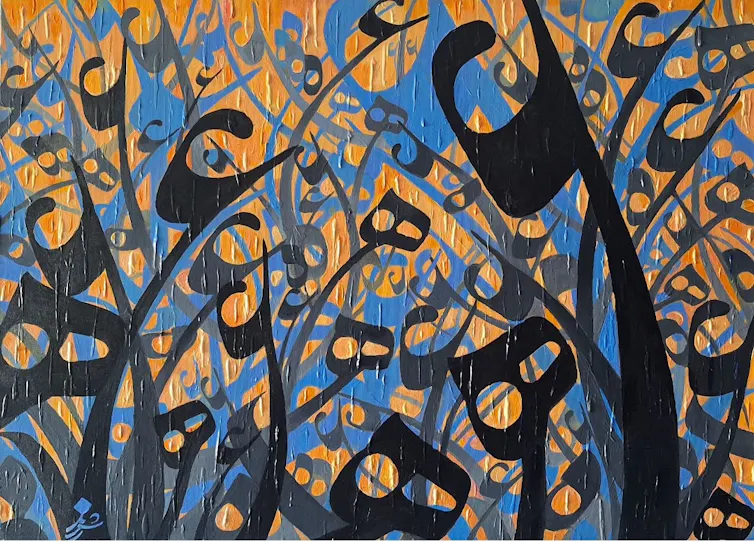
Fall by Afshin Rezaei. Mall Galleries
Works that might once have moved through ordinary shipping routes had to travel through more fragile and improvised channels. The exhibition’s existence is therefore part of its meaning. The works on display are examples of persistence under pressure.
That persistence is economic as well as symbolic. Because the works are for sale, the biennale can offer artists an economic lifeline at a time when sanctions, currency collapse and restricted exchange have made producing and selling art increasingly difficult.
Advertisement
The art market is often viewed with suspicion, especially when politically charged work enters systems of taste, ownership and value. Yet for many artists, sales can mean the ability to keep working and remain connected to a wider cultural economy.
This produces one of the exhibition’s most compelling tensions: the desire to enter the global art market without being consumed by it.
A global perspective
Iranian artists have long had to navigate the expectations of international audiences who often approach their work through familiar frames of politics, gender, conflict or cultural heritage.
The exhibition’s breadth is central to the resistance to conform to such expectations. Bringing together artists from Iran, the UK and 14 countries across Europe, North America and the Middle East, the variety of works mirrors the diversity of Iranian culture and society itself.
Advertisement
Work by Esmaeil Rashvand on show in the biennale. Mall Galleries
It also places established figures such as Simin Keramati and photographer Armin Amirian in dialogue with artists still building their international profile. This gives the exhibition historical depth while foregrounding practices that may not otherwise reach global audiences.
But even an exhibition of more than 100 artists can still only offer a partial view. For every work that reaches London, many others remain unseen – held back by closed borders, limited resources, fear, bureaucracy or the simple impossibility of getting work out.
The exhibition is shaped around two main curatorial themes: Eternal Iran and Art of Conflict. Together, they show the different tensions running through the show.
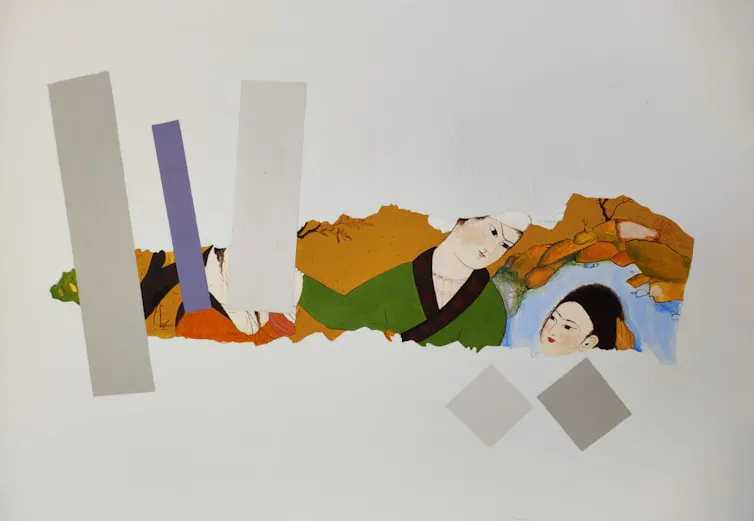
Eternal Iran focuses on cultural inheritance. It looks at how Iranian identity has lasted and changed across generations, political systems and countries. Tradition here isn’t frozen in the past, but something alive. Artists treat calligraphy, poetry, myth and visual symbols as tools they can reshape, break apart and rebuild in new ways.
Collage by Parvaneh Babaie. Mall Galleries
By contrast, Art of Conflict confronts the violence of the present more directly. It includes paintings, photographs and prints by 19 artists currently living in Iran and experiencing recent violence and war firsthand.
This section features photographs by Majid Saeedi, Alireza Memariani and Shahla Khodadadi, alongside battlefield photography by Maryam Saeedpoor and Maryam Rahmanian. These works bring a different register into the exhibition, being produced in proximity to instability, fear and loss.
Advertisement
The contrast between Eternal Iran and Art of Conflict gives the biennale much of its force. One section turns towards memory and the deep histories of Iranian culture; the other confronts the violence and uncertainty of the present. Together, they refuse an easy division between Iran as ancient civilisation and Iran as contemporary crisis. Both are true. Both are incomplete without the other.
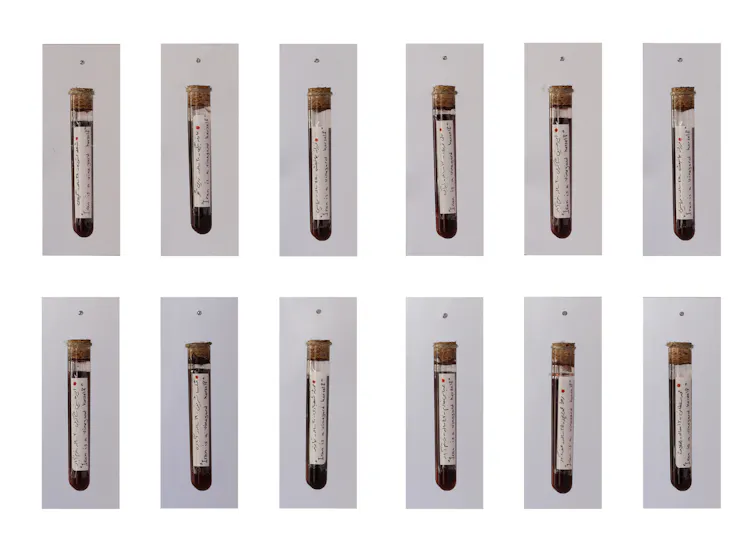
Iran Herself is a Vineyard by Homa Bazrafshan. Mall Galleries
This tension becomes especially vivid in Homa Bazrafshan’s Iran is a Vineyard Herself. The work evokes both fertility and mourning. Its vials of red liquid, which read visually as blood, suggest a memorial language without reducing the piece to a single political message. The vineyard, usually a symbol of cultivation and abundance, becomes a field of grief as well as endurance.
Panahi describes the biennale as an opportunity for audiences to move “outside the language of politics and conflict” and hear the voices of Iranian artists worldwide.
That ambition refuses to let politics become the only language through which Iran is understood.
At a time when Iran is often made visible only through crisis, the exhibition asks viewers to look slowly, to recognise historical depth without romanticising it, and to encounter conflict without allowing it to become the whole story.
Advertisement
This biennale is a reminder that Iranian art is not absent from the global stage. It is just moving through more precarious routes, carried by the artists, curators and communities who are determined that it should still be seen.
With My Roots is on show at Mall Galleries, London until May 30 2026.
After making a controversial transfer from Tottenham in 2001, Sol Campbell won two league titles and three FA Cups with Arsenal, as well as scoring in the 2006 Champions League final.
Alongside him was Ivorian Kolo Toure – moulded by Wenger from a central midfielder into one of the league’s finest centre-backs.
Both were key parts of Arsenal’s ‘Invincible’ season.
Advertisement
At right-back, Ivorian Emmanuel Eboue was a cult figure at Arsenal under Wenger, making 214 appearances between 2005 – 2011.
Meanwhile, Cole is widely regarded as one of the best left-backs in the history of the Premier League. He was part of the Gunners’ ‘Invincibles’ side of 2003-04, as well as the Chelsea side that scored a then-record 103 goals in 2009-10.
2026
For Arteta’s side, French centre-back William Saliba is ever reliable and was voted in the Professional Footballers’ Association team of the year three consecutive seasons between 2023 and 2025.
Advertisement
Alongside him, Gabriel is another contender for Arsenal’s player of the season. As well as being solid at the back, he ended the Premier League season with seven goal involvements (three goals, four assists).
Since 2000, the pair rank second behind Rio Ferdinand and Nemanja Vidic in terms of Premier League partnerships with the most clean sheets.
With Ben White injured, Arsenal fans will be hoping that Dutch defender Jurrien Timber can make it back from injury in time to play right-back against PSG’s Khvicha Kvaratskhelia.
Meanwhile, Arteta has options at left-back and has rotated this season between Italian full-back Riccardo Calafiori, Ecuadorian defender Piero Hincapie and academy graduate Myles Lewis-Skelly.
Hidden along the English coastline is a quite seaside village with a cafe right by the beautiful beach
If you’re looking for your next seaside escape, this village offers a slice of tranquillity by the sea and plenty of options for a good cup of tea.
Advertisement
Along the Norfolk coast, this village sits quietly with the most beautiful beach and clifftops, offering expansive views and a getaway from the business of life.
Old Hunstanton sits next to the larger resort of Hunstanton, also known as New Hunstanton, the more popular neighbour, but it’s not a destination that should be overlooked. Its quiet character makes for a different option for those who don’t quite fancy the fuss of a bustling seaside town, with steady walks and stripped cliff sightings.
It’s safe to say the real star of the show in the village is Old Hunstanton Beach, a beautiful stretch of sand that welcomes families, and even your dog, to explore it and go for a dip when the weather permits.
In fact, their dog-friendly feature is something that draws in a lot of avid walkers and visitors keen for their pups to have a true sense of freedom. One visitor wrote on TripAdvisor: “Old Hunstanton Beach is a top pick for dog owners. Dogs are welcome year-round with no leash required on the spacious sands, offering true freedom.
Advertisement
“This likely reflects the beach’s size and a culture of responsible dog ownership. Enjoy the beautiful cliffs and calm waters with your happy dog by your side!”
Making up part of this glorious landscape are the cliffs, famously striped, with three layers of colour, red, brown and white. Their natural striped layers draw a lot of attention to the beach and are thought to be a geological site of specific interest which dates back to the Cretaceous Period.
Another landmark of the area is the historic Old Hunstanton Lighthouse, originally built in 1844, sitting on top of the famed cliffs. This makes for a lovely walk on a nice day and offers spectacular views of the area.
Advertisement
Café on the beach
Situated on beautiful Old Hunstanton Beach, opposite the RNLI is Old Town Beach Cafe, which serves a varied menu that focuses on locally sourced ingredients. If you’re hoping for a more traditional resting stop, they also happen to serve up a delightful afternoon tea.
An afternoon tea right by the sea sounds like a dream, and yet it’s very real, with customers opting for lunch and breakfast food options too. You can sit outside in the sand and look out at the blue hues of the rolling waves as you sip away.
One customer shared on Tripadvisor: “I visited the old boathouse café twice this week, once for breakfast and again another day for afternoon tea. It’s in a great location just on Old Hunstanton Beach, and the food and service is excellent. A really great place to call into after a walk on the beach.”
Advertisement
Another dubbed the spot as an “outstanding little café Hunstanton” while someone else pointed out the cleanliness of the place.
They wrote: “Spotlessly clean throughout, lovely friendly staff, excellent quality, cater for gluten-free, freshly cooked, served piping hot, mega breakfast excellent as were homemade sweet potato patties gluten-free. Would definitely recommend.”
John Gerrish, his wife, Ellen Chung, and their one-year-old daughter Miju, were found dead in a baffling scene in a National Park. It took months for authorities to work our what had happened.
Jonathan Gerrish, 45, Ellen Chung, 31, their one-year-old daughter Aurelia Miju Chung-Gerrish and their dog Oski, eight, set out on an eight-mile hike in California’s Sierra National Forest. The temperature reached 42°C.
All four were found dead on a remote hiking trail on August 18, 2022. Despite the FBI working tirelessly to discover more about what happened to the family – their phone records revealed the truth of their horrifying last moments.
There was no mobile reception where the family was discovered, but records show Jonathan had tried to send multiple text messages.
One heart-breaking attempt read: “Can you help us.” The father also tried to make five phone calls, none were to emergency services. Ellen’s body was found further up the trail and it looked as if they had all sat down in the sun, according to Strange Outdoors.
Advertisement
The family’s babysitter raised the alarm two days before they were found when she turned up to look after their daughter and found no one at home.
She contacted their family who then reported the three missing that night. Search and rescue teams first found the family’s car, but were initially baffled at the cause of death when they found their bodies.
Mariposa County Sheriff’s spokeswoman Kristie Mitchell said, “Coming across a scene where everyone involved, including the family dog that is deceased, that is not a typical thing that we have seen or other agencies have seen. That is why we’re treating it as a hazmat situation. We just don’t know.”
Advertisement
Mariposa County, Sheriff Jeremy Briese said: “When we located the family there were no apparent causes of death.”
Multiple causes of death ruled out over the course of the investigation including: suicide, being caused by a gun or other weapon, alcohol, illegal drugs, a lightning strike, extreme heat and exposure to cyanide, carbon monoxide or carbon dioxide, according to The Fresno Bee.
Briese, said: “I’ve been here for 20 years and I’ve never seen a death, with any case, like this. There are no obvious indicators of how it occurred . . . you have two healthy adults, you have a healthy child and what appeared to be a healthy canine all within a general same area, deceased. It’s frustrating and we’re not going to rest . . . it’s devastating to everyone”
Advertisement
Jonathan, a Lancashire man who moved to the US to work for Google had texted someone saying: “On savage lundy trail heading back to Hites cove trail. No water or ver [over] heating with baby.”
Briese previously said one empty water bladder backpack was found with the families’ bodies alongside some snacks and baby formula, but they had no other water containers with them.
Two months later, after autopsies and extensive investigations, it looked like the family had simply run out of water and shelter.
The Mariposa County Sheriff’s Office released messages supporting the the coroner’s ruling that the family died due to environmental exposure.
Advertisement
In October of that year, Briese said what happened was “an unfortunate and tragic event due to the weather.”
Photos recovered from the phone showed the family left for the walk at 7.45am, with the final image of a creek taken at around 12pm.
Mariposa County Sheriff Jeremy Briese said: “The cell phone data results were the last thing both the family and detectives were waiting on. The extracted information confirms our initial findings.
“I am very proud of my team and our partner agencies for all the work they put in. Their dedication has allowed us to close this case and answer lingering questions the family had, bringing them a little peace.”
Advertisement
Tragically, the family had completed most of the hike before they died. One theory circulating was they were killed by toxic algae found in the nearby water.
Investigators worked with toxicology experts to determine whether the algae could have poisoned the family. Sheriff Briese confirmed there was “no evidence they drank any of that water”.
The area around the trail was also known to contain mines. Sheriff Briese said one mine was also located close to where the family were found but that there was no evidence the family had come into contact with it.















































You must be logged in to post a comment Login