


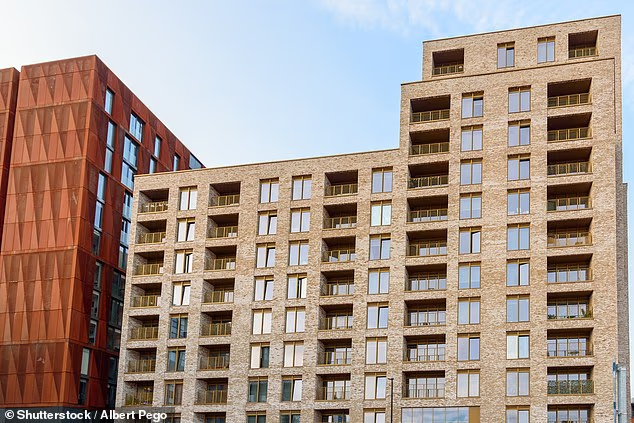
Flat owners are facing a service charge tipping point that could render their homes unsellable and unmortgageable.
In recent years, service charges have risen sharply while the price of flats has fallen.
Now, mortgage brokers say they are seeing increasing numbers of people having their mortgage applications rejected due to this disconnect.
Some banks have tightened their rules and now won’t offer mortgages on flats where the annual service charge exceeds 1 per cent of the property’s value.
This is because a high service charge could have an impact on how easily a lender could sell the property were it to be repossessed.
In 2025, some 37 per cent of flats had an annual service charge exceeding 1 per cent, according to property firm Hamptons, up from 28 per cent a decade earlier.
It means a mortgage application on a flat valued at £300,000 with an annual service charge of £4,000 could be refused by some lenders.
Crunch point: Some lenders won’t offer a mortgage if the service charge exceeds 1% of a home’s value
While some lenders may refuse the mortgage outright, many will make a call based on the opinion of their surveyor or valuer.
William Coe of mortgage broker Cleerly says: ‘We are seeing an increase in mortgage applications stalling or failing purely due to spiralling service charges.
‘When a flat’s service charge approaches or hits that 1 per cent mark, many mainstream lenders will indeed defer to the surveyor.
‘If the surveyor decides the fee is onerous or completely out of step with the local market, the property is flagged as unsuitable security, and the mortgage is declined flat out.’
Rising service charges and falling flat prices
Rising service charges combined with falling or flatlining values is a dangerous combination.
Across England and Wales, flat values have risen 16 per cent on average over the last 10 years, according to Land Registry data. But in London, where flats make up more than half of the housing stock, the average price of a flat hasn’t moved in the last decade.

William Coe of mortgage broker Cleerly
Meanwhile, the average service charge has risen 55.6 per cent over the last decade, according to Hamptons.
This is Money readers have reported hikes of 50 per cent or more within the last five years alone.
The average leaseholder’s service charge bill now ranges from £1,525 a year for the cheapest 10 per cent of buildings to £8,680 for the top 10 per cent, according to the latest research by the Property Institute.
Last year, the average flat had an annual service charge equal to 0.9 per cent of its value, according to Hamptons – perilously close to the 1 per cent that some lenders are using as their line in the sand.
Mortgage broker Aaron Strutt of Trinity Financial says: ‘If we have not already hit the tipping point then we are pretty close.
‘People are worried about buying flats at the moment because of the fees and ongoing unknown costs.’
Recent analysis for This is Money by analytics firm PropertyData found some areas where service charges are way out of kilter with flat prices.
In the BD1 postcode in Bradford city centre, service charges averaged £2,023 while the average asking price for these properties was £68,050. It means the typical service charge equates to 3.13 per cent of the asking price.
The same could be seen in L2, in Liverpool’s city centre. Service charges there were £2,910 per year when the average asking price was £122,374. That means the service charge is 2.58 per cent of the asking price.
Valuations a ‘frequent hurdle’
When buying with a mortgage, the lender will always commission an independent valuation of the property.
Many buyers will view it as a formality, but just as a lender can decide not to lend to a certain individual, so too can it decide not to lend on a particular property.
The valuer or surveyor may also value the property at less than the sales price agreed, which means the buyer cannot proceed unless they cover the shortfall.
At a time when flat prices are falling in many areas, valuers are becoming nervous about flats because they can ultimately be sued by lenders if they get it badly wrong.
Coe says: ‘We have seen a noticeable uptick in surveyors down-valuing flats against the agreed purchase price compared to this time last year.
‘Where we used to see occasional pushback, it is now a frequent hurdle with surveyors regularly cutting valuations by between 5 and 10 per cent of the agreed purchase price.’
Not all lenders have a hard cap
If a flat does have a service charge of 1 per cent or more, the lender will need to make a call on whether to hand the buyer a mortgage.
For some it will be a simple decision, as certain lenders have explicit, hard caps written into their lending criteria.
Lender Gen H states annual service charges must not exceed 1 per cent of the property’s purchase price or valuation, while others like MPowered Mortgages cap the combined service charge and ground rent at 1.5 per cent.
High Street lenders can be more flexible in some instances.

Steph Lyke, partner at SAS Daniels
Coe says: ‘Lenders like Santander or Barclays don’t necessarily apply a blunt percentage cap (like 1 per cent) to the property value.
‘Instead, they treat the service charge strictly as a monthly financial commitment—exactly like a student loan or car finance.’
The reason the charge is so high will often be investigated.
Steph Lyke, a partner in the residential property team at law firm SAS Daniels, says: ‘The breakdown of the service charges will need to be investigated, it could well be that the costs relate to a one off major works project, which generally the valuer would accept this as it is an indication of good property management.
‘If the costs are unproportionate and due to poor management, or includes high management fees, then the lender will likely decline.’
Lenders may also instruct the surveyor to assess the service charge against the local market.
For example, a £4,000 annual service charge on a £300,000 flat which is 1.3 per cent of the home’s value might be rejected in a regional town where standard fees are £1,200.
However, that same fee might be passed by a surveyor in London or Cambridge if the block includes a concierge, lifts, and complex building systems, as it reflects the ‘market norm’ for the area.
Why lenders are wary of rising service charges
Lenders like certainty. A monthly loan or credit card repayment is a fixed, known commitment over a set period, making it straightforward to model in an affordability calculator.
The inherent danger with service charges is the total lack of control over future costs.
Cleery’s Coe says: ‘A managing agent or freeholder can hike fees dramatically with very little recourse for the leaseholder.
‘For a lender’s risk committee, that word ‘could’ is a major red flag.
‘If a bank has to take back a property, their primary objective is to recover their funds quickly through a swift resale. If the service charge has spiralled to a point where the next buyer cannot secure a mortgage on it, the property becomes illiquid.’
Rising service charges are also in some cases restricting how much buyers are able to borrow.
This is because they must be factored in to the borrower’s monthly outgoings when assessing affordability.
Coe says: ‘Over the last two years, building insurance premiums, maintenance costs, and cladding-related expenses have driven service charges up significantly and it is no longer unusual to see modest two-bedroom flats with fees exceeding £3,500 per annum.
‘When this is plugged into a lender’s affordability calculator, it eats into the applicant’s maximum borrowing capacity, turning a previously viable mortgage offer into a decline.




















































You must be logged in to post a comment Login