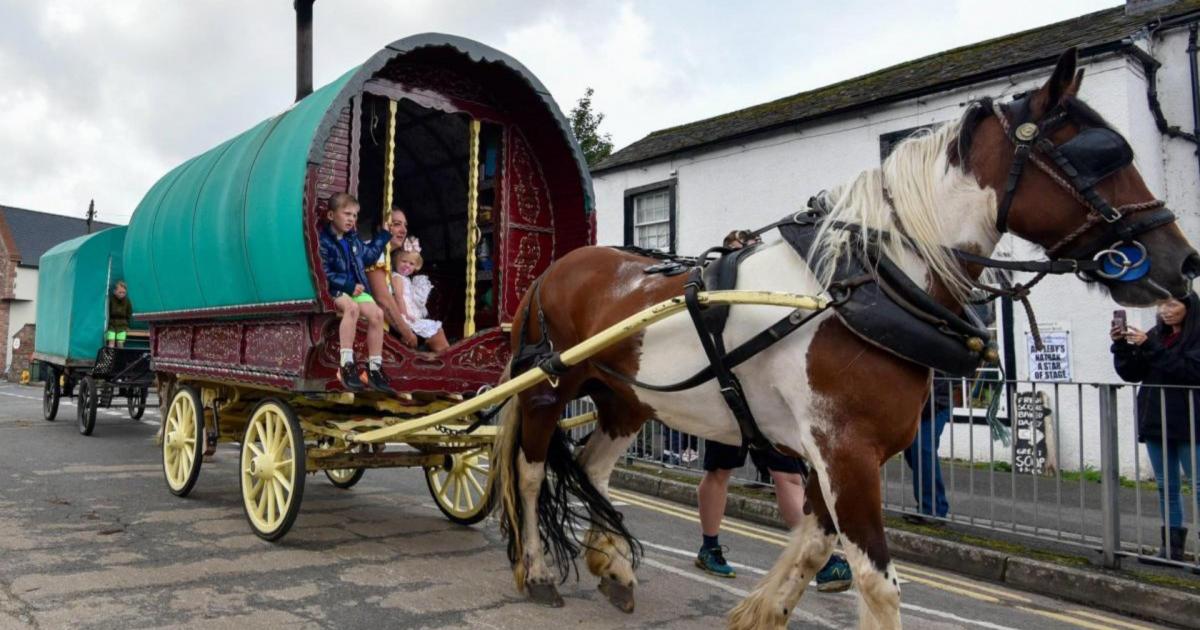
The annual event, held in Cumbria from June 4 to 10, is a traditional gathering for the Gypsy, Roma, and Traveller (GRT) communities and attracts visitors travelling through parts of County Durham.
Durham County Council has introduced Temporary Stop-Over Areas (TSOAs) in and around Teesdale and south-west Durham to support safe and respectful travel to and from the fair.
Councillor Dawn Bellingham, the council’s cabinet member for communities and civic resilience, said: “These TSOAs are provided every year, and we would encourage people attending Appleby Horse Fair to use them, as they provide a safe and convenient place to stop.
Advertisement
“We work closely with our partners to ensure that these areas bring benefit to both users and residents living along the routes.”
There are eight TSOAs in place between May 22 and June 25.
The locations are:
Westerton Lay by, DL14 8AL
Gurney Valley, DL14 8RP
Broomielaw Picnic Area, DL12 8TT
Guide Post Corner, Bowes, DL12 9HU
Land at Stainton Bank, DL12 8RQ
Shaw Bank Field, DL12 8TD
Wackerfield Lay by, DL2 3AP
Winston Corner, DL2 3RW
The areas are clearly marked with signs and include information on guidance for travellers.
The TSOAs form part of a wider partnership led by the South West Durham and Dales Residents’, Businesses’, and Travellers’ Forum.
Advertisement
The forum includes representatives from the county council, town and parish councils, Durham Constabulary, local businesses and the Gypsy, Roma, Traveller communities.
Council officers and partner agencies will visit the TSOAs regularly and provide support to those staying there.
Those staying in unauthorised encampments will be given advice and support, but will be encouraged to use the TSOAs.
Travellers and members of the public can find more information about the TSOAs on the Appleby Horse Fair website at www.applebyfair.org.
Advertisement
Durham County Council’s Gypsy Roma Traveller Service can also be contacted by calling 03000 260 000 or by emailing grtservice@durham.gov.uk.
The programme will run from August until November and begins with the Haver String Quarter on August 13.
A selection of Scotland’s best musicians will make their way to Low Parks Museum in Hamilton for a special series of events later this year.
Advertisement
‘Music in the Museum’ will give local people an experience they won’t forget, with a variety of quality live music in the 18th-century Assembly Room of the venue.
The programme will run from August until November and begins with the Haver String Quarter on August 13, followed by The Silver Keys on September 10, Trio Brio on October 8, before concluding with Troppos Ensemble on November 12.
A spokesperson for South Lanarkshire Leisure and Culture said: “We are really excited about the events and the performances coming to Low Parks.
“It’s a special opportunity to hear top-class musicians from across Scotland performing in a local and familiar setting.
Advertisement
“The Assembly Room is a wonderful venue with exceptional acoustics and sublime surroundings; we can’t wait for people to come and join us for these fantastic performances.”
Further information on the artists, plus ticket prices and performance times, can be found on the South Lanarkshire Leisure and Culture box office.
*Don’t miss the latest headlines from around Lanarkshire. Sign up to our newsletters here.
And did you know Lanarkshire Live had its own app? Download yours for free here.
It’s hot, no? As journalists reach for words untouched at other times of year – soaring, blistering, searing etc. – we all react like children to the weather being very sunny and very warm. We associate hot weather with holidays, so there’s an unmistakable excitement about the prospect of sandals and sunhats and floaty cotton dresses. Inside, we’re mentally carrying a bucket and spade and thinking ice-cream for tea. And there’s the usual jeering at other countries for being less hot than here. Posh and Becks in Ibiza? Pah! It’s hotter in Kew Gardens.
The last time it was around this temperature for Whit Weekend, it was 32.8 degrees in 1940, which must have made the situation in Dunkirk that bit more disagreeable. But now we’re contemplating this as the permanent condition of England: blistering, scorching, searing summers.
If this indeed the case, we’re going to have to change our ways, and we could start by looking to actually hot countries, where hot weather is the norm, for guidance. So here are some suggestions, large and small, for living with heat.
Stay indoors in the heat of the day
Advertisement
As the saying goes, only mad dogs and Englishmen go out in the midday sun; we shouldn’t.
In really hot places they wear layers of natural fabric rather than in the British fashion, as little as possible. Yesterday in the crowds at Reading station (the train from the west country unexpectedly decanted all the passengers) I found myself staring at the angry, red, naked shoulders of pale women after one day of heatwave. Cover up!
A minister has criticised the ‘obsession with laughing at people’ who get sunburn (Alamy/PA)
Alamy/PA
Cover yourself in cologne
Advertisement
In places like Spain supermarkets to sell industrial quantities of cheap, citrussy cologne, which you douse yourself and your clothes with for instant uplift. To get through the heatwave buy a giant bottle of 4711 and keep it in the fridge.
Start the day before it gets too warm
In hot countries people start the day early before the sun gets too hot. Children go to school at 7.30am and shops open by 8am. So, from the middle of May to the start of September, why not start the working day an hour earlier – at, say, 8am rather than 9am? Same would go for shops and schools. The Spanish siesta, an opportunity for a long lunch and closed shops, doesn’t work here, where so many people work far from home, but an early start would make it possible to leave work earlier, and be home for the cool of the evening.
Rethink our public spaces and our architecture
Advertisement
Think Victorian: the Metropolitan Drinking Fountain and Cattle Trough Association in 1859 installed drinking water fountains around London for men and beasts; we could do with lots more of those, even if we shy away from the communal cups on chains they used to have. It beats buying water in bottles.
Parisians drink from a water fountains to cool down in their hot Summers
Getty Images
Countries in the Near and Middle East have stratagems for capturing coolness. Think dark inner courtyards in buildings, where the warm air has room to rise, with plants (decorative palms, say) and fountains. In Dickensian London similarly, courtyards were standard elements of public space. Even now, the coolest places in London, in both senses, are those City churchyards with places to sit in the shade of the adjoining church, with shelter from the sun and dappled shade among the plants. There’s a lovely one belonging to the little church of St Vedast, which is a haven in the summer.
Use more glazed tiles when building
Advertisement
If you want a lesson in how it’s done, make for the newly renovated Arab Hall in Leighton House in Kensington, where that eminent Victorian, Lord Leighton, recreated some of the features of the buildings he visited in the Levant, notably Turkish decorative tiles. If you want the full Ottoman effect, we could adopt the wooden lattice screens that allow filtered sunlight to enter rooms, while keeping out the blaze.
REUTERS
And while at it, build thicker walls
As anyone knows who has visited castles, thick walls are brilliant for excluding heat. You can shiver inside them in the hottest summers. What that suggests is that we should not be adopting the paper-thin walls favoured by contemporary architects, but building much thicker ones.
Bring back narrow alleyways
Advertisement
Medieval streetscapes are good for combating heat: narrow alleyways, once commonplace in London, provide shade from adjoining buildings. These are preferable to the grandiose plazas around tall buildings which are such a feature of showoff modernism. As for sheet glass, which is a feature of pretty well every contemporary building I hate most, it is by its nature likely to attract and trap heat, unless there are very clever compensating devices. How about just not using sheet glass? And ostracising those architects who do?
These are all doable changes. But my favourite is the simplest:
Make windows that open, in buildings and on public transport
Why rely on air-conditioning when we could have the ventilation natural to man by simply letting the air in? Give us windows that open and shut: it’s that simple.
It is understood no-one was injured as a result of the disturbance.
Advertisement
Detective sergeant Kevin Clark said: “Thankfully no-one was injured as a result of this incident and our enquiries are ongoing to establish the full circumstances.
“I am appealing to anyone who was in the area and who may have dash cam or private CCTV which could assist to contact us.”
Anyone with any information is asked to contact 101 quoting reference 4078 of 23 May, 2026.
Police are searching for a suspect after a woman was scratched and bitten in an attack. The woman was attacked at around 2.15am on Friday (May 22) in Clements Close, Haverhill in Suffolk.
Advertisement
The victim, a woman in her 20s, suffered minor injuries in the attack. During the attack, she was scratched, bitten and her head was pulled.
A Suffolk Police spokesperson said: “Police are appealing for witnesses after an assault in Haverhill. The suspect is described as being black and around 5ft 8ins tall. It is believed the victim and the suspect are known to each other.”
Anyone with information should call police on 101 or report it online and quote reference 37/29086/26.
Gardeners’ World presenter Monty Don has shared his plant watering tips, including the best time of day to water your plants and how timing is crucial for keeping them alive
Expert gardener Monty Don is warning households when is best to water plants to keep them healthy, as doing so at the wrong time could actually cause harm.
Advertisement
The UK is bracing itself for further records following the hottest May day ever recorded. The country also registered its all-time highest meteorological spring temperature when Kew Gardens in south-west London reached 34.8C.
The Met Office identified 12 locations where the record was broken on Monday, stretching from Suffolk to Berkshire to Warwickshire — while 97 of its monitoring stations hit or surpassed 30C. Prior to Monday, the all-time May peak stood at 32.8C, a figure reached in both 1922 and 1944.
Get MEN Premium now for just £1 HERE – or get involved in our WhatsApp group by clicking HERE. And don’t miss out on our brilliant selection of newsletters HERE.
The forecast high for much of southern England and Wales on Tuesday is 35C — which could nudge up to 36C, according to senior Met Office meteorologist Becky Mitchell. Those predictions cover the Midlands, the south-east and south-west of England, East Anglia, and South Wales.
Advertisement
Gardeners’ World presenter Monty Don has shared his advice on how to look after your plants during the warm weather. He said hot weather is ‘lovely but quite tough on plants,’ reports the Mirror.
He explained: “Particularly if they’re in a container so they do need watering much more often than normal. In fact, every day when it’s as hot as this and, if you can, the best time to water your container is early morning before the sun warms up. If you can’t get it done early in the morning, don’t do it during the middle of the day wait till the evening. Basically, when it’s cool.”
“The plants will then take the moisture and they can lose it during the day without suffering any problems,” he continued. “The rule of watering is always the same soak don’t sprinkle.”
He went on to say: “Water directly to the roots of the soil or the compost and go on until the water is running out of the bottom of the container and then the roots can get down deep and find that moisture.
Advertisement
“And finally, just because you’re watering every day you don’t need to feed any more than normal. These plants will grow strong and healthy even if it’s burning hot.”
Gardeners’ World followers shared their own advice on Facebook. One said: “Make sure you water at the base of your plants otherwise your leaves will be toast in the morning in this roasting sun.” Another added: “Before going on holiday I create a plant paddling pool from plastic sheets and put pots in then fill with water. They look nice and healthy when u get back.”
Records could also be broken in the coming days, with forecasters cautioning that some areas may not fall below 20C overnight. This comes after the UK’s warmest May night on record, which was recorded on Sunday when temperatures failed to drop below 19.4C at Kenley Airfield, Surrey.
Advertisement
Multiple locations across England and Wales will reach the heatwave threshold on Tuesday, with some set to have experienced five consecutive days of it by Wednesday, Ms Mitchell said.
Heatwave conditions had already been met across eight parts of England by Sunday night: Heathrow, Kew Gardens and Northolt in London; Benson in Oxfordshire; Brooms Barn and Santon Downham in Suffolk; and High Beech and Writtle in Essex. That figure is expected to be significantly higher following the Bank Holiday weather, though the data is yet to be released, Ms Mitchell added.
The fact that nearly a hundred sites reached 30C on Monday “goes to show just how many places would have succeeded their heatwave threshold”, she said.
To officially qualify as a heatwave, temperatures must meet or exceed a specific threshold for three consecutive days. The highest heatwave threshold in the UK at this time of year stands at 28C, which applies to London and areas north of the capital towards Cambridgeshire.
Advertisement
Temperatures will begin to ease gradually from the middle of the week, though conditions will remain largely dry with plenty of sunny spells. Many areas will still see mercury sitting in the high 20Cs.
Temperatures will, however, drop by around 10C in eastern areas as a brisk easterly wind picks up. Should the latest May record be confirmed, it would mean seven of the 12 monthly highs have been set since 2003, according to the Met Office.
A previous study by the forecasters found that breaking that record “is around three times more likely now in our current climate than it would have been in a natural climate not impacted by greenhouse gas emissions”.
This means what was once considered a one-in-a-hundred year event is now a one-in-33 occurrence, it said. This comes off the back of a week that saw temperatures plummet to minus 5C in Scotland, with daytime highs more broadly peaking at around 14C to 15C.
Advertisement
“We see these changes happening so much more dramatically,” Met Office senior forecaster Greg Dewhurst said on Monday morning, adding that climate change is fuelling the rising heat.
“In the past, heatwaves built and built and built and built over days and days and days – these now just develop so quickly.” During the scorching bank holiday weekend, South East Water issued an apology and handed out bottled water after around 502 of its customers experienced difficulties, including outages and low pressure.
Strange, saucer‑shaped clouds had plenty of people in the North East glancing at the sky over the Bank Holiday – and checking their photos twice for UFOs.
The unusual formations, spotted from Darlington to Sunderland, looked uncannily like flying saucers stacked on top of each other, hanging almost motionless.
What people were really seeing were lenticular clouds – rare, lens‑shaped clouds that often get mistaken for unidentified flying objects because of their smooth, sculpted edges and layered, ‘spaceship‑like’ appearance.
Lenticular clouds over Sunderland during the bank holiday weekend (Image: Ian Maggiore/Northern Echo Camera Club)
They don’t behave like typical fluffy cumulus clouds; instead, they tend to sit in one place for a long time, forming and fading in the same spot, which only adds to the eerie, other‑worldly effect.
Advertisement
That stillness against a hazy blue backdrop is exactly what made them so eye‑catching during the Bank Holiday heatwave.
Lenticular clouds usually develop when stable, moist air is forced to flow over higher ground, such as the Pennines or the Cheviots, and begins to ripple in a series of invisible waves on the downwind side.
Lenticular clouds over Darlington during the bank holiday weekend (Image: Claire Bott/Northern Echo Camera Club)
As the air rises at the crest of each wave it cools, the moisture condenses and a distinctive, lens‑shaped cloud forms; as it sinks again, the cloud evaporates, giving that sharply defined, “cut‑out” edge.
During the heatwave, strong temperature differences at different levels of the atmosphere and changes in wind speed with height made these waves more pronounced, increasing the chances of lenticular clouds forming.
Advertisement
With clear skies, warm evenings and half the region outside for the bank holiday, it was the perfect recipe for these mini UFO clouds and some spectacular photos to go with the science.
Other contestants hoping to couple up include electrician Samuel, 25, from Dudley; primary school teacher Sean, 25, from Galway; videographer Ellie, 24, from West Lothian; model Samraj, 25, from Birmingham; West End performer Ope, 27, from Lincolnshire; fashion business owner Jasmine, 27, from Dubai; and property broker Aidan, 23, from Kent.
Pupils from Woodlands High School were part of the Lord’s Taverners National Table Cricket Finals in London.
Pupils from Woodlands High School had a day to remember last week as they travelled to London to take part in the Lord’s Taverners National Table Cricket Finals.
Advertisement
The Cardiff-based school’s side were one of 11 to compete in the Nursery Pavilion, at Lord’s Cricket Ground, for the right to call themselves national champions.
Teacher Nathan Griffith-Williams, 51, was beyond proud of his students for reaching the showpiece event for the second successive year.
“It’s amazing to be here at Lord’s,” he said. “We were lucky enough to be here last year as well, so a lot of these guys are coming back for a second time. The students have learnt so much. The accessibility of the game, the camaraderie, working together, being a team, it’s just gone through the roof. We’re now having regular table cricket sessions, so it’s really taken off.”
Table cricket is a fully inclusive and adapted version of the game aimed at young people living with a wide range of learning and physical disabilities. Teams of six compete to avoid fielders and hit specific scoring zones while the ball is bowled using a ramp and played on a table tennis table.
Advertisement
Table cricket provides an incredible opportunity for these young people to make new friends and develop life skills such as confidence and independence, while also helping them understand the importance of leadership and teamwork in competitive environments.
Student Callum Laver, 19, was delighted to play on the big stage and had the time of his life on the tables.
He said: “It’s a privilege to be here again. I came last year for this, and it feels good to be back. This is my last year in school so I’m just here enjoying it. Table cricket has given me experience and skills I didn’t have before. It’s helped me build confidence around other people and in different places.”
Advertisement
Lord’s Taverners president and former England captain David Gower attended the Home of Cricket and said: “The opportunity the students get to play a version of the game here at Lord’s is fantastic. It’s brilliant to see the spirit in which the games have been played. The Lord’s Taverners do such great work and I’m proud to be able to be a part of it.”
Much of the Lord’s Taverners work in cricket for young people with a disability is made possible thanks to funds raised by Postcode Lottery players and awarded by the Postcode Active Trust, in addition to support from the ECB and Sport England.
Lord’s Taverners provides free, inclusive, and impactful cricket programmes across the UK empowering young people living with a disability or facing socio-economic disadvantage, to overcome the challenges of inequality and unlock their potential – visit www.lordstaverners.org


























































You must be logged in to post a comment Login