British police are seeking to extradite a German man to stand trial in the UK in connection with the disappearance of Madeleine McCann.
The man, identified by local media as Christian Brueckner, was released in September 2025 after serving a seven-year sentence in Germany for the rape of an elderly woman in Praia da Luz, Portugal, in 2005.
However, Met Police said at the time that the 49-year-old remains a suspect in the Madeleine case – with Portuguese and German authorities also probing the three-year-old girl’s disappearance.
Scotland Yard are now hoping to bring him to the UK to stand trial relating to the suspected abduction and murder of the young girl, according to the Telegraph.
Advertisement
Brueckner has consistently denied any involvement in Madeleine’s disappearance.
The mystery of what happens to the young girl remains unsolved. Her body has never been found.
Here is a reminder of the events of the case.
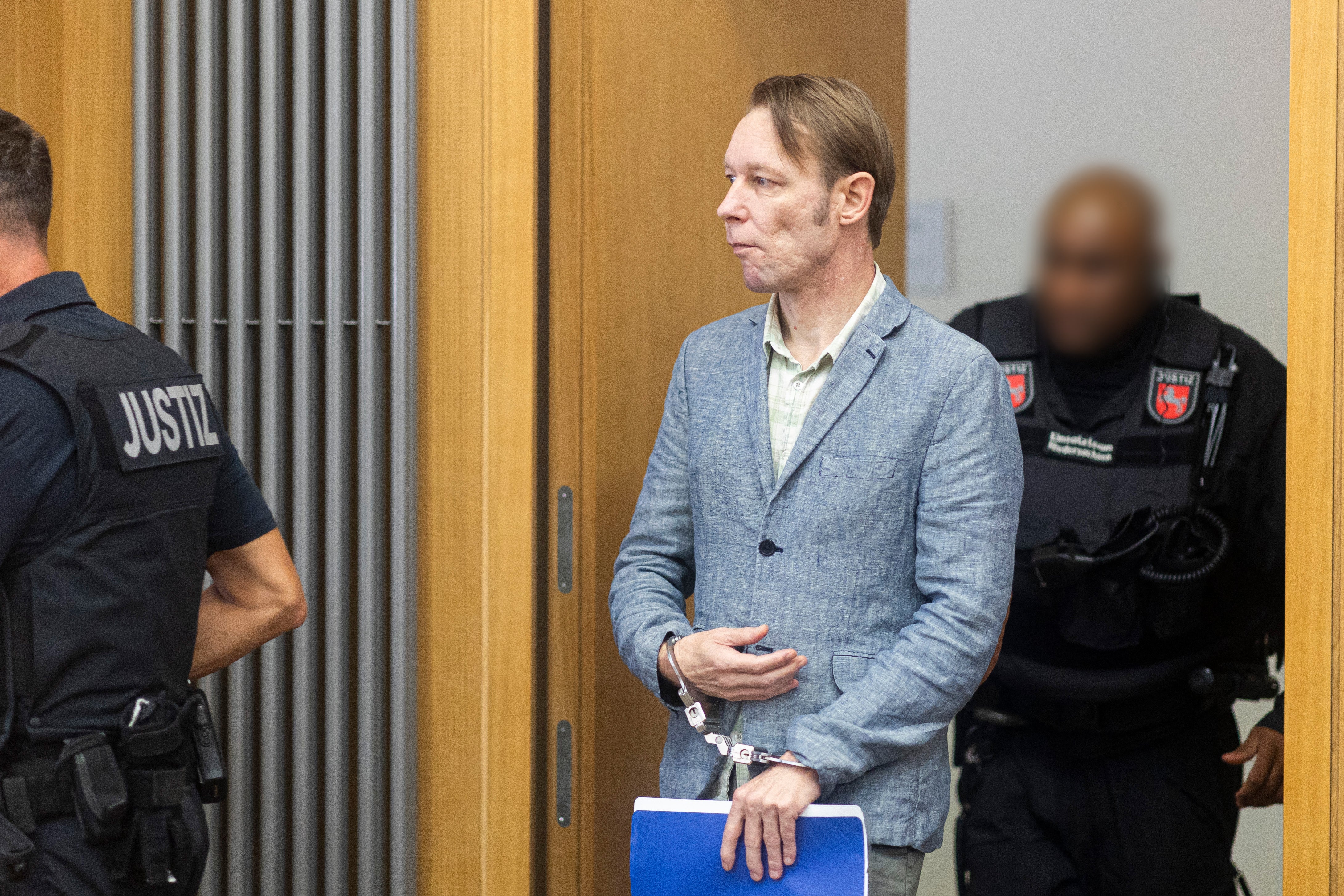
Christian Brueckner in court in 2024 (POOL/AFP via Getty Images)
Madeleine disappears from her bed on 3 May, 2007
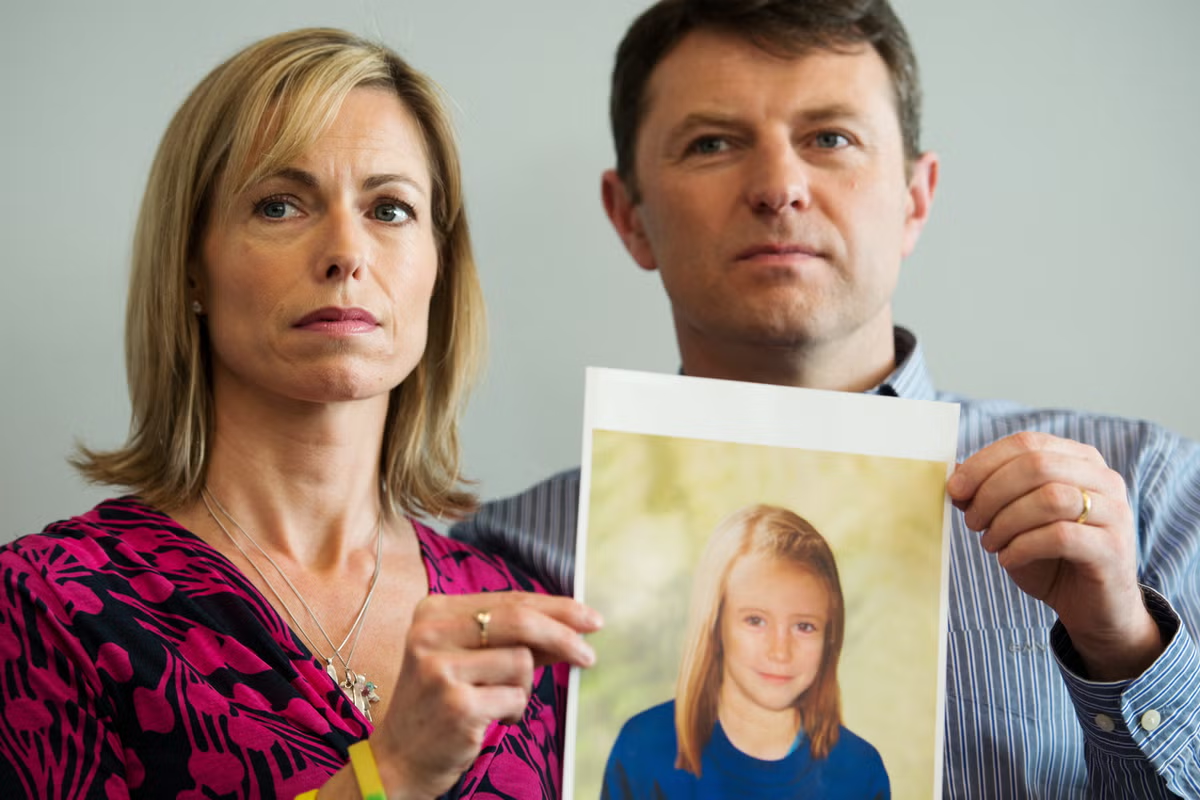
The story began when the McCanns – doctors Kate and Gerry, their three-year-old daughter Madeleine and her two-year-old twin siblings Amelia and Sean – joined a group of seven family friends and their five children on holiday at the Ocean Club in the village of Praia da Luz on the southwestern tip of Portugal on 28 April 2007.
Advertisement
After a pleasant spring break by the sea, the adults in the party went out for dinner at the resort’s open-air tapas bar on 3 May, gathering at 8.30pm. The children were left behind sleeping in their respective apartments with the doors unlocked and a rota system in place among the parents to ensure that someone returned every half-hour to check on them.
When Kate McCann took her turn and returned to her apartment at 10pm, she raced back to the restaurant screaming “Madeleine’s gone! Someone’s taken her!” The police were quickly called and 60 staff and fellow guests searched the complex, calling out the girl’s name in vain until daybreak the following morning.
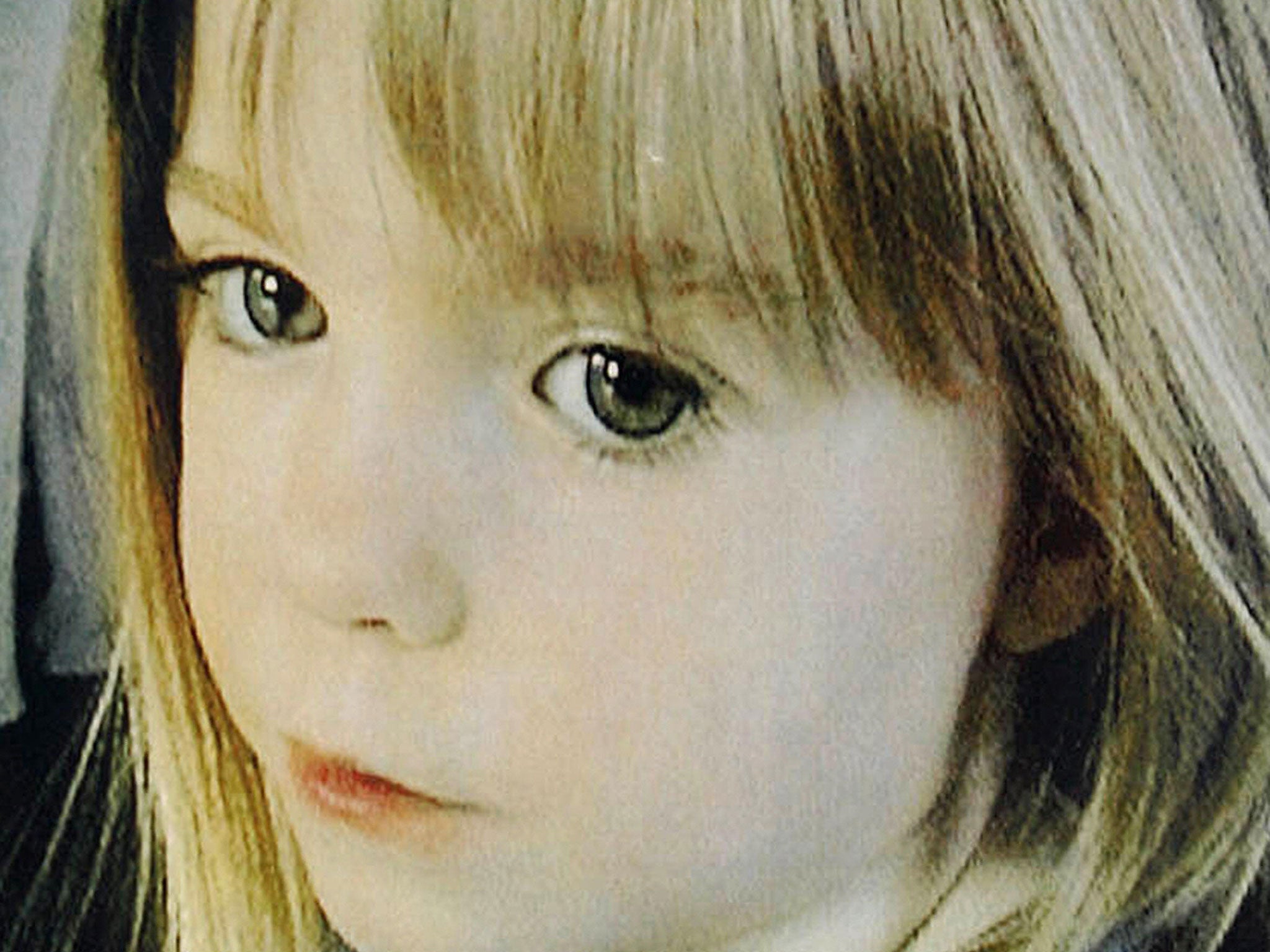
Madeleine McCann has not been seen for 18 years (PA)
Border police and airport staff were put on alert and hundreds of volunteers joined the efforts to find the missing girl over the coming days, the case fast becoming a sensation.
The Portuguese authorities would later attract criticism over their conduct in the crucial earliest hours of the investigation when the trail might still have been warm, accused of making rudimentary mistakes like failing to conduct a house-by-house search of every local residence or interview all of the other guests at the resort, acting slowly to erect roadblocks and potentially compromising forensic evidence at the crime scene.
The police initially stated that they believed Madeleine was still alive and had been abducted from the room by a stranger as the parents described their “anguish and despair” over her vanishing, a worst fear realised for any parent.
Advertisement
The search continued as the summer progressed amid a wild media circus and with huge fundraising activities underway, the McCanns setting up Madeleine’s Fund on 15 May to raise cash to support further investigation and keep the profile of the case high, attracting generous donations from celebrities like Richard Branson, Simon Cowell, JK Rowling and Coleen Rooney.
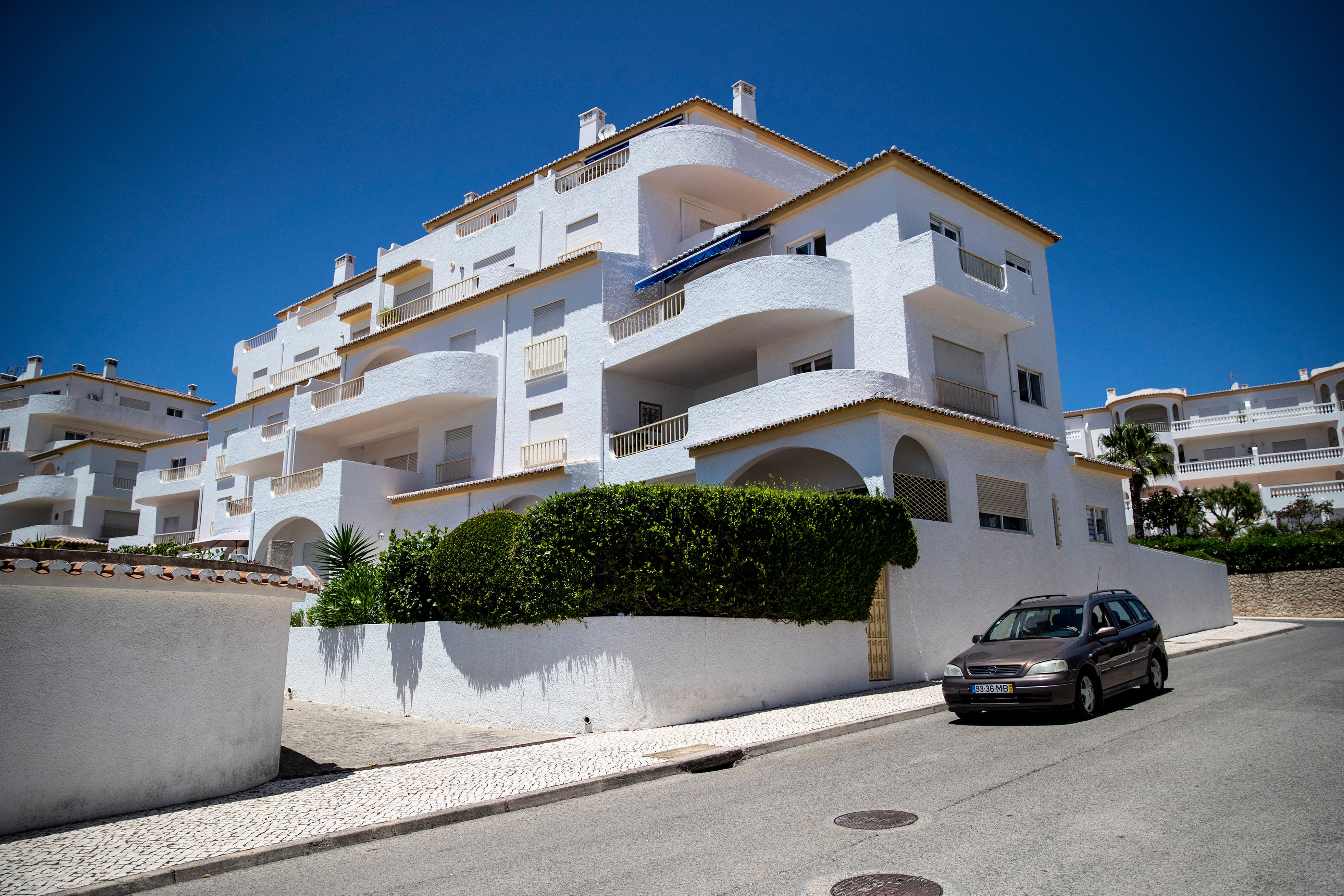
The resort the McCanns had been staying in (AFP via Getty Images)
A local man, Robert Murat, subsequently became its first suspect and had his house and car searched, his swimming pool drained and his electronic devices confiscated but no evidence was found to link him to Madeleine and the matter was soon dropped.
By June, the Portuguese police admitted that they had failed to protect potentially useful evidence at the scene as frustration with the lack of developments grew and the media began to question whether the McCanns themselves had been involved in the matter.
In July, British police sent over two springer spaniel sniffer dogs to search for DNA.
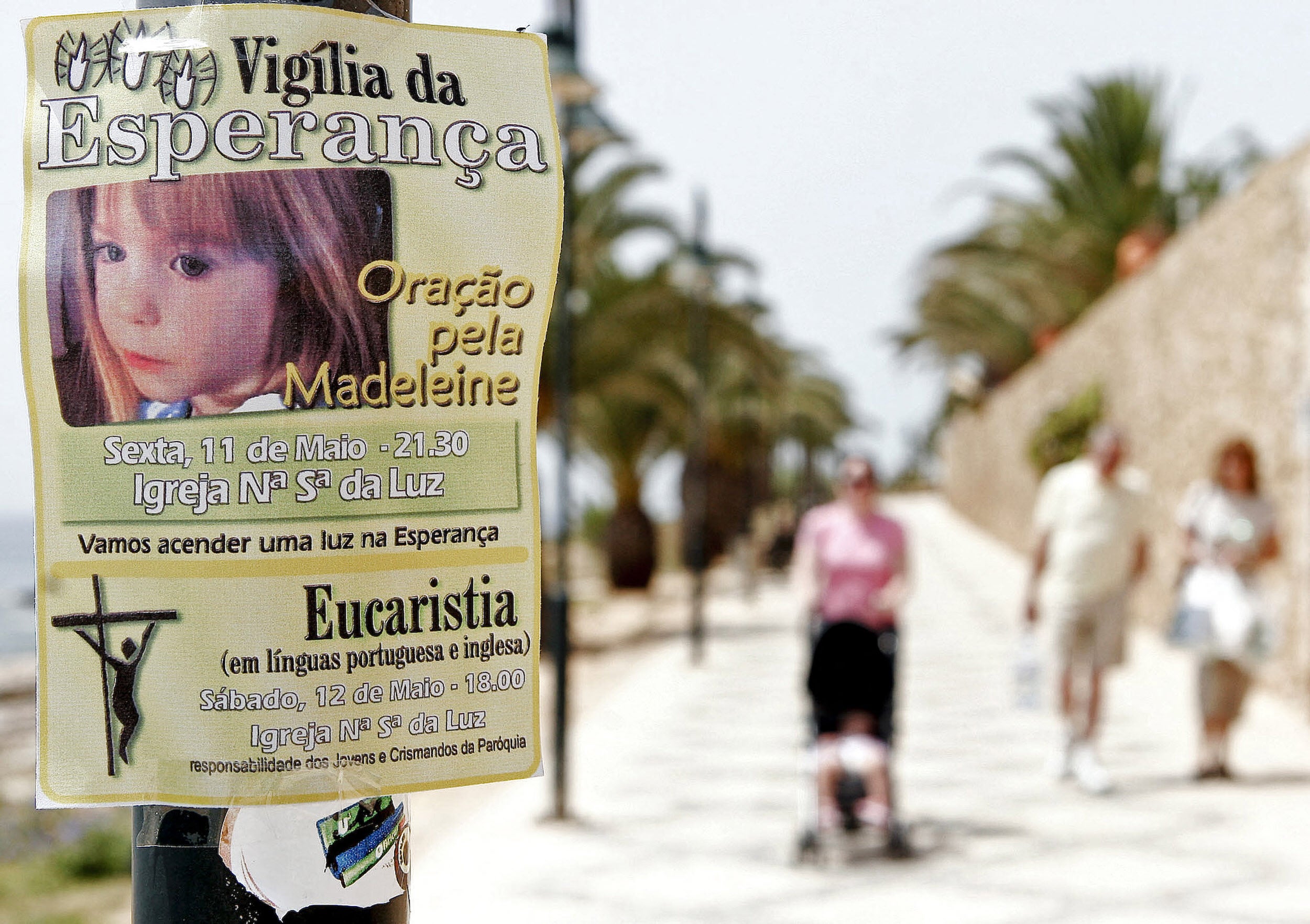
A poster displaying a vigil praying session for missing three-year-old Madeleine is seen in the Portuguese beach resort of Lagos, 12 May 2007 (AFP via Getty Images)
Spotlight turns to Madeleine’s parents in September 2007
Relations with the local authorities would ultimately sour as the latter came to resent British intrusion into a Portuguese inquiry, according to Anthony Summers and Robbyn Swan’s book Looking for Madeleine (2014).
Advertisement
By August 2007, Madeleine had been missing for 100 days and police admitted for the first time that she may never be found. They also told the McCanns that they were no longer considering the matter an abduction case but, rather, a murder inquiry.
The McCanns themselves were interviewed as “arguidos” (suspects) by Portuguese police in September 2007, with the parents told that the dogs had discovered DNA evidence from the missing girl in the boot of their holiday rental car, lines of inquiry that had already been leaked to the British press. They vehemently denied having any part in her disappearance.
Despite being listed as suspects (a designation that would linger until the following July), the McCanns were allowed to return to Britain on 9 September.
A day later, chief inspector Tavares de Almeida of the Policia Judiciaria in Portimao signed a nine-page report claiming that Madeleine had died in the apartment along with a series of other unproven allegations.
Advertisement
The mystery of Madeleine’s disappearance has endured (PA Media)
On 2 October, chief inspector Goncalo Amaral was removed from the case and transferred after alleging that the British police were only interested in pursuing leads favourable to the McCanns.
He would later publish a book, Maddie: The Truth of the Lie, the following summer, resulting in a lengthy libel battle with the McCanns that would run back and forth through the courts until March 2017. Their claim against Mr Amaral was unsuccessful.
Back in Britain, Gerry McCann issued a video that November in which he speculated that his family had been watched by a “predator” during their stay at Praia da Luz. His wife had come to believe that a potential perpetrator could have seen a note in the resort’s guest book visible to all in reception noting their dining arrangements on the evening of Madeleine’s disappearance.
The couple followed up on 20 January 2008 by releasing a sketch of a “creepy man” they said other holidaymakers had said they had seen loitering at the Ocean Club.
In April, a month before the one-year anniversary of the fateful night, Portuguese police travelled to Leicestershire to conduct further interviews with the McCanns’ friends.
Advertisement
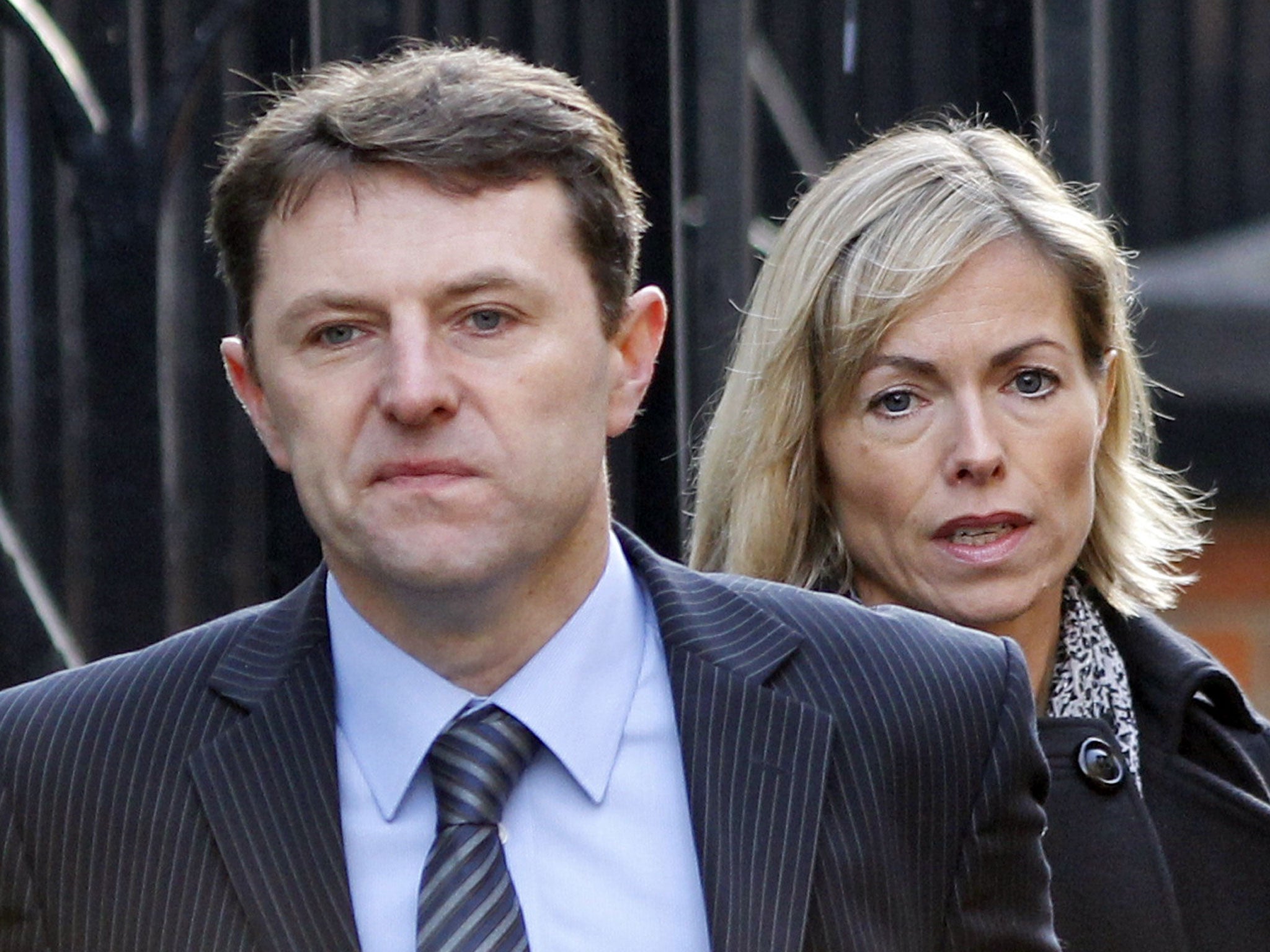
Gerry and Kate McCann have never given up hope for their missing daughter (PA)
McCanns are cleared in July 2008, Scotland Yard picks up the case
Then, on 21 July 2008, Portugal’s attorney general, Fernando Jose Pinto Monteiro, announced that there was no evidence to link either the McCanns or Robert Murat to the disappearance and closed the case, unsolved.
With the trail cold and no closure in sight, the McCanns continued to publicise their cause, issuing computer-generated images of how Madeleine might look now that she had aged on 3 November 2009 and condemning the release of previously unseen Portuguese police files – detailing possible sightings of their daughter – to British newspapers in March 2010.
The McCanns published a book of their own about their ordeal in May 2011, entitled simply Madeleine, which was serialised in The Sun as the newspaper led a campaign calling on then British prime minister David Cameron to launch a new inquiry. He did so.
Commenced by then-home secretary Theresa May, the Metropolitan Police’s Operation Grange would be led by commander Simon Foy and comprise a team of three detective inspectors, five detective sergeants, 19 detective constables and six civilian staff.
Advertisement
It began to yield results in 2013, with Scotland Yard formally announcing a new investigation in July and saying in October it had identified 41 potential suspects. That same month, BBC Crimewatch released an e-fit image of a man of particular interest who had been seen in Praia da Luz with a child matching Madeleine’s description in May 2007.
Detectives arrived in Portugal in January 2014 promising new arrests and finally searched the village in June, interviewing four people the following month but without unearthing new information. The quartet would be definitively ruled out in April 2017, before the UK government said it would continue to fund the investigation until 2020, having already admitted it had cost £10m in its first four years of operation.
That investment had enabled detectives to have tens of thousands of documents translated, investigate over 8,000 potential sightings, take 1,338 statements, collect 1,027 exhibits and investigate 650 sex offenders and 60 persons of interest, all without definitively establishing the truth.
New suspect shoots case back into the spotlight in June 2020
Advertisement
The Madeleine McCann case lay dormant before suddenly exploding into life in June 2020 when German media revealed that Brueckner, a 43-year-old prisoner with a track record of child abuse and drug trafficking, had been identified as a new suspect by the public prosecutor of the German city of Braunschweig.
He had reportedly been living in a Volkswagen camper van in the Algarve at the time of Madeleine’s disappearance and one woman has since come forward to suggest she saw a girl that might have been Madeleine speaking German in a supermarket in Portugal in 2017.
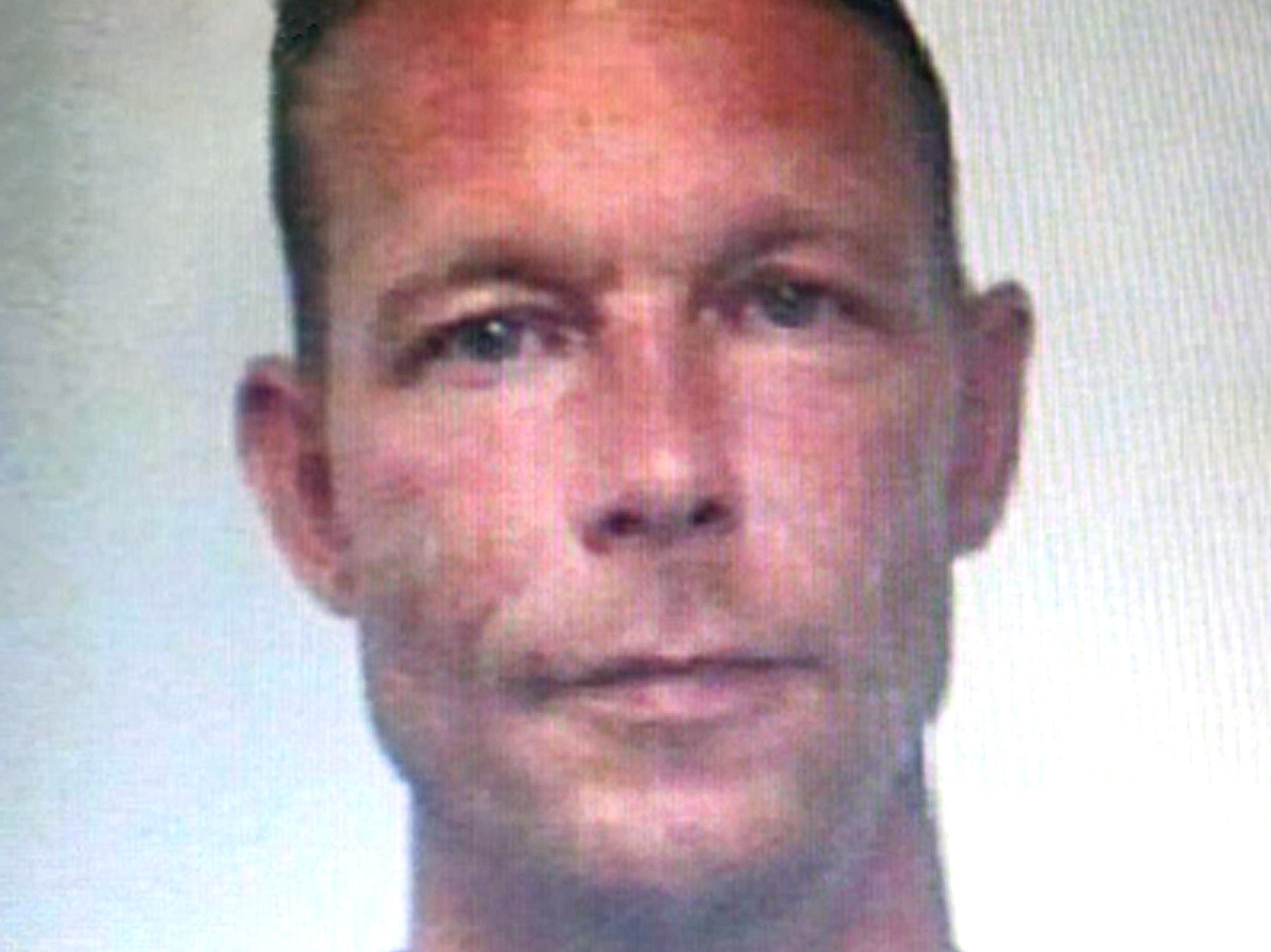
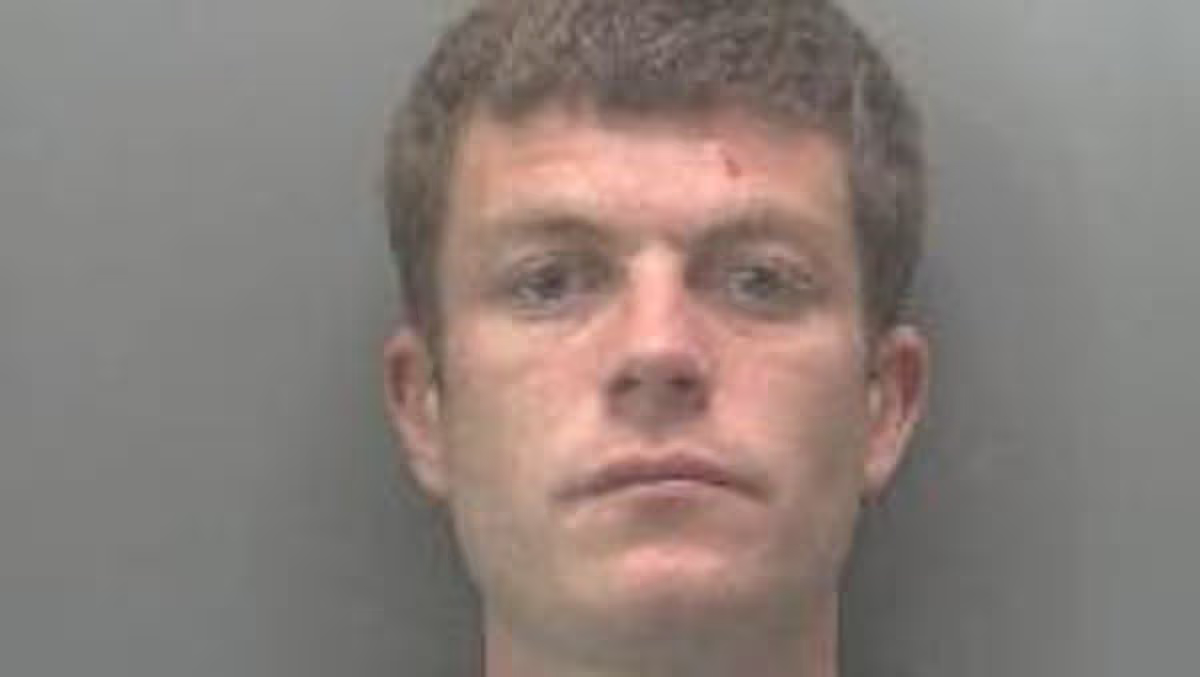
Christian Brueckner was named as a suspect in the case (AFP/Getty)
German investigators classified their probe into his movements as a murder inquiry, saying they were working on the assumption that Madeleine is dead and reporting in July 2021 that they had found an abandoned cellar beneath his former allotment near Hanover where she could, theoretically, have been held captive.
Hans Christian Wolters, the prosecutor leading the investigation into Brueckner, has said he was “very confident” the inmate is responsible for kidnapping her.
“If you knew the evidence we had you would come to the same conclusion as I do but I can’t give you details because we don’t want the accused to know what we have on him – these are tactical considerations,” he told the BBC.
Advertisement
Portuguese police formally made Brueckner a suspect in relation to the case on 21 April 2022.
Following their unsuccessful libel claim against Mr Amaral, the former chief inspector who had investigated the disappearance, the McCanns applied to the European Court of Human Rights on the ground that the Portuguese legal system had breached their right to be presumed innocent. But on 19 September 2022, the Court rejected their claim.
In February 2023, a Polish woman called Julia Faustyna made headlines by claiming she was Madeleine, using the Instagram name @iammadeleinemccann. Ms Faustyna, 21, did not provide any supporting evidence but sought DNA tests to prove her origins. The results ultimately revealed that she was entirely of Polish origin, with no British heritage, disproving her claims.
In April 2023, a court in Braunschweig dropped a rape charge against Brueckner, unrelated to the McCann case, concluding it did not have jurisdiction, while police in Germany continued to claim they had“concrete evidence” that Madeleine is dead.
Advertisement
McCanns mark 16 years since Madeleine’s disappearance in May 2023
On 2 May 2023, Madeleine’s parents posted a statement on the Find Madeleine website marking the latest anniversary of their daughter’s disappearance, reiterating their hopes of being reunited with her one day.
“The police investigation continues, and we await a breakthrough. Thank you to everyone for your support – it really helps.”
Portuguese police also reportedly apologised to the parents offor the way detectives investigated the case and treated the family.
Advertisement
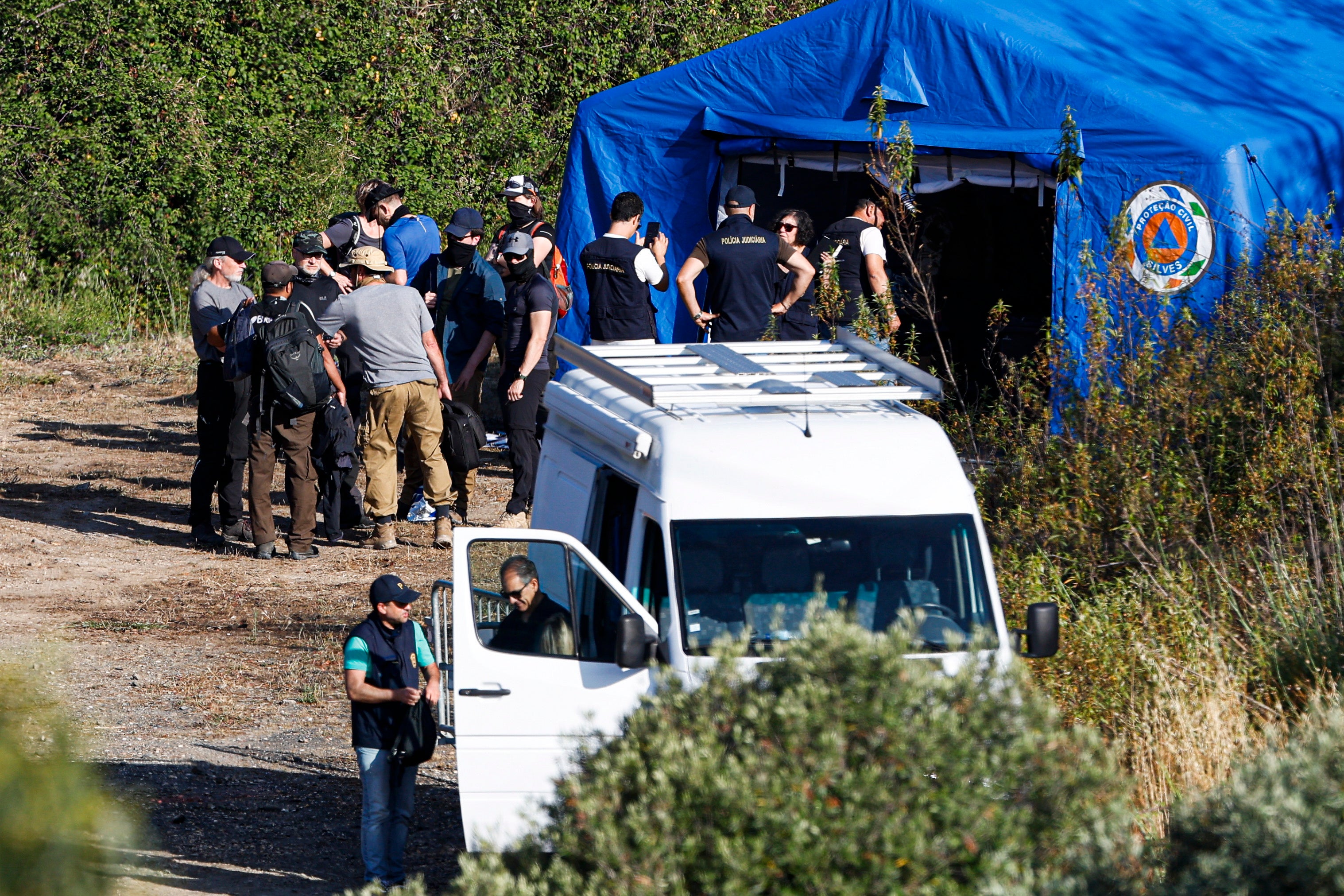
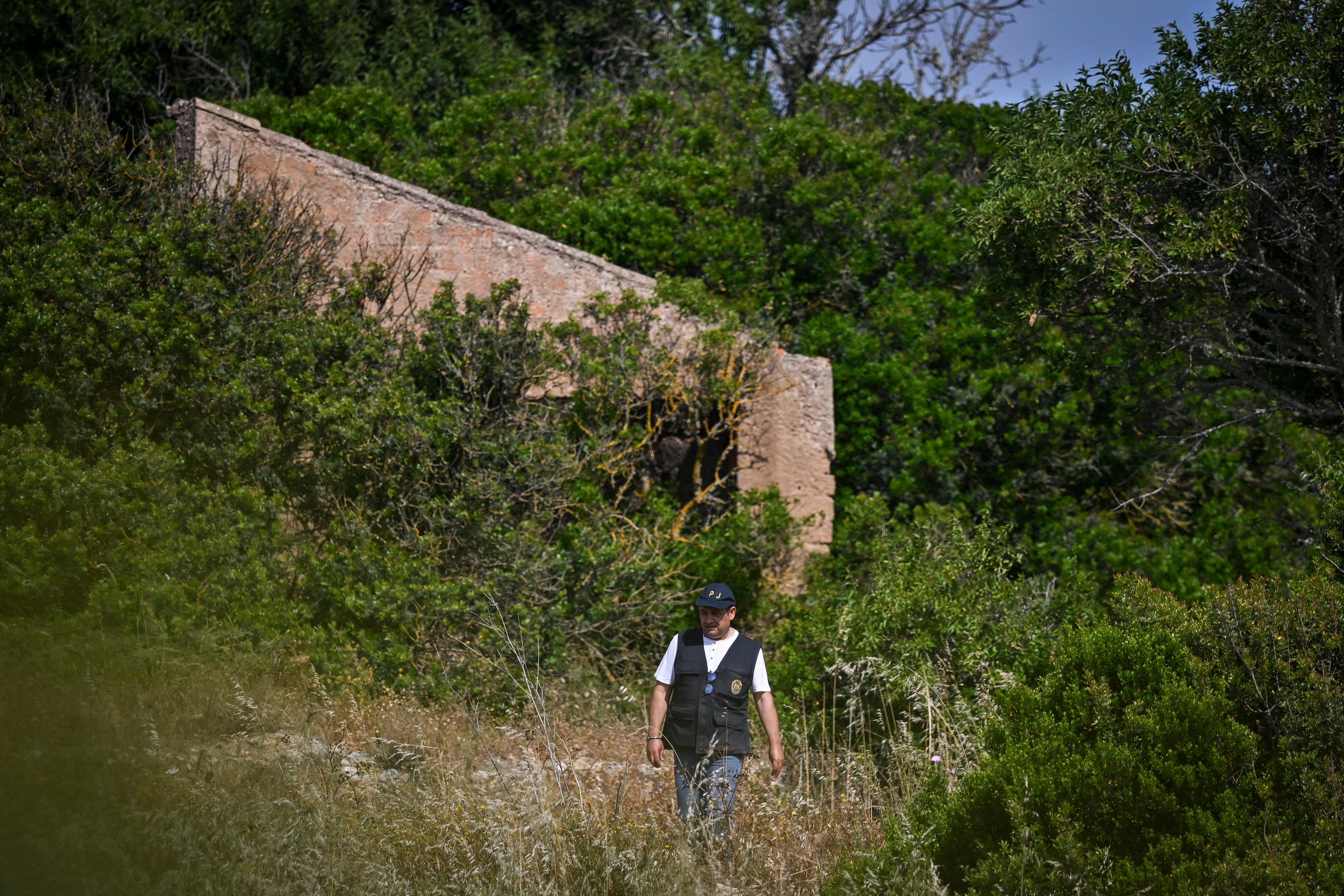
Investigators explore the Barragem do Arade beauty spot (EPA)
Later that month, the case unexpectedly lurched back into life in when investigators launched a major search operation at a reservoir in the Algarve, with Mr Wolters saying they were acting on “certain tips” from Brueckner, whom the prosecutor said he remains “very confident” holds the key to Madeleine’s disappearance.
They combed the shoreline and surrounding grasslands with sniffer dogs, rakes, spades and pickaxes and inspected the water in a rigid-hull inflatable boat. A no-fly zone was put in place in the skies overhead to allow police drones to survey the region undisturbed.
The site is located approximately 30 miles northeast of the Ocean Club resort, from which the missing girl first disappeared.
Brueckner cleared of further charges in October 2024
Brueckner had been serving a seven-year sentence for the 2005 rape of a woman in Portugal’s Algarve region, in the area where Madeleine went missing.
The renewed search has begun in Portugal (AFP/Getty)
In January 2025, Braunschweig Chief Public Prosecutor Hans Christian Wolters admitted there was no current prospect of charging Brueckner over Madeleine’s disappearance, as police were still trying to secure forensic evidence linking Bruekner to the case.
German police were in June been granted permission to undertake a widespread search of key areas in Portugal in a hunt for evidence, including Madeleine’s body.
The search, running from 2 June to 6 June, focused on an area around the spot where Brueckner had been living at the time of Madeleine’s disappearance.
Brueckner released from prison in September 2025
The main suspect in Madeleine’s disappearance left the high-security prison in Sehnde near Hanover on 17 September.
Advertisement
According to German media, he will have to wear an electronic tag, report to probation staff and give up his passport.
He will be required to take up a fixed residence and cannot move home without permission, although his lawyers are expected to appeal against the conditions.
Prosecutors believe he is still dangerous, following a recent psychiatric report that concluded he is likely to commit further crimes after he failed to undergo any therapy while in custody, according to reports.
After his release, he was placed under close monitoring including being tagged and subject to travel restrictions. He lashed out at camera crew when he was tracked down by ITV to a forest in northern Germany in September 2025. He was reportedly moved from his woodland tent to a new town in February 2026 after anger from local residents, according to the broadcaster.
Advertisement
Scotland Yard ‘seeks extradition’
A senior Scotland Yard official is now seeking to bring Brueckner to Britain to stand trial for Madeleine’s disappearance, according to The Telegraph.
“Next year marks 20 years since Madeleine McCann went missing. If the evidence is strong enough to extradite the prime suspect and try him here, that is what we would seek to do,” a source at the force told the publication.
“Clearly, there are numerous hurdles but our priority at the moment is to amass the strongest evidence we can against that prime suspect.”
Advertisement
According to the publication the Met Police believes it can gather strong enough evidence to enable the Crown Prosecution Service to press charges.
Polls open at 7am across West Lothian and will close at 10am on Thursday. Registered voters should have received their poll card advising where to vote.
Voters are reminded that they do NOT need ID to vote in the Holyrood elections this Thursday.
Advertisement
Polls open at 7am across West Lothian and will close at 10am on Thursday. Registered voters should have received their poll card advising where to vote.
There are now three constituencies covering the county. A new Bathgate constituency covers the northern half alongside the existing Almond Valley constituency around Livingston. The town of Linlithgow has been incorporated into a new East Falkirk and Linlithgow constituency.
The Local Democracy Reporting Service will cover the two counts being held in Livingston and also the Linlithgow one from Falkirk.
Registered postal voters cannot be issued with ballot papers at the polling station, but they can return their completed postal ballot pack to their polling station on polling day by 10pm.
Alternatively, they can hand deliver their postal vote to polling stations in the constituency or to West Lothian Civic Centre in Livingston.
The Scottish elections use a proportional system of voting which means that you vote for both a local constituency MSP and for additional regional MSPs.
This means that when you arrive at your designated polling station, you will receive two ballot papers – a constituency ballot paper and a regional ballot paper.
Advertisement
Your lilac-coloured ballot paper is for your local constituency and will contain a list of candidates running to be your area’s Member of Scottish Parliament (MSP).
Your peach-coloured ballot paper will be used to elect MSPs for your region. On this second ballot paper instead of voting for a specific candidate, you will be asked to cast a vote for a political party.
You must indicate your preferred choice on each paper by putting a cross (X) in the box next to your preferred candidate or party.
Advertisement
If you put a cross (X) next to more than one box on the ballot paper, your vote will be considered a ‘spoilt ballot’ and will not be counted. Once you have completed your ballot papers, fold and put them into the appropriate ballot box – there will be one ballot box for the constituency vote and another for the regional vote.
Staff in the polling places will be available to provide any support you may need. Arrangements will also be in place in polling stations to assist those with accessibility requirements.
Arrangements are available in the polling stations for voters who need help with reading the ballot paper or marking it. No photos can be taken inside the polling station.
MacDonald had thrown a phone at his victim’s face, which injured her lip and chin.
A man has been jailed after harassing and assaulting his former partner. Ryan MacDonald, 29, of Fen View, Stanground, Peterborough, threatened to smash the victim’s windows and doors on March 21, 2025.
Advertisement
The victim reported the incident to the police but two days later, she withdrew the complaint because she felt she and MacDonald, who she had a child with, had been getting on better. Three months later, MacDonald started messaging her at work and said he was outside her home.
Even though he was told to leave her alone, he had been waiting nearby her home when she finished work. The victim went with MacDonald to a park out of fear where they had an argument.
A few days later, the victim was collecting her child from school when MacDonald appeared and started shouting at her. He grabbed her phone and threw it at her face, which injured her lip and chin.
Over the course of around a week, MacDonald followed the victim and bombarded her with calls, text messages, and unannounced visits before he was arrested. While he was on bail, he made several calls to the victim to get her to withdraw the charges.
Advertisement
This led to him being arrested again. On Wednesday, April 29, at Huntingdon Law Courts, MacDonald was sentenced to two years and four months in jail after he pleaded guilty to harassment involving fear of violence, actual bodily harm (ABH), and intimidating a witness or juror.
Counts of stalking involving fear of violence, threats to damage or destroy property, threats to kill, and two counts of assault by beating were ordered to lie on file.
DC Isabelle Wilding, who investigated, said: “MacDonald’s behaviour was persistent, intimidating and left the victim living in fear. This sentence reflects the seriousness of his actions and sends a clear message that harassment and abuse will not be tolerated.
“We take reports of stalking and harassment extremely seriously and would encourage anyone experiencing similar behaviour to come forward and seek support.”
Advertisement
To get more news and top stories delivered directly to your phone, join our new WhatsApp community.Click this linkto receive your daily dose of CambridgeshireLive content.
We also treat our community members to special offers, promotions, and adverts from us and our partners. If you don’t like our community, you can check out any time you like. If you’re curious, you can read ourPrivacy Notice.
Ask Jeeves was among the first internet search engines to launch back in 1996, two years before Google (in 1998).
Visitors to the search engine were greeted with the iconic butler character, known as ‘Jeeves’.
Ask Jeeves was rebranded in February 2006, changing its name to Ask.com.
Ask.com shuts down after 30 years
Now, after 30 years, Ask.com has shut down (effective as of May 1, 2026).
Advertisement
The website says: “Every great search must come to an end.
“As IAC continues to sharpen its focus, we have made the decision to discontinue our search business, which includes Ask.com.
“After 30 years of answering the world’s questions, Ask.com officially closed on May 1, 2026.
“We are deeply grateful to the brilliant engineers, designers, and teams who built and supported Ask over the decades.
Advertisement
“And to you—the millions of users who turned to us for answers in a rapidly changing world—thank you for your endless curiosity, your loyalty, and your trust.
“Jeeves’ spirit endures.”
Ask.com shut down on May 1, 2026. (Image: Ask.com)
“End of an era” – Internet users saddened by Jeeves’ “retirement”
The closure of Ask.com has hit users hard, with some labelling it the “end of an era”.
One person, posting on the Reddit group r/technology, said: “Ask Jeeves. Such an OG. Enjoy retirement.”
Advertisement
Another added: “Oh man. End of an era.”
A third user commented: “It’s actually quite amazing the staying power some of these early internet giants despite having fallen out of relevance decades ago. RIP, Jeeves.”
This person posted: “This was the first search engine I ever used when I first came online. Thank you for your service.”
While another fan wrote: “Nooooo, not Jeeves. What’s next, Alta Vista?”
Advertisement
Do you remember Ask Jeeves? Will you miss the search engine now that it’s shut down? Let us know in the poll above or in the comments below.
If you saw me at a work meeting, out with friends, or honestly anywhere in the wild, I almost always have my arms crossed. With that being my default stance, you would think I’m a miserable person with a bad attitude. But that is far from the truth (most of the time).
I’m crossing my arms for two reasons: 1) I’m probably cold, and 2) it feels like I’m giving myself a hug, and it feels comforting.
As it turns out, crossed arms is the most commonly misunderstood body language sign, according to experts.
“Most of the time, body language reading is quite accurate; we have to remember it’s only a part of the communication, like tone, choice of words, or, in some cases, touch,” as Stephanie Pappas, a licensed marriage and family therapist, told HuffPost.
Advertisement
According to Pappas, our reason for judging a person for their body language is evolutionary. Body language was the prominent form of communication and a major survival skill for our ancestors thousands of years ago, she explains. “We were wired to be attuned to those in our tribe, or potential threats, by the way they moved and expressed themselves around us.”
PixelVista via Getty Images
Professional young woman with glasses standing arms crossed in a bright home office, exuding confidence and competence
So while we don’t have to rely as much on body language for communication, our brains might still read body language and create a story.
Turns out, crossed arms aren’t the only thing people are getting wrong. Here’s what experts say about the most overlooked body language signs.
Advertisement
Here’s what crossed arms actually mean…
While people read crossed arms as being closed off or rude, it’s actually a self-soothing technique for most people, says Pappas. “It’s so easy to cross your arms when you’re feeling stressed or overwhelmed as a way to try to regulate yourself.”
“The biggest mistake is that we judge too quickly,” Linda Clemons, body language expert and author of HUSH: How to Radiate Power and Confidence Without Saying a Word told HuffPost. “Say my arms are crossed. You think, ‘this person is cold, closed off’ and you walk away. Two seconds later, I reach for my sweater. I was literally cold!”
“But you weren’t there to see it, because you judged so quickly.”
Advertisement
In other words, my reasons for crossing my arms are totally valid. And so are yours.
It’s not just crossed arms – people are frequently confused by these body language signs, too.
While Pappas and Clemons agree that crossed arms is the top confusing body language sign, eye contact and even smiles leave a lot of room for interpretation.
“Often, eye contact is given a lot of weight for being the signal that shows attention and respect for the other person,” Pappas said. However, reasons for not maintaining eye contact can go beyond rudeness or indifference. For example, in some cultures, it’s considered disrespectful to make eye contact; some people who are neurodivergent also have difficulty making eye contact because it feels overwhelming or uncomfortable.
Advertisement
Another confusing body language is the smile, according to Clemons. Sometimes people give what Clemon called “a pageant smile,” (AKA a fake smile) because they feel they should be acting like they’re happy.
“People who are truly happy for you, their cheeks will be elevated, and their eyes will be wide,” Clemons said. But with pageant smiles, they’re only using the muscles in their lower faces.
This is how to get better at reading body language cues.
Body language is only a piece of the communication puzzle, says Pappas. “It needs to be taken into consideration with context in order to create as much accuracy as possible.” Here are some tips to better read body language.
Advertisement
Understand Baseline Behaviour
If you know someone closely, you’ll get a full picture of their mood, personality, and communication style, otherwise known as baseline behaviour, Pappas notes. For example. Say you have a friend who often uses their hands when telling stories, suddenly puts their hands on their lap; That may mean a shift in their emotions or mood.
Understanding the person’s baseline was necessary to interpret their non-verbal cues in that context, adds Clemons. “Say we’re at a funeral, we’re paying our respects. Everyone’s expression is very somber, but one person is smiling,” she describes. “It’s the wrong non-verbal cue for this context, so you probably think something is very off with this person. But then maybe someone tells you this person always smiles when they are nervous, or overwhelmed.”
Knowing a person’s reactions to situations can offer better clarity on how to proceed, too.
Advertisement
Look At Behaviours In Clusters
Another thing to pay attention to is to look at behaviour in clusters, according to Clemons. “If the arms are crossed, the tone of voice is dismissive, and the person’s shoulders or feet are turned away, it’s more likely that they really don’t want to be talking to you.”
Congruency is also key, she adds. The words people speak should match their tone and body language. “If I say to my spouse, ‘I want to make this marriage work,’ but I fold my arms and my tone of voice is not congruent with my words, I may be headed out the door,” Clemons said.
Understand Intuition Versus Anxiety
Advertisement
One of the best things you can do when reading body language is learning to distinguish between intuition and anxiety, says Pappas. When you’re overly focused on analysing someone’s signals, you can drop out of the parts of the brain that help connect and communicate (and spiral into anxious storytelling instead).
“Anxiety might tell you, ‘Look at the way they’re standing there, they’re so angry with you, what did you do now?’” Pappas explained. “Whereas intuition is usually an unconscious, nonjudgmental piece of information that helps you make productive decisions.”
In other words, anxiety builds a dramatic narrative while intuition delivers a quiet, neutral signal. The latter is worth listening to, especially in situations where safety is a concern. “Paying attention to your gut feeling, especially in a situation where safety may be a concern, is a skill that our bodies have honed to keep us alive,” Pappas said.
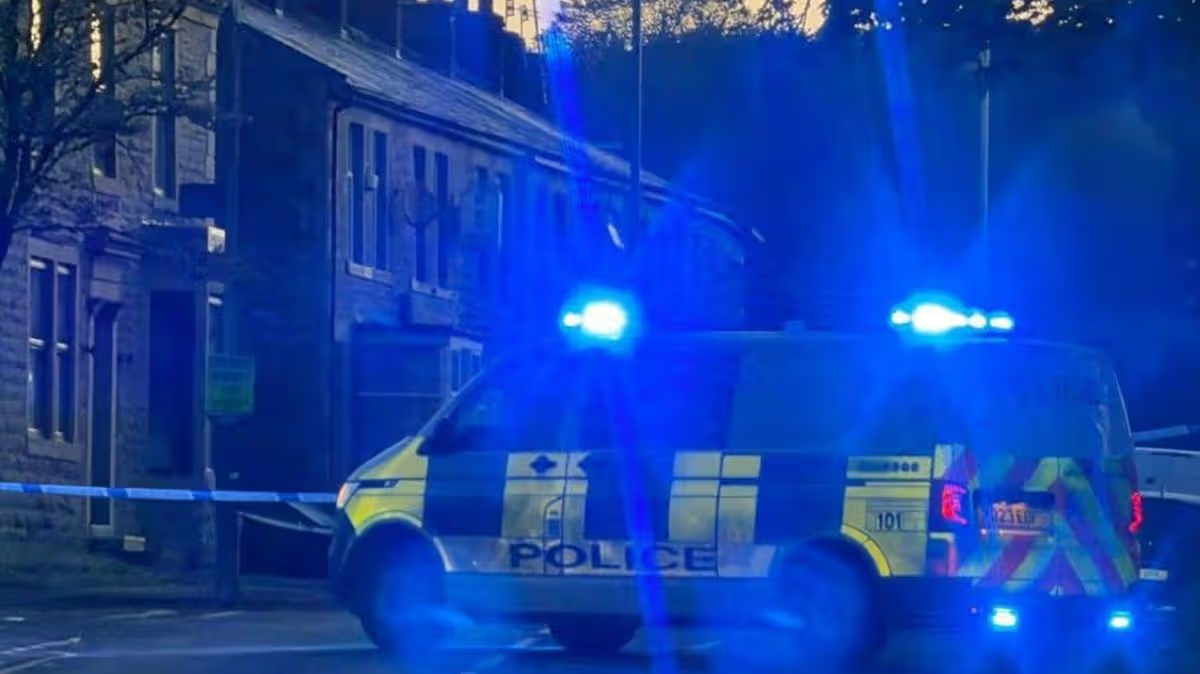
Emergency services raced to the property in Haslingden, Lancashire, where a car had left the carriageway and collided with the side of a house, killing a man and injuring two teens
A man has been killed and two teenage girls are severely injured after a car ploughed into a house in Lancashire.
Advertisement
Emergency services raced to Helmshore Road in Haslingden on Monday night, with police arriving to find a VW Golf which had left the carriageway and smashed into the side of the property.
Cruises are sold as floating holidays, but they are also useful for understanding public health. Cruise ships are carefully designed places where many people live, eat, relax and move through the same shared spaces for days at a time. They show how easily illness can spread when people are packed into a single interconnected environment.
Think of a cruise ship as a temporary city at sea. It has restaurants, theatres, lifts, cabins, kitchens, water systems and indoor gathering spaces. That is great for convenience, but it also means that once an infection gets on board, it can move through the ship in ways that are hard to stop.
The Diamond Princess outbreak is perhaps the best-known example. During the 2020 COVID outbreak, 619 passengers and crew tested positive for the disease. Researchers found that the ship conditions made the novel coronavirus spread more easily. Their modelling suggested that public health measures, such as isolation and quarantine, prevented many more cases, but it also showed that an earlier response would have further limited the outbreak.
Norovirus (the so-called vomiting bug) is the infection most closely linked to cruise ships. In a review of previously published studies, researchers found 127 reports of norovirus outbreaks on cruise ships, with many linked to contaminated food, contaminated surfaces and person-to-person spread. A more recent report from the US also showed that norovirus can spread very rapidly from person to person on a cruise ship.
Advertisement
This helps explain why ships such as Celebrity Mercury, Explorer of the Seas and Carnival Triumph have become familiar names in outbreak reports. These were not unusual in some special way; they were simply settings where shared dining, close contact and frequent movement through common areas allowed infection to spread fast.
Food service plays a big part in this risk. Buffet-style dining, shared utensils and many people touching the same surfaces can make it easier for stomach bugs to spread. If someone is infected but does not yet feel sick, they may still contaminate food or surfaces before they realise they are unwell.
Buffet dining can help stomach bugs spread. Hapsari Ayu/Shutterstock.com
The ship’s design adds to the problem. People spend time together in dining rooms, bars, lifts, corridors, theatres and spa areas. Crew members also live and work in the same environment, often in shared accommodation, so illness can move through the ship from passenger to passenger or between passengers and crew.
Ventilation also plays a crucial role. Cruise ships are not closed boxes, but they do rely heavily on indoor spaces where people spend long periods together. Studies into cruise ship air quality have shown that illness can spread more easily in crowded, enclosed spaces, like cabins, restaurants and entertainment venues, if the ventilation system is not up to scratch. Things like adequate fresh air circulation, specialist filters and air-purifying technology all play a role in keeping passengers safe.
Advertisement
Legionnaires’ disease (a serious lung disease caused by bacteria) shows a different kind of risk. It is not usually spread directly from one person to another. Instead, people can get infected by breathing in tiny droplets from contaminated water systems, hot tubs or showers.
A well-known outbreak among cruise passengers was linked to a whirlpool spa, and recent reports from the US Centers for Disease Control and Prevention have described other cruise-associated legionnaires’ disease outbreaks linked to ship water systems.
Age also matters. Cruise holidays are especially popular with older adults, and many passengers have long-term health conditions that make infections more serious. A stomach bug on a cruise can lead to dehydration, and a respiratory infection can lead to pneumonia or hospital care.
Cruise ships do have medical facilities, but they are limited compared with land-based hospitals. They are built to give first aid, basic treatment and short-term care, not to manage a fast-moving outbreak on a large scale. That is why cruise health depends so much on early reporting, quick isolation and strong cleaning practices.
Advertisement
Other infections such as respiratory viruses, including influenza, can spread in the same crowded indoor settings, and stomach bugs can spread through food, hands and shared surfaces. COVID and flu exploit enclosed air and crowds. Norovirus loves buffets and surfaces. Legionnaires’ targets water systems, which ships can’t easily sterilise. Hantavirus (a severe respiratory illness spread by rodents) outbreaks on ships are rare. However, as recent news of the deaths on the MV Hondius attests, germs in close quarters find it much easier to spread.
How to limit your risk
As an epidemiologist, I have seen many outbreaks in hospitals, schools and even flights. For travellers, the best protection starts before boarding. It is sensible to check whether the cruise line has clear illness reporting, cleaning and isolation policies. Make sure your routine vaccines are up to date. And for older adults, pregnant women and anyone with health problems, consult your GP before travelling. Also, ensure your travel insurance covers illness-related disruptions.
Once on board, washing your hands with soap and water is the most useful step for preventing stomach bugs like norovirus. Hand sanitiser can help, but it does not replace soap and water. If you start to feel unwell, the safest move is to avoid buffets and crowded shared spaces and report symptoms early rather than trying to carry on as normal.
Cruise lines have improved their hygiene and outbreak response systems over time, and many voyages pass without incident. But the basic structure of cruise travel still creates the same challenge: many people sharing the same meals, the same air, the same water systems and the same common spaces. That is why outbreaks keep returning, and why cruise ships remain a useful reminder that public health is shaped as much by design as by germs.
An expert has shared their spring gardening tips to create a blossoming garden in time for summer
Households in the UK are being urged to plant one specific flower in their gardens this May to get a beautiful display in time for summer. With the weather picking up across the country, May is the prime time to head outside and get your spring gardening jobs done.
Advertisement
According to a wildlife and gardening expert, May is all about keeping on top of your garden maintenance, intentional planting, and supporting wildlife during one of the busiest times of the year in the gardening calendar.
James Ewens at Green Feathers has revealed the essential jobs to tick off this month for a thriving summer garden, including the best time to plant sunflowers.
Get MEN Premium now for just £1 HERE – or get involved in our WhatsApp group by clicking HERE. And don’t miss out on our brilliant selection of newsletters HERE
“Spring is in full swing, and now is the perfect time to enjoy our gardens and start making the most of them – whether for relaxing, just pottering around, being green-fingered, hosting family and friends, bird watching, or doing some spring summer gardening,” explains James.
Advertisement
“May is when gardens really come into their own,” explains James. “Everything is growing fast, lawns need regular care, and it’s a fantastic time to plant flowers and vegetables that will reward you throughout the summer months.”
James explains that being proactive in May doesn’t require an exhaustive list, a few simple jobs can support our gardens and the wildlife in it: “You don’t need to overwhelm yourself with jobs in May, with a handful of key tasks – like watering, planting, mowing and supporting outdoor creatures, you and your wildlife friends, are all set for a thriving summer outside.”
What to plant in May
According to James, May is one of the best months for planting as the risk of frost is slim and the soil is starting to warm up. May is the perfect time to fill beds, borders, and containers with colourful summer flowers and start growing your own food.
Advertisement
“May is ideal for creating edible gardens; you can sow vegetables outdoors like beetroot, carrots, lettuce, potatoes, and spinach just in perfect timing for BBQ season – cheers to that! Don’t forget seasoning, May is ideal to grow herbs like basil, parsley and chives,” he says.
“Sunflower season is upon us – thank goodness – and May is the best time to plant sunflowers. Sunflowers are one of my favourites, they’re not only gorgeous, but beneficial for birds and pollinators, too.
“Start them in plants to protect them from pesky slugs, and once they’re a sturdy 30cm, they can be in the ground ready to pop out in August time.”
Looking after wildlife
May is critically important for wildlife due to warmer temperatures, a key time for pollinators, and many birds nesting and breeding.
“Keep bird feeders replenished with nutritious food like high-fat suet balls and sunflower seeds, and ensure birds have a consistent supply of replenished water to bathe and hydrate,” advises James.
“Bonus points if you have a nest box for bird populations, providing bird families with a safe haven in your garden is not only crucial for their survival, but extremely rewarding.
“If you need to tidy your garden, focus on light maintenance instead: tying in climbing plants, removing dead stems, or trimming small areas where you are certain no nests are present to ensure you’re not disrupting or harming wildlife.
Advertisement
“Supporting wildlife during nesting season helps maintain healthy bird populations and keeps gardens full of life and activity.”
No Mow May
No Mow May is a nationwide initiative that urges homeowners to pause mowing for the entire month of May. It is an easy but potent way to support wildlife and give nature a few weeks of breathing space to thrive.
“When you stop mowing, wildflowers like clover, daisies and dandelions are free to bloom, providing essential food for bees, butterflies and other pollinators that are considered endangered in the current climate,” James explains.
“To make your lawn even more wildlife-friendly, you can consider planting more wildflowers, starting by gently raking the lawn to remove any dead grass or cuttings. This helps prevent nutrient buildup, which can stifle the growth of native species. A little prep goes a long way in supporting wildlife.”
For generations, the mild and temperate climate of north-western Europe has been credited to one legendary force: the Gulf Stream. This idea is so deeply entrenched in our cultural identity that in James Joyce’s Ulysses, the protagonist Stephen Dedalus refuses to take a bath, arguing that “all Ireland is washed by the Gulf Stream”.
However, the Gulf Stream is just one part of a much more complex system called the Atlantic Meridional Overturning Circulation or AMOC.
To explain this better, scientists often use the image of a giant ocean conveyor belt, where warm waters move northwards across the surface of the Atlantic from the tropics. As these waters reach the North Atlantic, they release their heat into the atmosphere, much like a radiator. The AMOC also carries the moisture that gives us our temperate landscape. After the waters have released their heat, they become colder and denser, which makes them sink into the deep ocean. These waters then return southward, at great depths.
When scientists talk about the AMOC “slowing down” or “changing,” they are essentially describing a reduction in the strength of our natural radiator. Specifically, they measure how much water is moving north and south at different depths across the Atlantic. This allows them to estimate how much heat is being carried from the tropics toward the North Atlantic and back again at depth.
Advertisement
More than a conveyor belt
Although this “conveyor belt” analogy is a helpful starting point, modern research suggests it is incomplete and potentially misleading. For example, the system is incredibly sensitive to how seawater changes its weight and density as it interacts with the atmosphere, freshwater, ice and incoming solar radiation. Because of these additional processes, the AMOC behaves less like a single, steady loop and more like a network of interconnected regional components.
Different parts of the system can change independently, sometimes with only regional effects and sometimes with consequences for the entire system.
The Subpolar Gyre (SPG), a system of wind-driven ocean currents occupying the region from the Labrador Sea to the west of Ireland, is a powerful example of why the network perspective matters. This regional AMOC component can show a significant degree of independence from the global AMOC. It is controlled by local winds and pulses of freshwater, linked to changes in sea-ice.
Crucially for those of us in Ireland and the UK, a sudden weakening of the SPG could trigger abnormally cold winter weather, similar to conditions seen during the “little ice age”. This period of intense regional cooling, which lasted roughly from the early 14th century to the mid-19th century, was characterised by winters so severe that the River Thames froze over.
Advertisement
Scientific research suggests that this cold period was likely sustained and amplified by a regional change in the SPG while the AMOC remained relatively stable. This means we could face local climate shifts, including increased storminess and colder winters, because of a “flicker” in our regional component of the AMOC network, long before the entire global circulation reaches a tipping point.
This is why scientists are now focused on identifying early warning signs of instability within the AMOC.
The UK’s climate is mild and wet – but it may not stay that way. William Barton/Shutterstock
Are there signs that the AMOC has already begun to change? While climate models agree that it is likely that the AMOC will destabilise this century due to global warming, direct scientific observations of the AMOC are still too short to give us a definitive answer.
Networks of monitoring tools like Rapid or OSNAP that measure the transport of water both at depth and at the surface have only been in place for about 20 years. In the life of a massive ocean system, this is just a heartbeat. Scientists estimate we may need 30 to 40+ years of continuous observations to clearly detect a long-term AMOC decline against the ocean’s natural variability.
Advertisement
Why does it matter?
For generations, societies, economies and infrastructures in north-western Europe have been built around a stable, mild and wet climate. If this natural radiator fails or even significantly weakens the consequences will ripple across Ireland, the UK and the European continent.
We should care about this because the AMOC currently moves a massive amount of heat
from the tropics to the North Atlantic, where it is released into the atmosphere. A weakening of this system means that a portion of this tropical warmth is no longer delivered to our region as effectively, leading to cooling across northwestern Europe.
While Hollywood depicted a sudden ice age in the film The Day After Tomorrow (2004), the scientific reality of a slowdown is no less concerning. We could face significantly colder winters resulting in more frequent harsh freezes, snow and severe frosts. During the little ice age a weaker SPG led to agricultural failures and famines. We could also experience an increase in storminess shifting rainfall patterns, and drier summers, all of which could damage critical infrastructures like roads and crop harvests.
The AMOC is also essential for keeping carbon and heat stored in the deep ocean, effectively locking it away from the atmosphere. At the moment the world’s oceans absorb approximately 25-30% of all human-made carbon dioxide emissions each year.
Advertisement
However, should the AMOC slow down it is expected that the rate at which carbon is stored in the deep ocean also slows down. The AMOC also redistributes the nutrients that sustain marine ecosystems. A disruption here wouldn’t just change our weather; it would weaken the ocean’s ability to act as a carbon sink, potentially accelerating global warming in a dangerous feedback loop.
Keeping an eye on the AMOC is a matter of national and regional security.
Whether the decline is gradual or approaches a tipping point, the impact on our way of life will be profound. By listening to the signals coming from the deep ocean today, we can better prepare for the climate of tomorrow.
The actor is to play Sir Harry Evans, who was editor of the Echo from 1961-1965 before going on to edit The Sunday Times, in the six-part series Dragon Slayers.
The show will explore the work of Sir Harry, whose investigative Insight team at the Times broke some of the biggest stories in UK history, including the thalidomide scandal; the truth about Kim Philby, one of the most successful spies of the 20th century; and the facts about the DC-10 crash in 1974, then the worst air disaster of all time.
Rhys said: “At a time when stories of this nature are imperative, I am thrilled to be a part of this show.”
Set in the 1970s, the series will be based on wide-ranging research, published accounts and interviews with those who knew and worked with Sir Harry – including his widow, former Vanity Fair editor Tina Brown, and the Evans family.
Advertisement
Matthew Rhys is to play Sir Harry Evans in a new BBC drama (Image: Apple TV+/Robert Clark. All Rights Reserved. All Rights Reserved)
Brown said: “I could not be more thrilled that such a talented and creative team has come together to bring to the screen some of Harry’s most inspiring journalistic achievements at the Sunday Times, and that the brilliant and versatile Matthew Rhys will be playing him.”
The series will be written by Bafta-winner Peter Bowker, who added: “Telling the story of Harry Evans and the work of his Insight team is both a privilege and a joy.
“And having Matthew leading the cast is more than we could have hoped for.
“All of us are now united by a desire to honour the passion, doggedness and humour of this remarkable group of people.
Advertisement
“I hope the drama will make us take a fresh look at both journalism and that much maligned decade – the 1970s.”
One of the giants of post-war journalism, Sir Harry was editor of The Sunday Times from 1967 to 1981, and edited The Times for a year from 1981.
Often cited as the greatest British newspaper editor of all time, Sir Harry is credited with leading the investigation which resulted in victims of the morning sickness drug thalidomide winning £20 million in compensation in 1973.
Advertisement
His Insight team also exposed the intelligence service cover-up in the case of double agent Philby; and the corporate deception at the heart of the DC-10 Paris air crash, which killed all 346 people on board.
The review report found that Creswell was subjecting her to a “brutal regime of grooming, coercive control, verbal degradation and physical abuse”.
A review has found that “institutional misogyny” contributed to “clear warning signs” being missed in the initial PSNI investigation following the death of showjumper Katie Simpson.
Advertisement
The independent review led by Dr Jan Melia, commissioned by the Department of Justice, found that “not one officer thought seriously about abuse/control” in the police investigation in 2020.
It cited “systematic failures” and also criticised other bodies, including social services and the health service, over safeguarding, as well as within the equestrian sector.
It has made 16 recommendations, with many focused on training.
The 21-year-old from Tynan, Co Armagh, died in Altnagelvin Area Hospital almost a week after an incident in Gortnessy Meadows, Lettershandoney.
Advertisement
Police originally thought she had taken her own life.
It was not until the following year that Jonathan Creswell, the partner of Ms Simpson’s sister, was arrested on suspicion of murder.
The trial of Creswell, 36, for the murder of Ms Simpson ended in April 2024 after he took his own life following the first day of proceedings.
The report found that 37 people, both female and male, have come forward to say they were abused by Creswell.
Advertisement
It found officers failed to identify inconsistencies in Creswell’s account, neglected to preserve vital evidence, overlooked forensic scenes and opportunities, dismissed key witness statements and failed to secure/examine crucial digital communications such as text messages and phone records that might have revealed patterns of abuse.
It went on to find that police officers demonstrated a striking lack of professional curiosity, failed to employ an investigative mindset or consider the possibility of abuse/control, in spite of clear warning signs.
Ms Simpson had been going to a horse yard close to her home in Tynan from the age of eight up to three times a week to ride and care for horses. Creswell worked at that yard and was dating her sister.
The review report found that Creswell had groomed her from the age of 10, subjecting her to a “brutal regime of grooming, coercive control, verbal degradation and physical abuse”.
Advertisement
The report found the grooming and abusive behaviour was concealed behind a “charming facade”.
The report examined 16 hospital visits by Ms Simpson between 2003 and 2020 with increasingly severe injuries, which were explained as being due to horse riding, and found the pattern should have prompted closer examination.
Meanwhile, Creswell was found to have had a long-term pattern of persistent and escalating offending that included motoring offences, dangerous driving, animal abuse, indecent exposure, suspected fraud and domestic abuse.
Advertisement
Previously, a Police Ombudsman report concluded the initial police investigation into Ms Simpson’s death was “flawed” and “failed the Simpson family”.
The independent review found a series of failings, from failing to treat her death as suspicious, deficiencies in scene management, neglect of forensic evidence, oversight of suspect history, inadequate witness strategy, fragmented leadership and accountability and limited disciplinary action for the officers identified for misconduct.
The review also found discrepancies in information given by Creswell, a lack of investigation into evidence given by members of the public and poor communication with Ms Simpson’s family.
Advertisement
It also found “institutional misogyny”, with examples given of referring to Creswell as a “bad boy” rather than “acknowledging him as a violent perpetrator”.
The review concluded this choice of language “trivialises male aggression, dismissing harmful behaviour and ultimately protects male perpetrators, simultaneously undermining the credibility of female victims”.
“Seeing this kind of language use by police, draws attention to the concerns raised in the Angiolini Review and highlights how institutional cultures and communication practices perpetuate misogyny,” it found.
“There is no doubt that this kind of language is normalised, seen as a bit of laugh or banter, but this is part of the problem. Euphemistic or dismissive language, such as referring to a perpetrator as a ‘bad boy’ obscures the harm done by men like Creswell, denying women’s experience of abuse.”
Advertisement
It continued: “The use of this kind of language is misogynistic because it protects male perpetrators at the expense of female victims.
“Creswell’s misogyny was a risk factor for both women and for others who have come forward because of this case. When police endorse misogyny, as they do here, risk to women escalates.
“Institutional misogyny reinforces risk, allowing it to be minimised; it dismisses women’s experiences, creating and sustaining a culture where female victims are disbelieved, and perpetrators are given credibility and power.
Advertisement
“This was precisely the case for Katie: not one officer thought seriously about abuse/control.
“Katie’s lived experience was disregarded, clear warning signs were ignored, established protocols were treated as optional/discretionary, and police chose to privilege Creswell’s account.”
It found an “urgent need for trauma-informed training, gender-sensitive risk assessment, and a cultural shift within the PSNI, that challenges and changes its own institutional misogyny”.
In a foreword to the review’s report, Ms Simpson’s mother, Noeleen Mullan, said it had been “hard to read”, noting “so many things were missed, not done properly and it felt like there was a “lack of care for Katie from the police”.
Advertisement
Making an oral statement in the Assembly, Justice Minister Naomi Long said a “debt of gratitude” was owed to all who raised concerns about the circumstances surrounding the death of Ms Simpson.
She said the independent review “makes for uncomfortable reading” and announced that Dr Melia will co-ordinate and chair an implementation group for the 16 recommendations.
“My department and our partners will act on the recommendations contained in Dr Melia’s report and ensure lessons are not simply learned but embedded,” she told MLAs.
Advertisement
The Katie Trust, set up in Ms Simpson’s memory, welcomed the review as representing a “significant and necessary step toward transparency and accountability”.


















































You must be logged in to post a comment Login