Connect with us

NewsBeat

why the Trump administration is taking a big gamble by releasing millions of documents

Published

on

why the Trump administration is taking a big gamble by releasing millions of documents

The death of Jeffrey Epstein in 2019 was never going to be the end of his menacing presence in the American political orbit. More than six years later, the Department of Justice (DoJ) has now released millions of the “Epstein files” to a hungry and impatient audience.

But the DoJ’s conduct has set new questions in motion, this time about its own agenda in protecting powerful figures, including – according to his political opponents – the US president, Donald Trump. The unfolding saga reveals unsettling truths about elite power networks and our own ability to critically assess information in an era of extreme overload.

The Epstein Files Transparency Act compelled the DoJ to release the files to the fullest extent possible. The content is harrowing and shocking. But there are also a number of troubling implications in the DoJ’s actions in the build up to, and since, the release of the files, as well as in the manner in which sensitive information was handled.

Despite a statutory deadline of December 19 2025, the DoJ only began drip-feeding documents on the deadline day itself, drawing widespread criticism. And while an initial DoJ report identified 6 million “responsive” documents, the deputy attorney-general, Todd Blanche, claimed on January 30 that the cumulative release of 3.5 million documents met all legal obligations. This leaves 2.5 million documents effectively missing.

Advertisement

There were, predictably, accusations of a cover up. At the very least, in stalling the release of the files and then turning a trickle into a flood, the DoJ could reasonably be accused of malicious compliance; trying to bury damaging needles in mountainous haystacks.

Beyond the missing files, congressional oversight has been throttled. Secure “reading rooms” were established where sitting members, without staff, were able to review unredacted pages taking only hand-written notes. Quite the task with 3.5 million documents.

Most disturbingly, the DoJ’s redaction process appeared inverted. According to Democrat lawmaker, Ro Khanna, who has scrutinised unredacted versions of the files, high-profile names were shielded, yet the full names and contact details of 43 victims were published alongside graphic photographs of young women and potentially minors.

The DoJ acknowledged these “mistakes”, but in combination with the delayed release and the missing files, alarm bells are ringing that this, too, forms part of a more sinister strategy to divert attention away from the content of the files themselves through chaos.

Advertisement

Gambling on the attention economy

The DoJ appears to be making two significant gambles on the attention economy of the digital age. The first relies on information and crisis exhaustion. Releasing a massive data dump creates a triage and narrative challenge that few journalists or activists can meet.

This is not necessarily new: the practice, known in the US as “backing up the truck”, which involved the government when asked to divulge sensitive public documents, releasing a truckload of documents in which they hid the sensitive ones, is a time-honoured and devious tactic well known to journalists.

In a world where attention is a commodity, the Trump administration appears to be betting that the public simply lacks the bandwidth to process the Epstein revelations amid a sea of manufactured and organic distractions.

Consider the current pulls on even a mildly engaged citizen in the US. Since the start of the year, ICE and other immigration agencies have escalated their activities in US cities, most notably in Minnesota where they have killed two Americans without, critics say, probable cause or likely sanction.

Advertisement

The US captured the leader of Venezuela in a legally dubious military raid, and implied other Latin American leaders could face the same demise. Trump ramped up his threats to annex Greenland.

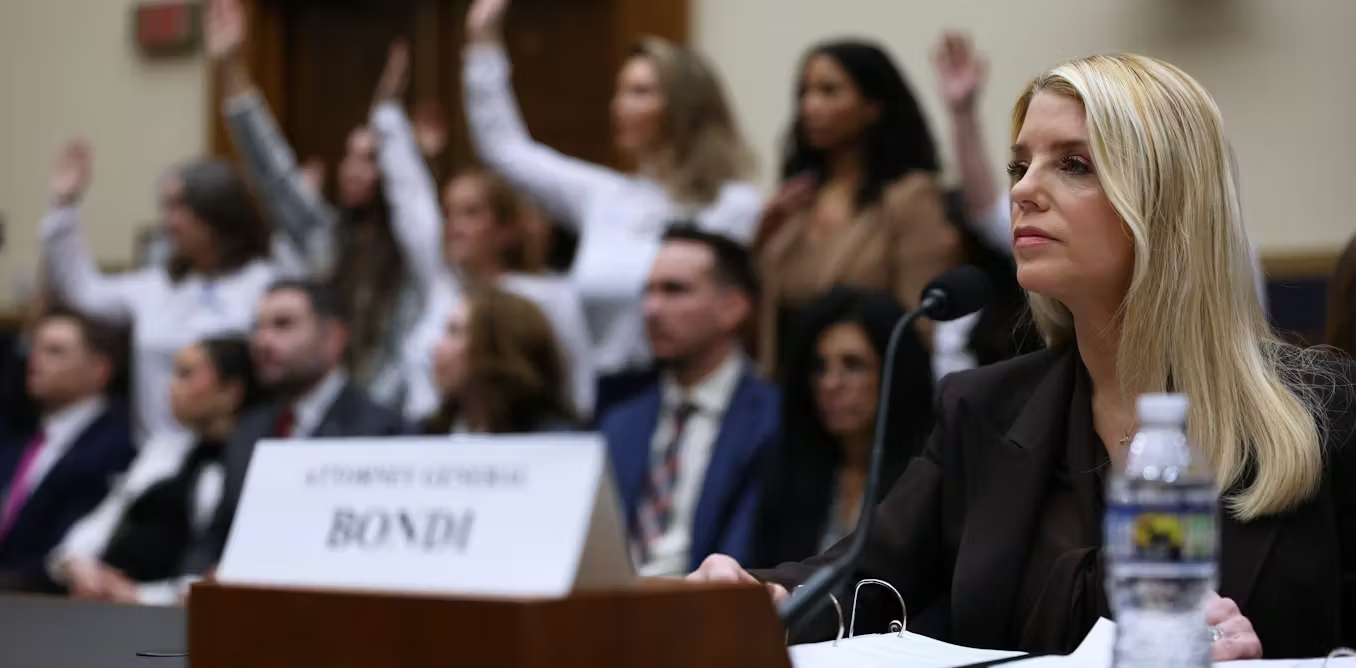
Republican representative Tom Massie highlighting problems with the release of the Epstein files at a House Judiciary Committee oversight hearing, February 11 2026.
AP Photo/Tom Brenner

Meanwhile millions of Americans have seen their health insurance premiums soar as a result of Republicans declining to extend healthcare subsidies.

It is little wonder that there have been observations in US media outlets that the public response to the Epstein revelations has seemed muted in comparison to audiences in the UK and elsewhere. With “perma-crisis” as the baseline, the administration appears to be betting that public focus will be dragged away by the next trending issue.

The partisan shield

Americans are, in fact, responding to the revelations. And while there has been an unusually bipartisan horror at the content of the files, this issue, as with so many others, has served to entrench divisions and resentment towards the partisan “other”.

Advertisement

This is at the heart of the administration’s second gamble. Research demonstrates that increasingly, our partisan identity forms a crucial part of our whole social identity. In effect, who we support defines a large part of how we see ourselves in the world. So strong is the connection, that challenges to our partisan beliefs feel like an existential threat to who we are.
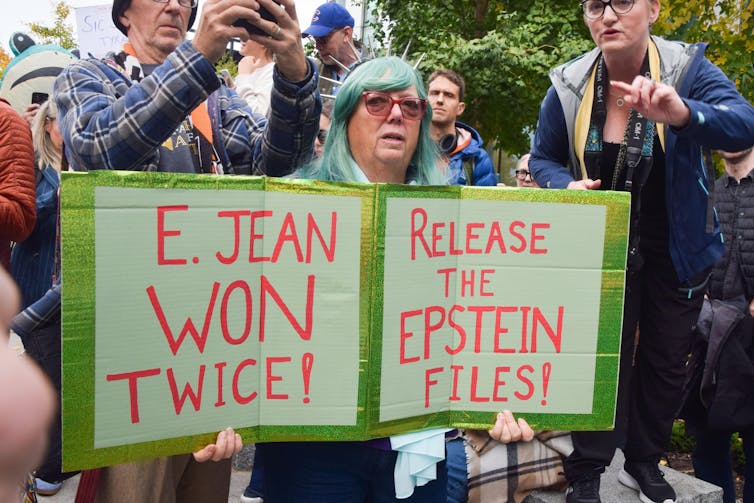
A woman stands at a protest rally with two signs. One says: E Jean won twice. The othe rsays: Release the Epstein files.
There’s bipartisan support for the release of the Epstein files. But when it comes to who to blame, partisan beliefs still count.
Vuk Valcic/Alamy Live New

Confronted with such a threat, we are more likely to double down on those beliefs, even in the face of contradictory evidence. So much so, that in extreme cases, people are able to see any contrary views as evidence of a conspiracy against them, their peers and their leaders. Trump has long understood this hold he has over his base.

The Maga community produced the loudest calls for the Epstein files, believing they would expose a “deep state” paedophile ring involving the Clintons and Hollywood elites. Indeed, Bill Clinton is in the files, mentioned multiple times, although he denies any wrongdoing and there has been nothing published to suggest he has been involved in any.

But to maintain their cognitive consistency, supporters must convince themselves that while the files condemn their enemies, the more than 30,000 references to Donald Trump are part of a broad conspiracy to defenestrate their leader.

Looming on the horizon to focus minds are the 2026 midterm elections in November. Republicans and the Trump White House may be gambling once more on the attention economy having long since consigned Epstein to history. Democrats will have to fight to maintain focus on Trump’s behaviour both in the files and about the files while tackling the barrage of injustices that, in reality, feel much more relevant to Americans in their day-to-day lives.

Advertisement

The other names in the files, those of the victims, remain much further away from any kind of justice.


Source link

Advertisement
Continue Reading
Click to comment

Leave a Reply

Your email address will not be published. Required fields are marked *

NewsBeat

EPA ends credits for automatic start-stop vehicle ignition, a feature Zeldin says ‘everyone hates’

Published

on

EPA ends credits for automatic start-stop vehicle ignition, a feature Zeldin says 'everyone hates'

The Environmental Protection Agency announced an end Thursday to credits to automakers who install automatic start-stop ignition systems in their vehicles, a device intended to reduce emissions that EPA Administrator Lee Zeldin said “everyone hates.”

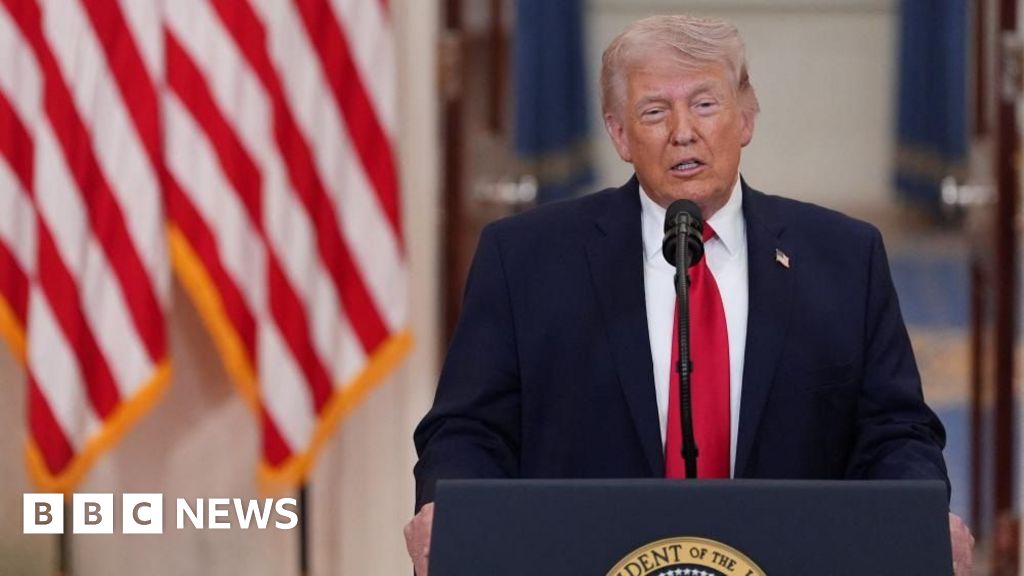
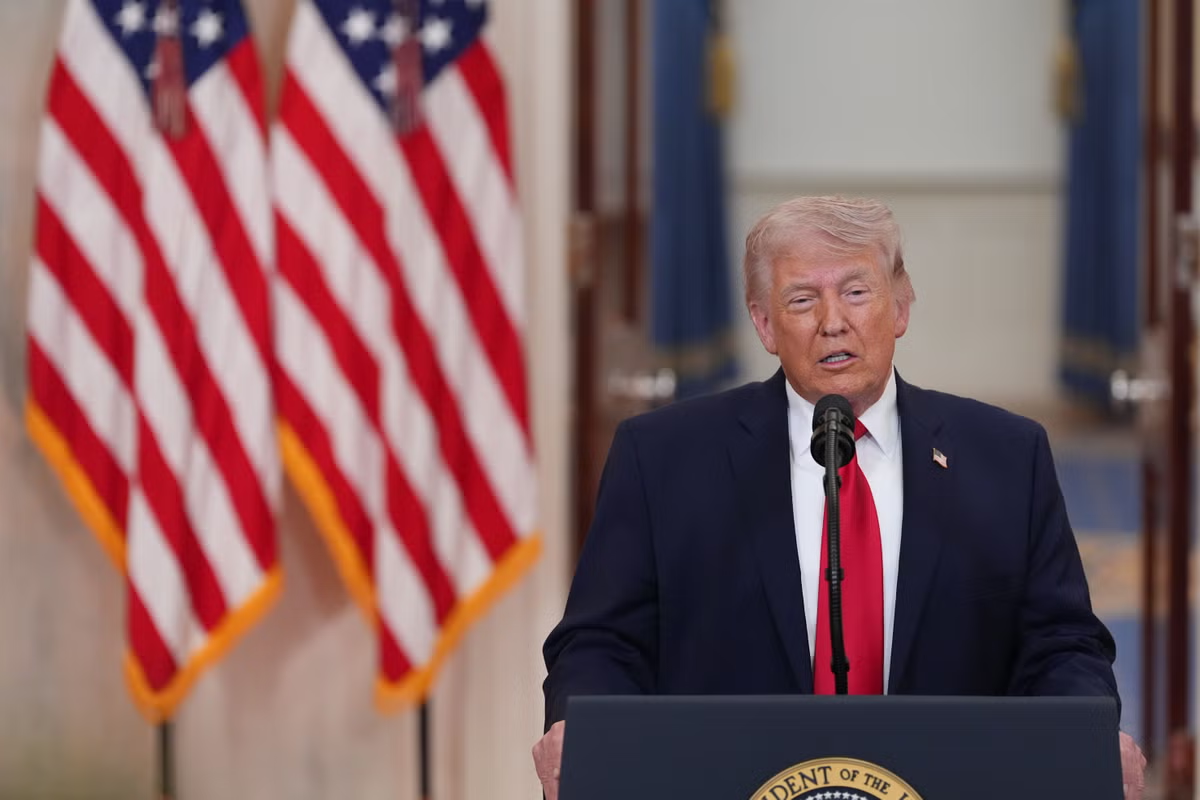
In remarks with President Donald Trump on Thursday at the White House, Zeldin called start-stop technology the “Obama switch” and said it makes vehicles “die” at every red light and stop sign. He said the credits, which also applied to options like improved air conditioning systems, are now “over, done, finished.”

Zeldin repeated the generally-debunked claims that start-stop systems — which are mostly useful for city driving — are harmful to vehicles, asserting Thursday that “it kills the battery of your car without any significant benefit to the environment.”

This latest Trump administration move to cut automotive industry efforts to clean up their cars and reduce transportation-driven emissions came as Zeldin and Trump also announced a broader repeal of the scientific finding known as endangerment that has been the central basis for regulating U.S. greenhouse gas emissions.

Advertisement

Start-stop is a technology that automatically shuts down a vehicle’s engine when a driver comes to a complete stop, and then automatically restarts the engine when the driver takes their foot off the brake pedal. Developed in response to the 1970s oil crisis, the feature was intended to cut vehicle idling, fuel consumption and emissions.

About two-thirds of vehicles now have it, providing drivers with anywhere from 7% to 26% in fuel economy savings, according to the Society of Automotive Engineers. Start-stop also causes a split-second lag in acceleration, a point of irritation for some consumers and automotive enthusiasts.

Burning gasoline and diesel fuel for transportation is a major contributor to planet-warming gases such as carbon dioxide, methane and more, according to the EPA. By implementing the systems, automakers could earn credits toward meeting federal emissions reduction rules.

“Countless Americans passionately despise the start/stop feature in cars,” Zeldin wrote in a post on X on Tuesday teasing the announcement. “So many have spoken out against this absurd start-stop-start-stop-start-stop concept.”

Advertisement

The announcement made good on Zeldin’s promises last year to “fix” the feature. Start-stop is “where your car dies at every red light so companies get a climate participation trophy,” Zeldin said in a post on X last May. “EPA approved it, and everyone hates it, so we’re fixing it,” he wrote at the time.

Zeldin’s announcement aligns with the administration’s broader attacks on cleaner-vehicle efforts. Trump eliminated the Biden administration’s target for half of all new vehicle sales in the U.S. to be electric by 2030, and signed Congress’ tax and spending bill that ended federal tax credits for new and used electric vehicle purchases.

The administration is also weakening rules for how far new vehicles must travel on average on a gallon of gasoline as it undermines the climate regulation at the core of auto tailpipe emissions.

Jeep-maker Stellantis welcomes the deregulatory effort, a spokesperson’s statement said: “We remain supportive of a rational, achievable approach on fuel economy standards that preserves our customers’ freedom of choice.”

Advertisement

A Ford Motor Co. statement said: “We appreciate the work of President Trump and Administrator Zeldin to address the imbalance between current emissions standards and customer choice.”

General Motors deferred comment to the auto industry group Alliance for Automotive Innovation.

“I’ve said it before: Automotive emissions regulations finalized in the previous administration are extremely challenging for automakers to achieve given the current marketplace demand for EVs,” said John Bozzella, president of the alliance. “The auto industry in America remains focused on preserving vehicle choice for consumers, keeping the industry competitive, and staying on a long-term path of emissions reductions and cleaner vehicles.”

___

Advertisement

Alexa St. John is an Associated Press climate reporter. Follow her on X: @alexa_stjohn. Reach her at ast.john@ap.org.

___

Read more of AP’s climate coverage.

___

Advertisement

The Associated Press’ climate and environmental coverage receives financial support from multiple private foundations. AP is solely responsible for all content. Find AP’s standards for working with philanthropies, a list of supporters and funded coverage areas at AP.org.

Source link

Continue Reading

NewsBeat

How the FBI search warrant to raid the Georgia election office was based on debunked conspiracy theories

Published

on

How the FBI search warrant to raid the Georgia election office was based on debunked conspiracy theories

The FBI document behind an unprecedented raid of an elections office in Georgia, sparked by an election denier close to Donald Trump, echoes allegations about the 2020 presidential election that have circulated for years and faced thorough investigations.

Those investigations did not uncover any evidence of widespread fraud to change the outcome of a race that Trump lost, and the affidavit itself provides no additional evidence to support a claim of fraud, even noting that “many allegations” have already been “disproven.”

“After more than five years, dozens of court cases, and over a year in total control of the federal government, this is all they’ve got?” said elections law expert David Becker, director of the Center for Election Innovation & Research.

“If taken at its word, this entire affidavit at most alleges human error after a late night during a global pandemic, all of which had no impact on the outcome of the race,” he said.

Advertisement

Here is what’s inside the document.

The document supporting the FBI’s raid of an elections office in Georgia echoes years-long allegations about the 2020 election that were previously debunked after state investigations

The document supporting the FBI’s raid of an elections office in Georgia echoes years-long allegations about the 2020 election that were previously debunked after state investigations (AP)

Election deniers lead investigation

The criminal investigation into allegations of fraud and the destruction of records was prompted by former Trump campaign attorney Kurt Olsen with support from witnesses who have promoted debunked conspiracy theories about election administration and the outcome of the 2020 race.

Advertisement

While the search warrant was executed in Georgia, the federal prosecutor whose name is on the document is Thomas Albus, the U.S. Attorney for the Eastern District of Missouri.

Albus, a Trump appointee who was tapped by Attorney General Pam Bondi to investigate elections, is among a fleet of newly hired government lawyers who boosted false claims about the 2020 election or were directly involved with litigation to overturn the results.

The affidavit then notes that the criminal probe “originated from a referral sent by Kurt Olsen, Presidentially appointed Director of Election Security and Integrity.”

Olsen worked closely with Trump’s campaign in 2020 to challenge election results as part of a “Stop the Steal” movement that was largely rejected by courts across the country.

Advertisement
Deputy FBI director Andrew Bailey, center, joined FBI agents during the raid. He is among several prominent election deniers now closely working on a criminal investigation into Trump’s loss in Georgia in 2020

Deputy FBI director Andrew Bailey, center, joined FBI agents during the raid. He is among several prominent election deniers now closely working on a criminal investigation into Trump’s loss in Georgia in 2020 (REUTERS)

He was later sanctioned by a federal judge for “false, misleading and unsupported factual assertions” in support of Republican Kari Lake’s unsuccessful attempt to overturn her loss in the 2020 race for Arizona governor.

Olsen also spoke with Trump on January 6 as a mob of the president’s supporters stormed the Capitol and breached the halls of Congress.

Deputy FBI director Andrew Bailey, the former attorney general of Missouri who publicly endorsed the president’s false narrative that the election was stolen, joined agents during the Georgia raid.

Advertisement

The FBI also called on Clay Parikh, who had joined Lake’s failed effort to reverse her loss in the Arizona governor’s race.

He is now a special government employee in the Trump administration, and the FBI relied on his analysis of Fulton County’s results to pursue the investigation, according to the affidavit.

The FBI seized Georgia voting records and other documents from the 2020 election as part of a criminal investigation into Trump’s loss in the state

The FBI seized Georgia voting records and other documents from the 2020 election as part of a criminal investigation into Trump’s loss in the state (REUTERS)

The affidavit also lists several witnesses whose names are redacted, though descriptions of their allegations and activities match those from State Election Board members and other figures who denied the results of the 2020 election and promoted conspiracy theories about the vote count.

Advertisement

FBI alleges ‘deficiencies or defects’ that were previously debunked

The document states that the investigation involves two statutes — one concerning the destruction of election records and another that makes it a crime to “knowingly and willfully deprive” residents of a “fair and impartially conducted election process.”

Election law experts say the rest of the document provides no evidence to support a claim of fraud; Georgia’s ballots were counted three times, three different ways, following the election and challenges withstood scrutiny each time.

The FBI is instead investigating five alleged “deficiencies or defects” from those recounts, according to the affidavit.

Advertisement

Those allegations include missing images of ballots, ballots that were scanned multiple times, inconsistent vote counts from a hand recount, ballots that could have been improperly added, and changing vote totals during a machine recount.

Only one of those allegations — that ballots may have been scanned twice during a Trump-requested recount — had previously been “partially substantiated” by law enforcement officials, who have repeatedly affirmed Trump’s loss in the state.

Election workers and officials in Georgia came under severe scrutiny during the 2020 election, with activists and Trump allies alleging widespread fraud

Election workers and officials in Georgia came under severe scrutiny during the 2020 election, with activists and Trump allies alleging widespread fraud (Getty Images)

One allegation alleges “inconsistent” ballot tallies during a Risk Limiting Audit, which Georgia’s secretary of state addressed in 2022. In its report, the office noted that the audit is designed to confirm a winner, not deliver a precise count of more than 5 million ballots, which “is impossible.”

Advertisement

“Human counting will always produce errors,” the report said. “These differences are well within the expected variances in a computer count vs. a hand count and further support the overall conclusion of the hand audit — that the initial reported result in the presidential contest in Georgia was correct.”

The FBI also notes that there were ballots “that had never been creased or folded,” which could happen for a number of reasons, including damaged ballots that cannot be read electronically and must be duplicated, or certain overseas and military ballots that cannot fit into scanners.

In 2023, the secretary of state’s office determined that “investigators could not substantiate the allegations of ‘pristine’ ballots being counted during the risk-limiting audit.”

“This affidavit was much weaker than I suspected — no allegations of intent, no allegations of election theft, no allegations of foreign interference, and no allegations that the statute of limitations doesn’t apply,” according to Becker, the elections law expert.

Advertisement
Trump supporters protested outside the State Farm Arena where Fulton County elections officials and workers counted ballots during the 2020 election

Trump supporters protested outside the State Farm Arena where Fulton County elections officials and workers counted ballots during the 2020 election (AFP via Getty Images)

What about the statute of limitations?

One of the crimes cited by the affidavit requires election officials to keep records for 22 months after an election, so the statute of limitations would expire five years after that.

The 2020 election falls well outside of that five-year window, and the affidavit concerns activities that happened in the immediate aftermath of that contest, not in the two years that followed.

Advertisement

And while it is technically possible that election officials could have disposed of those records within that time, the affidavit does not provide any allegations that they did.

“That raises serious questions about probable cause for the investigation and why such an intrusive action is being taken more than five years after the election was certified,” according to Michael McNulty, policy director with Issue One.

“This raid fits a growing pattern by the administration to exert executive control over elections, despite the Constitution’s clear assignment of election administration to the states and Congress,” he added. “Targeting election officials and records years later risks undermining confidence in the process for future elections. If allowed to stand, this could set a troubling precedent that would chill election administration nationwide and invite more executive interference.”

Source link

Advertisement
Continue Reading

NewsBeat

Zelensky accuses Winter Olympics of ‘playing into Russia’s hands’

Published

on

Zelensky accuses Winter Olympics of ‘playing into Russia’s hands’

Good morning and welcome to our live coverage of the men’s skeleton heats on day six of the Winter Olympics where all eyes are on Vladyslav Heraskevych.

Throughout practice, Heraskevych has worn a specially designed ‘helmet of memory’ which depicts the faces of 24 Ukrainian athletes killed since Russia’s invasion of the country in 2022.

The 27-year-old has vowed to continuing wearing the helmet in the first round of competition proper this morning, something which the International Olympic Committee say would contravene their rules forbidding political statements.

Advertisement

The IOC has offered Heraskevych the chance to display the helmet before and after his skeleton run, but they regard the field of play as sacrosanct.

When asked directly if they would disqualify Heraskevych or bar him from competing, the IOC said they would follow their rules.

Of course, it would be a considerable political and diplomatic own goal by the IOC were they to disqualify a Ukrainian athlete but on the other hand, allowing the rules to slide could open the floodgates to more political statements of various stripes.

It puts the organisers in something of a bind then, and it promises to be a tense moment when Heraskevych walks out to compete.

Advertisement

As Jeremy Wilson reports, the IOC held urgent talks on Wednesday with Heraskevych and begged him to stand down.

“I will not betray these athletes,” Heraskevych said. “These athletes sacrificed their lives, and because of this sacrifice, I am able to be here, so I will not betray them.

“An Olympic medal would be huge. Since my childhood, it’s my big dream. But in this time, in time of full-scale war, some things are really more important than medals. At this point, I would say that a medal is worthless in comparison to people’s lives, and I believe in comparison to memory of these athletes.”

Source link

Advertisement
Continue Reading

NewsBeat

Pam Bondi’s Very Public Crash Out

Published

on

Pam Bondi’s Very Public Crash Out

!function(n){if(!window.cnx){window.cnx={},window.cnx.cmd=[];var t=n.createElement(‘iframe’);t.display=’none’,t.onload=function(){var n=t.contentWindow.document,c=n.createElement(‘script’);c.src=”//cd.connatix.com/connatix.player.js”,c.setAttribute(‘async’,’1′),c.setAttribute(‘type’,’text/javascript’),n.body.appendChild(c)},n.head.appendChild(t)}}(document);(new Image()).src=”https://capi.connatix.com/tr/si?token=19654b65-409c-4b38-90db-80cbdea02cf4″;cnx.cmd.push(function(){cnx({“playerId”:”19654b65-409c-4b38-90db-80cbdea02cf4″,”mediaId”:”906c2cf9-6680-4659-8e9c-697b13983090″}).render(“698e34e1e4b0967ff009d559”);});

Source link

Continue Reading

NewsBeat

Snow maps reveal 95% of UK buried in Valentine’s Day blizzard including London

Published

on

Daily Mirror

Several inches of snow could settle across the UK this weekend as weather maps reveal a blizzard will bury several major cities including London, Birmingham and Manchester

Shocking new weather maps suggest as much as 95 per cent of the UK could see snow settled on the ground following a blizzard starting on Valentine’s Day this weekend.

Advertisement

The GFS weather model shows the south-west of England, parts of Wales, western parts of Scotland and all of Northern Ireland will see snow at around 9pm on Saturday, as a storm moves in from the Atlantic.

At around midnight on Valentine’s Day, snow is seen falling across the entire length of the UK – roughly 600 miles – from the south coast of England to the far north of Scotland. Glasgow, Manchester, Birmingham and Cardiff can all expect flurries around this time.

READ MORE: Met Office says ‘widespread snow is likely this weekend’ and names exactly whereREAD MORE: Snow maps reveal when twin blizzards will bury Brits as England faces 19 inches

Advertisement

The storm will then continue eastward, the maps suggest, consuming almost all of central England and parts of the south by 3am. London could face snow from around this time too, although the most intense flurries are expected in Scotland.

At 6am on Sunday, maps show East Anglia and the south-east will face more heavy snow, with wintry showers still impacting London. The Pennines and the north-east appear to be in the firing line as well.

Snow coverage maps show roughly 95 per cent of the UK shaded in purple by 9am on Sunday – showing snow settled on the ground – with only the far south-west of England missing out.

Advertisement

Snow depth charts reveal the greatest accumulations will be in the Scottish mountains, where 24cm (nine inches) is on the cards. Parts of northern England could see 6cm (two inches), with 4cm (1.5 inches) coming in Wales and 2cm (0.7 inches) in the Midlands.

BBC Weather suggests snow could fall in places on both Saturday and Sunday too. Its forecast states: “A crisp, bright day on Saturday, excluding some lingering wintry showers on east coasts in the morning.

“Turning cloudier in the west later in the afternoon and evening. Overnight and into Sunday morning, turning windy as a band of rain moves in from the west, falling as snow initially. Sunday afternoon and Monday will see a mix of sunny spells and showers.”

Advertisement

BBC Weather also expects some snow tomorrow. The forecast adds: “Tomorrow, rain across the south of England and Wales with a chance for snow over the hills. Cold in Scotland and North England with sunny spells and snow showers. Dry and bright for Northern Ireland.”

The Met Office expects snow around the coasts on Friday. It says: “Rain continues to move southwards with Northern Ireland and Scotland seeing some sunshine. Snow showers around the coasts. Staying cloudy and wet across the south but eventually clearing later.”

The national weather agency says “widespread” snow could come on Sunday. Its forecast states: “Bright skies with sunny spells on Saturday but feeling much colder than in recent days. Turing wetter on Sunday with widespread snow likely across the north. Unsettled into next week.”

Source link

Continue Reading

NewsBeat

M66 Northbound reopened following an earlier incident

Published

on

M66 Northbound reopened following an earlier incident

The incident occurred at around 4:45pm this evening on the M66 Northbound between Junction one (Ramsbottom) and the A56.

The incident caused around 50 minutes of delays with both lanes initially being closed.

One lane was eventually reopened before the road was opened up fully at around 18:45.

Advertisement

A National Highways spokesperson confirmed that the road has now been reopened and the collision resulted in only minor injuries to those involved.

Emergency services were called to the scene, but there were no serious injuries or fatalities.

Source link

Advertisement
Continue Reading

NewsBeat

Why phone signal in Northern Ireland is so poor

Published

on

Belfast Live

While 98.8% of Northern Ireland homes have 4G coverage from at least one mobile operator, the figure drops significantly when looking for coverage from all operators

On Thursday, MPs debated a motion which called on the Government and service providers to help improve mobile connectivity in rural areas across the UK

Advertisement

While geographic coverage is improving, Northern Ireland trails behind England, Scotland, and Wales for consumer choice and reliable indoor connection.

A key part of this comes down to differences in our planning laws, which are preventing service providers from erecting the required number of masts to expand coverage across Northern Ireland.

How does the phone coverage in NI compare to the rest of the UK?

According to a House of Commons Library briefing, data from July 2025 reveals a stark divide between urban and rural connectivity. While 98.8 per cent of Northern Ireland homes have 4G coverage from at least one mobile operator, the figure drops significantly when looking for coverage from all operators.

Access to all four major networks (EE, O2, Vodafone, and Three) is crucial for consumer choice and market competition. In Northern Ireland, only 75 per cent of premises have indoor 4G coverage from all four operators, which is the lowest figure in the UK.

Advertisement

The situation is most acute in the countryside. Only 50 per cent of rural premises in Northern Ireland have indoor 4G coverage from all operators. By comparison, 57 per cent of rural homes in England and 67 per cent in rural Scotland have full operator access.

Voice call reliability is also suffering in rural areas, with just 5 per cent of rural premises in Northern Ireland able to make indoor calls on all four networks.

What impact have NI’s planning laws had on the rollout?

The briefing suggests that differences in planning regulations may be a contributing factor to the slow rollout of infrastructure.

While the UK Government has introduced reforms in England to allow taller and wider masts to be built more easily, planning is a devolved matter. Notably, Northern Ireland does not have a “prior approval” procedure for building mobile masts.

Advertisement

In England and Scotland, “prior approval” allows developers to bypass the full planning application process for certain infrastructure, speeding up deployment. The lack of this mechanism in Northern Ireland means operators often face a more rigorous and slower planning process.

What is being done to tackle the poor signal?

Efforts are underway to close the gap through the Shared Rural Network (SRN), a £1 billion deal between the UK government and mobile operators to eliminate “not-spots”.

Mobile Network Operators have signed legally binding commitments to meet specific coverage targets by the end of January 2027.

Forecasts indicate that upon completion of the SRN, 4G geographic coverage from all operators in Northern Ireland is expected to rise to 85 per cent of the landmass, up from a pre-SRN baseline of 79 per cent.

Advertisement

However, the report notes that commercial viability remains a major hurdle. Low population density and difficult topography in rural areas make it expensive for operators to install masts, leaving Northern Ireland’s most remote communities reliant on government-subsidised interventions to stay connected.

For all the latest news, visit the Belfast Live homepage here and sign up to our daily newsletter here.

Source link

Advertisement
Continue Reading

NewsBeat

Swiss bar owners confronted by fire victim families

Published

on

Swiss bar owners confronted by fire victim families

The owners of a Swiss bar, where a deadly fire broke out on New Year’s Eve, killing 41 people and injuring at least 115 others, were heckled by grieving families, as they appeared in court in Switzerland on Thursday.

Jessica and Jacques Moretti are under criminal investigation for involuntary manslaughter, as well as bodily harm and arson through negligence.

Source link

Continue Reading

NewsBeat

Fact check: Jim Ratcliffe’s claims about population, manufacturing and emissions

Published

on

Fact check: Jim Ratcliffe’s claims about population, manufacturing and emissions

Claim: “There’s not much manufacturing. If you look at the UK, about 25 years ago – no, about 1995 I think it was – about 25% of our GDP was manufacturing, and Germany was about the same, 25%. So we’re going back what, 30 years? Today Germany’s still up there, 20-21% of its GDP is manufacturing, in the UK it’s down at about 8%. So manufacturing’s collapsed in the UK.”

Source link

Continue Reading

NewsBeat

To resurrect venerable American chestnuts, scientists turn to genetic testing

Published

on

To resurrect venerable American chestnuts, scientists turn to genetic testing

WASHINGTON (AP) — Billions of American chestnut trees once covered the eastern United States. They soared in height, producing so many nuts that sellers moved them by train car. Every Christmas, they’re called to mind by the holiday lyric “chestnuts roasting on an open fire.”

But by the 1950s, this venerable tree went functionally extinct, culled by a deadly airborne fungal blight and lethal root rot. A new study out Thursday in the journal Science provides hope for its revitalization, finding that the genetic testing of individual trees can reveal which are most likely to resist disease and grow tall, thus shortening how long it takes to plant the next, more robust, generation.

A smaller gap between generations means a faster path to lots of disease-resistant trees that will once again be able to compete for space in Eastern forests. The authors hope that can occur in the coming decades.

“What’s new here is the engine that we’re creating for restoration,” said Jared Westbrook, lead author and director of science at The American Chestnut Foundation, which wants to return the tree to its native range that once stretched from Maine to Mississippi.

Advertisement

The American chestnut, sometimes called the “redwood of the East,” can grow quickly and reach more than 100 feet (30 meters), produce prodigious amounts of nutritious chestnuts and supply lumber favored for its straight grain and durability.

But it had little defense against foreign-introduced blight and root rot. Another type of chestnut, however, had evolved alongside those diseases. The Chinese chestnut had been introduced for its valuable nuts and it could resist diseases. But it isn’t as tall or competitive in U.S. forests, nor has it served the same critical role supporting other species.

So, the authors want a tree with the characteristics of the American chestnut and the disease resistance of the Chinese chestnut.

That goal is not new — scientists have been reaching for it for decades and made some progress.

Advertisement

But it has been difficult because the American chestnut’s desirable traits are scattered across multiple spots along its genome, the DNA string that tells the tree how to develop and function.

“It’s a very complex trait, and in that case, you can’t just select on one thing because you’ll select on linked things that are negative,” said John Lovell, senior author and researcher at the HudsonAlpha Genome Sequencing Center.

Breed for disease resistance alone and the trees get shorter, less competitive.

To deal with this, the authors sequenced the genome of multiple types of chestnuts and found the many places that correlated with the desired traits. They can then use that information to breed trees that are more likely to have desirable traits while maintaining high amounts of American chestnut DNA — roughly 70% to 85%.

Advertisement

And genetic testing allows the process to move faster, revealing the best offspring years before their traits would be demonstrated by natural growth and encountering disease. The closer the gap between generations, the faster gains accumulate.

Steven Strauss, a professor of forest biotechnology at Oregon State University who wasn’t involved in the study, said the paper identified some promising genes. He wants scientists to be able to edit the genes themselves, a possibly faster, more precise path to a better tree. In an accompanying commentary piece in Science, he says regulations can bog down these ideas for years.

“People just won’t consider biotech because it is on the other side of this social, legal barrier” and that’s shortsighted, he said.

For people who have closely studied the American chestnut, the work begs an almost existential question: How much can the American chestnut be changed and still be an American chestnut?

Advertisement

“The American chestnut has a unique evolutionary history, it has a specific place in the North American ecosystem,” said Donald Edward Davis, author of the American chestnut, an environmental history. “Having that tree and no other trees would be sort of the gold standard.”

He said the tree was a keystone species, useful to humans and vital to bigger populations of squirrels, chipmunks and black bears — hybrids might not be as majestic or effective. He was pleased that the authors included some surviving American chestnuts in their proposal, but favored an approach that relied on them more heavily.

“Not that the hybrid approach is itself bad, it is just that why not try to get the wild American trees back in the forest, back in the ecosystem, and exhaust all possibilities from doing that before we move on to some of these other methods?” he said.

Lovells said resurrecting the species requires introducing genetic diversity from outside the traditional pool of American chestnut trees. The study authors’ goal is tall, resilient trees and they are optimistic.

Advertisement

“I think if we only select American chestnut (tree genes), period, there’s going to be too small of a pool and we’re going to end up with a genetic bottleneck that will lead to extinction in the future,” said Lovell.

___

The Associated Press receives support from the Walton Family Foundation for coverage of water and environmental policy. The AP is solely responsible for all content. For all of AP’s environmental coverage, visit https://apnews.com/hub/climate-and-environment

Advertisement

Source link

Continue Reading

Trending

Copyright © 2025